
Níðhöggr — Corpse-Dragon Beneath the World Tree
Níðhöggr — Corpse-Dragon Beneath the World Tree
The corpse-dragon gnaws beneath the roots of the world, feeding on dishonour, venom, and the dead who have broken the deep laws of oath, blood, and burial.
- Creature Type: Unique Dragon
- Moral Gravity: Neutral Evil
- Common Names: Níðhöggr, Nidhogg, Niðhöggr, Nidhögg, the Corpse-Dragon, the Root-Gnawer, the Malice-Striker, the Dragon Beneath the Tree
- Primary Function: Cosmic decay, corpse-devouring, punishment of oath-breakers and murderers, underworld pressure on Yggdrasil, Ragnarök omen
- Usual Location: Beneath the root of Yggdrasil that reaches toward Niflheim; Hvergelmir, Náströnd, Niflhel, and the corpse-shores below the worlds
- Creature Status: Unique mythic adversary, underworld dragon, world-root threat
- Typical Encounters: Omens, corpse-shores, venomous underworld halls, root-wounds, oath-curses, corpse-serpents, dragon cults, Ragnarök portents
- Associated Powers: Yggdrasil, Hel, the Norns, Ratatoskr, the eagle above the tree, the dead of Náströnd, the serpents below the roots
Overview
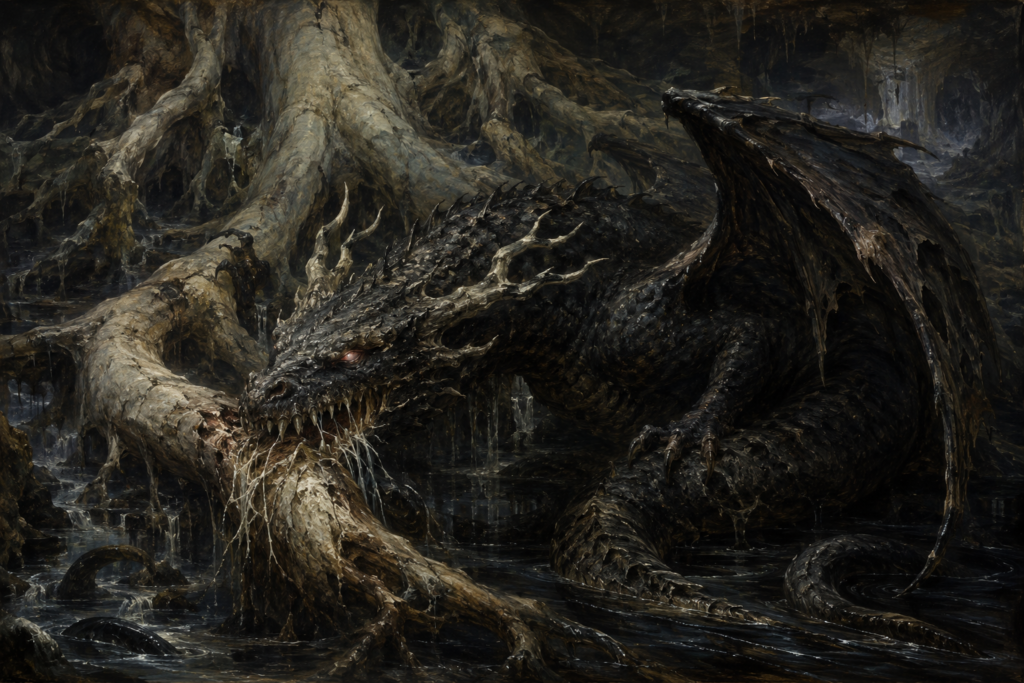
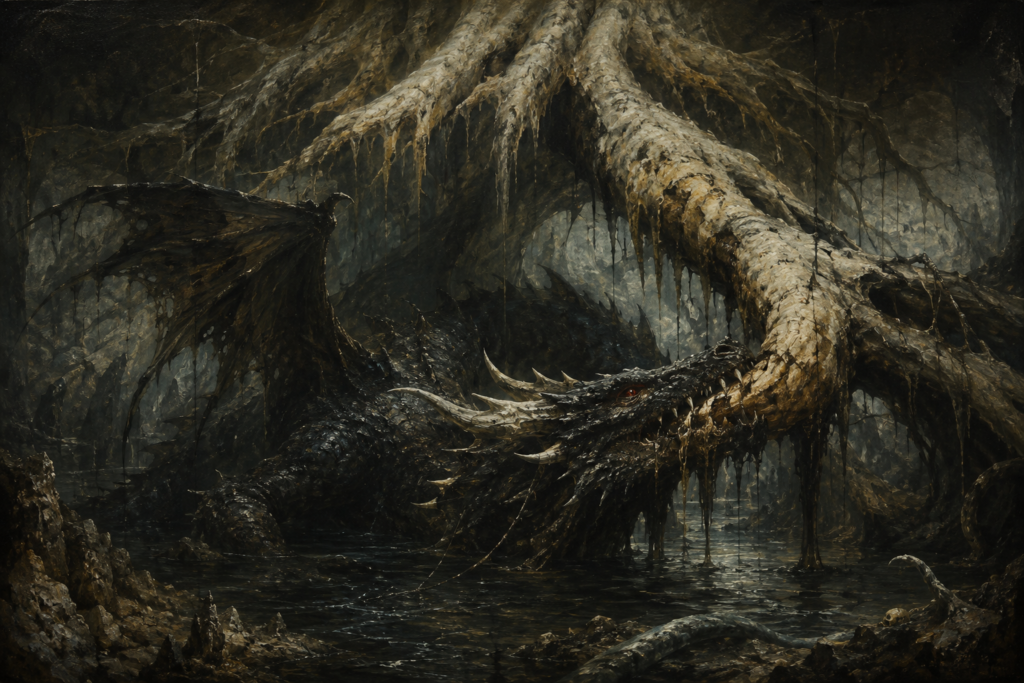
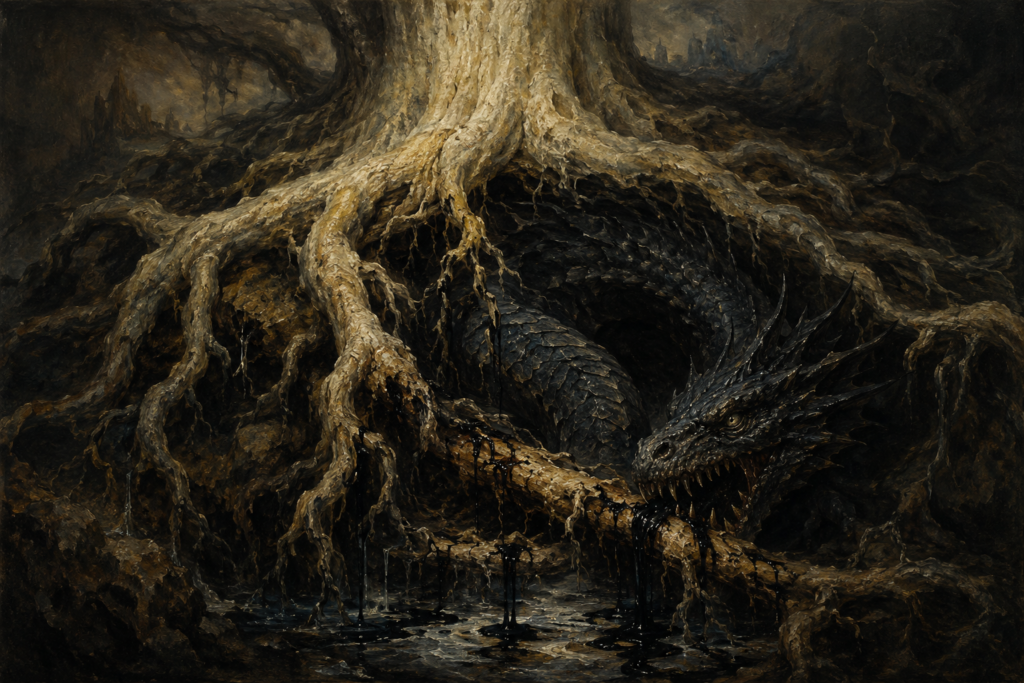
Níðhöggr is the corpse-dragon beneath the World Tree. He lies where the roots of Yggdrasil descend into the cold, venomous underworld and works his teeth into the living structure of the cosmos. He is hunger given ancient shape: a vast dragon of black scale, corpse-pale horn, root-splintered jaw, and grave-cold breath.
He is the rot that finds every hidden wound. He is the bite beneath the oath. He is the punishment waiting below false testimony, murder, treachery, and betrayal of sacred bonds. In the deep halls of Náströnd, where serpent-backs form walls and venom falls through the roof, Níðhöggr feeds upon the dishonoured dead.
The gods treat him as a world-root threat. The dead know him as a mouth in the dark. The roots of Yggdrasil know his teeth.
In the campaign, Níðhöggr functions as a unique mythic monster: an underworld dragon whose threat is cosmic, moral, and ecological at once. He can be encountered directly only in the deepest mythic play, but his influence reaches the mortal world through oath-plagues, corpse-dragons, venom rivers, under-root cults, and towns where murder goes unjudged.
Appearance
Níðhöggr is a colossal black dragon, but his body belongs to the underworld rather than the open sky. His scales are dark as wet grave-earth and old iron. White root-fibres hang from his jaws like torn sinew. His horns resemble dead branches polished by corpse-water. His eyes burn dull red beneath heavy brow plates, like embers seen through ash.
His wings, when shown, are vast, ragged, and seldom used. In some visions he is wingless, a serpent-dragon of root and cavern. In others, his wings are folded close around him like a burial shroud. His claws are broad enough to hold to the roots of worlds. His teeth are uneven, cracked, and crowded, grown for grinding tree, bone, stone, and dead flesh alike.
His presence changes the air. Wood sweats black sap. Oaths spoken nearby taste of iron. Corpses stiffen. Old lies become audible. Blood runs colder in the guilty. Living roots recoil.
Níðhöggr should look ancient, filthy, immense, and intelligent. He is beautiful only in the way a glacier, gallows, or plague pit can be beautiful: terrible, patient, and beyond apology.
Habitat
Níðhöggr dwells below the worlds, where the root of Yggdrasil reaches into Niflheim and the spring Hvergelmir roars in the dark. His lair touches several mythic places at once.
Hvergelmir is the root-spring, a freezing source of waters and serpents. Here Níðhöggr gnaws beneath Yggdrasil and shares the darkness with countless lesser serpents.
Náströnd, the Corpse-Shore, is a venomous hall of punishment. Its roof and walls are woven from serpent-backs. Venom falls through the openings. The dishonoured dead move through heavy streams while Níðhöggr feeds.
Niflhel is the deeper death beyond ordinary death. It is a place of cold, shadow, and moral residue, where unjudged crimes and broken oaths gather weight.
The Root-Wound is the campaign-facing name for places where Níðhöggr’s bite is felt in the living world. These appear as black-sapped trees, corpse-cold wells, collapsed burial mounds, plague-haunted oath stones, or undercroft roots growing through stone.
A mortal encounter with Níðhöggr usually begins far from the dragon. The party first finds signs of his hunger: blackened roots beneath a town gallows, murder victims who cannot decay, wells full of venomous worms, or a local oath that everyone knows was broken but no authority will name.
Ecology
Níðhöggr is part of a mythic underworld ecology. He feeds on corpses, dishonour, oath-rot, venom, and the living root of Yggdrasil. His hunger has physical and moral expression. He devours bodies, but he is drawn most strongly to deaths that carry betrayal, murder, false witness, kin-slaying, and broken sacred agreement.
Where his influence rises, ordinary decay becomes judgemental. A guilty corpse may rot in hours. An innocent corpse may remain clean until properly buried. Worms gather around hidden weapons. Tree roots enter graves and expose the truth. Venomous springs appear below halls where false oaths were sworn.
Existing creatures from the Bestiary gather around his pressure, especially undead born from dishonour, carrion feeders, serpents, and burrowing horrors:
- Draugr rise where old burial customs fail or where the dead are left with unfinished violence.
- Barrow Wights gather around burial mounds, violated tombs, and root-black graves.
- Wights serve as corpse-bound predators where Níðhöggr’s hunger stains the dead.
- Wraiths appear where the soul has been thinned by murder, oath-breaking, or underworld venom.
- Gallowdead are strong fits for false judgement, cruel execution, broken law, and gallows sites claimed by the Root-Gnawer.
- Revenants rise where vengeance and unresolved murder pull the dead back toward the living world.
- Ghosts linger where names, graves, or testimony have been stolen.
- Shadows gather where Níðhöggr’s bite leaves a corpse without a whole spiritual trace.
- Spectres haunt root-wounds, corpse-shores, and places where death has become unclean.
- Ghouls and ghasts feed around exposed graves, mass burials, and battlefields where the dead are left unnamed.
- Ravens and Rat Swarms follow the first visible signs of corpse-law and underworld rot.
- Rot Grub Swarms appear in graves, gallows pits, and corpse-water touched by the dragon’s venom.
- Snake Swarms and Venomous Snake Swarms echo the serpent-walls and venom imagery of Náströnd.
- Dire Snakes serve as larger under-root predators in caverns, burial tunnels, and cold springs.
These creatures do not need to be direct servants. Most are drawn by the conditions Níðhöggr creates: wrong burial, exposed corpses, venomous springs, hidden murder, oath-rot, and the thinning of the boundary between the living world and the corpse-shores below. The dragon does not need to appear for his ecology to matter at the table.
Behaviour
Níðhöggr is patient. He is not a raider, conqueror, or battlefield tyrant. He waits beneath the roots and bites.
His intelligence is old, bitter, and literal. He understands law through violation, kinship through betrayal, and life through the flavour of its ending. He does not tempt mortals with grand speeches unless they have already crossed a threshold of dishonour. To the guilty, he is a judge made of teeth. To the ambitious, he is a patron of rot. To the desperate, he is a promise that the world can be weakened from below.
Níðhöggr’s agents often work indirectly. A cult may help murderers escape earthly judgement so their souls fall to the Corpse-Shore. A necromancer may water a black root with blood to grow a gate. A chieftain may bind prisoners with false oaths, feeding the dragon each time the oath fails. A dragon-priest may teach that all law is food and all honour is a weakness waiting to be chewed.
Ratatoskr and the eagle above Yggdrasil matter because Níðhöggr is part of a vertical mythic ecology. Words travel. Insults travel. Omens travel. What happens at the root can reach the crown.
Mythic Role
Níðhöggr is the pressure beneath the world. Yggdrasil endures because the world is always under strain. The roots are gnawed. The trunk rots. The living order must be renewed, watered, judged, and defended.
He gives the campaign a powerful mythic truth: evil is not only invasion from outside. It also rises from neglected roots, unjudged blood, and broken oaths beneath the floor.
Níðhöggr is ideal for stories about:
- Murder that has been hidden but not answered
- False treaties between rulers
- Burial grounds that refuse peace
- A noble house built on perjury
- A clan whose oath-stone has cracked
- A world-root shrine going black
- A dragon cult seeking Ragnarök signs
- An underworld river carrying weapons, venom, or corpses into mortal lands
He works best as a long shadow. Let the players meet his symptoms before they meet his body.
Relationships
Yggdrasil: Níðhöggr gnaws beneath the World Tree. This makes him a cosmic adversary of living order, continuity, and world-structure.
The Norns: Their tending of Yggdrasil opposes the wasting pressure below. Níðhöggr’s influence often appears where fate, oath, and judgement have been corrupted.
Hel: Níðhöggr’s territory touches the deeper underworld. Hel governs the dead according to her own order; Níðhöggr consumes the dishonoured dead and the moral refuse of the worlds.
Ratatoskr: The squirrel carries hostile words between the eagle above and Níðhöggr below. In play, Ratatoskr can be a messenger, irritant, omen-bearer, or source of dangerous information.
The Eagle Above the Tree: The eagle represents the height opposite the root. Their enmity gives Yggdrasil a living tension between crown and underworld.
The Asgardian Gods: The gods know Níðhöggr as a sign of the world’s strain and a threat that cannot be solved by a single heroic blow. Thor may strike his spawn; Odin may seek knowledge of his movements; Tyr may care about the oaths that feed him; Hel may resent or tolerate his feeding according to the case.
Dragonkind: Most dragons understand Níðhöggr as an ancestor of dread rather than kin in the ordinary sense. Evil dragons may revere him as proof that dragons can wound the world itself.
Currently in the World
Níðhöggr remains below the roots, but his influence rises through wounds in law, burial, and memory.
In mortal lands, his signs include black sap, grave-cold springs, serpent-backed dreams, corpses with chewed shadows, oath-stones sweating venom, and trees whose roots clutch bones. In royal courts, his sign appears when every witness lies and the floorboards begin to grow dark roots. In battlefields, he is felt when the dead are stripped, dishonoured, and left unnamed.
His cults are rare and dangerous. They call themselves root-keepers, corpse-judges, venom witnesses, or children of the gnawing truth. Their practices include oath-breaking as sacrament, murder disguised as legal punishment, venom trials, corpse-feeding rites, and the planting of black root cuttings beneath temples, halls, and courts.
Mythic Scale and Defeat
Níðhöggr is a world-scale monster. Killing his body is possible only in epic, planar, or end-times play. Even then, ordinary victory is temporary unless the heroes address the root of his power.
A campaign can use three levels of defeat.
Local Defeat: The heroes cleanse a root-wound, destroy a cult, restore a violated oath, bury the dishonoured dead properly, or stop a corpse-dragon from hatching.
Mythic Defeat: The heroes descend to Hvergelmir or Náströnd, wound Níðhöggr, recover names from his belly, bind one of his jaws, or repair a damaged root of Yggdrasil.
True Defeat: The heroes sever his current feeding bond, restore the broken law that gave him purchase, and bind him beneath the root again. This does not erase cosmic decay, but it stops this manifestation of the dragon’s hunger from breaking into the worlds.
Use true death only for a campaign finale. Níðhöggr is strongest when he represents an ancient pressure that can be resisted, bound, starved, delayed, and driven back.
Quick Rules Reference
- Unique mythic dragon.
- Best used as a campaign villain, end-times threat, or underworld boss.
- His influence appears through root-wounds, oath-curses, corpse-shores, venom, and dishonoured dead.
- Direct combat should occur only at very high level.
- Defeating him requires moral, mythic, and physical victory.
- His cults are small, secretive, and rooted in murder, perjury, burial violation, and apocalyptic doctrine.
- Lesser encounters should use corpse-serpents, oath-wights, root-drakes, venom shades, and dragon-cult agents.
Mechanics Tabs
The rules below are mechanics compatible for different game editions.
Níðhöggr 5.5e
Níðhöggr Pathfinder 1e / 3.5e
Níðhöggr 5.5e-Compatible Rules
Níðhöggr, Corpse-Dragon Beneath the World Tree
Gargantuan Dragon, Neutral Evil
AC 25
Initiative +6
HP 615
Speed 50 ft., Burrow 50 ft., Climb 50 ft., Fly 80 ft., Swim 50 ft.
PB +9
| STR | DEX | CON | INT | WIS | CHA |
|---|---|---|---|---|---|
| 30 (+10) | 14 (+2) | 30 (+10) | 22 (+6) | 24 (+7) | 26 (+8) |
Saving Throws Str +19, Dex +11, Con +19, Wis +16, Cha +17
Skills Athletics +19, Insight +16, Intimidation +17, Perception +25, Religion +15, Stealth +11
Damage Resistances Acid, Cold, Necrotic; Bludgeoning, Piercing, and Slashing from nonmagical attacks
Damage Immunities Poison
Condition Immunities Charmed, Frightened, Paralyzed, Poisoned, Prone
Senses Truesight 120 ft., Blindsight 120 ft., Tremorsense 180 ft., Passive Perception 35
Languages Draconic, Giant, Old Norse, Primordial; Telepathy 300 ft.
CR 30
XP 155,000
Traits
Legendary Resistance (5/Day). If Níðhöggr fails a saving throw, he can choose to succeed instead.
Mythic Monster. When Níðhöggr is reduced to 0 hit points, he does not die unless his root-bond has been severed. Instead, he regains 315 hit points, all conditions on him end, and his mythic actions become available. Award experience for both phases only if the characters complete the mythic defeat condition.
Root-Bond. Níðhöggr cannot be permanently destroyed while he remains bound to an active root-wound, corpse-shore, or unjudged mass of oath-crime. The bond can be severed through a major quest, such as restoring the violated oath that feeds him, cleansing a root of Yggdrasil, recovering names from his belly, or consecrating the dishonoured dead he has claimed.
Corpse-Dragon Aura. A creature that starts its turn within 60 feet of Níðhöggr must succeed on a DC 25 Wisdom saving throw or have the Frightened condition until the start of its next turn. If the creature has knowingly broken an oath, murdered under guest-right, violated burial custom, or concealed a wrongful killing, it has disadvantage on this saving throw. A creature that succeeds is immune to this aura for 24 hours.
World-Root Gnawer. Níðhöggr deals double damage to objects, structures, plants, magical trees, sacred pillars, and world-root manifestations. Damage he deals to such targets ignores resistance and immunity unless the target is protected by divine or mythic magic.
Dishonoured Dead. Undead created by murder, betrayal, perjury, or wrongful burial do not attack Níðhöggr unless compelled by magic of 9th level or higher. If such an undead starts its turn within 120 feet of him, Níðhöggr may force it to make a DC 25 Charisma saving throw. On a failed save, it has the Charmed condition for 1 minute.
Venom of Náströnd. A creature poisoned by Níðhöggr’s Bite or Corpse-Shore Breath cannot regain hit points while poisoned in this way. At the end of each of its turns, the poisoned creature repeats the saving throw against the effect that poisoned it, ending the condition on itself on a success.
Magic Resistance. Níðhöggr has advantage on saving throws against spells and other magical effects.
Actions
Multiattack. Níðhöggr makes three attacks: one Bite attack and two Claw attacks. He can replace one Claw attack with Root-Tear.
Bite. Melee Attack Roll: +19, reach 20 ft. Hit: 32 (4d10 + 10) Piercing damage plus 22 (4d10) Necrotic damage and 22 (4d10) Poison damage. The target must succeed on a DC 27 Constitution saving throw or have the Poisoned condition for 1 minute. While poisoned in this way, the target cannot regain hit points. The target repeats the save at the end of each of its turns, ending the condition on itself on a success.
Claw. Melee Attack Roll: +19, reach 15 ft. Hit: 24 (4d6 + 10) Slashing damage. If the target is Huge or smaller, Níðhöggr can push it up to 20 feet or knock it prone.
Tail. Melee Attack Roll: +19, reach 30 ft. Hit: 28 (4d8 + 10) Bludgeoning damage. If the target is Huge or smaller, it must succeed on a DC 27 Strength saving throw or have the Prone condition.
Root-Tear. Níðhöggr targets one creature or magical object he can sense within 90 feet that is touching the ground, a root, a tree, worked wood, or a corpse. The target must make a DC 25 Strength saving throw. On a failed save, black roots erupt around it, it has the Restrained condition, and it takes 27 (6d8) Necrotic damage. A restrained creature repeats the save at the end of each of its turns, ending the condition on itself on a success.
Corpse-Shore Breath (Recharge 5–6). Níðhöggr exhales venom, corpse-cold, and shredded oath-shadow in a 120-foot Cone. Each creature in that area must make a DC 27 Constitution saving throw. On a failed save, a creature takes 63 (14d8) Poison damage and 63 (14d8) Necrotic damage and has the Poisoned condition for 1 minute. On a successful save, a creature takes half as much damage and is not poisoned. While poisoned in this way, a creature cannot regain hit points. The poisoned creature repeats the save at the end of each of its turns, ending the condition on itself on a success.
Swallow the Name. Níðhöggr targets one Incapacitated, Restrained, Unconscious, or dead creature within 10 feet. If the target is alive, it must succeed on a DC 25 Charisma saving throw or take 55 (10d10) Necrotic damage and become cursed. While cursed, the creature cannot speak its own name, cannot benefit from resurrection magic, and cannot be restored to life unless the curse is removed. If the target is dead, its spirit is drawn toward Níðhöggr’s belly unless protected by consecration, divine intervention, or a successful DC 25 Intelligence (Religion) check performed as part of a 10-minute rite.
Bonus Actions
Gnaw the Root. Níðhöggr bites into the ground, a root, a corpse, or a structure within reach. Until the start of his next turn, the area within 60 feet of him is difficult terrain for enemies, and each enemy that starts its turn in the area takes 14 (4d6) Necrotic damage. A creature can take this damage only once per round.
Under-Root Shift. Níðhöggr burrows up to half his Burrow Speed without provoking opportunity attacks. He can pass through earth, roots, bone, and worked stone, but not through metal barriers blessed by a deity, mythic oath, or equivalent magic.
Reactions
Oath-Breaker’s Recoil. When a creature Níðhöggr can see within 120 feet casts a spell, makes an attack, or uses a feature after knowingly speaking a lie or breaking a sworn condition within the last 24 hours, Níðhöggr forces it to make a DC 25 Wisdom saving throw. On a failed save, the creature takes 27 (6d8) Psychic damage and the triggering roll is made with disadvantage.
Root-Snap. When a creature moves out of Níðhöggr’s reach, black roots lash from below. The creature must succeed on a DC 25 Dexterity saving throw or have the Restrained condition until the end of its next turn.
Legendary Actions
Níðhöggr can take 3 legendary actions, choosing from the options below. Only one legendary action can be used at a time and only at the end of another creature’s turn. Níðhöggr regains spent legendary actions at the start of his turn.
Detect. Níðhöggr makes a Wisdom (Perception) check.
Tail Attack. Níðhöggr makes one Tail attack.
Black Sap. One creature restrained by Níðhöggr takes 18 (4d8) Necrotic damage.
Corpse Whisper Costs 2 Actions. Níðhöggr speaks through the dead. One creature within 120 feet that can hear him must succeed on a DC 25 Wisdom saving throw or have the Frightened condition until the end of its next turn. If a corpse known to the target is within 300 feet, the target has disadvantage on the save.
Gnaw Reality Costs 3 Actions. Níðhöggr tears at the local root of the world. Each creature of his choice within 60 feet must make a DC 25 Dexterity saving throw, taking 36 (8d8) Necrotic damage and having the Prone condition on a failed save, or taking half as much damage on a successful one.
Mythic Actions
If Níðhöggr’s Mythic Monster trait has activated, he can use the options below as legendary actions.
Root-Gnawing Apocalypse. The ground, floor, or underworld root within 300 feet becomes part of the Root-Wound. Enemies treat it as difficult terrain. At initiative count 20, each enemy touching the ground must succeed on a DC 25 Strength saving throw or have the Restrained condition until the end of its next turn.
Name-Hunger Costs 2 Actions. Níðhöggr targets one creature within 120 feet that has taken Necrotic damage from him this encounter. The target must succeed on a DC 25 Charisma saving throw or lose one Hit Die and take 22 (4d10) Necrotic damage. If it has no Hit Dice remaining, it instead gains one level of Exhaustion.
Corpse-Shore Opens Costs 3 Actions. A 30-foot-radius gate to Náströnd opens at a point Níðhöggr can see within 120 feet. Each creature in the area must make a DC 25 Strength saving throw. On a failed save, a creature takes 45 (10d8) Poison damage and is pulled up to 30 feet toward the centre. A creature reduced to 0 hit points by this damage is dragged halfway into the Corpse-Shore and requires a successful DC 25 Strength (Athletics) or Intelligence (Religion) check to retrieve before the end of its next turn.
Lair Actions
When fighting in Hvergelmir, Náströnd, a Root-Wound, or a mythic underworld lair, Níðhöggr can invoke one of the following effects on initiative count 20.
Venom Rain. Poison falls in a 40-foot-radius area Níðhöggr can see within 300 feet. Each creature in the area must succeed on a DC 25 Constitution saving throw or take 22 (4d10) Poison damage and have the Poisoned condition until the end of its next turn.
Serpents Without Number. Spectral and physical serpents flood a 60-foot Line that is 10 feet wide. Each creature in the line must make a DC 25 Dexterity saving throw, taking 27 (6d8) Piercing damage on a failed save, or half as much damage on a successful one. The line becomes difficult terrain until initiative count 20 on the next round.
The Root Remembers. One creature in the lair that has broken an oath, killed under protection, or hidden a wrongful death must succeed on a DC 25 Charisma saving throw or have the Stunned condition until the end of its next turn as the lair speaks the truth aloud.
Corpse Tide. Corpses, bones, and drowned dead shift across the battlefield. Each enemy on the ground must succeed on a DC 25 Strength saving throw or have the Prone condition and be pushed up to 20 feet.
Regional Effects
The region within 6 miles of a Root-Wound touched by Níðhöggr shows the following effects.
- Tree roots grow toward graves, gallows, courts, and oath-stones.
- Venomous worms appear in wells where murders have been concealed.
- Oath-breakers dream of chewing beneath the earth.
- Corpses of the wrongfully killed resist decay until named and judged.
- Dead branches point toward hidden bodies.
- Ravens, serpents, and carrion beasts gather without feeding.
- Speak with Dead spells may produce the sound of distant gnawing before the corpse answers.
If the Root-Wound is cleansed, these effects fade over 1d10 days. If the crime that opened the wound remains unjudged, the effects return at the next dark moon, major funeral, failed oath, or mass death.
Níðhöggr Pathfinder 1e / 3.5e-Compatible Rules
Níðhöggr, Corpse-Dragon Beneath the World Tree
CR 31
XP 3,276,800
NE Gargantuan dragon, mythic
Init +11; Senses blindsense 120 ft., darkvision 240 ft., low-light vision, scent, true seeing; Perception +50
Aura corpse-dragon aura 60 ft., frightful presence 300 ft.
Defence
AC 49, touch 13, flat-footed 42; natural armour +36, Dex +7, deflection +4, size -4
hp 740
Fort +32, Ref +24, Will +29
Defensive Abilities freedom of movement, mythic resilience, root-bond, unstoppable; DR 20/epic and good; Immune acid, death effects, disease, paralysis, poison, sleep; Resist cold 30, negative energy 30; SR 42
Offence
Speed 50 ft., burrow 50 ft., climb 50 ft., fly 100 ft. clumsy, swim 50 ft.
Melee bite +45 (4d8+22/19–20 plus venom of Náströnd), 2 claws +45 (4d6+15), 2 wings +43 (2d8+7), tail slap +43 (4d6+22)
Space 20 ft.; Reach 20 ft.
Special Attacks breath weapon, corpse-shore gate, crush, gnaw the root, mythic power, swallow the name, tail sweep, venom of Náströnd
Mythic Power 12/day, surge +1d12
Ability Scores
| STR | DEX | CON | INT | WIS | CHA |
|---|---|---|---|---|---|
| 40 (+15) | 25 (+7) | 36 (+13) | 27 (+8) | 30 (+10) | 29 (+9) |
Base Atk +31; CMB +50; CMD 71
Feats Awesome Blow, Cleave, Combat Reflexes, Flyby Attack, Great Cleave, Greater Vital Strike, Improved Critical (bite), Improved Initiative, Improved Vital Strike, Iron Will, Multiattack, Power Attack, Quicken Spell-Like Ability, Snatch, Vital Strike
Skills Acrobatics +38, Climb +55, Fly +29, Intimidate +43, Knowledge (history) +42, Knowledge (planes) +42, Knowledge (religion) +42, Perception +50, Sense Motive +44, Spellcraft +42, Stealth +29, Survival +44, Swim +55
Languages Abyssal, Draconic, Giant, Infernal, Old Norse, Sylvan; telepathy 300 ft.
Special Abilities
Breath Weapon (Su). Once every 1d4 rounds, Níðhöggr exhales a 120-foot cone of corpse-cold venom. Creatures in the area take 30d10 damage, half poison and half negative energy. A successful DC 38 Reflex save halves the damage. A creature that fails the save is poisoned by venom of Náströnd.
Corpse-Dragon Aura (Su). Creatures within 60 feet must succeed on a DC 34 Will save or become shaken for 1 minute. A creature that has knowingly broken a sacred oath, committed murder under protection, or concealed a wrongful killing is frightened instead. A creature that succeeds is immune to this aura for 24 hours.
Corpse-Shore Gate (Su). Three times per day as a standard action, Níðhöggr opens a 30-foot-radius wound into Náströnd within 120 feet. Creatures in the area must succeed on a DC 34 Reflex save or take 15d8 poison damage and be pulled 30 feet toward the centre. A creature reduced to 0 hit points by this ability is caught between the battlefield and the Corpse-Shore until retrieved by a successful DC 35 Strength, Knowledge (religion), or Use Magic Device check.
Gnaw the Root (Su). As a swift action, Níðhöggr bites into root, earth, corpse, or stone. Until the start of his next turn, the ground within 60 feet becomes difficult terrain for his enemies. Enemies that begin their turn in the area take 6d8 negative energy damage. A creature can take this damage only once per round.
Root-Bond (Su). If Níðhöggr is slain while a root-wound, corpse-shore bond, or unjudged oath-crime remains active, his body collapses into black serpents and corpse-water. He reforms in 1d10 years, or sooner during a major planar catastrophe. Ending the root-bond requires a mythic quest, miracle, wish, or equivalent narrative victory.
Swallow the Name (Su). As a standard action, Níðhöggr targets one helpless, pinned, unconscious, dead, or dying creature within reach. A living target must succeed on a DC 34 Will save or take 20d8 negative energy damage and become cursed. While cursed, the target cannot speak its own name, cannot benefit from raise dead, resurrection, or true resurrection, and takes a -4 penalty on Charisma-based checks. Remove curse can suppress this effect for 24 hours; miracle, wish, or recovery of the stolen name ends it.
Venom of Náströnd (Su). Bite injury; save Fort DC 38; frequency 1/round for 6 rounds; effect 2d6 Con damage and 2d6 Cha damage; cure 3 consecutive saves. A creature suffering this poison cannot regain hit points.
World-Root Gnawer (Ex). Níðhöggr ignores hardness less than 30 when damaging objects, roots, trees, sacred pillars, and structures. He deals double damage to plants, wooden objects, and mythic root manifestations.
Mythic Notes
Níðhöggr is a mythic creature. His mythic benefits are already included in the statistics above. He uses mythic power to surge, improve saving throws, activate mythic resilience, and empower corpse-shore or root-wound effects at the GM’s discretion.
Combat Tactics
Níðhöggr does not fight like a flying tyrant. He fights like the underworld opening beneath the enemy.
He begins by corrupting the ground. He uses Gnaw the Root and lair actions to turn the battlefield into difficult terrain, restrain enemies, and separate the guilty from the innocent. He then uses Corpse-Shore Breath against clustered foes, focusing on healers, oath-bound champions, and characters trying to consecrate bodies or repair roots.
He prefers to bite restrained enemies. If a character is tied to an oath, lineage, prophecy, or resurrected soul, he uses Swallow the Name to turn the fight into a rescue mission rather than a simple damage race.
Níðhöggr should use terrain aggressively. He burrows through roots, rises beneath casters, snaps at fleeing characters with Root-Snap, and opens corpse-shore hazards behind the party. He does not waste time trading blows with the toughest warrior unless that warrior is protecting a root, corpse, oath-stone, or ritualist.
In mythic phase, the battlefield should feel as if the world is losing its grip. Roots split the floor. Corpses speak. Venom falls upward. The party must both survive the dragon and complete the defeat condition.
Adventure Hooks
The Oath-Stone Sweats Venom
A border treaty has held two kingdoms at peace for generations, but the oath-stone between them begins to sweat black venom. Witnesses die with root marks in their throats. The treaty was founded on a concealed murder, and Níðhöggr’s cult now feeds the old crime to open a Root-Wound beneath the border.
The Dead Will Not Rot
A battlefield mass grave remains fresh months after burial. The dead whisper names at night, but never the same name twice. The local lord wants the site sealed and forgotten. The roots beneath the grave lead toward a corpse-serpent nest, and the truth points to prisoners murdered after surrender.
Ratatoskr Brings a Bad Word
Ratatoskr arrives with a message from below: Níðhöggr has learned the true name of a living king, saint, hero, or dragon. If the name is swallowed, resurrection, succession, and oath-lineage will fail. The party must descend through hostile root-paths, bargain with underworld powers, and retrieve the name before it becomes corpse-food.
Treasure and Remains
Níðhöggr’s treasure is not a normal hoard. It lies inside corpse-shores, root-caverns, swallowed names, and the refuse of the dishonoured dead.
Possible treasures include:
- Root-Black Scale: A shield or armour component worth 25,000 gp. It can be worked into armour granting resistance to poison or necrotic energy.
- Tooth of the Root-Gnawer: A dagger, ritual knife, or spearhead component worth 40,000 gp. Weapons made from it bite through wood, bone, and undead flesh with unnatural ease.
- Venom Pearl of Náströnd: A black-green pearl found in hardened corpse-venom, worth 15,000 gp to alchemists or 35,000 gp to necromancers.
- Recovered Name-Fragment: A silver rune, bone splinter, or breath-mark containing part of a stolen name. Priceless to the named soul; worth 10,000–50,000 gp to dangerous collectors.
- World-Root Splinter: A mythic relic suitable for staff, spear, wand, or oath-stone crafting. It cannot be bought openly.
- Serpent-Woven Mail: Armour made from the petrified backs of underworld serpents, worth 60,000 gp before enchantment.
- Corpse-Shore Gold: Coins and ornaments taken from dishonoured dead, usually worth 5,000–30,000 gp but carrying legal, spiritual, or familial claims.
Using Níðhöggr’s remains should carry risk. Items made from his body are powerful, but they attract underworld attention, oath-curses, dragon dreams, and the interest of cults that believe the Root-Gnawer must be restored.
Ending a Root-Wound
A Root-Wound is a local manifestation of Níðhöggr’s bite. It cannot be solved by killing monsters alone.
To end one, the characters must usually complete three tasks:
- Name the crime. The hidden murder, broken oath, violated burial, or false judgement must be discovered and spoken aloud.
- Answer the dead. The wronged dead must be buried, compensated, avenged, judged, released, or restored according to local law and custom.
- Close the root. The physical wound must be cleansed, sealed, burned, watered from a sacred source, cut away, or bound beneath a renewed oath.
Failure at any stage leaves the wound dormant rather than healed. It may return through another corpse, another tree, or another oath.
Mythic and Historic Context
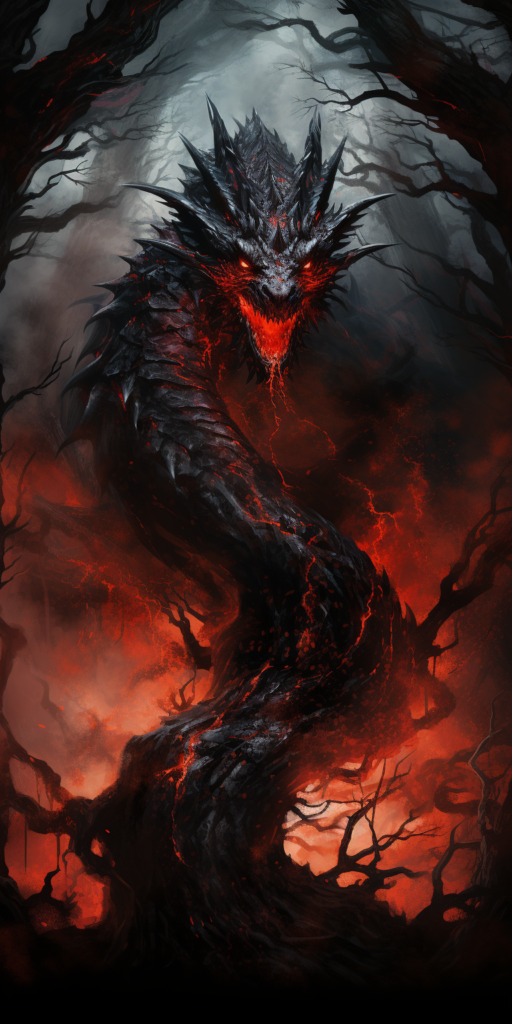
Níðhöggr belongs to the mythic landscape of Old Norse cosmology. He appears as a dragon or serpent associated with Yggdrasil, the World Tree, and with the cold underworld regions connected to Niflheim, Hvergelmir, and Náströnd. In the campaign, he functions as a unique mythic dragon and Asgardian adversary whose presence turns hidden crimes, oath-breaking, dishonoured burial, and moral corruption into physical decay.
Grímnismál 35 gives one of the clearest images of Níðhöggr’s cosmic role. Yggdrasil suffers more than mortals understand: a hart bites from above, the tree rots at its sides, and Níðhöggr gnaws from below. This places him beneath the living structure of the worlds, making him a pressure on creation itself rather than a wandering dragon of ordinary wilderness.
Grímnismál 32 names Ratatoskr as the squirrel who runs along Yggdrasil and carries words between the eagle above and Níðhöggr below. This gives Níðhöggr a place in the vertical ecology of the World Tree. The crown, trunk, roots, eagle, squirrel, serpents, and dragon all form a living structure of tension, insult, decay, endurance, and renewal.
Gylfaginning, in the Prose Edda, expands this World Tree material. It places one of Yggdrasil’s roots over Niflheim, with Hvergelmir beneath it, and describes Níðhöggr gnawing at the root from below. It also links him with the serpents of Hvergelmir and repeats the image of Ratatoskr carrying hostile words between the eagle and the dragon. This supports the campaign treatment of Níðhöggr as an under-root power tied to Yggdrasil, Hvergelmir, serpents, venom, and cosmic strain.
Völuspá 38–39 connects Níðhöggr with Náströnd, the Corpse-Shore. This hall stands far from the sun, its doors face north, venom falls through its openings, and the dead associated with oath-breaking, murder, and grave betrayal move through heavy streams. Níðhöggr feeds there, giving him a role that is both monstrous and punitive: he is a devourer of the dishonoured dead and a sign that hidden crimes do not vanish from the world.
These source strands combine into a strong campaign-facing figure. Níðhöggr is the Corpse-Dragon Beneath the World Tree: a cosmic monster of rot, punishment, oath-violation, venom, and world-root decay. His presence makes burial, law, memory, and judgement matter at the table. A village with a black-sapped tree, a court built on perjury, a battlefield of unburied prisoners, or an oath-stone sweating venom can all become signs of his bite rising from below.
For play, Níðhöggr works best as a long shadow before he becomes a direct opponent. His influence can appear through root-wounds, corpse-serpents, oath-wights, venomous wells, blackened trees, dishonoured graves, and cults that mistake decay for truth. Direct confrontation belongs to mythic, planar, or end-times play, but his pressure can shape adventures at many levels wherever murder is hidden, burial is violated, or sworn law has failed.