
Enlil — Lord of Divine Decree, Kingship & Nippur
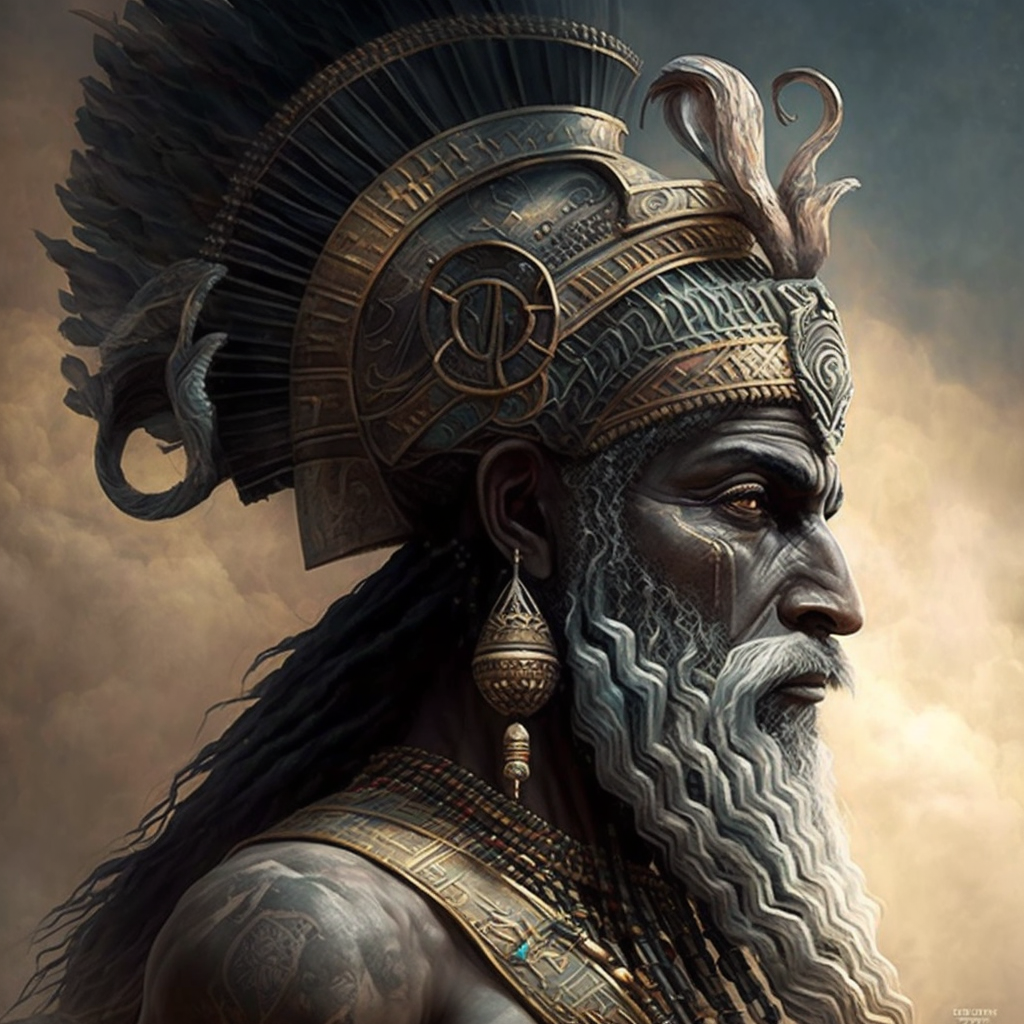
Enlil is one of the supreme gods of Mesopotamia: the great power of Nippur whose decrees fix destinies, whose command grants kingship and whose authority once stood at the centre of the divine order. Wind and storm belong to him, but they do not define him. Enlil is above all the god whose word makes a thing lawful, binding and real.
At a Glance
Mesopotamian — Sumerian, Akkadian and Babylonian traditions
Greater Deity
Lawful Neutral
Lord of Nippur; Decreer of Fates; Giver of Kingship; Great Mountain
Divine decree, kingship, authority, fate, wind, command, agriculture and ordered civilisation
Nippur — the Ekur, the “Mountain House”
Celestial Nippur and the Ekur of the Divine Cities of the Two Rivers
Game Mechanics
The following statistics are campaign adaptations for direct divine manifestations. They are not presented as official rules material.
5.5e / 2024 — Direct Divine Manifestation
Huge Celestial (Greater Deity), Lawful Neutral. AC 30; HP 1,050; Speed 50 ft., fly 120 ft. (hover); CR 39; PB +11. STR 36, DEX 24, CON 38, INT 32, WIS 38, CHA 36. Saving Throws Str +24, Con +25, Int +22, Wis +25, Cha +24. Damage Resistances cold, fire, lightning, thunder; Damage Immunities poison, psychic, radiant. Condition Immunities charmed, exhaustion, frightened, paralyzed, poisoned, stunned. Truesight 300 ft.; telepathy 1 mile.
Greater Divine Nature. Enlil requires no food, drink, air or sleep and cannot be transformed against his will. Legendary Resistance (5/Day). Magic Resistance.
Decreer of Fates. At the start of each round Enlil names one creature he can perceive within 240 feet. Until the start of his next turn, that creature either adds 1d12 to every d20 Test it makes or subtracts 1d12 from every d20 Test it makes. A creature protected by an equal or greater divine power is unaffected.
Grant Kingship. Once per round when an ally within 120 feet fails an attack roll, saving throw or ability check, Enlil may allow it to reroll. A creature benefiting from this ability also becomes immune to Frightened until the end of its next turn.
Voice of the Ekur. Creatures of Enlil’s choice within 60 feet cannot knowingly break a sworn oath or command they voluntarily accepted within the last hour unless they first succeed on a DC 31 Charisma saving throw.
Actions — Sceptre of Decree. +23 to hit, reach 15 ft., one target; 4d10+12 bludgeoning plus 6d8 force. Word That Cannot Be Altered (Recharge 5–6). One creature within 180 feet makes a DC 31 Wisdom save; on a failure it is Stunned until the end of its next turn and one magical effect of 8th level or lower affecting it ends. Separate Heaven and Earth (1/Day). Enlil creates a 120-foot-long, 30-foot-wide line of crushing wind and force. Creatures in the line make a DC 31 Strength save, taking 88 force damage and being pushed 60 feet on a failure, half damage and no push on a success. Structures and non-artifact barriers take double damage.
Legendary Actions (5/round). Commanding Step; Sceptre Strike; Royal Mandate (2 actions), allowing one ally to move up to its Speed and make one weapon attack; Silence the Dispute (2 actions), forcing a DC 31 Charisma save or suppressing verbal spell components until the end of the target’s next turn; Decree Fate (3 actions), immediately changing the current target of Decreer of Fates.
Cleric themes. Order, War, Tempest and Knowledge all fit parts of Enlil’s surviving identity. A campaign Decree Domain might use command, heroism; zone of truth, spiritual weapon; beacon of hope, crusader’s mantle; compulsion, guardian of faith; geas, wall of force.
Pathfinder 1e — Campaign Adaptation
CR 39 / MR 10; Huge outsider (divine, lawful). AC 61; hp 950; Fort +40, Ref +32, Will +43; DR 20/epic; SR 50; Speed 50 ft., fly 120 ft. (perfect). Decree Fate (Su): as an immediate action once per round, grant one creature within 120 feet a +8 sacred bonus or –8 penalty on its next d20 roll. Grant Kingship (Su): allies within 60 feet gain immunity to fear and +4 morale on attack rolls made while following a declared command. Word Unaltered (Su): 3/day, greater dispel magic plus daze for 1 round on a failed Will save. Domains: Air, Law, Nobility, War, Weather. Favoured weapon: pick or handaxe as a campaign adaptation of the mattock/pick tradition.
D&D 3.5e — Campaign Adaptation
Greater Deity; Divine Rank 17; Outsider 20 / Cleric 20 / Fighter 20; Lawful Neutral; suggested CR 55. DR 30/epic; SR 69; divine aura 17 miles. Salient divine abilities: Alter Reality, Avatar, Battlesense, Divine Battle Mastery, Divine Shield, Divine Spellcasting, Know Secrets, Power of Truth, Supreme Initiative. Domains: Air, Law, Nobility, War, Weather. His defining divine abilities should control command, fate and kingship before raw storm damage.
What Is Enlil Doing Right Now?
Enlil is watching rulers rediscover old words of legitimacy. Clay tablets, royal hymns and fragments of Nippur ritual are appearing in courts that barely understand what they have found. A king who repeats an ancient formula correctly may gain more than ceremonial prestige; the formula may still be a valid request for Enlil to recognise a crown.
That possibility has made Enlil dangerous to ambitious rulers. He does not reward every claimant who invokes him. Some discover that the god’s first question is not “Who are your ancestors?” but “Who obeys your orders because they trust your judgement?” A crown granted without responsibility is, to Enlil, a contradiction.
Appearance & Manner
Enlil appears as a mature horn-crowned god in heavy ceremonial robes, often standing above a stepped mountain or temple terrace. Wind gathers around him even indoors, but it is controlled rather than theatrical. He speaks in short declarations and dislikes repetition. When Enlil has decided something, the room itself seems to understand that the matter has changed.
Origins, Nippur & Divine Authority
Enlil was one of the supreme gods of Mesopotamia. His importance cannot be reduced to a translation of his name, whose second element remains debated. What survives much more clearly is his function: Enlil decrees fates, grants kingship and issues commands that even gods take seriously.
His great temple was the Ekur at Nippur, one of the most important religious centres of southern Mesopotamia. Kings who did not rule Nippur directly still sought legitimacy there because Enlil’s approval mattered beyond the city itself. The Ekur was not merely a local shrine; it was imagined as a cosmic mountain-house joining divine authority to the ordered world.
Wind, weather and agricultural prosperity remain real parts of Enlil’s identity, but they sit beneath the larger idea of rule. His storms are the movement of command through the world, not a substitute for kingship, fate and sacred order.
Divine Relationships
Ninlil. Enlil’s great consort and queen. Their relationship lies at the centre of major traditions surrounding Nippur and the birth of important younger gods.
Nanna/Sin. In a major Sumerian tradition, the moon god is the son of Enlil and Ninlil.
Ninurta. Warrior son and champion whose martial and agricultural roles express Enlil’s authority in action.
Nergal. Also counted as a son in important traditions, carrying divine violence, plague and inflicted death into a very different sphere.
Anu and Enki. With Anu and Enki/Ea, Enlil belongs to the highest level of the old divine order. Their authority overlaps without making them interchangeable.
Worship, Kingship & the Ekur
Enlil’s priests are concerned with legitimate authority: who has the right to command, what obligations accompany office, which oaths bind a ruler and whether a decree preserves order or merely hides fear behind law. Temples preserve royal gifts, decrees, boundary records and ritual formulas alongside agricultural offerings.
Nippur remains the model for his cult. Even when political power lies elsewhere, a ruler may send gifts to Enlil because kingship is not considered complete until it has been recognised within a sacred order greater than the king himself.
Omens, Favour & Displeasure
Enlil’s favour appears as a disputed decree becoming suddenly accepted, a banner standing rigid in still air, a damaged seal remaining legible, a storm breaking only after an oath has been fulfilled or a ruler discovering that subordinates obey without coercion.
He dislikes false claims of legitimacy, rulers who issue contradictory orders, officials who hide private interest inside public law and petitioners who ask for authority without accepting responsibility.
Encounters & Adventure Use
The Crown Without a Decree
A ruler possesses every legal document except the one ritual text required to ask Enlil to recognise the succession.
The Ekur Tablet
A recovered Nippur tablet contains a still-binding command addressed not to a king but to a city that no longer exists.
The Unalterable Word
Two temples preserve contradictory copies of a decree. Both appear ancient, but only one makes nearby magic fall silent when read aloud.
Divine Realm — Celestial Nippur
Enlil’s realm is the perfected Ekur: a mountain-house rising above a vast divine city of courts, archives, storehouses and assembly halls. Every gate bears a record of who authorised it. Every granary has a steward. Every throne has a place from which petitioners may challenge the person sitting upon it.
Relics, Sacred Objects & Divine Magic
The Tablet of the Unalterable Word. Once a declaration is lawfully written upon it, ordinary magic cannot change the text. Anyone attempting to enforce a forged version becomes unable to speak the false wording.
The Mattock of Kingship. A ceremonial pick associated with cultivation and civic order. It breaks fortifications only when doing so is necessary to restore lawful access, irrigation or public safety.
The Seal of Nippur. A royal seal that does not prove who should rule; instead it reveals whether the bearer knowingly violated an oath of office.
Historical & Mythological Context
Enlil was one of the most important gods of ancient Mesopotamia. ORACC summarises him as a supreme deity who decreed fates, granted kingship and issued commands that could not be altered. His Ekur temple at Nippur was among the most important sanctuaries in southern Mesopotamia. The exact etymology of his name is debated, so this page avoids treating “Lord Wind” or “Lord Storm” as a complete explanation of his historical identity.
The direct divine statistics, Celestial Nippur, relics and present activity above are campaign adaptations designed for play.
Sources & Licensing
Historical foundation: ORACC — Enlil/Ellil. Game mechanics and campaign material are original adaptation. See also the Mesopotamian Pantheon for related deities and variant traditions.
Keep this reference growing
If this page helped with your reading or game, you can support its upkeep or explore the curated books.
Explore the Bookshop — epics, classics and stories behind imagined worlds.