
Dragons
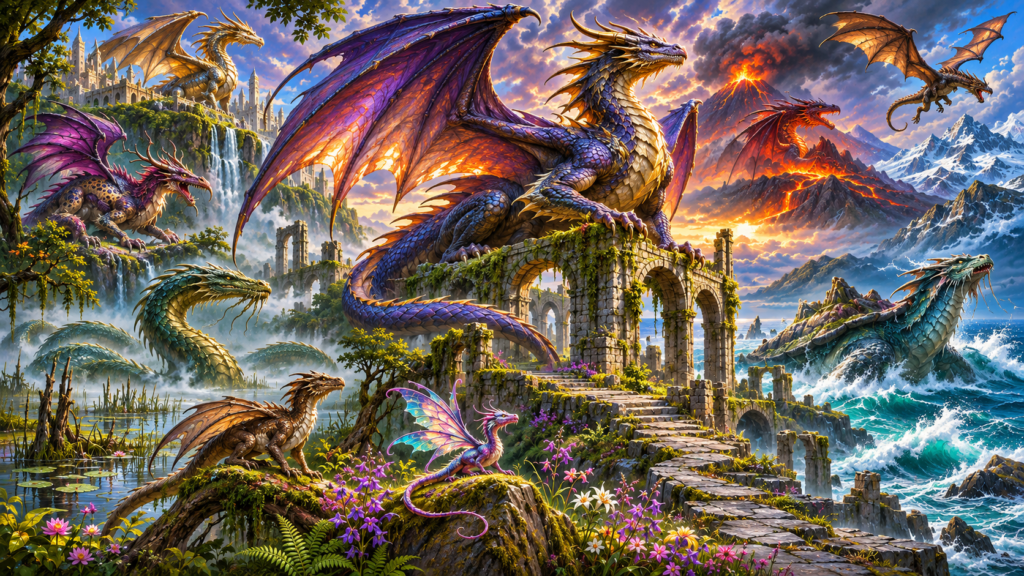
Dragons command lonely mountains, drowned marshes, old ruins and the hidden approaches to Faerie. Some guard sacred thresholds; others demand tribute, raise rival courts or turn whole kingdoms into hunting grounds. Their motives matter as much as their breath weapons.
At a flooded causeway, travellers find a burnt tollhouse and three different offers of safe passage. A Black Dragon claims the marsh, a Brass Dragon demands answers about a stolen relic, and a herald insists that an older Sirrush (Mušḫuššu) holds the road by divine right. None has told the whole truth.
Find your dragon: Chromatic · Metallic · Other great and planar · Drakes · Linnorms, wyrms and winged predators · Sea and river monsters · Faerie and unusual dragon-kin · Legendary serpents and sacred guardians · Related dragon-kind · Videos · Game rules · Faerie lore.
Chromatic threats: territory, fear and ruthless bargains.
Forest intrigue: hidden lairs, old oaths and patient hunters.
Metallic encounters: guardians, riddles and difficult alliances.
Explore the Dragon Bestiary
The directory opens all 65 published entries directly beneath the Dragon collection. Seven further linnorms have their own nested pages, while five additional dragon-kind creatures are cross-linked from their proper categories elsewhere in the World Bestiary. Creature lore and statistics belong to those Bestiary entries.
Chromatic dragons
Ambitious, territorial great dragons, each associated with its own hunting grounds, habits and breath weapon.
Black Dragon · Blue Dragon · Green Dragon · Red Dragon · White Dragon
Metallic dragons
Ancient guardians, scholars, diplomats and solitary powers whose alliances must be earned.
Other great and planar dragons
Ancient rarities, celestial rulers, shadow dragons and travellers from beyond ordinary skies.
Umbral Dragon · Orichalcum Dragon · Ladon · Lung Dragon · Tianlong · Planar Dragon · Infernal Planar Dragon
Drakes of wilderness, sea and sky
Lesser dragons that make memorable hunts, wilderness threats and encounters along dangerous roads.
Coral Drake · Desert Drake · Elemental Drake · Ether Drake · Fire Drake · Forest Drake · Frost Drake · Ice Drake · Jungle Drake · Lava Drake · Mist Drake · Rift Drake · River Drake · Salt Drake · Sea Drake · Shadow Drake · Spire Drake · Star Drake
Linnorms, wyrms and winged predators
Old serpents and legendary predators. Their forms vary, and not every wyrm is a true dragon.
Amphiptere · Balaur · Gorynych · Lambton Worm · Linnorms · The Firedrake · Wyvern · Tatzlwyrm · Vishap · Regulus · Peluda · Taniniver · Piasa
The seven named linnorms
Beyond the Linnorms collection lie seven separate Bestiary accounts of the older wyrms and their curses:
Fafnir · Flame Linnorm · Forest Linnorm · Frost Linnorm · Rain Linnorm · Sea Linnorm · Midgard Linnorm.
Sea dragons and river monsters
Deep-water, estuary, marsh and flooded-ruin encounters, from dragon turtles to strange river coils.
Cetus · Dragon Eel · Dragon Whale · Dragon Turtle · Wonambi · Nicor
Faerie dragons and unusual dragon-kin
Small draconic companions, courtly terrors, winged curiosities and other unusual creatures.
Faerie Dragon · Pseudodragon · Jabberwocky · Pyrausta · Questing Beast · Kongamato · Gargouille
Legendary serpents and sacred guardians
Regional dragon traditions and old guardians of temples, thresholds and dangerous passages.
Azi Gandareva · Azi Sruvara · Azi Zahhak · Sirrush (Mušḫuššu) · Ustu’tli · Scitalis
Other dragon-kind elsewhere in the Bestiary
Not every draconic creature is catalogued under the Dragon family. The wider World Bestiary also preserves these related entries under their proper creature categories:
Dragonnel and Dragonne (magical beasts) · Dragon Horse (magical beast) · Draconal (celestial outsider) · Clockwork Dragon (construct).
These are linked here for discovery, not reclassified as true dragons. Their own Bestiary entries remain the primary source for their lore, creature type and statistics.
What makes a dragon encounter memorable?
Desire: a dragon may want tribute, territory, an heir, a lost name, a forbidden spell or an enemy’s humiliation. Leverage: its servants, oaths, alliances, hoard and knowledge matter before battle begins. Consequence: slaying one can release a curse, open a contested lair or break a precarious peace.
For dangerous roads and crossings, consider River Drake, Dragon Turtle or Wyvern. For an old mystery, seek Faerie Dragon, Questing Beast or Ladon. An ancient dragon is a character with rivals and obligations, not simply a larger battle.
Dragon video guides and further viewing
Several entries in this Bestiary preserve external video demonstrations and commentary. Start with the monster’s own SpiralWorlds page for its description, lore and rules; use the videos there as optional illustrations, not as the source of its statistics or history. Playback depends on the original publishers.
True dragons in video
Chromatic dragons: Blue Dragon, Red Dragon and White Dragon. Metallic dragons: Copper Dragon.
Dragon-kin and legendary creatures in video
Faerie Dragon · Pseudodragon · Wyvern · Jabberwocky · Questing Beast · Piasa · Kongamato.
Ancient wyrms, unusual dragons and planar travellers in video
Linnorms · Fafnir · Tianlong · Lung Dragon · Ladon · Orichalcum Dragon · Dragon Turtle · Azi Zahhak · Infernal Planar Dragon.
All twenty links above lead to published Bestiary entries that contain video references. Videos are intentionally not embedded in this index, keeping the illustrated dragon catalogue quicker to load and easier to browse.
Dragon rules by game edition
Choose the edition used at your table. The individual monster entry provides its full statistics.
D&D 2024
Dragon is a creature type. True dragons commonly have wyrmling, young, adult and ancient stages. Use the individual monster’s stat block for AC, breath weapons, recharge, energy immunity, senses, spellcasting and challenge rating.
Legendary Resistance, legendary actions and lair features are not automatic for every dragon; use them only where the entry provides them. 2024 creature stat blocks.
D&D 2014
Use the dragon creature type and the published age-specific stat block for wyrmling, young, adult or ancient. Breath weapon, damage immunity, senses, abilities and challenge rating depend on the individual species and age.
Legendary actions and lair features apply only when listed in the matching dragon’s description.
Pathfinder 1e
Dragon type: d12 Hit Dice, base attack bonus equal to Hit Dice, good Fortitude, Reflex and Will saves, and 6 + Intelligence modifier skill ranks per Hit Die (minimum 1). Dragons have darkvision 60 feet and low-light vision and are immune to magical sleep and paralysis effects. They breathe, eat and sleep.
True dragons normally grow through twelve age categories, from wyrmling to great wyrm. Breath weapon, energy immunity, spellcasting and other powers depend on the entry. Pathfinder dragon type.
D&D 3.5e
Dragon type: d12 Hit Dice, base attack bonus equal to Hit Dice, good Fortitude, Reflex and Will saves, darkvision 60 feet, low-light vision and immunity to magical sleep and paralysis effects. A dragon breathes, eats and sleeps. Follow its own entry for attacks and other powers.
True dragons use twelve age categories, from wyrmling to great wyrm; statistics vary with species and age. Dragon type · True dragons.
Dragons in Faerie
Most dragons are decidedly set apart from other cultures of the Otherworld, even the diverse societies of fey. The primary exceptions are faerie dragons and pseudodragons, which are amenable to the Seelie Court; linnorms, with a dark pact with the Unseelie Court; and jabberwocks, generally bound in service to one of several major Faerie Courts and separated from most other dragons for their powerful links to fey.
Faerie Dragons and Pseudodragons
The faerie dragons and their close relatives the pseudodragons are descended directly from the famous Seelie Observer Nathair Sgiathach and his dead mate Taeliquist, an ill-fated daughter of Tiamat. As with their father and lord, these tiny dragon species combine a force of will much like that of their larger cousins with an unusual levity and self-consciousness that sets them apart from other dragons. They do not bridge the gap between fey and wyrm so much as ignore both.
Faerie dragons and pseudodragons do not make up a faction to speak of among the fey, though they generally follow the lead of Nathair if Nathair takes a position in matters; as their whims dictate, they may attach themselves individually or in small groups to some cause or personage of the Courts (especially the Seelie and certain Blood Courts) until they are either bored or dissatisfied with their efforts.
Linnorms
In sharp contrast to the minor dragons, linnorms are among the most selfish, dangerous, and destructive denizens of Faerie. Although they have been creeping and forcing their way through the edges of the Otherworld since time immemorial, linnorms emerged as a major force upon the arrival of some of the greatest of their number in the early Days of Antiquity.
Bound in contentious and bitter fealty to the elder linnorm Gottenrvnr Two-Tongues and his retinue, the linnorms of Faerie must follow his lead in agreements with the Unseelie to avoid death by his own teeth. They are only moderately placated by the opportunity he offers them to find land and some moderate (if tense) respect among the fey. The many linnorms unsatisfied with the somewhat limited lairs available in and near Unseelie realms must instead fight constantly to win and hold their own realms from the likes of giants, mighty beasts, Demesne Court fey, and occasionally other rivals such as Seelie fey or other dragons. They have a special enmity with the normally-reserved fey of the Watchers of the Current, who avidly strike at linnorms at every opportunity.
True Dragons
Rarer in Faerie than in the Fleeting Realm, true dragons nevertheless sometimes appear as great allies or rivals to different fey groups and occasionally seek to establish themselves as major figures of Faerie in their own right. Most arrive when beguiled by the ephemeral beauty of Faerie, which often takes the form of curious fey or mischievous faerie dragons. Tales recount that such tomfoolery is a favorite trick of Nathair Sgiathach himself. Once in Faerie, these dragons choose to stay surprisingly often, either because they have succumbed to its enchanted nature, or because they are simply too stubborn to leave after they have been drawn in.
Resident dragons retain much of the brutal practicality that is intrinsic to their mindset, but even so adapt to the wildness of their neighbors with relative ease. Without an active and present patron, these dragons forge alliances and animosities as their individual natures dictate. Few achieve marked prominence.
Further Reading
Rules references are linked within the edition panels above. Regional myths and provenance are explored in the individual entries. Return to the complete Bestiary for other creature types.
Keep this reference growing
If this page helped with your reading or game, you can support its upkeep or explore the curated books.
Explore the Bookshop — epics, classics and stories behind imagined worlds.