
Frost Drake Monster: Ice-Breathing Lesser Dragon of Frozen Roads
Frost Drake Monster: Ice-Breathing Lesser Dragon of Frozen Roads
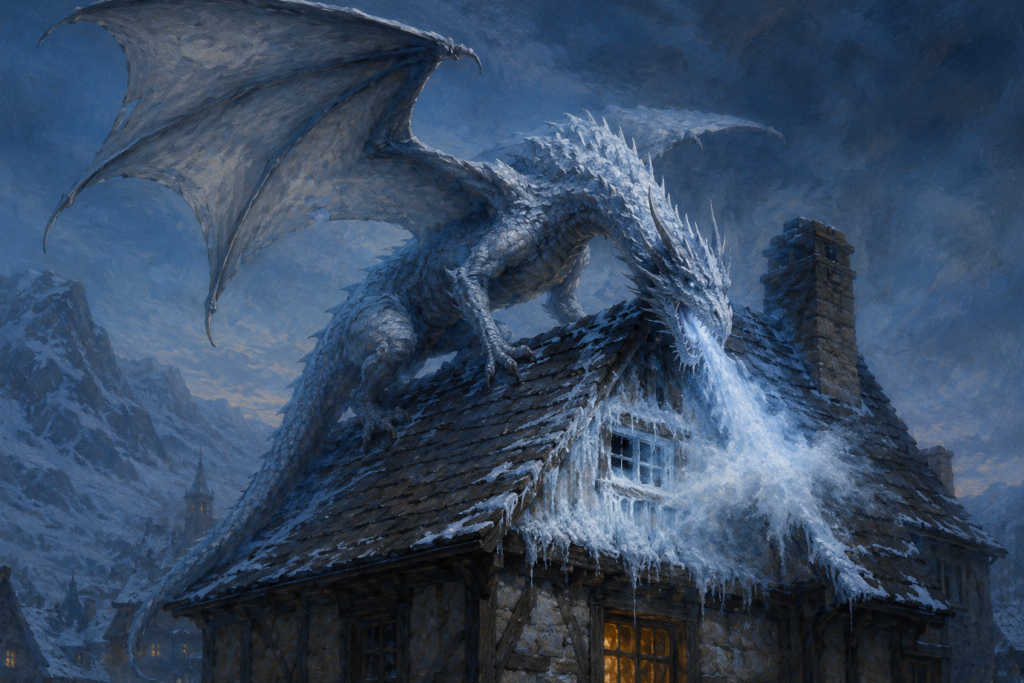
A frost drake is the thing that lands on the roof before dawn, freezes the doors shut, and eats the horses first.
Overview
The Frost Drake is a lesser dragon of cold mountains, frozen roads, glacier caves, snowbound forests, northern coasts, and high winter passes. It has enough dragon-blood to terrify a village, enough animal cunning to hunt caravans, and not enough majesty to behave with restraint.
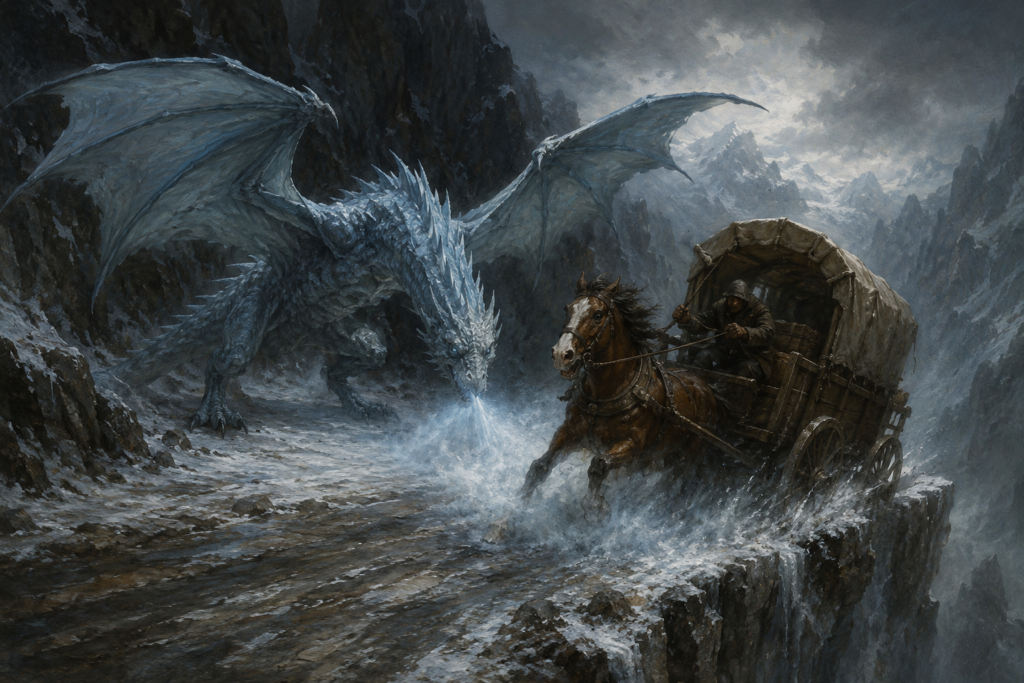
A frost drake matters because it attacks the conditions of survival. It freezes bridges, turns roads into glass, scatters horses, collapses rooflines, pins doors shut with ice, drives travellers off safe paths, and makes rescue parties arrive too late.
In a late medieval campaign world, a frost drake is a perfect monster for places where authority thins: Alpine passes, Scandinavian uplands, northern forests, mining roads, frozen coastlines, glacier ruins, giant-haunted valleys, and disputed winter borders between small lordships. It does not need to conquer a kingdom. It only needs to make one road unusable.
Appearance
A frost drake has the body plan of a winged drake: two powerful hind legs, two wings, a long tail, and no separate forearms. Its posture is low, predatory, and forward-driving, built for lunging, scrambling, gliding, and landing hard on roofs, ledges, bridges, and terrified livestock.
Its scales are dull blue, grey-white, glacier-dark, or cold cyan, often broken by pale ridges along the jaw, brow, spine, and wing joints. Frost crusts its nostrils and teeth in deep cold. Old blood freezes black between its fangs. Its breath leaks from its mouth as low freezing vapour even when it is not attacking.
Its feet are wide and clawed, made for gripping ice and punching through snow crust. Its wings are thick at the leading edge and often torn by hail, spears, avalanche stone, and frost giant weapons. A mature frost drake should not look noble. It should look like winter has grown teeth, wings, and a cruel memory for roads.
Habitat
Frost drakes favour cold mountains, glacial valleys, frozen lakes, sea cliffs, taiga, snow forests, and high passes where weather already does half their hunting.
A good frost drake lair has three things: height, ice, and escape. Height lets it watch roads and herds. Ice lets it move where horses, carts, and armoured men struggle. Escape routes let it retreat into crevasses, ledges, snow caves, avalanche slopes, and broken glacier shelves.
They often lair above trade roads because roads are predictable. A mountain pass with regular caravans is more valuable to a frost drake than a remote peak with no prey. A frozen mining route, winter toll road, goat trail, pilgrimage track, or military road can all become part of the drake’s hunting territory.
In fragmented regions, a frost drake quickly becomes political. One lord blames another for failing to keep the pass safe. A monastery calls the beast punishment for broken oaths. A mining guild hires hunters privately. A village pays tribute in goats and silence because no soldiers arrive before spring.
Ecology
Frost drakes are apex opportunists. They eat deer, reindeer, elk, goats, horses, mules, cattle, wolves, bears, stranded soldiers, miners, pilgrims, merchants, and isolated giant-kin. They prefer prey that can be separated, panicked, exhausted, or forced onto bad footing.
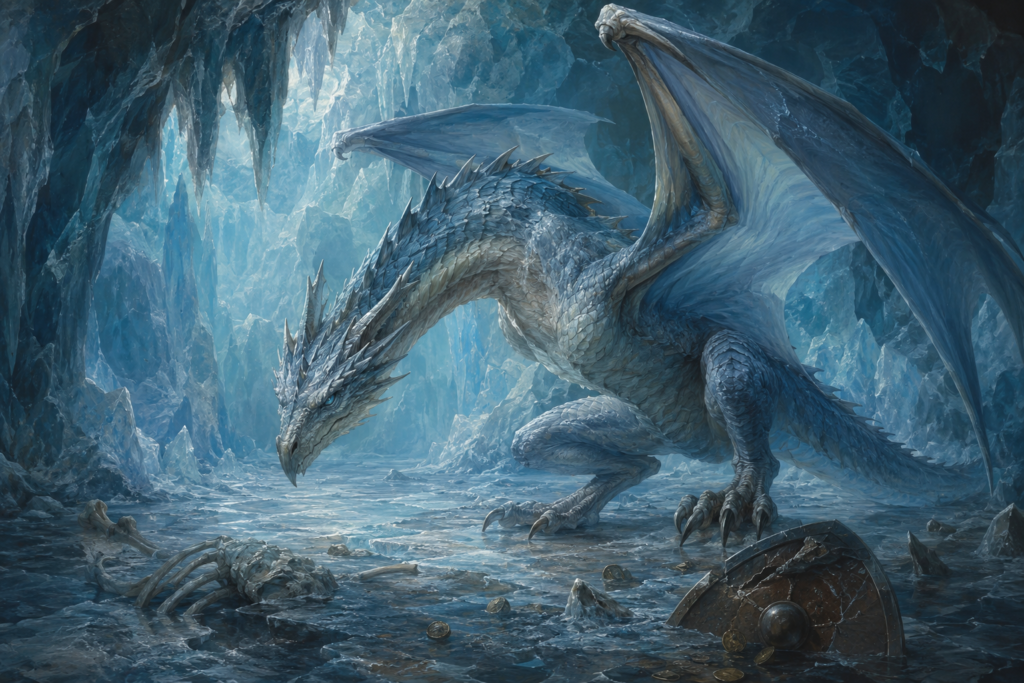
They do not hoard like true dragons, but their lairs accumulate wealth because prey brings possessions. A frost drake’s den may contain saddles, harness bells, broken spears, frozen packs, trade silver, cracked shields, torn cloaks, amber beads, ivory, salt, tools, merchant ledgers, and bones dragged inside before a storm.
They are not mindless. Their intelligence appears through timing, cruelty, and terrain use. A frost drake learns which bridges freeze first, which village sends rescue parties, which road merchants use after market day, where livestock are penned, and how long people can survive once their woodpile is buried.
Behaviour
A frost drake is arrogant without being noble. It bullies, tests, retreats, returns, and learns. It may abandon a direct fight if badly wounded, then shadow the same prey for days, waiting for exhaustion, weather, darkness, or division to do the work.
It attacks survival before it attacks pride. Against a settlement, it may freeze the mill path, seal a door, smash a watch ladder, kill the horses, break a bridge, or drive goats into a ravine before it risks landing among armed defenders. Against travellers, it tries to make the road itself unsafe.
A frost drake actively killing travellers, livestock, or villagers is normally treated as a public monster and lawful defence target. A speaking drake under treaty, oath, giant protection, draconic command, or sacred charge is more complicated. In those cases, killing the creature may still be justified, but it can carry political, sacred, or retaliatory consequences.
Frost drakes are often solitary, but they are not always alone. A pair may hold opposite sides of a pass. Young siblings may harry the same winter valley. A white dragon, frost giant jarl, winter hag, northern warlord, or cruel mountain spirit may tolerate one as a weapon, omen, hunting beast, or chained terror.
Mechanics Tabs
The rules below are mechanics compatible for different game editions.
Frost Drake 5.5e / 2024
Frost Drake, Pathfinder 1e / 3.5e
Frost Drake, Pathfinder
Frost Drake 5.5e / 2024-Compatible Version
Large Dragon, typically Chaotic Evil
Armor Class 15
Initiative +1
Hit Points 114 (12d10 + 48)
Speed 40 ft., fly 80 ft.
| STR | DEX | CON | INT | WIS | CHA |
|---|---|---|---|---|---|
| 20 (+5) | 13 (+1) | 18 (+4) | 8 (-1) | 12 (+1) | 11 (+0) |
Saving Throws Dex +4, Con +7, Wis +4
Skills Athletics +8, Perception +4, Stealth +4; Stealth +7 in snowy or icy terrain
Damage Immunities Cold
Damage Vulnerabilities Fire
Senses Darkvision 60 ft., Passive Perception 14
Languages Draconic
Challenge 7 (2,900 XP)
Proficiency Bonus +3
Traits
Ice Walker. The frost drake ignores difficult terrain caused by ice, snow, or frozen ground.
Snow-Crouch Ambusher. While the frost drake is in heavy snow, broken ice, freezing mist, or a blizzard, it has advantage on Dexterity (Stealth) checks made to hide.
Actions
Multiattack. The frost drake makes three attacks: one Bite, one Raking Talon, and one Tail attack.
Bite. Melee Weapon Attack: +8 to hit, reach 10 ft., one target.
Hit: 16 (2d10 + 5) piercing damage plus 3 (1d6) cold damage.
Raking Talon. Melee Weapon Attack: +8 to hit, reach 5 ft., one target.
Hit: 12 (2d6 + 5) slashing damage.
Tail. Melee Weapon Attack: +8 to hit, reach 10 ft., one target.
Hit: 14 (2d8 + 5) bludgeoning damage. If the target is Large or smaller, it must succeed on a DC 16 Strength saving throw or have the Prone condition.
Freezing Mist Breath. Recharge 5–6. The frost drake exhales freezing fog in a 30-foot cone. Each creature in that area must make a DC 15 Constitution saving throw, taking 36 (8d8) cold damage on a failed save, or half as much damage on a successful one.
The ground in the cone becomes glazed with supernatural ice until the end of the frost drake’s next turn. The area is difficult terrain for creatures other than the frost drake. A creature that enters the icy area for the first time on a turn or starts its turn there must succeed on a DC 15 Dexterity saving throw or have the Prone condition.
Reaction
Wing-Skid. When a creature the frost drake can see misses it with a melee attack, the frost drake moves up to 10 feet without provoking Opportunity Attacks. This movement must end on icy, snowy, rocky, or uneven ground.
Notes
The frost drake should fight like a terrain predator. It uses Freezing Mist Breath to break formations, knock enemies prone, ruin escape routes, and separate mounts from riders. It should not simply stand still trading attacks.
The frost drake’s fire vulnerability is a major weakness. Use fire as a meaningful counter, but do not let the creature become harmless after a single torch or cantrip. Against stronger parties, add weather, height, poor footing, a dangerous lair, or another drake rather than inflating the creature into a different kind of dragon.
Frost Drake, Pathfinder
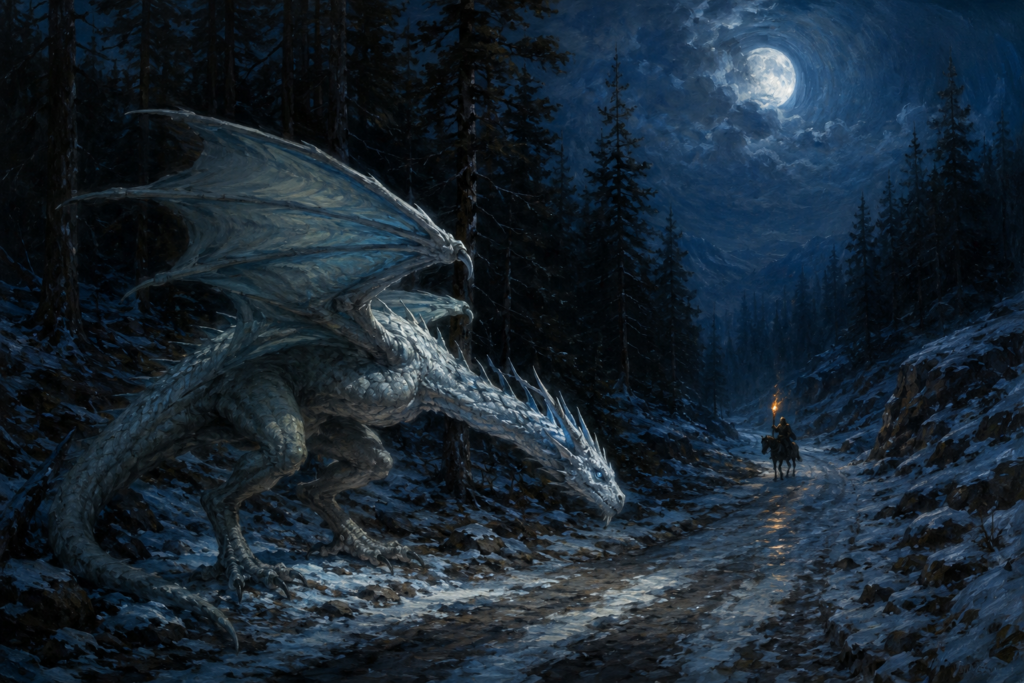
This two-legged dragon has dull blue scales tinged with bright blue ice. A freezing mist issues from between its powerful jaws.
Frost Drake CR 7
XP 3,200
CE Large dragon (cold)
Init +5; Senses darkvision 60 ft., low-light vision, scent, snow vision; Perception +10
DEFENSE
AC 20, touch 10, flat-footed 19 (+1 Dex, +10 natural, –1 size)
hp 84 (8d12+32)
Fort +10, Ref +7, Will +5
Immune cold, paralysis, sleep
Weaknesses vulnerability to fire
OFFENSE
Speed 20 ft., burrow 20 ft. (snow only), fly 60 ft. (average)
Melee bite +13 (2d6+6 plus 1d6 cold), tail slap +8 (1d8+3)
Space 10 ft.; Reach 10 ft.
Special Attacks freezing mist breath
STATISTICS
Str 22, Dex 13, Con 18, Int 8, Wis 9, Cha 13
Base Atk +8; CMB +15; CMD 26
Feats Flyby Attack, Improved Initiative, Power Attack, Vital Strike
Skills Climb +17, Fly +10, Intimidate +12, Perception +10, Stealth +8
Languages Draconic
SQ speed surge, icewalking
SPECIAL ABILITIES
Freezing Mist Breath (Su)
A frost drake can, as a standard action, spit a ball of liquid that bursts into a cloud of freezing mist. This attack has a range of 60 feet and deals 7d6 points of cold damage (DC 18 Reflex half) to all creatures in a 20-foot-radius spread. The mist cakes all surfaces in the area with a sheet of slippery ice that turns the area into difficult terrain for 2d4 rounds, after which the ice cracks or melts enough to revert to the normal terrain features in the area. Once a frost drake has used its freezing mist breath, it cannot do so again for 1d6 rounds. The Reflex save is Constitution-based.
Icewalking (Ex)
This ability works like spider climb, but the surfaces the drake climbs must be icy. It can move across icy surfaces without penalty and does not need to make Acrobatics checks to run or charge on ice.
Speed Surge (Ex)
Three times per day as a swift action, a frost drake may draw on its draconic heritage for a boost of strength and speed to take an additional move action in that round.
Snow Vision (Ex)
A frost drake can see perfectly well in snowy conditions, and does not take any penalties on Perception checks while in snow.
ECOLOGY
Environment cold mountains
Organization solitary, pair, or rampage (3–12)
Treasure standard
Degenerate cousins of white dragons, frost dragons are ferocious predators. They are larger than other drakes, reaching heights of up to 16 feet and weighing upward of 2,500 pounds. Their wide, clawed feet enable them to easily burrow through snow, though not through dirt or clay.
Young frost drakes form adolescent hunting packs divided along gender lines, but older frost drakes are usually encountered in mated pairs. Frost drakes mate for life, leaving their packs when they find a suitable mate. Mated pairs make a nest together, and the female lays a clutch of two to five eggs. Both parents care for their offspring when they hatch, and families usually form small packs until the young reach maturity at 5 years of age. At this point, the parents abandon their offspring, usually laying a new clutch of eggs in a new nest elsewhere, and leaving the fledgling drakes to find their own adolescent packs to join.
Section 15: Copyright Notice
Pathfinder Roleplaying Game Bestiary 2, © 2010, Paizo Publishing, LLC; Authors Wolfgang Baur, Jason Bulmahn, Adam Daigle, Graeme Davis, Crystal Frasier, Joshua J. Frost, Tim Hitchcock, Brandon Hodge, James Jacobs, Steve Kenson, Hal MacLean, Martin Mason, Rob McCreary, Erik Mona, Jason Nelson, Patrick Renie, Sean K Reynolds, F. Wesley Schneider, Owen K.C. Stephens, James L. Sutter, Russ Taylor, and Greg A. Vaughan, based on material by Jonathan Tweet, Monte Cook, and Skip Williams.
Frost Drake, Pathfinder 1e / 3.5e-Compatible Version
CR 7
XP 3,200
CE Large dragon (cold)
Init +5; Senses darkvision 60 ft., low-light vision, scent; Perception +15
Defense
AC 20, touch 10, flat-footed 19
(+1 Dex, +10 natural, -1 size)
hp 84 (8d12 + 32)
Fort +10, Ref +7, Will +7
Immune cold, paralysis, sleep
Weakness vulnerability to fire
Offense
Speed 40 ft., fly 80 ft. (average)
Melee bite +14 (2d6 + 7 plus 1d6 cold), 2 raking talons +14 (1d8 + 7), tail slap +9 (1d8 + 3)
Space 10 ft.; Reach 10 ft. with bite, 5 ft. otherwise
Special Attacks
Freezing Mist Breath. Every 1d4 rounds, a frost drake can breathe a 30-foot cone of freezing mist. Creatures in the area take 8d6 cold damage, Reflex DC 18 half.
The mist coats the ground in ice for 3 rounds. The affected area becomes difficult terrain. A creature moving through the area must succeed at a DC 15 Acrobatics check or fall prone. Creatures with ice walk, snow stride, or similar abilities ignore this movement hazard.
The save DC is Constitution-based.
Statistics
Str 25, Dex 12, Con 19, Int 8, Wis 13, Cha 10
Base Atk +8; CMB +16; CMD 27
Feats Flyby Attack, Improved Initiative, Power Attack, Skill Focus (Perception)
Skills Fly +10, Perception +15, Stealth +8, Survival +12; Stealth +12 in snow or ice
Languages Draconic
Ecology
Environment cold mountains, glaciers, taiga, frozen coastlines, high passes
Organization solitary, pair, or clutch of 2–4 young frost drakes
Treasure incidental
Special Abilities
Ice Walker. A frost drake ignores difficult terrain caused by natural or magical ice and snow.
Snow-Crouch Ambusher. In snow, fog, sleet, or broken ice, a frost drake gains a +4 racial bonus on Stealth checks.
Notes
This version is intended as a table-ready compatible Frost Drake rather than a full true dragon build. Its danger should come from terrain, flight, cold immunity, fire vulnerability, and freezing battlefield control.
For 3.5e use, ignore CMB and CMD if not used in your game and adjudicate combat maneuvers with the edition’s normal grapple, trip, and opposed check rules.
Combat Tactics
A frost drake attacks when the ground already favours it. It prefers cliffs, frozen bridges, snowfields, ravines, rooflines, broken ice, and slopes where heavy armour and pack animals become liabilities.
Its first move is usually to divide the enemy. It freezes the road behind the party, knocks pack animals prone, scatters torchbearers, lands above archers, drives armoured targets onto ice, or seizes a wounded enemy and retreats uphill.
A clever frost drake does not waste its breath only for damage. It uses freezing mist to create bad footing, stop charges, punish pursuit, isolate wounded prey, and turn a road or courtyard into a killing ground.
If badly wounded, it retreats into weather, height, or ice. It may return after dark, attack the horses, collapse a snow shelf, break a sledge, or wait until the party is exhausted. The drake should feel like a predator that remembers the fight rather than a monster that forgets once initiative ends.
Treasure
A frost drake does not build a true dragon hoard, but its lair often contains wealth taken from victims, half-buried under ice, bones, saddles, hides, and ruined packs. A normal adult frost drake lair contains goods worth 1,200–2,500 gp total.
Common treasure includes 300–900 gp in coins and trade silver, 200–700 gp in jewellery frozen into corpses or packs, 300–800 gp in merchant goods such as furs, ivory, amber, salt, tools, or spices, and 200–600 gp in weapons or armour taken from dead guards, hunters, or soldiers. If the drake has killed adventurers, noble retainers, or monster hunters, its lair may also contain one minor magic item or cold-themed charm worth 500–1,500 gp.
A freshly slain frost drake also has valuable remains if harvested quickly. Its hide is worth 400–700 gp and can be used for cold-weather armour, cloaks, saddle covers, shield facing, or spell components. Its teeth and claws are worth 150–300 gp to alchemists, charm-makers, monster hunters, and trophy buyers. The frost sac or breath organ is worth 500–1,000 gp, but it is fragile and dangerous to remove. Wing membrane is worth 100–250 gp, while heart ice, a cold crystal-like clot sometimes found near the heart, is worth 250–600 gp to northern witches, ice mages, frost giant shamans, and winter cults.
A careless harvesting attempt can ruin the breath organ or expose the butcher to freezing vapour. This usually requires a suitable Survival, Medicine, Nature, Craft, or Profession check, usually DC 15–20 depending on edition, tools, and working conditions.
Adventure Hooks
The Frozen Toll Road
A count claims the high pass is safe. Merchants disagree. Three caravans have vanished, and the only survivor says the road itself turned to glass before the beast landed.
The Roof-Taker
A mountain village has stopped sleeping indoors. The frost drake lands on roofs, freezes doors shut, and tears through timber and thatch to reach the people trapped below.
The Giant’s Shame
A frost giant war-band offers payment for the drake’s death, but not because it threatens humans. The beast has killed a young giant and stolen a sacred trophy from the corpse.
Source, Mythic, Historical, and Game Context
The frost drake is best treated as a modern fantasy game creature rather than a monster with one fixed ancient source. It belongs to the wider drake and dragon tradition: a lesser dragon, more bestial and immediate than a great wyrm, but still carrying enough draconic force to make it a serious regional threat.
The word drake has a long historical connection with dragons. It descends from older dragon-language, including Old English draca, meaning dragon, sea monster, or great serpent. That makes “drake” a strong term for a creature that is recognisably draconic without needing the full mythic weight of an ancient dragon. Online Etymology Dictionary: Drake
European dragon imagery was never completely uniform. Medieval dragons could be winged, serpentine, clawed, fire-breathing, bestial, symbolic, decorative, or monstrous depending on the manuscript, region, and story. The frost drake fits comfortably within that flexible tradition as a cold-land draconic predator: not a sovereign dragon of legend, but a dangerous winged monster of mountains, roads, and winter borders. Encyclopaedia Britannica: Dragon The British Library: The Anatomy of a Dragon
In game terms, the frost drake is useful because it narrows the idea of a dragon into a sharper encounter role. It is not there to rule an age, hold court over a kingdom, or carry the full symbolic burden of dragonkind. It makes a pass unsafe, breaks a winter road, destroys herds, cuts off a mining settlement, or turns a village roofline into hunting ground.
In a late medieval campaign world, the frost drake works especially well as a border monster. It belongs where law weakens because of altitude, distance, snow, disputed authority, or failed roads: Alpine passes, Scandinavian uplands, northern forests, glacial ruins, frozen coastlines, mining tracks, and the winter edges of giant-held territory. Its best role is not simply “cold damage.” Its freezing breath should change the battlefield, turn survival against the characters, and make winter itself feel predatory.
Keep this reference growing
If this page helped with your reading or game, you can support its upkeep or explore the curated books.
Explore the Bookshop — epics, classics and stories behind imagined worlds.