
Sirrush / Mušḫuššu – Babylonian Dragon-Guardian
Sirrush / Mušḫuššu – Babylonian Dragon-Guardian
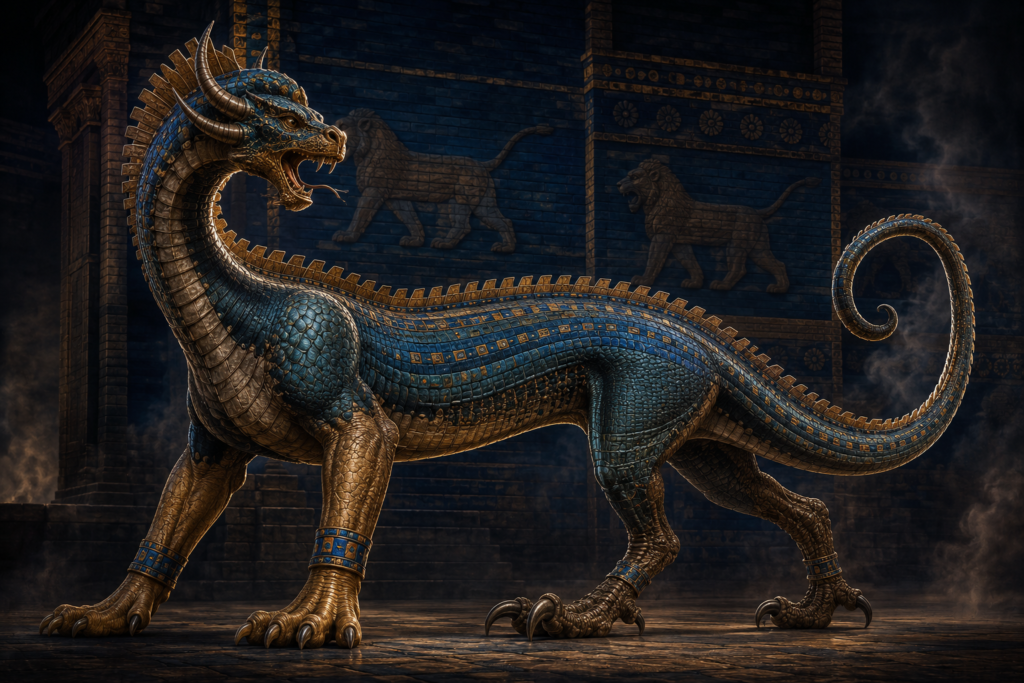
When the sun rises through the blue gates of Babylon, the sirrush opens its talons and judges who is worthy to pass.
The sirrush is a sacred serpent-dragon of ancient Mesopotamia, better known in modern scholarship as the mušḫuššu. It is a horned, scaled hybrid with a long serpent body, lion-like forelegs, eagle-taloned hind legs, a raised crest, and a snake-like tongue. It belongs to gates, temples, processional roads, royal thresholds, god-statue chambers, sealed archives, and cities where law is not merely written but consecrated.
A sirrush is not a wilderness dragon or treasure-hoarding reptile. It is a guardian-image made flesh: the moment when a city’s sacred symbol stops being decoration and begins enforcing the authority it represents.
Overview
A sirrush waits where passage has meaning. It stands at city gates, temple doors, royal archives, oath-halls, palace approaches, and processional roads where only the rightful may enter. It is not interested in hunger, conquest, or gold. It is interested in trespass, false titles, stolen sacred property, broken oaths, and unlawful entry.
Most sirrushes are bound to sacred architecture. They sleep in glazed brick, bronze gateposts, lapis-coloured wall reliefs, carved processional panels, and foundation stones marked with royal dedications. A painted or sculpted sirrush may stand motionless for centuries until a thief crosses the threshold with stolen offerings, a false ruler enters under borrowed titles, or a sealed archive is opened without the proper rites.
When it wakes, it does so with terrible dignity. Blue glaze cracks. Brick dust falls like sand from a tomb. The dragon steps out of the wall as if it has always had flesh waiting behind the image.
The strongest sirrush encounter is not simply a monster fight. It asks what right the characters have to cross the boundary before them. They may defeat the guardian, bargain with it, return what was stolen, expose a false claimant, produce a lawful token, or accept a binding oath. Killing the sirrush may solve the immediate problem, but it can also silence divine judgement, break temple law, or open the way for something worse.
What Makes a Sirrush Different
A sirrush is defined by authority, not appetite. It does not guard treasure because it wants treasure. It guards treasure because the object belongs to a god, king, temple, archive, treaty, or consecrated office.
It is defined by thresholds, not territory. Its “lair” is usually a gate, court, road, tomb approach, archive door, or oath-bound boundary. Away from that appointed place, it is still dangerous, but it loses part of its meaning.
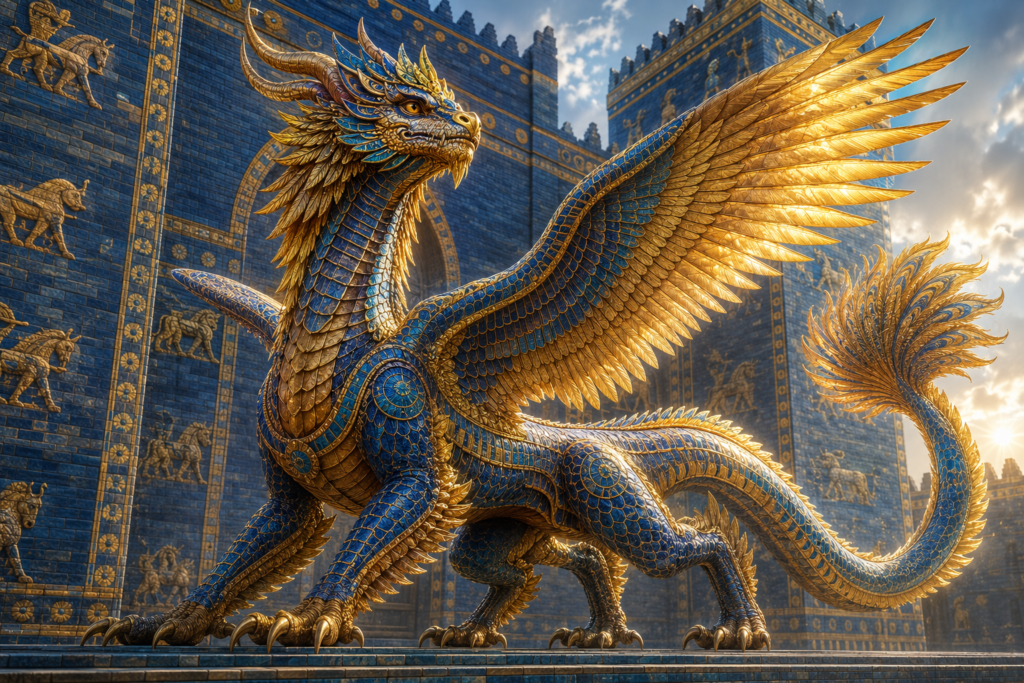
It is defined by hybrid sacred form, not generic draconic power. The serpent body, lion forelegs, eagle talons, horned head, crest, and divine posture should all remain visible. The sirrush should never become a winged European dragon with Babylonian decoration.
It is defined by judgement, not mindless aggression. A sirrush can fight savagely, but it usually begins by watching, barring the way, demanding a name, and testing whether those before it have lawful cause to pass.
Appearance
A sirrush has the long body and neck of a serpent-dragon, a narrow horned head, raised crest, scaled hide, and forked or snake-like tongue. Its forelegs are leonine, heavy and muscular, built to pin intruders against stone. Its hind legs end in hooked eagle talons, giving it a high, stalking gait unlike that of any ordinary reptile.
Its body looks both animal and emblematic. The lion strength, eagle talons, serpent form, and horned divine head all belong to a sacred symbolic order. The creature is not a confused hybrid assembled for strangeness. It is a royal and divine image given breath, judgement, and teeth.
In play, the silhouette should be crisp: wingless, horned, serpent-bodied, lion-fronted, eagle-taloned, and unmistakably Babylonian in character.
Habitat
Sirrushes are found where Mesopotamian sacred authority remains active or has been violently disturbed. They may guard ancient Babylonian ruins, buried ziggurat foundations, temple roads, palace approaches, god-statue chambers, royal tomb entrances, sealed archives, or vaults holding tablets, crowns, contracts, tribute records, and sacred weapons.
Some remain near the old lands of Babylon. Others have been carried away as plunder, trophy reliefs, temple fragments, royal gifts, or stolen bricks. A single glazed panel in a distant city can become a gate for the guardian if the object still bears divine charge. A European noble, imperial collector, demonologist, merchant prince, or ambitious cult might possess a stolen Babylonian dragon brick without understanding that the image on it is not only an image.
Ecology
A sirrush is not a breeding animal in the ordinary sense. Most are created, awakened, appointed, or bound. Some are divine servitor-beasts of Marduk or Nabu. Some are older dragon-powers conquered and brought into divine service. Some are temple images given life by rites of protection. Others are the surviving legal force of a ruined city whose gods have not forgotten their gates.
They do not need to eat as beasts do, though they may consume offerings, incense, sacrificial smoke, oath-blood, or the spiritual residue of broken vows. A neglected sirrush grows dry, cracked, and statue-like. An honoured one gleams like blue-glazed brick and polished bronze.
Their lairs are jurisdictions. A sirrush’s territory is defined by the boundary it has been appointed to guard. Within that space, it knows who belongs, who lies, who carries stolen goods, and who enters under false protection.
Behaviour
A sirrush is patient, formal, and dangerous. It does not usually begin with a roar and a charge. It watches. It bars the way. It demands a name, a patron, a lawful purpose, or the return of stolen property. Those who answer truthfully may be judged, delayed, marked, or escorted. Those who lie before it are treated as enemies of the gate.
The creature’s mind is old but not human. It understands command, rank, oath, offering, trespass, theft, desecration, tribute, royal legitimacy, and divine service. It is much less interested in personal excuses. A starving thief, an ambitious prince, and a well-meaning adventurer may all be trespassers if they break the same sacred boundary.
Not every sirrush serves good order. One bound to a tyrant’s restored cult may enforce oppression with the same certainty that another defends a holy archive. The creature is lawful by nature, but law can protect, exclude, punish, or enslave depending on whose order it embodies.
Combat Tactics
A sirrush fights like a guardian, not a raider. It holds a line, blocks a door, pins a leader, prevents escape, and drags thieves back toward judgement. Its body is built for layered assault: the serpent head strikes and marks, the lion foreclaws seize and crush, and the eagle talons rake, hook, and pull enemies out of position.
It makes strong use of terrain. In a gatehouse, it occupies the entrance and forces enemies into narrow space. In a temple court, it drives intruders toward sacred walls, statues, pits, altars, or guards. On a ruined processional road, it may move between reliefs, appearing first as image, then as flesh, then as image again.
The sirrush should not default to ordinary dragon breath. Its most memorable powers punish false authority and sacrilege. Its command can halt an intruder, force stolen sacred objects to be dropped, make a false ruler kneel, or mark a liar so that no shadow or invisibility hides them from the guardian’s sight.
Power Levels: Standard, Temple, and Divine Sirrushes
A sirrush is not a natural dragon species with ordinary age categories. Its power comes from sacred office, divine appointment, the authority of the ward it guards, and the age of the law bound into its body. Even an unnamed sirrush should feel like a major mythic guardian, not a juvenile monster or weakened relic.
Standard sirrushes are fully appointed guardians of sacred gates, royal archives, temple courts, buried processional roads, god-statue chambers, and consecrated thresholds. They sit around D&D CR 15. This makes them strong enough to matter as serious dragon-class encounters while still remaining usable as more than one creature in the world.
Named temple guardians are sirrushes with recognised offices, personal names, ancient service histories, and direct ties to a major god, city, temple, or royal line. Such a guardian may command lesser temple defenders, possess lair actions, enforce ancient judgements, and be known in priestly records or royal inscriptions. Treat this as roughly CR 17–19, depending on the strength of the ward and the importance of the place defended.
Divine unique sirrushes are singular sacred beings rather than ordinary members of a monster type. This might be Marduk’s ancient dragon-standard, the last living guardian of a divine throne, the beast that witnessed the founding of Babylon, or a mythic judge whose verdict can alter the legitimacy of kings. Such a creature belongs at CR 20 or higher and should have lair actions, regional effects, legendary actions, and consequences that extend beyond the battle.
Mechanics Tabs
The rules below are mechanics compatible for different game editions.
Sirrush 5.5e / 2024
Sirrush Temple Guardian 5.5e / 2024
Divine Sirrush 5.5e / 2024
Sirrush Pathfinder 1e / 3.5e
Sirrush Pathfinder 1e
Sirrush 5.5e / 2024-Compatible Version
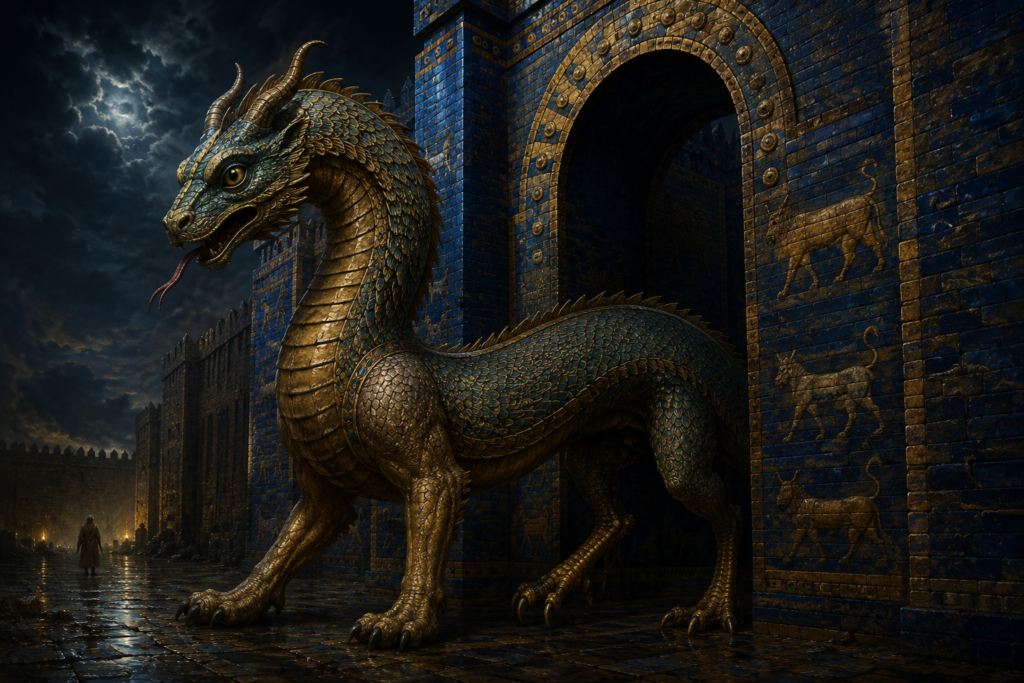
Use this version for a fully appointed sirrush guarding a sacred gate, royal archive, temple court, buried processional road, god-statue chamber, or consecrated threshold. This is the default version of the creature.
Huge Dragon, Lawful Neutral
Armor Class 19 (natural armor)
Initiative +4
Hit Points 247 (22d12 + 104)
Speed 50 ft., climb 30 ft.
| STR | DEX | CON | INT | WIS | CHA |
|---|---|---|---|---|---|
| 26 (+8) | 18 (+4) | 21 (+5) | 15 (+2) | 20 (+5) | 19 (+4) |
Saving Throws Str +13, Con +10, Wis +10, Cha +9
Skills Athletics +13, Insight +10, Intimidation +9, Perception +10
Damage Resistances fire, poison; bludgeoning, piercing, and slashing from nonmagical attacks
Condition Immunities charmed, frightened, paralyzed, poisoned
Senses darkvision 120 ft., truesight 60 ft., passive Perception 20
Languages Draconic, Celestial, one ancient Mesopotamian language; understands the languages of lawful oaths spoken within its ward
Challenge 15 (13,000 XP)
Proficiency Bonus +5
Traits
Threshold Guardian. The sirrush is appointed to guard a specific gate, sealed doorway, temple entrance, throne room, archive, consecrated boundary, or similar ward. While it is within 90 feet of that ward, it gains the following benefits:
- It has advantage on saving throws against effects that would move it, knock it prone, banish it, or force it away from its ward.
- Creatures of the sirrush’s choice treat the ward and the space within 20 feet of it as difficult terrain.
- Once per turn, when a creature the sirrush can see tries to cross the ward without permission, the sirrush can force that creature to make a DC 18 Charisma saving throw. On a failed save, the creature’s movement ends before it crosses. A creature has advantage on the save if it presents a legitimate token of authority, returns stolen sacred property, speaks a true name at the sirrush’s demand, or otherwise satisfies the condition of passage.
Oath-Scent. The sirrush knows when a creature within 90 feet is knowingly carrying stolen sacred property from its ward, using a false title to claim authority, or speaking a deliberate lie in response to the sirrush’s direct question. This trait reveals the presence of a violation, not the full truth behind it.
Glazed-Brick Body. The sirrush has advantage on saving throws against being petrified, restrained, or stunned. In addition, it can move through spaces occupied by appropriate sacred reliefs, glazed-brick walls, carved gate images, or temple murals within its ward as if they were difficult terrain. It cannot end its movement inside solid material.
Divine Standard. While the sirrush is not incapacitated and is visible at its ward, allied guards, priests, lawful servants, or bound defenders within 90 feet have advantage on saving throws against being charmed or frightened.
Legendary Resistance (3/Day). If the sirrush fails a saving throw, it can choose to succeed instead.
Magic Resistance. The sirrush has advantage on saving throws against spells and other magical effects.
Actions
Multiattack. The sirrush makes three attacks: one Bite attack, one Lion Claw attack, and one Eagle Talon attack.
Bite. Melee Attack Roll: +13, reach 15 ft., one target. Hit: 21 (2d12 + 8) piercing damage plus 14 (4d6) poison damage. If the target is carrying stolen sacred property from the sirrush’s ward or has lied to the sirrush since the start of the encounter, the target must succeed on a DC 18 Wisdom saving throw or be Marked by the Gate for 1 minute. While marked, the target cannot take the Dash action, cannot benefit from being invisible to the sirrush, and has disadvantage on saving throws against the sirrush’s Voice of the Gate and Judgement Roar. The marked creature can repeat the save at the end of each of its turns, ending the effect on itself on a success.
Lion Claw. Melee Attack Roll: +13, reach 10 ft., one target. Hit: 22 (4d6 + 8) slashing damage. If the target is Huge or smaller, it must succeed on a DC 21 Strength saving throw or be grappled. Until this grapple ends, the target is restrained, and the sirrush cannot use this Lion Claw against another target.
Eagle Talon. Melee Attack Roll: +13, reach 10 ft., one target. Hit: 18 (3d6 + 8) slashing damage. If the target is grappled by the sirrush or is within 20 feet of the sirrush’s ward, the sirrush can pull the target up to 15 feet to an unoccupied space closer to the ward.
Voice of the Gate. The sirrush speaks a command of divine authority. Each creature of the sirrush’s choice within 60 feet that can hear it must make a DC 18 Wisdom saving throw. On a failed save, a creature suffers one of the following effects, chosen by the sirrush:
- Halt. The creature’s speed becomes 0 until the end of its next turn.
- Kneel. The creature falls prone and cannot stand until the start of its next turn.
- Return What Was Taken. The creature must drop one object it is holding or carrying that the sirrush recognises as stolen from its ward, unless the object is worn or physically secured.
- Speak Truly. The creature cannot knowingly speak a direct lie until the end of its next turn.
On a successful save, the creature is immune to that sirrush’s Voice of the Gate for 24 hours.
Judgement Roar (Recharge 5–6). The sirrush releases a roar that shakes stone, bronze, and oath-bound hearts. Each enemy within 60 feet must make a DC 18 Constitution saving throw. On a failed save, a creature takes 45 (10d8) thunder damage, is knocked prone, and is deafened until the end of its next turn. On a successful save, it takes half as much damage and is not knocked prone or deafened. A creature that is knowingly using a false title, carrying stolen sacred property from the sirrush’s ward, or under the Marked by the Gate effect has disadvantage on this save.
Legendary Actions
The sirrush can take 3 legendary actions, choosing from the options below. Only one legendary action option can be used at a time, and only at the end of another creature’s turn. The sirrush regains spent legendary actions at the start of its turn.
Watch the Threshold. The sirrush makes a Wisdom (Perception) check or moves up to half its speed without provoking opportunity attacks. This movement must end closer to its ward or adjacent to a creature carrying stolen sacred property from its ward.
Talon Drag. The sirrush makes one Eagle Talon attack.
Command Intruder (Costs 2 Actions). The sirrush uses Voice of the Gate against one creature within 60 feet that can hear it.
Glazed-Brick Step (Costs 2 Actions). While within its ward, the sirrush moves up to 60 feet by passing through a sacred relief, glazed-brick wall, carved gate image, or temple mural. This movement does not provoke opportunity attacks, and the sirrush must emerge in an unoccupied space it can see.
Notes
- Guardian, not raider: The sirrush is strongest when defending a defined ward. Away from its appointed place, remove or reduce the benefits of Threshold Guardian and Glazed-Brick Step.
- Sacred property: Use this for temple goods, royal seals, god-statues, oath-tablets, consecrated weapons, tribute records, gate keys, and objects explicitly under the sirrush’s charge. Do not use it for every stolen coin in a character’s pack.
- False title: A creature triggers this if it knowingly claims a rank, bloodline, divine office, military command, priestly authority, or legal right it does not possess.
- Lawful solutions: Returning an object, producing a valid writ, swearing a binding oath, revealing a false ruler, accepting judgement, or performing a required rite may resolve the encounter without combat.
Sirrush Pathfinder 1e
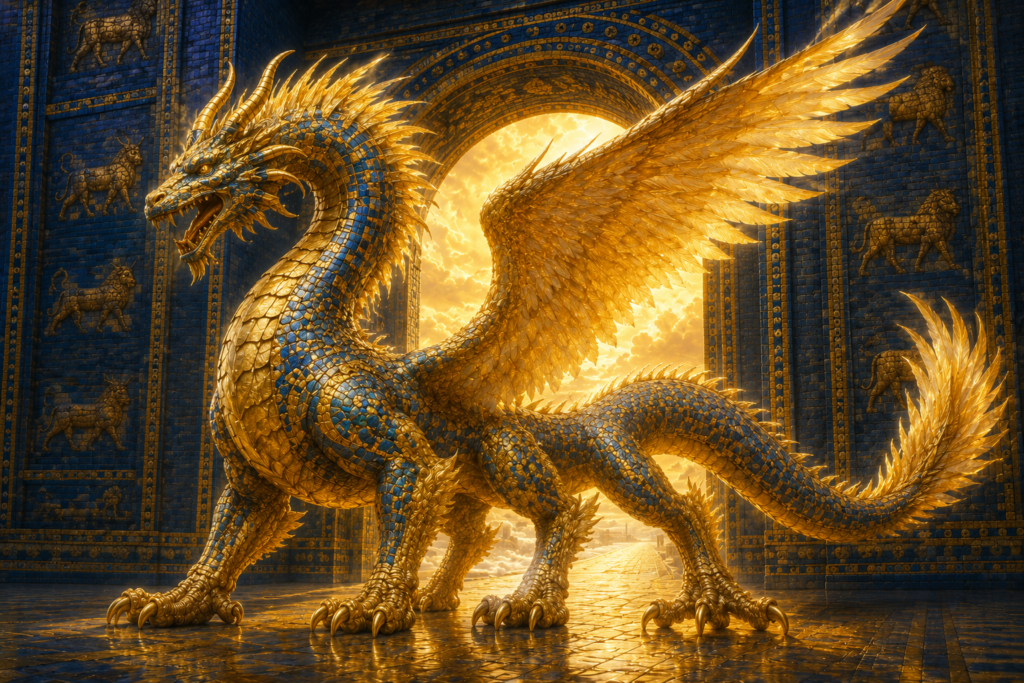
This graceful, elegant dragon has six legs, a radiantly feathered tail and wings, and scales that appear to be made of solid sunlight.
Sirrush CR 21
XP 409,600
NG Gargantuan dragon (extraplanar, good)
Init +6; Senses blindsense 60 ft., darkvision 120 ft., low-light vision; Perception +38
Aura radiance (120 ft.)
DEFENSE
AC 38, touch 38, flat-footed 31 (+6 Dex, +1 dodge, +25 natural, –4 size)
hp 406 (28d12+224); regenerate 20 (evil spells or effects)
Fort +24, Ref +22, Will +23
Defensive Abilities luminous scales; DR 10/epic; Immune ability damage, ability drain, blindness, dazzled, energy drain, fire, mind-affecting effects, negative energy, paralysis, sleep; Resist acid 20, cold 20, electricity 20; SR 32
OFFENSE
Speed 80 ft., fly 250 ft. (average)
Melee bite +34 (2d8+10/19–20), 4 claws +34 (2d6+10/19–20), tail slap +29 (2d8+5), 2 wings +29 (2d6+5)
Space 20 ft.; Reach 20 ft.
Special Attacks breath weapon (60-ft. cone, 25d6 fire and divine damage, Reflex DC 32 half)
Spell-Like Abilities (CL 20th; concentration +26)
3/day—miracle (to duplicate existing spells)
STATISTICS
Str 30, Dex 23, Con 26, Int 21, Wis 24, Cha 23
Base Atk +28; CMB +42 (+44 bull rush); CMD 59 (61 vs. bull rush, 67 vs. trip)
Feats Awesome Blow, Blinding Critical, Combat Expertise, Combat Reflexes, Critical Focus, Dodge, Flyby Attack, Hover, Improved Bull Rush, Improved Critical (bite, claw), Mobility, Power Attack, Wingover
Skills Acrobatics +34, Diplomacy +37, Fly +31, Intimidate +37, Knowledge (arcana, planes, religion) +36, Perception +38, Sense Motive +38, Spellcraft +36, Use Magic Device +37
Languages Celestial, Common, Draconic
SQ martyr’s blessing
SPECIAL ABILITIES
Breath Weapon (Su)
A sirrush’s breath weapon is a cone of searing sunlight that deals half fire damage and half divine damage, as per flame strike.
Luminous Scales (Su)
A sirrush’s touch AC is modified by its glowing scales’ natural armor bonus.
Martyr’s Blessing (Su)
When a sirrush dies, nonevil creatures within 100 feet (other than other sirrushes) receive the benefits of a breath of life spell (caster level 20th). This can return creatures to life if they died within the last minute, rather than within the last round.
Radiance (Su)
A sirrush exudes sunlight, filling a radius of 120 feet around it with bright light, though looking directly at a sirrush does not cause blindness as would looking at the sun. This sunlight affects creatures such as certain undead and fungi as if it were real sunlight. A sirrush’s radiance aura is suppressed when it is below half its maximum hit point total (203 hp for the typical sirrush).
ECOLOGY
Environment any (Nirvana)
Organization solitary or flight (2–4)
Treasure none
Enlightened and wise, sirrushes show mercy to all but the most irredeemable of evil beings. Unlike many creatures of the dragon type, sirrushes have little interest in treasure and feel no compulsion to hoard.
Section 15: Copyright Notice
Pathfinder Roleplaying Game Planar Adventures © 2018, Paizo Inc.; Authors: Robert Brookes, John Compton, Paris Crenshaw, Eleanor Ferron, Thurston Hillman, James Jacobs, Isabelle Lee, Lyz Liddell, Ron Lundeen, Joe Pasini, Lacy Pellazar, Jessica Price, Mark Seifter, F. Wesley Schneider, Todd Stewart, James L. Sutter, and Linda Zayas-Palmer.
Standard Sirrush Pathfinder 1e / 3.5e-Compatible Version

CR 16
XP 76,800
LN Huge dragon
Init +9; Senses darkvision 120 ft., low-light vision, scent, true seeing 60 ft.; Perception +30
Defense
AC 31, touch 13, flat-footed 26 (+5 Dex, +18 natural, -2 size)
hp 242 (23d12+92)
Fort +17, Ref +18, Will +19
Defensive Abilities threshold guardian, divine standard; DR 15/magic; Immune paralysis, sleep, poison; Resist fire 20; SR 27
Offense
Speed 50 ft., climb 30 ft.
Melee bite +31 (3d8+11 plus poison and oath-mark), 2 claws +31 (2d8+11 plus grab), 2 talons +31 (2d6+11)
Space 15 ft.; Reach 15 ft. with bite, 10 ft. otherwise
Special Attacks command of the gate, constrict 2d8+11, judgement roar, oath-mark, pounce on trespassers, rake 2 talons +31 (2d6+11)
Statistics
Str 32, Dex 21, Con 19, Int 15, Wis 23, Cha 21
Base Atk +23; CMB +36 (+40 grapple); CMD 51
Feats Combat Reflexes, Greater Vital Strike, Improved Bull Rush, Improved Initiative, Improved Natural Attack (bite), Improved Vital Strike, Iron Will, Lightning Reflexes, Power Attack, Skill Focus (Perception), Step Up, Vital Strike
Skills Climb +38, Intimidate +31, Knowledge (history) +28, Knowledge (nobility) +28, Knowledge (religion) +28, Perception +34, Sense Motive +32, Stealth +23
Languages Draconic, Celestial, ancient Babylonian or Akkadian equivalent; telepathy 100 ft. within its ward
Ecology
Environment ancient temples, city gates, royal roads, ziggurat ruins, sealed archives, palace thresholds
Organization solitary, pair, or gate relief of 2–6
Treasure incidental temple or royal treasure only
Special Abilities
Command of the Gate (Su) As a standard action, a sirrush can command creatures near its ward. Creatures of the sirrush’s choice within 60 feet must succeed at a DC 25 Will save or be affected as if by greater command for 1 round. The sirrush most often commands creatures to halt, kneel, return, drop a stolen sacred object, or speak truthfully. This is a language-dependent mind-affecting compulsion effect. The save DC is Charisma-based.
Divine Standard (Su) While the sirrush is conscious and visible at its ward, allied guards, priests, lawful servants, or bound defenders within 100 feet gain a +4 morale bonus on saving throws against fear and compulsion effects. This bonus ends immediately if the sirrush is slain or driven from its ward.
Glazed-Brick Step (Su) While within its ward, a sirrush can move through sacred wall reliefs, glazed-brick images, carved gate panels, or temple murals bearing its likeness or divine symbols. This functions as greater teleport, except the sirrush must begin and end its movement adjacent to an appropriate image within 300 feet. The sirrush can use this ability once every 1d4 rounds.
Judgement Roar (Su) Once every 1d4 rounds, a sirrush can release a divine roar in a 60-foot cone. Creatures in the area take 13d6 sonic damage and are knocked prone and deafened for 1 round. A successful DC 25 Fortitude save halves the damage and negates the prone and deafened conditions. A creature carrying stolen sacred property from the sirrush’s ward, knowingly using a false title, or currently affected by oath-mark takes a -4 penalty on this saving throw. The save DC is Constitution-based.
Oath-Mark (Su) When a sirrush damages a creature with its bite, it may mark that creature as a swift action if the creature has knowingly lied to the sirrush, claimed false authority, or stolen sacred property from its ward. The marked creature cannot benefit from invisibility or concealment against the sirrush, takes a -4 penalty on saves against the sirrush’s supernatural abilities, and cannot willingly cross the sirrush’s ward unless it succeeds at a DC 25 Will save. The mark lasts for 24 hours or until the creature returns the stolen object, speaks its true name before the ward, or receives remove curse, atonement, break enchantment, or similar magic. The save DC is Charisma-based.
Oath-Scent (Su) A sirrush automatically knows when a creature within 90 feet is carrying stolen sacred property from its ward, knowingly using a false title, or deliberately lying in response to the sirrush’s direct question. This ability reveals the presence of violation, not all details of the truth.
Pounce on Trespassers (Ex) If a sirrush charges a creature within 60 feet of its ward, it can make a full attack at the end of the charge. If it hits with both claw attacks, it may attempt a grapple as a free action without provoking attacks of opportunity.
Threshold Guardian (Su) A sirrush bound to a gate, temple entrance, archive, throne room, or consecrated boundary gains additional strength while defending it. Within 90 feet of its ward, it gains a +3 sacred bonus to AC and saving throws, cannot be forcibly moved away from the ward unless it fails a saving throw or combat maneuver check, and creatures attempting to cross the ward without permission must succeed at a DC 25 Will save or be unable to cross for 1 round. A creature gains a +4 bonus on this saving throw if it presents legitimate authority, returns stolen sacred property, or fulfils the condition of passage. The save DC is Charisma-based.
Notes
- CR adjustment: CR 16 assumes the sirrush fights within or near its ward. Away from its appointed place, consider reducing the encounter difficulty by 1–2 CR.
- Treasure: A sirrush does not accumulate treasure as a dragon hoard. Objects near it should be temple property, royal regalia, legal tablets, sealed offerings, or stolen sacred goods.
- Legal consequence: Slaying a sirrush may remove a guardian, but it can also create sacred, political, or royal fallout. The creature may be recognised as divine property, temple officer, royal ward, or witness-beast.
- Negotiation: A sirrush can be reasoned with through lawful authority, restitution, oath, purification, divine writ, or exposure of a false claimant. It should not behave like a mindless monster unless magically corrupted.
Sirrush Temple Guardian 5.5e / 2024-Compatible Version
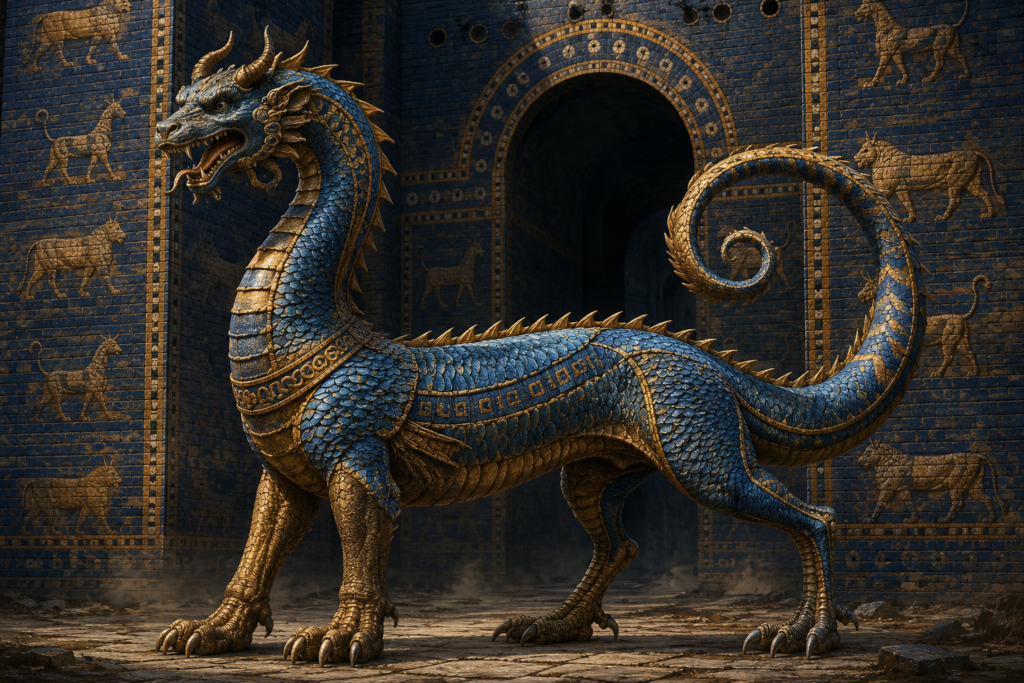
Use this version for a named sirrush with a recognised office, personal history, major temple or royal connection, lair actions, and authority over a significant sacred site.
Huge Dragon, Lawful Neutral
Armor Class 20 (natural armor)
Initiative +5
Hit Points 310 (27d12 + 135)
Speed 50 ft., climb 30 ft.
| STR | DEX | CON | INT | WIS | CHA |
|---|---|---|---|---|---|
| 28 (+9) | 20 (+5) | 22 (+6) | 16 (+3) | 22 (+6) | 21 (+5) |
Saving Throws Str +15, Con +12, Wis +12, Cha +11
Skills Athletics +15, History +9, Insight +12, Intimidation +11, Perception +12, Religion +9
Damage Resistances fire, poison, radiant; bludgeoning, piercing, and slashing from nonmagical attacks
Condition Immunities charmed, frightened, paralyzed, poisoned
Senses darkvision 120 ft., truesight 90 ft., passive Perception 22
Languages Draconic, Celestial, one ancient Mesopotamian language; telepathy 120 ft. within its ward; understands the languages of lawful oaths spoken within its ward
Challenge 18 (20,000 XP)
Proficiency Bonus +6
Traits
Named Ward. The named sirrush is appointed to a specific sacred site: a major temple gate, restored Babylonian gate, royal archive, god-statue chamber, ziggurat court, or consecrated throne approach. While it is within 120 feet of that ward, it gains the following benefits:
- It has advantage on saving throws against effects that would move it, knock it prone, banish it, restrain it, stun it, or force it away from its ward.
- Creatures of the sirrush’s choice treat the ward and the space within 30 feet of it as difficult terrain.
- Once per turn, when a creature the sirrush can see tries to cross the ward without permission, the sirrush can force that creature to make a DC 20 Charisma saving throw. On a failed save, the creature’s movement ends before it crosses. A creature has advantage on the save if it presents legitimate authority, returns stolen sacred property, speaks a true name at the sirrush’s demand, or fulfils the condition of passage.
Oath-Scent. The sirrush knows when a creature within 120 feet is knowingly carrying stolen sacred property from its ward, using a false title to claim authority, or speaking a deliberate lie in response to the sirrush’s direct question. This trait reveals the presence of a violation, not the full truth behind it.
Glazed-Brick Body. The sirrush has advantage on saving throws against being petrified, restrained, or stunned. In addition, it can move through spaces occupied by appropriate sacred reliefs, glazed-brick walls, carved gate images, temple murals, royal inscriptions, or divine boundary stones within its ward as if they were difficult terrain. It cannot end its movement inside solid material.
Divine Standard. While the sirrush is not incapacitated and is visible at its ward, allied guards, priests, lawful servants, summoned defenders, or bound guardians within 120 feet have advantage on saving throws against being charmed or frightened, and they gain a +2 bonus to attack rolls against creatures marked by the sirrush.
Legendary Resistance (3/Day). If the sirrush fails a saving throw, it can choose to succeed instead.
Magic Resistance. The sirrush has advantage on saving throws against spells and other magical effects.
Temple Office. The sirrush cannot be compelled to act against the purpose of its ward by charm, domination, command, geas, or similar magic unless the magic comes from the deity, divine office, or rightful authority that appointed it.
Actions
Multiattack. The sirrush makes four attacks: one Bite attack, two Lion Claw attacks, and one Eagle Talon attack.
Bite. Melee Attack Roll: +15, reach 15 ft., one target. Hit: 28 (3d12 + 9) piercing damage plus 14 (4d6) poison damage. If the target is carrying stolen sacred property from the sirrush’s ward or has lied to the sirrush since the start of the encounter, the target must succeed on a DC 20 Wisdom saving throw or be Marked by the Gate for 1 minute. While marked, the target cannot take the Dash action, cannot benefit from invisibility against the sirrush, and has disadvantage on saving throws against the sirrush’s Voice of the Gate, Judgement Roar, and Sentence of the Temple. The marked creature can repeat the save at the end of each of its turns, ending the effect on itself on a success.
Lion Claw. Melee Attack Roll: +15, reach 10 ft., one target. Hit: 23 (4d6 + 9) slashing damage. If the target is Huge or smaller, it must succeed on a DC 23 Strength saving throw or be grappled. Until this grapple ends, the target is restrained.
Eagle Talon. Melee Attack Roll: +15, reach 10 ft., one target. Hit: 19 (3d6 + 9) slashing damage. If the target is grappled by the sirrush or is within 30 feet of the sirrush’s ward, the sirrush can pull the target up to 20 feet to an unoccupied space closer to the ward.
Voice of the Gate. The sirrush speaks a command of divine authority. Each creature of the sirrush’s choice within 90 feet that can hear it must make a DC 20 Wisdom saving throw. On a failed save, a creature suffers one of the following effects, chosen by the sirrush:
- Halt. The creature’s speed becomes 0 until the end of its next turn.
- Kneel. The creature falls prone and cannot stand until the start of its next turn.
- Return What Was Taken. The creature must drop one object it is holding or carrying that the sirrush recognises as stolen from its ward, unless the object is worn or physically secured.
- Speak Truly. The creature cannot knowingly speak a direct lie until the end of its next turn.
- Withdraw. The creature must use its reaction, if available, to move up to half its speed away from the ward by the safest available route.
On a successful save, the creature is immune to that sirrush’s Voice of the Gate for 24 hours.
Judgement Roar (Recharge 5–6). The sirrush releases a roar that shakes stone, bronze, and oath-bound hearts. Each enemy within 90 feet must make a DC 20 Constitution saving throw. On a failed save, a creature takes 54 (12d8) thunder damage, is knocked prone, and is deafened until the end of its next turn. On a successful save, it takes half as much damage and is not knocked prone or deafened. A creature that is knowingly using a false title, carrying stolen sacred property from the sirrush’s ward, or under the Marked by the Gate effect has disadvantage on this save.
Sentence of the Temple (Recharge 6). The sirrush pronounces judgement on one creature it can see within 90 feet. The target must make a DC 20 Charisma saving throw. On a failed save, the target takes 45 (10d8) radiant or thunder damage, chosen by the sirrush, and is expelled from the sirrush’s ward until the end of its next turn. While expelled in this way, the creature appears in the nearest unoccupied space outside the ward and cannot willingly move closer to the ward. On a successful save, the target takes half as much damage and is not expelled. A creature carrying stolen sacred property from the ward has disadvantage on this save.
Legendary Actions
The named sirrush can take 3 legendary actions, choosing from the options below. Only one legendary action option can be used at a time, and only at the end of another creature’s turn. The sirrush regains spent legendary actions at the start of its turn.
Watch the Threshold. The sirrush makes a Wisdom (Perception) check or moves up to half its speed without provoking opportunity attacks. This movement must end closer to its ward or adjacent to a creature carrying stolen sacred property from its ward.
Talon Drag. The sirrush makes one Eagle Talon attack.
Command Intruder (Costs 2 Actions). The sirrush uses Voice of the Gate against one creature within 90 feet that can hear it.
Glazed-Brick Step (Costs 2 Actions). While within its ward, the sirrush moves up to 90 feet by passing through a sacred relief, glazed-brick wall, carved gate image, temple mural, or royal inscription. This movement does not provoke opportunity attacks, and the sirrush must emerge in an unoccupied space it can see.
Temple Crush (Costs 3 Actions). The sirrush makes one Lion Claw attack. On a hit against a creature already grappled by the sirrush, the attack deals an extra 18 (4d8) bludgeoning damage.
Lair Actions
On initiative count 20, losing initiative ties, the named sirrush can take one lair action while within its ward. It cannot use the same lair action two rounds in a row.
- Blue Brick Seals. Glazed lines flare across the floor. Until initiative count 20 on the next round, creatures of the sirrush’s choice cannot teleport into or out of the ward unless they succeed on a DC 20 Charisma saving throw.
- Tablets Speak. Ancient inscriptions recite names, debts, and offices. Each enemy within 60 feet that can hear the words must succeed on a DC 20 Wisdom saving throw or have disadvantage on Deception checks and saving throws against Voice of the Gate until initiative count 20 on the next round.
- Guardian Reliefs Stir. Relief images of lions, bulls, dragons, or armed temple guards animate briefly. Each enemy of the sirrush’s choice within 30 feet of a wall, statue, gate, or relief must make a DC 20 Dexterity saving throw, taking 22 (4d10) bludgeoning damage on a failed save, or half as much damage on a success.
Notes
- Use case: This version is for a named guardian of a major gate, temple, archive, or divine office.
- Combat role: It is meant to dominate a sacred space, not roam as a wandering dragon.
- Negotiation: The named sirrush should still allow lawful solutions. A valid rite, returned object, exposed false claimant, or oath of passage may matter as much as damage.
Divine Sirrush 5.5e / 2024-Compatible Version
Use this version for a singular divine sirrush: Marduk’s ancient dragon-standard, the guardian of a divine throne, the living witness of a city’s founding, or a mythic judge whose verdict can alter kingship.
Gargantuan Dragon, Lawful Neutral
Armor Class 22 (divine natural armor)
Initiative +6
Hit Points 444 (24d20 + 192)
Speed 60 ft., climb 40 ft.
| STR | DEX | CON | INT | WIS | CHA |
|---|---|---|---|---|---|
| 30 (+10) | 22 (+6) | 26 (+8) | 20 (+5) | 26 (+8) | 24 (+7) |
Saving Throws Str +17, Dex +13, Con +15, Wis +15, Cha +14
Skills Athletics +17, History +12, Insight +15, Intimidation +14, Perception +15, Religion +12
Damage Resistances cold, fire, poison, radiant, thunder; bludgeoning, piercing, and slashing from magical attacks
Damage Immunities bludgeoning, piercing, and slashing from nonmagical attacks
Condition Immunities charmed, deafened, frightened, paralyzed, petrified, poisoned, stunned
Senses darkvision 240 ft., truesight 120 ft., passive Perception 25
Languages all tongues spoken under lawful oath within its ward; telepathy 240 ft. within its ward
Challenge 22 (41,000 XP)
Proficiency Bonus +7
Traits
Divine Ward of Kingship. The divine sirrush is bound to a singular sacred office: Marduk’s ancient dragon-standard, the guardian of a divine throne, the last beast of a lost city’s gate, or the living witness of royal legitimacy. While it is within 1 mile of its ward, it gains the following benefits:
- It cannot be moved, banished, teleported, restrained, stunned, or knocked prone against its will unless it is incapacitated.
- Creatures of the sirrush’s choice treat the ward and the space within 60 feet of it as difficult terrain.
- Once per turn, when a creature the sirrush can see tries to cross the ward without permission, the sirrush can force that creature to make a DC 22 Charisma saving throw. On a failed save, the creature’s movement ends before it crosses, and the creature takes 18 (4d8) thunder damage.
Ancient Oath-Sight. The sirrush knows when a creature within 240 feet is carrying stolen sacred property, using a false title, concealing a broken oath, falsely claiming divine authority, or lying in answer to the sirrush’s direct question. The sirrush knows the nature of the violation, though not every hidden detail behind it.
Blue-Glazed Immortality. If the sirrush is destroyed within its ward, its body collapses into blue-glazed fragments, divine ash, and cuneiform-marked stone. It reforms in 1d10 days unless the ward is ritually released, lawfully transferred, or purified according to the authority that appointed it. Until then, a creature that destroyed the sirrush while knowingly carrying stolen sacred property from the ward is Marked by the Divine Gate.
Divine Standard. While the sirrush is not incapacitated and is visible within its ward, allied guards, priests, lawful servants, summoned defenders, and bound guardians within 240 feet have advantage on saving throws against being charmed, frightened, or stunned, and they gain a +3 bonus to attack rolls and saving throws against creatures marked by the sirrush.
Legendary Resistance (4/Day). If the sirrush fails a saving throw, it can choose to succeed instead.
Magic Resistance. The sirrush has advantage on saving throws against spells and other magical effects.
Office Beyond Command. The sirrush cannot be compelled to act against its divine office by any mortal charm, compulsion, domination, command, bargain, geas, or wish short of direct divine intervention from the power that appointed it.
Actions
Multiattack. The sirrush makes four attacks: one Bite attack, two Lion Claw attacks, and one Eagle Talon attack. It can replace one attack with Voice of the Divine Gate, if available.
Bite. Melee Attack Roll: +17, reach 20 ft., one target. Hit: 36 (4d12 + 10) piercing damage plus 21 (6d6) poison damage. If the target is carrying stolen sacred property from the sirrush’s ward, using a false title, or has lied to the sirrush since the start of the encounter, the target must succeed on a DC 22 Wisdom saving throw or be Marked by the Divine Gate for 1 minute. While marked, the target cannot take the Dash action, cannot benefit from invisibility or teleportation against the sirrush, and has disadvantage on saving throws against the sirrush’s Voice of the Divine Gate, Judgement Roar, and Sentence of Kingship. The marked creature can repeat the save at the end of each of its turns, ending the effect on itself on a success.
Lion Claw. Melee Attack Roll: +17, reach 15 ft., one target. Hit: 31 (6d6 + 10) slashing damage. If the target is Gargantuan or smaller, it must succeed on a DC 25 Strength saving throw or be grappled. Until this grapple ends, the target is restrained, and the sirrush can move the grappled target with it without its speed being halved.
Eagle Talon. Melee Attack Roll: +17, reach 15 ft., one target. Hit: 27 (5d6 + 10) slashing damage. If the target is grappled by the sirrush or is within 60 feet of the sirrush’s ward, the sirrush can pull the target up to 30 feet to an unoccupied space closer to the ward.
Voice of the Divine Gate. The sirrush speaks with the authority of a god’s threshold. Each creature of the sirrush’s choice within 120 feet that can hear it must make a DC 22 Wisdom saving throw. On a failed save, a creature suffers one of the following effects, chosen by the sirrush:
- Halt. The creature’s speed becomes 0 until the end of its next turn.
- Kneel. The creature falls prone, cannot stand until the start of its next turn, and drops any symbol of false authority it is holding.
- Return What Was Taken. The creature must drop one object it is holding or carrying that the sirrush recognises as stolen from the ward, unless the object is worn or physically secured.
- Speak Truly. The creature cannot knowingly speak a direct lie for 1 minute. It can repeat the saving throw at the end of each of its turns, ending the effect on itself on a success.
- Depart Unworthy. The creature must use its reaction, if available, to move up to its speed away from the ward by the safest available route.
On a successful save, the creature is immune to that sirrush’s Voice of the Divine Gate for 24 hours.
Judgement Roar (Recharge 5–6). The sirrush releases a roar that shakes stone, bronze, inscriptions, and oath-bound souls. Each enemy within 120 feet must make a DC 22 Constitution saving throw. On a failed save, a creature takes 72 (16d8) thunder damage, is knocked prone, is deafened for 1 minute, and cannot teleport until the end of its next turn. On a successful save, it takes half as much damage and is not knocked prone, deafened, or teleport-blocked. A creature that is knowingly using a false title, carrying stolen sacred property from the sirrush’s ward, or under the Marked by the Divine Gate effect has disadvantage on this save.
Sentence of Kingship (Recharge 6). The sirrush pronounces judgement on one creature it can see within 120 feet. The target must make a DC 22 Charisma saving throw. On a failed save, the target takes 66 (12d10) radiant or thunder damage, chosen by the sirrush, and is expelled from the sirrush’s ward, appearing in the nearest unoccupied space outside the ward. Until the end of the target’s next turn, it cannot willingly move closer to the ward, teleport into the ward, or command another creature to enter the ward on its behalf. On a successful save, the target takes half as much damage and is not expelled.
Legendary Actions
The divine sirrush can take 4 legendary actions, choosing from the options below. Only one legendary action option can be used at a time, and only at the end of another creature’s turn. The sirrush regains spent legendary actions at the start of its turn.
Watch All Gates. The sirrush makes a Wisdom (Perception) check or moves up to half its speed without provoking opportunity attacks. This movement must end closer to its ward or adjacent to a creature carrying stolen sacred property from its ward.
Talon Drag. The sirrush makes one Eagle Talon attack.
Command Intruder (Costs 2 Actions). The sirrush uses Voice of the Divine Gate against one creature within 120 feet that can hear it.
Glazed-Brick Step (Costs 2 Actions). While within its ward, the sirrush moves up to 120 feet by passing through a sacred relief, glazed-brick wall, carved gate image, temple mural, royal inscription, god-statue, or boundary stone. This movement does not provoke opportunity attacks, and the sirrush must emerge in an unoccupied space it can see.
Crush the Usurper (Costs 3 Actions). The sirrush makes one Lion Claw attack. On a hit against a creature under Marked by the Divine Gate, the attack deals an extra 27 (6d8) radiant or thunder damage, chosen by the sirrush.
Lair Actions
On initiative count 20, losing initiative ties, the divine sirrush can take one lair action while within its ward. It cannot use the same lair action two rounds in a row.
The Gate Refuses. Until initiative count 20 on the next round, enemies of the sirrush cannot willingly cross the ward unless they succeed on a DC 22 Charisma saving throw. A creature that fails this save takes 18 (4d8) thunder damage and remains outside the ward.
Inscriptions Accuse. Ancient names and records blaze across the walls. Each enemy within 120 feet must make a DC 22 Wisdom saving throw. On a failed save, the creature cannot benefit from invisibility, disguise, false identity, or magical concealment against the sirrush until initiative count 20 on the next round.
Reliefs Become Guardians. Images of lions, bulls, dragons, and armed temple servants strike from walls and columns. Each enemy of the sirrush’s choice within 60 feet of a wall, statue, gate, or relief must make a DC 22 Dexterity saving throw, taking 33 (6d10) bludgeoning damage on a failed save, or half as much damage on a success.
Law Becomes Weight. The air around the ward grows heavy with divine command. Until initiative count 20 on the next round, enemies of the sirrush within 120 feet cannot take reactions unless they succeed on a DC 22 Wisdom saving throw at the start of their turn.
Regional Effects
The region within 6 miles of the divine sirrush’s ward is altered by its sacred office. These effects end 1d10 days after the sirrush is destroyed or ritually released from its ward.
False Titles Sour. Forged writs, false seals, counterfeit royal claims, and fraudulent temple documents become difficult to use. Checks made to pass such documents as legitimate have disadvantage within the region.
Stolen Sacred Goods Grow Heavy. A creature knowingly carrying stolen sacred property from the ward feels its burden increase. Such items count as twice their normal weight, and the bearer has disadvantage on Dexterity (Stealth) checks while carrying them.
Gates Remember Names. Old gates, sealed doors, and boundary stones sometimes whisper the names of those who pass. Creatures using false identities near major thresholds feel watched and may be revealed by dreams, omens, or temple divination.
Notes
- Use case: This version is for a singular divine sirrush, not an ordinary member of the creature type.
- Campaign weight: Its defeat, judgement, or release should change the legal, royal, sacred, or political state of a region.
- Not just stronger: A divine sirrush should have a named office, a divine history, and a ward whose meaning matters to the campaign.
- Breath weapon equivalent: The divine sirrush does not use a conventional dragon breath weapon. Its Judgement Roar and Voice of the Divine Gate fill that role as sacred area powers of command, judgement, and divine authority.
Treasure and Remains
A sirrush does not keep a hoard in the manner of a greedy dragon. Anything found under its protection belongs to a temple, a god, a royal archive, a city gate, or an ancient legal office. Taking such treasure is not ordinary looting; it is theft from a sacred jurisdiction.
Useful treasure near a sirrush includes sealed clay tablets, lapis-inlaid bricks, bronze gate fittings, royal seals, temple bowls, god-statue ornaments, votive weapons, treaty cylinders, incense vessels, carved boundary stones, ceremonial maces, and crowns or sceptres tied to disputed rulership.
For a high-tier encounter, use treasure that creates decisions rather than a simple payout. A single tablet may prove that a modern ruler’s claim is false. A bronze gate key may open a buried archive but also mark the bearer as a trespasser. A lapis-blue dragon brick may be worth a fortune to collectors, yet removing it may awaken the sirrush again in another place.
Example Treasure
- Tablet of Sealed Tribute: A clay tablet recording tribute owed to a dead city, still magically binding on any ruler who claims that city’s name.
- Lapis Dragon Brick: A blue-glazed brick bearing the image of the mušḫuššu. It is worth much as art, but dangerous if stolen from its original gate.
- Bronze Gate Pin: A heavy hinge-pin or lock-rod from a consecrated gate. When properly installed, it can seal a doorway against spirits, oathbreakers, or creatures named in a formal warding rite.
- Seal of the False King: A royal cylinder seal used to impersonate a divine mandate. The sirrush may demand its destruction rather than allow it to be sold.
- Archive of Names: Tablets listing sworn names, treaties, bloodlines, debt records, temple offices, and forbidden contracts from the old city.
Harvested Remains
If slain, a sirrush may leave behind horn, crest-bone, scale plates, lion-claw sheaths, eagle talons, venom sacs, and fragments of glazed hide that still shine like blue brick. Its heart may harden into a fist-sized stone marked with divine signs.
- Glazed Sirrush Scale: Can be set into a door, shield, or seal-stone to strengthen wards against trespassers. It is especially useful in magic that distinguishes invited guests from intruders.
- Eagle Talon of the Gate: Used in hooks, clasps, manacles, and threshold charms. It suits magic that holds, drags, pins, or prevents escape across a named boundary.
- Lion-Claw Sheath: A component for weapons or gauntlets intended to restrain rather than merely wound. It is prized by temple guards, oath-enforcers, and royal wardens.
- Horn of Divine Challenge: Can be carved into a horn, sceptre-tip, or judgement token. When used in a formal rite, it helps expose false titles, forged authority, and unlawful claims.
- Heart-Stone of the Sirrush: A rare remains-object that tests authority rather than morality. It grows warm near lawful mandate, cold near usurpation, and painfully hot in the hand of someone knowingly carrying stolen sacred property.
Harvesting these remains should not be treated as simple butchery. The creature may have been a divine servant, temple guardian, or living legal instrument. Removing its parts without purification can bring legal pursuit, temple wrath, curses of false authority, or the attention of the god whose boundary it guarded.
Consequences of Killing a Sirrush
A sirrush can be killed in lawful defence, but the killing still matters. If the creature attacked innocent travellers without cause, slaying it may be judged necessary. If it was defending a temple gate against thieves, the killers may have committed sacrilege. If it refused entry to a ruler, killing it may be treated as an attempt to silence divine judgement.
The strongest consequence is not automatic punishment. It is uncertainty. Who appointed the sirrush? What was it guarding? Was the party trespassing, liberating, exposing, or stealing? Did the creature recognise a false title because it served truth, or because it served an older tyranny?
Possible consequences include temple claims against the party, disputed ownership of recovered treasures, a curse attached to stolen tablets, royal agents seeking the remains, cultists trying to revive the guardian, or a divine sign that the ward it guarded is now open to worse things.
Adventure Hooks
The Stolen Dragon Brick
A noble collector has bought a blue-glazed Babylonian relief showing a horned dragon. Since its arrival, servants refuse to cross the gallery after dusk, contracts signed in the house turn strangely binding, and thieves are found crushed against locked doors. The relief is not cursed. It is homesick, watchful, and still on duty.
The Gate Opens for No King
A ruler claims descent from an ancient imperial line and orders an old Mesopotamian gate restored as proof of divine favour. On the night of the dedication, the sirrush steps from the wall and refuses him entry. The court wants the monster slain. The priests want the judgement heard. The ruler wants witnesses silenced.
The Archive Beneath the Processional Road
Buried tablets beneath a ruined ceremonial road record treaties, oaths, bloodlines, and forbidden names older than the current kingdoms. A sirrush guards the descent. It will permit entry only to those who swear not to alter the tablets, not to sell them, and not to use them to crown a false king.
Source and Mythic Context
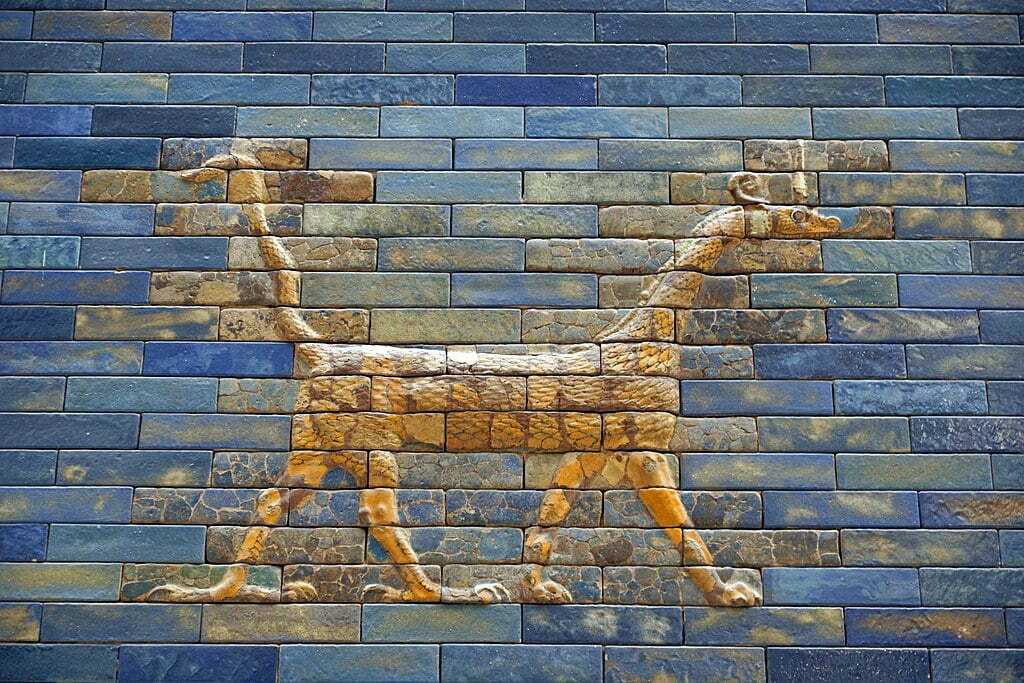
The sirrush is rooted in the ancient Mesopotamian dragon known more accurately as the mušḫuššu. The older reading Sirrush survives in fantasy, cryptid, and older popular material, but Mušḫuššu is the stronger modern scholarly form. The creature is one of the most recognisable hybrid beasts of Babylonian art and divine iconography.
The mušḫuššu is especially famous from the Ishtar Gate of Babylon, constructed under Nebuchadnezzar II in the Neo-Babylonian period. The Ishtar Gate used blue-glazed brick and rows of divine animal figures, including mušḫuššu dragons, bulls, and lions. Museum material identifies the mušḫuššu as a protective animal figure from the gate and as a divine creature associated with Marduk, the main god of Babylon.
The gate’s imagery was not neutral decoration. The animal figures proclaimed divine presence, sacred order, and royal legitimacy. World History Encyclopedia identifies the mušḫuššu on the Processional Way as the symbol of Marduk and places it in the Neo-Babylonian period under Nebuchadnezzar II.
In monster design, the hybrid anatomy should carry meaning. The serpent body suggests old chthonic and draconic force. The lion forelegs give royal strength and crushing authority. The eagle talons make the creature a divine hunter and seizer. The horned head and crest mark it as more than animal. Together, these features make the sirrush a sacred composite: not a random beast, but a visible grammar of kingship, divine protection, and guarded passage.
For game use, preserve that identity. The sirrush should not become a generic dragon with Mesopotamian ornaments. Its strongest role is as a guardian-sign: a creature whose body, law, and violence all declare that some gates are not merely physical entrances, but sacred claims.
Keep this reference growing
If this page helped with your reading or game, you can support its upkeep or explore the curated books.
Explore the Bookshop — epics, classics and stories behind imagined worlds.