
Asgardian Pantheon • Æsir
Týr — One-Handed God of Courage, Battle & Oath
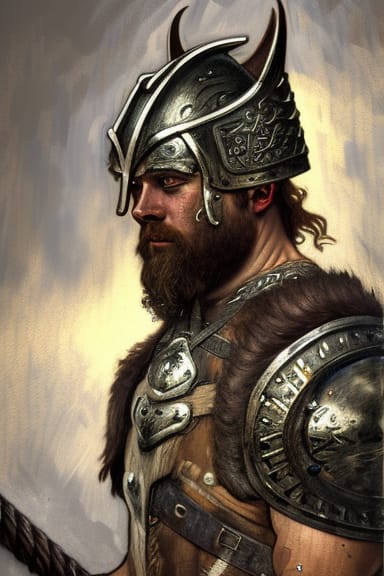
Týr is the god who pays the price of the oath. He is daring, wise and strongly associated with victory in battle. When Fenrir demanded a pledge before allowing Gleipnir to be placed upon him, Týr alone put his hand in the wolf’s mouth. The gods broke the promise to release Fenrir; Týr lost his hand. That act makes him more complicated than a generic god of “justice”: he embodies courage, victory, binding agreements and the terrible cost of accepting responsibility for necessary betrayal.
Týr at a Glance
| Divine clan | Æsir |
|---|---|
| Divine status | Greater deity; Divine Rank 18 in the legacy divine build |
| Alignment | Lawful Good in the current campaign tradition |
| Parentage | Snorri calls him a son of Odin; Hymiskviða presents the giant Hymir as his father |
| Titles | One-Handed God, Fosterer of the Wolf, God of Battles |
| Major concerns | Courage, battle, victory, oaths, binding agreements, responsibility, sacrifice and lawful order |
| Domains | War, Order, Knowledge, Protection and Good; older game traditions add Law, Retribution, Inquisition and Wrath |
| Favoured weapon | Longsword; victory-runes on sword hilts invoke Týr in Sigrdrífumál |
| Maiming | Right hand lost in Fenrir’s jaws when Gleipnir proved unbreakable |
| Current concern | The integrity of Fenrir’s binding and the oaths surrounding it |
| Foretold fate | At Ragnarök, Týr and Garm fight and kill one another |
Divine Mechanics
Týr in Play
Týr’s mechanics reward declared terms, accepted risk and victory purchased through personal cost. He is formidable with a sword, but his defining abilities are the ones where he willingly suffers damage, gives up advantage or places himself in danger to make an oath, restraint or battlefield promise hold.
Týr — 5.5e / 2024
Granted Domains & Spells
| Spell Level | Týr-Granted Spells |
|---|---|
| 1st | compelled duel, shield of faith |
| 2nd | zone of truth, warding bond |
| 3rd | crusader’s mantle, dispel magic |
| 4th | death ward, freedom of movement |
| 5th | geas, hold monster |
| 6th | forbiddance, true seeing |
| 7th | divine word, symbol |
| 8th | holy aura, power word stun |
| 9th | foresight, imprisonment |
Týr, the One-Handed God
Medium Celestial (Deity), Lawful Good · Greater Deity, Divine Rank 18 · CR 45 (epic; beyond the core CR table) · PB +13
Armor Class 31 (divine resilience)
Hit Points 1,140 (60d8 + 870)
Speed 60 ft.
| STR | DEX | CON | INT | WIS | CHA |
|---|---|---|---|---|---|
| 40 (+15) | 26 (+8) | 40 (+15) | 34 (+12) | 40 (+15) | 34 (+12) |
Saving Throws Str +28, Dex +21, Con +28, Int +25, Wis +28, Cha +25
Skills Athletics +28, Insight +28, Intimidation +25, Perception +28, Persuasion +25, Religion +25
Damage Resistances cold, fire, lightning, radiant; bludgeoning, piercing and slashing
Damage Immunities poison
Condition Immunities charmed, exhaustion, frightened, poisoned
Senses truesight 240 ft., passive Perception 38
Languages all languages; telepathy 1 mile
Divine Traits
Divine Nature. Týr requires no air, food, drink or sleep. He does not age.
Greater Deity — Divine Rank 18. Lower-rank effects cannot permanently strip Týr of his divine nature, sever his bond to oaths or restore the hand sacrificed to Fenrir unless Týr himself accepts the restoration.
Legendary Resistance (6/Day). If Týr fails a saving throw, he can choose to succeed instead.
Magic Resistance. Týr has Advantage on saving throws against spells and magical effects.
Týr-Valiant. Týr is immune to Frightened. Allies of his choice within 60 feet have Advantage on saving throws against Frightened and effects that would force them to abandon an oath, post or declared duty.
One-Handed God. Týr cannot use a shield or two-handed weapon, but suffers no penalty for fighting one-handed. He cannot be disarmed by a creature of lower divine rank.
Victory Rune. At the start of each round Týr marks one ally or himself with the T-rune. The marked creature gains Advantage on its first attack roll that round and adds 18 Force damage to the first hit.
Divine Immortality. Reducing Týr to 0 Hit Points defeats his present body but does not permanently destroy him without a valid divine-death condition. His foretold mutual death with Garm can satisfy such a condition.
Divine Spellcasting
Týr casts spells using Wisdom (spell save DC 36, +28 to hit with spell attacks). He requires no Material components.
At Will: any Cleric or Týr-granted spell of 5th level or lower.
3/Day Each: any Cleric or Týr-granted spell of 6th–8th level.
1/Day Each: any Cleric or Týr-granted spell of 9th level.
Actions
Multiattack. Týr makes four Divine Longsword attacks.
Divine Longsword. Melee Attack Roll: +28 to hit, reach 10 ft., one target. Hit: 34 (3d12 + 15) Slashing damage plus 36 (8d8) Radiant damage. If the target has broken an oath, escaped a restraint or violated declared terms since the end of Týr’s last turn, the attack deals an extra 36 (8d8) Force damage.
Gleipnir’s Terms (Recharge 5–6). Týr names one simple condition the target must accept to avoid restraint—such as “remain here,” “drop the weapon,” or “speak truthfully.” One creature within 120 feet chooses either to accept the condition until the end of Týr’s next turn or make a DC 36 Charisma saving throw. On a failed save, spectral Gleipnir binds it: the creature is Restrained, cannot teleport or change planes, and takes 55 (10d10) Force damage. It repeats the save at the end of each turn, ending the effect on a success.
Rune of Victory (Recharge 4–6). Up to six allies Týr can see within 120 feet may immediately move up to half their Speed and make one weapon attack as a Reaction. A creature that hits this way deals an extra 22 (4d10) Radiant damage.
Judgment After Battle (1/Day). Týr chooses one creature he can see within 120 feet that has knowingly broken a sworn oath since its last Long Rest. The target makes a DC 36 Charisma saving throw, taking 110 (20d10) Radiant damage on a failure or half as much on a success. On a failed save it is also unable to knowingly speak a lie for 24 hours.
Bonus Action
Declare the Terms. Týr names one visible enemy and one clear combat condition—single combat, hold this line, no retreat, protect that creature, or similar. Until the start of Týr’s next turn, Týr and that enemy each deal an extra 18 damage to the other, and neither can gain Advantage from an ally’s Help action against the other.
Reaction
Hand in the Wolf’s Mouth. When a creature Týr can see within 120 feet succeeds on a check or saving throw to escape a grapple, restraint, binding, oath or magical compulsion, Týr may take 45 damage that cannot be reduced or prevented. The creature rerolls the d20 and must use the new result. If it now fails, it cannot attempt to end that same effect again until the end of its next turn.
Legendary Actions — 4 Uses
- Fearless Advance. Týr moves up to half his Speed without provoking Opportunity Attacks.
- Divine Longsword. Týr makes one Divine Longsword attack.
- Victory Rune (Costs 2 Uses). One ally within 120 feet gains Advantage on its next attack roll and saving throw before the end of its next turn.
- Pay the Price (Costs 2 Uses). Týr takes 30 unavoidable damage; one ally within 120 feet automatically succeeds on a saving throw it just failed.
- Terms Become Law (Costs 3 Uses). One creature affected by Gleipnir’s Terms automatically fails its next saving throw to end that effect unless it is a deity of equal or greater rank.
Justicar — Campaign Artifact
The legacy rules give Týr a named longsword, Justicar. No such weapon is securely attested in the surviving Norse sources, so it remains a campaign artifact rather than being presented as inherited mythology.
- Weapon (longsword), Artifact. +5 bonus to attack and damage rolls.
- Deals an extra 4d8 Radiant damage and 4d8 Force damage to a creature that has broken a sworn oath within the last day.
- A creature struck by Justicar must succeed on a DC 36 Charisma save or be unable to knowingly speak a lie until the next dawn.
- Týr cannot be disarmed of Justicar by a creature of lower divine rank.
Týr — Pathfinder 1e
Divine Package
- Divine Status: Greater Deity
- Divine Rank: 18
- Alignment: Lawful Good
- Areas of Concern: courage, battle, victory, oaths, sacrifice and lawful order
- Domains: Good, Knowledge, Law, Protection, War
- Suggested Subdomains: Honor, Tactics, Judgment, Defense
- Favored Weapon: longsword
Týr, One-Handed Lord of Victory
CR 43 / MR 10 · LG Medium outsider (extraplanar, good, lawful, mythic) · Greater Deity, Divine Rank 18 — SpiralWorlds deity overlay
Init +18; Senses truesight 240 ft., Perception +66
Aura Týr-valiant 1,800 ft. (Will DC 40)
AC 77, touch 58, flat-footed 69
hp 1,140
Fort +63, Ref +56, Will +65
DR 35/epic and chaotic; SR 60
Speed 60 ft.
Melee +5 holy axiomatic longsword +86/+81/+76/+71 (1d8+35/17–20 plus 6d6 holy and 6d6 lawful)
Space 5 ft.; Reach 5 ft.
Str 40, Dex 26, Con 40, Int 34, Wis 40, Cha 34
Mythic Power 10/day; Surge +1d12.
Divine Abilities
Týr-Valiant (Ex). Týr is immune to fear. Allies within his divine aura gain a +8 morale bonus on saves against fear and effects that force retreat.
Victory Rune (Su). At the start of each round Týr grants one creature within 120 feet a +8 luck bonus on its first attack roll and damage roll that round.
Hand in the Wolf’s Mouth (Su). As an immediate action when a creature within 120 feet succeeds on a save or check to escape restraint or compulsion, Týr may take 50 points of unavoidable damage to force a reroll.
Gleipnir’s Terms (Su). By expending one use of mythic power, Týr subjects one creature within 120 feet to a binding effect equivalent to binding; Will DC 49 negates. Teleportation and planar travel fail while the effect lasts.
Divine Immortality (Ex). Týr does not age and need not eat, drink, sleep or breathe. Defeating his current body does not permanently destroy him without a valid divine-death condition.
Spell-Like Abilities
CL 28th; concentration +40; save DC 40 + spell level. Good and Law domain effects function at CL 29th.
Constant: discern lies, true seeing
At Will: compelled duel, detect chaos, dispel magic, mark of justice, shield of faith, zone of truth
3/Day: forbiddance, geas/quest, greater dispel magic, holy aura, imprisonment
1/Day: foresight, miracle, symbol of justice
Mythic/Divine Techniques
Rune of Victory (Su). By expending one use of mythic power, up to six allies within 120 feet may move up to half their speed and make one weapon attack as an immediate action.
Pay the Price (Su). Týr may take 30 unavoidable damage to allow one ally within 120 feet to reroll a failed saving throw with a +8 sacred bonus.
Judgment After Battle (Su). A creature that knowingly broke a sworn oath within the last day takes 20d10 sacred damage, Will DC 49 half, and on a failed save is affected by zone of truth for 24 hours.
Týr — D&D 3.5e
The large Dicefreaks-derived Divine Rank 18 build is retained as the edition-specific legacy rules package. Its justice bureaucracy and named artifact are game-setting developments, not presented here as direct Eddic evidence.
| Týr | |
| paladin of Honor 30/Cleric 20/Justicar 10 | |
| Medium outsider (good, lawful) | |
| Divine Rank | 18 |
| Hit Dice | 30d10 (paladin) +10d8 (justicar) +20d8 (cleric) plus 600 (1,140 hp) |
| Initiative | +11 (+7 Dexterity +4 Improved Initiative) |
| Speed | 60 ft. (12 squares) |
| Armor Class | 81 (+7 Dexterity, +18 divine, +33 natural, +13 deflection), touch 48, flat-footed 74 |
| Base Attack/Grapple |
+40/+53 |
| Attack | *Justicar +88 melee (1d8+41 +3d6 axiomatic and 1 negative level +3d6 holy and 1 negative level/17-20, always inflicts maximum damage 49 points, 18 axiomatic, and 18 holy); or spell +71 melee touch or +65 ranged touch. *always receives a 20 on attack rolls; roll die for critical check |
| Full Attack | * Justicar +88/+83/+78/+73 melee (1d8+41 +3d6 axiomatic and 1 negative level +3d6 holy and 1 negative level/17-20, always inflicts maximum damage 49 points, 18 axiomatic, and 18 holy); or by spell. *always receives a 20 on attack rolls; roll die for critical check |
| Space/Reach | 5ft./5 ft. |
| Special Attacks | Domain powers, salient divine abilities, spell-like abilities, spells, smite evil 6/day, remove disease 9/week, deadly touch, turn undead 16/day |
| Special Qualities | Divine aura (18 miles, DC 41), divine immunities, DR 35/epic and chaotic, acid/cold/electricity immunity, fire resistance 23, godly realm (100 miles outer plane, 1,800 ft. Material Plane), greater teleport at will, plane shift at will, remote communication, SR 50, speak, and read all languages and speak directly to all beings within 18 miles, |
| Saves | * Fort +73, Ref +64, Will +76 *always receives 20 on saves |
| Abilities | Strength 36, Dexterity 24, Constitution 30, Intelligence 37, Wisdom 48, Charisma 36 |
| Skills | * Concentration +91, Diplomacy +102, Handle Animal+46, Heal +90, Knowledge (Arcana) +84,Knowledge (history) +84, Knowledge (local) +87, Knowledge (nobility) +71, Knowledge (the planes) +94, Knowledge (religion)+94, Listen +58, Profession (judge) +110, Ride+42, Search +57, Sense Motive +70, Spellcraft +98, Spot +63 |
| Feats | Cleave, Combat Reflexes, Empower Spell, Great Cleave, Power Attack, Quicken Spell, Still Spell, Weapon Focus (long sword) (B) |
| Epic Feats | Automatic Quicken Spell(x3), Chain Spell, Devastating Critical (long sword), Enhance Spell, Epic Spellcasting, Epic Weapon Focus (long sword)(B), Great Smiting(B), Improved Critical (long sword), Improved Initiative, Improved Sunder, Intensify Spell, Maximize Spell, Overwhelming Critical (long sword), Planar Turning(B), Purify Spell, Twin Spell |
| Environment | Valhalla |
| Organization | Unique |
| Challenge Rating | 62 |
| Treasure | Justicar |
| Alignment | Lawful Good |
| Advancement | — |
| Level Adjustment | — |
– Alter Reality: Týr can use the wish spell with regard to his portfolio, save for the replication of other spells. This ability costs Týr no XP, and requires a standard action to implement. As a free action 18/day, for one round at a time, Týr may add +13 to his weapon damage, he may instead add +13 to his caster level.
-Domain Powers: Cast good and law spells at +1 caster level, +4 bonus on dispel checks. Once per day if struck in combat may inflict maximum damage to his attacker on the next hit. Once per day Týr may make an attack of opportunity against any enemy that strikes him in melee combat.
– Divine Immunities: Ability damage, ability drain, cold, death effects, disease, disintegration, energy drain, fire, mind-affecting effects, Paralysis, poison, sleep, stunning, transmutation, imprisonment, banishment.
– Salient Divine Abilities: Area Divine Shield, Call Creature (lawful celestials), Control Creatures (lawful celestials), Create Object, Create Greater Object, Divine Blast, Divine Creation, Divine paladin, Divine Shield, Divine Skill Focus (judge), Divine Spellcasting, Divine Weapon Focus (long sword), Divine Weapon Specialization (long sword), Extra Domain (War), Extra Domain (Wrath), Judge the Divine, Know Secrets, Mass Divine Blast, Lay Quest, Overlord (lawful celestials), Possess Mortal, Power of Truth, Increased Damage Reduction
– Spell-Like Abilities: Týr uses these divine domain abilities at caster level 28th, except for Good and Law spells, which function at caster level 29th. The save DCs are 40 + spell level. affliction, aid, banishment, bear’s endurance, blade barrier, calm emotions, detect chaos, detect lies, detect thoughts, dictum, discern location, dispel chaos, Dispel Evil, divine power, doom, energize potion, fire shield, flame strike, geas/quest, greater sword and hammer, Hold monster, holy aura, holy smite, Holy word, imprisonment, last judgment, Magic Circle Against Chaos, magic circle against evil, magic vestment, magic weapon, mark of justice, order’s wrath, power word blind, power word stun, power word kill, protection from chaos, protection from evil, radiant shield, Righteous Might, righteous smite, shield of faith, Shield of law, speak with dead, spell turning, Spiritual Weapon, storm of vengeance, summon monster IX, sword and hammer, true seeing, vengeance halo, zone of truth
–detect evil (Sp): At will, Týr can detect evil
–Smite Evil (Su): Six times per day, Týr can smite an evil enemy. He gains a +13 bonus to hit, and inflicts +150 damage.
-Smite Anarchy (Su): Thrice per day, Týr can smite a chaotic enemy. He gains a +13 bonus to hit, and inflicts +20 damage.
-Lay on Hands (Su): Týr may use his touch to heal up to 390 points of damage to an ally, he may also instead 390 points of damage to an undead creature.
-Aura of Courage (Su): The Just God is immune to fear and radiates an aura of courage, giving a +8 bonus on morale saves for all allies within 100 feet.
-Turn undead (Su): Sixteen times per day, Týr may turn undead as a 47th level cleric
–Cure Disease (Sp): Nine times per week, he may inflict disease with his touch per the cure disease spell
Bureaucratic Knowledge (Ex) Týr receives a +10 bonus on his Knowledge and Gather Information checks whenever they are related to laws or legal proceedings. He also gains the bonus on any Charisma based skill to argue legal matters.
Maimed God’s Boon (Su): Týr receives a +13 bonus on all saving throws against spells with the chaotic descriptor or against spell-like or supernatural abilities of chaotic outsiders.
Order’s Calm (Su): Once per day with a touch, Týr may negate the following effects: heroism, rage, symbol of insanity, any fear effect, or a barbarian’s rage ability. The target receives a Will save (DC: 28 ) to avoid the effect
Aura of Absolute Law(Su): Týr is surrounded by a constant dispel chaos effect at all times. Driving a chaotic outsider back to its home plane or dispelling a chaotic enchantment spell temporarily discharges and ends the effect, but Týr may reactivate it as a free action on his next turn.
Judge the Divine (unique SDA): Týr is considered the judge and to an extent guide of the other gods. While within the divine moot and holding the gathering of Greater Powers, his will is usually accepted. To these ends he receives a bonus of +28 (10+his divine rank) to the following skills within the divine moot-Diplomacy, Intimidate, Knowledge (any), Profession (judge), Sense Motive, and Spot.
– Spells: As a 30th level cleric and 15th level paladin of honor, 31st and 16th for law or good spells.
– Cleric Spells/Day (Levels 0-19 ): 6/10/10/10/9/9/9/9/7/7/4/4/3/3/3/3/2/2/2/2; base DC = 30 + spell level, or 31+spell level for law spells
–Paladin Spells/Day (Levels 1-19): 9/9/9/8/5/5/5/5/4/4/4/4/3/3/3/3/2/2/2/2; base DC: 30 + spell level, or 31+spell level for law spells
– Possessions: Týr carries Justicar, a +10 axiomatic, holy, vorpal, long sword; it also has all the powers of an holy devastator and a mace of ruin. Anyone struck by Justicar must speak the truth for the next 18 hours. (Will save DC: 65) (Caster Level: 25th, Weight: 6 lb.). Týr also wears an adamantine band around his right wrist. It acts as a ring of adamant law and virtuous good.
Other Divine Powers
- As a greater deity, Týr uses the legacy divine-rank rule and receives the best possible result on any die roll he makes (including attack rolls, damage, checks, and saves). He is immortal.
- Senses: Týr can see (using normal vision or Low-Light Vision), hear, touch, and smell at a distance of eighteen miles. As a standard action, he can perceive anything within eighteen miles of his worshipers, holy sites, objects, or any location where one of his titles or name was spoken in the last hour. He can extend his senses to up to twenty locations at once. He can block the sensing power of deities of his rank or lower at up to two remote locations at once for 18 hours.
- Portfolio Sense: Týr senses any injustice eighteen tendays before it happens and retains the sensation for eighteen tendays after the event occurs.
- Automatic Actions: Týr can use Knowledge (arcane), Knowledge (history), Knowledge (local), Knowledge (nobility), Knowledge (planes), Knowledge (religion), or Profession (judge) as a free action if the DC for the task is 30 or lower. He can perform up to twenty such free actions each round.
- – Create Magic Items: Týr can create any kind of magical arms or armor or any magic item that confers the ability to cut through illusions and lies.
Campaign Present
What Is Týr Doing Now?
Týr remains one of the gods most concerned with Fenrir. The missing hand is not an old wound he has forgotten; it is the continuing price of the binding. He inspects the oaths around Gleipnir, watches for attempts to reinterpret their wording, and opposes any scheme that claims the original betrayal makes every later restraint invalid.
He also appears where victory and obligation collide. A ruler may be legally entitled to abandon an ally and still earn Týr’s contempt. A warrior may break a lesser command to preserve the oath that truly matters. Týr’s law is therefore not bureaucracy for its own sake. It asks who gave the word, what was promised, who paid the cost, and whether the person demanding obedience accepts any risk themselves.
In Midgard, Týr is invoked before dangerous single combat, sworn military service, judicial ordeals and agreements where both parties must place something real at stake. Priests who invoke him while accepting no consequence for being wrong are treated as frauds.
The Hand in Fenrir’s Mouth
Fenrir had broken every ordinary fetter. When the gods brought out Gleipnir, the wolf recognised that the ribbon-like bond was dangerous and demanded proof that the gods intended to release him after the test. One god had to put a hand in his mouth as a pledge.
Týr did it. He knew what the others intended. When Fenrir could not break Gleipnir and the gods refused to release him, the wolf bit off Týr’s hand. The other gods laughed at their success; Týr did not.
This is not a simple story about perfect honesty. The gods deceive Fenrir, and Týr participates in that deception while accepting the personal cost that makes it possible. His cult therefore distinguishes between truthfulness and responsibility for a necessary breach. Someone who breaks an oath and makes another person pay the price has learned nothing from Týr.
Victory, Wisdom & the T-Rune
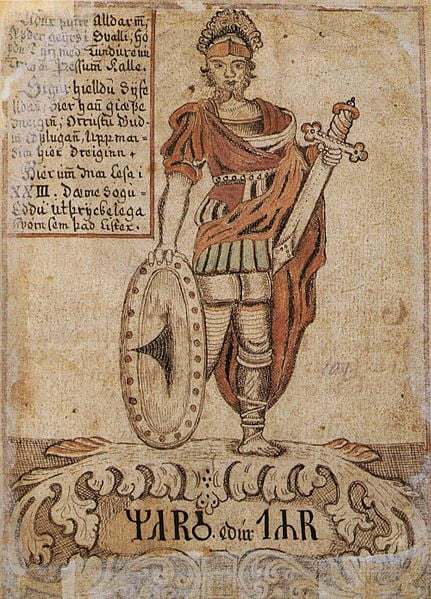
Gylfaginning calls Týr exceptionally daring and says he has great authority over victory in battle. “Týr-valiant” is a proverb for someone who does not waver, and “Týr-prudent” for someone wise. Sigrdrífumál tells warriors seeking victory to carve winning-runes on the sword and call on Týr twice.
That is a stronger foundation than treating him merely as a courtroom god. Judgment and law belong naturally to his campaign cult, but his older identity remains martial, courageous and bound to the consequences of an oath made under danger.
Living Worship
Týr is honoured by warriors, champions, judges, oath-witnesses, military officers, guards and communities that need agreements to survive dangerous conditions. His shrines often stand near assembly places, barracks, bridges, frontier gates or fields used for formal combat.
Offerings
Broken sword-hilts after an oath is fulfilled, written agreements with both parties’ marks, the first share of a victory feast, blood freely given rather than taken, and tools used by someone who accepted responsibility for failure.
Signs of Favour
A sword-rune remains bright after rain, a frightened fighter’s hand stops shaking, an oath-witness remembers exact wording at the critical moment, or a restraint holds one instant longer than it should.
Signs of Warning
A right-hand glove tears, knots loosen without being touched, a judge dreams of a wolf behind the bench, or a weapon repeatedly slips from the hand of someone demanding a sacrifice they will not share.
Priestly Duty
Witness terms precisely, demand that leaders share risk, distinguish courage from recklessness, and never praise victory bought entirely with someone else’s sacrifice.
Týr Is More Than a God of Justice
Modern summaries often reduce Týr to “the Norse god of law and justice.” Comparative Germanic evidence and later interpretation make law an important part of his reception, but the surviving Norse texts foreground something sharper: battle, victory, wisdom, courage and the hand lost to Fenrir.
The campaign keeps the law-and-oath tradition without letting it erase the warrior. Týr is the god invoked when a legal judgment must still be enforced, when an oath becomes dangerous, and when someone with authority has to pay part of the price personally.
Ragnarök — Týr and Garm
At Ragnarök, Týr fights Garm, the great hound associated with the road to Hel. The two kill one another. That fate means Týr already knows the shape of his final battle: not against Fenrir, whose binding cost him his hand, but against another monstrous guardian.
His priests read this as a warning against choosing enemies by grievance alone. Fenrir took Týr’s hand, yet prophecy assigns the wolf to others. Duty and vengeance are not always the same road.
Adventure Pressure
The Hand Returns
A perfectly preserved divine hand appears at a mortal Thing. It matches Týr’s missing hand, but Týr says the hand Fenrir bit off has never left the place of binding.
Gleipnir’s New Clause
A rune appears on Gleipnir that was not present when the gods forged the binding. It reads like an amendment to the original oath.
Victory Without Cost
An army wins every battle after invoking Týr but never suffers casualties. The god has granted them nothing; something else is answering the victory-runes.
The Wolf’s Witness
A surviving witness claims Fenrir was promised more than the gods remember. If true, Týr’s sacrifice secured a different oath from the one recorded in Asgard.
Deep Link Dive
Sources & Licensing
Gylfaginning explicitly describes Týr as daring, wise, powerful in victory and one-handed because of Fenrir’s binding. Skáldskaparmál calls him the One-Handed God, Fosterer of the Wolf and God of Battles. Sigrdrífumál preserves the victory-rune invocation of Týr on a sword. Parentage varies: Snorri calls him a son of Odin, while Hymiskviða presents Hymir as his father.
Read Gylfaginning · Read Skáldskaparmál · Read Sigrdrífumál.
The named sword Justicar, the detailed divine justice bureaucracy and some law-domain mechanics are retained as campaign/game developments rather than presented as medieval source claims.
Keep this reference growing
If this page helped with your reading or game, you can support its upkeep or explore the curated books.
Explore the Bookshop — epics, classics and stories behind imagined worlds.