
Enchantment · Courage Magic
Heroism Spell
Heroism turns courage into a measurable magical advantage. Modern D&D protects a willing creature from fear and repeatedly refreshes temporary Hit Points; PF1e and D&D 3.5e instead grant a broad morale bonus for much longer.
At a Glance
| Edition | Level and casting | Duration and effect |
|---|---|---|
| 5.5e / 2024 | Bard 1, Paladin 1; Action; Touch; V, S | Concentration, up to 1 minute; willing target is immune to Frightened and gains temporary Hit Points at the start of each turn. |
| 5e / 2014 | Bard 1, Paladin 1; 1 action; Touch; V, S | Concentration, up to 1 minute; fear immunity and temporary Hit Points each turn; remaining spell-granted points disappear when the spell ends. |
| Pathfinder 1e | Bard 2; many other classes 2 or 3; standard action; Touch; V, S | 10 minutes/caster level; +2 morale to attacks, saves and skill checks; Will and spell resistance harmless. |
| D&D 3.5e | Bard 2, Sorcerer/Wizard 3; standard action; Touch; V, S | 10 minutes/caster level; +2 morale to attacks, saves and skill checks; Will and spell resistance harmless. |
Heroism by Edition
Heroism — 5.5e / 2024
| Level | 1st-level Enchantment |
|---|---|
| Classes | Bard, Paladin |
| Casting Time | Action |
| Range | Touch |
| Components | V, S |
| Duration | Concentration, up to 1 minute |
| Target | One willing creature |
Until the spell ends, the willing creature you touch is immune to the Frightened condition and gains Temporary Hit Points equal to your spellcasting ability modifier at the start of each of its turns.
Temporary Hit Point duration: the 2024 spell omits the 2014 instruction to remove its remaining points when the spell ends. Reading this wording together with the 2024 general rule, remaining points last until depleted or the creature finishes a Long Rest; the fear immunity and repeated grants still end with the spell.
Higher-Level Slot: target one additional creature for each slot level above 1st.
Heroism — 5e / 2014
| Level | 1st-level Enchantment |
|---|---|
| Classes | Bard, Paladin |
| Casting Time | 1 action |
| Range | Touch |
| Components | V, S |
| Duration | Concentration, up to 1 minute |
| Target | One willing creature |
Until the spell ends, the willing creature you touch is immune to being frightened and gains temporary Hit Points equal to your spellcasting ability modifier at the start of each of its turns.
2014 expiry rule: when the spell ends, the target loses any remaining temporary Hit Points granted by Heroism.
Higher Levels: one additional creature can be targeted for each slot level above 1st.
Heroism — Pathfinder 1e
| School | Enchantment (compulsion) [mind-affecting] |
|---|---|
| Level | Alchemist 3, Arcanist 3, Bard 2, Bloodrager 3, Inquisitor 3, Investigator 3, Medium 2, Psychic 3, Skald 2, Sorcerer 3, Spiritualist 3, Summoner 3, Unchained Summoner 3, Witch 3, Wizard 3 |
| Casting Time | 1 standard action |
| Components | V, S |
| Range | Touch |
| Target | Creature touched |
| Duration | 10 minutes/level |
| Saving Throw | Will negates (harmless) |
| Spell Resistance | Yes (harmless) |
The target gains a +2 morale bonus on attack rolls, saving throws and skill checks.
Mythic Heroism (optional Pathfinder rules)
The Mythic version raises the morale bonus to +4 and applies it to all checks, attack rolls, saving throws and weapon damage rolls. Allies adjacent to the target gain a +4 morale bonus on saves against fear effects.
Augmented (3rd): by expending two uses of mythic power, you let the target attempt one additional attack per round when it takes a full attack action, as with Haste. The target can use this extra-attack ability a number of times equal to your mythic tier. This option requires at least 3rd tier.
Heroism — D&D 3.5e
| School | Enchantment (Compulsion) [Mind-Affecting] |
|---|---|
| Level | Bard 2, Sorcerer/Wizard 3 |
| Casting Time | 1 standard action |
| Components | V, S |
| Range | Touch |
| Target | Creature touched |
| Duration | 10 minutes/level |
| Saving Throw | Will negates (harmless) |
| Spell Resistance | Yes (harmless) |
The target gains a +2 morale bonus on attack rolls, saving throws and skill checks for the duration.
What Changed?
- 2024 and 2014: Heroism is 1st level for Bard and Paladin, lasts up to 1 minute with Concentration, grants fear immunity and refreshes Temporary Hit Points each turn.
- 2014 explicitly removes remaining Heroism temporary Hit Points when the spell ends. The 2024 spell text no longer includes that sentence.
- PF1e and 3.5e: Heroism is higher-level magic with a 10-minute-per-level duration and a +2 morale bonus instead of temporary Hit Points.
- PF1e supports many classes and has an optional Mythic version; those rules do not belong to the other edition panels.
Using Heroism in Play
Modern Heroism is most valuable on a creature expected to take repeated attacks or face fear effects while Concentration can be protected. The temporary Hit Point buffer does not stack with itself; it refreshes when the spell grants the target new temporary Hit Points at the start of its turn.
PF1e and 3.5e reward advance preparation. Ten minutes per caster level can cover several encounters, and the morale bonus applies across attacks, saves and skill checks rather than to one narrow combat role.
Heroism in Armies and Courts
Armies depend on discipline as much as armour. Men-at-arms must advance into missile fire, infantry must hold when cavalry approaches, and assault troops climbing a breach have little protection beyond the confidence that those behind them will continue forward.
Heroism magic is valuable because it strengthens the individual at precisely that point of decision. Captains, household champions, standard-bearers, scouts and messengers are natural recipients: people whose success can steady everyone around them even when the spell itself affects only one creature.
Rulings
Do the modern Temporary Hit Points stack every turn?
No. Temporary Hit Points do not add together. When new temporary Hit Points are gained, the creature keeps either its current amount or the new amount.
Does the 2014 target keep its remaining Temporary Hit Points when Heroism ends?
No. The 2014 spell explicitly removes any remaining temporary Hit Points granted by Heroism when the spell ends.
Do the 2024 points vanish when the spell ends?
The spell has no such removal instruction. Under the 2024 general Temporary Hit Point rule, remaining points last until depleted or a Long Rest. The spell no longer supplies fear immunity or new points once it ends.
Does Heroism heal a creature at 0 Hit Points?
No. Temporary Hit Points are a damage buffer, not healing, and do not wake an unconscious creature.
Does ordinary legacy Heroism grant fear immunity?
No. PF1e and 3.5e grant a +2 morale bonus on saving throws, including fear saves, but ordinary Heroism does not make the target immune. Greater Heroism is a separate spell.
Can a legacy target resist a beneficial Heroism spell?
PF1e and D&D 3.5e list the Will save and Spell Resistance as harmless. A creature can normally accept beneficial magic rather than resisting it.
Related Spells
- Greater Heroism — stronger legacy courage magic.
- Good Hope — group morale magic in legacy editions.
- Bless — multi-target battle support.
- Remove Fear — direct fear protection.
- Aid — another resilience spell.
Sources & Licensing
- D&D Beyond — Heroism (2024)
- D&D Beyond — Heroism (2014)
- Archives of Nethys — Heroism and Mythic Heroism (PF1e)
- d20 SRD — Heroism (3.5e)
This work includes material taken from the System Reference Document 5.1 (“SRD 5.1”) by Wizards of the Coast LLC and available at https://dnd.wizards.com/resources/systems-reference-document. The SRD 5.1 is licensed under the Creative Commons Attribution 4.0 International License available at https://creativecommons.org/licenses/by/4.0/legalcode.
Download the System Reference Document 5.1.
This work includes material from the System Reference Document 5.2.1 (“SRD 5.2.1”) by Wizards of the Coast LLC, available at https://www.dndbeyond.com/srd. The SRD 5.2.1 is licensed under the Creative Commons Attribution 4.0 International License, available at https://creativecommons.org/licenses/by/4.0/legalcode.
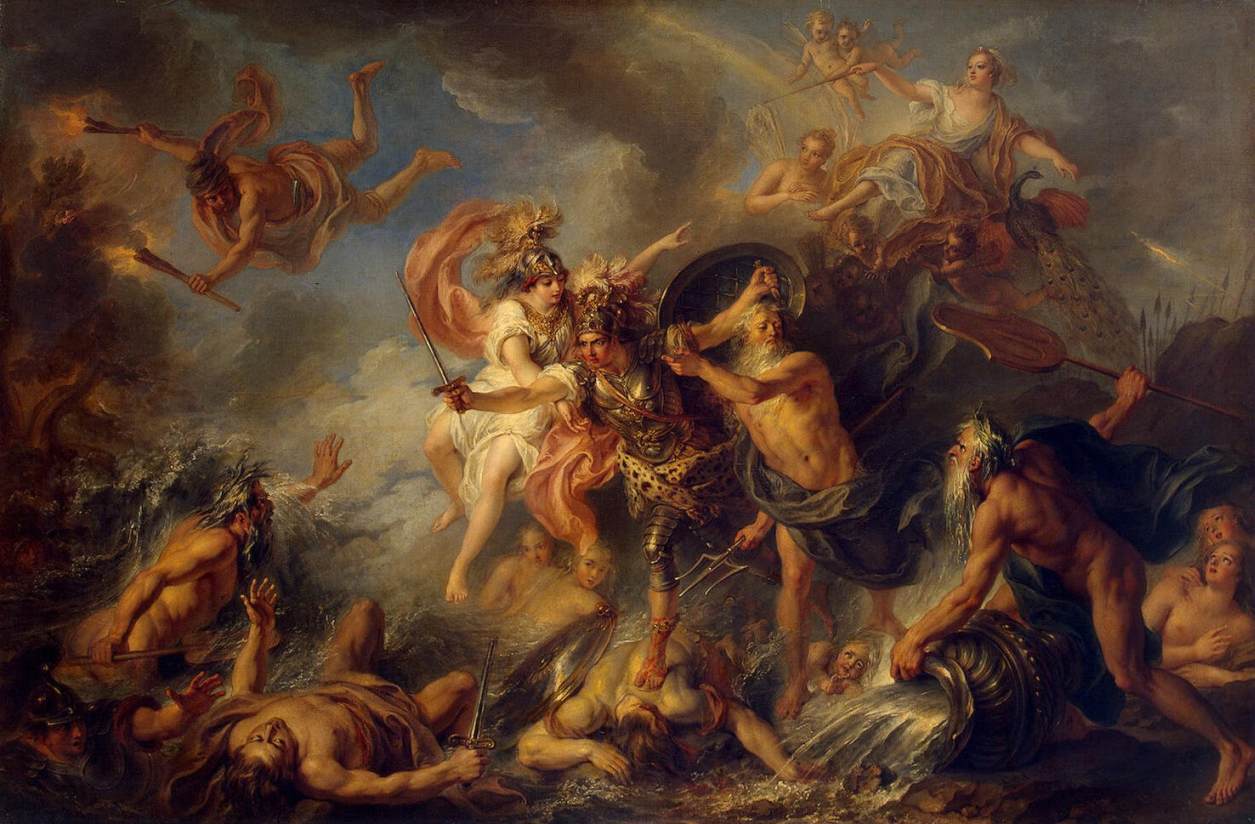
Charles-Antoine Coypel’s Fury of Achilles, 1737, remains the page illustration. Edition summaries are paraphrased; tactical discussion and setting examples are commentary.
Open Game License v1.0a & Copyright Notices
The Pathfinder 1e and D&D 3.5e rules material on this page is derived from Open Game Content and is used under the Open Game License Version 1.0a. SpiralWorlds presentation, navigation, original commentary, setting material and CSS are not designated Open Game Content by this notice.
OPEN GAME LICENSE Version 1.0a
The following text is the property of Wizards of the Coast, Inc. and is Copyright 2000 Wizards of the Coast, Inc (“Wizards”). All Rights Reserved.
- Definitions: (a)”Contributors” means the copyright and/or trademark owners who have contributed Open Game Content; (b)”Derivative Material” means copyrighted material including derivative works and translations (including into other computer languages), potation, modification, correction, addition, extension, upgrade, improvement, compilation, abridgment or other form in which an existing work may be recast, transformed or adapted; (c)”Distribute” means to reproduce, license, rent, lease, sell, broadcast, publicly display, transmit or otherwise distribute; (d)”Open Game Content” means the game mechanic and includes the methods, procedures, processes and routines to the extent such content does not embody the Product Identity and is an enhancement over the prior art and any additional content clearly identified as Open Game Content by the Contributor, and means any work covered by this License, including translations and derivative works under copyright law, but specifically excludes Product Identity. (e)”Product Identity” means product and product line names, logos and identifying marks including trade dress; artifacts; creatures characters; stories, storylines, plots, thematic elements, dialogue, incidents, language, artwork, symbols, designs, depictions, likenesses, formats, poses, concepts, themes and graphic, photographic and other visual or audio representations; names and descriptions of characters, spells, enchantments, personalities, teams, personas, likenesses and special abilities; places, locations, environments, creatures, equipment, magical or supernatural abilities or effects, logos, symbols, or graphic designs; and any other trademark or registered trademark clearly identified as Product identity by the owner of the Product Identity, and which specifically excludes the Open Game Content; (f)”Trademark” means the logos, names, mark, sign, motto, designs that are used by a Contributor to identify itself or its products or the associated products contributed to the Open Game License (g)”Use”, “Used” or “Using” means to use, Distribute, copy, edit, format, modify, translate and otherwise create Derivative Material of Open Game Content. (h)”You” or “Your” means the licensee in terms of this agreement.
- The License: This License applies to any Open Game Content that contains a notice indicating that the Open Game Content may only be Used under and in terms of this License. You must affix such a notice to any Open Game Content that you Use. No terms may be added to or subtracted from this License except as described by the License itself. No other terms or conditions may be applied to any Open Game Content distributed using this License.
- Offer and Acceptance: By Using the Open Game Content You indicate Your acceptance of the terms of this License.
- Grant and Consideration: In consideration for agreeing to use this License, the Contributors grant You a perpetual, worldwide, royalty-free, non-exclusive license with the exact terms of this License to Use, the Open Game Content.
- Representation of Authority to Contribute: If You are contributing original material as Open Game Content, You represent that Your Contributions are Your original creation and/or You have sufficient rights to grant the rights conveyed by this License.
- Notice of License Copyright: You must update the COPYRIGHT NOTICE portion of this License to include the exact text of the COPYRIGHT NOTICE of any Open Game Content You are copying, modifying or distributing, and You must add the title, the copyright date, and the copyright holder’s name to the COPYRIGHT NOTICE of any original Open Game Content you Distribute.
- Use of Product Identity: You agree not to Use any Product Identity, including as an indication as to compatibility, except as expressly licensed in another, independent Agreement with the owner of each element of that Product Identity. You agree not to indicate compatibility or co-adaptability with any Trademark or Registered Trademark in conjunction with a work containing Open Game Content except as expressly licensed in another, independent Agreement with the owner of such Trademark or Registered Trademark. The use of any Product Identity in Open Game Content does not constitute a challenge to the ownership of that Product Identity. The owner of any Product Identity used in Open Game Content shall retain all rights, title and interest in and to that Product Identity.
- Identification: If you distribute Open Game Content You must clearly indicate which portions of the work that you are distributing are Open Game Content.
- Updating the License: Wizards or its designated Agents may publish updated versions of this License. You may use any authorized version of this License to copy, modify and distribute any Open Game Content originally distributed under any version of this License.
- Copy of this License: You MUST include a copy of this License with every copy of the Open Game Content You Distribute.
- Use of Contributor Credits: You may not market or advertise the Open Game Content using the name of any Contributor unless You have written permission from the Contributor to do so.
- Inability to Comply: If it is impossible for You to comply with any of the terms of this License with respect to some or all of the Open Game Content due to statute, judicial order, or governmental regulation then You may not Use any Open Game Material so affected.
- Termination: This License will terminate automatically if You fail to comply with all terms herein and fail to cure such breach within 30 days of becoming aware of the breach. All sublicenses shall survive the termination of this License.
- Reformation: If any provision of this License is held to be unenforceable, such provision shall be reformed only to the extent necessary to make it enforceable.
- COPYRIGHT NOTICE
Open Game License v 1.0a Copyright 2000, Wizards of the Coast, Inc.
System Reference Document Copyright 2000-2003, Wizards of the Coast, Inc.; Authors Jonathan Tweet, Monte Cook, Skip Williams, Rich Baker, Andy Collins, David Noonan, Rich Redman, Bruce R. Cordell, John D. Rateliff, Thomas Reid, James Wyatt, based on original material by E. Gary Gygax and Dave Arneson.
Pathfinder Roleplaying Game Core Rulebook © 2009, Paizo Publishing, LLC; Author: Jason Bulmahn, based on material by Jonathan Tweet, Monte Cook, and Skip Williams.
Pathfinder Roleplaying Game Mythic Adventures © 2013, Paizo Publishing, LLC; Authors: Jason Bulmahn, Stephen Radney-MacFarland, Sean K Reynolds, Dennis Baker, Jesse Benner, Ben Bruck, Jim Groves, Tim Hitchcock, Tracy Hurley, Jonathan Keith, Jason Nelson, Tom Phillips, Ryan Macklin, F. Wesley Schneider, Amber Scott, Tork Shaw, Russ Taylor, and Ray Vallese.
Heroism Spell. Copyright 2026, SpiralWorlds.
END OF LICENSE
Keep this reference growing
If this page helped with your reading or game, you can support its upkeep or explore the curated books.
Explore the Bookshop — epics, classics and stories behind imagined worlds.