
Ysgard — Heroic Plane of Asgard, Valhalla, and Saga-Law
Ysgard — Heroic Plane of Asgard, Valhalla, and Saga-Law
Ysgard is the plane where courage becomes weather, oaths become roads, and the worthy dead rise at dawn to fight, feast, argue, love, boast, and try again.
- Plane Type: Outer Plane
- Moral Gravity: Chaotic Good, with strong heroic, oath-bound, and honour-court traditions
- Common Names: Ysgard, the Heroic Domains, the Saga-Heaven, the Shield-Realm, the High Hall of Storms
- Chief Realm: Asgard, the walled high realm of the Æsir
- Primary Function: Heroic courage, glorious death, divine halls, saga-law, free peoples, immortal contests, and chosen dead
- Usual Arrival Point: Bifrost, storm-gates, burial mounds, Valkyrie escort, oath-circles, heroic death, the threshold of a divine hall, or a World-Tree route
Ysgard is the heroic Outer Plane of courage, contest, oath, storm, feast, and chosen dead. It is not a quiet heaven. It is a realm of impossible mountains, storm-bright skies, floating earthbergs, sacred halls, ringing forges, wolf-haunted forests, fjords, battlefields, old laws, loud feasts, and songs that refuse to die.
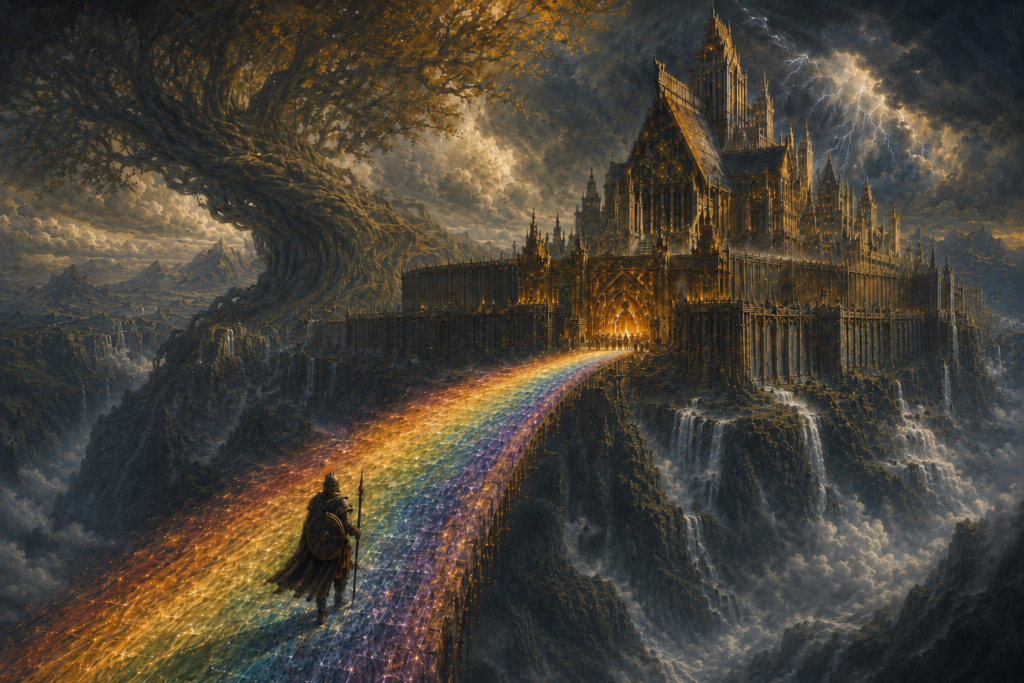
Its greatest realm is Asgard, the walled high seat of the Æsir. Asgard stands behind mighty walls and shining gates, reached most famously by Bifrost, the burning rainbow bridge watched by Heimdall. Within its bounds are divine halls, judgement seats, feast-houses, armouries, goddess-halls, prophecy places, battlefields, old wells, and gathering places for gods, goddesses, heroes, Valkyries, skalds, law-speakers, smiths, messengers, and chosen dead.
Ysgard rewards courage, but it does not make violence innocent. A clean challenge is honoured. A treacherous killing becomes a stain. A feast matters. A boast matters. A surrendered enemy may have standing. A guest under protection may be safer than a king behind walls.
The dead who belong here are not merely “good warriors.” They are souls whose stories still burn with courage, defiance, oath, fame, sacrifice, grief, loyalty, or unfinished heroic consequence. A skald can belong here. A shield-bearer can belong here. A healer who stayed under fire can belong here. A messenger who ran through a doomed battlefield can belong here. A queen who held a hall together while warriors boasted can belong here.
Cosmological Role
Ysgard is heroic chaos made meaningful by oath. It does not demand obedience in the manner of lawful heavens. It asks whether a being stands by their word, faces danger openly, gives hospitality properly, answers insult with proportion, honours witnesses, and accepts consequence.
The plane draws souls and stories that cannot rest in soft paradise or silent death. Some are chosen by gods. Some are carried by Valkyries. Some arrive because their names have become too strong for the grave. Some are summoned by unfinished oaths, inherited weapons, old songs, or bloodline promises.
Use Ysgard when glory must be tested rather than simply awarded.
Norse Cosmology Placement
Ysgard is the parent heroic plane; Asgard is its chief divine realm. The wider Norse worlds connect through mythic roads, divine treaties, death-roads, elemental routes, and Yggdrasill, but they do not all sit inside Asgard.
| Realm or Structure | Plane Placement | Use in Play |
|---|---|---|
| Yggdrasill | Transitive Planes / Cosmic Axis | The World-Tree and planar connector; its roots, branches, wells, wounds, and roads link Asgard, Midgard, Jotunheim, Niflheim, and other mythic realms. It is not inside Ysgard. |
| Asgard | Ysgard | Walled high realm of the Æsir; divine halls, Valhalla, Bifrost, Gladsheim, Vingolf, Folkvangr, and the Well of Urd. |
| Vanaheim | Ysgard | Allied Vanir divine realm; fertility, seidr, wealth, peace after war, hostage politics, and divine treaty. |
| Jotunheim | Ysgard | Giant border-realm and rival world of the Æsir; giant courts, old claims, border violence, and dangerous hospitality. |
| Alfheim | Fey World / Fey Wild / Otherworld | Bright elf realm; fey light, beauty, magic, old elven courts, and Vanir influence. |
| Svartalfaheim | Fey World / Otherworld, Deep Fey Under-Realm | Dark elf, svartalfar, duergar, under-craft, hidden roads, and dangerous bargains. |
| Muspellheim | Inner Planes — Plane of Fire / Primordial Fire | Primordial fire realm of Surtr, fire giants, volcanic forges, and end-time flame. |
| Niflheim | Abaddon / Gray Waste of Hades | Cold mist-death realm; frost, decay, old dead, and grim underworld roads. |
| Helheim | Abaddon / Gray Waste of Hades, within or behind Niflheim | Hel’s dead realm; not a normal Asgard location. |
| Midgard | Material Plane | Mortal Earth, especially the human world and Scandinavia connection. |
Yggdrasill, the World-Tree
Yggdrasill is not a district of Asgard and not a realm within Ysgard. It is a transitive cosmic axis: the World-Tree whose roots, branches, wells, wounds, and hidden roads connect Asgard, Midgard, Jotunheim, Niflheim, and other mythic planes.
On this page, Yggdrasill matters because Asgard stands within its mythic order. The Well of Urd lies near one of its roots, Bifrost crosses through its cosmic structure, and many Norse realm-routes only make sense because the World-Tree binds the worlds into one living pattern.
Asgard, High Seat of the Æsir
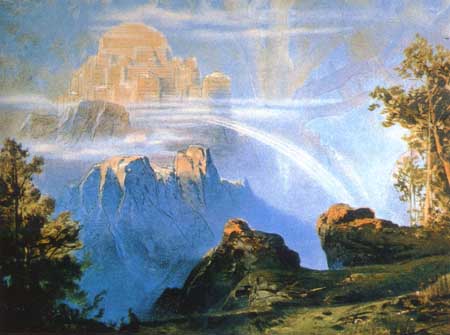
Asgard is the walled divine realm at Ysgard’s heart. It is fortress, court, holy city, cluster of halls, and living mythic country. Its roofs shine with gold, bronze, thatch, ice, and storm-light. Its walls remember giant hands. Its gates are watched by beings who know the sound of fate approaching.
Asgard is not only Odin’s realm. It contains the halls and houses of many powers, divine households, sacred courts, armouries, goddess-halls, guest-halls, battlefields, feasting courts, prophecy places, and old wells. It is ruled through reputation, oath, gift, kinship, challenge, divine precedence, hospitality, and ancient law.
A traveller who reaches Asgard does not simply wander freely. Entry requires a reason. A dead hero may be brought in by Valkyries. A living hero may be summoned by a god, permitted by Heimdall, carried by omen, sent under safe-conduct, or dragged there by the consequences of an oath.
A thief can enter only briefly. A liar can enter only dangerously.
Major Locations of Asgard
Bifrost, the Burning Bridge
Bifrost is the most famous gate into Asgard. It appears as a rainbow bridge, a burning road, a colour-storm, a bridge of aurora, or a blade of light laid across the worlds. It is beautiful, but not gentle. False travellers feel its heat. Cowards feel its height. Oath-breakers hear every promise they have broken.
Heimdall watches the crossing. His attention is not merely guard-duty. He hears approach, intent, hidden weapons, unsaid names, and the sound of a traveller’s doom.
Himinbjorg, Heimdall’s Watch
Himinbjorg stands where watchfulness becomes architecture. From this high place, Heimdall sees the bridge, the gates, the border-realms, the first tremors of disaster, and the lies that try to hide inside noble words.
Adventurers come here when they need permission to enter Asgard, warning of an approaching threat, judgement over a disputed crossing, or a witness whose word cannot easily be challenged.
Gladsheim, the Bright Home
Gladsheim is the great meeting realm of the high gods and heroic courts. It contains council-seats, judgement benches, bright halls, feast chambers, oath-rings, and places where public reputation becomes law.
A boast spoken in Gladsheim carries more weight than a boast spoken elsewhere. A lie told here does not vanish. It waits for a witness.
Valhalla, Hall of the Slain
Valhalla is Odin’s great hall of chosen dead. It is a place of shields, spears, ravens, roaring fires, mead, wounds, laughter, prophecy, and preparation. The einherjar train, fight, feast, and rise again, not because death has become meaningless, but because their final meaning is still being forged.
Valhalla should not be used as a simple warrior paradise. It is a holy military household, a prophetic barracks, a feast-hall of the doomed, and a place where glory and sacrifice are inseparable.
Folkvangr, Freyja’s Field
Folkvangr is the field and hall of Freyja, where many honoured dead are gathered under a different kind of power. It is not a lesser Valhalla. It is its own sacred afterlife: beautiful, dangerous, grief-aware, love-haunted, and fiercely selective.
Where Valhalla can feel like a war-host, Folkvangr often feels like a field of chosen memory. Its peace is never weak. Its mercy is never simple.
Vingolf, Hall of Goddesses
Vingolf is a sacred hall associated with the goddesses and divine women of Asgard. It is a place of counsel, weaving, judgement, healing, kinship, ritual, and private authority. Not every decision in Asgard is made in the loudest hall.
Parties come to Vingolf when a matter involves birth, marriage, oath, household, grief, women’s counsel, divine hospitality, hidden injury, or a wrong that the battle-halls have failed to understand.
The Well of Urd
The Well of Urd lies near a root of Yggdrasill and the seats of the Norns. It is not merely a water source. It is a place where fate is tended, carved, washed, remembered, and sometimes contested.
The Norns do not behave like court wizards or prophecy machines. They tend what must be tended. A traveller who reaches the well may learn less than they wanted and more than they can bear.
The Wall of Asgard
The wall of Asgard is more than defence. It is treaty, history, divine pride, old debt, and old danger made stone. It remembers who built it, who paid for it, who was deceived, who crossed it, and who will one day breach it.
Plots involving the wall should focus on old bargains, unpaid costs, giants’ claims, divine embarrassment, and the difference between rightful defence and stolen labour.
Ysgardic Border Realms
Vanaheim, Realm of the Vanir
Vanaheim is the elder divine realm of the Vanir. It belongs to the Ysgardic heroic-divine cluster, separate from Asgard but bound to it by treaty, marriage, hostage-exchange, rivalry, shared gods, old war, and uneasy respect.
Vanaheim is less obsessed with battle-glory than Asgard. It is concerned with land-use, fertility, sea-wind, wealth, magic, craft, household prosperity, desire, beauty, seasonal abundance, seidr, and the politics of peace after war.
Use Vanaheim for Vanir cults, divine diplomacy, fertility magic, hostage politics, Freyr, Freyja, Njord, old divine grudges, and treaties that still demand payment.
Jotunheim, Giant Border-Realm
Jotunheim is the giant world and hostile border-realm of the Æsir. It belongs to the Ysgardic Norse conflict structure, not the Fey Wild. It is a place of frost forests, stony mountains, giant halls, old bloodlines, dangerous hospitality, river-bound borders, and claims that Asgard cannot simply dismiss.
Giants here are not just random monsters. They have territory, kings, kinship, ancestry, envoys, feuds, insult-law, marriage claims, hostages, monster allies, and old stories in which the gods are not always innocent.
Use Jotunheim for giant courts, stolen weapons, border raids, old bargains, prophetic enemies, lawful envoys from hostile peoples, dangerous marriages, and wars that neither side can cleanly win.
Cross-Plane Norse Realms
Alfheim — Fey World / Fey Wild / Otherworld
Alfheim is the bright realm of the elves. It belongs to the Fey World / Otherworld side of the cosmology rather than to Asgard itself. Its connection to Ysgard runs through Vanir influence, Freyr, beauty, fertility, bright courts, ancient trees, luminous craft, and old elven roads.
Use Alfheim for bright elves, fey courts, radiant forests, elven law, beautiful danger, oath-poetry, and the unsettling kindness of beings who do not think like mortals.
Svartalfaheim — Deep Fey Under-Realm
Svartalfaheim is a dark under-realm of svartalfar, dark elves, duergar, under-craft, stone-work, metal-work, hidden roads, and dangerous bargains. It belongs best as a deep Fey World or Otherworld under-realm.
It is not the universal homeland of all dwarves. Dwarves in the campaign remain dispersed across many holds, mines, guilds, road-warden networks, craft enclaves, and mountain communities.
Use Svartalfaheim for cursed gifts, divine weapons, dark elf courts, underworld forges, secret craft, bargain law, duergar enclaves, and the price of asking underground powers to make something no mortal smith can make.
Muspellheim — Inner Plane of Fire / Primordial Fire
Muspellheim is a primordial fire realm tied to the Inner Planes, the Plane of Fire, and the first destructive flames. It is not a normal Asgard province and not Fey Wild.
It is the realm of Surtr, fire giants, volcanic forges, ash storms, ember seas, black glass, living flame, and world-ending prophecy. Its relationship to Ysgard is apocalyptic and militarised.
Use Muspellheim for fire giant civilisation, primordial flame, divine weapons, Surtr’s omens, volcanic trials, end-time armies, and the terrible beauty of destruction that calls itself renewal.
Niflheim — Abaddon / Gray Waste of Hades
Niflheim is a cold, misted death-realm tied to Abaddon and the Gray Waste of Hades. It is not a normal Asgard location. It is a place of frost, fog, decay, grim roots, cold rivers, ancient dead, and old things that existed before warm life became confident.
Use Niflheim when cold death presses against heroic glory, when a soul is lost beyond Valhalla and Folkvangr, when resurrection fails, or when a dead thing remembers a wrong.
Helheim — Hel’s Realm of the Dead
Helheim lies within, behind, or beyond Niflheim depending on the route taken. It belongs to the Abaddon / Gray Waste death structure, not to Ysgard proper.
Helheim is not simply “evil hell.” It is the realm of Hel and of the dead who do not belong in the bright heroic halls. Its atmosphere is cold, restrained, severe, and final.
Use Helheim for misclaimed souls, death bargains, cold judgement, grief quests, failed heroic return, ancient plague-dead, and negotiations where violence solves almost nothing.
Midgard — Material Plane
Midgard is the mortal world. In the campaign’s default era, this means real Earth under mythic pressure, with the Norse material connection centred most strongly on Scandinavia and its surrounding mythic geography.
Use Midgard for mortal stakes. A divine feud matters more when it burns a farm, curses a bloodline, raises a dead warrior, breaks a treaty, or sends a giant across a border where ordinary people live.
Laws of the Plane
Courage Has Weight
Fear is allowed. Cowardice is judged by what a person does with fear. A terrified messenger who keeps running toward danger may be honoured. A fearless killer who strikes guests under truce may be despised.
Boasts Become Binding
A formal boast in Ysgard is not idle talk. It creates expectation. A public boast may open doors, summon witnesses, impress halls, anger rivals, or trap the speaker inside their own words.
Hospitality Is Sacred
Guest-right matters. A person under hospitality cannot be murdered without consequence. Killing a guest, poisoning a feast, or breaking safe-conduct can stain a hall, a bloodline, or a divine household.
Death Is Not Always Final
In many heroic regions of Ysgard, those slain in open and worthy contest rise again at dawn. This does not make death meaningless. It makes the reason for death more important.
Secret murder, execution, sacrifice, oath-breaking, divine judgement, soul-theft, undeath, certain curses, and deaths outside heroic bounds may not be undone.
Reputation Is Law
Ysgard has courts, but reputation moves faster than judgement. Songs, ravens, witnesses, drinking companions, shield-siblings, and insulted hosts can all carry legal force. A character who wins wrongly may discover that no door opens afterward.
Worthy Enemies Have Standing
A giant envoy, rival hero, defeated champion, bound monster, or enemy under truce may have recognised standing. Random violence against such beings can trigger feud, judgement, weregild, exile, or divine anger.
Divine Powers and Sacred Realms
The Æsir dominate Asgard, but Ysgard is not a single-god plane. It contains many halls and overlapping jurisdictions.
- Odin rules through war-wisdom, sacrifice, poetry, ravens, prophecy, kingship, and the gathering of the chosen dead. His gifts are rarely safe.
- Frigg governs queenship, household fate, hidden knowledge, marriage, mothers, and the authority that does not need to shout.
- Thor stands for storm, strength, protection, giantslaying, farmers, common folk, and blunt divine force.
- Freyja rules love, war, magic, beauty, grief, desire, chosen dead, and the fierce dignity of those claimed by her field.
- Freyr bridges Vanir abundance, fertility, kingship, peace, beauty, and dangerous prosperity.
- Njord governs sea-wind, wealth, ships, coasts, trade, and the uneasy movement between divine households.
- Tyr governs courage, lawful sacrifice, battle-oaths, and the price of binding monsters.
- Heimdall guards thresholds, warning, divine vigilance, and the terrible clarity of being seen.
- Baldr carries beauty, innocence, doom, grief, and the unbearable brightness of what is loved before it is lost.
- Forseti belongs to judgement, settlement, mediation, and difficult peace.
Other Norse powers may appear by hall, omen, feast, envoy, divine messenger, or local sacred site. Do not flatten the plane into one court. Asgard is a living divine society full of competing honour, family, grievance, prophecy, and old bargains.
Inhabitants
Ysgard contains a mix of divine beings, chosen dead, heroic spirits, living visitors, mythic animals, intelligent peoples, monsters, and border powers.
Common inhabitants include:
- Æsir and Vanir divine households
- Valkyries
- Einherjar and other chosen dead
- Skalds, law-speakers, oath-witnesses, shield-maidens, messengers, smiths, and hall-servants
- Ravens, wolves, goats, boars, horses, eagles, serpents, and other sacred or monstrous animals
- Elves and fey envoys from Alfheim
- Dark elves, svartalfar, duergar, and under-craft emissaries from Svartalfaheim
- Giants, giant envoys, giant outlaws, and giant warbands from Jotunheim
- Fire giant envoys, flame spirits, and Surtr-bound forces from Muspellheim
- Cold dead, wights, draugar, and death-messengers from Niflheim or Helheim
- Mortal heroes summoned, dead, dreaming, or travelling under divine protection
Most inhabitants should have relationships, not just stat blocks. A Valkyrie may be a messenger, judge, battlefield chooser, rival, lover, accuser, or escort. An einherjar may be comic, tragic, magnificent, unbearable, or centuries tired of the same boast. A giant may be enemy, kin, claimant, guest, prisoner, or lawful ambassador.
Personhood and Law
Ysgard is dangerous, but it is not lawless. The plane recognises personhood through speech, oath, standing, custom, divine protection, hospitality, and witnessed conduct.
Killing a mindless battlefield hazard is one thing. Killing an enemy champion after formal surrender is another. Slaying a monster during an agreed hunt may earn honour. Slaying a guest under truce may bring ruin. Attacking a giant ambassador can start a war. Killing an undead oath-breaker may be a sacred duty.
In Ysgard, the legal question is rarely “was violence used?” The better question is “was the violence rightful, witnessed, proportionate, and bound by the terms everyone understood?”
Travel and Arrival
Travel in Ysgard is vivid, difficult, and public. The plane does not hide heroic movement. Drums carry. Ravens watch. Songs spread. Weather reacts.
Common arrivals include:
- Crossing Bifrost under Heimdall’s gaze
- Being escorted by a Valkyrie after death or near-death
- Waking in a feast-hall after a battlefield death
- Passing through a burial mound, ship-grave, standing stone, or oath-ring
- Following a storm-road during thunder
- Entering by divine summons
- Reaching a World-Tree root, branch-road, wound, hollow, or well connected to Yggdrasill
- Being dragged in by an oath, curse, prophecy, or inherited weapon
A failed crossing may place the party before the wrong hall, in a battlefield they are expected to survive, at a giant border-court, within a World-Tree hollow, or under the attention of a god who now wants to know why they came.
Planar Effects
Ysgard changes behaviour before it changes numbers.
Bravery becomes easier to speak and harder to fake. Songs are remembered. Names matter. Food tastes stronger. Wounds ache with meaning. Cowardice does not hide well. Oaths feel heavier in the mouth. A weapon carried for a worthy cause feels warmer in the hand.
In Asgard, hospitality is almost supernatural. A guest properly welcomed may be safer than an army. A guest who abuses hospitality may become more vulnerable than a beggar in winter.
In the Shield-Fields and heroic battle regions, dawn may restore the slain. In the Well regions, fate presses down. In Valhalla, prophecy and preparation hang behind every feast. In Folkvangr, grief and beauty are never far apart. At Bifrost, no one is as hidden as they think.
Mechanics Tabs
The rules below are mechanics compatible for different game editions.
Ysgard 5.5e
Ysgard Pathfinder 1e / 3.5e
Ysgard 5.5e-Compatible Rules
Plane Traits
| Trait | Rule |
|---|---|
| Planar Nature | Outer Plane |
| Moral Gravity | Chaotic Good, with strong heroic and oath-bound traditions |
| Time | Normal, though feast-nights, battle-days, and prophetic dreams may feel longer |
| Space | Mythic and elastic; halls, fjords, fields, and sky-islands connect by story, oath, and divine permission |
| Death | Conditional heroic return applies only in recognised heroic contest regions |
| Magic | Divination, thunder, courage, oath, weapon, feast, storm, song, and resurrection magic is especially resonant |
| Social Law | Hospitality, formal challenge, boast, weregild, safe-conduct, and witness carry supernatural force |
Heroic Return at Dawn
In recognised heroic regions of Ysgard, a creature slain during an open, witnessed, worthy contest may return to life at dawn.
The return happens at the nearest appropriate hall, cairn, battlefield edge, ship, feast-bench, or divine muster-point. The creature returns with 1 hit point, no temporary hit points, and one level of Exhaustion unless restored by feast, magic, or hall hospitality.
Heroic Return does not apply when the death is caused by:
- Assassination
- Execution
- Poisoning under hospitality
- Soul theft
- Sacrifice
- Undeath
- Divine judgement
- A death outside a recognised heroic contest
- A killing that breaks guest-right, truce, surrender, or safe-conduct
- A specific curse, relic, god, or plot effect that prevents return
A creature that abuses Heroic Return to murder guests, farm rewards, avoid all consequence, or trivialise the plane becomes marked by saga-shame. While marked, the creature cannot benefit from Heroic Return until the shame is answered through restitution, quest, judgement, or public admission.
Formal Boast
A character may make a formal boast before witnesses, naming a deed they will attempt before the next dawn or before a stated feast, battle, trial, or crossing.
After making the boast, the character gains advantage on one ability check, attack roll, or saving throw directly tied to fulfilling the boast.
If the character willingly abandons the boast, fulfils it dishonourably, or twists the wording in bad faith, they suffer saga-shame. Until they make amends, they have disadvantage on Charisma checks made in heroic halls and cannot gain advantage from another Formal Boast.
Guest-Right
A creature accepted as a guest in a hall, camp, ship, or household gains the protection of guest-right.
While under guest-right, the creature has advantage on saving throws against poison, fear, and charm effects caused by the host or the host’s sworn company. If the host knowingly harms the guest in violation of guest-right, the host loses this protection and suffers saga-shame.
A guest who attacks the host, steals from the hall, poisons the feast, or breaks sworn terms loses guest-right immediately.
Saga-Shame
Saga-shame is a supernatural social stain. It is not a simple condition, but it has rules weight in Ysgard.
A creature with saga-shame suffers disadvantage on Charisma checks made before heroic witnesses, cannot benefit from Heroic Return, and is easily recognised by ravens, skalds, oath-witnesses, and divine servants.
Saga-shame can be removed by:
- Public confession
- Restitution
- Trial by combat
- Wergild or equivalent payment
- Completing a dangerous quest for the wronged party
- Receiving judgement from an appropriate god, hall, court, or Norn-touched witness
Feast of Recovery
A creature that spends a full feast in a recognised hall as an accepted guest may remove one level of Exhaustion and regain one expended Hit Die. This benefit requires genuine hospitality and cannot be gained from a stolen meal, forced invitation, or poisoned feast.
Suggested Encounter Pressures
| Pressure | Table Use |
|---|---|
| Challenge | Someone demands a formal contest, duel, race, song, hunt, or oath-test |
| Witness | A raven, skald, Valkyrie, ghost, god, or enemy saw what really happened |
| Hospitality | The party is protected by guest-right but must obey its terms |
| Boast | A public promise becomes binding |
| Old Claim | A giant, dwarf, elf, god, or dead hero invokes an ancient debt |
| Dawn Failure | Someone expected to rise at dawn does not return |
| Saga-Shame | Victory was gained wrongly and now carries consequence |
Ysgard Pathfinder 1e / 3.5e-Compatible Rules
Planar Traits
| Trait | Rule |
|---|---|
| Gravity | Normal, with local exceptions on sky-islands, divine halls, and storm-roads |
| Time | Normal |
| Size and Shape | Highly morphic in divine domains; otherwise mythically expansive |
| Morphic Trait | Divinely morphic and mildly chaos-aligned |
| Alignment | Mildly chaos-aligned and mildly good-aligned |
| Magic | Spells and effects tied to courage, oaths, thunder, battle, feasting, prophecy, and heroic restoration may receive local narrative amplification |
| Death | Heroic return applies in recognised contest zones only |
Heroic Return at Dawn
In recognised heroic contest regions, a creature killed in open, witnessed, worthy combat returns to life at dawn as if affected by a limited true resurrection effect controlled by the plane.
The returning creature appears at an appropriate hall, cairn, battlefield boundary, ship, or feast-place with 1 hit point and is fatigued. If already fatigued, it becomes exhausted instead. This return does not restore spent daily abilities, spell slots, prepared spells, or limited-use powers.
Heroic Return fails if the death resulted from assassination, execution, poison under hospitality, soul binding, undeath, divine judgement, sacrifice, violation of surrender, or another effect that specifically prevents resurrection.
A creature that abuses the trait gains saga-shame and cannot benefit from Heroic Return until atonement, restitution, public judgement, or a dangerous quest removes the stain.
Formal Boast
A character may make a formal boast before witnesses. Once before the boast’s stated limit, the character gains a +2 morale bonus on one attack roll, saving throw, skill check, or ability check directly tied to fulfilling that boast.
If the character abandons the boast, twists it dishonourably, or fulfils it by treachery, they take a –4 penalty on Diplomacy, Intimidate, Perform, and Sense Motive checks before heroic witnesses until they make restitution.
Guest-Right
A creature accepted under guest-right gains a +2 morale bonus on saving throws against poison, fear, and charm effects created by the host or the host’s sworn company. If the host violates guest-right, the host loses this benefit and gains saga-shame.
A guest who attacks the host, steals from the hall, poisons the feast, or violates sworn terms immediately loses guest-right.
Saga-Shame
Saga-shame imposes a –4 penalty on Diplomacy, Intimidate, Perform, and Sense Motive checks before heroic witnesses. The creature cannot benefit from Heroic Return and is supernaturally recognisable to ravens, skalds, Valkyries, oath-witnesses, and divine servants.
Saga-shame can be removed through atonement, public confession, weregild, trial by combat, divine judgement, or a quest accepted by the wronged party.
Feast of Recovery
A creature that spends a full feast as an accepted guest in a recognised hall may remove fatigue or reduce exhaustion to fatigue. Once per week, such a feast may also restore 1 point of ability damage to one ability score if the injury was suffered in heroic contest.
Running Ysgard
Ysgard works best when victory is not enough. A fight should answer a question. A boast should create pressure. A hall should have politics. A feast should carry danger. A god’s invitation should feel like honour and risk at the same time.
Use Ysgard for:
- Heroic trials
- Divine courts
- Oath disputes
- Recovery of dead heroes
- Valkyrie missions
- Giant treaties
- Prophetic warnings
- Contests of strength, courage, poetry, memory, grief, and truth
- Failed resurrection mysteries
- Quests involving old weapons, old debts, old songs, and old lies
- World-Tree crossings where the route itself carries old fate
Avoid making Ysgard a simple endless combat arena. Fighting is common here, but the plane is about what fighting means. A duel, a feast, a public insult, a guest-right violation, or a broken boast can matter more than a battlefield.
Best Adventure Hooks
The Dawn That Failed
An honoured hero slain in a fair contest does not rise at dawn. Valhalla blames Helheim. Helheim denies the claim. The Norns refuse easy answers. The party must discover whether the hero was murdered under the cover of battle, stolen by a cold death-power, or never worthy of return in the first place.
Guest-Blood on the Feast Floor
A giant envoy is killed inside an Asgardian hall while under guest-right. The killer claims the giant was a monster and no law was broken. The giant’s kin demand blood-price, apology, or war. The party must investigate witnesses, songs, wounds, old insults, and divine politics before the feud reaches the gates.
The Boast No One Can Fulfil
A dying skald speaks an ancient boast aloud, and the plane accepts it. Now the words bind the wrong person: one of the player characters, a dead ancestor, a rival hero, or an entire hall. To break the boast dishonourably brings saga-shame; to fulfil it may require crossing Bifrost, bargaining with giants, and retrieving a weapon from a realm that remembers being cheated.
Quick Rules Reference
- Ysgard is the heroic Outer Plane of courage, oath, contest, feast, storm, and chosen dead.
- Asgard is Ysgard’s chief divine realm; Yggdrasill is a separate transitive cosmic axis.
- Open, worthy contest may allow the slain to rise at dawn; treachery, murder, poison, oath-breaking, and guest-right violations can prevent this.
- Boasts, witnesses, hospitality, surrender, and rightful standing matter as much as victory.
- Valhalla, Folkvangr, Bifrost, the Well of Urd, Vanaheim, and Jotunheim are the main Ysgard-facing Norse elements for this page.
Historic and Mythic Context
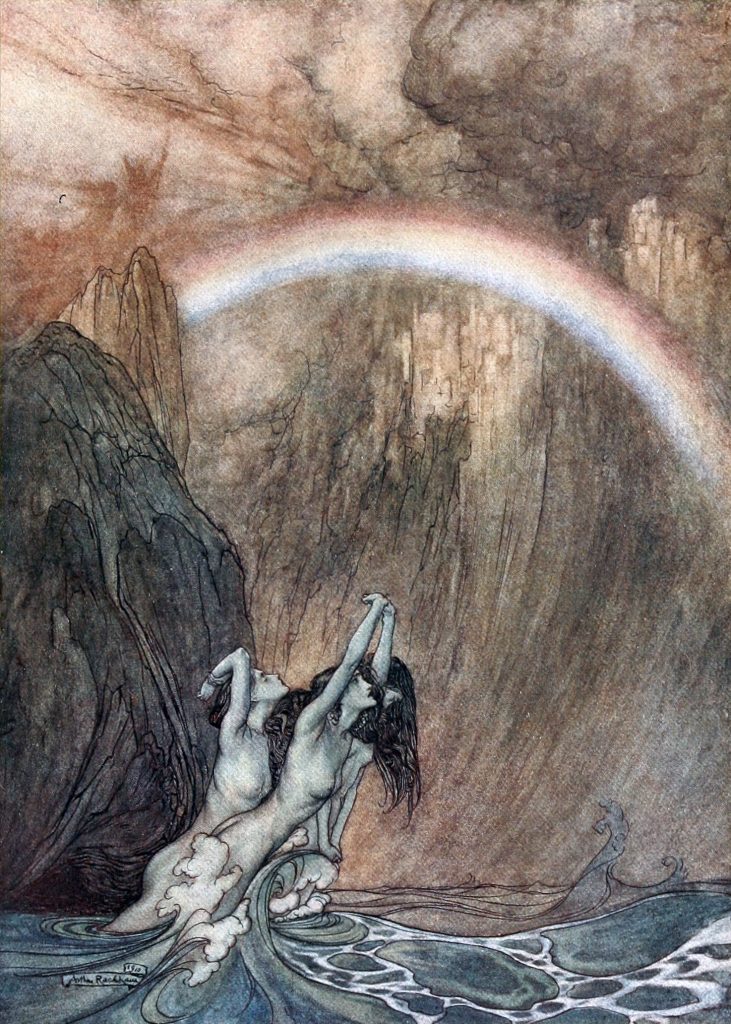
Asgard and Ysgard: In Norse myth, Asgard, or Ásgarðr, is the realm of the Æsir gods: a divine stronghold of halls, councils, gates, feasts, battles, prophecy, and doom. In the campaign, Asgard stands within Ysgard, the heroic Outer Plane of courage, oath, contest, chosen dead, saga-law, and divine hospitality.
Yggdrasill: Yggdrasill is the World-Tree and cosmic axis. Its roots, branches, wells, and hidden roads connect the Norse-linked realms across the wider cosmology. It belongs with the Transitive Planes as a living planar structure rather than as a local Fey World site.
Valhalla and the chosen dead: Valhalla is Odin’s hall of the slain, where chosen dead gather, feast, fight, and prepare under the shadow of prophecy. It is one of Asgard’s major halls, not the only honoured afterlife of warriors.
Neighbouring Norse realms: Vanaheim and Jotunheim sit in the Ysgardic divine-conflict cluster. Alfheim and Svartalfaheim belong to the Fey World / Otherworld side of the cosmology. Muspellheim belongs to Primordial Fire and the Inner Planes. Niflheim and Helheim belong to the cold death-realms of Abaddon / the Gray Waste. Midgard remains the Material Plane. These placements make the Norse worlds playable without forcing them all into Asgard.
Freyr and Alfheim: Norse source tradition links Freyr with Alfheim, famously describing Alfheim as given to Freyr as a tooth-gift. The campaign keeps that link as Vanir influence over the bright elf realm, while keeping Vanaheim itself as a Ysgardic divine realm.
Primary medieval source tradition: The strongest surviving literary material for this cosmology comes through the Poetic Edda, skaldic poetry, and Snorri Sturluson’s Prose Edda. These sources preserve mythic structures rather than a single clean modern map, so they are used here as foundations for playable planar geography rather than as a rigid gazetteer.
Useful external sources: For a public-domain English version of Snorri’s account of the World-Tree and the mythic realms, see The Prose Edda: Gylfaginning. For Freyr and Alfheim in Grímnismál, see The Poetic Edda: Grímnismál. For a modern overview of the Nine Worlds and Yggdrasill, see World History Encyclopedia: Nine Realms of Norse Cosmology.
Keep this reference growing
If this page helped with your reading or game, you can support its upkeep or explore the curated books.
Explore the Bookshop — epics, classics and stories behind imagined worlds.