
Galway — Walled Merchant Port of the Atlantic West
Ireland · Connacht · Walled port · Merchant government · Atlantic trade · Gaelic frontier
At a Glance
| Realm | Lordship of Ireland |
|---|---|
| Province | Connacht |
| Government | Chartered walled town governed by an annually elected sovereign and burgesses |
| Great neighbouring lord | Uilleag Ruadh Burke, 5th lord of Clanricard |
| Character | Defended merchant port surrounded by powerful Gaelic and gaelicised lordships |
| Key places | Town walls, quays, the Great Market Hall, market streets, merchant houses and the river mouth |
| Economy | Fish, hides, wool, wine, salt, cloth and long-distance Atlantic trade |
| Best for | Merchant intrigue, smuggling, hostage diplomacy, urban crime, sea voyages and frontier politics |
Galway is a fortified merchant town facing two worlds at once. Its burgesses look west to Atlantic shipping and south toward Iberian trade, while every land road passes into territories ruled by Gaelic or gaelicised lords. The town’s chartered government, walls and commercial wealth give it unusual independence, but that independence survives because Galway can bargain with Clanricard, pay for defence, keep ships moving and convince powerful neighbours that a prosperous port is more valuable intact than conquered.
What Is Happening Right Now?
Galway’s merchant elite is stronger than it was a generation ago. The royal charter granted in 1396 allows the burgesses to elect their own sovereign annually, weakening the direct grip once exercised by the de Burgh lords. The great merchant families increasingly dominate civic administration, trade, civic patronage and the defence of the town.
That civic confidence exists inside a dangerous political landscape. Uilleag Ruadh Burke, 5th lord of Clanricard, controls a powerful lordship across south Connacht. His authority is strong enough to shape politics far beyond his own castles, yet Galway’s walls, royal privileges and commercial usefulness make direct domination costly.
The town also sits between competing Burke powers. Clanricard has recovered from earlier pressure by the MacWilliam Burkes of Mayo, but the wider province remains full of rival dynasties. A merchant convoy leaving Galway may cross from one recognised jurisdiction into another before reaching its first night’s lodging.
At sea, opportunity is larger than the town. Ships bring wine, salt, cloth and information from Britain and continental Europe. They also bring strangers, debt, contraband and stories about islands that appear only through mist.
Run Galway Tonight
The Sovereign’s Missing Seal
The civic seal disappears hours before a charter must be witnessed. The burgesses cannot admit it is missing without inviting every rival faction to challenge the document. Three merchant houses accuse one another while a fourth quietly hires the party.
The Wine Ship
A vessel arrives with a full cargo of wine and no living crew. The ship’s log ends three days earlier with one repeated sentence: “Do not answer the singing beyond the fog.”
The Clanricard Hostage
A young Burke kinsman enters Galway under safe conduct and vanishes. Clanricard demands his return. The town swears he never left through a gate. A fish seller claims she saw him walking into the river at low tide.
The Broken Wall
Workmen repairing a section of the town wall uncover a sealed passage running beneath an older tower. The tunnel heads inland, away from the river, toward ground no current burgess admits belongs to the town.
The Forty Oaths
A merchant accused of murder intends to clear himself by producing forty oath-helpers. One dies the night before court. Another receives a warning written in Irish on the inside of a locked chest.
A Town That Governs Itself
Galway’s civic identity rests on its royal charter. The town elects a sovereign from among its burgesses and increasingly manages its own affairs through a wealthy merchant elite. This is not yet the later incorporated mayoral government, but the direction is clear: Galway’s merchants want law, markets and taxation handled inside the walls by men whose fortunes depend on the port.
The leading families build houses, fund religious institutions, finance ships and hold office. Their rivalries are commercial before they are ideological. A marriage can join trading interests. A disputed cargo can split two households that swear before the same civic gods. A debt owed in wine or silver can matter more than a distant lord’s friendship.
The families later remembered as the Tribes are already becoming the social core of the town. Their authority is practical: warehouses, credit, ships, clerks, servants and relatives abroad.
The Walls and Gates
Galway’s walls are not decoration. They separate a chartered town from a hinterland whose lords possess their own armies and claims. Gates control access, customs and night movement. During political tension, every cart, messenger and armed retinue can become a negotiation.
The walls also create crime. Smugglers look for waterside access, bribed guards and forgotten culverts. Merchants who want to avoid duties may be more willing to trust a criminal boatman than a rival guildsman.
Night Closure
Once the gates close, late arrivals must explain why they were delayed and who will answer for them. A noble retinue forced to wait outside can treat a routine precaution as an insult.
The River Edge
The Corrib enters Galway Bay beside the town. Quays, landing places, mills and fisheries make the waterline economically valuable and difficult to police completely.
The Harbour and Atlantic Trade
Galway’s wealth depends on movement by sea. Fish, hides, wool and other Irish goods leave through the port; wine, salt, cloth and manufactured goods arrive. Merchants build relationships beyond Ireland because distance by sea is often easier than distance by bad inland road.
Iberian connections are particularly valuable. Wine cargoes create fortunes, but they also require credit, storage and trustworthy factors abroad. A ship lost at sea can bankrupt a household that appears wealthy on land.
The harbour is therefore full of people whose loyalties do not fit the town walls: foreign sailors, Gaelic fishermen, merchant factors, pilots, porters, interpreters and smugglers. Information enters with cargo. News from England, France or Iberia can reach Galway before the same event becomes common knowledge in the Irish interior.
The Merchant Sanctuary
The Merchant Sanctuary stands at the centre of Galway’s public ritual life. Its great hall, judgement stones and family shrines receive patronage from the same wealthy houses that dominate commerce and civic government.
Memorial stones, burial places, household shrines and gifts turn the sanctuary into a record of merchant ambition. A family may endow a ritual alcove for devotion, prestige and remembrance at the same time. Disputes over patronage can reveal alliances more clearly than speeches in the town hall.
The sacred hall also offers sanctuary and public credibility. A merchant who swears before a judgement stone risks more than a legal penalty if the oath is false in a world where gods, geasa and older powers can all answer.
Clanricard Beyond the Walls
Galway cannot be understood without the Burke lordship surrounding much of south Connacht. Uilleag Ruadh has ruled Clanricard since 1430 and maintains a strong, prosperous lordship capable of shaping politics across the province.
The relationship is neither simple hostility nor obedience. Galway needs cattle, grain, hides, labour and safe inland routes. Clanricard benefits from customs, imported goods, credit and access to shipping. Both sides gain from trade while preparing for the possibility that the other will use dependence as leverage.
A party leaving Galway under a civic warrant may therefore discover that the document means little at the next lord’s bridge unless accompanied by local permission, a recognised escort or enough armed men to make refusal inconvenient.
Places That Matter
The Quays
Ships, cargo, customs, rumours and theft meet here. Every foreign vessel is a potential adventure hook before anyone leaves the waterfront.
The Market Streets
Imported wine stands beside fish, hides, wool, metalwork and food from the hinterland. A price change can reveal a blocked road or feud before official news reaches town.
The Merchant Sanctuary
The town’s principal sanctuary is a centre of worship, family prestige and public oath-taking.
The Town Hall and Prison
Civic government, records and confinement occupy the administrative heart of the town. A missing prisoner or altered ledger can threaten the authority of the sovereign himself.
The Merchant Houses
Fortified urban houses combine residence, warehouse, office and statement of status. A burglary here can expose correspondence spanning several kingdoms.
The Western Shore
Beyond the secure town, fishing communities and small craft know the bay better than civic officers do. They also know which reefs, islands and fog banks should be avoided.
Creatures and Sea Roads
Manannán mac Lir matters to Galway because the Atlantic is not merely water between markets. Mists, islands and sea-roads belong to powers older than any civic charter.
Pookas are more likely on the roads outside town, where travellers and pack animals can be led astray. Banshee traditions belong to families and death-memory rather than random haunting, making them especially dangerous in a city where inheritance and merchant houses are inseparable.
Sea-fey, drowned dead and impossible lights appear most often after storms or wrecks. Sailors treat such stories as practical warnings because disbelief does not make a reef, current or Otherworld crossing safer.
Dungeon: The Buried River Gate
Repairs near the western wall expose a masonry arch below the current street level. Town records mention no gate there, yet the passage is wide enough for laden men to move through.
The Smugglers’ Steps
The upper chambers contain fresh rope, broken wine seals and hidden storage niches. Someone still uses the route despite claiming it has been sealed for generations.
The Old Wall
Deeper masonry belongs to an earlier defensive line. Arrowheads and human bones lie in silt beside a doorway blocked from the river side.
The Tide Chamber
At high water the room fills from beneath. At low water a stone path appears across black mud toward a door marked with a ship whose sail is carved as a spiral.
The Western Road
Beyond the door is no sewer. It opens onto a moonlit shoreline even at midday. A ship waits offshore under a sail that never moves in the wind.
Using the route could make Galway the richest port in Ireland or expose the town to a sea-road no wall can defend.
Travel from Galway
| Route | Pressure |
|---|---|
| East toward Athenry | Clanricard influence, merchant traffic and fortified routes into the wider Connacht interior. |
| North toward Mayo | Burke rivalries, poor roads and changing local authority. |
| South toward Thomond | River crossings, lordly tolls and political boundaries that matter more than map distance. |
| Atlantic sea routes | Weather, piracy, long-distance trade and supernatural crossings through fog. |
| Across Galway Bay | Local pilots are more valuable than noble rank when tides and reefs turn against a vessel. |
Merrow Bargains and Atlantic Hauntings
Galway’s western sea has neighbours of its own. Merrow know wrecks, drowned cargo and the names of sailors who never reached shore. They bargain in information, metalwork, music and promises rather than ordinary coin.
Selkies are less common but well known along quieter stretches of coast. A seal that returns to watch the same household may be waiting for a debt to be recognised.
Ghost lights outside the walls often mark drowned travellers attempting to complete a journey. Following one may lead to a body, a wreck or a road that continues across the water.
Historical and Mythic Context
Galway developed from an Anglo-Norman settlement into one of Ireland’s most important medieval ports. Richard de Burgh established a castle in the thirteenth century, and the growing town secured resources to build and maintain its walls through tolls on trade.
The charter of 1396 marked a decisive step toward civic autonomy by allowing the burgesses to elect an annual sovereign. During the fifteenth century the merchant families later known as the Tribes increasingly dominate the town’s politics, economy and religious patronage.
The surrounding political world remains powerful. Uilleag Ruadh Burke has ruled Clanricard since 1430 and, after earlier conflict with rival Burke branches, presides over a lordship strong enough to dominate much of south Connacht. Galway survives not because the countryside is weak, but because its walls, royal privileges and commerce make cooperation profitable.
Galway City Museum — Medieval Galway · Galway City Museum — Medieval and Post-Medieval Collections · Dictionary of Irish Biography — Uilleag Ruadh Burke
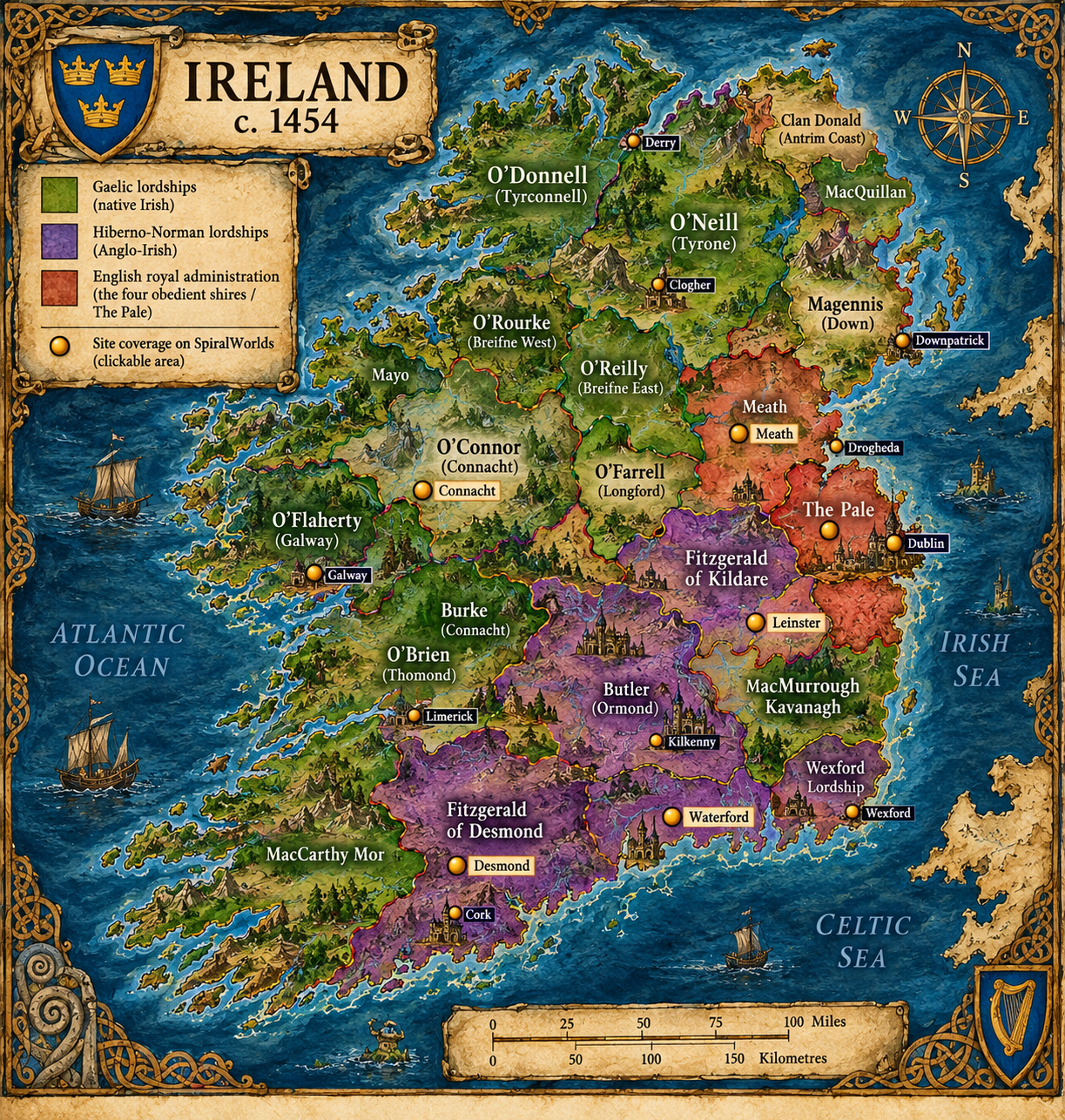
Map of the Wider Political Landscape
Keep this reference growing
If this page helped with your reading or game, you can support its upkeep or explore the curated books.
Explore the Bookshop — epics, classics and stories behind imagined worlds.