
The Stratification of Power
The Stratification of Power in Hell is not a single ladder of personal might. Infernal government is a web of sovereignty, territorial jurisdiction, noble rank, administrative office, military command and court membership. A devil may possess several of these at once—but none of them means precisely the same thing.
Asmodeus and Sovereign Authority
At the summit of the Stratification of Power stands Asmodeus , the recognised Lord of Nessus and Overlord of Hell. There is no hidden primordial sovereign behind him and Asmodeus is not the alias or mask of an unnamed ruler. He governs the Ninth directly and presides over the infernal state from Nessus and Malsheem.
The other Lords possess immense territorial power, but their lordships exist inside the state over which Asmodeus claims final sovereignty. Malsheem therefore matters not merely as a fortress but as the seat from which the highest appointments, disputes, central institutions and matters affecting Hell as a whole may be judged.
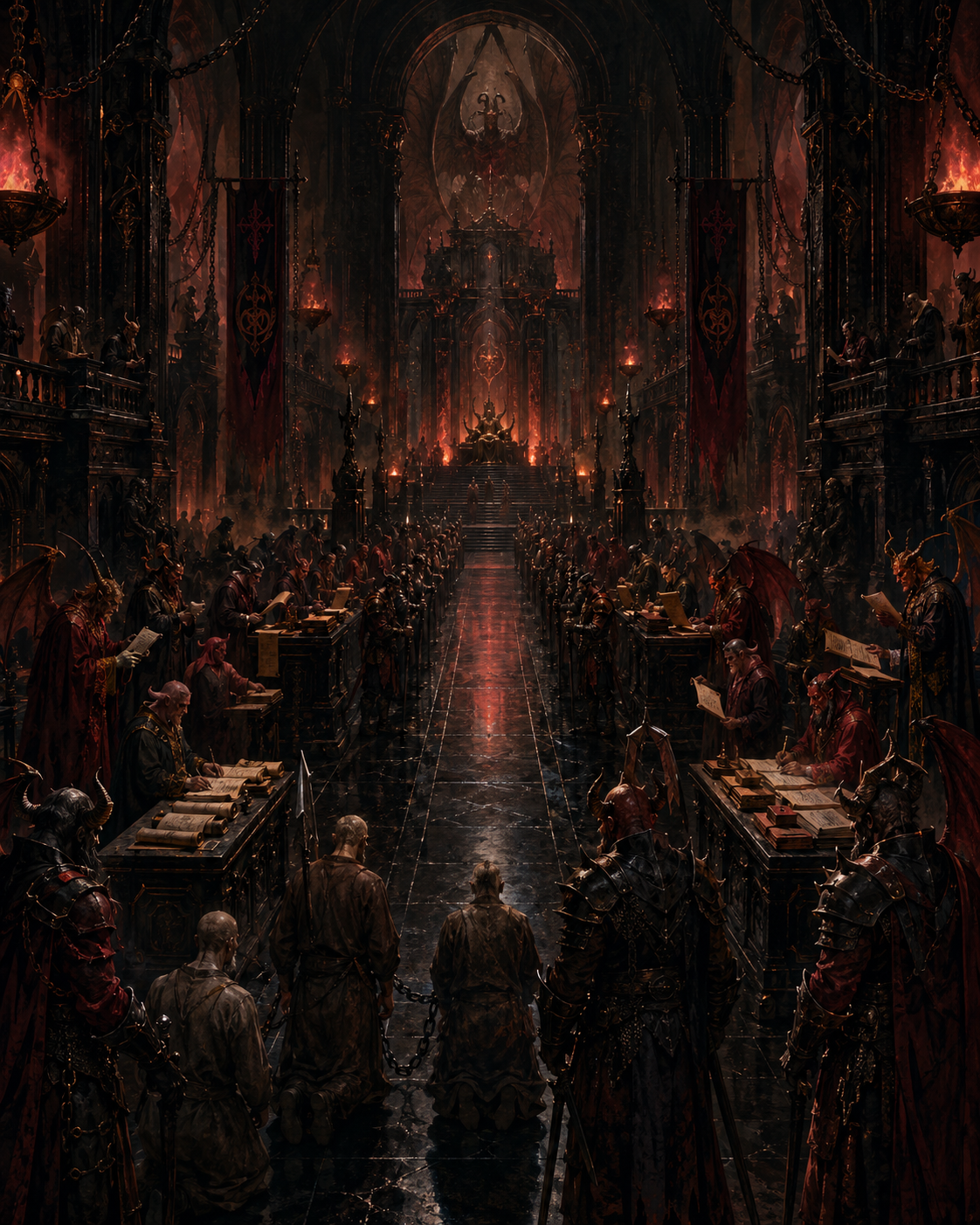
The Lords of the Nine
At the highest territorial level, the Stratification of Power is expressed through the Lords of the Nine, the recognised rulers of the Perditions. Their authority inside their own realms is vast, but none is a sovereign equal to Asmodeus. Central offices, Hell-wide military commands and decrees carrying the authority of Nessus can cross the borders of an individual Perdition.
Infernal Highnesses and Archdevils
The Stratification of Power does not treat archdevil as a synonym for “Lord of a Perdition.” It describes an exceptionally powerful and individually significant infernal being, but territorial sovereignty still depends upon recognised lordship. An archdevil may possess great personal power, followers, court influence, estates or offices without governing one of the Nine.
Power Without Lordship
Fierna is a major archdevil of Phlegethos with considerable influence in the Court of Fire. The present settlement nevertheless recognises Belial alone as Lord of the Fourth.
Influence Does Not Create Territory
Political influence, ancestry, personal might, followers or possession of a prestigious title do not by themselves grant a Perdition. Territorial sovereignty requires recognised lordship within the infernal order.
The 81 Dukes of Hell
Within the Stratification of Power, the recognised ducal structure contains 81 Dukes, nine associated with each Perdition. These nobles form one of the great political strata beneath the territorial Lords and operate through estates, court responsibilities, military resources, institutions, contracts, patronage and personal followings.
A Duke’s authority is political rather than merely biological or martial. A Duke can command enormous resources and still lack the legal power of a Hell-wide Minister acting inside that Minister’s mandate. Conversely, a central officer may possess sweeping executive authority while lacking the estates, precedence or patronage network of an ancient noble.
Individual nobles may bear additional styles and titles. For example, Merorem the Darkwind is styled Grand Duke of the Ebon Gale in Dis. Such individual styles should not be mistaken for a universal additional rung through which every Duke must pass.
The Dukes stand within the wider courtly world described by the Courtiers of Perdition , but court membership, noble title and formal office remain distinct forms of political standing.
The Dark Ministry
The Dark Ministry demonstrates why the Stratification of Power cannot be understood as a simple ladder of stronger and weaker devils. It is a Hell-wide executive institution whose authority derives from office, commission and central mandate rather than noble rank alone. Its historical foundation lies in the settlement after Dies Irae, when loyal senior pit-fiend commanders became instruments of a stronger central state.
Hell-Wide Mandate
Ministers coordinate functions that cannot be left entirely to one Perdition: major military, administrative and strategic responsibilities that cross territorial borders.
Office, Not Peerage
Ministerial authority is not identical to ducal nobility. A Minister’s command is strongest where the recognised mandate of the office applies.
Central Infernal Authority
Because the Ministry serves the infernal state as a whole, its senior offices form part of the machinery through which central government can act beyond the Ninth.
Dagos, Marshal of the Pits
Dagos is the clearest example. He maintains a military stronghold in Dis , yet the office of Marshal of the Pits concerns Hell’s legions as a whole. His location inside the Second does not make him merely a servant of Dispater, and his Hell-wide military mandate does not make him Lord of Dis.
Governors, Generals and Magistrates
Senior officials are another important part of the Stratification of Power because infernal hierarchy cannot be reduced to creature type or personal might. A pit fiend may be a general, governor, minister, courtier, noble, magistrate or holder of some other senior appointment. The authority of such an official depends upon the office actually held.
Gazra · Abriymoch
Gazra is Governor of Abriymoch. His office gives him direct responsibility for the administration and security of the capital, together with important security responsibilities extending beyond the city. Those duties make him one of the significant officials of Phlegethos without giving him Belial’s territorial lordship.
Ariyan · Tantlin
Ariyan governs Tantlin in Stygia. Her authority is substantial and locally enforceable, while Leviathan remains the recognised territorial Lord of the Fifth.
Territory vs Command
A local Lord, a central Minister and a governor can all possess valid authority over different aspects of the same place. Infernal disputes often begin where those jurisdictions overlap.
The Wider Infernal Hierarchy
Below the great courts, the Stratification of Power extends through the immense machinery required to keep Hell functioning. Soldiers, guards, scribes, messengers, hunters, interrogators, clerks, engineers, tax collectors, jailers, spies, magistrates and military specialists all occupy places within the infernal order.
Their relative standing may reflect infernal form, seniority, appointment, patronage, assigned duty and local custom. Promotion and transformation occur within devil society, but they should not be treated as a universal mechanical ladder in which every being inevitably passes through the same sequence.
Nor does reaching a formidable infernal form automatically confer a noble title, court seat or central office.
For the surviving wider taxonomy and its many individual devil kinds, see The Devils You Know . Where that older record conflicts with the current Hell parent, current Perdition pages or corrected chronology, the newer canon controls.
Appointment, Deposition and Succession
The Stratification of Power is not frozen forever. Infernal lordship is a political office rather than an immutable state of being. Hell remembers rulers who were deposed, imprisoned, replaced, restored or driven from territorial government. Lucifer was a genuine earlier sovereign; Asmodeus overthrew the Luciferian regime and established the sovereignty recognised in the present age.
The individual Perditions also changed hands. Avernus passed through successive rulers before Bael; Belial displaced Adrammelek in the Fourth; Geryon temporarily replaced Leviathan in Stygia; Moloch displaced Lilith before the Sixth was restored to her; and Beelzebub supplanted Sammael in the Seventh. Dies Irae then reshaped the political settlement without abolishing the Lords themselves.
The Stratification of Power in Practice
The practical purpose of the Stratification of Power is to determine who may command, govern, judge or intervene in a particular situation. Personal strength matters, but infernal authority depends just as heavily upon jurisdiction, office, mandate and recognised rank.
A Malsheem Decree
A decree carrying the recognised sovereign authority of Asmodeus can bind institutions and officials beyond Nessus, subject to the wording, scope and means of enforcement attached to it.
A Lord’s Territorial Order
Within a Perdition, its Lord possesses the dominant territorial jurisdiction unless a superior Hell-wide authority or recognised exception intervenes.
A Minister’s Command
A Minister can exercise sweeping authority inside the field of the office without thereby acquiring noble precedence over every Duke or replacing the local Lord.
A Duke’s Demand
A Duke may command retainers, estates and forces attached to the noble household, but title alone does not automatically transfer control of state legions or another office-holder’s jurisdiction.
Archdevils Beyond SpiralWorlds
The following video is retained as external gaming context. It reflects other Dungeons & Dragons traditions and does not define SpiralWorlds rulers, history, geography or hierarchy.
 Dungeons & Dragons: Every Archdevil
External YouTube reference · companion material only
Infernal Archive
The Stratification of Power defines the structure of infernal authority, but the wider Hell archive provides the geography, chronology, courts, devil taxonomy and dealings with mortal worlds needed to place that hierarchy in context.