
Hell — The Nine Perditions
Hell is tyranny made geography: nine descending Perditions joined by law, military force, contract, ambition and the sovereignty of Asmodeus. It is not the automatic destination of every wicked mortal. It is an ancient infernal civilisation that acquires souls, territory and influence through recognised claims, bargains, conquest, inheritance, coercion and enforceable obligation.
What Hell Is
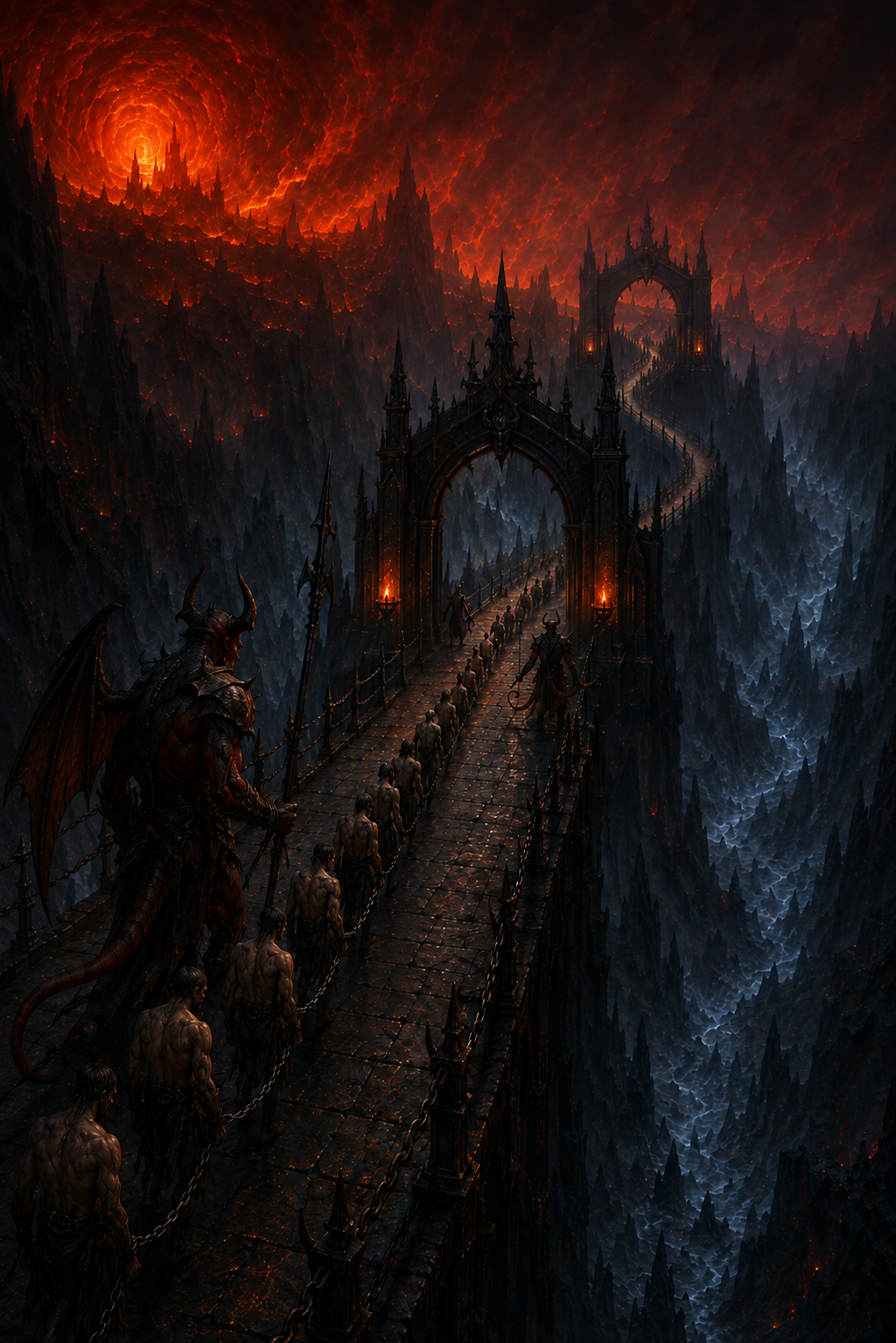
Hell is one of the great Outer Planes of the Depths Below: an immeasureable infernal civilisation in which cruelty is organised into government, warfare, law, commerce and hierarchy.
Its devils maintain cities and fortresses, levy armies, collect tribute, keep archives, administer roads, bargain with foreign powers and enforce claims across centuries. Hell is therefore more than a hostile landscape. It is a functioning supernatural state.
Devilkind · Infernal CivilisationThe Devils You Know
Explore devilkind itself: infernal forms, specialist strains, transformation, pit fiends and the linked 42-record Devil Bestiary.
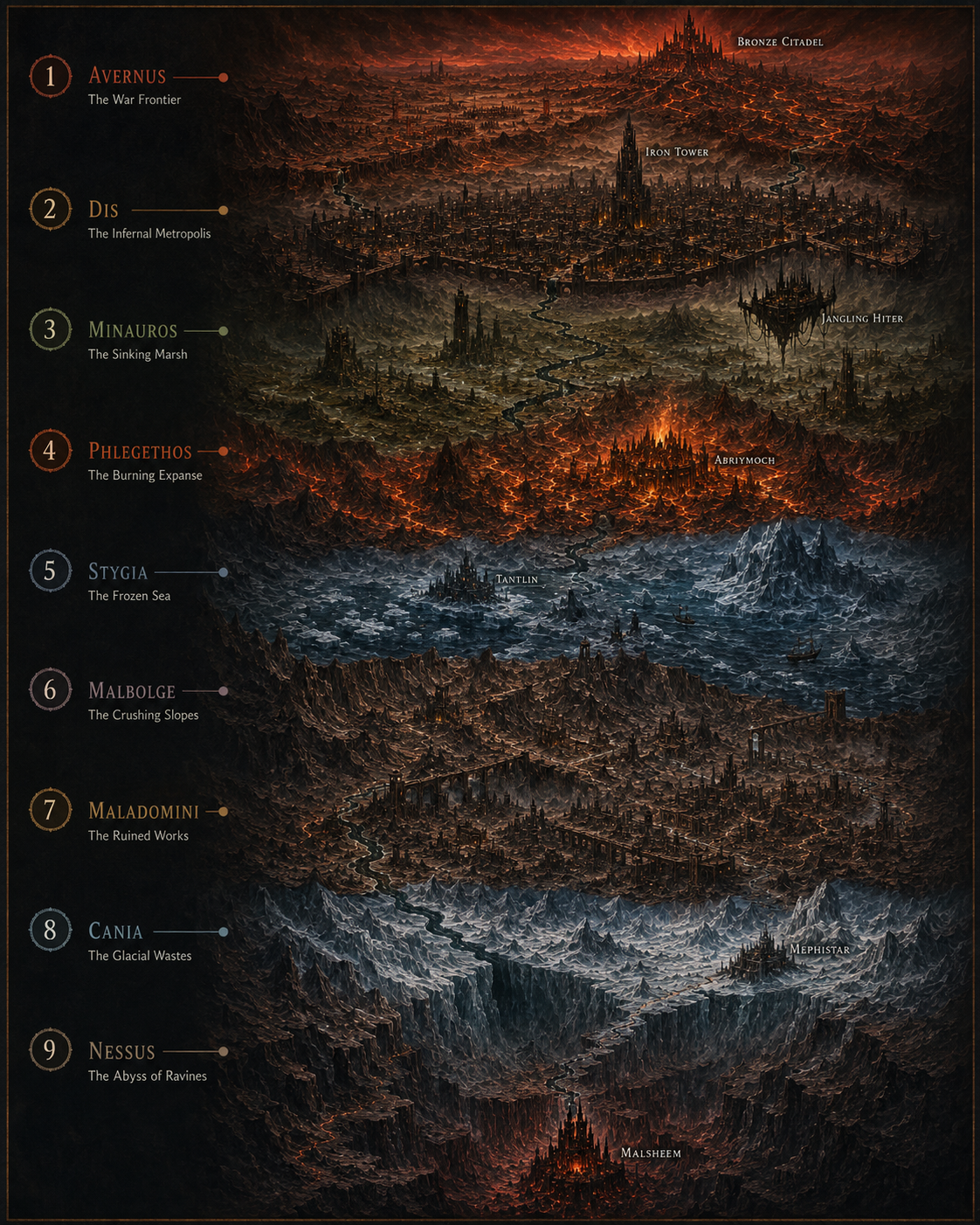
Fire is not the defining characteristic of the plane. Avernus is a war frontier; Dis is an iron metropolis; Minauros sinks into poisonous marsh; Phlegethos burns; Stygia freezes upon a black sea; Malbolge breaks beneath unstable slopes; Maladomini is scarred by ruined works; Cania is dominated by moving ice; and Nessus descends through immense rifts.
What binds those territories together is dominion: the infernal conviction that land, labour, loyalty, knowledge, souls and even obligation itself can be possessed, ranked, traded, commanded or subjected to recognised authority.
The Nine Perditions are consequently both immense places and political jurisdictions. Each possesses its own ruler, settlements, interests and administration, but none is independent of the wider infernal state. At the deepest point stands Nessus, where Asmodeus rules from Malsheem.
The Nine Perditions
The Perditions descend into increasingly remote regions of Hell, but they are not nine identical shelves arranged one beneath another. Each is an immense planar territory with its own geography, settlements, borders and recognised approaches.
The present infernal settlement recognises the following Lords of the Nine. Their authority within their own Perditions is enormous, but every one of them remains beneath the sovereignty of Asmodeus.
Avernus
Hell’s war frontier: blasted plains, fortified roads, infernal citadels and the principal mustering grounds of its legions.
Explore Avernus →Dis
The Iron City: an immense infernal metropolis of heated streets, fortified districts, markets, administration and surveillance.
Explore Dis →Minauros
A drowned and sinking jurisdiction of foul marsh, acidic rain, broken roads and the great city of Minauros settling into the mire.
Explore Minauros →Phlegethos
A volcanic Perdition of ash, burning wastes, magma and the fortress-city of Abriymoch.
Explore Phlegethos →Stygia
A black frozen sea crossed by ice, ports and infernal traffic, with the River Styx forming one of its great routes.
Explore Stygia →Malbolge
The Crushing Slopes: unstable stone, caverns, avalanches, ash-filled air and strongholds clinging to hostile ground.
Explore Malbolge →Maladomini
A devastated jurisdiction of quarries, polluted canals, abandoned cities and monumental works repeatedly built and ruined.
Explore Maladomini →Cania
The glacial wastes: moving ice-fields, crushing glaciers, blizzards and Mephistar carried upon the great glacier Nargus.
Explore Cania →Nessus
A realm fractured by colossal rifts and ravines. Within its depths stands Malsheem, the sovereign citadel of Hell.
Explore Nessus →From Plane to Empire
Hell existed before the civilisation that now dominates it. Its geography belongs to the ancient ordering of the Outer Planes; its cities, offices and political hierarchy emerged later.
The Infernal Realm Takes Shape
The wider architecture of the Outer Planes is established. Hell exists as a great domain of principle long before its later devil kingdoms, fortresses and governmental institutions assume their recognisable form.
Organised Devil Civilisation
Devils emerge as an organised outsider civilisation. Ranks, contracts, military establishments, courts, fortresses and administrative systems transform an ancient infernal realm into an increasingly coherent political power.
Lucifer Rules Before Asmodeus
Lucifer belongs to the genuine political history of Hell as an earlier sovereign. He is neither another name for Asmodeus nor the visible mask of a hidden primordial ruler.
Asmodeus Takes the Infernal Throne
Asmodeus succeeds the Luciferian regime and establishes the sovereignty recognised in the present infernal order. From Nessus and Malsheem he stands as Lord of the Ninth and Overlord of the whole infernal dominion.
Wars, Coups and Successions
The rulers of individual Perditions have changed through revolt, punishment, appointment, intrigue, civil war and political settlement. Such successions alter the Lords of individual Perditions without creating another sovereign above Asmodeus.
Government of Hell
Hell is not nine unrelated kingdoms. It is a single infernal state divided into nine great jurisdictions whose rulers govern beneath the ultimate sovereignty of Asmodeus.
Infernal authority is deliberately complicated. One devil may simultaneously possess noble rank, command troops, hold an administrative office, serve a Lord of the Nine and exercise authority over a particular fortress, court or institution.
Rank alone therefore does not answer every political question. Jurisdiction matters: who issued an order, what seal supports it, where it applies, which office can enforce it and whether a superior infernal authority chooses to intervene.
Infernal Government · Political AuthorityThe Stratification of Power
Follow the complete hierarchy of sovereignty, territorial jurisdiction, noble rank, archdevils, the 81 Dukes, the Dark Ministry, governors and Hell-wide offices.
Infernal Courts · Nobility · Office-HoldersThe Courtiers of Perdition
Enter Hell’s high political society: unique nobles, Dukes, archdevils, Ministers, governors and exceptional office-holders whose court standing, patronage and jurisdiction shape infernal politics.
Malsheem and Central Authority
The deepest stronghold of Nessus is more than Asmodeus’s residence. Malsheem is the sovereign and administrative heart of the infernal state: a place where the concerns of Lords, nobles, Ministries, military commands and central institutions can meet beneath the authority of the Ninth.
Political standing in Hell is therefore determined by the authority actually held rather than by creature form alone.
Infernal Law and Economy
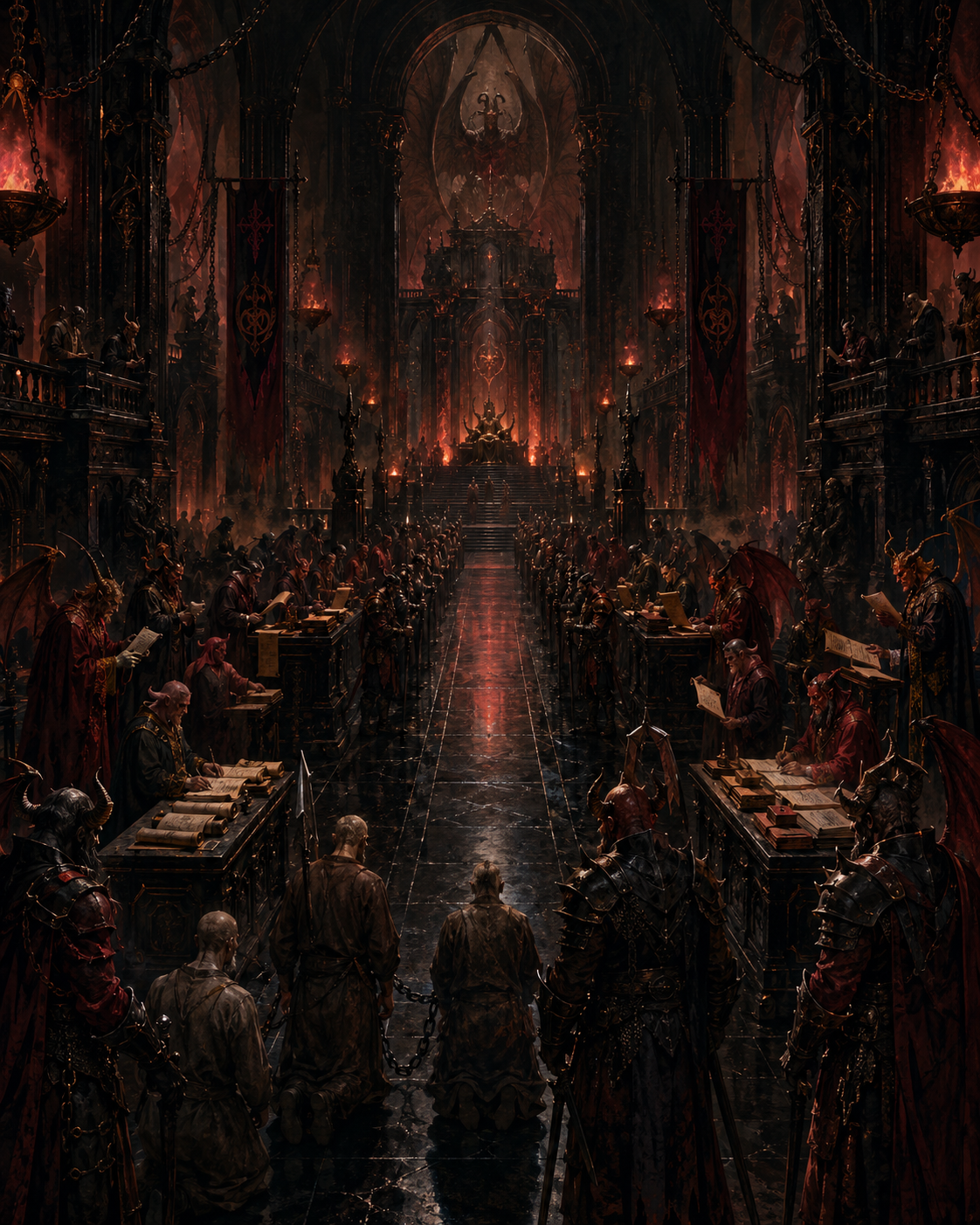
Hell’s law is terrifying because it can be enforced. Contracts, decrees, oaths, grants, precedent, testimony, seals and recognised jurisdiction are all instruments of infernal power.
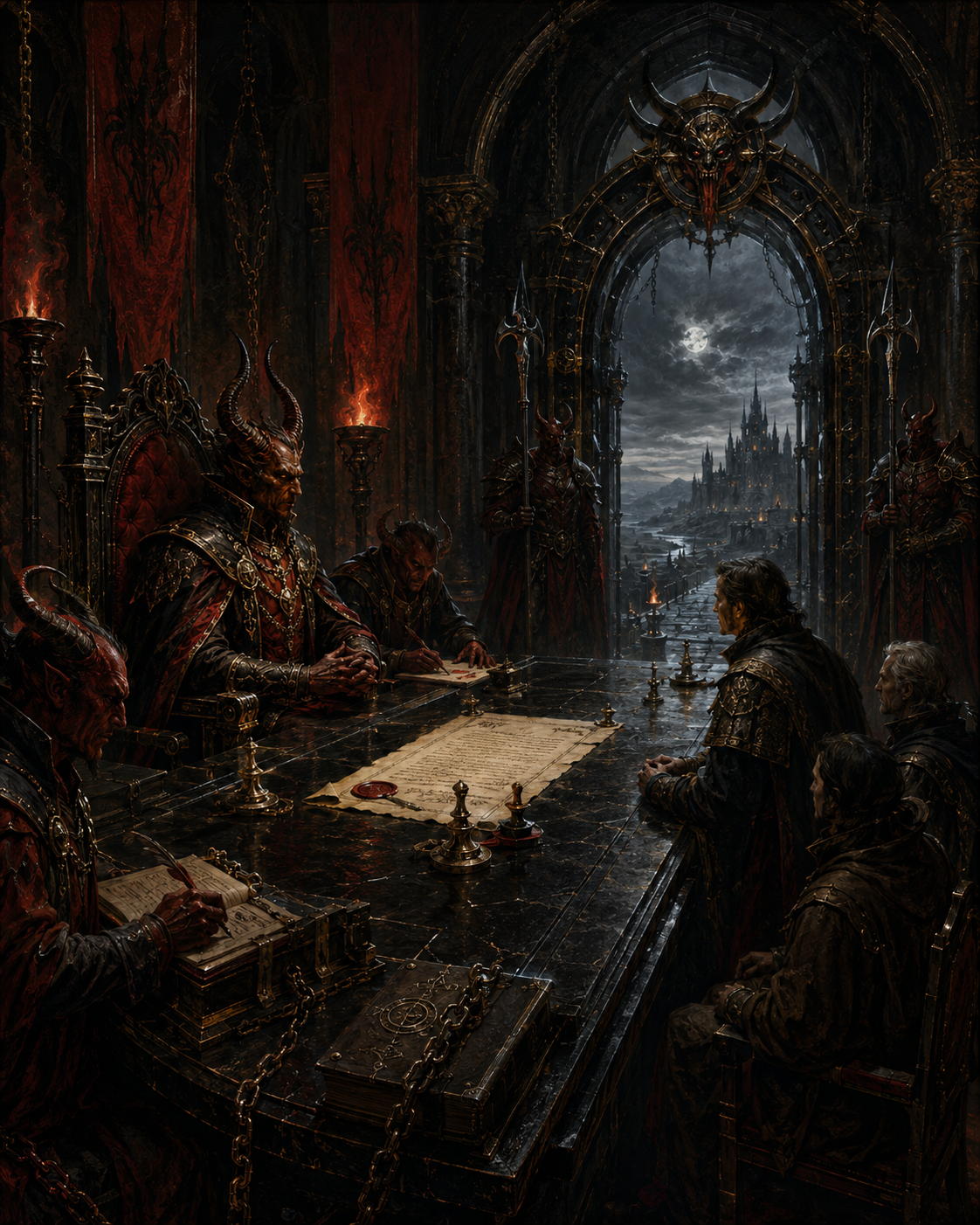
Devils exploit ambiguity and unequal bargains relentlessly, but the state still depends upon obligations carrying recognised meaning. A contract may survive its original signatories, be archived, transferred, inherited, disputed or presented generations later before an infernal authority capable of enforcing it.
Claims, Bargains and Records
Infernal power is often exercised through documents, witnesses, seals, archives and enforceable obligation rather than through open violence alone.
Contracts and Jurisdiction
Infernal law governs ownership, rank, obedience, debt, territory, permission, punishment and enforceable claims. Wording matters, but so does the authority standing behind the document.
More Than Souls
Hell trades coin, metals, weapons, magical resources, services, information, labour, prisoners, tribute and access. Souls are strategic assets, not its sole form of wealth.
Records and Enforcement
Clerks, magistrates, spies, tax collectors, military officers and noble agents turn promises into policy. A private claim and a decree carrying the authority of Malsheem are not equivalent.
The Legions of Hell and the Blood War
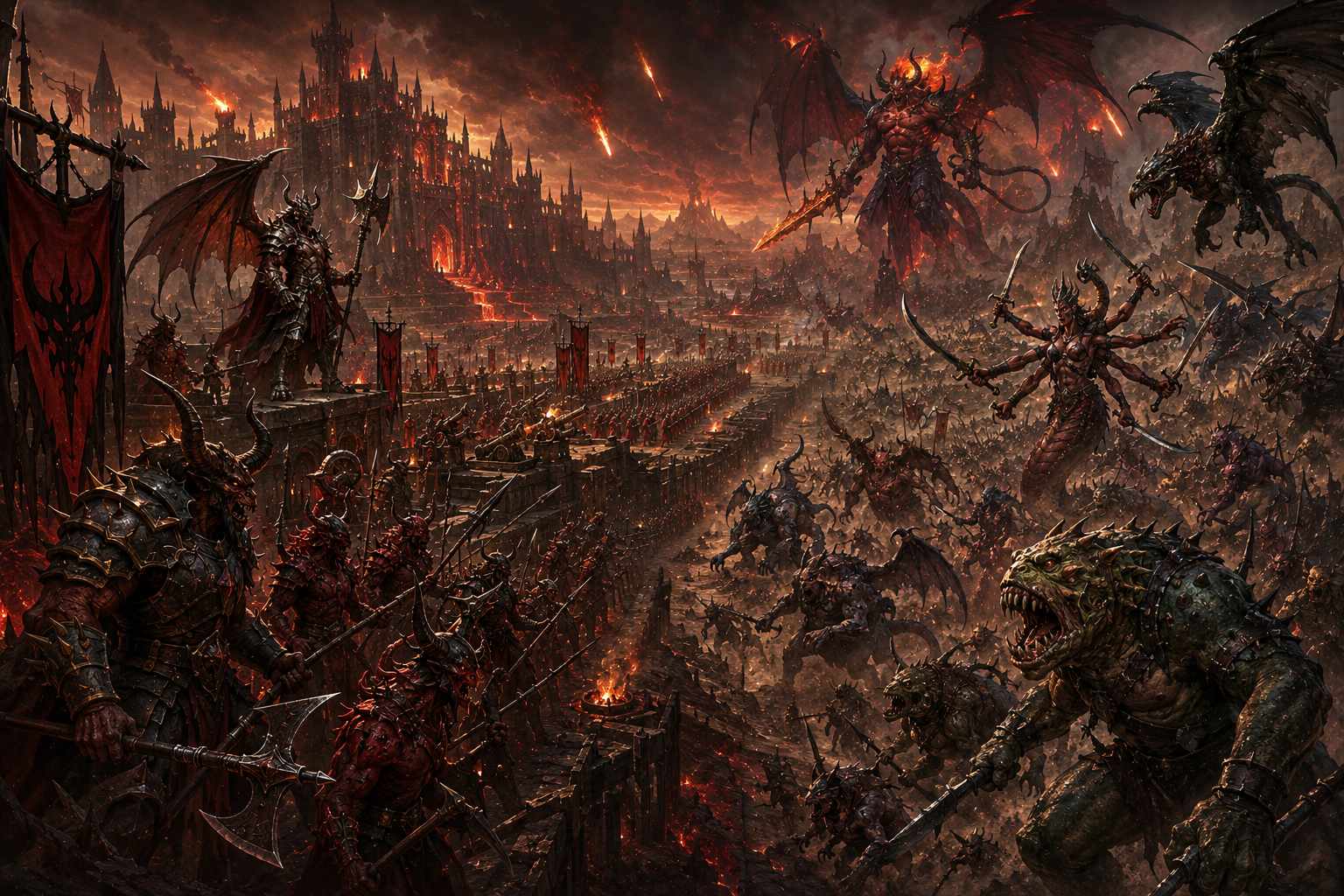
The military character of the infernal state is most visible on Avernus, where disciplined devil armies confront the destructive hosts of the Abyss.
Order as a Weapon
Devil armies depend upon prepared positions, fortified routes, clear command structures, logistics, drill and the ability to convert occupied ground into defensible territory.
The Blood War
The struggle is not good against evil. Hell fights the Abyss because ordered domination and unrestrained destructive chaos cannot permanently accommodate one another.
Central Command
The Lords maintain their own armies, while military offices serving Hell as a whole coordinate forces whose responsibilities cross the borders of individual Perditions.
The office of Marshal of the Pits and comparable central commands help maintain this war machine even while Hell’s nobles compete, conspire and undermine one another.
Travel, Gates and the River Styx
Descending through Hell means crossing borders, fortifications, checkpoints and jurisdictions rather than simply walking downward through a universal sequence of identical gates.
The Nine Perditions are connected by guarded passages, military roads, bridges, ports, planar gates and specialised routes. Access may depend upon authority, sponsorship, documents, payment, military necessity or simply the traveller’s willingness to risk an illicit crossing.
The River Styx is one of the great transport arteries of the lower planes. Within Hell it carries travellers, prisoners, troops and goods through important regions, most visibly across the frozen waters of Stygia. Ports, ferries, patrols and toll-points make it both a road and a strategic frontier.
The river itself remains dangerous. Contact with its waters can assault memory and identity, so passage upon the Styx is never merely an infernal version of ordinary river travel.
Souls and Petitioners
There is no universal rule that every evil mortal automatically becomes a petitioner of Hell.
The afterlife is broader than a single test of moral alignment. Divine claims, other Outer Planes, ancestral destinations, cultic allegiance, contracts, supernatural binding and extraordinary events can all affect the destination of the dead.
Hell therefore has reason to seek specific claims. A mortal may pledge a soul, enter infernal service, become subject to a binding bargain, be captured through supernatural means or otherwise fall beneath a route by which infernal authority can assert possession.
Those who reach Hell do not all suffer an identical transformation. Some retain substantial identity and memory. Others become prisoners, labourers, commodities or subjects of punishment and reshaping. Promotion, demotion and transformation exist within infernal society, but no one procedure automatically applies to every petitioner.
Hell in the Mortal World
Devils extend infernal influence through cults, contracts, possession, summoned servants, called outsiders, political agents, commerce, corruption and promises designed to create lasting obligation.
Ordinary devils, summoned creatures and bound outsiders do not operate under precisely the same circumstances as Dukes, archdevils or the Lords of the Nine. The greater the power crossing into a mortal world, the more significant the required gateway, ritual, compact or exceptional breach is likely to be.
Infernal manifestation does not produce a universal automatic alignment change in everyone nearby, nor does every visitor acquire a standard planar infusion. Corruption, haunting, environmental disturbance and other supernatural consequences depend upon the being, rite, location and event involved.
Prime Material · Infernal Client-StateThe Teutonic States — Hell’s Mortal Bridgehead
The Hell Knight regime centred upon Marienburg is the most developed recognised infernal client-state on Earth: a mortal government tied to Hell by permanent diplomatic representation, registered contracts, military cooperation, commerce and a fortified planar crossing.
The Burning Gate at Marienburg
Within the fortified heart of Marienburg stands the Burning Gate, a permanent regulated planar crossing between Earth and Hell.
It is not treated as a summoning circle or an uncontrolled wound in reality. It functions as an infernal frontier post.
Hell Knights control the mortal approaches. Infernal officials regulate passage beyond the threshold. Travellers may require recognised seals, sponsorship, military orders, diplomatic status, commercial authority or documents valid under both Teutonic and infernal jurisdiction.
Through the gate pass diplomats, legal records, intelligence, specialist goods, military personnel, prisoners, infernal advisers and authorised inhabitants of Hell.
A mortal crossing the Burning Gate has not entered a monster’s lair. They have crossed an international and interplanar border into another civilisation.
The Infernal Legation
Hell maintains a permanent recognised legation at Marienburg.
Its personnel can include infernal diplomats, jurists, scribes, intelligence officers, commercial agents, military observers and representatives of powerful courts and offices within the Nine Perditions.
These outsiders are not merely creatures summoned by mortal spellcasters. Those holding recognised infernal office may possess diplomatic, contractual or jurisdictional privileges acknowledged by the Hell Knight state.
This produces situations rare elsewhere on Earth. A Teutonic commander may have the military power to seize an infernal visitor while lacking the legal authority to do so. A seemingly unimpressive devil bearing the proper seal may possess greater jurisdiction in a particular dispute than a far more terrifying infernal warrior.
Contracts Registered Beyond Earth
Important Teutonic treaties, loans, grants, military obligations and private bargains can be registered within infernal archives.
Such registration does not make every Teutonic contract supernatural, but it allows selected agreements to become part of Hell’s much older system of recognised claim, debt, precedent and enforceable obligation.
A document can outlive its original signatories. Rights can be transferred. Debts can be inherited. Claims can be contested before an infernal authority. A forgotten agreement recovered generations later may still matter if the jurisdiction that recognised it continues to exist.
This is one reason Hell Knight jurists treat wording, seals, witnesses, archives and jurisdiction with such obsessive seriousness.
Infernal Residents on Earth
Some inhabitants of Hell reside openly within the Teutonic States under recognised status rather than appearing only through temporary summoning.
They may serve as diplomats, legal advisers, merchants, scribes, armourers, military specialists, messengers, intelligence agents, interrogators or representatives of infernal patrons.
The important question is not simply what kind of devil stands before a mortal official, but what authority it carries. Creature form, military power and political rank are not identical.
For a broader guide to the inhabitants of Hell, see The Devils You Know . For the noble and political society behind many such missions, see The Courtiers of Perdition .
Military Exchange
The Teutonic States do not command the legions of Hell.
They do maintain recognised military relationships with infernal authorities. Hell Knight officers can travel through the Burning Gate for instruction, observation, negotiation and service. Infernal specialists can enter Teutonic territory under treaty or contract.
Avernus has particular importance to Hell Knight military thought. Its fortified roads, prepared positions, disciplined command structures, logistics and relentless war against the Abyss provide the regime with a model of ordered warfare on a scale no mortal battlefield can match.
Teutonic armies may therefore include authorised infernal advisers, specialist outsiders and other contracted assets without every field army becoming an infernal legion.
Trade Through the Gate
Hell’s economy is not based solely upon souls, and neither is its relationship with the Teutonic States.
Weapons, metals, crafted goods, magical materials, intelligence, services, prisoners, specialised labour, commercial privileges and access can all become subjects of exchange.
Some goods arriving through the Burning Gate are legal within the Teutonic States while forbidden elsewhere on Earth. Others require licences, seals or military authority so restrictive that possession without the correct documentation is itself evidence of a serious offence.
Foreign Relations
Hell is expansionist, but it is not diplomatically mindless.
Its rulers bargain with outsiders, gods, planar merchants, mortal states, mercenaries and even established enemies when negotiation offers more leverage than immediate conquest.
Treaties may regulate access, commerce, prisoner exchange, military passage, non-interference, common enemies or temporary cooperation. Infernal diplomacy remains dangerous because every agreement is also an opportunity to create precedent, dependency, debt or future entitlement.
The Abyss remains Hell’s defining military enemy because demonic chaos threatens the principle upon which infernal civilisation is organised. Elsewhere, Hell can be colder and more calculating. Influence can cost less than invasion, and an obligation may remain useful long after an army would have been withdrawn.
The Teutonic States — A Different Kind of Expansion
The relationship with the Teutonic States is one of Hell’s most important experiments in mortal-world diplomacy.
The Hell Knights have not been conquered by an infernal army. They have voluntarily adopted aspects of infernal political thought, recognised Hell as a legitimate foreign civilisation, established treaties with infernal authorities and allowed a permanent regulated planar crossing to operate from their capital.
To Hell, this is potentially more valuable than temporary occupation.
A conquered kingdom must continually be held. A client-state maintains its own roads, courts, taxes, armies and administration while gradually normalising infernal law, diplomacy and commerce within mortal society.
Recognition from Malsheem
The infernal government recognises the Grand Master’s regime as a mortal political authority capable of entering treaties and recognised obligations with Hell.
The Grand Master is not a Lord of Hell, nor is he the political equal of Asmodeus. He rules a mortal client-state whose relationship with the infernal dominion rests upon treaty, utility and recognised jurisdiction.
Questions involving the highest agreements can therefore reach far beyond an individual devil patron. Infernal Ministries, nobles, territorial rulers and ultimately the authority centred upon Malsheem may possess interests in how a Teutonic obligation is interpreted.
Diplomatic Competition Inside the Alliance
Hell’s recognition of the Teutonic States does not make infernal politics simple.
The Lords, Dukes, courtiers, Ministries and other great infernal interests can compete for influence within the relationship. One faction may seek military access, another commercial privilege, another legal precedent and another patronage over a particular Hell Knight commander.
Their rivalries remain subordinate to the wider infernal order, but mortal officials who assume every devil wants exactly the same thing rarely remain influential for long.
For the political ranks and jurisdictions behind these struggles, see The Stratification of Power and The Courtiers of Perdition .
Why Hell Values Marienburg
The Burning Gate gives Hell something exceptionally difficult to obtain in a mortal world: a recognised lawful foothold.
Every treaty creates precedent. Every infernal document accepted by a mortal court extends the practical reach of infernal law. Every accredited devil establishes that an inhabitant of Hell can possess recognised standing on Earth. Every commercial privilege creates dependency. Every military agreement makes the next agreement easier.
Hell therefore has a strategic reason to preserve the Teutonic regime even when individual infernal powers dislike particular Hell Knights.
Marienburg demonstrates that infernal influence does not always need to arrive behind an invading army.
It can enter through a gate opened willingly, carrying a treaty, a ledger and the correct seal.
What the Hell Knights Think They Are Doing
The relationship is not one of simple mortal subservience.
The Hell Knights believe they have discovered in Hell the most complete existing model of ordered power: hierarchy without apology, law backed by force, contracts that survive sentiment, disciplined armies and a state capable of turning obligation itself into an instrument of rule.
They intend to learn from it without surrendering control of their own state.
Hell is content to let them believe that this distinction will always remain clear.
Hell in Mortal Imagination
Mortal traditions have imagined punishment, judgement, descent and underworld landscapes in many different forms. Some resemble features of Hell without constituting literal maps of the Nine Perditions.

Art, Myth and the Actual Plane
Poets, painters, storytellers and philosophers have described burning prisons, frozen depths, rivers of the dead, judges, monsters, subterranean cities and descending realms for centuries.
Within SpiralWorlds, such traditions may preserve distorted memories, symbolic visions, planar encounters or entirely separate underworld traditions. They should not all be collapsed into one cosmological system.
The Nine Perditions are a particular infernal plane possessing their own geography, political history and rulers.
Selected Video Guides
These external videos are retained for gaming, historical and visual context. They are companion material rather than definitions of SpiralWorlds canon.

The Nine Hells | D&D Outer Planes Lore
A gaming overview of the traditional Nine Hells. Its rulers, geography and cosmology may differ from SpiralWorlds.

The History of Hell
Historical background on changing mortal ideas and imagery associated with Hell.

What Does Hell Look Like?
A visual exploration of historical traditions concerning infernal landscapes and punishment.
Hell Directory
For deeper records of Hell’s history, hierarchy, jurisdictions and dealings with other worlds, continue through the infernal archive below.
Explore the Greater Cosmology
Hell is one hostile Outer Plane among several. Gehenna, Abaddon, the Abyss and Carceri possess distinct landscapes, inhabitants, political histories and cosmic identities.
- Devils and Cosmic Entities
- Devils, Gods, and the Prime
- The Presence of Hell
- Variant Rule: Called Devils
- Dukes of Hell in the Prime
- Arch-Devils in the Prime
- The Lords of the Nine and the Prime
- Devils and Other Fiends
- Devils and Cosmic Entities
- Devils, Gods, and the Prime
- The Presence of Hell
- Variant Rule: Called Devils
- Dukes of Hell in the Prime
- Arch-Devils in the Prime
- The Lords of the Nine and the Prime
- Devils and Other Fiends
Keep this reference growing
If this page helped with your reading or game, you can support its upkeep or explore the curated books.
Explore the Bookshop — epics, classics and stories behind imagined worlds.