
Avernus — The War Frontier
Avernus is the outer war frontier of Hell: an immense country of charred plains, broken fortifications, military roads, rivers, ruined settlements and infernal citadels where the organised legions of Hell meet the violence of the Abyss.
Hell’s Principal Battlefield
Avernus is where the military nature of Hell is most visible. Here infernal order has been forced into the shape of a permanent frontier: roads become supply lines, cities become fortresses and entire regions are organised around the movement of troops.
Charred wastelands stretch beneath a red and smoke-darkened sky. Ridges of broken stone, trenches, ruined walls, shattered towers and the remains of earlier battle-lines cover large parts of the landscape. Infernal strongholds stand wherever roads, gates, river crossings or other strategic approaches require protection.
Fire sometimes falls from the sky in enormous burning masses. Some regions are scarred by repeated bombardment, while others remain sufficiently stable to support fortresses, encampments, depots, prisons and permanent settlements.
Avernus is dangerous because it is a battlefield and an infernal jurisdiction—not because the Perdition automatically changes the alignment of everyone who enters it. There is no universal Avernian corruption, resurrection loop or planar-infusion system.
Bael/Bel and the Government of Avernus
Bael/Bel
Lord of the First · Warlord of AvernusBael/Bel is the present Lord of Avernus. A general and warlord as much as an infernal noble, he governs the First from the Bronze Citadel and commands immense military resources.
His authority is nevertheless part of the greater infernal state. Avernus is not Bael/Bel’s independent kingdom: he governs the First beneath the sovereignty of Asmodeus, Lord of Nessus and Overlord of Hell.
Avernus has changed rulers during the long political history of Hell. Those successions matter to infernal history, but they do not alter the present settlement: Bael/Bel holds the First.
Command of the First
Bael/Bel controls armies, fortifications and great war establishments within his Perdition.
Part of the Greater State
Hell-wide offices, central military commands and the authority of Nessus can cross the political borders of Avernus.
Seat of Bael/Bel
The great fortress-city serves as Bael/Bel’s principal seat and one of Hell’s most important military centres.
The Landscape of the First
War-Torn Wastes
Much of Avernus consists of scorched rubble, blackened earth and broken stone crossed by military roads, trenches and the remains of innumerable fortifications.
Red Light and Falling Fire
A red glow suffuses much of the sky. Burning masses can cross overhead and strike without warning, creating fresh craters and turning open ground into a dangerous place for unprotected travellers.
Styx and River of Blood
The River Styx passes through Avernus as part of the wider lower-planar transport network. The River of Blood is another important local watercourse cutting through the blasted land.
The Infernal War Machine
Avernus is Hell’s principal mustering ground and its most important frontier in the Blood War.
Legions
Devil armies gather in disciplined formations under officers, generals and infernal nobles. Their strength lies in hierarchy, logistics, prepared positions, reinforcement and the ability to turn conquered ground into fortified territory.
Fortifications
Citadels, redoubts, watchtowers, fortified roads and guarded crossings divide strategically important regions of the Perdition. Many are rebuilt repeatedly as battle-lines move.
War Machines
Infernal engineers maintain siege engines, armoured constructs and other engines of war. The greatest concentrations gather around the Bronze Citadel and the major military routes.
Supply and Administration
A permanent war requires more than soldiers. Prisoners, labour, weapons, metals, magical resources, information, foodstuffs, tribute and replacement troops pass through Avernus under military supervision.
Travel, Gates and Borders
Avernus is the first great infernal jurisdiction encountered along many routes into Hell, but that does not make it an open frontier. Roads and crossings are watched by patrols, garrisons, toll stations and military authorities.
The gate associated with Ribcage reaches the region near Darkspine. From there, travellers who remain on recognised routes may reach the Bronze Citadel, the great rivers, the Maggot Pit and eventually the approaches leading deeper into Hell.
The River Styx provides another means of movement. Ferries and vessels can carry travellers, prisoners, supplies and troops, although the Styx itself is dangerous and its waters should never be treated as an ordinary river.
Passage from Avernus to Dis is a crossing between infernal jurisdictions. Gates and approaches to the Second are strategic positions rather than casual borders.
An Atlas of Avernus
Avernus is best understood through its fortified routes, river crossings and strategic strongholds rather than as a single uninterrupted wasteland.
The map below shows the principal locations and recognised routes described on this page. Like much infernal cartography, it records relationships, approaches and strategic geography more reliably than absolute terrestrial distance.
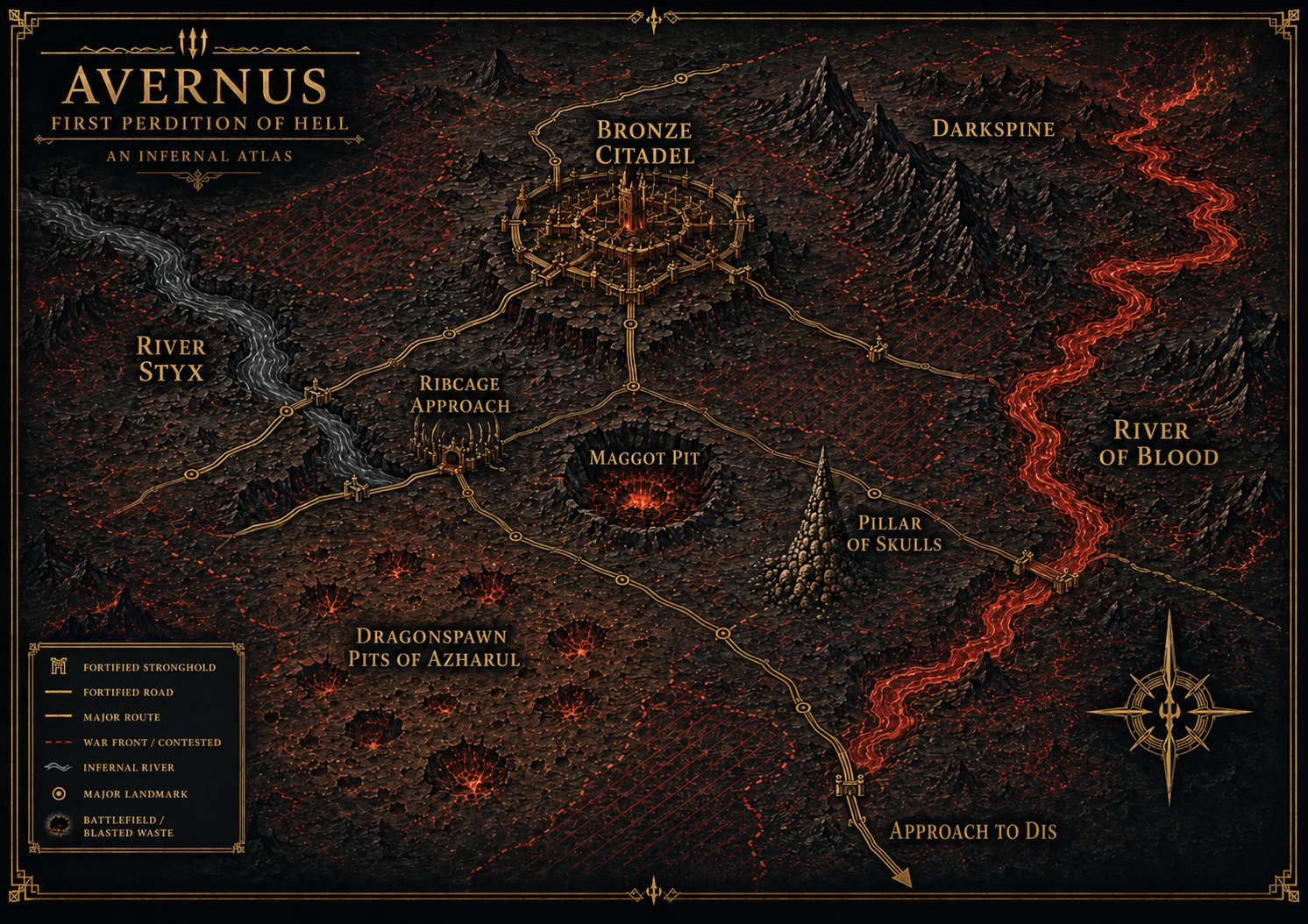
Places of Avernus
The Bronze Citadel
The great military heart of Avernus is an immense fortress-city of towers, walls, barracks, arsenals and repeatedly expanded defences. Legions and infernal war machines pass continually through its gates.
Bael/Bel maintains his principal seat within the Citadel, making it both the political centre of the First and one of the most important command complexes in Hell.
Darkspine
Darkspine is a ruined settlement near the approach from Ribcage. Refugees, exiles, fugitives and other marginal inhabitants gather among its damaged structures.
Its frontier position makes it valuable to anyone seeking information, shelter or an indirect route before entering the more tightly controlled regions of Avernus.
The Maggot Pit
A great basin associated with infernal larvae and major planar conduits. It is an unpleasant but strategically important point on routes crossing the First.
The existence of the Pit does not mean every soul arriving in Hell passes through it or is automatically reduced to a larval form.
The Dragonspawn Pits of Azharul
The hills and caverns of Azharul contain powerful draconic forces associated with Tiamat and her abishai servants.
Tiamat is a formidable resident power within Avernus, but she does not govern the First. Sovereignty over the Perdition belongs to Bael/Bel.
The Pillar of Skulls
Close to an important approach toward the deeper Perditions stands an immense column formed from the skulls of beings killed in the Blood War.
Stories claim that some of the skulls retain fragments of memory and can answer questions, though knowledge obtained from such a monument is never necessarily complete or trustworthy.
The Styx and River of Blood
Avernus is crossed by both the Styx and the River of Blood. Bridges, ferries, military crossings and riverside positions become natural strategic objectives in a Perdition dominated by warfare.
Denizens of Avernus
Devil Legions
Devils form the dominant organised population of the war frontier. Soldiers, officers, guards, messengers, engineers, magistrates and noble retainers all have roles in the functioning of Avernus.
Abishai and Draconic Servitors
Abishai and other draconic creatures are particularly associated with Tiamat’s enclave around Azharul. Their loyalties need not coincide perfectly with Bael’s own military hierarchy.
Infernal Beasts
Hell hounds, nightmares and other infernal creatures serve as hunting beasts, mounts, guards and battlefield assets throughout the First.
The Rabble of Devilkin
Avernus also shelters a loose population of unique infernal exiles traditionally called the rabble of devilkin: former consorts, nobles, vassals and other figures stripped of their former standing and, in some cases, even their recognised names.
Souls in Avernus
Avernus does not automatically receive everyone who committed violence, fought in wars or lived an evil life.
A soul must reach Hell through an appropriate cosmological destination, infernal claim, contract, allegiance, binding, supernatural circumstance or other recognised route.
Once inside Avernus, souls may become prisoners, labourers, spoils of war, military assets, objects of exchange or subjects of infernal transformation. Some may eventually become lesser devils, but there is no single automatic process by which every Avernian petitioner becomes a lemure.
Nor do those who die on the battlefields of the First automatically rise seconds later to fight again. Resurrection, undeath, infernal transformation and supernatural recurrence require their own causes.
Avernus Through the Infernal Ages
Avernus is older than organised devil civilisation. Hell itself formed during Eon VII, while recognisable organised devil society emerged during Eon XVI.
As infernal government developed, the First became increasingly important as Hell’s outer military frontier. Fortresses, garrisons, roads and supply networks transformed the devastated landscape into the principal theatre from which Hell sustains the Blood War.
The lordship of the First has changed during Hell’s political history. The present settlement recognises Bael/Bel as Lord of Avernus.
Whatever rivalries survive from earlier regimes, the First is now integrated into the Asmodean state and ultimately answers to the sovereignty of Nessus.
A Mortal Vision of Hell
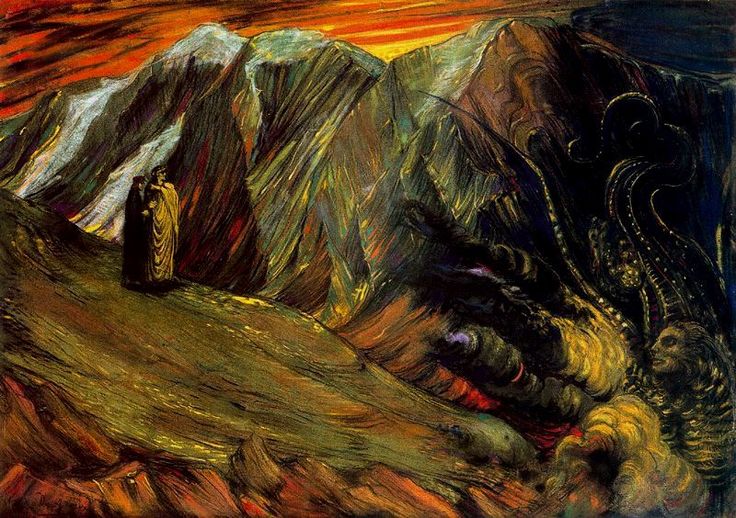
Mortal artists have imagined infernal landscapes in many forms. Such works can evoke the scale and terror of Avernus without serving as literal maps of the Perdition.
Avernus Beyond SpiralWorlds
These videos are retained as external gaming reference and atmosphere. They depict other interpretations of Avernus and do not define SpiralWorlds canon.
Avernus and the Nine Hells
A broader Dungeons & Dragons interpretation of Avernus and the Nine Hells. Rulers, history and cosmology may differ from SpiralWorlds.
External Fantasy Ambience
An external fantasy ambience track retained for tabletop atmosphere. It is not a canonical audio depiction of SpiralWorlds Avernus.
Keep this reference growing
If this page helped with your reading or game, you can support its upkeep or explore the curated books.
Explore the Bookshop — epics, classics and stories behind imagined worlds.