
Maladomini — The Ruined Works
Maladomini is Hell after ages of development without restraint: a Perdition of rejected cities, poisoned waterways, open sewers, quarried mountains, burning refuse fields, permanent smoke, vermin-choked ruins and monumental works demolished whenever Beelzebub decides that perfection has once again been missed.
The Seventh Perdition
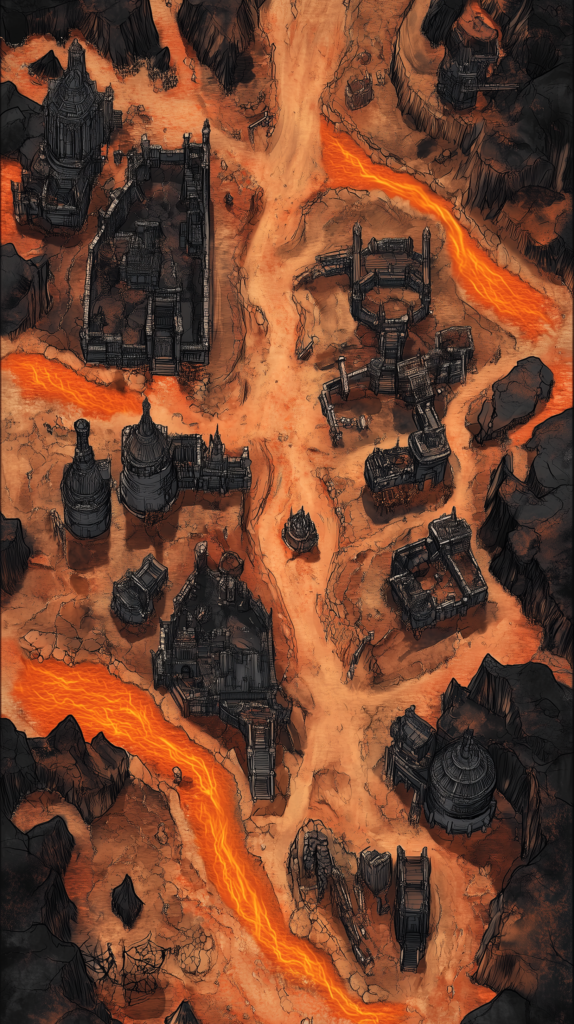
Maladomini is a landscape consumed by its own development. The destruction visible across the Seventh is not primarily the result of war, natural disaster or age. Much of it was created deliberately in the pursuit of better cities, greater works and increasingly exact expressions of Beelzebub’s ideal.
Mountains have been quarried away. Hills have been stripped for stone and metal. Mines descend beneath abandoned mines, while spoil from generations of excavation rises in artificial ridges across the plains.
Entire cities stand empty because some proportion, alignment, street plan or ornament eventually offended their ruler. Perfectly serviceable districts are demolished and their materials dumped into valleys, marshes and old workings.
Roads lead to capitals that no longer matter. Bridges cross black canals serving abandoned districts. Great ceremonial avenues vanish beneath refuse deposited after the next project was commissioned elsewhere.
Unlike Phlegethos, whose volcanoes belong to the nature of the Fourth, much of Maladomini’s devastation has been inflicted upon the Seventh by its own government.
Beelzebub and the Government of Maladomini
Beelzebub
Lord of the Seventh · Lord of the FliesBeelzebub is the recognised Lord of Maladomini and the authority responsible for the vast succession of cities, works and rebuilding programmes that define the Seventh.
His ideal of perfection is absolute. Buildings, roads, laws, servants and institutions can be condemned not because they fail to function but because some element no longer conforms to the standard he believes they should have achieved.
The result is a system in which enormous resources can be consumed correcting defects that exist chiefly in the mind of the ruler who commissioned the work.
No architect can safely argue that the design itself was wrong. No overseer can easily tell the Lord of the Seventh that continued rebuilding is destroying the realm. Responsibility therefore flows downward while the next project begins.
Maladomini remains tightly governed despite its ruined appearance. Beelzebub employs officials, spies, reports and controls over movement to supervise both his subjects and outsiders.
Like every Lord of the Nine, Beelzebub rules beneath the ultimate sovereignty of Asmodeus. Maladomini is part of the greater infernal state rather than an independent Hell.
A Poisoned Infernal Environment
The great horror of Maladomini is cumulative. No single project ruined the Seventh. Ages of extraction, construction, demolition and disposal transformed whole regions into wasteland.
Rivers of Refuse
Canals and waterways carry sewage, ash, slag, demolition rubble, corpses, animal waste and runoff from mines, furnaces and workshops.
In the most heavily used districts the water becomes black, oily or nearly solid with floating refuse.
Burning Rubbish Mountains
Rejected masonry, household refuse, organic waste, ash and industrial spoil accumulate in artificial hills.
Some burn internally for decades or centuries, venting smoke through cracks while whole slopes collapse into glowing cavities.
Permanent Smog
Quarry dust, furnace smoke, ash, sulphurous fumes, burning rubbish and sewage vapours combine above developed regions.
Some districts spend long periods beneath a thick brown-black haze through which distant buildings are barely visible.
Stripped Earth
Open pits, exhausted quarries and collapsed mine workings replace landscapes that supplied earlier generations of construction.
When one region is exhausted, another is opened.
Open Sewers
Outside wealthy districts, sewage commonly runs through open gutters and canals. Excrement, food waste and rotting organic matter gather wherever drainage fails.
Waste Fires
Furnaces and refuse pits consume unwanted material. Some fires spread underground through buried deposits and cannot easily be extinguished.
Dead Infrastructure
When a city is abandoned, its canals become drains, roads become rubbish grounds and unused tunnels fill with sewage, vermin and stagnant water.
A Perdition That Did This to Itself
Avernus is scarred by war. Phlegethos burns because it is volcanic. Stygia is naturally frozen.
Maladomini is different.
Its environmental catastrophe is largely the accumulated result of decisions: extraction beyond need, demolition instead of repair, construction beyond usefulness and a government unable to admit that endless improvement has become destruction.
Filth, Vermin and the Lord of Flies
The waste of Maladomini supports an enormous scavenger ecology.
Outside the prestigious quarters of Malagard, flies are almost ubiquitous. They gather over drains, slaughter waste, latrines, carcasses, sewage channels and burning refuse. In the worst districts they form dark clouds above the streets.
Rats live beneath rubbish piles and inside abandoned buildings. Cockroaches swarm through kitchens, sewers, cellars and warm masonry. Maggots and rot grubs flourish wherever organic waste remains undisturbed. Centipedes and spiders occupy tunnels, ruined houses, drainage works and mine galleries.
Buzzers
The enormous infernal flies associated with Beelzebub are more than scavengers. They can serve as eyes and ears of the Lord of Flies, carrying information back to his court.
This makes every gathering of flies potentially political. A traveller may dismiss ordinary vermin while failing to notice the creature among them that is actually watching.
Maladomini Slugs
Large infernal slugs thrive among abandoned buildings, sewage works, rubbish fields and polluted canals.
Their slime and corrosive secretions further damage already neglected masonry, making them scavengers and agents of continuing decay.
Fiendish Dire Rats
Large fiendish rats flourish around rubbish dumps, slaughter waste, sewers and abandoned settlements.
They are bold scavengers and dangerous predators where food becomes scarce.
Rat Swarms
Countless smaller rats gather into dangerous swarms in sewers, refuse fields, ruined buildings and neglected streets.
Cockroach Swarms
Cockroaches thrive in drains, dumps, abandoned buildings and foul areas rich in rotting waste.
Demolition can drive enormous infestations into surrounding streets and settlements.
Giant Hissing Cockroaches
Enormous cockroaches haunt sewers, cavernous refuse deposits and the interiors of abandoned construction.
Rot Grub Swarms
Corpses and great accumulations of organic waste can support horrifying infestations of flesh-eating rot grubs.
Centipede Swarms
These infest old mines, drains, foundations, tunnels and the damp spaces beneath abandoned cities.
Spider Swarms
Colonies occupy ruined structures, cellars, tunnels and unmaintained underground works.
Fiendish Monstrous Centipedes
Larger fiendish centipedes hunt through deep workings, sewers and abandoned underground infrastructure.
Fiendish Monstrous Spiders
These larger predators occupy caverns, ruined towers, empty districts and neglected construction works where smaller vermin provide abundant prey.
Perfection Has Somewhere Else to Put Its Filth
The finest quarters of Malagard can appear astonishingly clean compared with the rest of the Seventh.
Streets are swept. Drains are cleared. Walls are washed. Refuse is collected. Rats and cockroaches are trapped or killed. Dead animals are removed quickly, and visible sewage is treated as an offence against the image Beelzebub wishes his capital to present.
But the waste does not cease to exist.
It is carried outward.
The sewage of prestigious streets enters poorer canals. The rubbish of palaces is dumped beside labour districts. Construction debris is carted into abandoned capitals. Carcasses and night soil are unloaded wherever officials decide they will no longer offend important eyes.
The immaculate centre therefore depends upon the filth of the outskirts.
One creature remains welcome even in prestigious districts: the Buzzer. Beelzebub may tolerate his great infernal flies where he would never tolerate ordinary vermin, because surveillance is itself part of perfection.
The Cycle of Perfection
Maladomini’s defining political project is the repeated construction of Beelzebub’s ideal capital.
Numerous cities have been planned and built at his command. Each is intended to correct the failings of its predecessor. Each consumes fresh stone, metal, labour, roads, quarries and administrative attention.
Eventually Beelzebub discovers another defect.
An avenue is not perfectly aligned. A tower is wrongly proportioned. A ceremonial district fails to embody the order he imagined. An ornament is deemed vulgar. A successful city can be condemned for failing to achieve an ideal no servant fully understood.
The builders are blamed.
Then extraction begins again.
Extract
New mines and quarries consume another part of the landscape.
Build
Roads, foundations, towers, canals and districts rise on an enormous scale.
Condemn
The completed work is declared inadequate when some new defect is discovered.
Discard
Buildings and infrastructure become another layer of Maladomini’s accumulating waste.
Malagard
Malagard is the current capital of Maladomini and the principal seat of Beelzebub.
Against the devastated landscape surrounding it, Malagard presents itself as proof that the failures of earlier capitals have finally been corrected.
Its great avenues, fortified districts, administrative complexes and monumental architecture embody the current official standard of the Seventh.
The most prestigious quarters are kept conspicuously cleaner than the rest of Maladomini. Sewage is carried away, refuse removed and vermin suppressed so that the visible centre of government conforms to Beelzebub’s preferred image.
That cleanliness is achieved by exporting disorder into less important districts rather than solving the underlying problem.
Even Malagard is not secure. Beelzebub has already begun to find defects in his present capital.
If the pattern of the Seventh continues, Malagard may one day join the ruined cities it was intended to surpass.
Beelzebub’s Court
The Lord of the Seventh governs from Malagard through officials, spies, administrators and infernal nobles.
The Machinery of Inspection
Reports and inspections measure servants and works against changing standards of correctness.
Success is temporary because yesterday’s perfect solution may become tomorrow’s condemned failure.
The Abandoned Megaprojects
Some of Maladomini’s most extraordinary ruins were never cities at all.
Bridges to Nowhere
Immense bridges cross ravines and polluted waterways only to terminate where planned districts were never completed.
Empty Foundations
Foundations large enough to support palaces or entire administrative complexes survive after the structures intended for them were cancelled.
Unfinished Tunnels
Great passages cut through mountains can simply end where priorities changed or the destination itself was abandoned.
Dead Ceremonial Avenues
Perfectly ordered boulevards stretch through empty ground between ruins that no longer serve any purpose.
Half-Built Towers
Towers rise for hundreds of feet before ending in exposed chambers, scaffolding and unfinished masonry.
Demolished Successes
Some ruins are disturbing precisely because surviving fragments show that the rejected building had once been magnificent and fully functional.
Denizens of Maladomini
Infernal Officials
Administrators, inspectors, surveyors, spies and other officials translate Beelzebub’s demands into orders that reach across the Seventh.
Engineers and Overseers
The devils of Maladomini are capable engineers. The waste of the Seventh does not come from an inability to build but from what its government continually chooses to build, demolish and replace.
Workers and Captives
Prisoners, enslaved beings and souls held under infernal claims may be assigned to mines, quarries, demolition, hauling, sewage clearance, waste disposal and construction.
Buzzers
Beelzebub’s great infernal flies move through both ruins and functioning settlements as scavengers, predators and potential spies.
Maladomini Slugs
The native slugs flourish in filthy and abandoned districts, feeding among waste and leaving corrosive trails through damaged structures.
Vermin
Rats, cockroaches, maggots, rot grubs, centipedes, spiders and larger fiendish scavengers form an enormous secondary population wherever Maladomini’s waste accumulates.
Souls in Maladomini
Maladomini does not automatically receive mortals because they were greedy, corrupt, authoritarian or obsessed with perfection.
A soul reaches Hell through an appropriate cosmological destination, recognised infernal claim, contract, allegiance, binding or supernatural circumstance.
Once legitimately held within Maladomini, a soul can be assigned to mines, quarries, demolition crews, furnaces, refuse fields, sewage works, road building or other forms of infernal service.
The destruction of completed work may itself become a punishment. A captive can spend decades building something only to be ordered to tear it down because an inspector has declared it imperfect.
That is an infernal punishment imposed by authority, not a universal afterlife mechanism applied automatically to every soul in the Seventh.
Infernal transformation likewise requires its own process, cause and authority. Merely remaining within Maladomini does not automatically turn a visitor or captive into a devil.
Travel Through Maladomini
Maladomini possesses an enormous transport network, but much of it belongs to projects no longer maintained.
A traveller may follow an excellent paved road for miles only to discover that the bridge ahead was dismantled, the city beyond abandoned or the route converted into a dumping ground.
Other roads disappear beneath spoil heaps, rubbish mountains or permanent clouds of smoke from burning waste.
Recognised active routes remain carefully controlled. Beelzebub takes a direct interest in who enters and leaves the Seventh, and significant travellers may be recorded by gate, portal, sponsor and destination.
A seal, invitation or contract can therefore be as important as knowing the physical road.
Routes from Malbolge enter the Seventh through controlled approaches.
The recognised descent toward Cania crosses from Beelzebub’s exhausted works into the frozen jurisdiction of Mephistopheles.
Maladomini Through Infernal History
Hell formed during Eon VII, long before organised devil civilisation reached its mature form.
By Eon XVI, infernal cities, ranks, territorial government and administrative institutions had emerged.
The present infernal settlement recognises Beelzebub as Lord of the Seventh.
Under his rule, repeated capital-building became one of Maladomini’s defining political acts.
Each generation of construction altered the landscape. Quarries became larger. Mines ran deeper. Waste accumulated. Canals received more sewage and effluent. Former capitals became ruins, while rats, flies, cockroaches and slugs colonised the places government no longer valued.
Over infernal ages those separate decisions accumulated into the environmental condition of the modern Seventh.
Maladomini is therefore not simply a realm containing ruins. It is a civilisation continually manufacturing its own ruins, its own pollution and the vermin that flourish within them.
A Mortal Vision of Ruined Government
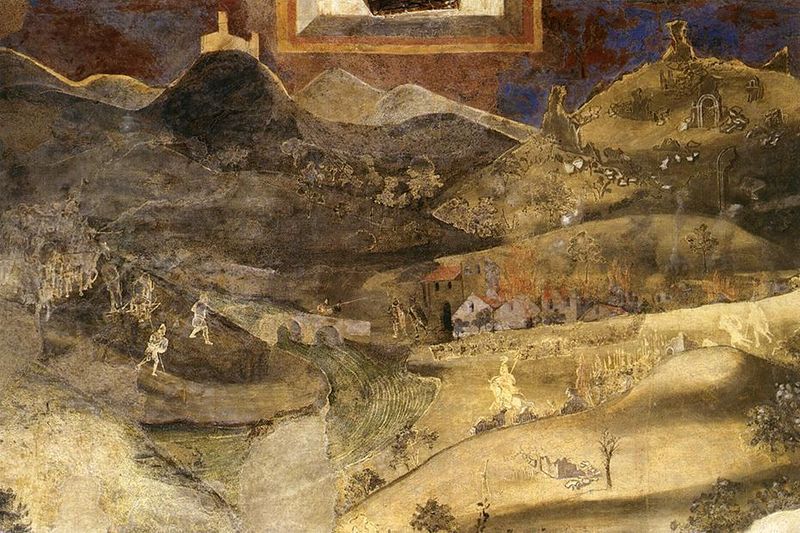
Mortal artists have long used damaged countryside, neglected infrastructure and civic ruin as images of failed government. Such works can evoke Maladomini without serving as literal illustrations of the Seventh.
Maladomini Beyond SpiralWorlds
These videos are retained as external gaming reference and atmosphere. Their rulers, locations, history and cosmology may differ from SpiralWorlds and do not define this setting’s canon.
Maladomini and the Nine Hells
An external Dungeons & Dragons interpretation of Maladomini retained for comparison rather than as SpiralWorlds canon.
Maladomini Ambience
External fantasy ambience inspired by the traditional Seventh Hell, retained for tabletop atmosphere rather than canonical description.
Keep this reference growing
If this page helped with your reading or game, you can support its upkeep or explore the curated books.
Explore the Bookshop — epics, classics and stories behind imagined worlds.