
Cania — The Frozen Eighth
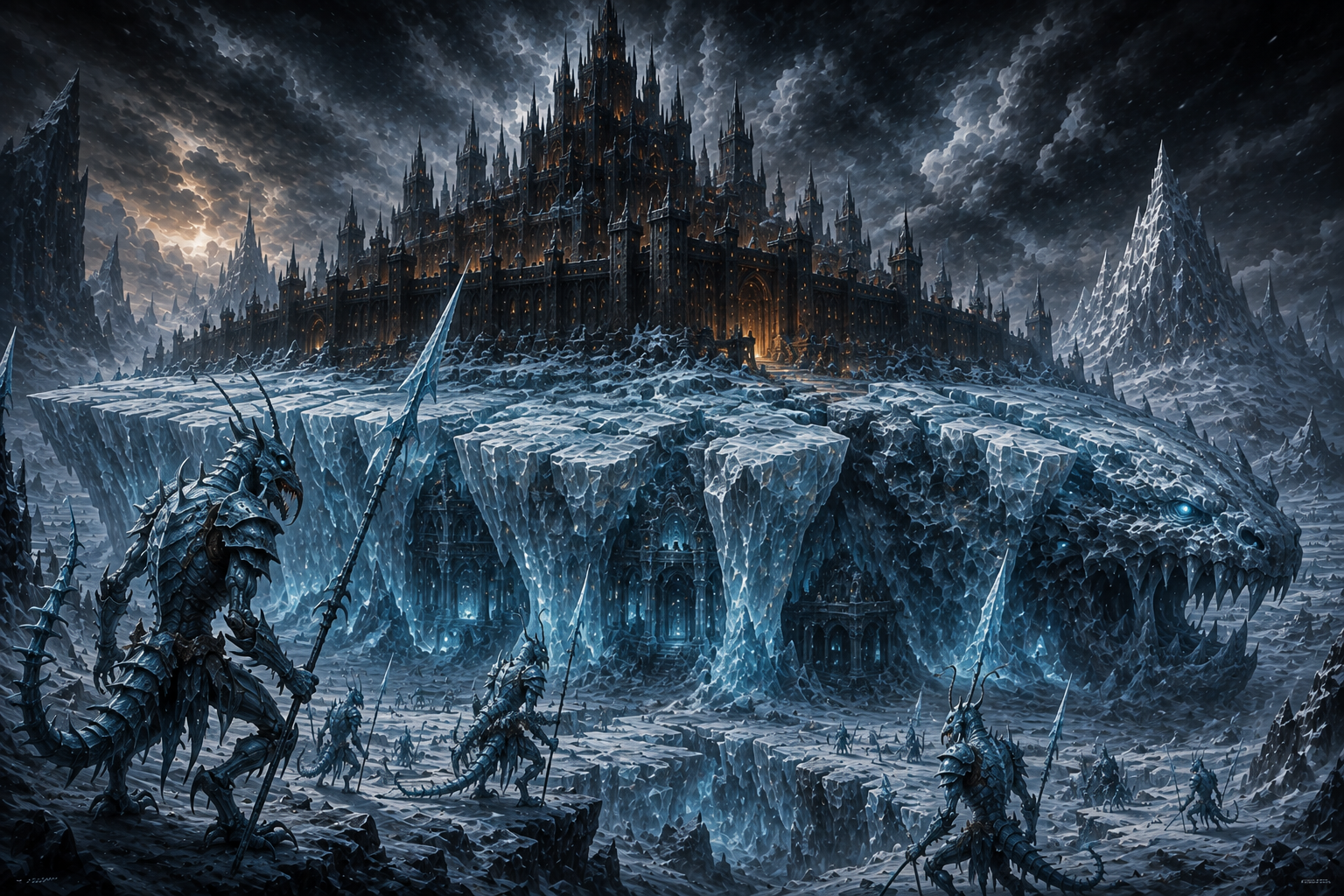
Cania is Hell’s great glacial Perdition: an immense frozen expanse of moving ice, buried cities, shattered mountains, crevasses and storm-scoured wastes dominated by Mephistar, where Mephistopheles pursues knowledge, experimentation and power with the same cold calculation that governs his realm.
The Eighth Perdition
Cania is an unimaginably cold wilderness dominated by glaciers, frozen mountains and enormous moving masses of ice. Exposure without protection can become lethal in very little time.
The glaciers of the Eighth are not static. They grind across the land, collide with one another, shear apart and force ridges of broken ice upward into new mountains.
When vast ice masses meet, the impact can throw snow, frozen rock and shattered ice high into the air. Crevasses open, close and migrate. Routes that were safe during one journey may be buried or split apart before the next.
Cania is therefore distinct from Stygia . The Fifth is a frozen sea crossed by ships and Styx traffic. The Eighth is a glacial country whose landscape itself moves.
The extreme cold is an environmental and supernatural hazard, not a universal planar rule. Cania does not automatically change alignment, grant cold powers, suppress fire magic or transform travellers through prolonged exposure.
Moving Continents of Ice
Some glaciers are immense enough to carry fortresses, roads and inhabited complexes while moving across the frozen landscape.
The Broken Surface
Deep fissures divide otherwise level ground, exposing ancient ice and sometimes opening passages into buried ruins below.
White Darkness
Blizzards and blown ice can erase the horizon, conceal crevasses and make navigation impossible without magical or infernal guidance.
Mephistopheles and the Government of Cania
Mephistopheles
Lord of the Eighth · Arch-Duke of CaniaMephistopheles is the recognised Lord of Cania and one of the most ancient and intellectually formidable powers within the infernal hierarchy.
His rule combines territorial authority with relentless study, experimentation and political calculation. He spends extraordinary amounts of time reading, researching, computing and testing ideas that might increase his knowledge or power.
Knowledge in his court is rarely pursued for its own sake. Information is valuable because it can expose weakness, produce advantage, strengthen magic, improve an infernal device or reveal something an enemy hoped to conceal.
Mephistopheles remains ambitious and dangerous, but Cania is not an independent Hell. He holds the Eighth beneath the sovereignty of Asmodeus and the central authority of Nessus.
Calculated Rule
Mephistopheles favours preparation, intelligence and controlled institutions over impulsive violence.
Knowledge as Weapon
Magical theory, historical records and captured information are valuable because they can be converted into practical infernal advantage.
The Throne Below
Mephistopheles remains one of Hell’s most ambitious Lords and watches both his rivals and Nessus with extreme care.
Mephistar
Mephistar is the principal citadel of Cania and the seat of Mephistopheles.
The fortress stands upon an immense glacier called Nargus. Unlike most of Cania’s moving ice, Nargus does not drift entirely according to natural forces: Mephistopheles can direct its movement, allowing his capital to cross the Eighth as an enormous mobile stronghold.
From outside, Mephistar appears to belong completely to the frozen world around it: towers, walls and fortifications rise from the glacier amid wind, snow and lethal cold.
The interior is very different.
Fires, heated chambers and great baths create habitable interior districts. Warm halls and private chambers can exist only a short distance from exterior walls exposed to the killing cold.
Mephistar also provides secure spaces in which Mephistopheles and trusted servants can study, experiment, store records and pursue work that requires protection from the open glaciers.
This contrast is deliberate. Mephistar is not simply a shelter from Cania. It demonstrates the power of its ruler to impose controlled conditions upon an environment that kills almost everything left unprotected.
Nargus
The giant glacier carrying Mephistar moves through Cania under Mephistopheles’ direction.
Its movement allows the seat of the Eighth to alter its position relative to other glaciers, ruins and recognised approaches.
The Warm Citadel
Great fires, heated baths and protected chambers make Mephistar unexpectedly comfortable compared with the lethal waste outside.
The Court of the Eighth
Infernal nobles, military officers, specialists, spies and servants gather in the moving citadel beneath the direct authority of the Lord of Cania.
Knowledge and Experiment in Mephistar
Mephistopheles’ court is strongly associated with study, experimentation and the pursuit of useful knowledge.
This activity is concentrated around Mephistar, its lord and the powerful servants or strongholds connected to his court. It should not be mistaken for a realm-wide network of infernal academies.
Research is valued because knowledge can produce power. Dangerous experiments are worthwhile if the possible result is useful enough, and concern for the suffering of test subjects is rarely a serious restraint.
Stored Knowledge
Magical, historical and political records can be gathered and preserved within secure Canian strongholds, especially Mephistar.
Arcane Study
Mephistopheles and selected servants investigate magical theory, rituals and techniques capable of increasing infernal power.
Controlled Testing
Secure chambers can be used to test dangerous ideas, spells, devices or captured phenomena without exposing the wider court unnecessarily.
Infernal Devices
Canian powers such as Belphegor demonstrate that invention, dangerous artifacts and infernal machinery have a recognised place within the Eighth.
Knowledge Does Not Automatically Damn
The intellectual character of Mephistopheles and his court does not mean that scholars, wizards, inventors, physicians or seekers of knowledge automatically come to Cania after death.
Souls reach Hell through recognised infernal claims, contracts, allegiance, supernatural circumstances or the cosmological destination that properly receives them.
Mephistopheles may deliberately tempt individuals through promises of knowledge and power, but that is a specific infernal relationship rather than a universal rule of the afterlife.
Powers and Denizens of Cania
Ice Devils — Gelugons
Gelugons are among the devils most strongly associated with Cania and are particularly favoured by Mephistopheles.
They serve as soldiers, guards and elite infernal enforcers well suited to the frozen wastes of the Eighth.
Belphegor
Belphegor resides within Cania beneath the lordship of Mephistopheles.
His fortress of twisted metal and blackened ice contains infernal machines and dangerous artifacts, making him one of the clearest expressions of the Eighth’s association with invention.
Pit Fiends and Courtiers
Powerful devils have long served within Cania’s court. Their loyalties are watched carefully: the history of the Eighth includes plots, conspiracies and attempted betrayals from within its own hierarchy.
Researchers and Advisers
Servants possessing useful magical, historical or planar knowledge can gain important roles around Mephistopheles and Mephistar.
Prisoners and Test Subjects
Claimed souls, prisoners and captured beings may be assigned to physical labour, interrogation or experimental use according to infernal authority.
Frozen Creatures
Creatures and forces from older periods lie trapped within Cania’s glaciers and may occasionally be exposed when the ice shifts.
The Buried Worlds of Cania
The moving glaciers of Cania conceal as much as they destroy.
Ruins, lost settlements and frozen armies lie beneath enormous depths of ice. Some were swallowed when glaciers shifted across them; others belong to periods of infernal history whose surface traces have long disappeared.
Glacial movement occasionally exposes fragments of these buried places. A ruined tower may emerge from an ice wall. A crevasse may open into a sealed street. Frozen creatures or military formations may appear where a glacier fractures.
Such discoveries are unlikely to remain ignored for long. Mephistopheles values knowledge and useful relics, giving his agents strong reason to investigate newly exposed remains before rivals can reach them.
Frozen Cities
Ruins and lost settlements survive below the ice in varying states of preservation.
Frozen Armies
Armies and other creatures from older periods lie trapped beneath Cania’s glaciers and may be exposed when the ice shifts.
Recovered Relics
Objects, structures and records exposed by moving ice can attract immediate infernal interest when they appear useful or historically important.
Souls in Cania
Cania does not automatically receive every cold-hearted intellectual, ambitious wizard, inventor or seeker of forbidden knowledge.
A soul reaches Hell through an appropriate cosmological destination, recognised infernal claim, contract, allegiance, binding or supernatural circumstance.
Mephistopheles may take particular interest in souls possessing rare knowledge, magical skill or intellectual ability. Such a soul may be worth more as an interrogated prisoner, specialist or bargaining resource than as anonymous labour.
Other souls may work inside fortresses, maintain routes, support expeditions across the glaciers or serve as prisoners and test subjects.
There is no automatic transformation into an ice devil or any other infernal form merely through residence in Cania.
Travel Through Cania and the Road to Nessus
Travel across Cania is difficult even before infernal authorities become involved.
Moving glaciers alter the landscape, storms destroy visibility and crevasses sever routes without warning. Recognised roads and approaches therefore depend heavily upon fortified markers, magical guidance and local knowledge.
Routes from Maladomini enter the Eighth through controlled infernal crossings.
The descent from Cania to Nessus is among the most heavily defended transitions in Hell.
Large gelugon forces guard the approaches. The recognised route descends through immense ice, darkness and black water toward the portal into the deepest Perdition.
Beyond that boundary lies Nessus. Immediately below the Cania–Nessus frontier rises Malsheem, the Citadel of Hell and seat of Asmodeus.
This proximity makes the descent strategically exceptional. A traveller passing beyond Cania is no longer merely entering another territorial domain: they are approaching the central seat from which the infernal state is ruled.
Cania Through Infernal History
Hell formed during Eon VII, long before organised devil civilisation developed the institutions recognised in the present age.
By Eon XVI, territorial government, infernal ranks, courts and organised offices had emerged. Mephistopheles became one of the great rulers of that early infernal order and remains Lord of the Eighth.
His rule has nevertheless faced internal challenges. At one point the Duke called Molikroth appeared to overthrow Mephistopheles with the support of traitorous nobles and pit fiends.
The apparent coup was a trap.
At the height of the conspiracy, Molikroth revealed himself to be Mephistopheles in disguise. The plot exposed those willing to betray him, allowing loyal forces to eliminate the conspirators.
Other Canian relationships changed over time. Merorem the Darkwind once served as a vassal of Mephistopheles in Cania before leaving the Eighth and eventually entering the service of Dispater in Dis.
Mephistopheles also maintains one of Hell’s most enduring rivalries with Beelzebub , Lord of Maladomini.
The present settlement nevertheless remains clear: Mephistopheles holds Cania beneath the ultimate authority of Asmodeus .
A Mortal Vision of Frozen Isolation
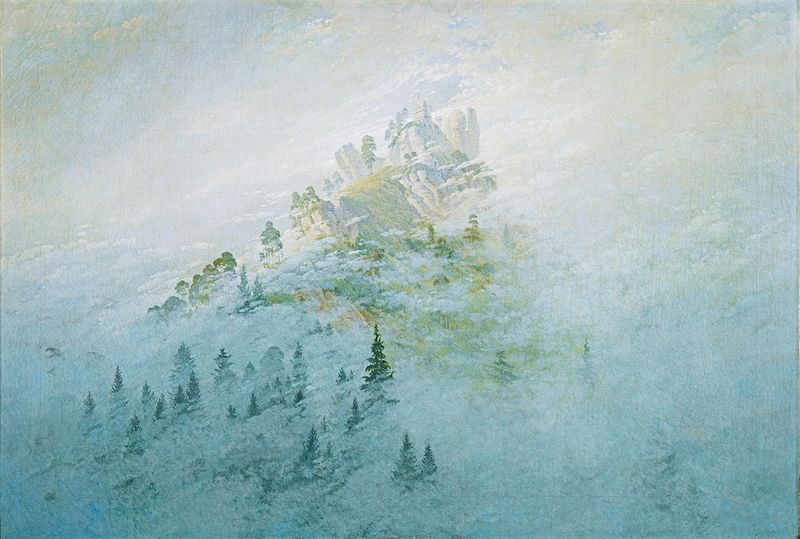
Mortal landscapes of mountains, mist and winter provide a useful visual language for Cania’s isolation without serving as literal depictions of the Eighth.
Keep this reference growing
If this page helped with your reading or game, you can support its upkeep or explore the curated books.
Explore the Bookshop — epics, classics and stories behind imagined worlds.