
Dis — The Iron City
Dis is Hell’s great iron metropolis: a vast and oppressive urban Perdition of heated streets, fortified districts, markets, courts, warehouses, shifting roads and ceaseless surveillance beneath the shadow of Dispater’s Iron Tower.
The Second Perdition
The Iron City dominates Dis so completely that travellers often struggle to decide where the surrounding Perdition ends and the metropolis begins.
Beyond the densest districts lies a largely flat country beneath a smoky green sky occasionally broken by lightning. Black, stagnant rivers cut across the plains, while enormous spurs of blackened natural iron rise from the ground.
Those formations grow more frequent toward the city. Roads, walls, manufactories, warehouses and inhabited districts gradually swallow the landscape until a traveller realises that the Iron City surrounds them.
The dangers of Dis are environmental, political and infernal rather than a universal planar mechanic. Its iron can burn, its streets can shift and its authorities can imprison travellers, but entering the Second does not automatically alter alignment or impose a standardised planar infusion.
Dispater and the Government of Dis
Dispater
Lord of the Second · The Iron DukeDispater is one of the oldest rulers within the infernal order and the present Lord of the Second. His hold over Dis has proved exceptionally durable.
He rules through administration, surveillance, delegation and exhausting systems of procedure as readily as through open violence. The metropolis provides him with wealth, intelligence and political influence extending far beyond the Second.
Dispater remains a Lord of the Nine beneath the sovereignty of Asmodeus. The size and wealth of Dis do not make it an independent infernal state.
Seat of Dispater
Dispater’s principal fortress and the dominant landmark of the city.
An Infernal Market
Merchants, emissaries, planewalkers, agents and traffickers from beyond the Second can enter recognised districts of the metropolis.
Authority by Record
Courts, records, permits, contracts, customs, surveillance and delegated offices reinforce Dispater’s rule.
The Streets of Dis
Burning Architecture
The streets and buildings of the city radiate dangerous heat. Bare contact with exposed iron can burn flesh, and many districts smoke continually beneath the green-black sky.
Shifting Streets
Roads and districts are continually rebuilt. Some changes are the result of labour and construction; others appear to belong to the unnatural geography of the city itself.
The Ever-Present Tower
The Iron Tower dominates the skyline. From within the city it can seem to present itself on the horizon regardless of the direction in which a traveller looks.
Trade, Wealth and Surveillance
Dis is one of Hell’s greatest centres of commerce and administration.
Infernal Markets
Coin, metals, weapons, magical resources, information, services, prisoners, labour, tribute, access and souls can all become objects of commerce inside the city.
Merchants from outside Hell may enter recognised markets, but every transaction takes place beneath infernal jurisdiction.
Information as Wealth
Dispater values knowledge almost as highly as material wealth. Agents, spies, clerks and informants make the city an important exchange for rumours, political secrets and strategic intelligence.
Permits and Contracts
Trade depends upon recognised access. Seals, permissions, contracts and sponsorship can determine who may enter a district, cross a gate, operate a warehouse or leave with valuable cargo.
Labour
Construction and reconstruction never cease. Devils, prisoners, enslaved beings and claimed souls all contribute to the work of maintaining, expanding and rebuilding the city.
Entering and Leaving Dis
Dis possesses walls and gates, yet its boundary is spatially deceptive. Travellers may pass gradually from iron-strewn plain into increasingly dense streets before realising that they have entered the city proper.
Leaving by recognised routes is considerably more controlled. The major gates are fortified and watched, while officials can demand proof of authority, payment, permits, contracts or sponsorship before allowing passage.
Routes from Avernus enter the Second through defended approaches. Other roads, gates and planar passages connect Dis with infernal commerce and destinations beyond Hell.
Passage onward toward Minauros is another jurisdictional crossing. Travellers leaving Dispater’s domain enter territory governed by Mammon, with its own roads, guards, laws and claims.
Places and Powers of Dis
The Iron Tower
Dispater’s immense fortress rises above the city as its defining landmark. Iron and lead dominate its construction, while its outer form is capable of changing over time.
The Tower is both residence and instrument of rule: a fortified centre of government, intelligence and infernal authority.
Ebon Gale
Merorem the Darkwind , Grand Duke of the Ebon Gale, maintains a keep called Ebon Gale on the outskirts of the metropolis and stands among the significant powers of Dispater’s court.
The Marshal’s Fortress
Dagos, Marshal of the Pits , maintains a military stronghold in Dis.
His presence demonstrates the distinction between territorial rule and central infernal authority: Dagos operates from the Second, but his military responsibilities concern Hell as a whole.
The Iron Spurs
Beyond the dense city, blackened formations of unworked iron thrust from the plains. They become increasingly common as one approaches the metropolis, blurring the distinction between landscape and city.
Denizens of Dis
The Iron City supports one of the most varied populations in Hell. Devils fill its guard posts, courts, workshops, offices and noble households, while traders and travellers from other planes move through authorised districts.
Abishai, erinyes, spinagons, lemures, bezekira, kocrachons, rakshasas and hamatulas all appear in older records of the city. Their presence should not be mistaken for a single uniform population: Dis is a metropolis whose inhabitants vary sharply by district, occupation and patron.
The city also contains prisoners and souls under recognised infernal claims. Some retain recognisable humanoid form and memory and are traditionally described in Dis as soul shells.
Souls in Dis
Dis does not automatically receive the souls of the lazy, the greedy, dishonest merchants or any other universal moral category.
Souls arrive through the same broader structures recognised throughout Hell: contracts, infernal claims, allegiance, binding, supernatural circumstance or an appropriate cosmological destination.
Once claimed within Dis, a soul might be imprisoned, assigned labour, traded, interrogated, transformed or retained in a recognisable form. Dispater’s government has many uses for beings who remember names, secrets, skills and obligations.
Endless labour therefore exists in Dis as punishment, exploitation and administration, but it is not an automatic afterlife rule imposed upon every mortal of a particular alignment or vice.
Dis Through Infernal History
Hell formed during Eon VII, long before organised devil civilisation reached mature form.
By Eon XVI, stable infernal offices, cities, territorial government and hierarchy had emerged. Dispater belongs to this ancient political order and is recorded among the early Lords of the Perditions.
His tenure has been unusually stable compared with many other infernal rulers. Through the Luciferian age, the Asmodean succession and later infernal conflicts, Dispater’s association with the Second has endured.
That continuity makes Dis one of Hell’s most established centres of administration, commerce and political memory, while its ruler still remains subject to the sovereignty of Nessus.
Mortal Visions of the Infernal City
Dark industrial cities, overcrowded districts and night markets have long given mortal artists visual languages that can evoke aspects of Dis. These works are retained as atmosphere rather than literal illustrations of the Second.

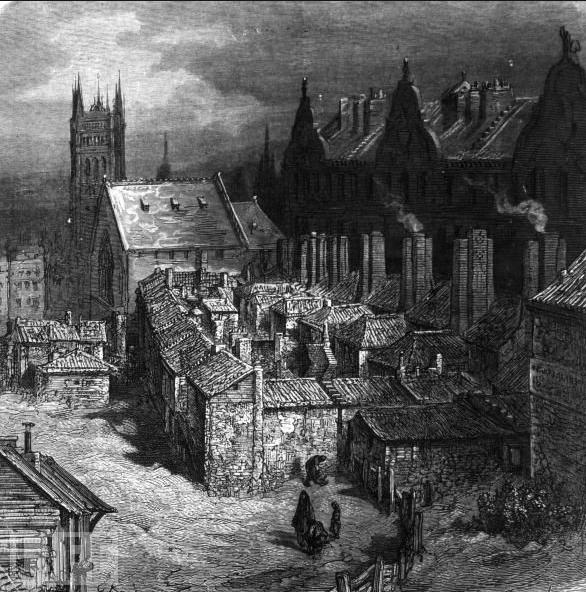
Dis Beyond SpiralWorlds
The following ambience track is retained for tabletop use. It represents an external Dungeons & Dragons interpretation and does not define SpiralWorlds canon.
Dis Ambience
External fantasy ambience inspired by the traditional second Hell. Useful for gaming atmosphere rather than canonical description.