
LeShay — Elders of the Forgotten Fey Courts
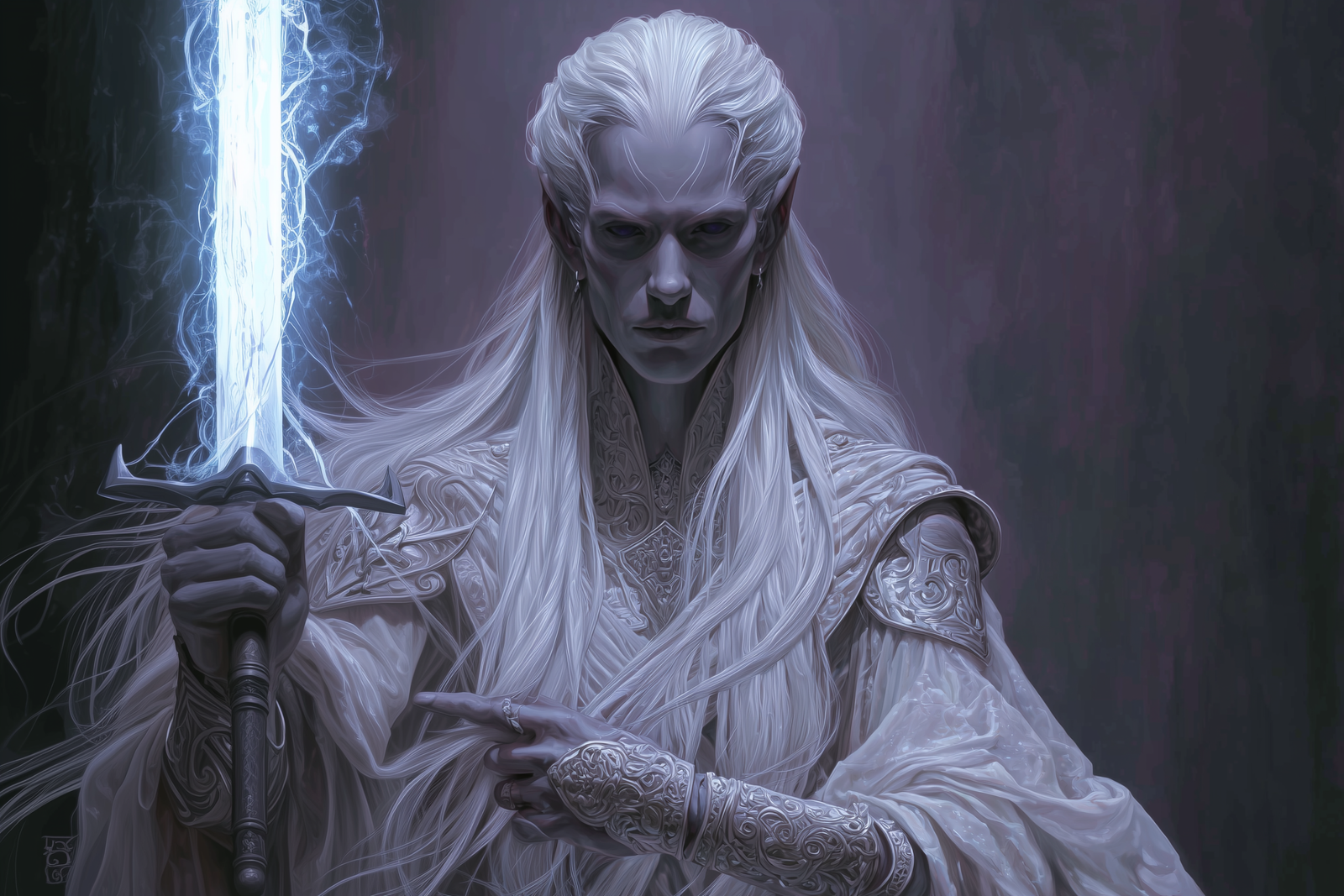
The court assembles beneath a hill that has no entrance on a mortal map. Its oldest guest arrives without herald or escort. Even the elven envoys rise to greet this pale stranger: the LeShay remembers the Sundering of their peoples, and has come to demand the fulfilment of a promise made before any living elf was born.
At a Glance
| Creature | LeShay, ancient and exceptionally powerful Fey |
|---|---|
| Nature | Ageless court elder and keeper of ancient bargains; not an elven ancestry or outsider |
| Alignment | Any; individual LeShay can be benevolent, tyrannical or indifferent |
| Homeland | Ancient courts of Faerie, forgotten enclaves and crossings into Midgard |
| Relations | The elven peoples remember the Sundering of the Courts; a LeShay may be ally, creditor, rival or living witness |
| Signs | Unchanging features, unfamiliar court ritual, impossible knowledge of lineages and conjured blades |
| Threat | Illusions, charm, rapid movement, formidable magic and ancient legal authority |
What Is Happening Right Now?
A small elven delegation has come to a deserted ring of stones with the seal of a court that vanished long before their grandfathers were born. The LeShay who waits there does not ask for tribute. It asks for the return of a single name erased from the histories of the Sundering. The delegates fear that speaking the name will revive an old claim to their lands. A mortal witness, who believes this to be a dispute over a ruin, may be asked to swear which account is true.
A LeShay is an elder of the ancient Fey courts, one of the few remaining witnesses to the age before the elven peoples separated from their former kinsfolk. Their longevity is a property of their Fey existence, not a sign that they have become outsiders or gods. Each carries obligations and memories that have survived the ruin of entire dynasties.
Appearance
LeShay are tall and slender, their bodies exuding an almost ethereal elegance. Skin and hair are ghostly white, contrasting with eyes that are entirely black, giving them a haunting, otherworldly presence. Their elongated limbs, graceful posture, and subtly pointed ears mark them as distant kin to elves, yet their aura radiates an ancient, inscrutable power. Each LeShay carries the weight of centuries in their movements, and their mere presence commands awe.
Behaviour
Prudent and proud, LeShay are deliberate in action and speech. They value etiquette, knowledge, and strategic thinking above impulse, often observing events for long periods before intervening. While not inherently malicious, their disdain for the frivolous or unworthy can make them formidable opponents or aloof allies.
Habitat
LeShay keep hidden residences in the old courts of Faerie and in places where its roads still touch Midgard: forgotten groves, hollow hills, ruins that remember their first names and islands concealed by enchantment. Their holdings seldom follow mortal borders. They may cross into the mortal world to collect a debt, preserve a treaty or judge a quarrel among younger Fey.
Modus Operandi
Masters of subtle magic, they prefer precision over brute force. In combat, they blend spellcasting with ethereal weaponry, often disarming or incapacitating foes with charm, illusion, or psychic influence before striking decisively. They can vanish or manipulate their surroundings to favor strategic advantage, and rarely engage without purpose or provocation.
Motivation
Driven by a blend of curiosity, pride, and the preservation of fey legacy, LeShay seek knowledge, artifacts, or the observation of mortals and magical phenomena. Their actions are guided by long-term goals, often spanning centuries, with the fate of their hidden realms or the balance of arcane power in mind.
Game Statistics
LeShay — Elder Courtier
Medium Fey, any alignment
AC 19 (fey armour); Initiative +5 (15); HP 252 (24d8 + 144); Speed 40 ft., Fly 60 ft. (Hover)
| STR | DEX | CON | INT | WIS | CHA |
|---|---|---|---|---|---|
| 16 (+3) | 20 (+5) | 22 (+6) | 21 (+5) | 18 (+4) | 24 (+7) |
Saving Throws Dex +11, Con +12, Wis +10, Cha +13
Skills Arcana +11, Insight +10, Perception +10, Persuasion +13, Stealth +11
Resistances Bludgeoning, Piercing and Slashing from nonmagical attacks other than cold iron
Immunities Psychic; Charmed, Frightened
Senses Truesight 120 ft., Passive Perception 20
Languages Common, Elvish, Sylvan; Telepathy 120 ft.
CR 18 (20,000 XP; PB +6)
Traits
Legendary Resistance (3/Day). If the LeShay fails a saving throw, it can choose to succeed instead.
Magic Resistance. The LeShay has Advantage on saving throws against spells and other magical effects.
Timeless Nature. The LeShay does not age and needs no sleep, though it must still rest to recover spent abilities.
Actions
Multiattack. The LeShay makes two Life-Blade attacks.
Life-Blade. Melee Attack Roll: +13, reach 5 ft., one target. Hit: 29 (4d10 + 7) Force damage plus 7 (2d6) Psychic damage. The weapon vanishes instantly when the LeShay releases it.
Gaze of Stillness (Recharge 5–6). One creature the LeShay can see within 60 feet must make a DC 21 Wisdom saving throw. On a failed save, the creature has the Stunned condition until the end of its next turn. A creature that succeeds is immune to this LeShay’s gaze for 24 hours.
Courtly Command (3/Day). Up to three creatures the LeShay can see within 60 feet each make a DC 21 Wisdom saving throw. On a failed save a creature has the Charmed condition for 1 minute. It repeats the saving throw at the end of each of its turns, ending the effect on a success. The condition ends early if the LeShay or its allies harm the creature.
Spellcasting. The LeShay casts one of the following spells, requiring no Material components and using Charisma (spell save DC 21, +13 to hit with spell attacks): at will Detect Magic, Disguise Self, Mage Hand; 3/day each Dimension Door, Greater Invisibility, Hold Person; 1/day each Dominate Person, Plane Shift (self only), Power Word Stun, Telekinesis.
Bonus Actions
Fey Step (3/Day). The LeShay teleports up to 60 feet to an unoccupied space it can see.
Reactions
Arcane Deflection. When hit by an attack roll, the LeShay adds 5 to its AC against that attack, potentially causing it to miss.
Counterspell (3/Day). When a creature the LeShay can see within 60 feet casts a spell, the LeShay casts Counterspell without Material components.
Legendary Actions
The LeShay can take three Legendary Actions, choosing from the options below, at the end of another creature’s turn. It regains spent Legendary Actions at the start of its turn.
Unhindered Motion. The LeShay moves up to half its Speed without provoking Opportunity Attacks.
Life-Blade (Costs 2 Actions). The LeShay makes one Life-Blade attack.
Fey Step (Costs 2 Actions). The LeShay teleports up to 30 feet to an unoccupied space it can see.
LeShay — Elder Courtier
Medium fey, any alignment
Armor Class 19 (fey armor)
Hit Points 252 (24d8 + 144)
Speed 40 ft., fly 60 ft. (hover)
| STR | DEX | CON | INT | WIS | CHA |
|---|---|---|---|---|---|
| 16 (+3) | 20 (+5) | 22 (+6) | 21 (+5) | 18 (+4) | 24 (+7) |
Saving Throws Dex +11, Con +12, Wis +10, Cha +13
Skills Arcana +11, Insight +10, Perception +10, Persuasion +13, Stealth +11
Damage Resistances bludgeoning, piercing and slashing from nonmagical attacks other than cold iron
Damage Immunities psychic
Condition Immunities charmed, frightened
Senses truesight 120 ft., passive Perception 20
Languages Common, Elvish, Sylvan, telepathy 120 ft.
Challenge 18 (20,000 XP); proficiency bonus +6
Traits
Legendary Resistance (3/Day). If the LeShay fails a saving throw, it can choose to succeed instead.
Magic Resistance. The LeShay has advantage on saving throws against spells and other magical effects.
Timeless Nature. The LeShay does not age and needs no sleep, though it must still rest to recover spent abilities.
Actions
Multiattack. The LeShay makes two life-blade attacks.
Life-Blade. Melee Weapon Attack: +13 to hit, reach 5 ft., one target. Hit: 29 (4d10 + 7) force damage plus 7 (2d6) psychic damage. The weapon vanishes when released.
Gaze of Stillness (Recharge 5–6). One creature the LeShay can see within 60 feet must succeed on a DC 21 Wisdom saving throw or be stunned until the end of its next turn. A creature that succeeds is immune to the gaze for 24 hours.
Courtly Command (3/Day). Up to three creatures the LeShay can see within 60 feet each make a DC 21 Wisdom saving throw. On a failed save the target is charmed for 1 minute, repeating the save at the end of each turn. Harm by the LeShay or its allies ends the effect.
Innate Spellcasting. Charisma (spell save DC 21, +13 to hit with spell attacks); requires no material components: at will detect magic, disguise self, mage hand; 3/day each dimension door, greater invisibility, hold person; 1/day each dominate person, plane shift (self only), power word stun, telekinesis.
Bonus Actions
Fey Step (3/Day). The LeShay magically teleports up to 60 feet to an unoccupied space it can see.
Reactions
Arcane Deflection. When an attack hits the LeShay, it adds 5 to its AC against that attack, potentially causing it to miss.
Counterspell (3/Day). The LeShay casts counterspell when a creature it can see within 60 feet casts a spell.
Legendary Actions
The LeShay can take three legendary actions, choosing from the options below. Only one may be used at a time and only at the end of another creature’s turn. It regains spent legendary actions at the start of its turn.
Unhindered Motion. The LeShay moves up to half its speed without provoking opportunity attacks.
Life-Blade (Costs 2 Actions). The LeShay makes one life-blade attack.
Fey Step (Costs 2 Actions). The LeShay magically teleports up to 30 feet to an unoccupied space it can see.
LeShay — Elder Courtier
CR 18; XP 153,600; N Medium Fey
Defense
Init +10; Senses low-light vision, true seeing; Perception +27
AC 32, touch 20, flat-footed 26 (+6 Dex, +12 natural, +4 deflection)
hp 190 (20d6+120)
Fort +12, Ref +18, Will +18
DR 15/cold iron; SR 29; Immune poison, disease, magical sleep; Defensive Abilities spell turning, freedom of movement
Offense
Speed 40 ft., fly 60 ft. (good)
Melee spectral rapier +20/+15 (2d6+7 force plus 2d6 cold)
Space/Reach 5 ft./5 ft.
Special Attacks courtly command, gaze of stillness
Spell-Like Abilities (CL 20th; concentration +27): constant—freedom of movement, spell turning, true seeing; at will—detect magic, disguise self, greater invisibility, mage hand, speak with plants; 3/day—dimension door, greater dispel magic, hold person (DC 19); 1/day—dominate person (DC 22), plane shift (self only), power word stun, telekinesis (DC 22)
Statistics
Str 16, Dex 22, Con 22, Int 21, Wis 18, Cha 24
Base Atk +10; CMB +13; CMD 29
Feats Combat Casting, Dodge, Greater Spell Penetration, Improved Initiative, Iron Will, Lightning Reflexes, Mobility, Spell Penetration, Weapon Finesse, Weapon Focus (rapier)
Skills Bluff +30, Diplomacy +30, Knowledge (arcana) +28, Knowledge (planes) +28, Perception +27, Sense Motive +27, Spellcraft +28, Stealth +29
Languages Common, Elven, Sylvan; telepathy 120 ft.
Ecology
Environment Old Fey courts, hidden forests and lost islands
Organization solitary or conclave (2–4)
Treasure double standard, often ancient tokens and Fey relics
Alignment any
Special Abilities
Spectral Rapier (Su). The LeShay conjures a blade of living force as a free action. It uses Dexterity in place of Strength on attack rolls and Charisma in place of Strength on damage rolls. The blade grants a +3 enhancement bonus on attack rolls, included in the attack line, and attacks as a magical weapon. When released, it disappears.
Courtly Command (Su, 3/Day). As a standard action, the LeShay designates up to three creatures within 60 feet. Each must succeed on a DC 27 Will save or be affected as by charm monster (caster level 20th) for 1 minute. The save DC is Charisma-based.
Gaze of Stillness (Su, 1/Day). As a standard action, the LeShay focuses its gaze on one creature within 60 feet. The target must succeed on a DC 27 Will save or be stunned for 1d4 rounds. This is a mind-affecting gaze effect; the DC is Charisma-based.
Ethereal Step (Su, 3/Day). As a swift action, the LeShay teleports up to 60 feet to a space it can see. It cannot cross a dimensional barrier that blocks teleportation.
Independent conversion. This creature uses Pathfinder 1e terms and statistics and is an original adaptation, distinct from the inherited epic-era D&D 3.5e entry.
LeShay — Epic Elder
Medium Fey, any alignment; inherited epic-era statistics
| Leshay | |
| Medium-Size fey | |
| Hit Dice | 50d6+650 (825 hp) |
| Initiative | +21 (+17 Dexterity, +4 Improved Initiative) |
| Speed | 40 ft. |
| AC | 52 (+17 Dexterity, +20 insight, +5 natural armor) |
| Base Attack/Grapple | +25/+30 |
| Attack | +10 keen brilliant energy bastard sword +53 melee (1d10+15/17–20) |
| Full Attack | Two +10 keen brilliant energy bastard swords, each +53/+48/+43/+38 melee (1d10+15/17–20) |
| Space/Reach | 5 ft./5 ft. |
| Special Attacks | Gaze, spell-like abilities, leShay weapons |
| Special Qualities | Superior two-weapon fighting, DR 15/epic and cold iron, elf traits, immune to poison and disease, Low-Light Vision, SR 42, fast healing 10 |
| Saves | Fort +29, Ref +44, Will +35 |
| Abilities | Strength 21, Dexterity 45, Constitution 37, Intelligence 33, Wisdom 23, Charisma 47 |
| Skills | Bluff +71, Concentration +66, Diplomacy +77, Disguise +71, Escape Artist +70, Gather Information +24, Hide +70, Intimidate +24, Jump +5, Knowledge (local, nature) +59, Listen +59, Move Silently +70, Search +59, Speak Language (any five), Spot +59 |
| Feats | Blind-Fight, Cleave, Dodge, Combat Expertise, Improved Critical (leShay weapon), Improved Initiative, Iron Will, Mobility, Power Attack, Quick Draw, Spring Attack, Weapon Finesse, Weapon Focus (leShay weapon), Whirlwind Attack |
| Epic Feats | Blinding Speed, Polyglot, Spell Stowaway (heal) |
| Climate/Terrain | Any |
| Organization | Solitary |
| Challenge Rating | 28 |
| Treasure | Standard |
| Alignment | Any |
| Advancement | None |
A leshay’s natural weapons are treated as epic for the purpose of overcoming damage reduction.
COMBAT
Spell-Like Abilities. At will—detect thoughts, disguise self, displacement, freedom, greater dispel magic, heal, greater invisibility, knock, speak with plants, spell turning, greater teleport and water breathing. Caster level 28th; saving throw DC 28 + spell level, Charisma-based.
Caster level 28th; save DC 28 + spell level. The DCs are Charisma-based.
LeShay Weapons (Su). A LeShay conjures two weapons from its own life essence as a free action. These most often resemble keen, brilliant-energy bastard swords, though an individual may choose another form. For the LeShay these weapons count as light weapons regardless of their apparent size. They disappear when relinquished and their attack values are already included above.
Superior Two-Weapon Fighting (Ex): They fight with a leShay weapon in each hand. Because these weapons are extensions of its own body, the leShay does not take an attack or Damage penalty for attacking with two weapons.
Gaze (Su): All creatures within 30 feet who meet the gaze of a leShay become affected as if by charm monster. A Will save (DC 53) negates the effect. Each opponent within range of a gaze attack must attempt a saving throw each round at the beginning of his or her turn in the initiative order. A leShay can also actively gaze as an attack action by choosing a target within range, who must then attempt a saving throw. LeShay are immune to their own gaze. The DC is Charisma-based.
Elf Traits: Immune to magic sleep spells and effects; +2 racial bonus on Will saves against enchantment spells or effects; Low-Light Vision (can see twice as far as a human in low-light conditions); entitled to a Search check when within 5 feet of a secret or concealed door as though actively looking for it; Martial Weapon Proficiency (composite longbow, composite shortbow, longbow, longsword, and rapier) as bonus feats; +2 racial bonus on Listen, Spot, and Search checks (already figured into the statistics given above).
Lineage note. Older rules describe the LeShay as having elf-like abilities. Such abilities are part of this creature’s statistics; the LeShay are an elder Fey lineage, not a subrace of mortal elves.
History of the LeShay
The LeShay belong to an order of Fey memory older than the Sundering of the Courts. They did not manufacture the elven peoples, nor were they simply early mortal elves. They remember the division between courts and the peoples who departed them, and some still hold titles granted before that division. Such inheritance gives them influence, not ownership of every elven soul or settlement.
Centuries ago, the LeShay ruled hidden enclaves of enchanted forests and mystical isles, overseeing magical ley lines and ancient relics. They were known to act as both advisors and arbiters, intervening subtly in mortal affairs only when the fates of kingdoms or the balance of magic were at stake.
The LeShay are scarce because the elder courts were broken, scattered or withdrawn during successive upheavals across Faerie and Midgard. They can be found within old seats of power, but one rarely calls upon another without a serious cause. The rise of mortal kingdoms has narrowed certain crossings; it is not the sole explanation for the disappearance of the earliest Fey courts.
Despite their scarcity, the LeShay remain masters of arcane secrets, patient and calculating, shaping events across centuries with a grace and cunning that only immortal fey can command.
Where the Elder Courts Still Hold
A LeShay’s authority comes from witnessed bargains, remembered borders and the patient application of magic. The Seelie may seek one as an arbiter, an Unseelie house as a feared creditor, and a Wild court as an unwelcome relic of restrictions it abandoned centuries ago. Few can compel a LeShay to act, but their oldest promises may still bind them.
Some elven envoys approach a LeShay as lost kin. Others remember the elder courts as possessive rulers from whom their ancestors were right to separate. The LeShay’s own account may be self-serving. None of these disagreements changes the fundamental distinction between a living elf and an ancient Fey elder. For the rivalries surrounding such claims, see Fey Relations with Other Beings.
Facing a LeShay
The first conflict should be over a promise, title or boundary rather than a fight. The elder courtier listens to anyone who can produce a genuine witness, even if that witness is a frightened servant or a mortal child. A false oath is far more dangerous than an insult. The LeShay prefers to know the enemy’s purpose before drawing a life-blade, and regards a retreat that secures the court’s interests as a victory.
If battle begins, the LeShay isolates dangerous spellcasters, disarms the impatient and changes position before an enemy can fix it in place. Its conjured weapons are unmistakable; a player who has witnessed them may recognise their wielder at a later meeting. Courtly Command does not alter the terms of a real bargain, and a charm cannot make a broken treaty valid.
Treasure and Ancient Obligations
Its true possessions are often legal rather than material: the right to a road through a hollow hill, custody of a vanished house’s name, a crown that may not be worn until a witness returns, or a safe crossing available on one night each century. Such rights can become the most valuable treasure in a campaign, but must be established in the terms of the agreement. A LeShay may also keep enchanted swords, old maps and gifts acquired before the Sundering.
Encounters and Rumours
The Name the Elves Erased
A LeShay demands that a kingdom restore the name of a fallen court to its annals. The present ruler knows the name, but revealing it will expose the dubious origin of the throne. The party must find the original witness before both sides resort to magic.
The Last Road to the Hill
Every winter a road appears between two ancient trees for one hour. A shepherd used it to escape a storm and returned with a child who has not aged in forty years. The LeShay claims the child as a lawful guest, not a captive. The claim turns on who made the original promise.
The Duel That Never Ended
Two life-blades still hover above the stones where their owners fought in an elder court. A present-day lord wants the blades seized as weapons of war; a LeShay insists they are evidence in a case that has never been judged. Touching either blade summons the surviving witness.
Related Fey
Fey Alignment explains the courts’ conflicting values, while Half-Fey and Faerie Creature examine altered or inherited nature. More individual beings belong to the Fey Bestiary.
Sources, Artwork and Licensing
3.5e source: 3.5 System Reference Document, leShay, an epic creature also associated with the Epic Level Handbook. The preserved epic statistics have been checked against that SRD. The other three rules panels are original adaptations written for their separate rules systems.
Art: existing site-hosted LeShay illustration (media 220918), shown once as the hero. The other inherited images are left in the media library rather than redundantly repeated inside stat blocks.
Open Game Content: The inherited 3.5e SRD mechanics are used under the Open Game License v1.0a. Original fiction, setting material, other edition conversions, art and page design are not designated as Open Game Content here. The complete licence and copyright notices are reproduced below.
Full Open Game License 1.0a and Section 15 notices
OPEN GAME LICENSE Version 1.0a
The following text is the property of Wizards of the Coast, Inc. and is Copyright 2000 Wizards of the Coast, Inc (“Wizards”). All Rights Reserved.
1. Definitions: (a)”Contributors” means the copyright and/or trademark owners who have contributed Open Game Content; (b)”Derivative Material” means copyrighted material including derivative works and translations (including into other computer languages), potation, modification, correction, addition, extension, upgrade, improvement, compilation, abridgment or other form in which an existing work may be recast, transformed or adapted; (c) “Distribute” means to reproduce, license, rent, lease, sell, broadcast, publicly display, transmit or otherwise distribute; (d)”Open Game Content” means the game mechanic and includes the methods, procedures, processes and routines to the extent such content does not embody the Product Identity and is an enhancement over the prior art and any additional content clearly identified as Open Game Content by the Contributor, and means any work covered by this License, including translations and derivative works under copyright law, but specifically excludes Product Identity. (e) “Product Identity” means product and product line names, logos and identifying marks including trade dress; artifacts; creatures characters; stories, storylines, plots, thematic elements, dialogue, incidents, language, artwork, symbols, designs, depictions, likenesses, formats, poses, concepts, themes and graphic, photographic and other visual or audio representations; names and descriptions of characters, spells, enchantments, personalities, teams, personas, likenesses and special abilities; places, locations, environments, creatures, equipment, magical or supernatural abilities or effects, logos, symbols, or graphic designs; and any other trademark or registered trademark clearly identified as Product identity by the owner of the Product Identity, and which specifically excludes the Open Game Content; (f) “Trademark” means the logos, names, mark, sign, motto, designs that are used by a Contributor to identify itself or its products or the associated products contributed to the Open Game License by the Contributor (g) “Use”, “Used” or “Using” means to use, Distribute, copy, edit, format, modify, translate and otherwise create Derivative Material of Open Game Content. (h) “You” or “Your” means the licensee in terms of this agreement.
2. The License: This License applies to any Open Game Content that contains a notice indicating that the Open Game Content may only be Used under and in terms of this License. You must affix such a notice to any Open Game Content that you Use. No terms may be added to or subtracted from this License except as described by the License itself. No other terms or conditions may be applied to any Open Game Content distributed using this License.
3. Offer and Acceptance: By Using the Open Game Content You indicate Your acceptance of the terms of this License.
4. Grant and Consideration: In consideration for agreeing to use this License, the Contributors grant You a perpetual, worldwide, royalty-free, non-exclusive license with the exact terms of this License to Use, the Open Game Content.
5. Representation of Authority to Contribute: If You are contributing original material as Open Game Content, You represent that Your Contributions are Your original creation and/or You have sufficient rights to grant the rights conveyed by this License.
6. Notice of License Copyright: You must update the COPYRIGHT NOTICE portion of this License to include the exact text of the COPYRIGHT NOTICE of any Open Game Content You are copying, modifying or distributing, and You must add the title, the copyright date, and the copyright holder’s name to the COPYRIGHT NOTICE of any original Open Game Content you Distribute.
7. Use of Product Identity: You agree not to Use any Product Identity, including as an indication as to compatibility, except as expressly licensed in another, independent Agreement with the owner of each element of that Product Identity. You agree not to indicate compatibility or co-adaptability with any Trademark or Registered Trademark in conjunction with a work containing Open Game Content except as expressly licensed in another, independent Agreement with the owner of such Trademark or Registered Trademark. The use of any Product Identity in Open Game Content does not constitute a challenge to the ownership of that Product Identity. The owner of any Product Identity used in Open Game Content shall retain all rights, title and interest in and to that Product Identity.
8. Identification: If you distribute Open Game Content You must clearly indicate which portions of the work that you are distributing are Open Game Content.
9. Updating the License: Wizards or its designated Agents may publish updated versions of this License. You may use any authorized version of this License to copy, modify and distribute any Open Game Content originally distributed under any version of this License.
10. Copy of this License: You MUST include a copy of this License with every copy of the Open Game Content You Distribute.
11. Use of Contributor Credits: You may not market or advertise the Open Game Content using the name of any Contributor unless You have written permission from the Contributor to do so.
12. Inability to Comply: If it is impossible for You to comply with any of the terms of this License with respect to some or all of the Open Game Content due to statute, judicial order, or governmental regulation then You may not Use any Open Game Material so affected.
13. Termination: This License will terminate automatically if You fail to comply with all terms herein and fail to cure such breach within 30 days of becoming aware of the breach. All sublicenses shall survive the termination of this License.
14. Reformation: If any provision of this License is held to be unenforceable, such provision shall be reformed only to the extent necessary to make it enforceable.
15. COPYRIGHT NOTICE
Open Game License v 1.0a Copyright 2000, Wizards of the Coast, Inc.
System Reference Document Copyright 2000–2003, Wizards of the Coast, Inc.; Authors Jonathan Tweet, Monte Cook, Skip Williams, Rich Baker, Andy Collins, David Noonan, Rich Redman, Bruce R. Cordell, John D. Rateliff, Thomas Reid and James Wyatt, based on original material by E. Gary Gygax and Dave Arneson.
Keep this reference growing
If this page helped with your reading or game, you can support its upkeep or explore the curated books.
Explore the Bookshop — epics, classics and stories behind imagined worlds.