
Traps — Design, Detection and Dungeon Hazards

The scrape of stone beneath a boot. A dry channel cut into the floor. A door that the guards never seem to use. A good trap gives adventurers a reason to investigate before it gives them a reason to roll dice.
Traps protect valuables, control movement, raise alarms, hold prisoners or delay an intruder until defenders arrive. This guide explains how to design, describe and adjudicate them. Use the edition rules below for the system you are running; the original D&D 3.5e rules and extensive trap catalogue are preserved in the expandable reference at the end.
At a Glance
| Purpose | Alarm, delay, isolation, capture, defence, punishment or protection of treasure |
|---|---|
| Typical places | Gatehouses, castles, tombs, vaults, mines, city sewers and monster lairs |
| Common clues | Scrape marks, disturbed dust, cut wires, scorched masonry, missing flagstone mortar |
| Fair counterplay | Find the trigger, study the mechanism, bypass it, jam it, disable it or accept a known risk |
| Rules supported | D&D 5.5e / 2024, 5e / 2014, Pathfinder 1e and D&D 3.5e |
Start Here — Run a Trap at the Table
- Decide why it exists. Who placed it, what is it meant to protect, and how do its owners pass safely?
- Show something observable. Offer a sound, mark, draught or suspicious detail before calling for a check, where circumstances allow.
- Define the trigger. Record its exact position and condition; do not move the trigger to catch an alert player.
- Accept intelligent solutions. A pole, rope, wedge, spell, trained animal or alternative route may defeat the mechanism without a roll.
- Resolve the consequence. A trap can sound an alarm, divide the party, consume time or change the terrain; hit-point damage is only one result.
- Decide what happens afterward. Does it reset? Can guards hear it? Has it given away the next danger?
Build your own: Designing a Trap — difficulty, triggers, CR, construction and cost. Related resources: Dungeons · Games Master Resources · Fire Trap spell · Glyph of Warding.
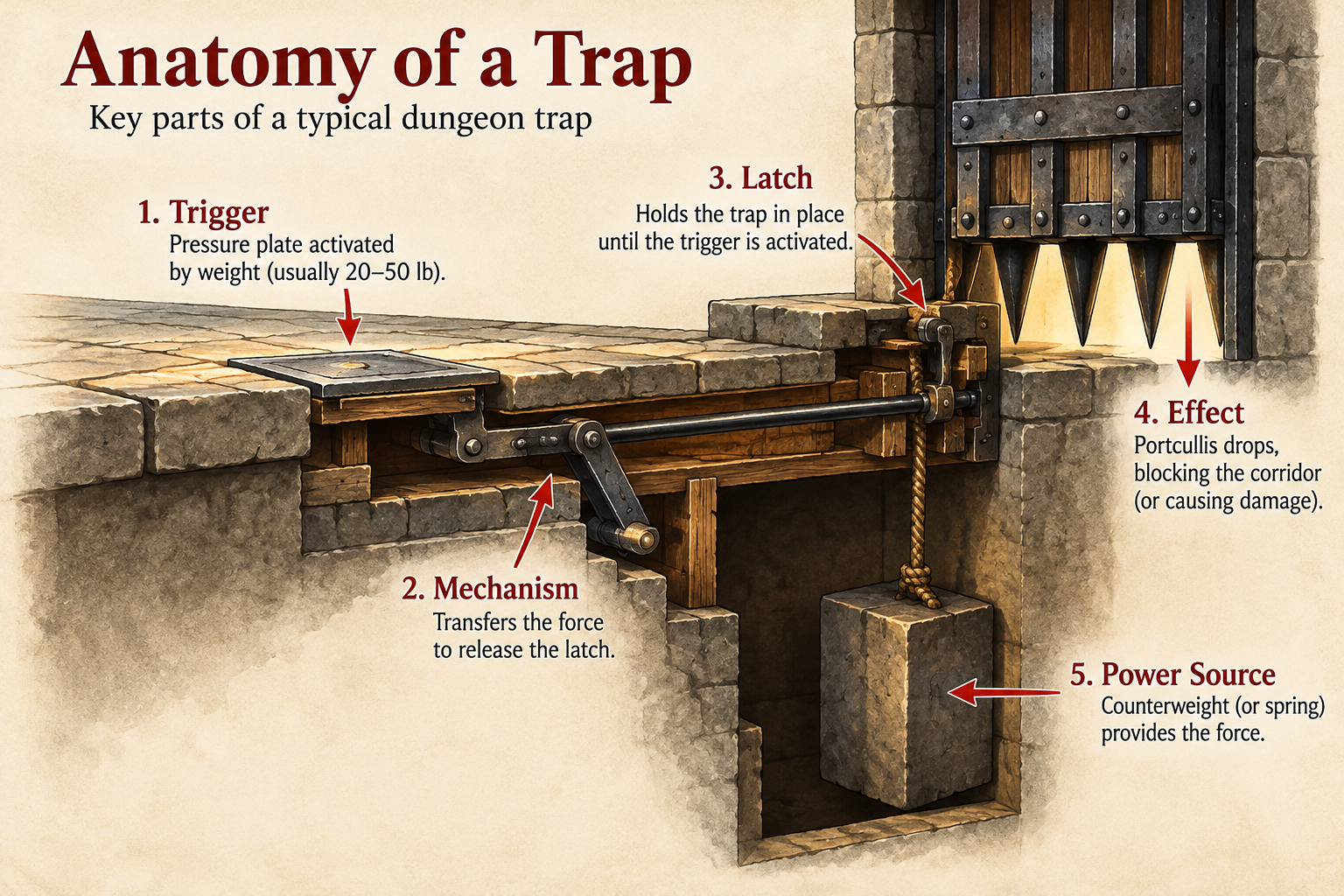
Trap Rules by Edition
Choose the ruleset. The four panels below apply different skills and procedures to the same kind of threat. The worked example is an original, adjustable low-level trap rather than an official published stat block.
2024-Compatible Traps
For a trap, specify where it is, what activates it, what clues reveal it, which checks and saves matter, and how the characters can prevent or escape its effect. Use the actual trap’s DC rather than treating an old Search or Disable Device number as universal. The GM can use Wisdom (Perception) to notice a concealed mechanism, Intelligence (Investigation) to understand it, and a Dexterity check using thieves’ tools when precise manipulation is necessary; match the action to the fiction.
Example: The Gatehouse Counterweight
Mechanical trap (original low-level example). A narrow passage beneath an old gatehouse contains a pressure flagstone.
Clue: the centre stone has polished edges; grooves climb both walls. Notice: DC 14 Wisdom (Perception). Understand: DC 13 Intelligence (Investigation).
Trigger: 60 pounds or more placed on the stone.
Effect: a falling timber strikes the trigger square and one adjacent square; creatures there make a DC 13 Dexterity saving throw, taking 7 (2d6) Bludgeoning damage on a failure, half as much on a success. Defeat: avoid the stone, wedge the counterweight, or make a DC 14 Dexterity check using thieves’ tools at the exposed housing.
Reset: manual; a nearby guard must winch the beam back into place. Scale damage and DC for the party.
Rules source: SRD 5.2.1 and the 2024 Dungeon Master’s Guide. This example is original, not quoted from an official stat block.
2014 Fifth-Edition Traps
Describe a trap’s trigger, effect and reset, and give enough physical clues to permit investigation. A careful character can try Wisdom (Perception) against the stated detection DC; passive Perception may notice a clue in passing when appropriate. Intelligence (Investigation) can reveal the mechanism and a Dexterity check with thieves’ tools can disable a device. Clever physical countermeasures can work without a roll.
Example: The Gatehouse Counterweight
Mechanical trap (original 2014-compatible example). DC 14 Wisdom (Perception) to notice the worn pressure stone; DC 13 Intelligence (Investigation) to identify the counterweight; DC 14 Dexterity check using thieves’ tools to disconnect the trigger. A creature stepping on the slab triggers the timber beam in its square and an adjacent square: DC 13 Dexterity saving throw or 7 (2d6) bludgeoning damage, half on a success. The beam must be reset manually. Avoiding the slab or immobilising the mechanism also works.
Reference: 5e SRD traps. These are 2014-style mechanics, not a claim that all 2014 traps use these DCs.
Pathfinder First Edition
Pathfinder 1e uses Perception to detect traps, Disable Device to disarm mechanisms, and trap-specific saving throws. A character with trapfinding can use Disable Device against magical traps, while noticing a magical trap is a Perception task. The rules for trap CR and costs differ from 3.5e; do not copy values across unchanged.
Example: The Gatehouse Counterweight
Mechanical trap (original PF1e example; GM-assigned CR). Perception DC 20; Disable Device DC 20; location trigger (pressure plate); manual reset; Reflex DC 15 halves 2d6 bludgeoning damage to anyone in the affected squares. The stone can be stepped around or the counterweight jammed; determine its CR and construction cost using the Pathfinder tables before awarding experience.
Reference: Pathfinder 1e Environment and Traps.
Third Edition 3.5e
Search and Disable Device are separate skills. A simple mechanical trap typically has Search DC 20, while harder-to-find traps use higher DCs and may require the trapfinding class feature. Trapfinding—not trap sense—also enables the relevant characters to find and disarm magic traps with Search and Disable Device under the 3.5e rules. Magic-trap DCs normally use 25 + spell level. Craft (trapmaking), CR modifiers and market prices are calculated by the older edition’s own rules.
Example: The Gatehouse Counterweight
Mechanical trap (original 3.5e example; confirm final CR from design modifiers). Search DC 20; Disable Device DC 20; location trigger; manual reset; Reflex DC 15 halves 2d6 bludgeoning damage in the affected area. A creature can bypass the trigger by stepping around it or physically blocking the counterweight.
See the preserved full 3.5e trap reference below and the 3.5e SRD.
Choose the Trap’s Purpose
| Purpose | Clue to describe | What changes in play |
|---|---|---|
| Alarm | Polished hinge, hidden bell wire | Defenders move toward the disturbance |
| Capture | Grooves in the stone, concealed bars | Exit shuts; prisoners may be taken alive |
| Delay | Wheel tracks, unusual slope, chains | Party loses time while a threat approaches |
| Damage | Scorch marks, bloodstained blades | Affected creatures take an attack or save |
| Divide | Unequal pressure stones, split doors | The group must cooperate across a barrier |
| Magical ward | Runes, cold air, faintly charged dust | Spell effect triggers unless the ward is countered |
Run It Tonight: The Quiet Gate
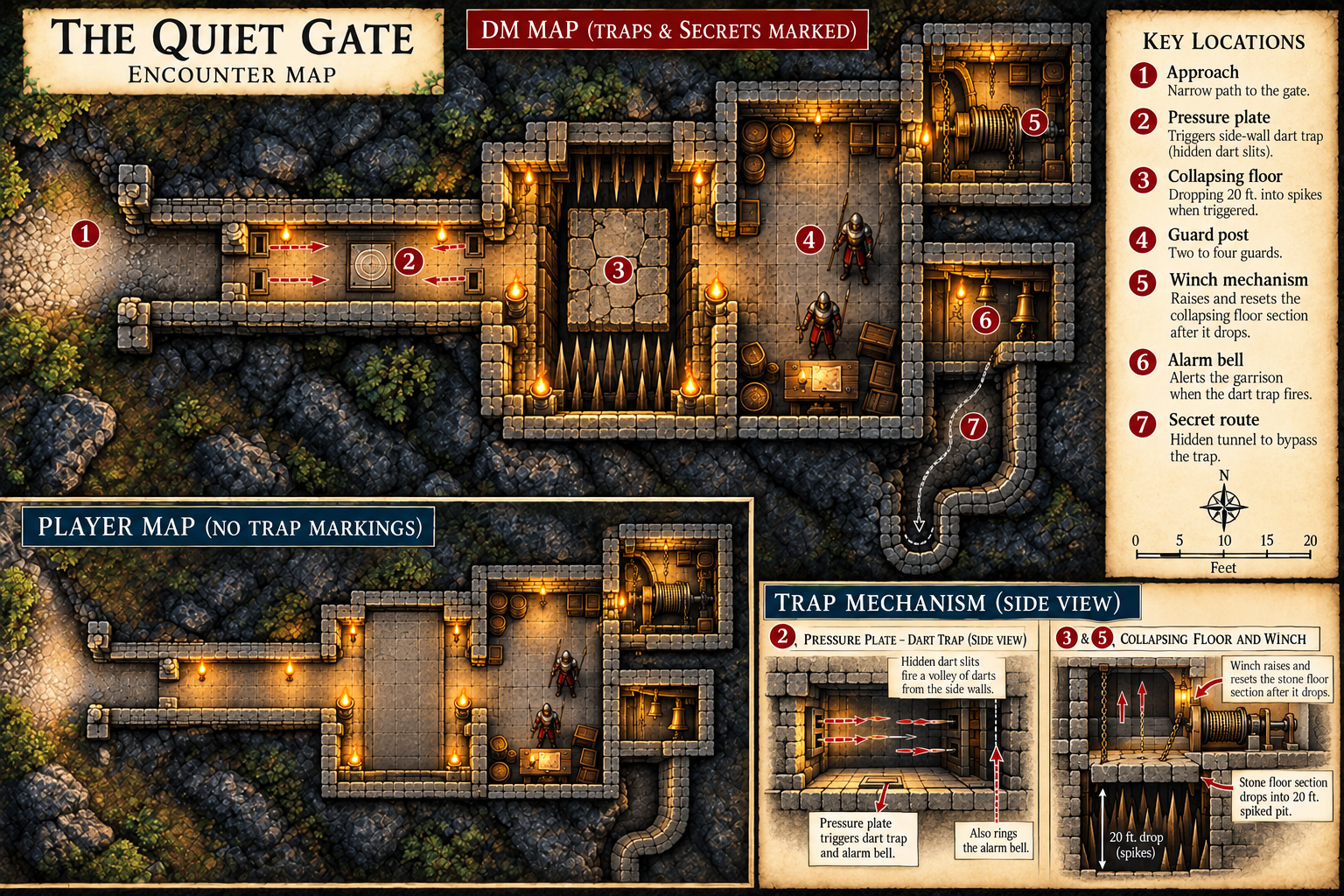
The guard captain has ordered a vault passage watched, but servants still carry oil to a winch chamber beyond it. Two independent defences protect the approach: a concealed pressure plate fires darts from the side walls and rings the alarm, while a separate section of floor collapses into a 20-foot spiked pit. The winch raises and resets the fallen floor; it does not operate the darts. The watch hopes to stop intruders and take survivors for questioning, not seal a passage permanently.
The Seven Map Locations
- Approach: An exposed torchlit passage; scuffed flagstones and unusually careful boot marks offer the first clue.
- Pressure plate: Weight on one marked flagstone releases a volley of darts from concealed slits in both walls and pulls the alarm-bell cord. This trigger does not operate the pit.
- Collapsing floor: A separate concealed catch gives way under weight, dropping the traveller 20 feet onto spikes. The opening remains visible until the winch restores the floor section.
- Guard post: Two to four watchmen hold the far side, investigate the bell and try to contain trespassers. They know both hazards and may bargain instead of fighting.
- Winch chamber: A geared drum, chains and latch lift and secure the collapsed floor after it drops. It cannot fire darts, and it must be operated to reset the floor.
- Alarm bell: Linked to the dart plate but also usable by hand. Cutting or muffling its cord prevents the alarm without necessarily disabling the darts.
- Secret bypass: A cramped maintenance route avoids both traps. Footprints, supplies, observation or negotiation may reveal it.
How to Run the Encounter
Describe the wall slots, scratched flagstones, joints in the suspicious floor and sound of distant guards before anyone rolls to detect the traps. Players can jam the launchers, test the floor with a pole, bridge the gap, climb the pit, capture the winch chamber, follow servants through the bypass or talk their way past the watch. Triggering the alarm changes the guards’ response; it does not end the adventure.
Four-edition mechanics: Use Fusillade of Darts for the pressure-plate volley and Spiked Pit Trap for the falling floor. Choose the appropriate edition tab for damage, checks, saves and disabling; do not apply D&D 3.5e DCs to the other editions. The map is a keyed GM illustration. For players, display only its lower-left unmarked map, never the full keyed graphic.
Historical and Mythological Inspirations
Ingenious doors, counterweights, valves and self-operating mechanisms were described by Hero of Alexandria. In a fantasy vault, similar machinery can be hidden inside a statue, gate, water clock or funerary chamber. Folklore also offers tests that punish greed, oath-breaking or the theft of a named treasure; use such stories as clues to motive, not merely as another way to inflict damage.
Questions at the Table
Must every trap inflict damage?
No. Alarm bells, locked doors, separated routes, stolen time and captured intruders can have more lasting consequences. The best result is one that gives players another decision to make.
Should a successful Perception check automatically disarm a trap?
No. Recognising an uneven slab is different from understanding its counterweight and safely disconnecting it. Explain what the character has found and invite a plan before requiring another check.
Can players bypass traps without rolling?
Yes. A well-described physical solution may avoid a roll entirely. Let the established mechanism, not a hidden predetermined answer, determine whether the plan works.
Do the old 3.5e Search and Disable Device DCs apply to 5e?
No. Each edition has its own skills and adjudication. Choose the matching panel above, then use the full 3.5e tables below only when running that edition.
Selected Trap Design Videos
For a short visual introduction, try Designing Devilish Traps in D&D 5e for practical encounter ideas, or Traps That Make Sense for clues, logic and player choice. The original broader video collection remains inside the expandable 3.5e reference, without crowding the opening of this hub.
Further Reading and Sources
- Designing a Trap — detailed CR and construction reference
- Dungeons — adventure spaces, exploration and hazards
- D&D SRD 5.2.1 (Creative Commons reference)
- Pathfinder 1e traps reference
- D&D 3.5e trap mechanics (OGL-era reference)
The examples and design guidance above are original. Edition-specific rules retain their respective licences and attribution; the preserved older reference below belongs to D&D 3.5e and must not be used as another edition’s rules.
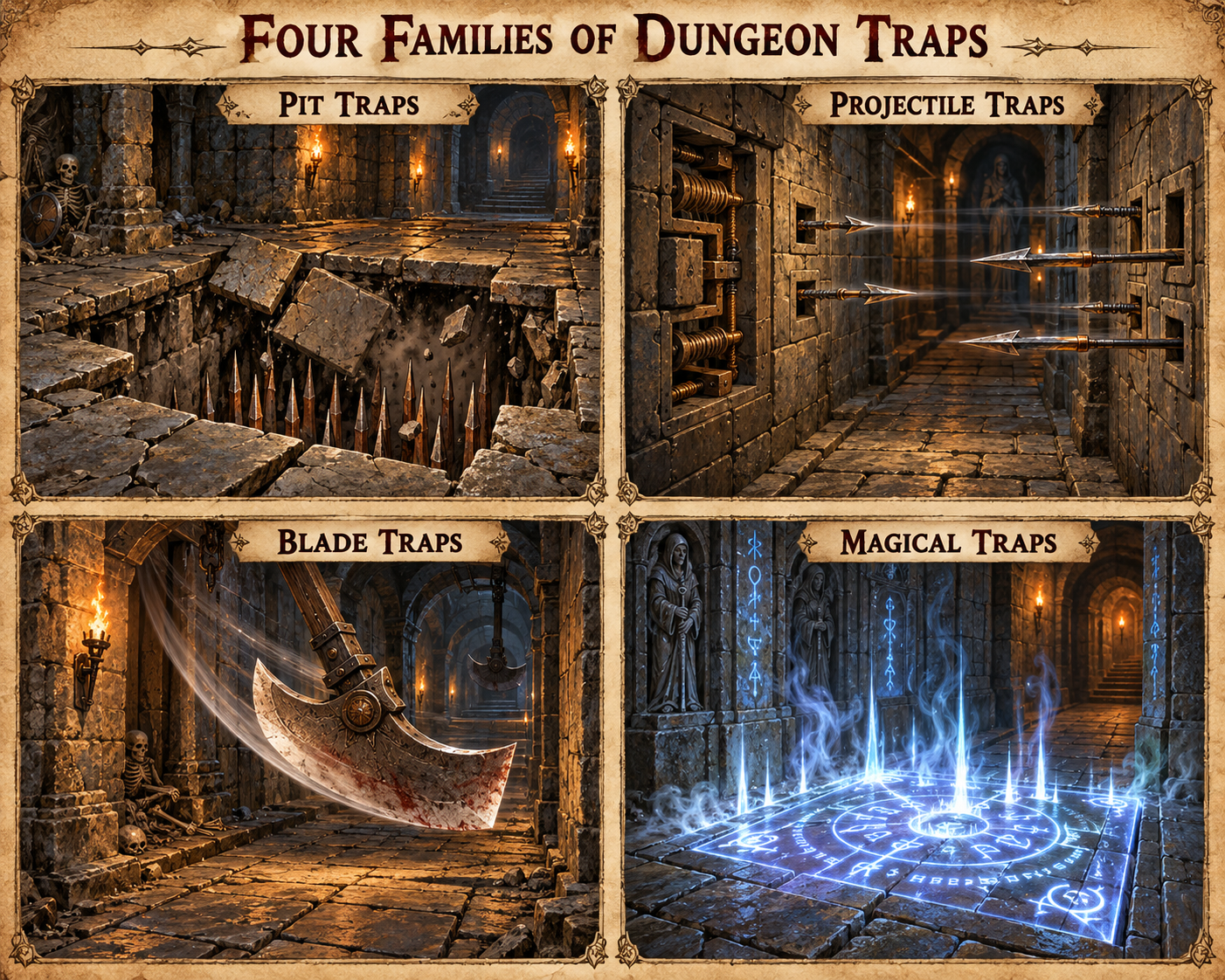
Converted Traps — CR 1 Collection
Thirteen original mechanical traps are now adapted for four rulesets. Open a trap to see the 5.5e/2024, 5e/2014, Pathfinder 1e or D&D 3.5e statistics. Use the visible clues and countermeasures to give the players a real choice. Modern damage and save DCs follow a level 1–4 design target; Pathfinder ratings have been recalculated independently for these thirteen traps and may differ substantially from their original D&D 3.5e CR 1; use the figure printed in each Pathfinder panel. The 3.5e entries retain their original statistics and prices.
Pick a trap: Basic Arrow Trap · Camouflaged Pit Trap · Deeper Pit Trap · Fusillade of Darts · Poison Dart Trap · Poison Needle Trap · Portcullis Trap · Razor-Wire across Hallway · Rolling Rock Trap · Scything Blade Trap · Spear Trap · Swinging Block Trap · Wall Blade Trap
Basic Arrow TrapD&D 2024 · 5e 2014 · Pathfinder 1e · D&D 3.5e
Basic Arrow Trap — 2024
Nuisance Trap (levels 1–4), original conversion.
Visible clue. Arrow holes in the masonry; broken arrowheads at the skirting.
Trigger. A creature enters the firing lane.
Detection. DC 12 Wisdom (Perception) Search action or Intelligence (Investigation) Study action.
Effect. One arrow attacks a creature (+4 to hit), dealing 1d10 Piercing damage on a hit.
Disable. DC 12 Dexterity check using thieves’ tools.
Counterplay. Block the slit or jam the trigger.
Reset. Reload the bowstring mechanism.
Basic Arrow Trap — 2014
Setback Trap (levels 1–4), original conversion.
Visible clue. Arrow holes in the masonry; broken arrowheads at the skirting.
Trigger. A creature enters the firing lane.
Detection. DC 12 Wisdom (Perception); Intelligence (Investigation) to understand the mechanism.
Effect. One arrow attacks a creature (+4 to hit), dealing 1d10 piercing damage on a hit.
Disable. DC 12 Dexterity check using thieves’ tools.
Counterplay. Block the slit or jam the trigger.
Reset. Reload the bowstring mechanism.
Basic Arrow Trap — PF1e
Mechanical trap — Pathfinder 1e CR 1 (calculated). Perception DC 20; Disable Device DC 20.
Clue: Arrow holes in the masonry; broken arrowheads at the skirting.
Trigger: A creature enters the firing lane.
Effect: Ranged attack +10 (1d6 piercing).
Counterplay: Block the slit or jam the trigger.
Reset: Reload the bowstring mechanism. CR calculation and cost: PF1e CR: base 0; proximity trigger +1; ranged attack +10, Perception DC 20, Disable Device DC 20 and 1d6 damage each add 0. Total CR 1. Mechanical-trap cost: 1,000 gp (manual reset). PF1e trap rules.
Basic Arrow Trap — 3.5e Original
Basic Arrow Trap: CR 1; mechanical; proximity trigger; manual reset; Atk +10 ranged (1d6/x3, arrow); Search DC 20; Disable Device DC 20. Market Price: 2,000 gp.
Camouflaged Pit TrapD&D 2024 · 5e 2014 · Pathfinder 1e · D&D 3.5e
Camouflaged Pit Trap — 2024
Nuisance Trap (levels 1–4), original conversion.
Visible clue. Loose dust and an unworn square of floor.
Trigger. A creature steps on a false floor panel.
Detection. DC 14 Wisdom (Perception) Search action or Intelligence (Investigation) Study action.
Effect. The creature drops 10 feet, taking 1d6 Bludgeoning damage; the exposed pit remains open.
Disable. DC 13 Dexterity check using thieves’ tools.
Counterplay. Probe the floor, brace its edge or jump clear.
Reset. Replace the cover manually.
Camouflaged Pit Trap — 2014
Setback Trap (levels 1–4), original conversion.
Visible clue. Loose dust and an unworn square of floor.
Trigger. A creature steps on a false floor panel.
Detection. DC 14 Wisdom (Perception); Intelligence (Investigation) to understand the mechanism.
Effect. The creature drops 10 feet, taking 1d6 bludgeoning damage; the exposed pit remains open.
Disable. DC 13 Dexterity check using thieves’ tools.
Counterplay. Probe the floor, brace its edge or jump clear.
Reset. Replace the cover manually.
Camouflaged Pit Trap — PF1e
Mechanical trap — Pathfinder 1e CR 1 (calculated). Perception DC 24; Disable Device DC 20.
Clue: Loose dust and an unworn square of floor.
Trigger: A creature steps on a false floor panel.
Effect: Reflex DC 20 avoids a 10-foot fall (1d6).
Counterplay: Probe the floor, brace its edge or jump clear.
Reset: Replace the cover manually. CR calculation and cost: PF1e CR: base 0; Perception DC 24 +1; Reflex DC 20, Disable Device DC 20 and 1d6 falling damage add 0. Total CR 1. Standard mechanical-trap cost 1,000 gp; the GM may use the reduced simple-pit cost permitted by Pathfinder. PF1e trap rules.
Camouflaged Pit Trap — 3.5e Original
Camouflaged Pit Trap: CR 1; mechanical; location trigger; manual reset; DC 20 Reflex save avoids; 10 ft. deep (1d6, fall); Search DC 24; Disable Device DC 20. Market Price: 1,800 gp.
Deeper Pit TrapD&D 2024 · 5e 2014 · Pathfinder 1e · D&D 3.5e
Deeper Pit Trap — 2024
Nuisance Trap (levels 1–4), original conversion.
Visible clue. Two adjacent flagstones rattle when tapped.
Trigger. Weight rests on either of two adjoining squares.
Detection. DC 13 Wisdom (Perception) Search action or Intelligence (Investigation) Study action.
Effect. DC 12 Dexterity save to catch the edge; failure means a 20-foot fall, 2d6 Bludgeoning damage.
Disable. DC 14 Dexterity check using thieves’ tools.
Counterplay. Discover the secret switch or wedge the panels.
Reset. Restore the panels manually.
Deeper Pit Trap — 2014
Dangerous Trap (levels 1–4), original conversion.
Visible clue. Two adjacent flagstones rattle when tapped.
Trigger. Weight rests on either of two adjoining squares.
Detection. DC 13 Wisdom (Perception); Intelligence (Investigation) to understand the mechanism.
Effect. DC 13 Dexterity save to avoid falling 20 feet and taking 2d6 bludgeoning damage.
Disable. DC 14 Dexterity check using thieves’ tools.
Counterplay. Discover the secret switch or wedge the panels.
Reset. Restore the panels manually.
Deeper Pit Trap — PF1e
Mechanical trap — Pathfinder 1e CR 2 (calculated; the original D&D 3.5e version is CR 1).
CR calculation: Base 0; Disable Device DC 23 +1; Reflex DC 15 −1; 2d6 falling damage averages 7, rounded to 10 per target then doubled for two affected squares (+2); Perception DC 20 adds 0. Total CR 2.
Cost: 2,000 gp (or GM-approved simple-pit discount). Perception DC 20; Disable Device DC 23.
Clue: Two adjacent flagstones rattle when tapped.
Trigger: Weight rests on either of two adjoining squares.
Effect: Reflex DC 15 avoids a 20-foot fall (2d6); affects two adjacent squares; hidden switch requires Perception DC 25.
Counterplay: Discover the secret switch or wedge the panels.
Reset: Restore the panels manually.
Deeper Pit Trap — 3.5e Original
Deeper Pit Trap: CR 1; mechanical; location trigger; manual reset; hidden switch bypass (Search DC 25); DC 15 Reflex save avoids; 20 ft. deep (2d6, fall); multiple targets (first target in each of two adjacent 5-ft. squares); Search DC 20; Disable Device DC 23. Market Price: 1,300 gp.
Fusillade of DartsD&D 2024 · 5e 2014 · Pathfinder 1e · D&D 3.5e
Fusillade of Darts — 2024
Nuisance Trap (levels 1–4), original conversion.
Visible clue. Several dart tubes open into the corridor.
Trigger. Pressure on a linked flagstone.
Detection. DC 11 Wisdom (Perception) Search action or Intelligence (Investigation) Study action.
Effect. One ranged attack (+4 to hit) against each creature in two adjacent squares; each hit deals 1d10 Piercing damage, representing the dart volley.
Disable. DC 12 Dexterity check using thieves’ tools.
Counterplay. Block the tubes or lock the pressure plate.
Reset. Restock the magazine manually.
Fusillade of Darts — 2014
Setback Trap (levels 1–4), original conversion.
Visible clue. Several dart tubes open into the corridor.
Trigger. Pressure on a linked flagstone.
Detection. DC 11 Wisdom (Perception); Intelligence (Investigation) to understand the mechanism.
Effect. One ranged attack (+4 to hit) against each creature in two adjacent squares; each hit deals 1d10 piercing damage.
Disable. DC 12 Dexterity check using thieves’ tools.
Counterplay. Block the tubes or lock the pressure plate.
Reset. Restock the magazine manually.
Fusillade of Darts — PF1e
Mechanical trap — Pathfinder 1e CR 1 (calculated).
CR calculation: Base 0; Perception DC 14 −1; volley affects two squares for approximately 17.5 average damage rounded to 20, +2; attack +10 and Disable Device DC 20 add 0.
Cost: 1,000 gp, manual reset. Perception DC 14; Disable Device DC 20.
Clue: Several dart tubes open into the corridor.
Trigger: Pressure on a linked flagstone.
Effect: Ranged attack +10 (1d4+1 per dart); 1d4 darts against each creature in two adjacent squares.
Counterplay: Block the tubes or lock the pressure plate.
Reset: Restock the magazine manually.
Fusillade of Darts — 3.5e Original
Fusillade of Darts: CR 1; mechanical; location trigger; manual reset; Atk +10 ranged (1d4+1, dart); multiple targets (fires 1d4 darts at each target in two adjacent 5-ft. squares); Search DC 14; Disable DeviceDC 20. Market Price: 500 gp.
Poison Dart TrapD&D 2024 · 5e 2014 · Pathfinder 1e · D&D 3.5e
Poison Dart Trap — 2024
Nuisance Trap (levels 1–4), original conversion.
Visible clue. A brown stain under a pinhole in the passage wall.
Trigger. A creature presses the trapped stone.
Detection. DC 13 Wisdom (Perception) Search action or Intelligence (Investigation) Study action.
Effect. Ranged attack +4 (1d4 Piercing). A hit requires a DC 12 Constitution save; failure deals 1d6 Poison damage and causes the Poisoned condition until the end of the target’s next turn.
Disable. DC 13 Dexterity check using thieves’ tools.
Counterplay. Shield the firing hole or disconnect the plate.
Reset. Replace the dart and poison manually.
Poison Dart Trap — 2014
Dangerous Trap (levels 1–4), original conversion.
Visible clue. A brown stain under a pinhole in the passage wall.
Trigger. A creature presses the trapped stone.
Detection. DC 13 Wisdom (Perception); Intelligence (Investigation) to understand the mechanism.
Effect. Ranged attack +5 (1d4 piercing). A hit requires a DC 12 Constitution save; failure deals 1d6 poison damage and poisons the target until the end of its next turn.
Disable. DC 13 Dexterity check using thieves’ tools.
Counterplay. Shield the firing hole or disconnect the plate.
Reset. Replace the dart and poison manually.
Poison Dart Trap — PF1e
Mechanical trap — Pathfinder 1e CR 1 (calculated).
CR calculation: Base 0; bloodroot injury poison +1; attack +8, both DCs and dart damage add 0.
Cost: 1,100 gp (1,000 gp mechanism plus 100 gp bloodroot). Perception DC 20; Disable Device DC 18.
Clue: A brown stain under a pinhole in the passage wall.
Trigger: A creature presses the trapped stone.
Effect: Ranged attack +8 (1d4 plus bloodroot injury poison). Bloodroot: Fortitude DC 12, onset 1 round, 1/round for 4 rounds, 1 Con and 1 Wis damage, cure 1 save.
Counterplay: Shield the firing hole or disconnect the plate.
Reset: Replace the dart and poison manually.
Poison Dart Trap — 3.5e Original
Poison Dart Trap: CR 1; mechanical; location trigger; manual reset; Atk +8 ranged (1d4 plus poison, dart); poison (bloodroot, DC 12 Fortitude save resists, 0/1d4 Constitution plus 1d3 Wisdom); Search DC 20; Disable DeviceDC 18. Market Price: 700 gp.
Poison Needle TrapD&D 2024 · 5e 2014 · Pathfinder 1e · D&D 3.5e
Poison Needle Trap — 2024
Nuisance Trap (levels 1–4), original conversion.
Visible clue. A spring behind a lock, with green residue in a narrow channel.
Trigger. Someone touches the locked fitting.
Detection. DC 14 Wisdom (Perception) Search action or Intelligence (Investigation) Study action.
Effect. Needle attack +4 (1 Piercing). On a hit, DC 12 Constitution save or take 1d10 Poison damage.
Disable. DC 13 Dexterity check using thieves’ tools.
Counterplay. Use an alternate entry, block the needle or dismantle the faceplate.
Reset. Replace needle and poison manually.
Poison Needle Trap — 2014
Dangerous Trap (levels 1–4), original conversion.
Visible clue. A spring behind a lock, with green residue in a narrow channel.
Trigger. Someone touches the locked fitting.
Detection. DC 14 Wisdom (Perception); Intelligence (Investigation) to understand the mechanism.
Effect. Needle attack +5 (1 piercing). On a hit, DC 12 Constitution save or take 1d10 poison damage.
Disable. DC 13 Dexterity check using thieves’ tools.
Counterplay. Use an alternate entry, block the needle or dismantle the faceplate.
Reset. Replace needle and poison manually.
Poison Needle Trap — PF1e
Mechanical trap — Pathfinder 1e CR 2 (calculated, unlike its original D&D 3.5e CR 1).
CR calculation: Base 0; Perception DC 22 +1; greenblood oil injury poison +1; attack +8 and Disable Device DC 20 add 0.
Cost: 2,100 gp (2,000 gp mechanism plus 100 gp greenblood oil). Perception DC 22; Disable Device DC 20.
Clue: A spring behind a lock, with green residue in a narrow channel.
Trigger: Someone touches the locked fitting.
Effect: Ranged attack +8 (1 piercing plus greenblood oil injury poison). Fortitude DC 13, 1/round for 4 rounds, 1 Con damage, cure 1 save.
Counterplay: Use an alternate entry, block the needle or dismantle the faceplate.
Reset: Replace needle and poison manually.
Poison Needle Trap — 3.5e Original
Poison Needle Trap: CR 1; mechanical; touch trigger; manual reset; Atk +8 ranged (1 plus greenblood oil poison); Search DC 22; Disable DeviceDC 20. Market Price: 1,300 gp.
Portcullis TrapD&D 2024 · 5e 2014 · Pathfinder 1e · D&D 3.5e
Portcullis Trap — 2024
Deadly Trap (levels 1–4), original conversion.
Visible clue. Vertical gouges in the gateway and a taut chain overhead.
Trigger. A creature steps across the threshold.
Detection. DC 13 Wisdom (Perception) Search action or Intelligence (Investigation) Study action.
Effect. The grille falls: DC 13 Dexterity save, 2d10 Bludgeoning on failure, half on success. It blocks the passage afterward.
Disable. DC 13 Dexterity check using thieves’ tools.
Counterplay. Jam the grille runners or cross by the postern.
Reset. Winch the grille up manually.
Portcullis Trap — 2014
Dangerous Trap (levels 1–4), original conversion.
Visible clue. Vertical gouges in the gateway and a taut chain overhead.
Trigger. A creature steps across the threshold.
Detection. DC 13 Wisdom (Perception); Intelligence (Investigation) to understand the mechanism.
Effect. The grille falls: DC 13 Dexterity save, 2d10 bludgeoning on failure, half on success. It blocks the passage afterward.
Disable. DC 13 Dexterity check using thieves’ tools.
Counterplay. Jam the grille runners or cross by the postern.
Reset. Winch the grille up manually.
Portcullis Trap — PF1e
Mechanical trap — Pathfinder 1e CR 1 (calculated).
CR calculation: Base 0; average 3d6 damage (10.5 rounded to 10) +1; attack +10, Perception DC 20 and Disable Device DC 20 add 0.
Cost: 1,000 gp. Perception DC 20; Disable Device DC 20.
Clue: Vertical gouges in the gateway and a taut chain overhead.
Trigger: A creature steps across the threshold.
Effect: Melee attack +10 (3d6 bludgeoning) against creatures under the grille; the grille blocks passage.
Counterplay: Jam the grille runners or cross by the postern.
Reset: Winch the grille up manually.
Portcullis Trap — 3.5e Original
Portcullis Trap: CR 1; mechanical; location trigger; manual reset; Atk +10 melee (3d6); Search DC 20; Disable Device DC 20. Note: Damage applies only to those underneath the portcullis. Portcullis blocks passageway. Market Price: 1,400 gp.
Razor-Wire across HallwayD&D 2024 · 5e 2014 · Pathfinder 1e · D&D 3.5e
Razor-Wire across Hallway — 2024
Nuisance Trap (levels 1–4), original conversion.
Visible clue. Metallic glints at knee height and fresh scratches on the jambs.
Trigger. A creature walks through the stretched wire.
Detection. DC 14 Wisdom (Perception) Search action or Intelligence (Investigation) Study action.
Effect. Melee attack +4 against the first creature in each of two adjacent squares, dealing 1d10 Slashing damage on a hit.
Disable. DC 11 Dexterity check using thieves’ tools.
Counterplay. Duck under it or cut it while holding it taut.
Reset. None; refit the wire.
Razor-Wire across Hallway — 2014
Setback Trap (levels 1–4), original conversion.
Visible clue. Metallic glints at knee height and fresh scratches on the jambs.
Trigger. A creature walks through the stretched wire.
Detection. DC 14 Wisdom (Perception); Intelligence (Investigation) to understand the mechanism.
Effect. Melee attack +4 against the first creature in each of two adjacent squares, dealing 1d10 slashing damage on a hit.
Disable. DC 11 Dexterity check using thieves’ tools.
Counterplay. Duck under it or cut it while holding it taut.
Reset. None; refit the wire.
Razor-Wire across Hallway — PF1e
Mechanical trap — Pathfinder 1e CR 2 (calculated; original D&D 3.5e CR 1). Calculation: Base 0; Perception DC 22 +1; Disable Device DC 15 −1; 2d6 averages 7, rounded to 10 per target and doubled for two targets (+2).
Cost: 1,000 gp (2,000 gp base reduced by half for a no-reset device). Perception DC 22; Disable Device DC 15.
Clue: Metallic glints at knee height and fresh scratches on the jambs.
Trigger: A creature walks through the stretched wire.
Effect: Melee attack +10 (2d6 slashing); first creature in each of two adjacent squares.
Counterplay: Duck under it or cut it while holding it taut.
Reset: None; refit the wire.
Razor-Wire across Hallway — 3.5e Original
Razor-Wire across Hallway: CR 1; mechanical; location trigger; no reset; Atk +10 melee (2d6, wire); multiple targets (first target in each of two adjacent 5-ft. squares); Search DC 22; Disable Device DC 15. Market Price: 400 gp.
Rolling Rock TrapD&D 2024 · 5e 2014 · Pathfinder 1e · D&D 3.5e
Rolling Rock Trap — 2024
Deadly Trap (levels 1–4), original conversion.
Visible clue. Deep grooves lead down a sloping corridor.
Trigger. A hidden floor catch releases a heavy boulder.
Detection. DC 13 Wisdom (Perception) Search action or Intelligence (Investigation) Study action.
Effect. Each creature in a straight 30-foot lane makes a DC 13 Dexterity save; 2d10 Bludgeoning on failure, half on success.
Disable. DC 14 Dexterity check using thieves’ tools.
Counterplay. Get into a recess, jam the release or brace the boulder.
Reset. Haul the stone back manually.
Rolling Rock Trap — 2014
Dangerous Trap (levels 1–4), original conversion.
Visible clue. Deep grooves lead down a sloping corridor.
Trigger. A hidden floor catch releases a heavy boulder.
Detection. DC 13 Wisdom (Perception); Intelligence (Investigation) to understand the mechanism.
Effect. Each creature in a straight 30-foot lane makes a DC 13 Dexterity save; 2d10 bludgeoning on failure, half on success.
Disable. DC 14 Dexterity check using thieves’ tools.
Counterplay. Get into a recess, jam the release or brace the boulder.
Reset. Haul the stone back manually.
Rolling Rock Trap — PF1e
Mechanical trap — Pathfinder 1e CR 3 (calculated for multiple targets; original 3.5e CR 1). Calculation: Base 0; Disable Device DC 22 +1; 2d6 averages 7, rounded to 10 per target and doubled for a boulder capable of striking several targets (+2). Perception DC 20 and attack +10 add 0.
Cost: 3,000 gp for a manual-reset mechanism. Perception DC 20; Disable Device DC 22.
Clue: Deep grooves lead down a sloping corridor.
Trigger: A hidden floor catch releases a heavy boulder.
Effect: Melee attack +10 (2d6 bludgeoning) against targets in the boulder’s travel path.
Counterplay: Get into a recess, jam the release or brace the boulder.
Reset: Haul the stone back manually.
Rolling Rock Trap — 3.5e Original
Rolling Rock Trap: CR 1; mechanical; location trigger; manual reset; Atk +10 melee (2d6, rock); Search DC 20; Disable Device DC 22. Market Price: 1,400 gp.
Scything Blade TrapD&D 2024 · 5e 2014 · Pathfinder 1e · D&D 3.5e
Scything Blade Trap — 2024
Nuisance Trap (levels 1–4), original conversion.
Visible clue. A crescent of polished stone marks the path of a concealed blade.
Trigger. A creature steps on the floor catch.
Detection. DC 14 Wisdom (Perception) Search action or Intelligence (Investigation) Study action.
Effect. A hidden blade attacks the triggering creature (+4 to hit), dealing 1d10 Slashing damage on a hit.
Disable. DC 13 Dexterity check using thieves’ tools.
Counterplay. Block the hinge or avoid the blade’s swing.
Reset. Automatic retraction, ready to trigger again.
Scything Blade Trap — 2014
Setback Trap (levels 1–4), original conversion.
Visible clue. A crescent of polished stone marks the path of a concealed blade.
Trigger. A creature steps on the floor catch.
Detection. DC 14 Wisdom (Perception); Intelligence (Investigation) to understand the mechanism.
Effect. A hidden blade attacks the triggering creature (+4 to hit), dealing 1d10 slashing damage on a hit.
Disable. DC 13 Dexterity check using thieves’ tools.
Counterplay. Block the hinge or avoid the blade’s swing.
Reset. Automatic retraction, ready to trigger again.
Scything Blade Trap — PF1e
Mechanical trap — Pathfinder 1e CR 2 (calculated; original 3.5e CR 1). Calculation: Base 0; Perception DC 21 +1; automatic reset +1; attack +8, Disable Device DC 20, and 1d8 average damage add 0.
Cost: 3,000 gp (2,000 gp base plus 50% for automatic reset). Perception DC 21; Disable Device DC 20.
Clue: A crescent of polished stone marks the path of a concealed blade.
Trigger: A creature steps on the floor catch.
Effect: Melee attack +8 (1d8 slashing, ×3 critical); automatic reset.
Counterplay: Block the hinge or avoid the blade’s swing.
Reset: Automatic retraction, ready to trigger again.
Scything Blade Trap — 3.5e Original
Scything Blade Trap: CR 1; mechanical; location trigger; automatic reset; Atk +8 melee (1d8/x3); Search DC 21; Disable Device DC 20. Market Price: 1,700 gp.
Spear TrapD&D 2024 · 5e 2014 · Pathfinder 1e · D&D 3.5e
Spear Trap — 2024
Nuisance Trap (levels 1–4), original conversion.
Visible clue. A capped tube looks along a straight gallery.
Trigger. Stepping on the linked floor plate.
Detection. DC 13 Wisdom (Perception) Search action or Intelligence (Investigation) Study action.
Effect. The first creature in a clear 200-foot firing lane is attacked (+4 to hit) for 1d10 Piercing damage.
Disable. DC 12 Dexterity check using thieves’ tools.
Counterplay. Remain outside the firing lane or wedge the mechanism.
Reset. Rearm the launcher manually.
Spear Trap — 2014
Setback Trap (levels 1–4), original conversion.
Visible clue. A capped tube looks along a straight gallery.
Trigger. Stepping on the linked floor plate.
Detection. DC 13 Wisdom (Perception); Intelligence (Investigation) to understand the mechanism.
Effect. The first creature in a clear 200-foot firing lane is attacked (+4 to hit) for 1d10 piercing damage.
Disable. DC 12 Dexterity check using thieves’ tools.
Counterplay. Remain outside the firing lane or wedge the mechanism.
Reset. Rearm the launcher manually.
Spear Trap — PF1e
Mechanical trap — Pathfinder 1e CR 1 (calculated). Calculation: Base 0; ranged attack +12 gives +1; Perception DC 20, Disable Device DC 20, and 1d8 damage add 0.
Cost: 1,000 gp, manual reset. Perception DC 20; Disable Device DC 20.
Clue: A capped tube looks along a straight gallery.
Trigger: Stepping on the linked floor plate.
Effect: Ranged attack +12 (1d8 piercing, ×3 critical); maximum 200-foot firing line.
Counterplay: Remain outside the firing lane or wedge the mechanism.
Reset: Rearm the launcher manually.
Spear Trap — 3.5e Original
Spear Trap: CR 1; mechanical; location trigger; manual reset; Atk +12 ranged (1d8/x3, spear); Search DC 20; Disable Device DC 20. Note: 200-ft. max range, target determined randomly from those in its path. Market Price: 1,200 gp.
Swinging Block TrapD&D 2024 · 5e 2014 · Pathfinder 1e · D&D 3.5e
Swinging Block Trap — 2024
Deadly Trap (levels 1–4), original conversion.
Visible clue. A heavy ceiling joint and a semicircular scrape mark on the wall.
Trigger. A cord or handle releases the weight.
Detection. DC 13 Wisdom (Perception) Search action or Intelligence (Investigation) Study action.
Effect. Creatures in a 10-foot swing make a DC 13 Dexterity save, taking 2d10 Bludgeoning on failure, half on success.
Disable. DC 13 Dexterity check using thieves’ tools.
Counterplay. Brace the block or move outside the sweep.
Reset. Haul the block up manually.
Swinging Block Trap — 2014
Dangerous Trap (levels 1–4), original conversion.
Visible clue. A heavy ceiling joint and a semicircular scrape mark on the wall.
Trigger. A cord or handle releases the weight.
Detection. DC 13 Wisdom (Perception); Intelligence (Investigation) to understand the mechanism.
Effect. Creatures in a 10-foot swing make a DC 13 Dexterity save, taking 2d10 bludgeoning on failure, half on success.
Disable. DC 13 Dexterity check using thieves’ tools.
Counterplay. Brace the block or move outside the sweep.
Reset. Haul the block up manually.
Swinging Block Trap — PF1e
Mechanical trap — Pathfinder 1e CR 1 (rebalanced from the original 3.5e). Calculation: Base 0; attack +6 adds 0; 4d6 averages 14, rounded to 10 (+1). The original +5 attack would contribute −1 and give an invalid CR 0, so the Pathfinder adaptation uses +6.
Cost: 1,000 gp, manual reset. Perception DC 20; Disable Device DC 20.
Clue: A heavy ceiling joint and a semicircular scrape mark on the wall.
Trigger: A cord or handle releases the weight.
Effect: Melee attack +6 (4d6 bludgeoning) in this Pathfinder adaptation.
Counterplay: Brace the block or move outside the sweep.
Reset: Haul the block up manually.
Swinging Block Trap — 3.5e Original
Swinging Block Trap: CR 1; mechanical; touch trigger; manual reset; Atk +5 melee (4d6, stone block); Search DC 20; Disable Device DC 20. Market Price: 500 gp.
Wall Blade TrapD&D 2024 · 5e 2014 · Pathfinder 1e · D&D 3.5e
Wall Blade Trap — 2024
Nuisance Trap (levels 1–4), original conversion.
Visible clue. A narrow polished seam sits beside a concealed stud.
Trigger. A creature handles a false wall fitting.
Detection. DC 14 Wisdom (Perception) Search action or Intelligence (Investigation) Study action.
Effect. A blade attacks one creature (+4 to hit), dealing 1d10 Slashing damage on a hit. Study DC 15 Intelligence (Investigation) finds a hidden bypass switch.
Disable. DC 14 Dexterity check using thieves’ tools.
Counterplay. Jam the slot or find the hidden switch.
Reset. Automatic retraction.
Wall Blade Trap — 2014
Setback Trap (levels 1–4), original conversion.
Visible clue. A narrow polished seam sits beside a concealed stud.
Trigger. A creature handles a false wall fitting.
Detection. DC 14 Wisdom (Perception); Intelligence (Investigation) to understand the mechanism.
Effect. A blade attacks one creature (+4 to hit), dealing 1d10 slashing damage on a hit. Investigation DC 15 reveals a bypass switch.
Disable. DC 14 Dexterity check using thieves’ tools.
Counterplay. Jam the slot or find the hidden switch.
Reset. Automatic retraction.
Wall Blade Trap — PF1e
Mechanical trap — Pathfinder 1e CR 4 (calculated; original 3.5e CR 1). Calculation: Base 0; Perception DC 22 +1; Disable Device DC 22 +1; automatic reset +1; 2d4 averages 5, rounded to 10 (+1); attack +10 adds 0.
Cost: 6,000 gp (4,000 gp base plus 50% for automatic reset). Perception DC 22; Disable Device DC 22.
Clue: A narrow polished seam sits beside a concealed stud.
Trigger: A creature handles a false wall fitting.
Effect: Melee attack +10 (2d4 slashing, ×4 critical); automatic reset; bypass switch Perception DC 25.
Counterplay: Jam the slot or find the hidden switch.
Reset: Automatic retraction.
Wall Blade Trap — 3.5e Original
Wall Blade Trap: CR 1; mechanical; touch trigger; automatic reset; hidden switch bypass (Search DC 25); Atk +10 melee (2d4/x4, Scythe); Search DC 22; Disable Device DC 22. Market Price: 2,500 gp.
Using These Conversions
These are new playable adaptations, not edition-to-edition numerical substitutions. D&D 2024 uses nuisance/deadly severity; 2014 uses setback/dangerous; Pathfinder and 3.5e use CR. Do not treat the original CR 1 label as a modern difficulty rating. Recalculate CR in Pathfinder if an altered poison, area or trigger changes the challenge.
2024 trap-building rules · 2014 trap rules · Pathfinder 1e trap rules · 3.5e source.
Converted Traps — CR 2 Collection
Twelve further low-level traps converted for 5.5e/2024, 5e/2014, Pathfinder 1e and D&D 3.5e. Beware: modern severity is assessed for levels 1–4, not equated with original CR. The Pathfinder entries use suggested CR 2 pending recalculation after changing spells, poisons or area effects.
Jump to a trap: Box of Brown Mold · Bricks from Ceiling · Burning Hands Trap · Camouflaged Pit Trap (Two-Square) · Inflict Light Wounds Trap · Javelin Trap · Large Net Trap · Pit Trap (40 feet) · Poison Needle Trap (Blue Whinnis) · Spiked Pit Trap · Tripping Chain · Well-Camouflaged Pit Trap
Box of Brown MoldD&D 2024 · 5e 2014 · Pathfinder 1e · D&D 3.5e
Box of Brown Mold — 2024
Nuisance Trap (levels 1–4). Original edition-specific adaptation.
Visible clue. A wooden chest feels cold; its iron bands carry frost.
Trigger. Opening the box exposes a living patch of brown mold.
Detection. DC 13 Wisdom (Perception) Search or Intelligence (Investigation) Study.
Effect. A creature within 5 feet of the exposed mold makes a DC 12 Constitution saving throw, taking 1d10 Cold damage on a failed save, or half on success. Apply this when the creature first enters the aura on a turn; do not add multiple exposures within the same turn.
Disarm. DC 13 Dexterity using thieves’ tools where appropriate.
Counterplay. Close the lid without touching the mold; cold damage destroys it, while fire causes it to expand.
Reset. The mold remains active until cleared; it is not reset mechanically.
Box of Brown Mold — 2014
Dangerous Trap (levels 1–4). Original edition-specific adaptation.
Visible clue. A wooden chest feels cold; its iron bands carry frost.
Trigger. Opening the box exposes a living patch of brown mold.
Detection. DC 13 Wisdom (Perception) or appropriate Intelligence (Investigation) checks.
Effect. A creature within 5 feet of the open box makes a DC 12 Constitution saving throw, taking 1d10 cold damage on a failed save or half on success. The aura persists while the box is open.
Disarm. DC 13 Dexterity using thieves’ tools where appropriate.
Counterplay. Close the lid without touching the mold; cold damage destroys it, while fire causes it to expand.
Reset. The mold remains active until cleared; it is not reset mechanically.
Box of Brown Mold — PF1e
Pathfinder 1e brown mold environmental hazard — CR 2 as published. The trapped box is the container, not a CR 2 mechanical device; the mold’s CR comes from Pathfinder’s dungeon hazard rules. No standard mechanical-trap construction price applies to the living mold; separately price any engineered lock or release mechanism. See PF1e Brown Mold. Perception DC 22; Disable Device DC 16 .
Trigger. Opening the box exposes a living patch of brown mold.
Effect. The 5-foot cold aura deals 3d6 nonlethal cold damage under the original trap design; use Pathfinder’s brown mold hazard rules for fire and cold interactions.
Bypass. Close the lid without touching the mold; cold damage destroys it, while fire causes it to expand.
Reset. The mold remains active until cleared; it is not reset mechanically. If you alter the trigger, damage, targets or reset, reassess the Pathfinder CR and cost using that edition’s rules.
Box of Brown Mold — 3.5e Original
Box of Brown Mold: CR 2; mechanical; touch trigger (opening the box); automatic reset; 5-ft. cold aura (3d6, cold nonlethal); Search DC 22; Disable Device DC 16. Market Price: 3,000 gp.
Bricks from CeilingD&D 2024 · 5e 2014 · Pathfinder 1e · D&D 3.5e
Bricks from Ceiling — 2024
Nuisance Trap (levels 1–4). Original edition-specific adaptation.
Visible clue. Hairline cracks and loose mortar cross two ceiling squares.
Trigger. A trapped wall fixture releases the overhead bricks.
Detection. DC 13 Wisdom (Perception) Search or Intelligence (Investigation) Study.
Effect. Both adjacent 5-foot squares are struck by falling bricks. Each creature there makes a DC 12 Dexterity save, taking 1d10 Bludgeoning damage on failure, half on success.
Disarm. DC 12 Dexterity using thieves’ tools where appropriate.
Counterplay. Shore up the damaged area or avoid the ceiling panel.
Reset. Repair and reload the ceiling section.
Bricks from Ceiling — 2014
Dangerous Trap (levels 1–4). Original edition-specific adaptation.
Visible clue. Hairline cracks and loose mortar cross two ceiling squares.
Trigger. A trapped wall fixture releases the overhead bricks.
Detection. DC 13 Wisdom (Perception) or appropriate Intelligence (Investigation) checks.
Effect. A creature under either of two adjacent squares makes a DC 12 Dexterity save, taking 2d10 bludgeoning damage on failure, half on success.
Disarm. DC 12 Dexterity using thieves’ tools where appropriate.
Counterplay. Shore up the damaged area or avoid the ceiling panel.
Reset. Repair and reload the ceiling section.
Bricks from Ceiling — PF1e
Mechanical trap — Pathfinder 1e CR 3 (calculated; original 3.5e CR 2). Calculation: Base 0; attack +12 adds +1; 2d6 damage averages 7, rounded to 10 and doubled for two adjacent target squares (+2). Perception DC 20 and Disable Device DC 20 add 0.
Construction cost: 3,000 gp, with repair reset. Perception DC 20; Disable Device DC 20 .
Trigger. A trapped wall fixture releases the overhead bricks.
Effect. Melee attack +12 (2d6 bludgeoning) against creatures in two adjoining 5-foot squares.
Bypass. Shore up the damaged area or avoid the ceiling panel.
Reset. Repair and reload the ceiling section. If you alter the trigger, damage, targets or reset, reassess the Pathfinder CR and cost using that edition’s rules.
Bricks from Ceiling — 3.5e Original
Bricks from Ceiling: CR 2; mechanical; touch trigger; repair reset; Atk +12 melee (2d6, bricks); multiple targets (all targets in two adjacent 5-ft. squares); Search DC 20; Disable Device DC 20. Market Price: 2,400 gp.
Burning Hands TrapD&D 2024 · 5e 2014 · Pathfinder 1e · D&D 3.5e
Burning Hands Trap — 2024
Deadly Trap (levels 1–4). Original edition-specific adaptation.
Visible clue. Scorching fans outward from rune-marked holes in the wall.
Trigger. A creature enters the ward’s proximity.
Detection. DC 14 Wisdom (Perception) Search or Intelligence (Investigation) Study.
Effect. A 15-foot Cone of fire erupts: creatures in it make a DC 13 Dexterity save, taking 3d6 Fire damage on failure, half on success. This is a 1st-level Burning Hands effect.
Disarm. DC 14 Intelligence (Arcana) to suppress the ward, or appropriate magic.
Counterplay. Identify the runes and counter the ward, or avoid its line of fire.
Reset. Automatic magical reset.
Burning Hands Trap — 2014
Dangerous Trap (levels 1–4). Original edition-specific adaptation.
Visible clue. Scorching fans outward from rune-marked holes in the wall.
Trigger. A creature enters the ward’s proximity.
Detection. DC 14 Wisdom (Perception) or appropriate Intelligence (Investigation) checks.
Effect. A 15-foot cone of flame erupts: creatures in it make a DC 13 Dexterity save, taking 3d6 fire damage on failure, half on success. This is a 1st-level burning hands effect.
Disarm. DC 14 Intelligence (Arcana) to suppress the ward, or appropriate magic.
Counterplay. Identify the runes and counter the ward, or avoid its line of fire.
Reset. Automatic magical reset.
Burning Hands Trap — PF1e
Magic device trap — Pathfinder 1e CR 2 (calculated). Calculation: Magic base CR 1 + the 1st-level burning hands spell (+1); its damage modifier is lower and is not added.
Construction cost: 500 gp for a CL 1 automatic-reset device (500 × 1 × 1), assuming the builder provides the spell; an alarm trigger adds no cost if self-cast. Perception DC 26; Disable Device DC 26 (trapfinding required).
Trigger. A creature enters the ward’s proximity.
Effect. Burning hands (caster level 1, 1d4 fire, Reflex DC 11 half). Magic device, proximity trigger using alarm, automatic reset; Perception and Disable Device DC 26.
Bypass. Identify the runes and counter the ward, or avoid its line of fire.
Reset. Automatic magical reset. If you alter the trigger, damage, targets or reset, reassess the Pathfinder CR and cost using that edition’s rules.
Burning Hands Trap — 3.5e Original
Burning hands Trap: CR 2; magic device; proximity trigger (alarm); automatic reset; spell effect (burning hands, 1st-level wizard, 1d4 fire, DC 11 Reflex save half damage); Search DC 26; Disable Device DC 26. Cost: 500 gp, 40 XP.
Camouflaged Pit Trap (Two-Square)D&D 2024 · 5e 2014 · Pathfinder 1e · D&D 3.5e
Camouflaged Pit Trap (Two-Square) — 2024
Nuisance Trap (levels 1–4). Original edition-specific adaptation.
Visible clue. Two close-set sections of flooring lie untouched by guards’ boots.
Trigger. The cover opens under a creature on either of two adjacent squares.
Detection. DC 14 Wisdom (Perception) Search or Intelligence (Investigation) Study.
Effect. A creature on either 5-foot square makes a DC 13 Dexterity save; failure means a 20-foot fall for 2d6 Bludgeoning damage; success catches the edge.
Disarm. DC 13 Dexterity using thieves’ tools where appropriate.
Counterplay. Use a pole to reveal the frame and wedge it open.
Reset. Manually restore both panels.
Camouflaged Pit Trap (Two-Square) — 2014
Dangerous Trap (levels 1–4). Original edition-specific adaptation.
Visible clue. Two close-set sections of flooring lie untouched by guards’ boots.
Trigger. The cover opens under a creature on either of two adjacent squares.
Detection. DC 14 Wisdom (Perception) or appropriate Intelligence (Investigation) checks.
Effect. A creature on either 5-foot square makes a DC 13 Dexterity save; failure means a 20-foot fall for 2d6 bludgeoning damage; success avoids the pit.
Disarm. DC 13 Dexterity using thieves’ tools where appropriate.
Counterplay. Use a pole to reveal the frame and wedge it open.
Reset. Manually restore both panels.
Camouflaged Pit Trap (Two-Square) — PF1e
Mechanical trap — Pathfinder 1e CR 3 (calculated; original 3.5e CR 2). Calculation: Base 0; Perception DC 24 +1; Reflex DC 20 and Disable Device DC 19 add 0; 2d6 falling damage averages 7, rounded to 10, then doubled for two target squares (+2).
Construction cost: 3,000 gp for a manual reset, or as low as 750 gp if treated as a simple pit by the GM. Perception DC 24; Disable Device DC 19 .
Trigger. The cover opens under a creature on either of two adjacent squares.
Effect. Reflex DC 20 avoids a 20-foot fall (2d6 falling damage), first creature in each of two adjacent squares.
Bypass. Use a pole to reveal the frame and wedge it open.
Reset. Manually restore both panels. If you alter the trigger, damage, targets or reset, reassess the Pathfinder CR and cost using that edition’s rules.
Camouflaged Pit Trap (Two-Square) — 3.5e Original
Camouflaged Pit Trap: CR 2; mechanical; location trigger; manual reset; DC 20 Reflex save avoids; 20 ft. deep (2d6, fall); multiple targets (first target in each of two adjacent 5-ft. squares); Search DC 24; Disable Device DC 19. Market Price: 3,400 gp.
Inflict Light Wounds TrapD&D 2024 · 5e 2014 · Pathfinder 1e · D&D 3.5e
Inflict Light Wounds Trap — 2024
Deadly Trap (levels 1–4). Original edition-specific adaptation.
Visible clue. An old funerary seal chills the hands; black script runs around its edge.
Trigger. Touching the rune-covered object activates the spell.
Detection. DC 14 Wisdom (Perception) Search or Intelligence (Investigation) Study.
Effect. 2024 Inflict Wounds equivalent: a creature touching the seal makes a DC 13 Constitution save, taking 2d10 Necrotic damage on failure, half on success. This is not the older Inflict Light Wounds spell.
Disarm. DC 14 Intelligence (Arcana) to suppress the ward, or appropriate magic.
Counterplay. Study the seal or dispel its ward; avoid touching the marked surface.
Reset. Automatic magical reset.
Inflict Light Wounds Trap — 2014
Deadly Trap (levels 1–4). Original edition-specific adaptation.
Visible clue. An old funerary seal chills the hands; black script runs around its edge.
Trigger. Touching the rune-covered object activates the spell.
Detection. DC 14 Wisdom (Perception) or appropriate Intelligence (Investigation) checks.
Effect. 2014 Inflict Wounds equivalent: the glyph makes a melee spell attack (+5 to hit) against the triggering creature, dealing 3d10 necrotic damage on a hit. An attack roll replaces the 2024 Constitution save.
Disarm. DC 14 Intelligence (Arcana) to suppress the ward, or appropriate magic.
Counterplay. Study the seal or dispel its ward; avoid touching the marked surface.
Reset. Automatic magical reset.
Inflict Light Wounds Trap — PF1e
Magic device trap — Pathfinder 1e CR 2 (calculated). Calculation: Magic base CR 1 + the 1st-level inflict light wounds spell (+1). Damage-based CR is lower; use the larger spell-level modifier, not both.
Construction cost: 500 gp for a CL 1 automatic-reset magic device when the builder supplies the spell. Perception DC 26; Disable Device DC 26 (trapfinding required).
Trigger. Touching the rune-covered object activates the spell.
Effect. Inflict light wounds magic device: a touched creature takes 1d8+1 negative energy damage, Will DC 11 half; living/undead interactions follow PF1e’s spell. Magic-trap Perception and Disable Device DC 26.
Bypass. Study the seal or dispel its ward; avoid touching the marked surface.
Reset. Automatic magical reset. If you alter the trigger, damage, targets or reset, reassess the Pathfinder CR and cost using that edition’s rules.
Inflict Light Wounds Trap — 3.5e Original
inflict light wounds Trap: CR 2; magic device; touch trigger; automatic reset; spell effect (inflict light wounds, 1st-level cleric, 1d8+1, DC 11 Will save half damage); Search DC 26; Disable Device DC 26. Cost: 500 gp, 40 XP.
Javelin TrapD&D 2024 · 5e 2014 · Pathfinder 1e · D&D 3.5e
Javelin Trap — 2024
Deadly Trap (levels 1–4). Original edition-specific adaptation.
Visible clue. A straight wall tube faces a row of old impact holes.
Trigger. Someone stands on the linked floor catch.
Detection. DC 13 Wisdom (Perception) Search or Intelligence (Investigation) Study.
Effect. One javelin attacks the first creature in the lane (+8 to hit), dealing 2d10 Piercing damage on a hit.
Disarm. DC 12 Dexterity using thieves’ tools where appropriate.
Counterplay. Block the tube or stay out of its target lane.
Reset. Manually rearm the launcher.
Javelin Trap — 2014
Dangerous Trap (levels 1–4). Original edition-specific adaptation.
Visible clue. A straight wall tube faces a row of old impact holes.
Trigger. Someone stands on the linked floor catch.
Detection. DC 13 Wisdom (Perception) or appropriate Intelligence (Investigation) checks.
Effect. One javelin attacks a creature in the lane (+6 to hit), dealing 2d10 piercing damage on a hit.
Disarm. DC 12 Dexterity using thieves’ tools where appropriate.
Counterplay. Block the tube or stay out of its target lane.
Reset. Manually rearm the launcher.
Javelin Trap — PF1e
Mechanical trap — Pathfinder 1e CR 3 (calculated; original 3.5e CR 2). Calculation: Base 0; attack +16 adds +2; 1d6+4 averages 7.5, rounded to 10, adding +1; Perception DC 20 and Disable Device DC 18 add 0.
Construction cost: 3,000 gp, manual reset. Perception DC 20; Disable Device DC 18 .
Trigger. Someone stands on the linked floor catch.
Effect. Ranged attack +16 (1d6+4 piercing), original location trigger; manual reset.
Bypass. Block the tube or stay out of its target lane.
Reset. Manually rearm the launcher. If you alter the trigger, damage, targets or reset, reassess the Pathfinder CR and cost using that edition’s rules.
Javelin Trap — 3.5e Original
Javelin Trap: CR 2; mechanical; location trigger; manual reset; Atk +16 ranged (1d6+4, javelin); Search DC 20; Disable Device DC 18. Market Price: 4,800 gp.
Large Net TrapD&D 2024 · 5e 2014 · Pathfinder 1e · D&D 3.5e
Large Net Trap — 2024
Nuisance Trap (levels 1–4). Original edition-specific adaptation.
Visible clue. A mesh bundle bulges above the beams; ropes lead into the wall.
Trigger. The party steps under the 10-foot-square net.
Detection. DC 13 Wisdom (Perception) Search or Intelligence (Investigation) Study.
Effect. A 10-foot-square net falls. Creatures below it make a DC 13 Dexterity save; on failure they are Restrained. They may use an action to escape with a DC 13 Strength (Athletics) check or cut the net (AC 10, 10 HP); no damage.
Disarm. DC 14 Dexterity using thieves’ tools where appropriate.
Counterplay. Cut the ropes in advance or take the edge of the passage.
Reset. Manually refold and rehang the net.
Large Net Trap — 2014
Setback Trap (levels 1–4). Original edition-specific adaptation.
Visible clue. A mesh bundle bulges above the beams; ropes lead into the wall.
Trigger. The party steps under the 10-foot-square net.
Detection. DC 13 Wisdom (Perception) or appropriate Intelligence (Investigation) checks.
Effect. The net drops over a 10-foot square. DC 13 Dexterity save avoids it; failure restrains the creature until it uses its action to escape with DC 13 Strength or destroys the net (AC 10, 10 hp).
Disarm. DC 14 Dexterity using thieves’ tools where appropriate.
Counterplay. Cut the ropes in advance or take the edge of the passage.
Reset. Manually refold and rehang the net.
Large Net Trap — PF1e
Mechanical trap — Pathfinder 1e CR 1 (calculated; original 3.5e CR 2). Calculation: Base 0; Disable Device DC 25 +1; Reflex DC 14 −1; multiple targets with a nondamaging net effect +1; Perception DC 20 adds 0.
Construction cost: 1,000 gp for manual reset. Resolve grappling and escape under PF1e, not 3.5e. Perception DC 20; Disable Device DC 25 .
Trigger. The party steps under the 10-foot-square net.
Effect. A 10-foot-square net attempts to grapple targets with an effective Strength 18; Reflex DC 14 avoids. Use the 1e net/grapple rules to escape or cut free.
Bypass. Cut the ropes in advance or take the edge of the passage.
Reset. Manually refold and rehang the net. If you alter the trigger, damage, targets or reset, reassess the Pathfinder CR and cost using that edition’s rules.
Large Net Trap — 3.5e Original
Large Net Trap: CR 2; mechanical; location trigger; manual reset; Atk +5 melee (see note); Search DC 20; Disable Device DC 25. Note: Characters in 10-ft. square are grappled by net (Strength 18) if they fail a DC 14 Reflex save. Market Price: 3,000 gp.
Pit Trap (40 feet)D&D 2024 · 5e 2014 · Pathfinder 1e · D&D 3.5e
Pit Trap (40 feet) — 2024
Deadly Trap (levels 1–4). Original edition-specific adaptation.
Visible clue. Scratches gather at the edge of a long, untravelled stone panel.
Trigger. A creature steps onto the hidden cover.
Detection. DC 13 Wisdom (Perception) Search or Intelligence (Investigation) Study.
Effect. A creature on the lid makes a DC 13 Dexterity save, avoiding the fall on success. On failure it drops 40 feet and takes 4d6 Bludgeoning damage.
Disarm. DC 13 Dexterity using thieves’ tools where appropriate.
Counterplay. Probe with a pole and brace the lid or cross above it.
Reset. Manually restore the hatch.
Pit Trap (40 feet) — 2014
Dangerous Trap (levels 1–4). Original edition-specific adaptation.
Visible clue. Scratches gather at the edge of a long, untravelled stone panel.
Trigger. A creature steps onto the hidden cover.
Detection. DC 13 Wisdom (Perception) or appropriate Intelligence (Investigation) checks.
Effect. A creature on the lid makes a DC 13 Dexterity save, avoiding the fall on success. On failure it drops 40 feet and takes 4d6 bludgeoning damage.
Disarm. DC 13 Dexterity using thieves’ tools where appropriate.
Counterplay. Probe with a pole and brace the lid or cross above it.
Reset. Manually restore the hatch.
Pit Trap (40 feet) — PF1e
Mechanical trap — Pathfinder 1e CR 1 (calculated; original 3.5e CR 2). Calculation: Base 0; 4d6 falling damage averages 14, rounded to 10, adding +1; Perception DC 20, Disable Device DC 20 and Reflex DC 20 add 0.
Construction cost: 1,000 gp for a manual-reset mechanism, or as low as 250 gp if treated as a simple pit. Perception DC 20; Disable Device DC 20 .
Trigger. A creature steps onto the hidden cover.
Effect. Reflex DC 20 avoids a 40-foot fall (4d6 falling damage).
Bypass. Probe with a pole and brace the lid or cross above it.
Reset. Manually restore the hatch. If you alter the trigger, damage, targets or reset, reassess the Pathfinder CR and cost using that edition’s rules.
Pit Trap (40 feet) — 3.5e Original
Pit Trap: CR 2; mechanical, location trigger; manual reset; DC 20 Reflex save avoids; 40 ft. deep (4d6, fall); Search DC 20; Disable Device DC 20. Market Price: 2,000 gp.
Poison Needle Trap (Blue Whinnis)D&D 2024 · 5e 2014 · Pathfinder 1e · D&D 3.5e
Poison Needle Trap (Blue Whinnis) — 2024
Deadly Trap (levels 1–4). Original edition-specific adaptation.
Visible clue. A near-invisible needle retracts behind a high-quality lock.
Trigger. A lock tamper releases the poisoned needle.
Detection. DC 14 Wisdom (Perception) Search or Intelligence (Investigation) Study.
Effect. The needle attacks (+8 to hit) for 1 Piercing damage. On a hit, DC 13 Constitution save or the creature becomes Poisoned and Unconscious for up to 1 minute; the Unconscious condition ends if it takes damage or another creature uses an action to rouse it.
Disarm. DC 13 Dexterity using thieves’ tools where appropriate.
Counterplay. Use the authorised lock bypass or jam the needle.
Reset. Repair and replace the needle.
Poison Needle Trap (Blue Whinnis) — 2014
Deadly Trap (levels 1–4). Original edition-specific adaptation.
Visible clue. A near-invisible needle retracts behind a high-quality lock.
Trigger. A lock tamper releases the poisoned needle.
Detection. DC 14 Wisdom (Perception) or appropriate Intelligence (Investigation) checks.
Effect. The needle attacks (+7 to hit) for 1 piercing damage. On a hit, DC 13 Constitution save or the creature becomes poisoned and unconscious for up to 1 minute; damage or an ally’s action to rouse it ends the unconsciousness.
Disarm. DC 13 Dexterity using thieves’ tools where appropriate.
Counterplay. Use the authorised lock bypass or jam the needle.
Reset. Repair and replace the needle.
Poison Needle Trap (Blue Whinnis) — PF1e
Mechanical trap — Pathfinder 1e CR 4 (calculated; original 3.5e CR 2). Calculation: Base 0; attack +17 adds +2, Perception DC 22 adds +1, blue whinnis poison +1; Disable Device DC 17 and 1 point of piercing damage add 0.
Construction cost: 4,120 gp: 4,000 gp mechanism plus 120 gp blue whinnis dose. Perception DC 22; Disable Device DC 17 .
Trigger. A lock tamper releases the poisoned needle.
Effect. Melee attack +17 (1 piercing plus blue whinnis injury poison). Fortitude DC 14; frequency 1/round for 2 rounds, 1 Con damage then unconsciousness 1d3 hours, cure 1 save. Lock bypass requires appropriate Disable Device check.
Bypass. Use the authorised lock bypass or jam the needle.
Reset. Repair and replace the needle. If you alter the trigger, damage, targets or reset, reassess the Pathfinder CR and cost using that edition’s rules.
Poison Needle Trap (Blue Whinnis) — 3.5e Original
Poison Needle Trap: CR 2; mechanical; touch trigger; repair reset; lock bypass (Open Lock DC 30); Atk +17 melee (1 plus poison, needle); poison (blue whinnis, DC 14 Fortitude save resists (poison only), 1 Constitution/unconsciousness); Search DC 22; Disable Device DC 17. Market Price: 4,720 gp.
Spiked Pit TrapD&D 2024 · 5e 2014 · Pathfinder 1e · D&D 3.5e
Spiked Pit Trap — 2024
Deadly Trap (levels 1–4). Original edition-specific adaptation.
Visible clue. A dark slot outlines the floor lid; faint blood flecks coat the seams.
Trigger. A creature steps onto either trapped square.
Detection. DC 13 Wisdom (Perception) Search or Intelligence (Investigation) Study.
Effect. DC 13 Dexterity save to avoid the 20-foot fall; failure deals 2d6 Bludgeoning plus 1d8 Piercing damage from spikes.
Disarm. DC 13 Dexterity using thieves’ tools where appropriate.
Counterplay. Brace the floor or cross overhead; spikes can be broken separately.
Reset. Automatic mechanical reset; the lid closes after the fall.
Spiked Pit Trap — 2014
Dangerous Trap (levels 1–4). Original edition-specific adaptation.
Visible clue. A dark slot outlines the floor lid; faint blood flecks coat the seams.
Trigger. A creature steps onto either trapped square.
Detection. DC 13 Wisdom (Perception) or appropriate Intelligence (Investigation) checks.
Effect. DC 13 Dexterity save avoids a 20-foot drop; failure deals 2d6 bludgeoning plus 1d8 piercing damage.
Disarm. DC 13 Dexterity using thieves’ tools where appropriate.
Counterplay. Brace the floor or cross overhead; spikes can be broken separately.
Reset. Automatic mechanical reset; the lid closes after the fall.
Spiked Pit Trap — PF1e
Mechanical trap — Pathfinder 1e CR 4 (calculated for this altered design; original 3.5e CR 2). Calculation: Base 0; Disable Device DC 15 −1; automatic reset +1; 2d6 falling plus an average 2.5 spikes dealing 1d4+2 each averages about 18 points, rounded to 20 and doubled for two targets (+4). Perception DC 18, Reflex DC 20 and spike attack +10 add 0.
Construction cost: 6,000 gp (4,000 gp base × 1.5 automatic-reset multiplier). Perception DC 18; Disable Device DC 15 .
Trigger. A creature steps onto either trapped square.
Effect. Reflex DC 20 avoids a 20-foot pit (2d6 falling); spikes attack +10, 1d4 spikes per target for 1d4+2 each, affecting two adjoining 5-foot squares.
Bypass. Brace the floor or cross overhead; spikes can be broken separately.
Reset. Automatic mechanical reset; the lid closes after the fall. If you alter the trigger, damage, targets or reset, reassess the Pathfinder CR and cost using that edition’s rules.
Spiked Pit Trap — 3.5e Original
Spiked Pit Trap: CR 2; mechanical; location trigger; automatic reset; DC 20 Reflex save avoids; 20 ft. deep (2d6, fall); multiple targets (first target in each of two adjacent 5-ft. squares); pit spikes (Atk +10 melee, 1d4 spikes per target for 1d4+2 each); Search DC 18; Disable Device DC 15. Market Price: 1,600 gp.
Tripping ChainD&D 2024 · 5e 2014 · Pathfinder 1e · D&D 3.5e
Tripping Chain — 2024
Nuisance Trap (levels 1–4). Original edition-specific adaptation.
Visible clue. Circular scrape marks surround a low metal slot.
Trigger. Stepping across a floor plate releases a sweeping chain.
Detection. DC 12 Wisdom (Perception) Search or Intelligence (Investigation) Study.
Effect. The target makes a DC 13 Dexterity save. On a failure it takes 1d10 Slashing damage and falls Prone; on success it avoids both. The chain strikes again if retriggered.
Disarm. DC 13 Dexterity using thieves’ tools where appropriate.
Counterplay. Step over the trigger or jam the chain housing.
Reset. Automatic reset; the chain rewinds.
Tripping Chain — 2014
Dangerous Trap (levels 1–4). Original edition-specific adaptation.
Visible clue. Circular scrape marks surround a low metal slot.
Trigger. Stepping across a floor plate releases a sweeping chain.
Detection. DC 12 Wisdom (Perception) or appropriate Intelligence (Investigation) checks.
Effect. The target makes a DC 13 Dexterity save; failure deals 1d10 slashing damage and knocks the creature prone; success avoids both.
Disarm. DC 13 Dexterity using thieves’ tools where appropriate.
Counterplay. Step over the trigger or jam the chain housing.
Reset. Automatic reset; the chain rewinds.
Tripping Chain — PF1e
Compound Pathfinder 1e trap — final CR requires separate component adjudication. The touch trip and the damaging spiked-chain attack are linked mechanisms: use PF1e attack and combat maneuver rules, determine whether the second depends on the first, calculate each component’s CR and award XP following the dependent/independent trap rules. Do not assign a single CR 2 or quote a construction price without that distinction. Perception DC 15; Disable Device DC 18 .
Trigger. Stepping across a floor plate releases a sweeping chain.
Effect. A paired trap: melee touch +15 to trip, then melee +15 spiked-chain attack (2d4+2); successful trip gives +4 to the follow-up attack against a prone creature.
Bypass. Step over the trigger or jam the chain housing.
Reset. Automatic reset; the chain rewinds. If you alter the trigger, damage, targets or reset, reassess the Pathfinder CR and cost using that edition’s rules.
Tripping Chain — 3.5e Original
Tripping Chain: CR 2; mechanical; location trigger; automatic reset; multiple traps (tripping and melee attack); Atk +15 melee touch (trip), Atk +15 melee (2d4+2, Spiked Chain); Search DC 15; Disable Device DC 18. Market Price: 3,800 gp. Note: This trap is really one CR 1 trap that trips and a second CR 1 trap that attacks with a Spiked Chain. If the tripping attack succeeds, a +4 bonus applies to the Spiked Chain attack because the opponent is prone.
Spell conversion note: The original Inflict Light Wounds spell no longer exists under that name in 5e. The 2014 version uses the melee spell attack from Inflict Wounds; the 2024 version uses the revised Constitution saving throw. These are new adaptations, not the original CR 2 rules.
2024 spell reference · 2014 trap rules · Pathfinder poison reference.
Complete Original Trap Catalogue — CR 1 to CR 10
All 105 original D&D 3.5e sample traps remain in the legacy reference below, from CR 1 through CR 10. Each trap now also has four-edition panels: CR 1–2 conversions appear above this index and CR 3–10 conversions follow it. Some Pathfinder 1e Challenge Ratings, spell effects, poisons and construction costs are still provisional and require edition-specific verification. Original D&D 3.5e statistics are not interchangeable with 2024 D&D, 2014 5e or Pathfinder 1e.
Four-edition CR 1 adaptations · Four-edition CR 2 adaptations · Designing a Trap
Converted Traps — CR 3 Collection
Twelve original CR 3 traps have been adapted for 5.5e/2024, 5e/2014, Pathfinder 1e and D&D 3.5e. These are newly balanced interpretations, not direct equivalents of the older CR, and the untouched original 3.5e catalogue remains below.
Burning Hands Trap (Empowered)D&D 2024 · 5e 2014 · Pathfinder 1e · D&D 3.5e
Clue: Soot halos a copper rune above a narrow passage.
Trigger: A creature approaches the carved magical sensor.
Reset: Automatic reset after one minute.
Counterplay: Move outside its flame cone or disable the sigil.
Burning Hands Trap (Empowered) — 2024
Deadly Trap (levels 1–4); original adaptation. Search DC 14 (Wisdom/Perception), Study DC 14 (Intelligence/Investigation).
Effect: A 15-foot cone of flame erupts. Each creature makes a DC 14 Dexterity save, taking 3d6 Fire damage on failure or half as much on success.
Disarm: Arcana DC 15 to identify and suppress with appropriate magic; Move outside its flame cone or disable the sigil.
Burning Hands Trap (Empowered) — 2014
Dangerous Trap (levels 1–4). Perception DC 14; Investigation DC 14.
Effect: A 15-foot cone of flame: DC 14 Dexterity save; 3d6 fire damage, half on success.
Disarm: Dispel or safely circumvent the ward.
Burning Hands Trap (Empowered) — PF1e
Pathfinder 1e magic device — CR 3 (calculated). Calculation: Magic base CR 1; burning hands is a 1st-level spell (+1), but CL 5 causes 5d4 fire damage in a cone, averaging 12.5, rounded to 10 and doubled for multiple targets (+2); use the larger modifier, giving CR 3.
Construction cost: 2,500 gp (500 × CL 5 × spell level 1), automatic reset. This is a high-caster-level burning hands, not the Empower Spell metamagic feat. Perception DC 26; Disable Device DC 26 (requires trapfinding);
Effect: Magic device; burning hands cast at CL 5, 5d4 fire damage; Reflex DC 11 half.
Bypass: Move outside its flame cone or disable the sigil. If you alter the effect, caster level, targets or reset, recalculate the Pathfinder CR and cost.
Burning Hands Trap (Empowered) — 3.5e Original
Burning hands Trap: CR 3; magic device; proximity trigger (alarm); automatic reset; spell effect (burning hands, 5th-level wizard, 5d4 fire, DC 11 Reflex save half damage); Search DC 26; Disable Device DC 26. Cost: 2,500 gp, 200 XP.
Camouflaged Pit Trap, 30 feetD&D 2024 · 5e 2014 · Pathfinder 1e · D&D 3.5e
Clue: Two panels lack wear and give a hollow note when tapped.
Trigger: Weight on either of two adjacent concealed panels.
Reset: Manual.
Counterplay: Bridge or brace the covers; leap over the pit.
Camouflaged Pit Trap, 30 feet — 2024
Nuisance Trap (levels 1–4); original adaptation. Search DC 14 (Wisdom/Perception), Study DC 14 (Intelligence/Investigation).
Effect: A creature on the false floor makes DC 14 Dexterity save to catch an edge; failure sends it 30 feet down for 3d6 Bludgeoning damage.
Disarm: DC 14 Dexterity using thieves’ tools; Bridge or brace the covers; leap over the pit.
Camouflaged Pit Trap, 30 feet — 2014
Dangerous Trap (levels 1–4). Perception DC 14; Investigation DC 14.
Effect: A creature on either panel makes a DC 14 Dexterity save or falls 30 feet for 3d6 bludgeoning damage.
Disarm: DC 14 Dexterity using thieves’ tools.
Camouflaged Pit Trap, 30 feet — PF1e
Pathfinder 1e mechanical trap — CR 3 (calculated). Calculation: Base 0; Perception DC 24 +1; 3d6 falling damage averages 10.5, rounded to 10 and doubled for two adjacent target squares (+2). Disable Device DC 18 and Reflex DC 20 add 0.
Construction cost: 3,000 gp with manual reset, or as little as 750 gp if the GM allows the simple-pit reduction. Perception DC 24; Disable Device DC 18;
Effect: Reflex DC 20 avoids a 30-foot fall, dealing 3d6 damage; affects two adjoining squares.
Bypass: Bridge or brace the covers; leap over the pit. If you alter the effect, caster level, targets or reset, recalculate the Pathfinder CR and cost.
Camouflaged Pit Trap, 30 feet — 3.5e Original
Camouflaged Pit Trap: CR 3; mechanical; location trigger; manual reset; DC 20 Reflex save avoids; 30 ft. deep (3d6, fall); multiple targets (first target in each of two adjacent squares); Search DC 24; Disable Device DC 18. Market Price: 4,800 gp.
Ceiling PendulumD&D 2024 · 5e 2014 · Pathfinder 1e · D&D 3.5e
Clue: A stone arc is gouged by a heavy swinging blade; a timer clicks above.
Trigger: A timed pendulum sweeps the corridor at initiative count 10 each round.
Reset: Automatic.
Counterplay: Count the swings, crawl beneath when safe, or jam its axle.
Ceiling Pendulum — 2024
Deadly Trap (levels 1–4); original adaptation. Search DC 14 (Wisdom/Perception), Study DC 14 (Intelligence/Investigation).
Effect: A 10-foot-wide swinging arc: creatures in it make DC 15 Dexterity saves, taking 4d10 Slashing damage on failure, half on success. The pendulum continues until stopped.
Disarm: DC 14 Dexterity using thieves’ tools; Count the swings, crawl beneath when safe, or jam its axle.
Ceiling Pendulum — 2014
Deadly Trap (levels 1–4). Perception DC 14; Investigation DC 14.
Effect: A 10-foot-wide sweeping blade: DC 15 Dexterity save, 4d10 slashing on failure, half on success; repeats each round.
Disarm: DC 14 Dexterity using thieves’ tools.
Ceiling Pendulum — PF1e
Pathfinder 1e mechanical trap — CR 4 (calculated; original 3.5e CR 3). Calculation: Base 0; Perception DC 15 −1; Disable Device DC 27 +2; melee attack +15 +1; 1d12+8 average 14.5, rounded to 10 (+1); automatic reset +1.
Construction cost: 6,000 gp (4,000 gp × 1.5 for automatic reset). Perception DC 15; Disable Device DC 27;
Effect: Melee +15 (1d12+8 slashing, ×3 critical), timed trigger, automatic reset.
Bypass: Count the swings, crawl beneath when safe, or jam its axle. If you alter the effect, caster level, targets or reset, recalculate the Pathfinder CR and cost.
Ceiling Pendulum — 3.5e Original
Ceiling Pendulum: CR 3; mechanical; timed trigger; automatic reset; Atk +15 melee (1d12+8/x3, Greataxe); Search DC 15; Disable Device DC 27. Market Price: 14,100 gp.
Fire Trap on a ChestD&D 2024 · 5e 2014 · Pathfinder 1e · D&D 3.5e
Clue: A dark scorch ring encircles the lid and lock of a sealed chest.
Trigger: Opening the guarded container without permission.
Reset: No reset; the ward must be recast.
Counterplay: Notice and avoid the rune, or use suitable magic to suppress it.
Fire Trap on a Chest — 2024
Nuisance Trap (levels 1–4); original adaptation. Search DC 14 (Wisdom/Perception), Study DC 14 (Intelligence/Investigation).
Effect: A fire ward fills a 5-foot area; DC 14 Dexterity save, 2d8 Fire damage on failure, half on success. Original ward replacing the older Fire Trap spell.
Disarm: Arcana DC 15 to identify and suppress with appropriate magic; Notice and avoid the rune, or use suitable magic to suppress it.
Fire Trap on a Chest — 2014
Dangerous Trap (levels 1–4). Perception DC 14; Investigation DC 14.
Effect: A 5-foot explosion of fire: DC 14 Dexterity save, 2d8 fire damage on failure, half on success. This is a custom 2014 trap rather than a copied spell.
Disarm: Dispel or safely circumvent the ward.
Fire Trap on a Chest — PF1e
Pathfinder 1e fire trap spell trap — CR 3 (calculated). Calculation: Magic base CR 1 + 2nd-level druid fire trap (+2). The one-use spell trap does not use the separate magic-device construction formula: its material component is 25 gp in gold dust, plus any fee for an NPC spellcaster. Detection and removal: trapfinding, Perception DC 27, Disable Device DC 27. This uses the druid spell level, not the 4th-level sorcerer/wizard version. Perception DC 27; Disable Device DC 27 (requires trapfinding);
Effect: Spell trap based on fire trap, CL 3, 1d4+3 fire, Reflex DC 13 half; single use.
Bypass: Notice and avoid the rune, or use suitable magic to suppress it. If you alter the effect, caster level, targets or reset, recalculate the Pathfinder CR and cost.
Fire Trap on a Chest — 3.5e Original
Fire trap: CR 3; spell; spell trigger; no reset; spell effect (fire trap, 3rd-level druid, 1d4+3 fire, DC 13 Reflex save half damage); Search DC 27; Disable Device DC 27. Cost: 85 gp to hire NPC spellcaster.
Extended Bane TrapD&D 2024 · 5e 2014 · Pathfinder 1e · D&D 3.5e
Clue: The floor emblem glows when one of the ward’s targeted creatures passes.
Trigger: A designated creature enters the proximity field.
Reset: Automatic reset.
Counterplay: Cover the magical sensor or remove the enchantment.
Extended Bane Trap — 2024
Nuisance trap (levels 1–4), original adaptation. Search DC 14 (Wisdom/Perception) or Study DC 14 (Intelligence/Investigation).
Effect: Up to three targets within 30 feet make DC 14 Charisma saves; failures subtract 1d4 from attack rolls and saving throws for 1 minute. The effect doesn’t stack with itself. Counter: Arcana DC 15 identifies the ward; use appropriate magic; Cover the magical sensor or remove the enchantment.
Extended Bane Trap — 2014
Setback trap (levels 1–4). Perception DC 14; Investigation DC 14.
Effect: Up to three creatures within 30 feet make DC 14 Charisma saves; on failure subtract 1d4 from attack rolls and saving throws for 1 minute. Counter: Dispel or bypass magical ward.
Extended Bane Trap — Pathfinder 1e
Pathfinder 1e magic device — CR 3 (calculated with extended bane). Calculation: Magic base CR 1 + a 2nd-level spell slot (+2); Extend Spell raises the 1st-level bane spell by one slot level. At CL 3, the extended duration is 6 minutes.
Construction cost: 3,000 gp (500 × CL 3 × slot level 2) for automatic reset, assuming the builder provides the spells. Perception DC 27; Disable Device DC 27 (requires trapfinding).
Effect: Magic device; extended bane effect, Will DC 13 negates. Use PF1e bane penalties and duration.
Reset: Automatic reset. If you change these mechanics, recalculate using Pathfinder 1e trap-design rules.
Extended Bane Trap — Original D&D 3.5e
Extended Bane Trap: CR 3; magic device; proximity trigger (detect good); automatic reset; spell effect (extended bane, 3rd-level cleric, DC 13 Will save negates); Search DC 27; Disable Device DC 27. Cost: 3,500 gp, 280 XP.
Ghoul Touch TrapD&D 2024 · 5e 2014 · Pathfinder 1e · D&D 3.5e
Clue: A dark handprint lies on the latch and the air smells of a sealed grave.
Trigger: A living humanoid touches the enchanted fitting.
Reset: Automatic reset after one minute.
Counterplay: Use a pole or a glove to avoid touching the sigil, or remove the magic.
Ghoul Touch Trap — 2024
Deadly trap (levels 1–4), original adaptation. Search DC 14 (Wisdom/Perception) or Study DC 14 (Intelligence/Investigation).
Effect: DC 14 Constitution saving throw; failure Paralyzes the target until the end of its next turn. Original ward, not an official 2024 Ghoul Touch spell. Counter: Arcana DC 15 identifies the ward; use appropriate magic; Use a pole or a glove to avoid touching the sigil, or remove the magic.
Ghoul Touch Trap — 2014
Dangerous trap (levels 1–4). Perception DC 14; Investigation DC 14.
Effect: DC 14 Constitution saving throw or Paralyzed until the end of its next turn. This is a custom ward; no identically named 2014 player spell. Counter: Dispel or bypass magical ward.
Ghoul Touch Trap — Pathfinder 1e
Pathfinder 1e magic device — CR 3 (calculated). Calculation: Magic base CR 1 + 2nd-level ghoul touch (+2); use the PF1e spell’s melee touch attack, paralysis and carrion stench, not a direct 3.5e conversion.
Construction cost: 3,000 gp (500 × CL 3 × spell level 2) with automatic reset. Determine the ward’s melee touch attack bonus from its actual Pathfinder caster statistics. Perception DC 27; Disable Device DC 27 (requires trapfinding).
Effect: PF1e ghoul touch: melee touch, Fortitude DC 13 negates, 1d6+2 rounds of paralysis; carrion stench in 10 feet, Fortitude save against sickened.
Reset: Automatic reset after one minute. If you change these mechanics, recalculate using Pathfinder 1e trap-design rules.
Ghoul Touch Trap — Original D&D 3.5e
ghoul touch Trap: CR 3; magic device; touch trigger; automatic reset; spell effect (ghoul touch, 3rd-level wizard, DC 13 Fortitude save negates); Search DC 27; Disable Device DC 27. Cost: 3,000 gp, 240 XP.
Hail of NeedlesD&D 2024 · 5e 2014 · Pathfinder 1e · D&D 3.5e
Clue: Clusters of tiny holes line an arched ceiling; metal slivers lie in cracks.
Trigger: The entrance pressure plate is stepped on.
Reset: Manual reload.
Counterplay: Shield the holes or wedge the pressure plate.
Hail of Needles — 2024
Deadly trap (levels 1–4), original adaptation. Search DC 14 (Wisdom/Perception) or Study DC 14 (Intelligence/Investigation).
Effect: Needles erupt across a 10-foot square; creatures there make DC 14 Dexterity saves, taking 2d10 Piercing damage on failure, half on success. Counter: Dexterity using thieves’ tools DC 14; Shield the holes or wedge the pressure plate.
Hail of Needles — 2014
Dangerous trap (levels 1–4). Perception DC 14; Investigation DC 14.
Effect: Needles shoot into a 10-foot square; DC 14 Dexterity saves, 2d10 piercing on failure, half on success. Counter: Dexterity using thieves’ tools DC 14.
Hail of Needles — Pathfinder 1e
Pathfinder 1e mechanical trap — CR 5 (calculated; original 3.5e CR 3). Calculation: Base 0; Perception DC 22 +1, Disable Device DC 22 +1, ranged attack +20 +2; 2d4 piercing averages 5, rounded up to 10 (+1).
Construction cost: 5,000 gp, manual reset. The unusually high attack bonus explains the changed Pathfinder rating. Perception DC 22; Disable Device DC 22.
Effect: Ranged trap attack +20 (2d4 piercing), manually reset.
Reset: Manual reload. If you change these mechanics, recalculate using Pathfinder 1e trap-design rules.
Hail of Needles — Original D&D 3.5e
Hail of Needles: CR 3; mechanical; location trigger; manual reset; Atk +20 ranged (2d4); Search DC 22; Disable Device DC 22. Market Price: 5,400 gp.
Acid Arrow TrapD&D 2024 · 5e 2014 · Pathfinder 1e · D&D 3.5e
Clue: A green etching coats the wall below a magical tube.
Trigger: A creature approaches the protective magical sensor.
Reset: Automatic reset after one minute.
Counterplay: Stay outside the firing line, block the aperture or suppress the rune.
Acid Arrow Trap — 2024
Nuisance trap (levels 1–4), original adaptation. Search DC 14 (Wisdom/Perception) or Study DC 14 (Intelligence/Investigation).
Effect: Ranged spell attack +6 against one target within 60 feet. On hit, 2d4 Acid damage immediately and 2d4 at the end of its next turn. Counter: Arcana DC 15 identifies the ward; use appropriate magic; Stay outside the firing line, block the aperture or suppress the rune.
Acid Arrow Trap — 2014
Setback trap (levels 1–4). Perception DC 14; Investigation DC 14.
Effect: Ranged spell attack +6 on one target. On hit, 2d4 acid damage now and 2d4 at the end of its next turn; a custom corrosive device. Counter: Dispel or bypass magical ward.
Acid Arrow Trap — Pathfinder 1e
Pathfinder 1e magic device — CR 3 (calculated). Calculation: Magic base CR 1; acid arrow is a 2nd-level spell (+2). At CL 3, 2d4 acid damage per round for two rounds also gives a damage modifier of +2. Use either modifier, not both.
Construction cost: 3,000 gp (500 × CL 3 × spell level 2) with automatic reset. Perception DC 27; Disable Device DC 27 (requires trapfinding).
Effect: Magic device based on acid arrow, CL 3; ranged touch +2; 2d4 acid per round for two rounds.
Reset: Automatic reset after one minute. If you change these mechanics, recalculate using Pathfinder 1e trap-design rules.
Acid Arrow Trap — Original D&D 3.5e
acid arrow Trap: CR 3; magic device; proximity trigger (alarm); automatic reset; Atk +2 ranged touch; spell effect (acid arrow, 3rd-level wizard, 2d4 acid/round for 2 rounds); Search DC 27; Disable Device DC 27. Cost: 3,000 gp, 240 XP.
Pit Trap — 60 FeetD&D 2024 · 5e 2014 · Pathfinder 1e · D&D 3.5e
Clue: A cold draught rises through an unnatural line of mortar.
Trigger: A creature steps onto the concealed central panel.
Reset: Manual reset.
Counterplay: Test the floor, brace its cover or use a rope bridge.
Pit Trap — 60 Feet — D&D 2024
Deadly trap, levels 1–4. Search (Wisdom/Perception) DC 14 or Study (Intelligence/Investigation) DC 14.
Effect: DC 14 Dexterity saving throw to catch the edge; a failure means a 60-foot fall dealing 6d6 Bludgeoning damage.
Disarm: DC 14 Dexterity using thieves’ tools or Test the floor, brace its cover or use a rope bridge.
Pit Trap — 60 Feet — D&D 2014
Deadly trap, levels 1–4. Perception DC 14, Investigation DC 14.
Effect: DC 14 Dexterity save avoids a 60-foot fall for 6d6 bludgeoning damage.
Disarm: DC 14 Dexterity using thieves’ tools or Test the floor, brace its cover or use a rope bridge.
Pit Trap — 60 Feet — Pathfinder 1e
Pathfinder 1e mechanical trap — CR 2 (calculated; original 3.5e CR 3). Calculation: Base 0; 6d6 falling damage averages 21, rounded to 20 (+2); Perception DC 20, Disable Device DC 20 and Reflex DC 20 add 0.
Construction cost: 2,000 gp for manual reset, or 500 gp for a GM-approved simple pit. Perception DC 20; Disable Device DC 20;
Effect: Reflex DC 20 avoids a 60-foot fall (6d6 falling damage).
Bypass: Test the floor, brace its cover or use a rope bridge.
Reset: Manual reset. These Pathfinder CR and cost calculations must be reconsidered if the design changes.
Pit Trap — 60 Feet — Original 3.5e
Pit Trap: CR 3; mechanical, location trigger; manual reset; DC 20 Reflex save avoids; 60 ft. deep (6d6, fall); Search DC 20; Disable Device DC 20. Market Price: 3,000 gp.
Poisoned Arrow — Scorpion VenomD&D 2024 · 5e 2014 · Pathfinder 1e · D&D 3.5e
Clue: A narrow arrow slit faces the lock, with sticky dark residue below.
Trigger: The trapped latch is handled.
Reset: Manual; replace arrow and venom.
Counterplay: Locate the trigger, block the firing slit or open with a remote tool.
Poisoned Arrow — Scorpion Venom — D&D 2024
Deadly trap, levels 1–4. Search (Wisdom/Perception) DC 14 or Study (Intelligence/Investigation) DC 14.
Effect: One arrow attacks (+6 to hit), dealing 1d8 Piercing damage. On hit, the target makes a DC 13 Constitution save; on failure it takes 2d6 Poison damage and is Poisoned until the end of its next turn.
Disarm: DC 14 Dexterity using thieves’ tools or Locate the trigger, block the firing slit or open with a remote tool.
Poisoned Arrow — Scorpion Venom — D&D 2014
Dangerous trap, levels 1–4. Perception DC 14, Investigation DC 14.
Effect: One arrow attacks (+6 to hit), dealing 1d8 piercing. On hit, DC 13 Constitution save or take 2d6 poison damage and become poisoned, repeating the save each turn.
Disarm: DC 14 Dexterity using thieves’ tools or Locate the trigger, block the firing slit or open with a remote tool.
Poisoned Arrow — Scorpion Venom — Pathfinder 1e
Pathfinder 1e mechanical trap — CR 3 (calculated). Calculation: Base 0; ranged attack +12 +1; Disable Device DC 15 −1; large scorpion venom +3; Perception DC 19 and 1d8 damage add 0.
Construction cost: 3,200 gp: 3,000 gp mechanism plus 200 gp large scorpion venom. Poison correction: PF1e large scorpion venom uses Fortitude DC 17, frequency 1/round for 6 rounds, 1d2 Strength damage, cure 1 save. Perception DC 19; Disable Device DC 15;
Effect: Ranged attack +12 (1d8 piercing plus large scorpion venom); Fortitude DC 17 against poison (1/round for 6 rounds, 1d2 Strength damage, cured by one successful save).
Bypass: Locate the trigger, block the firing slit or open with a remote tool.
Reset: Manual; replace arrow and venom. These Pathfinder CR and cost calculations must be reconsidered if the design changes.
Poisoned Arrow — Scorpion Venom — Original 3.5e
Poisoned Arrow Trap: CR 3; mechanical; touch trigger; manual reset; lock bypass (Open Lock DC 30); Atk +12 ranged (1d8 plus poison, arrow); poison (Large monstrous scorpion venom, DC 14 Fortitude save resists, 1d4 Constitution/1d4 Constitution); Search DC 19; Disable Device DC 15. Market Price: 2,900 gp.
Spiked Pit — CR 3D&D 2024 · 5e 2014 · Pathfinder 1e · D&D 3.5e
Clue: A faint iron smell leaks from the floor and a hinge is stained red.
Trigger: A creature steps onto either of two concealed adjacent panels.
Reset: Manual; replace the floor cover.
Counterplay: Shore up the lid or bridge over the pit.
Spiked Pit — CR 3 — D&D 2024
Deadly trap, levels 1–4. Search (Wisdom/Perception) DC 14 or Study (Intelligence/Investigation) DC 14.
Effect: DC 14 Dexterity save avoids a 20-foot fall. Failure deals 2d6 Bludgeoning damage plus 2d6 Piercing damage from spikes.
Disarm: DC 14 Dexterity using thieves’ tools or Shore up the lid or bridge over the pit.
Spiked Pit — CR 3 — D&D 2014
Dangerous trap, levels 1–4. Perception DC 14, Investigation DC 14.
Effect: DC 14 Dexterity save avoids a 20-foot fall. Failure deals 2d6 bludgeoning plus 2d6 piercing from spikes.
Disarm: DC 14 Dexterity using thieves’ tools or Shore up the lid or bridge over the pit.
Spiked Pit — CR 3 — Pathfinder 1e
Pathfinder 1e mechanical trap — CR 3 (calculated for one target). Calculation: Base 0; Perception DC 21 +1; 2d6 fall plus average 2.5 spikes dealing 1d4+2 each yields about 18 total damage, rounded to 20 (+2); Disable Device DC 20, Reflex DC 20 and spike attack +10 add 0.
Construction cost: 3,000 gp for manual reset. If the GM makes the trap strike multiple targets, recalculate its damage and CR. Perception DC 21; Disable Device DC 20;
Effect: Reflex DC 20 avoids 20-foot fall (2d6), with 1d4 spike attacks per target at +10, dealing 1d4+2 piercing each.
Bypass: Shore up the lid or bridge over the pit.
Reset: Manual; replace the floor cover. These Pathfinder CR and cost calculations must be reconsidered if the design changes.
Spiked Pit — CR 3 — Original 3.5e
Spiked Pit Trap: CR 3; mechanical; location trigger; manual reset; DC 20 Reflex save avoids; 20 ft. deep (2d6, fall); multiple targets (first target in each of two adjacent 5-ft. squares); pit spikes (Atk +10 melee, 1d4 spikes per target for 1d4+2 each); Search DC 21; Disable Device DC 20. Market Price: 3,600 gp.
Falling Stone BlocksD&D 2024 · 5e 2014 · Pathfinder 1e · D&D 3.5e
Clue: One ceiling panel is a different colour and shows long fractures.
Trigger: A hidden plate releases stacked stone blocks from the ceiling.
Reset: Repair reset; roof must be reconstructed.
Counterplay: Avoid the trigger, secure the slab or dismantle its catch.
Falling Stone Blocks — D&D 2024
Deadly trap, levels 1–4. Search (Wisdom/Perception) DC 14 or Study (Intelligence/Investigation) DC 14.
Effect: Every creature in a 10-foot square makes a DC 14 Dexterity save; 4d10 Bludgeoning damage on failure, half on success. Rubble makes the area difficult terrain.
Disarm: DC 14 Dexterity using thieves’ tools or Avoid the trigger, secure the slab or dismantle its catch.
Falling Stone Blocks — D&D 2014
Deadly trap, levels 1–4. Perception DC 14, Investigation DC 14.
Effect: A 10-foot-square collapse: DC 14 Dexterity save for 4d10 bludgeoning on failure, half on success. Rubble remains difficult terrain.
Disarm: DC 14 Dexterity using thieves’ tools or Avoid the trigger, secure the slab or dismantle its catch.
Falling Stone Blocks — Pathfinder 1e
Pathfinder 1e mechanical trap — CR 2 (calculated; original 3.5e CR 3). Calculation: Base 0; Perception DC 25 +1; 4d6 falling block damage averages 14, rounded to 10 (+1); Disable Device DC 20 and melee attack +10 add 0.
Construction cost: 2,000 gp, repair reset. Perception DC 25; Disable Device DC 20;
Effect: Melee attack +10 (4d6 bludgeoning) against a target beneath the ceiling; repair reset.
Bypass: Avoid the trigger, secure the slab or dismantle its catch.
Reset: Repair reset; roof must be reconstructed. These Pathfinder CR and cost calculations must be reconsidered if the design changes.
Falling Stone Blocks — Original 3.5e
Stone Blocks from Ceiling: CR 3; mechanical; location trigger; repair reset; Atk +10 melee (4d6, stone blocks); Search DC 25; Disable Device DC 20. Market Price: 5,400 gp.
Rules check: The modern rules above are original adaptations; older Pathfinder and 3.5e use their own CR, poison, Search/Perception, and trapfinding mechanics. See PF1e design rules and 3.5e rules.
Converted Traps — CR 4 Collection
Twelve traps grouped under their original D&D 3.5e CR 4 rating, with distinct game statistics for D&D 5.5e/2024, D&D 5e/2014, Pathfinder 1e and D&D 3.5e. Pathfinder 1e CRs have been independently calculated from that edition’s trap-design modifiers: they range from CR 3 to CR 10 and need not match the original grouping. The Water-Filled Room receives the full CR 10 calculation for its stated features, but needs a separate balance review before use at low levels. The original 3.5e blocks and market prices are unchanged.
Bestow Curse WardD&D 2024 · 5e 2014 · Pathfinder 1e · D&D 3.5e
Clue: A runic handle chills any hand that nears it.
Trigger: Touching the cursed fixture activates its marking.
Reset: Automatic reset after a minute.
Counterplay: Study the mark, use an insulated tool or remove its magic.
Bestow Curse Ward — 2024
Deadly trap, levels 1–4; original adaptation. Search or Study DC 15.
Effect: DC 15 Wisdom saving throw; on failure the creature has Disadvantage on attack rolls for one minute, repeating the save at the end of each turn to end the curse. A custom Bestow Curse-like ward.
Disarm: Arcana DC 15 to identify, then suitable spell or bypass.
Bestow Curse Ward — 2014
Dangerous trap, levels 1–4. Perception DC 15; Investigation DC 15.
Effect: DC 15 Wisdom saving throw; failure gives disadvantage on attack rolls for one minute. Remove curse ends the effect; use a custom trap, not an identical spell.
Disarm: Remove or counter its magic.
Bestow Curse Ward — PF1e
Magic device trap — Pathfinder 1e CR 4 (calculated). Perception DC 28, Disable Device DC 28 (trapfinding required).
Effect: PF1e bestow curse, caster level 5; Will DC 14 negates, using a chosen spell curse effect.
Bypass: Study the mark, use an insulated tool or remove its magic.
PF1e CR calculation: Magic-trap base 1 + 3rd-level bestow curse (+3) = CR 4. Use CL 5, Will DC 14 and the chosen PF1e curse. The automatically resetting spell device retains its touch trigger.
Construction: 7,500 gp (500 gp × caster level 5 × spell level 3); if another spell is genuinely built into its trigger, price that separately.
Bestow Curse Ward — 3.5e Original
bestow curse Trap: CR 4; magic device; touch trigger (detect chaos); automatic reset; spell effect (bestow curse, 5th-level cleric, DC 14 Will save negates); Search DC 28; Disable Device DC 28. Cost: 8,000 gp, 640 XP.
Camouflaged Pit Trap, 40 feetD&D 2024 · 5e 2014 · Pathfinder 1e · D&D 3.5e
Clue: The joins of two adjacent flagstones are dry and unnaturally regular.
Trigger: A creature stands on either concealed floor panel.
Reset: Manual.
Counterplay: Bridge the panels, anchor a safety rope or avoid the seam.
Camouflaged Pit Trap, 40 feet — 2024
Deadly trap, levels 1–4; original adaptation. Search or Study DC 15.
Effect: DC 15 Dexterity saving throw to catch an edge; on failure fall 40 feet for 4d6 Bludgeoning damage.
Disarm: DC 15 Dexterity with thieves’ tools or a physical bypass.
Camouflaged Pit Trap, 40 feet — 2014
Dangerous trap, levels 1–4. Perception DC 15; Investigation DC 15.
Effect: DC 15 Dexterity saving throw avoids a 40-foot fall for 4d6 bludgeoning damage.
Disarm: DC 15 Dexterity using thieves’ tools.
Camouflaged Pit Trap, 40 feet — PF1e
Mechanical trap — Pathfinder 1e CR 3 (calculated). Perception DC 25, Disable Device DC 17.
Effect: Reflex DC 20 avoids a 40-foot fall (4d6), affecting first creature in each adjacent square.
Bypass: Bridge the panels, anchor a safety rope or avoid the seam.
PF1e CR calculation: Base 0; Perception DC 25 +1; 4d6 falling damage averages 14, rounded to 10 then doubled for two targets (+2); Disable Device DC 17 and Reflex DC 20 add 0. Total CR 3.
Construction: 3,000 gp (manual reset), or as little as 750 gp if the GM applies the simple-pit exception.
Camouflaged Pit Trap, 40 feet — 3.5e Original
Camouflaged Pit Trap: CR 4; mechanical; location trigger; manual reset; DC 20 Reflex save avoids; 40 ft. deep (4d6, fall); multiple targets (first target in each of two adjacent 5-ft. squares); Search DC 25; Disable Device DC 17. Market Price: 6,800 gp.
Collapsing ColumnD&D 2024 · 5e 2014 · Pathfinder 1e · D&D 3.5e
Clue: A supporting pillar has a clean fracture and a loose locking pin.
Trigger: Someone touches or disturbs the stone support.
Reset: No reset; rebuilding required.
Counterplay: Brace the pillar, retreat from its fall lane or disable the pin.
Collapsing Column — 2024
Deadly trap, levels 1–4; original adaptation. Search or Study DC 15.
Effect: The column falls across a 15-foot line. Creatures there make DC 16 Dexterity saves, taking 4d10 Bludgeoning damage on failure, half on success. Rubble remains.
Disarm: DC 15 Dexterity with thieves’ tools or a physical bypass.
Collapsing Column — 2014
Deadly trap, levels 1–4. Perception DC 15; Investigation DC 15.
Effect: A 15-foot falling column: DC 16 Dexterity save, 4d10 bludgeoning on failure, half on success. Rubble remains and may block passage.
Disarm: DC 15 Dexterity using thieves’ tools.
Collapsing Column — PF1e
Mechanical trap — Pathfinder 1e CR 4 (calculated). Perception DC 20, Disable Device DC 24.
Effect: Melee attack +15 (6d6 bludgeoning), touch trigger; single use.
Bypass: Brace the pillar, retreat from its fall lane or disable the pin.
PF1e CR calculation: Base 0; Disable Device DC 24 +1; melee attack +15 +1; 6d6 damage averages 21, rounded to 20 (+2); Perception DC 20 adds 0. Total CR 4.
Construction: 2,000 gp: base 4,000 gp halved because the column cannot reset and must be rebuilt.
Collapsing Column — 3.5e Original
Collapsing Column: CR 4; mechanical; touch trigger (attached); no reset; Atk +15 melee (6d6, stone blocks); Search DC 20; Disable Device DC 24. Market Price: 8,800 gp.
Glyph of Warding — Acid BlastD&D 2024 · 5e 2014 · Pathfinder 1e · D&D 3.5e
Clue: A faint rune glints in an etched ring around a chest.
Trigger: An unauthorised creature opens or crosses the marked surface.
Reset: One use; requires recasting.
Counterplay: Read the glyph from a safe distance, use magic or avoid the ward.
Glyph of Warding — Acid Blast — 2024
Deadly trap, levels 1–4; original adaptation. Search or Study DC 15.
Effect: A magical acid explosion bursts in a 10-foot Emanation. Creatures in range make DC 15 Dexterity saves, taking 3d8 Acid damage on failure, half on success. This original ward is not an unchanged official spell stat block.
Disarm: Arcana DC 15 to identify, then suitable spell or bypass.
Glyph of Warding — Acid Blast — 2014
Dangerous trap, levels 1–4. Perception DC 15; Investigation DC 15.
Effect: Acid explosion in a 10-foot radius: DC 15 Dexterity save; 3d8 acid damage, half on success. A custom blast glyph inspired by the 2014 spell.
Disarm: Remove or counter its magic.
Glyph of Warding — Acid Blast — PF1e
Spell trap — Pathfinder 1e CR 4 (calculated). Perception DC 28, Disable Device DC 28 (trapfinding required).
Effect: PF1e glyph of warding blast, caster level 5; 2d8 acid, Reflex DC 14 half; magical spell trap.
Bypass: Read the glyph from a safe distance, use magic or avoid the ward.
PF1e CR calculation: Magic-trap base 1 + 3rd-level glyph of warding (+3) = CR 4. At caster level 5, the acid blast deals 2d8 damage (Reflex DC 14 half), then the ward is discharged. The spell has a 200 gp powdered-diamond material component.
Construction: 200 gp in required powdered diamond when self-cast; if hiring a CL 5 caster, add an estimated 150 gp casting fee (350 gp total), subject to campaign fees.
Glyph of Warding — Acid Blast — 3.5e Original
Glyph of Warding (Blast): CR 4; spell; spell trigger; no reset; spell effect (glyph of warding [blast], 5th-level cleric, 2d8 acid, DC 14 Reflex save half damage); multiple targets (all targets within 5 ft.); Search DC 28; Disable Device DC 28. Cost: 350 gp to hire NPC spellcaster.
Lightning Bolt WardD&D 2024 · 5e 2014 · Pathfinder 1e · D&D 3.5e
Clue: The corridor stones are blackened in a narrow straight line.
Trigger: An intruder approaches the lightning sigil.
Reset: Automatic; one discharge per minute.
Counterplay: Leave the straight firing line or suppress the rune.
Lightning Bolt Ward — 2024
Deadly trap (levels 1–4). Search or Study DC 15.
Effect: Each creature in a 100-foot line 5 feet wide makes a DC 15 Dexterity save; 5d6 Lightning damage on failure, half on success. Custom lightning device.
Disarm: Arcana DC 15 to identify, followed by magical countermeasure. Leave the straight firing line or suppress the rune.
Lightning Bolt Ward — 2014
Deadly trap (levels 1–4). Perception DC 15, Investigation DC 15.
Effect: Lightning strikes in a 100-foot line, 5 feet wide. DC 15 Dexterity save, 5d6 lightning on failure, half on success.
Disarm: Dispel magic or bypass the ward.
Lightning Bolt Ward — PF1e
Magic device trap — Pathfinder 1e CR 5 (calculated). Perception DC 28; Disable Device DC 28 (trapfinding required).
Effect: PF1e lightning bolt spell at caster level 5, 5d6 electricity; Reflex DC 14 half. Magical device.
Bypass: Leave the straight firing line or suppress the rune.
PF1e CR calculation: Magic base 1; lightning bolt level 3 yields +3, while 5d6 electricity averages 17.5, rounded to 20 then doubled for an area affecting several targets (+4). Apply only the larger modifier, for CR 5. Perception and Disable Device DC 28; Reflex DC 14 half.
Construction: 7,500 gp: CL 5 × spell level 3 × 500 gp for automatic reset, with a self-cast alarm trigger costing no extra gp.
Lightning Bolt Ward — Original 3.5e
lightning bolt Trap: CR 4; magic device; proximity trigger (alarm); automatic reset; spell effect (lightning bolt, 5th-level wizard, 5d6 electricity, DC 14 Reflex save half damage); Search DC 28; Disable Device DC 28. Cost: 7,500 gp, 600 XP.
Pit Trap, 80 FeetD&D 2024 · 5e 2014 · Pathfinder 1e · D&D 3.5e
Clue: Small pebbles vanish through a broad seam and never seem to land.
Trigger: A creature steps onto the concealed floor plate.
Reset: Manual; replace the lid.
Counterplay: Probe with a pole and cross on a rope or rigid beam.
Pit Trap, 80 Feet — 2024
Deadly trap (levels 1–4). Search or Study DC 15.
Effect: DC 16 Dexterity saving throw to catch an edge. Failure sends a creature 80 feet down, dealing 8d6 Bludgeoning damage.
Disarm: Dexterity using thieves’ tools DC 15. Probe with a pole and cross on a rope or rigid beam.
Pit Trap, 80 Feet — 2014
Deadly trap (levels 1–4). Perception DC 15, Investigation DC 15.
Effect: DC 16 Dexterity save or fall 80 feet for 8d6 bludgeoning damage.
Disarm: Dexterity using thieves’ tools DC 15.
Pit Trap, 80 Feet — PF1e
Mechanical trap — Pathfinder 1e CR 3 (calculated). Perception DC 20; Disable Device DC 20.
Effect: Reflex DC 20 avoids an 80-foot fall, dealing 8d6 falling damage.
Bypass: Probe with a pole and cross on a rope or rigid beam.
PF1e CR calculation: Base 0; 8d6 falling damage averages 28, rounded to 30 (+3); Perception DC 20, Disable Device DC 20, and Reflex DC 20 add 0. Total CR 3.
Construction: 3,000 gp manual reset, or as little as 750 gp under the GM’s simple-pit exception.
Pit Trap, 80 Feet — Original 3.5e
Pit Trap: CR 4; mechanical, location trigger; manual reset; DC 20 Reflex save avoids; 80 ft. deep (8d6, fall); Search DC 20; Disable Device DC 20. Market Price: 4,000 gp.
Poisoned Dart VolleyD&D 2024 · 5e 2014 · Pathfinder 1e · D&D 3.5e
Clue: Several dart holes face a small room; staining marks their tips.
Trigger: Pressure across the entrance plate launches four darts.
Reset: Manual reload.
Counterplay: Jam the release mechanism or block the apertures.
Poisoned Dart Volley — 2024
Deadly trap (levels 1–4). Search or Study DC 15.
Effect: Each creature in a 10-foot square is attacked once (+6 to hit). A hit deals 1d8 Piercing; DC 14 Constitution save or 2d6 Poison damage and Poisoned until end of next turn.
Disarm: Dexterity using thieves’ tools DC 15. Jam the release mechanism or block the apertures.
Poisoned Dart Volley — 2014
Dangerous trap (levels 1–4). Perception DC 15, Investigation DC 15.
Effect: Each creature in a 10-foot square is attacked once (+6). Hit: 1d8 piercing; DC 14 Constitution save or 2d6 poison and poisoned until end of next turn.
Disarm: Dexterity using thieves’ tools DC 15.
Poisoned Dart Volley — PF1e
Mechanical trap — Pathfinder 1e CR 6 (calculated). Perception DC 21; Disable Device DC 22.
Effect: Each target in the 10-foot square is attacked at +15 (1d4+4 piercing plus small centipede poison; Fortitude DC 11, frequency once per round for 4 rounds, 1 Dexterity damage per failed save, cure 1 successful save).
Bypass: Jam the release mechanism or block the apertures.
PF1e CR calculation: Base 0; Perception DC 21 +1, Disable Device DC 22 +1, ranged attack +15 +1; 1d4+4 piercing averages 6.5, rounded to 10, doubled for multiple targets (+2); small centipede poison +1. Total CR 6. Treat the four darts as up to four separate poisoned attacks.
Construction: 6,360 gp for a manually reloaded device: 6,000 gp mechanism plus four 90 gp doses of small centipede poison.
Poisoned Dart Volley — Original 3.5e
Poisoned Dart Trap: CR 4; mechanical; location trigger; manual reset; Atk +15 ranged (1d4+4 plus poison, dart); multiple targets (1 dart per target in a 10-ft.-by-10-ft. area); poison (Small monstrous centipede poison, DC 10 Fortitude save resists, 1d2 Dexterity/1d2 Dexterity); Search DC 21; Disable Device DC 22. Market Price: 12,090 gp.
Sepia Snake SigilD&D 2024 · 5e 2014 · Pathfinder 1e · D&D 3.5e
Clue: An illustrated book has an amber serpent twisted into its lettering.
Trigger: A reader deliberately reads the enchanted passage.
Reset: Single use, then the text must be enchanted again.
Counterplay: Avoid reading the text, cover the writing or dispel the ward.
Sepia Snake Sigil — 2024
Deadly trap (levels 1–4). Search or Study DC 15.
Effect: DC 15 Dexterity save when the text is read. On failure, a shimmering field Restrains the reader for one minute; it can repeat the save at the end of each turn, ending the restraint on success. This is a shorter homebrew adaptation.
Disarm: Arcana DC 15 to identify, followed by magical countermeasure. Avoid reading the text, cover the writing or dispel the ward.
Sepia Snake Sigil — 2014
Dangerous trap (levels 1–4). Perception DC 15, Investigation DC 15.
Effect: Reading the passage calls for DC 15 Dexterity save or the reader is restrained by a magical amber cocoon for one minute, repeating a save at end of each turn. Custom ward.
Disarm: Dispel magic or bypass the ward.
Sepia Snake Sigil — PF1e
Spell trap — Pathfinder 1e CR 4 (calculated). Perception DC 28; Disable Device DC 28 (trapfinding required).
Effect: PF1e sepia snake sigil; Reflex DC 14 negates. On failure the reader is held in amber stasis for 1d4 days plus one day per caster level, until released.
Bypass: Avoid reading the text, cover the writing or dispel the ward.
PF1e CR calculation: Magic base 1 + 3rd-level sepia snake sigil (+3) = CR 4. A creature must deliberately read at least 25 words of the enchanted writing; merely looking at it does not trigger the spell. At CL 5 the stasis lasts 1d4+5 days unless ended sooner; Reflex DC 14 negates.
Construction: 500 gp in powdered amber plus a snake scale when self-cast; if an NPC CL 5 caster is hired, add a 150 gp spellcasting fee (650 gp total). The spell has one use and no automatic reset.
Sepia Snake Sigil — Original 3.5e
sepia snake sigil Trap: CR 4; spell; spell trigger; no reset; spell effect (sepia snake sigil, 5th-level wizard, DC 14 Reflex save negates); Search DC 28; Disable Device DC 28. Cost: 650 gp to hire NPC spellcaster.
Spiked Pit Trap, 60 feetD&D 2024 · 5e 2014 · Pathfinder 1e · D&D 3.5e
Clue: Deep hinges run around a trapdoor; flecks of old iron stain its edges.
Trigger: A creature steps onto the concealed centre.
Reset: Automatic reset; the lid shuts behind the victim.
Counterplay: Bridge the space, jam the lid or mark the trigger.
Spiked Pit Trap, 60 feet — 2024
Deadly trap, levels 1–4. Search/Study DC 15.
Effect: DC 16 Dexterity save avoids a 60-foot fall. Failure deals 6d6 Bludgeoning damage and 2d8 Piercing from spikes.
Disarm: DC 16 Dexterity using thieves’ tools, or Bridge the space, jam the lid or mark the trigger.
Spiked Pit Trap, 60 feet — 2014
Deadly trap, levels 1–4. Perception DC 15, Investigation DC 15.
Effect: DC 16 Dexterity save to avoid the 60-foot fall. Failure deals 6d6 bludgeoning damage plus 2d8 piercing from spikes.
Disarm: DC 16 Dexterity with thieves’ tools, or Bridge the space, jam the lid or mark the trigger.
Spiked Pit Trap, 60 feet — Pathfinder 1e
Mechanical trap — Pathfinder 1e CR 5 (calculated). Perception DC 20; Disable Device DC 20;
Effect: Reflex DC 20 avoids a 60-foot fall (6d6). On falling, 1d4 pit spikes attack +10, dealing 1d4+5 piercing each.
Counterplay: Bridge the space, jam the lid or mark the trigger.
Reset: Automatic reset; the lid shuts behind the victim.
PF1e CR calculation: Base 0; 6d6 fall averages 21, plus 1d4 spikes (2.5 average) dealing 1d4+5 each (7.5 average) gives approximately 39.75 damage, rounded to 40 (+4); automatic reset +1. Perception DC 20, Disable Device DC 20, spike attack +10 and Reflex DC 20 add 0. Total CR 5.
Construction: 7,500 gp (5,000 gp base × 1.5 for automatic reset).
Spiked Pit Trap, 60 feet — D&D 3.5e
Spiked Pit Trap: CR 4; mechanical; location trigger; automatic reset; DC 20 Reflex save avoids; 60 ft. deep (6d6, fall); pit spikes (Atk +10 melee, 1d4 spikes per target for 1d4+5 each); Search DC 20; Disable Device DC 20. Market Price: 4,000 gp.
Wall Scythe TrapD&D 2024 · 5e 2014 · Pathfinder 1e · D&D 3.5e
Clue: A long narrow seam follows a wall and rust flakes litter the floor.
Trigger: The plate on a marked square releases a spring-loaded blade.
Reset: Automatic.
Counterplay: Avoid the triggering slab or jam the swinging blade.
Wall Scythe Trap — 2024
Deadly trap, levels 1–4. Search/Study DC 15.
Effect: A heavy scythe swings out into the trigger square. Attack +9 against the first creature there; on a hit it deals 4d10 Slashing damage.
Disarm: DC 16 Dexterity using thieves’ tools, or Avoid the triggering slab or jam the swinging blade.
Wall Scythe Trap — 2014
Deadly trap, levels 1–4. Perception DC 15, Investigation DC 15.
Effect: A concealed scythe attacks the first creature in the square at +9 to hit, dealing 4d10 slashing damage on a hit.
Disarm: DC 16 Dexterity with thieves’ tools, or Avoid the triggering slab or jam the swinging blade.
Wall Scythe Trap — Pathfinder 1e
Mechanical trap — Pathfinder 1e CR 5 (calculated). Perception DC 21; Disable Device DC 18;
Effect: Melee attack +20 (2d4+8 slashing, critical ×4), location trigger and automatic reset.
Counterplay: Avoid the triggering slab or jam the swinging blade.
Reset: Automatic.
PF1e CR calculation: Base 0; Perception DC 21 +1; melee attack +20 +2; average 2d4+8 damage is 13, rounded to 10 (+1); automatic reset +1. Disable Device DC 18 adds 0. Total CR 5; critical multiplier ×4 applies on a critical hit but is not added to the normal average.
Construction: 7,500 gp (5,000 gp base × 1.5 for automatic reset).
Wall Scythe Trap — D&D 3.5e
Wall Scythe Trap: CR 4; mechanical; location trigger; automatic reset; Atk +20 melee (2d4+8/x4, Scythe); Search DC 21; Disable Device DC 18. Market Price: 17,200 gp.
The Flooded Vault — Treasure-Triggered Trap
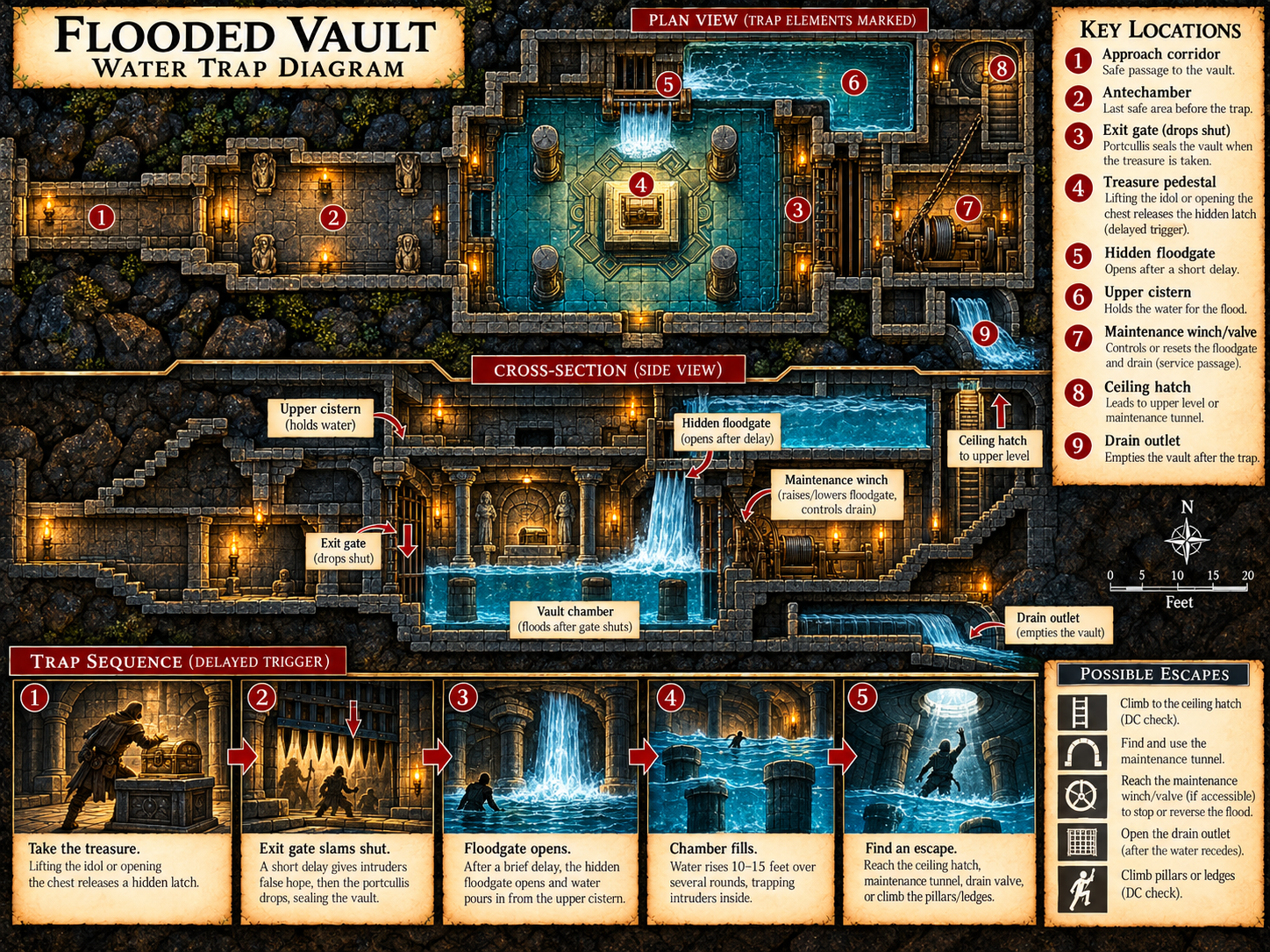
How the trap works. The approach and antechamber are safe. Removing the idol or opening the treasure chest releases a concealed latch. The exit gate then shuts, trapping anyone still in the vault. After a short, observable delay, the sluice from an upper cistern opens and water starts pouring into the chamber. A slow drain prevents instant flooding but cannot keep pace with the incoming water.
Clues and counterplay. Corroded waterlines, damp stone, a service winch and a chain disappearing toward the treasure pedestal can reveal the mechanism before it operates. Adventurers may secure the gate before taking the prize, interfere with the inlet, swim or climb to the ceiling hatch, find the maintenance tunnel, or reach a valve that diverts the water. The winch controls the sluice and drain for maintenance and resetting; it does not cause the treasure to trigger.
At the table. Give the players clear warning after the latch releases, then measure the rising water in rounds rather than declaring an unavoidable drowning. This diagram is an original encounter layout, not a separate official trap stat block: use the Water-Filled Room Trap below or the Flooding Room Trap for the edition-specific mechanical baseline, adapting timing, access routes and difficulty to this larger vault.
Water-Filled Room TrapD&D 2024 · 5e 2014 · Pathfinder 1e · D&D 3.5e
Clue: Damp tide marks stain a 10-foot-square chamber; drain holes have been plugged.
Trigger: A hidden floor plate seals both doors and opens the cistern.
Reset: Automatic refill and reset after occupants escape or the room is emptied.
Counterplay: Jam the doors, find the manual drain or force the water valve shut.
Water-Filled Room Trap — 2024
Deadly trap, levels 1–4. Search/Study DC 15.
Effect: Doors seal; over five rounds the chamber fills completely with water. Escape by opening a valve (DC 16 Strength/Athletics) or disabling it (DC 16 Dexterity using thieves’ tools). When submerged, use the 2024 breath-holding and suffocation rules; there is no arbitrary hit-point damage.
Disarm: DC 16 Dexterity using thieves’ tools, or Jam the doors, find the manual drain or force the water valve shut.
Water-Filled Room Trap — 2014
Deadly trap, levels 1–4. Perception DC 15, Investigation DC 15.
Effect: The 10-foot-square chamber seals and fills in five rounds. Open the drain with DC 16 Strength (Athletics) or disable the valve with DC 16 Dexterity (thieves’ tools). Once submerged, use the 2014 suffocation rules.
Disarm: DC 16 Dexterity with thieves’ tools, or Jam the doors, find the manual drain or force the water valve shut.
Water-Filled Room Trap — Pathfinder 1e
Mechanical trap — Pathfinder 1e CR 10 (calculation for the stated features; GM balance review needed). Perception DC 17; Disable Device DC 23;
Effect: A 10-by-10-foot room fills over five rounds; no attack roll, affects everyone inside. Perception DC 17, Disable Device DC 23. Apply PF1e drowning after the onset delay.
Counterplay: Jam the doors, find the manual drain or force the water valve shut.
Reset: Automatic refill and reset after occupants escape or the room is emptied.
PF1e CR calculation: Mechanical base 0; liquid/drowning +5; never miss +2; multiple targets without hit-point damage +1; automatic reset +1; Disable Device DC 23 +1; Perception DC 17 adds 0. Sum CR 10. The five-round onset delay is a timing feature, not an extra CR modifier. This is dramatically higher than the preserved original 3.5e CR 4 and must be reviewed for encounter suitability before being used unchanged.
Construction: 15,000 gp (10,000 gp base × 1.5 for automatic reset) if all listed Pathfinder features are retained.
Water-Filled Room Trap — D&D 3.5e
Water-Filled Room Trap: CR 4; mechanical; location trigger; automatic reset; multiple targets (all targets in a 10-ft.-by-10-ft. room); never miss; onset delay (5 rounds); liquid; Search DC 17; Disable Device DC 23. Market Price: 11,200 gp.
Wide-Mouth Spiked Pit TrapD&D 2024 · 5e 2014 · Pathfinder 1e · D&D 3.5e
Clue: The unusually wide lid has matching hinges along two neighbouring squares.
Trigger: Weight upon either concealed floor square.
Reset: Manual.
Counterplay: Bridge the two-square gap or lock the trapdoor open.
Wide-Mouth Spiked Pit Trap — 2024
Deadly trap, levels 1–4. Search/Study DC 15.
Effect: Creatures on either of two neighbouring squares make DC 15 Dexterity saves to avoid a 20-foot fall. Failures take 2d6 Bludgeoning plus 2d6 Piercing damage.
Disarm: DC 16 Dexterity using thieves’ tools, or Bridge the two-square gap or lock the trapdoor open.
Wide-Mouth Spiked Pit Trap — 2014
Dangerous trap, levels 1–4. Perception DC 15, Investigation DC 15.
Effect: Each creature on either of two adjoining squares makes DC 15 Dexterity save; failure drops them 20 feet for 2d6 bludgeoning and 2d6 piercing damage.
Disarm: DC 16 Dexterity with thieves’ tools, or Bridge the two-square gap or lock the trapdoor open.
Wide-Mouth Spiked Pit Trap — Pathfinder 1e
Mechanical trap — Pathfinder 1e CR 5 (calculated). Perception DC 18; Disable Device DC 25;
Effect: Reflex DC 20 avoids 20-foot fall (2d6); 1d4 spike attacks +10, each 1d4+2 piercing, against targets from adjoining five-foot squares.
Counterplay: Bridge the two-square gap or lock the trapdoor open.
Reset: Manual.
PF1e CR calculation: Base 0; Disable Device DC 25 +1. Per target: 2d6 fall averages 7; 1d4 spikes average 2.5 hits dealing 1d4+2 (4.5 each), for about 18.25 total; rounded to 20 and doubled for two affected target squares (+4). Perception DC 18, Reflex DC 20 and spike attack +10 add 0. Total CR 5.
Construction: 5,000 gp for a manually reset device, or as little as 1,250 gp if the GM applies the simple-pit exception.
Wide-Mouth Spiked Pit Trap — D&D 3.5e
Wide-Mouth Spiked Pit Trap: CR 4; mechanical; location trigger; manual reset; DC 20 Reflex save avoids; 20 ft. deep (2d6, fall); multiple targets (first target in each of two adjacent 5-ft. squares); pit spikes (Atk +10 melee, 1d4 spikes per target for 1d4+2 each); Search DC 18; Disable Device DC 25. Market Price: 7,200 gp.
Conversion note: Water-room hazards use each edition’s own suffocation rules after their stated delay. Older magical or mechanical trap CRs are not interchangeable with 5e severity. Sources: Pathfinder traps and D&D 3.5e traps.
Converted Traps — CR 5 Collection
Four-edition conversions of the fourteen original CR 5 traps. Choose D&D 5.5e / 2024, D&D 5e / 2014, Pathfinder 1e or D&D 3.5e within each trap. Modern D&D versions use a levels 5–10 starting point for encounter balance. All fourteen Pathfinder versions now have explicit mechanics, CR assessments and construction costs that may differ from the original 3.5e CR 5. The Flooding Room is a CR 11 sealed-chamber adaptation; the Moving Executioner Statue is a CR 6 two-square design, and Ungol Dust Vapour is a CR 6 enclosed-room design. Use each panel’s stated trigger, targets and reset when awarding Pathfinder XP. The original D&D 3.5e statistics and costs remain unchanged.
Each trap has observable warnings, a precise trigger, an effect, ways to interrupt or bypass it, and its reset method. A successful investigation can permit a non-violent solution.
Camouflaged Pit Trap (50 Feet)D&D 2024 · 5e 2014 · Pathfinder 1e · D&D 3.5e
Camouflaged Pit Trap (50 Feet) — 2024
Deadly Trap (Levels 5–10), original adaptation.
Visible clue. Two adjacent flagstones are much cleaner than the rest of the passage; a cold draught seeps from the joins.
Trigger. Weight on either of two adjoining five-foot-square covers.
Effect. DC 15 Dexterity saving throw to catch the edge. Failure: fall 50 feet, taking 5d6 Bludgeoning damage. The shaft remains open, with smooth walls.
Detect. Search (Wisdom / Perception) or Study (Intelligence / Investigation) DC 16.
Disable or avoid. Dexterity with thieves’ tools DC 15, or a sound physical solution. Probe the floor, brace the trapdoors or cross on rope and beams.
Reset. Manual: replace and lock the lids.
Camouflaged Pit Trap (50 Feet) — 2014
Dangerous Trap (Levels 5–10), original adaptation.
Visible clue. Two adjacent flagstones are much cleaner than the rest of the passage; a cold draught seeps from the joins.
Trigger. Weight on either of two adjoining five-foot-square covers.
Effect. DC 15 Dexterity saving throw to avoid a 50-foot fall (5d6 bludgeoning damage); the exposed pit obstructs the route.
Detect. Wisdom (Perception) or Intelligence (Investigation) DC 16.
Disable or avoid. Dexterity with thieves’ tools DC 15, or a sound physical solution. Probe the floor, brace the trapdoors or cross on rope and beams.
Reset. Manual: replace and lock the lids.
Camouflaged Pit Trap (50 Feet) — Pathfinder 1e
Mechanical trap — Pathfinder 1e CR 5 (calculated). Perception DC 25; Disable Device DC 17.
Clue: Two adjacent flagstones are much cleaner than the rest of the passage; a cold draught seeps from the joins.
Trigger: Weight on either of two adjoining five-foot-square covers.
Effect: Reflex DC 20 avoids a 50-foot fall, dealing 5d6 falling damage; affects the first creature in each of two adjoining squares.
Counterplay: Probe the floor, brace the trapdoors or cross on rope and beams.
Reset: Manual: replace and lock the lids.
PF1e CR calculation: Base 0; Perception DC 25 +1; 5d6 fall averages 17.5 damage, rounded to 20 and doubled for the two target squares (+4). Disable Device DC 17 and Reflex DC 20 add 0. Total CR 5.
Construction: 5,000 gp with manual reset, or as little as 1,250 gp if the GM permits the simple-pit discount.
Camouflaged Pit Trap (50 Feet) — D&D 3.5e Original
Camouflaged Pit Trap: CR 5; mechanical; location trigger; manual reset; DC 20 Reflex save avoids; 50 ft. deep (5d6, fall); multiple targets (first target in each of two adjacent 5-ft. squares); Search DC 25; Disable Device DC 17. Market Price: 8,500 gp.
Doorknob Smeared with Contact PoisonD&D 2024 · 5e 2014 · Pathfinder 1e · D&D 3.5e
Doorknob Smeared with Contact Poison — 2024
Deadly Trap (Levels 5–10), original adaptation.
Visible clue. The handle carries a faint bitter smell and a glossy coating that has not gathered dust.
Trigger. Bare skin touches the contaminated knob or a character smears the coating on their hands.
Effect. Exposed creature makes a DC 15 Constitution saving throw; on failure takes 3d6 Poison damage and has the Poisoned condition for 1 minute, repeating the save at the end of its turns. Successful save: half damage and no condition. Original poison effect, not a 2024 equipment poison.
Detect. Search (Wisdom / Perception) or Study (Intelligence / Investigation) DC 16.
Disable or avoid. Dexterity with thieves’ tools DC 15, or a sound physical solution. Use a cloth or gauntlet, wash the handle safely, or open from the other side.
Reset. Manual: reapply the contact poison.
Doorknob Smeared with Contact Poison — 2014
Dangerous Trap (Levels 5–10), original adaptation.
Visible clue. The handle carries a faint bitter smell and a glossy coating that has not gathered dust.
Trigger. Bare skin touches the contaminated knob or a character smears the coating on their hands.
Effect. DC 15 Constitution save; failure deals 3d6 poison damage and poisons for 1 minute, with a new save at the end of each turn. Success takes half damage only. Homebrew reinterpretation of the original ability-damage poison.
Detect. Wisdom (Perception) or Intelligence (Investigation) DC 16.
Disable or avoid. Dexterity with thieves’ tools DC 15, or a sound physical solution. Use a cloth or gauntlet, wash the handle safely, or open from the other side.
Reset. Manual: reapply the contact poison.
Doorknob Smeared with Contact Poison — Pathfinder 1e
Mechanical trap — Pathfinder 1e CR 5 (calculated). Perception DC 25; Disable Device DC 19.
Clue: The handle carries a faint bitter smell and a glossy coating that has not gathered dust.
Trigger: Bare skin touches the contaminated knob or a character smears the coating on their hands.
Effect: Contact poison (nitharit) on the knob, Fortitude DC 13, applying the PF1e nitharit poison rules where available; do not use the older 3.5e Constitution-damage sequence without conversion.
Counterplay: Use a cloth or gauntlet, wash the handle safely, or open from the other side.
Reset: Manual: reapply the contact poison.
PF1e CR calculation: Base 0; Perception DC 25 +1; nitharit contact poison +4; Disable Device DC 19 adds 0. Total CR 5. Pathfinder nitharit: Fortitude DC 13; onset 1 minute; once per minute for six minutes, 1d3 Constitution damage; cure one save.
Construction: 5,650 gp for a manually reset mechanism: 5,000 gp base plus one 650 gp dose of nitharit.
Doorknob Smeared with Contact Poison — D&D 3.5e Original
Doorknob Smeared with Contact Poison: CR 5; mechanical; touch trigger (attached); manual reset; poison (nitharit, DC 13 Fortitude save resists, 0/3d6 Constitution); Search DC 25; Disable Device DC 19. Market Price: 9,650 gp.
Falling Block TrapD&D 2024 · 5e 2014 · Pathfinder 1e · D&D 3.5e
Falling Block Trap — 2024
Deadly Trap (Levels 5–10), original adaptation.
Visible clue. Hairline cracks enclose a pair of ceiling stones, and iron hooks hide in their joints.
Trigger. A floor plate releases the suspended masonry over two adjoining squares.
Effect. Each creature in the two adjoining five-foot squares makes a DC 15 Dexterity saving throw, taking 4d10 Bludgeoning damage on failure or half on success. The fallen blocks become Difficult Terrain.
Detect. Search (Wisdom / Perception) or Study (Intelligence / Investigation) DC 15.
Disable or avoid. Dexterity with thieves’ tools DC 16, or a sound physical solution. Brace the suspended stones, jam the plate or cross outside the strike area.
Reset. Manual: lift and reset the blocks.
Falling Block Trap — 2014
Deadly Trap (Levels 5–10), original adaptation.
Visible clue. Hairline cracks enclose a pair of ceiling stones, and iron hooks hide in their joints.
Trigger. A floor plate releases the suspended masonry over two adjoining squares.
Effect. DC 15 Dexterity saving throw for each creature in two neighbouring squares; failure takes 4d10 bludgeoning damage, success half. Debris makes the passage difficult terrain.
Detect. Wisdom (Perception) or Intelligence (Investigation) DC 15.
Disable or avoid. Dexterity with thieves’ tools DC 16, or a sound physical solution. Brace the suspended stones, jam the plate or cross outside the strike area.
Reset. Manual: lift and reset the blocks.
Falling Block Trap — Pathfinder 1e
Mechanical trap — Pathfinder 1e CR 6 (calculated). Perception DC 20; Disable Device DC 25.
Clue: Hairline cracks enclose a pair of ceiling stones, and iron hooks hide in their joints.
Trigger: A floor plate releases the suspended masonry over two adjoining squares.
Effect: Melee attack +15 (6d6 bludgeoning), striking targets in the two designated squares; manual reset.
Counterplay: Brace the suspended stones, jam the plate or cross outside the strike area.
Reset: Manual: lift and reset the blocks.
PF1e CR calculation: Base 0; melee attack +15 +1; Disable Device DC 25 +1; 6d6 falling-block damage averages 21, rounded to 20 and doubled for the two target squares (+4); Perception DC 20 adds 0. Total CR 6.
Construction: 6,000 gp for the manually reset mechanical device.
Falling Block Trap — D&D 3.5e Original
Falling Block Trap: CR 5; mechanical; location trigger; manual reset; Atk +15 melee (6d6); multiple targets (can strike all characters in two adjacent specified squares); Search DC 20; Disable Device DC 25. Market Price: 15,000 gp.
Fire Trap (Warded Container)D&D 2024 · 5e 2014 · Pathfinder 1e · D&D 3.5e
Fire Trap (Warded Container) — 2024
Deadly Trap (Levels 5–10), original adaptation.
Visible clue. Reddish writing circles the chest seam, and tiny burnt marks radiate from the lock.
Trigger. The warded container is opened by anyone not authorised.
Effect. A custom fire ward bursts in a five-foot Emanation when the object is opened. DC 15 Dexterity saving throw, taking 4d8 Fire damage on failure or half on success. This is not an official 2024 Fire Trap spell.
Detect. Search (Wisdom / Perception) or Study (Intelligence / Investigation) DC 16.
Disable or avoid. Study its rune (Intelligence (Arcana) DC 16), then remove, counter or bypass the magic. Identify the rune, have the owner open the item, dispel the ward or operate it from a safe distance.
Reset. None: the ward requires recasting.
Fire Trap (Warded Container) — 2014
Dangerous Trap (Levels 5–10), original adaptation.
Visible clue. Reddish writing circles the chest seam, and tiny burnt marks radiate from the lock.
Trigger. The warded container is opened by anyone not authorised.
Effect. A custom magical fire burst in a five-foot radius: DC 15 Dexterity saving throw, 4d8 fire damage on failure, half on success. This ward is not copied from a 2014 spell of the same name.
Detect. Wisdom (Perception) or Intelligence (Investigation) DC 16.
Disable or avoid. Study its rune (Intelligence (Arcana) DC 16), then remove, counter or bypass the magic. Identify the rune, have the owner open the item, dispel the ward or operate it from a safe distance.
Reset. None: the ward requires recasting.
Fire Trap (Warded Container) — Pathfinder 1e
Spell trap — Pathfinder 1e CR 5 (calculated for wizard fire trap). Perception DC 29; Disable Device DC 29 (requires trapfinding).
Clue: Reddish writing circles the chest seam, and tiny burnt marks radiate from the lock.
Trigger: The warded container is opened by anyone not authorised.
Effect: Spell trap based on the Pathfinder fire trap spell at caster level 7; 1d4+7 fire, Reflex DC 16 half; the spell trap is single use.
Counterplay: Identify the rune, have the owner open the item, dispel the ward or operate it from a safe distance.
Reset: None: the ward requires recasting.
PF1e CR calculation: Magic base 1 + 4th-level wizard fire trap (+4) = CR 5; CL 7 and Reflex DC 16 half. This is the wizard version of the spell; the lower-level druid version has different spell-level calculations. The trap is single-use.
Construction: 25 gp of gold-dust material when self-cast; hiring a CL 7 wizard at 280 gp yields an estimated total of 305 gp.
Fire Trap (Warded Container) — D&D 3.5e Original
Fire Trap: CR 5; spell; spell trigger; no reset; spell effect (fire trap, 7th-level wizard, 1d4+7 fire, DC 16 Reflex save half damage); Search DC 29; Disable Device DC 29. Cost: 305 gp to hire NPC spellcaster.
Fireball TrapD&D 2024 · 5e 2014 · Pathfinder 1e · D&D 3.5e
Fireball Trap — 2024
Deadly Trap (Levels 5–10), original adaptation.
Visible clue. Scorched masonry surrounds a circular glyph and the floor is discoloured in a broad ring.
Trigger. Touching a trapped idol, vault door or marked treasure pedestal.
Effect. The magical device erupts like a Fireball centred on its point of origin. Creatures in a 20-foot-radius Sphere make DC 15 Dexterity saving throws, taking 8d6 Fire damage on failure or half on success.
Detect. Search (Wisdom / Perception) or Study (Intelligence / Investigation) DC 17.
Disable or avoid. Study its rune (Intelligence (Arcana) DC 17), then remove, counter or bypass the magic. Find the touch rune; lift the object remotely or counter its magic before contact.
Reset. Automatic magical reset after one minute.
Fireball Trap — 2014
Deadly Trap (Levels 5–10), original adaptation.
Visible clue. Scorched masonry surrounds a circular glyph and the floor is discoloured in a broad ring.
Trigger. Touching a trapped idol, vault door or marked treasure pedestal.
Effect. The trap releases a Fireball in a 20-foot-radius sphere. DC 15 Dexterity save, 8d6 fire damage on failure or half on success.
Detect. Wisdom (Perception) or Intelligence (Investigation) DC 17.
Disable or avoid. Study its rune (Intelligence (Arcana) DC 17), then remove, counter or bypass the magic. Find the touch rune; lift the object remotely or counter its magic before contact.
Reset. Automatic magical reset after one minute.
Fireball Trap — Pathfinder 1e
Magic device trap — Pathfinder 1e CR 7 (calculated). Perception DC 28; Disable Device DC 28 (requires trapfinding).
Clue: Scorched masonry surrounds a circular glyph and the floor is discoloured in a broad ring.
Trigger: Touching a trapped idol, vault door or marked treasure pedestal.
Effect: Magic device triggering a fireball at caster level 8 (8d6 fire, Reflex DC 14 half), automatic reset.
Counterplay: Find the touch rune; lift the object remotely or counter its magic before contact.
Reset: Automatic magical reset after one minute.
PF1e CR calculation: Magic base 1; fireball spell level 3 gives +3, but CL 8 deals 8d6 (average 28, rounded to 30 then doubled for multiple targets = 60), providing +6. Use the larger modifier only, for CR 7. Reflex DC 14 half, automatic reset.
Construction: 12,000 gp (500 gp × caster level 8 × spell level 3), assuming the builder supplies the magic.
Fireball Trap — D&D 3.5e Original
fireball Trap: CR 5; magic device; touch trigger; automatic reset; spell effect (fireball, 8th-level wizard, 8d6 fire, DC 14 Reflex save half damage); Search DC 28; Disable Device DC 28. Cost: 12,000 gp, 960 XP.
Flooding Room TrapD&D 2024 · 5e 2014 · Pathfinder 1e · D&D 3.5e
Flooding Room Trap — 2024
Deadly Trap (Levels 5–10), original adaptation.
Visible clue. The stone doors fit flush to their frame, rust stains surround roof pipes, and the floor’s drain is blocked.
Trigger. A creature approaches the centre of the chamber; sluice gates snap shut.
Effect. The sealed room fills with water over four rounds. Creatures must find or open a drain (DC 16 Strength (Athletics)) or disable the sluice (DC 16 Dexterity with thieves’ tools). Once completely submerged, apply the 2024 rules for holding breath and suffocation; do not invent direct damage.
Detect. Search (Wisdom / Perception) or Study (Intelligence / Investigation) DC 15.
Disable or avoid. Dexterity with thieves’ tools DC 16, or a sound physical solution. Wedge the doors, break a valve, turn the emergency wheel or force a ceiling hatch.
Reset. Automatic after the chamber drains and its doors reopen.
Flooding Room Trap — 2014
Deadly Trap (Levels 5–10), original adaptation.
Visible clue. The stone doors fit flush to their frame, rust stains surround roof pipes, and the floor’s drain is blocked.
Trigger. A creature approaches the centre of the chamber; sluice gates snap shut.
Effect. Doors lock and the room fills within four rounds. A DC 16 Strength (Athletics) check opens the drain, or DC 16 Dexterity with thieves’ tools disables the valve. After submersion, use 2014 suffocation rules.
Detect. Wisdom (Perception) or Intelligence (Investigation) DC 15.
Disable or avoid. Dexterity with thieves’ tools DC 16, or a sound physical solution. Wedge the doors, break a valve, turn the emergency wheel or force a ceiling hatch.
Reset. Automatic after the chamber drains and its doors reopen.
Flooding Room Trap — Pathfinder 1e
Mechanical liquid trap — Pathfinder 1e CR 11 (sealed-chamber adaptation). Perception DC 20; Disable Device DC 25.
Clues: Rusted ceiling pipes, watertight door seals, a dry floor drain and a handwheel behind an iron grille.
Trigger: A proximity linkage reacts when a creature reaches the centre of the 10-foot-square room, sealing the entrance and exit and releasing water from the overhead cistern.
Effect: Water reaches the ceiling after four rounds; everyone still inside is immersed without an attack roll. Apply Pathfinder 1e Swim, breath-holding and drowning rules rather than dealing invented direct damage.
Counterplay: Wedge either door before entry; stop the inlet with Disable Device DC 25; force the emergency wheel with a Strength check DC 22 (an original encounter DC); or reach and open the ceiling hatch before the fourth round.
Reset: Automatic only after the reservoir has refilled, the chamber drained and the doors reopened; allow time for these physical steps.
PF1e CR calculation: Mechanical base 0; liquid +5, never miss +2, multiple targets without hit-point damage +1, proximity trigger +1, automatic reset +1, Disable Device DC 25 +1. Perception DC 20 adds 0. Total CR 11. The four-round onset is warning time, not an extra CR modifier.
Construction: 16,500 gp (11,000 gp base × 1.5 for automatic reset). This is not suitable as a CR 5 Pathfinder encounter; the catalogue groups it under its preserved D&D 3.5e rating. If the chamber cannot seal, or water cannot reach every occupant, recalculate the Pathfinder design.
Flooding Room Trap — D&D 3.5e Original
Flooding Room Trap: CR 5; mechanical; proximity trigger; automatic reset; no attack roll necessary (see note below); Search DC 20; Disable Device DC 25. Note: Room floods in 4 rounds. Market Price: 17,500 gp.
Fusillade of Darts (Eight-Dart Volley)D&D 2024 · 5e 2014 · Pathfinder 1e · D&D 3.5e
Fusillade of Darts (Eight-Dart Volley) — 2024
Deadly Trap (Levels 5–10), original adaptation.
Visible clue. An arch bears numerous clean pinholes, and discarded darts lie in a drainage groove.
Trigger. A creature steps onto the centre plate in the guarded ten-foot square.
Effect. Each creature in a ten-foot square makes a DC 15 Dexterity saving throw, taking 4d6 Piercing damage on a failure, half on a success. Several darts count as one combined volley; this avoids up to eight separate attack rolls.
Detect. Search (Wisdom / Perception) or Study (Intelligence / Investigation) DC 15.
Disable or avoid. Dexterity with thieves’ tools DC 16, or a sound physical solution. Block each dart tube, shield the lane or wedge the pressure plate.
Reset. Manual: replace the dart magazine.
Fusillade of Darts (Eight-Dart Volley) — 2014
Dangerous Trap (Levels 5–10), original adaptation.
Visible clue. An arch bears numerous clean pinholes, and discarded darts lie in a drainage groove.
Trigger. A creature steps onto the centre plate in the guarded ten-foot square.
Effect. Each creature in the ten-foot square makes DC 15 Dexterity saving throw; 4d6 piercing damage on failure or half on success, representing a volley of darts.
Detect. Wisdom (Perception) or Intelligence (Investigation) DC 15.
Disable or avoid. Dexterity with thieves’ tools DC 16, or a sound physical solution. Block each dart tube, shield the lane or wedge the pressure plate.
Reset. Manual: replace the dart magazine.
Fusillade of Darts (Eight-Dart Volley) — Pathfinder 1e
Mechanical trap — Pathfinder 1e CR 7 (calculated). Perception DC 19; Disable Device DC 25.
Clue: An arch bears numerous clean pinholes, and discarded darts lie in a drainage groove.
Trigger: A creature steps onto the centre plate in the guarded ten-foot square.
Effect: Ranged attack +18, 1d8 darts per target in a 10-by-10-foot area, each dealing 1d4+1 piercing; manual reset.
Counterplay: Block each dart tube, shield the lane or wedge the pressure plate.
Reset: Manual: replace the dart magazine.
PF1e CR calculation: Base 0; ranged attack +18 +2; Disable Device DC 25 +1; 1d8 darts per target averages 4.5 darts at 1d4+1 (3.5) damage, 15.75 total rounded to 20 then doubled for multiple targets (+4). Perception DC 19 adds 0. Total CR 7.
Construction: 7,000 gp with manual reload; confirm the firing arc so that the multiple-target calculation matches the encounter.
Fusillade of Darts (Eight-Dart Volley) — D&D 3.5e Original
Fusillade of Darts: CR 5; mechanical; location trigger; manual reset; Atk +18 ranged (1d4+1, dart); multiple targets (1d8 darts per target in a 10-ft.-by-10-ft. area); Search DC 19; Disable Device DC 25. Market Price: 18,000 gp.
Moving Executioner StatueD&D 2024 · 5e 2014 · Pathfinder 1e · D&D 3.5e
Moving Executioner Statue — 2024
Deadly Trap (Levels 5–10), original adaptation.
Clue. A double-axe statue stands over worn flagstones; the axe marks cut far deeper than ordinary decoration.
Trigger. A creature enters the guarded two-square area, releasing both arms.
Effect. Each of the statue’s two axe arms makes a melee attack (+7 to hit) against one creature within 5 feet; a hit deals 3d10 Slashing damage. Each arm chooses a different target if possible. The arms reset at the end of the round.
Detection. Search (Wisdom / Perception) or Study (Intelligence / Investigation) DC 17.
Disarm. Dexterity using thieves’ tools DC 17; sensible physical solutions can work without a roll.
Bypass. Find the hidden bypass switch (Study/Investigation DC 17), jam either arm or cross behind the statue.
Reset. Automatic, rearmed after the arms retract.
Moving Executioner Statue — 2014
Deadly Trap (Levels 5–10), original adaptation.
Clue. A double-axe statue stands over worn flagstones; the axe marks cut far deeper than ordinary decoration.
Trigger. A creature enters the guarded two-square area, releasing both arms.
Effect. Two melee attacks (+7 to hit) against creatures adjacent to the statue; each hit deals 3d10 slashing damage. If only one target stands within reach, both attacks may strike it.
Detection. Wisdom (Perception) or Intelligence (Investigation) DC 17.
Disarm. Dexterity using thieves’ tools DC 17; sensible physical solutions can work without a roll.
Bypass. Find the hidden bypass switch (Study/Investigation DC 17), jam either arm or cross behind the statue.
Reset. Automatic, rearmed after the arms retract.
Moving Executioner Statue — Pathfinder 1e
Mechanical trap — Pathfinder 1e CR 6 (two-square adaptation). Perception DC 25; Disable Device DC 18.
Trigger: Entering either of the two marked 5-foot squares releases the corresponding axe arm.
Effect: One melee attack +16 (1d12+8 slashing, critical ×3) against the creature in each affected square; two separate targets can be struck, but neither arm attacks the same target twice in one activation.
Reset: Automatic; both arms retract and rearm after one minute.
Counterplay: Observe the worn swing arcs; find the hidden bypass switch (Perception DC 25), jam an arm, or cross behind the statue.
PF1e CR calculation: Base 0; Perception DC 25 adds +1; attack +16 adds +2; each hit averages 14.5 damage, rounded to 10 and doubled for two target squares (+2); automatic reset adds +1. Total CR 6.
Construction: 9,000 gp (6,000 gp base × 1.5 automatic reset). This Pathfinder layout deliberately specifies one hit per square; the original D&D 3.5e trap remains unchanged in its own tab. If both arms strike the same victim, calculate a different CR.
Moving Executioner Statue — D&D 3.5e Original
Moving Executioner Statue: CR 5; mechanical; location trigger; automatic reset; hidden switch bypass (Search DC 25); Atk +16 melee (1d12+8/x3, Greataxe); multiple targets (both arms attack); Search DC 25; Disable Device DC 18. Market Price: 22,500 gp.
Phantasmal Killer TrapD&D 2024 · 5e 2014 · Pathfinder 1e · D&D 3.5e
Phantasmal Killer Trap — 2024
Deadly Trap (Levels 5–10), original adaptation.
Clue. A cold statue seems to turn its head toward visitors; people report different shadows stalking them.
Trigger. A creature enters the warded chamber and its alarm senses an intruder.
Effect. One creature the ward can perceive makes a DC 16 Wisdom saving throw. Failure: Frightened for up to 1 minute and takes 3d10 Psychic damage at the end of its next turn. It repeats the save at the end of each turn; success ends the effect. This is a custom illusion, not the 3.5e death effect.
Detection. Search (Wisdom / Perception) or Study (Intelligence / Investigation) DC 18.
Disarm. Intelligence (Arcana) DC 18 to identify the ward; use appropriate magic or circumvent the trigger.
Bypass. Recognise the illusory source, leave the room before activation or counter the ward.
Reset. Automatic, resets after one minute.
Phantasmal Killer Trap — 2014
Deadly Trap (Levels 5–10), original adaptation.
Clue. A cold statue seems to turn its head toward visitors; people report different shadows stalking them.
Trigger. A creature enters the warded chamber and its alarm senses an intruder.
Effect. A target must make a DC 16 Wisdom save or become frightened for up to 1 minute. While frightened it takes 3d10 psychic damage at the end of its next turn and may repeat the save at each turn’s end to end the effect; original trap, not the historical instant-death spell.
Detection. Wisdom (Perception) or Intelligence (Investigation) DC 18.
Disarm. Intelligence (Arcana) DC 18 to identify the ward; use appropriate magic or circumvent the trigger.
Bypass. Recognise the illusory source, leave the room before activation or counter the ward.
Reset. Automatic, resets after one minute.
Phantasmal Killer Trap — Pathfinder 1e
Magic device trap — Pathfinder 1e CR 5 (calculated). Perception DC 29, Disable Device DC 29 (trapfinding required).
Trigger: A creature enters the warded chamber and its alarm senses an intruder.
Effect: Magical device with phantasmal killer at caster level 7; Will DC 16 disbelieves, then Fortitude DC 16 negates death and may cause partial effects under PF1e spell rules. Automatic reset.
Reset: Automatic, resets after one minute.
Counterplay: Recognise the illusory source, leave the room before activation or counter the ward.
PF1e CR calculation: Magic base 1 + 4th-level phantasmal killer (+4) = CR 5. At CL 7 use Will DC 16 to disbelieve, then Fortitude DC 16 to resist the deadly effect, as specified by the PF1e spell. Automatically resets.
Construction: 14,000 gp (500 gp × CL 7 × spell level 4), assuming the creator supplies the spells.
Phantasmal Killer Trap — D&D 3.5e Original
phantasmal killer Trap: CR 5; magic device; proximity trigger (alarm covering the entire room); automatic reset; spell effect (phantasmal killer, 7th-level wizard, DC 16 Will save for disbelief and DC 16 Fort save for partial effect); Search DC 29; Disable Device DC 29. Cost: 14,000 gp, 1,120 XP.
Pit Trap (100 Feet)D&D 2024 · 5e 2014 · Pathfinder 1e · D&D 3.5e
Pit Trap (100 Feet) — 2024
Deadly Trap (Levels 5–10), original adaptation.
Clue. The central paving flexes while the walls give off a steady, distant echo.
Trigger. An intruder steps onto the disguised 100-foot shaft cover.
Effect. DC 15 Dexterity saving throw to catch a firm edge. On failure the creature falls 100 feet and takes 10d6 Bludgeoning damage. The shaft is a continuing obstacle even once detected.
Detection. Search (Wisdom / Perception) or Study (Intelligence / Investigation) DC 16.
Disarm. Dexterity using thieves’ tools DC 15; sensible physical solutions can work without a roll.
Bypass. Probe the floor; rig a rope bridge, lower a ladder or find the maintenance passage.
Reset. Manual: re-close and lock the hatch.
Pit Trap (100 Feet) — 2014
Deadly Trap (Levels 5–10), original adaptation.
Clue. The central paving flexes while the walls give off a steady, distant echo.
Trigger. An intruder steps onto the disguised 100-foot shaft cover.
Effect. DC 15 Dexterity save avoids a 100-foot fall for 10d6 bludgeoning damage. The bottom is accessible only by climbing equipment, magic or an alternate route.
Detection. Wisdom (Perception) or Intelligence (Investigation) DC 16.
Disarm. Dexterity using thieves’ tools DC 15; sensible physical solutions can work without a roll.
Bypass. Probe the floor; rig a rope bridge, lower a ladder or find the maintenance passage.
Reset. Manual: re-close and lock the hatch.
Pit Trap (100 Feet) — Pathfinder 1e
Mechanical trap — Pathfinder 1e CR 4 (calculated). Perception DC 20, Disable Device DC 20.
Trigger: An intruder steps onto the disguised 100-foot shaft cover.
Effect: Reflex DC 20 avoids the 100-foot fall; falling damage 10d6. Manual reset.
Reset: Manual: re-close and lock the hatch.
Counterplay: Probe the floor; rig a rope bridge, lower a ladder or find the maintenance passage.
PF1e CR calculation: Base 0; 10d6 falling damage averages 35, rounded to 40 (+4); Perception DC 20, Disable Device DC 20 and Reflex DC 20 add 0. Total CR 4, distinct from the original 3.5e CR 5.
Construction: 4,000 gp manual reset, or as little as 1,000 gp for a GM-approved simple pit.
Pit Trap (100 Feet) — D&D 3.5e Original
Pit Trap: CR 5; mechanical, location trigger; manual reset; DC 20 Reflex save avoids; 100 ft. deep (10d6, fall); Search DC 20; Disable Device DC 20. Market Price: 5,000 gp.
Poison Wall SpikesD&D 2024 · 5e 2014 · Pathfinder 1e · D&D 3.5e
Poison Wall Spikes — 2024
Deadly Trap (Levels 5–10), original adaptation.
Clue. Small spring sockets line the wall behind scratches at rib height; sticky residue coats a spike.
Trigger. An intruder steps on either of two pressure slabs beside the wall.
Effect. The closest creature in each of two adjoining squares is attacked by a wall spike (+7 to hit, 2d8 Piercing damage). A hit also requires a DC 15 Constitution save; failure deals 2d6 Poison damage and gives the Poisoned condition until the end of the target’s next turn.
Detection. Search (Wisdom / Perception) or Study (Intelligence / Investigation) DC 15.
Disarm. Dexterity using thieves’ tools DC 16; sensible physical solutions can work without a roll.
Bypass. Jam the sockets, work from outside the affected squares or block the pressure plates.
Reset. Manual: rewind springs and replenish venom.
Poison Wall Spikes — 2014
Dangerous Trap (Levels 5–10), original adaptation.
Clue. Small spring sockets line the wall behind scratches at rib height; sticky residue coats a spike.
Trigger. An intruder steps on either of two pressure slabs beside the wall.
Effect. One spike attacks the nearest creature in each of two adjoining squares (+7 to hit, 2d8 piercing). A hit prompts a DC 15 Constitution save; on failure take 2d6 poison damage and become poisoned until the end of the next turn.
Detection. Wisdom (Perception) or Intelligence (Investigation) DC 15.
Disarm. Dexterity using thieves’ tools DC 16; sensible physical solutions can work without a roll.
Bypass. Jam the sockets, work from outside the affected squares or block the pressure plates.
Reset. Manual: rewind springs and replenish venom.
Poison Wall Spikes — Pathfinder 1e
Mechanical trap — Pathfinder 1e CR 7 (calculated). Perception DC 17, Disable Device DC 21.
Trigger: An intruder steps on either of two pressure slabs beside the wall.
Effect: Melee attack +16 (1d8+4 piercing plus Medium monstrous spider venom). Fortitude DC 14 (once per round for four rounds, 1d2 Strength damage per failed save, cure one successful save).
Reset: Manual: rewind springs and replenish venom.
Counterplay: Jam the sockets, work from outside the affected squares or block the pressure plates.
PF1e CR calculation: Base 0; melee attack +16 +2; Disable Device DC 21 +1; 1d8+4 averages 8.5 piercing, rounded to 10 and doubled for two targets (+2); medium spider venom +2. Perception DC 17 adds 0. Total CR 7. Pathfinder venom is Fortitude DC 14, once per round for four rounds, 1d2 Strength damage, cured by one successful save.
Construction: 7,300 gp (7,000 gp mechanism plus two 150 gp doses, one for each spike).
Poison Wall Spikes — D&D 3.5e Original
Poison Wall Spikes: CR 5; mechanical; location trigger; manual reset; Atk +16 melee (1d8+4 plus poison, spike); multiple targets (closest target in each of two adjacent 5-ft. squares); poison (Medium monstrous spider venom, DC 12 Fortitude save resists, 1d4 Strength/1d4 Strength); Search DC 17; Disable Device DC 21. Market Price: 12,650 gp.
Spiked Pit (40 Feet)D&D 2024 · 5e 2014 · Pathfinder 1e · D&D 3.5e
Spiked Pit (40 Feet) — 2024
Deadly Trap (Levels 5–10), original adaptation.
Clue. The floorcover creaks over a broad cavity; scratches on its edges look like grappling hooks.
Trigger. An intruder crosses either of two adjoining trapdoor squares.
Effect. DC 15 Dexterity save to avoid the pit. Failure causes a 40-foot fall (4d6 Bludgeoning) plus landing on spikes for 3d8 Piercing damage.
Detection. Search (Wisdom / Perception) or Study (Intelligence / Investigation) DC 16.
Disarm. Dexterity using thieves’ tools DC 16; sensible physical solutions can work without a roll.
Bypass. Bridge the lid or jam it shut with an iron spike before crossing.
Reset. Manual.
Spiked Pit (40 Feet) — 2014
Deadly Trap (Levels 5–10), original adaptation.
Clue. The floorcover creaks over a broad cavity; scratches on its edges look like grappling hooks.
Trigger. An intruder crosses either of two adjoining trapdoor squares.
Effect. DC 15 Dexterity save to avoid a 40-foot fall; failure deals 4d6 bludgeoning damage plus 3d8 piercing from spikes.
Detection. Wisdom (Perception) or Intelligence (Investigation) DC 16.
Disarm. Dexterity using thieves’ tools DC 16; sensible physical solutions can work without a roll.
Bypass. Bridge the lid or jam it shut with an iron spike before crossing.
Reset. Manual.
Spiked Pit (40 Feet) — Pathfinder 1e
Mechanical trap — Pathfinder 1e CR 8 (calculated). Perception DC 21, Disable Device DC 20.
Trigger: An intruder crosses either of two adjoining trapdoor squares.
Effect: Reflex DC 25 avoids the fall, 40 feet deep (4d6), with 1d4 spike attacks per creature at +10 for 1d4+4 each.
Reset: Manual.
Counterplay: Bridge the lid or jam it shut with an iron spike before crossing.
PF1e CR calculation: Base 0; Perception DC 21 +1 and Reflex DC 25 +1; 4d6 fall averages 14, plus 2.5 spikes dealing an average 1d4+4 (6.5) each = 30.25, rounded to 30 and doubled for two target squares (+6). Total CR 8.
Construction: 8,000 gp manual reset, or as little as 2,000 gp if the GM applies a simple-pit discount despite the spikes.
Spiked Pit (40 Feet) — D&D 3.5e Original
Spiked Pit Trap: CR 5; mechanical; location trigger; manual reset; DC 25 Reflex save avoids; 40 ft. deep (4d6, fall); multiple targets (first target in each of two adjacent 5-ft. squares); pit spikes (Atk +10 melee, 1d4 spikes per target for 1d4+4 each); Search DC 21; Disable Device DC 20. Market Price: 13,500 gp.
Spiked Pit (80 Feet)D&D 2024 · 5e 2014 · Pathfinder 1e · D&D 3.5e
Spiked Pit (80 Feet) — 2024
Deadly Trap (Levels 5–10), original adaptation.
Clue. A suspiciously long crack follows the side of a painted floor panel, and the chamber smells of damp iron.
Trigger. A creature steps on the trapped hatch.
Effect. DC 15 Dexterity save to avoid falling. Failure: an 80-foot plunge for 8d6 Bludgeoning plus 3d8 Piercing damage from metal spikes. Escape requires climbing gear or magic.
Detection. Search (Wisdom / Perception) or Study (Intelligence / Investigation) DC 16.
Disarm. Dexterity using thieves’ tools DC 16; sensible physical solutions can work without a roll.
Bypass. Tie off a rope, brace the hatch or take a narrow maintenance ledge.
Reset. Manual: haul the lid back up.
Spiked Pit (80 Feet) — 2014
Deadly Trap (Levels 5–10), original adaptation.
Clue. A suspiciously long crack follows the side of a painted floor panel, and the chamber smells of damp iron.
Trigger. A creature steps on the trapped hatch.
Effect. DC 15 Dexterity save avoids the 80-foot fall. Failure: 8d6 bludgeoning plus 3d8 piercing damage. The pit remains open and blocks the path.
Detection. Wisdom (Perception) or Intelligence (Investigation) DC 16.
Disarm. Dexterity using thieves’ tools DC 16; sensible physical solutions can work without a roll.
Bypass. Tie off a rope, brace the hatch or take a narrow maintenance ledge.
Reset. Manual: haul the lid back up.
Spiked Pit (80 Feet) — Pathfinder 1e
Mechanical trap — Pathfinder 1e CR 5 (calculated). Perception DC 20, Disable Device DC 20.
Trigger: A creature steps on the trapped hatch.
Effect: Reflex DC 20 avoids an 80-foot fall (8d6), with 1d4 spike attacks at +10 dealing 1d4+5 piercing each.
Reset: Manual: haul the lid back up.
Counterplay: Tie off a rope, brace the hatch or take a narrow maintenance ledge.
PF1e CR calculation: Base 0; 8d6 fall averages 28 and 2.5 spikes each average 1d4+5 (7.5), total about 46.75 damage rounded to 50 (+5). Perception DC 20, Disable Device DC 20 and Reflex DC 20 add 0. Total CR 5.
Construction: 5,000 gp manual reset; a lower simple-pit price is a GM decision because this version includes spikes.
Spiked Pit (80 Feet) — D&D 3.5e Original
Spiked Pit Trap (80 Ft. Deep): CR 5; mechanical; location trigger, manual reset; DC 20 Reflex save avoids; 80 ft. deep (8d6, fall), pit spikes (Atk +10 melee, 1d4 spikes for 1d4+5 each); Search DC 20; Disable Device DC 20. Market Price: 5,000 gp.
Ungol Dust Vapour TrapD&D 2024 · 5e 2014 · Pathfinder 1e · D&D 3.5e
Ungol Dust Vapour Trap — 2024
Deadly Trap (Levels 5–10), original adaptation.
Clue. The ceiling vent gives off a sweet metallic scent; guards wear cloth over their noses.
Trigger. Someone crosses the marked chamber; the vapour is released two rounds later.
Effect. After a two-round delay, a 10-foot-square chamber fills with hallucinogenic vapour for one minute. Each creature breathing the gas makes a DC 15 Constitution save when first exposed or starting its turn there; failure deals 3d6 Poison damage and gives Disadvantage on Charisma ability checks until its next turn. A creature makes at most one save per turn. Homebrew poison, not the old Charisma drain.
Detection. Search (Wisdom / Perception) or Study (Intelligence / Investigation) DC 16.
Disarm. Dexterity using thieves’ tools DC 16; sensible physical solutions can work without a roll.
Bypass. Seal the intake vents, wear appropriate sealed breathing protection, or disable the release before its two-round onset.
Reset. Manual: replace the poison reservoir.
Ungol Dust Vapour Trap — 2014
Dangerous Trap (Levels 5–10), original adaptation.
Clue. The ceiling vent gives off a sweet metallic scent; guards wear cloth over their noses.
Trigger. Someone crosses the marked chamber; the vapour is released two rounds later.
Effect. After two rounds, vapour fills a 10-foot-square room for one minute. Each exposed breathing creature makes a DC 15 Constitution save when it starts a turn there, taking 3d6 poison damage and suffering disadvantage on Charisma ability checks until its next turn on failure. Once per turn.
Detection. Wisdom (Perception) or Intelligence (Investigation) DC 16.
Disarm. Dexterity using thieves’ tools DC 16; sensible physical solutions can work without a roll.
Bypass. Seal the intake vents, wear appropriate sealed breathing protection, or disable the release before its two-round onset.
Reset. Manual: replace the poison reservoir.
Ungol Dust Vapour Trap — Pathfinder 1e
Mechanical gas trap — Pathfinder 1e CR 6 (sealed-room adaptation). Perception DC 20; Disable Device DC 16.
Trigger: A concealed plate in the 10-by-10-foot enclosed chamber releases a prepared dose of ungol dust after a two-round warning; the doors are not mechanically locked.
Effect: A nozzle distributes the inhaled poison throughout the chamber. All creatures still inside when the cloud is discharged are exposed, with no attack roll. Fortitude DC 15; initial effect 1 Charisma drain and subsequent effect 1d2 Charisma damage, frequency 1/round for four rounds, cure one successful save.
Counterplay: Leave the room during the warning, seal the nozzle, stop the bellows, or use an appropriate breathing defence.
Reset: Manual; ventilate and refill the single-dose reservoir before another activation.
PF1e CR calculation: Base 0; ungol dust poison +3, never miss +2 and multiple targets without hit-point damage +1; Perception DC 20 and Disable Device DC 16 add 0. Total CR 6.
Construction: 7,000 gp (6,000 gp manual-reset mechanism plus one 1,000 gp poison dose). This original design assumes one prepared dose reaches the entire enclosed 10-foot room; an open hall or partial gas coverage requires recalculation. Pathfinder poison effects follow the standard Core Rulebook rather than the 3.5e original.
Ungol Dust Vapour Trap — D&D 3.5e Original
Ungol Dust Vapor Trap: CR 5; mechanical; location trigger; manual reset; gas; multiple targets (all targets in a 10-ft.-by-10-ft. room); never miss; onset delay (2 rounds); poison (ungol dust, DC 15 Fortitude save resists, 1 Charisma/1d6 Charisma plus 1 Charisma drain); Search DC 20; Disable Device DC 16. Market Price: 9,000 gp.
CR 5: Conversion Notes
Falling into a deep shaft, an illusory death spell, and an automatic-reset fireball are not interchangeable encounters. Mechanical traps retain their physical clues and bypass routes. Ongoing gas effects allow a single exposure save per turn, and the illusion ward does not retain the 3.5e death effect in 5e. The original source rules remain available in the 3.5e panels below and the full archive.
Reference: D&D 2024 — Traps; Pathfinder 1e trap construction; 3.5e source reference.
Converted Traps — CR 6 Collection
These eleven original D&D 3.5e CR 6 traps have different statistics for D&D 2024, D&D 2014, Pathfinder 1e and D&D 3.5e. The newer D&D conversions are original designs for levels 5–10, with clues and counterplay. Pathfinder ratings and construction costs have now been recalculated independently for all eleven traps. The Whirling Poison Blades uses a one-sweep, one-minute-reset CR 7 adaptation with three poisoned blades; a faster repeated-attack version must be recalculated separately. A few Pathfinder CRs are much higher than the 3.5e grouping, notably the Compacting Room, and should be balanced to the actual party. The original D&D 3.5e entries and market prices are unchanged.
Built-to-Collapse WallD&D 2024 · 5e 2014 · Pathfinder 1e · D&D 3.5e
Built-to-Collapse Wall — 2024
Deadly Trap (Levels 5–10); original adaptation.
Clue. A wall’s lower stones are slanted; fresh mortar sits above a loose pair of timber braces.
Trigger. A creature approaches the wall’s concealed trigger zone.
Effect. Every creature in a ten-foot square makes a DC 15 Dexterity save; failure takes 4d10 Bludgeoning damage and is knocked Prone. Success: half damage, no Prone. Fallen rubble is Difficult Terrain.
Detection. Search with Wisdom (Perception) or Study with Intelligence (Investigation) DC 15.
Disarm. Dexterity check using thieves’ tools DC 16 or physically immobilise the mechanism.
Counterplay. Retreat beyond the ten-foot square, shore up the wall or safely release it from a distance.
Reset. None. The masonry collapses once and must be rebuilt.
Built-to-Collapse Wall — 2014
Deadly Trap (Levels 5–10); original adaptation.
Clue. A wall’s lower stones are slanted; fresh mortar sits above a loose pair of timber braces.
Trigger. A creature approaches the wall’s concealed trigger zone.
Effect. The ten-foot-square wall collapses: DC 15 Dexterity save; failure deals 6d6 bludgeoning and knocks the creature prone, success half damage without prone. Rubble remains.
Detection. Wisdom (Perception) or Intelligence (Investigation) DC 15.
Disarm. Dexterity check using thieves’ tools DC 16 or physically immobilise the mechanism.
Counterplay. Retreat beyond the ten-foot square, shore up the wall or safely release it from a distance.
Reset. None. The masonry collapses once and must be rebuilt.
Built-to-Collapse Wall — Pathfinder 1e
Pathfinder 1e mechanical trap — CR 8 (calculated). Perception DC 14; Disable Device DC 16.
Trigger: A creature approaches the wall’s concealed trigger zone.
Effect: Mechanical proximity trap; melee attack +20 (8d6 bludgeoning) against all creatures in a ten-by-ten-foot area. No reset.
Counterplay: Retreat beyond the ten-foot square, shore up the wall or safely release it from a distance.
Reset: None. The masonry collapses once and must be rebuilt.
PF1e assessment: Base 0; Perception DC 14 −1; proximity trigger +1; melee attack +20 +2; 8d6 damage averages 28, rounded to 30 and doubled for multiple targets (+6); Disable Device DC 16 adds 0. Total CR 8.
Construction: 4,000 gp: 8,000 gp base reduced by half because the wall cannot reset.
Built-to-Collapse Wall — D&D 3.5e Original
Built-to-Collapse Wall: CR 6; mechanical; proximity trigger; no reset; Atk +20 melee (8d6, stone blocks); multiple targets (all targets in a 10-ft.-by-10-ft. area); Search DC 14; Disable Device DC 16. Market Price: 15,000 gp.
Compacting RoomD&D 2024 · 5e 2014 · Pathfinder 1e · D&D 3.5e
Compacting Room — 2024
Deadly Trap (Levels 5–10); original adaptation.
Clue. The floor has a grid of old scrape marks and both walls contain hidden seams.
Trigger. The doors close and a timed sequence starts; walls begin advancing each round, crushing the chamber after four rounds.
Effect. At the end of round 4, if the mechanism is still running, creatures trapped in the ten-foot square make a DC 16 Dexterity save. Failure takes 8d10 Bludgeoning; success takes half as much. A creature can use an action each round to stop the gearing with a DC 16 Strength (Athletics) check or DC 16 Dexterity check using thieves’ tools.
Detection. Search with Wisdom (Perception) or Study with Intelligence (Investigation) DC 16.
Disarm. Dexterity check using thieves’ tools DC 16 or physically immobilise the mechanism.
Counterplay. Find the bypass switch (Investigation DC 17), jam the gears, break a door or reach the ceiling escape hatch before round four.
Reset. Automatic after the walls withdraw.
Compacting Room — 2014
Deadly Trap (Levels 5–10); original adaptation.
Clue. The floor has a grid of old scrape marks and both walls contain hidden seams.
Trigger. The doors close and a timed sequence starts; walls begin advancing each round, crushing the chamber after four rounds.
Effect. The room’s two walls close over four rounds; at the end of the fourth round trapped creatures make DC 16 Dexterity saves for 8d10 bludgeoning damage, half on success. Each round a character may try DC 16 Strength (Athletics) to stop a lever, or DC 16 Dexterity with thieves’ tools to jam the gearing.
Detection. Wisdom (Perception) or Intelligence (Investigation) DC 16.
Disarm. Dexterity check using thieves’ tools DC 16 or physically immobilise the mechanism.
Counterplay. Find the bypass switch (Investigation DC 17), jam the gears, break a door or reach the ceiling escape hatch before round four.
Reset. Automatic after the walls withdraw.
Compacting Room — Pathfinder 1e
Pathfinder 1e mechanical trap — CR 12 (calculated for its stated features). Perception DC 20; Disable Device DC 22.
Trigger: The doors close and a timed sequence starts; walls begin advancing each round, crushing the chamber after four rounds.
Effect: Automatic-reset timed trap. A 10-foot-square room closes over four rounds, then deals 12d6 crushing damage to trapped creatures; hidden bypass switch, Perception DC 25. Apply Pathfinder CR modifiers for never-miss, multiple targets and onset delay.
Counterplay: Find the bypass switch (Perception DC 25), jam the gears, break a door or reach the ceiling escape hatch before round four.
Reset: Automatic after the walls withdraw.
PF1e assessment: Base 0; Disable Device DC 22 +1; never miss +2; 12d6 damage averages 42, rounded to 40 and doubled for multiple targets (+8); automatic reset +1. Perception DC 20 adds 0. Four rounds of onset delay give warning but no separate CR modifier. Total CR 12; this substantially exceeds the original 3.5e CR 6, so the GM should rebalance its lethality and opportunities to escape.
Construction: 18,000 gp (12,000 gp base × 1.5 for automatic reset). The hidden bypass uses Perception DC 25.
Compacting Room — D&D 3.5e Original
Compacting Room: CR 6; mechanical; timed trigger; automatic reset; hidden switch bypass (Search DC 25); walls move together (12d6, crush); multiple targets (all targets in a 10-ft.-by- 10-ft. room); never miss; onset delay (4 rounds); Search DC 20; Disable Device DC 22. Market Price: 25,200 gp.
Flame Strike WardD&D 2024 · 5e 2014 · Pathfinder 1e · D&D 3.5e
Flame Strike Ward — 2024
Deadly Trap (Levels 5–10); original adaptation.
Clue. Twin-coloured scorch marks split a pillar’s stone into pale and blackened bands.
Trigger. A magical sensor senses a creature entering the protected circle.
Effect. A ten-foot-radius cylinder of magic descends on the marked floor. Each creature makes a DC 16 Dexterity save, taking 4d6 Fire and 4d6 Radiant damage on failure, or half on success. This is a custom flame-strike ward, not a copy of a particular spell’s 2024 text.
Detection. Search with Wisdom (Perception) or Study with Intelligence (Investigation) DC 17.
Disarm. Intelligence (Arcana) DC 18 to understand the glyph; then use magical countermeasures or a clear bypass.
Counterplay. Study the sensor, stay beyond the ritual circle or dispel the ward.
Reset. Automatic magical reset after one minute.
Flame Strike Ward — 2014
Deadly Trap (Levels 5–10); original adaptation.
Clue. Twin-coloured scorch marks split a pillar’s stone into pale and blackened bands.
Trigger. A magical sensor senses a creature entering the protected circle.
Effect. A pillar of fire and radiant light strikes a ten-foot-radius area. DC 16 Dexterity save, taking 4d6 fire plus 4d6 radiant on a failure, half on success. Custom ward modelled on Flame Strike.
Detection. Wisdom (Perception) or Intelligence (Investigation) DC 17.
Disarm. Intelligence (Arcana) DC 18 to understand the glyph; then use magical countermeasures or a clear bypass.
Counterplay. Study the sensor, stay beyond the ritual circle or dispel the ward.
Reset. Automatic magical reset after one minute.
Flame Strike Ward — Pathfinder 1e
Pathfinder 1e magic device — CR 7 (calculated). Perception DC 30; Disable Device DC 30 (trapfinding required).
Trigger: A magical sensor senses a creature entering the protected circle.
Effect: Magic device; flame strike cast at caster level 9, dealing 9d6 damage divided between fire and divine energy as defined by PF1e; Reflex DC 17 half. Automatic reset.
Counterplay: Study the sensor, stay beyond the ritual circle or dispel the ward.
Reset: Automatic magical reset after one minute.
PF1e assessment: Magic base 1; 5th-level cleric flame strike adds +5, while 9d6 damage averages 31.5, rounded to 30 and doubled for its area (+6). Apply the larger modifier only: total CR 7. CL 9, Reflex DC 17 half, half fire damage and half divine energy.
Construction: 22,500 gp (500 × CL 9 × spell level 5) for automatic reset if the builder supplies the spells; a separate magical sensor may incur additional trigger costs.
Flame Strike Ward — D&D 3.5e Original
flame strike Trap: CR 6; magic device; proximity trigger (Detect Magic); automatic reset; spell effect (flame strike, 9th-level cleric, 9d6 fire, DC 17 Reflex save half damage); Search DC 30; Disable Device DC 30. Cost: 22,750 gp, 1,820 XP.
Fusillade of SpearsD&D 2024 · 5e 2014 · Pathfinder 1e · D&D 3.5e
Fusillade of Spears — 2024
Deadly Trap (Levels 5–10); original adaptation.
Clue. Spear-shaped holes ring a ten-foot room, and broken spear shafts lie under a bench.
Trigger. A proximity linkage detects someone entering the defended square.
Effect. Each creature in a ten-foot square makes a DC 16 Dexterity save, taking 4d10 Piercing damage on failure or half on success. The volley includes several spears but is resolved with one save per creature.
Detection. Search with Wisdom (Perception) or Study with Intelligence (Investigation) DC 16.
Disarm. Dexterity check using thieves’ tools DC 16 or physically immobilise the mechanism.
Counterplay. Keep away from the triggering corner, hold up a shield-wall or plug the lance channels.
Reset. Repair reset; spears and release bars must be replaced.
Fusillade of Spears — 2014
Deadly Trap (Levels 5–10); original adaptation.
Clue. Spear-shaped holes ring a ten-foot room, and broken spear shafts lie under a bench.
Trigger. A proximity linkage detects someone entering the defended square.
Effect. A volley of spears fills a ten-foot square; DC 16 Dexterity save, 4d10 piercing on failure, half on success. The room has to be rearmed.
Detection. Wisdom (Perception) or Intelligence (Investigation) DC 16.
Disarm. Dexterity check using thieves’ tools DC 16 or physically immobilise the mechanism.
Counterplay. Keep away from the triggering corner, hold up a shield-wall or plug the lance channels.
Reset. Repair reset; spears and release bars must be replaced.
Fusillade of Spears — Pathfinder 1e
Pathfinder 1e mechanical trap — CR 9 (calculated after rebalancing attack +21 to +20). Perception DC 26; Disable Device DC 20.
Trigger: A proximity linkage detects someone entering the defended square.
Effect: Ranged attack +20; 1d6 spears per target in a ten-foot square, 1d8 piercing per spear; repair reset.
Counterplay: Keep away from the triggering corner, hold up a shield-wall or plug the lance channels.
Reset: Repair reset; spears and release bars must be replaced.
PF1e assessment: The original 3.5e attack +21 exceeds the last explicit Pathfinder trap attack-bonus band, so this PF1e adaptation uses attack +20. Base 0; Perception DC 26 +2; proximity trigger +1; ranged attack +20 +2; 1d6 spears per target averages 3.5 hits at 1d8 (4.5) = 15.75 damage, rounded to 20 and doubled for multiple targets (+4). Total CR 9.
Construction: 9,000 gp, repair reset (not automatic reset). The original 3.5e +21 attack remains unchanged.
Fusillade of Spears — D&D 3.5e Original
Fusillade of Spears: CR 6; mechanical; proximity trigger; repair reset; Atk +21 ranged (1d8, spear); multiple targets (1d6 spears per target in a 10 ft.-by-10-ft. area); Search DC 26; Disable Device DC 20. Market Price: 31,200 gp.
Glyph of Warding (Sonic Blast)D&D 2024 · 5e 2014 · Pathfinder 1e · D&D 3.5e
Glyph of Warding (Sonic Blast) — 2024
Deadly Trap (Levels 5–10); original adaptation.
Clue. Carved waves surround a closed chest, and the mortar vibrates when anyone approaches.
Trigger. An unauthorised creature touches the glyph or opens its protected object.
Effect. A crackling shockwave erupts in a ten-foot Emanation. DC 16 Constitution saving throw: 6d8 Thunder damage on failure or half on success. This is a newly designed sonic ward, not an unchanged spell from another edition.
Detection. Search with Wisdom (Perception) or Study with Intelligence (Investigation) DC 17.
Disarm. Intelligence (Arcana) DC 17 to understand the glyph; then use magical countermeasures or a clear bypass.
Counterplay. Read or identify the glyph; avoid contact, dispel the inscription or have the authorised holder open it.
Reset. Single-use spell trap.
Glyph of Warding (Sonic Blast) — 2014
Deadly Trap (Levels 5–10); original adaptation.
Clue. Carved waves surround a closed chest, and the mortar vibrates when anyone approaches.
Trigger. An unauthorised creature touches the glyph or opens its protected object.
Effect. A blast glyph releases a thunderous wave in a ten-foot radius: DC 16 Constitution saving throw, 6d8 thunder damage on failure, half on success. Original ward based on a 2014-style glyph.
Detection. Wisdom (Perception) or Intelligence (Investigation) DC 17.
Disarm. Intelligence (Arcana) DC 17 to understand the glyph; then use magical countermeasures or a clear bypass.
Counterplay. Read or identify the glyph; avoid contact, dispel the inscription or have the authorised holder open it.
Reset. Single-use spell trap.
Glyph of Warding (Sonic Blast) — Pathfinder 1e
Pathfinder 1e spell trap — CR 5 (calculated; spell damage cap corrected). Perception DC 28; Disable Device DC 28 (trapfinding required).
Trigger: An unauthorised creature touches the glyph or opens its protected object.
Effect: Spell trap: glyph of warding (blast), caster level 16, 5d8 sonic damage (Pathfinder maximum), Reflex DC 14 half; all creatures within five feet. Single use.
Counterplay: Read or identify the glyph; avoid contact, dispel the inscription or have the authorised holder open it.
Reset: Single-use spell trap.
PF1e assessment: Magic base 1; glyph of warding is spell level 3 (+3). A standard blast glyph is capped at 5d8, even at caster level 16. Five dice average 22.5 damage, rounded to 20 and doubled for creatures within five feet (+4); use the greater modifier, yielding CR 5. The earlier 8d8 was not valid for this PF1e spell.
Construction: 200 gp powdered diamond when self-cast; if hiring a CL 16 spellcaster, an estimated 480 gp fee brings total to 680 gp. One-use spell trap.
Glyph of Warding (Sonic Blast) — D&D 3.5e Original
Glyph of Warding (Blast): CR 6; spell; spell trigger; no reset; spell effect (glyph of Warding [blast], 16th-level cleric, 8d8 sonic, DC 14 Reflex save half damage); multiple targets (all targets within 5 ft.); Search DC 28; Disable Device DC 28. Cost: 680 gp to hire NPC spellcaster.
Lightning Bolt Trap (High Power)D&D 2024 · 5e 2014 · Pathfinder 1e · D&D 3.5e
Lightning Bolt Trap (High Power) — 2024
Deadly Trap (Levels 5–10); original adaptation.
Clue. A straight copper seam runs the length of a stone gallery; sparks gather at the far wall.
Trigger. A proximity rune senses an approaching intruder.
Effect. A bolt of lightning runs down a line 100 feet long and 5 feet wide. DC 16 Dexterity save, taking 10d6 Lightning damage on failure, half on success.
Detection. Search with Wisdom (Perception) or Study with Intelligence (Investigation) DC 16.
Disarm. Intelligence (Arcana) DC 17 to understand the glyph; then use magical countermeasures or a clear bypass.
Counterplay. Stay outside the bolt’s line, break the conductive strip or dispel the magical relay.
Reset. Automatic magical reset after one minute.
Lightning Bolt Trap (High Power) — 2014
Deadly Trap (Levels 5–10); original adaptation.
Clue. A straight copper seam runs the length of a stone gallery; sparks gather at the far wall.
Trigger. A proximity rune senses an approaching intruder.
Effect. A 100-foot-long, five-foot-wide bolt: DC 16 Dexterity save, 10d6 lightning damage on failure or half on success.
Detection. Wisdom (Perception) or Intelligence (Investigation) DC 16.
Disarm. Intelligence (Arcana) DC 17 to understand the glyph; then use magical countermeasures or a clear bypass.
Counterplay. Stay outside the bolt’s line, break the conductive strip or dispel the magical relay.
Reset. Automatic magical reset after one minute.
Lightning Bolt Trap (High Power) — Pathfinder 1e
Pathfinder 1e magic device — CR 9 (calculated). Perception DC 28; Disable Device DC 28 (trapfinding required).
Trigger: A proximity rune senses an approaching intruder.
Effect: Magic device casting lightning bolt at caster level 10 (10d6 electricity), Reflex DC 14 half, automatic reset.
Counterplay: Stay outside the bolt’s line, break the conductive strip or dispel the magical relay.
Reset: Automatic magical reset after one minute.
PF1e assessment: Magic base 1; 3rd-level lightning bolt adds +3, but 10d6 damage averages 35, rounded to 40 then doubled for multiple targets (+8). Apply the larger modifier, total CR 9. CL 10, Reflex DC 14 half, automatic reset.
Construction: 15,000 gp (500 × CL 10 × spell level 3) for automatic reset.
Lightning Bolt Trap (High Power) — D&D 3.5e Original
lightning bolt Trap: CR 6; magic device; proximity trigger (alarm); automatic reset; spell effect (lightning bolt, 10th-level wizard, 10d6 electricity, DC 14 Reflex save half damage); Search DC 28; Disable Device DC 28. Cost: 15,000 gp, 1,200 XP.
Spiked Blocks from CeilingD&D 2024 · 5e 2014 · Pathfinder 1e · D&D 3.5e
Spiked Blocks from Ceiling — 2024
Deadly Trap (Levels 5–10), original adaptation.
Clue. A cracked roof panel hangs over a ten-foot square; its underside bears spike tips.
Trigger. A creature steps onto the pressure plate below the panel.
Effect. Each creature in the ten-foot square makes a DC 16 Dexterity saving throw, taking 4d10 Piercing damage on failure or half on success. The fallen blocks turn the space into Difficult Terrain.
Detection. Search (Wisdom / Perception) or Study (Intelligence / Investigation) DC 16.
Disable. Dexterity check using thieves’ tools DC 17 to jam the trigger.
Counterplay. Shore the panel, jam its release or avoid the threatened square.
Reset. Repair reset: the collapsed roof requires rebuilding.
Spiked Blocks from Ceiling — 2014
Deadly Trap (Levels 5–10), original adaptation.
Clue. A cracked roof panel hangs over a ten-foot square; its underside bears spike tips.
Trigger. A creature steps onto the pressure plate below the panel.
Effect. A ten-foot-square roof collapses onto spikes. DC 16 Dexterity save, 4d10 piercing on failure, half on success; the rubble remains difficult terrain.
Detection. Wisdom (Perception) or Intelligence (Investigation) DC 16.
Disable. Dexterity check using thieves’ tools DC 17 to jam the trigger.
Counterplay. Shore the panel, jam its release or avoid the threatened square.
Reset. Repair reset: the collapsed roof requires rebuilding.
Spiked Blocks from Ceiling — Pathfinder 1e
Pathfinder 1e mechanical trap — CR 7 (calculated). Perception DC 24; Disable Device DC 20.
Trigger: A creature steps onto the pressure plate below the panel.
Effect: Melee attack +20 (6d6 piercing) against all creatures in the ten-by-ten-foot area, repair reset.
Bypass: Shore the panel, jam its release or avoid the threatened square.
Reset: Repair reset: the collapsed roof requires rebuilding.
PF1e assessment: Base 0; Perception DC 24 +1; melee attack +20 +2; 6d6 damage averages 21, rounded to 20 then doubled for all targets in the 10-foot square (+4); Disable Device DC 20 adds 0. Total CR 7.
Construction: 7,000 gp with repair reset (no automatic-reset multiplier).
Spiked Blocks from Ceiling — D&D 3.5e Original
Spiked Blocks from Ceiling: CR 6; mechanical; location trigger; repair reset; Atk +20 melee (6d6, spikes); multiple targets (all targets in a 10-ft.-by-10-ft. area); Search DC 24; Disable Device DC 20. Market Price: 21,600 gp.
Spiked Pit Trap (100 Feet)D&D 2024 · 5e 2014 · Pathfinder 1e · D&D 3.5e
Spiked Pit Trap (100 Feet) — 2024
Deadly Trap (Levels 5–10), original adaptation.
Clue. A broad crack encircles the floor, while a cold updraught carries the metallic smell of old spikes.
Trigger. A creature steps onto the concealed shaft lid.
Effect. DC 16 Dexterity save to catch the rim; failure sends a creature 100 feet down for 10d6 Bludgeoning damage plus 3d8 Piercing from spikes at the bottom.
Detection. Search (Wisdom / Perception) or Study (Intelligence / Investigation) DC 16.
Disable. Dexterity check using thieves’ tools DC 16 to jam the trigger.
Counterplay. Probe the panel, cross with rope and pulley, or secure its hinges.
Reset. Manual reset.
Spiked Pit Trap (100 Feet) — 2014
Deadly Trap (Levels 5–10), original adaptation.
Clue. A broad crack encircles the floor, while a cold updraught carries the metallic smell of old spikes.
Trigger. A creature steps onto the concealed shaft lid.
Effect. A DC 16 Dexterity save avoids falling 100 feet; failure deals 10d6 bludgeoning damage plus 3d8 piercing damage from spikes.
Detection. Wisdom (Perception) or Intelligence (Investigation) DC 16.
Disable. Dexterity check using thieves’ tools DC 16 to jam the trigger.
Counterplay. Probe the panel, cross with rope and pulley, or secure its hinges.
Reset. Manual reset.
Spiked Pit Trap (100 Feet) — Pathfinder 1e
Pathfinder 1e mechanical trap — CR 5 (calculated). Perception DC 20; Disable Device DC 20.
Trigger: A creature steps onto the concealed shaft lid.
Effect: Reflex DC 20 avoids a 100-foot fall (10d6). If the creature falls, 1d4 spikes attack +10, dealing 1d4+5 piercing each.
Bypass: Probe the panel, cross with rope and pulley, or secure its hinges.
Reset: Manual reset.
PF1e assessment: Base 0; 10d6 fall averages 35 plus 2.5 spikes × 1d4+5 (7.5 average) ≈ 53.75 total, rounded to 50 (+5); Reflex DC 20, spike attack +10, Perception DC 20 and Disable Device DC 20 add 0. Total CR 5.
Construction: 5,000 gp manual reset; pit-with-spikes cost reductions require a GM ruling.
Spiked Pit Trap (100 Feet) — D&D 3.5e Original
Spiked Pit Trap (100 Ft. Deep): CR 6; mechanical; location trigger, manual reset; DC 20 Reflex save avoids; 100 ft. deep (10d6, fall); pit spikes (Atk +10 melee, 1d4 spikes per target for 1d4+5 each); Search DC 20; Disable Device DC 20. Market Price: 6,000 gp.
Whirling Poison BladesD&D 2024 · 5e 2014 · Pathfinder 1e · D&D 3.5e
Whirling Poison Blades — 2024
Deadly Trap (Levels 5–10), original adaptation.
Clue. Three grooves run through the chamber, and greenish residue clings to scything blades.
Trigger. Timed mechanism sweeps three fixed squares once every round.
Effect. One creature in each of three marked five-foot squares makes a DC 16 Dexterity saving throw. Failure deals 2d10 Slashing damage, then DC 15 Constitution save or 2d6 Poison damage and the Poisoned condition until end of next turn. Success on the Dexterity save avoids both blade and poison.
Detection. Search (Wisdom / Perception) or Study (Intelligence / Investigation) DC 17.
Disable. Dexterity check using thieves’ tools DC 16 to jam the trigger.
Counterplay. Find the keyed lock bypass or jam the gearing; cross between sweeps.
Reset. Automatically winds up for the next cycle.
Whirling Poison Blades — 2014
Dangerous Trap (Levels 5–10), original adaptation.
Clue. Three grooves run through the chamber, and greenish residue clings to scything blades.
Trigger. Timed mechanism sweeps three fixed squares once every round.
Effect. Each creature in three preselected five-foot squares makes a DC 16 Dexterity save, taking 2d10 slashing on a failure and making a DC 15 Constitution save against 2d6 poison damage and being poisoned until end of next turn.
Detection. Wisdom (Perception) or Intelligence (Investigation) DC 17.
Disable. Dexterity check using thieves’ tools DC 16 to jam the trigger.
Counterplay. Find the keyed lock bypass or jam the gearing; cross between sweeps.
Reset. Automatically winds up for the next cycle.
Whirling Poison Blades — Pathfinder 1e
Mechanical trap — Pathfinder 1e CR 7 (one-sweep corridor adaptation). Perception DC 20; Disable Device DC 20.
Trigger: A timed gearing cycle releases three blades across three marked 5-foot squares once, then takes one minute to rearm.
Effect: One melee attack +10 (1d4+4 slashing or piercing; critical 19–20) against a creature in each affected square. Each blade carries one dose of purple worm poison, Fortitude DC 24. The trap cannot strike a creature a second time before it has rearmed.
Counterplay: Study the scratches and rhythm; pass during the winding interval, use the keyed bypass, jam the gearing, or approach outside the three squares.
Reset: Automatic, after one minute.
PF1e CR calculation: Base 0; purple worm poison +4, automatic reset +1; melee attack +10 adds 0; 1d4+4 averages 6.5 damage, rounded to 10 then doubled for multiple targets (+2). Total CR 7 for this one-sweep adaptation. Pathfinder purple worm poison deals 1d3 Strength damage on each failed save, frequency 1/round for six rounds, cure two consecutive saves.
Construction: 52,500 gp: 7,000 gp mechanism × 1.5 automatic reset (10,500 gp), plus three 700 gp poison doses × 20 for the automatic-reset supply (42,000 gp). A faster machine that attacks every round is a different, more dangerous trap and must be rerated.
Whirling Poison Blades — D&D 3.5e Original
Whirling Poison Blades: CR 6; mechanical; timed trigger; automatic reset; hidden lock bypass (Search DC 25, Open Lock DC 30); Atk +10 melee (1d4+4/19·20 plus poison, Dagger); poison (purple worm poison, DC 24 Fortitude save resists, 1d6 Strength/2d6 Strength); multiple targets (one target in each of three preselected 5-ft. squares); Search DC 20; Disable Device DC 20. Market Price: 30,200 gp.
Wide-Mouth Pit Trap (40 Feet)D&D 2024 · 5e 2014 · Pathfinder 1e · D&D 3.5e
Wide-Mouth Pit Trap (40 Feet) — 2024
Deadly Trap (Levels 5–10), original adaptation.
Clue. A ten-foot-square flagstone area is level but its edge joints sound hollow when struck.
Trigger. Any creature steps onto the broad trapdoor.
Effect. Each creature standing anywhere on the ten-foot-square lid makes a DC 16 Dexterity save to grab a firm edge. Failure means a 40-foot fall (4d6 Bludgeoning damage).
Detection. Search (Wisdom / Perception) or Study (Intelligence / Investigation) DC 17.
Disable. Dexterity check using thieves’ tools DC 17 to jam the trigger.
Counterplay. Mark the area, build a bridge or wedge its locking catches.
Reset. Manual.
Wide-Mouth Pit Trap (40 Feet) — 2014
Dangerous Trap (Levels 5–10), original adaptation.
Clue. A ten-foot-square flagstone area is level but its edge joints sound hollow when struck.
Trigger. Any creature steps onto the broad trapdoor.
Effect. Every creature standing on the ten-foot-square cover makes DC 16 Dexterity save to avoid falling 40 feet and taking 4d6 bludgeoning damage.
Detection. Wisdom (Perception) or Intelligence (Investigation) DC 17.
Disable. Dexterity check using thieves’ tools DC 17 to jam the trigger.
Counterplay. Mark the area, build a bridge or wedge its locking catches.
Reset. Manual.
Wide-Mouth Pit Trap (40 Feet) — Pathfinder 1e
Pathfinder 1e mechanical trap — CR 6 (calculated). Perception DC 26; Disable Device DC 25.
Trigger: Any creature steps onto the broad trapdoor.
Effect: Reflex DC 25 avoids a 40-foot fall (4d6). All creatures in a ten-by-ten-foot square may fall when the hatch opens.
Bypass: Mark the area, build a bridge or wedge its locking catches.
Reset: Manual.
PF1e assessment: Base 0; Perception DC 26 +2, Disable Device DC 25 +1, Reflex DC 25 +1; 4d6 falling damage averages 14, rounded to 10 and doubled for multiple targets (+2). Total CR 6.
Construction: 6,000 gp manual reset, or as little as 1,500 gp at the GM’s discretion for a particularly simple pit.
Wide-Mouth Pit Trap (40 Feet) — D&D 3.5e Original
Wide-Mouth Pit Trap: CR 6; mechanical; location trigger, manual reset; DC 25 Reflex save avoids; 40 ft. deep (4d6, fall); multiple targets (all targets within a 10-ft.-by-10-ft. area); Search DC 26; Disable Device DC 25. Market Price: 28,200 gp.
Wyvern Arrow TrapD&D 2024 · 5e 2014 · Pathfinder 1e · D&D 3.5e
Wyvern Arrow Trap — 2024
Deadly Trap (Levels 5–10), original adaptation.
Clue. A particularly heavy arrow head lies beneath a clean slit, its barb stained purple.
Trigger. The proximity mechanism detects an intruder in its firing path.
Effect. A poisoned arrow makes one ranged attack (+8 to hit) for 2d8 Piercing damage. On hit, DC 15 Constitution save; failure deals 3d6 Poison damage and causes Poisoned for one minute, with the saving throw repeated at the end of each turn. The effect is not the original Constitution-damage poison.
Detection. Search (Wisdom / Perception) or Study (Intelligence / Investigation) DC 16.
Disable. Dexterity check using thieves’ tools DC 16 to jam the trigger.
Counterplay. Step outside the firing line, jam the firing groove or release it from behind cover.
Reset. Manual reload and a fresh dose of toxin.
Wyvern Arrow Trap — 2014
Dangerous Trap (Levels 5–10), original adaptation.
Clue. A particularly heavy arrow head lies beneath a clean slit, its barb stained purple.
Trigger. The proximity mechanism detects an intruder in its firing path.
Effect. A poisoned arrow makes an attack (+8 to hit) for 2d8 piercing. On hit, a DC 15 Constitution save is required; failure causes 3d6 poison damage and poisoned for a minute (repeat saves at end of turns).
Detection. Wisdom (Perception) or Intelligence (Investigation) DC 16.
Disable. Dexterity check using thieves’ tools DC 16 to jam the trigger.
Counterplay. Step outside the firing line, jam the firing groove or release it from behind cover.
Reset. Manual reload and a fresh dose of toxin.
Wyvern Arrow Trap — Pathfinder 1e
Pathfinder 1e mechanical trap — CR 7 (calculated). Perception DC 20; Disable Device DC 16.
Trigger: The proximity mechanism detects an intruder in its firing path.
Effect: Ranged attack +14 (1d8 piercing plus wyvern venom); Fortitude DC 17 against poison, using the PF1e wyvern venom effects rather than the 3.5e Constitution-damage progression.
Bypass: Step outside the firing line, jam the firing groove or release it from behind cover.
Reset: Manual reload and a fresh dose of toxin.
PF1e assessment: Base 0; proximity trigger +1, ranged attack +14 +1, wyvern poison +5; 1d8 damage and Perception DC 20 and Disable Device DC 16 add 0. Total CR 7. PF1e wyvern poison: Fortitude DC 17; 1d4 Constitution damage each round for six rounds; cure two consecutive saves.
Construction: 10,000 gp (7,000 gp manual-reset mechanism plus one 3,000 gp poison dose).
Wyvern Arrow Trap — D&D 3.5e Original
Wyvern Arrow Trap: CR 6; mechanical; proximity trigger; manual reset; Atk +14 ranged (1d8 plus poison, arrow); poison (wyvern poison, DC 17 Fortitude save resists, 2d6 Constitution/2d6 Constitution); Search DC 20; Disable Device DC 16. Market Price: 17,400 gp.
Using CR 6 Traps
The crushing room and poison blades create multi-round situations rather than automatic unavoidable damage. Establish timing, show the warning clues, and allow the group to intervene before the crushing round or poisoned strike. Falling-damage rules and poison durations follow the selected edition, not the 3.5e numbers reused without adjustment.
2024 trap rules · PF1e trap rules · 3.5e original reference.
Converted Traps — CR 7 Collection
Ten traps from the original D&D 3.5e CR 7 catalogue, each with distinct D&D 2024, D&D 2014, Pathfinder 1e, and original D&D 3.5e panels. The newer D&D versions are original severe designs for levels 5–10. The Pathfinder panels use independent ratings and costs. Acid Fog specifies severe-wind dispersal for CR 7; Black Tentacles assumes seven rounds and two grappled targets for CR 15; the fast-flooding room is sealed and rated CR 9. Changing these encounter conditions requires a new calculation. The original 3.5e CRs, costs and stat blocks remain unchanged.
Acid Fog TrapD&D 2024 · 5e 2014 · Pathfinder 1e · D&D 3.5e
Acid Fog Trap — 2024
Deadly Trap (Levels 5–10); original adaptation.
Clue: A pale green mist hangs at ankle height and the stone shows signs of acid erosion.
Trigger: A creature approaches the ward’s activation circle.
Effect: A 20-foot-radius cloud of corrosive fog appears for three rounds and heavily obscures the area. A creature entering it for the first time on a turn or starting a turn inside makes a DC 16 Constitution save, taking 3d6 Acid damage on failure or half on success (one save per turn).
Detect: DC 17 Search (Wisdom/Perception) or Study (Intelligence/Investigation).
Disarm: Arcana DC 17 to recognise the focus, followed by magical suppression or bypass.
Counterplay: Remain outside the ward’s boundary, disperse the cloud with strong wind, seal its vents or dispel the magical source.
Reset: Automatic reset after one minute; each cloud lasts three rounds.
Acid Fog Trap — 2014
Deadly Trap (Levels 5–10); original adaptation.
Clue: A pale green mist hangs at ankle height and the stone shows signs of acid erosion.
Trigger: A creature approaches the ward’s activation circle.
Effect: A 20-foot-radius fog cloud lasts three rounds, creating a heavily obscured area. On entering or beginning a turn inside, a creature makes DC 16 Constitution save, taking 3d6 acid damage on failure or half on success.
Detect: DC 17 Wisdom (Perception) or Intelligence (Investigation).
Disarm: Arcana DC 17 to recognise the focus, followed by magical suppression or bypass.
Counterplay: Remain outside the ward’s boundary, disperse the cloud with strong wind, seal its vents or dispel the magical source.
Reset: Automatic reset after one minute; each cloud lasts three rounds.
Acid Fog Trap — Pathfinder 1e
Pathfinder 1e magic device — CR 7 (ventilated, one-round exposure). Perception DC 31; Disable Device DC 31 (trapfinding required).
Trigger: A magical proximity sensor activates when intruders enter the warded crossing.
Effect: A CL 11 acid fog fills a 20-foot-radius area, dealing 2d6 acid damage per round with the spell’s fog and movement restrictions. The dungeon’s permanently operating ventilation shaft directs a severe wind of at least 31 mph across the crossing at the end of the first round, dispersing the fog in one round as allowed by the solid fog rules. Other wind speeds are not sufficient.
Counterplay: Read the carved warning, remain outside the marked circle, jam or disable the magical sensor, cross the alternate walkway, or retreat once the vent opens.
Reset: Automatic after the effect disperses and the ward recharges; it cannot create overlapping clouds.
PF1e CR calculation: Magic base 1. Spell level 6 adds +6; one round of 2d6 acid averages 7, rounded to 10, then doubled for multiple targets (20 damage, +2). Use the greater modifier (+6), giving CR 7 for this specifically ventilated original adaptation. Without the severe ventilation, the CL 11 fog lasts 11 rounds; for multiple targets the full-duration calculation becomes base 1 + 22 = CR 23, and must not be awarded as CR 7.
Construction: 33,000 gp for the CL 11, level-6 automatically resetting magic device, plus any costs of building the ventilation, if it does not already exist.
Pathfinder sources: Acid Fog · Solid Fog and severe wind · Trap construction and CR.
Acid Fog Trap — original D&D 3.5e
Acid Fog Trap: CR 7; magic device; proximity trigger (alarm); automatic reset; spell effect (acid fog, 11th-level wizard, 2d6/round acid for 11 rounds); Search DC 31; Disable Device DC 31. Cost: 33,000 gp, 2,640 XP.
Blade Barrier TrapD&D 2024 · 5e 2014 · Pathfinder 1e · D&D 3.5e
Blade Barrier Trap — 2024
Deadly Trap (Levels 5–10); original adaptation.
Clue: A razor-fine scratch encircles the passage, and the air carries a metallic whine.
Trigger: A creature crosses the magical alarm line.
Effect: A 20-foot-long, five-foot-thick wall of spinning blades erupts for one minute. On appearing, or when a creature first enters or starts its turn in the wall, it makes DC 16 Dexterity save, taking 6d6 Slashing on failure or half on success. A creature is affected at most once per turn.
Detect: DC 17 Search (Wisdom/Perception) or Study (Intelligence/Investigation).
Disarm: Arcana DC 17 to recognise the focus, followed by magical suppression or bypass.
Counterplay: Find the break in the sigil, use a protected alternate path, or dispel the ward.
Reset: Automatically resets; the blade wall lasts up to one minute.
Blade Barrier Trap — 2014
Deadly Trap (Levels 5–10); original adaptation.
Clue: A razor-fine scratch encircles the passage, and the air carries a metallic whine.
Trigger: A creature crosses the magical alarm line.
Effect: A spinning blade wall forms across a 20-foot-long passage for one minute. DC 16 Dexterity save when it appears, when first entering or starting inside; 6d6 slashing damage on failure, half on success, once per turn.
Detect: DC 17 Wisdom (Perception) or Intelligence (Investigation).
Disarm: Arcana DC 17 to recognise the focus, followed by magical suppression or bypass.
Counterplay: Find the break in the sigil, use a protected alternate path, or dispel the ward.
Reset: Automatically resets; the blade wall lasts up to one minute.
Blade Barrier Trap — PF1e
Magic device — PF1e CR 9 for multiple targets crossing. Perception DC 31; Disable Device DC 31 (trapfinding required).
Trigger: A creature crosses the magical alarm line.
Effect: PF1e blade barrier cast by an 11th-level cleric; 11d6 slashing, Reflex DC 19 half; magical reset.
Bypass: Find the break in the sigil, use a protected alternate path, or dispel the ward.
Reset: Automatically resets; the blade wall can remain for up to 11 minutes.
PF1e assessment: Magic base 1; level-6 blade barrier +6, versus 11d6 damage averaging 38.5, rounded to 40 and doubled for multiple targets (+8); use greater modifier, yielding CR 9. The wall can last 11 minutes at CL 11 and damages those who pass through it.
Construction: 33,000 gp automatic-reset CL 11 level-6 device.
Blade Barrier Trap — original D&D 3.5e
Blade Barrier Trap: CR 7; magic device; proximity trigger (alarm); automatic reset; spell effect (blade barrier, 11th-level cleric, 11d6 slashing, DC 19 Reflex save half damage); Search DC 31; Disable Device DC 31. Cost: 33,000 gp, 2,640 XP.
Burnt Othur Vapour TrapD&D 2024 · 5e 2014 · Pathfinder 1e · D&D 3.5e
Burnt Othur Vapour Trap — 2024
Deadly Trap (Levels 5–10); original adaptation.
Clue: Charred grains lie below a ceiling vent and masks hang inside the guard station.
Trigger: A floor plate opens a poison reservoir; vapour enters the room after three rounds.
Effect: After three rounds, the ten-foot-square room fills with toxic vapour for three rounds. Each breathing creature makes a DC 16 Constitution save when first exposed or at the start of a subsequent turn inside; on failure takes 4d6 Poison damage and has the Poisoned condition until the start of its next turn. One exposure save per turn.
Detect: DC 17 Search (Wisdom/Perception) or Study (Intelligence/Investigation).
Disarm: Dexterity check with thieves’ tools DC 17 or a convincing physical bypass.
Counterplay: Block the intake, force open the outer door, disable the nozzle or avoid the chamber before round three.
Reset: Repair reset; the reservoir must be cleaned and refilled.
Burnt Othur Vapour Trap — 2014
Deadly Trap (Levels 5–10); original adaptation.
Clue: Charred grains lie below a ceiling vent and masks hang inside the guard station.
Trigger: A floor plate opens a poison reservoir; vapour enters the room after three rounds.
Effect: After a three-round delay, gas fills a ten-foot-square room for three rounds. Breathing creatures make DC 16 Constitution saves at the start of each turn inside; failures deal 4d6 poison damage and poison until the next turn. Once per turn.
Detect: DC 17 Wisdom (Perception) or Intelligence (Investigation).
Disarm: Dexterity check with thieves’ tools DC 17 or a convincing physical bypass.
Counterplay: Block the intake, force open the outer door, disable the nozzle or avoid the chamber before round three.
Reset: Repair reset; the reservoir must be cleaned and refilled.
Burnt Othur Vapour Trap — Pathfinder 1e
Mechanical gas trap — CR 11 (enclosed 10-foot-cube design). Perception DC 21; Disable Device DC 21.
Trigger: A pressure plate releases a prepared dose of burnt othur fumes into a sealed 10-by-10-foot, 10-foot-high chamber after a three-round warning.
Effect: Inhaling the gas requires Fortitude DC 18. On a failed initial save, suffer 1 Constitution drain; subsequent failed saves deal 1d3 Constitution damage once per round for up to six rounds, cured by two consecutive saves. No attack roll is required to fill the room. Creatures holding their breath use the Pathfinder inhaled-poison rules, including the 50% chance each round to avoid exposure.
Counterplay: Escape during the three-round delay, close or block the nozzle, or disable the release with Disable Device DC 21.
Reset: Repair/reset by venting and cleaning the chamber and replacing the spent dose.
PF1e CR calculation: Mechanical base 0; Perception DC 21 +1, Disable Device DC 21 +1, burnt othur fumes +6, never-miss gas delivery +2 and multiple targets without hit-point damage +1 = CR 11. The gas disperses in the defined room; creatures who leave before it enters avoid exposure. One dose fills the designated 10-foot cube as described in the Pathfinder poison rules.
Construction: 13,100 gp (11,000 gp manual/repair-reset mechanism plus one 2,100 gp dose of poison). A larger or poorly sealed chamber needs more doses and a fresh assessment.
Rules: Pathfinder inhaled poisons · Burnt Othur Fumes · Trap design.
Burnt Othur Vapour Trap — original D&D 3.5e
Burnt Othur Vapor Trap: CR 7; mechanical; location trigger; repair reset; gas; multiple targets (all targets in a 10-ft.-by-10-ft. room); never miss; onset delay (3 rounds); poison (burnt othur fumes, DC 18 Fortitude save resists, 1 Constitution drain/3d6 Constitution); Search DC 21; Disable Device DC 21. Market Price: 17,500 gp.
Chain Lightning TrapD&D 2024 · 5e 2014 · Pathfinder 1e · D&D 3.5e
Chain Lightning Trap — 2024
Deadly Trap (Levels 5–10); original adaptation.
Clue: Copper runes join a central pillar to eleven smaller statues; the air smells of ozone.
Trigger: The nearest creature enters the ward’s central zone.
Effect: The nearest creature and up to five other creatures within 30 feet of it are targeted. Primary target: DC 16 Dexterity save, 8d8 Lightning on failure, half on success. Secondary targets: DC 16 Dexterity save, 4d8 Lightning on failure, half on success.
Detect: DC 17 Search (Wisdom/Perception) or Study (Intelligence/Investigation).
Disarm: Arcana DC 17 to recognise the focus, followed by magical suppression or bypass.
Counterplay: Break contact with the central pillar, insulate the circuit or dispel the ward.
Reset: Automatic reset after one minute.
Chain Lightning Trap — 2014
Deadly Trap (Levels 5–10); original adaptation.
Clue: Copper runes join a central pillar to eleven smaller statues; the air smells of ozone.
Trigger: The nearest creature enters the ward’s central zone.
Effect: The nearest creature takes the primary fork, with up to five further creatures within 30 feet as secondary targets. Primary DC 16 Dexterity save for 8d8 lightning, half on success; secondary DC 16 for 4d8, half on success.
Detect: DC 17 Wisdom (Perception) or Intelligence (Investigation).
Disarm: Arcana DC 17 to recognise the focus, followed by magical suppression or bypass.
Counterplay: Break contact with the central pillar, insulate the circuit or dispel the ward.
Reset: Automatic reset after one minute.
Chain Lightning Trap — PF1e
Magic device — PF1e CR 9 for multiple targets. Perception DC 31; Disable Device DC 31 (trapfinding required).
Trigger: The nearest creature enters the ward’s central zone.
Effect: Chain lightning magic device, caster level 11: 11d6 electricity to the primary target (Reflex DC 19 half) and 11d6 electricity to each of up to eleven distinct secondary targets within 30 feet of it (Reflex DC 17 half); automatic reset.
Bypass: Break contact with the central pillar, insulate the circuit or dispel the ward.
Reset: Automatic reset after one minute.
PF1e assessment: Magic base 1; level-6 chain lightning +6 versus CL 11 primary 11d6 averaging 38.5, rounded to 40 doubled for multiple targets (+8), so CR 9. Unlike 3.5e, Pathfinder secondary targets take 11d6 as well, but have a Reflex DC 17 save rather than primary DC 19.
Construction: 33,000 gp CL 11 spell-level-6 automatic reset.
Chain Lightning Trap — original D&D 3.5e
Chain lightning Trap: CR 7; magic device; proximity trigger (alarm); automatic reset; spell effect (chain lightning, 11th-level wizard, 11d6 electricity to target nearest center of trigger area plus 5d6 electricity to each of up to eleven secondary targets, DC 19 Reflex save half damage); Search DC 31; Disable Device DC 31. Cost: 33,000 gp, 2,640 XP.
Black Tentacles TrapD&D 2024 · 5e 2014 · Pathfinder 1e · D&D 3.5e
Black Tentacles Trap — 2024
Deadly Trap (Levels 5–10); original adaptation.
Clue: The floor glistens darkly and the mortar bears hand-shaped depressions.
Trigger: A magical alarm senses intruders crossing two adjacent guarded squares.
Effect: Shadowy tentacles fill a ten-foot square for up to one minute. A creature entering or starting a turn in the area makes a DC 16 Strength save. On failure it is Restrained and takes 3d6 Bludgeoning damage; while restrained it can use an action for DC 16 Strength (Athletics) to escape. Damage occurs at most once per turn.
Detect: DC 16 Search (Wisdom/Perception) or Study (Intelligence/Investigation).
Disarm: Arcana DC 17 to recognise the focus, followed by magical suppression or bypass.
Counterplay: Avoid the sigil, dispel its conjuration or destroy the anchored focus.
Reset: No reset; the ritual must be recast.
Black Tentacles Trap — 2014
Dangerous Trap (Levels 5–10); original adaptation.
Clue: The floor glistens darkly and the mortar bears hand-shaped depressions.
Trigger: A magical alarm senses intruders crossing two adjacent guarded squares.
Effect: A ten-foot square fills with writhing tentacles for one minute. DC 16 Strength save when entering or starting inside: on failure restrained and takes 3d6 bludgeoning. Action: DC 16 Strength (Athletics) to escape.
Detect: DC 16 Wisdom (Perception) or Intelligence (Investigation).
Disarm: Arcana DC 17 to recognise the focus, followed by magical suppression or bypass.
Counterplay: Avoid the sigil, dispel its conjuration or destroy the anchored focus.
Reset: No reset; the ritual must be recast.
Black Tentacles Trap — Pathfinder 1e
Pathfinder 1e one-shot magic device — CR 15 (seven-round, two-target design estimate). Perception DC 29; Disable Device DC 29 (trapfinding required).
Trigger: An alarm ward senses creatures crossing the two marked entry squares.
Effect: CL 7 black tentacles spreads in a 20-foot radius for seven rounds. At the beginning of each round, one CMB +12 grapple check is rolled and applied against the CMD of every creature in the area; successful grapples inflict 1d6+4 bludgeoning damage, with the spell’s normal +5 bonus on later checks against an already-grappled foe. The area is difficult terrain. The trap is not guaranteed to hit.
Counterplay: Notice the sigils and go around, dispel the effect, break a grapple and flee the edge of the area, or prevent the alarm trigger.
Reset: None; replenish the one-shot spell device before it can fire again.
PF1e CR calculation: Magic base 1; level-4 spell (+4). This enclosed crossing is budgeted for two targets successfully grappled over the spell’s seven active rounds: 1d6+4 averages 7.5, rounded to 10, doubled for multiple targets (20), multiplied by seven rounds (140), giving +14; the damage modifier exceeds spell level, for CR 15. This is a high-exposure encounter estimate, not a promise that any creature will fail its CMD checks. A trap where the party can leave immediately may merit a lower custom CR after GM recalculation; do not automatically award XP at the level-4 spell baseline CR 5.
Construction: 1,400 gp for the one-shot CL 7, level-4 magic device.
Pathfinder sources: Black Tentacles · Trap CR and damage over time.
Black Tentacles Trap — original D&D 3.5e
Black Tentacles Trap: CR 7; magic device; proximity trigger (alarm); no reset; spell effect (Black Tentacles, 7th-level wizard, 1d4+7 tentacles, Atk +7 melee [1d6+4, tentacle]); multiple targets (up to six tentacles per target in each of two adjacent 5-ft. squares); Search DC 29; Disable Device DC 29. Cost: 1,400 gp, 112 XP.
Fusillade of Greenblood Oil DartsD&D 2024 · 5e 2014 · Pathfinder 1e · D&D 3.5e
Fusillade of Greenblood Oil Darts — 2024
Deadly Trap (Levels 5–10), original adaptation.
Clue. Pinholes spread across a ten-foot chamber and the discarded darts bear green stains.
Trigger. A hidden plate releases a volley into the entire chamber.
Effect. Each creature in a ten-foot-square room makes a DC 16 Dexterity save; on failure the volley deals 4d8 Piercing damage. Any creature hit then makes DC 15 Constitution save; failure deals 2d6 Poison damage and gives the Poisoned condition until end of next turn. Success on the Dexterity save avoids poisoning.
Detection. Search (Wisdom / Perception) or Study (Intelligence / Investigation) DC 17.
Disarming. Dexterity with thieves’ tools DC 17; a physical alternative may need no check.
Counterplay. Shield or block the dart holes, step over the pressure plate or remove the dart magazine.
Reset. Manual reload; the needles and poison must be replaced.
Fusillade of Greenblood Oil Darts — 2014
Deadly Trap (Levels 5–10), original adaptation.
Clue. Pinholes spread across a ten-foot chamber and the discarded darts bear green stains.
Trigger. A hidden plate releases a volley into the entire chamber.
Effect. Every creature in a ten-foot square makes DC 16 Dexterity save against 4d8 piercing damage; on a failure also make DC 15 Constitution save against 2d6 poison damage and being poisoned until the end of next turn.
Detection. Wisdom (Perception) or Intelligence (Investigation) DC 17.
Disarming. Dexterity with thieves’ tools DC 17; a physical alternative may need no check.
Counterplay. Shield or block the dart holes, step over the pressure plate or remove the dart magazine.
Reset. Manual reload; the needles and poison must be replaced.
Fusillade of Greenblood Oil Darts — Pathfinder 1e
Mechanical volley — PF1e CR 9. Perception DC 25; Disable Device DC 25.
Trigger: A hidden plate releases a volley into the entire chamber.
Effect: Ranged attack +18, 1d8 darts per creature in ten-foot-square area (each 1d4+1 piercing), plus greenblood oil injury poison. Fortitude DC 13; PF1e greenblood oil causes 1 Constitution damage per failed round for 4 rounds, cured by one successful save.
Counterplay: Shield or block the dart holes, step over the pressure plate or remove the dart magazine.
Reset: Manual reload; the needles and poison must be replaced.
PF1e assessment: Base 0; Perception DC 25 +1, Disable Device DC 25 +1, ranged attack +18 +2, greenblood oil +1, 1d8 darts average 4.5 at 1d4+1 each (15.75), rounded to 20 and doubled for multiple targets (+4) = CR 9. PF1e greenblood oil has Fort DC 13 and deals 1 Con per failed round for four rounds, cure one save.
Construction: 9,000 gp device plus 100 gp per poisoned dart dose; 12,200 gp if 32 poisoned darts are prepared.
Fusillade of Greenblood Oil Darts — Original 3.5e
Fusillade of Greenblood Oil Darts: CR 7; mechanical; location trigger; manual reset; Atk +18 ranged (1d4+1 plus poison, dart); poison (greenblood oil, DC 13 Fortitude save resists, 1 Constitution/ 1d2 Constitution); multiple targets (1d8 darts per target in a 10-ft.-by-10-ft. area); Search DC 25; Disable Device DC 25. Market Price: 33,000 gp.
Lock Covered in Dragon BileD&D 2024 · 5e 2014 · Pathfinder 1e · D&D 3.5e
Lock Covered in Dragon Bile — 2024
Deadly Trap (Levels 5–10), original adaptation.
Clue. A high-quality lock is slick to the touch and has an acrid reptilian odour.
Trigger. Skin touches the coating on the lock or door handle.
Effect. A creature touching the coating makes a DC 16 Constitution save. On failure it takes 6d6 Poison damage and has the Poisoned condition for one minute, repeating the save at the end of each turn. A success takes half damage with no condition. This is an original conversion, not 3.5e Strength damage.
Detection. Search (Wisdom / Perception) or Study (Intelligence / Investigation) DC 18.
Disarming. Dexterity with thieves’ tools DC 16; a physical alternative may need no check.
Counterplay. Avoid skin contact, neutralise the surface with suitable supplies or work through a protective barrier.
Reset. None: the coating is consumed or deliberately removed.
Lock Covered in Dragon Bile — 2014
Deadly Trap (Levels 5–10), original adaptation.
Clue. A high-quality lock is slick to the touch and has an acrid reptilian odour.
Trigger. Skin touches the coating on the lock or door handle.
Effect. DC 16 Constitution save on contact; failure causes 6d6 poison damage and poisoned for one minute, repeat save at end of turn; success half damage only. Original adaptation of dragon bile.
Detection. Wisdom (Perception) or Intelligence (Investigation) DC 18.
Disarming. Dexterity with thieves’ tools DC 16; a physical alternative may need no check.
Counterplay. Avoid skin contact, neutralise the surface with suitable supplies or work through a protective barrier.
Reset. None: the coating is consumed or deliberately removed.
Lock Covered in Dragon Bile — Pathfinder 1e
Contact-poison trap — PF1e CR 8. Perception DC 27; Disable Device DC 16.
Trigger: Skin touches the coating on the lock or door handle.
Effect: Contact poison coating based on dragon bile; Fortitude DC 26. PF1e dragon bile causes 1d3 Strength damage per failed Fortitude DC 26 save once per round for 6 rounds; no ordinary cure threshold is listed.
Counterplay: Avoid skin contact, neutralise the surface with suitable supplies or work through a protective barrier.
Reset: None: the coating is consumed or deliberately removed.
PF1e assessment: Base 0; Perception DC 27 +2 and dragon bile +6 produce CR 8. PF1e dragon bile (contact) has Fort DC 26 and deals 1d3 Str damage each failed round for six rounds, with no normal cure threshold listed.
Construction: 5,500 gp (8,000 gp base halved for no reset + 1,500 gp dose).
Lock Covered in Dragon Bile — Original 3.5e
Lock Covered in Dragon Bile: CR 7; mechanical; touch trigger (attached); no reset; poison (dragon bile, DC 26 Fortitude save resists, 3d6 Strength/0); Search DC 27; Disable Device DC 16. Market Price: 11,300 gp.
Summon Monster VI — Air Elemental GuardianD&D 2024 · 5e 2014 · Pathfinder 1e · D&D 3.5e
Summon Monster VI — Air Elemental Guardian — 2024
Deadly Trap (Levels 5–10), original adaptation.
Clue. A circle of air-swirled symbols hums below a barred arch; the breeze blows against the door.
Trigger. A magical sensor detects an intruder approaching the warded arch.
Effect. The ward summons one Air Elemental in an unoccupied space inside the warded room. Use the existing site’s 5e Air Elemental stat block, selecting the 2024-compatible version if available. It defends the room for up to one minute, then vanishes; disable the anchor with Arcana DC 17 before triggering it.
Detection. Search (Wisdom / Perception) or Study (Intelligence / Investigation) DC 17.
Disarming. Arcana DC 17 to identify the magical anchor; then dispel or bypass it.
Counterplay. Cover the runes, interrupt the conjuration, use the authorised bypass or defeat the guardian.
Reset. One-use: the magic must be renewed.
Summon Monster VI — Air Elemental Guardian — 2014
Dangerous Trap (Levels 5–10), original adaptation.
Clue. A circle of air-swirled symbols hums below a barred arch; the breeze blows against the door.
Trigger. A magical sensor detects an intruder approaching the warded arch.
Effect. The trap conjures one Air Elemental (using the site’s 5e stat block) to defend the marked chamber for up to one minute or until defeated. This is a custom trap, not an unchanged 2014 spell called Summon Monster VI.
Detection. Wisdom (Perception) or Intelligence (Investigation) DC 17.
Disarming. Arcana DC 17 to identify the magical anchor; then dispel or bypass it.
Counterplay. Cover the runes, interrupt the conjuration, use the authorised bypass or defeat the guardian.
Reset. One-use: the magic must be renewed.
Summon Monster VI — Air Elemental Guardian — Pathfinder 1e
One-shot summon device — PF1e CR 7. Perception DC 31; Disable Device DC 31 (trapfinding required).
Trigger: A magical sensor detects an intruder approaching the warded arch.
Effect: Magic device based on summon monster VI at caster level 11. Summons one Huge Air Elemental (Pathfinder 1e Bestiary CR 7) for 11 rounds; use its Pathfinder statistics for flight, slam attacks and whirlwind.
Counterplay: Cover the runes, interrupt the conjuration, use the authorised bypass or defeat the guardian.
Reset: One-use: the magic must be renewed.
PF1e assessment: Magic base 1 + summon monster VI level 6 = CR 7. At CL 11 summon one Huge Air Elemental, PF1e Bestiary CR 7, for 11 rounds using its Pathfinder statistics.
Construction: 3,300 gp (CL 11 × spell level 6 × 50), one shot.
Summon Monster VI — Air Elemental Guardian — Original 3.5e
summon monster VI Trap: CR 7; magic device; proximity trigger (alarm); no reset; spell effect (summon monster VI, 11th-level wizard), Search DC 31; Disable Device DC 31. Cost: 3,300 gp, 264 XP.
Water-Filled Room (Fast Flood)D&D 2024 · 5e 2014 · Pathfinder 1e · D&D 3.5e
Water-Filled Room (Fast Flood) — 2024
Deadly Trap (Levels 5–10), original adaptation.
Clue. The room’s walls are clammy, its ceiling holds water-gate joints and a worn wrench rests by a valve.
Trigger. A plate seals the chamber doors and releases the sluices.
Effect. The ten-foot-square room fills with water in three rounds, cutting off the exit unless reopened. A character can use an action to jam a door (DC 18 Strength (Athletics)) or turn the release valve (DC 18 Dexterity using thieves’ tools). Once submerged, apply the 2024 breath-holding and suffocation rules, not immediate invented damage.
Detection. Search (Wisdom / Perception) or Study (Intelligence / Investigation) DC 17.
Disarming. Dexterity with thieves’ tools DC 18; a physical alternative may need no check.
Counterplay. Block the doors, climb to the ceiling vent or open the valve (DC 18 Strength (Athletics)) before the water reaches the roof.
Reset. Manual reset; the water drains when the maintenance pump is operated.
Water-Filled Room (Fast Flood) — 2014
Deadly Trap (Levels 5–10), original adaptation.
Clue. The room’s walls are clammy, its ceiling holds water-gate joints and a worn wrench rests by a valve.
Trigger. A plate seals the chamber doors and releases the sluices.
Effect. A ten-foot-square room seals and fills with water over three rounds. DC 18 Strength (Athletics) opens a maintenance door, or DC 18 Dexterity with thieves’ tools releases the drain. Once full, use the 2014 rules for holding breath and suffocation.
Detection. Wisdom (Perception) or Intelligence (Investigation) DC 17.
Disarming. Dexterity with thieves’ tools DC 18; a physical alternative may need no check.
Counterplay. Block the doors, climb to the ceiling vent or open the valve (DC 18 Strength (Athletics)) before the water reaches the roof.
Reset. Manual reset; the water drains when the maintenance pump is operated.
Water-Filled Room (Fast Flood) — Pathfinder 1e
Pathfinder 1e mechanical trap — CR 9 (sealed fast-flood adaptation). Perception DC 20; Disable Device DC 25.
Clues: Watertight seals surround both doors, an inlet pipe creaks above the ceiling, and a maintenance valve sits behind a stone grille.
Trigger: A concealed location plate seals both doors and opens the water reservoir.
Effect: The enclosed 10-by-10-foot room fills in three rounds, without an attack roll. All creatures still inside are submerged; use Pathfinder’s swimming, breath-holding and drowning rules.
Counterplay: Wedge either door before entry, cut or block the inlet, use Disable Device DC 25 on the release mechanism, turn the manual valve (Strength DC 18, an original encounter DC) or reach the ceiling escape vent before the water rises.
Reset: Manual; drain the room and refill the reservoir.
PF1e CR calculation: Mechanical base 0; liquid +5, never-miss immersion of all occupants +2, multiple targets without hit-point damage +1, Disable Device DC 25 +1; Perception DC 20 and a location trigger add 0. Total CR 9. This calculation assumes sealed doors, full-volume flooding and no immediate avoidance once the three-round warning expires. If the doors cannot seal or the fluid does not reach everyone remaining, recalculate CR.
Construction: 9,000 gp for a manually reset mechanism, excluding routine water supply upkeep.
Pathfinder source: Trap design, liquid and never-miss modifiers.
Water-Filled Room (Fast Flood) — Original 3.5e
Water-Filled Room: CR 7; mechanical; location trigger; manual reset; multiple targets (all targets in a 10-ft.-by-10-ft. room); never miss; onset delay (3 rounds); water; Search DC 20; Disable Device DC 25. Market Price: 21,000 gp.
Well-Camouflaged Pit (70 Feet)D&D 2024 · 5e 2014 · Pathfinder 1e · D&D 3.5e
Well-Camouflaged Pit (70 Feet) — 2024
Deadly Trap (Levels 5–10), original adaptation.
Clue. Colour-matched grout disguises a hatch; a fine draught rises through the stone.
Trigger. A creature moves onto either of two disguised adjacent panels.
Effect. A creature on either of two adjoining concealed squares makes a DC 17 Dexterity saving throw. Failure sends the creature 70 feet down for 7d6 Bludgeoning damage; success catches the pit rim. Smooth walls complicate escape.
Detection. Search (Wisdom / Perception) or Study (Intelligence / Investigation) DC 18.
Disarming. Dexterity with thieves’ tools DC 16; a physical alternative may need no check.
Counterplay. Probe the stonework, brace the hatch and cross on ropes or a portable bridge.
Reset. Repair reset after the lid collapses.
Well-Camouflaged Pit (70 Feet) — 2014
Deadly Trap (Levels 5–10), original adaptation.
Clue. Colour-matched grout disguises a hatch; a fine draught rises through the stone.
Trigger. A creature moves onto either of two disguised adjacent panels.
Effect. A creature stepping on either of two adjacent covered squares makes DC 17 Dexterity save or falls 70 feet, taking 7d6 bludgeoning damage; success reaches an edge.
Detection. Wisdom (Perception) or Intelligence (Investigation) DC 18.
Disarming. Dexterity with thieves’ tools DC 16; a physical alternative may need no check.
Counterplay. Probe the stonework, brace the hatch and cross on ropes or a portable bridge.
Reset. Repair reset after the lid collapses.
Well-Camouflaged Pit (70 Feet) — Pathfinder 1e
Pit trap — PF1e CR 7. Perception DC 27; Disable Device DC 18.
Trigger: A creature moves onto either of two disguised adjacent panels.
Effect: Reflex DC 25 avoids a 70-foot fall (7d6). Two adjacent squares may be affected; Perception DC 27 to detect the carefully disguised covers.
Counterplay: Probe the stonework, brace the hatch and cross on ropes or a portable bridge.
Reset: Repair reset after the lid collapses.
PF1e assessment: Base 0; Perception DC 27 +2, Reflex DC 25 +1, 7d6 fall average 24.5 rounded to 20 and doubled for two targets (+4) gives CR 7.
Construction: 7,000 gp repair reset; a simpler-pit discount requires GM approval.
Well-Camouflaged Pit (70 Feet) — Original 3.5e
Well-Camouflaged Pit Trap: CR 7; mechanical; location trigger; repair reset; DC 25 Reflex save avoids; 70 ft. deep (7d6, fall); multiple targets (first target in each of two adjacent 5-ft. squares); Search DC 27; Disable Device DC 18. Market Price: 24,500 gp.
Using CR 7 Traps
Poison wards are rewritten as 5e Poison damage and the Poisoned condition rather than copied ability-score injury. Where a trap calls a creature, the adaptation uses an existing Air Elemental from this site’s bestiary, not a new invented monster. Original 3.5e spell, poison and construction data remain inside the old-edition panels. See PF1e traps.
Converted Traps — CR 8 Collection
Ten advanced traps grouped by their original D&D 3.5e CR 8, with distinct rules for D&D 2024, D&D 2014, Pathfinder 1e and the preserved 3.5e edition. The modern D&D designs target levels 11–16 where appropriate. Their Pathfinder panels have now been recalculated independently for spell level, poison, damage, construction and valid caster level; several have ratings other than CR 8. The Twin Acid Arrows are treated as independent magical devices, and terrain-dependent or random spell effects require encounter-specific adjudication. Original D&D 3.5e stat blocks and costs remain unchanged.
Deathblade Wall ScytheD&D 2024 · 5e 2014 · Pathfinder 1e · D&D 3.5e
Deathblade Wall Scythe — 2024
Deadly Trap (Levels 11–16); original adaptation.
Clue. The wall slit has a fresh scrape mark and a dark stain beneath the concealed blade.
Trigger. Touching the wall-mounted latch releases the scythe.
Effect. A scythe swings out (+9 to hit), dealing 4d10 Slashing damage on a hit. The struck creature then makes DC 17 Constitution save or takes 3d10 Poison damage and is Poisoned until the end of its next turn. The poison is a new 5e effect, not ability drain.
Detect. Search with Wisdom (Perception) or Study with Intelligence (Investigation) DC 18.
Disarm. Dexterity using thieves’ tools DC 17 to disable the mechanism.
Bypass. Brace the blade, detach the trip catch or use a bypass above the frame.
Reset. Manual: rewind the spring and reapply venom.
Deathblade Wall Scythe — 2014
Deadly Trap (Levels 11–16); original adaptation.
Clue. The wall slit has a fresh scrape mark and a dark stain beneath the concealed blade.
Trigger. Touching the wall-mounted latch releases the scythe.
Effect. Scythe attack +9, dealing 4d10 slashing on hit. On hit the target makes DC 17 Constitution save or takes 3d10 poison damage and is poisoned until the end of next turn.
Detect. Wisdom (Perception) or Intelligence (Investigation) DC 18.
Disarm. Dexterity using thieves’ tools DC 17 to disable the mechanism.
Bypass. Brace the blade, detach the trip catch or use a bypass above the frame.
Reset. Manual: rewind the spring and reapply venom.
Deathblade Wall Scythe — Pathfinder 1e
Mechanical poisoned-blade trap — PF1e CR 9. Perception DC 24; Disable Device DC 19.
Trigger: Touching the wall-mounted latch releases the scythe.
Effect: Mechanical melee attack +16 (2d4+8 slashing) plus deathblade injury poison (Fortitude DC 20); use Pathfinder poison frequency and effects, not the original 3.5e Constitution damage.
Bypass: Brace the blade, detach the trip catch or use a bypass above the frame.
Reset: Manual: rewind the spring and reapply venom.
PF1e assessment: Base 0; Perception DC 24 +1; attack +16 +2; 2d4+8 averages 13 rounded to 10 (+1); deathblade +5. Total CR 9. PF1e deathblade is injury poison, Fort DC 20, 1d3 Con damage per failed round for six rounds, cure 2 saves.
Construction: 10,800 gp (9,000 gp manual-reset mechanism plus 1,800 gp deathblade dose).
Deathblade Wall Scythe — D&D 3.5e Original
Deathblade Wall Scythe: CR 8; mechanical; touch trigger; manual reset; Atk +16 melee (2d4+8 plus poison, Scythe); poison (deathblade, DC 20 Fortitude save resists, 1d6 Constitution/2d6 Constitution); Search DC 24; Disable Device DC 19. Market Price: 31,400 gp.
Destruction WardD&D 2024 · 5e 2014 · Pathfinder 1e · D&D 3.5e
Destruction Ward — 2024
Deadly Trap (Levels 11–16); original adaptation.
Clue. The altar bears cracks as though stone has been turned to ash by a word.
Trigger. Touching the warded relic or crossing its magical alarm triggers the spell.
Effect. The target makes DC 17 Constitution save: on failure takes 8d10 Necrotic damage; on success takes half. This is a 2024-compatible destruction ward, not the original instant-death spell.
Detect. Search with Wisdom (Perception) or Study with Intelligence (Investigation) DC 18.
Disarm. Arcana DC 18 to understand the magical sensor; then dispel or bypass it.
Bypass. Identify the rune, keep clear of the relic, sever its magical focus or dispel it.
Reset. Automatic reset after one minute.
Destruction Ward — 2014
Deadly Trap (Levels 11–16); original adaptation.
Clue. The altar bears cracks as though stone has been turned to ash by a word.
Trigger. Touching the warded relic or crossing its magical alarm triggers the spell.
Effect. A target makes DC 17 Constitution save; failure deals 8d10 necrotic damage and success half. This custom ward replaces the 3.5e destruction effect.
Detect. Wisdom (Perception) or Intelligence (Investigation) DC 18.
Disarm. Arcana DC 18 to understand the magical sensor; then dispel or bypass it.
Bypass. Identify the rune, keep clear of the relic, sever its magical focus or dispel it.
Reset. Automatic reset after one minute.
Destruction Ward — Pathfinder 1e
Magic device — PF1e CR 8. Perception DC 32; Disable Device DC 32 (trapfinding required).
Trigger: Touching the warded relic or crossing its magical alarm triggers the spell.
Effect: Magic device reproducing Pathfinder destruction at caster level 13. Fortitude DC 20 negates death but takes 10d6 damage on a successful save; automatic reset.
Bypass: Identify the rune, keep clear of the relic, sever its magical focus or dispel it.
Reset: Automatic reset after one minute.
PF1e assessment: Magic base 1 plus 7th-level destruction (+7) gives CR 8. At CL 13, a failed Fortitude DC 20 causes death; success prevents death but still inflicts 10d6 damage. Damage-based CR is smaller than spell-level modifier.
Construction: 45,500 gp for CL 13 level-7 automatically resetting magic.
Destruction Ward — D&D 3.5e Original
destruction Trap: CR 8; magic device; touch trigger (alarm); automatic reset; spell effect (destruction, 13th-level cleric, DC 20 Fortitude save for 10d6 damage); Search DC 32; Disable Device DC 32. Cost: 45,500 gp, 3,640 XP.
Earthquake TrapD&D 2024 · 5e 2014 · Pathfinder 1e · D&D 3.5e
Earthquake Trap — 2024
Deadly Trap (Levels 11–16); original adaptation.
Clue. Stone dust falls from a vaulted ceiling, long fractures run through the floor and distant gears begin to hum.
Trigger. A creature enters the warded underground hall.
Effect. The ward shakes a 30-foot-radius area for three rounds. On each of its turns a creature on unstable ground must make a DC 17 Dexterity save; failure deals 4d10 Bludgeoning damage and causes Prone, success half damage without Prone. At most one save per creature per turn. The zone is Difficult Terrain.
Detect. Search with Wisdom (Perception) or Study with Intelligence (Investigation) DC 18.
Disarm. Arcana DC 18 to understand the magical sensor; then dispel or bypass it.
Bypass. Stop the magical sensor, reach a stable archway or leave the unstable zone before the third round.
Reset. Automatic reset after the magical tremor ends.
Earthquake Trap — 2014
Deadly Trap (Levels 11–16); original adaptation.
Clue. Stone dust falls from a vaulted ceiling, long fractures run through the floor and distant gears begin to hum.
Trigger. A creature enters the warded underground hall.
Effect. A 30-foot-radius magical tremor lasts three rounds. At the start of each turn inside, DC 17 Dexterity save: failure 4d10 bludgeoning plus prone; success half damage without prone; floor counts as difficult terrain.
Detect. Wisdom (Perception) or Intelligence (Investigation) DC 18.
Disarm. Arcana DC 18 to understand the magical sensor; then dispel or bypass it.
Bypass. Stop the magical sensor, reach a stable archway or leave the unstable zone before the third round.
Reset. Automatic reset after the magical tremor ends.
Earthquake Trap — Pathfinder 1e
Magic device — PF1e CR 9, terrain-dependent. Perception DC 33; Disable Device DC 33 (trapfinding required).
Trigger: A creature enters the warded underground hall.
Effect: PF1e earthquake at caster level 15, affecting the spell’s 80-foot radius with terrain-dependent Reflex save DC 15 or 20; automatic-reset magical trap.
Bypass: Stop the magical sensor, reach a stable archway or leave the unstable zone before the tremor begins.
Reset: Automatic reset after the magical tremor ends.
PF1e assessment: Magic base 1 plus 8th-level earthquake (+8) yields CR 9. A PF1e cleric must be at least caster level 15 to cast this 8th-level spell. The spell affects an 80-foot-radius area and lasts one round; cave-ins, collapsing structures, open-ground fissures and saves depend on terrain. Use Perception and Disable Device DC 33.
Construction: 60,000 gp (CL 15 × 8 × 500), with automatic reset. Terrain-specific consequences require encounter review.
Earthquake Trap — D&D 3.5e Original
Earthquake Trap: CR 8; magic device; proximity trigger (alarm); automatic reset; spell effect (earthquake, 13th-level cleric, 65-ft. radius, DC 15 or 20 Reflex save, depending on terrain); Search DC 32; Disable Device DC 32. Cost: 45,500 gp, 3,640 XP.
Insanity Mist Vapour TrapD&D 2024 · 5e 2014 · Pathfinder 1e · D&D 3.5e
Insanity Mist Vapour Trap — 2024
Deadly Trap (Levels 11–16); original adaptation.
Clue. A faint violet vapour clings to the ceiling and old footprints circle back on themselves.
Trigger. A floor switch releases gas after one round.
Effect. After one round, a ten-foot room fills with violet vapour for three rounds. A creature breathing it makes DC 17 Constitution save at most once per turn; failure takes 4d6 Poison damage and has the Poisoned condition until the start of its next turn, causing Disadvantage on Wisdom ability checks. No Wisdom ability damage is copied.
Detect. Search with Wisdom (Perception) or Study with Intelligence (Investigation) DC 17.
Disarm. Dexterity using thieves’ tools DC 17 to disable the mechanism.
Bypass. Block the vent, escape the chamber before onset or ventilate the mist.
Reset. Repair reset after the supply is exhausted.
Insanity Mist Vapour Trap — 2014
Dangerous Trap (Levels 11–16); original adaptation.
Clue. A faint violet vapour clings to the ceiling and old footprints circle back on themselves.
Trigger. A floor switch releases gas after one round.
Effect. One round after triggering, vapour fills the room for three rounds. DC 17 Constitution save once per turn if breathing it; failure takes 4d6 poison and becomes poisoned until its next turn. No Wisdom ability damage is used.
Detect. Wisdom (Perception) or Intelligence (Investigation) DC 17.
Disarm. Dexterity using thieves’ tools DC 17 to disable the mechanism.
Bypass. Block the vent, escape the chamber before onset or ventilate the mist.
Reset. Repair reset after the supply is exhausted.
Insanity Mist Vapour Trap — Pathfinder 1e
Mechanical poison-gas trap — CR 8 (enclosed 10-foot-cube design). Perception DC 25; Disable Device DC 20.
Trigger: A concealed floor switch opens a prepared reservoir after a one-round warning; the device distributes one dose of insanity mist throughout a sealed 10-by-10-foot chamber with a 10-foot ceiling.
Effect: All creatures still in the chamber are exposed to the inhaled poison, Fortitude DC 15. Each failed save deals 1d3 Wisdom damage, frequency once per round for up to six rounds; one successful save cures the poison. The device has no attack roll, but creatures holding their breath use the Pathfinder inhaled-poison rules, including the 50% chance each round of avoiding exposure.
Counterplay: Leave during the one-round warning; block the vent; disable the valve; use suitable magic or ventilation.
Reset: Repair/reset after airing the chamber and replacing the consumed dose.
PF1e CR calculation: Mechanical base 0; Perception DC 25 +1, insanity mist poison +4, never-miss gas delivery +2, multiple targets without hit-point damage +1; Disable Device DC 20 adds 0. Total CR 8. The area is exactly one 10-foot cube and is supplied by one poison dose. Larger rooms or incomplete dispersal require a revised design.
Construction: 9,500 gp (8,000 gp manually reset mechanism plus 1,500 gp insanity mist dose).
Rules: Pathfinder inhaled poisons and insanity mist · Trap design.
Insanity Mist Vapour Trap — D&D 3.5e Original
Insanity Mist Vapor Trap: CR 8; mechanical; location trigger; repair reset; gas; never miss; onset delay (1 round); poison (insanity mist, DC 15 Fortitude save resists, 1d4 Wisdom/2d6 Wisdom); multiple targets (all targets in a 10-ft.-by-10-ft. room); Search DC 25; Disable Device DC 20. Market Price: 23,900 gp.
Twin Acid Arrow TrapD&D 2024 · 5e 2014 · Pathfinder 1e · D&D 3.5e
Twin Acid Arrow Trap — 2024
Deadly Trap (Levels 11–16); original adaptation.
Clue. Two etched tubes face the same doorway, with twin green corrosion marks beyond.
Trigger. The ward visually recognises an intruder and discharges two magical bolts.
Effect. Two magical arrows launch, each making a ranged spell attack (+8 to hit) against a target within 60 feet (the same target may be chosen twice). A hit deals 3d8 Acid damage immediately and 2d8 Acid at the end of the target’s next turn. Each bolt resolves separately.
Detect. Search with Wisdom (Perception) or Study with Intelligence (Investigation) DC 18.
Disarm. Arcana DC 18 to understand the magical sensor; then dispel or bypass it.
Bypass. Find and cover both apertures, avoid the visual trigger or counter the spell matrix.
Reset. Automatic reset after one minute.
Twin Acid Arrow Trap — 2014
Deadly Trap (Levels 11–16); original adaptation.
Clue. Two etched tubes face the same doorway, with twin green corrosion marks beyond.
Trigger. The ward visually recognises an intruder and discharges two magical bolts.
Effect. The ward fires two corrosive spell attacks (+8 to hit); a hit deals 3d8 acid now and 2d8 at the end of the next turn. Both can hit the same target. Custom two-arrow adaptation.
Detect. Wisdom (Perception) or Intelligence (Investigation) DC 18.
Disarm. Arcana DC 18 to understand the magical sensor; then dispel or bypass it.
Bypass. Find and cover both apertures, avoid the visual trigger or counter the spell matrix.
Reset. Automatic reset after one minute.
Twin Acid Arrow Trap — Pathfinder 1e
Two independent Pathfinder 1e acid-arrow magic traps — CR 8 each. Perception DC 31; Disable Device DC 31 (trapfinding required).
Trigger: The ward visually recognises an intruder and discharges two magical bolts.
Effect: Two simultaneous acid arrow magic traps, each ranged touch +9 and acid damage of 2d4 per round for seven rounds (caster level 18), with a shared visual trigger. Calculate Pathfinder multiple-trap CR.
Bypass: Find and cover both apertures, avoid the visual trigger or counter the spell matrix.
Reset: Automatic reset after one minute.
PF1e assessment: Each magic-device component has base CR 1, with the 6th-level true seeing visual sensor contributing +6 and 2d4 acid per round for seven rounds producing a +7 damage modifier; each is CR 8. They fire independently and should be accounted for as two CR 8 traps, not a single CR 8 attack. Because true seeing is the highest-level spell, PF1e magic trap Perception and Disable Device DC are 31.
Construction: 69,000 gp total estimate (two CL 18 level-2 acid-arrow automatic-reset components at 18,000 gp each, plus one CL 11 level-6 true-seeing sensor at 33,000 gp).
Twin Acid Arrow Trap — D&D 3.5e Original
acid arrow Trap: CR 8; magic device; visual trigger (true seeing); automatic reset; multiple traps (two simultaneous acid arrow traps); Atk +9 ranged touch and +9 ranged touch; spell effect (acid arrow, 18th-level wizard, 2d4 acid damage for 7 rounds); Search DC 27; Disable Device DC 27. Cost: 83,500 gp, 4,680 XP. Note: This trap is really two CR 6 acid arrow traps that fire simultaneously, using the same trigger and reset.
Power Word Stun WardD&D 2024 · 5e 2014 · Pathfinder 1e · D&D 3.5e
Power Word Stun Ward — 2024
Deadly Trap (Levels 11–16), original adaptation.
Visible clue. A single carved word pulses beneath a polished lockplate, and footsteps echo unnaturally slowly.
Trigger. A hand turns the trapped lock or touches the word-inscribed face.
Effect. One touched creature makes DC 17 Constitution save. On failure it has the Stunned condition until the end of its next turn, then may repeat the save at the end of each subsequent turn; the condition ends on success. It cannot last longer than one minute. This is a custom ward, not an unchanged Power Word Stun spell.
Detect. Search (Wisdom / Perception) or Study (Intelligence / Investigation) DC 18.
Disarm. Arcana DC 18 to understand the glyph, then suppress or bypass its magical effect.
Counterplay. Cover the inscribed word, open from a distance or counter the magic before touching the lock.
Reset. None. The word must be inscribed anew.
Power Word Stun Ward — 2014
Dangerous Trap (Levels 11–16), original adaptation.
Visible clue. A single carved word pulses beneath a polished lockplate, and footsteps echo unnaturally slowly.
Trigger. A hand turns the trapped lock or touches the word-inscribed face.
Effect. A creature that touches the word makes DC 17 Constitution save or is stunned for up to one minute, repeating the save at the end of each turn to end the effect. It is a custom trap rather than the 2014 spell’s automatic condition.
Detect. Wisdom (Perception) or Intelligence (Investigation) DC 18.
Disarm. Arcana DC 18 to understand the glyph, then suppress or bypass its magical effect.
Counterplay. Cover the inscribed word, open from a distance or counter the magic before touching the lock.
Reset. None. The word must be inscribed anew.
Power Word Stun Ward — Pathfinder 1e
One-shot magic device — PF1e CR 9. Perception DC 33; Disable Device DC 33 (trapfinding required).
Effect. Spell-like device using Pathfinder power word stun at caster level 15, applying the spell’s current-hit-point thresholds and durations with no save; single-use trigger.
Reset. None. The word must be inscribed anew.
PF1e assessment: Magic base 1 + 8th-level power word stun (+8) gives CR 9. A sorcerer/wizard must be at least CL 15 to cast it; therefore use CL 15 and magic detection/disarm DC 33. No save: 150 hp or less stunned, with duration based on current hit points; over 150 hp unaffected.
Construction: 6,000 gp as a one-shot CL 15 spell-level-8 device (50 × 15 × 8).
Power Word Stun Ward — Original D&D 3.5e
Power Word Stun Trap: CR 8; magic device; touch trigger; no reset; spell effect (power word stun, 13th-level wizard), Search DC 32; Disable Device DC 32. Cost: 4,550 gp, 364 XP.
Prismatic Spray TrapD&D 2024 · 5e 2014 · Pathfinder 1e · D&D 3.5e
Prismatic Spray Trap — 2024
Deadly Trap (Levels 11–16), original adaptation.
Visible clue. A seven-coloured crystal turns slowly under the arch, casting different shadows onto the floor.
Trigger. A creature enters the protected gallery within the prism’s range.
Effect. A 30-foot Cone of rainbow light bursts from the crystal. Roll 1d6 for its colour: 1 red Fire, 2 orange Acid, 3 yellow Lightning, 4 green Poison, 5 blue Cold, 6 violet Force. Each creature in the cone makes DC 17 Dexterity save, taking 6d10 damage of that type on failure, half on success. Original simplified prismatic device, not the published spell’s colour table.
Detect. Search (Wisdom / Perception) or Study (Intelligence / Investigation) DC 18.
Disarm. Arcana DC 18 to understand the glyph, then suppress or bypass its magical effect.
Counterplay. Block the crystal’s line of sight, cross in darkness with proper cover or dispel its enchantment.
Reset. Automatic magical reset after one minute.
Prismatic Spray Trap — 2014
Deadly Trap (Levels 11–16), original adaptation.
Visible clue. A seven-coloured crystal turns slowly under the arch, casting different shadows onto the floor.
Trigger. A creature enters the protected gallery within the prism’s range.
Effect. A custom 30-foot cone of prismatic light. Roll 1d6: 1 Fire, 2 Acid, 3 Lightning, 4 Poison, 5 Cold, 6 Force. Each creature makes DC 17 Dexterity save, taking 6d10 of the rolled damage type on failure or half on success.
Detect. Wisdom (Perception) or Intelligence (Investigation) DC 18.
Disarm. Arcana DC 18 to understand the glyph, then suppress or bypass its magical effect.
Counterplay. Block the crystal’s line of sight, cross in darkness with proper cover or dispel its enchantment.
Reset. Automatic magical reset after one minute.
Prismatic Spray Trap — Pathfinder 1e
Magic device — Pathfinder 1e CR 8 (spell-level baseline). Perception DC 32; Disable Device DC 32 (trapfinding required).
Effect. Prismatic spray at caster level 13 using Pathfinder’s full spell colour table and saving throws (Reflex, Fortitude or Will as appropriate), spell save DC 20; automatic reset.
Reset. Automatic magical reset after one minute.
PF1e calculation: Magic-trap base 1 + the 7th-level prismatic spray spell (+7) = CR 8. Use the Pathfinder colour table and individual saves; the random effects can greatly alter encounter difficulty.
Construction: 45,500 gp (500 × CL 13 × spell level 7), automatic reset.
Prismatic Spray Trap — Original D&D 3.5e
prismatic spray Trap: CR 8; magic device; proximity trigger (alarm); automatic reset; spell effect (prismatic spray, 13th-level wizard, DC 20 Reflex, Fortitude, or Will save, depending on effect); Search DC 32; Disable Device DC 32. Cost: 45,500 gp, 3,640 XP.
Reverse Gravity TrapD&D 2024 · 5e 2014 · Pathfinder 1e · D&D 3.5e
Reverse Gravity Trap — 2024
Deadly Trap (Levels 11–16), original adaptation.
Visible clue. Fine gravel drifts toward a cracked roof; anchor rings are set around the walls.
Trigger. A creature enters the ten-foot magical trigger square.
Effect. Gravity reverses within a ten-foot cylinder 60 feet high for one round. Creatures make a DC 17 Dexterity save to grab a fixed anchor. Failure causes a fall upward, taking 6d6 Bludgeoning damage if they strike the ceiling. When gravity returns, unsecured creatures fall 60 feet again for 6d6 Bludgeoning damage. Handle each fall separately with normal falling rules.
Detect. Search (Wisdom / Perception) or Study (Intelligence / Investigation) DC 18.
Disarm. Arcana DC 18 to understand the glyph, then suppress or bypass its magical effect.
Counterplay. Grab the fixed iron rings, use a secured rope, break the rune or counter the spell.
Reset. Automatically resets after the gravity reversal ends.
Reverse Gravity Trap — 2014
Deadly Trap (Levels 11–16), original adaptation.
Visible clue. Fine gravel drifts toward a cracked roof; anchor rings are set around the walls.
Trigger. A creature enters the ten-foot magical trigger square.
Effect. A ten-foot-wide, 60-foot-high zone reverses gravity for one round. DC 17 Dexterity save lets a creature catch an anchored fixture; otherwise it falls upward 60 feet (6d6 bludgeoning if it hits the ceiling) and falls back down for another 6d6 when the effect ends.
Detect. Wisdom (Perception) or Intelligence (Investigation) DC 18.
Disarm. Arcana DC 18 to understand the glyph, then suppress or bypass its magical effect.
Counterplay. Grab the fixed iron rings, use a secured rope, break the rune or counter the spell.
Reset. Automatically resets after the gravity reversal ends.
Reverse Gravity Trap — Pathfinder 1e
Pathfinder 1e magic device — CR 9 for this multi-target 60-foot chamber. Perception DC 32; Disable Device DC 32 (trapfinding required).
Effect. Reverse gravity (caster level 13), six dice of falling damage on hitting the 60-foot ceiling, then six more when the effect ends; A creature can attempt a Reflex save only if it has something to hold; otherwise it falls upward (flight can prevent this). Verify Pathfinder spell adjudication.
Reset. Automatically resets after the gravity reversal ends.
PF1e rules: reverse gravity is a 7th-level wizard spell. In the illustrated 60-foot chamber, creatures can take 6d6 falling damage upward and another 6d6 when normal gravity returns. The combined 12d6 averages 42, rounded to 40 and doubled for multiple targets (+8); magic base 1 gives CR 9. Reflex saves are possible only if the character has something to grasp; flying or levitating creatures may avoid the fall.
Cost: 45,500 gp automatic-reset device at CL 13.
Reverse Gravity Trap — Original D&D 3.5e
Reverse Gravity Trap: CR 8; magic device; proximity trigger (alarm, 10-ft. area); automatic reset; spell effect (reverse gravity, 13th-level wizard, 6d6 fall [upon hitting the ceiling of the 60-ft.- high room], then 6d6 fall [upon falling 60 ft. to the floor when the spell ends], DC 20 Reflex save avoids damage); Search DC 32; Disable Device DC 32. Cost: 45,500 gp, 3,640 XP.
Well-Camouflaged Pit (100 Feet)D&D 2024 · 5e 2014 · Pathfinder 1e · D&D 3.5e
Well-Camouflaged Pit (100 Feet) — 2024
Nuisance Trap (Levels 11–16), original adaptation.
Visible clue. One clean stone shows no scuff marks at all, and the floor has a faint draught rising through the mortar.
Trigger. A creature steps on the nearly invisible floor lid.
Effect. Study (Intelligence (Investigation)) DC 18 reveals the concealed hatch. If an unsuspecting creature steps on it, DC 17 Dexterity save catches an edge; failure means a 100-foot fall for 10d6 Bludgeoning damage. Escape requires climbing gear or magic.
Detect. Search (Wisdom / Perception) or Study (Intelligence / Investigation) DC 18.
Disarm. Dexterity using thieves’ tools DC 18 or a mechanical bypass.
Counterplay. Use a probing pole, wedge the cover or secure a rope bridge.
Reset. Repair reset after the cover drops.
Well-Camouflaged Pit (100 Feet) — 2014
Dangerous Trap (Levels 11–16), original adaptation.
Visible clue. One clean stone shows no scuff marks at all, and the floor has a faint draught rising through the mortar.
Trigger. A creature steps on the nearly invisible floor lid.
Effect. Perception or Investigation DC 18 notices the lid. A creature on the false floor makes DC 17 Dexterity save to avoid a 100-foot fall and 10d6 bludgeoning damage.
Detect. Wisdom (Perception) or Intelligence (Investigation) DC 18.
Disarm. Dexterity using thieves’ tools DC 18 or a mechanical bypass.
Counterplay. Use a probing pole, wedge the cover or secure a rope bridge.
Reset. Repair reset after the cover drops.
Well-Camouflaged Pit (100 Feet) — Pathfinder 1e
Mechanical trap — Pathfinder 1e CR 6 (calculated). CR: Base 0; Perception DC 27 +2; 10d6 falling damage (average 35, rounded to 40) +4; Reflex DC 20 and Disable Device DC 18 add 0.
Construction: 6,000 gp, repair reset. Perception DC 27; Disable Device DC 18.
Effect. Reflex DC 20 avoids a 100-foot fall (10d6 damage); Perception DC 27, Disable Device DC 18. Repair reset.
Reset. Repair reset after the cover drops.
Well-Camouflaged Pit (100 Feet) — Original D&D 3.5e
Well-Camouflaged Pit Trap: CR 8; mechanical; location trigger; repair reset; DC 20 Reflex save avoids; 100 ft. deep (10d6, fall); Search DC 27; Disable Device DC 18. Market Price: 16,000 gp.
Word of Chaos TrapD&D 2024 · 5e 2014 · Pathfinder 1e · D&D 3.5e
Word of Chaos Trap — 2024
Deadly Trap (Levels 11–16), original adaptation.
Visible clue. A sequence of coloured letters turns in no fixed order, and nearby compasses point in different directions.
Trigger. A law-aligned visitor enters the ward’s selected proximity zone.
Effect. A chaotic word targets up to three creatures within 30 feet. Each makes a DC 17 Wisdom save. Failure causes 6d10 Psychic damage and the Incapacitated condition until the end of the target’s next turn; success halves damage and avoids the condition. This is an original ward rather than the 3.5e word of chaos spell.
Detect. Search (Wisdom / Perception) or Study (Intelligence / Investigation) DC 18.
Disarm. Arcana DC 18 to understand the glyph, then suppress or bypass its magical effect.
Counterplay. Recognise the nine-alignment rune, avoid its designated trigger or dispel the spoken ward.
Reset. Automatic magical reset after one minute.
Word of Chaos Trap — 2014
Deadly Trap (Levels 11–16), original adaptation.
Visible clue. A sequence of coloured letters turns in no fixed order, and nearby compasses point in different directions.
Trigger. A law-aligned visitor enters the ward’s selected proximity zone.
Effect. Up to three creatures within 30 feet make DC 17 Wisdom saves against a chaotic utterance. Failure deals 6d10 psychic damage and incapacitates until end of next turn; success halves damage, no condition. Homebrew replacement for the older alignment-dependent spell.
Detect. Wisdom (Perception) or Intelligence (Investigation) DC 18.
Disarm. Arcana DC 18 to understand the glyph, then suppress or bypass its magical effect.
Counterplay. Recognise the nine-alignment rune, avoid its designated trigger or dispel the spoken ward.
Reset. Automatic magical reset after one minute.
Word of Chaos Trap — Pathfinder 1e
Magic device — Pathfinder 1e CR 8 (calculated). Perception DC 32; Disable Device DC 32 (trapfinding required).
Effect. PF1e word of chaos at caster level 13, triggered by a lawful-alignment sensor but affecting all non-chaotic creatures within the spell’s range and using the spell’s hit-dice-dependent effects; magic device, proximity trigger, automatic reset.
Reset. Automatic magical reset after one minute.
PF1e calculation: Magic-trap base 1 + 7th-level word of chaos (+7) = CR 8. Pathfinder’s spell affects non-chaotic creatures of appropriate Hit Dice, including neutral ones; a detect-law trigger limits activation to lawful arrivals but does not limit the spell’s effects to lawful targets.
Construction: 46,000 gp (45,500 gp CL 13 spell-level-7 ward plus 500 gp for an automatically resetting detect-law sensor).
Word of Chaos Trap — Original D&D 3.5e
Word of Chaos Trap: CR 8; magic device; proximity trigger (detect law); automatic reset; spell effect (word of chaos, 13th-level cleric); Search DC 32; Disable Device DC 32. Cost: 46,000 gp, 3,680 XP.
Adjudicating Advanced Wards
Destruction and power-word effects do not carry automatic death or stun into the newly written 5e traps. The modern prismatic device uses an explicit six-colour damage table. Falling up under reverse gravity can cause one impact with the ceiling and a second with the floor, but an anchored rope or handhold can avert either. Treat the preserved Pathfinder and D&D 3.5e effects according to their own editions.
Converted Traps — CR 9 Collection
Five advanced traps from the original D&D 3.5e CR 9 catalogue, with four independent edition panels per trap. The Pathfinder versions now include calculated CRs, poison rules and construction costs rather than carrying over the original ratings. The Pathfinder Incendiary Cloud is CR 9 only in its wind-scoured, one-round design; an unventilated full-duration cloud must be rerated. The original 3.5e statistics and artwork remain unchanged.
Drawer Handle Smeared with Black LotusD&D 2024 · 5e 2014 · Pathfinder 1e · D&D 3.5e
Drawer Handle Smeared with Black Lotus — 2024
Deadly Trap (Levels 11–16), original adaptation.
Clue. A strange floral perfume clings to a brass drawer handle, while the surrounding dust is undisturbed.
Trigger. Bare skin touches the poisoned handle.
Effect. A creature touching the contact poison makes a DC 18 Constitution saving throw. On failure it takes 6d10 Poison damage and has the Poisoned condition for one minute, repeating the save at the end of each turn. On success it takes half damage without the condition. Custom toxin: no Constitution ability damage.
Detect. DC 19 Search (Wisdom/Perception) or Study (Intelligence/Investigation).
Disarm. Dexterity check using thieves’ tools DC 18 or a physical alternative.
Bypass. Avoid skin contact; use a cloth, gloves or a remote catch; clean the handle with suitable alchemical supplies.
Reset. Manual: remove and replenish the contact poison.
Drawer Handle Smeared with Black Lotus — 2014
Deadly Trap (Levels 11–16), original adaptation.
Clue. A strange floral perfume clings to a brass drawer handle, while the surrounding dust is undisturbed.
Trigger. Bare skin touches the poisoned handle.
Effect. DC 18 Constitution save on contact: 6d10 poison on failure, half on success; failure also poisons the target for one minute (save again at end of turns). This conversion does not copy the old Constitution loss.
Detect. DC 19 Wisdom (Perception) or Intelligence (Investigation).
Disarm. Dexterity check using thieves’ tools DC 18 or a physical alternative.
Bypass. Avoid skin contact; use a cloth, gloves or a remote catch; clean the handle with suitable alchemical supplies.
Reset. Manual: remove and replenish the contact poison.
Drawer Handle Smeared with Black Lotus — Pathfinder 1e
Mechanical contact-poison trap — PF1e CR 10. Perception DC 18; Disable Device DC 26.
Trigger: Bare skin touches the poisoned handle.
Effect: Contact poison black lotus extract, Fortitude DC 20. Use Pathfinder’s poison frequency and cure rules, not the 3.5e immediate and secondary Constitution damage model.
Reset: Manual: remove and replenish the contact poison.
Counterplay: Avoid skin contact; use a cloth, gloves or a remote catch; clean the handle with suitable alchemical supplies.
PF1e assessment: Mechanical base 0; Disable Device DC 26 +2, black lotus contact poison +8, Perception DC 18 and touch trigger add 0. Total CR 10. PF1e black lotus: Fort DC 20; 1d6 Constitution damage once per round for six rounds, cure two consecutive saves.
Construction: 14,500 gp (10,000 gp manual-reset mechanism plus one 4,500 gp dose).
Drawer Handle Smeared with Black Lotus — Original D&D 3.5e
Drawer Handle Smeared with Contact Poison: CR 9; mechanical; touch trigger (attached); manual reset; poison (black lotus extract, DC 20 Fortitude save resists, 3d6 Constitution/3d6 Constitution); Search DC 18; Disable Device DC 26. Market Price: 21,600 gp.
Dropping CeilingD&D 2024 · 5e 2014 · Pathfinder 1e · D&D 3.5e
Dropping Ceiling — 2024
Deadly Trap (Levels 11–16), original adaptation.
Clue. A ten-foot-square ceiling panel rests on narrow braces; hairline fissures curve toward its support posts.
Trigger. A pressure plate starts the ceiling lowering; the blocks fall one round later.
Effect. At the end of the round after the trigger activates, the ceiling crashes down on creatures in a ten-foot square. DC 17 Dexterity saving throw: 10d10 Bludgeoning damage on failure, half on success. Rubble blocks the room until moved.
Detect. DC 18 Search (Wisdom/Perception) or Study (Intelligence/Investigation).
Disarm. Dexterity check using thieves’ tools DC 17 or a physical alternative.
Bypass. Cross quickly, wedge the braces, rush through a side hatch or disable the support release before next round.
Reset. Repair reset after rebuilding the collapsed roof.
Dropping Ceiling — 2014
Deadly Trap (Levels 11–16), original adaptation.
Clue. A ten-foot-square ceiling panel rests on narrow braces; hairline fissures curve toward its support posts.
Trigger. A pressure plate starts the ceiling lowering; the blocks fall one round later.
Effect. One round after the trigger, ceiling stones drop onto the ten-foot-square chamber; DC 17 Dexterity save, 10d10 bludgeoning on failure, half on success. Collapsed rubble obstructs the route.
Detect. DC 18 Wisdom (Perception) or Intelligence (Investigation).
Disarm. Dexterity check using thieves’ tools DC 17 or a physical alternative.
Bypass. Cross quickly, wedge the braces, rush through a side hatch or disable the support release before next round.
Reset. Repair reset after rebuilding the collapsed roof.
Dropping Ceiling — Pathfinder 1e
Mechanical crushing hazard — PF1e CR 10. Perception DC 20; Disable Device DC 16.
Trigger: A pressure plate starts the ceiling lowering; the blocks fall one round later.
Effect: Crushing room-style trap affecting all creatures in the ten-by-ten-foot area, 12d6 bludgeoning, one-round onset, repair reset; never misses under original Pathfinder-style design.
Reset: Repair reset after rebuilding the collapsed roof.
Counterplay: Cross quickly, wedge the braces, rush through a side hatch or disable the support release before next round.
PF1e assessment: Mechanical base 0; 12d6 averages 42 damage, rounded to 40 and doubled for multiple targets (+8). Never-miss effect adds +2, while Perception DC 20, Disable Device DC 16 and repair reset add 0. Total CR 10. The one-round onset delay provides an opportunity to escape and is not another CR bonus.
Construction: 10,000 gp repair reset.
Dropping Ceiling — Original D&D 3.5e
Dropping Ceiling: CR 9; mechanical; location trigger; repair reset; ceiling moves down (12d6, crush); multiple targets (all targets in a 10-ft.-by-10-ft. room); never miss; onset delay (1 round); Search DC 20; Disable Device DC 16. Market Price: 12,600 gp.
Incendiary Cloud TrapD&D 2024 · 5e 2014 · Pathfinder 1e · D&D 3.5e
Incendiary Cloud Trap — 2024
Deadly Trap (Levels 11–16), original adaptation.
Clue. The overhead arches bear soot trails spiralling toward a small ember-red rune.
Trigger. A creature enters the magical proximity zone.
Effect. A 20-foot-radius cloud of burning smoke persists for three rounds and heavily obscures its area. A creature entering it for the first time on a turn or starting a turn there makes a DC 17 Dexterity saving throw, taking 5d10 Fire damage on failure or half on success (once per turn).
Detect. DC 19 Search (Wisdom/Perception) or Study (Intelligence/Investigation).
Disarm. Arcana DC 19 reveals the ward’s focus; then use appropriate magic or its bypass.
Bypass. Avoid the cloud’s centre, direct ventilation or dispel the ward; use side doors for escape.
Reset. Automatic reset after one minute. Each cloud persists for three rounds.
Incendiary Cloud Trap — 2014
Deadly Trap (Levels 11–16), original adaptation.
Clue. The overhead arches bear soot trails spiralling toward a small ember-red rune.
Trigger. A creature enters the magical proximity zone.
Effect. A burning, heavily obscuring cloud occupies a 20-foot radius for three rounds. Any creature entering or starting a turn there makes a DC 17 Dexterity saving throw; 5d10 fire damage on failure, half on success, once per turn.
Detect. DC 19 Wisdom (Perception) or Intelligence (Investigation).
Disarm. Arcana DC 19 reveals the ward’s focus; then use appropriate magic or its bypass.
Bypass. Avoid the cloud’s centre, direct ventilation or dispel the ward; use side doors for escape.
Reset. Automatic reset after one minute. Each cloud persists for three rounds.
Incendiary Cloud Trap — Pathfinder 1e
Pathfinder 1e magic device — CR 9 (wind-scoured hall adaptation). Perception DC 33; Disable Device DC 33 (trapfinding required).
Trigger: A magical proximity sensor activates when a creature crosses the scorched archway.
Effect: CL 15 incendiary cloud deals 6d6 fire damage, Reflex DC 22 half, to creatures in the 20-foot-radius smoke. A mechanical bellows system already operating in the open hall drives a strong wind of 21 mph or more through the archway, dispersing this fog cloud-derived smoke after one round. The clouds do not overlap.
Counterplay: Soot and draught give warning; avoid the archway, interrupt its sigil, retreat to the side passage, or use suitable fire protection.
Reset: Automatic after the bellows clear the corridor and the ward recharges; never while another cloud is active.
PF1e CR calculation: Magic base 1. Spell level 8 adds +8. One round of 6d6 damage averages 21, rounded to 20, doubled for multiple targets (40, +4); use the higher spell-level modifier for CR 9. Without strong wind, incendiary cloud lasts up to 15 rounds at CL 15 and can spread across new squares as it moves. The theoretical full-duration, multi-target damage CR would be CR 61 (base 1 + 60); this exceeds ordinary encounter design and must not be presented as a CR 9 trap.
Construction: 60,000 gp for the CL 15 automatic-reset level-8 magic device, plus any costs of building the wind system.
Pathfinder sources: Incendiary Cloud · Fog Cloud and wind dispersal · Trap CR calculation.
Incendiary Cloud Trap — Original D&D 3.5e
incendiary cloud Trap: CR 9; magic device; proximity trigger (alarm); automatic reset; spell effect (incendiary cloud, 15th-level wizard, 4d6/round for 15 rounds, DC 22 Reflex save half damage); Search DC 33; Disable Device DC 33. Cost: 60,000 gp, 4,800 XP.
Wide-Mouth Pit (100 Feet)D&D 2024 · 5e 2014 · Pathfinder 1e · D&D 3.5e
Wide-Mouth Pit (100 Feet) — 2024
Nuisance Trap (Levels 11–16), original adaptation.
Clue. A ten-foot-square section of floor is slightly higher than nearby flagstones, and a draft rises at its edge.
Trigger. Any creature stands on the broad ten-foot-square lid.
Effect. All creatures on the ten-foot-square lid make a DC 17 Dexterity saving throw to catch a firm edge. Failure drops them 100 feet for 10d6 Bludgeoning damage. Those trapped below must climb or escape by magic.
Detect. DC 18 Search (Wisdom/Perception) or Study (Intelligence/Investigation).
Disarm. Dexterity check using thieves’ tools DC 18 or a physical alternative.
Bypass. Find the plate, bridge the pit or anchor ropes and pass across the vault.
Reset. Manual reset.
Wide-Mouth Pit (100 Feet) — 2014
Dangerous Trap (Levels 11–16), original adaptation.
Clue. A ten-foot-square section of floor is slightly higher than nearby flagstones, and a draft rises at its edge.
Trigger. Any creature stands on the broad ten-foot-square lid.
Effect. The ten-foot-square cover gives way; DC 17 Dexterity save avoids falling 100 feet. Failure deals 10d6 bludgeoning damage.
Detect. DC 18 Wisdom (Perception) or Intelligence (Investigation).
Disarm. Dexterity check using thieves’ tools DC 18 or a physical alternative.
Bypass. Find the plate, bridge the pit or anchor ropes and pass across the vault.
Reset. Manual reset.
Wide-Mouth Pit (100 Feet) — Pathfinder 1e
Mechanical pit trap — PF1e CR 11. Perception DC 25; Disable Device DC 25.
Trigger: Any creature stands on the broad ten-foot-square lid.
Effect: Reflex DC 25 avoids a 100-foot fall (10d6); all creatures in a ten-by-ten-foot square can be affected.
Reset: Manual reset.
Counterplay: Find the plate, bridge the pit or anchor ropes and pass across the vault.
PF1e assessment: Base 0; Perception DC 25 +1, Disable Device DC 25 +1, Reflex DC 25 +1. 10d6 falling damage averages 35, rounded to 40 then doubled for multiple targets (+8). Total CR 11.
Construction: 11,000 gp, manual reset. A simple-pit discount is a GM ruling.
Wide-Mouth Pit (100 Feet) — Original D&D 3.5e
Wide-Mouth Pit Trap: CR 9; mechanical; location trigger; manual reset; DC 25 Reflex save avoids; 100 ft. deep (10d6, fall); multiple targets (all targets within a 10-ft.-by-10-ft. area); Search DC 25; Disable Device DC 25. Market Price: 40,500 gp.
Wide-Mouth Poisoned Spiked PitD&D 2024 · 5e 2014 · Pathfinder 1e · D&D 3.5e
Wide-Mouth Poisoned Spiked Pit — 2024
Deadly Trap (Levels 11–16), original adaptation.
Clue. The wide floorcover smells of damp iron and a bronze clasp lies almost flush to one wall.
Trigger. Weight on a ten-foot-square false floor releases the spiked pit.
Effect. Each creature on the ten-foot-square lid makes a DC 17 Dexterity save. Failure causes a 70-foot fall (7d6 Bludgeoning) and 4d8 Piercing from spikes. The creature then makes a DC 17 Constitution save; failure adds 3d6 Poison damage and the Poisoned condition until the end of its next turn.
Detect. DC 18 Search (Wisdom/Perception) or Study (Intelligence/Investigation).
Disarm. Dexterity check using thieves’ tools DC 18 or a physical alternative.
Bypass. Find the lock bypass, bridge the hatch or disable the spike plate.
Reset. Manual reset of lid and poison reservoirs.
Wide-Mouth Poisoned Spiked Pit — 2014
Deadly Trap (Levels 11–16), original adaptation.
Clue. The wide floorcover smells of damp iron and a bronze clasp lies almost flush to one wall.
Trigger. Weight on a ten-foot-square false floor releases the spiked pit.
Effect. A creature on the wide trapdoor makes DC 17 Dexterity save to avoid a 70-foot fall. Failure: 7d6 bludgeoning plus 4d8 piercing and DC 17 Constitution save against 3d6 poison damage and poisoned until end of next turn.
Detect. DC 18 Wisdom (Perception) or Intelligence (Investigation).
Disarm. Dexterity check using thieves’ tools DC 18 or a physical alternative.
Bypass. Find the lock bypass, bridge the hatch or disable the spike plate.
Reset. Manual reset of lid and poison reservoirs.
Wide-Mouth Poisoned Spiked Pit — Pathfinder 1e
Mechanical poisoned pit — PF1e CR 11. Perception DC 20; Disable Device DC 20.
Trigger: Weight on a ten-foot-square false floor releases the spiked pit.
Effect: Reflex DC 20 avoids a 70-foot fall (7d6) affecting all in ten-by-ten-foot area. Falling targets take 1d4 spike attacks (+10; 1d4+5 piercing each plus giant-wasp venom; Fortitude DC 18).
Reset: Manual reset of lid and poison reservoirs.
Counterplay: Find the lock bypass, bridge the hatch or disable the spike plate.
PF1e assessment: Base 0; 7d6 falling damage (average 24.5) plus 1d4 spikes (average 2.5 at 1d4+5 each, average 7.5) produces about 43 damage per affected target; rounded to 40 and doubled for multiple targets (+8), plus giant wasp poison +3. Total CR 11. PF1e giant wasp poison: Fort DC 18, 1d2 Dexterity damage once per round for six rounds, cure one save.
Construction: 11,000 gp manual-reset mechanism plus 210 gp per required poisoned spike. Allowing four targets and up to four poisoned spikes each requires at most 16 doses (3,360 gp), for a 14,360 gp fully loaded design.
Wide-Mouth Poisoned Spiked Pit — Original D&D 3.5e
Wide-Mouth Spiked Pit with Poisoned Spikes: CR 9; mechanical; location trigger; manual reset; hidden lock bypass (Search DC 25, Open Lock DC 30); DC 20 Reflex save avoids; 70 ft. deep (7d6, fall); multiple targets (all targets within a 10-ft.-by-10-ft. area); pit spikes (Atk +10 melee, 1d4 spikes per target for 1d4+5 plus poison each); poison (giant wasp poison, DC 14 Fortitude save resists, 1d6 Dexterity/1d6 Dexterity); Search DC 20; Disable Device DC 20. Market Price: 11,910 gp.
CR 9: Fair Warning and Counterplay
Each of these traps carries a visible clue and a means of escape or prevention. The poison conversions replace D&D 3.5e ability damage with effects written for 5e. The original values remain in the 3.5e tabs. See 2024 trap rules and Pathfinder 1e trap-building reference.
Converted Traps — CR 10 Collection
Six advanced traps from the original D&D 3.5e CR 10 catalogue with separate D&D 2024, D&D 2014, Pathfinder 1e and preserved D&D 3.5e panels. Pathfinder now treats the Forcecage and summoned guardian as two independent CR 8 devices; the summon uses a legal Pathfinder VII creature, while the original hamatula remains in 3.5e. The Pathfinder Wail of the Banshee is a single-target CR 18 ward; adapting it to harm several creatures changes the calculation to CR 35. Other high-damage designs can rate far above the historical CR 10 category. Match each design’s exact target area and effects before awarding XP. Original 3.5e rules and artwork remain intact.
Crushing RoomD&D 2024 · 5e 2014 · Pathfinder 1e · D&D 3.5e
Crushing Room — 2024
Deadly Trap (Levels 11–16), original adaptation.
Clue: The ten-foot chamber contains parallel score marks, and its closed doors conceal reinforced pistons.
Trigger: Stepping on the central stone locks the doors; both walls reach the middle after two rounds.
Effect: The chamber walls meet at the end of the second round. A creature still inside makes DC 18 Dexterity saving throw, taking 10d10 Bludgeoning damage on failure or half on success. A character can spend an action in either round to jam the works with DC 18 Strength (Athletics) or DC 18 Dexterity using thieves’ tools.
Detect: DC 18 Search (Wisdom / Perception) or Study (Intelligence / Investigation).
Disarm: Dexterity using thieves’ tools DC 18 or a physical bypass.
Counterplay: Find the external safety lever, jam the gears, break the hinges or escape through a ceiling aperture.
Reset: Automatic reset after the walls withdraw.
Crushing Room — 2014
Deadly Trap (Levels 11–16), original adaptation.
Clue: The ten-foot chamber contains parallel score marks, and its closed doors conceal reinforced pistons.
Trigger: Stepping on the central stone locks the doors; both walls reach the middle after two rounds.
Effect: After a two-round warning, the walls crush everything in the ten-foot chamber; DC 18 Dexterity save, 10d10 bludgeoning on failure, half on success. A DC 18 Strength (Athletics) action or thieves’ tools check can stop the mechanism before it closes.
Detect: DC 18 Wisdom (Perception) or Intelligence (Investigation).
Disarm: Dexterity using thieves’ tools DC 18 or a physical bypass.
Counterplay: Find the external safety lever, jam the gears, break the hinges or escape through a ceiling aperture.
Reset: Automatic reset after the walls withdraw.
Crushing Room — Pathfinder 1e
Mechanical trap — PF1e CR 16 (calculated; original 3.5e CR 10). Perception DC 22; Disable Device DC 20.
Trigger: Stepping on the central stone locks the doors; both walls reach the middle after two rounds.
Effect: The original mechanical room compresses after two rounds, dealing 16d6 crushing damage to all creatures inside with no attack roll. Automatic reset. Use Pathfinder’s trap-design CR modifiers for multiple targets and never-miss effects.
Bypass: Find the external safety lever, jam the gears, break the hinges or escape through a ceiling aperture.
Reset: Automatic reset after the walls withdraw.
PF1e assessment: Base 0; Perception DC 22 +1, 16d6 average 56 rounded to 60 and doubled for multiple targets (+12), never miss +2, automatic reset +1. Total CR 16. The two-round onset delay gives warning but adds no CR modifier. Balance this much higher Pathfinder rating against the party.
Construction: 24,000 gp (16,000 gp base × 1.5 for automatic reset).
Crushing Room — Original 3.5e
Crushing Room: CR 10; mechanical; location trigger; automatic reset; walls move together (16d6, crush); multiple targets (all targets in a 10-ft.-by-10-ft. room); never miss; onset delay (2 rounds); Search DC 22; Disable Device DC 20. Market Price: 29,000 gp.
Crushing Wall TrapD&D 2024 · 5e 2014 · Pathfinder 1e · D&D 3.5e
Crushing Wall Trap — 2024
Deadly Trap (Levels 11–16), original adaptation.
Clue: The end wall slides on polished grooves, and a wind-up ratchet clicks just behind the arch.
Trigger: A creature enters the pressure zone in front of the wall.
Effect: A massive wall surges down a 15-foot straight corridor. Each creature in its path makes a DC 18 Dexterity saving throw, taking 10d10 Bludgeoning damage on failure or half as much on success. The wall blocks the route until the end of its next turn.
Detect: DC 18 Search (Wisdom / Perception) or Study (Intelligence / Investigation).
Disarm: Dexterity using thieves’ tools DC 18 or a physical bypass.
Counterplay: Move to the side alcove, jam the tracks or disengage the plate before crossing.
Reset: Automatic reset when the wall returns to its housing.
Crushing Wall Trap — 2014
Deadly Trap (Levels 11–16), original adaptation.
Clue: The end wall slides on polished grooves, and a wind-up ratchet clicks just behind the arch.
Trigger: A creature enters the pressure zone in front of the wall.
Effect: The wall sweeps a straight 15-foot corridor. DC 18 Dexterity save, 10d10 bludgeoning on failure, half on success. Its moving edge blocks the path for one round before retracting.
Detect: DC 18 Wisdom (Perception) or Intelligence (Investigation).
Disarm: Dexterity using thieves’ tools DC 18 or a physical bypass.
Counterplay: Move to the side alcove, jam the tracks or disengage the plate before crossing.
Reset: Automatic reset when the wall returns to its housing.
Crushing Wall Trap — Pathfinder 1e
Mechanical trap — PF1e CR 10 (calculated). Perception DC 20; Disable Device DC 25.
Trigger: A creature enters the pressure zone in front of the wall.
Effect: The original location trap causes 18d6 crushing damage without an attack roll. Automatic reset; use Pathfinder mechanical-trap damage and save modifiers to establish its final CR.
Bypass: Move to the side alcove, jam the tracks or disengage the plate before crossing.
Reset: Automatic reset when the wall returns to its housing.
PF1e assessment: Base 0; Disable Device DC 25 +1, 18d6 average 63 rounded to 60 (+6), never miss +2, automatic reset +1. Total CR 10; a new multi-target area would require a fresh CR calculation.
Construction: 15,000 gp (10,000 gp base × 1.5 for automatic reset).
Crushing Wall Trap — Original 3.5e
Crushing Wall Trap: CR 10; mechanical; location trigger; automatic reset; no attack roll required (18d6, crush); Search DC 20; Disable Device DC 25. Market Price: 25,000 gp.
Energy Drain WardD&D 2024 · 5e 2014 · Pathfinder 1e · D&D 3.5e
Energy Drain Ward — 2024
Deadly Trap (Levels 11–16), original adaptation.
Clue: Pale shapes seem trapped in the wall, and a pair of watching eyes follows visitors.
Trigger: A true-seeing sensor detects an intruder in front of the vault.
Effect: The ward targets one creature (+9 ranged spell attack). A hit deals 8d10 Necrotic damage; the target then makes a DC 18 Constitution saving throw. On a failure it gains one level of Exhaustion. This is a homebrew conversion; it does not inflict 2d4 old-edition negative levels.
Detect: DC 19 Search (Wisdom / Perception) or Study (Intelligence / Investigation).
Disarm: Arcana DC 19 to identify and safely counter the ward.
Counterplay: Block the sensor, ward against necrotic energy, disable the sigil or find the lawful bearer’s bypass.
Reset: Automatic reset after one minute.
Energy Drain Ward — 2014
Deadly Trap (Levels 11–16), original adaptation.
Clue: Pale shapes seem trapped in the wall, and a pair of watching eyes follows visitors.
Trigger: A true-seeing sensor detects an intruder in front of the vault.
Effect: A ranged spell attack (+9 to hit) deals 8d10 necrotic on a hit. The target makes DC 18 Constitution save or gains one level of exhaustion. This is an original conversion, not the 3.5e energy-drain spell.
Detect: DC 19 Wisdom (Perception) or Intelligence (Investigation).
Disarm: Arcana DC 19 to identify and safely counter the ward.
Counterplay: Block the sensor, ward against necrotic energy, disable the sigil or find the lawful bearer’s bypass.
Reset: Automatic reset after one minute.
Energy Drain Ward — Pathfinder 1e
Magic device — PF1e CR 10 (calculated). Perception DC 34; Disable Device DC 34 (trapfinding required).
Trigger: A true-seeing sensor detects an intruder in front of the vault.
Effect: Ranged touch attack +8 using an energy drain effect at caster level 17; on hit, 2d4 negative levels under Pathfinder rules with no save against the initial negative levels; after 24 hours Fortitude DC 23 applies separately to each negative level.
Bypass: Block the sensor, ward against necrotic energy, disable the sigil or find the lawful bearer’s bypass.
Reset: Automatic reset after one minute.
PF1e assessment: Magic base 1 + 9th-level energy drain (+9) = CR 10. A successful ranged touch attack immediately inflicts 2d4 temporary negative levels; 24 hours later each one allows a Fortitude DC 23 save to prevent it becoming permanent. No Fortitude save negates the initial negative levels.
Construction: 109,500 gp estimate (CL 17 level-9 auto-reset ward 76,500 gp plus CL 11 level-6 true-seeing visual sensor 33,000 gp).
Energy Drain Ward — Original 3.5e
Energy Drain Trap: CR 10; magic device; visual trigger (true seeing); automatic reset; Atk +8 ranged touch; spell effect (energy drain, 17th-level wizard, 2d4 negative levels for 24 hours, DC 23 Fortitude save negates); Search DC 34; Disable Device DC 34. Cost: 124,000 gp, 7,920 XP.
Forcecage and Summoned HamatulaD&D 2024 · 5e 2014 · Pathfinder 1e · D&D 3.5e
Forcecage and Summoned Hamatula — 2024
Deadly Trap (Levels 11–16), original adaptation.
Clue. Two interlocking rings are scratched into the floor: one a cage grid, the other a barbed infernal seal.
Trigger. Intruders enter the magic-sensed chamber and activate two linked but independently functioning wards.
Effect. Two independent magical effects activate. First, a magical barred cube encloses a 20-foot area for one minute. Second, it conjures one Barbed Devil (Hamatula) inside the enclosure. Use the site’s existing 5e creature statistics or its 2024-compatible variant if present. The devil attacks intruders but cannot leave the enclosed room. This is a custom temporary cage ward, not an exact 2024 Forcecage spell.
Detect. DC 19 Search (Wisdom/Perception) or Study (Intelligence/Investigation).
Disarm. Arcana DC 19 to reveal the ward’s focus; counter or bypass its triggers before they activate.
Counterplay. Before triggering, identify the two runes, cover either sensor, cross by the side door or use an authorised token. After activation, use escape magic as appropriate, survive until the temporary cage ends or defeat the devil.
Reset. Automatic reset after one minute; the summoned devil disappears if not defeated sooner.
Forcecage and Summoned Hamatula — 2014
Deadly Trap (Levels 11–16), original adaptation.
Clue. Two interlocking rings are scratched into the floor: one a cage grid, the other a barbed infernal seal.
Trigger. Intruders enter the magic-sensed chamber and activate two linked but independently functioning wards.
Effect. Two linked effects: a magical cage enclosing a 20-foot square for one minute, and one Barbed Devil (Hamatula) using the site’s 5e stat block. Treat it as an original trap, not a literal recasting of a 2014 Forcecage that can be dispelled by ordinary Dispel Magic.
Detect. DC 19 Wisdom (Perception) or Intelligence (Investigation).
Disarm. Arcana DC 19 to reveal the ward’s focus; counter or bypass its triggers before they activate.
Counterplay. Before triggering, identify the two runes, cover either sensor, cross by the side door or use an authorised token. After activation, use escape magic as appropriate, survive until the temporary cage ends or defeat the devil.
Reset. Automatic reset after one minute; the summoned devil disappears if not defeated sooner.
Forcecage and Summoned Hamatula — Pathfinder 1e
Two independent PF1e magic devices — CR 8 each (not a single CR 10 trap). Perception DC 32; Disable Device DC 32 (trapfinding required).
Trigger: Intruders enter the magic-sensed chamber and activate two linked but independently functioning wards.
Effect: Two independent magic-device traps: forcecage at caster level 13 and summon monster VII producing a bone devil (the barbed devil instead belongs on the PF1e summon monster VIII list), also caster level 13; calculate and award CR using Pathfinder’s multiple-trap rules, not a single unmodified CR 10.
Bypass: Before triggering, identify the two runes, cover either sensor, cross by the side door or use an authorised token. After activation, use escape magic as appropriate, survive until the temporary cage ends or defeat the devil.
Reset: Automatic reset after one minute; the summoned bone devil disappears after 13 rounds if not defeated sooner. The two independent Pathfinder trap components each have their own CR and are awarded separately.
PF1e assessment: Forcecage and summon monster VII are both 7th-level spells: each separate magic-device component has base 1 + spell level 7, so CR 8 each. In Pathfinder 1e, summon monster VII can summon a bone devil or greater elemental, not a hamatula: the barbed devil is listed under summon monster VIII. The original D&D 3.5e hamatula statistics are preserved in their own tab. Forcecage allows a Reflex saving throw and lasts up to 13 rounds at CL 13; the summoning lasts 13 rounds. Award XP for two independent traps using PF1e rules.
Construction: 141,000 gp estimated: forcecage auto-reset 45,500 gp plus its 500 gp ruby component ×100 = 95,500 gp; separately, summon monster VII auto-reset costs 45,500 gp. Allow both effects to expire before resetting.
Forcecage and Summoned Hamatula — Original 3.5e
Forcecage and summon monster VII trap: CR 10; magic device; proximity trigger (alarm); automatic reset; multiple traps (one Forcecage trap and one summon monster VII trap that summons a hamatula); spell effect (forcecage, 13th-level wizard), spell effect (summon monster VII, 13th-level wizard, hamatula); Search DC 32; Disable Device DC 32. Cost: 241,000 gp, 7,280 XP.
Original explanation: Note: This trap is really one CR 8 trap that creates a Forcecage and a second CR 8 trap that summons a hamatula in the same area. If both succeed, the hamatula appears inside the Forcecage. These effects are independent of each other.
Poisoned Spiked Pit (50 Feet)D&D 2024 · 5e 2014 · Pathfinder 1e · D&D 3.5e
Poisoned Spiked Pit (50 Feet) — 2024
Deadly Trap (Levels 11–16), original adaptation.
Clue. Two joining floor panels sit above a cold shaft; the spikes below smell of venom and ground metal.
Trigger. Weight on either of two adjacent five-foot squares trips the hidden lid.
Effect. Creatures standing on either of two false panels make DC 18 Dexterity saving throws. Failure drops them 50 feet, taking 5d6 Bludgeoning plus 4d8 Piercing from spikes. A creature struck by the spikes then makes DC 18 Constitution save; failure deals 4d6 Poison damage and Poisoned until end of next turn.
Detect. DC 18 Search (Wisdom/Perception) or Study (Intelligence/Investigation).
Disarm. Dexterity check using thieves’ tools DC 19 or physically prevent activation.
Counterplay. Locate the hidden lock bypass, secure a rope across the gap or wedge the lids.
Reset. Manual: reset both trapdoors and re-poison the spikes.
Poisoned Spiked Pit (50 Feet) — 2014
Deadly Trap (Levels 11–16), original adaptation.
Clue. Two joining floor panels sit above a cold shaft; the spikes below smell of venom and ground metal.
Trigger. Weight on either of two adjacent five-foot squares trips the hidden lid.
Effect. DC 18 Dexterity save to avoid a 50-foot fall. Failure: 5d6 bludgeoning plus 4d8 piercing, followed by DC 18 Constitution save against 4d6 poison damage and poisoned until end of next turn. This is a homebrew replacement for ability-score poison.
Detect. DC 18 Wisdom (Perception) or Intelligence (Investigation).
Disarm. Dexterity check using thieves’ tools DC 19 or physically prevent activation.
Counterplay. Locate the hidden lock bypass, secure a rope across the gap or wedge the lids.
Reset. Manual: reset both trapdoors and re-poison the spikes.
Poisoned Spiked Pit (50 Feet) — Pathfinder 1e
Mechanical poisoned spiked pit — PF1e CR 13 (calculated). Perception DC 16; Disable Device DC 25.
Trigger: Weight on either of two adjacent five-foot squares trips the hidden lid.
Effect: Reflex DC 20 avoids 50-foot fall (5d6). Spikes attack +10, 1d4 per creature at 1d4+5 each, coated with purple worm poison (Fortitude DC 24). Hidden lock bypass requires Perception DC 25 and appropriate Disable Device.
Bypass: Locate the hidden lock bypass, secure a rope across the gap or wedge the lids.
Reset: Manual: reset both trapdoors and re-poison the spikes.
PF1e assessment: Base 0; Disable Device DC 25 +1; 5d6 falling damage averages 17.5 and 1d4 spikes averaging 2.5 hits at 1d4+5 (7.5 average) adds about 18.75, together about 36 damage rounded to 40 and doubled for two targets (+8). Purple worm poison +4. Total CR 13. Pathfinder purple worm poison: Fortitude DC 24, 1d3 Strength damage once per round for six rounds; cure two consecutive saves.
Construction: 13,000 gp manual reset plus 700 gp per poisoned spike dose. With a maximum of eight coated spikes across two affected targets, up to 18,600 gp fully supplied.
Poisoned Spiked Pit (50 Feet) — Original 3.5e
Poisoned Spiked Pit Trap: CR 10; mechanical; location trigger; manual reset; hidden lock bypass (Search DC 25, Open Lock DC 30); DC 20 Reflex save avoids; 50 ft. deep (5d6, fall); multiple targets (first target in each of two adjacent 5-ft. squares); pit spikes (Atk +10 melee, 1d4 spikes per target for 1d4+5 plus poison each); poison (purple worm poison, DC 24 Fortitude save resists, 1d6 Strength/2d6 Strength); Search DC 16; Disable Device DC 25. Market Price: 19,700 gp.
Wail of the Banshee WardD&D 2024 · 5e 2014 · Pathfinder 1e · D&D 3.5e
Wail of the Banshee Ward — 2024
Deadly Trap (Levels 11–16), original adaptation.
Clue. The passage is lined with carved screaming faces, and the air becomes deathly quiet near the seal.
Trigger. A proximity alarm detects intruders and releases a supernatural wail.
Effect. Up to 17 creatures that can hear the ward within 60 feet make DC 18 Constitution saving throws. On failure they take 10d10 Necrotic damage and are Frightened until the end of their next turn; on success they take half damage with no condition. This original 2024-compatible ward replaces the 3.5e instant-death mechanic.
Detect. DC 19 Search (Wisdom/Perception) or Study (Intelligence/Investigation).
Disarm. Arcana DC 19 to reveal the ward’s focus; counter or bypass its triggers before they activate.
Counterplay. Recognise the runic mouths, muffle or interrupt the magical focus, use protective magic or cross outside the triggered area.
Reset. Automatic magical reset after one minute.
Wail of the Banshee Ward — 2014
Deadly Trap (Levels 11–16), original adaptation.
Clue. The passage is lined with carved screaming faces, and the air becomes deathly quiet near the seal.
Trigger. A proximity alarm detects intruders and releases a supernatural wail.
Effect. Up to 17 hearing creatures within 60 feet make DC 18 Constitution saves. Failure deals 10d10 necrotic damage and frightens the target until end of its next turn; success halves damage without fright. Original 2014-compatible ward, not an unchanged earlier death spell.
Detect. DC 19 Wisdom (Perception) or Intelligence (Investigation).
Disarm. Arcana DC 19 to reveal the ward’s focus; counter or bypass its triggers before they activate.
Counterplay. Recognise the runic mouths, muffle or interrupt the magical focus, use protective magic or cross outside the triggered area.
Reset. Automatic magical reset after one minute.
Wail of the Banshee Ward — Pathfinder 1e
Pathfinder 1e magic device — CR 18 (single-target ward adaptation). Perception DC 34; Disable Device DC 34 (trapfinding required).
Trigger: A proximity sensor detects a living intruder near the graven stone faces.
Effect: CL 17 wail of the banshee selects only the nearest living creature in the spell’s valid range; that creature takes 170 damage (10 points per caster level), Fortitude DC 23 negates, subject to spell resistance. This is a deliberately restricted single-target trap, not the D&D 3.5e instant-death version.
Counterplay: Recognise the carved mouths and warding script, approach from outside the trigger area, disable or dispel the sensor, or use death-effect protection and spell resistance as appropriate.
Reset: Automatically after the ward recharges; it cannot affect additional targets on the same activation.
PF1e CR calculation: Magic base 1. The 9th-level spell contributes +9. A successful hit deals 170 damage to one target (170, +17), so the larger damage modifier gives CR 18. If adapted to affect two or more creatures, double the damage calculation (340, +34), giving CR 35, far beyond the original 3.5e CR 10 group and the recommended level range. This ward should appear only as a high-level or explicitly foreshadowed encounter.
Construction: 76,500 gp (CL 17 × level 9 × 500), automatic reset.
Pathfinder sources: Wail of the Banshee · Trap CR calculation.
Wail of the Banshee Ward — Original 3.5e
wail of the banshee Trap: CR 10; magic device; proximity trigger (alarm); automatic reset; spell effect (wail of the banshee, 17th-level wizard, DC 23 Fortitude save negates); multiple targets (up to 17 creatures); Search DC 34; Disable Device DC 34. Cost: 76,500 gp, 6,120 XP.
Higher-Level Conversion Notes
The original 3.5e CR 10 archive remains complete, including the separate note explaining why forcecage and the summoned hamatula count as two independent trap effects. Modern-edition traps use their own save types, damage, monster rules and duration. For the summoned creature, use the existing Barbed Devil (Hamatula) stat block, not an invented replacement.
Games Master Resources · Designing a Trap · 2024 rules · Pathfinder 1e trap rules · 3.5e trap rules.
Complete D&D 3.5e rules and CR 1–10 trap examples (105 traps) — click to collapse or expand the original reference, illustrations and videos
D&D 3.5e — Full Trap Rules and Reference
The following legacy article and sample-trap catalogue are retained for players and GMs using D&D 3.5e. For current play advice and the other rulesets, use the hub above. In 3.5e, references to trap sense for the ability to find and disarm complex or magical traps should instead read trapfinding.
Watch: Designing Devilish Traps in D&D 5e (opens on YouTube)
Watch: Guide to Crafting Dungeon Traps (opens on YouTube)
Watch: Creating and Using Traps — Game Master Tips (opens on YouTube)
Types of Traps
A trap can be either mechanical or magic in nature. Mechanical traps include pits, arrow traps, falling blocks, water-filled rooms, whirling blades, and anything else that depends on a mechanism to operate. A mechanical trap can be constructed by a PC through successful use of the Craft (trapmaking) skill (see Designing a Trap, below, and the skill description).
Magic traps are further divided into spell traps and magic device traps. Magic device traps initiate spell effects when activated, just as wands, rods, rings, and other magic items do. Creating a magic device trap requires the Craft Wondrous Item feat (see Designing a Trap and the feat description).
Spell traps are simply spells that themselves function as traps. Creating a spell trap requires the services of a character who can cast the needed spell or spells, who is usually either the character creating the trap or an NPC spellcaster hired for the purpose.
Mechanical Traps
Dungeons are frequently equipped with deadly mechanical (nonmagical) traps. A trap typically is defined by its location and triggering conditions, how hard it is to Spot before it goes off, how much damage it deals, and whether or not the heroes receive a saving throw to mitigate its effects. Traps that attack with arrows, sweeping blades, and other types of weaponry make normal attack rolls, with a specific attack bonus dictated by the trap’s design.
Creatures who succeed on a DC 20 Search check detect a simple mechanical trap before it is triggered. (A simple trap is a snare, a trap triggered by a tripwire, or a large trap such as a pit.)
A character with the trapfinding class feature who succeeds on a DC 21 (or higher) Search check detects a well-hidden or complex mechanical trap before it is triggered. Complex traps are denoted by their triggering mechanisms and involve pressure plates, mechanisms linked to doors, changes in weight, disturbances in the air, vibrations, and other sorts of unusual triggers.
MAGIC TRAPS
Many spells can be used to create dangerous traps. Unless the spell or item description states otherwise, assume the following to be true.
- A successful Search check (DC 25 + spell level) made by a rogue (and only a rogue) detects a magic trap before it goes off. Other characters have no chance to find a magic trap with a Search check.
- Magic traps permit a saving throw in order to avoid the effect (DC 10 + spell level x 1.5).
- Magic traps may be disarmed by a rogue (and only a rogue) with a successful Disable Device check (DC 25 + spell level).
ELEMENTS OF A TRAP
All traps mechanical or magic have the following elements: trigger, reset, Search DC, Disable Device DC, attack bonus (or saving throw or onset delay), damage/effect, and Challenge Rating. Some traps may also include optional elements, such as poison or a bypass. These characteristics are described below.
Trigger
A trap’s trigger determines how it is sprung.
Location: A location trigger springs a trap when someone stands in a particular square.
Proximity: This trigger activates the trap when a creature approaches within a certain distance of it. A proximity trigger differs from a location trigger in that the creature need not be standing in a particular square. Creatures that are flying can spring a trap with a proximity trigger but not one with a location trigger. Mechanical proximity triggers are extremely sensitive to the slightest change in the air. This makes them useful only in places such as crypts, where the air is unusually still.
The proximity trigger used most often for magic device traps is the alarm spell. Unlike when the spell is cast, an alarm spell used as a trigger can have an area that’s no larger than the area the trap is meant to protect.
Some magic device traps have special proximity triggers that activate only when certain kinds of creatures approach. For example, a detect good spell can serve as a proximity trigger on an evil altar, springing the attached trap only when someone of good alignment gets close enough to it.
- Sound: This trigger springs a magic trap when it detects any sound. A sound trigger functions like an ear and has a +15 bonus on Listen checks. A successful Move Silently check, magical silence, and other effects that would negate hearing defeat it. A trap with a sound trigger requires the casting of clairaudience during its construction.
- Visual: This trigger for magic traps works like an actual eye, springing the trap whenever it ·sees· something. A trap with a visual trigger requires the casting of arcane eye, clairvoyance, or true seeing during its construction. Sight range and the Spot bonus conferred on the trap depend on the spell chosen, as shown.
Spell Sight Range Spot Bonus arcane eye Line of sight (unlimited range) +20 clairvoyance One preselected location +15 true seeing Line of sight (up to 120 ft.) +30
If you want the trap to ·see· in the dark, you must either choose the true seeing option or add Darkvision to the trap as well. (Darkvision limits the trap’s sight range in the dark to 60 feet.) If invisibility, disguises, or illusions can fool the spell being used, they can fool the visual trigger as well.
- Touch: A touch trigger, which springs the trap when touched, is one of the simplest kinds of trigger to construct. This trigger may be physically attached to the part of the mechanism that deals the damage or it may not. You can make a magic touch trigger by adding alarm to the trap and reducing the area of the effect to cover only the trigger spot.
- Timed: This trigger periodically springs the trap after a certain duration has passed.
- Spell: All spell traps have this kind of trigger. The appropriate spell descriptions explain the trigger conditions for traps that contain spell triggers.
Reset
A reset element is the set of conditions under which a trap becomes ready to trigger again.
- No Reset: Short of completely rebuilding the trap, there’s no way to trigger it more than once. Spell traps have no reset element.
- Repair: To get the trap functioning again, you must repair it.
- Manual: Resetting the trap requires someone to move the parts back into place. This is the kind of reset element most mechanical traps have.
- Automatic: The trap resets itself, either immediately or after a timed interval.
Repairing and Resetting Mechanical Traps
Repairing a mechanical trap requires a Craft (trapmaking) check against a DC equal to the one for building it. The cost for raw materials is one-fifth of the trap’s original market price. To calculate how long it takes to fix a trap, use the same calculations you would for building it, but use the cost of the raw materials required for repair in place of the market price.
Resetting a trap usually takes only a minute or so. For a trap with a more difficult reset method, you should set the time and labor required.
Bypass (Optional Element)
If the builder of a trap wants to be able to move past the trap after it is created or placed, it·s a good idea to build in a bypass mechanism ·something that temporarily disarms the trap. Bypass elements are typically used only with mechanical traps; spell traps usually have built-in allowances for the caster to bypass them.
Lock: A lock bypass requires a DC 30 Open Lock check to open.
Hidden Switch: A hidden switch requires a DC 25 Search check to locate.
Hidden Lock: A hidden lock combines the features above, requiring a DC 25 Search check to locate and a DC 30 Open Lock check to open.
Search and Disable Device DCs
The builder sets the Search and Disable Device DCs for a mechanical trap. For a magic trap, the values depend on the highest-level spell used.
Mechanical Trap: The base DC for both Search and Disable Device checks is 20. Raising or lowering either of these DCs affects the base cost (Table: Cost Modifiers for Mechanical Traps) and possibly the CR (Table: CR Modifiers for Mechanical Traps).
Magic Trap: The DC for both Search and Disable Device checks is equal to 25 + the spell level of the highest-level spell used. Only characters with the trapfinding class feature can attempt a Search check or a Disable Device check involving a magic trap. These DCs do not affect the trap’s cost or CR.
Attack Bonus/Saving Throw DC
A trap usually either makes an attack roll or forces a saving throw to avoid it. Occasionally a trap uses both of these options, or neither (see Never Miss).
Pits: These are holes (covered or not) that characters can fall into and take damage. A pit needs no attack roll, but a successful Reflex save (DC set by the builder) avoids it. Other save-dependent mechanical traps also fall into this category.
Pits in dungeons come in three basic varieties: uncovered, covered, and chasms. Pits and chasms can be defeated by judicious application of the Climb skill, the Jump skill, or various magical means.
- Uncovered pits serve mainly to discourage intruders from going a certain way, although they cause much grief to characters who stumble into them in the dark, and they can greatly complicate a melee taking place nearby.
- Covered pits are much more dangerous. They can be detected with a DC 20 Search check, but only if the character is taking the time to carefully examine the area before walking across it. A character who fails to detect a covered pit is still entitled to a DC 20 Reflex save to avoid falling into it. However, if she was running or moving recklessly at the time, she gets no saving throw and falls automatically.
Trap coverings can be as simple as piled refuse (straw, leaves, sticks, garbage), a large rug, or an actual trapdoor concealed to appear as a normal part of the floor. Such a trapdoor usually swings open when enough weight (usually about 50 to 80 pounds) is placed upon it. Devious trap builders sometimes design trapdoors so that they spring back shut after they open. The trapdoor might lock once it’s back in place, leaving the stranded character well and truly trapped. Opening such a trapdoor is just as difficult as opening a regular door (assuming the trapped character can reach it), and a DC 13 Strength check is needed to keep a spring-loaded door open.
Pit traps often have something nastier than just a hard floor at the bottom. A trap designer may put spikes, monsters, or a pool of acid, lava, or even water at the bottom. Spikes at the bottom of a pit deal damage as Daggers with a +10 attack bonus and a +1 bonus on damage for every 10 feet of the fall (to a maximum bonus on damage of +5). If the pit has multiple spikes, a falling victim is attacked by 1d4 of them. This damage is in addition to any damage from the fall itself.
Monsters sometimes live in pits. Any monster that can fit into the pit might have been placed there by the dungeon’s designer, or might simply have fallen in and not been able to Climb back out.
A secondary trap, mechanical or magical, at the bottom of a pit can be particularly deadly. Activated by a falling victim, the secondary trap attacks the already injured character when she’s least ready for it.
Ranged Attack Traps: These traps fling darts, arrows, spears, or the like at whoever activated the trap. The builder sets the attack bonus. A ranged attack trap can be configured to simulate the effect of a composite bow with a high strength rating which provides the trap with a bonus on damage equal to its Strength rating.
Melee Attack Traps: These traps feature such obstacles as sharp blades that emerge from walls and stone blocks that fall from ceilings. Once again, the builder sets the attack bonus.
Damage/Effect
The effect of a trap is what happens to those who spring it. Usually this takes the form of either damage or a spell effect, but some traps have special effects.
- Pits: Falling into a pit deals 1d6 points of damage per 10 feet of depth.
- Ranged Attack Traps: These traps deal whatever damage their ammunition normally would. If a trap is constructed with a high strength rating, it has a corresponding bonus on damage.
- Melee Attack Traps: These traps deal the same damage as the melee weapons they ·wield.· In the case of a falling stone block, you can assign any amount of bludgeoning damage you like, but remember that whoever resets the trap has to lift that stone back into place.
A melee attack trap can be constructed with a built-in bonus on damage rolls, just as if the trap itself had a high Strength score.
Spell Traps: Spell traps produce the spell’s effect. Like all spells, a spell trap that allows a saving throw has a save DC of 10 + spell level + caster’s relevant ability modifier.
Magic Device Traps: These traps produce the effects of any spells included in their construction, as described in the appropriate entries. If the spell in a magic device trap allows a saving throw, its save DC is 10 + spell level x 1.5. Some spells make attack rolls instead.
Special: Some traps have miscellaneous features that produce special effects, such as drowning for water trap or ability damage for poison. Saving throws and damage depend on the poison or are set by the builder, as appropriate.
Miscellaneous Trap Features
Some traps include optional features that can make them considerably more deadly. The most common such features are discussed below.
- Alchemical Item: Mechanical traps may incorporate alchemical devices or other special substances or items, such as tanglefoot bags, alchemist’s fire, thunderstones, and the like. Some such items mimic spell effects. If the item mimics a spell effect, it increases the CR as shown on Table: CR Modifiers for Mechanical Traps.
- Gas: With a gas trap, the danger is in the inhaled poison it delivers. Traps employing gas usually have the never miss and onset delay features (see below).
- Liquid: Any trap that involves a danger of drowning is in this category. Traps employing liquid usually have the never miss and onset delay features (see below).
- Multiple Target: Traps with this feature can affect more than one character.
- Never Miss: When the entire dungeon wall moves to crush you, your quick reflexes won’t help, since the wall can’t possibly miss. A trap with this feature has neither an attack bonus nor a saving throw to avoid, but it does have an onset delay (see below). Most traps involving liquid or gas are of the never miss variety.
- Onset Delay: An onset delay is the amount of time between when the trap is sprung and when it deals damage. A never miss trap always has an onset delay.
- Poison: Traps that employ poison are deadlier than their nonpoisonous counterparts, so they have correspondingly higher CRs. To determine the CR modifier for a given poison, consult Table: CR Modifiers for Mechanical Traps. Only injury, contact, and inhaled poisons are suitable for traps; ingested types are not. Some traps simply deal the poison’s damage. Others deal damage with ranged or melee attacks as well.
- Pit Spikes: Treat spikes at the bottom of a pit as Daggers, each with a +10 attack bonus. The damage bonus for each spike is +1 per 10 feet of pit depth (to a maximum of +5). Each character who falls into the pit is attacked by 1d4 spikes. Pit spikes do not add to the average damage of the trap (see Average Damage, below).
- Pit Bottom: If something other than spikes waits at the bottom of a pit, it’s best to treat that as a separate trap (see Multiple Traps, below) with a location trigger that activates on any significant impact, such as a falling character.
- Touch Attack: This feature applies to any trap that needs only a successful touch attack (melee or ranged) to hit.
Watch: 6 Tips for Making Awesome Traps in Dungeons & Dragons (opens on YouTube)
Watch: Traps That Make Sense — Dael Kingsmill (opens on YouTube)
SAMPLE TRAPS
The costs listed for mechanical traps are market prices; those for magic traps are raw material costs. Caster level and class for the spells used to produce the trap effects are provided in the entries for magic device traps and spell traps. For all other spells used (in triggers, for example), the caster level is assumed to be the minimum required.
CR 1 Traps
- Basic Arrow Trap: CR 1; mechanical; proximity trigger; manual reset; Atk +10 ranged (1d6/x3, arrow); Search DC 20; Disable Device DC 20. Market Price: 2,000 gp.
- Camouflaged Pit Trap: CR 1; mechanical; location trigger; manual reset; DC 20 Reflex save avoids; 10 ft. deep (1d6, fall); Search DC 24; Disable Device DC 20. Market Price: 1,800 gp.
- Deeper Pit Trap: CR 1; mechanical; location trigger; manual reset; hidden switch bypass (Search DC 25); DC 15 Reflex save avoids; 20 ft. deep (2d6, fall); multiple targets (first target in each of two adjacent 5-ft. squares); Search DC 20; Disable Device DC 23. Market Price: 1,300 gp.
- Fusillade of Darts: CR 1; mechanical; location trigger; manual reset; Atk +10 ranged (1d4+1, dart); multiple targets (fires 1d4 darts at each target in two adjacent 5-ft. squares); Search DC 14; Disable DeviceDC 20. Market Price: 500 gp.
- Poison Dart Trap: CR 1; mechanical; location trigger; manual reset; Atk +8 ranged (1d4 plus poison, dart); poison (bloodroot, DC 12 Fortitude save resists, 0/1d4 Constitution plus 1d3 Wisdom); Search DC 20; Disable DeviceDC 18. Market Price: 700 gp.
- Poison Needle Trap: CR 1; mechanical; touch trigger; manual reset; Atk +8 ranged (1 plus greenblood oil poison); Search DC 22; Disable DeviceDC 20. Market Price: 1,300 gp.
- Portcullis Trap: CR 1; mechanical; location trigger; manual reset; Atk +10 melee (3d6); Search DC 20; Disable Device DC 20. Note: Damage applies only to those underneath the portcullis. Portcullis blocks passageway. Market Price: 1,400 gp.
- Razor-Wire across Hallway: CR 1; mechanical; location trigger; no reset; Atk +10 melee (2d6, wire); multiple targets (first target in each of two adjacent 5-ft. squares); Search DC 22; Disable Device DC 15. Market Price: 400 gp.
- Rolling Rock Trap: CR 1; mechanical; location trigger; manual reset; Atk +10 melee (2d6, rock); Search DC 20; Disable Device DC 22. Market Price: 1,400 gp.
- Scything Blade Trap: CR 1; mechanical; location trigger; automatic reset; Atk +8 melee (1d8/x3); Search DC 21; Disable Device DC 20. Market Price: 1,700 gp.
- Spear Trap: CR 1; mechanical; location trigger; manual reset; Atk +12 ranged (1d8/x3, spear); Search DC 20; Disable Device DC 20. Note: 200-ft. max range, target determined randomly from those in its path. Market Price: 1,200 gp.
- Swinging Block Trap: CR 1; mechanical; touch trigger; manual reset; Atk +5 melee (4d6, stone block); Search DC 20; Disable Device DC 20. Market Price: 500 gp.
- Wall Blade Trap: CR 1; mechanical; touch trigger; automatic reset; hidden switch bypass (Search DC 25); Atk +10 melee (2d4/x4, Scythe); Search DC 22; Disable Device DC 22. Market Price: 2,500 gp.
Watch: Basic Pit Trap Tutorial (opens on YouTube)
Watch: Spike Trap Tutorial (opens on YouTube)
CR 2 Traps
- Box of Brown Mold: CR 2; mechanical; touch trigger (opening the box); automatic reset; 5-ft. cold aura (3d6, cold nonlethal); Search DC 22; Disable Device DC 16. Market Price: 3,000 gp.
- Bricks from Ceiling: CR 2; mechanical; touch trigger; repair reset; Atk +12 melee (2d6, bricks); multiple targets (all targets in two adjacent 5-ft. squares); Search DC 20; Disable Device DC 20. Market Price: 2,400 gp.
- Burning hands Trap: CR 2; magic device; proximity trigger (alarm); automatic reset; spell effect (burning hands, 1st-level wizard, 1d4 fire, DC 11 Reflex save half damage); Search DC 26; Disable Device DC 26. Cost: 500 gp, 40 XP.
- Camouflaged Pit Trap: CR 2; mechanical; location trigger; manual reset; DC 20 Reflex save avoids; 20 ft. deep (2d6, fall); multiple targets (first target in each of two adjacent 5-ft. squares); Search DC 24; Disable Device DC 19. Market Price: 3,400 gp.
- inflict light wounds Trap: CR 2; magic device; touch trigger; automatic reset; spell effect (inflict light wounds, 1st-level cleric, 1d8+1, DC 11 Will save half damage); Search DC 26; Disable Device DC 26. Cost: 500 gp, 40 XP.
- Javelin Trap: CR 2; mechanical; location trigger; manual reset; Atk +16 ranged (1d6+4, javelin); Search DC 20; Disable Device DC 18. Market Price: 4,800 gp.
- Large Net Trap: CR 2; mechanical; location trigger; manual reset; Atk +5 melee (see note); Search DC 20; Disable Device DC 25. Note: Characters in 10-ft. square are grappled by net (Strength 18) if they fail a DC 14 Reflex save. Market Price: 3,000 gp.
- Pit Trap: CR 2; mechanical, location trigger; manual reset; DC 20 Reflex save avoids; 40 ft. deep (4d6, fall); Search DC 20; Disable Device DC 20. Market Price: 2,000 gp.
- Poison Needle Trap: CR 2; mechanical; touch trigger; repair reset; lock bypass (Open Lock DC 30); Atk +17 melee (1 plus poison, needle); poison (blue whinnis, DC 14 Fortitude save resists (poison only), 1 Constitution/unconsciousness); Search DC 22; Disable Device DC 17. Market Price: 4,720 gp.
- Spiked Pit Trap: CR 2; mechanical; location trigger; automatic reset; DC 20 Reflex save avoids; 20 ft. deep (2d6, fall); multiple targets (first target in each of two adjacent 5-ft. squares); pit spikes (Atk +10 melee, 1d4 spikes per target for 1d4+2 each); Search DC 18; Disable Device DC 15. Market Price: 1,600 gp.
- Tripping Chain: CR 2; mechanical; location trigger; automatic reset; multiple traps (tripping and melee attack); Atk +15 melee touch (trip), Atk +15 melee (2d4+2, Spiked Chain); Search DC 15; Disable Device DC 18. Market Price: 3,800 gp. Note: This trap is really one CR 1 trap that trips and a second CR 1 trap that attacks with a Spiked Chain. If the tripping attack succeeds, a +4 bonus applies to the Spiked Chain attack because the opponent is prone.
- Well-Camouflaged Pit Trap: CR 2; mechanical; location trigger; repair reset; DC 20 Reflex save avoids; 10 ft. deep (1d6, fall); Search DC 27; Disable Device DC 20. Market Price: 4,400 gp.
Watch: DIY Spike Wall Trap (opens on YouTube)
Watch: Make Trap Clip-ons for Dungeons & Dragons (opens on YouTube)
CR 3 Traps
- Burning hands Trap: CR 3; magic device; proximity trigger (alarm); automatic reset; spell effect (burning hands, 5th-level wizard, 5d4 fire, DC 11 Reflex save half damage); Search DC 26; Disable Device DC 26. Cost: 2,500 gp, 200 XP.
- Camouflaged Pit Trap: CR 3; mechanical; location trigger; manual reset; DC 20 Reflex save avoids; 30 ft. deep (3d6, fall); multiple targets (first target in each of two adjacent squares); Search DC 24; Disable Device DC 18. Market Price: 4,800 gp.
- Ceiling Pendulum: CR 3; mechanical; timed trigger; automatic reset; Atk +15 melee (1d12+8/x3, Greataxe); Search DC 15; Disable Device DC 27. Market Price: 14,100 gp.
- Fire trap: CR 3; spell; spell trigger; no reset; spell effect (fire trap, 3rd-level druid, 1d4+3 fire, DC 13 Reflex save half damage); Search DC 27; Disable Device DC 27. Cost: 85 gp to hire NPC spellcaster.
- Extended Bane Trap: CR 3; magic device; proximity trigger (detect good); automatic reset; spell effect (extended bane, 3rd-level cleric, DC 13 Will save negates); Search DC 27; Disable Device DC 27. Cost: 3,500 gp, 280 XP.
- ghoul touch Trap: CR 3; magic device; touch trigger; automatic reset; spell effect (ghoul touch, 3rd-level wizard, DC 13 Fortitude save negates); Search DC 27; Disable Device DC 27. Cost: 3,000 gp, 240 XP.
- Hail of Needles: CR 3; mechanical; location trigger; manual reset; Atk +20 ranged (2d4); Search DC 22; Disable Device DC 22. Market Price: 5,400 gp.
- acid arrow Trap: CR 3; magic device; proximity trigger (alarm); automatic reset; Atk +2 ranged touch; spell effect (acid arrow, 3rd-level wizard, 2d4 acid/round for 2 rounds); Search DC 27; Disable Device DC 27. Cost: 3,000 gp, 240 XP.
- Pit Trap: CR 3; mechanical, location trigger; manual reset; DC 20 Reflex save avoids; 60 ft. deep (6d6, fall); Search DC 20; Disable Device DC 20. Market Price: 3,000 gp.
- Poisoned Arrow Trap: CR 3; mechanical; touch trigger; manual reset; lock bypass (Open Lock DC 30); Atk +12 ranged (1d8 plus poison, arrow); poison (Large monstrous scorpion venom, DC 14 Fortitude save resists, 1d4 Constitution/1d4 Constitution); Search DC 19; Disable Device DC 15. Market Price: 2,900 gp.
- Spiked Pit Trap: CR 3; mechanical; location trigger; manual reset; DC 20 Reflex save avoids; 20 ft. deep (2d6, fall); multiple targets (first target in each of two adjacent 5-ft. squares); pit spikes (Atk +10 melee, 1d4 spikes per target for 1d4+2 each); Search DC 21; Disable Device DC 20. Market Price: 3,600 gp.
- Stone Blocks from Ceiling: CR 3; mechanical; location trigger; repair reset; Atk +10 melee (4d6, stone blocks); Search DC 25; Disable Device DC 20. Market Price: 5,400 gp.
Watch: Boss Battle Dungeon — Interactive Terrain (opens on YouTube)
Watch: Trap Design Video — Archive (opens on YouTube)
Watch: DIY Acid Trap Tiles (opens on YouTube)
CR 4 Traps
- bestow curse Trap: CR 4; magic device; touch trigger (detect chaos); automatic reset; spell effect (bestow curse, 5th-level cleric, DC 14 Will save negates); Search DC 28; Disable Device DC 28. Cost: 8,000 gp, 640 XP.
- Camouflaged Pit Trap: CR 4; mechanical; location trigger; manual reset; DC 20 Reflex save avoids; 40 ft. deep (4d6, fall); multiple targets (first target in each of two adjacent 5-ft. squares); Search DC 25; Disable Device DC 17. Market Price: 6,800 gp.
- Collapsing Column: CR 4; mechanical; touch trigger (attached); no reset; Atk +15 melee (6d6, stone blocks); Search DC 20; Disable Device DC 24. Market Price: 8,800 gp.
- Glyph of Warding (Blast): CR 4; spell; spell trigger; no reset; spell effect (glyph of warding [blast], 5th-level cleric, 2d8 acid, DC 14 Reflex save half damage); multiple targets (all targets within 5 ft.); Search DC 28; Disable Device DC 28. Cost: 350 gp to hire NPC spellcaster.
- lightning bolt Trap: CR 4; magic device; proximity trigger (alarm); automatic reset; spell effect (lightning bolt, 5th-level wizard, 5d6 electricity, DC 14 Reflex save half damage); Search DC 28; Disable Device DC 28. Cost: 7,500 gp, 600 XP.
- Pit Trap: CR 4; mechanical, location trigger; manual reset; DC 20 Reflex save avoids; 80 ft. deep (8d6, fall); Search DC 20; Disable Device DC 20. Market Price: 4,000 gp.
- Poisoned Dart Trap: CR 4; mechanical; location trigger; manual reset; Atk +15 ranged (1d4+4 plus poison, dart); multiple targets (1 dart per target in a 10-ft.-by-10-ft. area); poison (Small monstrous centipede poison, DC 10 Fortitude save resists, 1d2 Dexterity/1d2 Dexterity); Search DC 21; Disable Device DC 22. Market Price: 12,090 gp.
- sepia snake sigil Trap: CR 4; spell; spell trigger; no reset; spell effect (sepia snake sigil, 5th-level wizard, DC 14 Reflex save negates); Search DC 28; Disable Device DC 28. Cost: 650 gp to hire NPC spellcaster.
- Spiked Pit Trap: CR 4; mechanical; location trigger; automatic reset; DC 20 Reflex save avoids; 60 ft. deep (6d6, fall); pit spikes (Atk +10 melee, 1d4 spikes per target for 1d4+5 each); Search DC 20; Disable Device DC 20. Market Price: 4,000 gp.
- Wall Scythe Trap: CR 4; mechanical; location trigger; automatic reset; Atk +20 melee (2d4+8/x4, Scythe); Search DC 21; Disable Device DC 18. Market Price: 17,200 gp.
- Water-Filled Room Trap: CR 4; mechanical; location trigger; automatic reset; multiple targets (all targets in a 10-ft.-by-10-ft. room); never miss; onset delay (5 rounds); liquid; Search DC 17; Disable Device DC 23. Market Price: 11,200 gp.
- Wide-Mouth Spiked Pit Trap: CR 4; mechanical; location trigger; manual reset; DC 20 Reflex save avoids; 20 ft. deep (2d6, fall); multiple targets (first target in each of two adjacent 5-ft. squares); pit spikes (Atk +10 melee, 1d4 spikes per target for 1d4+2 each); Search DC 18; Disable Device DC 25. Market Price: 7,200 gp.
CR 5 Traps
- Camouflaged Pit Trap: CR 5; mechanical; location trigger; manual reset; DC 20 Reflex save avoids; 50 ft. deep (5d6, fall); multiple targets (first target in each of two adjacent 5-ft. squares); Search DC 25; Disable Device DC 17. Market Price: 8,500 gp.
- Doorknob Smeared with Contact Poison: CR 5; mechanical; touch trigger (attached); manual reset; poison (nitharit, DC 13 Fortitude save resists, 0/3d6 Constitution); Search DC 25; Disable Device DC 19. Market Price: 9,650 gp.
- Falling Block Trap: CR 5; mechanical; location trigger; manual reset; Atk +15 melee (6d6); multiple targets (can strike all characters in two adjacent specified squares); Search DC 20; Disable Device DC 25. Market Price: 15,000 gp.
- Fire Trap: CR 5; spell; spell trigger; no reset; spell effect (fire trap, 7th-level wizard, 1d4+7 fire, DC 16 Reflex save half damage); Search DC 29; Disable Device DC 29. Cost: 305 gp to hire NPC spellcaster.
- fireball Trap: CR 5; magic device; touch trigger; automatic reset; spell effect (fireball, 8th-level wizard, 8d6 fire, DC 14 Reflex save half damage); Search DC 28; Disable Device DC 28. Cost: 12,000 gp, 960 XP.
- Flooding Room Trap: CR 5; mechanical; proximity trigger; automatic reset; no attack roll necessary (see note below); Search DC 20; Disable Device DC 25. Note: Room floods in 4 rounds. Market Price: 17,500 gp.
- Fusillade of Darts: CR 5; mechanical; location trigger; manual reset; Atk +18 ranged (1d4+1, dart); multiple targets (1d8 darts per target in a 10-ft.-by-10-ft. area); Search DC 19; Disable Device DC 25. Market Price: 18,000 gp.
- Moving Executioner Statue: CR 5; mechanical; location trigger; automatic reset; hidden switch bypass (Search DC 25); Atk +16 melee (1d12+8/x3, Greataxe); multiple targets (both arms attack); Search DC 25; Disable Device DC 18. Market Price: 22,500 gp.
- phantasmal killer Trap: CR 5; magic device; proximity trigger (alarm covering the entire room); automatic reset; spell effect (phantasmal killer, 7th-level wizard, DC 16 Will save for disbelief and DC 16 Fort save for partial effect); Search DC 29; Disable Device DC 29. Cost: 14,000 gp, 1,120 XP.
- Pit Trap: CR 5; mechanical, location trigger; manual reset; DC 20 Reflex save avoids; 100 ft. deep (10d6, fall); Search DC 20; Disable Device DC 20. Market Price: 5,000 gp.
- Poison Wall Spikes: CR 5; mechanical; location trigger; manual reset; Atk +16 melee (1d8+4 plus poison, spike); multiple targets (closest target in each of two adjacent 5-ft. squares); poison (Medium monstrous spider venom, DC 12 Fortitude save resists, 1d4 Strength/1d4 Strength); Search DC 17; Disable Device DC 21. Market Price: 12,650 gp.
- Spiked Pit Trap: CR 5; mechanical; location trigger; manual reset; DC 25 Reflex save avoids; 40 ft. deep (4d6, fall); multiple targets (first target in each of two adjacent 5-ft. squares); pit spikes (Atk +10 melee, 1d4 spikes per target for 1d4+4 each); Search DC 21; Disable Device DC 20. Market Price: 13,500 gp.
- Spiked Pit Trap (80 Ft. Deep): CR 5; mechanical; location trigger, manual reset; DC 20 Reflex save avoids; 80 ft. deep (8d6, fall), pit spikes (Atk +10 melee, 1d4 spikes for 1d4+5 each); Search DC 20; Disable Device DC 20. Market Price: 5,000 gp.
- Ungol Dust Vapor Trap: CR 5; mechanical; location trigger; manual reset; gas; multiple targets (all targets in a 10-ft.-by-10-ft. room); never miss; onset delay (2 rounds); poison (ungol dust, DC 15 Fortitude save resists, 1 Charisma/1d6 Charisma plus 1 Charisma drain); Search DC 20; Disable Device DC 16. Market Price: 9,000 gp.
CR 6 Traps
- Built-to-Collapse Wall: CR 6; mechanical; proximity trigger; no reset; Atk +20 melee (8d6, stone blocks); multiple targets (all targets in a 10-ft.-by-10-ft. area); Search DC 14; Disable Device DC 16. Market Price: 15,000 gp.
- Compacting Room: CR 6; mechanical; timed trigger; automatic reset; hidden switch bypass (Search DC 25); walls move together (12d6, crush); multiple targets (all targets in a 10-ft.-by- 10-ft. room); never miss; onset delay (4 rounds); Search DC 20; Disable Device DC 22. Market Price: 25,200 gp.
- flame strike Trap: CR 6; magic device; proximity trigger (Detect Magic); automatic reset; spell effect (flame strike, 9th-level cleric, 9d6 fire, DC 17 Reflex save half damage); Search DC 30; Disable Device DC 30. Cost: 22,750 gp, 1,820 XP.
- Fusillade of Spears: CR 6; mechanical; proximity trigger; repair reset; Atk +21 ranged (1d8, spear); multiple targets (1d6 spears per target in a 10 ft.-by-10-ft. area); Search DC 26; Disable Device DC 20. Market Price: 31,200 gp.
- Glyph of Warding (Blast): CR 6; spell; spell trigger; no reset; spell effect (glyph of Warding [blast], 16th-level cleric, 8d8 sonic, DC 14 Reflex save half damage); multiple targets (all targets within 5 ft.); Search DC 28; Disable Device DC 28. Cost: 680 gp to hire NPC spellcaster.
- lightning bolt Trap: CR 6; magic device; proximity trigger (alarm); automatic reset; spell effect (lightning bolt, 10th-level wizard, 10d6 electricity, DC 14 Reflex save half damage); Search DC 28; Disable Device DC 28. Cost: 15,000 gp, 1,200 XP.
- Spiked Blocks from Ceiling: CR 6; mechanical; location trigger; repair reset; Atk +20 melee (6d6, spikes); multiple targets (all targets in a 10-ft.-by-10-ft. area); Search DC 24; Disable Device DC 20. Market Price: 21,600 gp.
- Spiked Pit Trap (100 Ft. Deep): CR 6; mechanical; location trigger, manual reset; DC 20 Reflex save avoids; 100 ft. deep (10d6, fall); pit spikes (Atk +10 melee, 1d4 spikes per target for 1d4+5 each); Search DC 20; Disable Device DC 20. Market Price: 6,000 gp.
- Whirling Poison Blades: CR 6; mechanical; timed trigger; automatic reset; hidden lock bypass (Search DC 25, Open Lock DC 30); Atk +10 melee (1d4+4/19·20 plus poison, Dagger); poison (purple worm poison, DC 24 Fortitude save resists, 1d6 Strength/2d6 Strength); multiple targets (one target in each of three preselected 5-ft. squares); Search DC 20; Disable Device DC 20. Market Price: 30,200 gp.
- Wide-Mouth Pit Trap: CR 6; mechanical; location trigger, manual reset; DC 25 Reflex save avoids; 40 ft. deep (4d6, fall); multiple targets (all targets within a 10-ft.-by-10-ft. area); Search DC 26; Disable Device DC 25. Market Price: 28,200 gp.
- Wyvern Arrow Trap: CR 6; mechanical; proximity trigger; manual reset; Atk +14 ranged (1d8 plus poison, arrow); poison (wyvern poison, DC 17 Fortitude save resists, 2d6 Constitution/2d6 Constitution); Search DC 20; Disable Device DC 16. Market Price: 17,400 gp.
Watch: Crushing Wall Trap — Part One (opens on YouTube)
Watch: Crushing Wall Trap — Part Two (opens on YouTube)
CR 7 Traps
- Acid Fog Trap: CR 7; magic device; proximity trigger (alarm); automatic reset; spell effect (acid fog, 11th-level wizard, 2d6/round acid for 11 rounds); Search DC 31; Disable Device DC 31. Cost: 33,000 gp, 2,640 XP.
- Blade Barrier Trap: CR 7; magic device; proximity trigger (alarm); automatic reset; spell effect (blade barrier, 11th-level cleric, 11d6 slashing, DC 19 Reflex save half damage); Search DC 31; Disable Device DC 31. Cost: 33,000 gp, 2,640 XP.
- Burnt Othur Vapor Trap: CR 7; mechanical; location trigger; repair reset; gas; multiple targets (all targets in a 10-ft.-by-10-ft. room); never miss; onset delay (3 rounds); poison (burnt othur fumes, DC 18 Fortitude save resists, 1 Constitution drain/3d6 Constitution); Search DC 21; Disable Device DC 21. Market Price: 17,500 gp.
- Chain lightning Trap: CR 7; magic device; proximity trigger (alarm); automatic reset; spell effect (chain lightning, 11th-level wizard, 11d6 electricity to target nearest center of trigger area plus 5d6 electricity to each of up to eleven secondary targets, DC 19 Reflex save half damage); Search DC 31; Disable Device DC 31. Cost: 33,000 gp, 2,640 XP.
- Black Tentacles Trap: CR 7; magic device; proximity trigger (alarm); no reset; spell effect (Black Tentacles, 7th-level wizard, 1d4+7 tentacles, Atk +7 melee [1d6+4, tentacle]); multiple targets (up to six tentacles per target in each of two adjacent 5-ft. squares); Search DC 29; Disable Device DC 29. Cost: 1,400 gp, 112 XP.
- Fusillade of Greenblood Oil Darts: CR 7; mechanical; location trigger; manual reset; Atk +18 ranged (1d4+1 plus poison, dart); poison (greenblood oil, DC 13 Fortitude save resists, 1 Constitution/ 1d2 Constitution); multiple targets (1d8 darts per target in a 10-ft.-by-10-ft. area); Search DC 25; Disable Device DC 25. Market Price: 33,000 gp.
- Lock Covered in Dragon Bile: CR 7; mechanical; touch trigger (attached); no reset; poison (dragon bile, DC 26 Fortitude save resists, 3d6 Strength/0); Search DC 27; Disable Device DC 16. Market Price: 11,300 gp.
- summon monster VI Trap: CR 7; magic device; proximity trigger (alarm); no reset; spell effect (summon monster VI, 11th-level wizard), Search DC 31; Disable Device DC 31. Cost: 3,300 gp, 264 XP.
- Water-Filled Room: CR 7; mechanical; location trigger; manual reset; multiple targets (all targets in a 10-ft.-by-10-ft. room); never miss; onset delay (3 rounds); water; Search DC 20; Disable Device DC 25. Market Price: 21,000 gp.
- Well-Camouflaged Pit Trap: CR 7; mechanical; location trigger; repair reset; DC 25 Reflex save avoids; 70 ft. deep (7d6, fall); multiple targets (first target in each of two adjacent 5-ft. squares); Search DC 27; Disable Device DC 18. Market Price: 24,500 gp.
Watch: DIY Saw Blade Trap (opens on YouTube)
Watch: DIY Buzzsaw Trap (opens on YouTube)
CR 8 Traps
- Deathblade Wall Scythe: CR 8; mechanical; touch trigger; manual reset; Atk +16 melee (2d4+8 plus poison, Scythe); poison (deathblade, DC 20 Fortitude save resists, 1d6 Constitution/2d6 Constitution); Search DC 24; Disable Device DC 19. Market Price: 31,400 gp.
- destruction Trap: CR 8; magic device; touch trigger (alarm); automatic reset; spell effect (destruction, 13th-level cleric, DC 20 Fortitude save for 10d6 damage); Search DC 32; Disable Device DC 32. Cost: 45,500 gp, 3,640 XP.
- Earthquake Trap: CR 8; magic device; proximity trigger (alarm); automatic reset; spell effect (earthquake, 13th-level cleric, 65-ft. radius, DC 15 or 20 Reflex save, depending on terrain); Search DC 32; Disable Device DC 32. Cost: 45,500 gp, 3,640 XP.
- Insanity Mist Vapor Trap: CR 8; mechanical; location trigger; repair reset; gas; never miss; onset delay (1 round); poison (insanity mist, DC 15 Fortitude save resists, 1d4 Wisdom/2d6 Wisdom); multiple targets (all targets in a 10-ft.-by-10-ft. room); Search DC 25; Disable Device DC 20. Market Price: 23,900 gp.
- acid arrow Trap: CR 8; magic device; visual trigger (true seeing); automatic reset; multiple traps (two simultaneous acid arrow traps); Atk +9 ranged touch and +9 ranged touch; spell effect (acid arrow, 18th-level wizard, 2d4 acid damage for 7 rounds); Search DC 27; Disable Device DC 27. Cost: 83,500 gp, 4,680 XP. Note: This trap is really two CR 6 acid arrow traps that fire simultaneously, using the same trigger and reset.
- Power Word Stun Trap: CR 8; magic device; touch trigger; no reset; spell effect (power word stun, 13th-level wizard), Search DC 32; Disable Device DC 32. Cost: 4,550 gp, 364 XP.
- prismatic spray Trap: CR 8; magic device; proximity trigger (alarm); automatic reset; spell effect (prismatic spray, 13th-level wizard, DC 20 Reflex, Fortitude, or Will save, depending on effect); Search DC 32; Disable Device DC 32. Cost: 45,500 gp, 3,640 XP.
- Reverse Gravity Trap: CR 8; magic device; proximity trigger (alarm, 10-ft. area); automatic reset; spell effect (reverse gravity, 13th-level wizard, 6d6 fall [upon hitting the ceiling of the 60-ft.- high room], then 6d6 fall [upon falling 60 ft. to the floor when the spell ends], DC 20 Reflex save avoids damage); Search DC 32; Disable Device DC 32. Cost: 45,500 gp, 3,640 XP.
- Well-Camouflaged Pit Trap: CR 8; mechanical; location trigger; repair reset; DC 20 Reflex save avoids; 100 ft. deep (10d6, fall); Search DC 27; Disable Device DC 18. Market Price: 16,000 gp.
- Word of Chaos Trap: CR 8; magic device; proximity trigger (detect law); automatic reset; spell effect (word of chaos, 13th-level cleric); Search DC 32; Disable Device DC 32. Cost: 46,000 gp, 3,680 XP.
CR 9 Traps
- Drawer Handle Smeared with Contact Poison: CR 9; mechanical; touch trigger (attached); manual reset; poison (black lotus extract, DC 20 Fortitude save resists, 3d6 Constitution/3d6 Constitution); Search DC 18; Disable Device DC 26. Market Price: 21,600 gp.
- Dropping Ceiling: CR 9; mechanical; location trigger; repair reset; ceiling moves down (12d6, crush); multiple targets (all targets in a 10-ft.-by-10-ft. room); never miss; onset delay (1 round); Search DC 20; Disable Device DC 16. Market Price: 12,600 gp.
- incendiary cloud Trap: CR 9; magic device; proximity trigger (alarm); automatic reset; spell effect (incendiary cloud, 15th-level wizard, 4d6/round for 15 rounds, DC 22 Reflex save half damage); Search DC 33; Disable Device DC 33. Cost: 60,000 gp, 4,800 XP.
- Wide-Mouth Pit Trap: CR 9; mechanical; location trigger; manual reset; DC 25 Reflex save avoids; 100 ft. deep (10d6, fall); multiple targets (all targets within a 10-ft.-by-10-ft. area); Search DC 25; Disable Device DC 25. Market Price: 40,500 gp.
- Wide-Mouth Spiked Pit with Poisoned Spikes: CR 9; mechanical; location trigger; manual reset; hidden lock bypass (Search DC 25, Open Lock DC 30); DC 20 Reflex save avoids; 70 ft. deep (7d6, fall); multiple targets (all targets within a 10-ft.-by-10-ft. area); pit spikes (Atk +10 melee, 1d4 spikes per target for 1d4+5 plus poison each); poison (giant wasp poison, DC 14 Fortitude save resists, 1d6 Dexterity/1d6 Dexterity); Search DC 20; Disable Device DC 20. Market Price: 11,910 gp.
CR 10 Traps
- Crushing Room: CR 10; mechanical; location trigger; automatic reset; walls move together (16d6, crush); multiple targets (all targets in a 10-ft.-by-10-ft. room); never miss; onset delay (2 rounds); Search DC 22; Disable Device DC 20. Market Price: 29,000 gp.
- Crushing Wall Trap: CR 10; mechanical; location trigger; automatic reset; no attack roll required (18d6, crush); Search DC 20; Disable Device DC 25. Market Price: 25,000 gp.
- Energy Drain Trap: CR 10; magic device; visual trigger (true seeing); automatic reset; Atk +8 ranged touch; spell effect (energy drain, 17th-level wizard, 2d4 negative levels for 24 hours, DC 23 Fortitude save negates); Search DC 34; Disable Device DC 34. Cost: 124,000 gp, 7,920 XP.
- Forcecage and summon monster VII trap: CR 10; magic device; proximity trigger (alarm); automatic reset; multiple traps (one Forcecage trap and one summon monster VII trap that summons a hamatula); spell effect (forcecage, 13th-level wizard), spell effect (summon monster VII, 13th-level wizard, hamatula); Search DC 32; Disable Device DC 32. Cost: 241,000 gp, 7,280 XP.
- Note: This trap is really one CR 8 trap that creates a Forcecage and a second CR 8 trap that summons a hamatula in the same area. If both succeed, the hamatula appears inside the Forcecage. These effects are independent of each other.
- Poisoned Spiked Pit Trap: CR 10; mechanical; location trigger; manual reset; hidden lock bypass (Search DC 25, Open Lock DC 30); DC 20 Reflex save avoids; 50 ft. deep (5d6, fall); multiple targets (first target in each of two adjacent 5-ft. squares); pit spikes (Atk +10 melee, 1d4 spikes per target for 1d4+5 plus poison each); poison (purple worm poison, DC 24 Fortitude save resists, 1d6 Strength/2d6 Strength); Search DC 16; Disable Device DC 25. Market Price: 19,700 gp.
- wail of the banshee Trap: CR 10; magic device; proximity trigger (alarm); automatic reset; spell effect (wail of the banshee, 17th-level wizard, DC 23 Fortitude save negates); multiple targets (up to 17 creatures); Search DC 34; Disable Device DC 34. Cost: 76,500 gp, 6,120 XP.
Watch: Hall Crawler — Mechanical Trap Machine (opens on YouTube)
Watch: Trap Design Video — Archive (opens on YouTube)
Watch: Rolling Ball of Boney Death (opens on YouTube)
Designing a Trap
Watch: Are Traps the Worst Form of Cheating? (opens on YouTube)
Watch: Traps and Dungeon Design — Web DM (opens on YouTube)
Keep this reference growing
If this page helped with your reading or game, you can support its upkeep or explore the curated books.
Explore the Bookshop — epics, classics and stories behind imagined worlds.