
Designing Traps in D&D 3.5e: CR, Costs and Crafting
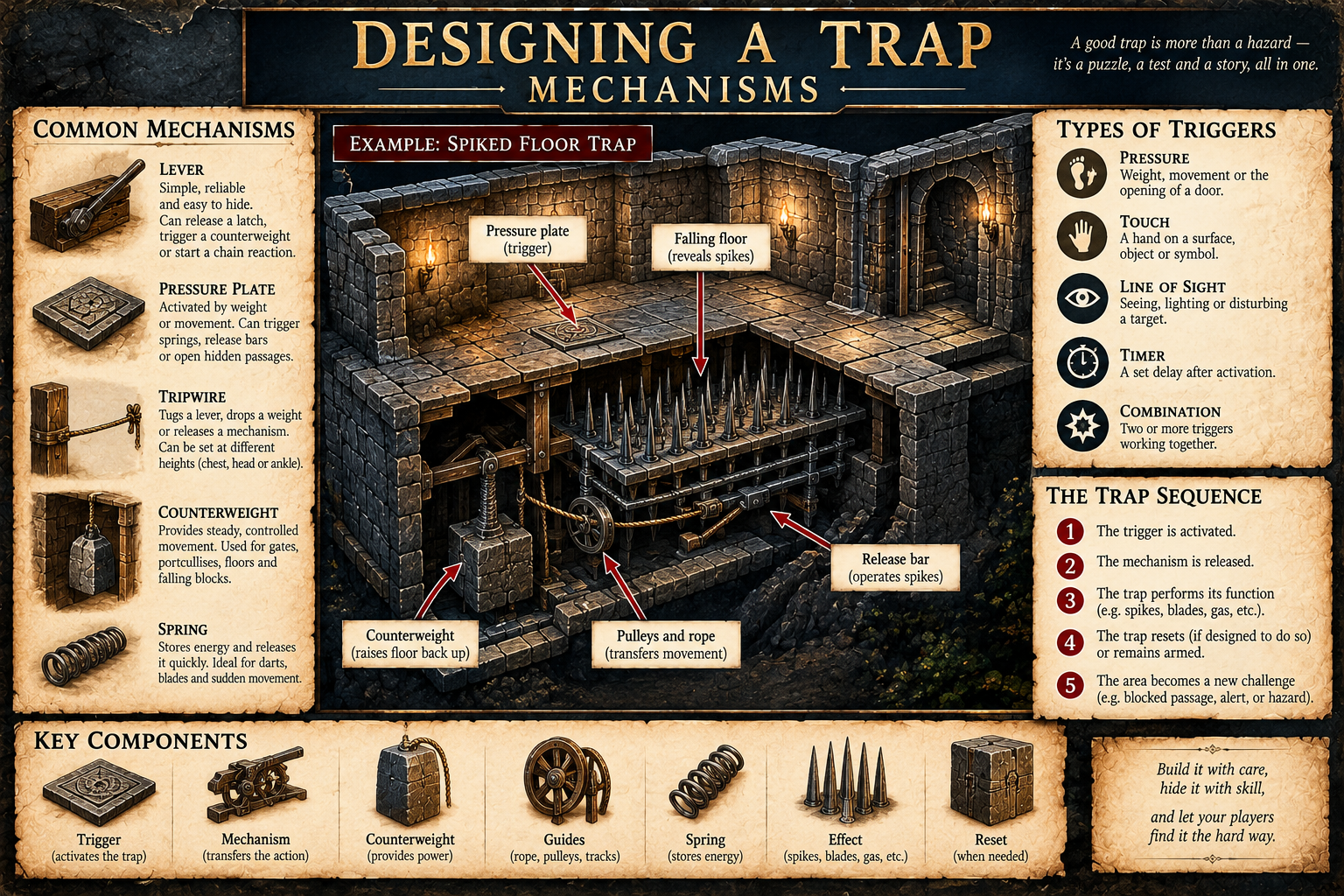
Designing traps begins with a question: why is this hazard here? Before calculating gold pieces or Challenge Rating, decide who built it, what it protects, who can pass without setting it off, and which warning signs an attentive party might discover. A trap that changes the adventure is more useful than a hidden damage roll.
This page preserves D&D 3.5e mechanical and magical trap construction rules. The tables below use the 3.5e system, including Craft (trapmaking), Search, Disable Device, XP construction costs and CR modifiers. For 5.5e/2024, 5e/2014 and Pathfinder 1e play procedures, use the main Traps hub and its edition tabs rather than converting these numbers unchanged.
Designing Traps in Seven Decisions
- Purpose: alarm, capture, delay, separate, damage or defend a vulnerable passage.
- Builder: identify the faction, guardian or skilled artificer and their available magic and materials.
- Location and trigger: mark the exact square, touch, sound, spell or timing condition.
- Clues: decide what survives of the builder’s work—worn stone, fresh bolts, scarring or an unnatural silence.
- Safe passage: include a legitimate bypass or maintenance access wherever it makes sense.
- Effect and reset: describe what happens, how long it lasts and whether defenders are alerted.
- Edition mechanics: only now assign Search and Disable Device DCs, saves, damage, CR and construction costs using the appropriate tables below.
Before You Set the CR
Does a higher Search DC make a trap more dangerous?
Sometimes, but not always. The 3.5e CR tables assign modifiers to some DC bands. The GM should consider how the trap affects the encounter, not only how difficult the mechanism is to spot.
How does a character find a magic trap in 3.5e?
Under these rules, trapfinding governs finding difficult traps and using Disable Device against magic traps. Do not substitute the unrelated trap sense class feature.
Does a trap need a reset mechanism?
No. One-shot traps exist, while other devices need repair, manual reset or automatic reset. A trap’s builders must have a way to maintain it if it is meant to guard a busy area.
Example: The Watchman’s Counterweight
A guarded passage contains a tilted flagstone. A hidden timber drops when enough weight strikes the stone, and a bell rings in the watchroom. A sentry follows a narrow groove along the wall rather than crossing the flagstone. Search DC 20 and Disable Device DC 20 provide a simple starting point in the 3.5e rules; the attack or save, damage, final Challenge Rating and price must be established with the mechanical-trap modifiers below. A party may bypass the slab, wedge the timber, cut the bell cord or negotiate passage. The bell remains important even if the timber misses.
Using the tables: set the intended CR, select modifiers, calculate market price and Craft DC, and then record all the details on the finished trap. Do not mistake a higher price for a more interesting obstacle.
Put the design to use: Run The Quiet Gate encounter to see meaningful clues and bypasses; compare the four rules editions; or choose from the converted CR 1 traps and converted CR 5 traps. Original 3.5e numbers should not be copied directly into a different rules edition.
Designing Traps from History and Legend
Not every defence begins as a concealed killing device. A castle gatehouse might force an intruder through a narrow passage while defenders operate a portcullis from a chamber above. In the old gatehouse at Etal Castle, a winch controlled the drawbridge and portcullis, with nearby rooms for guards. The dangerous feature was control of the passage: a defender could shut it, raise an alarm or delay a raiding party. See English Heritage’s account of Etal Castle.
When designing traps for a fortress or city, borrow that logic. The guard must have a way to operate the gate, release a prisoner and repair a broken winch. Place the chain, locking bar or service door where it makes sense. Such details give observant adventurers usable clues rather than a hidden roll with no possible counterplay. The development of medieval gatehouses and protected approaches provides further examples in English Heritage’s castle history.
In a temple, tomb or magical labyrinth, the same principles may appear in stranger forms: a marked path safe for initiates, a guardian who knows the correct signal, or a moving stone that closes a passage instead of slaying its trespasser. Designing traps around purpose, upkeep and choice makes even a supernatural mechanism feel as though it belongs to its builders.
The rules reference below contains material derived from the D&D 3.5 System Reference Document released as Open Game Content under the Open Game License v1.0a. Check the applicable licence and attribution requirements before republishing excerpts.
Watch: Pathfinder 1E Trap Guide (opens on YouTube)
Watch: Five Ways to Improve D&D Traps (opens on YouTube)
Watch: Making Traps Better in Dungeons & Dragons (opens on YouTube)

Mechanical Traps: Simply select the elements you want the trap to have and add up the adjustments to the trap·s Challenge Rating that those elements require (see Table: CR Modifiers for Mechanical Traps) to arrive at the trap·s final CR. From the CR you can derive the DC of the Craft (trapmaking) checks a character must make to construct the trap.
Magic Traps: As with mechanical traps, you don·t have to do anything other than decide what elements you want and then determine the CR of the resulting trap (see Table: CR Modifiers for Magic Traps). If a player character wants to design and construct a magic trap, he must have the Craft Wondrous Item feat. In addition, he must be able to cast the spell or spells that the trap requires·or, failing that, he must be able to hire an NPC to cast the spells for him.
Challenge Rating of a Trap
To calculate the Challenge Rating of a trap, add all the CR modifiers (see the tables below) to the base CR for the trap type.
Mechanical Trap: The base CR for a mechanical trap is 0. If your final CR is 0 or lower, add features until you get a CR of 1 or higher.
Magic Trap: For a spell trap or magic device trap, the base CR is 1. The highest-level spell used modifies the CR (see Table: CR Modifiers for Magic Traps).
Average Damage: If a trap (either mechanical or magic) does hit point damage, calculate the average damage for a successful hit and round that value to the nearest multiple of 7. Use this value to adjust the Challenge Rating of the trap, as indicated on the tables below. Damage from poisons and pit spikes does not count toward this value, but damage from a high strength rating and extra damage from multiple attacks does.
For a magic trap, only one modifier applies to the CR·either the level of the highest-level spell used in the trap, or the average damage figure, whichever is larger.
Multiple Traps: If a trap is really two or more connected traps that affect approximately the same area, determine the CR of each one separately.
Multiple Dependent Traps: If one trap depends on the success of the other (that is, you can avoid the second trap altogether by not falling victim to the first), they must be treated as separate traps.
Multiple Independent Traps: If two or more traps act independently (that is, none depends on the success of another to activate), use their CRs to determine their combined Encounter Level as though they were monsters. The resulting Encounter Level is the CR for the combined traps.
| Feature | CR modifier |
|---|---|
| Search DC | |
| 15 or lower | -1 |
| 25-29 | +1 |
| 30 or higher | +2 |
| Disable Device DC | |
| 15 or lower | -1 |
| 25-29 | +1 |
| 30 or higher | +2 |
| Reflex Save DC (Pit or Other Save-Dependent Trap) | |
| 15 or lower | -1 |
| 16-24 | – |
| 25-29 | +1 |
| 30 or higher | +2 |
| Attack Bonus (Melee or Ranged Attack Trap) | |
| +0 or lower | -2 |
| +1 to +5 | -1 |
| +6 to +14 | – |
| +15 to +19 | +1 |
| +20 to +24 | +2 |
| Damage/Effect | |
| Average damage | +1/7 points* |
| Miscellaneous Features | |
| Alchemical device | Level of spell mimicked |
| Liquid | +5 |
| Multiple target | +1 (or 0 if never miss) |
| Onset delay 1 round | +3 |
| Onset delay 2 rounds | +2 |
| Onset delay 3 rounds | +1 |
| Onset delay 4+ rounds | -1 |
| Pit spikes | +1 |
| Touch attack | +1 |
Poison CR modifiers
| Poison | CR modifier |
|---|---|
| Black adder venom | +1 |
| Large scorpion venom | +3 |
| Black lotus extract | +8 |
| Malyss root paste | +3 |
| Bloodroot | +1 |
| Medium spider venom | +2 |
| Blue whinnis | +1 |
| Nitharit | +4 |
| Burnt othur fumes | +6 |
| Purple worm poison | +4 |
| Deathblade | +5 |
| Sassone leaf residue | +3 |
| Dragon bile | +6 |
| Shadow essence | +3 |
| Giant wasp poison | +3 |
| Small centipede poison | +1 |
| Greenblood oil | +1 |
| Terinav root | +5 |
| Insanity mist | +4 |
| Ungol dust | +3 |
| Wyvern poison | +5 |
* Rounded to the nearest multiple of 7 (round up for an average that lies exactly between two numbers).
| Feature | CR modifier |
|---|---|
| Highest-level spell | + Spell level OR +1 per 7 points of average damage per round* |
*See the note following Table: CR Modifiers for Mechanical Traps.
Mechanical Trap Cost
The base cost of a mechanical trap is 1,000 gp. Apply all the modifiers from Table: Cost Modifiers for Mechanical Traps for the various features you’ve added to the trap to get the modified base cost.
The final cost is equal to (modified base cost x Challenge Rating) + extra costs. The minimum cost for a mechanical trap is (CR x 100) gp.
After you’ve multiplied the modified base cost by the Challenge Rating, add the price of any alchemical items or poison you incorporated into the trap. If the trap uses one of these elements and has an automatic reset, multiply the poison or alchemical item cost by 20 to provide an adequate supply of doses.
Multiple Traps: If a trap is really two or more connected traps, determine the final cost of each separately, then add those values together. This holds for both multiple dependent and multiple independent traps (see the previous section).
| Feature | Cost modifier |
|---|---|
| Trigger Type | |
| Location | — |
| Proximity | +1,000 gp |
| Touch | — |
| Touch (attached) | –100 gp |
| Timed | +1,000 gp |
| Reset Type | |
| No reset | –500 gp |
| Repair | –200 gp |
| Manual | — |
| Automatic | +500 gp (or 0 if trap has timed trigger) |
| Bypass Type | |
| Lock | +100 gp (Open Lock DC 30) |
| Hidden switch | +200 gp (Search DC 25) |
| Hidden lock | +300 gp (Open Lock DC 30, Search DC 25) |
| Search DC | |
| 19 or lower | –100 gp x (20 – DC) |
| 20 | — |
| 21 or higher | +200 gp x (DC – 20) |
| Disable Device DC | |
| 19 or lower | –100 gp x (20 – DC) |
| 20 | — |
| 21 or higher | +200 gp x (DC – 20) |
| Reflex Save DC (Pit or Other Save-Dependent Trap) | |
| 19 or lower | –100 gp x (20 – DC) |
| 20 | — |
| 21 or higher | +300 gp x (DC – 20) |
| Attack Bonus (Melee or Ranged Attack Trap) | |
| +9 or lower | –100 gp x (10 – bonus) |
| +10 | — |
| +11 or higher | +200 gp x (bonus – 10) |
| Damage Bonus | |
| High strength rating (ranged attack trap) | +100 gp x bonus (max +4) |
| High Strength bonus (melee attack trap) | +100 gp x bonus (max +8) |
| Miscellaneous Features | |
| Never miss | +1,000 gp |
| Poison | Cost of poison* |
| Alchemical item | Cost of item* |
* Multiply cost by 20 if trap features automatic reset.
Magic Device Trap Cost
Building a magic device trap involves the expenditure of experience points as well as gold pieces, and requires the services of a spellcaster.
Table: Cost Modifiers for Magic Device Traps summarizes the cost information for magic device traps. If the trap uses more than one spell (for instance, a sound or visual trigger spell in addition to the main spell effect), the builder must pay for them all (except alarm, which is free unless it must be cast by an NPC; see below).
The costs derived from Table: Cost Modifiers for Magic Device Traps assume that the builder is casting the necessary spells himself (or perhaps some other PC is providing the spells for free). If an NPC spellcaster must be hired to cast them those costs must be factored in as well.
A magic device trap takes one day to construct per 500 gp of its cost.
| Feature | Cost modifier |
|---|---|
| Alarm spell used in trigger | – |
| One-Shot Trap | |
| Each spell used in trap | +50 gp x caster level x spell level, +4 XP x caster level x spell level |
| Material components | + Cost of all material components |
| XP components | + Total of XP components x 5 gp |
| Automatic Reset Trap | |
| Each spell used in trap | +500 gp x caster level x spell level, +40 XP x caster level x spell level |
| Material components | + Cost of all material components x 100 gp |
| XP components | + Total of XP components x 500 gp |
Spell Trap Cost
A spell trap has a cost only if the builder must hire an NPC spellcaster to cast it.
Craft DCs for Mechanical Traps
Once you know the Challenge Rating of a trap determine the Craft (trapmaking) DC by referring to the table and the modifiers given below.
| Trap CR | Base Craft (trapmaking) DC |
|---|---|
| 1-3 | 20 |
| 4-6 | 25 |
| 7-10 | 30 |
Additional Components Modifier to Craft (Trapmaking) DC
Proximity trigger +5
Automatic reset +5
Making the Checks: To determine how much progress a character makes on building a trap each week, that character makes a Craft (trapmaking) check. See the Craft skill description for details on Craft checks and the circumstances that can affect them.
Keep this reference growing
If this page helped with your reading or game, you can support its upkeep or explore the curated books.
Explore the Bookshop — epics, classics and stories behind imagined worlds.