
Spell, Fireball, “Ruinflame”
Fireball Guide: Damage, Uses, Tactics, and How to Maximize Its Impact
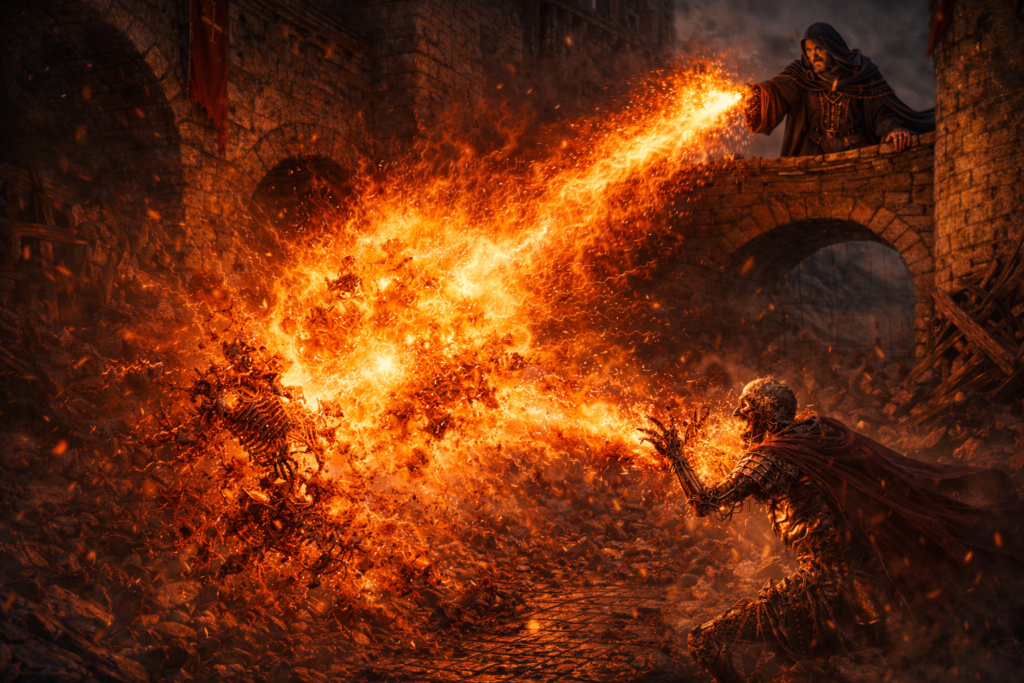
Some spells injure. Fireball condemns. A single spark becomes a roaring sphere of ruin, and everything within it is judged at once. Stone blackens. Wood erupts. Steel rings with heat. Flesh is simply taken. To stand where a Fireball lands is not to contest power, but to learn whether there is still enough of you left afterward to matter.
Hurl a point of flame into the world and let one instant decide the fate of everything caught inside it.
Rules
Fireball by Edition
Fireball — 5.5e / 2024

| Level | 3rd-level Evocation |
|---|---|
| Classes | Sorcerer, Wizard |
| Casting Time | 1 Action |
| Range | 150 feet |
| Components | V, S, M (a ball of bat guano and sulfur) |
| Duration | Instantaneous |
| Area | 20-foot-radius Sphere |
| Save | Dexterity; half damage on a success |
A streak of fire flashes to a point you choose within range and erupts in a 20-foot-radius Sphere. Each creature in the area makes a Dexterity saving throw, taking 8d6 Fire damage on a failed save or half as much on a successful one. Flammable objects in the area that are not worn or carried start burning.
Higher-level slot: add 1d6 Fire damage for each spell slot level above 3rd.
Fireball — 5e / 2014
| Level | 3rd-level Evocation |
|---|---|
| Classes | Sorcerer, Wizard |
| Casting Time | 1 action |
| Range | 150 feet |
| Components | V, S, M (a tiny ball of bat guano and sulfur) |
| Duration | Instantaneous |
| Area | 20-foot-radius sphere |
| Save | Dexterity; half damage on a success |
A bright streak reaches a point within range and explodes. Creatures in the 20-foot-radius sphere take 8d6 fire damage on a failed Dexterity save or half as much on a success. In this edition the spell text explicitly says the fire spreads around corners and ignites flammable objects that are not worn or carried.
At Higher Levels: add 1d6 fire damage for each slot level above 3rd.
Fireball — Pathfinder 1e

| School | Evocation [fire] |
|---|---|
| Level | Sorcerer/Wizard 3 |
| Casting Time | 1 standard action |
| Components | V, S, M |
| Range | Long (400 ft. + 40 ft./level) |
| Area | 20-ft.-radius spread |
| Duration | Instantaneous |
| Saving Throw | Reflex half |
| Spell Resistance | Yes |
The explosion deals 1d6 fire damage per caster level, to a maximum of 10d6. Unattended objects also take the damage. A glowing bead travels to the chosen point; if it strikes a solid barrier first, it detonates early. Sending it through a very narrow opening can require a ranged touch attack.
The blast can ignite combustibles and damage objects. Low-melting-point metals can be affected, and a barrier destroyed by the blast can allow the remaining spread to continue beyond it if the area permits.
Material component: a tiny ball of bat guano and sulfur.
Fireball — D&D 3.5e

| School | Evocation [Fire] |
|---|---|
| Level | Sorcerer/Wizard 3 |
| Casting Time | 1 standard action |
| Components | V, S, M |
| Range | Long (400 ft. + 40 ft./level) |
| Area | 20-ft.-radius spread |
| Duration | Instantaneous |
| Saving Throw | Reflex half |
| Spell Resistance | Yes |
Fireball deals 1d6 fire damage per caster level, up to 10d6. Unattended objects take the damage as well. The spell’s bead can detonate early against a barrier, and threading it through a narrow opening can require a ranged touch attack.
Combustibles can ignite, objects can be damaged, and low-melting-point metals can melt. If the blast destroys an intervening barrier, the spread can continue beyond it where space allows.
Material component: a tiny ball of bat guano and sulfur.
What Changed?
- 2024 and 2014 keep the familiar 8d6 baseline: 150-foot range, 20-foot-radius area and +1d6 per slot level above 3rd.
- 2024 removes the old spell-text sentence that fire spreads around corners: use the current area-of-effect and cover rules instead of importing the 2014 wording.
- Pathfinder 1e and D&D 3.5e scale by caster level: 1d6 fire damage per caster level, maximum 10d6.
- Legacy editions use much longer range and a travelling bead: barriers and narrow openings can cause early detonation or require a ranged touch attack.
Using Fireball
Fireball is a spell of immediate area denial through damage. Its battlefield value comes from turning enemy density into a liability: packed troops, clustered monsters, summoned creatures and defenders forced into a choke point all give one spell more targets.
It is equally important to know when not to cast it. Fireball is indiscriminate inside its area, can ignite exposed combustibles, and can destroy objects that the party may have wanted intact. The best use is not simply the largest visible group; it is the point where damage, positioning and acceptable collateral consequences all line up.
Best Uses
Breaking Formations
This is the classic and still one of the best uses. Troops in ranks, clustered monsters, summoned packs, shielded lines, and tightly packed defenders are exactly the kind of problem Fireball was born to answer. It punishes density with unforgettable severity.
Seizing the First Real Advantage
A well-placed Fireball at the opening of a fight can remove weaker enemies outright, cripple stronger ones, and immediately alter the enemy’s ability to hold ground, protect casters, or mount a coordinated answer.
Deciding Choke Points
Bridges, gates, tunnels, stairwells, alley mouths, breaches, and confined passages all become far more dangerous when one cast can fill the crucial space with catastrophic heat. Sometimes Fireball is not cast to kill everyone in an area, but to make that area no longer belong to the enemy.
Finishing the Damaged
When several foes are already bloodied, Fireball can end the matter all at once instead of allowing the fight to drag onward into wasted turns, extra risks, and bad surprises.
Destroying the Useful Along With the Living
Barricades, supplies, siege works, scaffolds, wooden defenses, and vulnerable structures may all suffer when the spell lands. This can be a strength or a disaster, depending on whether you meant to preserve them.
Forcing Better Fear
Even when it is not cast, the threat of Fireball changes enemy behavior. People spread out. They fear bunching. They hesitate before claiming obvious cover with obvious allies. The spell shapes movement simply by being possible.
Good Combinations
- Hold Person: A paralyzed target automatically fails Dexterity saving throws, turning Fireball into nearly certain devastation against the right victims.
- Web: Restrained creatures have disadvantage on Dexterity saves, making escape through agility far less likely and the blast far more punishing.
- Grease: Disrupted footing can keep targets where they should not be, making last-second movement and clean escape much harder.
- Wall of Force: Confinement and explosive area damage make a vicious pairing when enemies are trapped where the blast can decide them.
- Invisibility: It is easier to place a devastating Fireball correctly when enemies do not know where the caster is standing or what angle of attack is about to become fatal.
Tactics
Placement is everything. The difference between a legendary Fireball and an embarrassing one is often only a few feet. Learn to read spacing, count bodies, and imagine the sphere before you cast.
Do not think only about who is in the blast. Think about what the blast changes. A good Fireball does more than harm enemies. It wrecks formations, ruins confidence, creates panic, ignites hazards, and strips away the enemy’s control of the ground.
Respect friendly fire. Fireball does not care who was “supposed” to be safe. If allies, captives, civilians, evidence, treasure, or unstable structures matter, the spell demands restraint or a different answer.
Use terrain ruthlessly. Corners, bottlenecks, enclosed approaches, and crowded rooms all increase the spell’s value because they deny the enemy the freedom that would have spared them.
Consider the turn after the blast. Smoke, fire, fear, broken lines, and burning surfaces can all matter. Sometimes the best Fireball is the one that opens the enemy for what your side does next.
DM Notes
Fireball should feel powerful because it is powerful. It is one of the benchmark spells by which players measure magical impact, and flattening that truth makes the game poorer.
The right response is not to weaken its importance, but to build encounters that understand it. Spread enemies when appropriate. Use layered terrain, staggered formations, cover, elevation, and environments where explosive fire has consequences beyond hit points. Let the spell be excellent, but let the world answer honestly when it is used.
It is also worth remembering that Fireball leaves memory behind. It is loud, bright, immediate, and hard to mistake. Walls scorch. Beams collapse. Survivors carry burns. Witnesses remember the shape of the room before and after. This is not a spell that vanishes into bookkeeping. It is a spell that marks places.
When handled well, Fireball creates some of the clearest moments of magical authority in play. When handled badly, it becomes lazy force. The difference lies in whether the blast changed the world in a way that mattered.
Why This Spell Is Dangerous in the World
Fireball is dangerous because it destroys proportion.
One caster, one gesture, one point in space—and suddenly a room, a street, a gatehouse, a watchtower, a warband, or a ceremony is no longer what it was a heartbeat ago. There is no gradual escalation and very little warning. The spell does not argue. It arrives as a conclusion.
That changes the world around it. Military formations loosen. Barracks are built with distance and stone in mind. Noble halls become less crowded. Storehouses, archives, and arsenals become terrifying liabilities if magic reaches them. Ships, taverns, temples, and tunnels all become places where one reckless or murderous caster can kill far beyond the intended target. People learn that standing near the wrong person can be a death sentence.
In cities, this is terror. In war, it is collapse. In politics, it is assassination scaled upward into spectacle. A ruler need not fear only poison, steel, and treachery, but the possibility that a single spell might erase the chamber itself.
That is the true danger of Fireball. It teaches everyone who knows of it that destruction can be delivered instantly, at range, across a meaningful space, by one mind deciding that everything there should burn.
Keep this reference growing
If this page helped with your reading or game, you can support its upkeep or explore the curated books.
Explore the Bookshop — epics, classics and stories behind imagined worlds.