
Games Master Reference · Earth
Dungeons
Build ruins, caverns, vaults, mines, buried strongholds and other dangerous locations that make exploration a series of meaningful decisions rather than a succession of disconnected rooms.
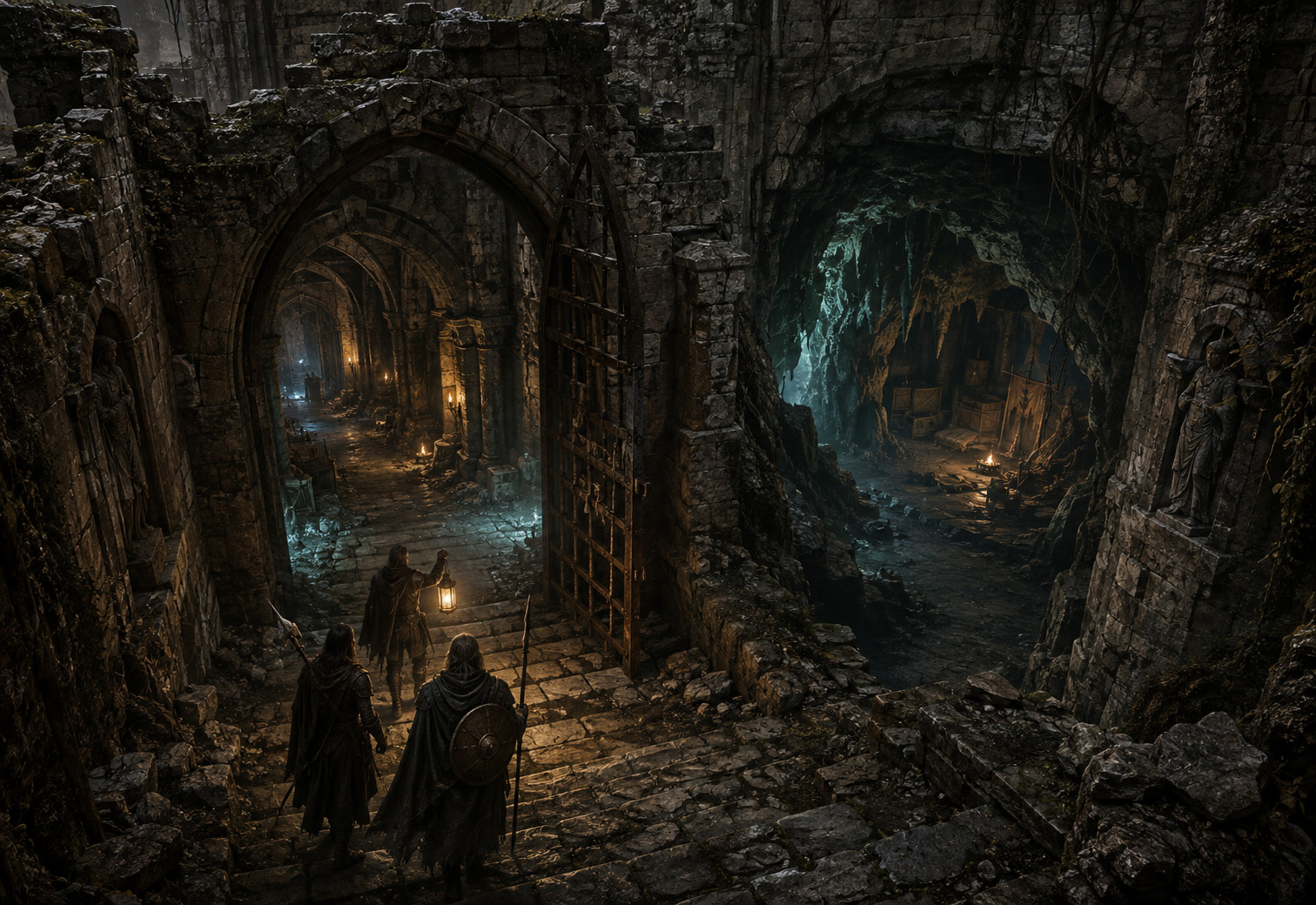
A dungeon is a bounded adventure location whose space matters. It may be underground, inside a ruined fortress, beneath a city, within a mine, aboard a wreck, across a cave system or buried beneath layers of older construction. What makes it a dungeon is not the presence of stone corridors. It is the interaction between routes, inhabitants, obstacles, discoveries, resources and consequences.
Do not begin by asking how many rooms the map needs. Begin with three questions: what is here, who acts here, and what changes after the characters intrude?
Prepare tonight
Build a dungeon in 10 minutes
You do not need fifty finished rooms. Establish enough structure for the characters to make choices and enough pressure for those choices to matter.
Give the expedition a purpose
Why must the characters enter? Rescue someone, recover an object, pursue an enemy, investigate a disturbance, destroy a threat, find a route, escape confinement or discover what happened here.
Decide what the place was built to do
A mine, prison, treasury, cistern, fortress, tomb, refuge and drainage system produce different rooms, entrances, doors and circulation patterns.
Decide who controls it now
The current occupants may be the builders, later settlers, monsters, scavengers, soldiers, spirits or nobody at all. Their needs determine what has changed.
Prepare three meaningful areas
Start with three places where a decision, discovery or confrontation can change the expedition. Add connective rooms only where they improve movement, atmosphere or information.
Complicate one route
Block, flood, trap, guard or destabilise one route. The obstacle should make another route attractive without making the dungeon a single compulsory corridor.
Hide one important truth
The strongest secret changes what the characters think the dungeon is: the supposed tomb is occupied, the monster is containing something worse, or the treasure is a political claim.
Add active pressure
Choose something that does not wait politely in its room: patrols, rising water, a hunting creature, unstable masonry, competing explorers, an advancing ritual or a faction preparing to move.
Place the reward logically
Treasure, evidence, prisoners, tools and supplies should normally be where their owners would keep them rather than appearing simply because an encounter occurred nearby.
Know what retreat costs
If the party leaves, decide what the surviving inhabitants repair, move, reinforce, consume, destroy, report or carry away before the characters return.
Let intrusion change the place
Opened doors remain open. Bodies are discovered. Noise draws attention. Fires spread. Alliances shift. A dungeon becomes memorable when it remembers the characters.
Fastest usable version: one purpose, one map with a choice of routes, three important areas, one active danger, one secret and one consequence for retreat.
Table rules
Dungeon mechanics by edition
Dungeon terrain is not mechanically identical between rulesets. Use the panel for the game being played rather than carrying old skill names, break DCs or terrain procedures across editions.
5.5e dungeon rules
Breaking dungeon objects
Fragile nonmagical objects can normally be destroyed without an attack when the circumstances make that automatic. For resilient doors, grates, locks and similar objects, use object Armor Class and Hit Points when time and resistance matter.
| Material | Object AC |
|---|---|
| Cloth, paper or rope | 11 |
| Crystal, glass or ice | 13 |
| Wood | 15 |
| Stone | 17 |
| Iron or steel | 19 |
| Mithral | 21 |
| Adamantine | 23 |
| Object size | Fragile HP | Resilient HP |
|---|---|---|
| Tiny | 2 (1d4) | 5 (2d4) |
| Small | 3 (1d6) | 10 (3d6) |
| Medium | 4 (1d8) | 18 (4d8) |
| Large | 5 (1d10) | 27 (5d10) |
Huge and Gargantuan structures are normally divided into Large or smaller sections. Objects are immune to Poison and Psychic damage, and the GM can decide that particular damage types are ineffective or especially effective against a material.
Large structures: castle walls, massive gates and similar structures may also use a Damage Threshold. Damage that does not meet that threshold does not reduce the structure’s Hit Points.
Searching and studying
- Search commonly uses Wisdom (Perception) when a character physically examines an area for concealed features.
- Study can use Intelligence (Investigation) when the challenge is understanding how a mechanism, disguised surface or clue works.
- Magical mechanisms may involve Intelligence (Arcana) once their magical signs have been found.
- There is no universal PF-style “secret door DC 20” rule that should automatically be applied to every concealed passage.
Traps
Current traps identify their severity, level range, trigger and duration, then state how they are detected, avoided or disarmed. Treat traps as discrete obstacles rather than assuming that every corridor contains one.
Good trap practice: the players should normally have some possibility of noticing danger, interpreting evidence or reacting to the trap. An unavoidable surprise that merely removes Hit Points rarely creates an interesting decision.
Doors and magical locks
A dungeon door does not need a legacy break DC simply because it is made of wood or iron. Determine whether it can be forced automatically, requires an ability check, or must be attacked as an object. For magically protected thresholds, use the actual spell.
Useful references: Arcane Lock and Knock.
Pathfinder 1e dungeon rules
Walls
| Wall | Typical thickness | Break DC | Hardness | HP | Climb DC |
|---|---|---|---|---|---|
| Masonry | 1 ft. | 35 | 8 | 90 | 20 |
| Superior masonry | 1 ft. | 35 | 8 | 90 | 25 |
| Reinforced masonry | 1 ft. | 45 | 8 | 180 | 20 |
| Hewn stone | 3 ft. | 50 | 8 | 540 | 25 |
| Unworked stone | 5 ft. | 65 | 8 | 900 | 15 |
| Iron | 3 in. | 30 | 10 | 90 | 25 |
| Paper | Paper-thin | 1 | — | 1 | 30 |
| Wood | 6 in. | 20 | 5 | 60 | — |
Wall Hit Points above are per 10-foot-by-10-foot section. Magically treated walls can add up to +20 to Break DC, double Hardness and double Hit Points or add at least 50 Hit Points, as applicable.
Floors and rubble
| Terrain | PF1e effect |
|---|---|
| Uneven flagstone | DC 10 Acrobatics to run or charge; failure prevents movement that round. |
| Hewn stone floor | DC 10 Acrobatics to run or charge; failure prevents the run or charge. |
| Light rubble | +2 to Acrobatics DCs. |
| Dense rubble | 2 squares of movement to enter; +5 Acrobatics DC; +2 Stealth DC. |
| Natural stone floor | Normally 2 squares of movement to enter; +5 Acrobatics DC; no running or charging except along paths. |
| Slippery floor | +5 to Acrobatics DCs. |
| Typical iron grate | Hardness 10; 25 HP; DC 27 Strength to break or tear loose. |
Doors, locks and secret passages
| Door | Thickness | Hardness | HP | Stuck DC | Locked DC |
|---|---|---|---|---|---|
| Simple wooden | 1 in. | 5 | 10 | 13 | 15 |
| Good wooden | 1½ in. | 5 | 15 | 16 | 18 |
| Strong wooden | 2 in. | 5 | 20 | 23 | 25 |
| Stone | 4 in. | 8 | 60 | 28 | 28 |
| Iron | 2 in. | 10 | 60 | 28 | 28 |
| Wooden portcullis | 3 in. | 5 | 30 | 25* | 25* |
| Iron portcullis | 2 in. | 10 | 60 | 25* | 25* |
*For a portcullis, DC 25 is the normal Strength DC to lift it.
- A typical secret door is found with Perception DC 20; a well-hidden one can reach DC 30.
- Lock-picking with Disable Device commonly falls in the DC 20–30 range.
- A separately attackable typical lock has Hardness 15 and 30 HP.
- A wooden bar requires Strength DC 25 to break through; an iron bar requires DC 30.
- Stairs normally allow movement without penalty, but running is not allowed; Acrobatics checks made on stairs increase by 4. Particularly steep stairs may count as difficult terrain.
For the extended legacy terrain reference, see Dungeon Terrain.
D&D 3.5e dungeon rules
Common wall statistics
| Wall | Thickness | Break DC | Hardness | HP | Climb DC |
|---|---|---|---|---|---|
| Masonry | 1 ft. | 35 | 8 | 90 | 20 |
| Superior masonry | 1 ft. | 35 | 8 | 90 | 25 |
| Reinforced masonry | 1 ft. | 45 | 8 | 180 | 15 |
| Hewn stone | 3 ft. | 50 | 8 | 540 | 25 |
| Unworked stone | 5 ft. | 65 | 8 | 900 | 15 |
| Iron | 3 in. | 30 | 10 | 90 | 25 |
Doors
| Door | Thickness | Hardness | HP | Stuck DC | Locked DC |
|---|---|---|---|---|---|
| Simple wooden | 1 in. | 5 | 10 | 13 | 15 |
| Good wooden | 1½ in. | 5 | 15 | 16 | 18 |
| Strong wooden | 2 in. | 5 | 20 | 23 | 25 |
| Stone | 4 in. | 8 | 60 | 28 | 28 |
| Iron | 2 in. | 10 | 60 | 28 | 28 |
Native 3.5e dungeon skills
- Search: DC 20 for a typical secret door and DC 30 for a well-hidden secret door.
- Open Lock: ordinary dungeon lock DCs commonly fall between 20 and 30.
- Balance: used for uneven or slippery dungeon floors and narrow ledges.
- Tumble: affected by rubble, natural floors and steep stairs.
- Move Silently: dense rubble increases the DC by 2.
- Climb: remains important for natural stone, shafts, ledges and walls.
- Use Rope: applies to specific dungeon features such as manipulating rope bridges.
Floor examples
| Terrain | 3.5e effect |
|---|---|
| Uneven flagstone | DC 10 Balance check to run or charge. |
| Light rubble | +2 to Balance and Tumble DCs. |
| Dense rubble | 2 squares of movement to enter; +5 Balance and Tumble DCs; +2 Move Silently DC. |
| Natural stone | Normally 2 squares of movement to enter; +5 Balance and Tumble DCs; running and charging normally impossible outside a path. |
| Slippery floor | +5 Balance and Tumble DCs. |
Useful related magic: Arcane Lock, Knock and Detect Secret Doors.
What exists now?
Four useful dungeon types
The traditional four-type model remains useful because it asks about the dungeon’s present condition rather than its visual style. Most strong locations combine two or more types.
Once-occupied ruin
The original builders are gone. Later creatures, scavengers, hazards and structural decay have altered the location. Old traps may already have fired or failed.
Best for: exploration, archaeology, clues, opportunistic lairs and layered history.
Occupied structure
Intelligent inhabitants actively use the location. Expect maintained routes, supplies, sleeping areas, guards, patrols and communication.
Best for: infiltration, negotiation, alarms, faction play and reactive defence.
Safe storage
The site exists principally to protect something: treasure, records, remains, relics, dangerous objects, prisoners or knowledge.
Best for: deliberate barriers, traps, guardian creatures, puzzles and concentrated rewards.
Natural cavern complex
Water, geology and living ecology shaped the site rather than architects. Doors and constructed traps are unusual unless intelligent occupants added them later.
Best for: vertical routes, water, darkness, natural hazards, predators and unexpected connections.
Hybrid locations are usually stronger. A ruined fortress may contain an occupied bandit level, an untouched treasury, a breached cavern and a much older buried structure beneath all three.
Dungeon architecture
Make the map create decisions
A map is useful when its shape gives the characters information, danger and choice.
Use more than one route
A second entrance, side passage, collapsed breach, concealed stair or flooded route prevents every problem from becoming a fight in the next doorway.
Create loops
Loops let the party approach the same area from different directions, retreat without completely reversing course and turn discoveries into shortcuts.
Use vertical space
Stairs, galleries, pits, wells, shafts, balconies, collapsed floors and natural chimneys make location matter in ways a flat corridor map cannot.
Telegraph important areas
Noise, airflow, footprints, architecture, smells, light, drainage, inscriptions and guard traffic should give clues about what lies beyond the next decision.
Use bottlenecks deliberately
A narrow stair, bridge, portcullis or flooded passage matters because it changes movement or security. Do not make every doorway a bottleneck.
Reward exploration with access
A secret route is often more satisfying when it offers leverage: a bypass, overlook, escape route, safer entrance or way behind a defended position.
Room purpose
Every important area should earn its place
A room does not need a fight. It does need a reason to exist in play. Useful rooms normally perform at least one of these functions:
Decision
The room presents routes, risks, negotiations, expenditure of resources or competing priorities.
Information
The characters learn who lives here, what happened before, what lies ahead or how another obstacle works.
Pressure
The location creates immediate danger through enemies, environment, time, noise, pursuit or instability.
Resource
The characters gain tools, supplies, defensible ground, healing, information, allies or access.
Revelation
The characters discover that their assumptions about the dungeon, its inhabitants or their mission were incomplete.
Consequence
A previous action changes what is found here: an alarm has arrived first, a prisoner has moved or a route has collapsed.
Active inhabitants
Make the dungeon live when nobody is looking
Intelligent occupants require routes, water, food or an alternative means of sustenance, places to rest, ways to communicate and some reason they have not already destroyed every neighbouring threat.
Give factions incompatible aims
Two groups become interesting when both want something the characters can affect. One may want passage reopened while another needs it sealed. One wants the relic; another wants it destroyed.
Give creatures routines
Guards change posts. Hunters leave their lairs. Workers collect water. Scavengers follow predators. A patrol route makes noise and timing meaningful before combat starts.
Explain basic logistics
If living creatures remain for weeks, ask what they eat, drink, breathe and discard. If magic replaces a requirement, make that magical solution part of the location.
Know where the keys are
An occupied location with locked internal doors should normally have a functioning access system: keys, passwords, guards, mechanisms or authorised magic.
A dungeon encounter does not have to begin when initiative is rolled. Footprints, voices, extinguished lamps, opened doors, moved supplies and missing guards can make the inhabitants’ behaviour visible before anyone meets them.
At the table
Dungeon exploration procedure
Use this loop whenever movement through the location itself matters.
- Describe what is immediately apparent. Give the characters enough sensory information to act without forcing them to interrogate every five feet of wall.
- Establish position. Know roughly where the party is, who leads, who carries light, what they can see and where obvious exits lead.
- Ask what they do. Do not roll until a character’s action creates meaningful uncertainty.
- Resolve the risky part. Use the appropriate edition rule, attack, saving throw, ability or skill check only where success and failure both matter.
- Change the situation. Reveal information, expend time, make noise, move an inhabitant, open access or create a new danger.
- Advance active threats. Patrols move, water rises, fires spread, factions react and unattended problems continue.
- Present the next decision. The loop ends when the characters leave, secure the location or transform the dungeon into something else.
Time matters
Resting, retreat and returning later
Rest only where rest makes sense
A room is not automatically safe because the characters closed a door. Consider sound, patrol routes, scent, smoke, tracks and whether anyone knows the party is present.
Retreat is a valid decision
Leaving should not automatically punish the players. It should allow the dungeon’s surviving forces to make sensible decisions of their own.
Record what changed
Note dead leaders, broken barriers, consumed supplies, revealed passages, alliances, alarms and abandoned treasure before the next visit begins.
Common questions
Common dungeon rulings
Does every hidden door require a roll?
No. If the characters use a method that would plainly reveal the opening, reveal it. Roll when their approach could reasonably succeed or fail and the difference matters.
Should every corridor contain a trap?
No. Traps work best where somebody had a reason to build one, where natural danger creates a similar challenge, or where a location’s history explains why it remains dangerous.
Can characters destroy a locked door?
Usually, if they possess sufficient time and suitable tools. The interesting question is often how long it takes, how much noise it creates and what happens before they finish.
Should monsters wait in their assigned rooms?
Only when they have a reason. Intelligent defenders investigate alarms, predators pursue prey and frightened creatures flee toward safety.
How much empty space is useful?
Enough to establish scale, rhythm and evidence of former use. Compress repetitive spaces that offer no choice, discovery, pressure or atmosphere.
Does treasure have to follow an encounter?
No. Valuable objects should normally be where their owners stored, displayed, hid, lost or abandoned them. Some opponents carry useful portable possessions; others do not.
Earth · 1454 CE
A dungeon is a layer of history
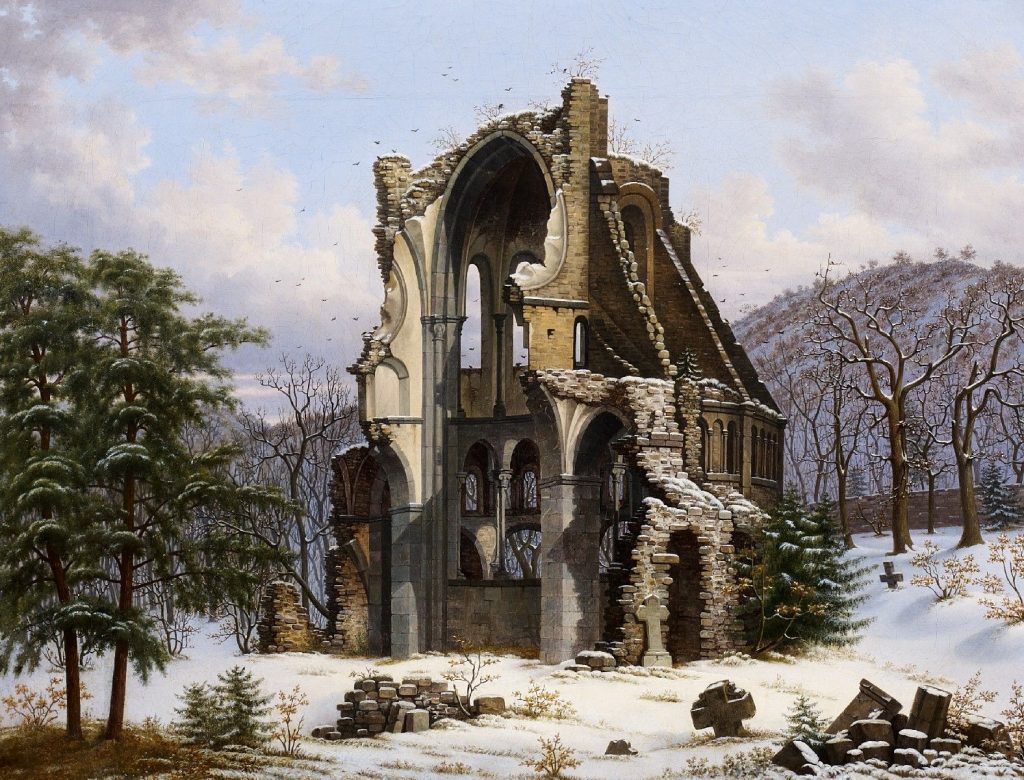
In Earth, the most distinctive dungeons are rarely purpose-built mazes. They are places repeatedly occupied, abandoned, rebuilt, buried, breached and remembered.
| Site | What created it | What may have changed |
|---|---|---|
| Castle undercroft or old keep | Storage, defence, imprisonment, foundations and earlier fortification phases. | Collapsed sections, abandoned passages, siege damage or later occupants below the active stronghold. |
| Siege mine or countermine | Attackers and defenders digging beneath walls or intercepting enemy tunnels. | Forgotten access shafts, unstable chambers, buried equipment or openings into older structures. |
| Roman or ancient foundations | Earlier civic, military, funerary or engineering works beneath later construction. | New streets and buildings conceal entrances while deeper chambers remain untouched. |
| Mine | Extraction of ore, stone, salt or other valuable material. | Abandoned galleries become lairs; deeper excavation breaks into natural caverns or older delvings. |
| Cistern, drain or buried watercourse | Storage and movement of water. | Flooding, contamination, collapsed access, smugglers, creatures or hidden routes beneath a settlement. |
| Crypt or ossuary | Burial, memorial storage and protection of the dead. | Robbery, supernatural disturbance, structural collapse or deliberate sealing from either side. |
| Plague-sealed cellar or abandoned quarter | Structures closed, emptied or repurposed during waves of disease. | Forgotten stores, sealed records, concealed deaths, scavengers or supernatural consequences of the Red Death. |
| Natural cave | Water, erosion and geological movement. | Human or nonhuman occupation adds stairs, walls, mines, shrines, fortifications and concealed exits. |
| Planar breach | A location where physical Earth no longer remains completely isolated from another reality. | Geometry, ecology, magic and inhabitants may change beyond the breach. |
Use the layers. A single expedition might descend from a functioning fifteenth-century cellar into older masonry, pass through a dwarven excavation, cross a natural cavern and end at a sealed structure built long before any of the upper levels existed.
Read history through the dungeon
Different layers should look different. Stone size, mortar, tool marks, drainage, ceiling height, inscriptions, door construction, repaired breaches and reused masonry can tell the players when one phase of construction ends and another begins.
That information can become practical. The oldest wall may be strongest. The recent partition may be easiest to break. A sealed doorway may prove that the present inhabitants have never entered the chamber behind it.
Build the expedition
Connect the dungeon to the wider world
A dungeon is usually the point where locations, monsters, hazards, magic and rewards meet.
Reference basis
Sources & licence
5.5e rules material
The 5.5e rules summary is checked against the current D&D Beyond Basic Rules: Rules Glossary and DM’s Toolbox.
This work includes rules material from the System Reference Document 5.2.1 by Wizards of the Coast LLC. SRD 5.2.1 is licensed under the Creative Commons Attribution 4.0 International Licence.
Pathfinder 1e rules material
The Pathfinder 1e dungeon-terrain mechanics are based on Open Game Content from the Pathfinder Roleplaying Game Core Rulebook, checked against Archives of Nethys: Dungeon Terrain.
D&D 3.5e rules material
The D&D 3.5e mechanics are based on the Revised System Reference Document, checked against the d20 SRD Dungeons reference.
Original material
The ten-minute dungeon procedure, living-dungeon framework, room-purpose structure, exploration procedure, 1454 campaign integration, layered-history guidance, internal navigation, presentation and commentary are original material.
The original four dungeon-type framework is retained because it remains useful for distinguishing ruined, occupied, protected and naturally formed adventure sites. The linked child pages remain available as deeper references.
Open Game Content designation: the Pathfinder 1e and D&D 3.5e mechanics summaries and rules tables within their respective edition panels are designated Open Game Content. Original prose, Earth setting material, page architecture, presentation, CSS and illustrations are not designated Open Game Content by this notice. The 5.5e material is used under its separate CC BY 4.0 licensing basis.
Open Game License v1.0a and copyright notice
OPEN GAME LICENSE Version 1.0a
The following text is the property of Wizards of the Coast, Inc. and is Copyright 2000 Wizards of the Coast, Inc (“Wizards”). All Rights Reserved.
- Definitions: (a)”Contributors” means the copyright and/or trademark owners who have contributed Open Game Content; (b)”Derivative Material” means copyrighted material including derivative works and translations (including into other computer languages), potation, modification, correction, addition, extension, upgrade, improvement, compilation, abridgment or other form in which an existing work may be recast, transformed or adapted; (c)”Distribute” means to reproduce, license, rent, lease, sell, broadcast, publicly display, transmit or otherwise distribute; (d)”Open Game Content” means the game mechanic and includes the methods, procedures, processes and routines to the extent such content does not embody the Product Identity and is an enhancement over the prior art and any additional content clearly identified as Open Game Content by the Contributor, and means any work covered by this License, including translations and derivative works under copyright law, but specifically excludes Product Identity. (e)”Product Identity” means product and product line names, logos and identifying marks including trade dress; artifacts; creatures characters; stories, storylines, plots, thematic elements, dialogue, incidents, language, artwork, symbols, designs, depictions, likenesses, formats, poses, concepts, themes and graphic, photographic and other visual or audio representations; names and descriptions of characters, spells, enchantments, personalities, teams, personas, likenesses and special abilities; places, locations, environments, creatures, equipment, magical or supernatural abilities or effects, logos, symbols, or graphic designs; and any other trademark or registered trademark clearly identified as Product identity by the owner of the Product Identity, and which specifically excludes the Open Game Content; (f)”Trademark” means the logos, names, mark, sign, motto, designs that are used by a Contributor to identify itself or its products or the associated products contributed to the Open Game License (g)”Use”, “Used” or “Using” means to use, Distribute, copy, edit, format, modify, translate and otherwise create Derivative Material of Open Game Content. (h)”You” or “Your” means the licensee in terms of this agreement.
- The License: This License applies to any Open Game Content that contains a notice indicating that the Open Game Content may only be Used under and in terms of this License. You must affix such a notice to any Open Game Content that you Use. No terms may be added to or subtracted from this License except as described by the License itself. No other terms or conditions may be applied to any Open Game Content distributed using this License.
- Offer and Acceptance: By Using the Open Game Content You indicate Your acceptance of the terms of this License.
- Grant and Consideration: In consideration for agreeing to use this License, the Contributors grant You a perpetual, worldwide, royalty-free, non-exclusive license with the exact terms of this License to Use, the Open Game Content.
- Representation of Authority to Contribute: If You are contributing original material as Open Game Content, You represent that Your Contributions are Your original creation and/or You have sufficient rights to grant the rights conveyed by this License.
- Notice of License Copyright: You must update the COPYRIGHT NOTICE portion of this License to include the exact text of the COPYRIGHT NOTICE of any Open Game Content You are copying, modifying or distributing, and You must add the title, the copyright date, and the copyright holder’s name to the COPYRIGHT NOTICE of any original Open Game Content you Distribute.
- Use of Product Identity: You agree not to Use any Product Identity, including as an indication as to compatibility, except as expressly licensed in another, independent Agreement with the owner of each element of the Product Identity. You agree not to indicate compatibility or co-adaptability with any Trademark or Registered Trademark in conjunction with a work containing Open Game Content except as expressly licensed in another, independent Agreement with the owner of such Trademark or Registered Trademark. The use of any Product Identity in Open Game Content does not constitute a challenge to the ownership of the Product Identity. The owner of any Product Identity used in Open Game Content shall retain all rights, title and interest in and to that Product Identity.
- Identification: If you distribute Open Game Content You must clearly indicate which portions of the work that you are distributing are Open Game Content.
- Updating the License: Wizards or its designated Agents may publish updated versions of this License. You may use any authorized version of this License to copy, modify and distribute any Open Game Content originally distributed under any version of this License.
- Copy of this License: You MUST include a copy of this License with every copy of the Open Game Content You Distribute.
- Use of Contributor Credits: You may not market or advertise the Open Game Content using the name of any Contributor unless You have written permission from the Contributor to do so.
- Inability to Comply: If it is impossible for You to comply with any of the terms of this License with respect to some or all of the Open Game Content due to statute, judicial order, or governmental regulation then You may not Use any Open Game Material so affected.
- Termination: This License will terminate automatically if You fail to comply with all terms herein and fail to cure such breach within 30 days of becoming aware of the breach. All sublicenses shall survive the termination of this License.
- Reformation: If any provision of this License is held to be unenforceable, such provision shall be reformed only to the extent necessary to make it enforceable.
-
COPYRIGHT NOTICE
Open Game License v 1.0 Copyright 2000, Wizards of the Coast, Inc.
System Reference Document Copyright 2000-2003, Wizards of the Coast, Inc.; Authors Jonathan Tweet, Monte Cook, Skip Williams, Rich Baker, Andy Collins, David Noonan, Rich Redman, Bruce R. Cordell, John D. Rateliff, Thomas Reid, James Wyatt, based on original material by E. Gary Gygax and Dave Arneson.
Pathfinder Roleplaying Game Core Rulebook © 2009, Paizo Publishing, LLC; Author: Jason Bulmahn, based on material by Jonathan Tweet, Monte Cook, and Skip Williams.
The Archives of Nethys. Copyright 2010, Blake Davis.
Dungeons. Copyright 2026, SpiralWorlds.
Keep the library growing
Support SpiralWorlds
If this dungeon material saves preparation time or gives you something useful at the table, you can help support continued maintenance and new material.