Enchantment spell reference

Power Word Stun Spell – RPG Rules, Uses & Rulings

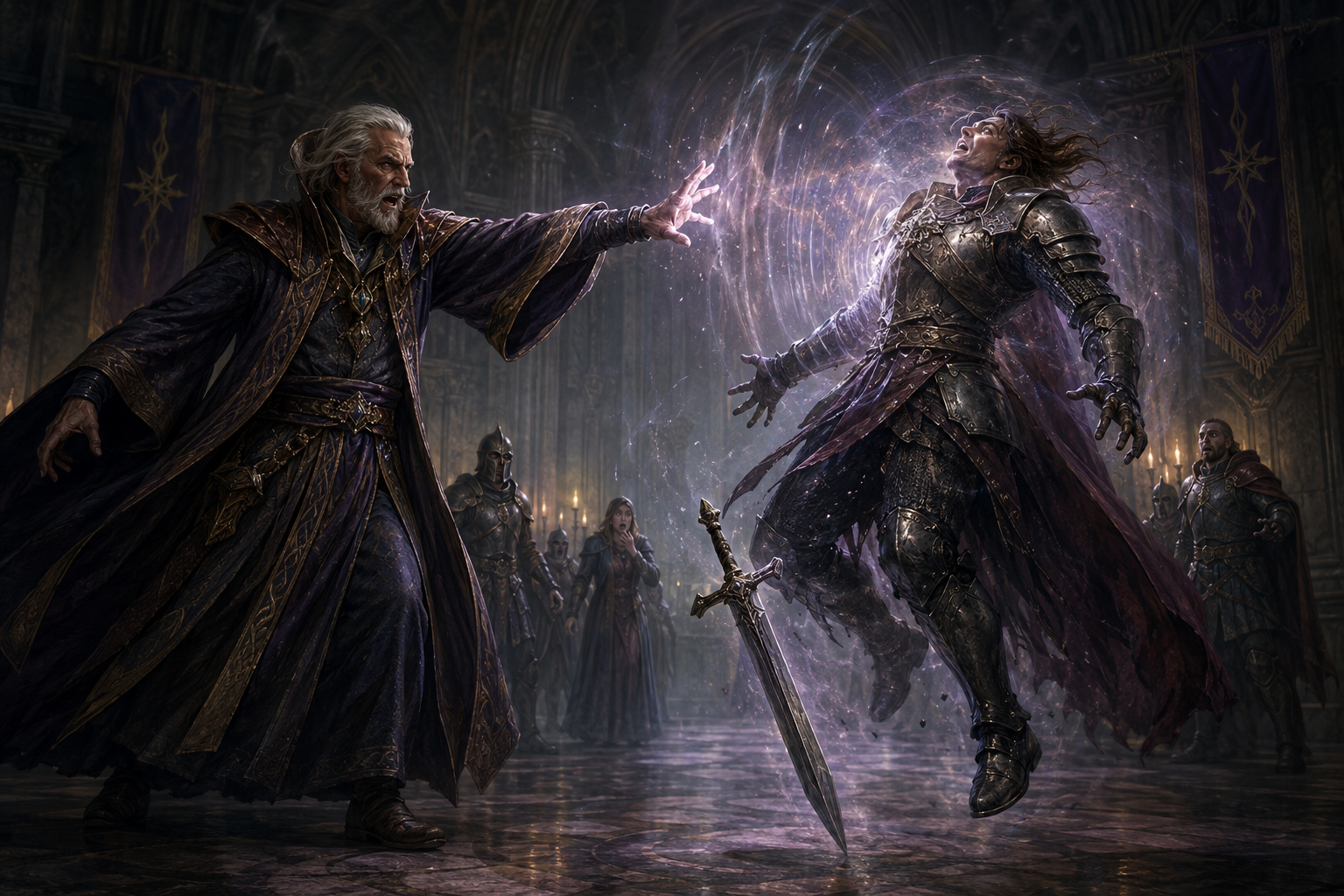
One word crosses the hall. A sword slips from suddenly useless fingers, thought falters, and a warrior who expected another exchange of blows discovers that language itself can be a weapon.

Power Word Stun — a single utterance overwhelms an armoured foe. Original SpiralWorlds illustration.

Power Word Stun Mechanics

Choose the ruleset in play. Each panel is independent: do not carry thresholds, durations, saving throws, condition effects or resistance rules from one panel into another.

Current rules

Power Word Stun — 5.5e / 2024

Level
8th
Casting Time
Action
Range
60 feet
Components
V
Duration
Instantaneous
Initial Save
None
Concentration
No

Classes: Bard, Sorcerer, Warlock, and Wizard.

Choose one creature you can see within 60 feet and overwhelm its mind with the word.

Target’s current Hit Points Result
150 or fewer The creature gains the Stunned condition. At the end of each of its turns it makes a Constitution saving throw against your spell save DC, ending Stunned on itself on a success.
151 or more The creature is not Stunned. Instead, its Speed is 0 until the start of your next turn.

The crucial current-rules distinction

Stunned does not itself set Speed to 0. A Stunned creature is Incapacitated, automatically fails Strength and Dexterity saving throws, and grants Advantage on attack rolls against it. Incapacitated prevents actions, Bonus Actions and Reactions, breaks Concentration and prevents speech, but neither condition independently reduces Speed.

That means the two Power Word Stun results are deliberately different: a target at 150 Hit Points or fewer is Stunned, while a target above 150 Hit Points instead has Speed 0 for the brief fallback effect.

What Stunned does here

  • The target has the Incapacitated condition.
  • It cannot take actions, Bonus Actions or Reactions.
  • Its Concentration ends immediately.
  • It cannot speak.
  • It automatically fails Strength and Dexterity saving throws.
  • Attack rolls against it have Advantage.
  • Its Speed is not automatically reduced to 0 by Stunned.

Current-rules rulings

Is there an initial saving throw?

No. The spell first checks the target’s current Hit Points. Constitution saves occur only after a target has actually become Stunned.

Can a Stunned target move?

Yes, if nothing else prevents movement. Stunned and Incapacitated do not themselves set Speed to 0. The creature still cannot take actions, Bonus Actions or Reactions.

Does the target need to hear the word?

No hearing requirement appears in the spell’s target or effect. The caster must provide the Verbal component, but the target is selected by sight.

Must the target understand the language?

No. The spell does not impose a shared-language or comprehension requirement.

Does Stunned break Concentration?

Yes. Stunned gives Incapacitated, and Incapacitated breaks Concentration immediately.

Does damage grant an extra recovery save?

No. The spell grants the Stunned target a Constitution save at the end of each of its turns. Taking damage does not create another save.

What if a 160-HP target is damaged below 150?

It does not become Stunned. The spell already resolved using the Hit Points the target had when it was cast.

What if a Stunned target is healed above 150?

Healing does not end the condition. Once Stunned is imposed, the target uses the spell’s end-of-turn Constitution saves to escape.

Does Stunned immunity produce the Speed-0 result instead?

No. A creature at 150 Hit Points or fewer is in the branch that attempts to impose Stunned. Immunity prevents that condition; it does not move the creature into the above-150-HP branch.

Does Stunned immunity stop the high-HP fallback?

Not by itself. The above-threshold result sets Speed to 0 rather than imposing the Stunned condition.

Can Legendary Resistance stop the initial effect?

There is no initial saving throw to turn into a success. If an affected creature later fails one of the spell’s Constitution recovery saves, a feature that can turn a failed saving throw into a success can apply according to that feature’s wording.

Is there a higher-slot benefit?

No. The spell has no higher-level casting entry.

For the wider spell catalogue, see the Sorcerer and Wizard spell reference .

Pathfinder rules

Power Word Stun — Pathfinder 1e

School
Enchantment (Compulsion) [mind-affecting]
Level
Sorcerer/Wizard 8
Casting Time
1 standard action
Range
Close
Components
V
Target
One creature with 150 hp or fewer
Saving Throw
None
Spell Resistance
Yes

Spell-list access: Sorcerer/Wizard 8; Witch 8; Psychic 8; and Arcanist 8 through the sorcerer/wizard spell list. The spell also appears as the 8th-level spell of the War Domain.

Close range: 25 feet + 5 feet per 2 caster levels.

The word instantly Stuns an eligible creature. The creature does not need to hear the word. Duration is determined by the target’s current hit points when the spell is cast.

Current hit points Effect
50 or fewer Stunned for 4d4 rounds
51–100 Stunned for 2d4 rounds
101–150 Stunned for 1d4 rounds
151 or more Unaffected

No saving throw does not mean no defence

The spell grants no saving throw, but it does allow Spell Resistance. Resolve Spell Resistance normally before applying the stun.

Stunned in Pathfinder 1e

A Stunned creature drops everything it is holding, cannot take actions, takes a –2 penalty to Armor Class, and loses its Dexterity bonus to AC if it has one.

Pathfinder rulings

Can a creature above 150 hp be affected?

Not by the ordinary spell. A creature currently at 151 hp or more is unaffected.

Does deafness protect the target?

No. The spell explicitly functions whether or not the creature can hear the word.

Is the duration recalculated after healing or damage?

No. The ordinary spell determines the duration from the target’s hit-point total when the spell takes effect.

Does immunity to mind-affecting effects matter?

Yes. Power Word Stun carries the [mind-affecting] descriptor, so an immunity that blocks mind-affecting effects applies.

Mythic Power Word Stun

The mythic version treats the target’s current hit-point total as though it were 5 × your mythic tier lower when determining the spell’s result.

A creature that still has too many hit points to be affected by the ordinary spell can nevertheless be targeted by the mythic version; instead of being Stunned, that creature becomes dazed for 1 round.

Augmented — 6th tier

If you expend three uses of mythic power, the word lingers until the beginning of your next turn. If further hit-point loss moves the target into a stronger Power Word Stun category during that interval, the stronger result applies. Later healing does not reduce an effect already gained.

Revised d20 rules

Power Word Stun — D&D 3.5e

School
Enchantment (Compulsion) [Mind-Affecting]
Level
Sorcerer/Wizard 8, War 8
Casting Time
1 standard action
Range
Close
Components
V
Target
One creature with 150 hp or fewer
Saving Throw
None
Spell Resistance
Yes

Close range: 25 feet + 5 feet per 2 caster levels. The creature becomes Stunned whether or not it can hear the word, provided it is within the spell’s hit-point limit and the spell overcomes any applicable Spell Resistance.

Current hit points Duration
50 or fewer 4d4 rounds
51–100 2d4 rounds
101–150 1d4 rounds
151 or more Unaffected

Stunned in D&D 3.5e

A Stunned creature drops everything it holds, cannot take actions, takes a –2 penalty to Armor Class, and loses its Dexterity bonus to AC if any.

Does the spell grant a save?

No. Its primary defensive checks are target eligibility, relevant immunities and Spell Resistance.

Does the target need to hear?

No. The spell explicitly works whether or not the creature hears the word.

What happens at 151 hp?

Nothing. A creature at 151 hit points or more is unaffected.

Can Spell Resistance negate it?

Yes. Resolve Spell Resistance normally before applying the result.

How to Use Power Word Stun

The spell turns hit-point knowledge into battlefield control. Its ideal target is not merely dangerous: it is dangerous and already wounded enough for the word to matter.

Attack the right moment, not merely the strongest enemy

A fresh champion, giant or monster may still be above the spell’s decisive threshold. The same creature after focused attacks, damaging spells or a brutal opening exchange may suddenly become an excellent target. Parties that communicate visible wounds and concentrate damage make the spell much more reliable.

Turn order matters

When the word successfully Stuns a foe, exploit the opening before that foe can recover. Allies who attack immediately after the caster gain much more from the window than allies whose turns have already passed.

Use it to interrupt a dangerous plan

Power Word Stun is particularly valuable against a creature whose next turn matters more than raw damage: a spellcaster maintaining a crucial effect, a commander about to trigger a devastating ability, a fleeing enemy with vital information, or a monster preparing to reach a vulnerable ally.

The spell’s real resource is information

Exact hit-point totals are rarely available to characters. Describe wounds, watch how much punishment an enemy has already endured, and coordinate damage. Power Word Stun becomes substantially stronger when the party has a credible reason to believe the target has crossed the threshold.

Common Power Word Stun Rulings

Does a verbal component mean the victim must hear the spell?

No. A Verbal component is a requirement on the caster. It does not automatically create a hearing requirement for the target. If hearing or understanding matters, the active spell description must say so.

Does the victim have to understand the word?

No version presented here requires the target to share the caster’s language. The versions that state the point explicitly say the effect functions even when the target cannot hear the word.

When are the target’s Hit Points checked?

Check the target’s current Hit Points when the spell resolves. Later damage does not retroactively change an ordinary result, and later healing does not normally cancel a Stun that has already been imposed.

Is Power Word Stun an attack roll?

No. None of the three versions uses an attack roll. Apply the targeting, hit-point, saving-throw, immunity and resistance rules of the selected mechanics panel.

Can a creature be too powerful but still vulnerable?

Yes. The spell cares about its stated mechanical thresholds and defences, not narrative status. An emperor, dragon, archmage or supernatural horror can be a legal target if the active rules allow it and the required conditions are satisfied.

The Word in the World

A spell like this changes how powerful people think about speech. A court that fears magical compulsion may inspect weapons and rings, yet the most dangerous object in the chamber can still be a trained voice.

Scholars treat true words of power as an extreme branch of learned Enchantment: utterances in which sound, intention and magical structure have been compressed until a single spoken form can overwhelm ordinary resistance. Universities preserve disputed pronunciations in coded marginalia. Court magicians compare regional variants. Masters refuse to teach certain syllables until an apprentice has demonstrated both precision and restraint.

On campaign roads the spell has a darker reputation. Survivors speak less about thunder or visible sorcery than about the humiliation of being stopped by a voice. The word does not need a chain, a blade or a wall. For a moment, authority becomes physical.

A 1454 campaign use

A prince summons rival envoys to a fortified hall after learning that one delegation has acquired a forbidden power word. Everyone expects poison, hidden knives and armed retainers. The real security question is simpler: who is allowed to speak first?

Words That Were Powers — Historical & Mythic Context

The fantasy idea that an utterance can possess power in itself has strong historical parallels. Graeco-Egyptian magical texts preserve sequences now commonly described as voces magicae: strange words, names and syllables used as operative elements of ritual rather than ordinary conversation.

The British Library’s discussion of the Greek magical papyri notes the repeated use of such unintelligible magical words. A British Museum Graeco-Egyptian papyrus , possibly dating to the third century CE, also preserves material catalogued with a sequence of voces magicae.

Power Word Stun should not be treated as a direct reconstruction of any one historical spell. The useful parallel is the underlying idea: certain sounds are not merely descriptions or requests. Correctly uttered, they are imagined as acts.

Power Word Stun FAQ

How does Power Word Stun work?

It targets one creature and compares that creature against the hit-point procedure in the selected rules panel. The modern spell can Stun a creature at 150 Hit Points or fewer and has a separate Speed-0 fallback above that threshold. Pathfinder 1e and D&D 3.5e instead use fixed stun durations and have a hard 150-hp maximum.

Does Power Word Stun have a saving throw?

There is no initial saving throw. In the current rules, a creature that becomes Stunned makes Constitution saving throws at the end of its turns to end the condition. Pathfinder 1e and D&D 3.5e instead use fixed durations with no saving throw, though Spell Resistance applies.

What happens if the target has more than 150 Hit Points?

In the current rules, its Speed becomes 0 until the start of the caster’s next turn. In Pathfinder 1e and D&D 3.5e, a creature at 151 hit points or more is unaffected by the ordinary spell.

Can a Stunned creature still move?

Under the current Stunned and Incapacitated definitions, yes: neither condition itself sets Speed to 0. This is why the spell’s separate above-threshold Speed-0 result should not be imported into the Stunned result.

Does Power Word Stun break Concentration?

In the current rules, yes when the target actually becomes Stunned. Stunned includes Incapacitated, and Incapacitated breaks Concentration.

Does Power Word Stun require the victim to hear or understand the caster?

No version on this page requires shared language. The current spell targets a creature the caster can see and does not add a hearing requirement. Pathfinder 1e and D&D 3.5e explicitly state that the spell works whether or not the creature can hear the word.

Does healing above 150 Hit Points remove Power Word Stun?

No. Once the spell has successfully imposed its result, later healing does not normally rerun the original hit-point check. The current Stunned result ends through its Constitution-save procedure; fixed-duration versions continue for the rolled time.

Can Legendary Resistance prevent Power Word Stun?

The current spell has no initial saving throw, so there is no initial failed save for Legendary Resistance to replace. A creature that later fails a Constitution save to end Stunned can use a feature that converts a failed saving throw into a success if that feature’s wording permits it.

Does Spell Resistance work against Power Word Stun?

It applies in Pathfinder 1e and D&D 3.5e, where the spell explicitly lists Spell Resistance: Yes. The current rules do not use that Spell Resistance mechanic.

How does Mythic Power Word Stun work?

The Pathfinder mythic version effectively lowers the target’s hit-point total by 5 times the caster’s mythic tier for the spell’s calculation. It can also daze a creature whose hit points are still above the ordinary maximum, and its 6th-tier augmentation can improve the result if the target loses enough additional hit points before the caster’s next turn.

Rules Sources & Licensing

D&D 5.5e / 2024

This work includes material derived from the System Reference Document 5.2.1 (“SRD 5.2.1”) by Wizards of the Coast LLC. SRD 5.2.1 is licensed under the Creative Commons Attribution 4.0 International License.

Open Game Content designation

The Pathfinder 1e and D&D 3.5e rules mechanics presented in this article are Open Game Content to the extent that they derive from Open Game Content sources. Original SpiralWorlds explanatory prose, comparisons, setting material, campaign material, layout, visual presentation, branding and artwork are not designated as Open Game Content.

Dungeons & Dragons and related names are trademarks of Wizards of the Coast LLC. Pathfinder is a trademark of Paizo Inc. SpiralWorlds is not affiliated with or endorsed by Wizards of the Coast LLC or Paizo Inc.

Scroll to Top