
Planar Campaigns — Running Adventures Beyond Earth
A practical guide to crossing between realities without losing the campaign’s purpose, its connection to mortal Earth or the distinct laws, peoples and dangers of the planes themselves.
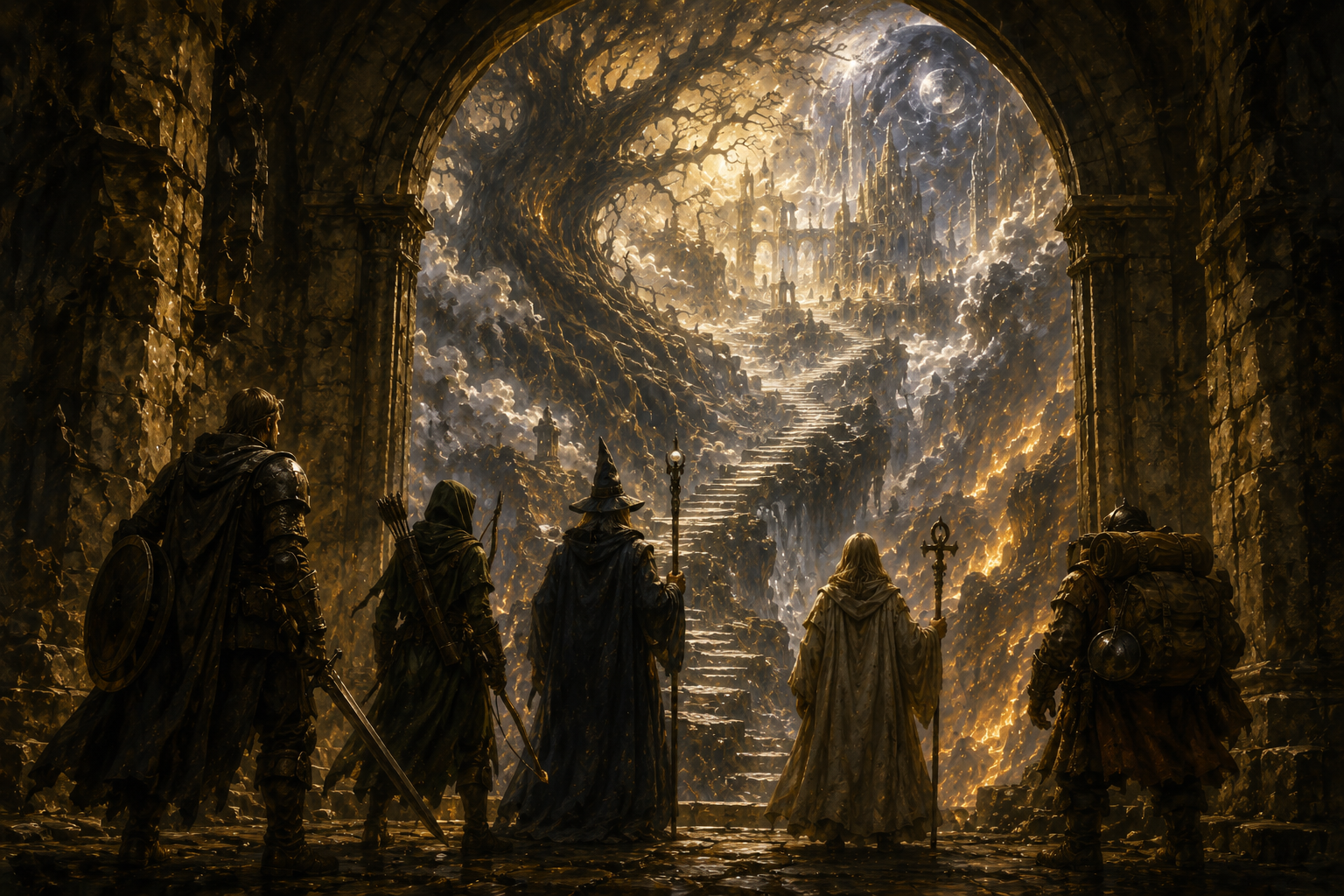
Begin with a mortal need
SpiralWorlds planar campaigns begin on physical Earth. A court, temple, city, bloodline, battlefield, plague-struck province or threatened community creates the need to cross the boundary. The planes expand the campaign because something beyond Earth has become necessary, dangerous or impossible to ignore.
Keep the question visible
At every stage, the players should know what they are trying to accomplish, why the destination matters and what will happen on Earth if they fail. Wonder strengthens direction; it does not replace it.
Find what Earth has forgotten
A law, name, route, memory or true account survives only in an Astral archive, divine court, ancestral realm or sealed planar repository.
Bring back the impossible
A cure, relic, seed, substance, witness or fragment of lost power can be obtained only where its governing principle is physically real.
Recover the living or the dead
A traveller, captive, stolen soul, dreamer or exiled power has been carried beyond ordinary reach and cannot return unaided.
Negotiate with another order
An extraplanar people or divine authority controls a route, judgement, sanctuary or military power that affects mortal affairs.
Follow the threat home
An enemy uses planar distance as protection. Ending the danger requires reaching its sanctuary, supply route, spawning ground or seat of command.
Stop the crossing
A breach, cult, relic, dream infection or damaged law is allowing something from another reality to enter Earth.
Choose the campaign scale before opening the gate
Planar play can remain rooted on Earth and can begin at any character level. The route, objective and return conditions determine the scale more reliably than spectacle does.
| Scale | Structure | Best use | Essential limit |
|---|---|---|---|
| The Breach | One crossing, one destination and a direct return. | Introducing planar danger without changing the whole campaign. | The opening is temporary, local or controlled by a patron. |
| The Expedition | Several sessions in one plane or one connected region. | Exploration, diplomacy, rescue, recovery or a single deep objective. | The party has one route home and cannot freely change destinations. |
| The Route Campaign | A sequence of destinations connected by one great road. | Astral voyages, dream journeys, Yggdrasill paths or the Infinite Staircase. | The road has its own law, cost and recurring enemies. |
| The Planar War | Earth and several planes become parts of one conflict. | High-level diplomacy, invasion, damaged cosmic law or divine struggle. | Every front must still affect named mortal places and people. |
Low-level access remains possible. A fixed gate, inherited key, seasonal crossing, dream ritual, compelled guide or one-use relic can take inexperienced characters beyond Earth while keeping destination choice and return under Game Master control.
Define the journey before designing encounters
A coherent planar adventure can be reduced to five decisions. When these remain clear, the campaign can survive strange geography, altered time, competing divine powers and unexpected player choices.
Objective
State the necessary result as an action: recover the witness, close the breach, obtain the judgement, destroy the anchor, secure safe passage or return with the cure.
Route
Name how the party crosses. The Astral Plane, Ethereal overlap, compressed Shadow, Oneirion, Yggdrasill and the Infinite Staircase create different journeys even when they reach the same destination.
Arrival point
Choose where the crossing places the party and why. A border station, dream shore, lower root, public gate, prison shell or remote wilderness creates a different adventure from arrival inside the objective.
Local authority
Identify who believes they own the place, who actually controls it and what the travellers have already done merely by arriving.
Return method
Establish what must remain intact: a portal, fork, guide, waking body, marked door, oath, remembered name, vessel, ley junction or permission to depart.
Write the return condition on the campaign sheet
The route home should be known before departure, threatened after arrival and capable of changing the story without simply ending it.
Choose the road whose law fits the story
The permanent Planes of Existence directory establishes the destinations. The Transitive Planes and Great Routes guide establishes six verified roads between realities.
Astral Plane
Law: intention, identity, relationship and passage wakes.
Use it for: travel between separate realities, cosmic archives, thought-realms, damaged leylines and long pursuit.
Failure changes: destination, identity or the relationship the traveller uses to navigate.
Ethereal Plane
Law: coexistence, proximity and insubstantial passage.
Use it for: hidden movement, haunted sites, observing the Material world and crossing physical barriers.
Failure changes: who can perceive, touch or follow the travellers.
Shadow Plane
Law: distorted reflection and compressed distance.
Use it for: rapid movement between Material places, infiltration and journeys through a hostile double of familiar geography.
Failure changes: distance, orientation or the point at which the party returns to Earth.
Oneirion — Plane of Dreams
Law: memory, fear, desire, prophecy and symbolic truth.
Use it for: dream rescue, revelation, nightmare containment, lost memory and journeys into sleeping minds.
Failure changes: the waking anchor, the remembered self or the truth carried home.
Yggdrasill — the World Tree
Law: oath, ancestry, burden, sacrifice and recognised standing.
Use it for: sacred crossings, ancestral quests, journeys between rooted realms and conflicts involving the Asgardian powers.
Failure changes: whether the road recognises the traveller or what obligation passage creates.
The Infinite Staircase
Law: doors, landings, changing gravity, keys and intelligent creativity.
Use it for: mystery journeys, unconventional access, lost doors and campaigns where navigation is itself the adventure.
Failure changes: the landing reached, the key required or the meaning of the chosen door.
Other forms of crossing
Natural crossings
Thin boundaries appear through season, weather, geology, death, dream, sacred geography, ancient violence or repeated ritual. They are usually local and conditional.
Constructed gates
Permanent or repeatable gates can require a key, sigil, bloodline, name, offering, recognised authority or a sequence of actions performed at the correct time.
Spell travel
Plane Shift, Gate, Astral Projection, Etherealness and Shadow Walk provide different forms of access. The Game Master still determines whether the required focus exists, where the travellers arrive and what powers can obstruct entry.
Planar travel spells
Planar magic changes the scale of a campaign, but each spell opens a different kind of road. Link the spell to a particular expedition purpose, destination and return problem rather than treating every form of magical travel as interchangeable.
Plane Shift — Worldrend Passage
Campaign role: the standard high-level expedition spell. It transports a group physically to another plane, but ordinary arrival remains broad rather than perfectly precise.
GM control: the attuned forked rod determines which destinations are genuinely available. Possessing the spell does not automatically grant a complete collection of planar keys.
Gate — Sovereign Breach
Campaign role: precise passage, emergency extraction, invasion and forced confrontation with a named extraplanar being.
GM control: powers ruling their own realms may bar the opening. A successful gate also creates a visible, two-way strategic vulnerability while it remains open.
Astral Projection
Campaign role: sends projected travellers through the Astral Plane while their physical bodies remain behind. It is ideal for long Astral voyages, remote observation and expeditions where the waking bodies become a second front.
GM control: the silver cord, the security of the bodies and the dependence of companions on the lead caster all create meaningful return risks.
Etherealness
Campaign role: carries a group into the Ethereal Plane for hidden movement, bypassing physical barriers, haunted-site exploration and access to nearby crossings.
GM control: the spell grants passage through proximity. It does not make the travellers invisible to Ethereal inhabitants or protect them from effects that can reach across the boundary.
Shadow Walk
Campaign role: uses the Shadow Plane to move rapidly between locations on Earth or to seek borders with other realities.
GM control: arrival is uncertain, terrain is difficult to read and separation from the guide can scatter travellers between Shadow and the Material world.
Wards, circles and recall
Travel magic becomes more useful when combined with protected arrival sites, known sigils, banishment, interdiction, summoning controls and a prepared method of recall. These spells should shape the expedition plan before the crossing rather than appear only as emergency answers after it fails.
Attuned planar tuning forks
The forked focus used by Plane Shift is a campaign key. An untuned fork must be carried to the intended plane and exposed to a defining resonance before it becomes useful. A fork attuned to a broad first arrival region should be easier to obtain than one keyed to a deeper layer, hidden realm, protected divine court or nearly forgotten demiplane.
Use four campaign categories: established forks held by recognised travellers and institutions; restricted forks controlled by planar authorities; rare forks requiring a native power, major relic or defining planar site; and unique forks whose creation is itself an adventure. Price follows access, politics and scarcity in the campaign rather than one universal Great Beyond table.
Magic items for planar campaigns
The live page’s planar travel items are retained here because each produces a different campaign structure. These are plot-critical assets as much as treasure: ownership, charges, destinations, carrying capacity and the ability to return should remain visible in play.

Amulet of the Planes
A powerful but dangerous means of taking a company between many planes. Its breadth makes it suitable for an open planar campaign, while failed control can send the group somewhere unintended.
Cubic Gate
An excellent campaign-limiting device. Its six keyed faces establish a comprehensible network of destinations without giving the party unrestricted access to the whole cosmology.
Flying Skiff
A vessel can turn planar travel into a crew-based campaign. The party may begin as passengers or retainers, inherit the craft after disaster, protect it during landings and depend upon it as both transport and refuge.
Obsidian Steed
This figurine of wondrous power offers rapid personal escape and pursuit across hostile ground. Its limited carrying capacity and dangerous tendencies make it a strong rescue or separation device rather than a complete group solution.
Planar Keystones
Slow, destination-specific keystones allow characters of any level to travel between two established points. They are ideal for a controlled expedition because they cannot usually solve an immediate combat crisis.
Robe of Stars
The robe physically transports its wearer to the Astral Plane. It supports scouting, solo escape and the discovery of routes onward, but its single-traveller limit can split the party or create a rescue problem.
Staff of the Planes
A fully charged staff can carry a group outward and back, and may protect travellers against dangerous planar traits. Because only powerful spellcasters can restore its charges, every use should feel like spending part of the campaign’s future.
Well of Many Worlds
A strong tool for sandbox play. It creates a movable gateway, but it must remain open and vulnerable on its point of origin if the party expects to use it for the return journey.
Desperate measures
Some items permit planar escape only through catastrophic misuse. Placing a bag of holding inside a portable hole, or breaking a staff of power in a retributive strike, may tear open an uncontrolled route or cast survivors into another plane. Use these as last-resort campaign turns: destination, separation, lost equipment and what follows through should all matter.
How to award a planar item
- Name its destinations. Players should know whether the item opens a network, one road or an uncertain range of realities.
- State its carrying limit. A one-rider escape device creates different choices from a group portal or ship.
- Show its return condition. Charges, an exposed gateway, a retained key or a surviving vessel should be tracked openly.
- Give it an owner and history. Courts, temples, planar merchants and native authorities do not ignore the movement of keys to their realms.
- Treat it as access beyond wealth. A plot-critical planar item can be awarded outside normal treasure expectations when its purpose is to open the campaign rather than increase combat power.
Reveal four things immediately
A planar arrival should establish the destination before initiative, exposition or map-reading turns it into an ordinary encounter site.
One wonder
Show the feature that could exist nowhere else: a horizonless silver sea, laws moving as machinery, roots wider than kingdoms or a sky made from remembered storms.
One pressure
Make the plane act upon the travellers through heat, radiance, silence, moral gravity, altered distance, unstable memory, crushing wind or hostile vitality.
One witness
Someone or something notices the crossing. The witness may be curious, alarmed, hungry, official, prophetic or responsible for reporting trespass.
One threat to return
The portal begins closing, a door changes its mark, a guide demands payment, the waking body is disturbed or local law forbids departure before judgement.
d8 Arrival pressures
| d8 | Arrival pressure | What it demands |
|---|---|---|
| 1 | The party arrives visibly inside claimed territory. | Explain, conceal or legitimise the crossing before local authority responds. |
| 2 | The intended landmark is visible but dangerously distant. | Travel through the plane rather than bypassing it. |
| 3 | One traveller arrives marked by the route. | Discover whether the mark is a key, claim, infection, blessing or accusation. |
| 4 | The crossing admits an unintended passenger. | Decide whether to protect, pursue, bargain with or destroy it. |
| 5 | The return method works only from another location. | Find the recognised departure point or create a substitute. |
| 6 | Time on Earth and time here no longer agree. | Finish quickly, accept delay or find a route with a different temporal relationship. |
| 7 | The plane interprets the objective differently. | Restate the quest through local law, symbolism or recognised authority. |
| 8 | The destination was expecting someone else. | Use the mistaken identity, correct it or survive the consequences. |
Run the plane as a complete reality
A plane becomes playable when its governing character changes movement, choices, relationships and consequences. Description establishes wonder; repeatable pressures establish reality.
Environment
Determine atmosphere, substance, temperature, pressure, visibility, gravity and what counts as shelter. Let preparation solve known dangers without erasing the plane.
Direction
Decide whether navigation follows distance, intention, memory, law, ancestry, dream symbolism, landmarks or recognised routes.
Time
State whether time is normal, altered, local, symbolic or merely difficult to measure. Use temporal differences to create choices rather than arbitrary loss.
Communication
Use named languages, interpreters, signs, telepathy, ritual speech or magic. Decide what can be translated accurately and what the plane itself prevents from being expressed.
Memory and identity
Dream, Astral and anomalous journeys can test what travellers remember, conceal or believe. Make changes visible and recoverable unless permanent transformation is the campaign’s agreed purpose.
Metaphysical pressure
Law, chaos, mercy, appetite, imprisonment, vitality or dissolution can influence the environment without removing character choice or reducing every inhabitant to one alignment.
Examples from the established cosmology
| Destination | What must shape play | Required distinction |
|---|---|---|
| Positive Energy Plane | Overwhelming vitality, survivable refraction regions, jyoti law, soul-orchards and the danger of life-force without limit. | Vitality remains powerful, morally neutral and potentially lethal. |
| Arcadia | Hospitality, shared duty, legitimate authority, Abellio and Buxenus, with Duat remaining a sovereign Pharaonic divine realm within Buxenus. | Its layers, cultures and forms of legitimate order remain distinct. |
| The Great Mechanism | Law made physically operational, jurisdiction, procedure, evidence, inevitables and the danger of correct systems serving incomplete purposes. | Procedure, jurisdiction and institutional purpose drive the adventure. |
| Pandemonium | Wind, darkness, fractured direction, damaged communication and the erosion of trust under relentless pressure. | Communication and trust deteriorate alongside navigation. |
| Carceri | Imprisonment, betrayal, hostile shells, demodand wardens, compromised escape and prisoners who may deserve confinement. | Its identity is cosmic imprisonment, betrayal and contested escape. |
| The Far Realm | Containment, category failure, damaged perception and the collapse of dependable cosmic relationships. | Dependable categories and cosmic relationships begin to fail. |
Native societies are participants
Every inhabited destination needs more than monsters and scenery. Establish the following before play:
- Authority: who claims jurisdiction, who enforces it and where that control fails.
- Livelihood: what inhabitants make, exchange, cultivate, guard, remember or require.
- Conflict: which local disputes exist before the characters arrive.
- Hospitality: what makes a stranger a guest, petitioner, customer, prisoner, sacrifice or enemy.
- Sacred limits: which places, names, bodies, memories or acts cannot be treated as ordinary resources.
- Opinion of mortals: whether Earth travellers are rare curiosities, dangerous primitives, valued intermediaries, thieves or descendants.
Power creates deeper politics
Immortal beings can still disagree about law, memory, borders, obligation, strategy and the meaning of ancient events. A divine court should create conflicts of authority, memory, obligation and competing interpretations of law.
Change the expedition instead of ending it
A failed check, damaged portal or lost guide should create a harder route, a debt, a changed arrival or a new obligation. Stranding the party can be powerful when it opens play; it is weak when it merely removes all meaningful choices.
Misplaced arrival
The party reaches the correct plane but the wrong border, layer, jurisdiction or side of a conflict. The objective remains possible after new travel and negotiation.
Planar debt
A guide, ruler, route or sanctuary permits progress in exchange for a service, truth, oath, memory, relic or future passage.
Damaged key
The return focus still works after repair, re-attunement, replacement of one component or recovery of something taken during arrival.
Divided objective
The party can complete the original mission or prevent a newly discovered disaster, but not both without securing allies or accepting greater risk.
Lost time
The return is delayed, accelerated or displaced. Give the players evidence before the full consequence and let them choose whether to continue.
Something follows
The expedition succeeds, but a witness, parasite, claimant, refugee, enemy or idea crosses back to Earth with the party.
Protect the road home
The return route is an active part of the adventure. Give it a keeper, location, condition and visible state. Characters should be able to defend it, repair it, bargain for it or replace it.
| Return method | What threatens it | How players can respond |
|---|---|---|
| Fixed portal | Closure, occupation, damage or changed ownership. | Guard it, reopen it, seize it or discover another linked gate. |
| Attuned focus | Theft, fracture, false attunement or planar interference. | Recover, repair, test or retune it under local conditions. |
| Guide | Death, betrayal, arrest, divided loyalty or a higher obligation. | Rescue, persuade, replace or learn the route independently. |
| Dream anchor | Waking disturbance, memory loss, possession or false awakening. | Signal the waking world, strengthen identity or find a new dreamer. |
| Oath or permission | Breach of terms, disputed authority or incompatible obligations. | Make restitution, prove standing, appeal or accept a binding consequence. |
| Marked door or path | Movement, concealment, altered symbols or changing destination. | Track its law, recover the key or force it to recognise the original route. |
Bring consequences back to Earth
Planar adventures should change the mortal campaign. A successful return may alter a succession, cure a plague, expose a false cult, restore an ancestral claim, provoke a divine enemy, transform local magic or bring a refugee people into a medieval political struggle.
- A recovered law changes who can inherit a throne.
- A rescued soul contradicts the official history of a war.
- A celestial treaty protects one city while isolating another.
- A Carcerian prisoner returns with knowledge worth killing for.
- An Astral wound causes competing memories of the same event to become physically active.
- A dream contagion spreads through a court after the characters awaken.
- A route through Shadow shortens military movement and destabilises regional power.
- A Far Realm breach changes local animals, weather, perception or geometry before it can be sealed.
Eight SpiralWorlds planar campaign models
The Disputed Memory
A destroyed city survives in several incompatible Astral reflections. Each version supports a different mortal claimant, and someone is turning the dispute into a weapon.
The Peace That Demands Work
A mortal ruler seeks protection from Arcadia but mistakes harmony for submission. The party must demonstrate shared duty while rivals sabotage the embassy.
The Prisoner Who Knows the Gate
The only witness capable of preventing a catastrophe is imprisoned in Carceri and may be guilty of crimes that make release dangerous.
The Judgement of a Broken Name
A dead royal name has been altered on Earth. The party enters Buxenus and reaches Duat to establish truth before the false version reshapes a dynasty.
The Law That Outlived Its Makers
An ancient cosmic procedure is correctly enforcing a command whose purpose no longer exists. The party must prove amendment without breaking the law it sustains.
The Door Made by an Unfinished Masterpiece
A lost work of art created a landing that now opens into several planes. Each faction wants the work completed differently so the final door serves its purpose.
The Army Beneath the Road
An enemy has learned to move through compressed Shadow and can bypass every mortal frontier. The party must map the route before the next invasion.
The Shape That Learned a Name
A breach becomes more stable each time scholars describe it. The characters must contain the incursion while deciding which knowledge must be preserved and which must be destroyed.
Rules guidance by game system
The setting canon, route identities and campaign procedures remain the same across systems. Use the rules below only for access, arrival and mechanical pressure. Do not combine spell details or planar traits from different editions.
D&D 5E 2024
Access and arrival
- Use fixed gates, patrons, one-use keys and natural crossings for adventures before characters possess their own planar travel magic.
- Plane Shift can transport the caster and up to eight willing creatures who link hands. It requires a forked metal rod worth at least 250 gp and attuned to a plane.
- The spell reaches the named plane and places the travellers in or near a destination described in general terms, as determined by the Dungeon Master. A known teleportation-circle sigil can provide exact arrival at that circle.
- Treat access to an attuned rod as specific campaign access. A focus may be held by a court, temple, planar embassy, ancient observatory, defeated traveller or native authority.
Running planar pressure
- Use one persistent environmental rule and one changing expedition pressure at a time. Add more only when the players understand the first two.
- Set routine planar checks at DC 13, serious expedition checks at DC 15, dangerous regional checks at DC 17 and exceptional cosmic pressures at DC 19 or higher.
- Failure should normally cost Hit Dice, spell slots, equipment, position, time, secrecy, trust or progress before it causes immediate death.
- Use Exhaustion, damage, conditions and lost resources only when they express the destination’s established character.
Encounter design
Build around mixed objectives. A difficult combat becomes planar when the party must also preserve a portal, maintain a waking anchor, obey a local prohibition, reach shelter or prevent the enemy from changing the route.
Pathfinder 1E
Access and arrival
- Plane Shift uses a forked metal rod attuned to the destination and can affect up to eight creatures joining hands.
- Arrival is highly imprecise: travellers normally appear 5 to 500 miles from the intended location. Make the displacement an expedition stage rather than an empty delay.
- Portals, planar allies, established routes and keyed sites allow lower-level or more precise access without granting unrestricted travel.
- Use the SpiralWorlds plane directory as the authoritative list of destinations and relationships.
Running planar pressure
- Use the destination’s gravity, time, morphic, elemental, energy, alignment and magic traits where applicable, but translate every trait into visible environmental evidence.
- Use Knowledge (planes), Survival, Spellcraft, Linguistics, Diplomacy and relevant Profession or Craft skills to support preparation and adaptation.
- Give protective magic clear duration pressure. A successful expedition must still manage distance, local law, hostile attention and the route home.
Encounter design
Set encounter level from the party’s APL, then treat the plane as a complication rather than adding invisible difficulty. If the environment substantially harms or restricts the party while benefiting enemies, count that advantage when judging the encounter.
D&D 3.5E
Access and arrival
- Plane Shift uses a small forked metal rod whose size and metal determine the destination. Up to eight willing creatures can travel by joining hands.
- Arrival from the Material Plane is normally 5 to 500 miles from the intended point. Use the resulting overland journey to reveal the plane’s laws and societies.
- Fixed gates and natural vortices often reach a plane’s accessible border or first layer. Deeper travel should require local routes, keys, guides or further crossings.
- Gate provides precise interplanar access but can be opposed by powers ruling their own realms.
Running planar pressure
- Apply planar traits consistently and tell players what their characters can observe before demanding checks or resource expenditure.
- Use Knowledge (the planes), Survival, Spellcraft and relevant languages to turn research and preparation into concrete advantages.
- Alignment traits should create pressure without replacing roleplay, native politics or the distinct identity of the destination.
Encounter design
Adjust effective encounter difficulty when planar traits strongly favour native creatures, impede the party’s magic or create persistent damage. Award success for navigation, negotiation and survival as well as combat.
System-neutral expedition clock
For journeys where time and resources matter, use four visible stages: Stable, Strained, Compromised and Critical. Advance the clock when the party loses shelter, damages the route, attracts major attention or fails a serious navigation challenge. Reduce it through rest in a true sanctuary, successful repair, local assistance or completion of a stabilising objective.
Journeys beyond the ordinary world
Planar campaigning draws upon many distinct historical, mythological, literary and modern fantasy traditions. They should inform atmosphere and structure without being collapsed into a single universal system.
Descent and return
Mesopotamian descent narratives and Hellenic journeys to the dead commonly involve thresholds, guides, prohibitions, exchanges, altered status and a return that carries consequences.
World trees and cosmic axes
Yggdrasill belongs to Old Norse cosmology and links divine, mortal and chthonic regions through a living cosmic structure. SpiralWorlds develops it as a transitive plane while preserving that identity.
Judgement and ordered passage
Pharaonic funerary texts describe named powers, trials, transformations and the preservation of identity. Within SpiralWorlds, Duat remains a sovereign Pharaonic realm within Buxenus rather than a generic underworld.
Dream gates and hidden truth
Ancient literature distinguishes truthful, deceptive and divinely significant dreams. Oneirion expands dream imagery into a traversable plane where memory and symbolism govern distance.
Editorial distinction: historical sources explain particular traditions and evidence. They do not prove that different cultures described the same place, and they do not override the established SpiralWorlds cosmology.
Selected historical and mythological references
- National Museum of Denmark — The Old Religion
- The Metropolitan Museum of Art — Death, Burial and the Afterlife in Ancient Greece
- The Metropolitan Museum of Art — The Weighing of the Heart
- University of Oxford ETCSL — Inana’s Descent to the Netherworld
External video guides
These videos provide Dungeons & Dragons gaming context. They do not define SpiralWorlds canon.

System reference points
The mechanics above are concise compatibility guidance rather than reproduced rulebook text. Consult the relevant rules source for complete spell wording, planar traits and system terminology.
- D&D Beyond — Plane Shift (2024)
- D&D Beyond — Gate (2024)
- Archives of Nethys — Plane Shift (Pathfinder 1E)
- Hypertext d20 SRD — Plane Shift (D&D 3.5E)
- Hypertext d20 SRD — Planes and Planar Traits (D&D 3.5E)
Dungeons & Dragons and related marks are trademarks of Wizards of the Coast. Pathfinder is a trademark of Paizo Inc. SpiralWorlds is not affiliated with or endorsed by either company.
Questions for Game Masters
What is a planar campaign?
A planar campaign is an adventure or series of adventures in which travel between complete realities is central to the objective, dangers and consequences. It may involve one brief crossing or a long war across several planes.
Do planar adventures need high-level characters?
No. Low-level characters can use a fixed portal, natural crossing, dream ritual, patron, guide or one-use key. Higher levels provide independent travel, but early play often benefits from a controlled route and a clearly limited destination.
How do I stop a planar campaign becoming disjointed?
Keep one mortal objective visible, use a defined route, establish a specific arrival point, identify local authority and make the return method part of play. Each destination should change the same developing conflict rather than beginning an unrelated story.
Which planar route should I use?
Choose by governing law. Use the Astral Plane for relationship and thought, the Ethereal Plane for proximity, Shadow for compressed distance, Oneirion for dream and memory, Yggdrasill for oath and ancestry, and the Infinite Staircase for doors, creativity and uncertain navigation.
What happens if the party loses its route home?
Replace immediate campaign failure with a new expedition problem: repair the key, reach another gate, obtain permission, rescue the guide, fulfil an obligation or travel to a departure point. The loss should change the campaign while preserving meaningful choices.
Keep this reference growing
If this page helped with your reading or game, you can support its upkeep or explore the curated books.
Explore the Bookshop — epics, classics and stories behind imagined worlds.