
Divine Magic • Core Spell Reference
Gate
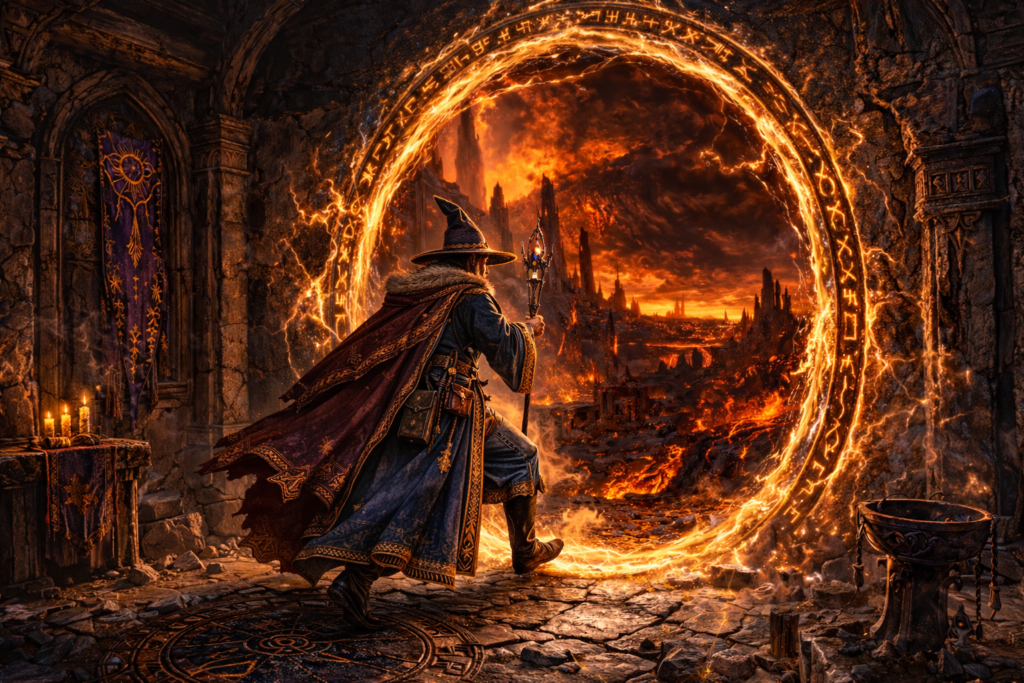
Choose your edition before using the spell. Its level, casting procedure, targets, effects, and limits follow the rules in the selected panel.
Gate at a Glance
| 5.5e (2024) | Level 9 |
|---|---|
| 5e (2014) | Level 9 |
| Pathfinder 1e | Level 9 |
| D&D 3.5e | Level 9 |
| Browse | Cleric spells • Cleric class |
Spell Rules
Gate — 5.5e (2024)
Cleric spell level 9. Edition source.
| Spell | Level 9 Conjuration (Cleric, Sorcerer, Warlock, Wizard) |
|---|---|
| Casting Time | Action |
| Range | 60 feet |
| Components | V, S, M (a diamond worth 5,000+ GP) |
| Duration | Concentration, up to 1 minute |
You conjure a portal linking an unoccupied space you can see within range to a precise location on a different plane of existence. The portal is a circular opening, which you can make 5 to 20 feet in diameter. You can orient the portal in any direction you choose. The portal lasts for the duration, and the portal’s destination is visible through it. The portal has a front and a back on each plane where it appears. Travel through the portal is possible only by moving through its front. Anything that does so is instantly transported to the other plane, appearing in the unoccupied space nearest to the portal. Deities and other planar rulers can prevent portals created by this spell from opening in their presence or anywhere within their domains. When you cast this spell, you can speak the name of a specific creature (a pseudonym, title, or nickname doesn’t work). If that creature is on a plane other than the one you are on, the portal opens next to the named creature and transports it to the nearest unoccupied space on your side of the portal. You gain no special power over the creature, and it is free to act as the GM deems appropriate. It might leave, attack you, or help you.
Gate — 5e (2014)
Cleric spell level 9. Edition source.
| Spell | 9th-level conjuration |
|---|---|
| Casting Time | 1 action |
| Range | 60 feet |
| Components | V, S, M (a diamond worth at least 5,000 gp) |
| Duration | Concentration, up to 1 minute |
You conjure a portal linking an unoccupied space you can see within range to a precise location on a different plane of existence. The portal is a circular opening, which you can make 5 to 20 feet in diameter. You can orient the portal in any direction you choose. The portal lasts for the duration. The portal has a front and a back on each plane where it appears. Travel through the portal is possible only by moving through its front. Anything that does so is instantly transported to the other plane, appearing in the unoccupied space nearest to the portal. Deities and other planar rulers can prevent portals created by this spell from opening in their presence or anywhere within their domains. When you cast this spell, you can speak the name of a specific creature (a pseudonym, title, or nickname doesn’t work). If that creature is on a plane other than the one you are on, the portal opens in the named creature’s immediate vicinity and draws the creature through it to the nearest unoccupied space on your side of the portal. You gain no special power over the creature, and it is free to act as the GM deems appropriate. It might leave, attack you, or help you.
Gate — Pathfinder 1e
Cleric spell level 9. Edition source.
| School | conjuration (creation or calling) |
|---|---|
| Level | cleric 9, sorcerer/wizard 9 |
| Casting Time | 1 standard action |
| Components | V, S, M (see text) |
| Range | medium (100 ft. + 10 ft./level) |
| Effect | see text |
| Duration | instantaneous or concentration (up to 1 round/level); see text |
| Saving Throw | none |
| Spell Resistance | no |
Casting a gate spell has two effects. First, it creates an interdimensional connection between your plane of existence and a plane you specify, allowing travel between those two planes in either direction.
Second, you may then call a particular individual or kind of being through the gate.
The gate itself is a circular hoop or disk from 5 to 20 feet in diameter (caster’s choice) oriented in the direction you desire when it comes into existence (typically vertical and facing you). It is a two-dimensional window looking into the plane you specified when casting the spell, and anyone or anything that moves through is shunted instantly to the other side.
A gate has a front and a back. Creatures moving through the gate from the front are transported to the other plane; creatures moving through it from the back are not.
Planar Travel: As a mode of planar travel, a gate spell functions much like a plane shift spell, except that the gate opens precisely at the point you desire (a creation effect). Deities and other beings who rule a planar realm can prevent a gate from opening in their presence or personal demesnes if they so desire. Travelers need not join hands with you—anyone who chooses to step through the portal is transported. A gate cannot be opened to another point on the same plane; the spell works only for interplanar travel.
You may hold the gate open only for a brief time (no more than 1 round per caster level), and you must concentrate on doing so, or else the interplanar connection is severed.
Calling Creatures: The second effect of the gate spell is to call an extraplanar creature to your aid (a calling effect). By naming a particular being or kind of being as you cast the spell, you cause the gate to open in the immediate vicinity of the desired creature and pull the subject through, willing or unwilling. Deities and unique beings are under no compulsion to come through the gate, although they may choose to do so of their own accord. This use of the spell creates a gate that remains open just long enough to transport the called creatures. This use of the spell has a material cost of 10,000 gp in rare incense and offerings. This cost is in addition to any cost that must be paid to the called creatures.
If you choose to call a kind of creature instead of a known individual, you may call either a single creature or several creatures. In either case, their total HD cannot exceed twice your caster level. In the case of a single creature, you can control it if its HD does not exceed your caster level. A creature with more HD than your caster level can’t be controlled. Deities and unique beings cannot be controlled in any event. An uncontrolled being acts as it pleases, making the calling of such creatures rather dangerous. An uncontrolled being may return to its home plane at any time.
If you choose to exact a longer or more involved form of service from a called creature, you must offer some fair trade in return for that service. The service exacted must be reasonable with respect to the promised favor or reward; see the lesser planar ally spell for appropriate rewards. Some creatures may want their payment in “livestock” rather than in coin, which could involve complications. Immediately upon completion of the service, the being is transported to your vicinity, and you must then and there turn over the promised reward. After this is done, the creature is instantly freed to return to its own plane.
Failure to fulfill the promise to the letter results in your being subjected to service by the creature or by its liege and master, at the very least. At worst, the creature or its kin may attack you.
Note: When you use a calling spell such as gate to call an air, chaotic, earth, evil, fire, good, lawful, or water creature, it becomes a spell of that type.
Gate — D&D 3.5e
Cleric spell level 9. Edition source.
| School | Conjuration (Creation or Calling) |
|---|---|
| Level | Clr 9, Sor/Wiz 9 |
| Components | V, S, XP; see text |
| Casting Time | 1 standard action |
| Range | Medium (100 ft. + 10 ft./level) |
| Effect | See text |
| Duration | Instantaneous or concentration (up to 1 round/level); see text |
| Saving Throw | None |
| Spell Resistance | No |
Casting a gate spell has two effects. First, it creates an interdimensional connection between your plane of existence and a plane you specify, allowing travel between those two planes in either direction.
Second, you may then call a particular individual or kind of being through the gate.
The gate itself is a circular hoop or disk from 5 to 20 feet in diameter (caster’s choice), oriented in the direction you desire when it comes into existence (typically vertical and facing you). It is a two-dimensional window looking into the plane you specified when casting the spell, and anyone or anything that moves through is shunted instantly to the other side.
A gate has a front and a back. Creatures moving through the gate from the front are transported to the other plane; creatures moving through it from the back are not.
Planar Travel: As a mode of planar travel, a gate spell functions much like a plane shift spell, except that the gate opens precisely at the point you desire (a creation effect). Deities and other beings who rule a planar realm can prevent a gate from opening in their presence or personal demesnes if they so desire. Travelers need not join hands with you—anyone who chooses to step through the portal is transported. A gate cannot be opened to another point on the same plane; the spell works only for interplanar travel.
You may hold the gate open only for a brief time (no more than 1 round per caster level), and you must concentrate on doing so, or else the interplanar connection is severed.
Calling Creatures: The second effect of the gate spell is to call an extraplanar creature to your aid (a calling effect). By naming a particular being or kind of being as you cast the spell, you cause the gate to open in the immediate vicinity of the desired creature and pull the subject through, willing or unwilling. Deities and unique beings are under no compulsion to come through the gate, although they may choose to do so of their own accord. This use of the spell creates a gate that remains open just long enough to transport the called creatures. This use of the spell has an XP cost (see below).
If you choose to call a kind of creature instead of a known individual you may call either a single creature (of any HD) or several creatures. You can call and control several creatures as long as their HD total does not exceed your caster level. In the case of a single creature, you can control it if its HD do not exceed twice your caster level. A single creature with more HD than twice your caster level can’t be controlled. Deities and unique beings cannot be controlled in any event. An uncontrolled being acts as it pleases, making the calling of such creatures rather dangerous. An uncontrolled being may return to its home plane at any time.
A controlled creature can be commanded to perform a service for you. Such services fall into two categories: immediate tasks and contractual service. Fighting for you in a single battle or taking any other actions that can be accomplished within 1 round per caster level counts as an immediate task; you need not make any agreement or pay any reward for the creature’s help. The creature departs at the end of the spell.
If you choose to exact a longer or more involved form of service from a called creature, you must offer some fair trade in return for that service. The service exacted must be reasonable with respect to the promised favor or reward; see the lesser planar ally spell for appropriate rewards. (Some creatures may want their payment in “livestock” rather than in coin, which could involve complications.) Immediately upon completion of the service, the being is transported to your vicinity, and you must then and there turn over the promised reward. After this is done, the creature is instantly freed to return to its own plane.
Failure to fulfill the promise to the letter results in your being subjected to service by the creature or by its liege and master, at the very least. At worst, the creature or its kin may attack you.
Note: When you use a calling spell such as gate to call an air, chaotic, earth, evil, fire, good, lawful, or water creature, it becomes a spell of that type.
XP Cost: 1,000 XP (only for the calling creatures function).
Why This Spell Is Dangerous in the World
Gate destroys the safety of being elsewhere.
No realm remains beyond reach. No exile is secure. No prison is absolute. The idea that distance protects you ceases to be true the moment this spell is spoken.
Worse, it allows mortals to force proximity with powers that were never meant to be approached directly. Angels can be summoned into courts. Fiends can be dragged into sanctuaries. Patrons can be confronted. Enemies can be brought into carefully prepared ground—or into catastrophic mistakes.
And because the spell does not grant control, it creates situations that cannot be contained once they begin. It does not simply bring power closer. It brings independent will into immediate consequence.
Rules Sources and Licensing
This work includes material from the System Reference Document 5.2.1 and/or 5.1 by Wizards of the Coast LLC. The original documents are available at D&D Beyond and are licensed under CC BY 4.0. Presentation and formatting have been changed.
The Pathfinder and 3.5 spell mechanics and their tables are Open Game Content under the Open Game License v1.0a. Artwork and original setting prose are excluded from that designation.
Open Game License v1.0a and copyright notices
Permission to copy, modify and distribute the files collectively known as the System Reference Document (“SRD”) is granted solely through the use of the Open Gaming License, Version 1.0a.
This material is being released using the Open Gaming License Version 1.0a and you should read and understand the terms of that license before using this material.
The text of the Open Gaming License itself is not Open Game Content. Instructions on using the License are provided within the License itself.
The following items are designated Product Identity, as defined in Section 1(e) of the Open Game License Version 1.0a, and are subject to the conditions set forth in Section 7 of the OGL, and are not Open Content: Dungeons & Dragons, D&D, Player’s Handbook, Dungeon Master, Monster Manual, d20 System, Wizards of the Coast, d20 (when used as a trademark), Forgotten Realms, Faerûn, proper names (including those used in the names of spells or items), places, Red Wizard of Thay, the City of Union, Heroic Domains of Ysgard, Ever-Changing Chaos of Limbo, Windswept Depths of Pandemonium, Infinite Layers of the Abyss, Tarterian Depths of Carceri, Gray Waste of Hades, Bleak Eternity of Gehenna, Nine Hells of Baator, Infernal Battlefield of Acheron, Clockwork Nirvana of Mechanus, Peaceable Kingdoms of Arcadia, Seven Mounting Heavens of Celestia, Twin Paradises of Bytopia, Blessed Fields of Elysium, Wilderness of the Beastlands, Olympian Glades of Arborea, Concordant Domain of the Outlands, Sigil, Lady of Pain, Book of Exalted Deeds, Book of Vile Darkness, beholder, gauth, carrion crawler, tanar’ri, baatezu, displacer beast, githyanki, githzerai, mind flayer, illithid, umber hulk, yuan-ti.
All of the rest of the SRD is Open Game Content as described in Section 1(d) of the License.
More information on the Open Game License can be found at www.wizards.com/d20.
The terms of the Open Gaming License Version 1.0a are as follows:
OPEN GAME LICENSE Version 1.0a
The following text is the property of Wizards of the Coast, Inc. and is Copyright 2000 Wizards of the Coast, Inc (“Wizards”). All Rights Reserved.
1. Definitions: (a)”Contributors” means the copyright and/or trademark owners who have contributed Open Game Content; (b)”Derivative Material” means copyrighted material including derivative works and translations (including into other computer languages), potation, modification, correction, addition, extension, upgrade, improvement, compilation, abridgment or other form in which an existing work may be recast, transformed or adapted; (c) “Distribute” means to reproduce, license, rent, lease, sell, broadcast, publicly display, transmit or otherwise distribute; (d)”Open Game Content” means the game mechanic and includes the methods, procedures, processes and routines to the extent such content does not embody the Product Identity and is an enhancement over the prior art and any additional content clearly identified as Open Game Content by the Contributor, and means any work covered by this License, including translations and derivative works under copyright law, but specifically excludes Product Identity. (e) “Product Identity” means product and product line names, logos and identifying marks including trade dress; artifacts; creatures characters; stories, storylines, plots, thematic elements, dialogue, incidents, language, artwork, symbols, designs, depictions, likenesses, formats, poses, concepts, themes and graphic, photographic and other visual or audio representations; names and descriptions of characters, spells, enchantments, personalities, teams, personas, likenesses and special abilities; places, locations, environments, creatures, equipment, magical or supernatural abilities or effects, logos, symbols, or graphic designs; and any other trademark or registered trademark clearly identified as Product identity by the owner of the Product Identity, and which specifically excludes the Open Game Content; (f) “Trademark” means the logos, names, mark, sign, motto, designs that are used by a Contributor to identify itself or its products or the associated products contributed to the Open Game License by the Contributor (g) “Use”, “Used” or “Using” means to use, Distribute, copy, edit, format, modify, translate and otherwise create Derivative Material of Open Game Content. (h) “You” or “Your” means the licensee in terms of this agreement.
2. The License: This License applies to any Open Game Content that contains a notice indicating that the Open Game Content may only be Used under and in terms of this License. You must affix such a notice to any Open Game Content that you Use. No terms may be added to or subtracted from this License except as described by the License itself. No other terms or conditions may be applied to any Open Game Content distributed using this License.
3.Offer and Acceptance: By Using the Open Game Content You indicate Your acceptance of the terms of this License.
4. Grant and Consideration: In consideration for agreeing to use this License, the Contributors grant You a perpetual, worldwide, royalty-free, non-exclusive license with the exact terms of this License to Use, the Open Game Content.
5.Representation of Authority to Contribute: If You are contributing original material as Open Game Content, You represent that Your Contributions are Your original creation and/or You have sufficient rights to grant the rights conveyed by this License.
6.Notice of License Copyright: You must update the COPYRIGHT NOTICE portion of this License to include the exact text of the COPYRIGHT NOTICE of any Open Game Content You are copying, modifying or distributing, and You must add the title, the copyright date, and the copyright holder’s name to the COPYRIGHT NOTICE of any original Open Game Content you Distribute.
7. Use of Product Identity: You agree not to Use any Product Identity, including as an indication as to compatibility, except as expressly licensed in another, independent Agreement with the owner of each element of that Product Identity. You agree not to indicate compatibility or co-adaptability with any Trademark or Registered Trademark in conjunction with a work containing Open Game Content except as expressly licensed in another, independent Agreement with the owner of such Trademark or Registered Trademark. The use of any Product Identity in Open Game Content does not constitute a challenge to the ownership of that Product Identity. The owner of any Product Identity used in Open Game Content shall retain all rights, title and interest in and to that Product Identity.
8. Identification: If you distribute Open Game Content You must clearly indicate which portions of the work that you are distributing are Open Game Content.
9. Updating the License: Wizards or its designated Agents may publish updated versions of this License. You may use any authorized version of this License to copy, modify and distribute any Open Game Content originally distributed under any version of this License.
10. Copy of this License: You MUST include a copy of this License with every copy of the Open Game Content You Distribute.
11. Use of Contributor Credits: You may not market or advertise the Open Game Content using the name of any Contributor unless You have written permission from the Contributor to do so.
12. Inability to Comply: If it is impossible for You to comply with any of the terms of this License with respect to some or all of the Open Game Content due to statute, judicial order, or governmental regulation then You may not Use any Open Game Material so affected.
13. Termination: This License will terminate automatically if You fail to comply with all terms herein and fail to cure such breach within 30 days of becoming aware of the breach. All sublicenses shall survive the termination of this License.
14. Reformation: If any provision of this License is held to be unenforceable, such provision shall be reformed only to the extent necessary to make it enforceable.
15. COPYRIGHT NOTICE
Open Game License v 1.0a Copyright 2000, Wizards of the Coast, Inc.
System Reference Document Copyright 2000-2003, Wizards of the Coast, Inc.; Authors Jonathan Tweet, Monte Cook, Skip Williams, Rich Baker, Andy Collins, David Noonan, Rich Redman, Bruce R. Cordell, John D. Rateliff, Thomas Reid, James Wyatt, based on original material by E. Gary Gygax and Dave Arneson.
Pathfinder Roleplaying Game Core Rulebook. © 2009, Paizo Publishing, LLC; Author: Jason Bulmahn, based on material by Jonathan Tweet, Monte Cook, and Skip Williams. END OF LICENSE
Keep this reference growing
If this page helped with your reading or game, you can support its upkeep or explore the curated books.
Explore the Bookshop — epics, classics and stories behind imagined worlds.