
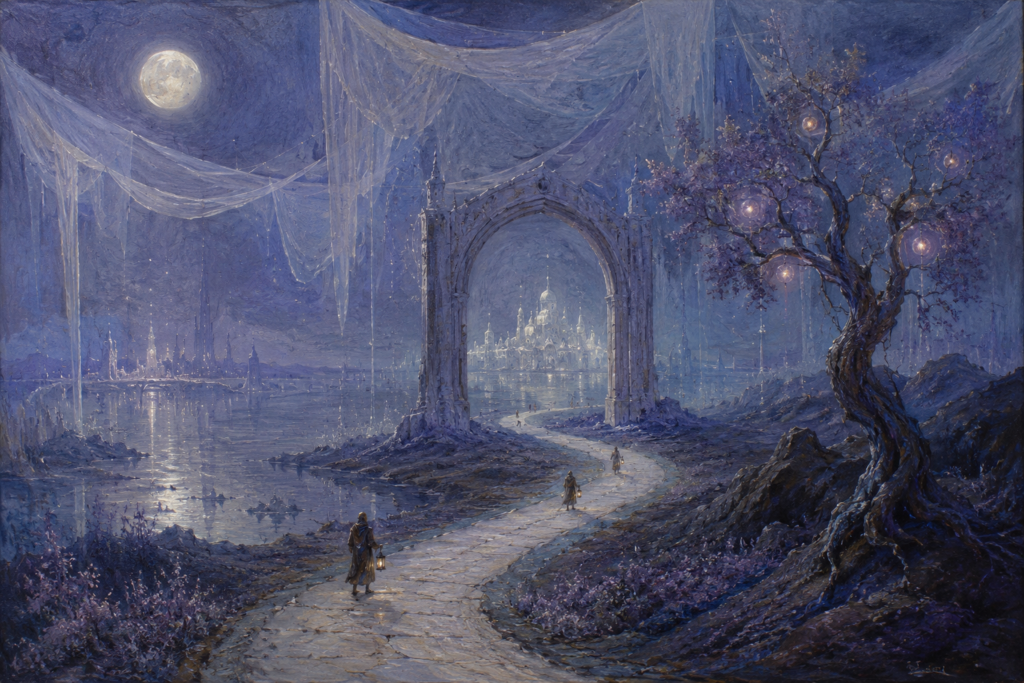
Plane of Dreams — Oneirion, the Veiled Dominion
Where sleep becomes country, memory becomes road, prophecy wears a mask and every nightmare knows the name of the dreamer.
Oneirion at a Glance
Oneirion is the hidden reality beneath ordinary dreaming: an ancient transitive plane of vision, memory, possibility, desire, prophecy, imagination, nightmare and half-formed truth.
It is not recreated every night by sleeping mortals. Mortal minds reshape its shallows and continually contribute faces, rooms, roads, landscapes and stories, but the plane itself belongs to the much older architecture of the multiverse.
A traveller may open a bedroom door and step onto a battlefield that no longer exists, find an orchard whose fruit contains forgotten childhoods, enter a court where every witness wears the traveller’s face or climb a stair whose direction changes whenever somebody remembers why they came.
Oneirion is mutable, but it is not meaningless. Identity, memory, expectation, fear, longing, prophecy, divine attention and repeated stories exert genuine pressure upon its landscapes.
- Plane Type Transitive Plane
- Moral Gravity True Neutral
- Common Names Oneirion, Veiled Dominion, Dreaming Sea
- Older Name The Twilight Expanse
- Distance Symbolic before physical
- Time Mutable and unreliable
- Usual Arrival Sleep, Silver Road, memory-scape or threshold
- Primary Risks Entrapment, false awakening, memory loss, nightmare predation
What Oneirion Is For
Use Oneirion when a dream must become somewhere the characters can enter, explore, negotiate with, escape from or deliberately alter.
It supports prophetic quests, shared nightmares, stolen memories, artistic inspiration, divine messages, dream assassinations, sleeping curses and routes between distant minds.
Cosmological Role
| Plane | What It Carries | Relationship to Oneirion |
|---|---|---|
| Astral Plane | Thought, soul, divine distance and passage between separated realities. | Astral thought can touch dream, but Oneirion gives thought image, emotion, personal symbolism and narrative form. |
| Ethereal Plane | Ghostly nearness, border-presence and hidden passage. | Cursed sleepers and haunted chambers may touch both realms, but dream substance is not simply ethereal matter. |
| Shadow Plane | Loss, reflection, darkness, absence and diminished material images. | The strongest correspondences occur where fear sinks toward the Nightward and organised nightmare. |
| Fey World | Glamour, heightened nature, primal feeling and fey sovereignty. | Fey glamour enters dreams easily, but Oneirion is neither a province nor an extension of Faerie. |
A wizard may deliberately cross the Astral Plane to reach a distant divine realm, while a ghost may linger beside the living through the Ethereal. Oneirion requires no such training merely to touch its outer edge. A sleeping child, terrified soldier, fevered ruler or exhausted artist may reach its shallows without ever learning the plane’s name.
Cosmic History of the Plane of Dreams
Oneirion begins before mortal civilisation and long before later cultures give divine names to sleep, dreaming and nightmare.
The Living Weave
As magic becomes a universal structure, thought, memory, intention, symbol and imagination become things to which reality can meaningfully respond. The conditions necessary for dream to acquire objective consequence now exist.
The Awakening of Dream
Recurring possibility gathers identity within the great mirror structures of creation. From possibility seeking image, emotion and story arises Dream, one of the ancient primordial powers later counted among the great Primal Titans.
The deepest architecture of Oneirion coheres around this primordial principle.
The First Great Breach
When ordered creation suffers a vast assault from beyond known reality, Dream stands among the primordial powers resisting the breach.
Oneirion therefore matures in a cosmos already capable of conflict, terror, memory, loss, hope and resistance rather than emerging later as a by-product of mortal imagination.
The Great Multiplication
As mortal minds multiply, Oneirion’s upper reaches become vastly more complex. Repeated dreams wear roads through the plane. Shared fears create recurring hunting grounds. Cultural symbols establish stable landmarks. Prophetic traditions discover thresholds that generations of seers can revisit.
Human, elven, dwarven, halfling and countless other experiences alter its dreamlands without having created the ancient plane beneath them.
See the broader cosmic sequence in the SpiralWorlds Timeline.
Dream, Sleep and the Powers That Walk Here
Dream — The Primal Reflection
Dream is not simply a deity sitting upon a throne inside Oneirion. It is the primordial intelligence of unrealised possibility becoming image, emotion and story.
Dream does not administer every sleeper, issue every prophecy or command every dream-born being. Its influence is deeper than government. Whenever something that has not happened acquires the emotional weight of a memory, or an unspoken truth becomes landscape, travellers may be encountering its oldest current.
Direct meetings with Dream should be extraordinarily rare. Adventures usually encounter its effects: archetypal roads, impossible architecture, recurring choices, living symbols and lesser powers whose divine offices exist within a plane older than their pantheons.
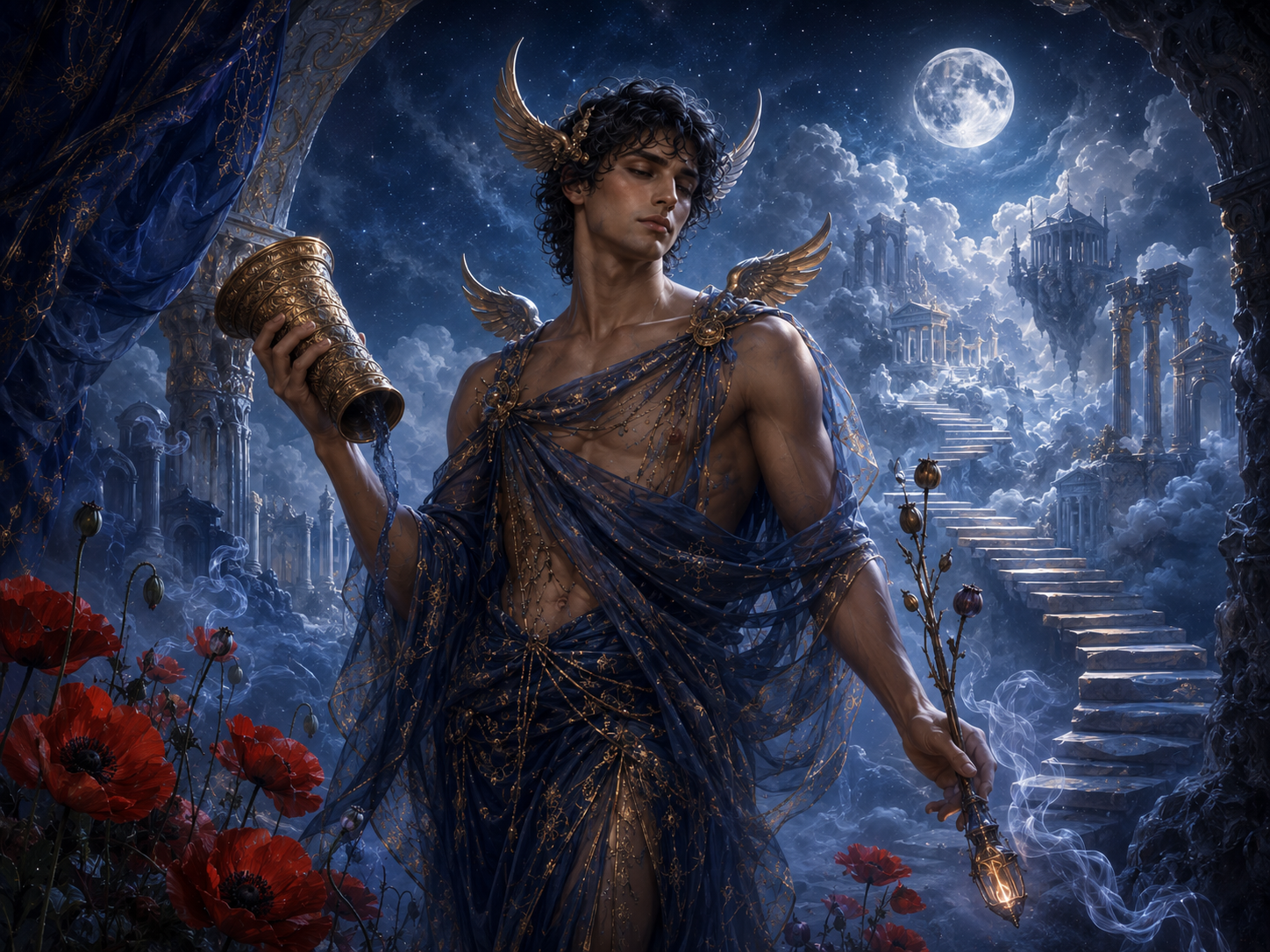
Hypnos — God of Sleep
Hypnos is the divine personification of sleep: rest, slumber, drowsiness, restorative unconsciousness, waking and the surrender of consciousness that precedes ordinary dreaming.
He did not create Oneirion and does not possess universal sovereignty over it. His principal divine association remains with the Hellenic Pantheon and its divine realms in Arborea.
His exceptional authority in Oneirion comes instead from the Veil of Sleep. Every genuine transition from waking consciousness into sleep approaches the condition represented by his divine office.
Hypnos and his priests can stabilise the first crossing, protect sleeping bodies, distinguish natural sleep from hostile supernatural intrusion, call lost travellers toward waking and, under exceptional circumstances, open a controlled threshold directly into the Veil.
That authority ends at the threshold. Hypnos can make entry safer without making the dreamlands beyond it obedient.
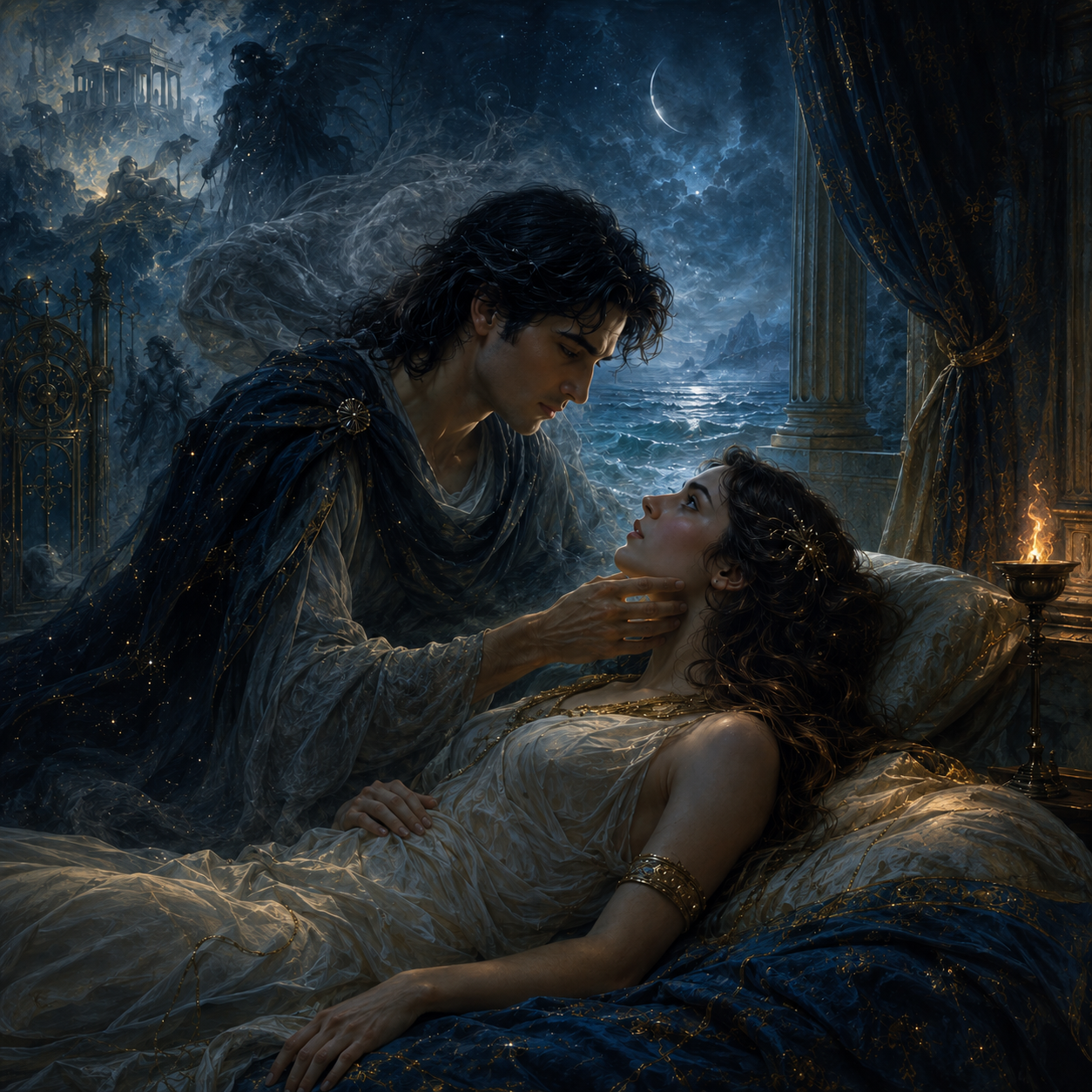
Morpheus — Shaper of Dream Form
Morpheus gives a dream a convincing face, voice, body, room and narrative identity.
Where Hypnos governs the descent into sleep, Morpheus becomes important when a vision must become coherent enough to be seen, recognised, spoken with and remembered after waking.
Artists, actors, poets, seers and rulers invoke him when seeking to understand or transmit visions. His art can comfort, warn, deceive or terrify because perfect representation is not the same thing as truth.
His famous assumption of Ceyx’s likeness before Alcyone demonstrates the principle clearly: dream-form can make an unbearable message intelligible by giving it a recognisable human presence.
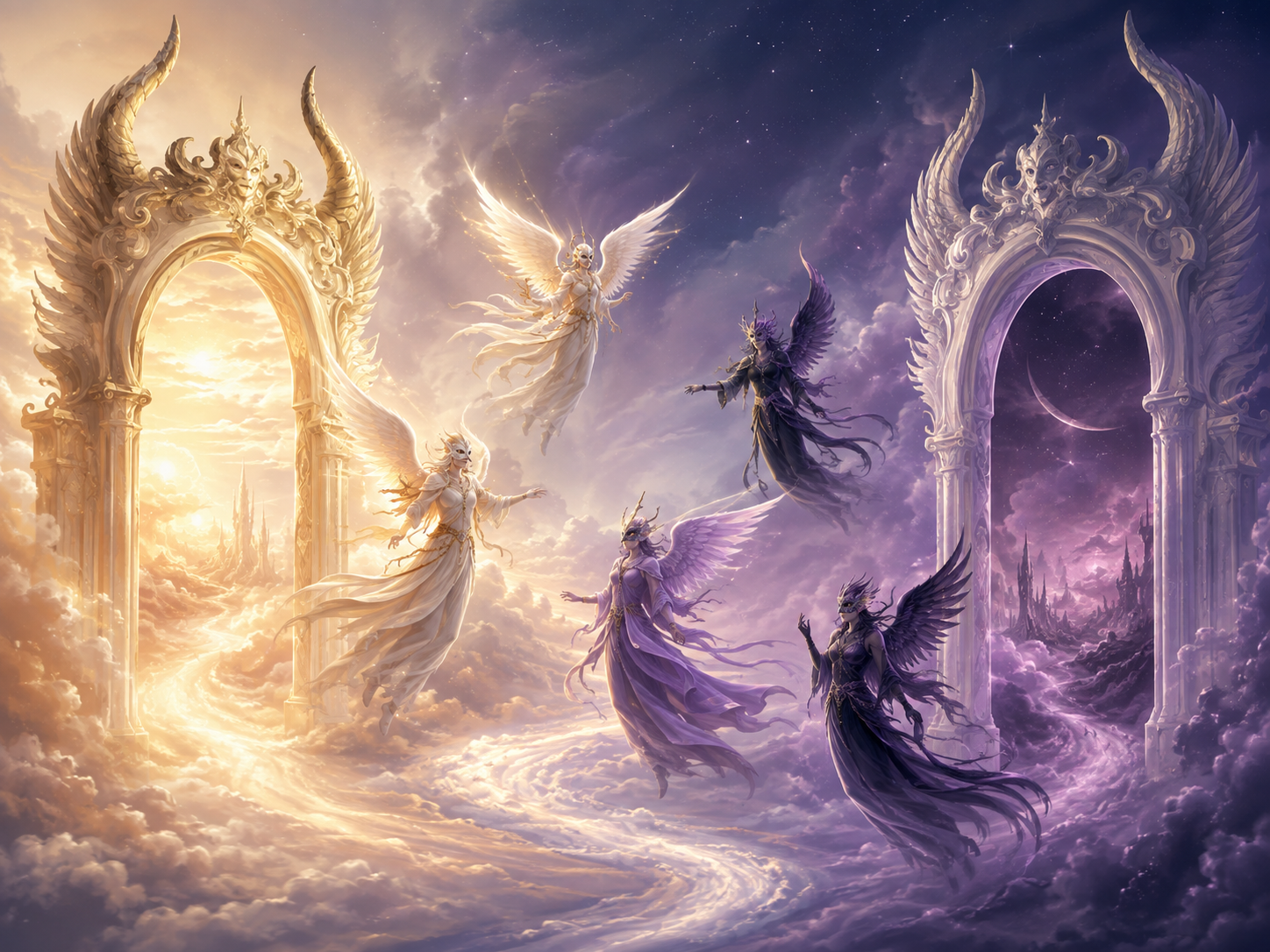
The Oneiroi — Dream Spirits of Oneirion
Oneiroi are stable independent dream spirits native to Oneirion. They act as messengers, mask-bearers, guides, deceivers, heralds and nightmare riders.
An Oneiros possesses memory, personality and purpose beyond the particular dream in which it appears. It may cross between sleepers, divine courts and distant dreamlands long after an individual dream has dissolved.
They are consummate shape-bearers. A spirit may approach a king as a dead parent, a soldier as a fallen comrade or a frightened child as a familiar animal. The most dangerous rarely begin by looking dangerous.
The Oneiroi are not universally servants of Hypnos. Some carry messages for him or guard sleepers beneath his protection. Others bargain independently, serve other gods or follow their own oneiric purposes.
Horn-Current Oneiroi
Horn-current spirits transmit something genuinely true: revelation, warning, healing insight, recovered memory, divine communication or prophetic knowledge. Truth does not make them kind.
Ivory-Current Oneiroi
Ivory-current spirits specialise in persuasive falsehood: corrupted prophecy, false awakening, manufactured memory, temptation, identity erosion and explanations designed to confirm what the dreamer already wants to believe.
Horn and Ivory describe dream-currents rather than species, bloodlines or nations.
The Laws of Oneirion
Dream-Reality
Meaning can acquire temporary substance. A remembered sword can cut, an imaginary door can open and an accusation believed by an entire dream-court can become an actual chain.
Identity Pressure
True names, grief, guilt, vows, titles, desires and denied memories press upon the surrounding dream and may alter its form.
Symbolic Distance
Meaning outranks mileage. A stolen name may lie beyond every doorway bearing the wrong one rather than ten miles east.
Mutable Time
A single mortal night can contain months of subjective travel, while an epic dream-quest may conclude moments after it began.
Waking Anchors
Names, companions, scars, heirlooms, songs, vows and unmistakable memories help travellers preserve identity and remember the road home.
Nightmare Gravity
Fear sinks. Repeated terror, unresolved grief, broken prophecy and predatory dreams gather toward darker and more stable strata.
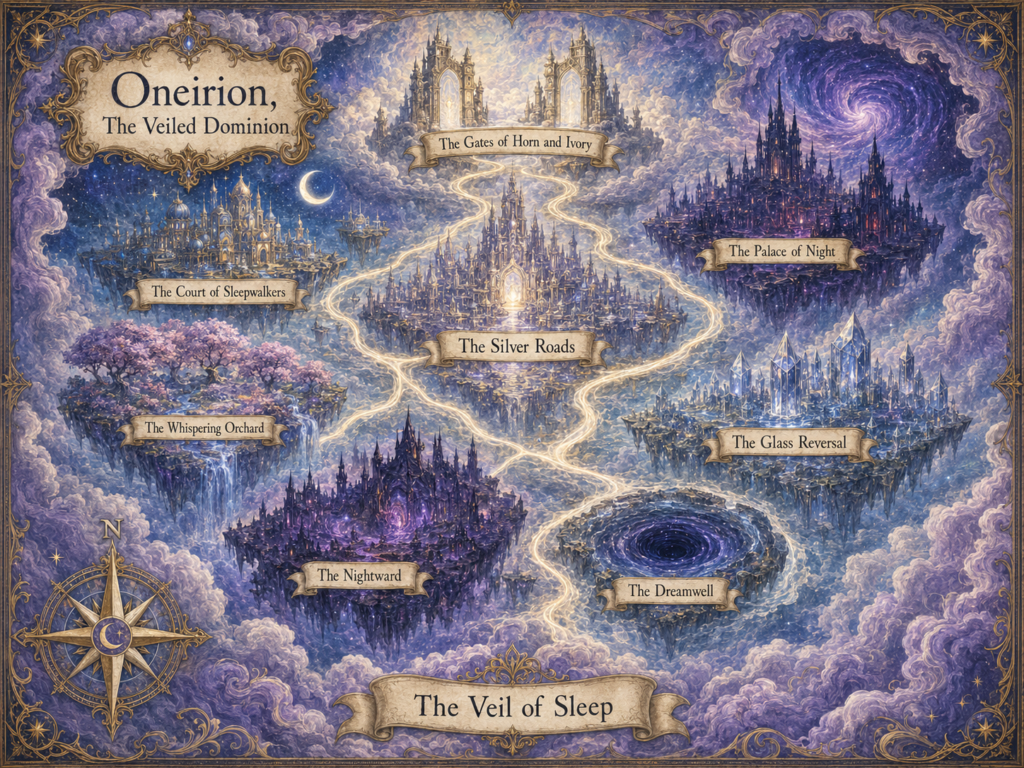
The Veiled Dominion Chart
A useful map of Oneirion records relationships rather than fixed distances. The Veil of Sleep lies conceptually nearer to waking minds than the Nightward. Silver Roads connect coherent dreamlands. The Gates of Horn and Ivory often stand between ordinary dream and visions with lasting consequence.
Regions and Dreamlands
These are not surveyed provinces with permanent borders. They are recurring oneiric conditions stable enough for skilled travellers to recognise, revisit and deliberately seek.
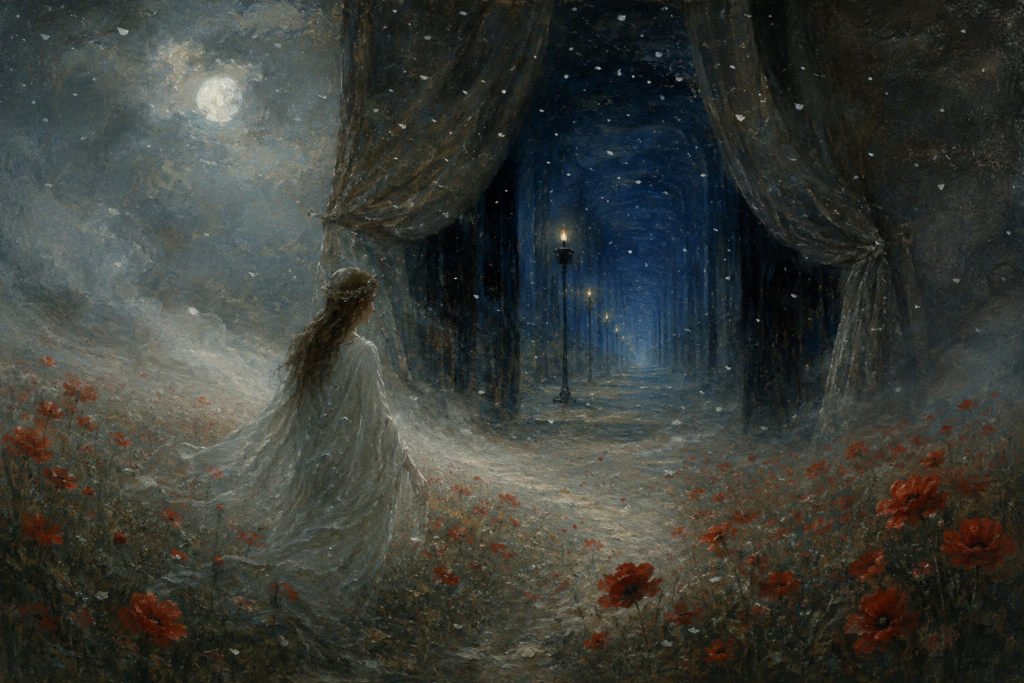
The Veil of Sleep
The Veil is the soft frontier where ordinary dreaming first touches the true plane. It might appear as falling snow, slowly closing curtains, a field of poppies, a corridor whose lamps extinguish one at a time, drifting ash, a black sea or the moment when a familiar bedroom becomes almost—but not quite—correct.
Most sleepers never knowingly pass beyond it. Their dreams remain shallow enough for Oneirion to provide depth without pulling the dreamer into its deeper roads. Lucid dreamers, powerful seers and magically targeted sleepers are much more likely to notice doors leading onward.
Hypnos and the Veil
Of all Oneirion’s regions, the Veil lies closest to the divine authority of Hypnos. He does not own it, but natural sleep falls so directly within his portfolio that his presence can make this threshold unusually calm and traversable.
Where Hypnos has recently manifested, sound becomes muted, fire burns low without dying and poppy petals may appear where no flowers grow. A sleeper protected by his rites is harder to disturb accidentally but easier for a trusted companion to recall deliberately.
Such protection normally ends when the traveller leaves the Veil for the deeper Silver Roads, prophetic gates, independent dreamlands or the Nightward.
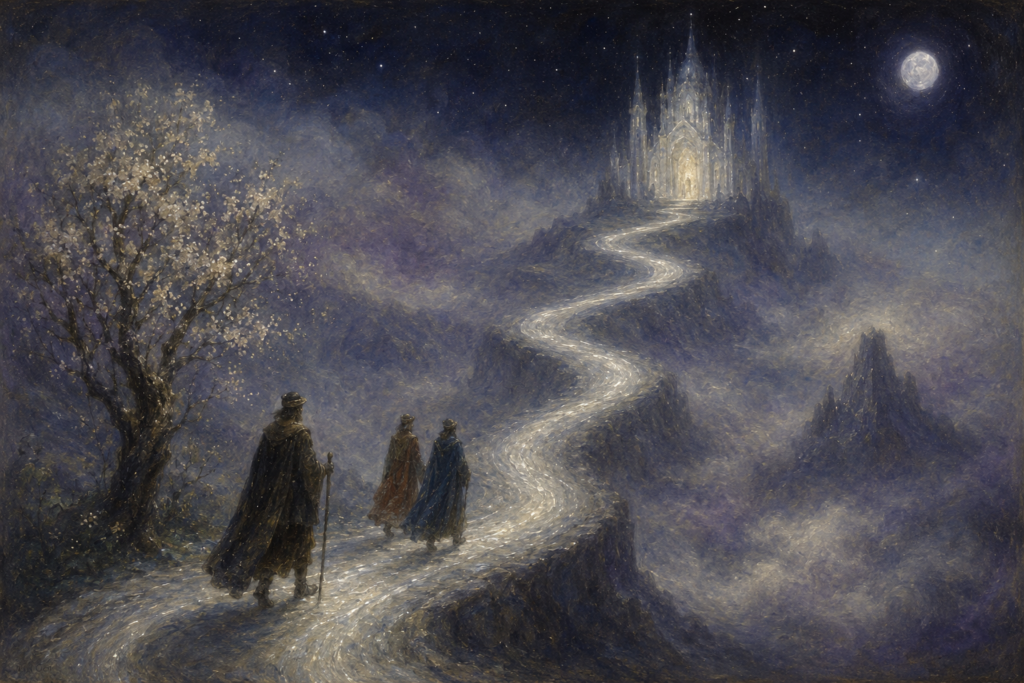
The Silver Roads
Silver Roads appear most readily beneath travellers who recognise that they are dreaming. They can resemble moonlit highways, threads suspended over an abyss, stairways in empty sky, rivers flowing uphill, lines of polished coins or a chalk path across a childhood courtyard.
They are the nearest thing Oneirion possesses to dependable roads, yet they still obey significance rather than spoken directions. A route may lead toward the truth necessary to reach a destination rather than toward the destination itself.
Road markers frequently take the form of names, songs, recurring images or deeply personal symbols. Destroying a marker may not break the road; it may instead make travellers forget why they were following it.
The Gates of Horn and Ivory
The Gate of Horn opens toward dreams containing a real truth: warning, revelation, healing insight, divine message, prophecy or a symbolic statement of something the waking mind cannot yet express.
The Gate of Ivory opens toward persuasive falsehood: comforting lies, corrupted omens, temptations, nightmare prisons and visions engineered to replace judgement with certainty.
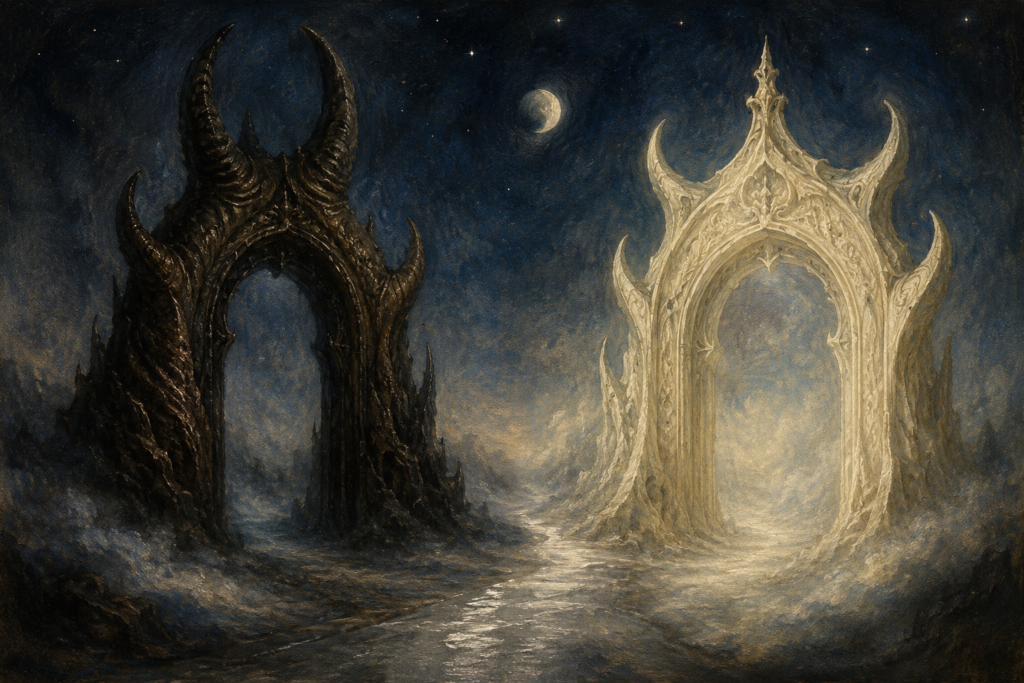
Neither Gate possesses one permanent architectural form. Travellers may find paired doors, masks, towers, roads, horns, mirrors or monumental arches beneath a moon.
Oneiroi are closely associated with both thresholds but neither own nor universally control them.
Crossing Horn does not make a vision literal, while Ivory dreams often become most dangerous when they appear helpful, coherent and emotionally satisfying.
The Dreamwell
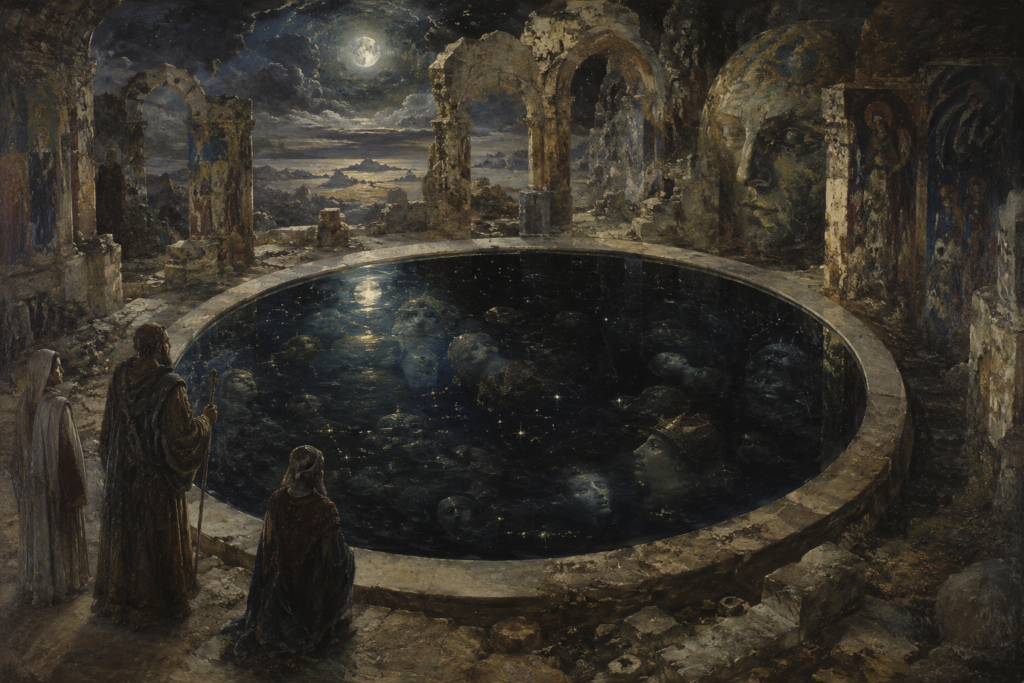
The Dreamwell is a black-silver depth into which forgotten dreams seem to fall. Its shores may resemble ruined gardens, an abandoned observatory, bare stone, submerged stairs or a courtyard whose shadows all point toward the water.
Diviners seek it for erased names, stolen memories, buried prophecies and visions deliberately concealed by rulers, sorcerers, gods or dying seers.
Nothing recovered from the Dreamwell is entirely free. Drawing out a memory or truth commonly requires surrendering a certainty, secret, cherished falsehood or memory that the Well can keep in exchange.
The Whispering Orchard
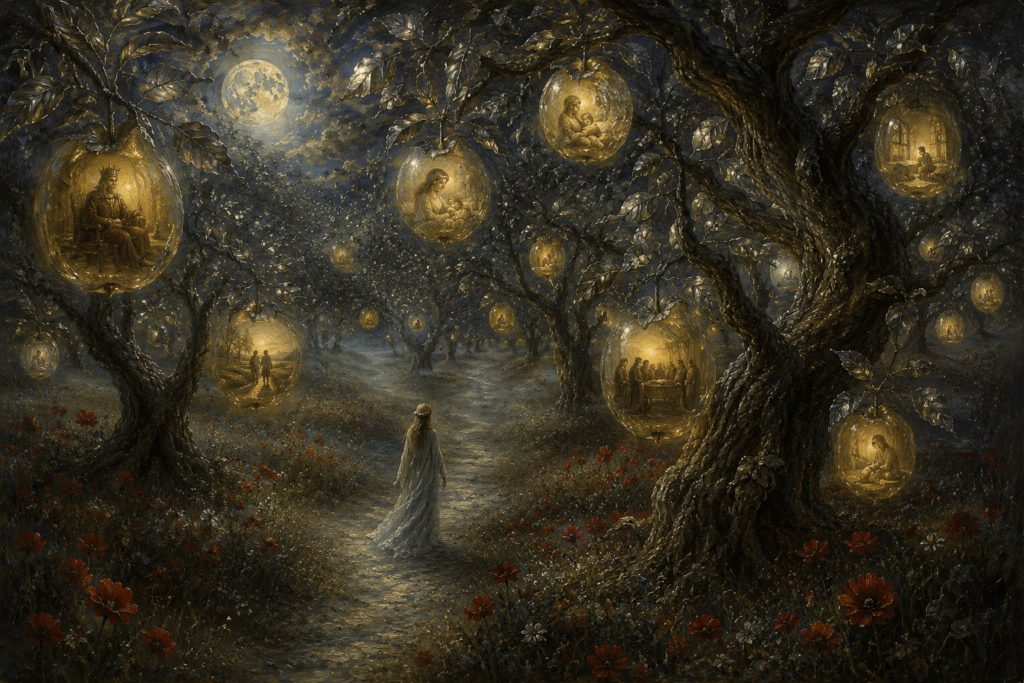
Every fruit in the Whispering Orchard contains a memory—or something capable of imitating one perfectly.
A pear may contain the first face a traveller remembers seeing. A dark plum can preserve the final dream of a dead soldier. An apple might contain the childhood of somebody sleeping hundreds of miles away.
Some fruits restore genuine memories. Others transfer experiences, reveal events never personally witnessed or offer an exquisitely constructed false past that the eater desperately wishes had been real.
The branches whisper names, unfinished conversations and half-remembered songs before anybody reaches for the fruit.
The Glass Reversal
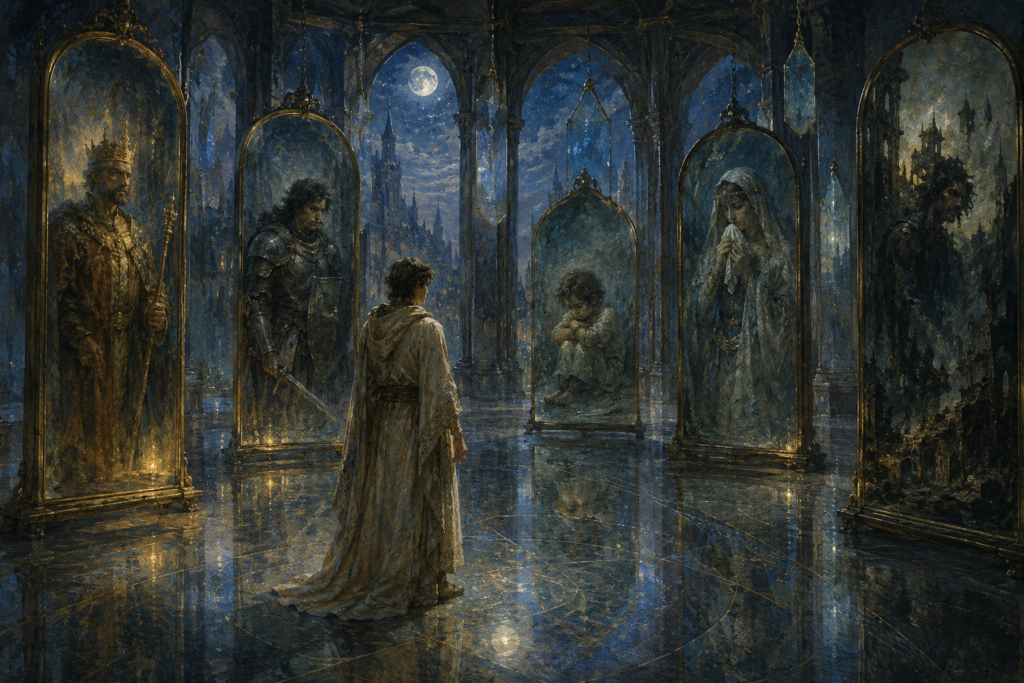
The Glass Reversal is built from mirrored halls, reversed rooms, black water and reflections that continue moving after their originals stop.
Travellers encounter identities they hide, fear or refuse to acknowledge: coward, tyrant, child, lover, beast, victim, conqueror, traitor or corpse.
The Reversal is not an infallible moral court. A reflection may reveal a genuine failing, a fear mistaken for fate or a possible future that becomes less likely once recognised.
Breaking the glass seldom resolves the problem as effectively as accepting, rejecting or disproving what the reflection claims.
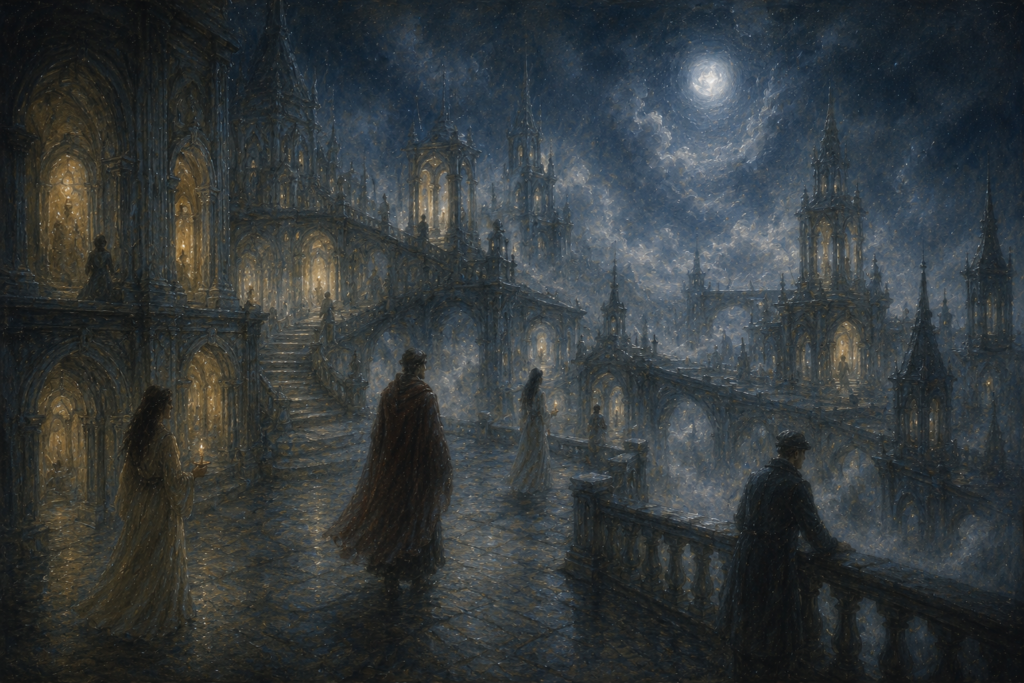
The Court of Sleepwalkers
The Court is a drifting city assembled from places remembered by its inhabitants. A Venetian balcony may overlook a northern timber hall, while a Parisian lane ends at a castle gate destroyed centuries ago.
Some citizens possess living bodies that remain asleep in the waking world. Others are remnants accidentally left behind when a dreamer escaped. A few have existed here for so long that nobody can establish whether they ever possessed a waking body.
The Court trades in names, memories, messages, routes and waking objects. Its factions include those desperate to return, those convinced waking life was the lesser dream and those who profit from guiding newcomers farther inward.
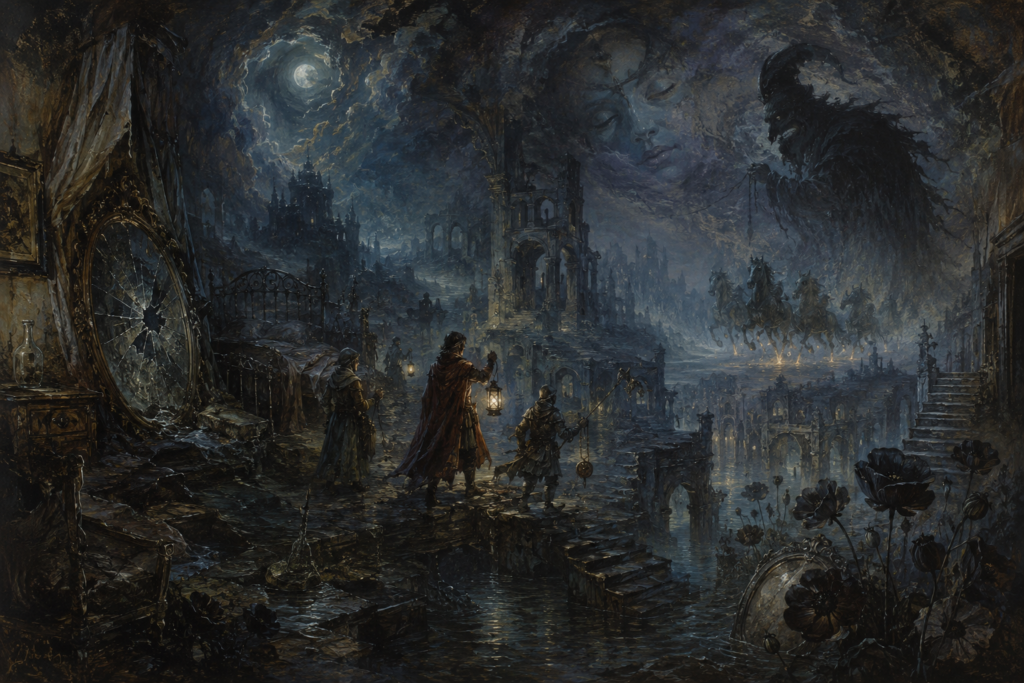
The Nightward
The Nightward is the dark pressure beneath ordinary dream. Nightmares accumulate until private fear becomes geography: ruined bedrooms, endless corridors, burning stables, flooded sanctuaries, childhood cellars and battlefields that repeat until somebody refuses the role imposed upon them.
Sandmen, Thought Eaters, Id Manifestations, predatory Ivory-current Oneiroi and other established nightmare predators are drawn toward its deeper regions.
Fear can also generate temporary monsters and environments. Such manifestations are components of the active nightmare rather than automatically representing new independent species.
Innocent people can fall into the Nightward while cruel people sleep peacefully. It is dangerous because repeated fear has acquired enough reality to defend its own continued existence.
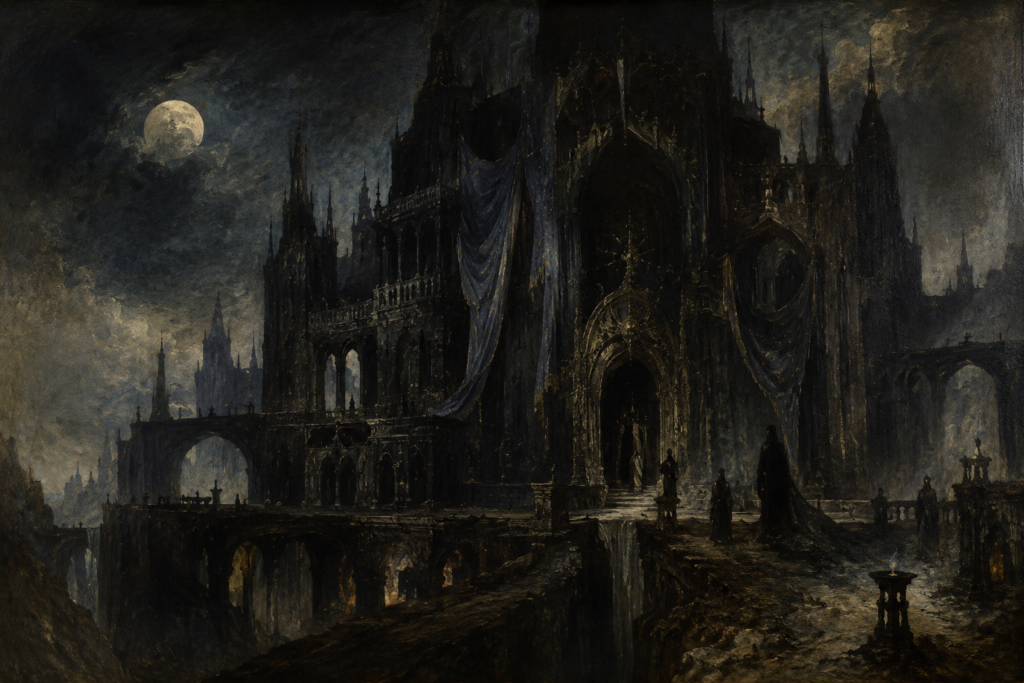
The Palace of Night
The Palace is a black fastness glimpsed where deep dream approaches shadow, death-vision and primordial Night.
Scholars disagree whether every traveller encounters the same structure or whether Oneirion repeatedly constructs a similar palace whenever nightmare becomes organised enough to resemble sovereignty.
Ivory-current Oneiroi, envoys, dream-jailers and possessing powers gather within galleries of false bedrooms, sealed doors, silent halls and empty thrones prepared for rulers who have not yet arrived.
Some Ivory spirits use the Palace as the centre of elaborate false awakenings, persuading a sleeper that they have escaped when they have actually entered a more disciplined layer of the nightmare.
The Palace is not Hypnos’s home, the capital of Oneirion or the universal court of the Oneiroi. It is a dangerous frontier where nightmare, false sovereignty, Shadow and death-adjacent visions become unusually stable.
Inhabitants of Oneirion
Not every figure appearing in a dream is a separate creature. Some are temporary components of the dream itself. Others possess sufficient identity, memory and will to survive after the scene around them dissolves.
Oneiroi
The characteristic independent dream spirits of Oneirion, carrying true warnings, false visions, prophecy and divine messages through sleeping minds.
They may work with Hypnos, Morpheus or other powers, but no god universally owns the race.
Sandmen
Sleep-haunting beings associated with dreamdust, stolen rest, memory and nightmare.
Nightmares
Fire-and-shadow steeds whose passage through hostile dreamlands commonly signals pursuit, captivity, infernal intervention or war.
Thought Eaters
Psychic predators attracted to exposed memories and vulnerable consciousness. Their strong Ethereal affinity does not prevent them from hunting where dream and memory provide suitable prey.
Id Manifestations
Subconscious drives made independently monstrous: appetite, fear, rage, envy, shame and survival stripped of ordinary restraint.
Alps
Nightmare demons that oppress sleepers and exploit cursed sleep, sleep-paralysis and fear-heavy borders between waking and dreaming.
Sleepwalkers
Mortals who have lost the route back to waking. Some still possess living bodies; others are remnants left behind after the rest of the person returned.
Dream-Echoes & Dream-Petitioners
Final dreams, unfinished desires, persistent death-visions, stolen memories or self-aware fragments capable of surviving the end of the dream that produced them.
A sleeping mortal’s dream-form is likewise not automatically identical to their soul. The consequences of harm depend upon the method by which the traveller entered Oneirion.
Oneirion and Earth in 1454
Few people on Earth use the scholarly name Oneirion, yet almost everybody touches its outer shallows through sleep.
In 1454, dreams matter in courts, villages, universities, military camps, workshops and magical practice because experience has established that some dreams are more than private fancy. The difficult problem is determining which.
Dreams of Kings
Rulers consult astrologers, physicians, diviners and learned advisers about recurring nightmares and ominous visions. A dream preceding a succession crisis can change alliances before anybody knows whether it passed through Horn or Ivory.
The Night Before Battle
Commanders fear shared dreams because panic can defeat an army before the first trumpet. A genuine warning may save thousands; an engineered Ivory vision can ruin a campaign without a battle.
Natural or Supernatural Sleep
Physicians, herbalists and learned practitioners distinguish ordinary sleep, exhaustion, fever-dream and poisoning from magical unconsciousness, possession, stolen dreaming or a sleeper whose consciousness has crossed dangerously far into Oneirion.
Devotees of Hypnos have particular expertise in destructive sleeplessness, ritual sleep, protected dream travel and restoring sleepers trapped beyond the Veil.
Their knowledge overlaps medicine, herbalism, astrology, natural philosophy and learned magic rather than existing as an isolated “wizard school.”
Plague Dreams
Districts scarred repeatedly by mass death may produce persistent shared nightmares. Survivors dream the same streets, bells and returning dead, gradually establishing routes into deeper dreamlands long after the waking outbreak ends.
Impossible Inspiration
Painters, poets, architects, scholars and musicians sometimes awaken with images or ideas they cannot consciously explain. Most are ordinary dreams. Some are fragments carried from deeper Oneirion.
Dream-Walkers
Practitioners employ controlled sleep, mirrors, poppy preparations, memory tokens, names, sympathetic correspondences and magical geometry to approach the dreams of another person.
Experienced dream-walkers often fear an effortless return more than a difficult journey. False awakening remains among Oneirion’s oldest traps.
Houses, prisons, battlefields and entire communities can become thin through repetition. When generations sleep beneath the same fear or repeat the same dream-story, Oneirion may continue remembering the place after its waking inhabitants have forgotten why.
Entering, Navigating and Leaving Oneirion
The danger of dream travel depends upon what actually crosses the threshold. An ordinary sleeper is not exposed in the same way as a physically present adventurer.
| Mode of Entry | Where the Body Remains | Form in Oneirion | Typical Consequence of Defeat |
|---|---|---|---|
| Ordinary Dreaming | Asleep in the waking world | Fluid dream-self | Usually wakes; fear, fatigue or a lingering Dream Scar may remain. |
| Dream Projection | Sleeping or entranced elsewhere | Stable projected self | Memory disruption, waking injury, entrapment or inability to wake. |
| Soul-Bound Travel | Body remains vulnerable | Dream-form closely bound to the soul | Serious spiritual injury, imprisonment or death where the soul-link is explicitly endangered. |
| Physical Entry | The traveller enters bodily | Actual body translated through dream logic | Injury and death are normally genuine. |
Common Ways In
Sleep, dream magic, divine summons, prophetic illness, cursed mirrors, haunted beds, fey thresholds, shadowed ruins, prepared rites and failed planar crossings can all open passages.
The safest deliberate approaches normally begin in controlled sleep and remain close to the Veil.
Passage Under Hypnos
Rites invoking Hypnos can stabilise the transition between waking and sleep.
His priests specialise in inducing safe slumber, protecting the body, recognising unnatural unconsciousness, establishing the first threshold and recalling travellers toward waking.
Physical Arrival
A waking body carries unusually strong physical certainty. Oneirion responds by interpreting that certainty symbolically. Armour may become the visible burden of responsibility, a wound may open into written words and an inherited sword may cut only while its bearer remembers who first owned it.
The equipment has not stopped existing. Oneirion is insisting that meaning has become part of its physical behaviour.
Waking Anchors
Before deliberately travelling beyond the Veil, each character should name at least one Waking Anchor: a true name, trusted companion, scar, vow, heirloom, personal token, remembered song or unmistakable memory.
Anchors are not invulnerable. An enemy can steal a token, falsify a memory, imitate an ally or convince a traveller that their true name belongs to someone else.
Oneiroi are particularly adept at attacking anchors indirectly. Ivory spirits corrupt the relationship supporting the anchor; Horn spirits may force the traveller to acknowledge an uncomfortable truth concealed inside it.
Leaving Oneirion
Most exits require restoring the traveller’s relationship with waking reality. An ordinary sleeper can wake naturally. A projected traveller may follow a Silver Road toward the Veil. Someone beside the sleeping body may call a true name or present a recognised anchor.
A Horn vision may release its subject once its truth has been received. An Ivory dream may collapse once the lie supporting it has genuinely been rejected.
Oneirion rarely traps travellers because the plane itself is malicious. Entrapment usually comes from lost identity, a broken anchor, an unresolved dream or another intelligence deliberately keeping the threshold closed.
Magic and Planar Effects
Dream Logic
Cause and effect remain meaningful, but symbols can replace ordinary tools. A locked door might require a confession instead of a key. A predator may weaken when its true name is spoken aloud.
False Awakening
Oneirion can reproduce waking life with terrifying precision. A traveller may apparently awaken at home before noticing that a scar is on the wrong side, a dead companion is making breakfast or every clock shows the same impossible hour.
Memory Drift
The longer travellers remain, the more easily their memories become available to the plane as scenery. Secrets become locked rooms, guilt becomes weather and former companions wait at crossroads.
Nightmare Pressure
Repeated panic, failed attempts at control and damaged anchors teach a hostile dream how to resist its visitors. Deep in the Nightward, environment itself can become the principal antagonist.
Magic in Oneirion
Illusion, divination, enchantment, sleep, dream, memory, prophecy and mind-affecting magic harmonise naturally with the plane.
Other magic still functions unless a particular region establishes a contrary rule, but Oneirion may express an effect symbolically. Fire may burn a lie more easily than a stone wall. Lightning may pursue an oath-breaker. A summoned creature might arrive wearing imagery drawn from the caster’s expectations.
Running Oneirion by Edition
The cosmology above is system-neutral. The rules below provide a shared framework for Waking Anchors, lucid manipulation, Nightmare Pressure, false awakening and dream injury.
Plane of Dreams — D&D 5.5e / 2024
- Plane: Transitive
- Gravity: Subjective or variable
- Time: Variable
- Reality: Dream-responsive
Waking Anchor
When a character deliberately enters Oneirion, have the player name one Waking Anchor.
While the character remembers and trusts the anchor, they have Advantage on saving throws made specifically to resist dream entrapment, forced memory alteration, false awakening, nightmare possession or effects that make them forget the route back to waking reality.
If the anchor is stolen, convincingly falsified or forgotten, the benefit ends until the character restores it.
Lucid Shaping
Once per Long Rest, a conscious character who understands that they are inside Oneirion may attempt one Lucid Shaping check.
- Intelligence interprets the dream’s structure.
- Wisdom preserves self-knowledge and rejects false assumptions.
- Charisma imposes identity and intent on the scene.
| Dream Change | DC | Example |
|---|---|---|
| Minor symbolic change | 13 | Change clothing, relight a lamp, make writing legible. |
| Useful local change | 16 | Create a door, expose a route, recall a simple object. |
| Major scene change | 19 | Turn a fall into stairs, halt a crowd, reshape a room. |
| Dangerous or contested change | 22 | Break a nightmare role or radically alter hostile terrain. |
Nightmare Pressure
Begin a dangerous nightmare at 0 Pressure. Add 1 whenever a meaningful failure strengthens the nightmare.
- 3 Pressure: the environment closes a route or adopts a hostile rule.
- 6 Pressure: a major manifestation or appropriate established predator enters.
- 9 Pressure: the nightmare attempts decisive entrapment, separation, possession or identity rewriting.
Reduce Pressure by 1 when the characters restore an anchor, identify the fear organising the scene, reject a false role, rescue a trapped dreamer or open a genuine threshold.
False Awakening
- DC 13: weak imitation.
- DC 15: dangerous false awakening.
- DC 18+: deliberately prepared supernatural trap.
On a success, the character detects a contradiction. On a failure, they accept the apparent awakening until strong contrary evidence appears.
Dream Scars & Defeat
| Entry | Normal Defeat |
|---|---|
| Ordinary dreaming | The sleeper normally wakes; powerful dream magic may leave a Mild Dream Scar. |
| Dream projection | Psychic injury, 1 level of Exhaustion, entrapment or a Dream Scar. |
| Soul-bound travel | The soul may be imprisoned or deeply injured where that danger has been explicitly established. |
| Physical entry | Damage and death function normally unless a specific effect says otherwise. |
Permanent destruction of a true name, relationship or major memory should never be an automatic consequence of reaching 0 Hit Points.
Plane of Dreams — Pathfinder 1e
- Plane: Transitive
- Gravity: Subjective Directional Gravity
- Time: Erratic
- Alignment: Mildly neutral-aligned
Waking Anchor
A traveller maintaining a trusted Waking Anchor gains a +2 circumstance bonus on Will saves and relevant skill checks made specifically to resist dream entrapment, false awakening, memory alteration, nightmare possession or becoming lost within Oneirion.
Lucid Alteration
| Dream Change | DC |
|---|---|
| Cosmetic or symbolic change | 15 |
| Useful local change | 20 |
| Major scene change | 25 |
| Dangerous or contested change | 30 |
Nightmare Pressure
- 3: symbolic hazard, hostile terrain or misleading route.
- 6: suitable established creature, fear effect or major manifestation.
- 9: imprisonment, possession, separation or major dream-rewriting.
False Awakening
- DC 15: rough imitation.
- DC 20: dangerous prepared dream.
- DC 25+: major supernatural dream-prison.
Dream Injury
Ordinary sleepers normally awaken when defeated. Projected travellers may awaken fatigued, suffer nonlethal damage, take temporary ability damage or acquire a Dream Scar.
Soul-bound and physically present travellers can suffer genuine imprisonment, spiritual injury or death when the method of travel has explicitly established those stakes.
Plane of Dreams — D&D 3.5e
- Plane: Transitive
- Gravity: Subjective Directional Gravity
- Time: Erratic
- Alignment: Mildly neutral-aligned
- Realm: Infinite
- Morphic: Highly morphic and dream-responsive
Waking Anchor
A creature maintaining a trusted Waking Anchor gains a +2 circumstance bonus on Will saves and relevant checks against dream entrapment, forced memory alteration, false awakening, nightmare possession and effects that would make the traveller lose the road back to waking life.
Lucid Alteration
| Dream Change | DC |
|---|---|
| Cosmetic or symbolic change | 15 |
| Useful local change | 20 |
| Major scene change | 25 |
| Dangerous or contested change | 30 |
Nightmare Pressure
- 3: the environment acquires a hostile symbolic rule.
- 6: an established predator or major manifestation appears.
- 9: the nightmare attempts to trap, possess, separate or rewrite a traveller.
False Awakening
- DC 15: imperfect imitation.
- DC 20: strong nightmare.
- DC 25+: major prepared dream-prison.
Dream Injury & Death
Ordinary dreamers normally awaken when defeated. Projected dreamers may wake fatigued, take nonlethal damage, suffer temporary ability damage or retain a Dream Scar.
A physically present character can die normally. Soul-bound travel can inflict genuine spiritual injury when the method of entry specifically establishes that danger.
d12 Oneirion Encounters
| d12 | Encounter |
|---|---|
| 1 | A Silver Road appears beneath the party but leads toward the truth they are avoiding instead of the destination they named. |
| 2 | A Horn-current Oneiros delivers a genuine warning in the voice of somebody the characters know to be dead. |
| 3 | An Ivory-current Oneiros gives the party precisely the answer they wanted and asks for nothing in return. |
| 4 | A procession from the Court of Sleepwalkers carries candles whose flames contain stolen memories. |
| 5 | A Sandman collects dreamdust from a child’s recurring nightmare. |
| 6 | Hoofbeats approach rapidly from behind, although the road is empty whenever anybody looks back. |
| 7 | A Thought Eater begins by consuming directions and then starts feeding on the names of places. |
| 8 | An Id Manifestation rises from a fear, appetite or rage somebody insists they no longer feel. |
| 9 | The Whispering Orchard grows fruit labelled with decisions the characters distinctly remember making differently. |
| 10 | The Glass Reversal shows every traveller calmly performing one act they insist they would never choose. |
| 11 | The party awakens inside a flawless recreation of the last safe inn they visited. Exactly one detail is wrong. |
| 12 | The Dreamwell reveals the final dream of somebody the characters believe is still alive. |
Running the Plane of Dreams
Repeat Symbols
If a red door matters, let it recur. If bells mean a sleeper is near waking, establish that association before an enemy rings a false bell.
Let Interpretation Change Play
Understanding what something represents should reveal a weakness, path, choice or opportunity rather than merely decorating the scene.
Protect Player Agency
Oneirion can expose fears and possibilities, but do not invent a hidden motivation for a player character when the player has never chosen it.
Make the Impossible Testable
Surreal does not mean arbitrary. Give the characters repeated patterns, contradictions and consequences they can investigate.
Three Adventures Ready to Run
The King Who Dreams of Treason
A sleeping king names a different traitor each night. Every named noble dies before the following dawn.
An Ivory-current Oneiros has entered the royal sleep and learned to transform the king’s fear into political murder.
The characters must enter the dream, identify its false threshold and discover who benefits from teaching the crown to fear everyone around it.
The Child Without Dreams
A child once blessed by Hypnos no longer dreams. Each night more colour drains from the household, then the street and finally the surrounding quarter.
A Sandman has carried the child’s dream-anchor into the Nightward.
The child can neither wake fully nor enter proper sleep and has become a widening doorway through which dreamlessness leaks into the waking city.
Recovering the anchor solves only part of the problem. The characters must return the child to the Veil and persuade Hypnos—or a recognised servant acting with his authority—to reopen the natural passage between sleep, dream and waking before the damaged threshold becomes permanent.
The Mirror That Remembers Better
A mirror in a noble household begins reflecting crimes several days before they occur. Servants flee, relatives accuse one another and one reflected murder has already happened exactly as shown.
The Glass Reversal is leaking into waking reality. The reflections are not merely predicting the future—they are narrowing possibility until people begin performing the roles shown to them.
The party must enter the mirror-dream and discover whether the apparent future can still be refused.
Treasure From a Dream
Ordinary coins and mundane equipment rarely survive waking unless the traveller entered physically or obtained them from an unusually stable dreamland.
Knowledge & Restoration
- a true dream exposing a concealed threat;
- a stolen memory restored;
- a name released from nightmare power;
- a prophecy corrected at the Gate of Horn;
- an Ivory prophecy exposed before anyone acts upon it;
- a sleeping victim safely returned.
Dream-Bound Objects & Favours
- a dream-key capable of opening one appropriate symbolic lock;
- a charm protecting its bearer from supernatural sleep;
- a mirror shard exposing signs of false awakening;
- a memory-fruit from the Whispering Orchard;
- a favour owed by Morpheus or another dream power;
- the mercy of Hypnos for somebody trapped in impossible sleep.
Dreams as Divine Message, Deception and Threshold
Oneirion draws especially upon ancient Mediterranean traditions in which sleep places mortals near prophecy, healing, death, divine communication, inspiration and deception, while remaining broad enough to accommodate the many independent dream traditions of Earth.
Hypnos and Sleep
In Greek tradition, Hypnos personifies Sleep and is closely associated with Night, Death and the dream spirits.
Ancient traditions do not supply one universally consistent residence. Hesiod associates Sleep and Death with the house of Night; Homer connects Hypnos with Lemnos; later literature develops secluded and cavernous dwellings surrounded by silence and sleep-bearing plants.
SpiralWorlds preserves these as divine sanctuaries and manifestations without turning any of them into the cosmic origin or capital of Oneirion.
Hypnos matters here because his office is universal: countless mortal minds approach Oneirion through sleep every night.
Horn and Ivory
The ancient distinction between dreams passing through horn and ivory provides the mythic foundation for Oneirion’s truthful and deceptive dream-currents.
SpiralWorlds develops this image into recurring planar thresholds and tendencies among the Oneiroi.
Morpheus
Morpheus is especially associated in surviving Roman literary tradition with dreams capable of assuming convincing human form.
SpiralWorlds develops this into his divine office of shaping dream appearances, voices, bodies and narrative identities.
Icelos / Phobetor
Ovid distinguishes a dream spirit particularly skilled at assuming the forms of beasts, birds and serpents. The gods call him Icelos; mortals call him Phobetor.
Phantasos
Phantasos instead assumes the likeness of earth, water, stone, trees and other inanimate things, demonstrating that dream spirits need not manifest as humanoids.
Ovid and the Dream of Alcyone
The story preserved in Metamorphoses Book XI demonstrates the power of a dream taking the appearance of somebody known to its recipient.
Morpheus assumes Ceyx’s form before Alcyone so that a terrible truth can arrive in a face and voice she recognises.
Dream Planes and Dream Adventures
These external videos provide supplementary campaign inspiration. They do not define SpiralWorlds canon.
Exploring the Plane of Dreams
A broader planar-lore treatment useful for imagining dreams, thought and imagination as explorable fantasy environments.
Use Dreams in Your Campaign
A practical companion for turning dream sequences into interactive scenes, clues, decisions and adventures instead of passive exposition.
Related SpiralWorlds Entries
The wise traveller enters with a name, a companion and something worth waking for.
Keep this reference growing
If this page helped with your reading or game, you can support its upkeep or explore the curated books.
Explore the Bookshop — epics, classics and stories behind imagined worlds.