This site is games | books | films

Carceri, The Tarterian Depths

Carceri, The Tarterian Depths
Create
Carceri 3
  • Plane Type: Outer Plane.
  • Moral Tendency: Evil, with a strong chaotic tendency.
  • Primary Themes: Imprisonment, betrayal, exile, custody and failed escape.
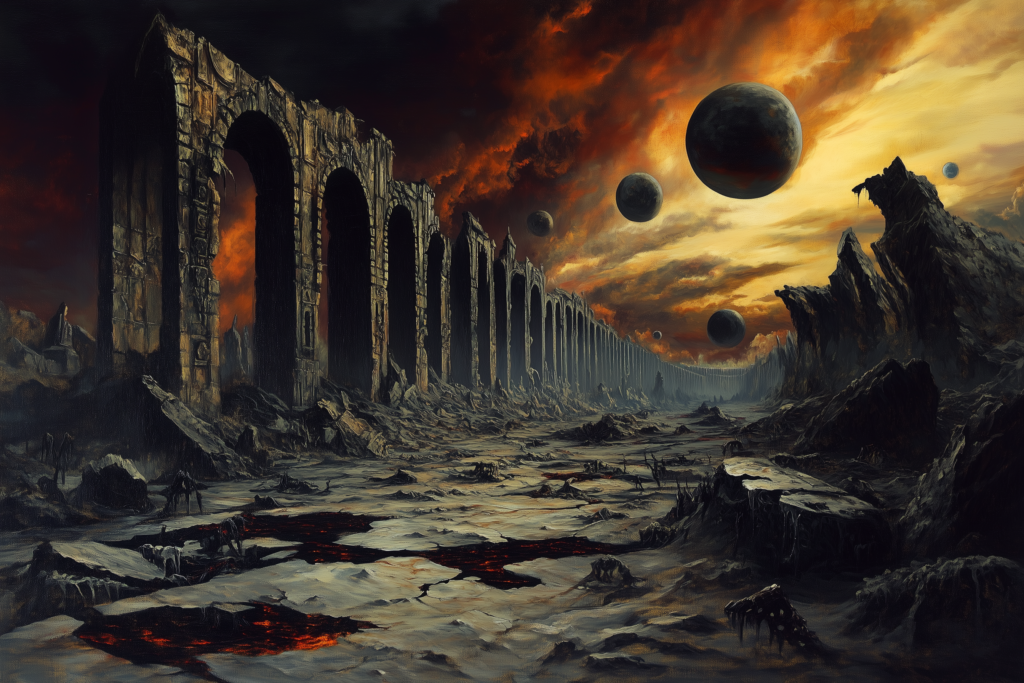
  • Structure: Six layers composed of innumerable unequal world-orbs suspended in a lightless gulf.
  • Layers: Othrys, Cathrys, Minethys, Colothys, Porphatys and Agathys.
  • Light: Dim red radiance without a conventional sun.
  • Native Outsiders: Demodands.
  • Time: Normally consistent with the Material Plane.
  • Planar Movement: Entry is easier than departure.
  • Government: No universal ruler or recognised central authority.
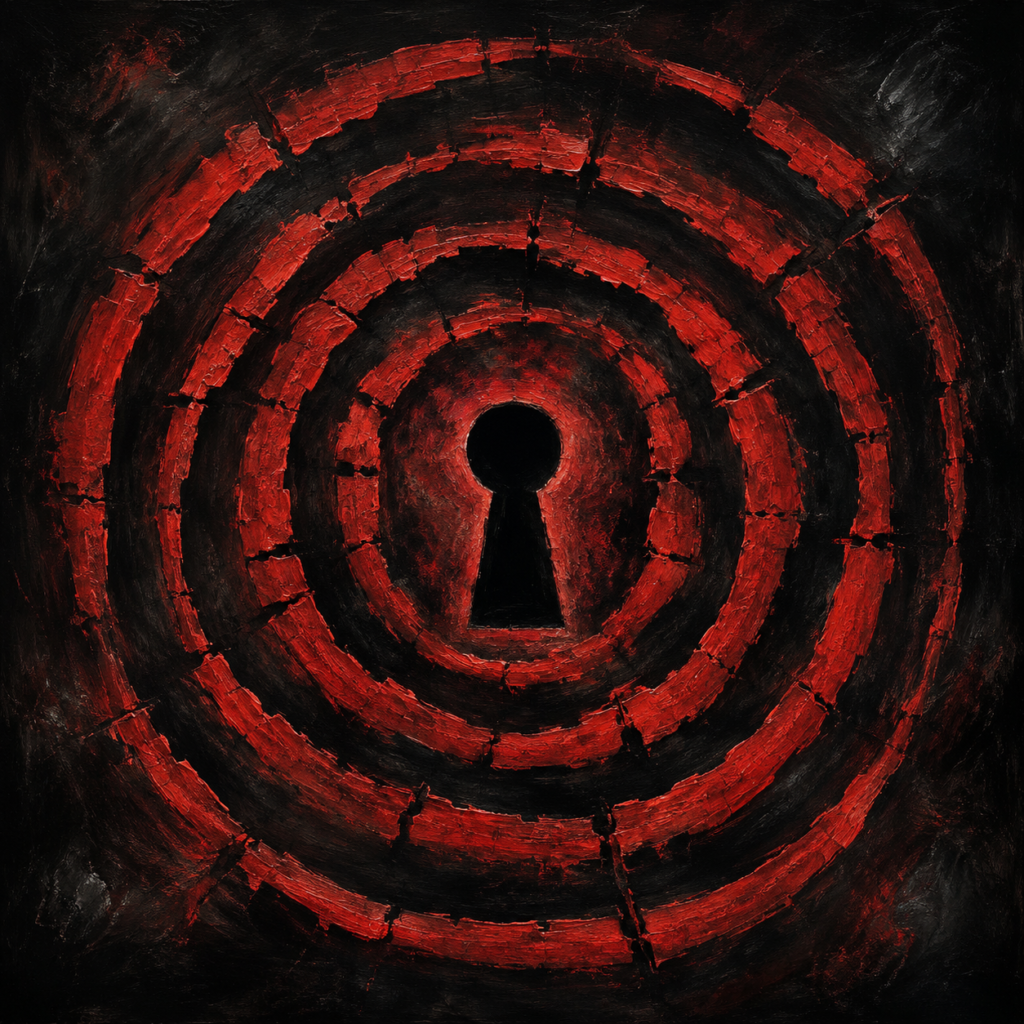
  • Planar Sigil: A black keyhole surrounded by six unequal fractured red rings.

A prison in Carceri is rarely just a cell. It may be a continent, a fortress, a jungle, a name carved into a seal, an oath accepted under duress or an entire world whose inhabitants no longer remember that another existence is possible.

Its endless prisons hold defeated powers, deposed rulers, oath-breakers, dangerous monsters, captured armies, political hostages and people condemned by authorities that could not—or dared not—destroy them.

Some prisoners deserve confinement. Some lost a war. Others were betrayed, misjudged, exchanged as hostages or abandoned when their usefulness ended.

Carceri does not determine guilt. It preserves custody.

Planar Identity

Carceri is sustained by the difference between being held and being judged.

A court attempts to establish guilt. A prison requires only that one power possesses the means to confine another. Carceri therefore attracts sentences, seals, hostages, captured enemies and unresolved claims from across the planes.

The plane does not compel betrayal. It creates conditions in which betrayal appears useful. A refuge may have room for only half a company. A gate may carry one prisoner but not their companions. A warden may offer freedom in exchange for another captive. A settlement may survive only while an ancient being remains chained beneath it.

Carceri’s evil lies in reducing people to property, bargaining pieces and mechanisms. Its chaos lies in the absence of a final authority capable of deciding who has the right to imprison whom.

Carceri in Cosmic History

Carceri is one of the later Outer Planes. It forms after the Great Collision, the Energy Planes, the Astral Plane and the rise of the Elder Gods described in the Cosmic Dawn.

By the Titan Age, Carceri has become a place where defeated powers, dangerous beings and unresolved divine enemies can be exiled or confined. Its oldest prisons predate mortal civilisation, but not the primal planes or the Astral foundations of reality.

Across later ages, gods, rulers, outsiders, magical orders and mortal civilisations add new prisons to its world-orbs. Some still serve their original purpose. Others continue operating long after the authority that created them has vanished.

The World-Orbs

Each layer of Carceri contains innumerable world-orbs suspended in an immeasurable black gulf.

The orbs are not equal. One may support a single fortress, while another contains oceans, mountain ranges and nations whose inhabitants believe their world to be the whole of existence. Their curvature is not always visible from the surface.

Most inhabitants live upon the outer surfaces of the orbs. Each sphere produces its own gravity. Travellers crossing between them feel competing pulls before reaching the point at which one world’s gravity yields to another.

Falling into the gulf is not necessarily fatal, but rescue may be impossible without flight, magic, a vessel or a passing conjunction. A creature may drift for days between spheres while remaining unable to reach either.

The world-orbs cast a muted red radiance across one another. There is no ordinary sun. Distance, weather and the movement of neighbouring spheres create periods resembling dusk and night.

The arrangement of the orbs changes slowly. Two spheres may approach closely enough for bridges, ferries or portals to function for several days, then separate for centuries.

Conjunctions

A conjunction occurs when world-orbs, prison systems or layers become temporarily accessible to one another.

A conjunction may create a bridge of stone, ice or vegetation; a passage through a ruin; a gravitational crossing through the gulf; a navigable chain of debris; or a temporary portal activated by shared names, sentences or prison seals.

Settlements may prepare for a known conjunction for generations, only to discover that the expected destination has changed or that another faction now controls the crossing.

The Six Layers of Carceri

LayerEnvironmentPrimary Form of Confinement
OthrysMarshes, drowned ruins, fallen palaces and sealed divine prisonsLost authority
CathrysPredatory jungles, swamps and living entanglementsDependency
MinethysRed deserts, abrasive winds and buried citiesErasure
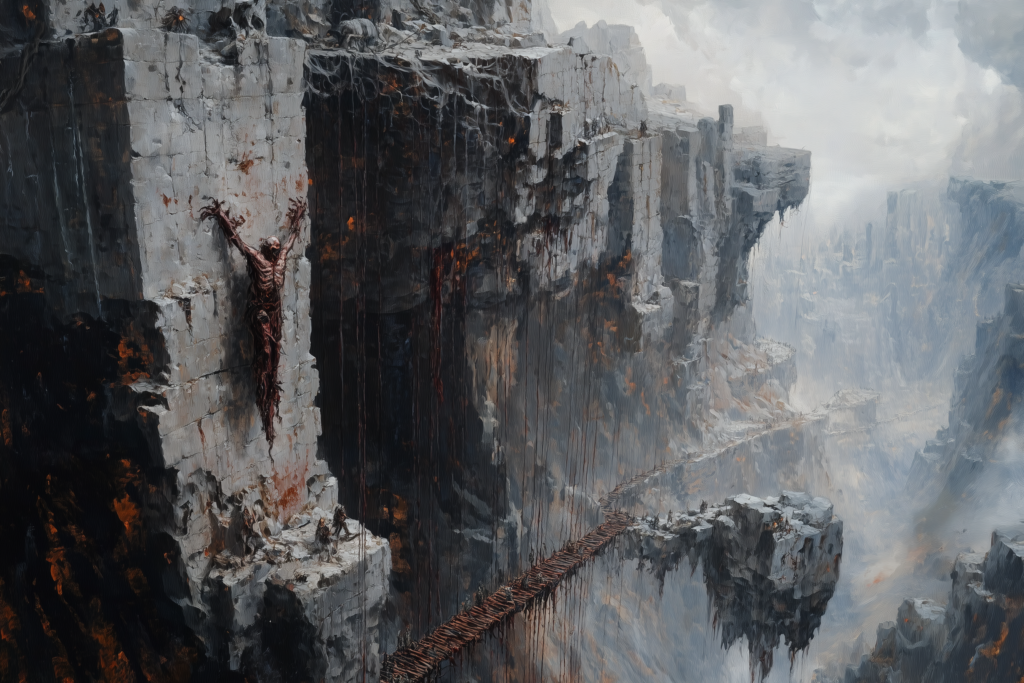
ColothysMountains, chasms and vertical settlementsExhaustion
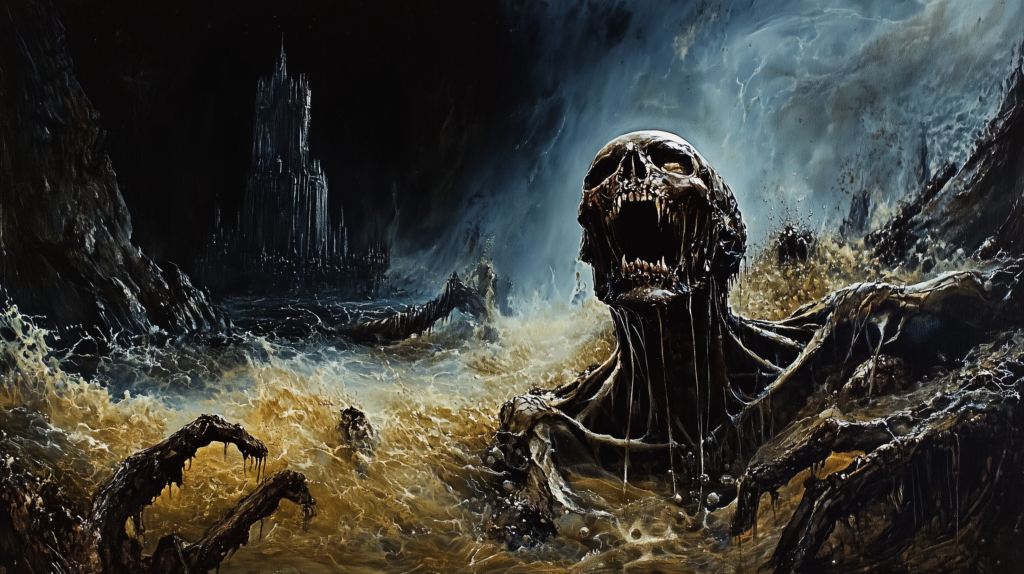
PorphatysCorrosive black waters, sleet and dissolving islandsErosion
AgathysBlack ice, buried vaults and absolute stillnessSuspension
  • Othrys (First Layer)
  • Cathrys (Second Layer)
  • Minethys (Third Layer)
  • Colothys (Fourth Layer)
  • Porphatys (Fifth Layer)
  • Agathys (Sixth Layer)
Othrys 1
Create

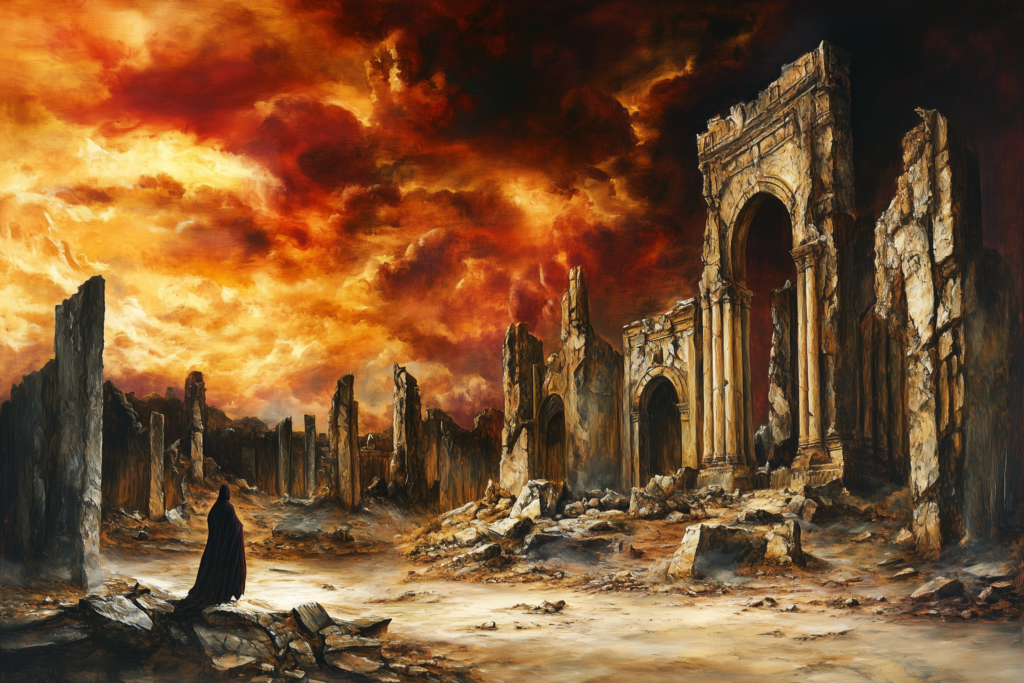
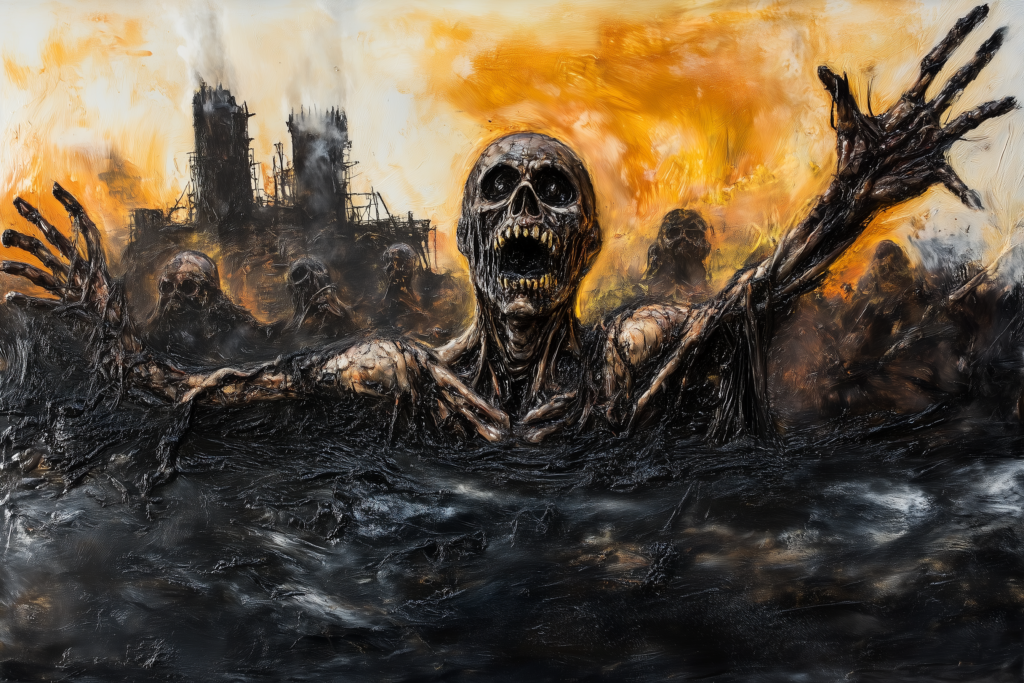
Othrys, the Ruined Exile, is the first and broadest layer of Carceri, the Tarterian Depths. Its unequal red world-orbs carry drowned roads, stagnant marshes, ruined palaces, abandoned fortresses and the diminished courts of powers that once expected to rule forever.

Othrys imprisons through lost authority. Kings still wear their crowns, commanders still issue orders and defeated powers still receive petitioners, yet every ceremony exposes the power they no longer possess. Some prisoners command nations within their world-orbs but cannot cross a single open gate beyond them.

The layer also contains Tartarus, the greatest sealed prison-domain within Carceri. Tartarus holds Cronus, defeated Titans, Typhon, condemned rulers and other prisoners bound under the settlement established after the Titanomachy.

Othrys at a Glance

  • Plane: Carceri, the Tarterian Depths.
  • Layer: First layer.
  • Primary Form of Confinement: Lost authority.
  • Environment: Stagnant marshes, drowned roads, eroded uplands, ruined palaces, prison fortresses and broken monumental landscapes.
  • Structure: Innumerable unequal red world-orbs suspended in the black gulf of Carceri.
  • Light: Dim red radiance reflected from neighbouring world-orbs.
  • Native Outsiders: Demodands.
  • Important Inhabitants: Exiled rulers, Titans, prisoner kingdoms, hag coveys, mortal communities, petitioners, refugees and escaped prisoners.
  • Principal Prison-Domain: Tartarus.
  • Named Imprisoned Power: Cronus, the Deposed King.
  • Travel: Othrys has more portals and conjunctions than the deeper layers, but wardens and prisoner states control many of them.
  • Planar Sigil: A black keyhole surrounded by six unequal fractured red rings.

Identity of Othrys

Othrys is a layer of courts that have outlived their kingdoms.

Its ruins are not empty relics. Fallen rulers occupy broken audience halls, continue ceremonies beneath collapsed roofs and grant titles over territories that disappeared ages ago. Prisoners rebuild fragments of former capitals around themselves because admitting that those realms are gone would mean accepting the full scale of their defeat.

Authority still has practical value. A recognised title may command soldiers, open a prison seal or grant passage across a world-orb. The same title may carry no meaning beyond the next marsh. An emperor in one ruined province may become an unregistered prisoner the moment they cross into another.

Othrys encourages prisoners to preserve the structures that confined them. A defeated king may become a gaoler. A former hostage may protect the keep that once barred their own escape. A refugee settlement may depend upon an imprisoned power whose release would destroy the refuge.

The layer’s central question is not whether authority exists, but whether anyone still has the right to exercise it.

Othrys in Cosmic History

By the Titan Age, Othrys already serves as a place of exile and confinement for powers that cannot safely be destroyed or reconciled. Its oldest prisons predate the Titanomachy, although many have changed wardens, names and purposes repeatedly.

The defeat of Cronus and his allies gives Othrys its most famous prison-domain. Tartarus becomes the principal prison of the defeated Hellenic powers under the settlement enforced by Zeus and the victorious Olympians.

Uranus had cast the Cyclopes and the Hundred-Handed Ones into Tartarus. Cronus left them confined after overthrowing Uranus. Zeus later released them and secured their aid during the Titanomachy. After the war, the three Hundred-Handed brothers—Briareus, Cottus and Gyges—became wardens of Tartarus’s most important gates.

Later gods, rulers, outsiders, magical orders and mortal authorities add their own prisons to Othrys. Some follow the Hellenic model. Others are hostage keeps, sealed palaces, military camps or entire settlements whose inhabitants inherited the sentence of a former ruler.

The World-Orbs of Othrys

Othrys consists of innumerable unequal world-orbs suspended in the lightless gulf of Carceri.

Some are small enough that a traveller can see their curvature from a high tower. Others hold mountain ranges, inland seas and rival kingdoms. Their outer surfaces carry normal gravity, although the pull changes near conjunctions and crossings between neighbouring spheres.

Othrys has more frequent conjunctions than the deeper layers. Two world-orbs may draw close enough for ruined towers, roots, chains or temporary bridges to connect them. A crossing can remain open for hours, years or generations before separating without warning.

Many settlements build around predicted conjunctions. Their calendars record the approach of neighbouring world-orbs rather than seasons. A gate that returns every seventy years may support an entire ruling house, ferry guild or demodand prison administration.

The dim red light makes distance difficult to judge. A neighbouring world-orb may appear close enough to touch while remaining hundreds of miles away across the gulf.

Travel Between World-Orbs

Travellers move between world-orbs by:

  • temporary conjunction bridges;
  • ferries capable of crossing the black gulf;
  • chains anchored to approaching spheres;
  • fixed portals maintained from outside Carceri;
  • prison gates linked to another recognised custody site;
  • flight or planar magic;
  • gravitational crossings where the pull of two world-orbs briefly overlaps.

Crossing is rarely a purely geographical problem. A bridge may be open but controlled by a warden. A ferry may carry only registered prisoners. A portal may recognise a title rather than the individual using it.

Regions of Othrys

The Drowned Causeways

Carceri 4

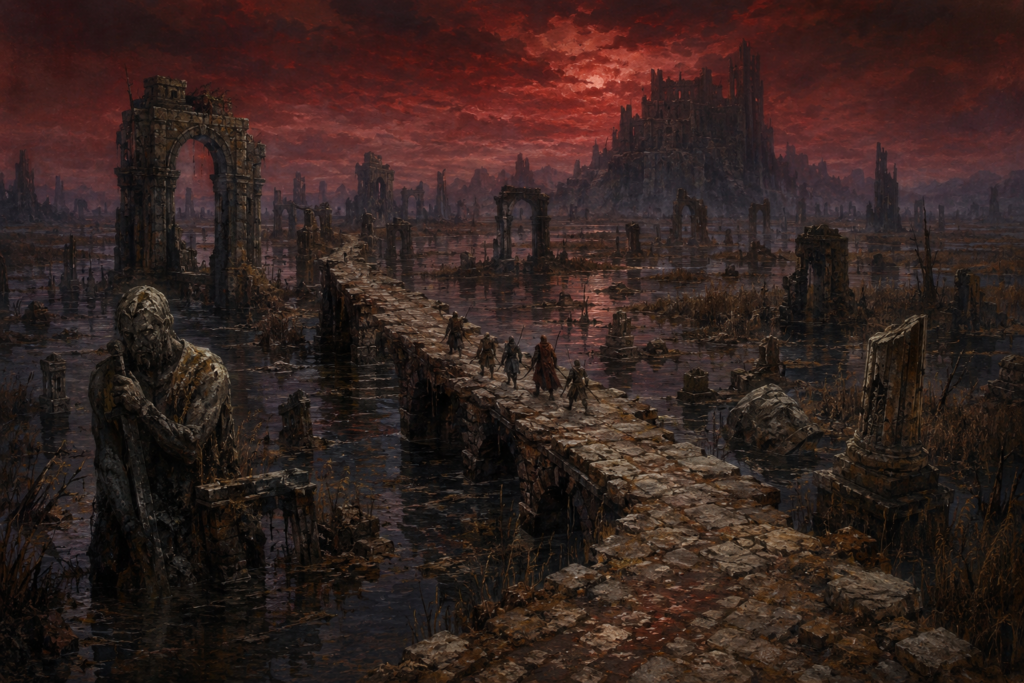
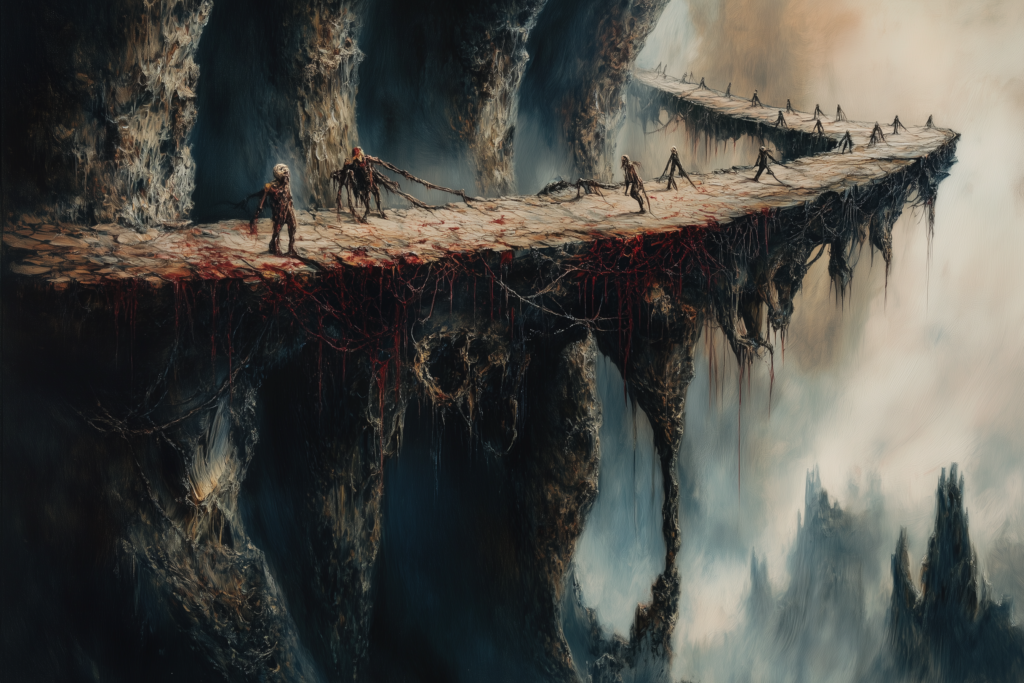
The Drowned Causeways cross a wide family of marsh-covered world-orbs. Sections of monumental road emerge from black water, run between ruined arches and vanish beneath reeds or silt.

The roads once connected palaces, military camps and ceremonial cities. Their builders disagreed over who possessed the right to use them, and those disputes survived the collapse of the kingdoms they served.

Causeway stations now function as toll forts, refugee shelters and demodand inspection posts. Some demand coin. Others demand names, testimony, hostages or proof that a traveller is not escaped property.

The submerged sections are often safer than the visible roads because patrols watch the remaining stone. Local guides travel through waist-deep water, marking stable footing with reeds that they remove behind them.

The Fallen Courts

The Fallen Courts occupy the broken palaces of rulers who retained followers after exile.

Each court preserves its own ceremonies, titles and version of history. One monarch may claim to rule every world-orb visible from the palace balcony. Another may insist that the war responsible for their exile has not formally ended. A third may conduct daily audiences for subjects who died generations ago.

These courts remain political powers. They maintain troops, negotiate marriages, exchange hostages and control routes through their territories. Some offer sanctuary to new arrivals in return for service. Others classify every visitor as a subject and refuse to recognise departure without royal permission.

The most dangerous courts are not necessarily the cruelest. A fair and stable ruler may still possess no legitimate right to hold the population inherited with the prison.

The Marsh of Broken Standards

Thousands of military standards rise from the Marsh of Broken Standards. Some mark the positions where armies surrendered. Others identify regiments, noble households and prisoner companies transported to Othrys after forgotten wars.

The standards retain fragments of the authority invested in them. Soldiers may still recognise commands issued beneath their former banner. An oath sworn while touching one may bind the speaker to an army that no longer exists.

Prisoner communities recover standards to establish legal identity, prove service or challenge inherited sentences. Demodands collect them because possession of a recognised banner can grant authority over every surviving member of the force it represented.

The marsh preserves armour, bodies and sealed orders beneath its dark water. Recovering evidence from it can free an entire company or establish that a celebrated surrender was betrayed.

The Hostage Keeps

The Hostage Keeps are fortress-prisons built upon rocky islands above the marshes. They hold heirs, diplomats, commanders, divine servants and descendants of people exchanged under ancient treaties.

Some hostages receive comfortable apartments, servants and ceremonial honours. Others have never seen the authority supposedly guaranteeing their safety. Whole families have been born in the keeps and taught that their continued confinement prevents a distant war.

The wardens maintain meticulous records of names, titles, marriages and inheritances. A hostage released under the wrong title may remain bound. A child may inherit a claim intended for a parent. A destroyed dynasty can leave its hostages trapped because no recognised authority remains to complete the exchange.

Hag coveys frequently operate near the keeps, selling genealogies, forged testimony and knowledge of forgotten bloodlines.

The Red Narrows

The Red Narrows form where several world-orbs pass close enough for their fields of gravity to overlap.

For several weeks during each conjunction, travellers can cross between them using chains, hanging platforms and narrow bridges. The spheres dominate the sky and stain everything in deep red light.

The Narrows support markets, embassies and temporary camps. Prisoner kingdoms that refuse all contact at other times send representatives here to trade food, metal, maps and release rights.

When the conjunction ends, bridges tear free, buildings split between world-orbs and anyone caught in the central region falls into the gulf. Local calendars are accurate, but factions sometimes falsify them to strand rivals.

The Reed-Crown Refuge

The Reed-Crown Refuge stands inside the roofless remains of an immense audience hall. Its inhabitants cultivate floating gardens in the surrounding marsh and weave a crown of fresh reeds each year for the empty throne.

The refuge recognises surrender, sanctuary and parole. Weapons are sealed rather than confiscated, and every prisoner receives written terms of custody. The community refuses hereditary sentences and does not recognise claims transferred without the subject’s consent.

Its protections depend upon a bound being beneath the palace foundations. The prisoner warms the water, discourages predators and prevents demodands from approaching openly. Most inhabitants know that the being is imprisoned. Few agree about what would happen if it were released.

The Last Audience

The Last Audience is a city built around a palace where an unnamed ruler continues to receive petitions.

No visitor sees the ruler directly. Requests pass through layers of chamberlains, advocates, scribes and inherited offices. Orders emerge bearing a seal recognised by prisons across several world-orbs.

Some believe the ruler died long ago and the administration now produces decrees to preserve itself. Others believe the throne is occupied by a prisoner incapable of speaking except through the machinery of the court.

The Last Audience is the best place in Othrys to challenge a custodial claim through paperwork, testimony and precedent. It is also the easiest place to become trapped inside an appeal that lasts for generations.

Tartarus

Tartarus is the greatest sealed prison-domain within Othrys. It is not another name for the entire layer.

Its gates, chasms, walls and individual sentences hold gods, Titans, monsters and mortals condemned under the ancient Hellenic settlement. The domain has its own laws of confinement, its own wardens and its own routes. A traveller may cross Othrys without entering Tartarus, while a prisoner of Tartarus may be unable to pass through an open gate.

Tartarus is older than the Olympian victory. Uranus confined the Cyclopes and the Hundred-Handed Ones there. Cronus left them imprisoned after overthrowing Uranus. Zeus later freed them during the war against Cronus. After the Titanomachy, Tartarus was expanded and reinforced to hold the defeated Titans and other enemies of the new Olympian order.

The Outer Gates

The Outer Gates stand between Othrys and the Hellenic prison-domain. They do not occupy one permanently accessible location. A traveller reaches them by approaching with a sentence, prison key, recognised prisoner or formal permission.

The gates are watched by Briareus, Cottus and Gyges, the Hundred-Handed Ones. Their duty is to maintain the settlement that ended the Titanomachy, not to punish every creature they encounter.

They can permit entry, deny release, recognise an authorised transfer and respond to a broken seal. They are divine-scale wardens capable of overwhelming armies, but conversation, evidence and exact wording matter more at their gates than combat.

An encounter with one of the Hundred-Handed Ones normally concerns testimony, prison claims, unauthorised transfers or the consequences of a failing seal. Direct battle is a divine-scale event rather than an ordinary level-20 encounter.

The Palace of the Titans

The Palace of the Titans is the prison-court of Cronus.

The palace preserves the scale and ceremony of his former kingship. Colossal halls accommodate Titan households, petitioners and servants. Empty thrones bear the names of allies, children and rivals. Every audience reminds Cronus that the court exists inside a prison established by those who defeated him.

Cronus remains immensely powerful. His confinement depends upon seals, defeated claims and the settlement of the Titanomachy rather than physical weakness. He can command followers within his domain, influence prisoners and offer bargains, but his power does not grant him freedom.

Visitors may be treated as diplomats, spies, potential servants or tools through which Cronus can act beyond Tartarus. He offers restoration, wealth and authority more readily than simple violence. Every gift strengthens a relationship through which he may later claim influence.

Other defeated Titans and their households occupy lesser courts around the palace. Some remain loyal to Cronus. Others blame him for their defeat and seek agreements that would free them without restoring his rule.

The Prison of Typhon

Typhon is confined beneath a prison landscape of crushed mountains, volcanic fissures and storm-filled caverns.

The prison converts his movement into tremors, eruptions and violent weather rather than allowing him to rise. Serpentine shapes appear beneath the rock when he struggles. Fire and poison escape through fractures that demodand crews and divine servants continually reseal.

Adventures around his prison concern damaged seals, stolen fragments, released offspring, cult activity and the choice between repairing a prison or changing the conditions sustaining it.

The Individual Sentences

Tartarus contains punishments built around specific crimes, oaths and acts of defiance. These prisons are smaller than the Titan domains but often more difficult to alter because each repeats the logic of the original sentence.

  • Sisyphus: His hill, boulder and repeated labour form a closed prison mechanism. Sisyphus continually studies its wording and searches for someone clever enough to create a genuine exception.
  • Tantalus: He remains surrounded by food and water that withdraw whenever he reaches for them. His prison tests desire, entitlement and the willingness of visitors to interfere.
  • Ixion: His burning wheel turns through a chamber of smoke and reflected fire. Its chains bind him to the consequences of murder, betrayed hospitality and his offence against Zeus and Hera.
  • Tityos: His vast body lies stretched across a prison plain while scavenging birds return to continue his sentence.
  • Salmoneus: His ruined court preserves the instruments with which he imitated thunder and demanded divine honours. He still claims that performance and rulership made his authority legitimate.
  • Pirithous: The king remains bound by the consequences of entering the realm of the dead to seize Persephone. Loyalty, courage and hubris all form part of his prison claim.

These prisoners are people with motives, intelligence and agency. Their sentences do not turn them into scenery. They may negotiate, lie, repent, manipulate visitors or challenge the legitimacy of the authority holding them.

Inhabitants and Powers

Demodands

Demodands are Othrys’s principal native outsiders.

They patrol causeways, register prisoners, control ferries and seize abandoned fortresses. Their authority is self-appointed in some territories and inherited from vanished jailers in others.

Tarry demodands serve as marsh patrols and direct enforcers. Their adhesive bodies make them particularly effective at preventing flight across unstable ground.

Stringy demodands occupy bogs, narrow prison corridors and ruined chambers where their bodies can restrain fugitives.

Shaggy demodands control larger prison administrations, negotiate transfers and manipulate rival prisoner states. They prefer recognised custody over a captive to reliance upon walls alone.

Demodands do not form one unified government. Rival wardens dispute ownership, steal keys and accuse one another of invalid custody.

Titans and Their Households

Titans are among Othrys’s most powerful inhabitants.

Not every Titan in the layer fought for Cronus, and not every imprisoned Titan remains loyal to him. Some maintain courts, libraries, gardens or workshops within the terms of their confinement. Others rule populations descended from servants and soldiers transported with them.

Their disputes are fought through agents, prison claims, stolen relics and attempts to alter the settlements that bind them.

Hags and Coveys

Hags and their coveys thrive in Othrys because its inhabitants trade in names, inheritances, curses and disputed authority.

Annis hags occupy ruined keeps, isolated towers and former execution grounds. They serve as gaolers, bodyguards and enforcers for prisoner rulers while building their own collections of prisoners.

Green hags control marsh paths, ferries, antidotes and hidden approaches to conjunction sites. They rarely offer false information when a carefully incomplete truth will cause more harm.

Coveys sell proof of ancestry, identify the source of inherited sentences and locate people whose consent is needed to transfer custody. Their solutions generally move a burden rather than remove it.

Prisoner Kingdoms

Prisoner kingdoms range from stable city-states to ceremonial courts occupying a single ruined hall.

Some protect their inhabitants and negotiate legitimate agreements with neighbouring communities. Others treat everyone within sight of their palace as a subject. Several are ruled by councils formed from former hostages, soldiers or servants rather than the monarch originally imprisoned there.

A kingdom’s inhabitants may be prisoners, descendants of prisoners, settlers or people who entered voluntarily and later lost their route home.

Refugees and Rescuers

Othrys receives refugees from deeper layers because it offers more stable portals and conjunctions. It also attracts rescuers searching for named prisoners.

Some rescuers become permanent residents after discovering that release requires a condition they cannot fulfil. Others decide that the prisoner they came to save must remain confined.

Settlements and Government

No authority rules all of Othrys.

Government is local and often tied to control of a palace, prison seal, ferry or conjunction. Common forms include:

  • prisoner councils;
  • fallen monarchies;
  • demodand wardenships;
  • hostage administrations;
  • military enclaves;
  • hag coveys controlling essential resources;
  • refuges governed by written sanctuary agreements;
  • Titan households maintaining ancient forms of service.

Stable communities publish their laws and define what surrender, parole and sanctuary mean. Predatory authorities keep their rules deliberately uncertain so that any visitor can be declared in violation.

Languages

Inhabitants retain the languages of their original peoples.

Long-isolated mortal communities may preserve archaic forms of Greek, Latin and other mortal languages. Titan and giant households use Giant alongside the languages of their former courts.

Demodands use planar languages and specialised custodial cants suited to their prison administrations. Hag coveys use the languages of the peoples they bargain with, together with private signs and ritual formulae.

Multilingual settlements rely upon interpreters, written contracts, gesture systems and witnessed translation. Deliberate mistranslation of a surrender or custody agreement can create a dangerous disputed claim.

Hazards and Survival

Drowning Marshes

Large areas of Othrys are covered by deep marsh, flooded ruins and former prison camps. What appears to be firm ground may be a thin mat of reeds and mud over several feet of stagnant water.

Submerged chains, roots, masonry and rusted weapons make falls more dangerous. Heavy rain and conjunction-driven tides can flood a passable route within minutes.

D&D 5E 2024

Intended Levels: 1–4.

A creature examining the ground can identify concealed deep mud with a successful DC 13 Wisdom (Perception or Survival) check.

A creature entering concealed mud must succeed on a DC 14 Strength saving throw or become Restrained. A Restrained creature sinks 1 foot at the end of each of its turns.

The creature can use its action to make a DC 14 Strength (Athletics) check, escaping on a success. Another creature within reach can use its action to attempt the same check and pull it free. A secured rope or pole grants Advantage.

After sinking 3 feet, a Medium or smaller creature is submerged and begins suffocating unless it can breathe water.

Pathfinder First Edition and D&D 3.5e

Hazard CR: 2.

Detection: Perception DC 15 in Pathfinder First Edition; Spot or Survival DC 15 in D&D 3.5e.

A creature entering the mud must succeed on a DC 15 Reflex save or become stuck. Escaping requires a DC 15 Strength or Escape Artist check as a full-round action.

Each failed escape check increases the escape DC by 2, to a maximum of DC 21. Three failed checks leave the creature submerged and drowning. A secured rope grants a +4 circumstance bonus.

Collapsing Causeways

The ancient roads crossing Othrys were built for armies, processions and prison transports, but centuries of flooding have undermined their foundations.

Cracked paving, leaning milestones and water flowing through the stone provide warning. Demodands, hags and bandits sometimes weaken causeways deliberately.

D&D 5E 2024

Intended Levels: 3–8.

A successful DC 15 Intelligence (Investigation) or Wisdom (Perception) check identifies an unstable section.

When at least 400 pounds enters a weakened 20-foot section, every creature upon it must make a DC 15 Dexterity saving throw. On a success, the creature reaches the nearest stable space. On a failure, it falls 30 feet, takes 3d6 Bludgeoning damage and lands Prone in flooded ruins.

A creature that fails by 5 or more is pinned beneath debris and Restrained. Escaping requires a DC 15 Strength (Athletics) check.

Pathfinder First Edition and D&D 3.5e

Hazard CR: 4.

Detection: Perception DC 20 in Pathfinder First Edition; Search or Spot DC 20 in D&D 3.5e.

Creatures on the collapsing section must succeed on a DC 17 Reflex save or fall 30 feet, taking 3d6 damage and landing Prone.

A creature that fails by 5 or more is pinned. Escaping requires a DC 18 Strength or Escape Artist check. Reaching the surviving road requires a DC 15 Climb check.

Tainted Water

Most standing water in Othrys is unsafe to drink. Marshes collect corpses, rust, sewage, rotting vegetation and waste from abandoned prisons and workshops.

Water near major seals may contain ash, poisonous minerals or traces of alchemical substances released from damaged containment works.

D&D 5E 2024

Intended Levels: 1–10.

A successful DC 14 Wisdom (Medicine or Survival) check identifies unsafe water.

A creature drinking untreated water must succeed on a DC 14 Constitution saving throw. On a failure, it has the Poisoned condition for 8 hours. If the save fails by 5 or more, it also gains 1 Exhaustion level.

Boiling the water for 10 minutes and succeeding on a DC 12 Wisdom (Survival) check makes it safe. Purification magic removes the danger automatically.

Pathfinder First Edition and D&D 3.5e

Hazard CR: 3.

Detection: Heal or Survival DC 15.

Fortitude DC 15: onset 1 hour; frequency once per hour for 4 hours; effect 1 Constitution damage and sickened for 1 hour. Two consecutive successful saves end the effect.

Marsh Gas and Dead Air

Rotting matter beneath the marsh produces pockets of poisonous or oxygen-poor gas. These collect in cellars, flooded tunnels, prison shafts and low ruins.

Dead birds, extinguished flames and sudden headaches provide warning. Some pockets contain flammable gas and explode when exposed to fire.

D&D 5E 2024

Intended Levels: 5–10.

A successful DC 15 Wisdom (Perception or Survival) check notices the warning signs.

A creature beginning its turn in the gas must succeed on a DC 15 Constitution saving throw or take 3d6 Poison damage and become Poisoned for 10 minutes. Failure by 5 or more also renders the creature Unconscious for 1 minute. It repeats the save at the end of each turn, ending the unconsciousness on a success.

Open flame or lightning ignites a flammable pocket. Every creature in a 20-foot-radius sphere must make a DC 15 Dexterity saving throw, taking 6d6 Fire damage on a failure or half as much on a success.

A strong wind disperses a 20-foot cube of gas after 1 round.

Pathfinder First Edition and D&D 3.5e

Hazard CR: 6.

Detection: Perception DC 20 in Pathfinder First Edition; Spot or Survival DC 20 in D&D 3.5e.

A creature entering the gas must succeed on a DC 17 Fortitude save or take 1d4 Constitution damage and become sickened for 10 minutes. Failure by 5 or more also causes unconsciousness for 1d4 minutes.

Open flame ignites the gas, dealing 6d6 Fire damage in a 20-foot radius, Reflex DC 17 half.

Gravitational Shear

When two world-orbs approach one another, their competing gravity makes movement unpredictable. Objects become light, slide across level ground or rise before falling towards the neighbouring sphere.

The greatest danger occurs on bridges, cliffs, ferries and exposed ruins where a sudden pull can carry travellers into the gulf.

D&D 5E 2024

Intended Levels: 7–12.

Loose stones rise and unsecured objects slide towards the approaching orb 1 round before the shear begins.

At initiative count 20, every unsecured creature in the affected area must make a DC 16 Dexterity saving throw. On a failure, it is pulled 40 feet towards the competing gravity source and falls Prone.

A creature striking a solid surface takes 4d6 Bludgeoning damage. A creature pulled beyond an exposed edge begins falling or drifting towards the neighbouring world-orb.

A secured creature makes the save with Advantage. Fixing a rope to a stable anchor requires an action and a successful DC 14 Strength (Athletics) or Dexterity (Sleight of Hand) check.

The shear lasts for 1d4 + 2 rounds.

Pathfinder First Edition and D&D 3.5e

Hazard CR: 10.

Creatures receive 1 round of warning when loose objects begin to rise.

Each unsecured creature must succeed on a DC 18 Reflex save or be pulled 40 feet and knocked Prone. A creature striking a solid object takes 4d6 damage. A secured creature gains a +4 circumstance bonus.

The shear continues for 1d4 + 2 rounds. Securing a rope requires a DC 15 Use Rope or Climb check.

Conjunction Storms

Close approaches between world-orbs disturb the weather across Othrys. Winds change direction without warning, marsh water surges across causeways and red lightning passes between the spheres.

The storms are most dangerous on ferries, bridges and exposed ruins. Flying creatures lose control, boats overturn and metal structures attract repeated strikes.

D&D 5E 2024

Intended Levels: 11–16.

Rising wind, water flowing against its usual current and loose objects drifting towards the approaching orb provide 10 minutes of warning. The storm lasts 1d4 hours.

Wind: At the end of every 10 minutes spent exposed, each creature must succeed on a DC 17 Strength saving throw or be pushed 30 feet and knocked Prone. A flying creature that fails descends 60 feet and cannot gain altitude until the end of its next turn.

Red Lightning: Once every 10 minutes, one creature wearing or carrying significant metal and every creature within 10 feet must make a DC 17 Dexterity saving throw, taking 8d6 Lightning damage on a failure or half as much on a success.

Flood Surge: A creature in the marsh must succeed on a DC 17 Strength saving throw or be swept 60 feet and become Restrained beneath debris. Escaping requires a DC 17 Strength (Athletics) check.

Pathfinder First Edition and D&D 3.5e

Hazard CR: 14.

The storm lasts 1d4 hours.

Wind: Treat as severe wind. Exposed creatures must succeed on a DC 20 Reflex save every 10 minutes or be moved 30 feet and knocked Prone.

Red Lightning: Once every 10 minutes, lightning strikes a metal-bearing creature and all creatures within 10 feet, dealing 8d6 electricity damage, Reflex DC 20 half.

Flood Surge: Strength or Swim DC 20 avoids being swept 60 feet. Failure by 5 or more leaves the creature pinned beneath debris, requiring a DC 20 Strength or Escape Artist check.

Prison-Seal Discharge

The seals surrounding major prisons contain immense magical pressure. A cracked, altered or partially erased seal may discharge without releasing the prisoner.

Fractures, pulsing light, distorted sound and rhythmic movement in nearby debris normally provide warning. Striking or dispelling a damaged seal triggers an immediate release.

D&D 5E 2024

Intended Levels: 11–16.

A successful DC 18 Intelligence (Arcana or Investigation) or Wisdom (Religion) check identifies an unstable seal.

When the seal is touched, damaged or targeted by magic without first being suppressed, every creature within 30 feet must make a DC 18 saving throw determined by the seal’s nature:

  • Force: Dexterity save; 10d8 Force damage and pushed 30 feet on a failure.
  • Fire: Dexterity save; 10d8 Fire damage and 2d8 additional Fire damage at the end of the creature’s next turn.
  • Cold: Constitution save; 10d8 Cold damage and Restrained by ice until freed with a DC 18 Strength check.
  • Storm: Constitution save; 10d8 Lightning damage and Stunned until the end of the creature’s next turn.
  • Mind: Wisdom save; 10d8 Psychic damage and Frightened for 1 minute, repeating the save at the end of each turn.

A successful save halves the damage and prevents the secondary effect.

Suppressing the seal requires three successes before two failures using DC 18 Intelligence (Arcana or Investigation), Wisdom (Religion) or Dexterity checks with thieves’ tools. Each check requires an action. A failure triggers a half-damage discharge.

After three successes, the seal remains stable for 1 hour.

Pathfinder First Edition and D&D 3.5e

Hazard CR: 16.

Detection: Perception DC 28 in Pathfinder First Edition; Search DC 28 in D&D 3.5e.

Suppression: Three successes before two failures using Disable Device, Knowledge (arcana), Knowledge (religion) or Spellcraft, DC 28.

A discharge deals 10d8 damage of the seal’s energy type to all creatures within 30 feet. Reflex, Fortitude or Will DC 22 halves the damage. A failed save also inflicts one appropriate secondary effect: pushed 30 feet, entangled in ice, stunned for 1 round or frightened for 1 minute.

Each failed suppression attempt triggers a half-damage discharge. Three successful checks suppress the seal for 1 hour.

Titan-Seal Failure

The seals containing Titans and other divine-scale prisoners are regional structures rather than ordinary traps. A serious failure creates earthquakes, violent weather, warped gravity and manifestations of the imprisoned power.

A Titan-seal failure is a three-stage complex hazard. The party must locate and stabilise three anchor points before the prison breaches.

D&D 5E 2024

Intended Levels: 17–20.

Initiative: The hazard acts on initiative counts 20 and 10, losing initiative ties.

Stage One: Locate the Anchors

The party must achieve four successes before three failures using DC 19 Intelligence (Arcana, History or Investigation), Wisdom (Perception or Religion) or Charisma (Persuasion) checks.

On initiative count 20, the seal releases one effect:

  • Earthshock: Every creature touching the ground makes a DC 19 Dexterity save or takes 6d10 Bludgeoning damage and falls Prone.
  • Gravity Break: Every unsecured creature makes a DC 19 Strength save or is hurled 50 feet and takes 5d10 Force damage.
  • Prisoner’s Voice: Every creature makes a DC 19 Wisdom save or becomes Charmed by the prisoner until the end of its next turn and must move towards the nearest anchor.

After four successes, the locations of all three anchors become known. After three failures, one anchor begins Stage Two already collapsed.

Stage Two: Stabilise the Anchors

Each anchor requires two successful DC 20 checks before it suffers two failures. Appropriate checks include Intelligence (Arcana or Investigation), Wisdom (Religion), Strength (Athletics) or Dexterity checks with thieves’ tools.

A character adjacent to an anchor can expend a spell slot of 7th level or higher to gain one automatic success. Dispel magic does not end the hazard but grants Advantage on the next check made at that anchor.

On initiative count 20, the hazard uses one Stage One effect.

On initiative count 10, the prisoner’s projection uses one effect:

  • Crushing Presence: Creatures within 60 feet make a DC 20 Wisdom save or take 5d10 Psychic damage and become Frightened until the end of their next turn.
  • World-Breaking Surge: A 100-foot-long, 20-foot-wide line erupts from the seal. Creatures in the line make a DC 20 Dexterity save, taking 10d10 Force damage on a failure or half as much on a success.
  • Command the Bound: Up to three creatures make a DC 20 Charisma save. On a failure, a creature must use its reaction to move towards an anchor and impose Disadvantage on the next stabilisation check made there.

When all three anchors are stabilised, proceed to Stage Three. If two anchors collapse, Stage Three begins with one automatic failure.

Stage Three: Reseal the Prison

The party must achieve five successes before three failures using DC 21 Intelligence (Arcana or Investigation), Wisdom (Religion) or Charisma (Persuasion) checks.

A character can gain one automatic success by sacrificing a permanent Very Rare or greater magical item to replace part of the binding.

The hazard continues acting on initiative counts 20 and 10 using the Stage Two effects.

Success: The prison reseals. The regional disturbances end over 1d6 hours, although damage to roads and settlements remains.

Failure: The prisoner gains a partial breach. A projected body, avatar or major manifestation emerges, and the region remains under violent planar disturbance until the breach is repaired.

Pathfinder First Edition and D&D 3.5e

Hazard CR: 20.

Initiative: +10.

Stage One: Four successful DC 30 checks before three failures using Knowledge (arcana, history or religion), Perception, Search or Spellcraft. Each failure triggers either a 6d10 earthshock, a 5d10 gravity surge or a Will DC 25 compulsion lasting 1 round.

Stage Two: Each of three anchors requires two DC 32 successes before two failures. Applicable checks include Disable Device, Knowledge (arcana), Knowledge (religion), Spellcraft or Strength. Expending a prepared or spontaneous 7th-level or higher spell grants one automatic success.

Each round the projection uses one effect: 5d10 psychic damage and frightened for 1 round, Will DC 26 half and negates fear; a 10d10 force line, Reflex DC 26 half; or a command effect, Will DC 26 negates.

Stage Three: Five successful DC 34 checks before three failures. Sacrificing a permanent magical item worth at least 50,000 gp grants one automatic success.

Success reseals the prison. Failure creates a partial breach and releases a manifestation appropriate to the imprisoned power.

Custodial Claims and Escape

Entering Othrys does not automatically make a traveller a prisoner.

A custodial claim requires a source, subject, maintaining condition and means of release. In Othrys, common claims include:

  • surrender under a military standard;
  • inheritance of a royal or military title;
  • transfer as a hostage;
  • service sworn to a fallen court;
  • acceptance of sanctuary under restrictive terms;
  • possession of a prisoner’s seal or true name;
  • formal inclusion in a divine or planar sentence;
  • acceptance of a gift carrying an obligation to an imprisoned power.

An open portal does not free someone whose claim remains active. Conversely, an unbound traveller may leave through a functioning portal even when nearby prisoners cannot follow.

Othrys adventures work best when characters can investigate who created a claim, what it recognises and how it can be fulfilled, invalidated, transferred or broken.

Planar Mechanics

D&D 5E 2024

Marsh Travel

Unmarked marsh, flooded ruins and broken causeways are difficult terrain. A group travelling without a local guide makes a group Wisdom (Survival) check after each significant journey.

  • DC 12: Travelled ground near a settlement or active causeway.
  • DC 15: Open marsh, flooded ruins or poorly marked territory.
  • DC 18: Active patrol territory or a route altered by a conjunction.
  • DC 21: A collapsing conjunction or approach to a major sealed prison.

On a failure, the party loses time and encounters a hazard, patrol or faction. Failure changes the route or situation rather than requiring the same check repeatedly.

Escape Magic

Teleportation within a familiar part of the same world-orb usually functions normally. Travel to another world-orb requires reliable knowledge, a conjunction, a linked circle or another established connection.

Magic that would leave Carceri fails unless it uses an active portal, external anchor, recognised key or release that addresses every custodial claim affecting the traveller.

Pathfinder First Edition and D&D 3.5e

Othrys uses Carceri’s general planar traits:

  • normal time;
  • normal or locally directional gravity;
  • infinite size;
  • slowly morphic or divinely morphic terrain;
  • mildly evil-aligned and mildly chaos-aligned where alignment traits are used;
  • impeded interplanar travel.

Unmarked marshes and flooded ruins count as difficult terrain. Survival DCs normally range from 12 near settlements to 25 around unstable conjunctions and major prison domains.

Spells and spell-like abilities used to leave Carceri, cross between layers or bypass a recognised prison are impeded.

  • Pathfinder First Edition: Concentration check, DC 20 + the spell’s level.
  • D&D 3.5e: Spellcraft check, DC 20 + the spell’s level.

On a failure, the effect does not function and the prepared spell, spell slot or use is expended.

Sample Encounters

Use these tables when the characters travel through Othrys, enter a ruined court, cross a marsh or approach Tartarus. Creature and NPC names link directly to their SpiralWorlds entries. The heading establishes the intended party tier.

Low-Level Encounters: Levels 1–4

d8EncounterComplication
1The Buried Standard: A section of marsh collapses beneath the party, exposing weapons, bodies and a military standard preserved in the mud.The standard proves that a forgotten prisoner company surrendered under terms guaranteeing eventual release, but recovering it alerts the authority still claiming custody over them.
2Flooded Prison Chamber: A causeway falls into a chamber occupied by two trapped prisoners.A demodand patrol is approaching, and each prisoner insists that the other must remain confined.
3Desperate Prisoner Band: Four bandits demand food, rope and a map.They carry a stolen warrant bearing one character’s name but another prisoner’s description.
4Dire Frog: A giant dire frog strikes from beneath a flooded road.The frog has swallowed a bronze prison key and the sealed message attached to it.
5The Bound Dead: Six skeletons rise around a fallen military standard.They stop fighting if someone raises the standard and formally accepts their surrender.
6The Prison Checkpoint: Four escaped guards occupy a ruined causeway station and demand registration papers.Their authority is false, but the papers they issue are recognised by several nearby settlements.
7Green Hag’s Ferry: A green hag controls the only boat crossing a poisonous channel.She offers free passage if each traveller truthfully names someone they betrayed.
8The Borrowed Crown: A wounded noble scion asks the party to carry a crown across a border.The crown grants authority but identifies its bearer as the ruler responsible for an inherited debt.

Mid-Level Encounters: Levels 5–10

d8EncounterComplication
1Annis Gaoler: An annis hag and four prison guards occupy a ruined watchtower.One prisoner is innocent, one is dangerous and one has magically exchanged names with the gaoler.
2Tarry Patrol: A tarry demodand and six prisoner soldiers block a causeway.Their warrant is genuine, but its names and physical descriptions have been deliberately mismatched.
3Hag Covey at the Crossing: Three green hags control a temporary conjunction.Each hag offers a different route, and only one reaches the promised world-orb.
4The Oath-Bound Company: A captain commands twelve prisoner soldiers at an abandoned surrender site.The company cannot leave until someone formally accepts its surrender and assumes responsibility for its members.
5Black Annis at the Hostage Keep: Black Annis and two ogres hold a prison archive.Destroying the archive frees several hostages but erases the only evidence proving that others were wrongfully confined.
6The Marsh Wizard: A hedge wizard and two bandits are cutting names from prison seals.The wizard claims to be freeing prisoners, but removing the names transfers their sentences to unidentified people elsewhere.
7Hostage Transfer: A tarry demodand escorts four mounted officers and a chained prisoner.The prisoner is dangerous, but the transfer documents are fraudulent.
8Conjunction Saboteurs: Two sellswords and a battle mage attempt to collapse a bridge between world-orbs.Defeating them is not enough; the bridge must be stabilised before the spheres separate.

High-Level Encounters: Levels 11–16

d8EncounterComplication
1Stringy Warden: A stringy demodand and four prison guards seal a causeway with living tar.The tar also supports a hanging cage containing six prisoners.
2Shaggy Warden: A shaggy demodand, a fallen general and six soldiers defend a prison registry.The registry proves that the warden’s authority is fraudulent but contains thousands of legitimate release orders.
3Double Tarry Patrol: Two tarry demodands close both ends of a flooded causeway.They seek capture rather than death and offer parole to the first character who surrenders.
4The Fallen King’s Escort: A king, two knights and eight soldiers cross the marsh beneath a ruined standard.The king has no remaining kingdom, but several prisons still recognise his authority.
5Annis Covey: Three annis hags, four torturers and six guards occupy a genealogical archive.Defeating the covey may invalidate every marriage, inheritance and office created under its records.
6Pirithous Unbound: A damaged chair-seal allows Pirithous and four oath-bound soldiers to act beyond his prison.Every action Pirithous takes outside the boundary strengthens the claim that holds him.
7The Prisoner Hunters: A bounty hunter and four sellswords pursue an escaped hostage.The hostage committed the crime named in the warrant, but the sentence was imposed upon the wrong person.
8The Prison Court: A general, two battle mages and twelve soldiers occupy a ruined palace.The court offers safe passage if the party recognises its commander as the lawful ruler of the world-orb.

Epic Encounters: Levels 17–20 and Beyond

Epic encounters are planned set pieces rather than ordinary wandering results. Named divine powers and the Hundred-Handed Ones are normally approached through negotiation, investigation, rescue or containment rather than direct combat.

d6EncounterComplication
1Ixion’s Burning Wheel: Ixion and his wheel break into a neighbouring prison while six oath-bound champions follow in their wake.Stopping him may require restoring a sentence the party considers unjust.
2Elite Recovery Force: A shaggy demodand, two stringy demodands and a bounty hunter pursue an escaped prisoner.The prisoner deliberately transferred the pursuit order to the party.
3The Fallen Army: A general, four knights, two battle mages and twenty-four soldiers defend a conjunction.The army can keep the crossing stable, but only while its commander is recognised as the lawful ruler of the surrounding settlements.
4Hundred-Handed Warden: Briareus, Cottus or Gyges refuses passage through an Outer Gate.The warden is correct that one companion carries an active prison claim but accepts evidence of another lawful resolution.
5Typhon’s Manifestation: A serpent-headed projection of Typhon erupts through a damaged seal while demodand crews attempt to contain it.Destroying the manifestation widens the breach unless the party repairs the seal during the battle.
6Titan Champion: A Titan servant or offspring and a company of prisoner soldiers challenge the party for control of a conjunction.The champion can stabilise the crossing but demands public recognition as its lawful governor.

Social and Custody Complications

d8EncounterImmediate Decision
1False Warrant: A demodand presents a valid warrant bearing one character’s name but another person’s description.Submit to custody, challenge the warrant or identify the person whose name was stolen.
2Sanctuary Terms: A refuge offers food and protection if the party surrenders its weapons until a conjunction opens.Accept limited custody, negotiate different terms or remain outside during an approaching patrol.
3Sisyphus’s Exception: Sisyphus demonstrates a genuine flaw in his sentence.Exploit it and transfer his labour, expose it to the wardens or bargain for information.
4Salmoneus Holds Court: Salmoneus has convinced a refugee settlement that he speaks for Zeus.Expose him and risk destroying the settlement’s government, tolerate his rule or replace it.
5Hostage Exchange: Two kingdoms agree to exchange heirs, but one hostage refuses to return.Enforce the treaty, defend the hostage’s refusal or find another guarantee acceptable to both sides.
6Hag Genealogy: A hag covey produces evidence that the current ruler inherited the sentence of a deposed dynasty.Recognise the claim, challenge the evidence or reveal that the covey forged only part of it.
7The Prisoner’s Warning: A captive begs the party not to release another prisoner held nearby.Investigate both sentences, trust one prisoner or free both and accept the consequences.
8The Empty Throne: The Last Audience offers to invalidate a party member’s claim if that character accepts an unoccupied royal title.Accept authority and its inherited obligations, refuse or identify the missing ruler.

Tartarus Campaign Events

d8EventCampaign Consequence
1The Outer Gate Opens: A gate into Tartarus appears on an inhabited Othrys world-orb.Prisoners, rescuers and wardens race to control the crossing before a Hundred-Handed warden arrives.
2Audience with Cronus: Cronus offers to break a custodial claim affecting the party.His price weakens part of the settlement that keeps the defeated Titans confined.
3Typhon Stirs: Storms, tremors and serpentine projections spread from Typhon’s prison.The party must repair the prison, redirect the pressure or discover who damaged the seal.
4The Warden Refuses: Briareus, Cottus or Gyges refuses to release a companion whose title belongs to a Titan household.Freedom requires testimony from an enemy of Cronus and evidence held inside the Palace of the Titans.
5Tantalus Reaches the Water: For the first time, Tantalus manages to drink.An external authority, stolen relic or damaged sentence is changing the laws of Tartarus.
6Ixion’s Wheel Stops: The burning wheel ceases turning.The silence indicates repentance, a broken divine sentence or preparation for escape.
7The Titan Courts Divide: Several imprisoned Titans renounce Cronus and petition for separate release.Recognising their claims weakens Cronus but creates several new divine powers competing across Othrys.
8The Wrong Prisoner Is Freed: A ritual succeeds, but the released being is not the person named in the prison record.The false identity exposes a larger exchange of names, sentences and custodial claims across Tartarus.

Law, Personhood and Consequence

Being imprisoned does not remove personhood. Holding a key does not establish legitimate authority.

Othrys contains recognised courts, fraudulent courts, refuges, military occupations and demodand administrations. Each defines custody differently.

A recognised surrender may provide protection, but the terms must be established. A ruler who accepts surrender and then violates it may create an oath-curse, revenant or competing claim over the victim.

Freeing a prisoner is not automatically righteous. Some prisoners remain dangerous. Some prisons support settlements, contain destructive powers or form part of treaties still protecting other people.

Killing a prisoner does not necessarily end a sentence. The claim may bind the spirit, title, remains or office rather than the living body. Wrongful execution can create ghosts, revenants and curses while leaving the original prison mechanism intact.

Using Othrys in Play

Othrys works best when authority remains useful but questionable.

A strong adventure should include:

  • a prison claim with a discoverable source and release;
  • at least two authorities claiming the right to decide the prisoner’s fate;
  • inhabitants whose survival depends upon the current arrangement;
  • a route that can be opened through investigation rather than combat alone;
  • a consequence if the wrong title, name or prisoner crosses a boundary;
  • a failure state that changes custody, alliances or available routes.

Do not make every ruler treacherous, every prisoner innocent or every warden cruel. Othrys becomes interesting when legitimate needs, false claims and inherited injustices overlap.

Adventure Hooks

The Prisoner Beneath Reed-Crown

The being beneath the Reed-Crown Refuge proves that its sentence was established under a false name.

Releasing it ends an ancient injustice but removes the warmth, clean water and protection supporting thousands of inhabitants. The settlement’s council asks the party to find a replacement before breaking the seal. The prisoner insists that requiring a replacement merely extends the original wrong.

The Standards of Surrender

A banner recovered from the Marsh of Broken Standards proves that an entire prisoner company surrendered under terms guaranteeing eventual release.

Three kingdoms claim descent from the authority that accepted the surrender. Each argues that it alone can fulfil the agreement. A demodand warden intends to destroy the banner before its wording can be tested.

The Gate of the Hundred Hands

A conjunction opens a direct route to the Outer Gates of Tartarus.

The Hundred-Handed warden on duty allows the party to enter but refuses to release one of their companions, whose inherited title connects them to an ancient Titan household. Breaking the claim requires evidence held in the Palace of the Titans and testimony from an enemy of Cronus.

Real-World Inspirations

  • Mount Othrys and the Titanomachy: In Greek tradition, Mount Othrys is associated with Cronus and the Titans during their war against the Olympians. The surviving traditions provide the foundation for Othrys’s ruined Titan courts and defeated royal households.
  • Hesiod’s Theogony: The confinement of the defeated Titans and the role of the Hundred-Handed Ones inspire Tartarus, its gates and the settlement maintaining the prisons.
  • Penal colonies and prison islands: Remote prisons often developed their own administrations, labour systems, settlements and dependent populations. Othrys applies the same principle to isolated world-orbs and conjunction-controlled communities.
  • Marsh forts and defended waterscapes: Fortified settlements built within wetlands inspire the Hostage Keeps, causeway forts and communities protected by terrain as much as walls.
  • Deposed courts and governments in exile: Othrys draws upon rulers who preserve titles, ceremonies, diplomatic claims and hopes of restoration after losing the territory that gave those institutions meaning.
  • Hostage diplomacy: The exchange of heirs, relatives and nobles as guarantees of treaties informs the Hostage Keeps and inherited custody claims passed to later generations.

Historic and Mythic Context

Othrys 2
Create

Othrys carries the name of the mountain associated with the Titans’ stronghold. Within Carceri, that memory has expanded into an entire layer of fallen power, defeated states and rulers who continue to act as though their loss were temporary.

Hesiod’s Theogony describes the overthrow of the Titans, their confinement in Tartarus and the appointment of the Hundred-Handed Ones as guards.

Uranus first cast Briareus, Cottus, Gyges and the Cyclopes into Tartarus. Cronus left them there after taking power. Zeus released them during the Titanomachy, and their strength helped the Olympians defeat Cronus and his allies. After the war, the Hundred-Handed brothers became wardens of the prison containing the defeated Titans.

Cronus remains the most prominent imprisoned ruler, but he does not rule the whole layer. His Palace of the Titans is one prison-court among innumerable kingdoms, keeps and sealed estates spread across Othrys’s world-orbs.

Zeus remains an external power whose victory and authority support the settlement holding many Hellenic prisoners. The individual sentences of Sisyphus, Tantalus, Ixion, Tityos, Salmoneus and Pirithous express different forms of punishment, defiance, betrayed hospitality and failed authority.

Tartarus remains a distinct Hellenic prison-domain within Othrys. Othrys is the wider first layer of Carceri: a realm where fallen authority survives long after the kingdom, army or divine order that once sustained it has disappeared.


Cathrys
Create

Other Names: The Jungle of Despair, The Venomous Exile, The Suffocating Swamp
Location: Second Layer of Carceri, the plane of eternal betrayal and torment.

Description:

Cathrys is a nightmarish blend of sweltering, fetid jungles and vast toxic swamps. The air here is thick and oppressive, laden with noxious fumes that choke the unwary. The landscape is a tangled mass of towering, mutated vegetation and stagnant pools of acidic water. Along its winding paths, nature itself seems to rebel—vines writhe like living serpents, and the ground is riddled with deep, treacherous sinkholes that threaten to swallow the unwary whole.

Real-World Inspirations:

  • Tropical Swamp and Jungle Environments: Drawing on the dark, humid swamplands of the Louisiana bayous or the overgrown jungles of Central America, where decay and danger lurk in every shadow.
  • Gothic Horror: Inspired by the unsettling works of H.P. Lovecraft and gothic landscapes in classic horror, where nature and malice intertwine to create a living nightmare.
  • Post-Apocalyptic Wastelands: Elements reminiscent of scorched earth and toxic wastelands, where life clings desperately to survival in an environment ravaged by both time and betrayal.

Inhabitants/Creatures:

  • Venomous Beasts: Predatory creatures such as giant poisonous snakes, mutated amphibians, and carnivorous insects, all adapted to the toxic environment.
  • Swamp Horrors: Slime-covered undead or corrupted nature spirits that arise from the rotting vegetation, driven by an insatiable hunger.
  • Fey-Tainted Fiends: Distorted fey or minor demonic entities that prowl the murky undergrowth, luring victims deeper into the suffocating jungle.
  • Exiled Souls: Tormented spirits of traitors and deceivers, their anguished wails mingling with the croaking of monstrous toads and the rustle of diseased leaves.

Conditions & Terrain:

  • Temperature: The air is suffocatingly warm, with oppressive humidity that saps strength and clarity of mind.
  • Terrain: The land is uneven and treacherous—thick, sprawling undergrowth interspersed with hidden quicksand pits and sudden sinkholes. Giant, twisted trees and parasitic vines create natural labyrinths that disorient even the most experienced travelers.

Weather Hazards:

  • Toxic Miasma: Pockets of poisonous gas emanate from decaying plant life and stagnant waters; any prolonged exposure demands Constitution checks to avoid debilitating effects.
  • Acid Rain: Occasional, corrosive downpours wash over the jungle, damaging unprotected gear and skin alike.
  • Humid Stagnation: The air’s unyielding moisture breeds fungal spores and parasitic insects, increasing the risk of infection and exhaustion.

Notable Features:

  • The Rotting Canopy: An immense, dense canopy of intertwined trees that nearly seals out any natural light, creating a perpetual twilight below.
  • The Sludge Pits: Vast, bubbling pools of acidic, toxic water that emit noxious fumes and harbor unknown, monstrous life forms.
  • Winding Labyrinths: Dense clusters of vegetation form natural mazes, with hidden clearings that may serve as ambush sites for the plane’s predatory inhabitants.
  • The Weeping Vines: Gigantic, sentient vines that droop like sorrowful tendrils across the landscape; legend holds that they weep for the lost souls condemned to wander Cathrys.

Common Languages:

  • Infernal: Frequently spoken among fiendish creatures and demonic entities that have made their home in the toxic jungles.
  • Abyssal: Often used by the exiled souls and corrupted nature spirits that haunt the swamps.
  • Common: Adventurers from other planes might use Common, though its use is limited by the twisted dialects shaped by the plane’s constant decay.
  • Sylvan (Corrupted): Once the language of the fey, now twisted and guttural, spoken by the mutated fey-tainted creatures roaming the jungle.

Cathrys
Create

D12 encounter tables for Cathrys, tailored for low, mid, and high-level adventurers.

Low-Level Adventurer Encounter Table (Levels 1-5)

d12Encounter
1Venomous Snake: A large, brightly colored snake slithers out from the underbrush, its fangs dripping with venom.
2Poisonous Fog: The adventurers stumble into a dense cloud of toxic gas. A Constitution saving throw is needed to avoid poison damage.
3Mimic Fruit: A seemingly harmless fruit hanging from a vine turns out to be a mimic, attempting to devour the nearest adventurer.
4Swarm of Bloodthirsty Insects: A cloud of aggressive, biting insects swarms over the party, draining vitality with each sting.
5Wandering Fungal Creature: A mutated fungal monster, resembling a large plant, attacks with spores that paralyze and confuse.
6Hostile Wildling: A gaunt, disheveled humanoid, driven mad by the jungle’s horrors, attacks the party on sight.
7Corrupted Animal: A once-friendly deer or similar creature now twisted by the jungle’s evil nature, it charges the adventurers with unnatural aggression.
8A Rift in Time: A strange tear in reality briefly opens, causing strange, fleeting visions of past and future. If the adventurers approach, an apparition of a lost soul attacks.
9Vile Sludge Pool: The adventurers come across a pool of sludgy, thick liquid that tries to pull them in, offering them an unwelcome embrace.
10Chasm of Souls: A chasm opens beneath the party’s feet, and they must make a Dexterity saving throw to avoid falling into a pit filled with jagged rocks.
11Cursed Tapestry: A hanging tapestry shows an idyllic scene—until the adventurers touch it, summoning an eerie creature from the fabric.
12Piranha-Infested River: A river crosses the party’s path, teeming with piranhas. The adventurers must cross carefully or face an aquatic assault.

Mid-Level Adventurer Encounter Table (Levels 6-10)

d12Encounter
1Shadowmancer: A necromancer-like figure who controls the shadows of the jungle, using darkness to strike at the party from unseen places.
2Feral Beast Pack: A pack of monstrous, mutated wolves or panthers hunt in coordinated silence, using the jungle’s cover to ambush the party.
3Corrupted Elemental: A once-beautiful earth elemental now corrupted by Cathrys, it is a monstrous, twisted form of stone and vine, attacking with fiery, poisoned earth.
4The Wraith of Cathrys: A ghostly figure, its face hidden beneath a hood of dark foliage, who offers cryptic words and promises… but only if the party dares accept its challenge.
5Cursed Monolith: A towering stone pillar pulsates with malevolent energy, summoning otherworldly creatures to fight for control of the jungle.
6Vine Horror: The party encounters a gargantuan, sentient plant, its roots and vines alive, attacking with suffocating strength and venomous thorns.
7Cabal of the Twisted Cult: A cult dedicated to the evil forces of Cathrys, seeking to sacrifice the adventurers to an ancient, dark god.
8Enchanted Jungle Path: An ancient trail opens through the jungle, but it shifts and twists the party’s sense of direction, disorienting them as they move deeper into Cathrys.
9Wandering Horror: A twisted, humanoid creature, part animal and part plant, stalks the party through the jungle, waiting for the perfect moment to strike.
10Poisonous River of Souls: A river that runs with venomous water, filled with the spirits of the damned. The party must cross while avoiding both the deadly waters and the wraith-like spirits.
11Wild Behemoth: A gargantuan mutated beast, partially plant-based, prowls the jungle. It reacts to sounds, and its roar can summon additional dangers from the foliage.
12The Heart of Cathrys: The party stumbles upon a massive tree at the heart of Cathrys. Its fruit is said to grant immense power, but consuming it comes with dangerous, unforeseen consequences.

High-Level Adventurer Encounter Table (Levels 11-15)

d12Encounter
1Ancient Demon Lord: A powerful demon lord has emerged from the depths of Cathrys, and it seeks to reclaim its dominion over the jungle, using fire, smoke, and death in its wake.
2The Serpent Queen: A gargantuan, mystical snake queen controls the wilds, commanding venomous creatures to do her bidding. She can charm one adventurer to serve her, but the price is high.
3The Everbloom: A legendary sentient flower, capable of granting godlike powers to those who enter its deadly sanctuary. Yet, it devours the soul of anyone it deems unworthy.
4Flesh-Eating Jungle: The very ground itself has become alive, seeking to swallow any intruders whole. Vines grow like arms, pulling the party into the earth to suffocate.
5Beast of the Abyss: An eldritch beast, a creature from the void, breaches the jungle. It brings cosmic terror and a madness-inducing aura that warps reality.
6Wraiths of the Fallen: An army of wraiths and shadows of those who once roamed Cathrys, now mindless and hungry for souls. They will chase the party relentlessly.
7The Unholy Shrine: An ancient, desecrated temple dedicated to a forgotten evil god. Its doors open to those who are worthy… or cursed to be the next offerings.
8Corrupted Time Rifts: The party encounters a rift in the fabric of time. Enemies from other ages—both past and future—attack, as time itself distorts around them.
9The Moonlit Horror: A terrifying, ancient entity, bound to the jungle’s core. It rises only under the moon’s light, feeding on the fear of the party.
10Jungle Leviathan: A massive, sentient serpent-like creature slithers through the jungle, devastating everything in its path. The adventurers must decide whether to face it or try to flee.
11The Forbidden Citadel: An ancient fortress rising above the jungle’s heart, it holds knowledge and power from before time. But the price of seeking it is becoming one of its eternal guardians.
12The Black Sun Eclipse: A dark ritual completes as the black sun eclipses the sky, and the jungle itself morphs into a terrifying otherworldly realm, transforming into a battlefield between the forces of light and dark.

Cathrys is a realm of relentless decay and venomous beauty—a place where nature’s once-majestic forms have been contorted by betrayal and punishment. It is an unforgiving wilderness where survival depends on overcoming both the physical dangers of the toxic environment and the insidious, malevolent forces that call this cursed jungle home.

Minethys 1
Create

Other Names: The Infinite Desert, The Wastes of Broken Minds, The Sands of Madness

Location: Minethys is the Third Layer of Carceri, located beneath the shattered and warping realms of Othrys and Cathrys. It is a barren, endless desert, stretching far beyond sight in all directions. The skies are permanently darkened, offering only the faintest illumination of distant, flickering stars.

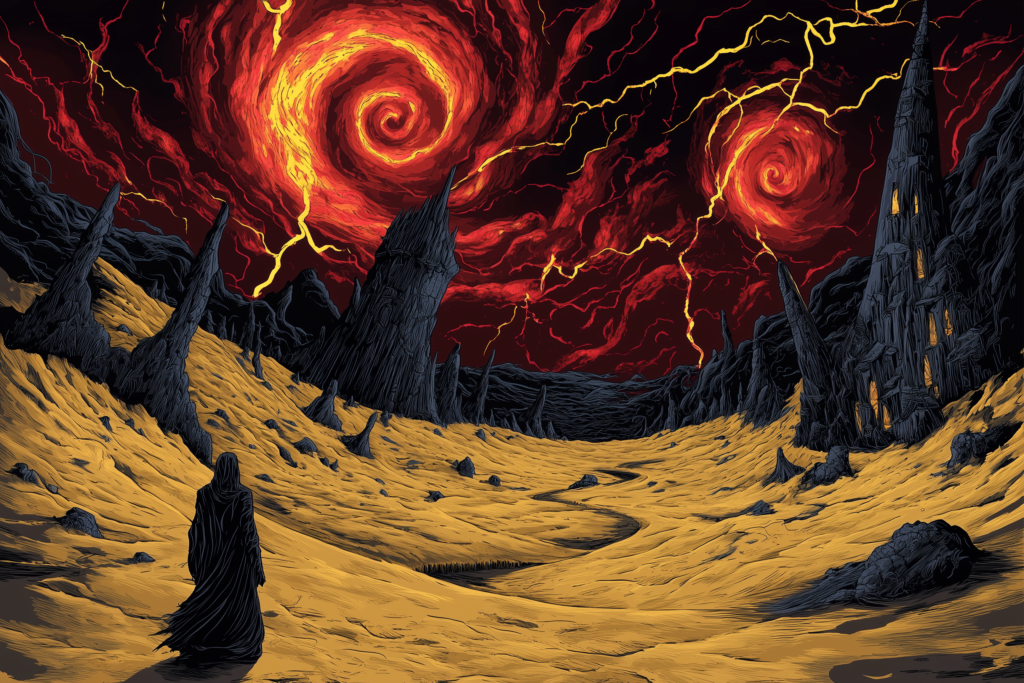
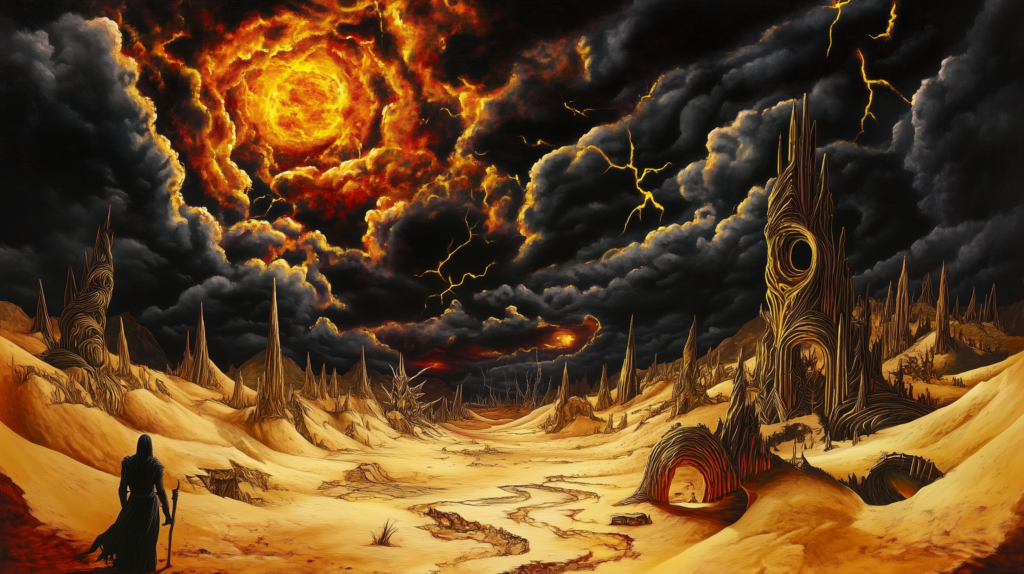
Description: Minethys is a vast and oppressive desert, with endless dunes of shifting golden sands. The desert is not just barren, but also alive, with the sand constantly moving in strange, unnatural patterns, as if the very ground is shifting to confound any who attempt to navigate it. In the distance, jagged ruins of ancient stone towers and broken cities appear intermittently through the haze, their crumbling forms half-sunken in the desert sands. These structures, relics of a lost civilization, are often misperceived as mirages, only to vanish when approached. The wind blows ceaselessly, carrying with it whispers that echo with the voices of the lost souls who have been trapped here for eternity.

Despite its vastness, the desert feels suffocating. The air is thick with heat by day, and bitterly cold by night. The sun, a dim and oppressive light, hangs perpetually low in the sky, casting long shadows and creating a world of distorted shapes. Reality itself seems warped in Minethys, and travelers risk losing their way, their sanity, or even their sense of time.

Real-World Inspirations:

  • The Sahara Desert: The sweeping dunes, scorching heat, and endless horizon of the Sahara provide a clear visual reference for Minethys, especially in its sense of isolation and the feeling of being lost in an infinite, uninhabited wilderness.
  • T.S. Eliot’s “The Waste Land”: The emptiness and existential decay of Minethys are inspired by the themes of desolation and madness found in this classic modernist poem.
  • The Desert in Dune: The barren, oppressive desert setting of Dune reflects the harsh and unforgiving nature of Minethys, where survival is a constant struggle against the elements and one’s mind.

Details:

  • Sands of the Mind: The sand itself seems to shimmer with a strange energy, at times taking on unsettling forms like eyes or faces, the spirits of those lost in the desert.
  • Ruins of the Forgotten Cities: Occasionally, crumbled remnants of cities emerge from the sands, their towering, skeletal remains offering little comfort. These ruins hold no water or sustenance, but may contain valuable artifacts or pieces of forbidden knowledge that lure travelers into their depths.
  • Illusory Oasis: Mirages of shimmering lakes and palm trees can appear on the horizon, leading the weary traveler astray. These illusions are designed to prey on the desperation of those who wander too long without rest.

Inhabitants/Creatures:

  • Sand Wraiths: Ghostly entities that drift through the sand, their forms barely discernible from the dunes themselves. They are the spirits of lost souls who were consumed by the desert, forever wandering in search of peace that will never come.
  • Mindshifters: These deformed creatures, twisted by the harsh environment and the madness of Minethys, use their psionic abilities to alter the perceptions of travelers, luring them deeper into the desert or turning them against each other.
  • Scorpion of Madness: A colossal, terrifying creature that burrows beneath the sands. Its sting is rumored to inject not venom, but the seeds of madness, driving those it stings to insanity and disarray.
  • Nomads of the Sands: Rare and elusive, these wandering tribes are the last survivors of Minethys’ once-great civilization. They live in constant motion, moving from ruin to ruin in search of hidden knowledge, hoping to escape the desert’s eternal hold.

Conditions:

  • Temperature: During the day, the sun burns relentlessly, with temperatures reaching scorching levels, while the nights are bitterly cold. The desert is in constant extremes.
  • Terrain: Endless sand dunes, rocky outcrops, and the ruins of long-forgotten cities characterize the terrain of Minethys. Some areas are filled with quicksand, while others hide deep fissures and dangerous sandstorms.
  • Weather Hazards:
    • Sandstorms of Memory: These violent storms whip through Minethys, obscuring vision and causing hallucinations, making navigation near impossible. Those caught in them often lose years from their lives—or worse, they lose themselves entirely.
    • Time Warp Winds: In certain parts of Minethys, the wind carries a strange magic that causes time to warp unpredictably. A traveler may walk for what feels like days, only to find that mere minutes have passed—or vice versa.

Notable Features:

  • The Oasis of False Hope: An illusory oasis that appears to offer relief from the harsh desert. However, those who drink from its waters are cursed to wander the sands forever.
  • The Pyramid of Forgotten Souls: A massive, partially buried pyramid located deep within the desert. It is said to house the trapped souls of those who once sought to conquer Minethys and failed.
  • The Labyrinth of Whispers: A network of winding tunnels beneath the sand, where lost minds become entangled in endless corridors, their voices whispering in the wind above.

Common Languages:

  • Ancient Carceri: The old, cryptic language of the desert dwellers, long forgotten by all but the most ancient of beings.
  • Common: Although it is spoken by adventurers and some of the nomadic survivors, Common is twisted by the effects of Minethys’ reality-warping nature.
  • Whispers of the Lost: A strange, almost unintelligible form of communication used by the Sand Wraiths and other desert spirits. It is a haunting whisper that echoes through the winds and sands, only understood by those who have been touched by the madness of the desert.
Colothys 2
Create

d12 encounter tables for Minethys, divided by character level:


Minethys Encounter Table (Levels 1-5)

d12Encounter Description
1Sand Dune Ambush: A group of Dust Mephits suddenly rises from the sand and attacks.
2Cursed Oasis: A mirage-like oasis appears, but drinking its water curses the drinker with weakness (Disadvantage on all checks for 1 hour).
3Scorpions of the Wastes: A Giant Scorpion and her brood of smaller scorpions attack anyone that disturbs their nest.
4Wandering Exile: A lone Gnoll wanderer offers a map to a nearby ruin, but has hidden motives.
5Vulture Swarm: A swarm of Giant Vultures swoops down, searching for food. They are aggressive and hungry.
6Tremor in the Sand: The ground shakes as a massive Sandworm bursts from the dunes, attacking anyone in its path.
7The Forgotten Ruin: A small band of Hobgoblins searches a ruined tower for treasure and notices the players.
8Mirage of the Dead: A mirage of a long-dead king appears in the distance, beckoning the adventurers toward certain doom.
9Sinister Dust Devil: A Dust Devil forms from the desert winds, pulling sand and debris toward the party, trying to suffocate them.
10Corrupted Traveler: A Tiefling Sorcerer wanders the desert, cursed and driven mad, attacking anyone they see.
11Lost Caravan: A ruined, abandoned caravan of Camel-sized Skeletons can be found, along with a few surviving wrecks.
12The Scorched King: A cursed Wight with a crown of fire attacks anyone who tries to approach a ruined palace.

Minethys Encounter Table (Levels 6-10)

d12Encounter Description
1Sandstorm Ambush: The desert suddenly whips up a Sandstorm, obscuring vision and hiding Searing Elementals.
2Necrotic Oasis: The party finds an oasis where the water is tainted with necrotic energy, raising the dead that drank from it.
3The Pillars of Ash: A ruined temple with Wights and Lich Servants that attack anyone who dares to defile it.
4Dune Devils: Hell Hounds track the party across the desert, drawn to the scent of living flesh.
5Sand Giant Encounter: The players are approached by a Sand Giant that demands tribute in exchange for safe passage.
6Corrupted Serpent: A Mummified Naga rises from the sand and curses those it touches.
7Sands of Time: A Wandering Efreeti offers to grant one wish, but it comes with a dire price.
8Cursed Labyrinth: A vast maze of shifting sand creates an illusionary path, and the adventurers must solve riddles or face eternal entrapment by Sand Golems.
9Lost Hero’s Tomb: The tomb of a long-forgotten hero is guarded by Death Knights, who challenge the players to prove their worth.
10Fiendish Incursion: A Pit Fiend appears in a fiery rift, bringing a group of Devils with it to assault the adventurers.
11Fury of the Sun: A Solar descends from the sky, and the party must either defend themselves or offer penance to avoid destruction.
12Ruinous Mirage: A Demon Lord in disguise offers false promises of power, leading the players into a trap filled with lesser demons.

Minethys Encounter Table (Levels 11-15)

d12Encounter Description
1The Sand Maw: The ground opens up to reveal a massive, ancient Beholder dwelling within the sands.
2Infernal Stratus: The sky tears open, revealing a portal from which Fiendish Warriors emerge to challenge the adventurers.
3Judgement of the Forgotten: The adventurers find an ancient city of undead, where a Death Titan awaits to pass judgment on the living.
4The Black Sun: A Solar Eclipse occurs, and the Desert Efreeti awakens to lay waste to everything that crosses its path.
5Desert of Souls: A vast sandstorm reveals Nightmare Hounds, the tormented spirits of past adventurers, who now roam as fiends.
6The Demon’s Forge: A Pit Fiend crafts weapons in the heart of a volcano, surrounded by Devils and Infernal Engines.
7Twilight Lord’s March: An army of Nightmare Liches rides across the desert, led by a Twilight Lord, looking to convert the souls of the living.
8Fallen Citadel: The citadel of a fallen king, ruled now by a Demon Prince, is found half-buried in the sands, and it is brimming with powerful, dark magic.
9The Dune Leviathan: A Dune Leviathan—a colossal sand-dwelling creature—emerges from the earth and wreaks havoc on the party.
10Sandstorm Dragon: A Dragon of Sand appears, born of ancient desert storms and infused with powerful desert magic.
11The Eternal Flame: A Phoenix guards the remains of an ancient desert temple, attacking anyone who dares to enter its sanctuary.
12The Mad Mummy: A Mummy Lord who has gained control of the desert’s power emerges from an ancient crypt, commanding sand and flame to destroy the players.
Colothys 3
Create
  • Other Names: The Abyssal Cliffs, The Chasm of Despair, The Edge of Oblivion
  • Location: Colothys is the Fourth Layer of Carceri, a realm defined by its sheer, vertiginous cliffs and endless chasms that suspend in a void-like space. This treacherous domain is situated above the lower layers of torment, serving as both a barrier and a prison for those who dare ascend or descend its precipices.
  • Description:
    Colothys is a nightmarish expanse where colossal cliffs rise like jagged teeth from a sea of nothingness. The terrain is dominated by towering rock faces, narrow ledges, and endless chasms that drop into unfathomable depths. The environment is a perpetual balancing act between peril and desolation. The natural structures appear almost sculpted by malevolent forces—a chaotic blend of natural grandeur and infernal design. The landscape is dotted with precarious natural bridges, crumbling stone arches, and deep crevasses that emit eerie echoes of the suffering contained within.
  • Real-World Inspirations:
    • The Grand Canyon and Himalayan Cliffs: The awe-inspiring yet treacherous heights and sheer drops of real-world canyons and mountain ranges serve as a primary visual reference for the immense scale and danger of Colothys.
    • Gothic Cathedrals & Medieval Fortresses: The crumbling ruins scattered along the cliffs evoke a sense of lost civilizations, similar to the haunting remains of medieval structures overtaken by time.
    • Surreal Art and Dystopian Landscapes: The abstract, twisted forms found in the works of surrealist painters—where gravity seems to have a mind of its own—infuse Colothys with an otherworldly, almost apocalyptic quality.
  • Details:
    • Architectural Remnants: Scattered among the natural formations are the ruins of once-great fortresses or temples, their broken spires and shattered arches serving as grim reminders of past ambitions and failures.
    • Whispering Winds: The constant rush of wind between the cliffs carries with it faint, mournful whispers—voices of those who fell into the abyss, forever lost in the void.
    • Infernal Carvings: Deep grooves and symbols etched into the rock surfaces hint at ancient, perhaps cursed rituals performed here, leaving a residue of dark power that pervades the air.
  • Inhabitants/Creatures:
    • Cliff Dwellers: Hardy and often sinister creatures such as harpies, giant vultures, and rock elementals make their homes along the sheer faces, preying on the unwary or lost souls who dare to traverse their domain.
    • Demon Sentinels: Infernal beings and minor devils patrol the precarious ledges, serving as wardens of the layer, ensuring that escape from Carceri remains impossible.
    • Lost Wanderers: Tormented souls and exiled mortals may be found clinging to narrow ledges or hiding in the crevices, either awaiting rescue that never comes or succumbing to madness in isolation.
    • Elemental Aberrations: With gravity defied and physics twisted, bizarre creatures that merge rock and shadow—such as living statues or animated boulders—wander the crags, their forms as unpredictable as the terrain.
  • Conditions & Temperature/Terrain:
    • Temperature: The air is cool to bitterly cold, especially along the high, exposed edges where the wind cuts like a blade. However, pockets of heat may radiate from volcanic fissures or the residual magic of infernal rituals.
    • Terrain: Dominated by sheer rock faces, narrow ledges, and deep, yawning chasms, the terrain in Colothys is as unforgiving as it is dangerous. Natural stone bridges and precarious archways provide the only means of passage across vast gaps, making every step a test of balance and nerve.
  • Weather Hazards:
    • Relentless Gale: Powerful, unyielding winds whip along the cliffs, reducing visibility and threatening to hurl even the most steadfast traveler into the abyss.
    • Acidic Mists: Occasional mists seep from the chasms, carrying corrosive properties that can damage both equipment and flesh if one lingers too long.
    • Sudden Temperature Shifts: Rapid drops in temperature can lead to brittle, frozen surfaces on the stone, making footing treacherous and increasing the risk of falling.
  • Notable Features:
    • The Endless Abyss: A seemingly infinite chasm that dominates the center of Colothys, its bottom lost to darkness. Legend says that those who peer into it can see reflections of their own soul in torment.
    • The Ruined Citadel: A towering, crumbling fortress that clings to the edge of a massive cliff, its broken battlements and shattered towers standing as silent witnesses to ancient conflicts.
    • The Whispering Archway: A natural stone arch carved by eons of wind and magic, known for the ghostly voices that echo through it, purportedly offering cryptic prophecies to those who dare listen.
  • Common Languages:
    • Infernal: Frequently spoken by the demon sentinels and other infernal inhabitants who patrol the perilous heights.
    • Common: Used by lost wanderers and exiles, though often spoken in hushed tones or with an accent warped by the harsh environment.
    • Ancient Carceri: An archaic language carved into the very stone of Colothys, understood only by those deeply attuned to the dark histories of the layer.
    • Celestial (Distorted): Occasionally heard in the whispers along the cliffs—a remnant of a once-pure tongue, now twisted by the pervasive corruption of the realm.

Colothys stands as a forbidding testament to the perils of Carceri—a realm where every step is a dance with death, every gust of wind a potential harbinger of doom, and every chasm a gateway to eternal torment. It is a place where the natural and the supernatural converge in a nightmarish landscape of towering cliffs and bottomless darkness, challenging the resolve of even the most determined adventurers.

Colothys 4
Create

Colothys, the Fourth Layer of Carceri, is a realm of endless, jagged mountains, treacherous cliffs, and deep, deadly ravines. The land itself punishes the exiled, forcing them to scale impossible peaks or perish in the depths below. These encounter tables reflect the brutal dangers of this forsaken realm.


Low-Level Encounters (Levels 1-5)

d12Encounter
1A group of desperate exiles (Commoners, Bandits, or Cultists) cling to the cliffs, pleading for food—or planning an ambush.
2A twisted vulture (Giant Vulture with fiendish traits) circles overhead, waiting for someone to fall.
3A bridge made of rotting wood and stretched sinew—cross it, or risk climbing?
4A wandering hermit (Mad Prophet) warns of a coming landslide. His prophecies are half-crazed, but eerily accurate.
5A sudden, violent gust of wind threatens to throw the party into the abyss (DEX save to hold on).
6A pack of abyssal scavengers (Jackals twisted by the plane, with glowing eyes and skeletal maws) stalks the party from the rocks.
7A cliffside monastery—long abandoned, yet strange whispers echo from its ruins.
8The group stumbles across a hanging corpse swinging from iron chains… until it starts whispering their names.
9A lost traveler begs for help. They are an illusion—or a disguised Night Hag seeking victims.
10Loose footing! A section of the path crumbles—DEX saves or fall into the abyss.
11A mysterious stairway carved into the mountain—leading down into darkness.
12A dying demon impaled on a rock warns of something far worse coming… before laughing as it dissolves to ash.

Mid-Level Encounters (Levels 6-10)

d12Encounter
1A bloodstained rope bridge—someone (or something) waits on the other side.
2A mountain wurm (Bulette with fiendish traits) erupts from the rock, seeking prey.
3Howls echo through the ravine—a pack of shadow wolves (Worgs with teleportation abilities) hunt for fresh souls.
4A demonic pilgrim, crawling on bloody hands, prays at a black altar. He offers knowledge… for a price.
5Rockslide! Avoid it, or be buried alive in shifting stone.
6A wounded erinyes dangles from a chain above a pit—does she offer a pact, or is it a trap?
7Flesh-masked monks (cultists wearing the stolen faces of their victims) demand tribute.
8A tower looms ahead, its bridges crumbling, its windows filled with watching eyes.
9The party encounters a wandering judge of the damned—he asks riddles, and those who fail must fight his minions.
10A flying fortress of stone and bone drifts above. A monstrous figure watches from its parapets.
11A chasm pulses with unnatural light—a gate to a deeper layer… or a hungry mouth?
12A storm rolls in—thunderous winds tear at everything, and something moves within the clouds.

High-Level Encounters (Levels 11-20)

d12Encounter
1The group disturbs a Titan chained in the mountains—a remnant of an ancient war, begging for freedom.
2A colossal chasm opens, revealing a city built on the walls of an abyss—its rulers are watching.
3An army of the damned (Shades, Wraiths, and Specters) marches across the cliffs, led by a long-forgotten warlord seeking revenge.
4A mountain god, long imprisoned—a cyclopean being with a temple built into its chest—offers a terrible bargain.
5The echoes of a past battle play out as ghostly figures fight, unaware of the party… until they notice them.
6A floating iron citadel drifts through the sky, its chains dragging screaming souls.
7A river of molten metal flows through the cliffs, filled with tormented spirits trying to escape.
8A Nightmare Behemoth, a massive, skeletal wyvern with fire-blackened bones, takes notice of the party.
9A god’s severed hand, miles tall, grips the mountainside. It still moves.
10A Demon Prince’s envoy, carried in a palanquin of writhing flesh, demands tribute.
11A living storm—formed from the rage of the forsaken—hunts those who climb too high.
12The mountains shift—revealing the face of an ancient being, trapped beneath the stone, whispering secrets to those who listen.
Porphatys 2
Create

Other Names:

  • The Drowned Layer, The Sea of Black Tears, The Eternal Deluge

Location:

Porphatys is the fifth layer of Carceri, an endless realm of acidic black waters under a perpetual, storm-darkened sky. It is one of the most desolate and hopeless regions of the prison plane, where the condemned are swallowed by the relentless tides and ceaseless snowfall.

Description:

Porphatys is a nightmarish expanse of shallow, inky-black water stretching infinitely in all directions. Occasionally, jagged, barren islands of black stone rise above the surface, their slick surfaces offering little refuge from the churning sea. The waters are cold and acidic, eating away at flesh and eroding what little remains of solid land. Snow constantly falls from the sky, blanketing the surface in a slush that quickly dissolves into the burning sea. The air is damp and thick with the scent of decay, and the distant wails of the eternally drowning echo across the void.

Real-World Inspirations:

  • Greek Mythology: The river Phlegethon, a river of boiling or corrosive waters in the underworld.
  • Dante’s Inferno: The frozen and flooded depths of Cocytus, where sinners are trapped in ice or submerged in darkness.
  • Lovecraftian Horror: The concept of vast, uncaring oceans that consume all life, with unspeakable horrors lurking in the depths.
  • Norse Mythology: Niflheim, a realm of freezing mists and waters, where the dead drift in endless despair.

Inhabitants & Creatures:

  • The Drowned Dead: The spirits of those who perished in the sea, cursed to wail and wander the tides.
  • Hags of the Black Depths: Hideous, waterlogged witches that lure the desperate to their doom.
  • Acid-Spined Leviathans: Gigantic, blind creatures that lurk beneath the water, detecting movement through vibration.
  • Abyssal Lampreys: Swarming eel-like creatures that burrow into flesh and drain vitality.
  • Forsaken Petitioners: Condemned souls, their flesh eroded by acid, endlessly struggling to keep their heads above the surface.
  • Slavers of the Abyss: Demonic raiders who hunt for souls to drag into deeper torment.

Conditions (Temperature/Terrain):

  • Near-Freezing Temperature: The water is ice-cold, and the unrelenting snowfall makes exposure deadly.
  • Acidic Waters: Prolonged exposure burns flesh and erodes armor and weapons.
  • Few Solid Landmasses: The rare islands are slick, jagged, and crumbling.

Weather Hazards:

  • Endless Blizzard: The snow never ceases, layering everything in an icy sludge.
  • Occasional Acid Storms: Rain that burns like fire, scarring the land and sea alike.
  • Tidal Surges: Unpredictable waves that sweep away anything not anchored down.
  • Black Fog: Rolling mists that obscure vision and carry the whispers of the drowned.

Notable Features:

  • The Weeping Isles: A scattered archipelago of spires resembling skeletal hands reaching from the water.
  • The Sunken Labyrinth: A submerged city of impossible geometry, now home to creatures that should not be.
  • The Black Maw: A whirlpool leading into an abyssal void, rumored to be the entrance to an even darker realm.
  • The Tower of the Last Breath: A single, ruined keep standing upon the largest island, said to hold the secrets of forgotten gods.

Common Languages:

  • Abyssal, Infernal, Aquan, The desperate, unintelligible screams of the drowning

Porphatys is a realm where suffering is slow, inevitable, and all-consuming. It is not a place of fire and chains, but of slow erosion—of body, mind, and soul.

Porphatys 1
Create

Low-Level Encounter Table (Levels 1-5) for Porphatys:

d12 RollEncounter Description
1Choking Miasma – The adventurers stumble upon a dense cloud of toxic gas, causing suffocation and hallucinations. They must find cover or risk losing health with every breath.
2Lost Souls – A group of tortured souls, their bodies melted and formless, wails for help. Though their voices are heartrending, any attempt to assist will only trap the party in their eternal agony.
3Flesh-Devouring Acid Pools – A slow-moving pool of corrosive liquid is found in the path ahead. It can dissolve weapons and armor if touched, and creatures nearby may attempt to pull adventurers in.
4Twisted Statue of a Forgotten Deity – A petrified figure stands motionless in the landscape. It’s clear from the broken pillars that it once guarded a place of worship. Its eyes glow faintly, as if still alive.
5Horrific Mirage – A mirage of safety—a distant city with lush gardens and rivers—appears before the party. A sudden burst of dark energy dispels it, revealing horrifying skeletal figures mocking the adventurers’ hope.
6Wandering Chains – Animated chains slither like serpents across the ground, their clanking audible long before they strike. They seek to ensnare and drag players into nearby acid pits.
7Unholy Scavengers – A small group of Porphatyss Wraiths, partially dissolved by the acid pools, emerges from the shadows. They seek to feed on the life essence of adventurers, their spectral forms flickering.
8Quicksand of Flesh – The party encounters a strange, fleshy swamp that pulses with the sounds of heartbeat-like rhythms. Any movement will lead to the sinking of legs into the flesh and its acidic nature, requiring a strength check to escape.
9Corrupted Lurker – A mutated abomination born from the land itself attacks the adventurers. It has a body fused with stone and acid, and its very touch causes great pain.
10Abandoned Campsite – An abandoned campsite, surrounded by bloodstained cloth and broken weapons, appears untouched by the acid. Investigating reveals clues of a previous adventuring party that met a tragic end.
11Tangled Screams – A patch of land that causes those who step into it to experience unnerving hallucinations of loved ones or enemies. Those who fail to resist might take psychic damage and be paralyzed by their fears.
12The Fallen Traveler – A lone figure, seemingly unaffected by the acidic landscape, offers cryptic warnings about the deeper dangers ahead. The adventurers must decide whether to trust this mysterious figure.

Mid-Level Encounter Table (Levels 6-10) for Porphatys:

d12 RollEncounter Description
1Dread Abomination – A towering creature, part-man, part-acid, emerges from the sea of corrosive liquid. Its grotesque body constantly shifts and reforms. It seeks to pull adventurers into its acidic maw.
2Blood-Bound Minions – A group of blood-bound thralls, cursed souls with molten eyes, are summoned to serve a dark power. They attack relentlessly with their acid-infused weapons, their bodies writhing in pain.
3Stolen Dreams – A group of Porphatyss Mindflayers lurks in the shadows, attempting to steal the adventurers’ memories and thoughts. The party must stop them before they are completely overwhelmed.
4The Acid Spire – A spire of blackened stone rises from the landscape, surrounded by an unnatural heat. Anyone nearing the spire risks becoming paralyzed by the intense aura or worse. The party must decipher its puzzle or face destruction.
5Hellish Reaver – A demon lord or greater fiend resides in a nearby cavern, driven to madness by the torture of Porphatys. It seeks to enslave adventurers for its own twisted amusement, wielding powerful magics.
6The Endless Torrent – A wave of acid crashes down the landscape, sweeping away anything in its path. The adventurers must escape or be drowned in the corrosive wave.
7Anguished Oracle – A tortured, blind oracle is chained to a pillar in the middle of a flooded ruin. It offers cryptic prophecies and warnings about the party’s doom if they venture deeper into the land.
8Corrupted Druid – A druid of Porphatys, its body half-submerged in acidic liquid, has become a twisted guardian of the land. It commands the beasts and elements to attack the adventurers on sight.
9Abyssal Call – A horrific beast from the deepest trenches of Porphatys begins its ascent. Its skin shimmers with the light of dying stars, and it attacks with deadly acid-spitting appendages.
10Chains of the Damned – The adventurers are caught in a deadly trap, as a series of chains spring from the ground and attempt to ensnare them. The chains are cursed, and breaking free requires strength or magic.
11Ruins of the Fallen God – The adventurers uncover an ancient ruin that hints at the original purpose of Porphatys. As they explore, the ruin seems to shift and move, forcing them into a deadly maze filled with acid-slick traps.
12Porphatys Sorcerer – A powerful sorcerer whose body has been consumed by the acid of Porphatys. Its form is partially decayed, but its power remains immense. It offers dark knowledge for those who are willing to bargain.

High-Level Encounter Table (Levels 11-15) for Porphatys:

d12 RollEncounter Description
1The Abyssal Leviathan – A monstrous Leviathan, a half-submerged creature of incredible size, roams the seas of Porphatys. It causes waves that devastate anything in its path, and it targets the party with its acid-encrusted maw.
2Fiendish Conclave – A dark conclave of demons gathers in a ruined temple. These demonic beings control the very landscape of Porphatys and seek to corrupt adventurers, tempting them with power in exchange for loyalty.
3The Enslaved King – A once-immense ruler now broken and imprisoned within the acidic lands. The adventurers must face his loyal guards, and the mad king himself, who wields devastating necrotic magic.
4Ancient Entity – A god-like entity, bound in chains of obsidian, awakens from its eons-long slumber. The adventurers must decide whether to release it or face its horrific wrath as it claws at the walls of its prison.
5The Dark Citadel – The Citadel of Porphatys is said to house a portal to a forgotten dimension. The adventurers must infiltrate the citadel, bypassing its monstrous defenses, to destroy the portal before it destroys their world.
6Apocalyptic Storm – An apocalyptic storm of acid rain and dark energy strikes the area. The adventurers must find shelter or risk being melted away or driven mad by the unrelenting weather.
7Corrupt Godling – A fallen god who has taken up residence within the deepest parts of Porphatys. This godling has been warped into something far darker and more sinister. It demands a sacrifice from the adventurers or will send its minions after them.
8Flesh-Devouring Hydra – A multi-headed hydra, its bodies fused with acid and venom, attacks the party. Each head regenerates, and the acid from each bite burns through armor and flesh alike.
9The Reborn Champion – A legendary hero, long dead and resurrected by dark magic, guards an ancient, cursed artifact. The adventurers must defeat this powerful undead warrior to obtain the item, which is key to escaping Porphatys.
10Eternal Torment Chamber – The adventurers stumble upon a chamber that shows glimpses of their greatest fears and desires, tormenting them with impossible choices. Each choice shapes the very landscape, conjuring new horrors.
11Porphatyss Queen – The Queen of Porphatys, a terrifying and powerful entity, reveals herself. Her very presence warps reality, and she uses her power to warp and twist the minds of adventurers into servitude or madness.
12The Leviathan’s Heart – The adventurers find the heart of the Leviathan, which pulsates with energy that can shift the fabric of reality. If they manage to gain control over it, they may harness its power for their own dark purposes or destroy it for good.
Agathys – The Frozen Abyss of Betrayal (Sixth Layer)
Create

Other Names: The Eternal Ice Prison, The Frozen Wasteland of Damnation, The Black Glacier of the Betrayed

Location:
Agathys is the deepest layer of Carceri, a realm of unyielding, enchanted black ice where all who commit the ultimate betrayal are condemned to eternal imprisonment.

Description:
Agathys is a desolate, frozen hellscape where time itself appears to have stopped. The entire realm is a vast, unbroken expanse of obsidian-hued ice, cold beyond mortal comprehension, and imbued with dark magic that traps both body and soul. No warmth, light, or hope exists here—only the unending, icy grip of punishment for those who betrayed trust and honor.

Real-World Inspirations:

  • Dante’s Inferno: Reflecting the idea of ultimate retribution in the lowest circles of Hell.
  • Norse Mythology’s Niflheim: An ancient realm of bitter cold and despair.
  • Lovecraftian Cosmic Horror: The sense of a vast, indifferent, and eldritch void that consumes all.
  • The Arctic Wastelands: The harsh, unyielding environment of Earth’s polar deserts, but twisted into a supernatural realm.

Details:

  • Magical Black Ice: The ice is not ordinary; it is magically dark, with an eerie, inky sheen that seems to absorb light and sound.
  • Frozen Runic Inscriptions: Mysterious, glowing runes are etched into the ice, remnants of ancient curses and the punishments of the betrayed.
  • Eternal Stillness: The silence is oppressive, broken only by the distant creak of shifting ice and the faint, anguished whispers of trapped souls.

Inhabitants/Creatures:

  • Frozen Wraiths: The souls of the ultimate betrayers, now spectral and tormented, endlessly drifting beneath the ice.
  • Icebound Fiends: Lesser demons and devilish entities adapted to this frozen environment, patrolling the boundaries between solid ice and deep crevasses.
  • Prisoners of Agathys: Ancient gods, titans, or mortals once infamous for their betrayal, now immured within the glacier, their tormented faces occasionally visible beneath the surface.
  • Chill Revenants: Undead warriors and traitors animated by the bitter cold and dark magic, eternally bound to enforce the prison’s unyielding rules.

Conditions, Temperature, & Terrain:

  • Temperature: Bitterly frigid, with a cold that penetrates to the bone and saps the will to live.
  • Terrain: An endless, smooth, and treacherous sheet of black ice, punctuated by deep crevasses, jagged ice spires, and the occasional frozen monolith—the remnants of betrayed souls or ancient structures.
  • Environmental Magic: The very air is heavy with enchantments that slow time and stifle hope, making every step feel like an eternity.

Weather Hazards:

  • Frost Storms: Sudden, magical blizzards rage across the landscape, whipping shards of ice with lethal precision.
  • Icy Maelstroms: Whirlwinds of snow and magic that suck up light, sound, and warmth, disorienting even the hardiest adventurers.
  • Shifting Ice Fields: The ice is alive—its surface cracks and shifts unpredictably, threatening to plunge the unwary into bottomless crevasses.

Notable Features:

  • The Frozen Throne: A massive block of ice intricately carved with runes and the tormented visages of the damned, believed to be the seat of judgment in Agathys.
  • The Wall of Betrayal: A towering barrier of ice that divides the realm, inscribed with the names and sins of the ultimate traitors, glowing faintly with dark power.
  • The Silent Expanse: A vast, featureless plain of ice where the silence is so complete it becomes oppressive, a constant reminder of the eternal punishment that awaits.

Common Languages:

  • Common: Spoken by exiled mortals and adventurers who traverse Carceri, though often twisted by the layer’s corrupting influence.
  • Infernal & Abyssal: Languages of fiends and cursed souls, used to cast the dark spells that hold Agathys together.
  • Ancient Carceri: A cryptic tongue etched into the very ice, understood only by those who have embraced the full horror of betrayal.

Agathys stands as the final, frozen testament to betrayal—a realm where time, warmth, and mercy have been utterly extinguished, leaving only eternal, soul-crushing torment.

Agathys – The Frozen Abyss of Betrayal (Sixth Layer)
Create

Agathys Encounter Table (Levels 1–5) – The Bitter Frost

d12Encounter Description
1Frostbitten Shadows: A small cluster of spectral wraiths drifts from cracks in the cursed ice, their chilly touch sapping vitality.
2Cracked Ice Pit: A section of unstable black ice gives way underfoot, forcing the party to make Dexterity saves to avoid falling into a shallow but bitterly cold crevasse.
3Skeletons of the Frozen Beast: The remains of a long-dead creature lie half-embedded in the ice—until a single frozen skull rattles, animated by residual curse.
4Icebound Imp: A minor fiend, its form partially encased in frost, skulks out of a fissure to pilfer stray souls (or treasures).
5Runes of the Damned: Glowing, ancient runes suddenly flare along the ice, triggering a burst of cold magic that deals frost damage (DC save to halve).
6Frost Mephit Skirmish: A pair of mischievous frost mephits materialize, causing minor havoc with their chilling blasts.
7Chilling Mirage: An illusory oasis appears, promising warmth—but those who approach find it is a cursed mirage draining life energy.
8Frozen Pilgrim’s Wail: The mournful cry of a trapped, disembodied soul echoes across the ice, unnerving the party and possibly imposing disadvantage on Wisdom checks.
9Brittle Bridge Collapse: While traversing a narrow, frozen causeway, the ice begins to crack; Dexterity saves are required as portions collapse into a shallow but dangerous chasm.
10Icy Tendrils: Animated strands of ice attempt to bind the adventurers, reducing movement and causing piercing cold damage.
11The Whispering Frost: A disembodied voice carried on the wind offers cryptic warnings, but its cursed echo imposes a minor psychic penalty.
12Wail of the Damned: A sudden gust carries the sorrowful screams of countless frozen souls, instilling fear (Wisdom save to resist being frightened).

Agathys Encounter Table (Levels 6–10) – The Cursed Expanse

d12Encounter Description
1Frost Wraith Ambush: A more potent group of frost wraiths rises from the cracks, their chilling touch more damaging and their presence more unnerving.
2Icebound Golem: A golem forged of cursed black ice lumberingly patrols a narrow ridge, its slam attacks echoing like the crack of doom.
3Glacial Chasm Collapse: The party triggers a collapse of a major ice bridge, with deep fissures opening suddenly; Dexterity saves are required to avoid falling into freezing depths.
4Soul-Draining Demon: A minor demon that feeds on the despair of the damned emerges from a crevasse, siphoning life force with each successful strike.
5Frozen Revenants: The ice stirs as undead revenants—former traitors encased in frost—rise to attack, their cold, empty eyes fixed on intruders.
6Runic Guardian: An ancient, animated construct made of ice and inscribed with cursed runes awakens to defend its territory.
7Ravenous Frost Wolves: A pack of spectral, ice-infused wolves stalks the ridge, their howls echoing in the cold, and their bites delivering a potent chill.
8Frozen Siren: A haunting, spectral figure formed of ice and sorrow lures adventurers toward perilous crevasses with its eerie, melancholy song.
9Cursed Beacon: An ominous, abandoned structure on the ice emanates a draining aura—prolonged exposure saps the party’s strength (Constitution check required).
10Temporal Rift: A sudden anomaly in the cursed ice distorts time momentarily, summoning a time-warped spirit that attacks before vanishing.
11Frostbite Burst: A localized explosion of magical cold erupts from a fissure in the ice, dealing area-of-effect damage and potentially freezing limbs.
12Bitter Requiem: The collective wails of dozens of frozen souls rise in a cacophonous wave, imposing psychic damage and fear on those caught within its radius.

Agathys Encounter Table (Levels 11–20) – The Frozen Judgment

d12Encounter Description
1The Frozen Titan: A colossal titan, its body entombed in cursed ice for centuries, begins to stir—its immense strength and tragic fury threaten to shatter the frozen wasteland.
2Frost Demon Prince: A powerful demon lord of winter, cloaked in rime and malice, commands the ice with brutal authority and unleashes devastating, freezing attacks.
3Lich of the Black Glacier: An ancient lich, its phylactery embedded deep within the cursed ice, rises to exact retribution on all who disturb its eternal slumber.
4The Soul Prison: A massive, sentient block of cursed ice, containing the tormented souls of traitors, awakens to drain the life force of any intruders in its vicinity.
5Winter’s Wrath: A supernatural blizzard of magical cold engulfs the party, accompanied by furious ice elementals that assault with unbridled savagery.
6Black Ice Leviathan: A titanic, serpentine creature composed of living, cursed ice slithers beneath the surface, emerging to drag unsuspecting foes into the depths.
7Frozen Doom Portal: A swirling vortex of dark magic appears in the ice, opening a gateway that summons otherworldly, nightmarish entities from beyond.
8Spectral Army of the Betrayed: A host of vengeful, frozen spirits—once great traitors—arise in unison, their combined assault a blizzard of icy fury and psychic torment.
9Shattering Fissure: The ground trembles as a titanic crevasse rips through the ice, releasing hordes of frozen horrors and engulfing everything in its path.
10Eternal Warden: A monstrous, ancient devil-turned-guardian, now fused with the ice, emerges to defend a cursed relic—its mere presence exuding paralyzing dread.
11Frostfire Elemental: A rare and deadly phenomenon where elemental frost and fire merge, creating a being that burns with a cold, searing rage, attacking with both frost and flame.
12The Frozen Judgment: An immense, disembodied voice echoes from the heart of the glacier as a colossal frost colossus materializes, delivering a final, crushing retribution to all who dare disturb Agathys.

Othrys — The Ruined Exile

Othrys is the broadest and most frequently reached layer. Its world-orbs contain stagnant marshes, eroded uplands, drowned roads, broken fortresses and monumental ruins built by powers that once expected to rule forever.

Elder Titans, dethroned monarchs, broken divine claimants and defeated warlords establish courts among the ruins. Their palaces remain immense, but their territories are divided by poisonous wetlands, collapsed causeways and old fortifications now controlled by jailers, scavengers or former servants.

Othrys imprisons through the memory of lost authority. Its captives can still command followers, conduct ceremonies and issue decrees, but every order reveals how much power they no longer possess.

Tartarus

Tartarus is the greatest sealed prison-domain within Othrys. It is not another name for the whole layer, but a vast Hellenic prison complex containing gods, Titans, monsters and mortals condemned under the ancient laws of the Hellenic Pantheon.

Its deepest prisons contain Cronus, Typhon, many defeated Elder Titans and other enemies overcome during the wars between the Titans and the Olympians. The Hecatoncheires guard its innermost confines, while the Erinyes enforce sentences connected to blood-guilt, violated oaths, betrayal and crimes against family and guest-right.

The prison takes its present form after Zeus and the Olympians defeat Cronus and his allies. Its gates and seals are part of the settlement that ends the Titanomachy, but the prison is older than the Olympian victory. Cronus himself once used it to confine the Cyclopes and Hecatoncheires before they were released to aid Zeus.

Beyond the prisons of the gods and Titans stand the individual sentences of Sisyphus, Tantalus, Ixion and other condemned mortals. Each punishment is maintained by its own offence, judgement and binding condition rather than by the general nature of Othrys.

A traveller may cross Othrys without entering Tartarus, while a prisoner bound to Tartarus may remain unable to pass through an open gate until the foundation of the sentence has been fulfilled, invalidated or broken.

Cathrys — The Living Snare

Cathrys is a humid expanse of forests, swamps, fungal reaches and parasitic vegetation. Its growth is violent rather than generous. Vines reinforce ruined walls, roots seal doors, spores alter memory and entire settlements depend upon organisms that slowly consume them.

Paths close after travellers pass. Shelters become traps if occupied for too long. Food may nourish the body while creating dependence upon the plant that produced it.

Cathrys imprisons through dependency. Survival requires relationships with the layer’s living systems, but every dependency makes departure more difficult.

Minethys — The Burying Sands

Minethys is a desert of red dust, iron-coloured dunes and relentless abrasive winds. Cities, armies and enormous prison complexes periodically emerge from the sand before being buried again.

The winds strip paint from shields, inscriptions from monuments and identifying marks from the dead. Maps remain useful only briefly. A prison may be rediscovered centuries after its guards and prisoners have forgotten which group originally held the keys.

Minethys imprisons through erasure. Captives lose evidence, history, direction and eventually the certainty that they were ever meant to leave.

Colothys — The Endless Ascent

Colothys is formed from mountains, chasms, tilted plateaus and sheer rock faces. Some world-orbs appear almost entirely vertical, with settlements clinging to cliffs or hanging beneath enormous natural arches.

Movement is possible but never secure. Ladders end at locked platforms. Bridges connect rival enclaves. A route that descends towards one prison may become an ascent when local gravity changes around a neighbouring orb.

Colothys imprisons through exhaustion. Freedom remains visible beyond the next ridge, above the next cliff or upon the opposite wall of a chasm, but reaching it consumes strength, supplies and companions.

Porphatys — The Drowning Dark

Porphatys is covered by shallow black seas, corrosive rain, drifting sleet and isolated spires of rapidly eroding stone. Its water is rarely deep enough for easy sailing, yet deep enough to conceal pits, ruins, chains and predators.

Temporary islands form from wreckage, sediment or the backs of immense creatures. Settlements continually rebuild their foundations as the waters dissolve stone, metal and bone.

Porphatys imprisons through erosion. It destroys equipment, records, shelter and physical strength until the captive lacks the means to attempt escape.

Agathys — The Final Stillness

Agathys is an expanse of black ice beneath a dark red radiance. Entire fortresses, creatures and landscapes lie visible at different depths below the surface. Some remain conscious. Others awaken only when the ice cracks or a name is spoken above them.

There are few permanent settlements. Those that exist cluster around fissures, sealed vaults or rare sources of heat that may fail without warning.

Agathys imprisons through suspension. Individual prisons beneath the ice may halt movement, awareness or change, although time across the layer otherwise passes normally.

Prison Claims and Escape

General Planar Resistance

All travellers find departure from Carceri difficult. Portals into the plane are more stable than portals leading out. A gate may admit an army and then allow only its recognised commander to depart. A summoning may draw a creature into Carceri but lack the power to return it.

Merely entering Carceri does not automatically create a custodial claim. An unbound visitor can still use a valid portal, external anchor or conjunction, provided no local prison prevents access.

Custodial Claims

A custodial claim binds a particular creature, title, bloodline, object or office to a sentence, prison, bargain or recognised custodian.

Every valid claim has four discoverable elements:

  • Source: Who or what created the claim.
  • Subject: Whom or what the claim binds.
  • Condition: What continues to maintain the confinement.
  • Release: What fulfils, invalidates, transfers or overrides the claim.

A creature cannot create a valid claim merely by announcing ownership. Carceri responds to established authority, accepted bargains, binding oaths, true names, inherited sentences, prison marks, recognised titles and powers capable of enforcing confinement.

Sources of Custody

A custodial claim may arise from:

  • a divine or planar sentence;
  • a willingly accepted bargain;
  • a binding oath;
  • a captured true name;
  • a curse placed upon a bloodline, office or title;
  • possession of a recognised prison mark;
  • a lawful or unlawful transfer of custody;
  • a powerful being personally maintaining the confinement.

Carceri does not decide whether the claim is just. It recognises that the claim exists.

Breaking a Prison

Every prison is maintained by something. Discovering and breaking that foundation is the closest Carceri offers to a universal key.

A release may require:

  • the consent of the original jailer;
  • completion of an unfinished sentence;
  • proof that the claim was established under a false name;
  • destruction of the seal, title or authority maintaining the prison;
  • restoration of a betrayed oath;
  • transfer to a willing and recognised custodian;
  • the willing assumption of the prisoner’s place;
  • a conjunction that occurs only once in an age;
  • an artefact, divine power or external anchor capable of overriding the claim.

The difficulty lies not in proving that escape is impossible, but in discovering what the prison recognises and deciding what price should be paid to break it.

Death and Custody

Death does not automatically end a custodial claim. A sentence may bind the prisoner’s spirit, title, remains or true name. Wrongful execution may create a ghost, revenant, oath-wight or curse while leaving the original prison intact.

Planar Traits

Time

Time normally passes at the same rate as on the Material Plane. Particular prisons may suspend, repeat or divide time, but these are local effects rather than a universal trait.

Gravity

Gravity is normal upon most world-orbs but changes during crossings, conjunctions and travel through the gulf. Some regions of Colothys possess several competing gravitational surfaces.

Light

Carceri has no conventional sun. The world-orbs and distant planar phenomena produce a dim red illumination. Darkness is complete within deep ruins, beneath the waters of Porphatys and below the ice of Agathys.

Shape and Change

Carceri is slowly morphic. Ordinary labour can build settlements and fortifications, but changing the underlying structure of a world-orb requires tremendous power, a mass ritual or control of its prison seals.

Planar Travel

Magic functions normally unless it attempts to leave Carceri, cross between its layers or override a recognised prison.

Teleportation within a familiar region of the same world-orb is usually possible. Travel to another orb is less reliable. Leaving the plane requires a valid portal, external anchor, conjunction, release, recognised key or equivalent break in any custodial claim affecting the traveller.

Divination

Divinations concerning a prisoner may reveal the custodian, sentence, seal or prison title rather than the prisoner’s physical location. A creature hidden from ordinary scrying may still be traced through the power claiming custody over it.

Summoning

Summoned creatures can enter Carceri normally. Returning them may become impossible if they accept a binding bargain, acquire a custodial mark or are formally included in an existing sentence while present.

Mechanics

  • D&D 5E 2024
  • Pathfinder First Edition and D&D 3.5e

D&D 5E 2024

Restricted Planar Escape

A spell, magic item or feature that would transport a creature from Carceri to another plane fails unless at least one of the following applies:

  • the destination is reached through an active portal or conjunction;
  • the effect is maintained by a willing creature outside Carceri;
  • the traveller possesses a key recognised by the relevant prison;
  • every custodial claim affecting the traveller has been fulfilled, invalidated, transferred or overridden;
  • the effect is produced by an artefact, divine power or similar force capable of overcoming the confinement.

On a failure, the spell slot, magic-item charge or use of the feature is expended unless that effect states otherwise.

Teleportation Within Carceri

Teleportation within the same known world-orb functions normally unless a local prison specifically blocks it.

Teleportation to another world-orb requires reliable knowledge of the destination, a linked teleportation circle, a conjunction, a prison key or another established connection. Without one, the effect fails or deposits the travellers at the nearest relevant prison boundary.

Custodial Claims

A custodial claim is a narrative and planar state rather than a standard game condition. It must arise from a named sentence, bargain, oath, curse, seal or event.

The characters must be able to investigate its source, subject, maintaining condition and means of release. A claim should not be imposed merely because the characters behave selfishly or make a choice the Game Master dislikes.

Layer Hazards

  • Othrys: Diseased water, unstable ruins, poisonous marshes and collapsing causeways.
  • Cathrys: Extreme heat, poisonous air, entangling growth, parasites and exhaustion.
  • Minethys: Extreme heat or cold, strong winds, abrasive dust and navigation failure.
  • Colothys: High winds, falling, difficult climbing and shifting gravity.
  • Porphatys: Acid exposure, cold water, sleet, drowning and equipment damage.
  • Agathys: Extreme cold, slippery surfaces, crevasses and local magical suspension.

Long rests remain possible when the characters secure suitable shelter. Carceri is oppressive because of confinement, difficult choices and contested escape, not because every rest or spell automatically fails.

Pathfinder First Edition and D&D 3.5e

For both systems, Carceri possesses the following general planar traits:

  • normal time;
  • normal or locally directional gravity;
  • infinite size;
  • slowly morphic or divinely morphic terrain;
  • mildly evil-aligned and mildly chaos-aligned where alignment traits are used;
  • impeded interplanar travel.

Spells and spell-like abilities used to leave Carceri, cross between its layers or bypass a recognised prison are impeded.

  • Pathfinder First Edition: The caster must succeed at a concentration check with a DC equal to 20 + the spell’s level.
  • D&D 3.5e: The caster must succeed on a Spellcraft check with a DC equal to 20 + the spell’s level.

On a failed check, the effect does not function and the prepared spell, spell slot or use is expended.

Teleportation within the same world-orb is not normally impeded unless a local prison specifically blocks it. Travel to another world-orb or layer still requires a known connection, conjunction, key or linked destination.

Travel and Navigation

Carceri can be reached through the Astral Plane, fixed portals, deliberate exile, divine sentences, prison seals and failed planar summonings.

It possesses no single permanent road leading across all six layers or towards another Outer Plane.

Maps are useful locally but unreliable over long periods. Travellers navigate by:

  • the position and brightness of neighbouring world-orbs;
  • recorded conjunction cycles;
  • custodial seals and prison marks;
  • the names of prisons and jailers;
  • sympathetic objects taken from the destination;
  • chains, bridges and vessels maintained by local communities;
  • guides who remember routes through more than one conjunction.

A route may remain physically open while becoming unusable because a new faction controls it. Ferries, bridges and portals are therefore political resources as much as methods of travel.

Inhabitants of Carceri

Demodands

Demodands are the principal native outsiders of Carceri.

They claim authority as wardens, inspectors, gaolers and custodians, but they do not form a single orderly government. Their hierarchies depend upon possession of prisons, captives, keys and enforceable claims.

Some demodands maintain sentences whose creators no longer exist. Others capture travellers and invent charges afterwards. Rival factions steal one another’s prisoners, dispute ownership and sabotage escape routes.

Powerful shaggy demodands dominate many prison hierarchies, while lesser demodands perform the direct work of pursuit, restraint and enforcement.

Demodands are intelligent beings capable of negotiation, cruelty, custom, loyalty and self-interest. Their species alone does not determine whether a particular community recognises them as persons, officials, enemies or monsters.

Hags and Coveys

Hags and their coveys are influential non-native inhabitants of Carceri. They are drawn by its captives, curses, inherited sentences, broken bargains and trade in hidden knowledge.

Hags rarely attempt to govern an entire world-orb. They control particular necessities: a safe path, an antidote, a source of heat, a ferry, a prison key, a forgotten name or testimony capable of breaking a sentence.

Annis hags occupy ruined keeps, cliff fortresses and abandoned prison courts. Green and wood hags cultivate dependencies within Cathrys. Sea hags establish themselves among the wreck settlements and drowned prisons of Porphatys. Winter hags maintain frozen bargains and sources of heat upon Agathys.

Night hags travel between prisons as brokers, dream-tormentors and traders in souls, memories and release rights. They are visitors and commercial powers rather than native Carcerian outsiders.

A covey may help free a wrongfully imprisoned traveller while ensuring that the release transfers a curse, obligation or dangerous captive to someone else.

Prisoners

Carceri’s prisoners include:

  • exiled gods and divine servants;
  • Elder Titans and other defeated powers;
  • mortal rulers and military commanders;
  • oath-bound spirits;
  • dangerous creatures from across the World Bestiary;
  • captured outsiders;
  • entire armies or settlements;
  • political hostages;
  • people imprisoned under false names;
  • descendants inheriting a sentence they did not incur.

A prisoner may possess great freedom within a world-orb while remaining unable to leave the plane.

Petitioners

The souls found in Carceri are not a single moral category.

Some betrayed companions, subjects or sworn obligations in life. Others were themselves betrayed. Some followed a condemned ruler, belonged to a conquered people or accepted protection whose hidden price was eternal custody.

Petitioners retain enough identity to form communities, preserve traditions and dispute the legitimacy of their sentences. They are not automatically mindless shades.

Settlers and Refugees

Not everyone in Carceri is formally imprisoned. Traders, rescuers, mercenaries, scholars and refugees sometimes enter voluntarily.

A voluntary arrival can still become trapped through debt, bargain, failed portal, political seizure or the destruction of an external anchor. Settlements founded by outsiders therefore guard their exit routes as fiercely as their food and water.

Undead

Carceri contains ghosts, revenants, oath-wights and other undead created by unresolved confinement, wrongful execution and betrayed surrender.

Undeath is not the automatic fate of every prisoner. It arises when a death leaves a specific obligation, injustice or claim unresolved.

Divine Prisoners and Exiled Powers

Carceri has no universal divine ruler.

Exiled gods, defeated divine claimants, Titans and imprisoned divine servants possess isolated courts, estates and sealed territories throughout the plane, but none governs all six layers.

The greatest recognised divine prison is Tartarus within Othrys, where Cronus and many of his allies remain confined after their defeat by Zeus and the Olympians. Other imprisoned powers retain their own sentences, seals, enemies and conditions of release.

Some divine prisoners retain worshippers, heralds and servants within their domains. Others rule only over remnants of former courts, captive populations or descendants who have never known another world.

Even a divine jailer may become a prisoner when alliances fail, titles change or another power seizes control of the seal maintaining its authority.

Settlements, Power and Custody

Carceri supports settlements because imprisonment does not end ordinary needs.

Communities form around:

  • reliable food and water;
  • stable conjunctions;
  • defensible ruins;
  • sources of heat;
  • prison industries;
  • ferries and bridges;
  • protected external anchors;
  • powerful prisoners capable of discouraging attack.

Common forms of authority include prisoner councils, hereditary custodians, demodand wardens, military enclaves, hag coveys, divine households and communities organised around maintaining a single portal.

No authority is recognised everywhere. A title valid on one orb may be meaningless on the next.

Custody as Wealth

Prisoners, keys, release rights and recognised custodial claims function as wealth.

A faction may trade:

  • temporary parole;
  • permission to cross a world-orb;
  • access to an external anchor;
  • knowledge of a conjunction;
  • custody of a dangerous prisoner;
  • responsibility for maintaining a seal;
  • testimony capable of invalidating a sentence;
  • the true name of a jailer or prisoner.

The easiest way to gain safety in Carceri is often to control someone else. Prisoners seize fortresses, impose tolls, capture guides and guard the gates they once sought to use.

Carceri reproduces itself whenever survival becomes justification for permanent custody.

Languages

Inhabitants retain the languages of their original peoples. Long-isolated mortal communities may preserve archaic forms of Greek, Latin and other mortal languages.

Titan and giant households may use Giant, while demodands, fiends, celestials, aquatic peoples, fey communities and other planar inhabitants retain the languages associated with their own peoples.

Local prison cants, signs and ritual formulae develop wherever speakers of different languages must negotiate custody, trade, surrender or release. Demodand officials use specialised custodial cants to identify prisoners, record claims and issue commands across language barriers. Knowing the words does not necessarily grant the authority required to use them.

Law, Personhood and Consequence

Being imprisoned does not remove personhood. Being a warden does not confer legitimate authority.

Local law depends upon recognition, custom and power. A refuge may recognise surrender, parole and sanctuary. A demodand fortress may treat every unregistered traveller as escaped property. A prisoner kingdom may enforce elaborate laws while refusing to acknowledge the rights of anyone from a rival world-orb.

Travellers must determine:

  • who is recognised as a person;
  • who can give binding consent;
  • whether a sentence is legitimate;
  • what protection surrender provides;
  • who inherits responsibility if a prison is broken;
  • what happens to local communities when a prisoner is released.

A recognised surrender may create temporary custody. Its terms should be discoverable. A warden who accepts surrender and then violates the agreed protection may create an oath-curse, revenant or competing claim over the victim.

Freeing someone from Carceri is not automatically righteous. The consequence depends upon why the prisoner was confined, who benefits from the confinement and what safeguards replace the prison.

Likewise, killing a prisoner is not a simple way to end a problem. Wrongful killing may create a ghost, revenant or curse while leaving the underlying claim intact.

Using Carceri in Play

Carceri works best as a plane of difficult freedom, not automatic hopelessness.

The players should know that escape is possible. The pressure comes from discovering what freedom costs and deciding who will pay.

A strong Carceri adventure includes:

  • an identifiable prison, sentence or claim;
  • at least two possible routes towards release;
  • factions with conflicting but understandable interests;
  • a visible consequence if the wrong prisoner is freed;
  • inhabitants with lives beyond waiting for adventurers;
  • a failure state that changes the situation rather than ending play.

A failed attempt might transfer custody, close one route, empower a rival, separate the party across two world-orbs or force the characters to seek a more dangerous conjunction. It should not simply declare that escape was impossible all along.

Avoid treating every inhabitant as a hostile monster. A plane populated only by enemies provides no meaningful betrayal because there is no trust to lose.

Avoid making Carceri arbitrarily cancel every spell, rest or plan. Its prisons should operate through discoverable rules.

Avoid making every prisoner secretly guilty. Wrongful confinement is essential to the plane’s identity and gives characters a reason to challenge its systems rather than merely survive them.

Adventure Hooks

The Prisoner Beneath the Refuge

A settlement on Othrys survives because an imprisoned power beneath its foundations warms the ground, purifies its water and discourages predators.

Evidence reveals that the prisoner was condemned under a false name. Releasing them ends an ancient injustice but may destroy the only refuge available to thousands of inhabitants.

The Broken Return

The party enters Carceri through a portal maintained by allies on the Material Plane. The gate closes when its external anchor is stolen.

The characters must cross several world-orbs and layers in search of another route while their allies investigate who now possesses the anchor and why it was taken.

The Warden’s Rebellion

A demodand official in a fortress upon Colothys offers keys, maps and safe passage in return for help overthrowing its superior.

The rebellion is genuine, but victory will transfer thousands of prisoners to the new warden rather than free them. The party must decide whether to accept the immediate route home, alter the transfer or turn both factions against the prison system itself.

Historic and Mythic Context

Carceri, The Tarterian Depths
Create

The name Carceri evokes the Latin carcer, meaning a prison, enclosed place or place of restraint. The same root appears in words such as “incarcerate” and “carceral.”

Its classical foundations draw upon traditions of cosmic imprisonment. In Hesiod’s Theogony, the defeated Titans are confined in Tartarus beneath the world and guarded by the Hecatoncheires. Tartarus is a place of immense distance, divine danger and confinement.

Agathys reflects another literary image of betrayal and frozen punishment. In Dante’s Inferno, the deepest circle is the frozen lake Cocytus, where traitors are held in ice and separated from warmth, movement and human fellowship.

These influences do not make the entire plane identical to Tartarus. Tartarus is the Hellenic prison-domain within Othrys. Carceri, the Tarterian Depths, is the wider Outer Plane in which imprisonment itself has become a cosmic environment.

Scroll to Top