
Arcadia — The Peaceable Kingdoms of Ordered Harmony
Arcadia is the plane where peace is cultivated, roads are kept safe, harvests are shared and promises carry weight. Its open layer, Abellio, expresses goodness through neighbourly duty and protected communities; deeper Buxenus contains sovereign divine kingdoms, including the Divine Cities of the Two Rivers and Duat, each preserving its own sacred laws, customs and identity.
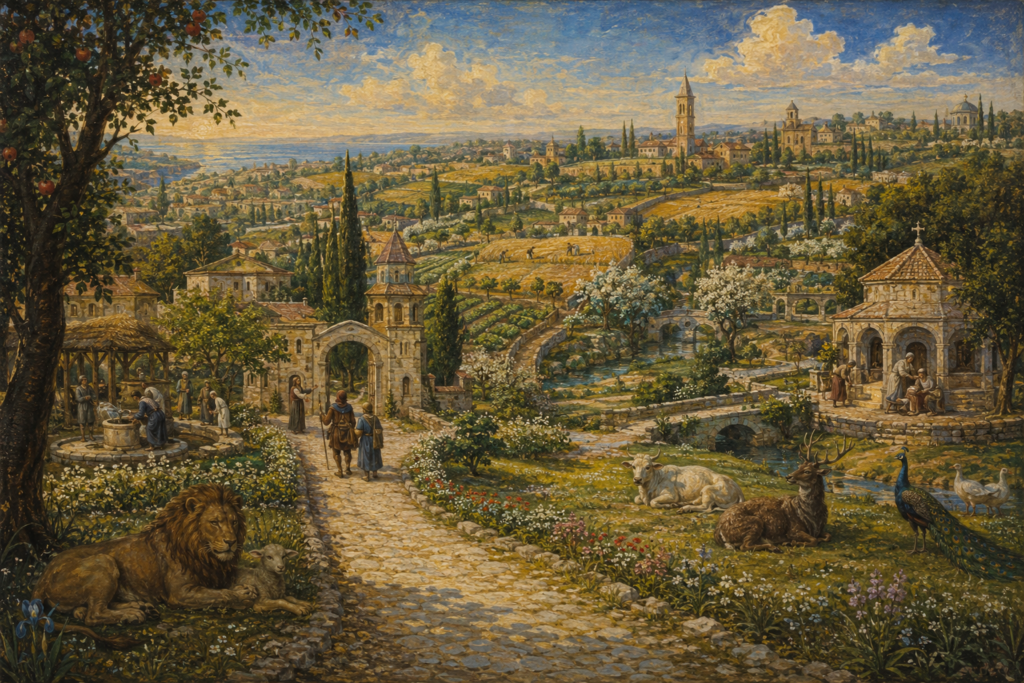
Goodness given roads, fields, law and responsibility
Planar Sigil
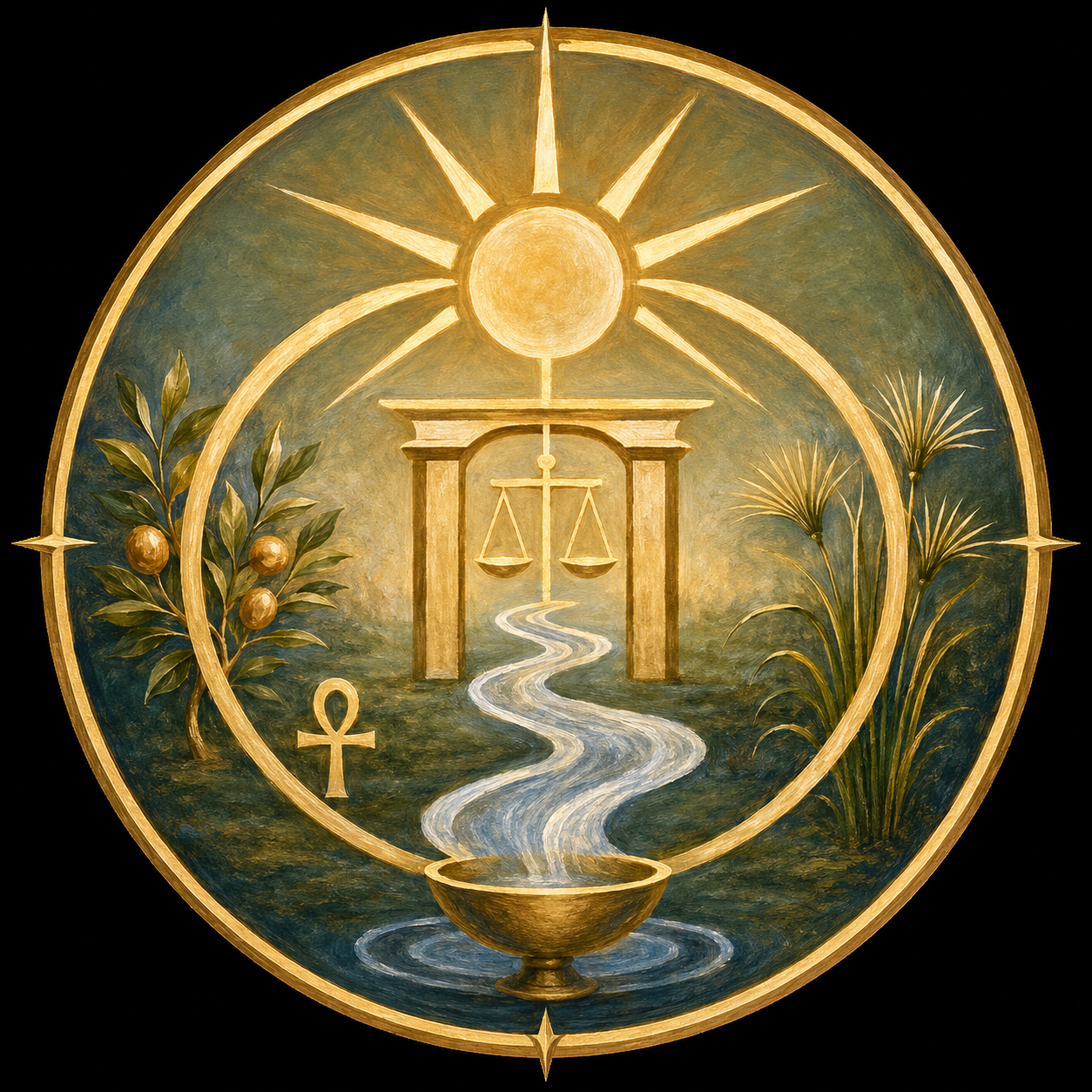
Arcadia’s greater sign combines an ordered sun, open gate, flowing river, balanced judgement, cultivated growth and renewal. The older orchard gate remains a local emblem of Abellio. The greater planar sign belongs to Arcadia as a whole rather than to any single culture or divine realm within Buxenus.
Arcadia is cultivated goodness made into land. Its peace does not exist because conflict has magically ceased. It exists because people mend what breaks, protect those seeking refuge, maintain roads and canals, preserve records, judge disputes and continue the ordinary work required to keep community possible.
Its orchards bear fruit because hands prune them. Its canals run because communities clear them. Its roads remain safe because guardians walk them. Its divine realms endure because sacred duties are performed rather than merely praised.
Arcadia is therefore not one culture enlarged into a plane. Abellio contains many peaceful communities and sacred landscapes. Buxenus contains distinct ordered divine kingdoms. The Divine Cities of the Two Rivers retain their Mesopotamian character; Duat remains distinctly Pharaonic. Their shared location establishes cosmological relationship without erasing their own gods, rites or sacred geography.
Arcadia’s central truth: order is worthy when it protects life, preserves truth, remembers obligations and prevents the powerful from abandoning those who depend upon them.
Quick Rules Reference
- Peace is active: roads, homes, temples, tombs, fields and sanctuaries must be maintained.
- Hospitality is sacred, but refuge does not require a community to ignore genuine danger.
- Oaths, truthful records and recognised witnesses carry supernatural weight.
- Healing, mediation, stewardship, proper judgement and useful labour are honoured acts.
- Animals, petitioners, divine envoys and the honoured dead may possess recognised standing.
- Violence is judged by necessity, restraint, protection and what repair follows it.
- Abellio expresses Arcadia through open communities and maintained peace.
- Buxenus expresses Arcadia through sacred jurisdiction, divine estates, judgement, memory and renewal.
- The Divine Cities of the Two Rivers and Duat are sovereign realms within Buxenus, not additional planar layers.
Abellio and Buxenus
Arcadia is one Outer Plane expressed through two immense layers. Both favour goodness shaped by responsibility, but the experience of that order changes profoundly as travellers move deeper.
Abellio — The Open Peace
Abellio is Arcadia’s broad and welcoming face: orchards, villages, peace-roads, animal sanctuaries, shared fields, guest houses, healing gardens and watchful borders.
Its laws are encountered through neighbours, wells, bells, animals, milestones and communal obligations. Most travellers first experience Arcadia here.
Buxenus — The Deep Ordered Kingdoms
Buxenus is the deeper layer of divine estates, temple roads, sacred rivers, archives, courts, processional gates and enduring cosmic obligations.
Its realms are not governed by one universal law. Each divine kingdom preserves its own rites and authority while sharing Buxenus’s concern with recognised order, remembered obligation, judgement and renewal.
Passage between the layers is rarely a staircase. A traveller may reach Buxenus by following a duty to its source, carrying a judgement beyond appeal, completing an oath, joining a divine procession or passing a gate that opens only when the traveller’s purpose is properly recognised.
Arcadia among the Upper and Ordered Planes
Arcadia stands where compassion accepts responsibility and law remains answerable to life. Its neighbouring planes reveal what changes when mercy, labour, instinct or order becomes the dominant cosmic principle.
The Celestial Realms
Pilgrimage, healing and divine embassy connect Arcadia with other flourishing heavens. Arcadia remains distinct through its emphasis on maintained peace and accountable civic duty.
The Great Mechanism
Arcadia treats law as a means of protecting life. The Great Mechanism asks what happens when procedure itself becomes the governing reality.
Bytopia
Bytopia turns goodness toward honest work and shared reward. Arcadia places greater emphasis on safe communities, civic obligation, mediation and protected passage.
Elysium
Elysium is merciful rest and healing after suffering. Arcadia asks what must be done tomorrow so that the peace enjoyed today remains real.
The Beastlands
The Beastlands expresses animal sovereignty through living wilderness. Arcadia’s Animal Kingdoms approach many of the same questions through sanctuary, covenant and recognised standing.
Buxenus’s Divine Realms
Within Arcadia itself, the greatest cosmological contrast appears inside Buxenus. Mesopotamian temple-cities and Pharaonic Duat both belong here without becoming versions of one another.
Abellio — The Open Peace
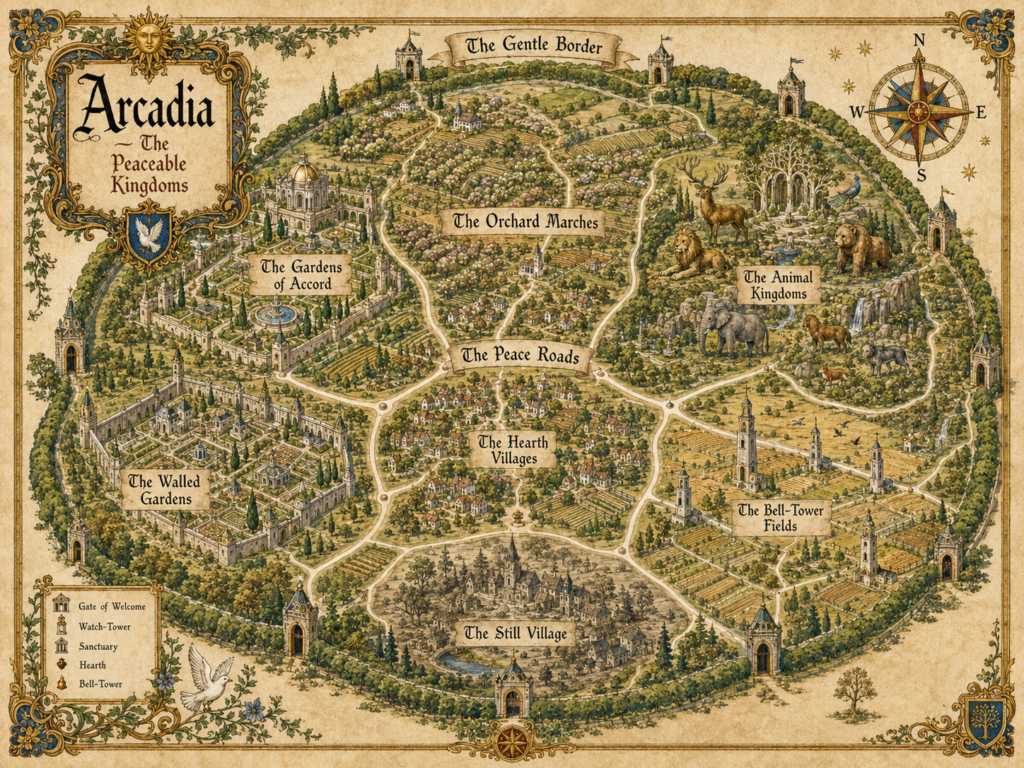
Abellio is Arcadia’s broad pastoral layer and the usual first destination for planar travellers. Its regions are organised around cultivated abundance, safe passage, sanctuary, mediation, animal standing and peace maintained through shared work.
The Orchard Marches
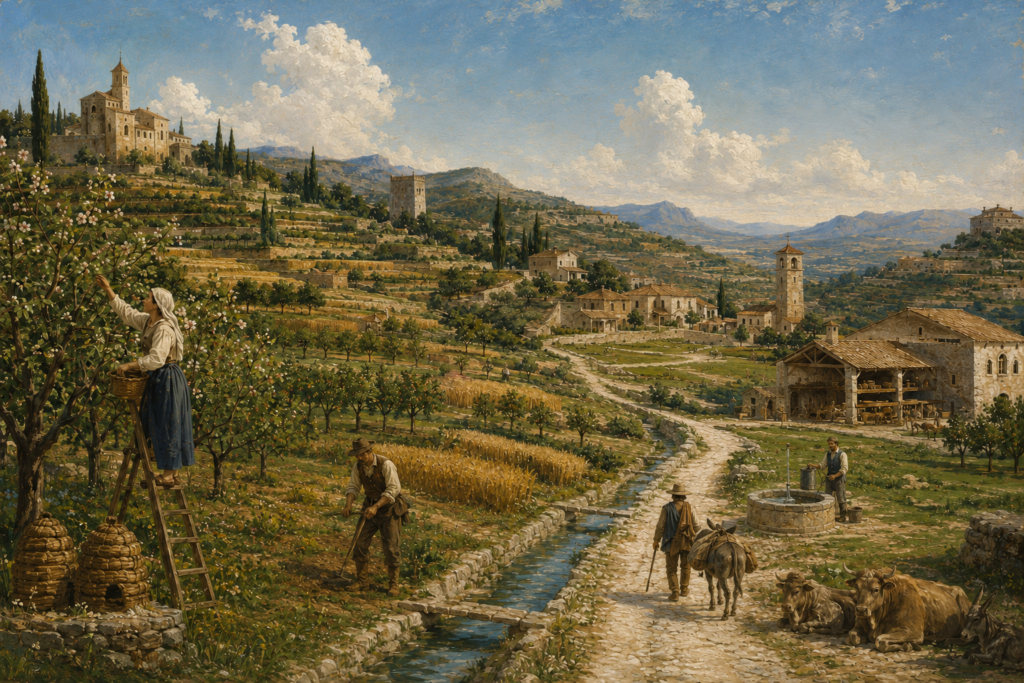
Terraced orchards, grainfields, irrigation channels, beehives, communal halls and open granaries form one of Arcadia’s most common arrival regions. A failed harvest is treated as a shared emergency rather than private misfortune.
The Peace Roads
Long pale roads are lined with milestones, shade trees, wells, guest houses and warning bells. A road promises safe passage. Travellers who use it to prey upon others may find the road lengthening, closing or guiding them toward those empowered to answer the harm.
The Gardens of Accord
Gardens, pools and shaded courts serve as places of mediation. Harm is named, testimony is heard and repair is negotiated. Reconciliation is honoured, but restraint or separation remains legitimate where restored trust would be unsafe.
The Animal Kingdoms
Sacred territories preserve migration rights, nesting grounds, old hunting covenants, guardian packs, predator custom and the standing of animals within Arcadian law. Their peace is not tame: it rests upon recognised limits between people, predators and prey.
The Hearth Villages
Villages of public tables, clean stables, wells, shared ovens, search bells and communal stores. Heroism here is often measured after the danger has ended: rebuilding a roof, finding the missing, caring for livestock or keeping a frightened household together.
The Walled Gardens
Sanctuaries of healing, memory and cultivation. Some restore exhausted travellers with extraordinary speed. Others are dangerous precisely because they can soften grief until visitors forget that sorrow may contain truths that still need to be faced.
The Bell-Tower Fields
Mills, grazing commons, orchards, signal towers and disciplined guardians dominate this watchful country. Defence is understood as care: the shield protects the household, and the warning bell promises that danger will not be faced alone.
The Gentle Border
Hedges, quarantine gardens, guest houses and guarded gates receive refugees, cursed travellers, pursued souls and dangerous cases. The border’s purpose is not exclusion but safe welcome.
The Still Village
A warning-place where every argument has been softened, every grief hidden and every difficult truth made harmless. It represents Arcadia’s most characteristic failure: harmony becoming the erasure of living difference.
Selected Views of Abellio
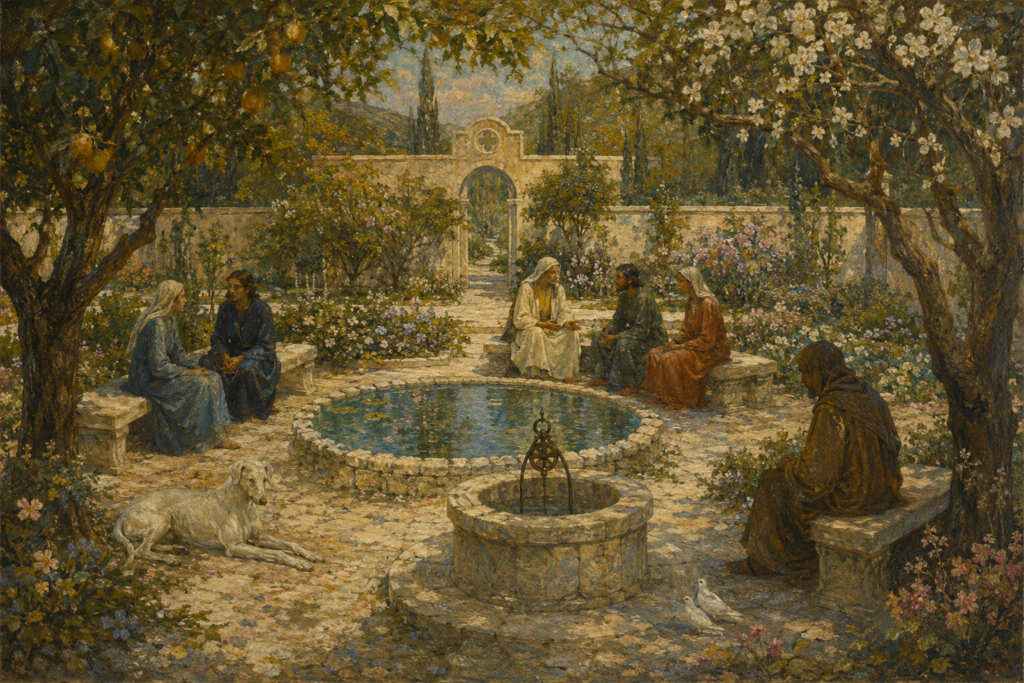
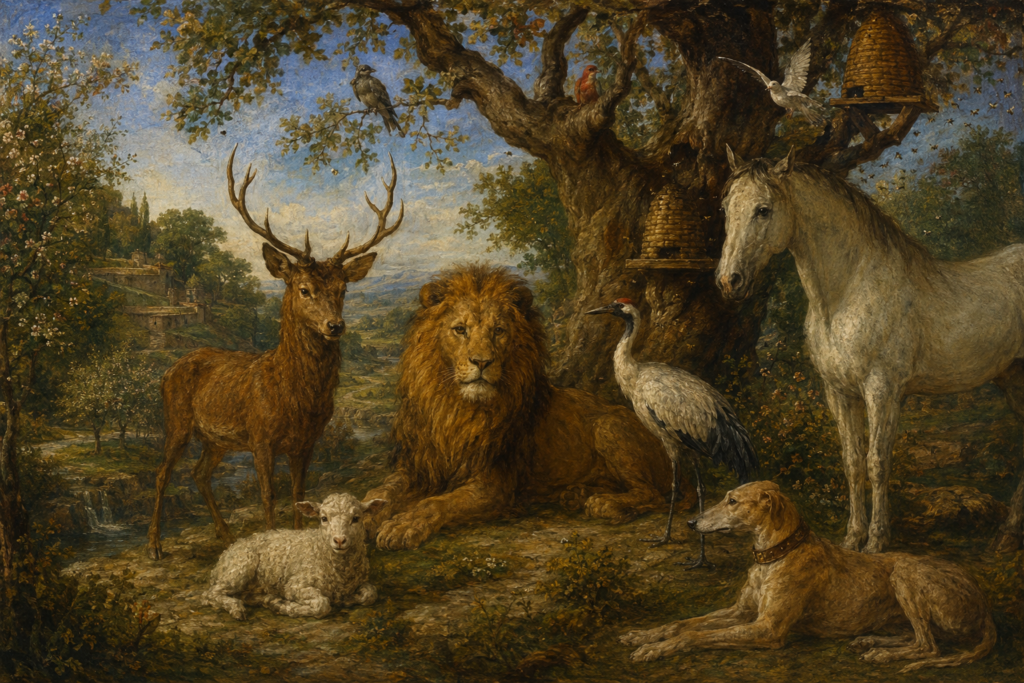
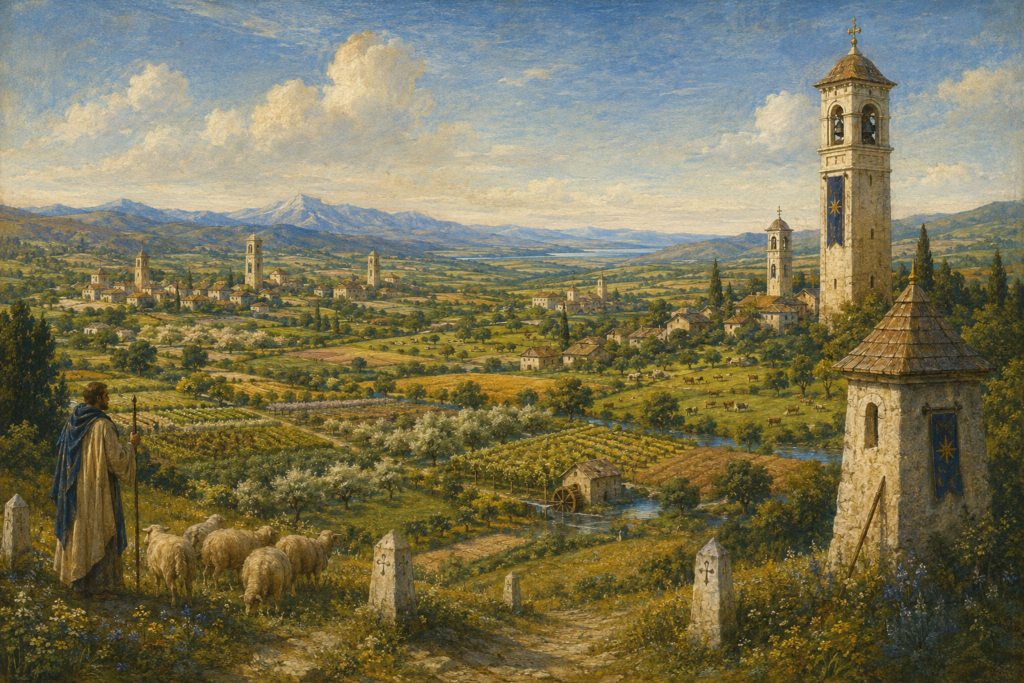
Buxenus — The Deep Ordered Kingdoms
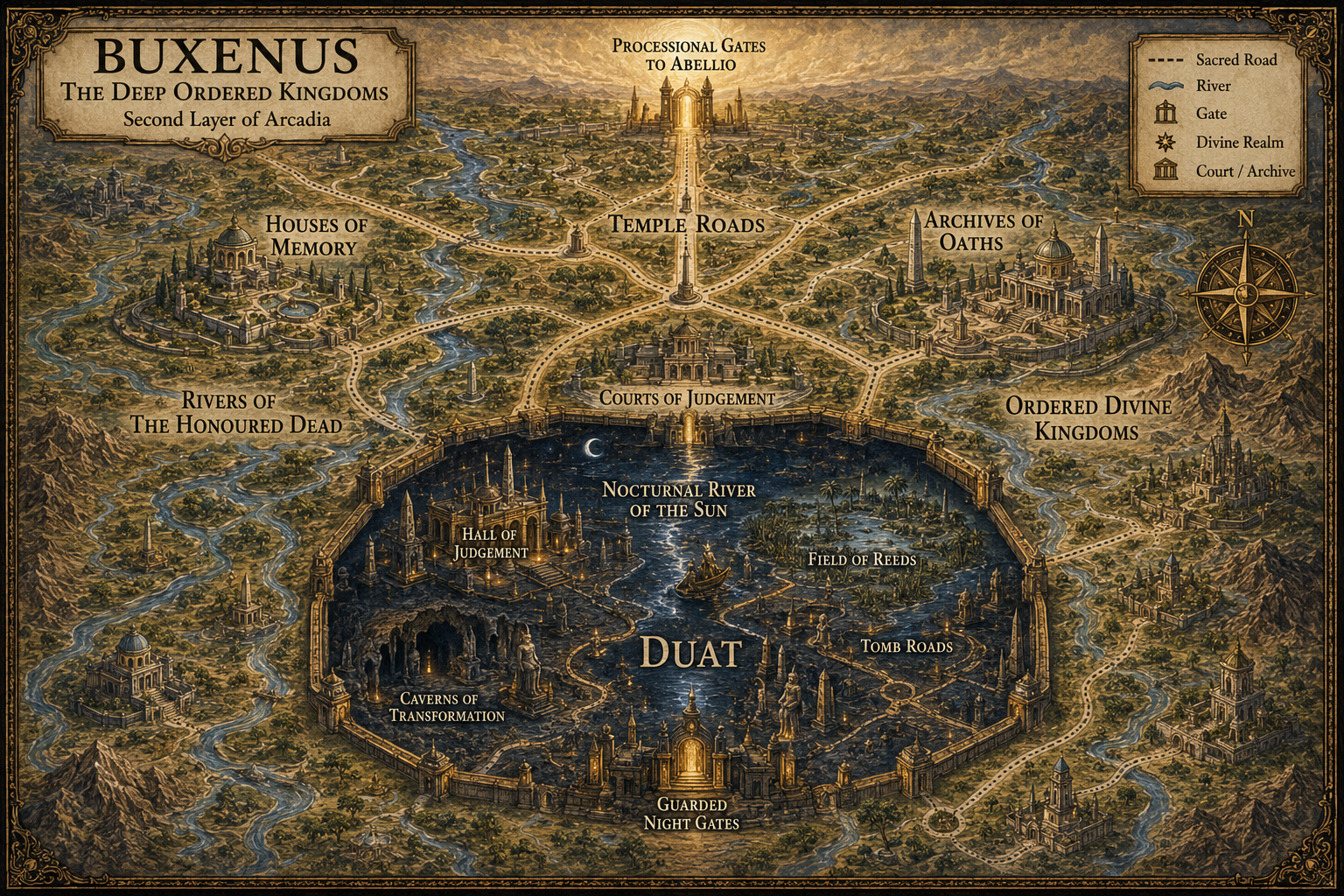
Buxenus is Arcadia’s deeper layer: an immeasurable order of temple roads, divine estates, courts, archives, sacred rivers, processional gates and kingdoms whose laws are older than many mortal civilisations.
Its order is not uniform. A traveller leaving one divine jurisdiction may cross into another whose language of duty, ritual time, sacred office and legitimate authority is very different. What these realms share is the belief that obligations, memory, judgement and renewal have consequences that cannot simply be ignored.
The Temple Roads
Ceremonial avenues connect divine estates, courts, archives, river landings and sacred districts. Proper purpose, escort or recognised office may matter more than physical distance.
The Houses of Memory
Sanctuaries preserve names, lineages, deeds, rites and memories required to keep a soul, office or covenant intact.
The Archives of Oaths
Serious promises leave records. Divine scribes and recognised witnesses distinguish honest failure from calculated betrayal.
The Courts of Judgement
Disputes between souls, petitioners, divine servants and sacred authorities are heard according to the law of the jurisdiction in which they arise.
The Rivers of the Honoured Dead
Sacred waterways carry recognised dead, funerary companies, processions and envoys toward the realms empowered to receive them.
The Processional Gates
Great thresholds open for recognised embassies, funerary processions, sacred animals, judges and travellers whose purpose has been accepted.
The Divine Cities of the Two Rivers
Along the Celestial Idiqlat and Celestial Purattu rise the great divine cities associated with the ancient powers of Sumer, Akkad, Babylonia and Assyria. Ziggurats, walled temple districts, canals, gardens, processional avenues, courts, archives and sacred river landings create one of Buxenus’s greatest concentrations of divine civilisation.
This is not one celestial empire, and the Mesopotamian gods do not form one obedient court. Divine authority remains bound to city, office, cult, remembered precedence and ancient relationship. One road may lie under the protection of a power whose judgement carries little weight beyond the next sacred boundary.
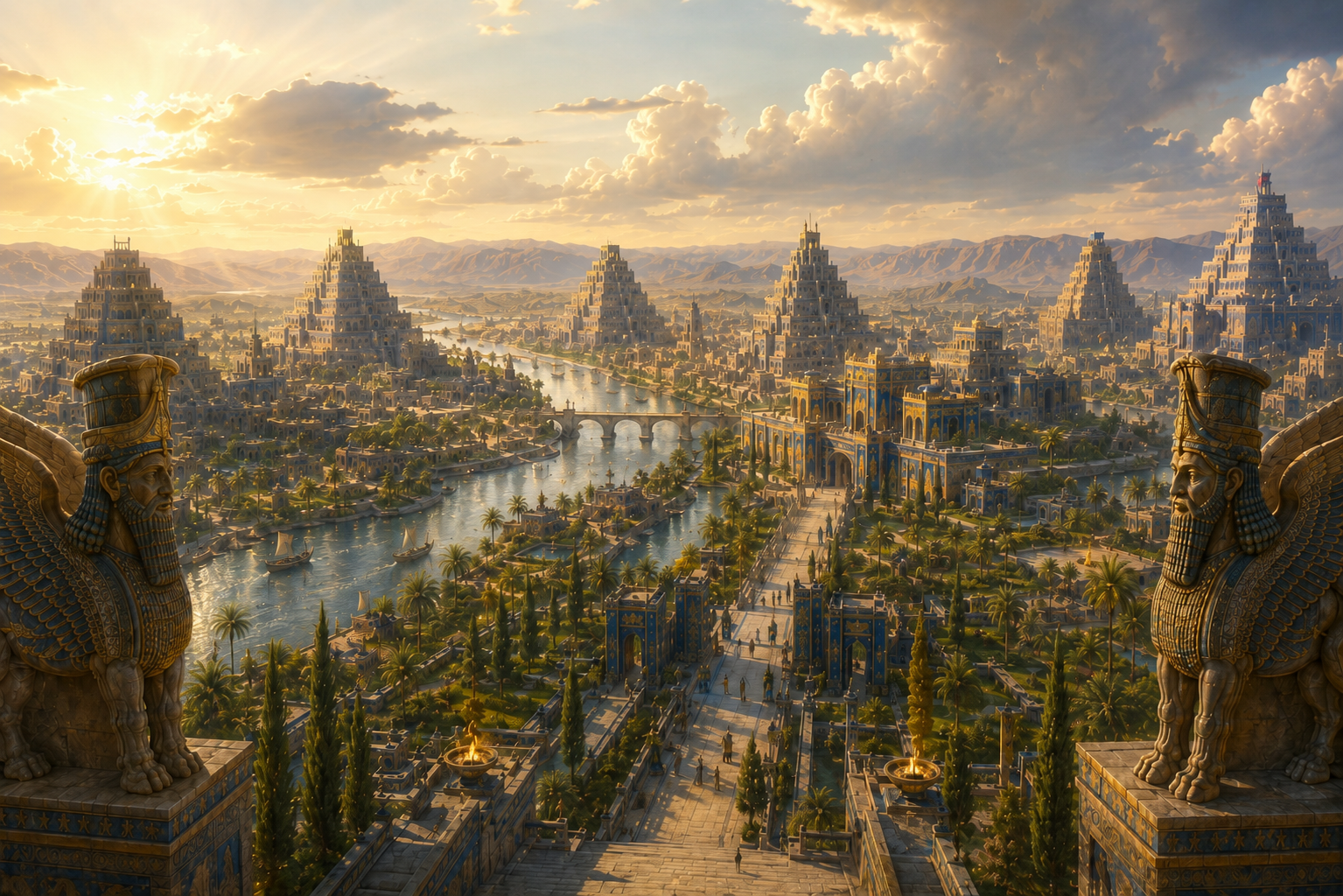
Principal Divine Cities
The greatest sacred centres include Uruk, Nippur, Eridu, Ur, Babylon, Borsippa, Assur, Sippar and Larsa. They are not districts of a single celestial capital. Each preserves its own temples, cultic memory, divine patrons, processional traditions and ancient claims to authority.
City, Temple and Divine Authority
The great powers retain different interests and jurisdictions. An / Anu, Enlil, Enki / Ea, Inanna / Ishtar, Nanna / Sin, Utu / Shamash, Marduk, Ashur and the other powers of the Mesopotamian divine world may command extraordinary authority within particular cities, temples or offices without forming a single obedient celestial court.
Political change on mortal Earth did not erase older divine claims. A god elevated by one empire may possess extraordinary splendour without causing older powers, temples or sacred offices simply to cease existing.
The Celestial Idiqlat and Celestial Purattu
The twin rivers are roads, boundaries, witnesses and sources of cultivated life. Their water feeds divine canals, temple gardens and sacred districts. A procession may cross one river under one law and arrive on the opposite bank under another.
The names preserve the Akkadian forms Idiqlat for the Tigris and Purattu for the Euphrates. Within Buxenus they are not the mortal rivers lifted bodily from Earth, but celestial rivers whose identity remembers the cultures that named and depended upon them.
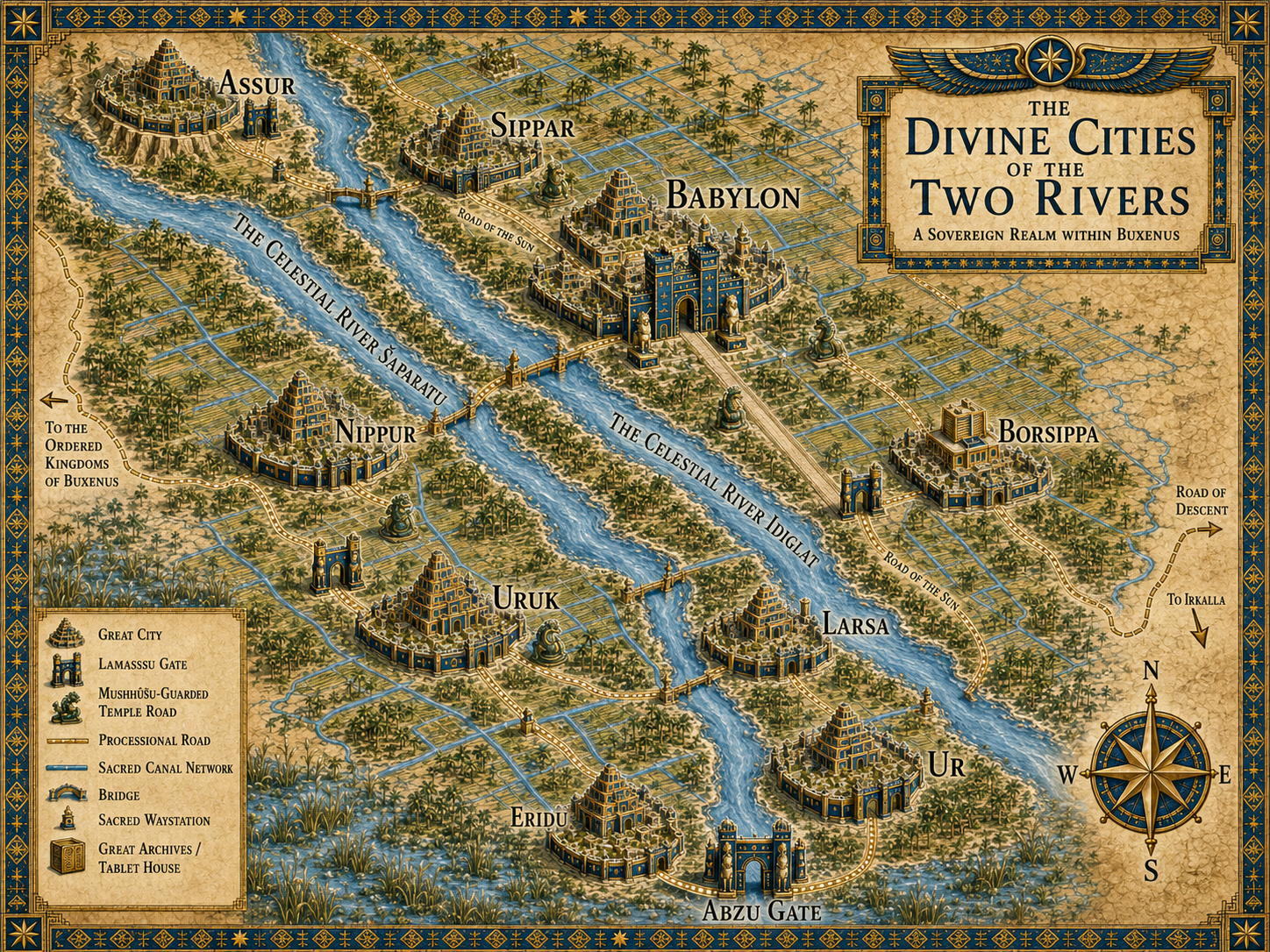
Using the Divine Cities in Play
Divine Diplomacy
A judgement, treaty or safe-conduct recognised in one city may require formal confirmation before another divine authority.
Temple Archives
Lost oaths, divine genealogies, boundary records and the true history of an ancient cult may survive where mortal archives failed.
River Expeditions
Sacred barges and river roads provide controlled movement between divine jurisdictions without making travel automatic or safe.
Restoration
Repairing a canal, procession route, abandoned shrine or broken civic obligation can matter as much as defeating an enemy.
The Divine Cities are not the Mesopotamian land of the dead. Ereshkigal, Nergal, Namtar and the powers of the underworld retain their own divine jurisdiction. The presence of Mesopotamian gods and their sacred cities within Buxenus does not relocate the land of no return to Arcadia, nor make every Mesopotamian afterlife tradition part of the Two Rivers.
Explore the gods, city cults and divine traditions through the Mesopotamian Pantheon .
Duat — Judgement, Night Passage and Renewal
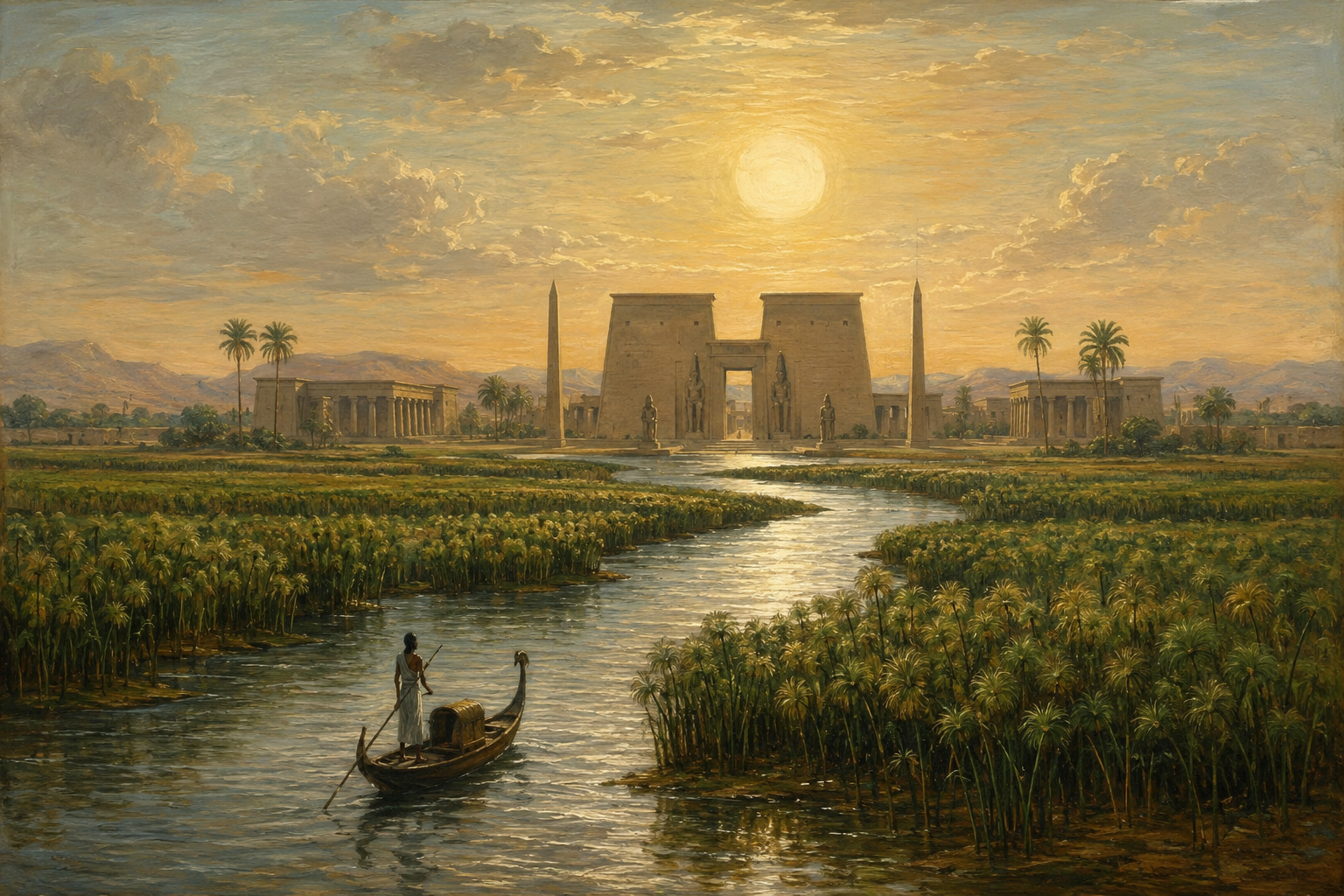
Duat is the Pharaonic netherworld and nocturnal solar realm, governed through maat: truth, justice, rightful order, proper relationship and the renewal that allows creation to continue.
Its sacred geography includes the nocturnal journey of the sun, guarded gates, divine courts, funerary roads, houses of memory, the Field of Reeds and dangerous regions in which enemies of cosmic order threaten the passage toward dawn.
The realm retains its own gods, sacred names, rites and funerary identity. Osiris, Anubis, Thoth, Isis, Horus and other Pharaonic powers perform distinct offices within this order. Judgement is not generic Arcadian mediation: the heart is weighed within a specifically Pharaonic sacred system.
The Sacred Geography of Duat
The realm is crossed by the Nocturnal River of the Sun, whose passage binds together guarded night gates, tomb roads, caverns of transformation, divine courts and the ordered lands of the justified. Distance is measured as much by ritual progress and cosmic hour as by ordinary geography.
The Hall of Judgement is among Duat’s great centres of divine authority. The Field of Reeds represents ordered life among the justified dead, while the Guarded Night Gates divide stages of the nocturnal journey and admit travellers according to rite, identity and purpose.
The Tomb Roads connect funerary passages and sacred approaches, while the Caverns of Transformation belong to the dangerous work of change, purification and renewed passage toward dawn.
The justified may pass toward ordered life among the honoured dead. Others remain before guarded thresholds, wander incomplete roads or face final consequence in judgement. These are conditions and destinations within Duat rather than additional planar layers.
Duat belongs within Arcadia because its deepest cosmological work is the preservation and renewal of rightful order. Its severity does not make it a realm of arbitrary punishment, and its placement within Buxenus does not make the rest of Arcadia Pharaonic.
Explore its divine authorities through the Pharaonic Pantheon and the Anubis entry.
What Arcadia expects
Peace Is Active
A settlement that knowingly leaves travellers exposed, lets a dangerous road decay or ignores preventable suffering has failed the peace even if no law was formally broken.
Hospitality Is Sacred
Honest travellers usually receive food, shelter and protection. Guests in turn owe respect to households, animals, graves, temples, food stores and the safety of those who welcomed them.
Oaths and Records Matter
Promises may be remembered by roads, gates, witnesses, archives, sacred rivers and divine offices. Honest failure is treated differently from concealed betrayal.
Useful Work Has Dignity
Farming, tending animals, healing, teaching, copying records, clearing canals, preparing the dead and guarding travellers can all be sacred acts.
Judgement Must Mean Something
A judgement should protect, establish truth, identify responsibility and decide what must happen next. Procedure without truthful purpose is not enough.
Harmony Can Become a Trap
Peace can become silence. Care can become control. Ritual can become empty obedience. Arcadia is most interesting when its own virtues are placed under pressure.
Those who live under Arcadian order
Petitioners
Arcadian petitioners include souls shaped by care, stewardship, honest labour, healing, teaching, responsible defence, mediation and the protection of others. Their forms and communities reflect the realm in which they dwell rather than one universal Arcadian culture.
Peace-Keepers and Wardens
Celestial servants, road spirits, orchard guardians, temple wardens, lantern bearers and other recognised protectors keep roads, refuges, temples and civic spaces safe. Warning, shelter, mediation and separation usually precede force.
Animal Sovereigns
Sacred and intelligent animals may hold authority over migration, nesting, hunting custom, herd protection and old treaties between communities and the living world.
Servants of the Divine Cities
The Divine Cities of the Two Rivers contain temple servants, divine scribes, judges, river officials, heralds, procession keepers, guardians and petitioners whose duties arise from the city and god they serve. Their offices follow established Mesopotamian divine identities rather than a generic Arcadian bureaucracy.
Pharaonic Divine Servants
Duat contains gate guardians, funerary guides, divine scribes, judges, sacred animals, protectors of names and the servants required to sustain the nightly solar journey and the ordered passage of the dead.
Roads recognise conduct as well as direction
Arcadia is unusually easy to navigate when travellers act openly, respect refuge and accept the authority of the place through which they are passing. Roads are clear, signs are honest and shelters can usually be trusted.
A traveller who steals from hosts, abuses sanctuary, harms protected animals or carries concealed predatory intent may find gates closing, roads lengthening and convenient routes turning toward witnesses or authorities.
Reaching Buxenus
Reaching the Divine Cities of the Two Rivers
Routes may open through restored temple thresholds, divine invitations, ancient processional roads, recognised river rites, sacred tablets, star-marked gates or journeys whose purpose concerns a Mesopotamian god, city cult or surviving divine obligation.
Arrival commonly places travellers at a gate, quay, temple approach or processional road rather than directly inside a divine sanctuary. Visitors should expect to establish who they are, whom they seek and under whose authority they travel.
Reaching Duat
Common approaches include consecrated tombs, funerary rites, sacred western gates, ritual river crossings, divine processions and paths opened by Pharaonic powers. Improper entry can leave a traveller unrecognised before gates that require name, rite or lawful purpose.
Return may depend on completing an appointed passage, preserving a true name, receiving judgement, accompanying the dawn procession or carrying an authorised sign from a recognised divine authority.
For route design, arrival pressure and return conditions, use the Planar Campaigns guide.
How Arcadia responds
Active Peace
Violence in settled regions draws rapid attention from neighbours, guardians and witnesses. The first response is usually protection and separation rather than vengeance.
Oath-Echo
Serious promises can leave a supernatural trace. Recognised witnesses may sense that an obligation exists even when they do not know its wording.
Shared Labour
Travellers who repair damage, tend the wounded, maintain roads, protect rites, preserve records or assist harvests find the plane more willing to provide clear passage.
Sacred Jurisdiction
In Buxenus, authority is local and meaningful. A seal, oath, temple office or court ruling may open one gate and have no power beyond the next recognised boundary.
The Two Rivers Remember
Within the Divine Cities, river crossings and public records can serve as witnesses. Attempts to falsify civic or sacred obligation are more difficult before recognised divine authorities.
The Measure of Maat
Within Duat, deliberate false testimony, desecration, destruction of sacred names and betrayal of ritual duty acquire spiritual weight until truth and appropriate repair are restored.
Solar Renewal
Duat changes with the nocturnal passage of the sun. Gates, hazards and authorities may differ by sacred hour, and successful passage moves inexorably toward dawn.
Arcadian Planar Rules
Use the edition that matches the campaign. Arcadia’s narrative laws remain the same; the mechanical expression changes with the rules system.
Arcadian Baseline
Gravity and Time. Normal throughout most of Abellio. Divine estates in Buxenus may organise themselves around ritual hours or processional cycles, but this does not change rest or spell durations unless the individual realm says so.
Conduct over Alignment. Arcadia does not prevent entry because of a creature’s alignment or moral description. The plane responds to what the creature actually does.
Sanctity of Shelter. A creature honestly seeking refuge can normally obtain basic food, rest and protection where providing it does not create an immediate threat to others. A creature that knowingly abuses sanctuary cannot gain Arcadian Favour until meaningful repair is made.
Arcadian Favour
After finishing a Long Rest in Arcadia, a creature that has protected another, repaired harm, kept a difficult promise, honoured an important rite or completed useful communal work gains one Arcadian Favour die, a d4. A creature can hold only one Arcadian Favour die.
After making an attack roll, ability check or saving throw directly connected to protection, healing, truth, duty, restoration or the fulfilment of a recognised obligation, the creature may roll the d4 and add it to the result before the outcome is declared. The die is then lost.
The die is also lost if the creature knowingly commits needless cruelty, violates sanctuary, deliberately breaks a serious oath or desecrates a protected sacred place.
The Divine Cities of the Two Rivers
Sacred Record. A creature attempting to deceive a recognised divine judge, temple authority or sacred witness about a formal oath, official seal, civic obligation or temple record has disadvantage on the relevant Charisma check when that authority has access to the true record.
Work that restores a canal, protects a lawful procession, preserves an endangered record or fulfils a public obligation can qualify for Arcadian Favour.
Duat
Record of the Heart. A creature that knowingly commits false testimony, desecration, destruction of a sacred true name or betrayal of recognised sacred trust in Duat is marked until it confesses and makes appropriate restitution.
Recognised judges, gatekeepers and divine servants of Duat have advantage on Wisdom (Insight) checks against the marked creature, and the marked creature has disadvantage on Charisma (Deception) checks against them.
Dawn Renewal. After completing a dangerous stage of the solar passage while preserving maat, a creature may complete one Short Rest in 10 minutes at the first light of the next stage. A creature can benefit from this once per Long Rest.
Planar Traits
- Gravity: Normal.
- Time: Normal in Abellio; particular divine estates may impose ritual cycles without altering numerical durations unless stated.
- Shape: Immeasurable.
- Morphic: Divinely Morphic.
- Abellio Alignment: Mildly good-aligned and mildly law-aligned across most settled regions.
- Buxenus Sanctuaries: Principal divine courts and protected sacred districts may be strongly good-aligned, strongly law-aligned or both according to the realm.
Enhanced Magic
In protected healing houses, refuge communities, sacred orchards and recognised good-aligned sanctuaries, spells and spell-like abilities with the good descriptor are enhanced and function at +2 caster level.
In lawful courts, archives, protected processions and sanctuaries devoted to rightful judgement, spells and spell-like abilities with the lawful descriptor may receive the same enhancement. The bonuses do not stack with each other.
Impeded Magic
A spell or spell-like ability with the evil descriptor used to violate sanctuary, or a chaotic effect used specifically to destroy a recognised sacred procession, court or protected record, may be impeded.
The caster must succeed at a concentration check (DC 20 + spell level). On a failure, the spell does not function and the prepared spell or spell slot is lost.
Oath-Echo
A creature that knowingly breaks a serious promise made under recognised Arcadian witness takes a –2 circumstance penalty on Bluff and Diplomacy checks against Arcadian spirits and recognised witnesses aware of the breach until appropriate repair is made.
The Divine Cities of the Two Rivers
A creature knowingly presenting a false sacred record, forged divine authority or fraudulent oath before an authority possessing the authentic record takes a –2 circumstance penalty on Bluff checks related to that falsehood.
Duat — Weight of the Heart
A creature marked by serious desecration, false testimony, betrayal of sacred trust or destruction of a true name takes a –2 penalty on Bluff checks against recognised Duat judges and gatekeepers, and a –2 penalty on saving throws against divination effects used by those authorities to establish truth.
Truthful confession and appropriate restitution remove the mark.
Planar Traits
- Gravity: Normal.
- Time: Normal in Abellio; local ritual time may exist in divine estates without altering numerical durations unless stated.
- Size: Immeasurable.
- Morphic: Divinely Morphic.
- Abellio Alignment: Mildly good-aligned and mildly law-aligned in most settled regions.
- Buxenus Sanctuaries: Important courts and divine estates may become strongly aligned according to the governing power.
Alignment Pressure
A creature with an alignment opposite a mildly aligned Arcadian trait takes the normal –2 circumstance penalty on Charisma-based checks. Where a realm is strongly aligned, use the normal strong alignment penalties for that moral or ethical component.
Arcadian Resonance
In healing sanctuaries, protected refuges and sacred orchards, spells with the good descriptor are cast at +1 caster level.
In recognised lawful courts, archives and sacred processions, spells with the lawful descriptor used to preserve legitimate order may receive the same benefit. These bonuses do not stack.
Impeded Magic
Evil magic used to violate protected sanctuary and chaotic magic used specifically to destroy recognised sacred order may be impeded.
The caster must succeed on a Spellcraft check (DC 20 + spell level). On a failure, the spell does not function and is still lost as a prepared spell or spell slot.
Oath-Echo
A creature that knowingly breaks a serious witnessed oath takes a –2 circumstance penalty on Bluff and Diplomacy checks against Arcadian spirits and recognised witnesses aware of the breach until meaningful repair occurs.
The Divine Cities of the Two Rivers
False records and fraudulent claims of sacred authority impose a –2 circumstance penalty on Bluff checks when presented before a recognised authority possessing the true record.
Duat — Weight of the Heart
A creature marked by serious desecration, false testimony, betrayal of sacred trust or destruction of a true name takes a –2 penalty on Bluff checks against Duat’s recognised judges and gatekeepers and a –2 penalty on saves against divination effects used by those authorities to establish truth.
Running Arcadia
Arcadia works best when it is genuinely beautiful, generous and safe enough that its virtues matter. Its roads should really be easier to travel. Its villages should really offer shelter. Its courts should usually care whether the truth has been established.
The tension appears when those virtues meet a difficult case: a dangerous refugee, a sacred procedure hiding an injustice, a repentant enemy who still requires restraint, two divine jurisdictions with legitimate but incompatible claims, or a community so committed to peace that it no longer knows how to hear anger.
Use Abellio for
- Hospitality
- Shared labour
- Animal covenants
- Safe roads
- Refuge
- Community repair
Use the Two Rivers for
- Divine diplomacy
- City and temple authority
- Ancient records
- Sacred river travel
- Competing jurisdictions
- Restoration of old obligations
Use Duat for
- Judgement
- True names
- Funerary passage
- Sacred identity
- Nightly peril
- Renewal at dawn
Let Arcadia’s goodness be real. The strongest Arcadian adventures test what good people and legitimate institutions do when two responsibilities cannot both be satisfied easily.
Stories for the Peaceable Kingdoms
The Gate That Opens Too Easily
Refugees are welcomed into an Arcadian settlement before anyone knows that one carries a dangerous curse. Preserve hospitality without allowing mercy to become negligence.
The Herd That Refuses the Road
Sacred animals block a major peace-road because an old hunting covenant beneath it has been violated. Trade and rescue caravans cannot pass until the buried wrong is understood.
The Village Without Arguments
A settlement has eliminated hunger, crime, grief, disagreement and song. A peace-keeper asks the characters to discover what the village surrendered to become perfectly harmonious.
The River That Refuses a City
A channel of the Celestial Purattu withdraws from a divine city whose authorities insist every required rite has been observed. An older obligation survives in an archive no current ruler accepts.
The Tablet Between Two Thrones
Two divine cities possess authentic records granting each of them control of the same sacred procession road. Both claims are true, but they were never intended to operate at the same time.
The Missing Hour of the Sun
One guarded hour of the solar passage disappears from Duat. Dawn reaches Earth weakened while divine records insist the missing hour still exists.
The Heart That Weighs Too Light
A notorious ruler passes judgement because the memories carrying the weight of the ruler’s deeds have been removed. The characters must restore truth without corrupting the judgement they are trying to save.
The traditions behind the campaign plane
Historical Arcadia was a mountainous region of the central Peloponnese with strong pastoral associations and important local cults. Later European literature developed “Arcadia” into an idealised rural refuge. SpiralWorlds draws upon that pastoral inheritance while making the Peaceable Kingdoms themselves a fantasy campaign plane.
The Mesopotamian material belongs to a separate cultural tradition. Ancient religion developed through many cities and periods rather than one permanent pantheon organised under an unchanging hierarchy. Sumerian and Akkadian names could coexist or succeed one another, and the prominence of particular gods changed with cities, kingdoms and theological traditions.
The names Idiqlat and Purattu are Akkadian names for the Tigris and Euphrates. Their celestial counterparts in Buxenus are a SpiralWorlds cosmological development rather than a claim that historical Mesopotamian religion placed those rivers on Arcadia.
Duat is likewise distinct. Pharaonic funerary material describes a netherworld through which the sun travels at night and within which the dead encounter divine judgement. The weighing of the heart and the principle of maat belong to that specific tradition.
Placing both the Divine Cities and Duat within Buxenus is a SpiralWorlds campaign-cosmology decision. It establishes where those divine realms lie on the planar map without claiming that Greek, Mesopotamian and Pharaonic traditions historically described a single afterlife or cosmology.
Selected References
Perseus Digital Library — Dictionary of Greek and Roman Geography: Arcadia Perseus Digital Library — Pausanias, Description of Greece, Book VIII ORACC — Ancient Mesopotamian water names, including Idiqlat and Purattu The Metropolitan Museum of Art — Amduat papyrus and the sun’s journey through Duat The Metropolitan Museum of Art — Funerary papyrus showing judgement before OsirisKeep this reference growing
If this page helped with your reading or game, you can support its upkeep or explore the curated books.
Explore the Bookshop — epics, classics and stories behind imagined worlds.