
SpiralWorlds Cosmology
Elemental Planes — Air, Earth, Fire and Water
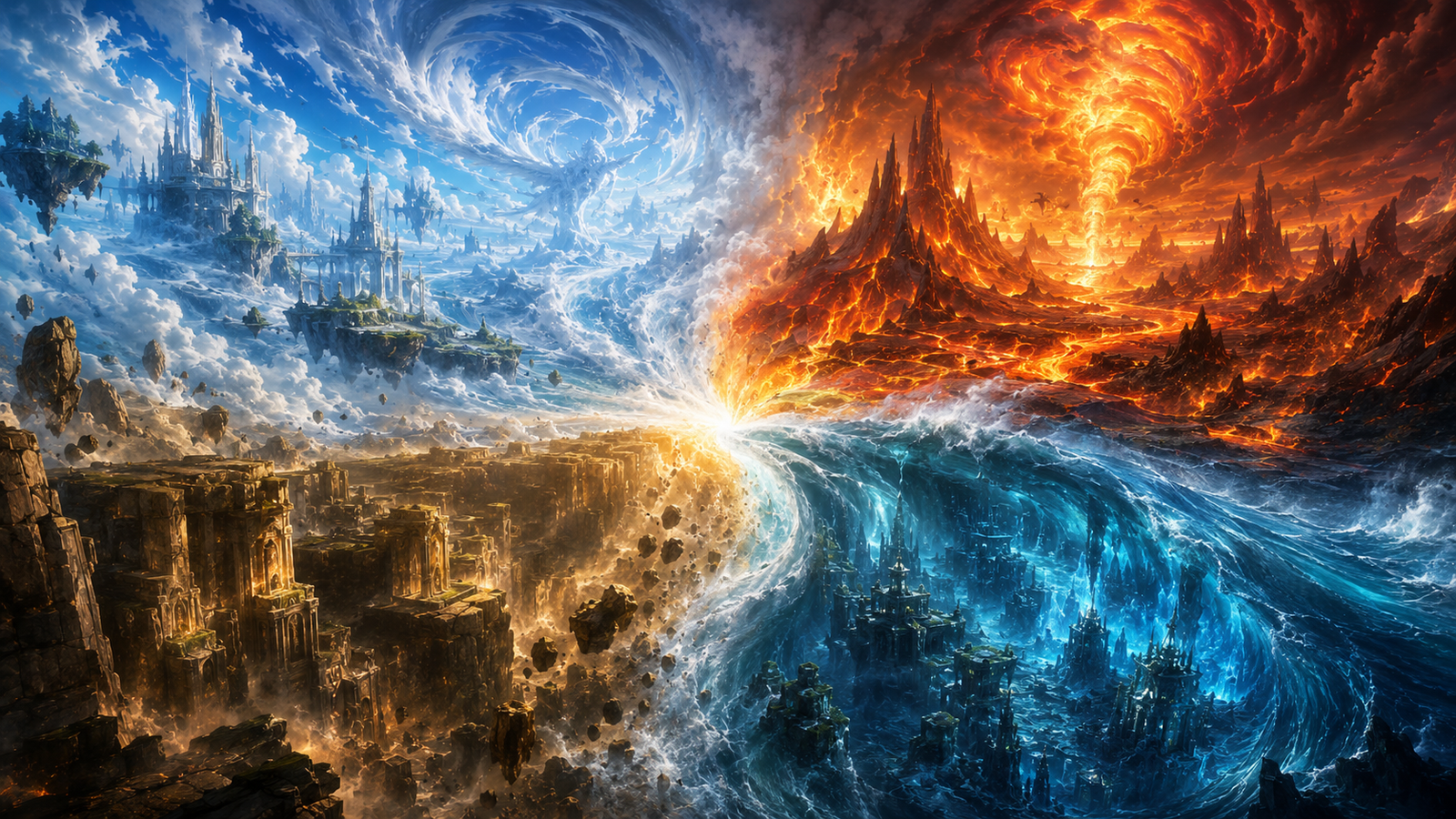
The Elemental Planes are four primal Inner Planes where air, earth, fire and water exist as complete realities rather than ingredients of an ordinary world. They are ancient, inhabited, politically complex and often lethally hostile to travellers who arrive without preparation.
Quick Reference
The Four Primal Planes
Each Elemental Plane is effectively a universe. Mortal visitors usually encounter only a fraction of it: a court, storm-road, cavern network, lava sea, drifting harbour, portal region or frontier where another element begins to intrude.
Air
Infinite Sky
A world of open blue, cloudlands, floating territories, storms, pressure shelves, wind roads and aerial powers.
Its first danger is not lack of air but lack of ground. Movement, orientation, weather and control of safe routes matter more than ordinary roads.
Explore the Elemental Plane of AirEarth
Deep Foundation
An immeasurable reality of stone, mineral, pressure, crystal, caverns, vaults and territories buried inside greater territories.
Here open space is a resource. Ownership, excavation, buried law, treasure claims and the possibility of entombment shape every expedition.
Explore the Elemental Plane of EarthFire
Eternal Furnace
A realm of flame, volcanic pressure, moving plates, molten rivers, burning weather, forge-cities and powers that regard heat as ordinary environment.
Resistance to fire is only the beginning. Smoke, thirst, unstable terrain, legal danger, supplies and shelter remain separate problems.
Explore the Elemental Plane of FireWater
Worldsea Without Shore
An endless three-dimensional ocean of currents, pressure kingdoms, drifting settlements, air-bells, luminous depths and seas within seas.
There is no universal surface or sea floor. Breath, current, orientation, pressure and hospitality determine whether a visitor survives.
Explore the Elemental Plane of WaterCosmological Role
The Elemental Planes are older than the gods. They are not divine estates, afterlives or kingdoms created by later pantheons. They belong to the primal physical order of existence.
In SpiralWorlds cosmology, the Great Collision awakens the raw forces from which the elemental order emerges. Air, Earth, Fire and Water become coherent realities before the later Astral order, before the Elder Gods, before the Outer Planes assume their mature forms and before the Titans enter cosmic history.
Later gods can enter an Elemental Plane, establish houses, palaces, shrines, sacred currents, fortresses and protected territories there. They can influence portions of the plane and become important political powers within it. They do not thereby become its creators or universal sovereigns.
This distinction matters at the table. A sea god does not own all Water. A fire god does not command every flame. An earth deity does not possess every mountain. Divine authority meets an older elemental reality whose native powers, peoples and laws existed independently.
The Elemental Planes also stand beside the Energy Planes within the greater family of Inner Planes. Together these realities form part of the primal infrastructure beneath later worlds rather than a moral map of good and evil.
Where the Elements Meet — Elemental Border Realms
The four planes are distinct, but their frontiers are not clean lines. Where two elemental realities approach one another, mixed regions form. SpiralWorlds treats these as Elemental Border Realms: enormous unstable territories in which neither neighbouring element has complete control.
This six-frontier model reflects the geography already established across the individual plane entries without requiring each frontier to become a separate full plane.
Ash and Smoke Frontier
Ember updrafts, smoke oceans, cinder storms and burning clouds form where heat invades open sky.
Air becomes difficult to trust. Visibility collapses, winds carry sparks across impossible distances and settlements survive around clean-air currents or magically protected routes.
Magma Frontier
Stone melts, hardens, fractures and melts again. Rivers of molten rock cut through black mountains while metal-rich islands drift in incandescent seas.
This is a natural realm for mining wars, forge enclaves, salamanders, magma elementals, territorial claims and roads that cease to exist when the crust breaks.
Ooze and Mud Frontier
Water thickens with mineral, clay and silt until sea and stone become difficult to distinguish.
Drowned caverns, mud seas, pressure vents, living reefs, mineral swamps and slow elemental ecologies make this frontier rich in resources and terrible for ordinary movement.
Ice Frontier
Mist, snow, rain, hail and impossible ice connect open sky with the Worldsea.
Glassice drifts may carry frozen cities, trapped air, sleeping elementals and ancient wrecks. Storm fronts can make the distinction between cloud and ocean meaningless.
Dust Frontier
Stone becomes particulate and sky becomes weight. Dust seas, sand cyclones, floating rock, abrasive storms and collapsing visibility fill the boundary.
Travellers may be buried without ever touching a conventional ground, while earth-born creatures move through airborne debris as naturally as swimmers through water.
Steam Frontier
Boiling currents, pressure explosions, geysers, superheated mist and rapidly changing visibility mark the direct collision of Fire and Water.
Steam is not a gentle compromise. Sealed pressure can be deadlier than flame, and sudden condensation can flood settlements built in spaces that were dry moments earlier.
Terminology: published fantasy game cosmologies have used several different para-elemental schemes and names over time. SpiralWorlds therefore uses Elemental Border Realms as its setting term. Smoke or Ash, Magma, Ooze or Mud, Ice, Dust and Steam can still appear as useful historical or rules terminology without forcing the setting into a four-frontier map.
Who Lives in the Elemental Planes?
Elemental does not mean empty. These planes contain predators, herds, territorial elemental intelligences, settlements, courts, trade routes, treaties, sacred sites, wars and peoples whose bodies are adapted to conditions that kill ordinary mortals.
Elementals
Elementals range from temporary manifestations and wandering creatures to ancient thinking powers whose bodies are effectively weather, reef, firestorm or moving landscape.
Intelligence, personhood and legal status vary. A traveller should not assume that a creature made of fire or stone is mindless simply because its body is unfamiliar.
Genie Civilisations
Genie societies are among the most recognisable political cultures of the Inner Planes.
Other Natives
Xorns, invisible stalkers, mephits, salamanders, aquatic peoples, mineral feeders, sacred beasts, enormous predators and mixed-element creatures all belong somewhere within the larger ecology.
Use the individual plane guides for the deeper native ecology of each realm rather than treating the hub as a monster catalogue.
Personhood, Territory and Law
A planar expedition can become a political incident long before combat begins. A stable cavern may belong to a shaitan claimant. An air current may be a recognised road. An air-bell in Water may be private property. A sheltered district in Fire may charge for water, cooling, safe passage and refuge.
Some elementals are people. Some are animals. Some are natural events with intention. Some are sacred property. Some are effectively sovereign territories that can speak.
Before deciding that an unfamiliar native is simply an encounter, decide whether somebody recognises its rights, ownership, kinship, rank, sanctity or treaty status.
Practical rule: if a creature can bargain, surrender, hold property, make law, remember an obligation or recognise a treaty, treat killing it as an act that may carry social and political consequences.
Travel, Arrival and Survival
Reaching an Elemental Plane and surviving an Elemental Plane are two different problems.
Plane Shift can move a party between realities, but planar magic does not guarantee a comfortable campsite, breathable medium, stable footing, recognised legal status or a safe way home.
The Planar Campaigns guide covers expedition structure in greater detail. For an elemental journey, the first preparation should be specific to the destination.
| Plane | Immediate Problem | Movement | Major Hazards | Preparation Priority |
|---|---|---|---|---|
| Air | Usually breathable, but there may be no ground and local air can become thin, poisonous, dusty or smoke-filled. | Flight, controlled falling, wind routes, floating terrain and local gravity. | Storms, lightning, extreme wind, pressure changes, separation and uncontrolled falls. | Reliable flight, anchoring, weather protection and a route guide. |
| Earth | Open space is not guaranteed. An uncontrolled crossing can become an entombment emergency. | Caverns, mining roads, burrowing, fault-lines and controlled passages. | Suffocation, cave-in, crushing pressure, darkness, seismic movement and legal trespass. | Secure arrival coordinates, excavation magic, air and a known open route. |
| Fire | Heat is continuous in exposed regions and safe shelter may be scarce, owned or defended. | Moving crust, lava routes, fire roads, fortress corridors and protected districts. | Heat, flame, smoke, lava, thirst, unstable surfaces and burning equipment. | Fire protection, drinkable water, heat-safe equipment and protected shelter. |
| Water | The normal medium is water and an air pocket cannot be assumed. | Swimming, currents, three-dimensional navigation and drifting settlements. | Drowning, violent currents, pressure, cold, boiling brine, predators and separation. | Water breathing, swim capability, current navigation and pressure protection. |
Arrival Is Part of the Encounter
A controlled gate into an established harbour is different from an emergency crossing into raw elemental territory. When arrival is uncertain, decide four things immediately:
- Can the travellers breathe the local medium?
- What counts as stable movement or footing?
- What environmental pressure begins acting on them immediately?
- Who owns, patrols or claims the place where they arrived?
A fifth question follows quickly: how are they returning? The exit route should be part of the expedition plan before the party leaves Earth.
Elemental Planes Mechanics
These are hub-level rules. Use them to establish the immediate character of each plane, then use the individual plane entry for more specific regional hazards, societies and encounter procedures.
5.5e-Compatible Hub Rules
These are SpiralWorlds-compatible procedures for running elemental travel with the current fifth-edition rules framework. They are intended as quick hub guidance rather than replacements for the detailed procedures on the individual plane pages.
| Plane | Baseline | Quick Procedure |
|---|---|---|
| Air | Open space; breathable regions are common; little solid terrain is guaranteed. | Use the Elemental Plane of Air procedures when the environment becomes dangerous. In a Storm, a flying creature without Hover makes a DC 15 Strength saving throw at the start of its turn or is pushed 30 feet with the wind. A creature falling through the plane can attempt a DC 15 Dexterity saving throw at the end of its turn when usable support is nearby. |
| Earth | Solid matter dominates. Caverns, tunnels and vaults are habitable exceptions within a greater reality of stone. | Use the Elemental Plane of Earth unsafe-arrival procedure rather than a generic check. An uncontrolled crossing can lead to an airless pocket, falling shaft or sealed stone. If sealed stone occurs, the travellers are displaced toward the nearest open space by the portal, protective magic or DM ruling and may suffer force or bludgeoning damage from partial entombment. Failed arrival creates danger, not unavoidable instant death. |
| Fire | Extreme heat, burning surfaces, hostile atmosphere and fire weather dominate exposed regions. | Fire resistance helps against fire damage but does not automatically solve smoke, thirst, exhaustion, sinking, unstable footing or the need for shelter. Use the full Elemental Plane of Fire exposure, smoke, cinderstorm and lava procedures rather than duplicating their damage ladder here. |
| Water | Water is the default medium and travel is fully three-dimensional. | A creature that cannot breathe water needs an air pocket or another solution. In a strong current, use a DC 14 Strength (Athletics) check. Violent currents increase the DC to 16 or 18. In deep-pressure regions, an unprotected traveller makes a DC 15 Constitution saving throw after each hour of travel, or more often in extreme pressure. |
Mixed Border Realms
In an Elemental Border Realm, apply the environmental pressure that actually exists rather than stacking every rule from both parent planes automatically.
A smoke frontier may be primarily an Air hazard with heat and obscuration. A magma frontier may behave primarily as Fire with unstable stone. An Ice frontier may use Water movement with cold and solid surfaces. Steam may combine heat, pressure and obscuration without behaving like either an ordinary ocean or an ordinary fire field.
Native Adaptation
Creatures native to a region should normally be adapted to its ordinary environmental conditions unless their stat block or the scene establishes otherwise. Planar hazards are primarily a problem for outsiders and for natives forced into an opposing elemental environment.
Magic
Do not assume that every elemental spell gains a universal bonus simply because it is cast on its associated plane. Use specific regional rules, creature abilities and adventure effects where magical enhancement or interference actually matters.
Pathfinder 1e Planar Traits
Pathfinder treats planes through physical, elemental, alignment and magic traits. The four Elemental Planes are immeasurable Inner Planes dominated by their respective elemental essences.
| Plane | Core Trait | Important Consequence | Magic |
|---|---|---|---|
| Air | Air-dominant; subjective directional gravity. | Mostly open space with little solid matter. The atmosphere is usually breathable, though dangerous gases and hostile weather can occur. | Air-associated magic is enhanced where specified by the plane; opposed Earth effects may be impeded. |
| Earth | Earth-dominant. | The plane is overwhelmingly solid. Travellers arriving outside a cavern or open pocket risk entombment, suffocation and crushing danger. | Earth and stone effects are favoured; opposing Air effects may be impeded according to the plane’s magic traits. |
| Fire | Fire-dominant. | Unprotected creatures take 3d10 points of fire damage each round. Creatures made of water take 6d10 instead. Unprotected flammable materials catch fire rapidly. | Fire magic is enhanced. Water-associated effects are impeded. |
| Water | Water-dominant; subjective directional gravity. | Creatures unable to breathe water must find air or avoid drowning. Creatures made of fire take 1d10 points of damage each round in ordinary water-dominant conditions. | Water-associated magic is enhanced. Fire-associated effects are impeded. |
Border Realms
Treat a mixed border as a specific environment rather than assuming that both full dominant traits apply simultaneously everywhere. The six SpiralWorlds border realms describe geography and campaign identity; individual regions may use one dominant trait, a mixture, or ordinary environmental rules.
Arrival
Plane Shift and similar travel effects do not remove the need for planar survival. Earth’s entombment danger, Water’s breathing problem and Fire’s continuous environmental damage can make the first moments after arrival decisive.
D&D 3.5e Planar Traits
The Revised System Reference Document gives each elemental plane a dominant elemental trait and, where appropriate, directional gravity and specific enhanced or impeded magic.
| Plane | Planar Traits | Environmental Effect | Magic Traits |
|---|---|---|---|
| Air | Subjective directional gravity; air-dominant. | Open sky dominates. Solid matter is scarce, but the air is usually breathable. | Air spells and spell-like abilities are empowered and enlarged without using higher-level slots. Earth magic is impeded. |
| Earth | Earth-dominant. | The plane is largely solid. Travellers arriving within earth risk suffocation and may need to dig their way toward open space. | Earth and stone effects are empowered and extended without using higher-level slots. Air magic is impeded. |
| Fire | Fire-dominant. | Unprotected creatures take 3d10 fire damage every round. Creatures made of water take double that environmental damage. Flammable materials ignite rapidly. | Fire-descriptor magic is maximized and enlarged without using higher-level slots. Water magic is impeded. |
| Water | Subjective directional gravity; water-dominant. | The plane is almost entirely liquid. Creatures unable to breathe water require air or magic. Creatures made of fire take 1d10 damage each round. | Water effects are extended and enlarged without using higher-level slots. Fire magic is impeded. |
Enhanced and Impeded Magic
An enhanced spell gains the plane’s stated metamagic benefits without occupying a higher-level slot. An impeded spell requires the normal planar check for impeded magic before it can function.
Mixed Frontiers
The six Elemental Border Realms are SpiralWorlds geography. Apply the dominant planar trait that best describes the immediate region, then add ordinary environmental consequences from the second element where appropriate.
Running Elemental Adventures
The fastest way to make the four planes feel different is to give each expedition a different fundamental problem.
Air — Movement
Use Air when the adventure is about freedom, pursuit, weather, falling, navigation, moving settlements or control of a route no one can physically fence.
Earth — Claim
Use Earth for enclosure, excavation, inheritance, treasure, buried rights, siege, mining, pressure and the question of who owns what lies beneath.
Fire — Ordeal
Use Fire for endurance, appetite, industry, transformation, contract, scarce refuge and societies built around resources mortals cannot safely reach.
Water — Depth
Use Water for current, hospitality, memory, concealment, pressure, drifting borders, three-dimensional exploration and danger arriving from any direction.
Use the Border Realms for Mixed Stories
A border realm is ideal when the adventure should resist a simple elemental answer. Ice can be simultaneously sky and sea. Magma turns mining into a fire expedition. Dust can bury a flying party. Steam can make water protection and fire protection equally incomplete.
These regions are also natural places for diplomacy and trade because travellers and natives from two different elemental cultures have a reason to meet there.
Historical and Mythic Context
The familiar fourfold pattern of earth, water, air and fire has a long history outside fantasy gaming.
In the fifth century BCE, the Greek philosopher Empedocles of Acragas described four enduring “roots” associated with earth, water, air and fire. His cosmology also used the forces of Love and Strife to explain combination and separation. Aristotle later credited Empedocles with clearly distinguishing the four-element scheme.
That history is useful context, but it is not evidence that ancient philosophers imagined four navigable RPG planes. The Elemental Planes are fantasy cosmology built from a much older habit of explaining the physical world through elemental categories.
Read the historical overview at the Stanford Encyclopedia of Philosophy: Empedocles .
Elemental Cosmology Across Game Editions
Elemental cosmology has not used one immutable map throughout tabletop RPG history. Different rulesets and settings have variously described elemental planes as four separate infinities, adjacent realms, layers of an Inner Sphere, territories connected through elemental chaos, or realities separated by formal para-elemental regions.
Names also change. The Air–Fire frontier may be described through smoke, ash or both. Earth–Water may be mud or ooze. Other traditions emphasise Dust and Steam as additional mixed-element frontiers.
SpiralWorlds therefore distinguishes game terminology from setting geography. Its stable setting model is four primal Elemental Planes with six major Elemental Border Realms. An edition-specific rules tab can still use its own planar traits without rewriting the cosmology.
Selected External Video Guides
These videos are useful external introductions to published tabletop cosmologies. They are not sources of SpiralWorlds setting canon.
The Elemental Planes — The Dungeoncast
A broad D&D Inner Planes overview and the strongest general introduction retained from the earlier page.
Pathfinder Planar Guide — MythKeeper
Pathfinder context for the Inner Sphere and the four great elemental realms, with dedicated Air, Earth, Fire and Water coverage.
Para-Elemental Planes — Jorphdan
Useful beside the edition-history section because it explores the older formal para-elemental model.
Sources and Licensing
SpiralWorlds Setting Sources
- Elemental Plane of Air
- Elemental Plane of Earth
- Elemental Plane of Fire
- Elemental Plane of Water
- Planes of Existence
- Planar Campaigns
- Ethereal Plane
Rules and Historical References
- System Reference Document 5.2.1 — reference for the current fifth-edition rules framework. The hub-specific fifth-edition procedures above are original SpiralWorlds compatible material.
- Revised System Reference Document — Planes — D&D 3.5e planar and elemental traits.
- Pathfinder planar rules reference — Pathfinder 1e planar and elemental traits.
- Stanford Encyclopedia of Philosophy — Empedocles — historical context for four-root elemental theory.
Open Game Content Identification
The Pathfinder 1e and D&D 3.5e rules-derived mechanical material in the mechanics section is Open Game Content to the extent that it is derived from Open Game Content identified in the applicable source documents.
SpiralWorlds setting lore, the Great Collision chronology, Elemental Border Realms presentation, original prose, original compatible procedures, page structure and artwork are not designated Open Game Content except where a rule element is necessarily derived from an identified Open Game Content source.
Open Game License v1.0a & Applicable Section 15 Notices
OPEN GAME LICENSE Version 1.0a
THIS LICENSE IS APPROVED FOR GENERAL USE. PERMISSION TO DISTRIBUTE THIS LICENSE IS MADE BY WIZARDS OF THE COAST!
The following text is the property of Wizards of the Coast, Inc. and is Copyright 2000 Wizards of the Coast, Inc (“Wizards”). All Rights Reserved.
1. Definitions: (a) “Contributors” means the copyright and/or trademark owners who have contributed Open Game Content; (b) “Derivative Material” means copyrighted material including derivative works and translations (including into other computer languages), potation, modification, correction, addition, extension, upgrade, improvement, compilation, abridgment or other form in which an existing work may be recast, transformed or adapted; (c) “Distribute” means to reproduce, license, rent, lease, sell, broadcast, publicly display, transmit or otherwise distribute; (d) “Open Game Content” means the game mechanic and includes the methods, procedures, processes and routines to the extent such content does not embody the Product Identity and is an enhancement over the prior art and any additional content clearly identified as Open Game Content by the Contributor, and means any work covered by this License, including translations and derivative works under copyright law, but specifically excludes Product Identity. (e) “Product Identity” means product and product line names, logos and identifying marks including trade dress; artifacts; creatures characters; stories, storylines, plots, thematic elements, dialogue, incidents, language, artwork, symbols, designs, depictions, likenesses, formats, poses, concepts, themes and graphic, photographic and other visual or audio representations; names and descriptions of characters, spells, enchantments, personalities, teams, personas, likenesses and special abilities; places, locations, environments, creatures, equipment, magical or supernatural abilities or effects, logos, symbols, or graphic designs; and any other trademark or registered trademark clearly identified as Product identity by the owner of the Product Identity, and which specifically excludes the Open Game Content; (f) “Trademark” means the logos, names, mark, sign, motto, designs that are used by a Contributor to identify itself or its products or the associated products contributed to the Open Game License; (g) “Use”, “Used” or “Using” means to use, Distribute, copy, edit, format, modify, translate and otherwise create Derivative Material of Open Game Content. (h) “You” or “Your” means the licensee in terms of this agreement.
2. The License: This License applies to any Open Game Content that contains a notice indicating that the Open Game Content may only be Used under and in terms of this License. You must affix such a notice to any Open Game Content that you Use. No terms may be added to or subtracted from this License except as described by the License itself. No other terms or conditions may be applied to any Open Game Content distributed using this License.
3. Offer and Acceptance: By Using the Open Game Content You indicate Your acceptance of the terms of this License.
4. Grant and Consideration: In consideration for agreeing to use this License, the Contributors grant You a perpetual, worldwide, royalty-free, non-exclusive license with the exact terms of this License to Use, the Open Game Content.
5. Representation of Authority to Contribute: If You are contributing original material as Open Game Content, You represent that Your Contributions are Your original creation and/or You have sufficient rights to grant the rights conveyed by this License.
6. Notice of License Copyright: You must update the COPYRIGHT NOTICE portion of this License to include the exact text of the COPYRIGHT NOTICE of any Open Game Content You are copying, modifying or distributing, and You must add the title, the copyright date, and the copyright holder’s name to the COPYRIGHT NOTICE of any original Open Game Content you Distribute.
7. Use of Product Identity: You agree not to Use any Product Identity, including as an indication as to compatibility, except as expressly licensed in another, independent Agreement with the owner of each element of that Product Identity. You agree not to indicate compatibility or co-adaptability with any Trademark or Registered Trademark in conjunction with a work containing Open Game Content except as expressly licensed in another, independent Agreement with the owner of such Trademark or Registered Trademark. The use of any Product Identity in Open Game Content does not constitute a challenge to the ownership of that Product Identity. The owner of any Product Identity used in Open Game Content shall retain all rights, title and interest in and to that Product Identity.
8. Identification: If you distribute Open Game Content You must clearly indicate which portions of the work that you are distributing are Open Game Content.
9. Updating the License: Wizards or its designated Agents may publish updated versions of this License. You may use any authorized version of this License to copy, modify and distribute any Open Game Content originally distributed under any version of this License.
10. Copy of this License: You MUST include a copy of this License with every copy of the Open Game Content You Distribute.
11. Use of Contributor Credits: You may not market or advertise the Open Game Content using the name of any Contributor unless You have written permission from the Contributor to do so.
12. Inability to Comply: If it is impossible for You to comply with any of the terms of this License with respect to some or all of the Open Game Content due to statute, judicial order, or governmental regulation then You may not Use any Open Game Material so affected.
13. Termination: This License will terminate automatically if You fail to comply with all terms herein and fail to cure such breach within 30 days of becoming aware of the breach. All sublicenses shall survive the termination of this License.
14. Reformation: If any provision of this License is held to be unenforceable, such provision shall be reformed only to the extent necessary to make it enforceable.
15. COPYRIGHT NOTICE
Open Game License v 1.0a Copyright 2000, Wizards of the Coast, Inc.
System Reference Document Copyright 2000-2003, Wizards of the Coast, Inc.; Authors Jonathan Tweet, Monte Cook, Skip Williams, Rich Baker, Andy Collins, David Noonan, Rich Redman, Bruce R. Cordell, John D. Rateliff, Thomas Reid, James Wyatt, based on original material by E. Gary Gygax and Dave Arneson.
Pathfinder Roleplaying Game Core Rulebook Copyright 2009, Paizo Publishing, LLC; Author: Jason Bulmahn, based on material by Jonathan Tweet, Monte Cook, and Skip Williams.
Pathfinder Roleplaying Game Reference Document Copyright 2011, Paizo Publishing, LLC; Author: Paizo Publishing, LLC.
Elemental Planes. Copyright 2026, SpiralWorlds.
Continue Exploring
Keep this reference growing
If this page helped with your reading or game, you can support its upkeep or explore the curated books.
Explore the Bookshop — epics, classics and stories behind imagined worlds.