
Playable People • Campaign Present: 1454 CE
Halflings — A Playable People of 1454
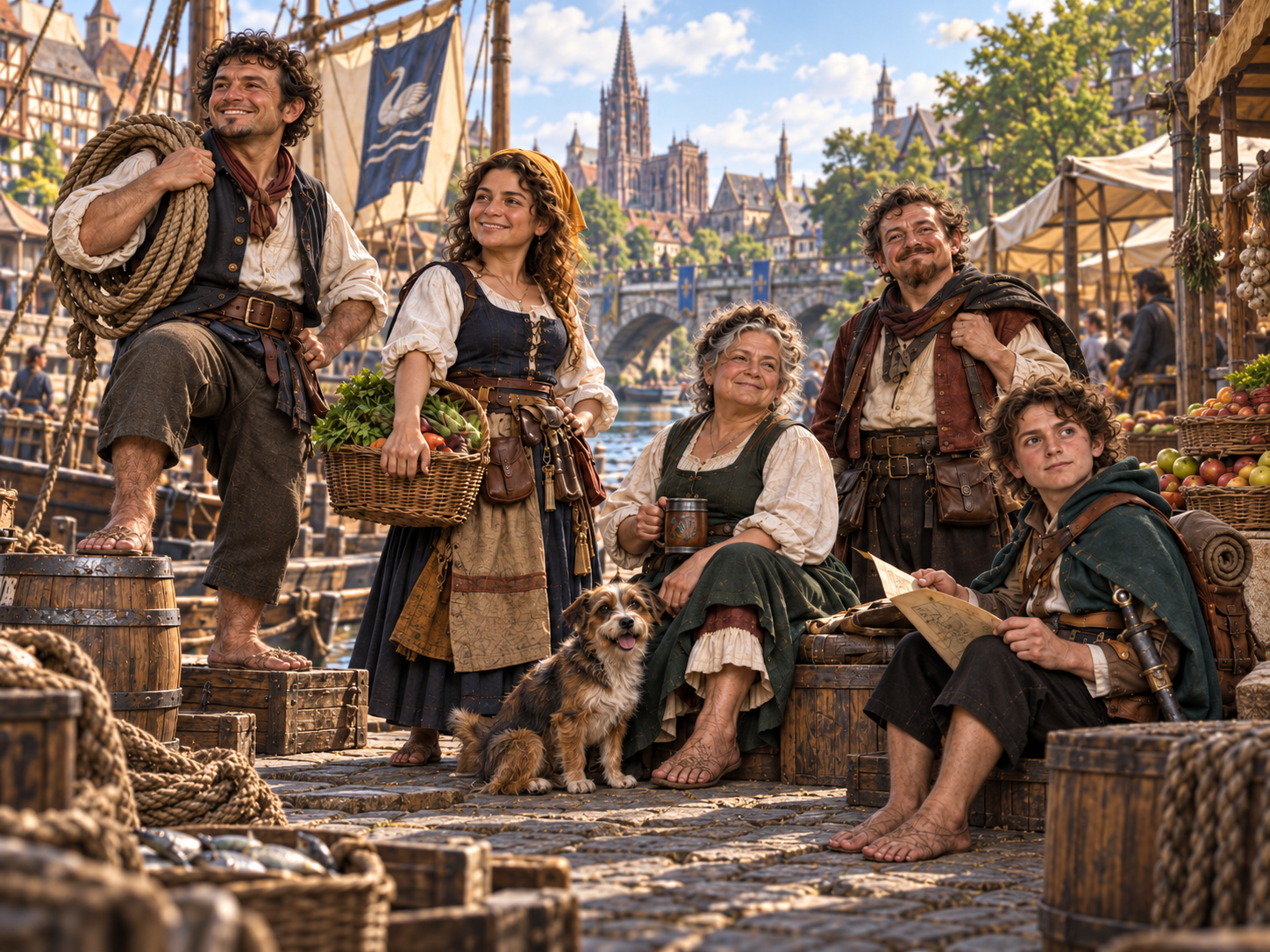
Halflings are a small mortal people whose history is written less in kingdoms than in households, roads, rivers, markets and places that larger powers overlooked. Some families have lived in the same town or valley for generations. Others follow established circuits between fairs, ports, seasonal work, relatives and trusted stopping places. Neither way of life makes a halfling more or less authentic.
A halfling character begins with a family, homeland and history rather than a predetermined personality. One may be cautious or reckless, devout or sceptical, settled or itinerant, generous or selfish. What halflings share is physical inheritance and a long experience of living in a world whose buildings, laws, armies, animals and political institutions were usually designed by people much larger than they are.
Halflings at a Glance
Choose Your Rules
Use one rules edition for the character. The setting is shared, but movement, ability adjustments, skills and other numerical mechanics come from the single game system being played.
5.5e / 2024 Halfling
| Creature Type | Humanoid |
|---|---|
| Size | Small; the current SRD places halflings at roughly 2–3 feet tall. |
| Speed | 30 feet |
| Brave | Advantage on saves made to avoid or end the Frightened condition. |
| Halfling Nimbleness | You can pass through the space of a creature one or more sizes larger than you, but cannot finish movement there. |
| Luck | When the d20 of one of your D20 Tests shows a 1, reroll it and use the new result. |
| Naturally Stealthy | You can take the Hide action when your only obscurement is a creature at least one size larger than you. |
Ability scores: ability-score increases come from the character’s background rather than halfling species.
Languages: languages are chosen during character creation rather than supplied by halfling species.
1454 language rule: replace any assumed universal Common language with the actual language or languages learned in the character’s homeland. A halfling raised in Strasbourg may know German or another locally appropriate language; a river household that works across several jurisdictions may know several regional languages, trade forms, sign systems or household cants. Halfling ancestry by itself does not create a universal worldwide language.
5e / 2014 Halfling
| Ability Score Increase | Dexterity +2 |
|---|---|
| Size | Small; the 2014 baseline is about 3 feet tall and around 40 pounds. |
| Speed | 25 feet |
| Lucky | On a natural 1 for an attack roll, ability check or saving throw, reroll the d20 and use the new result. |
| Brave | Advantage on saving throws against being frightened. |
| Halfling Nimbleness | You can move through the space of a creature larger than you. |
| Lightfoot | Charisma +1; Naturally Stealthy lets you attempt to hide when obscured only by a creature at least one size larger. |
| Stout | Constitution +1; Stout Resilience grants advantage on saves against poison and resistance to poison damage. |
Campaign language override: replace automatic Common and Halfling with languages the character could actually have learned from homeland, household and travel. The remaining 2014 racial mechanics stay unchanged.
Pathfinder 1e Halfling
| Ability Scores | +2 Dexterity, +2 Charisma, –2 Strength |
|---|---|
| Type | Humanoid with the halfling subtype |
| Size | Small: +1 AC, +1 on attack rolls, –1 CMB and CMD, and +4 Stealth. |
| Speed | 20 feet |
| Fearless | +2 racial bonus on saving throws against fear. |
| Halfling Luck | +1 racial bonus on all saving throws. |
| Keen Senses | +2 racial bonus on Perception checks. |
| Sure-Footed | +2 racial bonus on Acrobatics and Climb checks. |
| Weapon Familiarity | Proficient with slings; weapons with “halfling” in their rules name count as martial weapons. |
PF1e Age Categories
| Adulthood | Intuitive | Self-Taught | Trained |
|---|---|---|---|
| 20 years | +2d4 years | +3d6 years | +4d6 years |
PF1e Height and Weight
| Gender | Base Height | Height Modifier | Base Weight | Weight Modifier |
|---|---|---|---|---|
| Male | 2 ft. 8 in. | +2d4 in. | 30 lb. | ×1 lb. per inch rolled |
| Female | 2 ft. 6 in. | +2d4 in. | 25 lb. | ×1 lb. per inch rolled |
1454 language rule: ignore the default Common/Halfling package when establishing campaign languages. Select languages the character could actually have learned from household, homeland, trade, neighbours and travel. Linguistics otherwise works normally.
D&D 3.5e Halfling
| Ability Scores | +2 Dexterity, –2 Strength |
|---|---|
| Size | Small: +1 AC, +1 on attack rolls, +4 Hide, smaller weapons, and three-quarters of a Medium creature’s carrying limits. |
| Speed | 20 feet |
| Skills | +2 racial bonus on Climb, Jump, Listen and Move Silently. |
| Saving Throws | +1 racial bonus on all saving throws. |
| Fear | +2 morale bonus on saves against fear, stacking with the general +1 racial save bonus. |
| Thrown Weapons and Slings | +1 racial bonus on attack rolls. |
| Favoured Class | Rogue |
1454 language rule: replace the automatic Common/Halfling package with actual learned languages while retaining the normal 3.5e language-learning and Intelligence-based mechanics.
Halflings in 1454
Halflings possess no single world-spanning state, church, political programme or cultural capital. That does not make them stateless wanderers by definition. A halfling household may possess civic rights in a Free Imperial City, hold farmland from a local lord, belong to a guild network, operate a riverboat under licence, maintain an inn beside a trade road or live beyond the easy reach of central government.
The difference that matters most is often not between halfling and human but between resident and outsider, citizen and stranger, guild member and unlicensed trader, protected tenant and unwanted vagrant. A family established in the same town for five generations may be regarded as thoroughly local. Their cousins arriving with wagons from three jurisdictions away may be searched at the gate.
Settled Households
Settled halflings can be farmers, gardeners, carriers, innkeepers, artisans, shopkeepers, boat owners, servants, money-changers, scribes or labourers. They tend to take on the language, clothing, foodways and legal habits of the places in which they actually live.
Road Households
Other families maintain established circuits between market towns, fairs, relatives, seasonal employers and known camps. Among many western families descended from the Kemetite diaspora, the wagon became a portable household as much as a vehicle: sleeping space, workshop, store-room, strongbox and family archive moving together. Some caravans are reputable carriers and traders; others combine legal work with smuggling, poaching, theft or the movement of fugitives. A child may grow up knowing a hundred miles of roads more intimately than a settled merchant knows the next valley.
River Households
Rivers allow halfling families to carry more than they could move by road. Barges, ferries and smaller trading boats connect households to mills, ports, city markets and one another. Some families spend most of the year afloat and still regard particular quays, villages or stretches of river as home.
Hidden Enclaves
Some halfling communities survived periods of conquest, forced movement and predation by withdrawing into places larger powers considered inconvenient or unprofitable. Fertile valleys, wooded margins, islands, marsh edges and forgotten roads can sustain small communities that prefer quiet continuity to political importance.
Living in a Human-Scale World
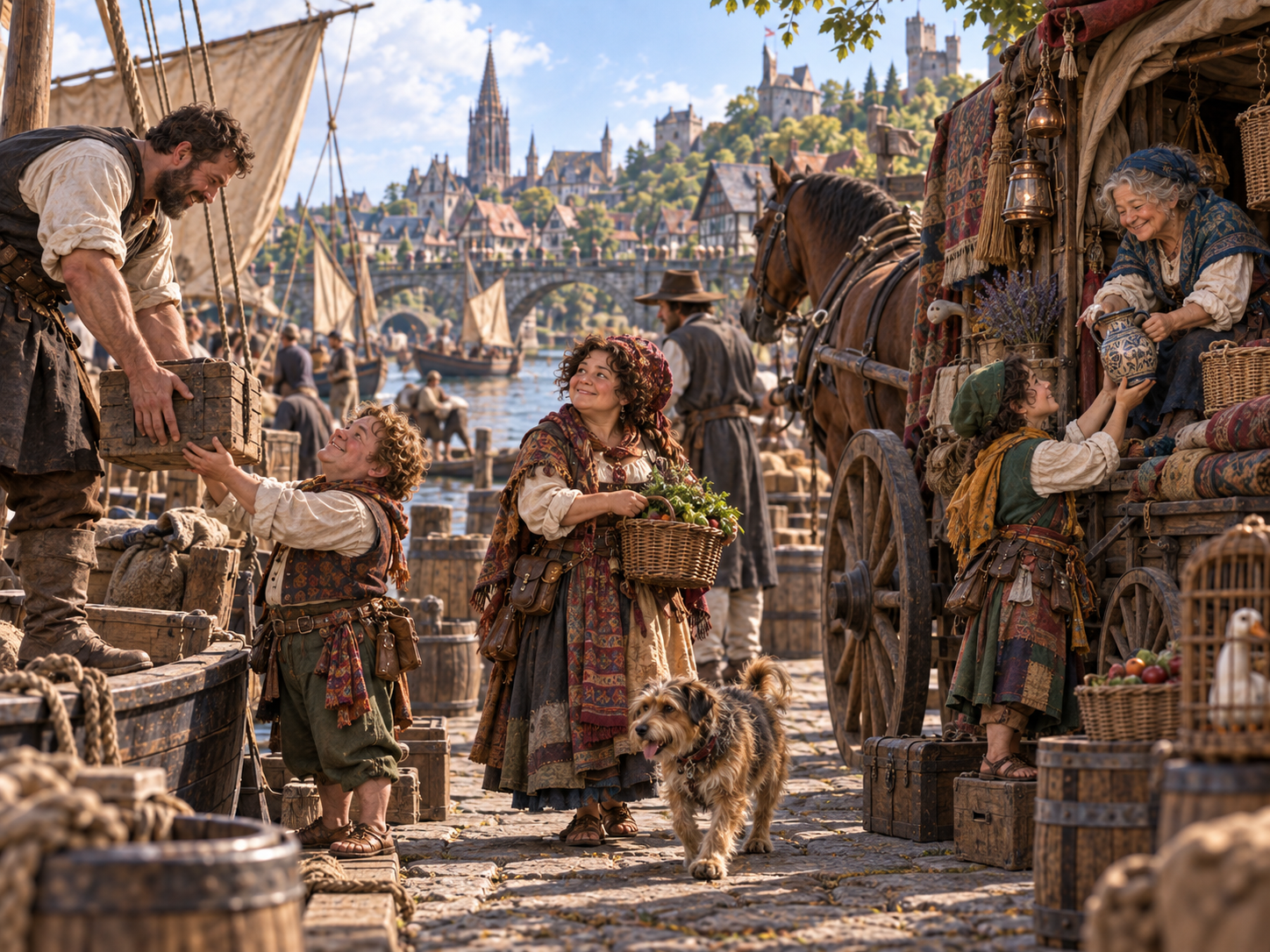
The physical difference between halflings and larger peoples affects daily life without deciding who a halfling becomes. A human tavern bench may be too high. A warehouse sack that one labourer can shoulder may require a handcart. A horse is an enormous animal. Door latches, armour, weapon grips, stair risers, work benches and ship fittings are commonly built for larger bodies.
Halfling households answer these problems through ordinary adaptation: stools, shortened tools, smaller harness, low counters, altered wagon interiors, scaled furniture, pack animals, pulleys, carts and cooperation. Places with long-established halfling populations often make such accommodations without comment. Elsewhere every room reminds a traveller that the town was not built for them.
This difference becomes particularly important in combat and travel. A halfling soldier does not need to imitate a human soldier at half scale. Scouts, skirmishers, crossbowmen, slingers, wagon guards, boat crews, guides and mounted messengers can exploit spaces, routes and animals that suit them. Others train with the same military institutions as their larger neighbours and use equipment made specifically for their size.
Family, Household and Belonging
“Family” can mean blood relatives, marriage ties, foster relations, long-term travelling partners, adopted kin or households formed by necessity. In communities that move regularly, the household may be a stronger institution than the village. In settled districts the reverse can be true.
Hospitality is important in many halfling communities because information, shelter and introductions keep travellers alive. It is not a biological instinct and it is not universal. A prosperous urban innkeeper, an isolated farmer, a ferry family and an armed caravan company can have very different ideas about who deserves a place at the table.
Home need not mean immobility. A wagon used for twenty years, a boat inherited across three generations or the same sequence of winter and summer stopping places can be as stable a home as a stone house.
Markets, Roads and Rivers
Movement creates information. Families who travel between towns hear which bridges have failed, which tolls have risen, which lords are hiring soldiers, which forests have become dangerous and where grain is cheap. That knowledge can be more valuable than the goods in a wagon.
This does not make every halfling a merchant. It does mean that travelling households are often well placed to act as carriers, brokers, guides, animal handlers, messengers and intermediaries. They may connect communities whose rulers barely speak to one another.
The same networks can support an illicit economy. Some post-Kemet caravan branches became skilled at smuggling untaxed goods, poaching protected game, avoiding tolls, picking pockets at fairs, burgling poorly guarded stores, forging travel papers and fencing stolen property through relatives several jurisdictions away. A caravan may be completely legitimate, openly criminal, or contain different households whose activities fall on both sides of the law.
That history makes road knowledge valuable to honest traders and thieves alike. Hidden compartments, coded route marks, trusted inns, sympathetic ferrymen, quiet river landings and cousins in distant markets can move wool, spices, letters, fugitives or stolen silver along exactly the same roads.
The same mobility attracts suspicion. Customs officials may assume that travellers are concealing taxable goods. Town guards may blame outsiders when something disappears. A licence honoured in one territory may mean nothing beyond the next boundary stone. Halfling families therefore keep receipts, letters, guild tokens, seals, introductions and personal relationships whenever they can.
Law, Prejudice and Protection
There is no single legal status for halflings. Rights depend on jurisdiction. One ruler may treat a halfling tenant exactly like any other subject. Another city may recognise halfling householders as citizens but exclude itinerant traders from particular guild privileges. Elsewhere a local lord may see an unprotected travelling family primarily as a source of tolls or forced labour.
Small size can make intimidation by larger authorities especially dangerous. Halflings therefore place practical value on witnesses, patrons, recognised employers, guild membership, written passes, local allies and the ability to leave before a dispute becomes a prison sentence.
Suspicion of some caravans is not entirely invented: particular halfling networks really do smuggle, steal, poach or shelter wanted people, and some towns have learned that a stolen object can vanish through three markets before sunrise. What is unjust is turning the crimes of one household into proof against every traveller of the same ancestry. A settled citizen, an honest carrier and a professional thief can all be halflings without sharing guilt, culture or livelihood.
A settled household with neighbours and clients can therefore experience the same town very differently from newly arrived kin. Equally, a respectable urban merchant may quietly act as a fence, safe-house keeper or source of forged documents for travelling relatives. Reputation is local, complicated and often more important than ancestry alone.
Languages
There is no universal Common tongue. A halfling speaks what the character has actually learned. A settled family normally speaks the language or languages of its district. A household moving between several territories may be multilingual. Trade vocabulary, signs, marks, family expressions, cants and specialised professional language can cross borders without becoming a magical species-wide language.
“Halfling” may still be used by an individual campaign as the name of a particular inherited halfling language or language family where history supports it. It should not be assumed that two halflings from opposite ends of the world can automatically understand one another.
See the Speak Language and Languages material for the wider campaign treatment of language learning.
Names
Halflings do not use one worldwide list of racial names. Personal names normally reflect actual homeland, language, household history and local custom. A halfling family established in an Upper Rhine city may use the same pool of regional given names as its neighbours while retaining a distinctive household byname. A travelling family may preserve an older name long after its original language has disappeared from daily speech.
Nicknames, occupational names, route names and names derived from an ancestor or remembered place are common enough to be useful, but none should be treated as mandatory.
Religion and the Supernatural
Halfling ancestry does not dictate worship. Religion follows homeland, household tradition, occupation, inherited custom and personal belief. Nevertheless, some gods have particularly strong relationships with halfling communities because their concerns overlap with the realities of halfling life: home, family, children, roads, luck, trade, hospitality, harvests and safe travel.
Bes — Protector of Households and Halfling Families
Of all the established gods, Bes has one of the strongest direct associations with halflings. His portfolio includes households, childbirth, fertility, entertainment, protection against evil spirits and misfortune, luck, happiness and prosperity; his established favoured people are halflings.
His worship does not require a great temple. Bes is honoured at household shrines and more informally in taverns, gambling halls and roadway shrines, which makes his cult unusually portable. A family can carry a small image, charm or household custom associated with Bes for generations even after moving far from the lands where his worship first became established.
Bes is especially attractive to households with young children, midwives, entertainers, innkeepers, gamblers and travellers who believe good fortune should never be taken for granted. A halfling family might invoke him before a birth, before opening an inn, before setting out along a dangerous road or simply when a run of bad luck begins to feel supernatural.
Hathor — Joy, Love, Motherhood and Celebration
Hathor is honoured by some halfling households as a goddess of love, beauty, music, motherhood, fertility and joy. Her cult is especially suited to communities in which marriages, births, festivals, music and shared meals strengthen bonds between scattered branches of a family.
A household that honours both Hathor and Bes need not regard them as interchangeable. Bes may be called upon to guard the household, protect children and drive away malign influences, while Hathor may preside over love, motherhood, fertility, music, beauty and communal celebration.
Hestia — Hearth, Home and Family
In Hellenic communities, some halflings honour Hestia, lady of the domestic and civic hearth, sacred fire, home and family. Settled households can treat the hearth as the spiritual centre of the dwelling, while travelling families may preserve the same idea through a brazier, cooking fire or carefully tended flame carried from one stopping place to another.
In Roman traditions the corresponding figure of Vesta can fill a similar role. The deity changes with culture; the importance of household continuity, shared meals and hospitality does not.
Hermes — Roads, Markets and Travellers
Travelling halflings, carriers and merchants frequently encounter cults of Hermes. He governs boundaries, roads, travellers, shepherds, commerce, weights and measures, cunning, messages and luck. Those concerns make his wayside shrines natural stopping places for merchants and travelling households operating within or near Hellenic religious traditions.
Hermes is not a universal halfling god. A halfling born hundreds of miles from his cult may never make an offering to him. But along routes where Hermes is honoured, halfling merchants, guides, messengers and caravan families can find much in his portfolio that speaks directly to their lives.
Tyche and the Question of Halfling Luck
Stories of extraordinary halfling luck are widespread. Worshippers of Bes may regard fortunate escapes as his favour, while communities influenced by the Hellenic world may turn to Tyche, goddess of fortune and civic destiny, when chance begins to matter more than planning.
Other halflings insist that their luck predates any particular cult. Priests argue about it, gamblers swear by it, and scholars have failed to establish whether halfling fortune is divine intervention, inherited magic, supernatural probability or simply a reputation strengthened by centuries of unlikely survivals. The rules editions model luck mechanically in different ways; people in the world do not necessarily agree on why it happens.
Fields, Flocks and Rural Households
Agricultural communities naturally turn toward the gods of the land around them. In Hellenic regions this can include Demeter for grain and agriculture, while shepherding households may honour Pan as lord of shepherds, flocks, pasture, rustic music, fertility and wild country.
Elsewhere, rural halflings honour whatever powers govern harvest, livestock, fertility, weather, water or local sacred places. Religion follows the landscape and culture in which the household actually lives.
River Gods and Local Powers
River households rarely treat water as merely scenery. Ferries, currents, floods, fords and bridges can have their own gods, spirits or sacred customs. A family that spends most of its life afloat may maintain offerings to a major river deity while also respecting minor powers known only along a particular stretch of water.
The same principle applies to roads, wells, forests, boundaries and bridges. Travelling households pass through many supernatural jurisdictions, and practical respect can matter as much as formal devotion.
No Universal Halfling Pantheon
There is therefore no single compulsory halfling pantheon. A halfling household in Kemet may honour Bes and Hathor. A Hellenic merchant family might maintain rites to Hestia, Hermes and Tyche. Rural families may look toward harvest, pasture or river powers. Another household may preserve gods brought from an older homeland, adopt the cults of its neighbours, or reject inherited religious practice altogether.
This diversity is important: halflings carry beliefs along the same roads by which they carry goods, stories, marriages and news. A god can therefore acquire a small halfling shrine hundreds of miles from the deity’s principal cult centres without becoming a universal god of the entire people.
Work, Weapons and Adventurers
Halfling adventurers come from the same range of circumstances as everyone else: debt, ambition, duty, revenge, curiosity, military service, scholarship, faith, exile, family obligation or the simple need to earn money.
Caravan guards and village defenders may use spears, bows, crossbows, slings, short blades, bucklers and light armour. River crews favour equipment that does not make falling overboard a death sentence. Urban retainers can be trained to the standards of the household or company that employs them. Wealthy halflings commission properly fitted armour and weapons rather than relying on whatever can be cut down from human equipment.
Class does not follow ancestry. A halfling can be a professional soldier, scholar, priest, artisan, magician, scout or anything else allowed by the selected game system and the character’s actual life.
Regional Examples
Strasbourg
In Strasbourg, halflings are visible among boat families, carriers, gardeners, innkeepers, market traders and travelling households. Long-established families may be thoroughly local, while itinerant groups face greater suspicion from customs officers and residents when goods disappear or smuggling is suspected.
Colmar and the Upper Rhine
In the Imperial City of Colmar and across the Upper Rhine, halfling households are strongly associated with market gardening, carrying, inns, river work, orchards and the wine economy. Some families work vines or cellars directly; others move barrels, food, tools and seasonal labour between villages, estates and towns. This is one of the clearest western regions where the old Nile horticultural tradition became a settled European livelihood.
The English Shires and Downs
England contains some of the most deeply rooted rural halfling communities in western Europe. The Cotswolds and South Downs are especially associated with halfling gardeners, shepherds, orchard keepers, herbalists, innkeepers and smallholders. Nearby shires contain mixed human-halfling villages, isolated household clusters and market-town families whose ancestors stopped travelling generations ago.
These communities are not evidence that all halflings naturally prefer quiet rural life. Many descend from households that spent generations on the road before finally obtaining tenancy, protection or freehold land. Once a family possessed ground of its own, gardens, orchards and inheritance boundaries acquired enormous emotional importance.
France and the Wine Country
Across the Kingdom of France, halfling households are found both settled and itinerant. Their strongest rural concentrations tend to follow fertile river valleys, orchards, intensive gardens and vineyards. Burgundy, Champagne, the Loire districts and the wine country of Gascony and Bordeaux all attract families whose skills lie in pruning, grafting, drainage, cellar work, carrying and the patient management of valuable crops.
The old wine trade also connects these settled families to caravan and river kin. A halfling vintner may have cousins who never own a vine but carry casks between markets, know which tolls have changed, or move wine through routes disrupted by the recent fall of English Gascony.
Beyond the Western Green Settlements
These examples are not templates for every region. Halflings in Scandinavia, Italy, the Balkans, North Africa, Asia, southern Africa or across the Atlantic can have completely different languages, occupations, dress, religious traditions and relationships with neighbouring peoples. The same rule applies everywhere: start with the real region and its altered history, then place the halfling community inside it.
Halfling History — The Long Road
Halfling history does not begin in Kemet and it does not begin with slavery. Halflings are an ancient mortal people whose communities were already scattered across river valleys, lake country, wooded meadows, dry grasslands, desert margins and sheltered coasts thousands of years before the present age. Their oldest remembered homelands were often networks of related households rather than compact kingdoms, which made them easy for later conquerors to mistake for people without territory or political rights.
The oldest surviving traditions emphasise paths, guest-right, seed varieties, seasonal return, ferries, family stories and remembered places. Some communities settled permanently. Others moved between several recognised homes. In later ages, halfling river leagues, ferry systems, farming villages and market alliances controlled food and transport without needing a single continental state. See The Rooting Age, The Rise of Kingdoms and The Wars of Dominion.
The Old Paths of Southern Africa
Some of the oldest surviving halfling populations live far to the south of Kemet, across parts of the Kalahari, Namib margins and adjoining savannah and dry woodland country. They are not descendants of escaped Kemetite slaves. Their presence predates the later Catfolk-controlled Kemet by thousands of years and demonstrates how widely dispersed halfling peoples were before the great later diasporas.
These southern communities traditionally organise themselves in small related bands and seasonal networks rather than kingdoms. Their maps are carried in memory: waterholes, game trails, edible roots, medicinal plants, nesting grounds, dry-season refuges and the tracks left by animals moving across country that looks empty to outsiders.
Their characteristic hunting weapon is a small bow firing light poisoned arrows. A hunter does not expect the first wound to bring down a large animal. The shot begins a patient pursuit in which spoor, broken grass, dung, blood, wind and the behaviour of other animals are read until the quarry weakens. Different bands preserve different poisons and antidotes, and such knowledge is taught carefully rather than treated as a universal halfling secret.
Their political tradition has never centred on conquest states or permanent standing armies. Feuds, raids, revenge killings and defensive violence can occur, but open territorial warfare is normally avoided. When a larger army enters their country, resistance is more likely to involve concealment, ambush, misleading tracks, removal of supplies and refusal to be found than a formal battle line. This resembles the older halfling preference for traps, concealment and attacks on logistics recorded in the Rooting Age without making every southern community identical.
By 1454 some of these halfling bands trade with neighbouring peoples, guide caravans across difficult country or hire out trackers, while others remain deliberately remote. Contact with Kemetite or western halflings has occurred in places, but southern halfling traditions are their own history rather than a branch of the Nile diaspora.
Halflings Beyond the Western Diaspora
Halflings are not an African-and-European people with a few distant colonies. Ancient independent populations survive across other parts of the world, many separated from Kemetite and western halflings for thousands of years. Their languages, religions, tools, foodways and political traditions developed locally. Shared ancestry does not imply a shared civilisation.
South and Southeast Asia
Across parts of South and Southeast Asia, halfling communities survive in river country, forest margins, hill districts and coastal trading zones. Some are intensive gardeners and orchard keepers; others fish, hunt, trade forest products or move seasonally between upland and lowland settlements. Long contact with neighbouring human, dwarf, gnome and other peoples has produced local cultures that are recognisably regional rather than imported versions of European halfling life.
The Island World of Sundaland and Wallacea
The eastern archipelagos contain some of the oldest isolated halfling populations known to scholars. Communities on volcanic slopes, forested interiors, narrow coasts and smaller islands have survived for immense spans of time without any historical connection to Kemet. They are skilled small-boat sailors, fishers, hunters and gardeners, often moving between several islands through kinship and exchange rather than belonging to a single maritime kingdom.
Some island households cultivate steep terraces, root crops, fruit trees and medicinal gardens in places where larger plough teams are impractical. Others hunt in dense forest with light bows, spears, traps or blowpipes and know cave systems, freshwater springs and seasonal sea routes that outsiders miss. Their small stature is simply one part of a much older adaptation to difficult island environments; they are not treated as remnants of any real prehistoric human population.
New Guinea and the Western Pacific
Farther east, small halfling populations exist in mountain valleys, forest interiors and coastal settlements of New Guinea and neighbouring island groups. Some communities practise intensive garden agriculture; others combine fishing, canoe travel, hunting and exchange between coast and interior. Their societies are locally rooted and can differ as much from one another as they do from halflings in Europe.
Central Asian Uplands and Caravan Margins
Central Asia contains fewer halfling-majority settlements, but old communities survive in sheltered valleys, oasis districts and the margins of caravan routes. Many are multilingual and deeply integrated into wider trading worlds. Some maintain small farms, orchards and animal herds; others work as guides, brokers, drovers, craftsmen or caravan specialists. Their mobility developed independently of the later Kemetite refugee caravans.
The Americas
Halflings were present in the Americas long before medieval Atlantic colonies. Their oldest communities belong to the continent’s deep prehistory, not to recent European migration. By 1454 some live within larger Indigenous states and trading systems, while others maintain riverine, woodland, agricultural or upland communities beyond the direct control of major powers.
Atlantic-arriving halflings from Europe therefore do not encounter an empty continent awaiting their own people. In some places they meet halfling communities whose ancestors have been separated from them for so long that language, religion and custom provide almost no immediate sense of kinship beyond obvious physical resemblance.
Terra Australis
Terra Australis contains sparse, ancient halfling populations of its own, especially in parts of the tropical north, island fringes and remote refuges. They are not offshoots of recent European exploration. Their relationships with the continent’s human peoples are regional and varied, ranging from exchange and interdependence to deliberate separation.
Taken together, these populations establish an important rule for halfling history: there is no single lost homeland from which every halfling culture spread. The Kemetite slave diaspora is crucial to the history of many western households, but it is only one major branch within a much older worldwide story.
Kemet and the Enslavement of Halflings
One of the most important later ruptures in halfling history came in Catfolk-ruled Kemet. Catfolk dominion over the Nile lands was already long-established well before the later medieval period. By the thirteenth century, halfling slavery and hereditary bondage were not new institutions but old systems embedded in parts of Kemetite society.
Halflings had been drawn into the agricultural and household economies of the Nile for generations. Their reputation for “green fingers” became particularly valuable to landholders. Bound and enslaved families worked irrigated kitchen gardens, vegetable beds, orchards, vineyards, medicinal plots, seed nurseries and other forms of intensive cultivation where patient skill mattered more than brute strength.
This horticultural knowledge was cultural rather than an inborn racial talent. Families accumulated expertise in seed saving, grafting, pruning, soil, irrigation, plant medicines and the timing of crops. Some estates deliberately kept experienced halfling households together because inherited knowledge made the land more productive even while the people who possessed that knowledge were denied control of the ground they worked.
Other enslaved halflings were used in households, workshops, markets, transport, caravan service and river work. Families could be divided by sale, debt, punishment, inheritance or the transfer of an estate from one owner to another. Children could inherit the status imposed upon their parents.
This was a political and economic system, not an instinct of Catfolk ancestry. Catfolk peoples outside Kemet possess their own histories, and even within Kemet not every Catfolk household participated in slavery and not every halfling was enslaved. Free, protected and semi-independent halfling households also existed. The injustice lies with institutions, laws and individuals that claimed ownership over other people, not with biology.
The system nevertheless left a deep wound. In 1454 there are still halflings in Kemet whose families remain enslaved, bound to estates or trapped by inherited obligations that are freedom in name only. Others are free Kemetite halflings whose families have lived along the Nile for generations and have no wish to abandon their homeland simply because rulers and slaveholders claimed power over people like them.
Freedom Was Not One Event
There was no single liberation and no one moment when the halflings of Kemet became free. The diaspora formed through hundreds of smaller breaks in ownership and authority. Some people escaped alone or with relatives. Some bought freedom or had it purchased for them. Some were formally released. Some were abandoned when households collapsed in war, plague or political disorder. Some were taken away by merchants, sailors or caravan masters and never returned. Others were hidden by free halflings, sympathetic neighbours or people who simply refused to recognise another person’s claim of ownership.
A successful escape did not end the danger. A fugitive might still be recognised as property under one jurisdiction and as a free traveller under another. Papers could be forged, stolen, purchased or challenged. A family might have to cross several borders before an owner’s claim became practically unenforceable. Children born on the road could possess a different legal status from their parents while remaining vulnerable to anyone powerful enough to ignore that distinction.
For this reason halfling freedom developed alongside networks of guides, carriers, safe households, ferrymen, innkeepers, brokers and caravan families. Escape became easier when there was somewhere known to go next.
From Refugees to Caravan Peoples
For many freed and escaped households, liberty began without land, guild rights, citizenship or a secure village to return to. Wagons, pack animals, riverboats and extended kin therefore became portable homes. What began as refugee movement hardened over generations into a recognisable caravan culture across parts of the Mediterranean and western Europe.
Most caravans survived through ordinary work: carrying freight, peddling small goods, animal dealing, repairing tools and pots, entertaining, cooking, seasonal labour, guiding, ferry work, messenger service and moving between fairs. Mobility itself became an asset because the household knew roads, markets and people that settled neighbours did not.
Some families also developed criminal economies. Smuggling, poaching, pickpocketing, burglary, fencing stolen goods, toll evasion, forged papers, black-market trading and hiding wanted people could all exploit the same routes used by legitimate commerce. In a few networks these became recognised family specialisms, and certain caravans function more like mobile criminal companies than merchant households.
This history explains the halfling reputation for theft without making theft a racial instinct. A child is not born knowing how to steal. A caravan household may teach burglary because it has practised burglary for generations, while another household of the same ancestry teaches animal dealing, music, bookkeeping, gardening or river work. Culture, opportunity and necessity create the profession.
It also explains why official suspicion can contain both truth and prejudice. Some gate guards have genuinely caught halfling smugglers. That does not make every caravan criminal, any more than a corrupt human merchant makes every human trader a thief. In 1454 the distinction between evidence and reputation is often exactly what local authorities fail to make.
The Eastern Road to the West
One of the principal migration corridors ran from Kemet through Sinai and the Levant, into Anatolia, through the Balkans and toward northern Italy. From there families divided again. Some entered the Italian states or crossed the Alps. Others followed the Rhine and its tributaries northward, eventually contributing to the settled, river and road households now found in the Empire, France and farther west.
Later political changes repeatedly altered the danger of the route. Officials might grant transit in one decade and demand bonds, tolls or labour in the next. Armed powers controlling eastern roads could seize undocumented travellers, return fugitives for payment, deport inconvenient households or turn caravan permits into instruments of coercion. The route survived because the network was never dependent upon one ruler’s goodwill.
The North African and Mediterranean Roads
Not every family travelled through the Levant. Other halfling groups moved westward across North Africa, following ports, oasis routes and merchant connections before crossing into Mediterranean islands, Iberia, southern France or Italy. Some travelled by sea from Kemetite ports. Others moved gradually from one North African community to another and crossed only generations later.
These western and maritime routes produced different communities from the eastern caravan road. A family that spent generations in North Africa might arrive in Europe carrying different languages, foodways, clothing, religious practices and trading connections from relatives whose ancestors travelled through Anatolia and the Balkans. Shared ancestry did not erase the cultures acquired along the way.
Halfling Caravan and Fugitive Networks
By 1454 the surviving Halfling Caravan & Fugitive Networks are not one organisation with a single leader. They are a dispersed mutual-aid system: caravan families, settled households, sympathetic innkeepers, ferrymen, merchants, guides, fences, smugglers and intermediaries who know which roads are safe, which officials can be bribed, which charters will be honoured, where stolen goods can be moved and which doors can be knocked on after dark.
A wagon carrying cloth one season may conceal an escaped family the next and contraband the season after that. A river household may know where a traveller can leave one jurisdiction and enter another without passing a hostile gate. A respectable urban halfling merchant may never travel at all but can provide work, letters, introductions, forged papers, a buyer for stolen property or the money needed to turn flight into settlement.
The networks preserve memory as well as crime and commerce. Families remember who sold people back to Kemetite claimants, which communities offered sanctuary, which roads were closed by war and which towns allowed former slaves to become householders, guild members or citizens. Those memories can survive long after the original legal dispute has been forgotten by everyone else.
From the Nile to the Green Settlements
The western diaspora carried more than trade goods and household gods. It carried horticultural knowledge learned and refined along the Nile. Escaping families sometimes brought seeds, cuttings, medicinal plants and remembered techniques with them; later generations carried knowledge rather than literal plants, adapting Nile experience to completely different soils and climates.
This made fertile western districts unusually attractive. Families who had no land of their own could offer something rulers, monasteries, landlords, towns and merchants wanted: the ability to make difficult or neglected ground productive. A household might begin as seasonal labourers, become trusted vineyard workers or gardeners, obtain a tenancy and eventually acquire land of its own.
That progression helps explain the emergence of the great green settlements: halfling communities concentrated around gardens, orchards, vines, fertile river country and small mixed farms. The Upper Rhine and Alsace became especially important, as did wine and orchard districts farther west. In France, communities grew in Burgundy, Champagne, the Loire country and around Gascony and Bordeaux. In England, the Cotswolds and South Downs became famous for deeply settled halfling households, with related populations scattered through neighbouring shires.
The cultural meaning of land changed with this history. For descendants of people whose ancestors had cultivated somebody else’s estate under bondage, possession of a garden, orchard, vineyard or freehold could represent far more than wealth. A family boundary hedge, a seed chest or a few acres inherited intact might be treated almost as proof that nobody owned the household anymore.
This is why some of the most settled halflings in 1454 can be closely related to families that still travel. One branch remained on the road. Another stopped when it finally found land worth defending and law strong enough to let it keep that land.
From Fugitives to Settled Communities
Many western halfling communities began with movement but did not remain mobile forever. A family might stop because a town offered protection, because a marriage tied it to local land, because river work proved reliable, because a guild accepted its craft, because a vineyard or orchard required permanent care, or because children born after years of flight wanted a fixed home.
Other descendants deliberately preserved road or river life. Mobility had become more than escape: it was livelihood, knowledge and family structure. Caravan routes linked separated branches of kin, carried messages between settlements and allowed people to leave quickly when local law turned hostile. This is one reason settled and itinerant halflings in 1454 should not be treated as separate peoples. They are often branches of the same extended families using different survival strategies.
The present-day halfling households of Strasbourg, Colmar, the English shires and the French wine country therefore need not descend from one migration. Some are ancient local communities whose history predates Catfolk Kemet. Some descend partly from the Kemetite diaspora. Others combine several lines through marriage, adoption and later movement.
What the Diaspora Carried West
Fugitives did not leave every part of Kemet behind. Families carried recipes, songs, craft habits, stories, words, protective charms, business practices, seeds, horticultural knowledge and religious traditions along the roads. Some retained devotion to Bes, whose protection of households, children, luck and travellers made his worship particularly durable among people rebuilding homes after bondage. Others continued to honour Hathor or other powers known in Kemet.
Keeping a Kemetite god does not imply loyalty to Kemetite rulers. A freed family can despise the laws that enslaved its ancestors while preserving a household shrine carried by those same ancestors. Over generations, such traditions mix with the gods, spirits and customs of new homelands.
The same is true of language. Some families preserve old Kemetite words or household expressions long after they speak the language of their new neighbours in daily life. Others deliberately abandon names, accents or customs that once made fugitives easier to identify. There is no single diaspora response.
Halflings in 1454
The history remains unfinished. Some halflings are still enslaved or bound in Kemet. Some are free Kemetite subjects. Some belong to long-established western communities that remember Kemet only through family stories. Some road families still carry names of places their ancestors passed through centuries ago. Others have no connection to Kemet at all.
By 1454 three broad historical traditions can therefore sit beside one another without contradiction: ancient independent populations such as the southern African hunting communities; caravan and river families shaped by Kemetite enslavement, escape and migration; and the western green settlements whose gardens, orchards, vineyards and small farms grew from older halfling horticultural traditions carried into new lands.
The Kemetite slave diaspora is one of the great historical streams shaping modern halfling life, especially the caravan and fugitive networks running west, but it is not the origin of the entire people. Halflings possessed homelands, settlements, technologies, religions and political histories long before the medieval period and far beyond Kemet’s reach.
Historical and Mythic Context
The halfling history above is campaign history. It draws upon broad historical realities of slavery, manumission, forced migration, caravan trade, refugee movement, itinerant economies and communities rebuilding themselves under new laws, but it should not be mapped onto one real ethnic people.
The southern African halfling material takes limited inspiration from documented San hunter-gatherer traditions, especially sophisticated tracking, seasonal mobility, detailed environmental knowledge and the historical use of small bows with poisoned hunting arrows. Real San peoples are human cultures with their own histories and are not being presented as halflings. The setting also deliberately does not repeat the claim that such societies “never had war”: historical San communities experienced conflict, and poisoned arrows were sometimes used in fighting as well as hunting. The fantasy distinction is narrower—these southern halfling bands traditionally lack conquest states and permanent war-making institutions.
For useful real-world context, see South African History Online: San hunter-gatherer society in the Later Stone Age and the open-access study Beetle and plant arrow poisons of the Ju|’hoan and Hai||om San peoples of Namibia. Two video references used while developing this material are San / southern African hunter-gatherer reference video and deep-history reference video.
Post-Kemet caravan culture also uses broad features found in many real itinerant societies—portable households, kin networks, specialised trades, seasonal routes, performance, animal dealing and uneasy relationships with settled authorities. It is not intended as a direct representation of Romani or any other historical travelling people. Criminal traditions in some halfling caravans are setting-specific consequences of dispossession, exclusion, opportunity and the practical advantages of mobile networks; they are not presented as inherited traits of a real or fictional ethnicity.
Human folklore contains many stories about small humanlike beings, hidden neighbours, household spirits, underground people and diminutive travellers. Those traditions can inform encounters, local misunderstandings and regional names, but they should not all be treated as descriptions of halflings. Some concern fey beings, spirits, gnomes, dwarves or creatures whose nature is entirely different.
No real historical people are a disguised halfling population. Similarities in mobility, commerce, family structure, persecution, hunting practice or diaspora are inspirations and parallels rather than claims that a human culture was secretly nonhuman.
Creating a Halfling Character
Begin with the person rather than a stereotype. Choose the rules edition first, then decide which household and homeland actually produced the character.
- Where does your family call home, and does everyone in the family agree?
- Are you settled, travelling, river-based or from a secluded community?
- Which languages did you actually grow up hearing?
- Who among the larger peoples knows your family well enough to trust them?
- Which authority has the power to make your life difficult?
- What route, town, inn, quay or farm feels safest to you?
- What possession could not easily be replaced if it were lost?
- What obligation would make you abandon a profitable journey and turn back?
- What story about halfling luck do you believe, and which one do you think is nonsense?
- Why are you adventuring instead of continuing the life expected of you?
Adventure Hooks
The Missing Household
A travelling family expected at the autumn market never arrives. Authorities assume they changed route. Their relatives know they would never miss the meeting without sending word.
The Sealed Road
A new toll fort cuts across a route used by halfling households for generations. The lord claims the travellers are smugglers. Someone inside the fort is making sure every appeal disappears.
The River Debt
A boat family owes a favour to something living beneath an old bridge. The bargain kept three generations safe. Now the bridge is being demolished.
The Empty Enclave
A secluded halfling settlement is found intact but abandoned: meals spoiled on tables, tools left in gardens and doors unlocked. There are no bodies and no signs of a struggle.
Further Viewing
The three videos retained from the earlier page are moved below the campaign material so they support the entry without delaying the playable opening.
Frequently Asked Questions
Do all halflings travel?
No. Some households travel regularly, some move seasonally and others have lived in the same settlement for generations.
Do halflings have their own kingdom?
There is no single worldwide halfling kingdom. Halfling communities can nevertheless possess land, civic rights, guild influence, local authority and long-established settlements.
Are all halflings lucky?
Several supported RPG systems give halflings luck-related mechanics. In the world itself, people disagree about whether famous halfling luck is supernatural, inherited, divine, exaggerated or simply the result of which stories survive.
What language do halflings speak?
The languages they have learned. A universal species language is not assumed. Homeland, family and travel determine actual language use.
Are travelling halflings culturally the same everywhere?
No. Mobility is a way of life, not one culture. Two travelling families from different regions may have different languages, clothing, laws, gods, occupations and social customs.
Are all halflings descended from slaves in Kemet?
No. Halfling communities existed across Africa, Europe and other regions long before Catfolk rule in Kemet. The Kemetite slave diaspora is one major historical stream, especially important to many western caravan families, but it is not the origin of the entire people.
Are halfling caravans thieves?
Some caravan networks include smugglers, pickpockets, burglars, poachers, fences and forgers, and a few function as organised criminal companies. Many others are lawful carriers, traders, entertainers, craftspeople, ferrymen or seasonal workers. Criminality belongs to particular households and networks, not to halfling ancestry.
Where do the southern African halflings fit into this history?
They are ancient independent populations whose presence in the Kalahari, Namib margins and neighbouring country predates the Kemetite diaspora by thousands of years. Their tracking traditions and poisoned-arrow hunting developed within their own regional histories rather than as an offshoot of Kemet.
Are there ancient halfling populations outside Africa and Europe?
Yes. Independent halfling populations survive in parts of South and Southeast Asia, the island world of Sundaland and Wallacea, New Guinea and the western Pacific, Central Asian uplands, the Americas and Terra Australis. These peoples are not descended from Kemetite refugees and have their own languages, religions and material cultures shaped by their regions.
Why are halflings associated with gardens, English shires and wine country?
Halflings possessed old horticultural traditions before Kemet, but generations of forced agricultural labour along the Nile made some diaspora families exceptionally skilled gardeners, orchard keepers and vintners. When western households gained land of their own, many settled in fertile districts such as the Cotswolds, South Downs, Upper Rhine and the vineyard regions of France. Their “green fingers” are a cultural tradition built over generations, not an automatic biological trait.
Can halflings use normal weapons and armour?
Yes, subject to the size rules of the game edition being used. Equipment made for halflings is sized appropriately rather than assumed to be crudely shortened human gear.
Can a halfling be any class?
Yes. Ancestry does not determine profession, calling or class. Use the options permitted by the selected rules system and the character’s history.
Connected Resources
Rules Sources and Licensing
5.5e / 2024
This work includes material from the System Reference Document 5.2.1 (“SRD 5.2.1”) by Wizards of the Coast LLC, available at https://www.dndbeyond.com/srd. The SRD 5.2.1 is licensed under the Creative Commons Attribution 4.0 International License, available at https://creativecommons.org/licenses/by/4.0/legalcode.
5e / 2014
This work includes material taken from the System Reference Document 5.1 (“SRD 5.1”) by Wizards of the Coast LLC and available at https://dnd.wizards.com/resources/systems-reference-document. The SRD 5.1 is licensed under the Creative Commons Attribution 4.0 International License available at https://creativecommons.org/licenses/by/4.0/legalcode.
Pathfinder 1e and D&D 3.5e Open Game Content
The mechanical summaries inside the Pathfinder 1e and D&D 3.5e panels are designated Open Game Content only to the extent that they derive from material already released as Open Game Content under the Open Game License version 1.0a. No campaign lore, 1454 material, original explanatory prose, artwork, CSS, page design, adventure material or editorial presentation is designated Open Game Content by this notice.
Section 15 notices used by this page:
Open Game License v 1.0a Copyright 2000, Wizards of the Coast, Inc.
System Reference Document. Copyright 2000, Wizards of the Coast, Inc.; Authors Jonathan Tweet, Monte Cook and Skip Williams, based on material by E. Gary Gygax and Dave Arneson.
Pathfinder Roleplaying Game Reference Document. © 2011, Paizo Publishing, LLC; Author: Paizo Publishing, LLC.
Pathfinder Roleplaying Game Core Rulebook. © 2009, Paizo Publishing, LLC; Author: Jason Bulmahn, based on material by Jonathan Tweet, Monte Cook and Skip Williams.
Publication requirement: keep the site’s existing complete Open Game License v1.0a legal text directly with, or globally attached to, pages that distribute OGL Open Game Content. Do not replace that full legal text with this short Section 15 summary.