
The Rise of Kingdoms
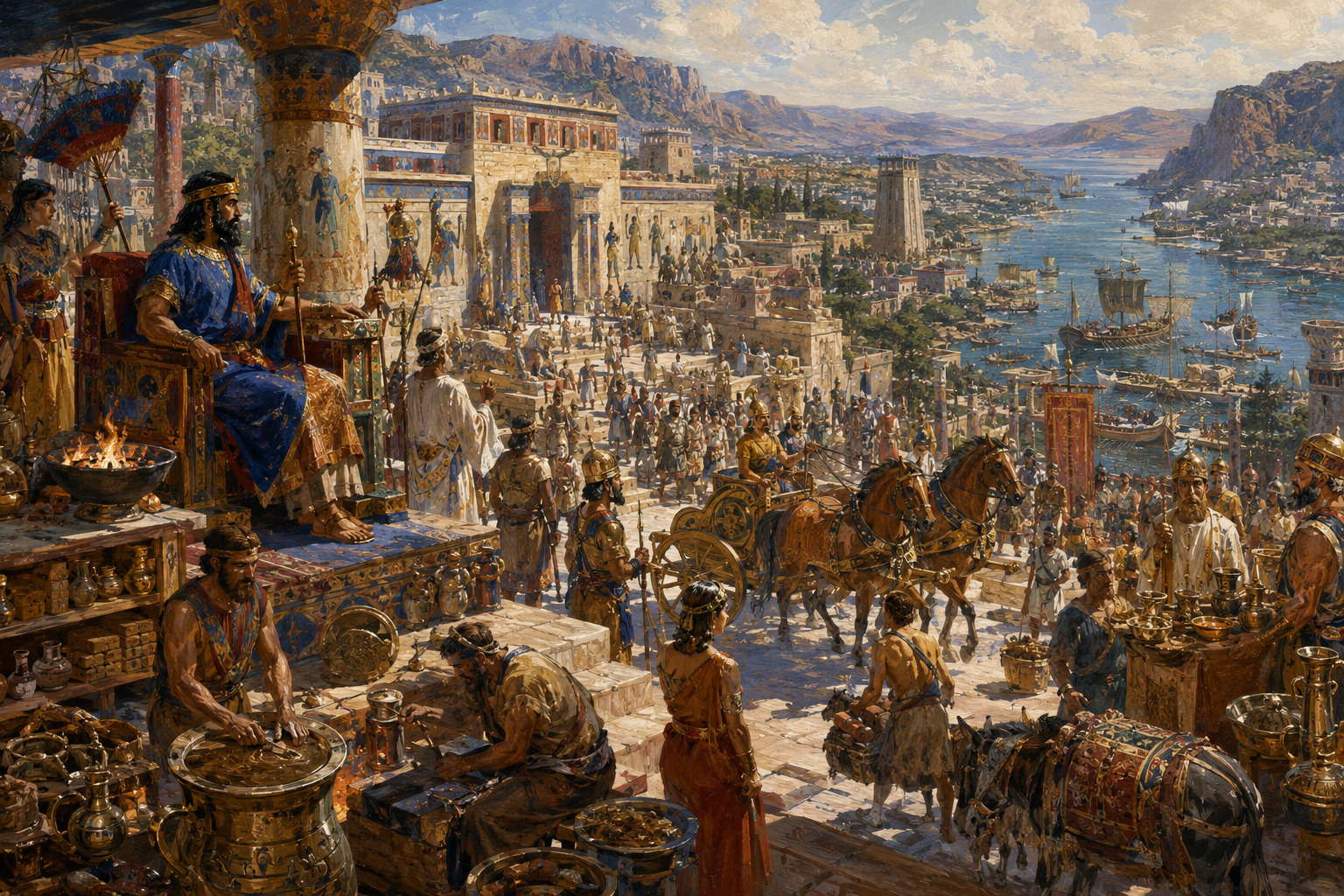
The Rise of Kingdoms begins when rulers build institutions capable of surviving them—and ends when those magnificent systems discover how quickly palaces, alliances and divine favour can burn.
Time Frame: c. 2000–1200 BCE
Common Name: The Middle and Late Bronze Age, depending upon the region
Theme: Palace economies, written law, chariot warfare, heroic dynasties, international diplomacy and divine kingship create powerful but dangerously interdependent realms.
The Rise of Kingdoms begins after the collapses and divisions that closed The Breaking Paths. Cities, temples, archives and territorial states already exist. What changes is the scale and durability of royal government.
Palaces gather scribes, judges, priests, soldiers, artisans, merchants, hostages, slaves and storehouse officials around one ruling house. Kings claim authority over roads, ports, mines, irrigation, tribute villages and foreign policy. Written archives preserve obligations beyond the lives of their witnesses. Royal marriages connect distant courts, while chariots allow rulers to project prestige and violence across wider territories.
This transformation is neither universal nor simultaneous. Kemet, Mesopotamia, Anatolia, Crete, Mycenaean Greece, Kerma, the Shang realm and other regions build different kinds of kingdom. The Indus cities decentralise rather than becoming a palace empire. Poverty Point organises monumental labour without hereditary monarchy. Late Jōmon communities remain outside state rule. Australian peoples continue governing land through inherited custodianship, seasonal law and sacred geography.
Nonhuman peoples follow equally distinct paths. Some dwarven holds become powerful kingdoms; others remain clan confederacies, isolated mining settlements or communities still resisting giant dominion. Some elven societies develop hereditary courts, while others deliberately reject fixed kingship. Gnome enclaves may possess extraordinary magical knowledge without controlling large territories. Halfling peoples may sustain extensive farming, river and trade networks without palaces or standing armies.
Mixed settlements exist, but they remain specific political arrangements rather than the normal condition of the world. A human port may contain a protected gnome quarter because one portal treaty permits it. A dwarven mine may admit human merchants under strict gate-law. An elven harbour may receive foreign ships during one recognised season. Such coexistence depends upon named agreements, not automatic racial harmony.
The Rise of Kingdoms is therefore not one march towards monarchy. It is the age in which many rulers attempt to make their own order permanent—and create courts, heroic bloodlines, archives and curses that remain active in 1454 CE.
The World at the Beginning
- The Third Dynasty of Ur has fallen, leaving rival states and disputed administrative inheritances across Mesopotamia.
- The Egyptian Middle Kingdom is consolidating royal authority after the First Intermediate Period.
- Kerma is an independent Kushite kingdom controlling Upper Nubian trade and cattle wealth.
- The Indus civilisation remains extensive but is beginning to divide into more regional traditions.
- Early Minoan communities possess wide maritime networks but have not reached the height of palace civilisation.
- Central Asian communities possess horses, wagons, bronze industries and widening exchange routes.
- Writing, seals and formal accounting exist in several independent traditions.
- Bronze production depends upon distant supplies of copper, tin, fuel and specialist knowledge.
- Chariot technology is developing but has not yet become the defining weapon of royal armies.
- Stonehenge, Brú na Bóinne, Malta’s temples and other monumental landscapes are already ancient sacred centres.
- The Tuatha Dé Danann have not yet taken surface sovereignty in Ireland.
- Dwarven societies remain divided by the ancient legacy of enslavement and revolt against giant rulers.
- The gods possess established divine realms; mortal kingdoms do not create the planes during this age.
- Serpentfolk, elder cults and surviving Hyborian traditions continue through hidden courts, archives and bloodlines.
The age begins with kingdoms forming from the remains of older cities. It ends with an interconnected Bronze Age world whose dependence upon palaces, tribute, shipping, diplomacy and specialised labour makes its brilliance inseparable from its vulnerability.
The Rise of Kingdoms Timeline
c. 2000–1800 BCE — Kingdoms Take Lasting Form
Across several regions, rulers rebuild authority after the crises that closed the third millennium BCE.
Palaces and temples become permanent centres of administration. They collect agricultural surplus, commission craft, organise military service, host foreign envoys and distribute food to dependants.
The palace is not merely the ruler’s residence. It contains archives, workshops, storerooms, courts, shrines and quarters for guards, servants, captives and officials.
Kingdoms differ sharply in structure. Some rulers control compact territories centred upon one city. Others govern river systems, trading networks or several subject peoples. Many regions continue without kings.
c. 2000–1700 BCE — The First Minoan Palaces
On Crete, major centres such as Knossos, Phaistos and Malia develop increasingly elaborate palace complexes.
The palaces organise storage, craft, feasting, ritual and maritime exchange. They contain courts, magazines, workshops, stairways, shrines and administrative spaces rather than functioning solely as royal residences.
Minoan influence travels through pottery, textiles, metalwork, seals, ships and religious practice. Crete becomes a major Aegean power without necessarily possessing one permanently united kingdom.
Binding campaign ruling: the earliest palace centres are governed by related but competing sacred houses. Minos begins as a royal title associated with sea-law, bull rites and the authority to judge disputes among Cretan centres. Later traditions compress several rulers bearing the title into one legendary king.
c. 2000–1600 BCE — Isin, Larsa and Old Babylonian Rivalry
After the fall of Ur III, competing dynasties claim its political and sacred inheritance.
Isin, Larsa, Eshnunna, Mari, Babylon and other states contend over cities, canals, temple estates and trade routes. Rulers restore walls and sanctuaries while presenting conquest as the recovery of lawful order.
Babylon begins as one power among several. Its later supremacy is not inevitable.
Marduk gains influence as Babylon rises, but he does not erase Enlil, Enki, Inanna, Shamash, Sin or the patron gods of rival cities.
c. 2000–1700 BCE — The Chariot Revolution
Communities associated with the Sintashta-Petrovka world develop light, spoked-wheel vehicles drawn by teams of horses.
These vehicles are faster and more specialised than earlier heavy wagons. They require trained horses, skilled drivers, specialist carpentry and maintained equipment.
Chariot technology spreads through migration, diplomacy, warfare, captive specialists and royal exchange. It reaches courts from Central Asia to Anatolia, Mesopotamia, Kemet and the Aegean.
Binding campaign ruling: no later kingdom possesses a divine monopoly over the chariot. Several peoples adapt the technology to their own terrain and military traditions.
The chariot becomes a royal status symbol before it becomes a consistently decisive battlefield weapon.
c. 1950–1750 BCE — The Merchants of Kanesh
Assyrian merchants establish trading colonies in Anatolia, most famously at Kanesh.
Family firms carry textiles and tin into Anatolia and return with silver and other goods. Thousands of clay tablets preserve contracts, letters, debts, partnerships, marriages and disputes.
Merchant households operate across political borders while remaining subject to both Assyrian commercial custom and local Anatolian authority.
Women play important roles in textile production, household finance and the management of long-distance business.
Trade produces wealth but also debt bondage, fraud, smuggling, official corruption and conflict over the protection of foreign merchants.
c. 1900–1500 BCE — Elam and Susa Hold the Eastern Roads
Elamite rulers centred upon Susa and other regional powers control routes linking Mesopotamia with the Iranian plateau.
Elam is not one uninterrupted empire. Several dynasties and centres share, dispute or divide authority.
Elamite rulers exchange royal marriages, messengers, soldiers, craft and sacred objects with Mesopotamian kingdoms while preserving their own languages, gods and political traditions.
Binding campaign ruling: Elamite temples maintain independent treaties with mountain powers and mining communities. Conquest of Susa does not automatically transfer every upland agreement to the conqueror.
1934–1897 BCE — The Fir Bolg High Kings
Descendants of Nemedian exiles and related peoples return to Ireland in several groups later remembered collectively as the Fir Bolg.
They establish provincial divisions, royal centres and a high kingship governing alliances among distinct communities rather than one uniform nation.
Their rule does not erase earlier inhabitants, Fomorian enclaves, spirits or nonhuman territorial claims.
Binding campaign ruling: the Fir Bolg are mortal peoples shaped by exile, servitude, migration and return. They are not one monstrous race and are not naturally inferior to the powers who later defeat them.
1897 BCE — The Tuatha Dé Danann Arrive
The Tuatha Dé Danann reach Ireland from the four Otherworld cities of Falias, Gorias, Murias and Finias.
They bring four great treasures:
- the Stone of Falias;
- the Spear of Lugh from Gorias;
- the Sword of Nuada from Finias;
- the Cauldron of the Dagda from Murias.
Their ships are burned after landing, and smoke and magical mist conceal their arrival.
The Tuatha Dé Danann are a people of divine, semi-divine and mortal houses. Not every member possesses the full power or immortality of a god.
They possess sophisticated magic, healing, metallurgy, poetry, law and portal knowledge, but are not uniformly superior in every craft or immune to hunger, injury and political division.
1897 BCE — The First Battle of Magh Tuireadh
The Fir Bolg refuse to surrender Ireland without judgement or battle.
The First Battle of Magh Tuireadh ends in a Tuatha victory, but the Fir Bolg fight with sufficient honour and strength to secure negotiated territories rather than complete extermination.
Nuada loses an arm and becomes unable to continue as king under the sovereignty law then recognised by the Tuatha.
Binding campaign ruling: the battle is a genuine war between organised peoples, not a simple contest between gods and primitive mortals. The Fir Bolg retain communities, descendants and lawful claims after defeat.
1897–1890 BCE — The Reign of Bres
Bres, born of both Tuatha and Fomorian ancestry, becomes king after Nuada’s injury.
His mixed lineage initially appears capable of reconciling rival powers. Instead, his government becomes increasingly dependent upon Fomorian tribute demands.
Craftspeople, poets, farmers and warriors are compelled to support an extractive royal court. Bres protects powerful allies while failing the reciprocal duties expected of a king.
His downfall is caused not by mixed ancestry but by unjust rule, broken hospitality and failure to protect the people supporting his crown.
1890–1870 BCE — Nuada Restored
Dian Cécht and other healers restore Nuada first through a crafted silver arm and later through living flesh.
Nuada resumes kingship as conflict with the Fomorians becomes unavoidable.
At the Second Battle of Magh Tuireadh, Lugh coordinates the warriors, smiths led by Goibhniu, healers, poets, druids and craftspeople. Balor’s destructive eye is defeated, and Fomorian domination over the Tuatha is broken.
Nuada falls in battle. The Fomorians survive as peoples, sea powers and divine houses rather than disappearing.
The Celtic Bestiary preserves creatures and powers associated with these wars.
1870–1830 BCE — The Reign of Lugh
Lugh becomes the leading king and champion of the Tuatha Dé Danann.
His authority rests upon mastery of many skills, victory over Balor and his ability to coordinate specialists rather than personally replacing them.
The Tuatha establish royal centres, fortified settlements, sacred assemblies and renewed relationships with existing monuments and spirits.
Lugh’s court encourages craft, law, athletic competition, poetry and military preparation. It also creates rivalries among divine houses whose descendants continue claiming precedence in later ages.
c. 1900–1300 BCE — The Indus World Regionalises
The highly integrated Indus urban system gradually divides into more regional traditions.
Major cities lose population or change function. Trade routes alter. Some districts are abandoned, while settlements grow farther east and south.
This is not one sudden invasion or total disappearance. Urban communities disperse, adapt and merge with local populations.
Weights, craft practices, water knowledge, agricultural traditions and religious symbols survive even where the Indus script ceases to be widely used.
Binding campaign ruling: some civic archives are deliberately sealed when institutions dissolve. Their custodians fear that written offices might continue enforcing obligations after the communities that created them have scattered.
c. 1800–1500 BCE — Bronze, Amber and the Sky Disc
Warrior and craft elites expand across western and central Europe. Bronze weapons, gold ornaments, amber and imported objects move through long-distance networks.
The Nebra Sky Disc and related traditions preserve increasingly formal observations of the sun, moon and stars.
Stonehenge continues to be used and rearranged, but its principal monumental form belongs to the preceding age. New burials, routes and gatherings alter its political meaning without representing one final moment of completion.
Binding campaign ruling: sky objects such as the Nebra disc function as astronomical instruments and symbols of recognised authority. Possessing one does not allow a ruler to command the heavens, but may establish who is trusted to declare seasons and ritual dates.
1792–1750 BCE — Hammurabi and the Judgements of Babylon
Hammurabi expands Babylon from a regional kingdom into the leading power of southern Mesopotamia.
He defeats rival states through war, diplomacy and control of waterways.
The great stela associated with his reign preserves hundreds of legal judgements involving property, family, labour, injury, debt, slavery, trade and official responsibility.
Binding campaign ruling: the stela is not a universal modern law code applied identically in every case. It is a royal declaration of justice, precedent and divinely sanctioned authority.
Its differences in punishment reveal a society ordered by legal status rather than equality.
Shamash remains the divine source of judicial illumination, while Marduk’s political importance grows with Babylon.
c. 1750–1550 BCE — Classical Kerma
Kerma reaches the height of its power in Upper Nubia.
Its rulers control cattle wealth, gold routes, river exchange and relations with desert communities and lands farther south.
Royal burials beneath great earthen mounds contain locally made objects and imported goods.
Kerma alternates between trade, rivalry and war with Kemet.
During the Egyptian Second Intermediate Period, Kerma allies with the Hyksos rulers of the Delta and occupies Egyptian forts in Lower Nubia.
Binding campaign ruling: Kerma is a sovereign Kushite kingdom with its own divine and legal order. Egyptian descriptions of it as a dangerous southern power are political records, not neutral measures of civilisation.
1830–1750 BCE — The Reign of the Dagda
The Dagda succeeds Lugh as high king.
His reign emphasises abundance, protection, hospitality, agriculture and the binding of divine authority to the prosperity of the land.
The Dagda’s cauldron and club remain royal and divine instruments rather than ordinary examples of Tuatha technology.
His long reign strengthens the settlement between Tuatha houses but does not end Fomorian claims, Fir Bolg territorial rights or disputes with earlier inhabitants.
1750–1740 BCE — The Reign of Delbáeth
Delbáeth inherits a kingdom whose divine houses have become increasingly difficult to reconcile.
His brief reign is remembered through succession, genealogy and the maintenance of royal rites rather than one great conquest.
1740–1730 BCE — The Reign of Fiacha
Fiacha preserves the surface kingship during a period of growing Milesian and overseas pressure.
Later traditions preserve conflicting accounts of his lineage and deeds. The binding chronology retains his ten-year reign without requiring every surviving genealogy to agree.
c. 1700 BCE — Poverty Point Begins to Gather the Rivers
Communities in the lower Mississippi region begin building the monumental centre later known as Poverty Point.
Earthworks, ridges and mounds support large seasonal gatherings and long-distance exchange.
Stone and other materials arrive from distant regions despite the absence of roads, pack animals or wheeled transport.
Binding campaign ruling: Poverty Point is governed through a confederation of river communities, ritual custodians and exchange houses. It does not require a hereditary king or permanently urban population.
Its construction and use continue beyond the end of this age.
1730–1701 BCE — The Three Kings
Mac Cuill, Mac Cecht and Mac Gréine rule jointly as the final surface high kings of the Tuatha Dé Danann.
Their shared sovereignty distributes authority among several divine houses but also makes decisive action more difficult.
The three kings marry Banba, Fódla and Ériu, each of whom holds an older sovereignty claim over Ireland.
Their reign ends with the Milesian challenge.
c. 1700 BCE — The Milesians Reach Ireland
The Sons of Míl arrive from Iberia after the death of Íth and challenge the Tuatha Dé Danann for sovereignty.
Their landing leads to contests of law, poetry, magic, weather and battle rather than one unopposed conquest.
Amergin negotiates with Ériu, Banba and Fódla, whose claims to the island predate either Milesian or Tuatha rule.
The Milesians defeat the Tuatha at Tailtiu and other engagements.
Binding campaign ruling: the settlement divides sovereignty rather than annihilating the defeated people. The Milesians receive primary rule over the surface world. The Tuatha withdraw into the sídhe, hidden territories, islands, divine courts and renewed routes to the four Cities of Danu.
The Tuatha remain active in Ireland. They bargain, intermarry, foster heroes, fight among themselves and defend their own territories.
Later Milesian kings do not automatically control every mound, forest, lake, spirit road or Tuatha domain within the island.
c. 1700–1500 BCE — Erlitou and the Memory of Xia
Erlitou becomes a major urban centre in the Yellow River region.
Large buildings, roads, bronze production, elite burials and craft specialisation reveal concentrated political authority.
Later histories associate this period with the Xia dynasty.
Binding campaign ruling: Erlitou is the centre of a real early state. Later Xia traditions preserve memories of this and related rulers but do not provide a precise one-to-one royal chronology.
Some remembered Xia kings combine several historical rulers, flood engineers and culture heroes.
c. 1700–1450 BCE — Minos and Cretan Sacred Kingship
Cretan palace power reaches its most elaborate form.
Several rulers bear the title Minos, but one becomes the centre of later heroic tradition.
This Minos claims the right to judge the Aegean sea roads and receives signs of favour from Poseidon.
The appearance of the Cretan Bull confirms divine attention but also exposes the royal house’s broken promises.
Pasiphaë’s curse and the birth of Asterion create a succession and personhood crisis within the palace.
Binding campaign ruling: Asterion is the singular Cretan Minotaur of the Labyrinth. Other minotaurs exist, but possess separate origins and are not automatically his descendants.
Daedalus constructs the Labyrinth as palace undercroft, ritual maze, prison and limited planar geometry. It confuses memory and direction but is not an entire plane.
Talos is a unique bronze guardian protecting Crete’s shores. He is a divine construct rather than evidence that Cretan armies contain ordinary bronze giants.
c. 1650–1550 BCE — Hyksos Rule in the Nile Delta
Rulers of western Asian ancestry establish power in the Nile Delta during Egypt’s Second Intermediate Period.
The Hyksos rise through migration, settlement, trade, military strength and the weakness of central Egyptian rule rather than one sudden invasion by a single foreign army.
Their court adopts Egyptian royal traditions while preserving connections to Levantine gods, weapons and customs.
Horse-drawn chariots, composite bows and new military practices become more important in Kemet during this period.
Upper Egyptian rulers, Kerma, Hyksos dynasties and local powers compete for control of the Nile.
c. 1627–1600 BCE — The Eruption of Thera
The volcanic island of Thera erupts with catastrophic force.
Ash, earthquakes, darkness and tsunamis affect the Aegean. Settlements on Thera are buried, and coastal communities suffer severe disruption.
Date: The eruption occurs at approximately 1620 BCE.
The eruption damages Minoan trade, fleets and sacred confidence but does not instantly destroy the palace civilisation of Crete.
Later stories of drowned islands, divine punishment and lost sea kingdoms combine memories of Thera with older Atlantean traditions and unrelated coastal disasters.
c. 1600 BCE — The Hittite Kingdom Rises
Hittite rulers consolidate power in central Anatolia and establish Hattusha as a royal centre.
The kingdom combines military power, written treaties, palace administration and the incorporation of local gods.
Hittite religion does not erase conquered divine powers. The court collects and recognises gods from many regions, creating the famous “thousand gods of Hatti.”
Acknowledging a conquered city’s god can help preserve that city’s obligations to the Hittite crown.
c. 1600 BCE — The Shang Dynasty Takes Power
Shang rulers establish control across parts of northern China.
Royal authority rests upon bronze production, warfare, agriculture, tribute and the ritual relationship between the living king and powerful ancestors.
Bronze vessels serve feasting, offering and ancestral communication. Control of mines, foundries, craftworkers and mould-making becomes a foundation of royal power.
Binding campaign ruling: Shang ancestors are genuine active spirits, but they do not speak independently of ritual context. Diviners, kings and competing lineages can misunderstand or manipulate ancestral signs.
Other states and bronze traditions, including those later represented at Sanxingdui, remain outside direct Shang control.
c. 1600–1450 BCE — The Mycenaean Palace States Rise
Warrior dynasties establish powerful centres at Mycenae, Tiryns, Pylos, Thebes and elsewhere.
Shaft graves and later tholos tombs contain weapons, gold, imported objects and symbols of dynastic status.
Mycenaean rulers adopt and adapt Minoan writing, craft and palace practices while maintaining their own military and funerary traditions.
No single king rules all Greek-speaking lands. The palace states ally, feud, intermarry and compete for trade and heroic prestige.
1595 BCE — Babylon Falls and Kassite Rule Begins
A Hittite army reaches Babylon and ends the dynasty founded by Hammurabi.
The conquerors do not permanently occupy southern Mesopotamia. The raid breaks royal continuity and allows new powers to emerge.
Kassite rulers subsequently establish one of Babylon’s longest-lasting dynasties.
Binding campaign ruling: Kassite rule does not destroy Babylonian culture. The dynasty adopts local scribal, temple and royal traditions while preserving elements of its own ancestry and divine relationships.
Marduk’s cult survives the fall. Divine continuity and dynastic continuity are not the same thing.
c. 1600–1350 BCE — Mitanni and the Chariot Aristocracy
Mitanni becomes a major Hurrian-speaking kingdom across northern Mesopotamia and Syria.
Its ruling and warrior elites are closely associated with horse training and chariot warfare.
Mitanni competes and negotiates with Kemet, Hatti, Assyria and neighbouring Syrian states.
Royal marriages link Mitanni princesses with the Egyptian court, while control of roads and subject cities supports its power.
Binding campaign ruling: Mitanni is not merely a corridor between greater empires. It possesses its own court, gods, laws and subject relationships.
c. 1550 BCE — Ahmose Reunifies Kemet
Ahmose defeats the Hyksos and begins the Egyptian New Kingdom.
Royal armies adopt and improve chariot warfare, composite bows and siege techniques.
Kemet expands south into Nubia and campaigns north into the Levant.
Victory strengthens the Theban god Amun, whose cult becomes increasingly tied to royal power and imperial wealth.
Foreigners, former Hyksos subjects and people of mixed descent do not vanish. Some are expelled, some remain and others enter royal service.
c. 1500 BCE Onward — The Rigvedic Traditions
Indo-Aryan-speaking communities enter and spread through parts of northwestern South Asia, interacting with Late Harappan and other established peoples.
The hymns later gathered as the Rigveda are composed and transmitted orally.
Indra, Agni, Varuna, the Ashvins and other divine powers gain recognisable cult forms through poetry, sacrifice and social memory.
Binding campaign ruling: the Vedic peoples do not replace every earlier population, and the gods do not arrive as strangers creating religion from nothing. Migrants, local communities and existing sacred traditions interact, conflict and merge across generations.
Oral transmission can preserve extraordinary precision and is not an inferior form of history simply because it is unwritten.
c. 1500–1000 BCE — Lapita Voyagers Cross the Ocean
Communities associated with Lapita pottery and Austronesian languages spread eastward through Melanesia into Remote Oceania.
They carry crops, domesticated animals, pottery, navigation, kinship law and ritual traditions.
By the later part of this age, voyagers reach Fiji, Tonga and Samoa.
Binding campaign ruling: Lapita expansion is carried by many independent voyaging communities rather than one oceanic empire.
They encounter, trade and intermarry with peoples already living within Near Oceania. Their expansion continues into the following age.
1479–1458 BCE — Hatshepsut Rules Kemet
Hatshepsut governs first as regent and then as pharaoh.
Her reign strengthens temples, trade and monumental construction. Expeditions reach Punt and return with incense, exotic goods, animals and living trees.
Hatshepsut presents herself through established royal forms, including masculine titles and imagery, without ceasing to be recognised as a woman.
Binding campaign ruling: her kingship is lawful and divinely recognised. Later attempts to remove parts of her public memory are political acts and do not invalidate her reign.
c. 1450 BCE — Mycenaean Power Reaches Knossos
Most Cretan palace centres have already declined or been destroyed. Knossos continues under increasing Mycenaean influence.
Linear B replaces earlier palace writing for Greek-language administration.
Minoan religion, craft and sea-law do not disappear. They survive within Cretan communities, Mycenaean courts and later Hellenic tradition.
The shift is conquest and absorption rather than the replacement of one people by another in a single year.
c. 1450 BCE — Kemet Conquers Kerma
Egyptian New Kingdom armies extend control deep into Nubia.
Kerma loses royal independence, and Egyptian forts, officials and temples govern much of the region.
The Kushite population remains the majority and participates in administration, trade and military service.
Local gods, burial traditions and resistance continue beneath imperial rule.
Egyptian control does not erase the sovereignty claims of Kerma’s royal dead or the rights of communities displaced by conquest.
c. 1450–1200 BCE — The Heroic Generations
The palace world produces the rulers and champions later remembered as the great Hellenic heroes.
Perseus, Heracles, Bellerophon, Jason, Theseus, Atalanta and other figures belong to overlapping generations shaped by dynastic marriage, divine ancestry, exile, monster territory and palace rivalry.
Binding campaign ruling: these heroes are historical and supernatural people. Later poets compress events, merge rulers, shift locations and make several generations appear contemporary.
Monster-slaying does not always mean an innocent kingdom is rescued from a mindless beast. Some creatures are predators; others are recognised territorial powers, cursed persons or enemies declared monstrous by royal propaganda.
c. 1450 BCE — Theseus Breaks the Cretan Tribute
Athens and related communities owe human tribute to the Cretan royal house.
Theseus enters the Labyrinth with the aid of Ariadne and kills Asterion.
Binding campaign ruling: Asterion is dangerous and has killed captives, but he is also a royal prisoner denied lawful judgement. His death ends the immediate threat without resolving the crimes of Minos, Pasiphaë, Daedalus or the tribute system.
Theseus’s return breaks Cretan authority over Athens but contributes to the death of his father Aegeus.
The fall of the tribute becomes one event within the broader weakening of Minoan palace supremacy.
c. 1450–1190 BCE — Ugarit and the Scribal Sea
Ugarit grows into a wealthy port linking inland Syria with Mediterranean trade.
Its scribes use several languages and scripts, including a local alphabetic cuneiform system.
Merchants, diplomats and priests preserve relationships with Hatti, Kemet, Cyprus, Mesopotamia and neighbouring Levantine kingdoms.
Ugaritic archives record contracts, treaties, myths, offerings and royal correspondence.
Binding campaign ruling: Ugarit’s gods are active divine powers rather than later scribal names for foreign deities. Similarities among regional gods reflect genuine relationships, shared titles and contested identification—not proof that every storm or sea god is one being.
c. 1400–1200 BCE — The International Court of Great Kings
The rulers of Kemet, Hatti, Babylon, Assyria, Mitanni and other major powers recognise one another through a diplomatic language of royal brotherhood.
Courts exchange:
- letters;
- gifts;
- princesses;
- physicians;
- craft specialists;
- gold;
- horses and chariots;
- ivory and precious stone;
- requests for military aid.
Akkadian becomes an important diplomatic language even in courts where it is not spoken ordinarily.
The Amarna Letters preserve rivalry beneath the language of brotherhood. Rulers complain about inferior gifts, delayed marriages and failures of protection.
Binding campaign ruling: diplomatic kinship is a recognised legal fiction. It creates obligations among rulers without making their subjects one family or one political community.
c. 1400–1200 BCE — San Lorenzo and the Early Olmec World
San Lorenzo develops into a major ceremonial and political centre in Mesoamerica.
Its inhabitants reshape the landscape, move enormous stones and create monumental images of rulers and supernatural powers.
Trade and cultural influence extend through parts of the Gulf Coast and beyond.
Binding campaign ruling: Olmec sacred rulership grows from control of water, agriculture, exchange and ritual transformation. The colossal heads represent particular rulers or honoured ancestors rather than a separate giant race.
Jaguar, maize, rain and underworld powers become associated with royal and shamanic transformation, but no single Olmec state rules all Mesoamerica.
1353–1336 BCE — Akhenaten and the Aten Revolution
Amenhotep IV takes the name Akhenaten and establishes a new royal capital at Akhetaten.
He elevates the Aten above the established temple cults and redirects royal wealth away from powerful institutions, particularly those associated with Amun.
The reform concentrates access to the Aten through the king and royal family.
Binding campaign ruling: the Aten is a genuine solar divine power, but Akhenaten does not create it and cannot destroy or abolish the other gods by decree.
His reforms restrict temples, names, images and public offices. The suppressed gods remain active through hidden worship, local rites, dreams, curses and surviving divine realms.
The conflict is political, economic and supernatural rather than a discovery that every other god is unreal.
c. 1336–1327 BCE — Tutankhamun and the Restoration
Tutankhamun’s reign restores temples, divine names and royal relationships damaged during the Aten revolution.
The court returns from Akhetaten, and Amun’s priesthood regains influence.
The young king dies before establishing a long dynasty.
Binding campaign ruling: his tomb contains protective objects and sealed ritual evidence concerning the Amarna crisis. Some symbols later treated as decoration are components of wards intended to prevent rival divine claims from reaching the dead king.
c. 1365–1200 BCE — Middle Assyria Expands
Assyria grows from a regional kingdom into a major territorial power.
Its rulers campaign against Mitanni, Babylonian, Hurrian and Anatolian territories while imposing governors, tribute and military obligations.
Assyrian law and administration become increasingly severe, particularly concerning status, punishment, household authority and conquered populations.
Binding campaign ruling: Assyrian state violence is a political system rather than a racial quality of Assyrians. Merchants, farmers, subject communities, soldiers and rulers do not share equal responsibility for imperial policy.
Middle Assyrian power continues into the following age despite periods of contraction.
c. 1300–1200 BCE — Early Iron Appears
Iron objects appear in several regions but remain rare, difficult to produce and often prestigious.
Bronze continues to dominate tools, armour, weapons and palace exchange.
Iron does not cause the Late Bronze Age collapse and does not immediately provide cheap weapons to entire populations.
Some dwarven holds possess established ironworking traditions, while many human kingdoms treat iron as meteoric, royal or sacred material.
The widespread political consequences of iron belong to the following age.
c. 1300–1200 BCE — The Shang Oracle Archives
At Anyang, Shang rulers consult ancestors and divine powers through inscribed bones and shells.
Questions concern harvests, warfare, childbirth, weather, illness, dreams and royal decisions.
The resulting records preserve names and events with unusual precision.
Binding campaign ruling: oracle cracks are genuine channels of communication but remain open to interpretation. A diviner can misread a true sign, and an ancestor can answer the question asked rather than the danger the ruler should have considered.
1274 BCE — The Battle of Kadesh
Ramesses II and the Hittite king Muwatalli II fight near Kadesh.
Thousands of chariots and large infantry forces participate in one of the greatest battles of the Bronze Age.
Both sides later present the conflict as a success. Neither achieves permanent control through the battle alone.
Royal inscriptions magnify Ramesses’s personal heroism, but the survival of the Egyptian army depends upon scouts, infantry, chariot crews, officers and reinforcements.
Divine aid is real, but it does not transform one king into the only person responsible for victory or survival.
c. 1259 BCE — The Egyptian-Hittite Peace
Kemet and Hatti formalise peace through a written treaty.
The agreement recognises mutual defence, royal legitimacy and the return of fugitives.
Copies are preserved in Egyptian and Akkadian forms.
Binding campaign ruling: differences between the versions create genuine legal tensions. A person classified as a rebel in one kingdom may be treated as a refugee, hostage or escaped slave in another.
The treaty is sworn before many gods, making divine witnesses responsible for punishing royal violation.
c. 1250–1200 BCE — The Wars Remembered as Troy
Mycenaean rulers and their allies conduct campaigns against Troy and other powers controlling routes through the northeastern Aegean.
Later poetry gathers several expeditions, sieges and dynastic conflicts into one ten-year Trojan War.
Agamemnon, Menelaus, Helen of Troy, Priam, Hector, Achilles, Odysseus, Nestor of Gerenia, Memnon and other heroic figures are real, but not every surviving story preserves exact chronology.
The gods intervene through omens, storms, blessings, curses, disguises and chosen champions. They do not remove mortal responsibility for atrocity.
Binding campaign ruling: Troy falls near the end of the age after a sequence of campaigns rather than one perfectly preserved siege. The wooden horse is both a military deception and a sacred offering used to bypass protections bound to the city gates.
c. 1220–1200 BCE — The Palace World Begins to Break
Trade routes become less dependable. Royal successions fail. Subject peoples revolt. Earthquakes, drought, famine, piracy and warfare place increasing pressure upon palace systems.
Some rulers respond by demanding more tribute and labour from populations already struggling to survive.
Mercenaries, displaced farmers, former palace soldiers, raiders and refugees begin moving in larger groups.
Archives record emergency grain distributions, missing shipments and appeals for aid shortly before many centres are destroyed.
c. 1200 BCE — The Late Bronze Age Collapse Begins
Palace centres across the eastern Mediterranean burn or are abandoned.
Hattusha falls. Ugarit is destroyed before some of its final appeals can be answered. Mycenaean palace administration collapses. Long-distance exchange contracts sharply.
Kemet survives but loses much of its external power. Assyria and Babylon endure in altered form. Other regions are affected differently or continue without comparable collapse.
Binding campaign ruling: the Sea Peoples are not one ethnicity, nation or supernatural race. They are changing coalitions of displaced communities, raiders, mercenaries, former palace troops, migrants and seaborne war bands.
Some groups contain cults connected with Deep Ones or hostile sea powers. Others are refugees fleeing the same destruction attributed to them.
The collapse has no single cause. Drought, earthquakes, invasion, rebellion, disease, dynastic failure, trade disruption, magical catastrophe and palace overreach reinforce one another.
The collapse begins the transition into The Iron Ascendancies. Its migrations, successor states and wider iron adoption continue beyond 1200 BCE.
The Kingdom-World
Mesopotamia, Elam and the Gulf
Babylon, Assyria, Mari, Kassite Babylonia, Elam and other powers combine palace administration, temple estates, merchant networks and written law.
Dilmun prospers through Gulf trade linking Mesopotamia with Arabia and the Indus world.
Political supremacy changes repeatedly. No kingdom permanently controls every river, city or god.
Kemet and Kush
The Egyptian Middle and New Kingdoms create some of the age’s strongest royal institutions.
Pharaohs control temple wealth, armies, archives and major public works while claiming responsibility for Ma’at.
Kerma remains a powerful independent kingdom until its conquest by the New Kingdom. Kushite identity, law and divine claims survive imperial rule.
Anatolia, Syria and the Levant
Hittite, Mitanni, Hurrian, Canaanite, Syrian and other powers compete across a landscape of fortified cities, merchant routes and overlapping divine traditions.
Ugarit, Alalakh, Qatna and other centres connect inland kingdoms with Mediterranean trade.
Local rulers may owe tribute to a great king while retaining their own laws and gods.
The Aegean
Minoan Crete and the later Mycenaean palace states build sea-linked court cultures based upon craft, agriculture, exchange and military power.
Neither civilisation forms one continuous empire over every island and coastal settlement.
Heroic tradition emerges from genuine courts, rivalries, monster territories and divine interventions later compressed by poetry.
South Asia
The Indus urban system decentralises into regional traditions.
Indo-Aryan-speaking communities, Late Harappan populations and other peoples interact throughout northern South Asia.
Southern and central regions follow separate farming, pastoral and craft histories rather than becoming extensions of northern developments.
China and East Asia
Erlitou and the Shang realm develop palace, bronze and ancestral systems of authority.
Other regional states and cultures, including those represented at Sanxingdui, remain politically independent.
Late Jōmon communities in Japan continue fishing, hunting, gathering, cultivation and exchange without palace kingdoms.
Central Asia and the Steppe
Sintashta, Andronovo, Bactria-Margiana and related communities control important horse, bronze and mineral networks.
Some organise fortified settlements and warrior elites. Others remain mobile pastoral communities.
They are not one united steppe empire.
Europe and the Atlantic
Bronze, amber, gold and prestige objects support warrior and craft elites.
Some regions develop ranked societies and fortified centres without written kingdoms.
Stonehenge and other monuments remain active places whose authority is repeatedly reinterpreted.
Africa beyond Kemet and Kush
Pastoral, farming, river and forest communities continue independent development across the continent.
The prominence of Kemet and Kerma does not make them the sources of every African technology, god or political tradition.
The Americas
Poverty Point becomes a major North American exchange and ceremonial centre without requiring monarchy.
San Lorenzo grows within the early Olmec world of Mesoamerica.
Andean communities continue developing irrigation, monumental centres, textile traditions and exchange after the decline of Caral-Supe.
Australia and Oceania
Australian peoples maintain complex systems of fire, water, kinship, seasonal movement and sacred custodianship without adopting palace states.
Lapita voyagers carry settlement and navigation traditions into Remote Oceania through independent seagoing communities.
Peoples beyond One Kingdom Model
The Rise of Kingdoms does not mean every people becomes a monarchy, builds palaces or adopts contemporary human technology.
Dwarves — Kingdoms after the Giant Chains
Dwarven societies enter the age with histories far older than most human states.
Many descend from peoples enslaved by ancient giant rulers. Others descend from clans that remained free or from houses that collaborated with giant dominions.
Some dwarven holds become kingdoms controlling mines, furnaces, underground roads, fortified passes and dependent settlements. Other communities remain small, isolated, impoverished or enslaved beneath surviving giant strongholds.
Technological difference is severe. One hold may forge iron or advanced bronze while another lacks access to ancestral mines and survives through stonecraft or scavenged metal.
Some kingdoms outlaw slavery because of the giant chains. Others restrict freedom to recognised dwarves and use foreign captives in mines.
No single High King rules all dwarves, and dwarves possess no single homeland.
Elves — Courts, Forests and Refusals of Kingship
Elven communities respond differently to the kingdom-world.
Some long-lived houses develop royal courts, inherited ritual offices and coastal or woodland strongholds. Others reject fixed monarchy because one long-lived ruler can dominate many generations without peaceful succession.
Elven societies may possess advanced navigation, medicine, astronomy, oral archives, spirit law and ecological magic without mass bronze production, palace administration or large standing armies.
Some heroic dynasties claim elven ancestry. Such claims may arise from genuine marriage, fosterage, political invention or confusion between elves and independent Fey.
Gnomes — Enclaves, Workshops and Portal Law
Gnome communities remain primarily local and concealed.
Some become valued as seal-cutters, healers, alchemists, surveyors, translators or portal custodians.
Royal courts may invite or abduct gnome specialists. A captured workshop can enrich a kingdom while beginning a feud lasting centuries.
A gnome settlement linked to the Fey World may possess sophisticated crossing magic while relying upon simple farming, barter and hand tools.
Halflings — River Leagues and Household Sovereignty
Halfling communities commonly maintain dispersed villages, gardens, ferries, river markets and kin-based exchange networks.
Some form leagues for defence and trade. Few require monumental capitals or divine kings.
Halfling storehouse families can become wealthy enough to influence neighbouring rulers, especially during famine. Other communities become subject to tribute, forced resettlement or slavery.
Halflings are not naturally peaceful. They feud, raid, smuggle, resist taxation and sometimes build harsh local oligarchies.
Orcs, Goblins and Kobolds
Orc, goblin and kobold peoples follow independent regional histories.
Some create fortified kingdoms, mine confederacies, pastoral war bands or forest settlements. Others remain divided into smaller communities.
Human records often classify hostile nonhuman states as monster territories rather than kingdoms in order to deny treaty and land rights.
Technological development varies. A kobold community associated with an ancient dragon or mine may possess sophisticated traps and metallurgy, while another depends upon scavenged tools.
Giants
Some giant kingdoms survive from older ages.
They may rule mountain valleys, islands, ruined titan works or high plateaux beyond the reach of human states.
Several retain enslaved dwarven or mortal populations. Others have abandoned slavery, entered treaties with neighbouring peoples or divided into rival giant houses.
No single war ends the conflict between giants and dwarves.
Serpentfolk and Elder Courts
Serpentfolk maintain hidden dynasties, temple cells and archives inherited from prehuman civilisations.
Some advise Bronze Age rulers as healers, astrologers or scribes. Others infiltrate royal bloodlines or seek objects sealed in earlier ages.
They possess knowledge beyond many contemporary courts but lack one unified empire.
Mixed Settlements
Mixed settlements remain exceptional and require a specific cause, such as a treaty-controlled port, shared mine, neutral sanctuary, refugee settlement, border fortress, royal marriage or supernatural crossing.
Such settlements need clear law governing personhood, burial, taxation, military service, slavery, marriage and which authority judges disputes between peoples.
Gods, Divine Domains and Royal Power
The gods do not originate during the Rise of Kingdoms, and mortal worship does not create the planes.
Kingdoms strengthen particular cults, build stable routes to divine realms and present one god’s favour as proof of royal legitimacy.
Mesopotamia
The Mesopotamian pantheon remains divided among powerful gods with distinct cities and claims.
- Marduk rises with Babylon but does not yet possess unquestioned supremacy.
- Shamash remains associated with justice, light and lawful judgement.
- Ishtar governs desire, war, sovereignty and dangerous political transformation.
- Enlil remains a major source of recognised command and kingship.
- Enki protects wisdom, craft, water and cunning solutions.
- Nanna-Sin governs the moon, time, royal signs and night travel.
A king may elevate one god without destroying the divine domains of rivals.
Kemet
The Pharaonic pantheon becomes increasingly connected to royal expansion and temple wealth.
- Amun rises from Theban power and becomes joined with Ra as Amun-Ra.
- Horus remains the divine model of living kingship.
- Osiris governs lawful death, resurrection and judgement.
- Isis protects throne, lineage and ritual knowledge.
- Set remains a dangerous but necessary power of desert, storm, violence and royal defence.
- Thoth preserves writing, measure and divine record.
- Anubis guards embalming and tomb law.
- The Aten becomes the centre of Akhenaten’s exclusive royal reform without erasing the other gods.
The Duat and the gods’ divine domains predate every pharaoh.
The Hellenic Gods
The Hellenic pantheon becomes increasingly involved with palace houses, heroic bloodlines and Aegean sovereignty.
The Olympians already possess Mount Olympus within Arborea. Bronze Age worship strengthens mortal routes and cult relationships with that realm; it does not create Olympus or Arborea.
- Zeus supports kingship but does not guarantee that every king rules justly.
- Hera protects marriage, queenship and dynastic legitimacy.
- Poseidon influences sea routes, earthquakes, horses and coastal kingdoms.
- Athena protects craft, strategy and particular palace centres.
- Apollo governs prophecy, healing, music and dangerous divine clarity.
- Artemis guards wilderness, animals and territories beyond palace law.
- Ares and Enyo embody violence kingdoms attempt to direct but cannot fully control.
- Hephaestus creates exceptional works such as Talos without turning Bronze Age craft into industrial automation.
The Tuatha Dé Danann and Fomorian Powers
The Celtic pantheon includes divine houses active within the Irish wars.
The Tuatha Dé Danann do not cease to exist after losing surface sovereignty. They establish courts within the sídhe, Otherworld territories and hidden landscapes.
Lugh, the Dagda, Brigid, Nuada, Goibhniu, Dian Cécht, Ogma and other powers retain active cults and political relationships.
Fomorian gods and sea powers also survive defeat. Domnu, Balor’s house and other powers retain claims through sea, tribute, bloodline and storm. Cethlenn, prophetess and warrior queen of the Fomorians, preserves their prophetic and martial memory into later ages.
The division of Ireland is political and planar, not a clean separation between good gods above and evil monsters below.
Shang Ancestors and High Powers
Shang rulers maintain relationships with royal ancestors and the high power later known as Shangdi.
Ancestor worship provides real guidance and supernatural protection but also reinforces the authority of particular royal lineages.
Other communities possess their own ancestors and gods. Shang royal ritual does not make the king the sole mediator for every people within East Asia.
The Vedic Gods
Vedic hymns establish influential relationships with Indra, Agni, Varuna, Soma, the Ashvins and other powers.
These deities already exist within the wider divine cosmos, but their mortal titles, cults and ritual routes develop through the communities preserving the hymns.
Local gods and spirits are not false because they are absent from the earliest Vedic collections.
Mesoamerican and Oceanic Powers
Early Olmec rulers negotiate with rain, maize, jaguar, serpent, ancestor and underworld powers. Later Mesoamerican gods inherit and reinterpret some of these traditions, but not every later deity exists at San Lorenzo in an unchanged form.
Lapita voyagers carry relationships with ancestors, winds, reefs, stars and sea beings across the Pacific. New islands require new agreements, and a navigator’s inherited authority does not automatically overrule spirits or peoples already present.
Palace Law, War and Labour
Royal Law and Archives
Kings issue judgements and decrees, but royal law does not erase household, village, temple, craft, clan or spirit law.
Palaces and temples record land, taxes, tribute, military equipment, labour, slaves, offerings, marriages, diplomatic gifts and royal genealogy.
An archive can protect recognised rights and allow institutions to survive a ruler’s death. It can also preserve exploitation or become a single target whose destruction erases debts, status and identity.
Diplomacy, Marriage and Hostages
Royal marriages link courts but do not guarantee peace between their peoples.
Foreign spouses may act as envoys, patrons, spies, hostages or mediators.
Kingdoms also exchange royal children and noble relatives as guarantees. Such fosterage may create genuine kinship while remaining coercive.
Treaties with Nonhuman Powers
Some kingdoms negotiate with dwarven holds, elven courts, giant rulers, dragon territories, spirit nations or Fey powers.
A treaty must establish who possesses personhood, which language governs disputes, where boundaries lie above and below ground, how captives are returned and what happens when the mortal dynasty ends.
The Bronze System
Bronze depends upon mines, smelting, alloying and long-distance exchange. Copper and tin commonly come from different regions.
A kingdom may possess many bronze weapons while remaining unable to replace them if one distant supply route fails.
Chariots and Infantry
Chariots require trained horses, drivers, archers, wheelwrights, leatherworkers, grooms and dependable fodder. They become symbols of noble rank because few households can support them.
They are effective in suitable terrain but vulnerable in mountains, forests, marshes and broken ground.
Most fighting is still done by infantry using spears, bows, slings, axes, swords, clubs and shields.
Siege and Heroic Combat
Kingdoms build walls, gates, towers and citadels. Attackers use blockade, fire, rams, ladders, mining, betrayal and attacks upon water or food.
Champions may challenge rivals before armies, but single combat rarely decides every political consequence of a war.
A heroic victory can inspire surrender or settle an oath. It cannot automatically govern captured land or make an unjust invasion lawful.
Slavery and Compulsory Labour
The palace world depends upon free and unfree labour.
People are enslaved through war, piracy, debt, criminal punishment, birth, tribute, famine sale, kidnapping and royal deportation.
Palace records may list workers receiving rations without clearly distinguishing free employment, hereditary service, debt obligation and slavery.
Free households may also owe seasonal corvée for roads, canals, walls, temples, tombs and royal estates.
Kingdoms may deny personhood to captured nonhumans in order to enslave them without applying ordinary law. Other realms may recognise those captives as persons and treat their bondage as kidnapping or cause for war.
Dwarven law remains deeply shaped by the giant chains. Some holds free any slave reaching their gates. Others protect only dwarves or repeat the practices of their former masters against weaker peoples.
Magic in the Rise of Kingdoms
Palace Magic
Royal courts gather diviners, healers, curse-breakers, astrologers, dream interpreters and ritual specialists.
Concentrating magic in one court increases capability but makes the kingdom vulnerable to corruption, false prophecy or the death of a few specialists.
Royal Names and Bloodlines
Coronation names and throne titles possess magical and legal force.
Erasing a ruler’s name can weaken their posthumous cult or inheritance. It cannot make their deeds cease to have happened.
Some rulers and heroes genuinely descend from gods, monsters, spirits or other nonhuman beings. Divine ancestry may grant power, obligation or curse but does not automatically create a lawful right to rule.
Monstrous Birth and Royal Secrecy
Courts often conceal children whose bodies, magic or ancestry threaten succession.
Such children may be imprisoned, exposed, dedicated to temples or declared monsters.
Asterion demonstrates how royal fear and divine punishment can turn one person into both victim and danger.
Temple Wards and Heroic Relics
Palaces, tombs and temples use guardian statues, buried offerings, sacred measurements, names and bound spirits.
Wards require maintenance. A collapsed dynasty may leave powerful protections enforcing rules no later inhabitant understands.
Weapons, cauldrons, chariots, ships, armour and divine gifts become associated with particular heroes and royal houses. A relic may recognise bloodline, office, oath or conduct rather than whoever physically possesses it.
International Magic
Courts exchange physicians, statues, sacred objects and ritual specialists.
Foreign magic does not always function under local divine law. A spell or relic may require translation, recognition or offerings to powers absent from the original agreement.
What Changed During the Rise of Kingdoms
- Palaces become enduring administrative, economic and sacred institutions.
- Royal archives preserve law, tribute, labour and diplomacy beyond one reign.
- Old Babylonian kingdoms and Hammurabi establish influential models of royal justice.
- Kassite Babylonia, Elam, Mitanni and Middle Assyria become major political powers.
- Ugarit creates an influential multilingual scribal and maritime culture.
- Chariot warfare spreads through royal and military networks.
- Old Assyrian merchant colonies demonstrate the power of private long-distance trade.
- Minoan palace civilisation reaches its height and later yields political dominance to Mycenaean powers.
- Minos, the Labyrinth, Asterion, Talos and the Cretan Bull enter historical myth.
- Mycenaean palace states create the setting for the Hellenic heroic generations.
- The Tuatha Dé Danann defeat the Fir Bolg and Fomorian domination before losing primary surface sovereignty to the Milesians.
- The Tuatha surface reigns are fixed from 1897 to approximately 1700 BCE.
- The Hittite kingdom becomes a major Anatolian power.
- Kerma reaches its height and is later conquered by the Egyptian New Kingdom.
- The Hyksos rule the Delta and influence Egyptian military development.
- Ahmose begins the New Kingdom and Egyptian imperial expansion.
- Hatshepsut establishes a lawful female pharaonic reign.
- Akhenaten attempts to concentrate Egyptian worship around the Aten.
- Tutankhamun’s court restores the older temples and divine names.
- The Shang dynasty creates a powerful bronze and ancestral kingdom.
- Erlitou becomes the historical core behind part of the later Xia tradition.
- The Indus civilisation decentralises without vanishing.
- Vedic hymns begin their long oral transmission.
- Poverty Point develops as a monumental river confederation without monarchy.
- San Lorenzo becomes a major centre of the early Olmec world.
- Lapita voyagers enter Remote Oceania.
- International diplomacy binds great courts through gifts, marriages and Akkadian correspondence.
- The Battle of Kadesh and the Egyptian-Hittite treaty demonstrate both the limits and sophistication of royal warfare.
- The Trojan conflicts enter heroic memory.
- Early iron appears but does not yet replace Bronze Age systems.
- The Late Bronze Age collapse begins the destruction or transformation of many palace kingdoms.
What Survives from the Rise of Kingdoms
- palace archives preserving obsolete claims to land and labour;
- royal roads whose toll rights remain disputed;
- Hammurabi’s judgements cited outside their original context;
- merchant tablets identifying forgotten debts and family partnerships;
- Elamite treaties with mountain and mining powers;
- Minoan palace chambers containing sealed ritual routes;
- the Labyrinth beneath later Cretan ruins;
- fragments of Talos and false attempts to reproduce him;
- bloodlines claiming descent from Minos, Theseus or Asterion;
- Fir Bolg territorial claims ignored by later Irish rulers;
- Tuatha treasures and hidden roads to the Cities of Danu;
- sídhe courts enforcing Bronze Age agreements;
- Fomorian tribute claims preserved beneath sea and island fortresses;
- Kerma royal graves and Kushite sovereignty claims;
- Egyptian imperial temples built over Nubian sacred sites;
- Hyksos weapons, chariot traditions and disputed descendants;
- objects concealed during the Aten reforms;
- Tutankhamun’s wards and funerary contracts;
- Shang oracle records whose answers remain active;
- Indus seals representing offices no one can now translate;
- Rigvedic ritual obligations preserved through oral transmission;
- Poverty Point earthworks connected to hidden river paths;
- Olmec monuments depicting rulers whose names are forgotten;
- Lapita route traditions surviving in island genealogies;
- Bronze Age dwarf kingdoms sealed after giant wars;
- giant fortresses containing dwarven slave quarters and unfinished weapons;
- elven treaties witnessed by heroic houses that later died out;
- gnome workshops confiscated by vanished palace states;
- halfling ferries still claiming exemption from royal tolls;
- Amarna letters containing diplomatic secrets never delivered;
- the divine witnesses of the Egyptian-Hittite peace treaty;
- Troy’s ruins, heroic dead and unresolved curses;
- palace guardian spirits defending capitals whose kingdoms no longer exist.
Campaign Legacies
The Second Labyrinth
A hidden plan suggests that Daedalus built another maze beneath a different palace. Its central prisoner was never named, and the final passage is still being maintained from the other side.
The Fir Bolg Crown
An excavated crown proves that a modern Irish territory was granted to the Fir Bolg after the First Battle of Magh Tuireadh. The current ruler refuses to recognise descendants previously treated as landless.
The City of Danu Opens
A road to one of the four Cities of Danu becomes accessible for the first time in centuries. Its inhabitants still recognise the political settlement of c. 1700 BCE and regard Milesian surface rule as temporary.
The Dwarf King’s Chain
A dwarven crown is discovered attached to a giant slave collar. One faction claims it commemorates liberation; another says the first king accepted authority from the giant master.
The Aten Vault
A sealed Amarna chamber contains divine names removed during Akhenaten’s reforms. Restoring them will return several suppressed cults, including one the older gods themselves feared.
The Letter between Great Kings
An undelivered Amarna tablet promises military support in exchange for a royal marriage. Two modern dynasties claim the ancient promise still binds their bloodlines.
The Kadesh Fugitive
The Egyptian-Hittite treaty requires the return of fugitives, but an immortal witness claims the person sought was an escaped slave entitled to sanctuary under an older law.
The Palace without a King
A ruined palace reactivates its storehouses, wards and labour records. It begins appointing officials from nearby villages but cannot identify anyone with a lawful claim to the throne.
Ending State and Transition
By c. 1200 BCE, the great Bronze Age palace systems have reached extraordinary sophistication.
Kings command chariot armies, scribes, temples, archives and international diplomacy. Trade carries copper, tin, grain, timber, horses, ivory, gold, cloth and sacred objects across vast distances.
The same systems have become dangerously fragile. Palaces depend upon tribute, specialist workers and distant materials. A failed harvest, blocked sea route, civil war or broken succession can damage several kingdoms at once.
The Late Bronze Age collapse destroys many courts but not civilisation itself. Villages survive. Local rulers replace palace officials. Refugees create new communities. Smiths adapt. Oral traditions preserve what archives lose. Gods retain their divine realms after temples burn.
Some powers survive largely intact. Others disappear from written history while continuing through descendants, ruins and regional custom.
Iron begins entering wider use. New peoples and successor kingdoms emerge from palace ruins. The age of the great Bronze courts gives way to a harsher world of migration, recovering states, territorial war and increasingly widespread iron technology.
The Rise of Kingdoms therefore passes into The Iron Ascendancies.
Historic and Mythic Context
The Rise of Kingdoms covers c. 2000–1200 BCE. The former wording of “2,000–1,200 years ago” incorrectly placed its Bronze Age events within the Common Era.
The age includes the Middle and Late Bronze Age only as broad archaeological descriptions. Bronze technology, palace government, writing, horses and kingship appear at different times in different regions.
SpiralWorlds makes the following binding campaign rulings:
- The age runs from c. 2000 to 1200 BCE.
- Stonehenge’s principal monumental form belongs to The Breaking Paths; this age contains later rearrangement, burial and reinterpretation.
- The first Minoan palaces are governed by competing sacred houses rather than one permanently unified Cretan empire.
- Minos is both a royal title and the name of a particular ruler later merged with others in heroic tradition.
- Asterion is the singular Cretan Minotaur of the Labyrinth. Other minotaurs have separate origins.
- The Labyrinth is a real palace prison, ritual maze and limited planar structure built by Daedalus.
- Talos is a unique divine bronze construct rather than evidence of widespread Bronze Age automatons.
- The Thera eruption occurs around 1620 BCE and weakens Aegean systems without instantly destroying Minoan Crete.
- Mycenaean control of Knossos follows earlier Minoan decline and does not erase Cretan culture.
- Hellenic heroes are historical and supernatural figures whose lives are compressed and rearranged by later poetry.
- The Trojan tradition combines several campaigns culminating near the end of the Bronze Age.
- The wooden horse is both a military deception and a sacred mechanism used to bypass Troy’s gate protections.
- The Fir Bolg are mortal peoples with lawful territorial claims rather than an inferior monstrous race.
- The Tuatha Dé Danann arrive in 1897 BCE and hold primary surface sovereignty for approximately 197 years.
- The binding Tuatha reigns are Bres, Nuada, Lugh, the Dagda, Delbáeth, Fiacha and the three final kings.
- The Milesians gain primary surface sovereignty around 1700 BCE but do not exterminate the Tuatha or acquire automatic ownership of every sídhe and spirit territory.
- The Fomorians survive the Second Battle of Magh Tuireadh as sea powers, divine houses and mortal communities.
- Hammurabi’s stela preserves royal judgements and legal ideology rather than a modern universal code applied identically to every person.
- Elam, Mitanni, Ugarit, Kassite Babylonia and Middle Assyria are independent political traditions rather than minor extensions of neighbouring empires.
- Kerma is an independent Kushite kingdom whose conquest by Kemet does not erase Kushite law or identity.
- The Hyksos rise through migration, settlement and political consolidation rather than one simple invasion.
- Hatshepsut is a lawful pharaoh whose later erasure is political rather than proof that her reign was illegitimate.
- The Aten is a real solar power, but Akhenaten cannot destroy other gods or their divine realms by royal decree.
- Erlitou is a real early state underlying part of the later Xia tradition without proving every later king list exact.
- Shang ancestors are active spirits whose answers still require interpretation.
- The Indus civilisation regionalises rather than vanishing in one catastrophe.
- Vedic traditions arise through migration and interaction with established South Asian peoples rather than complete replacement.
- Poverty Point is governed through a river confederation rather than hereditary monarchy.
- Olmec colossal heads represent rulers or ancestors rather than giants.
- Lapita expansion is conducted by independent voyaging communities rather than an oceanic empire.
- Early iron exists before 1200 BCE but does not cause the Bronze Age collapse or immediately replace bronze.
- The Sea Peoples are changing coalitions of migrants, raiders, refugees, mercenaries and displaced palace populations rather than one race.
- Some Sea Peoples contain Deep One cults, but this does not define every group.
- The Late Bronze Age collapse has several reinforcing causes rather than one universal catastrophe.
- Dwarves, elves, gnomes, halflings and other peoples do not share one technological or political stage.
- Mixed settlements are specific local arrangements created by treaty, conquest, refuge, trade or supernatural necessity.
These rulings establish campaign truth. They do not mean that every historian, priest, ruler or magical scholar in 1454 CE possesses an accurate account of the age.
Continue the Timeline
Timeline and World History
Selected Historical and Literary References
- The Metropolitan Museum of Art — Mesopotamia, 2000–1000 BCE
- The Metropolitan Museum of Art — The Isin-Larsa and Old Babylonian Periods
- The Metropolitan Museum of Art — Egypt, 2000–1000 BCE
- The Metropolitan Museum of Art — Egypt in the New Kingdom
- The Metropolitan Museum of Art — The Reign of Akhenaten
- The Metropolitan Museum of Art — The Amarna Letters
- The Metropolitan Museum of Art — Sudan and Kerma, 2000–1000 BCE
- The Metropolitan Museum of Art — Minoan Crete
- The Metropolitan Museum of Art — Mycenaean Civilisation
- The Metropolitan Museum of Art — Anatolia and the Caucasus, 2000–1000 BCE
- The Metropolitan Museum of Art — The Eastern Mediterranean and Syria, 2000–1000 BCE
- The Metropolitan Museum of Art — Central and North Asia, 2000–1000 BCE
- The Metropolitan Museum of Art — China, 2000–1000 BCE
- The Metropolitan Museum of Art — South Asia, 2000–1000 BCE
- The Metropolitan Museum of Art — Western and Central Europe, 2000–1000 BCE
- The Metropolitan Museum of Art — Mesoamerica and Central America, 2000–1000 BCE
- United States National Park Service — Monumental Earthworks of Poverty Point
- The Metropolitan Museum of Art — Oceania, 2000–1000 BCE
- University College Cork CELT — Lebor Gabála Érenn
Keep this reference growing
If this page helped with your reading or game, you can support its upkeep or explore the curated books.
Explore the Bookshop — epics, classics and stories behind imagined worlds.