
Player’s Guide · Getting Started
Create Your Character
D&D 2024 · D&D 2014 · Pathfinder 1e · D&D 3.5e
Your character is the person you play in the story. Think about who you want to be, ask your Games Master which rules your group is using, and follow the steps for that edition below. You only need to learn the rules your group is playing.
Looking for a character creator or builder? The interactive Character Forge is not open to the public yet. This is the working character-creation guide: choose your game edition and follow the steps below to make a playable character now.
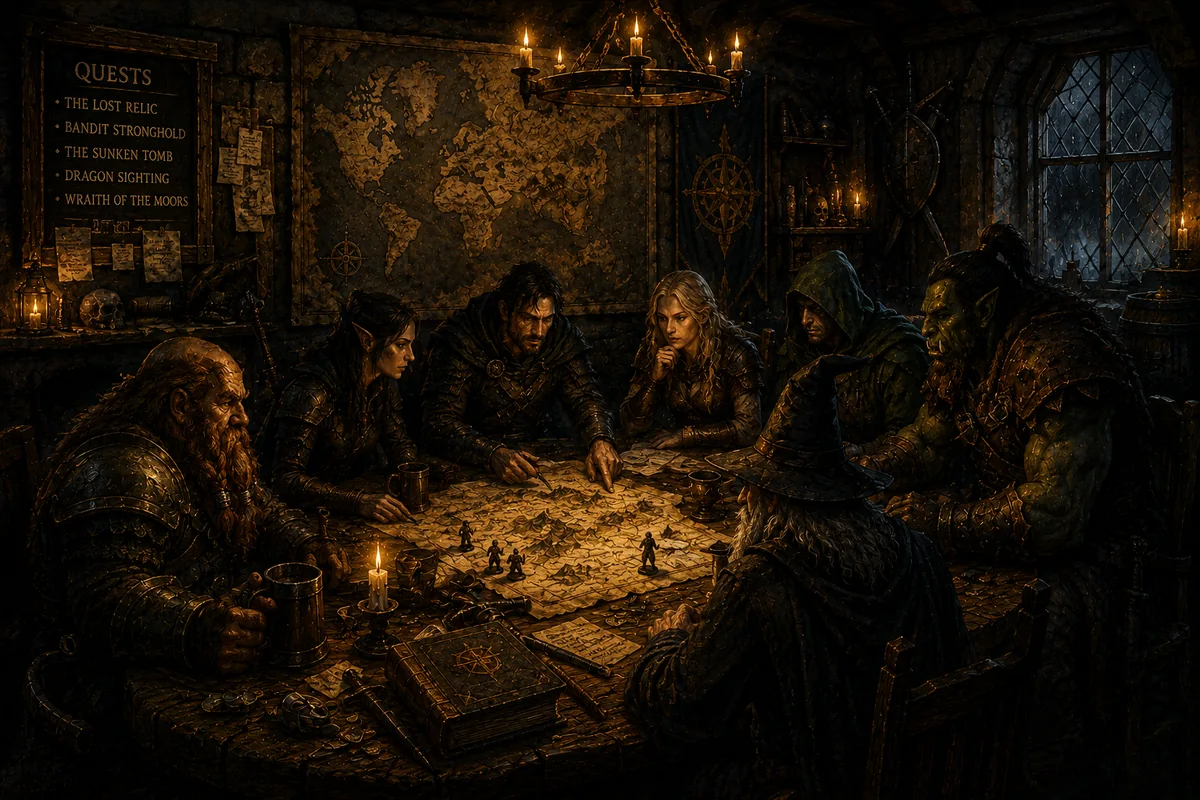
Start here
Four things you need
New to roleplaying? You only need a few choices to begin. Your Games Master (GM) can help with any rules you have not met before.
Make your character
Pick your game rules below
Click the edition your group plays. Follow just that set of steps; the extra rules and reference tables can wait until you need them.
D&D 5.5e / 2024
Follow these five steps in order. You can open the detailed rules if you want more help.
- Choose your class: what your character is good at. Explore classes.
- Choose your background, people and languages: where you came from and how you grew up. Explore peoples · See background examples.
- Set your six ability scores: Strength, Dexterity, Constitution, Intelligence, Wisdom and Charisma. Get help with scores.
- Choose alignment: a guide to your character’s values. See alignment.
- Finish your character sheet: skills, hit points, equipment, attacks and spells if you use them. Open the topic guides.
Show detailed 2024 rules and character notes
| Step | Do this | Character details |
|---|---|---|
| 1 | Choose a class. Record level, Hit Die, proficiencies and level-1 class features. Use the Choose Your Class chapter. | What does this class look like in the character’s actual life: soldier, court mage, guild thief, hunter, scholar, temple servant or another role? |
| 2 | Determine origin. Choose an approved 2024 background from the current rules, choose the character’s people/species, then choose languages. Record the background’s Origin feat, two skill proficiencies, tool proficiency and starting equipment choice. Use the Basic Rules background reference below · use the Choose Your People chapter. Where an individual people page is still marked legacy, use it for setting identity and use the approved 5.5e rules source for mechanics. | Record homeland, household/community and former occupation. Language conversion: a standard 2024 character knows Common plus two chosen languages. In SpiralWorlds, replace Common with one real home/local language appropriate to the character, then keep the two additional language choices unless another feature changes them. Language reference. |
| 3 | Determine ability scores. Generate six scores using the approved method, assign them, then apply the background increases. | Use the rebuilt Ability Scores chapter. |
| 4 | Choose alignment. Use the Alignment chapter if the campaign records alignment. | Also note one loyalty, taboo or principle that actually affects decisions. |
| 5 | Finish the sheet. Use the rebuilt chapters for Skills & Proficiencies, Feats, Hit Points, Equipment, Saving Throws, Initiative & Attacks, Description & Personality and, if the class casts spells, Starting Spells & Spellcasting. | Add one ally, one rival, one obligation and one present reason to adventure. |
D&D 5e / 2014
Create your character using the 2014 rules from beginning to end. A 2014 background provides its own proficiencies, belongings and roleplaying traits; it does not grant the 2024 Origin feat.
- Choose your race and class. Record 2014 racial traits and ability changes, class Hit Die, starting proficiencies and first-level features. People guide · Class guide.
- Determine your six ability scores. Use your group’s approved 2014 method and apply the 2014 racial adjustments, not 2024 background ability increases. Ability Scores.
- Describe your character. Choose a 2014 background and its skill/tool proficiencies, languages and equipment. Record personality traits, an ideal, a bond and a flaw. Description & Personality.
- Choose starting equipment. Take the equipment offered by your 2014 class and background, or use your 2014 class’s starting wealth to purchase a complete kit instead. Do not add both methods together. Starting Equipment and all twelve class wealth entries.
- Complete the sheet. Record hit points, Armor Class, initiative, weapon attacks, skills, saving throws, class spells and any unspent money. Skills · Hit Points · Saving Throws and Attacks · Spells.
Pathfinder 1e
Use this order if your group plays Pathfinder First Edition.
- Set your ability scores. Ability scores guide.
- Choose your people (race). Record Pathfinder racial traits. People guide.
- Choose your class. Class guide.
- Choose skills and feats. Skills guide · Feats guide.
- Buy your starting equipment. Equipment guide.
- Finish the sheet: hit points, defence, attacks, saves, spells, appearance and personal connections.
Show detailed Pathfinder 1e rules and character notes
| Step | Do this | Character details |
|---|---|---|
| 1 | Determine ability scores. Use the Ability Scores chapter. | Record the six final scores and modifiers. |
| 2 | Choose race/people. Apply PF1e racial modifiers and traits. | Record homeland, languages and community separately from the mechanics. |
| 3 | Choose class. | Record level, Hit Die, proficiencies, class skills and class features. |
| 4 | Assign skill ranks and choose feats. | Use PF1e ranks, class-skill bonuses and feat prerequisites only. PF1e skill-rank reference. |
| 5 | Buy equipment. | Use PF1e starting wealth/equipment rules, then note regional availability. PF1e starting-equipment reference. |
| 6 | Finish the character. | HP, AC, saves, initiative, attacks, spells, alignment, appearance, ally, rival, obligation and reason to adventure. |
D&D 3.5e
Use these steps if your group plays D&D 3.5e.
- Set your ability scores. Ability scores guide.
- Choose your race. Apply 3.5e traits. People guide.
- Choose your class. Class guide.
- Assign skill points. Skills guide.
- Choose feats. Feats guide.
- Choose your starting equipment. Equipment guide.
- Finish the sheet: hit points, defence, attacks, saves, spells, appearance and personal connections.
Show detailed D&D 3.5e rules and character notes
| Step | Do this | Character details |
|---|---|---|
| 1 | Determine ability scores. Use the Ability Scores chapter. | Record the six final scores and modifiers. |
| 2 | Choose race/people. | Apply 3.5e racial traits and adjustments; record homeland and languages. |
| 3 | Choose class. | Record Hit Die, BAB, saves, class skills and class features. |
| 4 | Assign skill points. | Use 3.5e class and cross-class skill rules. |
| 5 | Choose feats. | Use 3.5e feat timing and prerequisites. |
| 6 | Choose equipment. | Use 3.5e starting wealth and equipment statistics. |
| 7 | Finish the character. | HP, AC, saves, initiative, attacks, spells, alignment, appearance, ally, rival, obligation and reason to adventure. |
Pathfinder 1e and D&D 3.5e resemble one another but are not interchangeable. Do not import Pathfinder revisions into a 3.5e build unless the Games Master explicitly allows them.
D&D 2024 backgrounds — optional reference
D&D 2024 only
Choose a Basic Rules background
In 2024 rules, background is mechanical: it supplies three eligible ability scores, one Origin feat, two skill proficiencies, one tool proficiency and an equipment choice. Apply the ability increases in Step 3, not before.
| Background | Eligible abilities | Origin feat | Skills | Tool | Equipment choice |
|---|---|---|---|---|---|
| Acolyte | Intelligence, Wisdom, Charisma | Magic Initiate (Cleric) | Insight, Religion | Calligrapher’s Supplies | Calligrapher’s Supplies, prayer book, Holy Symbol, 10 sheets of parchment, robe and 8 GP; or 50 GP |
| Criminal | Dexterity, Constitution, Intelligence | Alert | Sleight of Hand, Stealth | Thieves’ Tools | 2 Daggers, Thieves’ Tools, crowbar, 2 pouches, Traveler’s Clothes and 16 GP; or 50 GP |
| Sage | Constitution, Intelligence, Wisdom | Magic Initiate (Wizard) | Arcana, History | Calligrapher’s Supplies | Quarterstaff, Calligrapher’s Supplies, history book, 8 sheets of parchment, robe and 8 GP; or 50 GP |
| Soldier | Strength, Dexterity, Constitution | Savage Attacker | Athletics, Intimidation | One Gaming Set | Spear, Shortbow, 20 Arrows, chosen Gaming Set, Healer’s Kit, Quiver, Traveler’s Clothes and 14 GP; or 50 GP |
Make it your own: keep the rules package but describe the actual occupation appropriately. Soldier can mean mercenary, city-watch veteran, household retainer, militia veteran or professional man-at-arms; Sage can be a university or court scholar; Acolyte can belong to an appropriate temple or sacred tradition; Criminal can be a thief, smuggler, poacher or outlaw courier.
Bring them to life
Who is your character?
Start with a name, a place you call home and a reason you have set out. These prompts can help your Games Master bring familiar people and places into the story.
Explore more character story ideas
Nearly there
Ready for your first session?
Check that your character sheet has what you need. Your Games Master can help with the numbers.
Open the final character checklist
- Only one rules system has been used.
- Class and all level-1 choices are complete.
- Background/origin or legacy race/class steps are complete for the chosen edition.
- Ability scores and modifiers are final.
- Skills/proficiencies or ranks are calculated correctly.
- Feats are correct for the edition.
- HP, AC/defence, saves, initiative, attacks and movement are recorded.
- Spellcasting statistics and starting spells are complete where applicable.
- Weapons, armour, tools, money and supplies are recorded.
- Name, people, homeland and languages are recorded.
- At least one ally, rival and obligation are named.
- The character has a reason to adventure now.
Need more help?
Guides for every part of your character
Use a guide when you reach that part of your character: dice, ability scores, people, classes, skills, equipment and more. Choose your own edition in each guide.
Browse the character guides
| Page | Use |
|---|---|
| Dice & Core Rolls | Edition-separated dice notation, d20 tests, natural rolls, Advantage/Disadvantage and multiplier rules. |
| Character Sheet & What to Record | Edition-safe sheet selection plus the mechanical and SpiralWorlds details a player needs to record. |
| Ability Scores | Edition-separated ability generation. |
| Choose Your People | Edition-separated people/species/race gateway. |
| Choose Your Class | Edition-separated class gateway and novice class-selection guide. |
| Skills & Proficiencies | Edition-separated 5.5e proficiencies, PF1e ranks and 3.5e skill points. |
| Feats | Edition-separated 5.5e feat categories, PF1e feat progression and 3.5e feat progression. |
| Hit Points & Hit Dice | Edition-separated starting HP, higher-level HP, Constitution and class Hit Dice. |
| Equipment & Starting Gear | Edition-separated 5.5e packages, PF1e starting wealth and 3.5e starting gold. |
| Saving Throws, Initiative & Attacks | Edition-separated saves, Initiative, Armor Class, weapon attacks, spell attacks and combat modifiers. |
| Alignment | Edition-separated moral shorthand, class restrictions and alignment-sensitive rules. |
| Description & Personality | Playable appearance, motivations, backstory, relationships, obligations and roleplaying cues. |
| Starting Spells & Spellcasting | Edition-separated cantrips, prepared spells, spellbooks, slots and spellcasting ability. |
Optional viewing
Character-creation videos
Broad beginner introduction retained from the original page. Use the edition rules above when details differ.
Optional concept and personality advice.
Sources and licensing
Rules sources
- D&D 2024 Basic Rules — Creating a Character
- System Reference Document 5.2.1
- Archives of Nethys — Pathfinder 1e
- d20 SRD — D&D 3.5e
SRD 5.2.1 attribution: This work includes material from the System Reference Document 5.2.1 by Wizards of the Coast LLC, licensed under Creative Commons Attribution 4.0 International.
Legacy Open Game Content notice
Pathfinder 1e and D&D 3.5e mechanical material is Open Game Content only to the extent that it derives from material released as Open Game Content under the Open Game License version 1.0a. SpiralWorlds setting material, 1454 campaign material, examples, artwork, CSS and editorial presentation are excluded.
Open Game License v1.0a © 2000 Wizards of the Coast, Inc. System Reference Document © 2000 Wizards of the Coast, Inc. Pathfinder Roleplaying Game Core Rulebook © 2009 Paizo Publishing, LLC.
Keep this reference growing
If this page helped with your reading or game, you can support its upkeep or explore the curated books.
Explore the Bookshop — epics, classics and stories behind imagined worlds.