
Free Imperial City · Alsace · The Empire
Colmar — Free Imperial City of Wine, Guilds and Hidden Waters
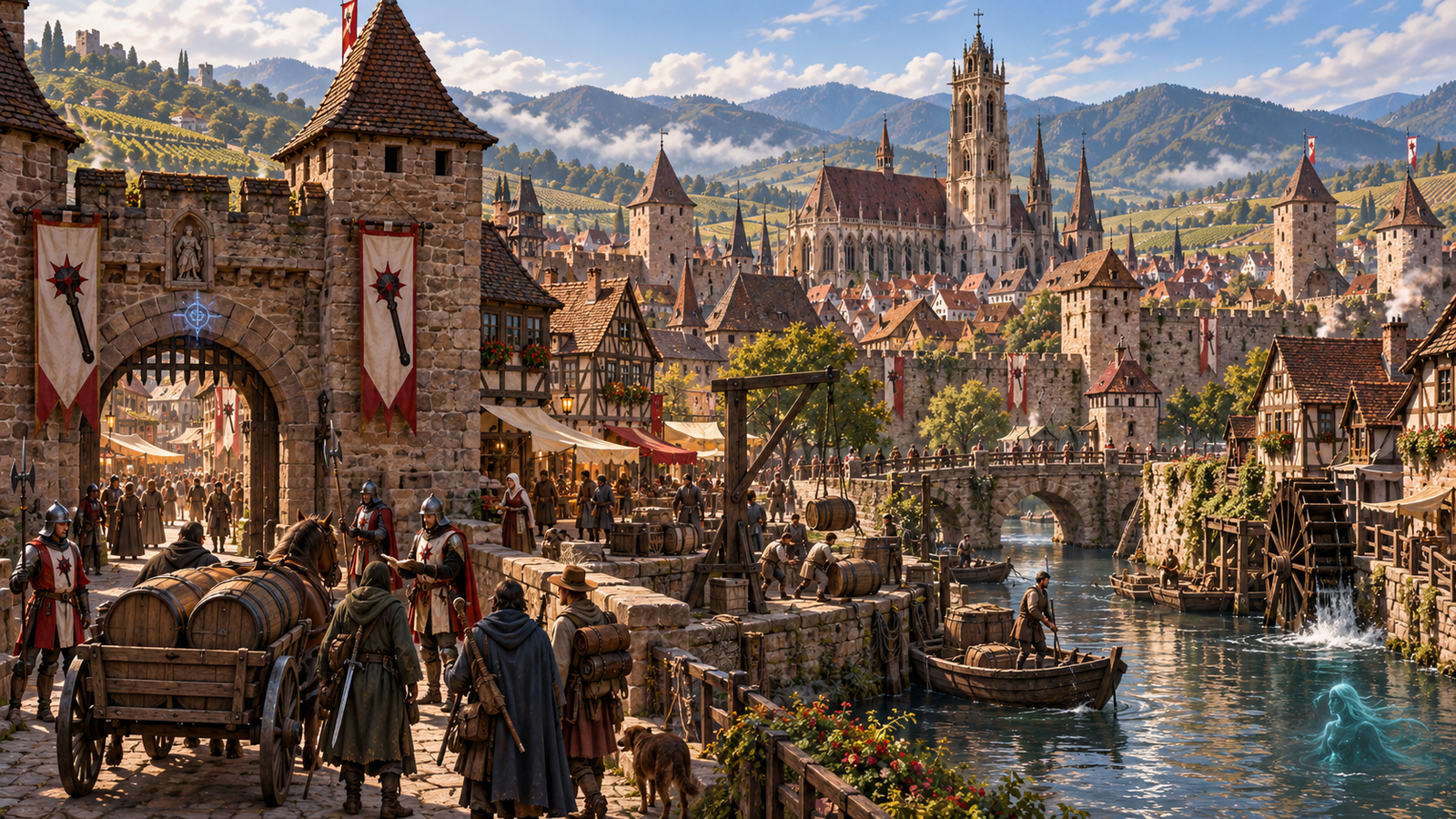
The first thing travellers notice is the wine. The second is the walls. Barrels rattle over paving stones, mill wheels turn beside narrow streams, guild marks hang above workshops, and armed gatekeepers ask questions before they ask names. Colmar is wealthy without being enormous: roughly five thousand people live inside and around the fortified city, which means a stranger can arrive unnoticed but cannot remain unknown for long.
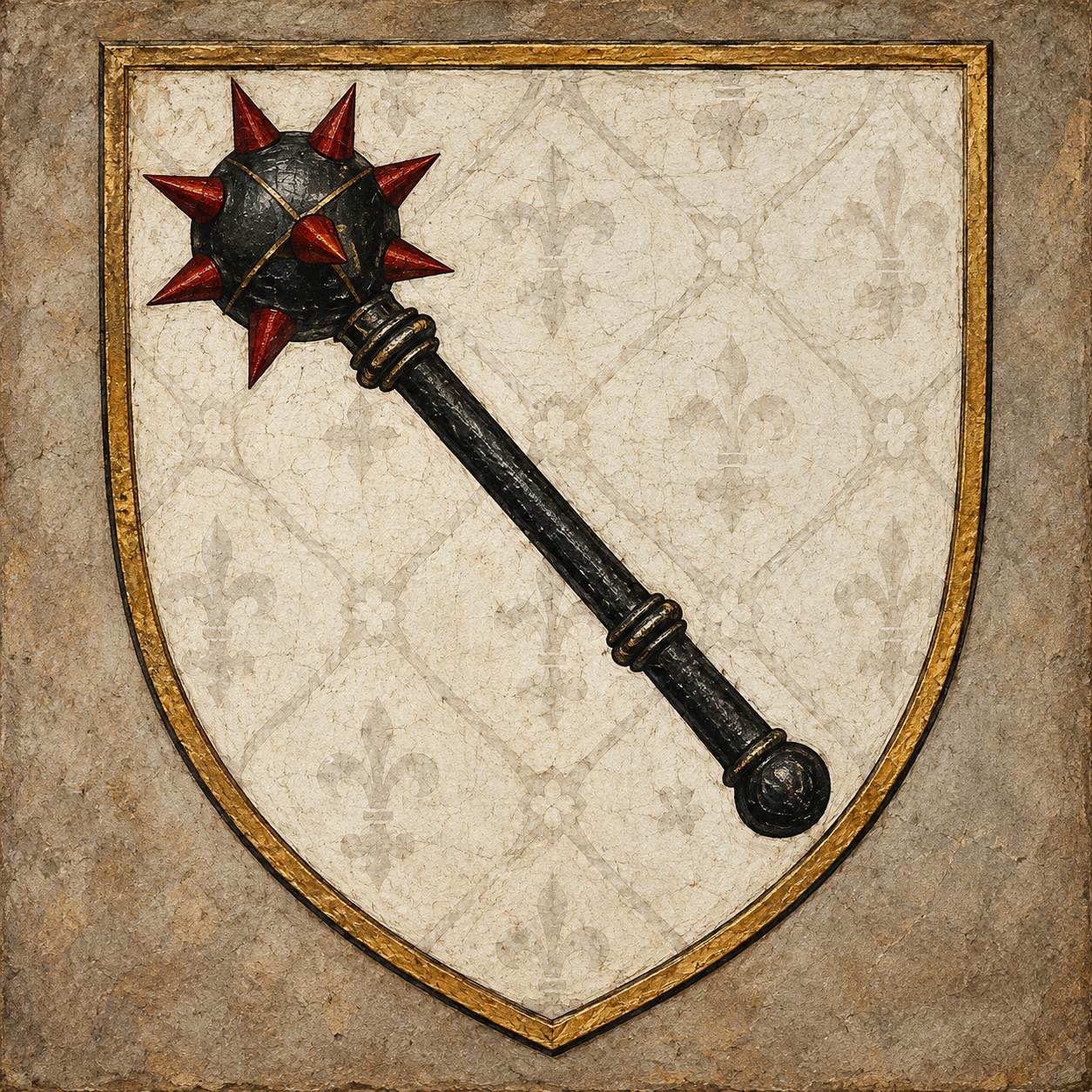
Colmar is a Free Imperial City whose prosperity rests on vineyards, crafts, agriculture and trade. Twenty guilds help shape civic government. Merchants argue over tolls, goldsmiths test precious metal, millers worry about water rights, envoys carry sealed instructions between allied Imperial cities, and the city remembers what happens when armed outsiders are allowed too close to the gates.
Magic here is neither hidden nor effortless. Merchants pay to have suspicious cargo examined. Wealthy warehouses use magical wards. Assayers know that an enchanted coin can be more dangerous than a clipped one. Water spirits are treated as troublesome neighbours where they have established old claims, and everyone has heard at least one story about a cask of wine that showed its drinker something that had not happened yet.
Wine pays for the walls. Guilds decide who passes through them.
Colmar at a Glance
| Settlement | Free Imperial City; mechanically a large-town-scale settlement |
|---|---|
| Population | About 5,000 residents |
| Campaign present | 1454 CE |
| Government | Guild-dominated council and Magistrat headed by civic officers including the Obristmeister, Stettmeister and Schultheiss |
| Political position | Imperial city within the Empire; member of the league of Alsatian Imperial cities later known as the Decapolis |
| Character | Prosperous, watchful, guild-conscious, intensely protective of civic liberties |
| Money | Wine, vineyards, agricultural produce, milling, metalwork, cloth, craft goods, customs and regional trade |
| Defences | Walls, towers, gates, defensive ditches, professional watchmen and a much larger guild-and-household muster |
| Languages heard | Alsatian Alemannic in everyday speech; German in much civic and Imperial business; Latin among scholars and formal record-keepers; French among some western merchants, envoys and soldiers. There is no universal Common tongue. |
| Magic | Practical wards, appraisal, alchemy, healing, learned natural philosophy, enchanted craftwork and negotiated dealings with local supernatural powers |
| Immediate danger | A missing courier, a disputed seal and a vote that could turn a commercial quarrel into armed conflict |
What Is Happening Right Now?
Immediate Adventure
Three Seals Before Dawn
A courier from another Imperial city entered Colmar carrying sealed evidence that a neighbouring lord intends to levy an unlawful toll on wine traffic. Before the Magistrat could question him, the courier disappeared.
His satchel has been pulled from the Mühlbach. His body has not. The wax seal appears genuine. The document inside may not be.
Several powerful wine interests are already demanding retaliation. Carriers fear that the roads will close. Armed guild members are gathering. A councillor claims the whole affair was manufactured to provoke a private war.
Stettmeister Diebold Kempf needs an answer before the council meets. He cannot openly accuse another councillor, another Imperial city or a neighbouring lord without proof, so he needs people who can ask questions without wearing Colmar’s colours.
There is one additional complication. Goldsmith Caspar Schongauer recognises a tiny piece of workmanship on the courier’s seal capsule. It came from a workshop he knows.
And a woman in reed-coloured sleeves who is seen only beside the water insists that the courier walked beneath a bridge after his disappearance— without breathing.
If the characters do nothing
- Wine merchants begin hiring additional armed escorts.
- The gates become stricter and travelling mercenaries are pushed outside the walls.
- A forged accusation circulates through the guilds.
- The council is pressured to authorise seizure of disputed goods.
- A retaliatory attack on a convoy risks invoking the obligations of Colmar’s allied Imperial cities.
Why Adventurers Come to Colmar
Escort Valuable Cargo
Wine, precious metals, pigments, manuscripts and costly components move through a city where one missing wagon can involve several guilds and multiple jurisdictions.
Get Something Appraised
Goldsmiths, assayers, scribes and trained magical practitioners can tell a party whether an object is valuable, enchanted, forged, stolen—or all four.
Work for the Magistrat
Civic officers often need deniable investigators, neutral escorts and outsiders who are not tied to a local guild feud.
Find a Specialist
Colmar supports excellent metalworkers, vintners, armourers, millers, engravers, healers, scribes and traders with contacts far beyond the walls.
Reach the Vosges
The city is a useful place to buy supplies, hire guides and arrange credit before travelling toward the western valleys and more dangerous country.
Follow a Rumour
Prophetic wine, impossible footprints beside mill races, cracked wards, missing customs goods and old water bargains all produce work for people willing to investigate what respectable citizens would rather not discuss.
Places You Can Actually Go
Colmar is compact enough for characters to cross much of the inhabited city on foot, but walls, waterways, markets, crowds and guild jurisdictions make social distance more important than physical distance.
1. The Gates, Walls and Outer Vineyards
Every arrival begins with inspection. Carts queue under stonework while guards check cargo declarations, merchants argue over exemptions and armed travellers explain why they need so many weapons.
The walls and towers are not decorative relics. The city has living memory of large armed companies moving through Alsace, and officials have little patience for mercenaries who assume an Imperial road gives them unrestricted entry.
2. The Koïfhus and Customs Quarter
Colmar’s trading house is where imported goods are declared, weighed, stored and taxed. The commercial institution is already old, although the monumental late-century building familiar to later generations is not yet the finished structure travellers would recognise. Work, rebuilding and expansion make the quarter even more chaotic.
Temporary stores stand beside guarded rooms, scales and scribal tables. A merchant who loses control of a disputed cargo here can lose it legally before a thief ever touches it.
3. The Vintners’ Market and Deep Cellars
Wine is food, trade good, tax base, status symbol and political weapon. Casks change hands by the dozens. Brokers inspect colour and scent. Coopers repair barrels while carriers negotiate onward transport.
Beneath prosperous houses lie cool cellars containing old vintages, private reserves and sometimes things that were never entered in a customs ledger.
4. The Saint-Martin Precinct
The great Gothic mass of Saint-Martin dominates the civic centre. In SpiralWorlds, the old precinct remains an important monumental, archival and ceremonial space even though the world’s active religious order follows the campaign’s own divine landscape.
Several old windows have been incorporated into civic protective workings. Most citizens do not know exactly what each ward does; they know only that damaging one deliberately is treated as something between vandalism, sabotage and magical assault.
5. Unterlinden
North-west of the city’s central bustle stands the wealthy and well-connected Unterlinden community. Its gardens, records, cultivated silence and relationships with important regional families make it far more than a secluded religious house.
In the SpiralWorlds campaign, its learned women maintain herb gardens, archives, dream records, correspondence and traditions of disciplined contemplation. Some are healers. Some are scholars. A few are better at interpreting visions than they admit publicly.
6. The Fishers’ Quarter and Lauch Quays
Boats carrying fish and garden produce move along the Lauch. Fishers, boatmen and market gardeners know stretches of water that respectable councillors see only from bridges.
At night the sound changes. Water carries voices beneath buildings, and narrow landing places provide routes for smugglers, lovers, informants and things that do not need a street.
7. The Mühlbach and Mill Runs
Working water is part of Colmar’s machinery. Streams and channels drive mills, move waste, feed ditches and divide properties. Flour depends upon water. So do livelihoods.
Millers know exactly how quickly a jammed wheel or altered sluice becomes a city problem.
8. Schädelgasse and the Goldsmiths’ Network
Precious metal leaves evidence. Alloy, tool marks, wire, solder, engraving and tiny habits of workmanship can identify a workshop almost as effectively as a written signature.
This makes Colmar’s goldsmiths unexpectedly useful to investigators. They can distinguish a foreign piece from local work, recognise copied patterns and tell when an apparently old object was assembled recently.
9. The Magistrat’s Chambers
Petitions, warrants, toll disputes, guild complaints, criminal accusations, diplomatic letters and requests for civic protection eventually arrive here. The building matters less than the people inside it.
An adventurer with a council sponsor can obtain access that an ordinary traveller cannot. An adventurer who embarrasses the wrong guild can discover that every door still technically opens—but nobody is willing to hold it.
People You Will Meet
Diebold Kempf
Kempf belongs to a family deeply experienced in Colmar’s civic government. He has already served in the city’s highest guild-held office and understands that a badly worded letter can cost more lives than an alley fight.
Wants: Colmar’s liberties protected without allowing an avoidable commercial dispute to become a private war.
From adventurers: evidence, discreet interviews, escort work and actions the Magistrat cannot publicly perform before it knows who is guilty.
Pressure point: Kempf cannot appear weak before the guilds, but he also cannot let angry guildmasters dictate Imperial diplomacy.
Caspar Schongauer
Schongauer is an established Colmar goldsmith with civic standing. His workshop knowledge makes him an excellent judge of metalwork, engraving and provenance even when the object itself is magical.
Wants: to protect the credibility of his craft and discover who is using respected workmanship to give false objects an air of legitimacy.
From adventurers: recover stolen tools, trace a seal, find the original owner of precious metal, or quietly inspect a rival workshop.
Can provide: introductions to armourers, smiths, assayers, wealthy patrons and councillors who would otherwise ignore strangers.
Mara Kessel Campaign NPC
Mara coordinates carts, mule teams, warehouse hand-offs and small boat transfers. She knows which gate is slow, which guard is thorough and which merchant always claims a broken axle when his paperwork is wrong.
Wants: open roads, predictable tolls and no armed guild seizure of carrier wagons.
From adventurers: convoy protection, recovered cargo and occasional intimidation delivered without starting a blood feud.
Beren Umbervein Campaign NPC
Beren tests silver, gold, foreign coin and enchanted metal for merchants who prefer certainty to optimism. He considers inaccurate scales a personal insult.
Wants: honest measures and a market in which a council order does not magically turn bad metal into good.
From adventurers: samples from dangerous sites, escort to disputed mines or workshops, and protection when his findings make somebody rich look dishonest.
Elsa Rottweber Campaign NPC
Elsa buys, sells and arranges transport for wine belonging to several independent vineyard families. She can be generous, but never forgets a debt.
Wants: the disputed road toll destroyed without anyone burning the vineyards that make the argument worth having.
From adventurers: discreet escorts, proof of sabotage, and leverage against merchants trying to manufacture a shortage.
The Reed-Sleeved Woman Campaign NPC
She appears beside certain stretches of the Lauch and Mühlbach wearing clothes that move as if still underwater. Children leave small offerings where adults claim no such spirit exists.
Wants: recognition of an old promise concerning water, a mill passage and a payment nobody now remembers making.
From adventurers: restore the bargain or prove that Colmar has already fulfilled it.
Problem: she tells the truth literally and incompletely.
Factions in Play
| Faction | What it wants now | What it fears | What it can offer adventurers |
|---|---|---|---|
| The Magistrat | Order, lawful trade and preservation of Colmar’s civic liberties. | A guild feud becoming armed conflict; forged civic documents; intervention justified by disorder. | Warrants, introductions, limited immunity, access to records and official employment. |
| The Twenty Guilds | Protection of trade rights, craft privileges, prices, access and political influence. | Outside competition, arbitrary tolls and another guild gaining permanent advantage. | Workshops, credit, hirelings, specialist equipment, rumours and organised muscle. |
| Wine Interests | Keep roads open and prevent outside lords from taking a larger share of the wine trade. | Embargo, crop destruction, counterfeit vintages and transport disruption. | Money, wagons, cellar access, rural contacts and introductions to vineyard owners. |
| Decapolis Envoys | Keep the allied Imperial cities coordinated without allowing one city’s private dispute to drag the others into war. | Forged seals, bad intelligence and a failure to honour mutual obligations. | Letters of introduction, regional intelligence and safe-conduct between allied cities. |
| Unterlinden’s Patron Network | Protect its independence, estates, learned community and relationships with important families. | Political intrusion, stolen records and visions being weaponised by civic factions. | Healing, scholarship, old correspondence, discreet sanctuary and access to elite households. |
| The Night-Water Network | Move untaxed goods, messages and people through routes overlooked by ordinary gate controls. | Drainage works, informants, supernatural attention and one smuggler exposing everyone else. | Secret movement, contraband, information and people who can make cargo disappear. |
The guilds are not a single political faction. A vintner, miller, smith, merchant and carrier may all defend guild government while disagreeing violently about the problem in front of them.
Law, Gates and What Happens When You Cause Trouble
Colmar’s law is civic, practical and intensely concerned with keeping trade, property and public order functioning. Adventurers are useful precisely because they are dangerous professionals; that does not place them outside the law.
At the gates
- Ordinary personal weapons are not automatically forbidden.
- Large armed companies attract immediate scrutiny.
- Military wagons, suspicious prisoners, monsters and hazardous magical cargo must be explained.
- Untaxed commercial goods can be seized until ownership and duties are settled.
- A mercenary company may be required to camp beyond the walls.
Crimes that bring a rapid response
- Forging civic or diplomatic seals.
- Attacking a recognised official while that person performs civic duty.
- Arson inside the walls.
- Sabotaging gates, water supplies, mills or defensive works.
- Using coercive magic to obtain contracts, testimony or access.
- Necromantic activity that threatens public safety.
- Binding or deliberately provoking a supernatural entity within the city.
- Magical assault, impersonation or tampering with civic wards.
Ordinary magic is not automatically criminal
Colmar does not possess a universal law declaring all magic suspicious. Merchants, scholars and specialists make legitimate use of spells such as Detect Magic, Identify and Arcane Lock. The legal question is usually what did you do with it?
Typical consequences
- Warning or complaint: minor disorder, first offence, influential sponsor.
- Fine or compensation: damaged property, unlawful market conduct, small-scale violence.
- Surety: a citizen, guild or employer must guarantee future behaviour.
- Confiscation: disputed cargo, contraband, dangerous objects or evidence.
- Detention: serious assault, forgery, flight risk or unresolved identity.
- Expulsion or banishment: useful when the city wants a dangerous outsider gone more than it wants a long trial.
- Severe punishment: murder, treasonous conspiracy and acts that place the whole city at risk can bring the harshest sentences available under civic law.
Characters with a guild sponsor or Magistrat warrant are not immune. They simply have someone important who will be asked why the party was allowed to do what it did.
Everyday Magic and the Supernatural
Colmar should never feel like an ordinary historical city with three fantasy encounters pasted onto it. Magic appears most clearly where people have found a practical reason to pay for it.
Warehouses
Expensive stores use mundane locks first and magical protection where the cargo justifies it. A magical lock is still only as trustworthy as the person holding the keys, passwords or legal claim.
Customs
Suspicious objects may be examined for enchantment before officials decide whether they are valuable cargo, hazardous material or evidence.
Goldsmiths and Assayers
Enchanted metalwork is not beyond their understanding simply because it is magical. They can still judge alloy, workmanship, weight and provenance.
Medicine
Herbal medicine, learned healing and magical treatment overlap without making every injury trivial. Skilled healers are valuable professionals.
Water
Some old supernatural claims are handled through bargains and custom rather than extermination. A water spirit that keeps an agreement may be less dangerous than a human mill owner who breaks one.
Stone and Wards
Protective marks and older warding practices survive on important structures. Occasionally a carving assumed to be ornamental proves to be something more. A true gargoyle is a different problem entirely.
Nonhuman residents
Colmar’s nonhuman population is visible but not organised into artificial “racial quarters.” Halfling carriers, innkeepers and small traders; dwarf metalworkers and assayers; gnome engravers, mechanics and specialised craftsmen; and smaller numbers of elves and other peoples live among human households, guild contacts and professional networks.
A useful campaign population mix is approximately:
| Humans | About 4,420 |
|---|---|
| Halflings | About 220 |
| Dwarves | About 160 |
| Gnomes | About 110 |
| Elves | About 60 |
| Other peoples | About 30 |
These are SpiralWorlds campaign demographics, not claims about historical Colmar.
What Adventurers Can Obtain
| Need | Availability | Where to start |
|---|---|---|
| Lodging, food, stabling | Readily available | Gate approaches, market streets and merchant inns |
| Wine and preserved provisions | Excellent | Vintners, markets, carriers and cellars |
| Ordinary weapons and armour | Readily available within town-scale limits | Smiths, armourers and guild contacts |
| Precious-metal appraisal | Excellent | Goldsmiths and assayers |
| Scribes, copying, contracts and translation | Readily available | Civic scribes, learned houses and private specialists |
| Magical detection or identification | Available by payment or introduction | Learned practitioners, trusted guild specialists and private masters |
| Healing | Routine treatment available; powerful magical healing requires the right practitioner | Healers, learned houses and private specialists |
| Rare spell components | Possible, not guaranteed | Imported-goods merchants, apothecaries and private collectors |
| Magic items | Not a general shelf market | Private sale, recovered goods, specialist commissions and trusted introductions |
| Guides toward the Vosges | Available | Carriers, hunters, merchants and travellers from western valleys |
| Mercenaries | Available outside normal civic forces, but politically sensitive | Recruiters and companies operating beyond the gates |
Rumours in the Wine Shops
Roll 1d8 or choose one. The final column is for the GM.
| d8 | Rumour | Truth |
|---|---|---|
| 1 | The missing courier never crossed the bridge where his satchel was found. | True |
| 2 | A vintner has a cask that gives the same prophetic dream to everyone who drinks from it. | Half-true |
| 3 | The Magistrat keeps a wizard beneath its chambers to read every visitor’s thoughts. | False |
| 4 | Someone is buying damaged civic seals rather than melting them down. | True |
| 5 | A miller hears knocking from inside his wheel whenever the sluice is closed. | Half-true |
| 6 | Unterlinden has recorded the same unknown woman in dreams separated by generations. | True |
| 7 | Every dwarf in Colmar belongs to a secret underground guild. | False |
| 8 | One of the stone figures above the city has changed position twice this month. | Half-true |
Adventures in Colmar
The Shade Under the Mill Race
Workers see a human silhouette moving beneath fast water. It is blamed for two disappearances, but neither victim drowned. Dry footprints begin at the mill and end at a locked warehouse.
The Wine of Prophecy
A sealed cask appears at auction after decades in a private cellar. Everyone who samples it sees a murder on the same bridge. The murderer changes from vision to vision.
The Broken Window
A warded window in the Saint-Martin precinct cracks inward. Nothing entered the building. Detecting the magic reveals that the ward still functions—but its protective direction has been reversed.
The Guild Embargo
Vintners refuse to load the wagons of a carrier association accused of cooperating with an unlawful toll collector. The carriers respond by blocking access to several storehouses. Someone wants the dispute to become violent.
The Silent Weighing
A customs scale balances perfectly for every object placed on it, regardless of weight. That sounds harmless until an imported chest is found to weigh exactly nothing.
The Unterlinden Dream
Three women who do not know one another describe the same chamber, the same extinguished lamp and the same sealed door. One of them can draw a floor plan of a building she has never entered.
The Counterfeit Seal
Caspar Schongauer identifies a piece of goldwork as local. The workshop that supposedly produced it did not exist when the accompanying document claims to have been sealed.
The Watcher on the Wall
A sentry swears that a carved figure moved after midnight. His captain assumes exhaustion until the same figure is found with blood on its claws. The question is whether Colmar has a gargoyle, a murderer with an excellent hiding place, or both.
Beyond the Walls
Colmar does not exist in isolation. Its security and prosperity depend on roads, wine country, neighbouring Imperial cities and routes leading toward the Vosges.
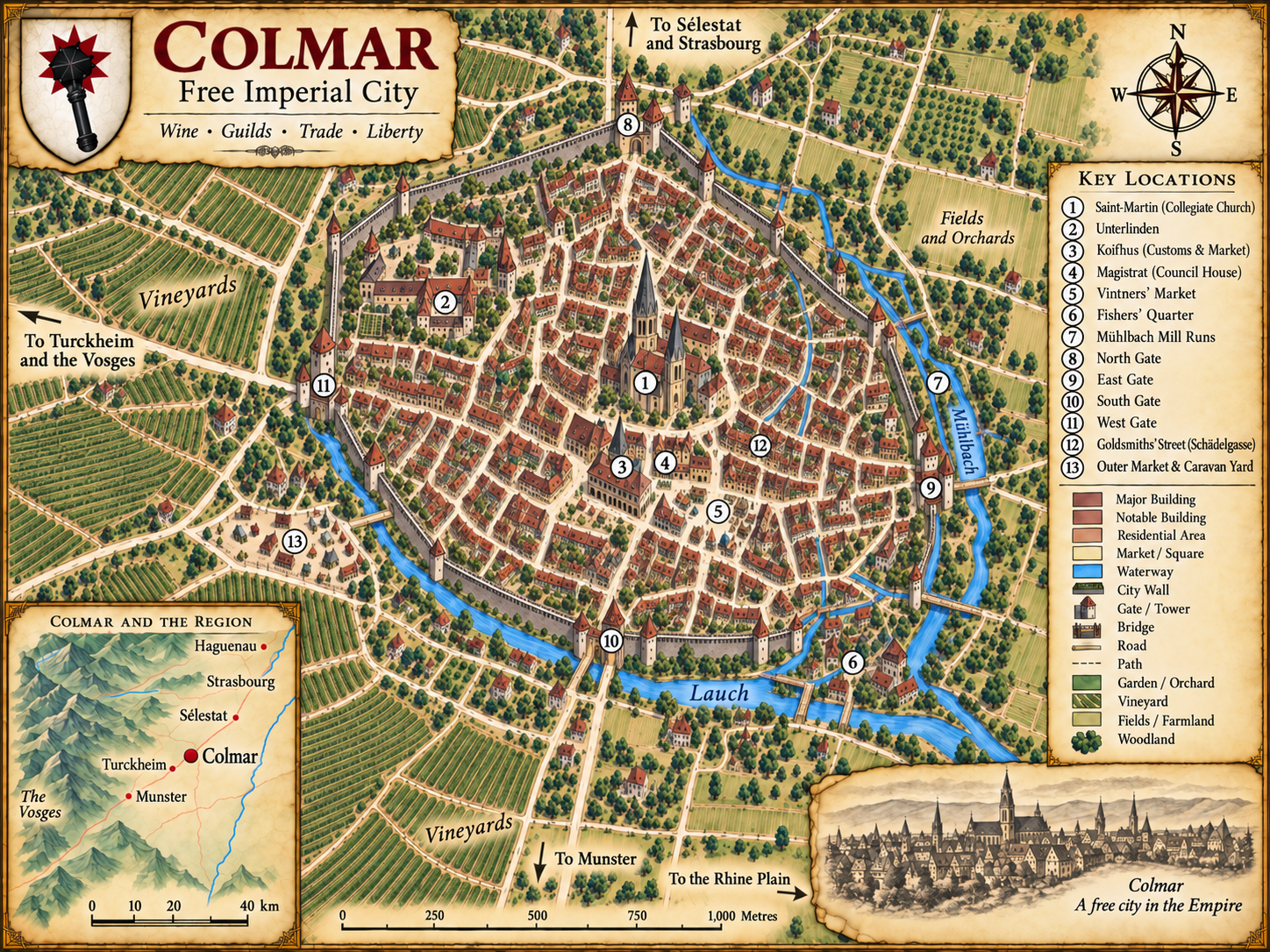
Turckheim
A nearby fellow Imperial city west of Colmar and an important neighbour on routes toward the foothills.
Munster
The western valley route leads toward Munster and deeper Vosges country, where urban authority becomes much less useful.
Sélestat
Another allied Imperial city to the north, valuable for diplomatic, commercial and learned connections.
Strasbourg
The great city farther north dominates far larger commercial, political and intellectual networks.
Obernai
A fellow Imperial city whose interests overlap with Colmar in the wider network of Alsatian urban liberties.
Haguenau
The administrative centre of the alliance of Imperial cities and one of Colmar’s most important political counterparts.
How Power Actually Works
Colmar is not ruled by a fictional “High Magistrate.” Its real civic structure is much more useful for play.
The constitution established in 1360 provided a thirty-seat council. Eight seats belonged to nobles, two to allied patrician families and twenty to guild masters. The guilds also controlled the office of Obristmeister.
The annually chosen Obristmeister worked with three Stettmeister. Together with the Schultheiss, they formed the Magistrat. Colmar purchased control of the Schultheiss office from King Sigismund in 1425, bringing an important judicial office into the city’s own hands.
What that means during play
- No single mayor can casually command the whole city.
- A guild can obstruct policy without controlling every councillor.
- A lawful warrant may still provoke a political fight over who authorised it.
- Characters can gain one patron without gaining the city.
- Trade disputes naturally become political disputes because guild leaders sit inside government.
The league of Imperial cities
Colmar belongs to the alliance of ten Alsatian Imperial cities founded in 1354 and later known as the Decapolis. The cities defend their privileges, promise mutual assistance and attempt to arbitrate disputes among themselves.
Haguenau has an important administrative role, while Colmar’s size and wealth give it considerable diplomatic influence. The alliance is collegial rather than a hierarchy in which one city simply rules the others.
For adventurers, this turns a local document into something potentially regional: a false seal, intercepted envoy or unlawful toll may affect not only Colmar but its relationships with several other Imperial cities.
A City That Remembers Armed Strangers
Only a few years have passed since the Armagnac or Écorcheur forces spread through Alsace, ravaging much of the region. Colmar escaped becoming an easy prize, but the memory of armed companies, failed protection and devastated countryside remains politically useful.
Older soldiers remember the badges. Merchants remember lost consignments. Rural families remember burned holdings. Councillors remember how little comfort an Imperial promise provides when thousands of hungry soldiers are already nearby.
This is why a heavily armed adventuring party is tolerated more easily than a hundred armed retainers with the same explanation.
The City Beneath the Adventure
Late-medieval Colmar is a bustling city of approximately five thousand people, with commercial, artisanal and agricultural activity packed inside substantial defences. Contemporary historical study describes two successive defensive enclosures, numerous towers, gates and ditches.
Around twenty corporations organise the city’s trades. Agriculture remains fundamental: vineyards, gardens, fields and livestock are not picturesque scenery outside a purely urban economy but part of the system that keeps Colmar wealthy.
The waterways matter for the same reason. The Lauch, Mühlbach and associated streams, channels and ditches support fishing, gardens, milling, transport, drainage and defence. Colmar should therefore feel like a working water city, not a romantic fantasy version of modern “Little Venice.”
The Koïfhus is already an established commercial institution, but the great surviving late-medieval customs building belongs to an ongoing later-century building programme. The campaign therefore uses a busy customs and market complex under development rather than pretending the finished 1480 monument already exists unchanged.
The Collegiate Church of Saint-Martin, built through the thirteenth and fourteenth centuries, is one of the city’s great architectural landmarks. Unterlinden, founded in the thirteenth century, is likewise a substantial and wealthy institution with important ties to prominent regional families.
Colmar in Your Game
Colmar’s political title is city, but its population and ordinary adventuring market are closer to a large town. That distinction keeps the settlement wealthy and important without turning every spell, magic item or expert into an automatic retail purchase.
D&D 5.5e / 2024
Town-scale adventuring market · strong civic institutions · unusually good specialist crafts
Routine purchases
Characters can readily obtain ordinary adventuring equipment, weapons, armour, mounts, carts, food, wine, common craft services, lodging and hirelings appropriate to a prosperous town.
Spellcasting services
For the current rules’ spellcasting-service framework, treat Colmar as a town despite its political status as an Imperial city.
| Spell level | Core service cost | Colmar availability |
|---|---|---|
| Cantrip | 30 GP | Usually obtainable |
| 1st | 50 GP | Usually obtainable |
| 2nd | 200 GP | Available with the right practitioner |
| 3rd | 300 GP | Available by arrangement |
| 4th–5th | 2,000 GP | Rare specialist; not walk-in service |
| 6th+ | — | Not part of Colmar’s routine market; find a named exceptional caster or travel elsewhere |
Magic items
Do not treat Colmar as a magic-item supermarket. Items appear through private owners, commissioned work, adventuring treasure, confiscated property, inheritance and specialist dealers. A rare object is an adventure connection, not merely another line on a shop menu.
Optional Colmar traits
- Guild Writ. A character formally sponsored by a relevant guild or civic officer has Advantage on one appropriate Charisma check per day made to obtain ordinary cooperation from that institution. The writ does not protect the character from criminal conduct.
- Closed Gates. During a civic alarm, leaving or entering the city requires official permission, deception or another route until the alarm is lifted.
- Everybody Knows Somebody. A public scandal involving the party reaches relevant guild or civic figures quickly. Reputation should have visible consequences by the next major social scene rather than disappearing between encounters.
Pathfinder 1e
LN Large Town · Government: Council
| Population | About 5,000 |
|---|---|
| Corruption | +0 |
| Crime | +0 |
| Economy | +2 |
| Law | –1 |
| Lore | +0 |
| Society | +3 |
| Danger | +5 |
| Qualities | Prosperous, Strategic Location, Rumormongering Citizens |
| Base Value | 2,800 gp |
| Purchase Limit | 15,000 gp |
| Spellcasting | 5th level |
| Available magic items | 3d4 minor, 2d4 medium, 1d4 major |
The modifiers incorporate the Pathfinder Council government, Colmar’s lawful-neutral character and the three listed settlement qualities rather than simply reusing the oversized numbers from the legacy page.
The relatively strong Society modifier reflects a place where guild, civic and family connections matter. The negative Law modifier does not mean weak law enforcement; it reflects the Pathfinder Council-government modifier and the complexity of authority spread across civic bodies.
D&D 3.5e
Large Town · Population approximately 5,000 · Community Modifier +3
| Community size | Large Town |
|---|---|
| Population | About 5,000 |
| Community modifier | +3 |
| GP limit | 3,000 gp |
| Estimated adult population | About 3,800 for community-generation purposes |
| Ready cash | Approximately 570,000 gp using the standard community formula |
| Professional guards / officers | About 38 as a table-ready estimate |
| Rapid militia | About 190 as a table-ready estimate, with a larger guild-and-household muster possible in a major crisis |
These guard and militia figures are game-facing estimates derived from D&D 3.5e community assumptions, not claimed historical troop censuses.
Generate the settlement’s highest-level NPCs using the normal Large Town procedure and the +3 community modifier. Their existence does not mean their abilities are automatically available for hire.
Running Colmar at the Table
Make the city feel small enough to remember the party
Colmar is not an anonymous metropolis. If the characters overturn a customs cart in the morning, a merchant may know about it by supper. If they save a guildmaster’s son, that should open doors. If they cheat an innkeeper, it should close some.
Use institutions as adventure tools, not exposition
The council matters because it can issue a warrant. The guilds matter because they can deny labour or provide it. The Koïfhus matters because it can hold the party’s confiscated chest. Unterlinden matters because somebody there has the letter the characters need.
Let magic solve magical questions, not every question
Identify can reveal what an enchanted object does according to its edition. It does not automatically reveal who forged the silver casing, who legally owns it, why a guildmaster hid it or which councillor will kill to recover it.
Keep water moving through scenes
Characters hear mill wheels during conversations, cross bridges while following suspects, smell wet stone near warehouses and find evidence washed into channels. The Lauch and Mühlbach should be part of Colmar’s navigation and adventure logic, not just scenery.
Put danger just outside respectability
The best Colmar adventures begin with something mundane enough for the city to care about—a toll, contract, missing person, spoiled wine, forged seal or stopped mill—and then reveal the supernatural complication beneath it.
Related SpiralWorlds Entries
Historical Sources and Campaign Foundations
The historical framework establishes Colmar’s scale, civic institutions, guild structure, waterways, built environment and documented historical figures. The supernatural incidents, campaign NPCs, nonhuman demographics, magical wards, water spirit and adventure plots are SpiralWorlds material.
- Monique Debus Kehr, “La Fête-Dieu à Colmar à la fin du Moyen Âge,” Revue d’Alsace — population, economy, approximately twenty corporations, waterways and fortifications.
- Heidelberger Akademie der Wissenschaften — Colmar civic constitution — thirty-seat council, guild representation, Obristmeister, Stettmeister, Magistrat and Schultheiss.
- Ville de Colmar — La charte de la Décapole — Imperial-city alliance, collegial organisation and Colmar’s diplomatic role.
- Ville de Colmar — L’histoire du blason de Colmar — historical mace emblem, judicial seal and late-medieval colours.
- Ville de Colmar — À Colmar, les cours d’eau charrient des siècles d’histoire — Lauch, Mühlbach, milling, defensive ditches and working waterways.
- Ville de Colmar — Le patrimoine architectural de Colmar — Saint-Martin and Koïfhus chronology.
- Musée Unterlinden — Middle Ages — foundation, development, reform and regional family connections.
- Fédération des Sociétés d’Histoire et d’Archéologie d’Alsace — Kempf — Diebold Kempf and his family’s civic careers.
- Fédération des Sociétés d’Histoire et d’Archéologie d’Alsace — Schongauer — Caspar Schongauer’s goldsmithing, citizenship and council membership.
- Fédération des Sociétés d’Histoire et d’Archéologie d’Alsace — Louis XI — Armagnac/Écorcheur operations in Alsace.
Rules Sources and Licensing
- D&D Beyond — 2024 Equipment and Spellcasting Services
- Archives of Nethys — Pathfinder 1e Settlement Rules
D&D 5.5e / 2024 rules material
This work includes material from the System Reference Document 5.2.1 (SRD 5.2.1) by Wizards of the Coast LLC. SRD 5.2.1 is licensed under the Creative Commons Attribution 4.0 International License .
Open Game License v1.0a & Copyright Notices
The Pathfinder 1e and D&D 3.5e rules material on this page is derived from Open Game Content and is used under the Open Game License Version 1.0a. SpiralWorlds presentation, navigation, original commentary, setting material and CSS are not designated Open Game Content by this notice.
OPEN GAME LICENSE Version 1.0a
The following text is the property of Wizards of the Coast, Inc. and is Copyright 2000 Wizards of the Coast, Inc (“Wizards”). All Rights Reserved.
- Definitions: (a)”Contributors” means the copyright and/or trademark owners who have contributed Open Game Content; (b)”Derivative Material” means copyrighted material including derivative works and translations (including into other computer languages), potation, modification, correction, addition, extension, upgrade, improvement, compilation, abridgment or other form in which an existing work may be recast, transformed or adapted; (c)”Distribute” means to reproduce, license, rent, lease, sell, broadcast, publicly display, transmit or otherwise distribute; (d)”Open Game Content” means the game mechanic and includes the methods, procedures, processes and routines to the extent such content does not embody the Product Identity and is an enhancement over the prior art and any additional content clearly identified as Open Game Content by the Contributor, and means any work covered by this License, including translations and derivative works under copyright law, but specifically excludes Product Identity. (e)”Product Identity” means product and product line names, logos and identifying marks including trade dress; artifacts; creatures characters; stories, storylines, plots, thematic elements, dialogue, incidents, language, artwork, symbols, designs, depictions, likenesses, formats, poses, concepts, themes and graphic, photographic and other visual or audio representations; names and descriptions of characters, spells, enchantments, personalities, teams, personas, likenesses and special abilities; places, locations, environments, creatures, equipment, magical or supernatural abilities or effects, logos, symbols, or graphic designs; and any other trademark or registered trademark clearly identified as Product identity by the owner of the Product Identity, and which specifically excludes the Open Game Content; (f)”Trademark” means the logos, names, mark, sign, motto, designs that are used by a Contributor to identify itself or its products or the associated products contributed to the Open Game License (g)”Use”, “Used” or “Using” means to use, Distribute, copy, edit, format, modify, translate and otherwise create Derivative Material of Open Game Content. (h)”You” or “Your” means the licensee in terms of this agreement.
- The License: This License applies to any Open Game Content that contains a notice indicating that the Open Game Content may only be Used under and in terms of this License. You must affix such a notice to any Open Game Content that you Use. No terms may be added to or subtracted from this License except as described by the License itself. No other terms or conditions may be applied to any Open Game Content distributed using this License.
- Offer and Acceptance: By Using the Open Game Content You indicate Your acceptance of the terms of this License.
- Grant and Consideration: In consideration for agreeing to use this License, the Contributors grant You a perpetual, worldwide, royalty-free, non-exclusive license with the exact terms of this License to Use, the Open Game Content.
- Representation of Authority to Contribute: If You are contributing original material as Open Game Content, You represent that Your Contributions are Your original creation and/or You have sufficient rights to grant the rights conveyed by this License.
- Notice of License Copyright: You must update the COPYRIGHT NOTICE portion of this License to include the exact text of the COPYRIGHT NOTICE of any Open Game Content You are copying, modifying or distributing, and You must add the title, the copyright date, and the copyright holder’s name to the COPYRIGHT NOTICE of any original Open Game Content you Distribute.
- Use of Product Identity: You agree not to Use any Product Identity, including as an indication as to compatibility, except as expressly licensed in another, independent Agreement with the owner of each element of that Product Identity. You agree not to indicate compatibility or co-adaptability with any Trademark or Registered Trademark in conjunction with a work containing Open Game Content except as expressly licensed in another, independent Agreement with the owner of such Trademark or Registered Trademark. The use of any Product Identity in Open Game Content does not constitute a challenge to the ownership of that Product Identity. The owner of any Product Identity used in Open Game Content shall retain all rights, title and interest in and to that Product Identity.
- Identification: If you distribute Open Game Content You must clearly indicate which portions of the work that you are distributing are Open Game Content.
- Updating the License: Wizards or its designated Agents may publish updated versions of this License. You may use any authorized version of this License to copy, modify and distribute any Open Game Content originally distributed under any version of this License.
- Copy of this License: You MUST include a copy of this License with every copy of the Open Game Content You Distribute.
- Use of Contributor Credits: You may not market or advertise the Open Game Content using the name of any Contributor unless You have written permission from the Contributor to do so.
- Inability to Comply: If it is impossible for You to comply with any of the terms of this License with respect to some or all of the Open Game Content due to statute, judicial order, or governmental regulation then You may not Use any Open Game Material so affected.
- Termination: This License will terminate automatically if You fail to comply with all terms herein and fail to cure such breach within 30 days of becoming aware of the breach. All sublicenses shall survive the termination of this License.
- Reformation: If any provision of this License is held to be unenforceable, such provision shall be reformed only to the extent necessary to make it enforceable.
-
COPYRIGHT NOTICE
Open Game License v 1.0a Copyright 2000, Wizards of the Coast, Inc.
System Reference Document Copyright 2000-2003, Wizards of the Coast, Inc.; Authors Jonathan Tweet, Monte Cook, Skip Williams, Rich Baker, Andy Collins, David Noonan, Rich Redman, Bruce R. Cordell, John D. Rateliff, Thomas Reid, James Wyatt, based on original material by E. Gary Gygax and Dave Arneson.
Pathfinder Roleplaying Game Core Rulebook © 2009, Paizo Publishing, LLC; Author: Jason Bulmahn, based on material by Jonathan Tweet, Monte Cook, and Skip Williams.
Pathfinder RPG GameMastery Guide, © 2010, Paizo Publishing, LLC; Authors: Cam Banks, Wolfgang Baur, Jason Bulmahn, Jim Butler, Eric Cagle, Graeme Davis, Adam Daigle, Joshua J. Frost, James Jacobs, Kenneth Hite, Steven Kenson, Robin Laws, Tito Leati, Rob McCreary, Hal Maclean, Colin McComb, Jason Nelson, David Noonan, Richard Pett, Rich Redman, Sean K Reynolds, F. Wesley Schneider, Amber Scott, Doug Seacat, Mike Selinker, Lisa Stevens, James L. Sutter, Russ Taylor, Penny Williams, Skip Williams, Teeuwynn Woodruff.
Colmar — Free Imperial City of Wine, Guilds and Hidden Waters. Copyright 2026, SpiralWorlds.
END OF LICENSE