
Janus — Roman God of Gates, Beginnings & Transitions
Janus stands wherever one state of being becomes another: at the door of a house, the gate of a city, the first day of a year, the departure of an army, the restoration of peace and the instant when an old order gives way to something new. His two faces do not merely watch past and future. One regards what is being left behind; the other watches what is about to be entered.

Janus at a Glance
Tradition
Distinctly Roman and Italic; Janus has no direct Hellenic equivalent.
Divine standing
Intermediate Deity · Divine Rank 13 · Campaign Divine Tier 34.
Alignment
True Neutral.
Portfolio
Beginnings, endings, gates, doorways, thresholds, transitions, passage, journeys, exchange, war and peace, and the turning of time.
Principal residence
The Threshold Court in Abellio, Arcadia, with ancient roots in Latium.
Symbols
Two-faced head, key, staff and paired gates.
Domains
Travel · Knowledge · Protection · Threshold.
Favoured weapon
Quarterstaff.
The Keeper of the Threshold
- Pantheon: Roman Pantheon
- Latin Name: Ianus
- Principal Titles: Ianus Pater, Bifrons, Geminus
- Divine Rank: Intermediate Deity
- Alignment: True Neutral
- Superior: None
- Origin Plane: Material Plane — ancient Latium
- Principal Residence: Abellio, Arcadia
- Portfolio: Beginnings, endings, gates, doorways, thresholds, transitions, passage, journeys, exchange, war and peace, the turning of time
- Symbols: Two-faced head; key and staff; paired gates
- Divine Artifact: The Key of Janus
- Favoured Weapon: Quarterstaff
- Divine Domains: Threshold, Travel, Knowledge, Protection
- Servants: Janitores, Keepers of Hours and other divine custodians of the Threshold Court
- Associated Creatures: Keepers of Hours; sphinxes may guard especially dangerous thresholds
- Worshippers: Romans, travellers, merchants, diplomats, magistrates, gatekeepers and those entering a new state of life
Janus has no direct Hellenic counterpart. He remains a distinct Roman divine power rather than another name or aspect of an Olympian god.
Janus is invoked at beginnings because beginnings are dangerous. A door can admit a friend or an enemy. A road can lead to prosperity or ruin. A coronation may establish order or begin a civil war. A treaty can end violence while preserving the grievances that create another conflict.
Janus governs the moment of crossing. He does not promise that whatever waits on the far side will be good.
Divine Mechanics
These statistics represent Janus himself when divine conflict brings the god directly into an adventure. Reducing Janus to 0 Hit Points can defeat or expel him from a battlefield, but permanent divine death requires circumstances appropriate to his rank, realm and cosmic office.
Janus
Armor Class 28
Hit Points 820
Speed 40 ft.
Initiative +19 (29)
| STR | DEX | CON | INT | WIS | CHA |
|---|---|---|---|---|---|
| 34 (+12) | 32 (+11) | 34 (+12) | 32 (+11) | 30 (+10) | 28 (+9) |
Saving Throws Dex +19, Con +22, Int +21, Wis +22, Cha +21
Skills Arcana +21, History +21, Insight +22, Perception +22, Religion +21
Damage Resistances Cold, Fire, Lightning, Psychic, Radiant
Condition Immunities Charmed, Frightened, Poisoned
Senses Truesight 120 ft.; Passive Perception 32
Languages All; Telepathy 120 ft.
Challenge 36 (custom epic; PB +10)
Divine Awareness
Janus knows whenever a creature crosses a deliberately constructed doorway, gate or active magical portal within 1 mile of him.
Legendary Resistance
5/Day, or 6/Day in the Threshold Court. If Janus fails a saving throw, he can choose to succeed instead.
Magic Resistance
Janus has Advantage on saving throws against spells and other magical effects.
Two-Faced Vigil
Janus can’t be surprised. He can take two Reactions during each round, but no more than one during the same turn.
Patulcius and Clusius
At the start of each of his turns, Janus chooses one divine aspect until the start of his next turn.
- Patulcius, the Opener. Janus and allies of his choice within 30 feet don’t provoke Opportunity Attacks when moving, and Janus doubles the range of his teleportation effects.
- Clusius, the Closer. A hostile creature within 30 feet that attempts to teleport or use extradimensional movement must succeed on a DC 30 Charisma saving throw or the movement fails.
Expelled, Not Destroyed
When Janus reaches 0 Hit Points away from the Threshold Court, his physical presence breaks into the sound of turning locks, closing gates and footsteps receding along an unseen road. He is defeated and expelled from the scene rather than automatically erased from divinity.
Divine Spellcasting
Wisdom is Janus’s spellcasting ability (spell save DC 30, +22 to hit with spell attacks). He casts these spells without material components.
At Will: Arcane Lock, Detect Magic, Knock, Thaumaturgy
3/Day Each: Dimension Door, Dispel Magic, Freedom of Movement, Glyph of Warding
1/Day Each: Foresight, Gate, Plane Shift, Teleport
Full Domain Access
Janus has every spell granted by his Travel, Knowledge and Protection domains in the matching edition, in addition to the commonly used spells listed above.
Actions
Multiattack. Janus makes three Staff of the Threshold attacks.
Staff of the Threshold. Melee Spell Attack: +22 to hit, reach 10 ft., one target. Hit: 28 (4d8 + 10) Bludgeoning damage plus 18 (4d8) Force damage.
Open the Way (Recharge 5–6). Janus chooses up to six creatures he can see within 120 feet. A willing creature teleports to an unoccupied space Janus can see within 60 feet of its starting position.
An unwilling creature must make a DC 30 Charisma saving throw. On a failure, it takes 55 (10d10) Force damage and Janus moves it to an unoccupied space he can see within 30 feet. On a success, it takes half damage and isn’t moved.
Close the Way (Recharge 5–6). Janus projects the authority of the barred gate in a 60-foot Cone. Each hostile creature in the area makes a DC 30 Charisma saving throw.
On a failed save, a creature takes 66 (12d10) Force damage and can’t teleport, enter an extradimensional space or travel through a magical portal until the end of Janus’s next turn. On a success, it takes half damage only.
The First and Last Gate (1/Day). Janus creates two linked luminous gateways at points he can see within 120 feet. They remain for 1 minute. Entering either gateway causes a creature to emerge through the other. Janus may designate creatures that the gates refuse to admit.
Bonus Actions
Step Through the Hinge. Janus teleports up to 60 feet to an unoccupied space he can see.
Reactions
Bar the Passage. When a creature Janus can see within 120 feet attempts to teleport or enter a magical portal, it must succeed on a DC 30 Charisma saving throw or the movement fails and it takes 27 (6d8) Force damage.
Open for the Worthy. When a creature Janus can see within 60 feet is targeted by an attack, Janus teleports it up to 20 feet to an unoccupied space he can see. If its new position lies outside the attack’s reach or range, the attack misses.
Legendary Actions
Legendary Action Uses: 3 (4 in the Threshold Court). Janus regains all expended uses at the start of his turn.
Staff. Janus makes one Staff of the Threshold attack.
Turn the Hinge. Janus uses Step Through the Hinge.
Seal the Road. One creature Janus can see within 90 feet must succeed on a DC 30 Charisma saving throw or have Speed 0 and be unable to teleport until the end of its next turn.
Invitation to Cross. One willing creature Janus can see within 90 feet teleports up to 60 feet to an unoccupied space Janus can see.
Janus — Pathfinder 1e
Init +16; Senses truesight 120 ft., divine awareness; Perception +48
AC 56, touch 34, flat-footed 46
hp 820
Fort +38, Ref +34, Will +40
DR 25/epic; SR 47
Immune disease, poison, aging effects, fear
Resist acid 20, cold 20, electricity 20, fire 20
Speed 40 ft.
Melee Staff of the Threshold +54/+49/+44/+39 (1d6+13 plus 4d6 force)
Str 30, Dex 28, Con 34, Int 32, Wis 34, Cha 32
Two-Faced Vigilance (Ex)
Janus is never flat-footed and can take two immediate actions each round, though never more than one in response to the same triggering event.
Patulcius or Clusius (Su)
As a swift action, Janus assumes the aspect of the Opener or the Closer. Patulcius doubles the range of his teleportation effects and prevents his movement from provoking attacks of opportunity.
Clusius creates a 30-foot aura in which hostile teleportation and planar travel require a DC 38 Will save.
Open the Way (Su) 3/day
Janus chooses up to six creatures within 120 feet. Willing creatures may teleport up to 60 feet. An unwilling creature must succeed on a DC 38 Will save or take 10d10 force damage and be repositioned by Janus to a legal square within 30 feet.
Close the Way (Su) 3/day
All hostile creatures in a 60-foot cone take 12d10 force damage, Will DC 38 half. A creature that fails is additionally affected as though by dimensional anchor for 1 round.
Bar the Passage (Su)
As an immediate action, Janus can attempt to interrupt teleportation or planar travel within 120 feet. The creature initiating the effect must succeed on a DC 38 Will save or the movement fails.
Spell-Like Abilities — CL 36th
At Will: arcane lock, detect magic, knock
3/day: dimension door, freedom of movement, greater dispel magic, glyph of warding, plane shift
1/day: foresight, gate, greater teleport
Full Domain Access
Janus has the complete Travel, Knowledge, Protection and Threshold domain spell suites in their Pathfinder-facing forms.
Janus — D&D 3.5e
Medium Outsider (Extraplanar)
Armor Class 56, touch 34, flat-footed 47
Hit Points 820
Speed 40 ft.
Base Attack/Grapple +39/+49
Attack: Staff of the Threshold +54 melee (1d6+13 plus 4d6 force)
Full Attack: Staff of the Threshold +54/+49/+44/+39 melee
Special Qualities: DR 25/epic, spell resistance 47, divine awareness, two-faced vigilance, immortality of the divine self
Saves: Fort +38, Ref +34, Will +40
Abilities: Str 30, Dex 28, Con 34, Int 32, Wis 34, Cha 32
Divine Awareness
Janus automatically senses the opening, closing or crossing of any deliberately constructed gateway or active magical portal within 1 mile.
Two-Faced Vigilance
Janus cannot be surprised or flanked. He may take two immediate actions in a round, but never more than one against the same triggering action.
Open the Way (Su)
Three times per day Janus may relocate up to six willing creatures within 120 feet as though each had used dimension door . An unwilling creature receives a DC 38 Will save; failure also deals 10d10 points of force damage.
Close the Way (Su)
Three times per day Janus may project a 60-foot cone. Creatures within take 12d10 force damage, Will DC 38 half. A creature that fails is affected by dimensional anchor for 1 round.
Spell-Like Abilities — CL 36th
At Will: arcane lock, detect magic, knock
3/day: dimension door, freedom of movement, greater dispel magic, glyph of warding, plane shift
1/day: foresight, gate, greater teleport
Full Domain Access
Janus can use every spell-like ability granted by Travel, Knowledge, Protection and Threshold at the caster level appropriate to his Divine Rank.
Divine Domains & Domain Spells
Janus grants power through four principal divine spheres: Threshold, Travel, Knowledge and Protection. Threshold is his characteristic domain, governing admission, exclusion, recognised passage and the supernatural authority of gates.
Threshold
Janus’s defining domain. Threshold magic opens, closes, protects, recognises and traverses boundaries.
Travel
Janus protects departures, roads, journeys, arrivals and legitimate movement between places.
Knowledge
Every threshold separates the known from the unknown. Janus grants insight into roads, histories, boundaries, rites and what lies beyond them.
Protection
Doors and walls do more than divide: they shelter. Janus grants protection to guarded places, travellers and those placed under lawful safe-conduct.
Threshold Domain — 5.5e
Clerics dedicated particularly to Janus may receive the Threshold Domain. Its spells are always prepared once the cleric reaches the indicated level.
Cleric Level 5: Glyph of Warding, Magic Circle
Cleric Level 7: Dimension Door, Freedom of Movement
Cleric Level 9: Passwall, Teleportation Circle
Threshold Initiate
You have Advantage on ability checks made to identify concealed doors, recognise magical portals or determine the purpose of a deliberately constructed threshold.
Channel Divinity: Open or Bar the Way
As a Magic action, present your Holy Symbol and choose one door, gate, window, archway or magical portal you can see within 60 feet.
- Open. A mundane lock opens. Against a magical lock or ward, make a Wisdom check using your Proficiency Bonus against the effect’s spell save DC.
- Bar. The threshold is magically sealed for 1 minute. A creature trying to force it open must succeed on an ability check against your spell save DC.
Threshold Domain — PF1e
Gatekeeper’s Touch (Su): 3 + Wisdom modifier times per day, you can touch a door, lock or portal as a standard action. Mundane locks open or close at your choice. Against a magical lock or seal, make a caster level check against DC 11 + the effect’s caster level. Success suppresses the effect for 1 minute.
Crossing Step (Sp): At 8th level, once per day you may use dimension door as a spell-like ability.
Threshold Domain Spells
1 — Hold Portal
2 — Knock
3 — Glyph of Warding
4 — Dimension Door
5 — Teleport
6 — Find the Path
7 — Greater Teleport
8 — Dimensional Lock
9 — Gate
Threshold Domain — D&D 3.5e
Granted Power: Knowledge (the planes) becomes a cleric class skill. Once per day, you may use knock as a spell-like ability with a caster level equal to your cleric level.
Threshold Domain Spells
1 — Hold Portal
2 — Knock
3 — Glyph of Warding
4 — Dimension Door
5 — Teleport
6 — Find the Path
7 — Greater Teleport
8 — Dimensional Lock
9 — Gate
Janus may additionally grant the Travel Domain, Knowledge Domain and Protection Domain.
The Key of Janus
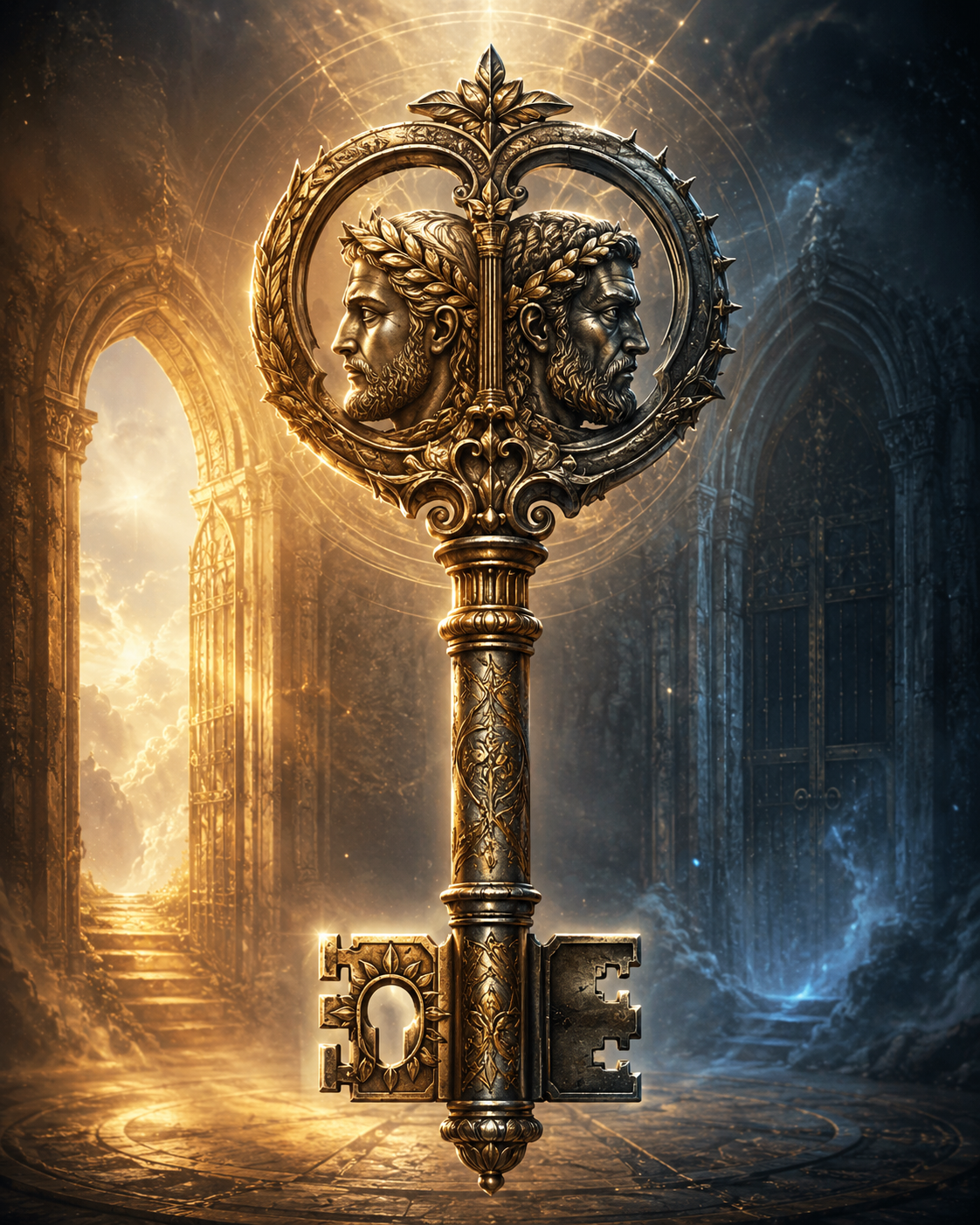
The Key of Janus is not a universal skeleton key. One face of its bow represents admission; the other exclusion. It opens roads that genuinely exist and seals passages that genuinely possess a threshold.
Attunement: Required.
Charges: 7. The Key regains 1d6 + 1 expended charges at dawn.
Eye of the Gatekeeper. While attuned to the Key, you have Truesight to 60 feet and know whether a visible magical portal is active. If you have previously crossed the portal, you recognise its destination.
Open (1 Charge). Touch a door, gate, chest, lock or similar closure. A non-artifact mundane or magical lock opens.
Seal (2 Charges). Touch a doorway, gate or active portal. For 1 hour it is sealed. A creature attempting to overcome a magical seal must succeed on a DC 27 ability check using its spellcasting ability.
Step Across (2 Charges). Enter a doorway and emerge through another doorway you have personally crossed within 1 mile on the same plane. You may take up to five willing creatures with you.
Master Gate (5 Charges). Touch an existing doorway, arch, gate or permanent magical threshold. For 1 minute it becomes a portal either to a place on the same plane that you have visited or to a permanent threshold on another plane that you have crossed.
Divine Seals. The Key does not automatically override another deity’s personal ward, a major artifact or a cosmic seal. Attempting to force such a threshold requires a DC 30 spellcasting ability check.
Return to the Keeper. If Janus wills it, a stolen Key vanishes at the following dawn and returns to his possession.
Who Is Janus?
Janus is often reduced to one face looking into the past and another into the future. That catches only part of his nature. His central power is the threshold: the point at which one condition ends because another is beginning.
He is therefore present at a front door and city gate, but also at an accession, declaration of war, conclusion of a treaty, beginning of a voyage, opening of a market, foundation of a settlement and first formal act of a new government.
Janus is neither automatically benevolent nor hostile. A gate left open when it should be barred is dangerous. A gate kept closed when lawful travellers require passage can be equally destructive.
Janus is not primarily a god of time travel. Time belongs within his portfolio because years, months, reigns and lives pass from one state into another. His deeper divine principle is passage.
The God Before the Door Opens
No Direct Greek Equivalent
Janus occupies an unusually independent place within Roman religion. He remains a distinct Roman power rather than an adopted Roman name for a Hellenic deity.
Key & Staff
Ancient tradition gives Janus the key and staff, fitting emblems for a divine custodian who controls admission and directs passage.
Janiculum
Roman tradition connects Janus with the Janiculum and remembers an ancient seat of the god overlooking the Tiber.
War & Peace
The famous gates associated with Janus stood open during war and were closed in peace, making him the divine hinge between two conditions of the Roman state.
Janus and Saturn
One important Roman tradition remembers Janus receiving Saturn after the older god’s arrival in Latium. Saturn is therefore an ancient associate rather than a natural enemy.
Chaos, Beginning & Roman Theology
Roman literary theology sometimes extends Janus’s principle of transition back to the first ordering of the cosmos itself. This expresses a Roman understanding of his nature rather than making Janus the literal creator of the planes.
Janus Geminus
The shrine of Janus Geminus became one of Rome’s great symbols of public transition. When Rome was at war its gates stood open; their closing proclaimed the rarer condition of peace.
Mars governs battle. Janus governs the gate through which society passes when war begins—and through which it must eventually return.
The Powers on Either Side of the Gate
Saturn
Ancient guest, associate and fellow power of primordial Latium.
Jupiter
Jupiter possesses supreme civic authority, yet Janus may be invoked first because every rite must begin before its principal action can proceed.
Vesta
A natural ritual counterpart. Janus governs entrance and beginning; Vesta guards the sacred centre and hearth.
Juno
Juno and Janus intersect through calendrical observance, civic life and the ordered continuities of Roman society.
Juturna
Roman genealogical tradition connects Juturna and Janus and associates their union with Fons.
Fons / Fontus
God of springs and wells and, in Roman tradition, a son of Janus and Juturna.
Portunus
A neighbouring jurisdiction over gates, harbours and passage.
Quirinus
Janus’s passage between war and peace places him naturally beside Roman powers of citizenship and civic restoration.
Culsans: The Etruscan Culsans provides an ancient parallel for a double-faced guardian of doorways. Resemblance does not require the two gods to be identical.
From Latium to Abellio
Janus belongs to the Roman divine order without being absorbed into Hellenic Olympus. His earliest cultic identity is rooted in Latium, while his principal divine residence stands within Arcadia.
Ancient Latium
Janus’s oldest remembered kingship, cult landscape and Janiculum tradition anchor him to Latium and Rome.
The Threshold Court
Janus maintains a sovereign threshold realm in Abellio, the Open Peace. Its roads and gates connect Roman divine estates.
The Threshold Court
Janus’s realm is organised around roads, courts, colonnades, bridges and innumerable gates. Some open onto Roman divine estates; others connect divine roads or recognised planar crossings.
The Janitores keep registers of passage. They record embassies, pilgrimages, exiles, authorised crossings and gates closed by divine order.
Begin Properly, Cross Carefully
Priestly Duties
- Consecrate doors, bridges and city gates.
- Witness formal departures and returns.
- Supervise openings of markets and public offices.
- Bless journeys and diplomatic missions.
- Seal dangerous portals.
- Witness transfers of authority.
- Attend declarations of war and formal restorations of peace.
Holy Observances
- Kalends: first day of every month.
- 1 January: opening of the year.
- 9 January: January Agonalia.
- Beginnings: foundations, departures, accessions and treaties.
Janitores
The Janitores are an order of divine custodians: spirits, petitioners and appointed guardians who keep records of passage, carry keys and staffs, test travellers and enforce the rules of particular gates.
Sphinx Guardians
Some exceptionally dangerous thresholds belonging to Janus are guarded by sphinxes. Such guardians usually determine whether a traveller is permitted to cross rather than simply attacking everyone who approaches.
Manifestations & Omens
- A locked door opens precisely when a decision becomes unavoidable.
- A gate closes after the last permitted traveller crosses.
- A two-faced shadow appears where only one person is standing.
- A key turns by itself in an old lock.
- Footsteps approach from both sides of a closed doorway.
Keeper of Hours
Keepers of Hours are Janus’s custodians of temporal thresholds. They guard the passage between appointed moments just as Janitores guard gates and roads.
Nature
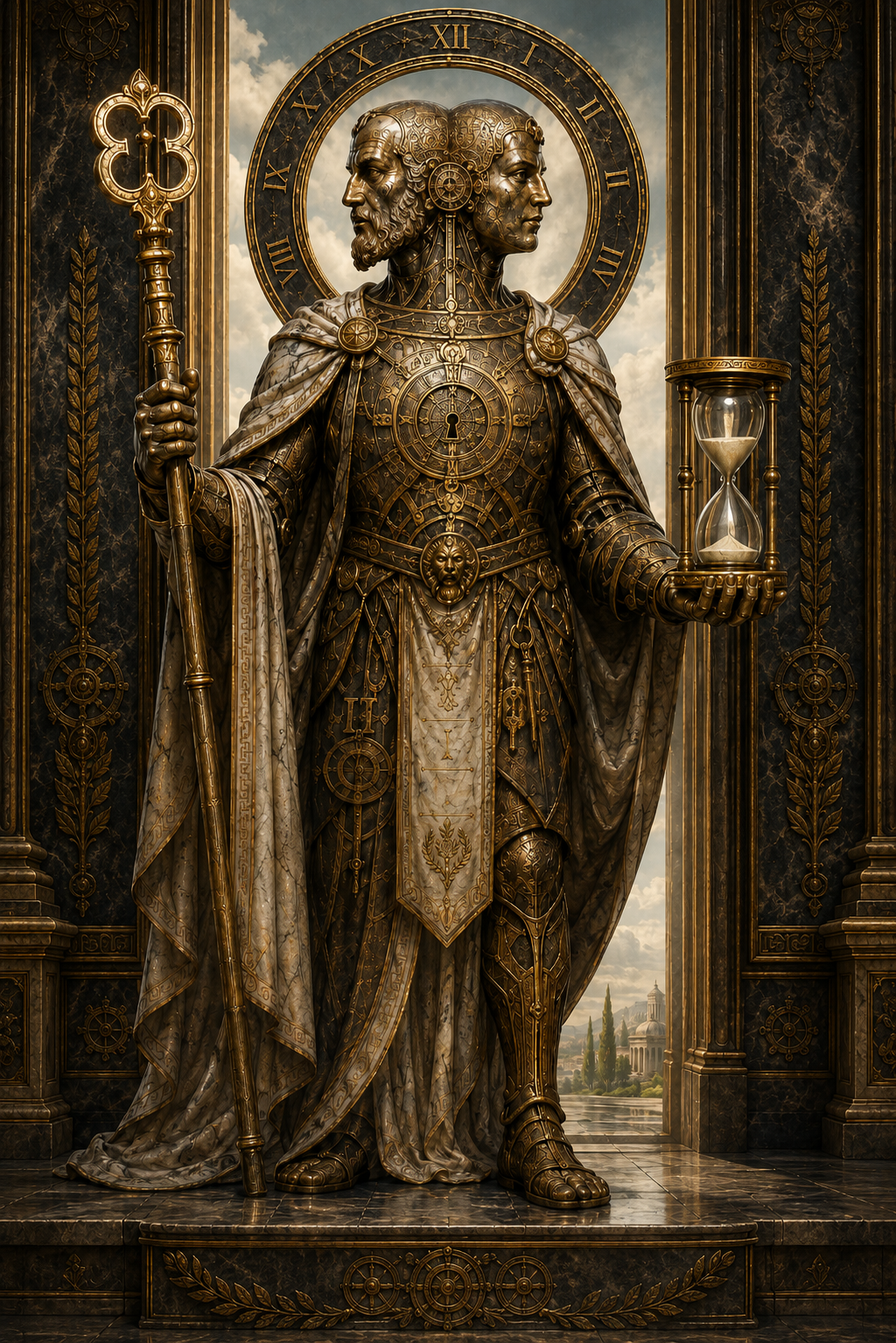
A Keeper usually resembles a tall figure of bronze or pale stone with two opposed faces. One appears old, the other young, although which face is which may change with the observer.
A ring of numerals or calibrated marks often surrounds its head. Most carry a key-headed staff and an hourglass whose sand can stop, reverse or divide into simultaneous streams.
Office
Keepers watch coronations, treaties, sacred calendars, expiring oaths and other events whose meaning depends upon an appointed moment.
They are especially dangerous to creatures attempting to bypass such moments through teleportation, planar travel or temporal displacement.
Every Event Has Its Hour
Janus does not rule unrestricted time. A Keeper therefore concerns itself only with moments functioning as genuine thresholds: the beginning of a reign, end of a treaty, first bell of a festival, completion of an oath or instant at which one recognised state becomes another.
Scrolls of Sequence
The Keepers maintain bronze tablets, calendrical rolls and sealed records known collectively as the Scrolls of Sequence. These do not record immutable destiny. They record recognised appointments and temporal claims acknowledged by Janus’s court.
A wizard who reaches a sealed archive three days early by ordinary travel has merely arrived early. A wizard who travels backward through time to enter before its ward existed has attempted to circumvent a threshold that a Keeper of Hours may defend.
Keeper of Hours — Game Statistics
Keeper of Hours
Armor Class 18 (natural armor)
Hit Points 102 (12d8 + 48)
Speed 30 ft.
Initiative +5 (15)
| STR | DEX | CON | INT | WIS | CHA |
|---|---|---|---|---|---|
| 16 (+3) | 14 (+2) | 18 (+4) | 16 (+3) | 18 (+4) | 12 (+1) |
Saving Throws Con +7, Int +6, Wis +7
Skills Arcana +6, History +6, Insight +7, Perception +7, Religion +6
Damage Resistances Psychic; Bludgeoning, Piercing and Slashing from nonmagical attacks
Damage Immunities Necrotic, Poison
Condition Immunities Charmed, Exhaustion, Frightened, Paralyzed, Petrified, Poisoned
Senses Darkvision 60 ft., Passive Perception 17
Languages Celestial, Latin; understands all languages
Challenge 6 (2,300 XP; PB +3)
Constructed Nature
The Keeper doesn’t require air, food, drink or sleep.
Immutable Schedule
The Keeper is immune to magical aging and effects that alter its personal rate of time.
Temporal Awareness
The Keeper knows whenever a creature within 1 mile arrives through teleportation, planar travel or temporal displacement.
Two-Faced Vigil
The Keeper can’t be surprised and has Advantage on Wisdom (Perception) checks.
Actions
Multiattack. The Keeper makes two Chronal Strike attacks.
Chronal Strike. Melee Weapon Attack: +6 to hit, reach 5 ft., one target. Hit: 10 (2d6 + 3) Force damage plus 7 (2d6) Psychic damage.
If the target is benefiting from a magical effect that alters its Speed, Initiative or number of actions, the attack deals an additional 7 (2d6) Force damage.
Hourglass Gaze (Recharge 5–6). One creature within 60 feet must make a DC 15 Wisdom saving throw.
On a failure, it takes 18 (4d8) Psychic damage and is temporally slowed until the end of its next turn: Speed halved, no Reactions and no more than one attack.
Temporal Lock (1/Day). One creature within 60 feet must make a DC 15 Charisma saving throw.
On a failure, it is temporally anchored for 1 minute and can’t teleport, travel between planes, enter an extradimensional space or move through time. It repeats the save at the end of each of its turns.
Bonus Actions
Temporal Shift (1/Day). The Keeper teleports up to 30 feet. Until the start of its next turn, Opportunity Attacks against it automatically miss.
Reactions
Intercept the Moment. When a creature within 60 feet attempts to teleport or leave the plane, it must make a DC 15 Charisma saving throw. On a failure, the movement fails and it takes 9 (2d8) Force damage.
Between the Ticks (1/Day)
Other creatures can’t take Reactions until the end of the current turn. The Keeper immediately moves up to its Speed without provoking Opportunity Attacks and makes one Chronal Strike.
Keeper of Hours — PF1e
Init +6; Senses darkvision 60 ft., temporal awareness; Perception +15
AC 21, touch 12, flat-footed 19
hp 85
Fort +6, Ref +5, Will +9
Immune construct traits, disease, poison, aging effects
Resist cold 10, electricity 10
Speed 30 ft.
Melee 2 chronal strikes +12 (1d8+4 plus 1d6 force)
Str 18, Dex 15, Con —, Int 16, Wis 18, Cha 12
Immutable Schedule (Ex)
The Keeper is immune to magical aging and effects that alter its personal rate of time.
Temporal Awareness (Su)
The Keeper automatically senses teleportation, planar travel or temporal displacement within 1 mile.
Hourglass Gaze (Su)
Every 1d4 rounds, one creature within 60 feet must succeed on a DC 17 Will save or be slowed for 1 round.
Temporal Lock (Su) — 1/day
One creature within 60 feet must succeed on a DC 17 Will save or be affected as though by dimensional anchor for 1 minute.
Temporal Shift (Su) — 1/day
As a swift action, the Keeper teleports up to 30 feet without provoking attacks of opportunity.
Intercept the Moment (Su)
As an immediate action, the Keeper may oppose a teleportation or planar travel effect within 60 feet. The traveller must succeed on a DC 17 Will save or the movement fails.
Between the Ticks (Su) — 1/day
The Keeper immediately moves up to its Speed and makes one chronal strike. This movement does not provoke attacks of opportunity.
Keeper of Hours — D&D 3.5e
Hit Dice 10d10+20 (75 hp)
Initiative +2
Speed 30 ft.
Armor Class 21, touch 12, flat-footed 19
Base Attack/Grapple +7/+11
Attack Chronal Staff +11 melee (1d8+4 plus 1d6 force)
Full Attack Chronal Staff +11/+6 melee
Special Attacks Hourglass Gaze, Temporal Lock
Special Qualities Construct traits, temporal awareness, immutable schedule, darkvision 60 ft.
Saves Fort +3, Ref +5, Will +7
Abilities Str 18, Dex 15, Con —, Int 16, Wis 18, Cha 12
Temporal Awareness (Su)
A Keeper senses teleportation, planar travel and temporal displacement occurring within 1 mile.
Immutable Schedule (Ex)
The Keeper is immune to magical aging and effects that alter its personal rate of time.
Hourglass Gaze (Su)
Every 1d4 rounds the Keeper may target one creature within 60 feet. Will DC 17 negates. On a failed save, the target is slowed for 1 round.
Temporal Lock (Su)
Once per day, the Keeper may affect one creature within 60 feet as dimensional anchor for 1 minute. Will DC 17 negates.
Temporal Shift (Su)
Once per day, as a swift action, the Keeper may teleport up to 30 feet without provoking attacks of opportunity.
Intercept the Moment (Su)
Once per round, as an immediate action, the Keeper may oppose teleportation or planar travel originating within 60 feet. The traveller must succeed on a DC 17 Will save or the movement fails.
Between the Ticks (Su)
Once per day, the Keeper may move up to its Speed and immediately make one Chronal Staff attack. This movement does not provoke attacks of opportunity.
Speech of the Keepers
- “This hour does not admit you.”
- “The appointed passage has not begun.”
- “You have crossed without completing the interval.”
- “The preceding state remains in force.”
- “Depart now. Return when the gate recognises you.”
Janus and His Keepers in 1454
Constantinople has crossed one of the great thresholds of the age. The Ninefold Dominion seized the Eastern Roman capital in 1453 , and now occupies a city whose walls, offices, archives and civic memories belong to an older Roman order.
Few mortal events could draw Janus’s attention more completely. The city remains; its authority has changed. Ancient Roman obligations and newly imposed Dominion commands now meet at the same gates.
The Gate of Janus at Constantinople
A small Roman threshold sanctuary survives among structures repeatedly buried, rebuilt and incorporated into the city. Its custodians know it as the Gate of Janus.
The Gate recognises changes in lawful possession, civic office and authorised passage. Since the conquest it has become unstable.
Refugees seek forgotten exits. Dominion officials want the sanctuary controlled. Roman custodians fear that opening certain sealed ways could expose archives, treasury vaults, abandoned tunnels or passages beyond the city.
A Keeper at the Gate
At least one Keeper of Hours may now be watching the transition. It does not judge whether the conquest was just. It records the moments at which offices, gates, treasuries and civic obligations actually pass from one recognised authority to another.
Disputed Reigns
Elsewhere, Keepers appear when rival claimants manipulate coronation dates, succession rites or prophecies depending upon the first hour of a reign.
Adventure Hooks
The Gate That Changed Masters
A Dominion commander discovers that one gate refuses to recognise his seal of office after sunset. A Keeper of Hours insists that the previous authority has not completed its final hour.
The Missing Key
The Key of Janus fails to return to its keeper at dawn. Someone has found a way to prevent the artifact from answering Janus’s summons.
The Coronation Before Dawn
A claimant attempts to hold a coronation several hours early so that an ancient prophecy will recognise him as king. A Keeper of Hours blocks the ceremonial gate.
The Missing Hour
An entire hour disappears from clocks, memories and official records. Only a Keeper remembers what happened during it.
The Guardian’s Question
A sphinx guarding one of Janus’s roads refuses passage because the travellers can describe where they wish to go but not what they are willing to leave behind.
Before the Door Was Built
Thieves discover a ritual allowing them to enter a treasury one hour before its enchanted doors were installed. A Keeper begins waiting for them at yesterday’s threshold.
Janus in Roman Tradition
The historical Janus was not simply a personification of January. His functions reach into Roman ideas about beginnings, doorways, religious action, public transition, journeying and the movement between war and peace.
The two faces, key, staff, Janiculum traditions and gates of war and peace provide the historical foundation. The Threshold Court, Key of Janus mechanics, Janitores and Keepers of Hours expand those themes for play.
Regional Effects
Where Janus’s authority is strongest, a major sanctuary or recognised divine gateway can project these effects across roughly six miles. Lesser shrines manifest them on a smaller scale.
Thresholds Remember
A deliberately constructed doorway, gate or bridge retains a supernatural memory of who last opened, closed or crossed it. Janus or his appointed custodians can read that memory directly.
False Passage Fails
Illusions that create a doorway with no real destination shimmer at the edges, and concealed portals become easier to identify by touch.
Beginnings Announce Themselves
Formal accessions, treaty openings, declarations of war and other recognised transitions are accompanied by a small omen: a turning key, a double shadow, a gate moving without wind or a bell sounding once.
The Wrong Road Closes
Teleportation or planar travel used solely to evade a binding threshold must overcome Janus’s regional authority; on a failed divine contest the traveller remains at the point of departure.
Deep Dive
Follow Janus through the Roman Pantheon, Saturn, Cardea, Juturna, Fons and Portunus. His planar roads lead into Arcadia; player-facing worship links to the Cleric, Travel, Knowledge and Protection domains.
Myth, History & SpiralWorlds Canon
Ovid — Fasti, Book I
A principal ancient literary source for Janus’s twofold form, key and staff, beginnings, Janiculum tradition, Saturn relationship and Roman theological interpretations.
British Museum — Temple of Janus Coin
Material evidence for Roman representation of the shrine of Janus and the political symbolism of its doors.
Roman Pantheon
Arcadia
Janus’s principal divine residence lies in Abellio, the Open Peace of Arcadia.
The Age of Severed Crowns
Rules licensing. D&D 5.5e terminology derived from the System Reference Document 5.2.1 is used under CC BY 4.0 where applicable. Pathfinder 1e and D&D 3.5e deity statistics on this page are original campaign conversions rather than official published deity stat blocks.
Janus FAQ
Who is Janus?
Why does Janus have two faces?
Is Janus the Roman version of a Greek god?
Is Janus a god of time?
What domains does Janus grant?
What is a Keeper of Hours?
Is a Keeper of Hours a Modron?
What is the Key of Janus?
Where does Janus live?
Related SpiralWorlds Entries
Roman Pantheon
Explore Rome’s distinct divine powers and its wider sacred order.
Mars
War, civic defence and the ritual passage from peace into campaign and back again.
Cardea
Hinges, household thresholds and the smaller protected boundaries inside Janus’s wider jurisdiction.
Juturna
Springs, fountains and the Roman tradition that connects Juturna, Janus and Fons.
Arcadia
Explore Abellio, Buxenus and the Peaceable Kingdoms.
Sphinx
Established guardians of especially dangerous thresholds.
Travel Domain
Divine power over roads, movement and safe passage.
Knowledge Domain
Lore, discovery and understanding of what lies beyond.
The Keeper of Hours
Janus’s CR 6 divine temporal custodian, fully detailed above for 5.5e, PF1e and 3.5e.
Keep this reference growing
If this page helped with your reading or game, you can support its upkeep or explore the curated books.
Explore the Bookshop — epics, classics and stories behind imagined worlds.