
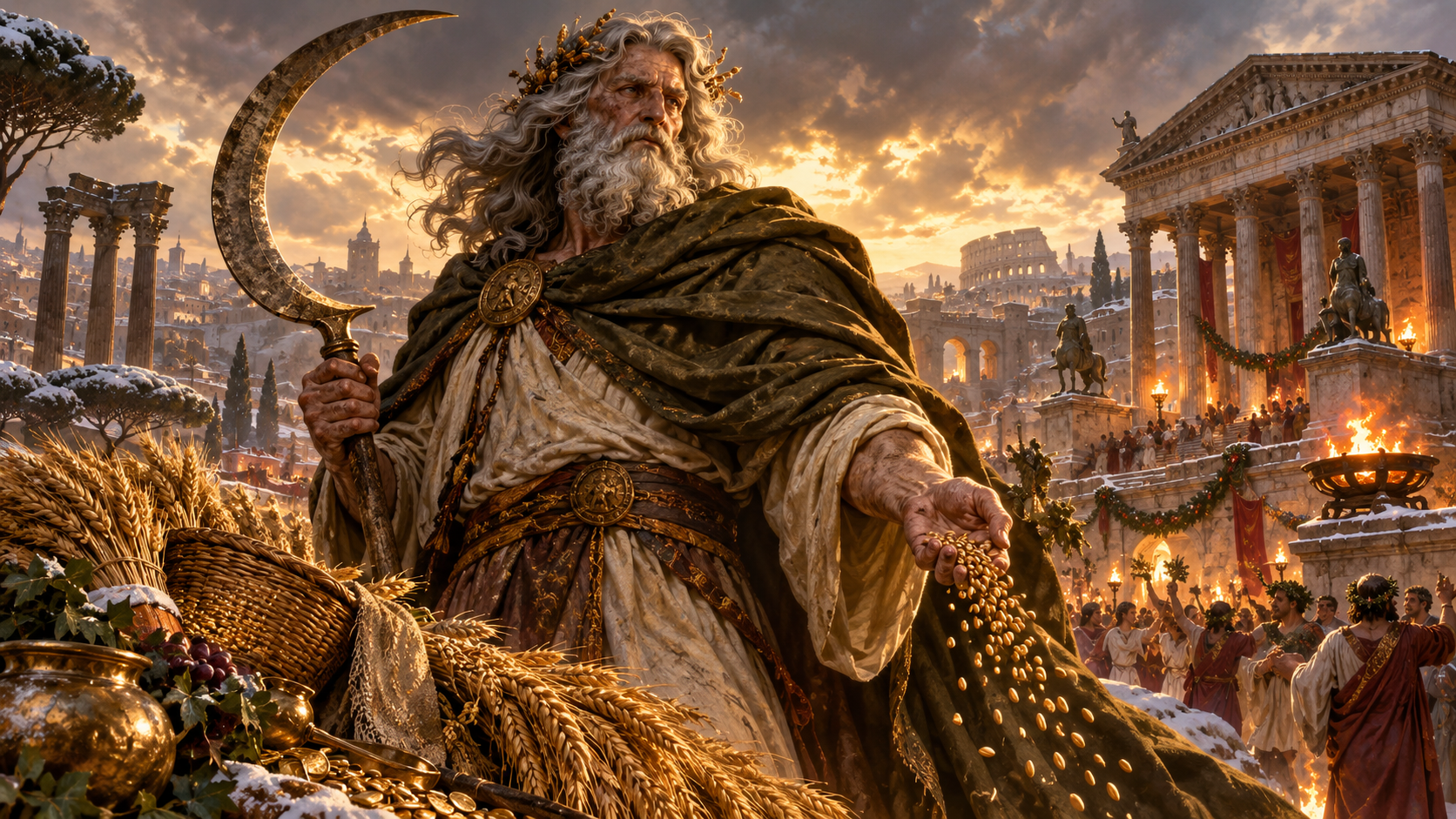
Saturn at a Glance
Tradition
Roman aspect of Cronus.
Divine standing
Intermediate Deity / Elder Titan power · Campaign Divine Tier 34.
Alignment
Chaotic Neutral in his Roman cult aspect.
Portfolio
Sowing, seed, agriculture, old kingship, abundance, inherited memory, the Golden Age and ritual reversal.
Principal festival
Saturnalia, beginning with the rites of 17 December and expanding in later Roman practice into several days of feasting, gifts and loosened social convention.
Material anchor
The Temple of Saturn at the foot of the Capitoline beside the Roman Forum, once closely associated with the state treasury.
Divine imprisonment
The underlying Cronus/Saturn power remains bound in Tartarus; Roman worship reaches an aspect of that same being.
Sacred symbol
Sickle and grain.
Favoured weapon
Domains
Plant · Liberation · Community · Knowledge
Related Roman powers
Roman Pantheon · Sowing · Golden Age · Saturnalia · Old Kingship · Abundance
Saturn is the Roman face of the elder power the Hellenes call Cronus, but Rome remembers him very differently. Here he is not only the fallen father of Jupiter. He is the old king of Latium, keeper of seed and buried wealth, patron of an age before the present order, and the god whose festival reminds masters and magistrates that hierarchy is neither eternal nor absolute.
Same Deity, Different Cultural Aspect
Saturn and Cronus are the same underlying divine being. The Hellenic aspect preserves the Titan dynasty, overthrow and imprisonment in Tartarus. The Roman aspect preserves sowing, Latium, the Golden Age, the Temple of Saturn and Saturnalia. These are not duplicate gods.
The distinction matters in play. Cronus’s true cosmic body remains bound in Tartarus. Saturn’s Roman cult can still receive power through ancient rites, relics, dreams, seasonal manifestations and the accumulated divine identity of centuries of worship. Saturn does not simply walk free because a priest lights a lamp in Rome.
Divine Mechanics
Campaign Divine Tier 34 is not a ceiling. Saturn is a god: his Challenge Rating and ability scores may exceed mortal limits where the campaign needs them to. The 5.5e and Pathfinder blocks are encounterable Roman manifestations; the 3.5e block preserves the established full Cronus/Saturn elder-power baseline.
Saturn — D&D 5.5e Divine Manifestation
Large Celestial (Deity), Chaotic Neutral
CR 36 (custom epic) · PB +10 · Campaign Divine Tier 34
AC 30 (divine panoply) · HP 960 (divine manifestation) · Speed 50 ft.
| STR | DEX | CON | INT | WIS | CHA |
|---|---|---|---|---|---|
| 36 (+13) | 26 (+8) | 36 (+13) | 32 (+11) | 34 (+12) | 34 (+12) |
Saving Throws Str +23, Dex +18, Con +23, Wis +22, Cha +22
Skills History +20, Insight +21, Nature +21, Perception +21, Persuasion +21, Religion +20
Damage Resistances acid, cold, fire, lightning, radiant; bludgeoning, piercing and slashing from non-artifact attacks
Damage Immunities poison, psychic
Condition Immunities Charmed, Frightened, Paralyzed, Petrified, Poisoned
Senses Truesight 240 ft., passive Perception 31
Languages all; telepathy 240 ft.
Traits
Legendary Resistance (5/Day). If Saturn fails a saving throw, he can choose to succeed instead.
Magic Resistance. Saturn has Advantage on saving throws against spells and magical effects.
Divine Weapons. Saturn’s weapon attacks are magical and count as artifact attacks for overcoming resistance and immunity.
Golden Age Memory. Saturn and allies of his choice within 60 feet have Advantage on saving throws against Exhaustion, fear and effects that reduce hit point maximums. They also ignore the first level of Exhaustion they would gain each day while within the aura.
Lord of Sowing. Mundane seed, grain and cultivated plants within 1 mile obey Saturn. He can cause them to sprout, ripen, remain dormant or become perfectly preserved. In combat he can make plant growth within 120 feet either normal terrain for chosen creatures or Difficult Terrain for others.
Bound Until the Feast. Saturn has Disadvantage on checks and saving throws he makes to avoid or end Grappled or Restrained. The first time each round he ends either condition on himself, he regains 30 Hit Points. During a Saturnalian rite performed in his honour, this drawback is suppressed.
Immortal Manifestation. Reducing this manifestation to 0 Hit Points destroys only the manifested form. Saturn’s underlying elder power remains bound in Tartarus unless a campaign event explicitly changes that fact.
Domain Spell Mastery
Saturn has access to every spell granted by his Roman domains: Plant, Liberation, Community and Knowledge. He does not need to prepare them and requires no material components. Wisdom is his spellcasting ability (spell save DC 30, +23 to hit with spell attacks). If a listed domain spell has no native 5.5e form, use the campaign conversion on the linked domain or spell page.
Plant domain: Entangle, Barkskin, Plant Growth, Command Plants, Wall of Thorns, Repel Wood, Animate Plants, Control Plants, Shambler.
Liberation domain: Remove Fear, Remove Paralysis, Remove Curse, Freedom of Movement, Break Enchantment, Greater Dispel Magic, Refuge, Mind Blank, Freedom.
Community domain: Bless, Shield Other, Prayer, Imbue with Spell Ability, Telepathic Bond, Heroes’ Feast, Refuge, Mass Cure Critical Wounds, Miracle.
Knowledge domain: Comprehend Languages, Detect Thoughts, Speak with Dead, Divination, True Seeing, Find the Path, Legend Lore, Discern Location, Foresight.
At will: any domain spell of 4th level or lower.
3/day each: any domain spell of 5th–7th level.
1/day each: any domain spell of 8th–9th level; Time Stop; Wish.
Divine Spellcasting
Saturn has access to every spell granted by the deity’s portfolio domains in the edition being used: Plant · Liberation · Community · Knowledge. Those spells are always prepared or available to the deity.
Actions
Multiattack. Saturn makes four Elder Sickle attacks, or two Elder Sickle attacks and uses Seed of Reversal if available.
Elder Sickle. Melee Weapon Attack: +23 to hit, reach 20 ft., one target. Hit: 38 (4d12 + 12) slashing plus 27 (6d8) psychic damage. If the target is benefiting from a magical effect that increases AC, Speed or saving throws, Saturn can attempt to sever one such effect; the target must succeed on a DC 30 Charisma saving throw or the effect ends.
Seed of Reversal (Recharge 4–6). Saturn scatters divine seed in a 60-foot-radius sphere centred on a point he can see within 120 feet. Chosen allies regain 36 (8d8) Hit Points and may immediately end Charmed, Frightened, Grappled or Restrained on themselves. Enemies must make a DC 30 Charisma saving throw or lose one beneficial magical effect of Saturn’s choice and be unable to take Reactions until the end of their next turn.
Harvest of the Old King (Recharge 5–6). Saturn sweeps the sickle through a 90-foot cone. Each enemy in the area makes a DC 30 Dexterity saving throw, taking 110 (20d10) slashing and psychic damage on a failure or half as much on a success. Chosen allies in the cone can spend up to two Hit Dice and add Saturn’s Wisdom modifier to each die spent.
Return to the Golden Age (1/Day). Saturn chooses up to twelve creatures within 120 feet. Each willing target ends one curse, disease or condition affecting it, regains 100 Hit Points and gains 30 Temporary Hit Points. Each unwilling creature must succeed on a DC 30 Charisma saving throw or have one magical transformation, domination, binding or enhancement effect suppressed for 1 minute; it repeats the save at the end of each of its turns.
Bonus Action
Unbind the Feet. Saturn ends Grappled, Restrained or Paralyzed on himself or one creature within 60 feet. If the condition comes from a spell or magical effect of 8th level or higher, Saturn makes a Wisdom check against DC 30 + the effect’s spell level; on a failure the condition remains.
Reaction
The Old Order Breaks. When a creature Saturn can see within 120 feet gains Advantage, Temporary Hit Points or a bonus from an aura, command or magical hierarchy effect, Saturn forces it to make a DC 30 Charisma saving throw. On a failure, that benefit is suppressed until the end of the creature’s next turn.
Legendary Actions
Saturn can take 4 Legendary Actions, one at a time at the end of another creature’s turn, and regains all spent uses at the start of his turn.
- Stride of the Old King. Saturn moves up to half his Speed without provoking Opportunity Attacks.
- Elder Sickle. Saturn makes one Elder Sickle attack.
- Golden Plenty (Costs 2). Up to four allies within 60 feet each regain 27 (6d8) Hit Points.
- Reverse the Places (Costs 2). Saturn swaps the positions of two willing creatures he can see within 120 feet. An unwilling creature may be one of the two if it fails a DC 30 Charisma saving throw.
- Unmake the Bond (Costs 3). Saturn ends one spell or magical effect of 7th level or lower within 120 feet. For a higher-level effect, he makes a Wisdom check against DC 30 + the spell’s level.
Divine Manifestation — The Golden Age Remembered
Once per encounter, when Saturn would be reduced to 0 Hit Points, the manifestation instead drops to 1 Hit Point, ends all conditions affecting it and gains 220 Temporary Hit Points. Until those Temporary Hit Points are gone, the ground within 120 feet becomes a supernatural harvest-field: chosen creatures treat it as normal terrain and regain 15 Hit Points at the start of their turns; enemies treat it as Difficult Terrain and cannot regain Hit Points from non-artifact magic while standing on the field.
Saturn — Pathfinder 1e Divine Manifestation
Intermediate divine manifestation; Chaotic Neutral Large Outsider (chaotic, extraplanar)
CR 34 · Campaign Divine Tier 34 · XP campaign epic
Init +15 · Senses darkvision 120 ft., true seeing, Perception +48
Aura Golden Age 60 ft.
Defense
AC 54, touch 31, flat-footed 47; hp 880; fast healing 20
Fort +36 · Ref +31 · Will +36
DR 25/epic · SR 45
Immune charm, fear, paralysis, petrification, poison; Resist acid 20, cold 30, electricity 20, fire 30
Offense
Speed 50 ft.
Melee +6 elder sickle +48/+43/+38/+33 (3d6+24/19–20 plus 4d6 divine)
Space 10 ft. · Reach 20 ft.
Special Attacks harvest of the old king, Saturnalian reversal, seed of plenty
Statistics
Str 38 · Dex 24 · Con 36 · Int 30 · Wis 34 · Cha 32
Base Atk +34 · CMB +50 · CMD 67
Skills Diplomacy +48, Knowledge (history) +47, Knowledge (nature) +47, Knowledge (religion) +45, Perception +48, Sense Motive +48, Spellcraft +47
Languages all; telepathy 240 ft.
Domain Spell Mastery
Saturn has full access to every spell from Plant, Liberation, Community and Knowledge. Caster level 34th; concentration +45; save DC 21 + spell level.
At will: all 1st–4th-level spells from those four domains.
3/day each: all 5th–7th-level spells from those four domains.
1/day each: all 8th–9th-level spells from those four domains, plus miracle and time stop.
Special Abilities
Golden Age Aura (Su). Allies within 60 feet gain a +4 morale bonus on saving throws against fear, fatigue, exhaustion, energy drain and effects that reduce maximum hit points. They also gain fast healing 5 while below half hit points.
Saturnalian Reversal (Su) (Recharge 1d4 rounds). As a standard action, Saturn targets creatures of his choice within 60 feet. Enemies must succeed on a DC 38 Will save or lose one morale, competence, sacred, profane or enhancement bonus of Saturn’s choice for 1 round. Allies gain 30 temporary hit points and may immediately stand from prone or move 20 feet without provoking attacks of opportunity.
Seed of Plenty (Su). As a swift action, Saturn causes a 30-foot-radius area within 120 feet to erupt with grain and vines. Allies in the area gain fast healing 10 for 3 rounds; enemies treat the area as difficult terrain and must succeed on a DC 38 Reflex save or become entangled for 1 round.
Unbind the God (Su). As an immediate action Saturn may end one grapple, paralysis, restraint or magical binding affecting himself or an ally within 60 feet. Against a spell, he makes a caster-level check at +34 against DC 11 + the effect’s caster level.
Divine Presence. This CR 34 form is the Roman-facing manifestation. Destroying it does not destroy the elder power imprisoned in Tartarus.
Saturn — D&D 3.5e
Roman cult aspect of Cronus; Virtual Divine Rank 11; Chaotic Neutral cult aspect
CR 57 · Virtual Divine Rank 11
Colossal Outsider (Chaotic, Extraplanar)
Core Statistics
Hit Dice 95d8 + 1,615 (2,375 hp)
Initiative +12 · Speed 450 ft.
AC 78 (–8 size, +35 natural, +24 divine, +4 Dex, +13 deflection), touch 47, flat-footed 74
Base Attack/Grapple +95/+132
Attack Sickle of Castration +122 melee, +112 melee touch, or +91 ranged touch
Full Attack Sickle of Castration +122/+117/+112/+107 melee
Space/Reach 30 ft./30 ft.
Fort +62 · Ref +52 · Will +60
Str 60 · Dex 18 · Con 45 · Int 44 · Wis 42 · Cha 36
Defenses
DR 30/epic and mithral plus DR 20/good · SR 72 · Fast Healing 32/holy and mithral
Immunities form alteration, petrification, energy drain, ability drain, ability damage, mind-affecting effects, natural ageing and ordinary mortal needs; plus the legacy Cronus elemental immunities.
Resistances fire 20, cold 20.
Skills
Bluff +111, Climb +123, Concentration +64, Decipher Script +64, Diplomacy +135, Escape Artist +101, Intimidate +119, Jump +98, Knowledge (all) +115, Listen +114, Search +115, Spellcraft +123, Sense Motive +114, Spot +114, Use Magic Device +60.
Feats
Awesome Blow, Blind-Fight, Cleave, Empower Spell, Extend Spell, Great Cleave, Great Fortitude, Heighten Spell, Improved Bull Rush, Improved Critical (sickle), Improved Initiative, Improved Sunder, Power Attack, Quicken Spell, Twin Spell, Weapon Focus (sickle).
Epic Feats Automatic Quicken Spell ×4, Devastating Critical (sickle), Dire Charge, Epic Fortitude, Epic Spellcasting, Epic Weapon Focus (sickle), Improved Heighten Spell, Improved Metamagic, Improved Spell Capacity (10th–13th), Multispell, Overwhelming Critical (sickle), Superior Initiative.
Roman Domain Spell Access
Saturn has full access to the Plant, Liberation, Community and Knowledge domain spell lists in addition to the underlying Cronus spellcasting. Roman domain spell-like abilities use the established Cronus caster level 95 and divine save structure.
The hostile Hellenic Cronus cult retains its older Chaos, Cannibalism, Hatred and Knowledge emphasis. Roman Saturn worship does not replace the underlying being; it changes which divine portfolio and spell channels answer the worshipper.
Roman Aspect Powers
- Golden Age Memory. Saturn can substitute harvest, abundance, freedom or communal effects for hostile Cronus domain effects of equivalent level when answering Roman worship.
- Saturnalian Reversal. Once per round during a consecrated Saturnalia rite, Saturn may invert one morale bonus or penalty affecting creatures within 110 feet. Unwilling creatures use the underlying Cronus divine save DC.
- Unbinding. Saturn may use freedom of movement, greater dispel magic or equivalent divine power to break restraints, seals and hereditary bonds.
- Historical Revision. The legacy Cronus power to revise recent events remains available to the underlying being; Roman manifestations most often use it to restore a previous lawful possession, boundary, obligation or social position rather than simply to destroy opponents.
Full cosmic body: for the complete legacy elder-Titan spellcasting, special attacks, epic spells, possession and cosmic qualities, use the established Cronus entry. This Saturn block records the full core combat numbers and the Roman cult overlay without pretending there are two separate cosmic bodies.
Who Is Saturn?
Saturn is one of the oldest and strangest powers in Roman religion. The Romans identified him with the Hellenic Cronus, yet the Roman stories do not simply repeat the Titanomachy. Saturn arrives in Latium as an ancient displaced king, is received by Janus, teaches agriculture and becomes associated with a remembered Golden Age of abundance.
That Roman memory changes how worshippers encounter him. A hostile Titan cult may call to Cronus as the imprisoned father who wants his lost supremacy restored. A Roman farmer, priest or civic fraternity can call to Saturn as the keeper of seed, old agreements and the unsettling memory that society has not always been arranged as it is now.
Saturn, the Golden Age and the Old Order
The Golden Age is not simply a promise that the past was better. In Saturn’s cult it is a divine memory of another order: crops were abundant, wealth did not yet dominate every relationship and the boundaries between ruler and subject were imagined differently. That memory can comfort, inspire or become dangerously political when someone insists that ancient custom outranks present law.
Saturn therefore attracts two very different kinds of worshipper. Farmers and householders ask for viable seed, winter endurance and a good sowing. Antiquarians, dispossessed families and rebels search his rites for proof that a present hierarchy is temporary.
The Temple of Saturn and the Bound God
The Temple of Saturn stood at the foot of the Capitoline beside the Roman Forum. Roman tradition connected the temple not only with worship but with public treasure and official memory. That makes Saturn unusually useful at the table: his sanctuary is a place where agriculture, divine antiquity, wealth, state records and forgotten obligations meet.
The cult image carried one of Saturn’s most distinctive ritual signs. Its feet were bound with wool through the year and released for Saturnalia. In the campaign this is more than decorative symbolism. Binding represents the old power held under the present order; unbinding allows a controlled return of Golden-Age possibility without freeing the underlying Titan from Tartarus.

Saturnalia
Saturnalia begins from the rites associated with 17 December and, in later Roman practice, expands into several days of feasting, gifts, gambling, lamps, jokes and altered social convention. Masters may serve slaves at table, formal dress loosens and speech becomes freer than ordinary hierarchy permits.
This is not a week in which every inequality vanishes. The power of the festival comes from temporary reversal: everyone knows ordinary order will return, which is exactly why things can be said during Saturnalia that would be dangerous on another day.
The Unbinding
Woollen restraints are removed from Saturn’s image. Priests watch closely for knots that untie themselves before the rite begins.
The Feast
Public and household meals become religious acts. Leaving someone deliberately outside the table can be treated as an offence against the god’s remembered plenty.
Gifts and lamps
Small gifts, figurines and lights carry the festival into homes and streets, turning private generosity into a visible public custom.
Reversal
Role-swapping and freer speech create a sanctioned space in which servants, dependants and juniors can expose truths normally buried by rank.
What Is Saturn Doing Right Now?
Saturn cannot simply leave Tartarus in his full cosmic form. He acts through cult memory, dreams, clerics, relics, harvest omens and brief manifestations anchored to Roman ritual.
His attention is drawn to land stripped from communities, seed withheld as leverage, treasuries built on forgotten obligations, ancient charters, hereditary claims and festivals that rulers try to tame into harmless entertainment. Wherever someone invokes “the old way,” Saturn asks which old way they mean — and who benefited from forgetting the rest.
Worship in the Campaign Present
Saturn’s worship survives in Italy through farmers, seed keepers, old Roman families, antiquarians, winter fraternities and communities that preserve Saturnalia customs even when they have forgotten their oldest explanations.
His clergy are as likely to keep inventories and old contracts as they are to bless fields. They preserve seed stores, record rights to common land, arbitrate disputes over inherited obligations and remember which powerful families once accepted duties in return for privilege.
Priests and devotees
- Seed keepers maintain stores against famine, crop failure and magical blight.
- Festival priests organise Saturnalia rites and enforce the temporary protections attached to ritual reversal.
- Archivists of obligation preserve contracts, debt records and grants older authorities would prefer forgotten.
- Old houses honour Saturn as a memory of pre-imperial or pre-dynastic legitimacy.
- The dispossessed sometimes turn to him when law protects ownership but no longer remembers the bargain by which ownership was granted.
Signs of Saturn
A woollen knot falls open without being touched. Grain sprouts beneath snow. A sealed ledger opens to a forgotten debt. A sickle remains sharp after cutting iron chains but turns blunt against a starving labourer. During Saturnalia, a lamp may burn until every person intentionally excluded from the feast has been named aloud.
Regional Effects
Saturn’s presence changes places that hold his attention. A major manifestation or fully awakened temple normally affects a 6-mile radius; a lesser shrine or seasonal rite may affect only a district, village or estate. These effects are strongest within 1 mile of the divine focus and usually fade 1d6 days after the manifestation ends, unless a permanent sanctuary, relic or unresolved oath sustains them.
The Seed Remembers
Mundane seed remains viable regardless of ordinary frost, damp or age, and cultivated ground shows green shoots out of season. Within the affected region, checks made to preserve seed, identify crop disease or restore exhausted farmland have Advantage, or receive a +4 circumstance bonus in d20 systems that do not use Advantage.
Old Obligations Surface
Erased clauses reappear in ledgers, concealed boundary stones work loose from the earth and sealed charters open to forgotten grants. A creature deliberately searching for an old debt, land-right, oath or public obligation can sense when relevant evidence exists within 300 feet, though not its exact location.
Bonds Loosen
Knots slip, rusted locks open more easily and chains feel strangely light. Mundane checks to escape bonds, manacles or confinement are made with Advantage; magical bindings and curses are not automatically broken, but attempts to dispel or save against them gain a +2 bonus.
The Feast Makes Room
Food shared freely stretches further than it should. A meal honestly offered to all members of a household, company or community feeds twice as many creatures as normal without diminishing in quality. Food deliberately hoarded while nearby dependants starve spoils twice as quickly.
Saturnalian Reversal
During an active Saturnalia rite, formal rank loses supernatural weight. Magic that relies on titles, compulsory deference, inherited authority or enforced social hierarchy is suppressed within 1 mile unless its source succeeds on a DC 20 ability check using its spellcasting ability, or an equivalent opposed check in another ruleset. This effect ends with the rite.
Domains, Domain Spells and Divine Gifts
Saturn’s Roman cult grants access to four domains: Plant, Liberation, Community and Knowledge. Browse the wider collection at the Cleric Domains hub. Where a ruleset does not officially contain one of these domains, use the linked campaign adaptation rather than treating it as official material.
Plant Domain
Domain spells: Entangle, Barkskin, Plant Growth, Command Plants, Wall of Thorns, Repel Wood, Animate Plants, Control Plants, Shambler.
This is Saturn’s sowing domain: seed, cultivated growth and the survival of planted food rather than wilderness for its own sake.
Liberation Domain
Domain spells: Remove Fear, Remove Paralysis, Remove Curse, Freedom of Movement, Break Enchantment, Greater Dispel Magic, Refuge, Mind Blank, Freedom.
This domain expresses the ritual unbinding of Saturn, Saturnalia’s loosening of rank and the god’s hostility to restraints presented as permanent merely because they are old.
Community Domain
Domain spells: Bless, Shield Other, Prayer, Imbue with Spell Ability, Telepathic Bond, Heroes’ Feast, Refuge, Mass Cure Critical Wounds, Miracle.
Community represents the shared table, communal stores, mutual obligation and the Golden-Age idea that abundance becomes sacred when it is held in common.
Knowledge Domain
Domain spells: Comprehend Languages, Detect Thoughts, Speak with Dead, Divination, True Seeing, Find the Path, Legend Lore, Discern Location, Foresight.
Knowledge is Saturn’s memory of older arrangements: lost boundaries, forgotten promises, buried treasuries and the uncomfortable truth that the current order had a beginning.
Divine Gifts
Saturnalian Voice
Once per long rest, when speaking during a feast, council or ritual in which social rank has been formally set aside, you gain Advantage on one Charisma check made to expose an abuse of rank or forgotten obligation.
Seed of the Old Year
A handful of mundane seed you bless remains viable through any ordinary winter, drought or storage failure for one year. Magic that specifically destroys life or fertility can still ruin it.
Unbind the Worthy
Once per long rest, as an action, you may allow one creature you touch to immediately repeat a saving throw against an effect that has it Grappled, Restrained, Charmed or magically compelled. This does not automatically break curses or divine bindings.
Artifacts and Relics
The Unbound Sickle
Major Divine Artifact · Weapon (sickle)
Attunement: Required by a creature that has freed another from unlawful bondage or dispossession.
5.5e
The Sickle is a +3 sickle.
Cut the Bond. Rope, chain, seals and nonartifact restraints struck by the Sickle are severed automatically if doing so frees a creature from confinement. Magical restraints require a DC 22 ability check using the wielder’s spellcasting ability or Strength.
Against the Tyrant. Once per turn, a hit against a creature knowingly using inherited status to enslave or unlawfully dispossess others deals an extra 18 (4d8) Force damage.
Saturnalian Reversal (1/Day). For 1 minute, allies within 30 feet have Advantage on checks and saves made to escape grapple, restraint or magical compulsion.
Pathfinder 1e
Major Artifact · CL 20th. Functions as a +5 freedom sickle; automatically severs mundane restraints and gains +4d6 damage against creatures using inherited authority to enslave or unlawfully dispossess others. 1/day: allies within 30 feet gain +4 sacred bonus to escape restraint and compulsion for 10 rounds.
D&D 3.5e
Major Artifact · CL 20th. Functions as a +5 sickle, severs mundane restraints, deals +4d6 damage against hereditary oppressors, and 1/day grants nearby allies +4 sacred bonus against restraint and compulsion for 10 rounds.
Destroying the Sickle
The Sickle can be destroyed only when its attuned bearer freely chooses to restore an unjust hereditary bondage they personally abolished, then cuts the first new chain with the Sickle.
The Saturnalian Lamp
Lesser Divine Relic · Wondrous Item (lamp)
While the Lamp burns over a communal meal, everyone present becomes aware if someone who genuinely belongs at that table has been deliberately excluded. It reveals exclusion, not motive or legal entitlement.
The Seed-Coffer of the Aerarium
Lesser Divine Relic · Wondrous Item (coffer)
Coin placed inside becomes ordinary base metal at dawn unless an equal value of seed, grain or public provision has been set aside for community use. The Coffer cannot create food or determine whether taxation itself is just.
Relationships
Cronus
The Hellenic aspect of the same elder being: deposed Titan, imprisoned father and far darker expression of the same ancient power.
Jupiter
The son and successor. Jupiter represents the authority of the present civic order; Saturn represents the memory that another order existed before it.
Ops
Plenty, stored abundance and the earth’s capacity to provide. Their cults meet wherever seed, harvest and communal stores become sacred concerns.
Ceres
Ceres governs grain, agriculture and the human community built around the harvest. Saturn is older, stranger and more concerned with sowing, lost order and the memory of abundance.
Janus
Roman tradition remembers Janus receiving Saturn in Latium. Together they connect beginnings, old kingship and the transition from one social order into another.
How Saturn Appears
Saturn usually appears as an old but immensely powerful king carrying a sickle, with earth-stained hands and a traveller’s cloak rather than the armour of a conqueror. In Roman manifestations his feet may be wrapped in pale wool. When the bindings fall away, nearby locks loosen, sealed chests open and old debts become impossible to ignore.
His most unsettling manifestations are not violent. A banquet table extends to make room for people who were excluded. A treasury floor cracks and grain pushes up between the stones. A forgotten charter appears beneath a ruler’s chair.
Use Saturn Tonight
The Festival Does Not End
Saturnalia reaches its final night, but calendars, bells and divinations all insist it is still the same day. Someone has asked Saturn to keep the old order suspended until a hidden injustice is corrected.
The Bound Statue Walks
The woollen restraints fall from an ancient image of Saturn before the proper rite. The statue descends from its plinth and walks directly toward a sealed treasury chamber.
The Golden Age Charter
A damaged grant proves an entire valley once possessed communal rights older than the ruling dynasty. Three factions want the document; Saturn’s priests want the promise honoured.
The Seed That Will Not Die
A sack of grain survives fire, flood and rot. Every faction assumes it is miraculous food. The priests insist it is seed and that eating it would destroy the last surviving crop of an extinct variety.
Deep Dive
Continue through the Roman Pantheon, compare Saturn with Cronus, Ops, Ceres, Jupiter and Janus. Follow the Roman cult into Rome, wider Italy, and the prison of the underlying Titan in Tartarus. Player-facing worship connects naturally to the Cleric.
Historical Sources and Rules Compatibility
Roman Saturn is presented as the same underlying being as Cronus while preserving the distinctly Roman traditions of sowing, Latium, the Golden Age, the Temple of Saturn and Saturnalia. Ancient evidence and later Roman explanations do not always agree, so the page treats debated reconstructions as traditions rather than certainty.
- Temple of Saturn — Platner & Ashby — temple location, dedication traditions, the wool-bound cult image and the Saturnalia date.
- Saturnalia — Encyclopaedia Romana — festival chronology, the unbinding of Saturn’s image, public feast and later gift customs.
- Macrobius, Saturnalia — late-antique preservation of Roman traditions surrounding Saturn and his festival.
The 5.5e and Pathfinder material is original campaign adaptation built to interoperate with those rules rather than reproduced official deity statistics. The D&D 3.5e section deliberately preserves the site’s existing Cronus/Saturn Virtual Divine Rank 11 baseline and uses the Roman material as a cultural overlay instead of inventing a conflicting second cosmic stat block.
Rules licensing. D&D 5.5e terminology derived from the System Reference Document 5.2.1 is used under CC BY 4.0 where applicable. Pathfinder 1e and D&D 3.5e deity statistics on this page are original campaign conversions rather than official published deity stat blocks.
Keep this reference growing
If this page helped with your reading or game, you can support its upkeep or explore the curated books.
Explore the Bookshop — epics, classics and stories behind imagined worlds.