
Ancient Mesopotamia • Divine Directory
Mesopotamian Pantheon — Gods of Sumer, Akkad, Babylon & Assyria
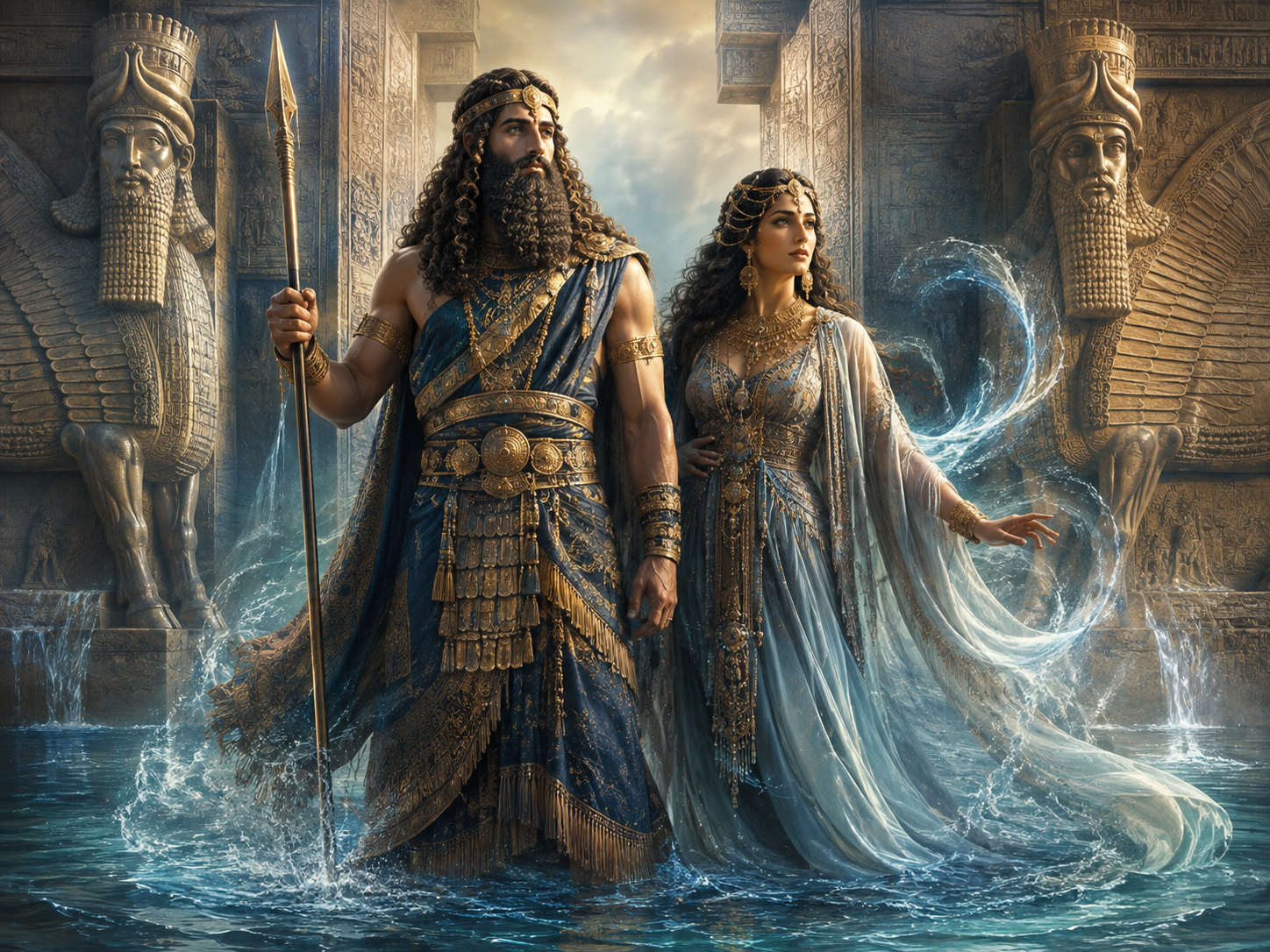
The divine powers of the Two Rivers are an old and complicated family of city gods, cosmic rulers, river and storm powers, underworld sovereigns, scribes, judges, warriors and primordial beings. Their names, ranks and relationships change across Sumerian, Akkadian, Babylonian and Assyrian tradition, but their rivalries and alliances still shape the mortal world.
At a Glance
The Divine World of the Two Rivers
Great Traditions
Sumerian, Akkadian, Babylonian and Assyrian cults preserve overlapping but not identical divine hierarchies.
Major Powers
Anu, Enlil, Enki, Inanna/Ishtar, Nanna/Sin, Utu/Shamash and, in Babylon, Marduk stand among the most influential gods.
Sacred Order
Divine authority is tied to cities, temples, kingship, irrigation, law, writing, harvest, war and the dangerous powers beneath the earth.
Campaign Present
The old gods remain active through surviving cults, recovered tablets, sacred sites, relics, dreams, oaths and their own divine courts.
Divine Order
One Pantheon, Many Cities
Mesopotamian religion never depended on one permanent list of gods with fixed ranks. A deity could dominate one city, rise to imperial importance under a later dynasty, absorb titles from another god or be identified differently in Sumerian and Akkadian-speaking communities. The result is a divine world in which political power, sacred geography and myth constantly overlap.
Anu represents the high heaven; Enlil commands immense authority through wind, decree and kingship; Enki rules wisdom, craft, magic and the life-giving sweet waters; Inanna/Ishtar crosses love, sovereignty and war; Nanna/Sin governs the moon; Utu/Shamash illuminates justice; and Ereshkigal holds the deep kingdom of the dead. Marduk rises through Babylon without erasing the older gods from existence.
Great Gods
Major Powers of the Pantheon
Anu
High heaven, divine authority and the senior order of the gods.
Enlil
Wind, storm, command and the terrible weight of divine decree.
Enki
Wisdom, craft, magic, creation and the fresh waters beneath the earth.
Inanna / Ishtar
Love, desire, sovereignty, war and dangerous transformative power.
Nanna / Sin
The moon, measured time, omens and the ordered passage of the night.
Utu / Shamash
The sun, justice, judgement and the exposure of hidden wrongdoing.
Marduk
Babylon’s champion, royal authority, divine kingship and the ordering of chaos.
Ereshkigal
Queen of the great below and sovereign of the Mesopotamian underworld.
Nergal
War, plague, scorching destruction and underworld kingship.
Ninhursag
Motherhood, mountains, fertility and the shaping of living things.
Ninurta
Warrior strength, agriculture, kingship and the defeat of monstrous threats.
Nabu
Writing, scribal wisdom, record-keeping and the fixing of destinies.
Before the City Gods
Primordial & Ancestral Powers
Apsu
Primeval fresh water and the deep source beneath the ordered world.
Tiamat
Primordial salt-water power whose conflict with the younger gods lies at the heart of Babylonian creation tradition.
Lahmu & Lahamu
Ancient divine pair belonging to the generations before the great city gods.
Anshar
Ancestral cosmic power associated with the heavenly horizon and the older divine genealogy.
Kishar
Ancient earth-linked counterpart within the primordial divine generations.
Mummu
Primordial figure and counsellor associated with Apsu in the Babylonian creation cycle.
Temple, Field & Underworld
Other Mesopotamian Powers
Dumuzid
Shepherd-king, fertility, seasonal loss and the descent cycle.
Geshtinanna
Fertility, vine traditions, lamentation and ties to the underworld.
Enkimdu
Irrigation, canals, farming and the ordered abundance of cultivated land.
Lahar
Fashion, wool, textiles, tailoring, courtly style and the pastoral abundance from which his divine art began.
Namtar
Fate, disease and the feared authority of the underworld court.
Nuska
Fire, light, divine service and the carrying of messages between great powers.
Neighbouring Traditions
Gods at the Edges of the Mesopotamian World
Trade, conquest and shared Semitic traditions carry divine names across the wider Near East. These powers belong beside the Mesopotamian material without being flattened into a single city-based pantheon.
Restored Cults & Divine Houses
Additional Core Powers
Several major gods and divine ministers now have their own complete entries. Together they restore important Assyrian, Nippur, Ur, healing, scribal and underworld traditions that were previously missing from this pantheon directory.
Aššur / Ashur
Assyrian sovereignty, kingship, war, civic order and the sacred authority of the royal state.
Ninlil
Divine queenship, legitimacy, household authority and the great consort tradition beside Enlil.
Namma / Nammu
Primordial freshwater, creation, magic and the ancient Eridu tradition that names her mother of Enki.
Ningal
Great Lady of Ur, divine household, lamentation and intercession beside Nanna/Sin.
Gula / Ninkarrak
Healing, medicine, protective rites, sacred dogs and the restoration of what has been broken.
Nidaba / Nisaba
Grain, writing, reckoning, measurement and the older patronage of scribes and records.
Aya / Šerida
Dawn light, divine intercession, protection and the household of Utu/Shamash.
Ninsumun / Ninsun
Royal ancestry, dreams, wisdom and the divine motherhood behind Gilgamesh and Lugalbanda.
Ningishzida
Vegetation, serpents, lawful passage, seasonal return and the guarded roads of the netherworld.
Ninazu
Underworld stewardship, serpents, ancestral rites and the martial defence of Enegi and Ešnunna.
Papsukkal / Ninshubur
Divine messages, protocol, intercession and the power to control access to greater divine courts.
Zababa
War, civic defence, martial courage and the walls and standards of Kiš.
Current Divine Order
What Is Happening Right Now?
The old river cities no longer command the political world they once did, but their gods have not vanished. Temple foundations, buried tablets, royal seals, forgotten canals and ruined ziggurats remain points where divine power can gather. Priests, scholars, treasure-seekers and rulers who recover the correct names and rites can still attract attention from powers that remember the first cities.
Ancient rivalries also survive. Marduk’s Babylonian supremacy does not make Anu, Enlil or Enki irrelevant; Ereshkigal’s underworld remains a realm with its own laws; Ishtar continues to cross boundaries between love and war; and the primordial generation still represents forces older than mortal kingdoms. A recovered tablet can therefore be a legal claim, a magical key, a divine summons or the opening move in a conflict whose participants have waited centuries for a mortal hand to disturb it.
Sources & Interpretation
Historical & Mythological Context
The surviving myths come from different cities, languages and periods. Names such as Inanna/Ishtar, Utu/Shamash and Nanna/Sin reflect overlapping Sumerian and Akkadian traditions, while Babylonian and Assyrian theology can elevate particular gods in different ways. Individual entries therefore keep local identities and variant traditions visible instead of forcing every source into one fixed hierarchy.
Keep this reference growing
If this page helped with your reading or game, you can support its upkeep or explore the curated books.
Explore the Bookshop — epics, classics and stories behind imagined worlds.