
Firearms
At a Glance
- Baseline technology: handgonnes, hand bombards, bombards, cannon and other early black-powder weapons.
- Availability: established but uneven; concentrated in royal arsenals, fortified cities, ports, mercenary companies and specialist workshops.
- Advanced firearms: rare, expensive and politically important rather than ordinary equipment.
- North American frontier: exiled gnome gunsmiths produce revolvers, precision rifles, metallic cartridges and other weapons far beyond ordinary Old World practice.
- Ammunition: loose powder and shot dominate early firearms; soft cartridges assist loading, while metal cartridges belong to advanced designs.
- Maintenance: a firearm without dry powder, ammunition, spare parts or a competent gunsmith may be more burden than treasure.
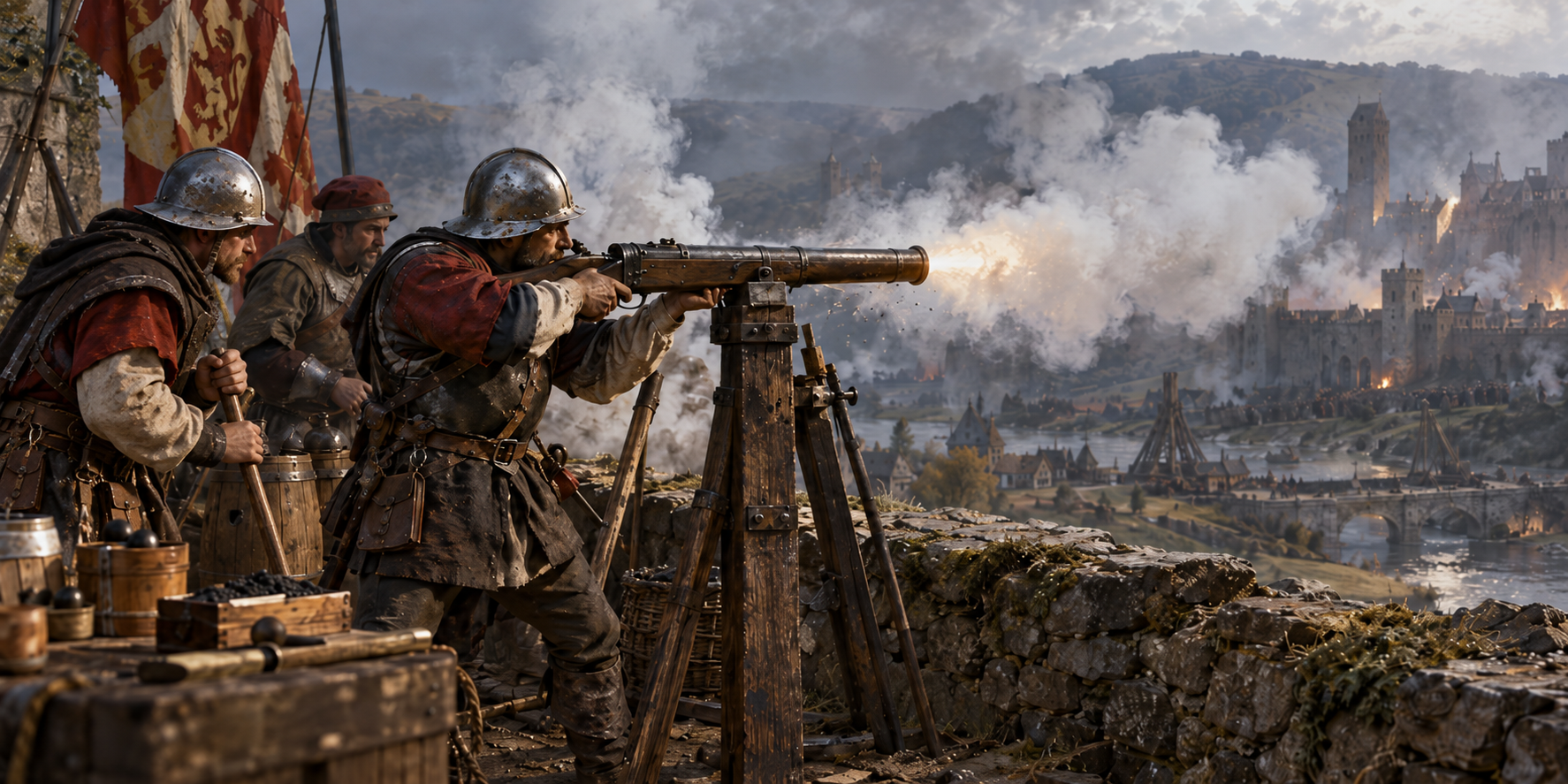
Gunpowder weapons have not replaced bows, crossbows, armour or close combat. They have added a new and frightening voice to battle. A handgun can strike through protection at short range, a bombard can break masonry, and a well-served cannon can decide a siege. Firearms are also smoky, expensive, temperamental and dependent on specialist knowledge.
The most advanced firearms are not evidence of a universally industrial world. They are exceptional objects made possible by rare workshops, magical engineering and the precision traditions of gnome gunsmiths. A revolver carried into an ordinary Old World town may be worth more for the secrets inside its mechanism than for the shots in its cylinder.
Firearms and Fantasy
Guns are no strangers to fantasy. Early fantasy and weird-fiction writers often placed firearms beside swords and sorcery: Burroughs’s John Carter and Howard’s Solomon Kane are obvious examples, while pirate stories are difficult to imagine without cannon fire.
Primitive and experimental firearms are particularly useful adventure weapons because they are dangerous without being dependable. A misfire, damaged lock, wet powder or shortage of suitable ammunition can change an encounter immediately. In the hands of a skilled gunner, however, even an unreliable weapon remains formidable.
Firearms in the Campaign
Firearm availability is part of the setting rather than a campaign toggle. Early gunpowder weapons are established but unevenly distributed. Siege artillery, handgonnes, hand bombards and other primitive guns appear where states, cities and military specialists can afford them. Advanced firearms are rare, expensive and politically significant.
European and Asian arsenals: early firearms, bombards and black-powder artillery can appear in appropriate military centres, fortified cities, mercenary companies and royal arsenals. They remain specialist weapons rather than universal replacements for bows, crossbows and melee arms.
Frontier innovation: in North America, exiled gnome gunsmiths have pushed firearm design far beyond the normal late-medieval baseline. Their weapons are handmade, difficult to maintain and closely guarded. Possessing one can attract buyers, thieves, rulers and rival artificers.
Manufacture and repair: early firearms are produced by specialist workshops, military armouries and individual gunsmiths. Advanced examples require rare expertise, precision parts and reliable powder. A weapon found far from its maker may be more valuable for its mechanism than for its damage.
Availability: not every settlement sells firearms or ammunition. Ports, frontier forts, royal arsenals and major trade cities are the likeliest sources. Rural communities may know what guns are without having powder, shot, spare fittings or anyone able to repair one.
Advanced weapons: revolvers, rifles, metallic cartridges and similar advanced entries are rules references for exceptional campaign technology. They normally enter play through gnome frontier manufacture, rare prototypes, magical engineering, recovered devices or another established source rather than ordinary shops.
Campaign Availability
Established Gunpowder Weapons
Handgonnes, fire lances, hand bombards, bombards and cannon are part of warfare wherever rulers, cities or military specialists can support the cost of powder, metalworking and trained crews.
Rare Specialist and Prototype Weapons
Compact pistols, multi-barrel weapons, combination weapons and increasingly sophisticated long guns exist, but they are not routine military equipment. They are most likely to appear in wealthy arsenals, experimental workshops, specialist mercenary companies or the hands of adventurers.
Gnome-Advanced Firearms
Exiled gnome gunsmith families and their apprentices have developed precision mechanisms, dependable springs, improved breeches and self-contained cartridges. Their best workshops can produce revolvers, precision rifles, repeating mechanisms and advanced shotguns without making the wider world industrial.
Complete Firearm Catalogue
The Pathfinder rules category and campaign availability are separate. A weapon can be an early firearm mechanically while remaining a rare specialist design in the setting.
| Weapon | PF1e Category | Campaign Availability |
|---|---|---|
| Handgonne / Hand Cannon | Early baseline | Established |
| Fire Lance | Early | Established |
| Culverin / Hand Bombard | Early | Established |
| Buckler Gun | Early | Rare specialist |
| Pepperbox | Early | Rare specialist |
| Pistol | Early | Rare specialist |
| Coat Pistol | Early | Rare specialist |
| Pistol Dagger | Early | Rare specialist |
| Double-Barrelled Pistol | Early | Rare specialist |
| Dragon Pistol | Early | Rare specialist |
| Sword Cane Pistol | Early | Rare specialist |
| Blunderbuss | Early | Rare specialist |
| Double Hackbut | Early | Rare specialist |
| Musket | Early | Rare specialist |
| Axe Musket | Early | Rare specialist |
| Double-Barrelled Musket | Early | Rare specialist |
| Warhammer Musket | Early | Rare specialist |
| Revolver | Advanced | Gnome-advanced |
| Rifle | Advanced | Gnome-advanced |
| Pepperbox Rifle | Advanced | Gnome-advanced |
| Shotgun | Advanced | Gnome-advanced |
| Double-Barrelled Shotgun | Advanced | Gnome-advanced |
Pathfinder 1e Firearm Rules
Firearms work differently from other ranged projectile weapons and use the following rules.
Firearm Proficiency
The Exotic Weapon Proficiency (firearms) feat allows a character to use firearms without the standard non-proficiency penalty. A non-proficient character takes a -4 penalty on attack rolls with firearms. If a non-proficient character loads a firearm, the misfire value of those shots increases by 4.
Even though Exotic Weapon Proficiency (firearms) covers firearms generally, feats that modify a single weapon type still require the character to choose a specific firearm, such as musket, axe musket, blunderbuss, pistol or double pistol. All firearms count as the same weapon group for a fighter’s weapon training class feature.
Capacity
A firearm’s capacity is the number of shots it can hold at one time. During a full attack, a firearm may be fired as many times as the wielder has attacks, up to its capacity, unless the wielder can reload it as a swift or free action during that full attack. For early firearms, capacity often represents separate barrels. For advanced firearms, it usually represents chambers.
Range and Penetration
Armour, manufactured or natural, provides relatively little protection against a bullet at short range.
Early firearms: an early firearm resolves its attack against touch AC when the target is within the first range increment. This is not treated as a touch attack for feats and abilities such as Deadly Aim. Beyond the first increment, resolve the attack normally with the cumulative -2 penalty for each full range increment. Early firearms have a maximum range of five range increments.
Advanced firearms: an advanced firearm resolves attacks against touch AC within the first five range increments. This is not treated as a touch attack for feats such as Deadly Aim. Beyond that distance, attacks resolve normally with the cumulative -2 range penalty. Advanced firearms have a maximum range of ten range increments.
Loading a Firearm
At least one hand must be free to load a one-handed or two-handed firearm. A two-handed firearm can be held in one hand while the other loads it; two hands are required to aim and fire it. Loading a siege firearm requires both hands, with one hand normally manipulating a ramrod that can also be used as a club in combat.
The Rapid Reload feat reduces the loading time of one-handed and two-handed firearms, but it does not reduce the loading time of siege firearms. Loading any firearm provokes attacks of opportunity.
Early firearms: early firearms are muzzle-loaded. Bullets or pellets and black powder are rammed down the muzzle. Each barrel of a multi-barrelled early firearm must be loaded separately. Loading each barrel of a one-handed early firearm is a standard action; loading each barrel of a two-handed early firearm is a full-round action. A siege firearm takes three full-round actions for one person to load, reduced to two full-round actions when more than one person loads it.
Advanced firearms: advanced firearms are chamber-loaded. Loading a one-handed or two-handed advanced firearm to full capacity is a move action.
Misfires
If the natural result of an attack roll falls within a firearm’s misfire value, the shot misses even if it would otherwise hit. The firearm gains the broken condition. While broken, it suffers the usual disadvantages of a broken weapon and its misfire value increases by 4. A wielder with gun training for that firearm increases the misfire value by 2 instead.
Early firearms: if an early firearm with the broken condition misfires again, it explodes. A nonmagical firearm is destroyed. A magical firearm is wrecked and cannot fire until fully restored, such as through make whole or appropriate gunsmithing. The explosion originates from one corner of the wielder’s square and uses the burst radius listed with the weapon’s misfire value. Every creature in the burst, including the wielder, takes the weapon’s normal hit damage; a DC 12 Reflex save halves this damage.
Advanced firearms: advanced firearms can misfire and gain the broken condition, but a later misfire does not make them explode.
Ammunition
Firearm ammunition takes two forms: loose black powder and shot, or cartridges. Bullets, pellets and cartridges are destroyed when used and cannot normally be recovered after a miss. No part of a cartridge can be reused to make a new cartridge. Firearm ammunition cannot normally be poisoned unless a pitted bullet is used.
Concealing Firearms
Like light weapons and hand crossbows, one-handed firearms are comparatively easy to conceal. Some particularly small designs, such as the coat pistol, provide additional benefits when concealed on the body.
Inappropriately Sized Firearms
A firearm that is not properly sized for its user imposes a cumulative -2 attack penalty for each size category of difference between wielder and weapon. This stacks with the standard -4 non-proficiency penalty where applicable. The size of a firearm does not normally change how many hands are required to shoot it, with the special exceptions for siege firearms and Large or larger creatures. A Large or larger creature using a siege firearm as a two-handed firearm takes a -4 penalty for its awkwardness.
Other PF1e Firearm Rules
Bucklers: a one-handed or two-handed firearm can be used without penalty while carrying a buckler.
Fire while prone: firearms, like crossbows, can be fired while the wielder is prone.
Black powder and water: black powder becomes useless when exposed to water, although powder horns and cartridges can protect it. An early firearm cannot normally be loaded underwater, and a firearm cannot normally be fired underwater without magical assistance.
Deflecting and snatching bullets: Deflect Arrows and Snatch Arrows can be used against bullets, but not pellets from a scatter weapon. Neither feat can deflect a siege-firearm attack.
Firearm Categories and Scatter Weapons
PF1e divides firearms mechanically into early and advanced weapons, then into one-handed, two-handed and siege firearms. One-handed firearms require one hand to wield and shoot. Two-handed firearms work best with two hands and can be fired one-handed at a -4 attack penalty. Siege firearms are normally mounted on a platform and trade rate of fire for greater power.
Campaign note: PF1e’s term early firearm is a rules category rather than a statement that every later historical ignition system is normal in the setting. The common baseline is primitive handgonne, bombard and early externally ignited gunpowder technology. More sophisticated locks remain rare or exceptional.
Scatter weapon quality: a scatter weapon can fire a normal bullet at a single creature or make a scattering shot against every creature in a cone. A cannon with the scatter quality normally fires grapeshot unless its description states otherwise.
When a scatter weapon attacks creatures in a cone, make a separate attack roll against every creature in the area, with a -2 penalty on each attack. Scatter damage cannot be modified by precision damage or damage-increasing feats such as Vital Strike. Concealment effects such as smoke, fog, blur, invisibility or mirror image do not foil the scatter attack. Confirm a threatened critical only for the relevant attack roll. A scatter weapon misfires on a scattering shot only if all the attack rolls misfire. If the scatter weapon then explodes, it deals triple its normal damage to creatures inside its misfire radius.
PF1e Firearm Statistics
Early Firearms — One-Handed
| Weapon | Cost | Dmg (S) | Dmg (M) | Critical | Range | Misfire | Capacity | Weight | Type | Special |
|---|---|---|---|---|---|---|---|---|---|---|
| Buckler gun | 750 gp | 1d4 | 1d6 | ×4 | 10 ft. | 1 (5 ft.) | 2 | 6 lbs. | B and P | — |
| Pepperbox | 3,000 gp | 1d6 | 1d8 | ×4 | 20 ft. | 1–2 (5 ft.) | 6 | 5 lbs. | B and P | — |
| Pistol | 1,000 gp | 1d6 | 1d8 | ×4 | 20 ft. | 1 (5 ft.) | 1 | 4 lbs. | B and P | — |
| Pistol, coat | 750 gp | 1d3 | 1d4 | ×3 | 10 ft. | 1 (5 ft.) | 1 | 1 lb. | B and P | — |
| Pistol dagger | 740 gp | 1d3 | 1d4 | ×3 | 10 ft. | 1 (5 ft.) | 1 | 1 lb. | B and P | — |
| Pistol, double-barrelled | 1,750 gp | 1d6 | 1d8 | ×4 | 20 ft. | 1–2 (5 ft.) | 2 | 5 lbs. | B and P | — |
| Pistol, dragon | 1,000 gp | 1d4 | 1d6 | ×4 | 20 ft. | 1–2 (5 ft.) | 1 | 3 lbs. | B and P | scatter |
| Pistol, sword cane | 775 gp | 1d3 | 1d4 | ×3 | 10 ft. | 1 (5 ft.) | 1 | 1 lb. | B and P | — |
Early Firearms — Two-Handed
| Weapon | Cost | Dmg (S) | Dmg (M) | Critical | Range | Misfire | Capacity | Weight | Type | Special |
|---|---|---|---|---|---|---|---|---|---|---|
| Blunderbuss | 2,000 gp | 1d6 | 1d8 | ×2 | special | 1–2 (10 ft.) | 1 | 8 lbs. | B and P | scatter |
| Culverin | 4,000 gp | 2d6 | 2d8 | ×4 | 30 ft. | 1 (10 ft.) | 1 | 40 lbs. | B and P | scatter |
| Double hackbut | 4,000 gp | 2d10 | 2d12 | ×4 | 50 ft. | 1–2 (5 ft.) | 2 | 18 lbs. | B and P | — |
| Fire lance | 25 gp | 1d4 | 1d6 | ×4 | 10 ft. | 1–4 (5 ft.) | 1 | 4 lbs. | P | — |
| Musket | 1,500 gp | 1d10 | 1d12 | ×4 | 40 ft. | 1–2 (5 ft.) | 1 | 9 lbs. | B and P | — |
| Musket, axe | 1,600 gp | 1d6 | 1d8 | ×4 | 30 ft. | 1–2 (5 ft.) | 1 | 6 lbs. | B and P | — |
| Musket, double-barrelled | 2,500 gp | 1d10 | 1d12 | ×4 | 40 ft. | 1–3 (5 ft.) | 2 | 11 lbs. | B and P | — |
| Musket, warhammer | 1,600 gp | 1d6 | 1d8 | ×4 | 30 ft. | 1–2 (5 ft.) | 1 | 6 lbs. | B and P | — |
Advanced Firearms
| Weapon | Cost | Dmg (S) | Dmg (M) | Critical | Range | Misfire | Capacity | Weight | Type | Special |
|---|---|---|---|---|---|---|---|---|---|---|
| Revolver | 4,000 gp | 1d6 | 1d8 | ×4 | 20 ft. | 1 | 6 | 4 lbs. | B and P | — |
| Rifle | 5,000 gp | 1d8 | 1d10 | ×4 | 80 ft. | 1 | 1 | 12 lbs. | B and P | — |
| Rifle, pepperbox | 7,000 gp | 1d8 | 1d10 | ×4 | 80 ft. | 1–2 | 4 | 15 lbs. | B and P | — |
| Shotgun | 5,000 gp | 1d6 | 1d8 | ×2 | 20 ft. | 1–2 | 1 | 12 lbs. | B and P | scatter |
| Shotgun, double-barrelled | 7,000 gp | 1d6 | 1d8 | ×2 | 20 ft. | 1–2 | 2 | 15 lbs. | B and P | scatter |
PF1e weight figures are for Medium weapons. A Small weapon weighs half as much and a Large weapon weighs twice as much. Where a weapon lists two damage types joined by “and,” it counts as both types.
Early and Advanced Firearms
Early firearms: in PF1e, early firearms are muzzle-loaded and require powder plus a bullet, pellets or another suitable alchemical load to be pushed down the barrel before firing. Soft cartridges made from paper or cloth can package the powder and projectile together, but the cartridge is opened and its contents still loaded through the muzzle.
Advanced firearms: advanced firearms are more reliable and accurate. Their ammunition normally takes the form of metal cartridges loaded into a chamber rather than rammed down the muzzle.
Firearm Ammunition and Adventuring Gear
Gun users need ammunition, dry powder and tools to keep their weapons working. An alchemical cartridge is a prepared bundle of black powder with a bullet or pellets and sometimes another alchemical material, wrapped in paper or cloth and sealed with wax, lard or tallow.
An alchemical cartridge reduces loading time by one step: full-round action to standard action, standard action to move action, and move action to free action. This convenience comes with instability; the weapon’s misfire value increases by the amount given in the cartridge’s own entry.
| Item | Cost | Weight |
|---|---|---|
| Alchemical cartridge, dragon’s breath | 40 gp | — |
| Alchemical cartridge, entangling shot | 40 gp | — |
| Alchemical cartridge, flare | 10 gp | — |
| Alchemical cartridge, paper (bullet or pellet) | 12 gp | — |
| Alchemical cartridge, salt shot | 12 gp | — |
| Black powder (dose) | 10 gp | — |
| Black powder (keg) | 1,000 gp | 5 lbs. |
| Firearm bullet (1) | 1 gp | — |
| Firearm bullet (30) | 30 gp | 1/2 lb. |
| Bullet, adamantine | 61 gp | — |
| Firearm bullet, pitted | 5 gp | — |
| Firearm bullet, silver | 25 gp | — |
| Gunsmith’s kit | 15 gp | 2 lb. |
| Metal cartridge | 15 gp | — |
| Pellets (handful) | 1 gp | — |
| Pellets (30 handfuls) | 30 gp | 1/2 lb. |
| Powder horn | 3 gp | 1 lb. |
Firearm Magic Items
The following magic ammunition and firearm qualities modify how guns function, allow them to work in hostile environments or give them abilities beyond ordinary craftsmanship.
Firearm Ammunition Special Ability: Dry Load
Aura: faint abjuration; CL: 3rd; Price: 30 gp per cartridge or 1,500 gp for 50 cartridges.
This special ability can only be applied to alchemical or metal firearm cartridges. A dry-load cartridge can be used to load a firearm underwater or in another airless environment. It protects the cartridge during loading and creates a residual bubble of air around the firearm. After loading, the bubble lasts for 3 minutes or until the weapon is fired, whichever happens first.
A firearm using dry-load ammunition underwater still takes the normal -2 attack penalty for every 5 feet of water the bullet passes through, in addition to the normal range penalties. A misfire that would cause an explosion still does so normally.
Construction: Craft Magic Arms and Armor, air bubble.
Specific Firearm Ammunition: Burrowing Bullet
Aura: moderate necromancy; CL: 9th, or 13th for a greater burrowing bullet. Price: 1,722 gp, or 3,447 gp for a greater burrowing bullet.
A +1 burrowing bullet deals normal damage. When it hits a living creature, it burrows into the target’s flesh and causes severe pain. The creature is staggered while the bullet remains inside it. A standard burrowing bullet remains for 1d3 rounds unless removed with a DC 15 Heal check made as a standard action.
A greater burrowing bullet remains for 1d3+2 rounds and requires a DC 20 Heal check made as a standard action to remove.
Construction: Craft Magic Arms and Armor and symbol of pain for a normal burrowing bullet, or symbol of stunning for a greater burrowing bullet. Cost: 861 gp, or 1,723 gp for the greater version.
Specific Firearm Ammunition: Tracer Bullet
Aura: faint evocation; CL: 2nd; Price: 100 gp.
A +1 tracer bullet deals no damage. Instead, it outlines the target in a pale glow, producing the effect of faerie fire and imposing a -2 penalty to AC against ranged attacks. Both effects last for 1d4 rounds.
Construction: Craft Magic Arms and Armor, faerie fire. Cost: 50 gp.
Magic Firearm Special Ability: Lucky
Aura: moderate transmutation; CL: 8th; Price: +1 bonus.
Lucky can only be placed on a one-handed or two-handed firearm. The firearm contains its own magical reserve of grit, usually held in engraved marks, divine sigils, fetishes or another appropriate focus. The reservoir holds 1 grit point and refreshes at the start of each day.
Whether or not the wielder normally has deeds, the wielder can spend the firearm’s grit point to reroll an attack from that firearm that would result in a misfire. The second result must be accepted even if it also misfires.
Construction: Craft Magic Arms and Armor, heroism; creator must be a grit user.
Magic Firearm Special Ability: Greater Lucky
Aura: moderate enchantment; CL: 12th; Price: +3 bonus.
Greater lucky functions like lucky but stores 3 grit points instead of 1. A firearm cannot have both lucky and greater lucky.
Construction: Craft Magic Arms and Armor, greater heroism; creator must be a grit user.
Magic Firearm Special Ability: Reliable
Aura: moderate transmutation; CL: 8th; Price: +1 bonus.
Reliable can only be placed on a firearm. It reduces the firearm’s misfire value by 1, to a minimum of 0. Apply this reduction after calculating increases caused by the broken condition or other effects.
Construction: Craft Magic Arms and Armor, mending.
Magic Firearm Special Ability: Greater Reliable
Aura: moderate enchantment; CL: 12th; Price: +3 bonus.
Greater reliable can only be placed on a one-handed or two-handed firearm. It reduces the firearm’s misfire value by 4, to a minimum of 0, after calculating increases from the broken condition or another effect. A firearm with greater reliable cannot also have reliable.
Construction: Craft Magic Arms and Armor, make whole.
Bombs and Explosives
These bombs are designed primarily to be dropped by riders of flying mounts, though they can also be used as ammunition for siege engines. They are crude and unreliable devices and can be dangerous to carry, especially without a purpose-built bomb box fitted to the mount.
A typical bomb uses an extremely thin wooden tube with a reinforced striking end. A metal plug caps the point, while strips of cloth at the opposite end create drag so the weapon is more likely to fall point-first. Inside the striking end sits a thunderstone, above which is a large flask of alchemist’s fire surrounded by the bomb’s chosen payload.
When the bomb strikes correctly, a spike behind the metal plug drives into the thunderstone. The resulting detonation breaks the alchemist’s fire container and scatters the payload.
Bomb Rules
Bombs are grenade-like weapons normally aimed at a 5-foot square rather than a specific creature. The target square has AC 5. Bombs have a 20-foot range increment. Their total range is limited mainly by the height from which they are dropped, but greater height means more range penalties and a greater chance of an imperfect landing.
A bomb can be aimed directly at a creature. When this is attempted, double the attacker’s normal range penalty. The target also receives a DC 15 Reflex save to step aside and avoid the direct hit.
A normal bomb detonation deals 2d6 damage to every creature within 10 feet of the point of detonation, in addition to any deafening effect caused by the thunderstone. A DC 25 Reflex save halves this damage. A creature struck directly by the bomb takes 4d6 damage plus 1 additional point of damage for every range increment through which the bomb fell, to a maximum of +5 damage.
Rolling a natural 1 on an attack with a bomb is disastrous: the bomb strikes the wielder or the wielder’s mount and explodes immediately. Both are treated as if they suffered a direct hit.
A carried bomb is itself vulnerable. Its thin wooden shell has hardness 3 and 2 hit points. If an attack destroys a bomb after overcoming its hardness and hit points, there is a 50% chance that it detonates. If it does not detonate, the device is ruined and its alchemical contents and payload fall away.
Exposed bombs are also vulnerable to damaging area effects. If a bomb is caught in an effect that deals fire, electrical, force or impact damage, the wielder fails the relevant saving throw and the bomb is destroyed, it has a 50% chance of detonating immediately. Carrying several bombs can therefore produce a chain of extremely dangerous results.
Bombs are unreliable even when not damaged. For every range increment through which a dropped bomb falls, it gains a cumulative 5% chance of failing to land point-first and therefore failing to detonate as intended. Depending on the circumstances, an impact may still cause it to explode.
Bombs can also be launched from siege engines such as catapults or trebuchets. If the siege crew chief rolls a natural 1 on the attack, the bomb detonates as it is launched, potentially damaging or destroying the engine and injuring the crew.
Bomb Types
- Acid Bomb
- Caltrop Bomb
- Fire Bomb
- Consecrated Water Bomb
- Lightning Bomb
- Midnight Bomb
- Noon Bomb
- Ooze Bomb
- Poison Bomb
- Tanglefoot Bomb
- Thunderstone Bomb
Firearms in Play
A firearm should create decisions beyond its damage die. Powder must be kept dry. Ammunition must be replaced. Smoke can reveal a shooter’s position. A misfire can ruin an ambush. Carrying an advanced weapon can attract thieves, rulers, artificers and rival gunsmiths who care more about its mechanism than its owner.
A captured revolver may be worth a fortune and still become nearly useless once its last suitable cartridges are fired. A common handgonne may be crude, slow and frighteningly loud, yet a town defending a breach may value twenty of them more than one exotic masterpiece nobody can repair.
Related Rules and Setting
Further Viewing
The older page opened with four videos. They are retained here but moved below the reference material so they no longer delay access to the actual rules and catalogue.
Sources and Licensing
Pathfinder firearm statistics and associated PF1e rules material derive from Pathfinder Roleplaying Game Ultimate Combat, © 2011 Paizo Publishing, LLC; authors Jason Bulmahn, Tim Hitchcock, Colin McComb, Rob McCreary, Jason Nelson, Stephen Radney-MacFarland, Sean K Reynolds, Owen K.C. Stephens and Russ Taylor.
Bomb material derives from Ultimate Equipment Guide II, Mongoose Publishing, 2005; authors Greg Lynch and J. C. Alvarez.