
Illusion · Concealment · Stealth and detection
Invisibility Spell
Also called “Unseen Veil”.
At a Glance
| 5.5e / 2024 | 2nd-level Illusion; Action; Touch; Concentration, up to 1 hour. Ends after attack roll, damage or spellcasting. |
|---|---|
| 5e / 2014 | 2nd-level Illusion; 1 action; Touch; Concentration, up to 1 hour. Ends for a target that attacks or casts a spell. |
| Pathfinder 1e | Creature or object; standard action; 1 minute/level (dismissible); direct-attack ending; Stealth +40/+20. |
| D&D 3.5e | Creature or object; standard action; 1 minute/level (dismissible); direct-attack ending; Hide +40/+20. |
Invisibility removes a creature from ordinary sight, but it does not erase sound, tracks, displaced water, scent or physical presence. The four editions below use their own duration, ending conditions, detection rules and counters.
Shared principle: invisibility defeats ordinary sight. It does not silence the subject, remove scent, prevent tracks, make the body intangible or stop the surroundings from reacting to movement.
Spell Rules by Edition
5.5e / 2024
Invisibility — D&D 5.5e / 2024
This version grants the Invisible condition and uses modern concentration, targeting and unseen-attacker rules.
| Level | 2nd-level Illusion |
|---|---|
| Classes | Bard, Sorcerer, Warlock, Wizard |
| Casting Time | Action |
| Range | Touch |
| Components | V, S, M |
| Material | An eyelash in gum arabic |
| Duration | Concentration, up to 1 hour |
| Target | One creature touched |
| Saving Throw | None |
| Higher Slots | One additional creature per slot level above 2 |
Spell Effect
A creature you touch has the Invisible condition until the spell ends.
The spell ends early immediately after the target makes an attack roll, deals damage or casts a spell.
The Invisible Condition
- If the creature is Invisible when Initiative is rolled, it gains Advantage on that Initiative roll.
- An effect that requires its target to be seen cannot affect the creature unless the effect’s creator can somehow see it.
- Equipment worn or carried by the creature is concealed with it.
- Attack rolls against the creature have Disadvantage, and its attack rolls have Advantage.
- If another creature can somehow see the Invisible creature, the Invisible creature does not gain the Invisible condition’s attack-roll Advantage or incoming-attack Disadvantage against that observer.
Location and Targeting
- Invisibility does not make a creature silent.
- The spell does not state that observers automatically forget the creature’s location.
- Footprints, displaced water, opened doors and disturbed objects can reveal movement.
- An attacker unable to see the creature may attack the location it believes the creature occupies.
- If the chosen location is wrong, the attack misses.
- An area effect can still affect an Invisible creature whose space lies inside that area.
Counters and Interactions
- See Invisibility allows its caster to perceive Invisible creatures and objects within the spell’s limits.
- Blindsight and Truesight can perceive Invisible creatures within the limits of those senses.
- Dispel Magic can end an ongoing Invisibility spell when the normal modern dispel requirements are met.
- Losing Concentration ends the spell for every creature affected by that casting.
- Invisibility can interfere with reactions and magical effects whose triggers specifically require the observer to see the creature.
- Casting any spell ends this Invisibility immediately after the casting, even when that spell neither attacks nor damages an enemy.
5e / 2014
| Level / school | 2nd-level Illusion |
|---|---|
| Classes | Bard, Sorcerer, Warlock, Wizard |
| Casting time | 1 action |
| Range | Touch |
| Components | V, S, M (an eyelash encased in gum arabic) |
| Duration | Concentration, up to 1 hour |
| Target | One creature touched |
| Saving throw | None |
| Higher slots | One additional creature for each slot level above 2 |
The creature you touch becomes invisible until the spell ends. Everything it wears or carries is invisible while on its person. The spell ends for a target that attacks or casts a spell.
Invisible creature and location
The 2014 Invisible condition prevents sight without appropriate magic or a special sense. For hiding, the creature is heavily obscured; noise and tracks can still reveal its location. The condition gives its attack rolls Advantage and attack rolls against it Disadvantage. Apply the 2014 rules for unseen attackers, targets and special senses.
Invisibility does not itself perform the Hide action, remove sound or make a body intangible. If an attacker guesses the wrong occupied location, the attack misses. A valid area effect can still affect the creature, while a spell requiring a target the caster can see needs another means of seeing it.
Ending and counters
Speaking, movement and ordinary object interaction do not by themselves trigger this spell’s ending. Casting any spell does, including harmless magic. Loss of Concentration ends this casting for all its remaining targets; the attack or spellcasting trigger ends it for the target performing that action.
See Invisibility provides sight of invisible subjects; Dispel Magic can end the ongoing spell according to its 2014 procedure.
2014 wording: the ending clause is “attacks or casts a spell”. It does not include the separate “deals damage” trigger added to the 2024 spell, and the 2014 condition does not grant Initiative Advantage.
Pathfinder 1e
Invisibility — Pathfinder 1e
Pathfinder uses glamer, Stealth, total concealment, spell resistance and its own definition of what counts as an attack.
| School | Illusion (glamer) |
|---|---|
| Casting Time | 1 standard action |
| Range | Personal or touch |
| Components | V, S, M/DF |
| Material | An eyelash encased in gum arabic |
| Target | You, a creature, or an object weighing no more than 100 lb./level |
| Duration | 1 minute/level (D) |
| Saving Throw | Will negates (harmless), or Will negates (harmless, object) |
| Spell Resistance | Yes (harmless), or Yes (harmless, object) |
| Stealth | +40 stationary; +20 moving |
Spell level: adept 2, alchemist 2, antipaladin 2, arcanist 2, bard 2, inquisitor 2, investigator 2, magus 2, medium 2, mesmerist 2, occultist 2, psychic 2, Red Mantis assassin 2, skald 2, sorcerer 2, spiritualist 2, summoner 2, unchained summoner 2 and wizard 2.
Spell Effect
Object and weight limit: the target can be you or a creature or object weighing no more than 100 pounds per caster level. The spell does not silence the subject.
The creature or object touched becomes invisible. A creature’s worn and carried equipment disappears with it. The caster and the subject’s allies do not automatically continue to see the invisible subject.
Dropped objects become visible. Newly acquired items disappear when concealed inside clothing or containers worn by the subject. A concealed light source continues to shed visible light, and any carried part extending more than 10 feet from the subject remains visible.
The spell ends when the subject directly attacks a creature. Permanency can make Invisibility permanent on an object but not on a creature.
Stealth and Concealment
- A stationary invisible creature gains +40 on Stealth checks.
- A moving invisible creature gains +20 on Stealth checks.
- Against a sighted opponent unable to perceive it, the invisible creature has total concealment.
- An attack against the correct occupied square normally has a 50% miss chance.
- A creature cannot normally make attacks of opportunity against a target that has total concealment from it.
Attacking from Invisibility
- An invisible attacker normally gains a +2 bonus on its attack roll.
- A sighted defender normally loses its Dexterity bonus to AC against the invisible attacker.
- The first direct attack receives those benefits before the subject becomes visible.
- An offensive spell targeting a foe, or whose area or effect includes a foe, counts as an attack.
- Who qualifies as a foe depends upon the invisible subject’s perceptions.
Actions and Counters
- Talking, opening doors, handling unattended objects and casting ally-only magic do not automatically end the spell.
- Indirect harm, such as releasing another creature or triggering an existing trap, is not necessarily a direct attack by the subject.
- See Invisibility reveals the subject without ending Invisibility.
- Glitterdust coats and visibly outlines an invisible creature caught in its area whether or not that creature succeeds on its saving throw against blindness.
- Invisibility Purge negates qualifying invisibility within its emanation.
- Dispel Magic can attempt to end the spell using Pathfinder’s normal dispel procedure.
Nonvisual Senses
Blindsight can permit normal interaction with an invisible creature within its range. Scent can detect an invisible creature, while Tremorsense can locate a qualifying target in contact with the same surface. Each sense retains its own limits.
D&D 3.5e
Invisibility — D&D 3.5e
D&D 3.5e uses Hide, Spot, Listen, total concealment and its legacy invisibility and dispel procedures.
| School | Illusion (Glamer) |
|---|---|
| Level | Bard 2, Sorcerer/Wizard 2, Trickery 2 |
| Casting Time | 1 standard action |
| Range | Personal or touch |
| Components | V, S, M/DF |
| Material | An eyelash encased in gum arabic |
| Target | You, a creature, or an object weighing no more than 100 lb./level |
| Duration | 1 minute/level (D) |
| Saving Throw | Will negates (harmless), or Will negates (harmless, object) |
| Spell Resistance | Yes (harmless), or Yes (harmless, object) |
Spell Effect
Object and weight limit: the target can be you or a creature or object weighing no more than 100 pounds per caster level. The spell does not silence the subject.
The touched creature or object vanishes from sight, including darkvision. Equipment worn or carried by a creature disappears with it. Allies require their own means of detecting invisible creatures if they wish to continue seeing the subject.
Dropped objects become visible. An item picked up while the subject is invisible disappears once concealed in worn clothing or a carried container. Light remains visible even when its source is invisible, and carried portions extending more than 10 feet remain visible.
The spell ends when the subject directly attacks a creature. Permanency can make the spell permanent on an object, but not on a creature.
Hide and Concealment
- An immobile invisible creature gains +40 on Hide checks.
- A moving invisible creature gains +20 on Hide checks.
- Spot and Listen checks can reveal presence or help pinpoint location under the edition’s detection rules.
- An invisible creature has total concealment from a sighted opponent unable to perceive it.
- An attack against the correct square normally has a 50% miss chance.
Attacking from Invisibility
- An invisible attacker normally gains +2 on its attack roll.
- A sighted defender normally loses its Dexterity bonus to AC against the invisible attacker.
- The direct attack receives those benefits before Invisibility ends.
- An offensive spell targeting a foe, or including a foe within its area or effect, counts as an attack.
- An ally-only spell does not become an attack merely because enemies also occupy its area.
Actions and Counters
- Speech, ordinary movement, eating, climbing and interaction with unattended objects leave the spell intact.
- Indirectly releasing a danger or allowing summoned creatures to attack is not itself a direct attack by the invisible subject.
- See Invisibility reveals the subject without ending Invisibility.
- Glitterdust coats and visibly outlines invisible creatures caught in its area. Its Will saving throw negates blinding only, not the coating.
- Invisibility Purge provides a specialised area answer to invisible creatures.
- Dispel Magic can attempt to end Invisibility using the legacy dispel procedure.
- Blindsight allows interaction regardless of ordinary invisibility within its range; scent follows its own separate detection procedure.
How Invisibility Works
Invisibility removes the subject from ordinary visual perception. It does not remove that subject from the physical world.
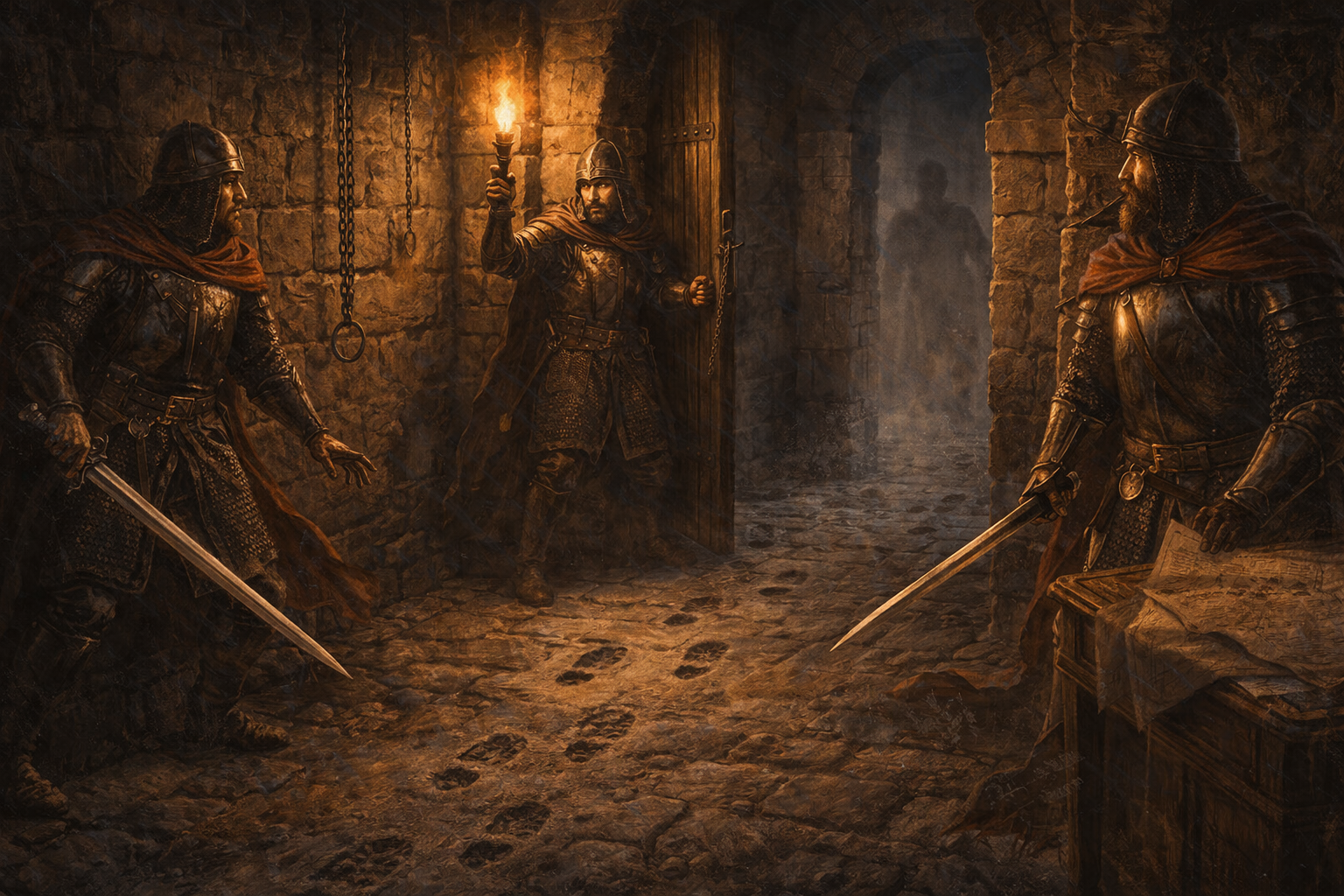
An invisible person still has mass. Floorboards bend. Mud receives footprints. Water parts around unseen legs. Curtains move when brushed aside. Doors still have to open. Loose gravel shifts beneath unseen boots, and a creature that speaks can still be heard.
This distinction is fundamental when adjudicating the spell: unseen is not the same as undetectable.
Invisibility, Hiding and Location
D&D 5.5e / 2024
Modern rules use the Invisible condition directly. Possessing that condition does not erase a creature’s interaction with its environment.
Sound, previous observation, disturbed surroundings and ordinary hiding and searching remain relevant. An attacker that knows or correctly guesses an Invisible creature’s location can still attempt to attack that location, subject to the appropriate unseen-target and Invisible-condition rules.
D&D 5e / 2014
An invisible creature can attempt to hide, but invisibility alone does not hide its location. Use the 2014 Hide, Search, unseen-attacker and condition rules, including noise and tracks; there is no Initiative bonus from this condition.
Pathfinder 1e
Pathfinder combines invisibility with Stealth, Perception and total concealment. Its +40 stationary and +20 moving Stealth bonuses are extremely powerful, but invisibility does not abolish detection rules, environmental evidence or nonvisual senses.
D&D 3.5e
D&D 3.5e uses the older Hide, Spot, Listen and Move Silently structure. Apply those mechanics rather than importing Pathfinder terminology or the modern Invisible-condition procedure.
Revealing an Invisible Creature
Different countermeasures solve different parts of the invisibility problem. Some change what an observer can perceive. Others coat an unseen creature, suppress invisibility within an area or terminate the spell itself.
| Counter | What It Does | Ends Invisibility? |
|---|---|---|
| See Invisibility | Allows an observer to perceive invisible creatures and objects within the spell’s limits. | No |
| Glitterdust | Coats creatures and objects in visible golden particles, outlining an invisible subject. | No |
| Faerie Fire | Uses magical outlining to undermine invisibility according to the selected edition. | Normally no |
| Invisibility Purge | Suppresses qualifying invisibility within its legacy-edition emanation. | Suppresses it within the effect |
| Dispel Magic | Attempts to terminate the magical spell itself. | Yes, when the dispel succeeds or automatically qualifies under the edition’s procedure |
| Blindsight | Allows perception without ordinary vision within the sense’s range. | No |
| Truesight / True Seeing | Provides supernatural perception capable of defeating invisibility within its stated limits. | No |
Glitterdust: The Saving Throw Is Against Blindness
Glitterdust has two separate consequences in Pathfinder 1e and D&D 3.5e: it coats creatures and objects, and it can blind creatures.
The Will saving throw applies only to the blinding effect. An invisible creature caught by Glitterdust therefore remains coated even after succeeding on its saving throw.
The successful creature can still see, but sparkling golden particles reveal its position and trace the outline of its body.
Revealing Is Not Dispelling
Seeing an invisible creature does not necessarily mean the magical effect creating its invisibility has ended.
See Invisibility changes what an observer can perceive. Glitterdust physically marks the hidden creature with visible magical particles. Dispel Magic instead attempts to end the spell itself.
This distinction is particularly important with Greater Invisibility. Glitterdust can reveal a creature protected by Greater Invisibility without terminating Greater Invisibility. If the Glitterdust expires first, the creature can become fully unseen again while the original invisibility effect remains active.
Environmental Clues
Invisible creatures are often discovered by what they disturb rather than by direct sight. The environment can therefore become an important part of the encounter.
- Dust and ash: footprints can appear beneath unseen feet.
- Mud and snow: tracks can show both route and direction.
- Water: an unseen body displaces the surface and creates ripples.
- Rain: falling droplets may break around an unseen moving form.
- Loose objects: curtains, beads, chains, foliage and hanging cloth can move when brushed.
- Doors and containers: handles turn, lids rise and locks move even when the operator cannot be seen.
- Sound: breathing, armour, footsteps, speech and carried equipment remain possible clues unless separately silenced.
Uses and Tactics
Infiltration and Scouting
Cross guarded passages, inspect watch posts and count defenders while still managing noise, tracks, doors and physical obstacles.
Positioning
Reach a decisive location before becoming visible. The spell can gain more value from position than from the first attack that eventually ends it.
Escape
Breaking visual pursuit forces enemies to rely on sound, tracks, prediction, terrain and blocked routes.
Espionage
Observe guarded events and overhear conversations while remembering that doors still move, floors still bear weight and speech remains audible.
Rescue and Theft
Concealment can allow a character to reach a prisoner, recover an object or pass a dangerous sentry without immediately committing to combat.
Combat
Allow invisibility to deliver its positional or defensive advantage before taking the edition-specific action that ends it.
GM Adjudication
Describe an invisible creature through the consequences of its movement rather than automatically giving it a convenient visible shimmer.
- Establish perception. Separate ordinary sight from Blindsight, Truesight, See Invisibility, scent, Tremorsense and environmental clues.
- Establish location. Use the chosen edition’s hiding, detection and pinpointing procedures rather than treating invisibility as automatic loss of location.
- Describe evidence. Footprints appear in dust, water parts around unseen legs, a latch rises, floorboards complain or loose debris shifts.
- Resolve targeting. Determine whether the attacker can target the creature directly, must choose a space, has Disadvantage or faces a concealment miss chance.
- Apply the correct ending trigger. The 2024 spell ends immediately after an attack roll, dealing damage or casting a spell. The 2014 spell ends for a target that attacks or casts a spell. Pathfinder and D&D 3.5e use their direct-attack definitions.
Related Spells and Counters
Historical and Occult Development
Greco-Egyptian Invisibility Rites
The Greek Magical Papyri preserve Greek and Demotic ritual texts from Roman Egypt. Among their many operations are rites intended to make the practitioner unseen or unnoticed, often combining spoken formulae, prepared substances, ritual actions and written signs.
These traditions provide a useful historical parallel for fantasy invisibility: concealment appears as a deliberately prepared magical condition rather than an effortless personal power.
Read the Cambridge University Press excerpt .
Collected Recipes and Practical Magic
Historical magical handbooks frequently combine protection, healing, divination, concealment and other operations as practical recipes involving ingredients, written characters, spoken formulae and prescribed actions.
Such material offers a useful real-world analogue for the material components and deliberate procedures associated with fantasy spellcasting.
Mythological and Literary Parallels
The Ring of Gyges
In Plato’s Republic, the Ring of Gyges grants invisibility and becomes the basis of a moral thought experiment: how would a person behave if ordinary witnesses and consequences could apparently be escaped?
Perseus and the Cap of Hades
In the mythographic tradition associated with Apollodorus, Perseus receives the cap of Hades among the supernatural tools used during his encounter with Medusa and her sisters. Invisibility becomes a means of survival against enemies too dangerous to confront openly.
Read the Apollodorus passage .
Alberich and the Tarnhelm
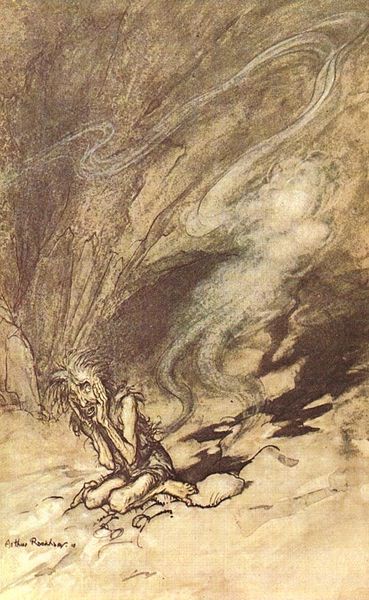
Richard Wagner’s Der Ring des Nibelungen gives Alberich the Tarnhelm, a magical helm associated with concealment and transformation. It belongs to Wagner’s nineteenth-century reshaping of Germanic legendary material rather than representing an unchanged ancient Norse source.
Further Viewing
The Ancient Egyptians Believed in Invisibility Spells
ReligionForBreakfast provides an accessible introduction to invisibility rites preserved among the magical texts of Roman Egypt and the historical culture in which those formularies circulated.
Invisibility Rules FAQ
Does Invisibility automatically hide the creature’s location?
No. Invisibility prevents ordinary visual perception, but the creature continues interacting with the physical world. Edition-specific hiding, detection, sound and environmental rules remain relevant.
Does speaking end Invisibility?
Ordinary speech does not itself end these versions of Invisibility, although speaking can reveal presence or approximate location. Casting a spell ends both modern versions; the 2024 text explicitly says immediately after the casting. Ordinary speech can still reveal presence.
Exactly when does an attack end the spell?
In D&D 5.5e / 2024, the spell ends immediately after the target makes an attack roll, deals damage or casts a spell. In 5e / 2014, it ends for a target that attacks or casts a spell. Pathfinder and D&D 3.5e instead use their edition-specific definitions of directly attacking a creature.
Can Dispel Magic remove Invisibility?
Yes. Dispel Magic can end an ongoing Invisibility spell according to the dispel procedure used by the relevant edition.
Does See Invisibility end Invisibility?
No. It allows its user to perceive the invisible subject without itself terminating the Invisibility effect.
Does Glitterdust reveal a creature that succeeds on its saving throw?
Yes. In Pathfinder 1e and D&D 3.5e, Glitterdust’s saving throw negates blindness only. A successful save does not prevent the creature from being coated by sparkling particles, so an invisible creature can still be visibly outlined.
Does Glitterdust dispel Invisibility?
No. Glitterdust reveals an invisible subject by coating it in visible magical particles. The underlying Invisibility spell can remain active and may conceal the creature normally again after Glitterdust expires.
Can Glitterdust reveal Greater Invisibility?
Yes. Glitterdust can visibly outline a creature protected by Greater Invisibility without ending Greater Invisibility itself.
Can darkvision see an invisible creature?
No. Darkvision solves darkness rather than invisibility. Pathfinder and D&D 3.5e expressly conceal the subject from darkvision, while modern rules require an appropriate sense or magical effect capable of perceiving an Invisible creature.
Can an area spell affect an invisible creature?
Yes. If the invisible creature’s space lies inside a valid area of effect, ordinary invisibility does not make that creature immune to the spell.
Browse the Bard spell list or return to Magic.
Sources & Licensing
- D&D Beyond — 2024 spell rules
- D&D Beyond — 2014 spell rules
- Archives of Nethys — Invisibility (PF1e)
- System Reference Document — Invisibility (3.5e)
2024 rules attribution
This work includes material from the System Reference Document 5.2.1 (“SRD 5.2.1”) by Wizards of the Coast LLC, available at https://www.dndbeyond.com/srd. The SRD 5.2.1 is licensed under the Creative Commons Attribution 4.0 International License, available at https://creativecommons.org/licenses/by/4.0/legalcode.
2014 rules attribution
This work includes material taken from the System Reference Document 5.1 (“SRD 5.1”) by Wizards of the Coast LLC and available at https://dnd.wizards.com/resources/systems-reference-document. The SRD 5.1 is licensed under the Creative Commons Attribution 4.0 International License available at https://creativecommons.org/licenses/by/4.0/legalcode.
Open Game License v1.0a & Copyright Notices
The Pathfinder 1e and D&D 3.5e rules material on this page is derived from Open Game Content and is used under the Open Game License Version 1.0a. SpiralWorlds presentation, navigation, original commentary, setting material and CSS are not designated Open Game Content by this notice.
OPEN GAME LICENSE Version 1.0a
The following text is the property of Wizards of the Coast, Inc. and is Copyright 2000 Wizards of the Coast, Inc (“Wizards”). All Rights Reserved.
- Definitions: (a)”Contributors” means the copyright and/or trademark owners who have contributed Open Game Content; (b)”Derivative Material” means copyrighted material including derivative works and translations (including into other computer languages), potation, modification, correction, addition, extension, upgrade, improvement, compilation, abridgment or other form in which an existing work may be recast, transformed or adapted; (c)”Distribute” means to reproduce, license, rent, lease, sell, broadcast, publicly display, transmit or otherwise distribute; (d)”Open Game Content” means the game mechanic and includes the methods, procedures, processes and routines to the extent such content does not embody the Product Identity and is an enhancement over the prior art and any additional content clearly identified as Open Game Content by the Contributor, and means any work covered by this License, including translations and derivative works under copyright law, but specifically excludes Product Identity. (e)”Product Identity” means product and product line names, logos and identifying marks including trade dress; artifacts; creatures characters; stories, storylines, plots, thematic elements, dialogue, incidents, language, artwork, symbols, designs, depictions, likenesses, formats, poses, concepts, themes and graphic, photographic and other visual or audio representations; names and descriptions of characters, spells, enchantments, personalities, teams, personas, likenesses and special abilities; places, locations, environments, creatures, equipment, magical or supernatural abilities or effects, logos, symbols, or graphic designs; and any other trademark or registered trademark clearly identified as Product identity by the owner of the Product Identity, and which specifically excludes the Open Game Content; (f)”Trademark” means the logos, names, mark, sign, motto, designs that are used by a Contributor to identify itself or its products or the associated products contributed to the Open Game License (g)”Use”, “Used” or “Using” means to use, Distribute, copy, edit, format, modify, translate and otherwise create Derivative Material of Open Game Content. (h)”You” or “Your” means the licensee in terms of this agreement.
- The License: This License applies to any Open Game Content that contains a notice indicating that the Open Game Content may only be Used under and in terms of this License. You must affix such a notice to any Open Game Content that you Use. No terms may be added to or subtracted from this License except as described by the License itself. No other terms or conditions may be applied to any Open Game Content distributed using this License.
- Offer and Acceptance: By Using the Open Game Content You indicate Your acceptance of the terms of this License.
- Grant and Consideration: In consideration for agreeing to use this License, the Contributors grant You a perpetual, worldwide, royalty-free, non-exclusive license with the exact terms of this License to Use, the Open Game Content.
- Representation of Authority to Contribute: If You are contributing original material as Open Game Content, You represent that Your Contributions are Your original creation and/or You have sufficient rights to grant the rights conveyed by this License.
- Notice of License Copyright: You must update the COPYRIGHT NOTICE portion of this License to include the exact text of the COPYRIGHT NOTICE of any Open Game Content You are copying, modifying or distributing, and You must add the title, the copyright date, and the copyright holder’s name to the COPYRIGHT NOTICE of any original Open Game Content you Distribute.
- Use of Product Identity: You agree not to Use any Product Identity, including as an indication as to compatibility, except as expressly licensed in another, independent Agreement with the owner of each element of that Product Identity. You agree not to indicate compatibility or co-adaptability with any Trademark or Registered Trademark in conjunction with a work containing Open Game Content except as expressly licensed in another, independent Agreement with the owner of such Trademark or Registered Trademark. The use of any Product Identity in Open Game Content does not constitute a challenge to the ownership of that Product Identity. The owner of any Product Identity used in Open Game Content shall retain all rights, title and interest in and to that Product Identity.
- Identification: If you distribute Open Game Content You must clearly indicate which portions of the work that you are distributing are Open Game Content.
- Updating the License: Wizards or its designated Agents may publish updated versions of this License. You may use any authorized version of this License to copy, modify and distribute any Open Game Content originally distributed under any version of this License.
- Copy of this License: You MUST include a copy of this License with every copy of the Open Game Content You Distribute.
- Use of Contributor Credits: You may not market or advertise the Open Game Content using the name of any Contributor unless You have written permission from the Contributor to do so.
- Inability to Comply: If it is impossible for You to comply with any of the terms of this License with respect to some or all of the Open Game Content due to statute, judicial order, or governmental regulation then You may not Use any Open Game Material so affected.
- Termination: This License will terminate automatically if You fail to comply with all terms herein and fail to cure such breach within 30 days of becoming aware of the breach. All sublicenses shall survive the termination of this License.
- Reformation: If any provision of this License is held to be unenforceable, such provision shall be reformed only to the extent necessary to make it enforceable.
- COPYRIGHT NOTICE
Open Game License v 1.0a Copyright 2000, Wizards of the Coast, Inc.
System Reference Document Copyright 2000-2003, Wizards of the Coast, Inc.; Authors Jonathan Tweet, Monte Cook, Skip Williams, Rich Baker, Andy Collins, David Noonan, Rich Redman, Bruce R. Cordell, John D. Rateliff, Thomas Reid, James Wyatt, based on original material by E. Gary Gygax and Dave Arneson.
Pathfinder Roleplaying Game Core Rulebook © 2009, Paizo Publishing, LLC; Author: Jason Bulmahn, based on material by Jonathan Tweet, Monte Cook, and Skip Williams.
Invisibility Spell. Copyright 2026, SpiralWorlds.
END OF LICENSE
Primary references: System Reference Document 5.2.1, Archives of Nethys — Invisibility, and d20 SRD — Invisibility.
The Arthur Rackham illustration is public domain.
Keep this reference growing
If this page helped with your reading or game, you can support its upkeep or explore the curated books.
Explore the Bookshop — epics, classics and stories behind imagined worlds.