
Igor Voss — Grave-Bent Heretic and Gothic Laboratory Assistant
Igor Voss — Grave-Bent Heretic and Gothic Laboratory Assistant
The doctor may have built the monster, but Igor chose the bodies, hid the failures, and tried to put the gods themselves on the dissecting table.
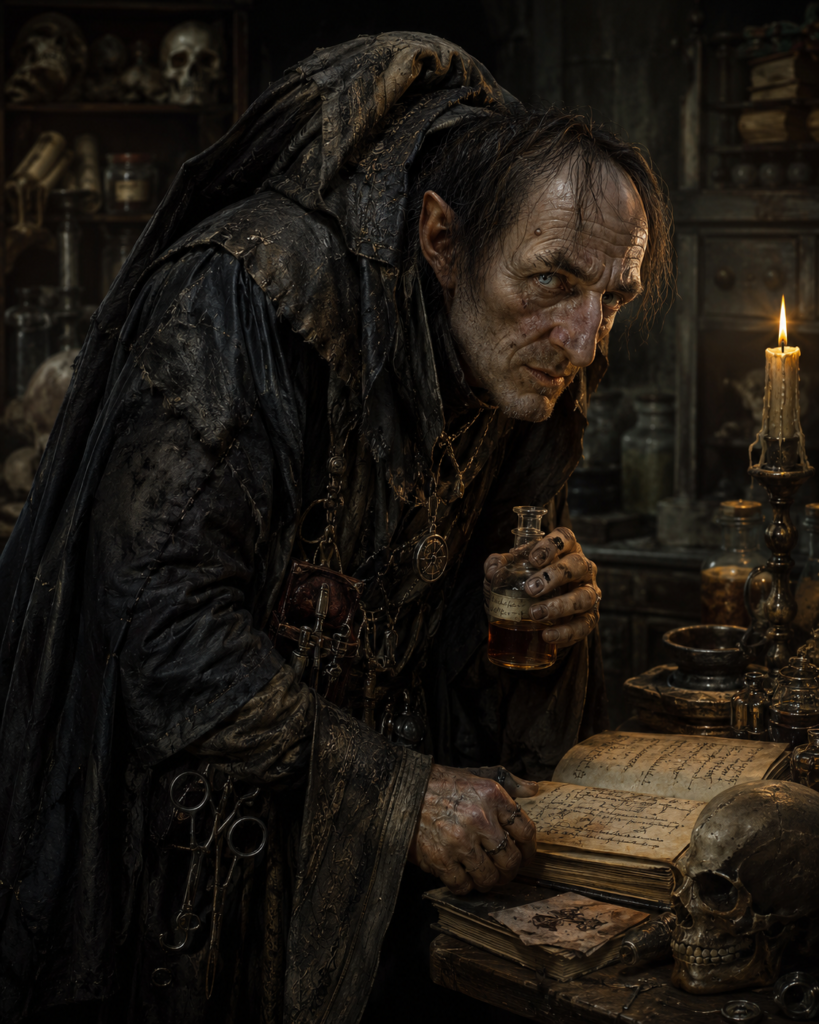
- Full Name: Igor Voss
- Common Name: Igor
- Aliases: The Grave-Bent Heretic, the Anatomical Heretic, the Crooked Witness, the Bell-Ringer Below, the Waxman’s Porter
- Gender: Male
- Race: Human
- Occupation: Ex-cleric, laboratory assistant, grave-robber, anatomical porter, alchemical fixer, keeper of forbidden records
- Nationality: Bohemian or borderland Germanic-Slavic
- Region: Late-medieval university cities, plague districts, paupers’ burial grounds, charnel houses, wax museums, hidden anatomy theatres, noble-funded laboratories
- Base of Operations: The Macabre House of Wax, with older ties to the Lower Theatre beneath a disused infirmary and plague chapel
- Languages: Common, medical Latin, thieves’ cant, graveyard codes, fragments of university jargon and borderland dialect
- Religion: Former servant of a burial, healing, or death-rite cult; expelled for grave violation and anatomical heresy; now obsessed with whether divine creation can be corrected by mortal hands
- Alignment: Neutral Evil
- Affiliations: His former clerical order, the Macabre House of Wax, forbidden anatomists, corpse-sellers, corrupt physicians, bribed sextons, noble patrons, unfinished creations
- Allies: The Curator of the Macabre House of Wax, grave-diggers, executioners, corpse-sellers, blackmailed servants, debtors, watchmen paid to look away
- Rivals: Honest physicians, rival corpse-merchants, suspicious midwives, temple wardens, apprentices with consciences, escaped experimental subjects
- Enemies: His former clerical order, families of the stolen dead, investigators, betrayed patrons, surviving victims, villagers who once tried to hang him, and any master who decides Igor knows too much
- Significant Others: None openly; Igor’s closest emotional attachment may be to an unfinished creation, a preserved corpse, or the first victim whose body he failed to “correct”
Igor Voss is the servant everyone notices too late.
At first glance, he is only the bent-backed man with the lantern: the porter who opens the side door after closing, carries the tools, sharpens the bone saws, washes the table, and mutters when his master forgets ordinary precautions. He appears to be a servant of genius rather than a figure of importance. That is his best disguise.
But Igor was not born in the laboratory. He began in a clerical order devoted to burial rites, healing, death records, and the keeping of bodies from desecration. He learned prayers for the dying, the washing of corpses, the naming of the dead, and the laws that separate reverence from violation. He was supposed to guard the dead.
Instead, he began opening them.
Igor’s first heresy was not ambition. It was a question: why had the gods made him misshapen? As a young cleric, he was told that every body bore the mark of divine order. The beautiful body, the crippled body, the stillborn child, the plague-swollen corpse, the hanged thief, the noble bride, and the drowned beggar were all supposed to fit inside a sacred design. Igor tried to believe this. Then he began cutting.
What he found beneath the skin did not look like mercy. It looked like mechanism.
When Igor was caught opening graves assigned to his own burial register, he claimed he was seeking proof of divine design. His order called it desecration. Both were true. He was expelled, beaten, nearly hanged by the villagers whose dead he had stolen, and driven into the company of physicians, corpse-sellers, anatomists, alchemists, and monsters.
Now he serves the Curator of the Macabre House of Wax, a public showman whose museum provides the perfect cover for preservation, display, and disappearance. The House of Wax is Igor’s present refuge. The Lower Theatre is his buried past. Between them lies a trail of false death records, stolen bodies, unfinished creations, and names no respectable patron wants spoken aloud.
Igor is not comic relief. He is the laboratory’s memory, the church’s failure, and the village’s unfinished punishment.
Igor Voss, 5.5e / 2024-Compatible Stat Block
Igor Voss, Pathfinder 1e / 3.5e-Compatible Stat Block
Igor Voss, 5.5e / 2024-Compatible Stat Block
Medium Humanoid, Neutral Evil
Armor Class: 15
Initiative: +3
Hit Points: 99 (18d8 + 18)
Speed: 30 ft.
Proficiency Bonus: +3
Saving Throws: Dex +6, Int +7, Wis +5
Skills: Arcana +7, Deception +5, Investigation +7, Medicine +8, Religion +7, Sleight of Hand +6, Stealth +6
Senses: passive Perception 12
Languages: Common, medical Latin, thieves’ cant, two regional languages
Challenge: 5
| STR | DEX | CON | INT | WIS | CHA |
|---|---|---|---|---|---|
| 10 (+0) | 16 (+3) | 12 (+1) | 18 (+4) | 14 (+2) | 10 (+0) |
Traits
Ex-Cleric of the Burial Rites. Igor has Advantage on Intelligence (Religion) and Wisdom (Medicine) checks involving burial customs, death records, funerary taboos, corpse preparation, grave desecration, undead traces, or the proper handling of the dead.
Laboratory Familiarity. Igor has Advantage on Intelligence checks related to anatomy, corpses, surgical tools, poisons, preservation methods, hidden laboratories, wax preservation, and signs of experimental tampering.
Keeper of Keys. Igor has Advantage on Dexterity checks made to open locks, disable simple mechanical restraints, hide small objects, or palm keys, notes, vials, and surgical implements.
Unsettling Servility. Igor has Advantage on Charisma (Deception) checks made to appear harmless, obedient, frightened, ignorant, or beneath notice.
Corpse-Knowledge. After examining a corpse for 1 minute, Igor can identify its likely age, condition, cause of death, and whether it has been moved, altered, preserved, harvested, disguised, or experimentally used, unless the body has been magically disguised or destroyed beyond recognition.
Blackmail Ledger. Once per day, Igor can reveal compromising information about a creature he has researched, served, supplied, or observed. One creature that can hear and understand him must make a DC 15 Wisdom saving throw. On a failed save, the creature has Disadvantage on the next attack roll, ability check, or saving throw it makes before the end of Igor’s next turn. This trait has no effect if Igor’s claim is obviously false.
Actions
Multiattack. Igor makes two Bone Saw or Dagger attacks.
Bone Saw. Melee Weapon Attack: +6 to hit, reach 5 ft., one target. Hit: 8 (2d4 + 3) slashing damage. If the target has half its Hit Points or fewer, it takes an extra 3 (1d6) slashing damage.
Dagger. Melee or Ranged Weapon Attack: +6 to hit, reach 5 ft. or range 20/60 ft., one target. Hit: 5 (1d4 + 3) piercing damage.
Alchemical Bomb. Ranged Weapon Attack: +6 to hit, range 30 ft., one target. Hit: 14 (4d6) fire or acid damage, Igor’s choice. Each creature within 5 feet of the target must succeed on a DC 15 Dexterity saving throw or take 3 (1d6) damage of the same type.
Frost Bomb. Ranged Weapon Attack: +6 to hit, range 30 ft., one target. Hit: 10 (3d6) cold damage, and the target must succeed on a DC 15 Constitution saving throw or have its Speed reduced by 10 feet until the end of its next turn.
Vial of Numbing Draught. Ranged Weapon Attack: +6 to hit, range 20 ft., one creature. Hit: 10 (3d6) poison damage, and the target must succeed on a DC 15 Constitution saving throw or have Disadvantage on Dexterity checks and opportunity attacks until the end of its next turn.
Shuttered Lantern. Igor snaps open a specially prepared lantern. One creature within 15 feet that can see him must make a DC 15 Constitution saving throw. On a failed save, the creature has the Blinded condition until the end of its next turn. On a successful save, the creature is not Blinded but cannot make opportunity attacks against Igor until the end of this turn.
Command the Prepared Dead. Igor targets one corpse or mindless Undead within 60 feet that he has ritually prepared within the last 24 hours. The corpse briefly animates, or the Undead follows a simple command until the end of Igor’s next turn: move, block a passage, make one attack, drag a body, open a door, or interpose itself between Igor and danger. A corpse animated this way has no will of its own and collapses again after the command ends. Recharge 5–6.
Bonus Actions
Scuttle Away. Igor takes the Disengage or Hide action.
Prepared Implements. Igor draws or stows up to two small objects, such as keys, vials, scalpels, notes, or thieves’ tools.
Bitter Mutagen. Igor drinks a mutagenic draught. For 1 minute, he gains a +2 bonus to AC and Advantage on Strength checks and Strength saving throws, but has Disadvantage on Intelligence checks for the duration. Once Igor uses this bonus action, he cannot use it again until he finishes a Long Rest.
Reactions
Not Me, Master. When a creature Igor can see targets him with an attack while Igor is within 5 feet of another creature, Igor imposes Disadvantage on the attack roll by ducking behind the adjacent creature. If the attack misses Igor, the attacker may choose to hit the adjacent creature instead if the original attack roll would hit it.
I Know Where It Hurts. When a creature Igor can see within 5 feet of him misses him with a melee attack, Igor makes one Bone Saw or Dagger attack against that creature.
Igor Voss, Pathfinder 1e / 3.5e-Compatible Stat Block
Male human ex-cleric 4/alchemist 4
NE Medium humanoid
CR 5
Init +3; Senses Perception +12
Defence
AC 17, touch 13, flat-footed 14; studded leather, mutagen or shield extract when prepared
hp 52
Fort +8, Ref +8, Will +7; +2 vs. poison
Offence
Speed 30 ft.
Melee mwk bone saw +8/+3 (1d6+1/19–20) or +1 spear +9/+4 (1d8+2/×3)
Ranged bomb +10 touch (2d6+4 fire plus 5 splash) or frost bomb +10 touch (2d6+4 cold plus stagger, DC 16) or acid +10 touch
Special Attacks bombs 8/day, frost bomb, mutagen
Alchemist Extracts Prepared
2nd—invisibility, cat’s grace
1st—bomber’s eye, expeditious retreat, shield, cure light wounds
Tactics
Before Combat Igor prepares the room before he prepares himself. He locks interior doors, positions corpse-servants or wax-covered bodies as obstacles, hides behind curtains or tables, and drinks his shield extract if he hears intruders approaching.
During Combat Igor orders minions or prepared dead to delay intruders while he throws bombs from cover. He favours frost bombs against fast enemies, acid against armoured pursuers, and smoke or darkness when he needs to reposition. If forced into melee, he drinks his mutagen and uses his spear or bone saw only long enough to escape.
Morale Igor does not fight to prove courage. If reduced below 15 hit points, he uses expeditious retreat, invisibility, smoke, hostages, evidence, or hidden exits to flee. If cornered by clerical authorities, he becomes more desperate and may offer names from his ledger rather than submit to judgement.
Statistics
Str 12, Dex 16, Con 12, Int 18, Wis 13, Cha 8
Base Atk +6; CMB +7; CMD 20
Feats Brew Potion, Improved Initiative, Point-Blank Shot, Precise Shot, Skill Focus (Use Magic Device), Throw Anything
Skills Craft (alchemy) +17, Disable Device +12, Heal +14, Knowledge (arcana) +13, Knowledge (dungeoneering) +7, Knowledge (history) +10, Knowledge (religion) +14, Perception +12, Profession (mortician) +12, Spellcraft +12, Stealth +11, Use Magic Device +13
Languages Common, medical Latin or scholarly equivalent, Undercommon, two regional languages
Gear studded leather, +1 spear, masterwork bone saw, daggers, alchemist’s kit, masterwork embalming tools, thieves’ tools, formula book, shuttered lantern, coded ledger, preserving salts, acid, alchemist’s fire, smokesticks, tanglefoot bag, thunderstones, potions of cure light wounds, potions of enlarge person, wand or charm of command undead with limited remaining charges, 180 gp
Special Abilities
Ex-Cleric. Igor violated the tenets of his former order and lost his clerical spells and sacred class features. He retains his proficiencies, religious education, burial knowledge, and the bitter habits of a man who once served rites he now profanes.
Anatomical Heretic. Igor gains a +4 bonus on Heal, Knowledge (religion), and Profession (mortician) checks involving corpses, burial rites, cause of death, grave desecration, undead preparation, or anatomical tampering.
Beneath Notice. Igor gains a +4 bonus on Bluff and Disguise checks made to appear harmless, servile, frightened, ignorant, or socially insignificant.
Ledger of the Dead (Ex). Igor keeps coded records of stolen bodies, false burials, paid informants, altered death certificates, private patrons, and failed experiments. A creature who studies the ledger for 10 minutes may attempt a DC 20 Linguistics, Knowledge (local), Knowledge (religion), or Sense Motive check. On a success, the creature uncovers one useful lead, such as a hidden patron, a false burial, a corpse’s true identity, a secret entrance, a bribed official, or the location of a failed experiment. On a failure, the cipher remains unclear, though another attempt can be made after gaining new context, a sample of Igor’s shorthand, or a key to his notation.
Appearance
Igor is short, narrow, and permanently stooped, with one shoulder raised higher than the other. His body has been shaped by birth, old injury, bad treatment, and years of carrying loads no one else wished to touch. His deformity is not the source of his evil. It is the wound around which his heresy formed.
His hands are the most unsettling part of him: careful, clean when required, and far too steady around knives. Ink stains his nails. Old blood has darkened the seams of his cuffs. Wax clings beneath one thumbnail. He smells faintly of lamp oil, vinegar, damp wool, embalming resin, iron, and the sour sweetness of rooms washed too often after bad work.
He dresses as a servant, porter, or low-ranking surgical assistant: patched coat, heavy apron, hooded cloak, keys at the belt, leather satchel, wrapped instruments, wax tablets, and a shuttered lantern. In the House of Wax, he may pass as a harmless attendant who adjusts displays after closing. In the lower rooms, he becomes something more precise: the man who knows which figure is wax, which is corpse, and which still hears.
Personality
Igor speaks softly because he has spent his life in rooms where shouting attracts witnesses. He is obsequious to power, contemptuous of innocence, patient with fear, and vicious toward anyone who mistakes him for harmless.
He rarely threatens directly. He records. He remembers. He hints. He knows which apprentice stole coin from the master’s cabinet, which patron demanded a child’s body, which guard helped carry a sack through the rain, and which healer signed a false death certificate. Igor’s weapon is not strength. It is continuity.
He retains the habits of clerical life in corrupted form. He keeps records with ritual precision. He washes his hands before cutting. He whispers old prayers when frightened, then spits at himself for doing it. He knows funeral formulas better than many priests and can turn them into curses with a change of emphasis.
He can show genuine tenderness toward broken things: abandoned animals, malformed children, rejected apprentices, and unfinished creations. That tenderness does not redeem him. It makes him more dangerous, because he can understand suffering and still choose profit, survival, revenge, or experiment.
The Heresy of the Body
Igor Voss did not begin by hating the gods. He began by asking why they had made him crooked.
As a cleric, he was taught that bodies were not accidents. Each form had meaning, each wound could be interpreted, each death belonged to an order larger than grief. But Igor saw too much: infants born twisted, soldiers split open, plague victims bloated beyond recognition, noble corpses perfumed and praised while paupers were stacked in pits. His own body, pitied by some and mocked by others, became the argument he could not stop having with heaven.
So he turned to anatomy.
If the gods made bodies, then bodies could be questioned. If flesh had laws, those laws could be learned. If a spine could bend, perhaps it could be remade. If a corpse could be opened, perhaps creation itself could be put on the table.
This is Igor’s true blasphemy. He does not merely steal bodies. He treats the body as evidence against its makers.
What Igor Wants
Igor wants importance without exposure.
He does not need to be the famous doctor, the noble patron, or the public curator. He has seen what happens to famous men when mobs gather, patrons panic, or monsters escape. Igor prefers the lower position: close enough to the work to matter, low enough to deny responsibility, informed enough to survive the master’s fall.
But he does dream of a laboratory of his own.
Not a servant’s corner. Not a borrowed table. Not a cellar where he must ask permission before opening the next body. Igor wants a locked room, proper instruments, reliable subjects, heat, light, assistants, jars, ledgers, and enough money to continue without flattering another genius.
His deeper desire is uglier. Igor wants to prove that the body can be corrected by a will stronger than the gods’. He wants to fix deformity, command death, expose hypocrisy, and show every priest who condemned him that flesh obeys the knife more readily than prayer.
What Igor Fears
Igor fears being discarded.
He has watched failed experiments thrown into pits and covered with quicklime. He knows exactly how useful servants are treated once they become liabilities. His loyalty lasts only until the moment he believes his master intends to silence him.
He also fears his former order. Not because he still believes in its mercy, but because he knows its punishments. A civil court may hang him. His former brethren would make an example of him, name his crimes before the dead, burn his records, deny his burial, and erase his work as filth.
He fears the dead as well. Not death in the abstract, but the specific dead he has handled. He remembers faces. He mutters names when drunk. He never sleeps in a room with uncovered mirrors. He will not enter certain graveyards after moonrise, even when paid.
Most of all, he fears the first successful creation recognising him.
Backstory
Igor Voss was born in a borderland village where hard winters, poor soil, and local superstition made visible deformity into a public verdict. Some pitied him. Some mocked him. A few whispered that his shape marked divine displeasure. Igor listened to all of them and remembered every voice.
His family gave him to a clerical house attached to burial, healing, and death records. There, his bent body became useful. He could work. He could read. He could copy names. He could prepare bodies. He could stand beside the dying and be ignored by their relatives. He learned the language of death before he learned the language of ambition.
The order expected obedience. Igor gave them curiosity.
He began with small violations: measuring limbs, copying wound patterns, opening shrouds, comparing the bodies of rich and poor. Then he began digging. When he was caught opening graves from his own register, the scandal was too large to hide. His order expelled him. The village tried to hang him. He survived by informing on another grave-robber, escaping before dawn, and leaving behind three empty graves.
Years later, he returned.
By sunrise, several of the village dead had risen from their graves and walked home to knock at the doors of the living. Igor never admitted whether this was vengeance, experiment, or both.
After that, he wandered from master to master: not as a legendary servant of famous men, but as the kind of useful, forgettable fixer every forbidden laboratory eventually needs. He served anatomists, alchemists, corpse-buyers, preservers, and reanimators. Some called him useful. Some called him cursed. Some died after deciding he knew too much.
Now he works beneath the painted respectability of the Macabre House of Wax.
Secrets
Igor knows which wax figures are art, which are corpses, and which were made from bodies that never reached the grave.
He knows the Curator’s true business and which patrons pay for private displays after midnight.
He knows which noble patron funded the old Lower Theatre.
He knows that one “corpse” was alive when delivered.
He knows where the failed creations were hidden.
He keeps duplicate records in a private cipher.
He preserved one vital organ, brain, eye, hand, heart, or tongue from an early experiment for reasons he has never explained.
He may have sabotaged his master’s greatest work so the creation would remain dependent on him.
He has never fully lost the ability to command the dead, though he insists the power comes from instruments, salts, formulae, and “proper preparation,” not faith.
The Ledger of the Dead
Igor’s true treasure is not coin. It is a ledger bound in cracked leather and written in cipher, grease pencil, surgical shorthand, coffin marks, and fragments of clerical death notation.
Each entry contains just enough detail to ruin someone: initials, payments, burial locations, false names, missing parts, weather, witnesses, and the condition of the body when received. A single page can expose a noble house, a physician’s guild, a prison official, a temple warden, or a magistrate who sold justice for anatomy.
The ledger is also a map. It can lead the party to stolen bodies, living victims declared dead, hidden patrons, failed experiments, false relics, wax-preserved corpses, and one creature Igor’s former master insists was destroyed.
The ledger should be used as evidence and leverage, not as a combat power. Igor does not shout secrets like curses. He offers one page, one name, or one decoded entry at a time when he needs protection, delay, payment, or revenge.
Igor will never surrender the whole ledger unless doing so keeps him alive.
The Macabre House of Wax
The Macabre House of Wax is a public attraction by day and a preservation laboratory by night. Merchants, students, nobles, children, and travellers pay to see murderers, plague victims, famous beauties, executed criminals, condemned traitors, infamous rulers, legendary beasts, and scenes of instructive horror shaped in wax.
Igor tends the figures after closing.
He repairs cracked faces, oils hinges, replaces glass eyes, adjusts wigs, cleans dust from wax throats, and checks which displays have begun to smell. Some figures are harmless artifice. Some contain bones. Some are preserved corpses with wax over the skin. A few were never properly dead before the work began.
The Curator values Igor because he knows the difference.
The House of Wax gives Igor what the Lower Theatre never could: public respectability, steady coin, fresh rumours, and a building full of bodies no one is eager to inspect too closely.
Using Igor Voss in Your Game
Igor Voss works best when the party first meets him as a specific servant attached to a specific horror. He is not “the assistant” in the abstract. He is the expelled burial cleric who knows why the Lower Theatre existed, whose money built it, which graves supplied it, and why the House of Wax keeps its lower doors locked.
Let the doctor, the monster, the wax figure, or the corpse take attention first. Then let Igor’s importance accumulate.
He has the keys. He knows the schedule. The watchdogs obey him. He corrects the Curator’s memory. He knows which jar should not be opened. He remembers which grave was empty before anyone else checked.
Igor should not dominate the first scene. He should survive it.
Roleplaying Igor
Speak with restraint. Igor should rarely rant.
Use politeness as a shield. He calls dangerous people “sir,” “madam,” “my lord,” “doctor,” or “curator” while quietly deciding how they might be used.
Let him answer direct questions with narrow truth. He lies best by omission.
Make him physically cautious but socially bold when protected by secrets.
In public, he should seem servile. In the laboratory, he should seem almost managerial. Around clerics, he becomes colder, sharper, and more watchful.
Useful Igor lines:
“Bodies do not ask many questions, my lord. Living men ask too many.”
“The doctor had theories. I had receipts.”
“No, no, that one was not stolen. That one was misdelivered.”
“You want the truth? Then you want the ledger. And if you want the ledger, you want me alive.”
“I did not make the monster. I only made sure the pieces arrived on time.”
“The gods made me crooked. I merely asked to see the workmanship.”
Combat and Encounter Use
Igor should not fight like a warrior. He fights like a man who prepared the room before anyone entered it.
A strong Igor encounter includes locked interior doors, narrow stairs, surgical clutter, obstructing curtains, covered vats, wax figures, unstable creations, dangerous evidence, and at least one thing the party cannot simply destroy. The room should force choices: capture Igor, save a victim, recover the ledger, stop a creation, or prevent the doctor’s notes from burning.
In the House of Wax, his best encounters happen among displays. A figure falls and cracks open to reveal bone. A wax saint grips a passing character’s sleeve. A preserved murderer turns its head. Igor’s voice comes from behind the wrong curtain.
Igor’s goal is survival. He bargains once blood is drawn. He offers evidence, not battlefield insults. He blames the doctor, the Curator, the patron, the villagers, the gods, or anyone useful. He names patrons only when cornered or when doing so buys him time. He threatens to burn records, mislead investigators, or reveal the wrong scandal at the wrong moment. If escape is impossible, he tries to make himself necessary.
Treasure
Igor does not carry heroic treasure. He carries useful, filthy, story-driving treasure.
On His Person: 12–40 gp in mixed coin, 2–4 keys, a shuttered lantern, a bone saw, 2 daggers, thieves’ tools, surgical tools, coded wax tablets, a vial of numbing draught, and a folded list of burial sites.
Hidden Cache: 150–300 gp, the Ledger of the Dead, forged death certificates, anatomical sketches, invoices from corpse-sellers, a noble patron’s signet token, 1–3 preserved organs in sealed jars, wax-sealing tools, stolen clerical death records, and a partial formula for revivification, fleshcrafting, corpse preservation, or deformity correction.
Major Discovery: Igor’s full ledger is worth more than coin. It can expose noble patrons, corrupt physicians, illegal experiments, stolen bodies, false burials, wax-preserved victims, and one living person officially recorded as dead.
Adventure Hooks
The Ledger Under the Lime
A grieving family hires the party to recover a stolen body. The trail leads not to the doctor, but to Igor’s private ledger, hidden beneath a lime pit where failed experiments were buried. The family wants one name. The ledger contains fifty.
The Heretic Comes Home
Igor returns to the village that tried to hang him for grave-robbing. By dawn, the dead begin knocking on the doors of those who judged him. Some corpses accuse the guilty. Some accuse the innocent. Igor claims he has only given the village back what it buried.
The Wax Figure Blinks
A visitor to the Macabre House of Wax swears one of the figures moved. The Curator dismisses it as theatrical trickery, but Igor quietly offers the party coin to leave the matter alone. The figure is not wax. It is a preserved victim waiting for the right voice to wake it.
The Assistant Wants Protection
Igor approaches the party before his master’s arrest, claiming he will testify if protected. He brings proof, but not enough to convict everyone. He is deciding whether the party, the doctor, the Curator, or the noble patron offers the better chance of survival.
The Monster Remembers Him
A created being stalks the city, killing grave-diggers, surgeons, and former patrons. It spares Igor again and again. The party must learn whether the creature loves him, fears him, obeys him, or is waiting for him to confess what he did during its making.
The Corpse Was Not Dead
A person officially buried weeks ago appears alive, mutilated, and unable to remember the missing days. Igor knows exactly where the body went and who paid for it. He will sell the truth only if the party first removes a rival corpse-seller.
The Doctor Is Innocent of This One
A new series of corpse-thefts is blamed on Igor’s former master, but Igor insists the method is wrong. Someone has copied the Lower Theatre’s work from stolen notes. Igor can identify the copyist, but doing so reveals that he preserved the original illegal records.
Social Encounters
Igor is hard to intimidate with simple violence. He has lived near worse things than blades. He responds better to evidence, leverage, and fear of abandonment.
He may talk if the party proves his master plans to kill him, offers practical protection, recovers his private ledger, threatens exposure to former patrons, or confronts him with a creation he thought destroyed.
He becomes especially volatile around clerics, burial officers, and anyone who suggests that his body proves divine judgement. Such accusations do not make him confess. They make him precise, cruel, and eager to demonstrate what he has learned.
He lies when met with pity, moral lectures, vague promises, or threats that treat him as only a servant.
What he can offer is valuable: names, routes, keys, hidden doors, corpse origins, failed experiment sites, surgical weaknesses, wax-preserved evidence, and proof against more powerful villains.
What he withholds is more dangerous: his own first crime, the condition of the earliest successful creation, the truth of what happened in his village, and the location of his duplicate records.
Using the Ledger as Leverage
Igor uses the Ledger of the Dead before and after violence, not as a battlefield trick. He offers fragments: one name, one grave, one patron, one false certificate, one wax figure’s true identity. Each answer is shaped to keep him alive and to make the party need one more answer.
If the party corners him, he may offer one decoded entry as proof of good faith. If they threaten to kill him, he may warn that the ledger is written in a cipher only he can fully read. If they promise protection, he may expose a lesser patron while preserving the more dangerous name for later.
The ledger works best when it creates choices, not automatic answers.
Connections to Other NPCs
The Curator of the Macabre House of Wax: Igor’s current employer provides respectability, coin, public cover, and a building where preserved bodies are expected to be on display.
The Mad Doctor: Igor served, feared, resented, and understood the doctor better than any apprentice did.
The Created Monster: Igor may be caretaker, tormentor, false father, witness, saboteur, or the first human face the creature remembers.
The Former Clerical Order: Igor’s old brethren know enough to condemn him, but not enough to understand what he became after expulsion.
The Noble Patron: Igor knows who funded the work and why. This gives him power far beyond his station.
The Honest Physician: A rival doctor may suspect Igor, but lack proof. Igor may frame this physician for illegal anatomy.
The Sexton or Grave-Digger: Igor’s supply chain depends on people willing to open graves quietly.
The City Watch: At least one watchman has been paid to ignore late-night carts.
Igor’s Possible Endings
Igor Voss should not end as a random corpse on a laboratory floor unless the party deliberately chooses that result. He is a witness, accomplice, anatomical heretic, and survivor. His ending should affect the larger campaign.
Captured: Igor gives testimony, but only enough to save himself. His evidence may destroy the doctor while preserving the noble patron or the Curator.
Escaped: Igor vanishes with part of the ledger, several keys, one preserved organ, and enough coin to seek a laboratory of his own.
Killed: His death removes the easiest path to the truth. The party must recover his cipher, question the dead, or bargain with the creature he helped make.
Judged by His Former Order: Igor’s trial becomes a public crisis. If he speaks freely, he exposes not only his own crimes but the corruption of patrons, physicians, and burial officials who profited from them.
Betrayed by His Master: Igor becomes temporarily useful to the party, but never trustworthy. He gives up secrets in layers, always holding one more back.
Recognised by the Monster: This is the strongest ending. The created being remembers Igor’s voice from its first moments and forces him to confess what was done before it learned language.
Given a Laboratory: This is the most dangerous ending. If Igor acquires money, space, and protection, he stops being an assistant and becomes the thing he always claimed to despise.
Source and Literary Context
Igor Voss is an original named campaign NPC built from the later gothic “mad scientist’s assistant” archetype, not from Mary Shelley’s original novel, Frankenstein; or, The Modern Prometheus. Shelley’s novel does not include a character named Igor; the familiar hunchbacked laboratory assistant belongs to later stage, film, parody, and horror-tradition development.
The popular “Igor” figure is better understood as a composite stock character associated with Frankenstein adaptations and wider gothic cinema, rather than a single original literary figure. The archetype draws from characters such as Fritz, Ygor, and later horror-film assistants; for a concise overview of that development, see Igor as a stock character.
This version turns the stock assistant into a specific late-medieval dark fantasy figure: an expelled burial cleric, anatomical heretic, grave-robber, alchemical fixer, wax-museum attendant, and survivor of several forbidden laboratories. The result is not a direct literary transplant, but a campaign-ready synthesis of gothic laboratory imagery, grave-robbing anxiety, clerical failure, corrupt science, servant-leverage dynamics, wax-museum horror, and the recurring figure of the overlooked assistant who knows more than the master admits.
Keep this reference growing
If this page helped with your reading or game, you can support its upkeep or explore the curated books.
Explore the Bookshop — epics, classics and stories behind imagined worlds.