
Kingdom of Croatia
At a Glance
| Political moment | Mid-fifteenth century, with royal claims and the power of frontier noble houses under strain |
|---|---|
| Crown | King Ladislaus V, sharing the throne with Hungary |
| Political character | A kingdom within the shared crown; castellans, nobles and rival claimants exercise power locally |
| Royal court | Buda and the royal household; Croatia has no single permanent capital in this period |
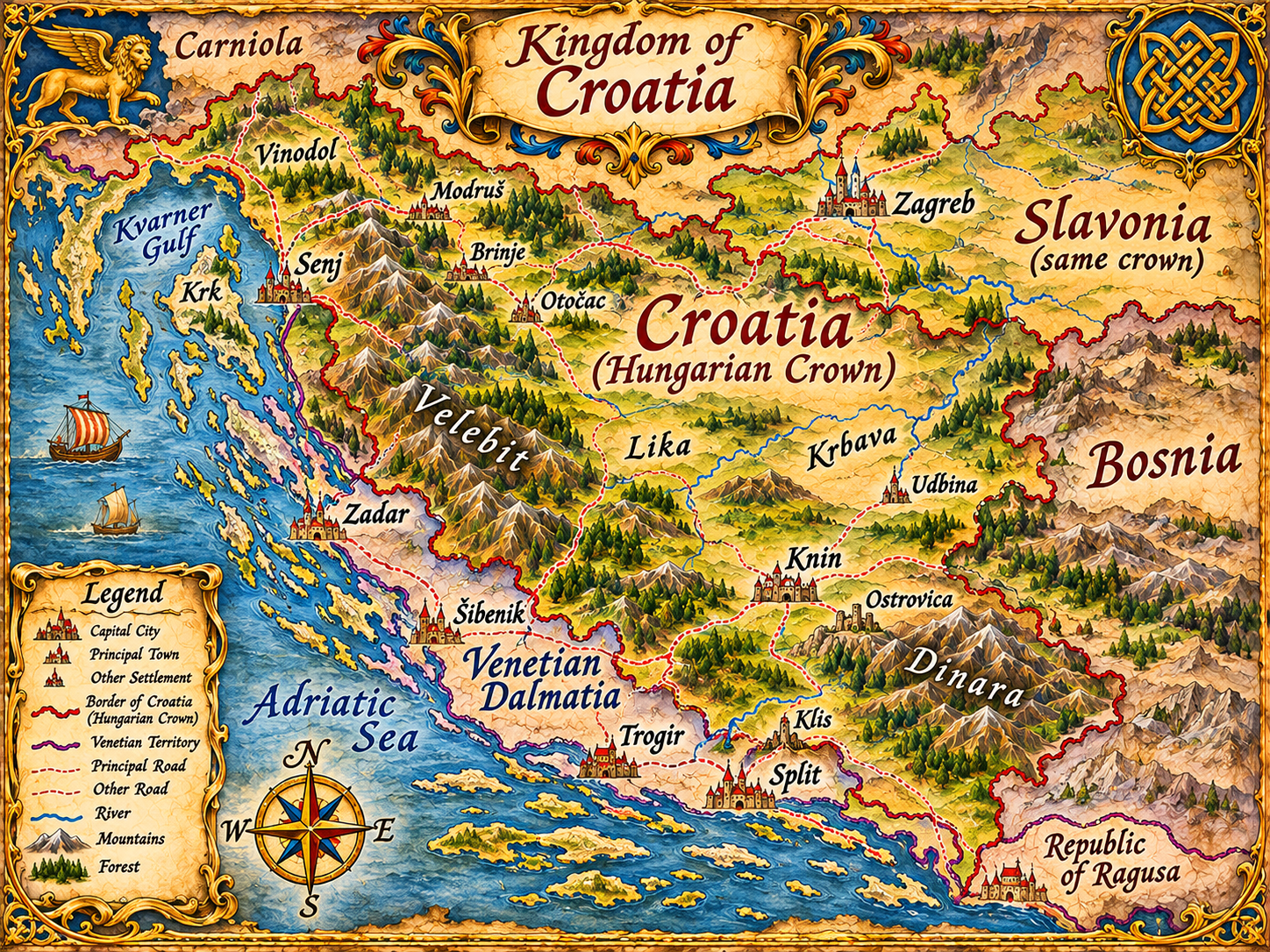
| Strategic centres | Knin, Senj, Modruš, Brinje, Otočac, Krbava, Klis and the inland mountain crossings |
| Coast | Senj and Frankopan coastal holdings; much of the Dalmatian town-and-island coast held by Venice |
| Related land | Slavonia lies farther north, tied to the same crown but with its own estates and political life |
| Landscape | Velebit and Dinaric Mountains, Lika and Krbava fields, stone passes, Adriatic inlets and islands |
| Languages | Croatian and related South Slavic speech, Latin in many official documents, Venetian and other maritime tongues; interpreters are valued on the coast and at court |
| Key rivals | The Frankopan and Kurjaković houses, Ulrich II of Celje, royal captains and Venetian magistrates |
| Neighbours | Bosnia, Hungary and Slavonia, Venetian Dalmatia, and the wider Balkan lands |
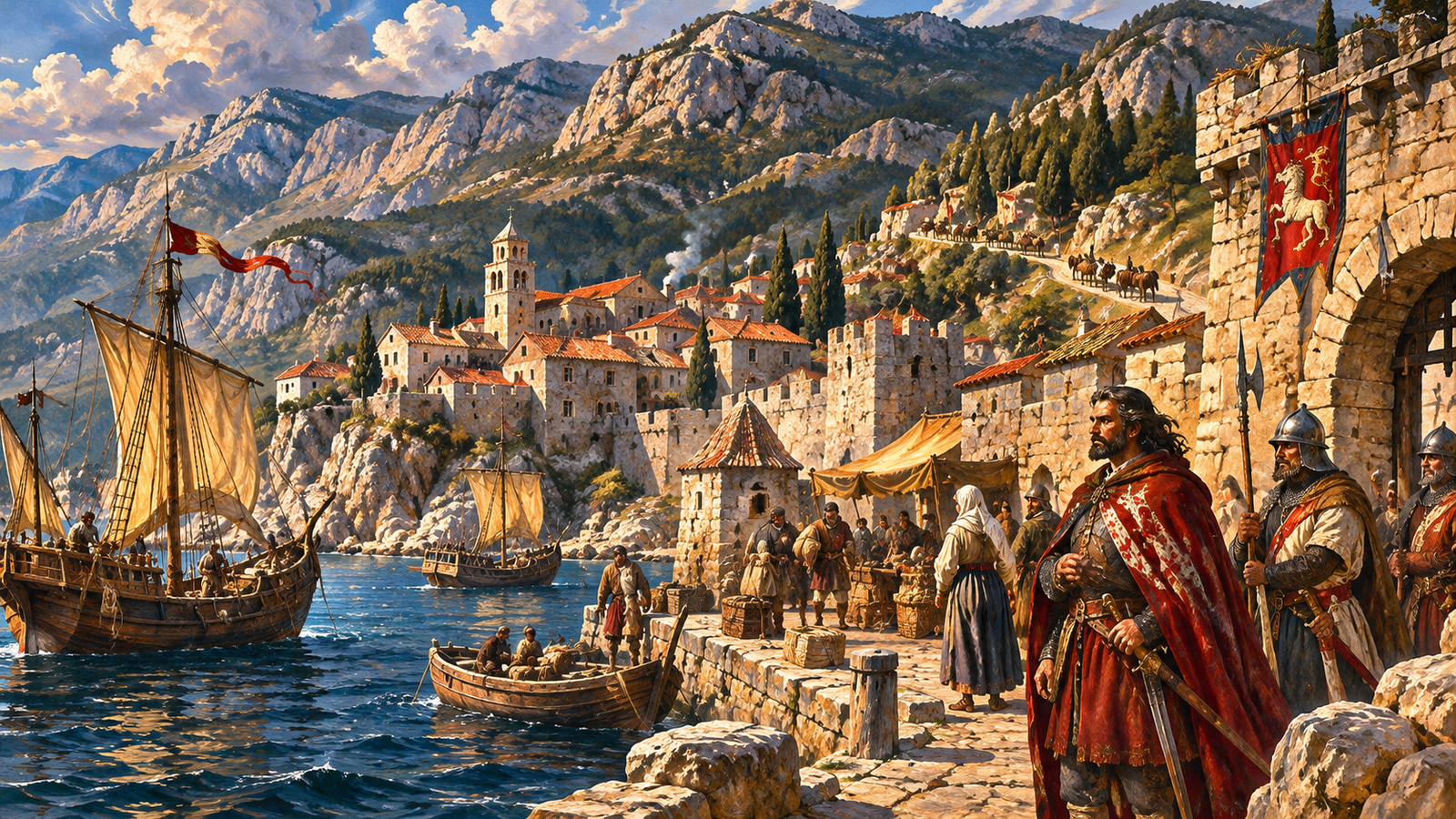
At the port of Senj, ships wait for a fair wind while mule trains arrive from the limestone mountains. Above the market, a lord’s banner announces one allegiance; a messenger on the road claims that its owner has already lost his castles. Between the Adriatic and the interior, every tower guards something valuable: a pass, a salt store, a bridge, a family inheritance or the only safe road through the hills.
The Hungarian crown claims the Kingdom of Croatia, but the young king cannot command each harbour, fortress or mountain lord from afar. The Frankopans hold powerful western estates. The counts of Celje push into the Croatian interior. Venetian magistrates govern many of the great Dalmatian ports. To travel from one settlement to another is to pass through several competing worlds, each with its own friendships and dangers.
What Is Happening Right Now?
The War for the Castles Has Begun
Ulrich II of Celje seeks to extend his influence from Slavonia into the Croatian heartland. In 1454 his armies move against the castles held by the lords of Krbava. After an unsuccessful first campaign, his men capture the important stronghold of Ostrovica. From there the road to Knin is threatened. The loss of a fortress can change the fortunes of whole valleys: retainers leave, traders reroute their wagons, and farmers discover that yesterday’s lord cannot protect them.
Ulrich lays claim to the offices and authority of the Croatian and Dalmatian banate, but military possession and unquestioned royal recognition are not the same thing. His officers can bring discipline, garrison pay and protection to compliant towns while dispossessing houses that refuse their rule. Local lords resist because the castles are the foundation of their power, not merely places where soldiers sleep.
The Frankopans Hold the Western Gate
The Frankopan family controls influential estates around Senj, Modruš, Brinje, Otočac and the northern coast and islands. Their followers oversee mountain roads and maritime connections. A count may give a caravan safe passage, call a levy of fighting men or use a marriage and an inheritance to tighten his grip on a disputed stronghold. Frankopan retainers are not a single uniform army: a captain’s first concern may be the safety of his own town.
At the southern edge of Croatia, castles such as Klis connect inland authority with the maritime world. An ally in one port might be an enemy in the next, and an apparently minor dispute over a mountain gate can draw powerful houses into open fighting.
Venice Rules Much of the Dalmatian Coast
The Republic of Venice holds Zadar, Šibenik, Trogir, Split and numerous Adriatic islands and harbours. These are not simply Croatian royal towns awaiting orders from Buda. Venetian magistrates protect the Republic’s shipping, collect harbour revenue and discourage challenges to their garrisons. Croatian noble houses still have lands, relations and ambitions beside these ports; merchants readily cross political boundaries for profit.
Farther south Dubrovnik (Ragusa) maintains its own maritime republic. It trades with both coasts and interior courts, making its envoys useful to people who publicly despise one another.
The Southern Frontier Watches
The hobgoblin Ninefold Dominion holds distant Constantinople. Its captains and scouts threaten the Balkan approaches, while the human Ottoman state remains a separate and sometimes competing power. Croatia is not yet a country of devastated frontier forts. Its people feel the pressure through anxious envoys, military preparations and disturbing reports from Bosnia and the Serbian Despotate. The true danger is that local rivals may exhaust each other before a larger threat arrives.
Places Where Adventures Begin
Senj — The Gate Between Land and Sea
Senj’s harbour, fortifications and market connect Adriatic merchants with the steep roads through the Velebit. Frankopan officials inspect cargoes and pay fighting men. Inns and warehouses offer work to caravan guards, sailors, guides and anyone who can settle an argument before one vessel leaves under another lord’s protection.
Modruš, Brinje and Otočac — The Western Strongholds
These settlements lie in the defended hill country. Narrow roads, bridges and fortified places make modest garrisons powerful. A forested shortcut can save a caravan two days or put it in a rival lord’s hands. A village mill may matter more than a marble audience chamber when grain is scarce.
Krbava and Lika — The Inland Crossroads
Krbava’s high fields and the roads across Lika link the mountains to the sea and toward Bosnia. The Kurjaković lords and neighbouring families retain deep claims here. Horse breeding, livestock, guarded passes and markets sustain the communities. Political enemies know how to use a valley’s winter isolation against its people.
Knin and Ostrovica — The Disputed East
Knin is an old centre of Croatian royal authority, protected by a powerful fortress and routes into the interior. Ostrovica’s contested possession makes it an immediate source of danger. Soldiers move through nearby villages with letters from different masters; houses suspected of helping one side are made to feed the other.
Klis and the Coastal Passage
Klis dominates a crucial passage between the hinterland and the coast around Split. Below the heights lie wealthy towns under Venetian power. An escort travelling from inland Croatia to a ship may need to bargain first with a castle commander and then with a foreign port authority. The two will not necessarily honour one another’s promises.
Venetian Dalmatia — Neighbours Across the Border
In Zadar, Šibenik, Trogir and Split, trade moves under the Republic’s protection, supported by stone quays, councils and ships. These cities serve as excellent places for diplomacy, theft, maritime investigation and escape. Adventurers must remember that a Croatian noble’s warrant does not command a Venetian harbour guard.
People and Factions
King Ladislaus V is the legitimate shared sovereign, but his attention is divided among several realms. His decisions arrive through royal officers and competing noble patrons. Hungary offers political legitimacy and military help, although its own internal quarrels often delay both.
Ulrich II of Celje is ambitious, disciplined and quick to recognise the value of a strong castle. His authority grows when defeated lords are brought into his service, but confiscated estates and imposed captains create lasting enemies. The Frankopans seek to preserve influence, roads, coastal connections and inherited strongholds. The Kurjaković of Krbava defend their regional inheritance and resent outside encroachment. Their rivalries place lesser families and whole villages at risk.
Venetian magistrates protect the security of ships and the prosperity of ports, punishing smuggling and hostile landings while rewarding the merchants who keep their harbours rich. Mountain communities value guides, grazing lands, household obligations and reliable protection. A captain who honours a promise to protect a valley earns cooperation; a lord who confiscates winter stores may face hidden roads and empty watchtowers when danger comes.
Gods, Sacred Places and Magic
Across the coastal settlements, inland fields and forests, people honour different divine and local powers. Some recognise Perun in the thunder above the mountains, Veles in the wealth of herds and underworld bargains, and Jarilo in the return of spring. Their traditions are not identical from one valley to the next. The Slavic pantheon is a source of powerful local connections, while seafarers may ask protection of older Adriatic and maritime powers.
A storm-broken oak, a hidden spring, a cave beyond a boundary stone or a reef said to shelter a drowned guardian can be as influential as a lord’s castle. Divine favour shapes what villagers will defend or refuse to surrender. Magic is sought from healers, wise people, tutors and rare practitioners; the most powerful require payment, service or reciprocal obligation. A local guardian who protects a spring may not be persuaded by gold at all.
Senj and the larger market towns offer smiths, inns, shipwrights, healers, stables and guides. Inland travellers may find only a reliable blacksmith and a host whose reputation is known throughout the valley. Spellcasting services are not uniform goods sold at fixed prices.
Dangers of the Kingdom
The greatest daily threats are armed retainers, rival claimants, mountain robber bands and storms at sea. From a distance the Dinaric passes look simple; up close they have cliffs, narrow shelves, dangerous weather and competing local guides. A captured bridge or blocked gorge can close the only provision route to a castle.
The highlands and forests also shelter dangerous creatures. Vila may defend springs and remote groves, rewarding respect but punishing trespass. Wolves, bears, restless dead and other beings in the regional bestiary belong to particular valleys and legends. A threat is most compelling when it has a territory, victims and a reason to come into conflict with the settlements nearby.
Rumours and Adventure Hooks
| d8 | What the Characters Hear |
|---|---|
| 1 | The castle that changed hands. Two groups arrive at Ostrovica, each carrying a different letter authorising its occupation. Inside, the old garrison has concealed the keys to the armoury and its wounded commander. |
| 2 | The horses from Senj. A Frankopan household hires the party to escort valuable horses inland. A rival company wants the animals, but the caravan also carries a hungry prisoner whose family controls the next pass. |
| 3 | A ferry beneath the Velebit. A fishing boat returns to port without its crew. The nets hold a salt-white stone stolen from an upland sanctuary; the village offers its last winter provisions for its return. |
| 4 | The broken road to Knin. Engineers cutting a new route find a sealed cave. A vila protects the water running through it, and breaking the seal would solve one lord’s supply problem by flooding another lord’s fields. |
| 5 | The Venetian commission. Two merchants in a Venetian-held port offer to pay for the same stolen coastal chart. One seeks smuggling coves; the other wants to prevent a surprise landing against Senj. |
| 6 | The inheritance at Krbava. A border noble dies before naming an heir. His tenants swear he left a secret testament, but every witness disappeared after a detachment wearing Celje colours entered the valley. |
| 7 | The burning watchfire. A coastal beacon burns on a moonless night although no raiders have been seen. The watchers are missing and a single survivor insists that the warning came from a ship under the water. |
| 8 | The letter from Bosnia. A Bosnian envoy asks the adventurers to carry an offer past several competing castles. Delivering it might avert an invasion—but a frightened household begs them to destroy it before a new marriage alliance is sealed. |
Travel Through Croatia
The hardest journeys cross the limestone highlands between coast and interior. The Velebit passes lead toward Senj, while routes through Lika, Krbava, Knin and Klis connect inland Croatia with the Dalmatian shore. On the Adriatic, short coastal voyages may be quicker than mountain travel, but winds, rival harbours and storms can make the sea an equally uncertain road.
Guides are essential in bad weather, and permission from a friendly lord may mean little at the next tower. A caravan with a reputation for paying its way can gather escorts and good intelligence. A company that steals animals or insults a village guardian may find the bridges dismantled before it returns.
The Deeper History
The Croatian kingdom has shared a crown with Hungary for centuries, but that union has never eliminated powerful regional families or maritime rivals. Royal, noble and communal authority overlap in the fortresses and valleys, while coastal towns have repeatedly changed allegiance through conquest, bargain and diplomacy.
Venice secured much of the Dalmatian coast in the early fifteenth century. Croatian noble houses retained significant inland and northern coastal holdings, particularly around Senj and the mountain routes. The death of the Croatian-Dalmatian ban Peter Talovac in 1453 sharpened a dispute over castles and inheritance. Ulrich of Celje’s campaigns of 1454 turn that struggle into armed confrontation; the outcome is not yet settled.
The country is therefore a frontier of loyalties rather than an empty strip between two empires. Inland nobles, island sailors, mining and trading interests, mountain clans and harbour merchants each have reasons to defend their communities. Their actions will determine who holds the roads when the greater wars move westward.
Continue Exploring
Sources and Artwork
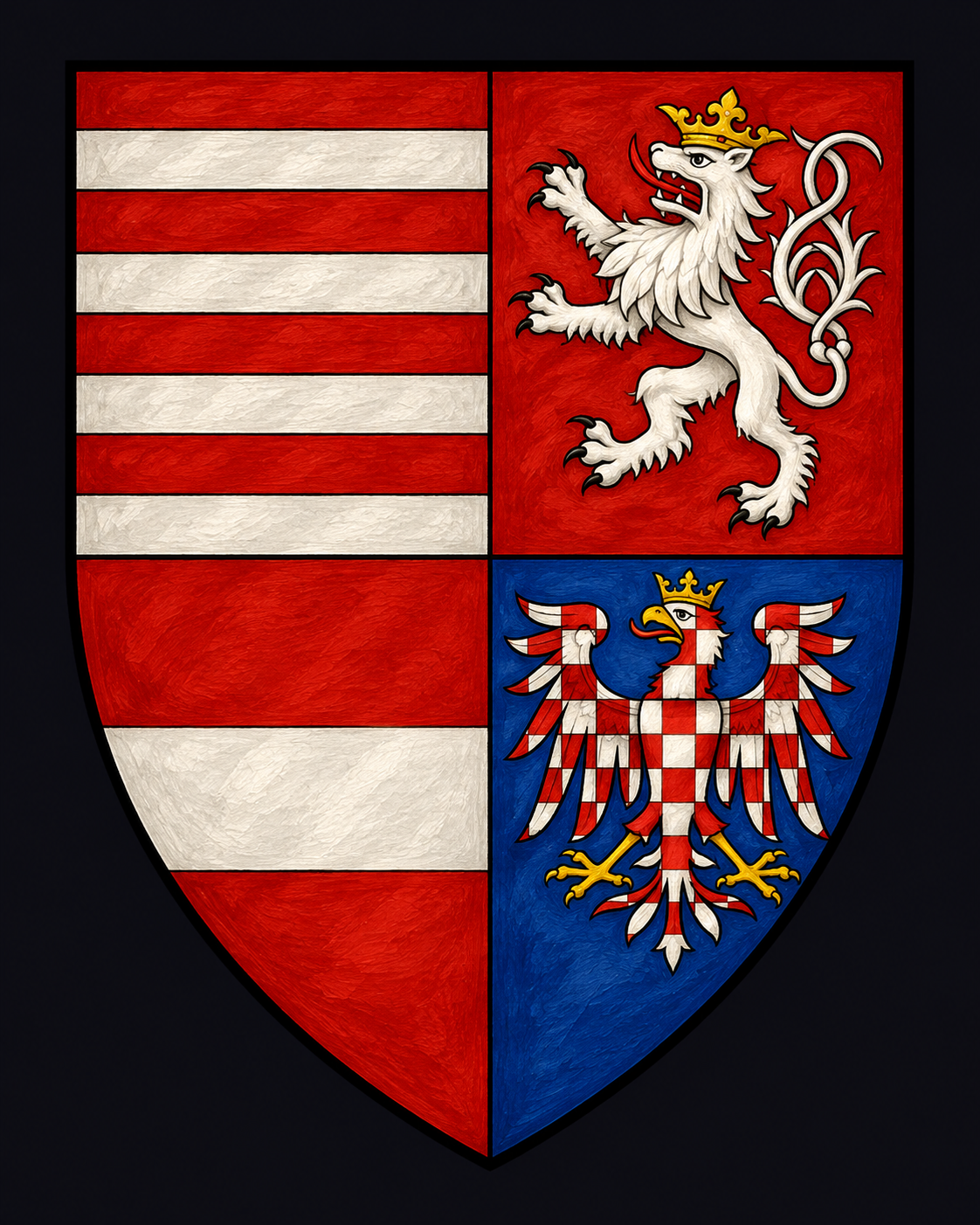
Historical foundations: Slovenska biografija, Ulrik II Celjski; Hrvatska enciklopedija, Krbava; The Uncrowned Lion: Ulrich II of Celje; and The Development of the State Emblems and Coats of Arms in Southeast Europe. The shared royal arms belong to Ladislaus V. The distinct Croatian chequered arms are not securely documented for 1454. The hero is original painted artwork; the map is a wider regional overview.
Keep this reference growing
If this page helped with your reading or game, you can support its upkeep or explore the curated books.
Explore the Bookshop — epics, classics and stories behind imagined worlds.