
Slavic Pantheon — Gods of Iriy and the Living Lands
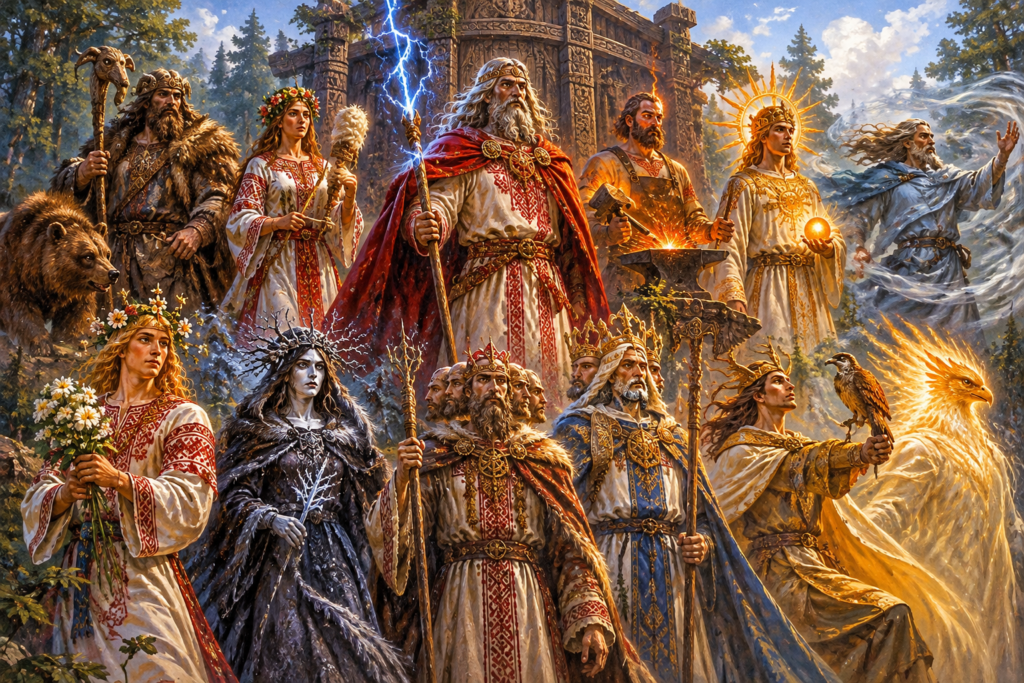
Slavic Pantheon at a Glance
| Traditions | East Slavic and distinct West Slavic divine traditions, with later seasonal figures |
|---|---|
| Great powers | Perun, Veles, Mokosh; Khors, Simargl; the other East Slavic and distinct West Slavic gods |
| Divine home | Iriy (Wyraj), the Slavic sacred country within Bytopia |
| Ways in | River-mist crossings, ancestral bird-roads and rootways of Yggdrasill |
| On Earth | Rus’ rivers and forests, Polish and Bohemian fields, Pomeranian and Baltic shores |
| At the table | Thunder trials, lost souls, harvest omens, sacred horses, living household rites |
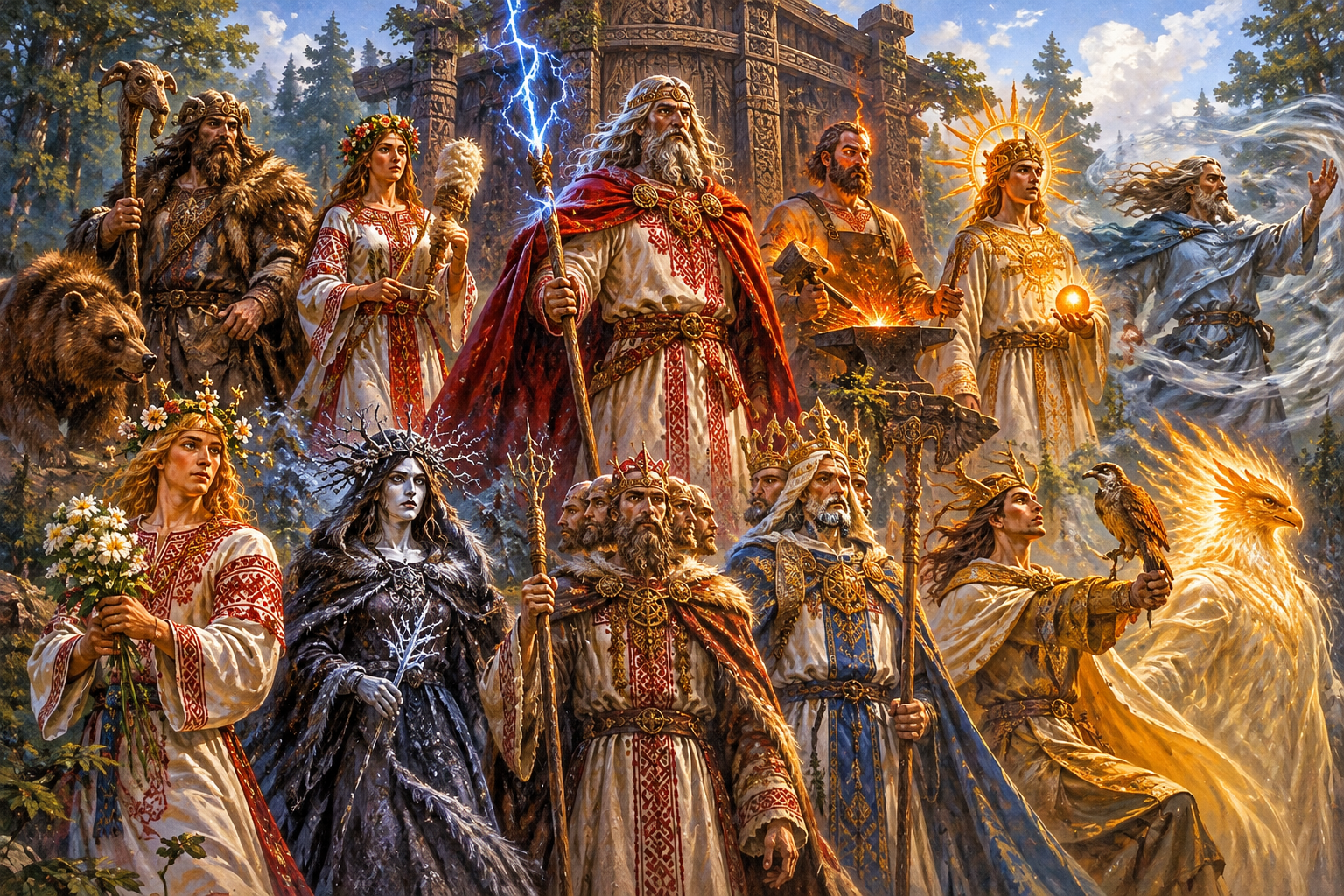
The Slavic pantheon lives in Iriy, the sacred country of Bytopia. Across the Rus’ rivers, Polish fields, Bohemian valleys and the Baltic coast, the old gods are still answered. Perun calls the thunder; Veles knows the roads under the roots; Mokosh hears the spindle and the spring. Westward, the four-faced oracle of Arkona remembers the sea, while the three-headed watcher guards crossings that lead out of the mortal world.
The old gods in the world
In 1454, the great routes through the forests are dangerous, trade still follows the rivers, and older worship survives in household rites, hidden shrines and open challenges from living gods. A shrine can be as small as a spindle beside a spring, or as dangerous as a sacred oak that answers a warlord with lightning. Gods are not guaranteed allies of a person simply because that person belongs to a people who once honoured them.
No universal priesthood speaks for all Slavs. A shrine keeper on a Rus’ river may know nothing of a Rugian horse oracle. A spring celebration in Poland is not identical to the worship at Kyiv. Their gods meet, disagree, visit and bargain, but the old traditions do not become a single imperial church.
Iriy — the garden beyond the birds’ road
Across the two facing landscapes of Bytopia extends Iriy, the Slavic sacred country of orchards, reeds, living pastures and cloud-black hills. Its fertile garden estates lie on Dothion, while its thunder ridges and wilder crossings rise through Shurrock. Migrating birds follow a path to its dawnward gardens, and some ancestral souls are welcomed along the same road. The route is not the fate of every dead person. Many remain bound to a household, another god’s domain or the roads of the dead.
Perun holds the Thunder Ridge and its high oaks. Veles keeps the Black Pastures beneath the roots and the rivers that vanish underground. Mokosh’s Reed Gardens lie where springs emerge beside a thousand spinning houses. Dazhbog’s light reaches the Dawn Orchards; Svarog’s hearths burn beyond them; Stribog’s winds sweep the high cliffs. The shrines of Svetovid and Triglav guard separate gates. Jarilo and Morana walk the changing edge of the seasons.
Iriy belongs to Bytopia. Between Dothion and Shurrock, Slavic shrines, forges, meadows and deep valleys occupy connected but distinct estates. The Thunder Ridge has a dangerous road into Ysgard. The roots of Yggdrasill offer less predictable passages toward the dead and the mortal forests.
Entering and leaving Iriy
Bird-road crossings appear most readily near returning migratory flocks, reed beds and burial mounds. A traveller must carry a living memory of the person or place sought; the road is rarely opened by a map alone. Those returning with an ancestral guest must bring the guest home before sunrise, unless the guest has chosen to remain with the gods. An empty-handed crossing is easier than returning with something that was never yours.
The gods and their shrines
Each god keeps a distinctive household, sacred country and claim upon the living world. A traveller seeking rain, a lost soul or a safe return must decide whose shrine to approach.
Perun
Thunder, lightning, armed defence and the hilltop oak
On the highest wooded ridges, Perun’s thunder breaks across the earth before the rain begins. He is the god a war-band invokes when its line must hold, but he is not a patron of every ambitious conqueror. His storm will defend a village against raiders and ruin a proud captain who mistakes cruelty for courage.
Primary realm: The Thunder Ridge in Shurrock; a storm road to Ysgard
Veles
Herds, wealth, poetry, low places and the journey of souls
Veles keeps the places where rivers disappear into mud and the pastures no ploughman remembers. His wealth is alive: cattle, songs, the knowledge of old paths, and the names of the dead. Those who take his gifts without respecting their keepers often discover that he can reclaim more than gold.
Primary realm: The Black Pastures in the deep valleys of Bytopia; rootways to the dead
Mokosh
Earth, moisture, spinning, work and women’s lives
Mokosh receives the prayers whispered over flax, wet soil and the work that keeps a household alive. She does not make famine a metaphor. When the earth is exhausted or a spinner’s fingers bleed, she sees the person and the work together.
Primary realm: The Reed Gardens in Dothion
Svarog
Heavenly fire and the craft of the smith
Svarog’s fires burn where metal first blushes red. He teaches that a good tool carries the patience of its maker, and that a blade made without thought for its wielder will one day turn against the hand that forged it.
Primary realm: The Ember Hearths in Dothion
Dazhbog
Sunlight, prosperity and the gifts of the day
Dazhbog’s light belongs to the orchard worker and the woman carrying water as surely as to a crowned ruler. He brings the daylight that makes growth possible, and he is most angered by those who hoard life’s necessities while their neighbours freeze.
Primary realm: The Dawn Orchards in Dothion
Stribog
Wind, weather and the distance between places
Stribog sends winds over seas, marshes and steppe roads. Travellers invoke him before they cross open water; millers listen for his temper from the shape of the clouds, and the old songs call winds his grandchildren.
Primary realm: The Windward Cliffs in Shurrock
Jarilo
Spring renewal, youth and the vigorous fields
Jarilo arrives with mud on his boots and a field full of fresh green. In the spring dances people praise him as the returning strength of the growing year. Where he runs, gardens burst into bloom—but the year cannot remain young forever.
Primary realm: The Spring Meadows in Dothion
Morana
Winter’s end, mortality and ritual departure
Morana is the hard edge of winter: the hunger after the stores are empty, the clear night when a river freezes, and the death that must be faced rather than bargained away. She does not delight in murder. She insists that seasons end.
Primary realm: The Last Frost at the seasonal crossings of Bytopia
Svetovid
War, divination, the harvest and a far-seeing oracle
Svetovid sees in four directions at once. His priest knows how to read a filled horn and the step of a sacred horse, but neither omen removes the need to choose. His greatest gift is foresight that leaves mortals responsible for what they do.
Primary realm: The Four Watchtowers between Bytopia’s layers
Triglav
Threefold sight, sacred crossings and hidden depths
Triglav watches the upper road, the road beneath the earth and the crossing between them. His faces are not three gods forced into one body. Each looks toward a different danger, and no pilgrim receives all three answers at once.
Primary realm: The Three Gateways at Bytopia’s Meeting Peaks
Khors
Twilight light and the return road. Khors guards the dusk crossings in Iriy. His pale light reveals the return road when the sun has left the forest, and a lost traveller hears his horse beyond the last line of trees. Dazhbog keeps the daylight orchards; Khors watches the threshold of night.
Simargl
The ember watch and the guarded threshold. Simargl keeps the Ember Gate. His burning wings shelter the shrine’s last living flame, and he follows the scent of a broken sanctuary across forests and rivers. A petitioner must bring something worth protecting before asking him to leave his watch.
Temples, crossings and encounters
The Oak at the Ford — Novgorod’s borderlands
A revived lightning-split oak keeps raiders from a ford, but someone has sold its thunderstone to the army approaching from the east. The party must choose between recovering the stone before dawn and evacuating a settlement that trusts too much in its protection.
The Reed Spring — a Rus’ riverside village
Cloth washed in the spring has begun carrying the names of children who have not been born. The midwife knows the weaving is a warning, but neither she nor the families agree on what must change before the river floods.
The White Horse — the Pomeranian coast
A horse that has crossed seven villages refuses to cross one captain’s spear. The captain calls the omen treason. A scout knows the coast ahead has been prepared for a massacre.
Magic and divine travellers
Clerics serve a particular power and a living tradition, not a generic Slavic church. A follower of Mokosh works through healing and craft; Perun’s champions defend a cause they can name; Veles favours those who understand the value of an exchange. A person may pray to several gods while being sworn to only one. Their shrines promise rain, shelter and a hearing before the divine household; they also demand courage, work and the return of what was entrusted.
Historical roots and further reading
The Primary Chronicle names Khors and Simargl among Vladimir’s Kyiv idols in 980. It records names and rites rather than a complete divine mythology. The households of Iriy and the individual powers described above are campaign interpretations of these fragmentary traditions.
For the Kyiv idols and the chronicle’s account of Perun, see Nora Chadwick’s study of the Russian chronicles. Václav Blažek examines the names Dazhbog and Khors in Celto-Slavic Parallels in Mythology and Sacral Lexicon. For the sanctuary at Arkona, read Saxo Grammaticus’ description in translation. Jiří Dynda explores Triglav’s cosmological associations in The Three-Headed One at the Crossroad; Milorad Ivanković re-examines Veles in New Insights on Slavic God Volos / Veles.
Explore the Gods & Pantheons, the Slavic Monsters, the Rus’ lands, the Planes of Existence, and the Ysgard realm guide.
Keep this reference growing
If this page helped with your reading or game, you can support its upkeep or explore the curated books.
Explore the Bookshop — epics, classics and stories behind imagined worlds.