
Earth Age 03 · c. 359–201 million years ago
Bugs, Amphibians and the Rise of Giants
Earth passes from Carboniferous coal forests through the drying Permian and the greatest mass extinction in its history, then rebuilds into the Triassic world of archosaurs, pterosaurs and the first dinosaurs. Beneath that natural history run older wars: Elder Treants retreat from corrupted forests, Serpent kingdoms inherit deep-time claims, and the Shoggoths rebel against the Elder Things in the Middle Permian.
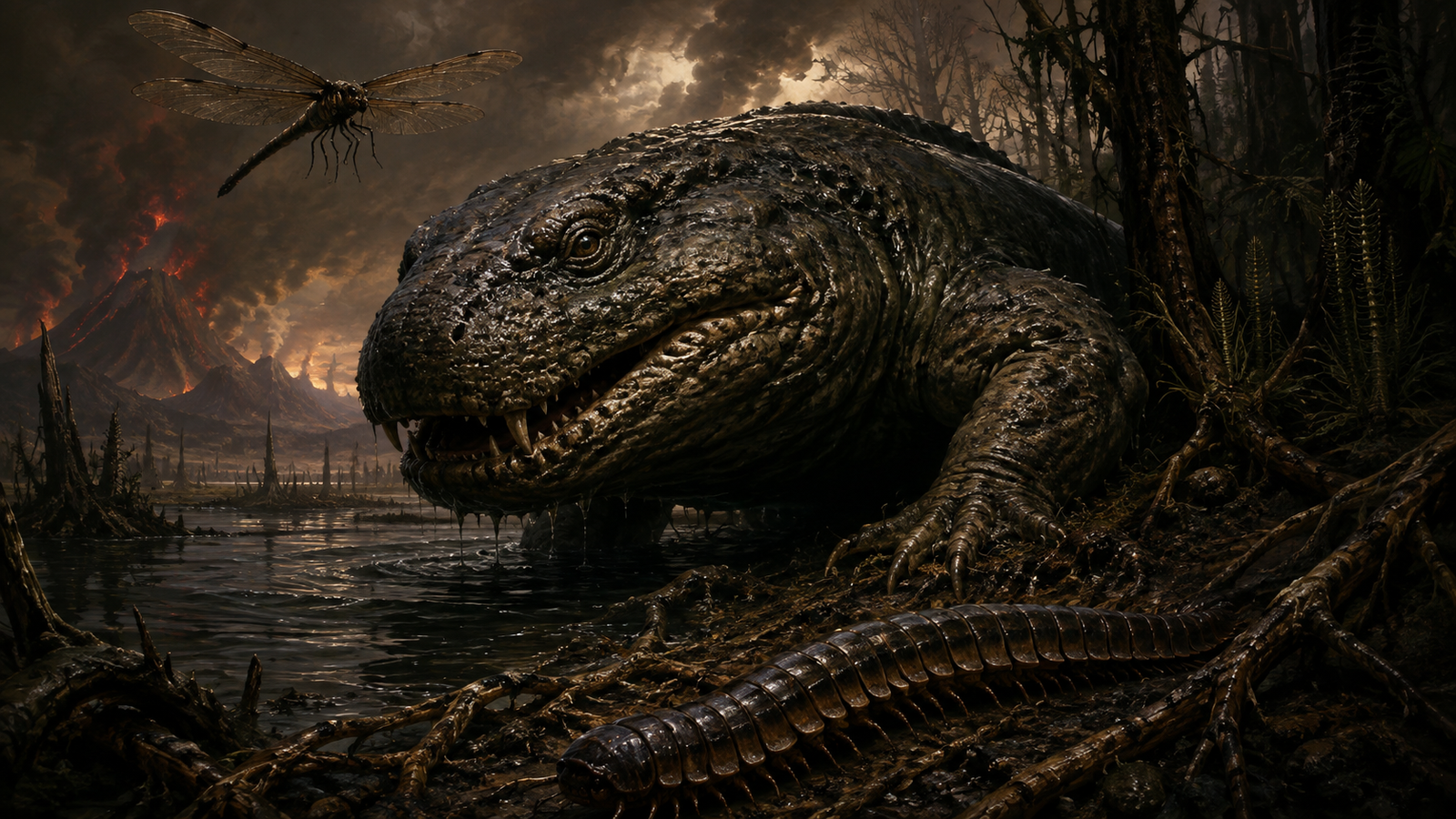
What is Earth Age 03?
It is the long transition from the great Carboniferous wetland forests to the first dinosaur worlds. The age spans three geological periods—Carboniferous, Permian and Triassic—and two enormous ecological resets. SpiralWorlds keeps the real geological sequence intact while adding supernatural peoples and monsters whose fortunes rise and fall with the changing planet.
Three worlds, one age
The Swamp Crown
Carboniferous coal forests, Arthropleura, giant griffinflies, amphibious hunters, early amniotes, Elder Treants, Treants, predatory plants and the first great green refuges.
Read the Carboniferous chapter →
The Drying World
Synapsids, river monsters, Helicoprion, Serpent kingdoms and Valusia, the Middle-Permian Shoggoth Rebellion, surviving Treant refuges and the Great Dying.
Read the Permian chapter →
The World After Ruin
Post-extinction recovery, Lystrosaurus, archosaurs, first dinosaurs, pterosaurs, marine reptiles, surviving elder powers and the end-Triassic extinction.
Read the Triassic chapter →
The hidden history running beneath the fossils
Elder Treants and the green refuges
The oldest Elder Treants belong to the Carboniferous. Ordinary Treants appear later in the Carboniferous–Permian transition. Conflict associated with Zuggtmoy destroys many ancient living pillars; survivors withdraw into hidden refuges.
First Valusia and the serpent kingdoms
Serpent People are already an indigenous Earth people before First Valusia. Around c. 275 million years ago, First Valusia rises as the dominant Serpentfolk empire of its age without ruling every Serpentfolk kingdom or community. Its layered imperial monarchy combines a directly governed heartland with subordinate kingdoms, tributary cities, clients and provinces. Around c. 225 million years ago, Triassic ecological disasters shatter the unified empire; successor dynasties, subterranean cities, sealed sanctuaries and political or cultic networks preserve competing Valusian claims thereafter.
The Shoggoth Rebellion
The Elder Things developed proto-Shoggoths over immense spans of Precambrian time. Fully adaptive Shoggoths revolt in the Middle Permian, badly damaging—but not exterminating—their makers.
The Great Dying
The end-Permian extinction is not caused by the supernatural war. It is a real planetary catastrophe driven by natural Earth processes. Elder and serpent civilisations suffer because the ecosystems and geography supporting them collapse too.
Creatures and powers of Earth Age 03
Carboniferous
Arthropleura · Giant Dragonfly · Eogyrinus · Elder Treant · Giant Flytrap · Star-Spawn.
Permian
Sphenacodon · Helicoprion · Serpent People · Elder Thing · Shoggoth.
Triassic
Stagonolepis · Postosuchus · Plateosaurus · Shonisaurus · surviving Serpent People and Shoggoths.
Earth Age 03 sequence
| Date | Natural Earth | SpiralWorlds hidden history |
|---|---|---|
| c. 359 Ma | Carboniferous begins. | Oldest Elder Treants become established within great forest systems. |
| Late Carboniferous | Coal forests fragment; amniotes diversify. | Ordinary Treants and predatory plant monsters spread; Zuggtmoy-linked corruption destroys ancient green pillars. |
| c. 299 Ma | Permian begins; Pangaean interiors become increasingly seasonal and dry. | Independent Serpentfolk realms expand across the deep-time world. |
| c. 275 Ma | Permian ecosystems continue to change across Pangaea. | First Valusia rises as the dominant but non-universal Serpentfolk empire of its age. |
| Middle Permian | Synapsid and therapsid faunas diversify. | Shoggoth Rebellion. Elder Thing civilisation is badly damaged but survives. |
| c. 252 Ma | The Great Dying devastates life on land and at sea. | Valusian territories, Elder Thing installations and Treant refuges are devastated, buried or isolated. |
| c. 225 Ma | Triassic recovery remains ecologically unstable and regionally destructive. | First Valusia shatters as a unified empire. Successor dynasties, subterranean cities, sealed sanctuaries and surviving networks preserve rival Valusian claims. |
| Later Triassic | Archosaurs diversify; first dinosaurs and pterosaurs appear. | Surviving Shoggoths, Serpentfolk successor states and elder installations rebuild or withdraw. |
| c. 201 Ma | End-Triassic extinction. | Surviving powers enter the Jurassic; the Mi-Go invasion is still in the future. |
Deep time is still underneath the world
The Death Layer
A mine, cavern or magical excavation can cross the Permian–Triassic boundary into a physical record of catastrophe—then continue into sealed architecture older than the extinction itself.
Ancient claims
A Serpent priest can produce a territorial record from before the Great Dying. The document can be genuine even when its political claim is meaningless—or terrifyingly enforceable—to people living in 1454.
Living witnesses
An Elder Treant may remember forests whose continents no longer exist. Its memory is not perfect historical narration, but it can destroy assumptions held by human scholars.
Rebellion below
A Shoggoth sealed under a monastery or mine may descend from an independent lineage that escaped Elder Thing control in the Middle Permian.
How this timeline is built
- International Commission on Stratigraphy — geological chronology.
- UC Museum of Paleontology — Carboniferous.
- UC Museum of Paleontology — Permian.
- UC Museum of Paleontology — Triassic.
- Natural History Museum — Permian extinction.
- Lovecraftian and Robert E. Howard-derived material is treated as literary source material adapted into SpiralWorlds canon, never as scientific evidence.
- Rules and creature statistics remain on their linked Bestiary pages with their own licensing notices; this hub contains chronology and setting material.