
Sandman — Harbinger of Sleep, Thief of Sight & Shepherd of Broken Dreams
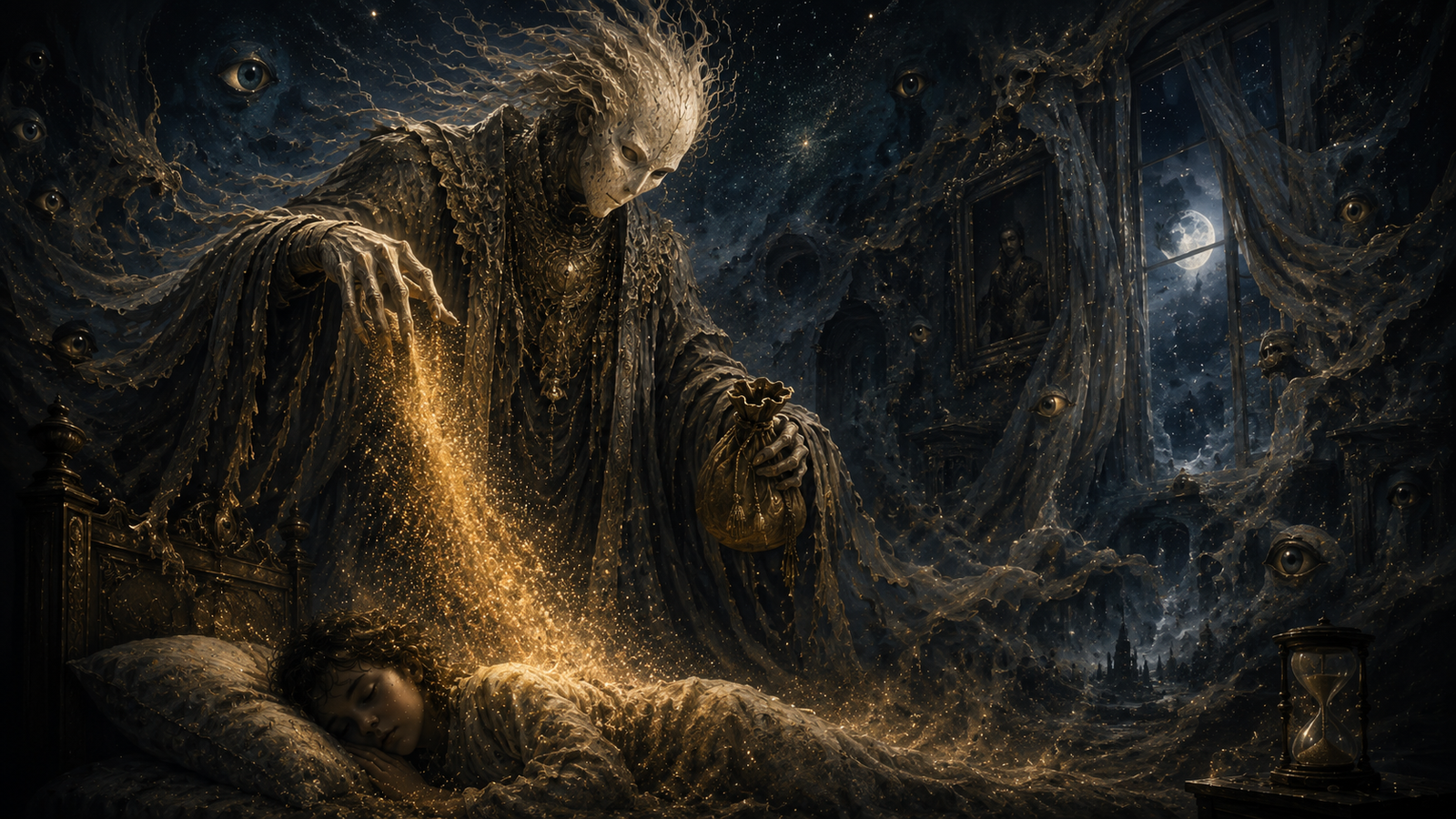
Sandmen are powerful dream-born predators of Oneirion, the Plane of Dreams, carrying golden dreamdust across the Veil of Sleep to dull waking perception, enter nightmares and steal the sight of vulnerable dreamers.
“When the room becomes too quiet and golden dust gathers where no window stands open, do not ask whether you are awake. Remember who you were before you fell asleep.”
Sandmen at a Glance
Sandmen are stable predatory beings of Oneirion whose identity gathers around one of the most persistent mortal images of sleep: an unseen visitor who closes the eyes and leaves grains of sand behind.
They are not creators of sleep, fallen celestials or earth elementals. Nor are they members of the Oneiroi. They are independent oneiric predators shaped where repeated mortal stories of sleep, insomnia, nightmare, eye-dust and nocturnal visitation have pressed enduring patterns into the mutable shallows of Oneirion.
No two Sandmen are perfectly identical. Their apparent age, dress, masks and mannerisms reflect the cultures and dreamers upon which they have fed. Mature individuals nevertheless share enough continuity of behaviour and supernatural power to constitute a recognisable kind of creature.
Appearance
A Sandman’s least disguised form is usually tall, thin and humanoid. Layered robes hang from its body like worn bed linen, old curtains, mourning cloth and shrouds remembered from childhood rooms.
The eyes are always wrong. Some possess hollow sockets from which luminous grains continually fall. Others carry tiny black eyes in an otherwise featureless face. A few have no visible eyes until they begin feeding, when impressions of watching eyes appear across walls, curtains and surrounding darkness.
Fine golden sand leaks from sleeves, fingertips and small pouches. The grains do not obey ordinary gravity. Some rise toward ceilings; others vanish before striking the floor; a few remain beneath a victim’s eyelids after waking.
Borrowed Faces
Within dreams, a Sandman rarely begins in its natural shape. It prefers a trusted face: parent, companion, physician, teacher, servant, lover or dead friend. The disguise usually fails through some minute contradiction—a reflection that does not blink, a remembered voice using the wrong childhood phrase, or golden sand collecting at the corners of familiar eyes.
Sandman Rules by Edition
These statistics represent a mature Sandman capable of hunting powerful adventurers across the boundary between waking life and Oneirion. All three rulesets describe the same creature.
Sandman
Medium Monstrosity (Oneiric, Shapechanger), Usually Neutral Evil
AC 19
Initiative +10 (20)
HP 225 (30d8 + 90)
Speed 40 ft., Fly 40 ft. (Hover)
Skills Arcana +9, Deception +16, Insight +10, Perception +10, Stealth +15
Resistances Cold, Necrotic, Psychic
Immunities Poison; Charmed, Frightened, Poisoned
Senses Darkvision 120 ft., Truesight 30 ft.; Passive Perception 20
Languages any four languages; Telepathy 120 ft.
CR 15 (XP 13,000, or 15,000 in its lair; PB +5)
Legendary Resistance (3/Day, or 4/Day in Lair). If the Sandman fails a saving throw, it can choose to succeed instead.
Magic Resistance. The Sandman has Advantage on saving throws against spells and other magical effects.
Oneiric Nature. The Sandman doesn’t need to sleep and can’t be forced to sleep by magic. While in Oneirion, it always knows the symbolic direction of the nearest stable dream-road or threshold it has previously travelled.
Dream Passage. If the Sandman spends 1 minute beside a sleeping creature, it can pass through the Veil of Sleep into that creature’s active dream. It disappears from its current location and enters the dream within Oneirion. If the dream ends while it remains inside, the Sandman returns to Oneirion rather than appearing beside the sleeper. This isn’t general-purpose planar travel.
Drowsing Presence. A creature capable of sleep that starts its turn in a 30-foot Emanation originating from the Sandman must make a DC 19 Wisdom saving throw.
- First Failure: The target has the Incapacitated condition until the end of that turn, when it repeats the save.
- Second Failure: The target has the Unconscious condition for 1 minute. This effect ends if the target takes damage or a creature within 5 feet of it takes an action to wake it.
- Success: Any effect of Drowsing Presence on the target ends, and the target is immune to that Sandman’s Drowsing Presence for 24 hours.
Drowsing Presence is a magical sleep effect.
Multiattack. The Sandman makes two Dreamlash attacks.
Dreamlash. Melee Attack Roll: +11, reach 10 ft. Hit: 22 (3d10 + 6) Psychic damage.
Sandman’s Dust (Recharge 5–6). Constitution Saving Throw: DC 19, each creature in a 30-foot Cone. Failure: 36 (8d8) Psychic damage, and the target has the Blinded condition until the end of its next turn. If the target is Incapacitated by Drowsing Presence, it also has the Unconscious condition until the end of its next turn. Success: Half damage only.
Thief of Sight (Recharge 6). Wisdom Saving Throw: DC 19, one creature the Sandman can perceive within 60 feet. Failure: 45 (10d8) Psychic damage, and the target has the Blinded condition for 1 minute. The target repeats the save at the end of each of its turns, ending the condition on itself on a success.
If the target has the Unconscious condition when it fails the initial save, the Sandman can steal its sight instead. The blindness then persists until ended by Greater Restoration, Wish, or permanent destruction of that Sandman in its own Nightward lair.
Spellcasting. The Sandman casts one of the following spells, requiring no Material components and using Charisma as the spellcasting ability (spell save DC 19, +11 to hit with spell attacks):
- At Will: Detect Thoughts, Disguise Self
- 2/Day Each: Dimension Door, Greater Invisibility, Phantasmal Killer, Suggestion
- 1/Day: Dream
Borrowed Face. The Sandman alters its apparent form to resemble a Small or Medium Humanoid, Beast or symbolic dream figure it has previously perceived. Its game statistics don’t otherwise change.
Dream Step. The Sandman teleports up to 40 feet to an unoccupied space it can perceive. If either its starting space or destination lies within 5 feet of a sleeping or Unconscious creature, the range increases to 80 feet.
Legendary Action Uses: 3 (4 in Lair). Immediately after another creature’s turn, the Sandman can expend one use to take one of the following actions. It regains all expended uses at the start of each of its turns.
Dreamlash. The Sandman makes one Dreamlash attack.
Lurk Through Dreams. The Sandman uses Dream Step.
Dustfall. Wisdom Saving Throw: DC 19, one creature capable of sleep within 30 feet. Failure: 10 (3d6) Psychic damage, and the target’s Speed is halved and it can’t take Reactions until the end of its next turn. The Sandman can’t take Dustfall again until the start of its next turn.
Sandman
CR 15 · NE Medium outsider (oneiric, shapechanger)
XP 51,200
Init +11; Senses darkvision 60 ft., dreamsight; Perception +28
A Sandman gains the extraplanar subtype whenever it is away from its native plane, Oneirion.
AC 31, touch 22, flat-footed 24 (+7 Dex, +5 deflection, +9 natural)
hp 225 (18d10+126)
Fort +18, Ref +18, Will +18
DR 10/ cold iron and good; SR 26
Immune magical sleep, poison; Resist cold 10
Defensive Abilities dream ward, dream-bound reformation, oneiric nature
Speed 40 ft., fly 40 ft. (good)
Melee 2 dreamlashes +25 (2d8+7 plus 4d6 dream damage)
Special Attacks dreamdust, drowsing presence, thief of sight
Spell-Like Abilities
CL 18th; concentration +25
- At will — detect thoughts, disguise self
- 3/day — deep slumber, dimension door, greater invisibility, phantasmal killer, suggestion
- 1/day — dream, nightmare
Str 12, Dex 24, Con 24, Int 20, Wis 24, Cha 24
Base Atk +18; CMB +19; CMD 36
Feats Ability Focus (drowsing presence), Ability Focus (thief of sight), Dodge, Flyby Attack, Improved Initiative, Iron Will, Quicken Spell-Like Ability (suggestion), Skill Focus (Bluff), Weapon Finesse
Skills Bluff +31, Disguise +28, Fly +32, Knowledge (planes) +26, Perception +28, Sense Motive +28, Spellcraft +26, Stealth +28
Languages any four languages; telepathy 120 ft.
Oneiric Subtype (Ex). A creature with the oneiric subtype is a stable native being of Oneirion. It does not need to sleep and is immune to magical sleep.
Dream Ward (Su). The Sandman’s displaced oneiric form grants it a +5 deflection bonus to AC.
Dreamsight (Su). The Sandman automatically perceives sleeping creatures within 120 feet and knows whether each is dreaming, affected by magical sleep or caught within a supernatural dream effect.
Borrowed Face (Su). As a swift action, a Sandman may assume the apparent form of any Small or Medium humanoid, animal or symbolic dream figure it has previously perceived.
Dream Passage (Su). By concentrating for 1 minute beside a sleeping creature, a Sandman can disappear from its current plane and enter that creature’s active dream within Oneirion. If the dream ends, the Sandman returns to Oneirion.
Dreamlash (Su). A Sandman attacks with its dreamlashes using Dexterity rather than Strength and adds its Charisma modifier to dreamlash damage. Each dreamlash also deals 4d6 points of nonlethal dream damage to a creature capable of dreaming.
Drowsing Presence (Su). A living creature capable of sleep that begins its turn within 30 feet must succeed on a DC 28 Will save or become fatigued for 1 minute. A creature already fatigued by that Sandman’s Drowsing Presence that fails another save instead falls asleep for 1d4 rounds. Damage immediately awakens a sleeping creature. A successful save ends fatigue caused by this ability and grants immunity to that Sandman’s Drowsing Presence for 24 hours. This is a mind-affecting magical sleep effect. The save DC is Charisma-based and includes Ability Focus.
Dreamdust (Su). Once every 1d4 rounds, a Sandman releases dreamdust in a 30-foot cone. Creatures in the area take 12d6 points of nonlethal damage and are blinded for 1d4 rounds. A DC 26 Will save halves the damage and negates the blindness. A creature currently fatigued by Drowsing Presence that fails this save also falls asleep for 1d4 rounds. The save DC is Charisma-based.
Thief of Sight (Su; 1/day). One living creature within 60 feet must succeed on a DC 28 Will save or become permanently blinded. The save DC is Charisma-based and includes Ability Focus.
If the victim is sleeping or unconscious when it fails the save, its sight has been stolen rather than merely suppressed. Ordinary Remove Blindness/Deafness does not end the effect. It instead requires Break Enchantment, Greater Restoration, Miracle, Wish, or permanent destruction of the responsible Sandman within its own Nightward lair.
Dream-Bound Reformation (Su). If destroyed outside its own Nightward lair, a Sandman’s body collapses into inert golden dust. The creature reforms within that lair after seven nights. A Sandman destroyed inside its own lair is permanently destroyed.
Environment Plane of Dreams — Oneirion
Organization solitary or rare pair
Treasure standard; usually dream-tokens, stolen memories, oneiric objects and possessions taken from sleepers
Sandman
Medium Outsider (Oneiric, Shapechanger)
A Sandman gains the extraplanar subtype whenever it is encountered away from Oneirion.
| Hit Dice | 18d8+162 (243 hp) |
|---|---|
| Initiative | +11 (+7 Dexterity, +4 Improved Initiative) |
| Speed | 40 ft.; fly 40 ft. (good) |
| Armor Class | 31 (+7 Dex, +5 deflection, +9 natural), touch 22, flat-footed 24 |
| Base Attack/Grapple | +18/+19 |
| Attack | Dreamlash +25 melee (2d8+7 plus 4d6 dream damage) |
| Full Attack | 2 dreamlashes +25 melee (2d8+7 plus 4d6 dream damage) |
| Space/Reach | 5 ft./10 ft. with dreamlash |
| Special Attacks | Dreamdust, drowsing presence, spell-like abilities, thief of sight |
| Special Qualities | Borrowed face, Darkvision 60 ft., damage reduction 10/ cold iron and good, dream-bound reformation, dream passage, dream ward, dreamsight, immunity to magical sleep and poison, oneiric traits, resistance to cold 10, Spell Resistance 26, telepathy 120 ft. |
| Saves | Fort +20, Ref +18, Will +18 |
| Abilities | Str 12, Dex 24, Con 28, Int 20, Wis 24, Cha 24 |
| Skills | Bluff +28, Concentration +30, Disguise +28, Hide +28, Knowledge (the planes) +26, Listen +28, Move Silently +28, Search +26, Sense Motive +28, Spellcraft +26, Spot +28 |
| Feats | Ability Focus (drowsing presence), Ability Focus (thief of sight), Flyby Attack, Improved Initiative, Iron Will, Quicken Spell-Like Ability (suggestion), Weapon Finesse |
| Environment | Plane of Dreams — Oneirion |
| Organization | Solitary or rare pair |
| Challenge Rating | 15 |
| Treasure | Standard |
| Alignment | Usually neutral evil |
| Advancement | 19–24 HD (Medium); 25–36 HD (Large) |
Sandmen avoid straightforward battles whenever possible. They separate victims, weaken perception, turn sleeping allies into routes through the battlefield and retreat through dream-space when direct confrontation ceases to favour them.
Oneiric Traits (Ex): A Sandman does not need to sleep, is immune to magical sleep and gains a +4 racial bonus on saving throws against mind-affecting effects.
Dream Ward (Su): The Sandman’s displaced oneiric form grants it a +5 deflection bonus to Armor Class.
Dreamsight (Su): A Sandman automatically detects sleeping creatures within 120 feet and knows whether they are dreaming or affected by magical sleep.
Borrowed Face (Su): As a swift action, a Sandman may assume the apparent form of a Small or Medium humanoid, animal or symbolic dream figure it has previously perceived.
Dream Passage (Su): A Sandman that spends 1 minute beside a sleeping creature may disappear from its current plane and enter that creature’s active dream within Oneirion. When the dream ends, it returns to Oneirion.
Dreamlash (Su): A Sandman uses Dexterity rather than Strength for dreamlash attack rolls and adds its Charisma modifier to dreamlash damage. Its dreamlashes deal an additional 4d6 points of nonlethal dream damage to creatures capable of dreaming.
Drowsing Presence (Su): A creature capable of sleep that begins its turn within 30 feet must succeed on a DC 28 Will save or become fatigued for 1 minute. A creature already fatigued by that Sandman’s Drowsing Presence that fails another save falls asleep for 1d4 rounds instead. Damage wakes the sleeper. A successful save ends fatigue caused by the ability and grants immunity for 24 hours. This is a mind-affecting magical sleep effect. The DC is Charisma-based and includes Ability Focus.
Dreamdust (Su): Once every 1d4 rounds, a Sandman releases dreamdust in a 30-foot cone. Creatures within the cone take 12d6 points of nonlethal damage and are blinded for 1d4 rounds. A DC 26 Will save halves the damage and negates blindness. A creature fatigued by Drowsing Presence that fails this save also falls asleep for 1d4 rounds.
Thief of Sight (Su): Once per day, a Sandman targets one living creature within 60 feet. The target must succeed on a DC 28 Will save or become permanently blind. The save DC is Charisma-based and includes Ability Focus.
If the victim is asleep or unconscious when it fails, ordinary Remove Blindness/Deafness cannot restore its sight. Break Enchantment, Greater Restoration, Miracle, Wish, or permanent destruction of the responsible Sandman can restore it.
Dream-Bound Reformation (Su): If destroyed outside its own Nightward lair, a Sandman collapses into powerless golden sand and reforms after seven nights. If destroyed within its own lair, it is permanently destroyed.
Caster level 18th. Save DCs are Charisma-based.
- At will — detect thoughts, disguise self
- 3/day — deep slumber, dimension door, greater invisibility, phantasmal killer, suggestion
- 1/day — dream, nightmare
Dreamdust
The golden substance associated with Sandmen resembles powdered amber, impossibly fine desert sand or dust illuminated by late sunlight. Its resemblance to mundane sand is superficial.
Dreamdust is oneiric matter temporarily made stable. A grain examined under a lens may appear crystalline, fibrous or completely absent depending upon whether the observer is alert, exhausted or dreaming.
Drowsiness
The first symptom is oppressive fatigue: repeated blinking, delayed reactions and the sensation that remaining awake requires conscious effort.
Dream Entry
Once a victim sleeps, physical distance becomes less important. The sleeper’s active dream provides a threshold through the Veil into Oneirion.
False Awakening
A victim may dream that they have awakened, dressed, spoken to companions and begun the day while never having left the dream.
Stolen Sight
A mature Sandman can steal the supernatural possession of sight itself, leaving physical eyes intact while preventing them from perceiving the waking world.
Why the Eyes?
Eyes stand at the boundary between perception and interpretation. Sandmen attack that boundary. To them, sight is one of the strongest channels through which waking certainty enters the mind.
The epithet Thief of Sight therefore describes more than physical horror. It expresses the creature’s central purpose: making the victim distrust what can be seen.
Sandmen in Oneirion
Oneirion is vastly older than the mortal cultures that later told stories of Sandmen. Mortal minds do not create the plane each night, but repeated dreams, stories, symbols and fears can exert genuine pressure upon its mutable upper regions.
Sandmen are among the stable predatory beings that emerged from that interaction. Their strongest populations haunt the Nightward, where repeated fears acquire landscape, continuity and defensive power.
Hypnos
Hypnos governs sleep, rest, drowsiness and the closing of waking consciousness. Sandmen repeatedly trespass upon those conditions, but they are not his servants and he did not create them.
Morpheus
Morpheus shapes convincing dream-form: faces, bodies, voices and appearances. Sandmen imitate this principle through Borrowed Face, but do not possess his divine office.
The Oneiroi
Oneiroi are independent dream spirits associated with truthful and deceptive dream-currents. Sandmen are a different order of oneiric being.
The Nightward
The darker strata of Oneirion collect recurring fear, unresolved memory, false awakenings and predatory dream structures. This is the natural stronghold of Sandmen.
Other Nightward Predators
Sandmen share darker dreamlands with other established creatures including Thought Eaters, Id Manifestations, Nightmares and Alps.
Hunting the Sleeping
A Sandman is patient. It prefers victims whose certainty has already begun to erode. Exhaustion, grief, repeated nightmares, magical sleep, fever and deliberate sleep deprivation create easier thresholds.
Preferred Prey
- The chronically exhausted: people who no longer remember exactly where waking ended and dreaming began.
- Prophets and habitual dreamers: minds already accustomed to treating dreams as meaningful experiences.
- Insomniacs: especially those who have begun to fear sleep itself.
- The grief-stricken: whose memories provide convincing faces and locations for Borrowed Face.
- Magically sleeping creatures: whose consciousness is already held near the threshold Sandmen prefer.
They Do Not Always Kill
Death ends a useful dreamer. A Sandman often leaves survivors instead: one wakes unable to remember a familiar face; another becomes terrified of closing both eyes; a third remembers a conversation that never occurred; a fourth sleeps normally but can no longer remember dreaming.
Encounter Tactics
- Begin before initiative. Use exhaustion, missing time, impossible memories, golden grains or a false awakening.
- Make perception unreliable. The first frightening figure the characters see need not be the actual Sandman.
- Use Drowsing Presence to create decisions. Characters must choose whether to wake companions, move away or continue pressing the attack.
- Exploit Dream Step. Sleeping and unconscious creatures become both victims and routes through combat.
- Reserve Thief of Sight for an important moment. It should feel like the creature’s signature threat.
- Let it escape. Outside its lair, a Sandman has little reason to die for pride.
Suitable Battlefields
- a noble household where half the servants are sleepwalking;
- a university residence during an outbreak of identical nightmares;
- a roadside inn whose guests repeatedly awaken into the same midnight hour;
- a military camp where sentries cannot remain awake;
- a physician’s house containing several magically sleeping patients;
- a dream-version of a familiar place where doors no longer lead where memory says they should.
The Chamber Behind Closed Eyes
Mature Sandmen anchor themselves to recurring Nightward territories known to occultists collectively as Chambers Behind Closed Eyes. No two Chambers are identical.
One may resemble an abandoned nursery; another a corridor whose doors all return to the same bed; another a moonlit palace in which every mirror shows the viewer sleeping somewhere else.
D&D 5.5e / 2024 — Sandman in Its Lair
While within its own Chamber Behind Closed Eyes, a Sandman has Legendary Resistance (4/Day) and 4 Legendary Action Uses rather than 3. An encounter with a Sandman in its lair awards 15,000 XP.
Signs of a Nearby Chamber
Golden Grains
Fine sand appears in beds, beneath eyelids or around sealed windows.
False Dawn
A sleeper wakes and begins the day before discovering that night never ended.
Shared Phrase
Unconnected sleepers repeat the same sentence or describe the same corridor.
Fogged Mirrors
A mirror briefly shows the observer still asleep somewhere else.
Missing Faces
A victim remembers a conversation but cannot remember the speaker’s face.
Sleepwalking
Several sleepers independently walk toward the same locked room, cellar or rooftop.
Waking Anchors & Dream-Wards
Identity is unusually powerful in Oneirion. A traveller’s most dependable defence against a convincing dream is something they genuinely associate with waking life.
A Waking Anchor may be a true name, trusted companion, scar, vow, heirloom, personal token, remembered song or unmistakable memory.
D&D 5.5e / 2024
A traveller who remembers and trusts their Waking Anchor has Advantage on saving throws made specifically to resist dream entrapment, forced memory alteration, false awakening, nightmare possession or effects that would make them forget the route back to waking reality.
Pathfinder 1e & D&D 3.5e
A traveller maintaining a trusted Waking Anchor gains a +2 circumstance bonus on Will saves and relevant checks made specifically to resist dream entrapment, false awakening, memory alteration, nightmare possession or becoming lost within Oneirion.
Breaking an Anchor
Sandmen understand Waking Anchors extremely well. They may imitate a trusted companion, change the remembered words of an oath, replace an heirloom with a perfect false copy or construct a dream in which the traveller becomes convinced that the anchor never belonged to them.
Sandmen in the Mortal World
In 1454, knowledge of Sandmen survives as fragments rather than a single doctrine. Nurses tell children that unseen visitors bring sleep. Travellers describe inns where every guest dreamed of the same stranger. Physicians recognise cases in which exhaustion behaves unlike ordinary illness.
In German-speaking and northern European lands, domestic explanations connecting sleep with supernatural “sand” provide especially useful masks. This does not mean every such tale describes an actual Sandman. Most are ordinary folklore.
Learned Investigation
University masters, physicians, astrologers, alchemists and scholars of natural philosophy generally place genuine Sandman incidents among oneiric and imaginal phenomena rather than elemental manifestations.
Experienced investigators compare several sleepers’ testimony, looking for details none could reasonably have learned from the others: the same phrase, impossible architecture, repeated unknown face, identical missing memories or a consistent route through a dream.
Adventure Hooks — 1454
- The Sleepless Prince. A ruler refuses to sleep after three advisers dream of the same visitor and awaken blind.
- The Latin School Dream. Students independently draw the same impossible staircase during lessons, although none remembers dreaming it.
- The Physician’s Patients. A respected healer has placed several feverish patients into controlled magical sleep. Something has begun visiting all of them.
- The False Morning. An entire household believes dawn has arrived, but every candle has burned to exactly the same height.
- The Golden Vessel. A learned collector has preserved dreamdust in glass, inadvertently creating a stable threshold into a Chamber Behind Closed Eyes.
Building a Sandman Scenario
| Stage | What Happens | What the Characters Learn |
|---|---|---|
| 1. Disturbance | Shared nightmares, exhaustion, sleepwalking or golden grains appear. | The problem affects several sleepers and is not mundane insomnia. |
| 2. Contradiction | Victims remember events that never happened or disagree about whether they are awake. | Dream-reality is overlapping waking perception. |
| 3. Identification | The same visitor, phrase, corridor or eye imagery appears repeatedly. | An independent intelligence is moving between dreams. |
| 4. Confrontation | A Sandman manifests physically or traps the party inside a false awakening. | Destroying it outside its own lair is only temporary. |
| 5. Dream Pursuit | The characters deliberately enter Oneirion and follow it into the Nightward. | Waking Anchors become critical to preserving identity. |
| 6. Final Hunt | The party reaches the creature’s Chamber Behind Closed Eyes. | The Sandman can finally be destroyed permanently. |
Mythic and Literary Context
European traditions surrounding the Sandman connect an unseen supernatural visitor with sleep and the “sand” or grit found around the eyes after waking. Those traditions are broader than the hostile creature presented here; the Sandman of folklore is not universally sinister.
E. T. A. Hoffmann — The Sand-Man
The famous horrifying image of an eye-stealing Sandman is strongly associated with E. T. A. Hoffmann’s nineteenth-century story Der Sandmann. Its nurse’s tale describes a monstrous Sandman who throws sand into children’s eyes and carries their eyes away.
That literary tradition is the principal inspiration behind the SpiralWorlds epithet Thief of Sight. Hoffmann’s story itself is not treated as literal campaign history.
Primary text: E. T. A. Hoffmann, The Sand-Man — Project Gutenberg.
Hans Christian Andersen — Ole-Luk-Oie
Hans Christian Andersen presents a markedly different sleep-bringer in Ole-Luk-Oie, the Dream God. Ole-Luk-Oie quietly brings sleep and stories rather than functioning as Hoffmann’s eye-stealing horror.
This contrast matters. SpiralWorlds does not treat every benevolent Sandman story as a disguised appearance of the predatory beings described on this page.
Primary text: Hans Christian Andersen, Ole-Luk-Oie, the Dream God — Project Gutenberg.
Sandman Questions
Is a Sandman an earth elemental?
No. Its golden dreamdust resembles sand, but a Sandman is an oneiric being native to Oneirion. It has no inherent connection to the Plane of Earth.
Is there only one Sandman?
No. Sandmen are a recognised class of dream predator. The statistics on this page represent a mature and dangerous individual.
Are Sandmen Oneiroi?
No. The Oneiroi are an independent class of dream spirits. Sandmen are separate predators that travel some of the same dream-roads.
Does Hypnos control Sandmen?
No. Hypnos governs sleep and exercises great authority over the threshold of slumber, but Sandmen are neither his creations nor his servants.
What Challenge Rating is a mature Sandman?
The mature Sandman presented here is CR 15 in D&D 5.5e, Pathfinder 1e and D&D 3.5e.
Can a Sandman be permanently killed?
Yes. A Sandman destroyed outside its personal Nightward lair reforms after seven nights. Destroying it within its own Chamber Behind Closed Eyes ends that reformation permanently.
How is stolen sight restored?
In PF1e and D&D 3.5e, Break Enchantment or sufficiently powerful restorative magic can release stolen sight. Permanently destroying the responsible Sandman also restores sight stolen through Thief of Sight.
Keep this reference growing
If this page helped with your reading or game, you can support its upkeep or explore the curated books.
Explore the Bookshop — epics, classics and stories behind imagined worlds.