
Hypnos — God of Sleep
Hypnos is the divine personification of sleep: the gentle closing of waking consciousness, the surrender of exhausted bodies, the silence before dreams, and the strange power capable of laying even gods beneath its influence. He is the twin brother of Thanatos, son of Nyx, and one of the principal Hellenic powers whose divine office opens directly onto Oneirion, the Plane of Dreams.
Hypnos does not create dreams and did not create Oneirion. His authority is more fundamental to mortal experience: he governs the threshold at which the waking mind releases its hold upon the world.
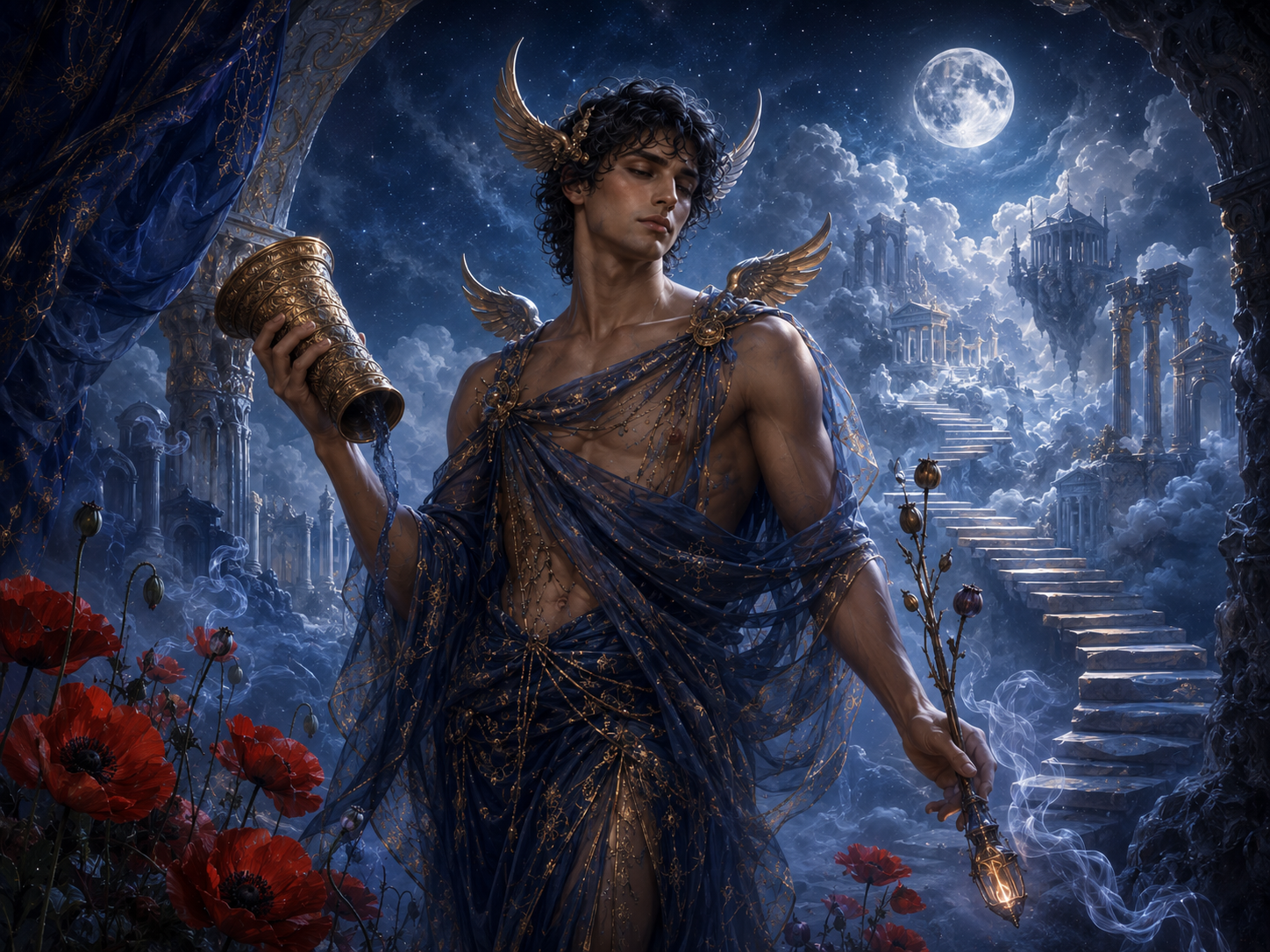
The Gentle Power No Mortal Escapes
- Pantheon: Hellenic Pantheon
- Greek Name: Hypnos (Ὕπνος)
- Roman Counterpart: Somnus
- Divine Rank: Lesser Deity / Divine Personification
- Challenge Ratings: 5.5e / 2024 CR 32 • Pathfinder 1e CR 32 • D&D 3.5e CR 32
- 3.5e Divine Rank: 8
- Alignment: Neutral
- Portfolio: Sleep, rest, slumber, drowsiness, restorative unconsciousness, waking, and the threshold of dreaming
- Mother: Nyx in the principal Hesiodic genealogy
- Alternative Genealogy: Nyx and Erebus in later traditions
- Twin Brother: Thanatos, Death
- Consort: Pasithea, one of the Charites
- Dream Association: Morpheus and the Oneiroi
- Principal Divine Association: The Hellenic divine order of Arborea
- Oneiric Authority: The Veil of Sleep and sleeping thresholds into Oneirion
- Recognised Sovereign Realm: None separate from the wider Hellenic divine order
- Portfolio Domains: Dream, Repose, Sleep, Night
- Favoured Weapon: Quarterstaff
- Divine Implements: Poppy branch, horn of sleep, inverted torch
- Sacred Plants: Poppy and sleep-bearing herbs
- SpiralWorlds Iconography: A winged poppy above an inverted torch
- Common Manifestation: A serene winged youth whose arrival muffles sound and makes eyelids heavy
- Worshippers: Healers, exhausted soldiers, dream interpreters, physicians, herbalists, seers, travellers, sentries, and those desperate for peaceful sleep
- Cleric Ethos: Preserve natural rest, relieve destructive sleeplessness, distinguish healing sleep from hostile enchantment, guard sleepers from predation, and awaken those whose sleep has become dangerous
Divine Manifestation of Hypnos
These statistics represent a manifestation through which Hypnos enters an encounter directly. Reducing the manifestation to 0 hit points drives the god from the immediate scene; it does not erase the immortal personification of Sleep from the cosmos.
Hypnos is dangerous because his authority is not ordinary sleep magic. His strongest powers can challenge beings that casually ignore mortal enchantments, while creatures fundamentally incapable of sleep remain outside the natural jurisdiction of his portfolio.
Traits
Divine Awareness. Hypnos can’t be surprised. He automatically knows whether a creature he can perceive within 120 feet is naturally asleep, unconscious through injury, magically asleep, feigning sleep, or projecting its consciousness into a dream.
Lord of the Sleeping Threshold. Hypnos can’t be forced to sleep or rendered Unconscious by a sleep effect. He may voluntarily enter or leave ordinary sleep without an action, suffers no penalty for doing so, and remains aware of creatures entering or leaving the dream-state within 1 mile of him.
All-Conquering Sleep. When a creature would automatically succeed against a sleep effect solely because of magical sleep immunity, it instead has Advantage on its saving throw against Hypnos’s divine sleep.
A creature that genuinely does not sleep, lacks consciousness, or is physiologically or metaphysically incapable of sleep remains immune.
Magic Resistance. Hypnos has Advantage on saving throws against spells and other magical effects.
Legendary Resistance (4/Day). If Hypnos fails a saving throw, he can choose to succeed instead.
Dream Threshold. While within Oneirion or within 30 feet of a sleeping creature, Hypnos can move through creatures and objects as though they were Difficult Terrain. If he ends his turn inside an object, he appears in the nearest unoccupied space.
Expelled, Not Destroyed. When this manifestation is reduced to 0 Hit Points, its wings dissolve into drifting poppy petals and the surrounding silence breaks. Hypnos is expelled from the encounter but remains an immortal divine power.
Actions
Multiattack. Hypnos makes three Poppy Branch or Lethean Whisper attacks in any combination.
Poppy Branch. Melee Spell Attack: +21 to hit, reach 10 ft., one target. Hit: 24 (3d8 + 11) Force damage plus 27 (6d8) Psychic damage. Until the start of Hypnos’s next turn, the target’s Speed is reduced by 20 feet and it can’t take Reactions.
Lethean Whisper. Ranged Spell Attack: +21 to hit, range 180 ft., one target. Hit: 47 (8d8 + 11) Psychic damage. The target can’t benefit from Advantage until the start of Hypnos’s next turn as immediate memory and intention blur.
Sovereign Slumber (Recharge 5–6). Hypnos releases the full authority of Sleep in a 90-foot-radius sphere centred on himself. Each enemy capable of sleep makes a DC 29 Wisdom saving throw.
- Failure: 72 (16d8) Psychic damage and the creature has the Unconscious condition for up to 1 minute.
- Success: Half damage and the creature’s Speed is halved until the end of its next turn.
An Unconscious target repeats the saving throw at the end of each of its turns, ending the condition on a success. Taking damage allows an immediate additional saving throw with Advantage. All-Conquering Sleep applies.
Merciful Sleep (3/Day). Hypnos chooses up to six willing creatures he can perceive within 120 feet. Each immediately enters a supernatural, restorative slumber until the end of Hypnos’s next turn.
While asleep it has the Unconscious condition and is immune to Frightened. When it awakens, it regains 55 (10d10) Hit Points, ends Charmed or Frightened on itself, and reduces its Exhaustion by one level.
A creature can benefit from Merciful Sleep only once per Long Rest.
Open the Veil (1/Day). Hypnos touches a sleeping creature or an unoccupied space within 30 feet and opens a temporary threshold into the Veil of Sleep in Oneirion. The threshold remains for 1 minute.
Bonus Actions
Walk the Sleeping Roads. Hypnos teleports up to 90 feet to an unoccupied space he can see. If his starting space or destination lies within 10 feet of a sleeping creature, the range becomes 180 feet.
Reactions
The Gentle Closing. When a creature Hypnos can see within 120 feet makes an attack roll, Hypnos forces it to make a DC 29 Wisdom saving throw. On a failure, the creature has Disadvantage on the triggering attack and can’t take Reactions until the start of its next turn.
Wake. When an ally within 120 feet becomes Unconscious, Charmed, or Frightened, Hypnos may cause that ally immediately to repeat the saving throw against the triggering effect, if the effect normally allows one. The creature has Advantage on the new save.
Legendary Actions
Hypnos has 3 Legendary Action uses. Immediately after another creature’s turn, he may expend one use to take one of the following actions. He regains all expended uses at the start of his turn.
Drift. Hypnos moves up to half his Speed without provoking Opportunity Attacks.
Poppy Touch. Hypnos makes one Poppy Branch attack.
Heavy Eyelids (Costs 2 Uses). One creature Hypnos can see within 90 feet makes a DC 29 Wisdom saving throw. On a failure, it has the Incapacitated condition until the end of its next turn. All-Conquering Sleep applies.
Into Dream (Costs 3 Uses). Hypnos teleports up to 180 feet. He may take one willing creature within 5 feet with him.
Environmental Manifestations
- Open flames shrink without extinguishing.
- Voices soften even when speakers attempt to shout.
- Poppy petals appear where no poppies grow.
- Exhausted creatures feel an overwhelming desire to rest.
- Natural sleepers become difficult to wake accidentally but easy to wake deliberately.
- Dreams become unusually vivid near thresholds into Oneirion.
Defense
Offense
Special Abilities
Divine Resistance (Ex). Hypnos gains a +8 resistance bonus on saving throws.
Drowsing Touch (Su). A creature struck by Hypnos’s poppy branch must succeed on a DC 39 Will save or become staggered for 1 round. A creature already fatigued or exhausted instead falls asleep for 1 round on a failed save. All-Conquering Sleep applies.
All-Conquering Sleep (Su). A creature normally protected from magical sleep is not automatically immune to Hypnos’s divine sleep powers. Such a creature instead gains a +8 circumstance bonus on its saving throw. Constructs, mindless creatures, and beings fundamentally incapable of sleeping remain immune.
Sovereign Slumber (Su). Once every 1d4 rounds as a standard action, Hypnos affects all enemies capable of sleep within 90 feet. Each creature must succeed on a DC 39 Will save or take 16d6 points of nonlethal damage and fall asleep for 1 minute. A successful save halves the damage and negates the sleep.
Lethean Whisper (Su). Ranged touch attack, range 180 feet. On a hit, the target takes 10d6 points of nonlethal damage and suffers a –4 penalty on initiative, Perception, Sense Motive, and Intelligence-based skill checks for 1 round as immediate memory becomes indistinct. This is a mind-affecting supernatural effect.
Merciful Sleep (Su) 3/day. Hypnos places up to six willing creatures within 120 feet into restorative sleep for 1 round. On waking, each creature heals 10d8+32 hit points, removes fatigue or reduces exhaustion to fatigue, and immediately attempts a new saving throw against one charm, compulsion, or fear effect currently affecting it.
Walk the Sleeping Roads (Su). As a swift action, Hypnos teleports up to 90 feet. If either endpoint lies adjacent to a sleeping creature, the range increases to 180 feet.
Open the Veil (Su) 1/day. Hypnos opens a stable threshold into the Veil of Sleep within Oneirion. The portal lasts for 1 minute and may be used by Hypnos and willing creatures he designates.
Divine Awareness (Su). Hypnos automatically knows whether a creature within 120 feet is naturally asleep, magically sleeping, unconscious from injury, or pretending to sleep.
Dream Threshold (Su). Within Oneirion or while adjacent to a sleeping creature, Hypnos may move through solid objects as though incorporeal, although he must end his movement in an open space.
Expelled, Not Destroyed (Su). At 0 hit points, the manifestation dissolves into poppy petals, dream mist, and silence. Hypnos survives as an immortal deity.
Statistics
This conversion works with the existing SpiralWorlds Salient Divine Ability framework .
Hypnos-Specific Divine Abilities
All-Conquering Sleep (Su). Hypnos’s portfolio authority can affect creatures normally immune to mortal sleep magic. Such creatures receive a +8 divine bonus on saving throws against his sleep abilities rather than automatic immunity. Constructs and beings fundamentally incapable of sleep remain immune.
Sovereign Slumber (Su). Once every 1d4 rounds, Hypnos may force creatures within 90 feet to make a DC 39 Will save. Failure causes 16d6 nonlethal damage and sleep for 1 minute. Success halves the damage and prevents sleep.
Merciful Sleep (Su) 3/day. Up to six willing creatures within 120 feet sleep for 1 round. When they awaken, they regain 10d8+32 hit points, remove fatigue or reduce exhaustion to fatigue, and gain an immediate new saving throw against one charm, compulsion, or fear effect.
Lethean Whisper (Su). Ranged touch attack to 180 feet. The target takes 10d6 nonlethal damage and suffers a –4 penalty on initiative, Search, Spot, Listen, Sense Motive, and Intelligence-based checks for 1 round.
Walk the Sleeping Roads (Su). Hypnos may teleport 90 feet as a swift action. If either endpoint lies adjacent to a sleeping creature, the range increases to 180 feet.
Dream Threshold (Su). Hypnos may enter the active dream of a sleeping creature and emerge through the Veil of Sleep in Oneirion. This is portfolio-linked dream passage, not unrestricted planar teleportation.
Expelled, Not Destroyed (Su). Reducing this encounter manifestation to 0 hit points expels it. Hypnos remains an immortal divine personification.
Domains & Domain Spells
Hypnos’s four portfolio domains are Dream, Repose, Sleep, and Night. The mechanical implementation differs by rules edition rather than pretending that every edition publishes four identically named domains.
Sleep
Drowsiness, supernatural slumber, awakening, and the irresistible surrender of consciousness.
Dream
Symbolic vision, prophecy, memory, dream communication, and the places where sleeping consciousness touches Oneirion.
Repose
Restoration, peaceful rest, relief from exhaustion, and the narrow boundary between healthy sleep and death.
Night
The quiet darkness inherited from Nyx: concealment, silence, stillness, and the hours in which waking minds most readily surrender.
Sleep Domain — 5.5e
| Cleric Level | Always Prepared |
|---|---|
| 3rd | Sleep, Sanctuary, Calm Emotions, Suggestion |
| 5th | Hypnotic Pattern, Slow |
| 7th | Confusion, Dimension Door |
| 9th | Dream, Scrying |
Dream Domain — 5.5e
| Cleric Level | Always Prepared |
|---|---|
| 3rd | Sleep, Augury, Detect Thoughts, Suggestion |
| 5th | Clairvoyance, Hypnotic Pattern |
| 7th | Dimension Door, Phantasmal Killer |
| 9th | Dream, Scrying |
Repose Domain — 5.5e
| Cleric Level | Always Prepared |
|---|---|
| 3rd | Sanctuary, Gentle Repose, Lesser Restoration, Calm Emotions |
| 5th | Remove Curse, Protection from Energy |
| 7th | Death Ward, Freedom of Movement |
| 9th | Greater Restoration, Hallow |
Night Domain — 5.5e
| Cleric Level | Always Prepared |
|---|---|
| 3rd | Sleep, Darkness, Darkvision, Silence |
| 5th | Hypnotic Pattern, Fear |
| 7th | Greater Invisibility, Confusion |
| 9th | Dream, Seeming |
In Pathfinder 1e, Hypnos’s strongest established mechanical fits are the Repose Domain and the Night subdomain of Darkness . Dream and Sleep remain major portfolio aspects and are available as optional SpiralWorlds domain traditions.
Repose Domain — Pathfinder 1e
Domain Powers: Gentle Rest and Ward Against Death.
| Level | Domain Spell |
|---|---|
| 1 | Deathwatch |
| 2 | Gentle Repose |
| 3 | Speak with Dead |
| 4 | Death Ward |
| 5 | Slay Living |
| 6 | Undeath to Death |
| 7 | Destruction |
| 8 | Waves of Exhaustion |
| 9 | Wail of the Banshee |
Night Subdomain of Darkness — Pathfinder 1e
Replacement Power: Night Hunter replaces Touch of Darkness.
| Level | Domain Spell |
|---|---|
| 1 | Sleep |
| 2 | Blindness/Deafness (blindness only) |
| 3 | Deeper Darkness |
| 4 | Shadow Conjuration |
| 5 | Summon Monster V (1d3 shadows) |
| 6 | Nightmare |
| 7 | Power Word Blind |
| 8 | Greater Shadow Evocation |
| 9 | Shades |
Sleep Domain — SpiralWorlds PF1e Option
Granted Power — Drowsing Touch: As a melee touch attack, a living creature must succeed on a Will save against the cleric’s domain DC or become fatigued for 1 minute. An already fatigued creature instead falls asleep for 1 round. This ability may be used a number of times per day equal to 3 + the cleric’s Wisdom modifier.
| Level | Domain Spell |
|---|---|
| 1 | Sleep |
| 2 | Calm Emotions |
| 3 | Deep Slumber |
| 4 | Phantasmal Killer |
| 5 | Dream |
| 6 | Mass Suggestion |
| 7 | Greater Scrying |
| 8 | Power Word Stun |
| 9 | Weird |
Dream Domain — SpiralWorlds PF1e Option
Granted Power — Dreamer’s Insight: The cleric gains a +2 sacred bonus on saving throws against illusions, dream effects, and magical sleep. Once per day after sleeping for at least 1 hour, the cleric may reroll one failed Knowledge, Perception, or Sense Motive check made to interpret a dream, omen, or symbolic vision.
| Level | Domain Spell |
|---|---|
| 1 | Sleep |
| 2 | Augury |
| 3 | Deep Slumber |
| 4 | Phantasmal Killer |
| 5 | Nightmare |
| 6 | Dream |
| 7 | Greater Scrying |
| 8 | Mind Blank |
| 9 | Weird |
In D&D 3.5e, Hypnos mechanically grants the established Dream and Repose domains. Sleep and Night remain explicit parts of his divine portfolio without being misrepresented as standard 3.5e domains.
Dream Domain — D&D 3.5e
Granted Power: Because the cleric has long delved into dreams and nightmares, the cleric is immune to fear effects.
| Level | Domain Spell |
|---|---|
| 1 | Sleep |
| 2 | Augury |
| 3 | Deep Slumber |
| 4 | Phantasmal Killer |
| 5 | Nightmare |
| 6 | Dream Sight |
| 7 | Greater Scrying |
| 8 | Power Word Stun |
| 9 | Weird |
Repose Domain — D&D 3.5e
Granted Power: The cleric may use death touch once per day. The touch is a spell-like death effect using the normal Repose Domain rules.
| Level | Domain Spell |
|---|---|
| 1 | Deathwatch |
| 2 | Gentle Repose |
| 3 | Speak with Dead |
| 4 | Death Ward |
| 5 | Slay Living |
| 6 | Undeath to Death |
| 7 | Destruction |
| 8 | Surelife |
| 9 | Wail of the Banshee |
Associated Sleep, Dream & Memory Magic
Hypnos’s influence reaches far beyond a single Sleep spell. SpiralWorlds contains a broad family of magic concerned with drowsiness, forced slumber, waking, dream transmission, memory loss, restorative rest, and the dangerous postponement of exhaustion.
Sleep & Waking
These spells approach Hypnos most directly: causing sleep, strengthening it, prolonging it, or returning the sleeper to waking consciousness.
- Sleep
- Lullaby — softens resistance to later sleep magic
- Quick Sleeping — sends a willing creature rapidly into natural sleep
- Quick Wakening — awakens an ordinary sleeper without lingering drowsiness
- Deep Slumber
- Mystic Sleep
- Symbol of Sleep
- Endless Sleep
- Sleep of Ages — an extreme magical slumber
Dream & Vision
These spells operate after the sleeping threshold has been crossed: communicating through dreams, creating visions, observing distant places, or shaping the sleeper’s experience.
Memory, Forgetfulness & Lethe
Hypnos’s Lethean associations touch the strange relationship between sleep and memory: the forgotten dream, the blurred waking thought, and the frightening possibility that memory itself can be edited.
Hypnos is not automatically the patron of every memory-altering spell. These spells belong here because they illuminate the same border between consciousness, sleep, recollection, and Lethean forgetfulness that appears in his divine manifestation.
Rest, Exhaustion & Sleeplessness
Not every spell that keeps a person functioning has actually given them rest. That distinction matters enormously to priests of Hypnos.
- Gentle Repose
- Lesser Restoration
- Greater Restoration
- Song of Serenity
- Invigorate — “Borrowed Morning” — suppresses weariness without providing genuine rest
- Guard Watch — postpones the need for sleep for a night
Who Is Hypnos?
Hypnos is not laziness, and he is not dreams themselves. He is the thing that happens before the dream: the body’s surrender, the slowing breath, the loosening of attention, and the moment in which the waking mind stops insisting upon control.
That makes him gentler than many divine powers and far more dangerous than his quiet appearance suggests.
Every warrior eventually sleeps. Every king closes his eyes. Every scholar loses the argument against exhaustion. Even divine beings can discover that power, vigilance, and immortality do not necessarily place them beyond the jurisdiction of Sleep.
Rest
Hypnos gives exhausted bodies permission to stop. His merciful aspect protects natural sleep, healing, and recovery.
Surrender
Sleep temporarily abandons conscious control. That makes Hypnos a power feared by rulers, sentries, and anyone who believes vigilance can be maintained forever.
Threshold
Once the waking mind releases its hold, dream, memory, and prophecy may acquire paths into Oneirion.
Born of Night
Hesiodic Tradition — Nyx Alone
In the principal genealogy preserved by Hesiod, Hypnos is brought forth by Nyx without a father. His twin is Thanatos, and the wider family of Night contains other personified forces that need no Olympian government in order to exist.
Sleep is therefore older than temples, kings, and organised mortal learning. Civilisations can explain it, ritualise it, fear it, or invoke it, but they do not create it.
Later Genealogies — Nyx and Erebus
Later traditions sometimes give Erebus alongside Nyx as Hypnos’s parent. SpiralWorlds preserves the variant rather than forcing ancient authors into one artificial family tree. The Hesiodic genealogy remains the principal one used for the divine profile.
The God Who Put Zeus to Sleep
The defining demonstration of Hypnos’s power comes from the Iliad. Hera needs Zeus to cease watching the Trojan War long enough for events to move beyond his immediate control.
She therefore turns not to a warrior capable of defeating him, but to Sleep.
Hypnos is reluctant. He remembers an earlier occasion when Hera persuaded him to put Zeus to sleep while Heracles was at sea. Zeus woke furious and would have punished Hypnos severely.
Sleep survived by fleeing to Nyx, whose ancient power made even Zeus restrain his anger.
When Hera asks a second time, Hypnos initially refuses. The bargain changes when she promises him Pasithea, one of the Charites, whom he desires as his wife.
The agreement is made. Hera distracts Zeus. Hypnos closes the eyes of the king of the gods.
Hypnos and Thanatos — Sleep and Death
Hypnos and Thanatos appear together in one of the most enduring images of the Trojan cycle. After Sarpedon falls, Apollo is commanded to prepare the body and entrust it to the twin brothers Sleep and Death, who carry the hero away for proper return to his homeland.
The scene makes the theological relationship visible. Sleep and Death resemble one another. Both still the body. Both interrupt ordinary human action. One returns what it takes; the other usually does not.
SpiralWorlds retains that distinction mechanically and cosmologically. Hypnos may stand beside dying creatures, preserve rest, and still violent motion, but he is not a substitute death god and does not inherit Thanatos’s authority over death itself.
Pasithea — The Promised Bride
Pasithea enters Hypnos’s mythology through Hera’s bargain in the Iliad. She belongs among the Charites and becomes the divine reward that finally persuades Hypnos to risk the anger of Zeus again.
In SpiralWorlds, the pairing reflects the relationship between sleep and the release of tension: rest is not merely the absence of waking motion, but the loosening of strain that allows body and mind to recover.
Hypnos, Morpheus & the Oneiroi
The relationship between Hypnos and the Oneiroi changes across literary traditions.
Hesiod places Sleep and the Dreams within the family generated by Nyx. Later Greco-Roman literature develops a different structure in which Somnus is father of a multitude of dream spirits.
The famous individual dream-shapers Morpheus, Icelos or Phobetor, and Phantasos belong especially to the later literary development preserved by Ovid:
- Morpheus forms convincing human figures and voices.
- Icelos / Phobetor assumes the shapes of beasts, birds, and serpents.
- Phantasos presents earth, water, trees, stones, and other inanimate forms.
SpiralWorlds uses these figures because they are excellent oneiric powers, but does not project Ovid’s later taxonomy backwards and call it the only original Greek arrangement.
Night, Death, Dreams & Olympus
Nyx — Mother
Hypnos belongs to the ancient household of Night. His refuge beneath Nyx’s protection in the Iliad demonstrates that his identity is not dependent upon Olympian favour.
Thanatos — Twin Brother
Sleep and Death are paired but not interchangeable. Hypnos restores; Thanatos concludes. Their joint bearing of Sarpedon remains the clearest image of their relationship.
Pasithea and the Charites
Pasithea is the Charis promised to Hypnos by Hera. Her association with grace, release, and repose fits the gentler side of his divine office.
Zeus — The Sleepless King Who Slept
Zeus is neither Hypnos’s automatic enemy nor his simple superior. Their mythic relationship is marked by caution: Zeus has known what it is to wake and discover that Sleep acted while divine vigilance failed.
Hera — Dangerous Patron
Hera understands Hypnos’s usefulness better than most Olympians. She has persuaded him to act against Zeus more than once, with Pasithea forming the decisive reward in their greatest bargain.
Morpheus — Shaper of Dream Form
Hypnos governs entry into sleep. Morpheus gives a dream convincing human face, body, voice, and narrative presence. Their offices touch constantly without becoming identical.
The Oneiroi — Dream Spirits
Oneiroi may serve Hypnos, carry messages through sleeping minds, bargain independently, or follow other divine powers. They are not universally enslaved to him.
Asclepius — Healing Sleep
Ancient cultic evidence places Sleep in healing contexts. Within SpiralWorlds, physicians and healers understand that restorative slumber can stand at the intersection of Hypnos’s office and traditions associated with Asclepius.
Arborea, Sleep & Oneirion
Hypnos’s cosmology distinguishes his place among the Hellenic gods from his enormous influence over sleeping minds.
Arborea
The principal divine order of the Hellenic pantheon belongs to Arborea, whose Olympian Glades contain Mount Olympus and the political centre of Olympian society.
The Veil of Sleep
Hypnos’s portfolio reaches every sleeping consciousness. The Veil is the soft oneiric border where ordinary sleep begins to touch the deeper reality of dreams.
Oneirion
The Plane of Dreams is older than Hypnos. His office grants enormous authority over entrances created through sleep, but it does not make him creator, owner, or universal monarch of Oneirion.
Ancient Residence Traditions
Ancient authors do not provide one uniform geographical residence for Hypnos. Hesiod places Sleep and Death in the dark house beyond ordinary sunlight, while Homer associates Hypnos with Lemnos. Later literature develops elaborate subterranean or cavernous residences surrounded by sleep-bearing plants and silence.
SpiralWorlds treats these accounts as manifestations, sanctuaries, threshold-estates, and mythic descriptions rather than allowing one of them to erase the campaign’s larger planar structure.
Why Hypnos Does Not Rule the Plane of Dreams
Oneirion belongs to the ancient architecture of reality. Its deepest principle, Dream, awakens in the primordial history of the multiverse before later mortal cultures give names and cult to powers such as Hypnos and Morpheus.
Hypnos’s importance is not diminished by denying him ownership of the plane. Every ordinary mortal crossing into dream by sleeping uses a threshold corresponding directly to his divine office.
The Cult of Sleep
Hypnos does not require a vast imperial priesthood to matter. Sleep is too universal for his power to depend upon monumental temples. His religious presence is strongest wherever people urgently need rest, fear what happens while they sleep, or seek meaning in the visions that follow.
Ancient Cult
Pausanias records an image of Hypnos at Sicyon and another image of Sleep, surnamed Epidotes—the Giver— putting a lion to sleep. At Troezen he records an altar where sacrifice was made to the Muses and to Sleep, whom local tradition called especially dear to the Muses.
These traces are more useful than inventing an enormous centralised cult. Hypnos belongs naturally beside healing, inspiration, night, repose, music, and dream interpretation.
Priests of Hypnos
- They treat destructive insomnia and supernatural wakefulness.
- They watch over people undergoing ritual or prophetic sleep.
- They distinguish ordinary dreams from oneiric intrusion.
- They protect sleepers whose minds are travelling through Oneirion.
- They investigate magical sleep used for kidnapping, poisoning, theft, espionage, or political manipulation.
- They recognise Lullaby, Sleep, and related enchantments as tools that can serve either mercy or abuse.
- They prepare quiet rooms for the exhausted, wounded, and traumatised.
- They serve physicians, healers, armies, courts, travellers, musicians, and dream interpreters.
Sacred Rites
The Quiet Hour
Speech, bells, weapons, and unnecessary movement cease while the sick or exhausted are allowed to enter undisturbed sleep.
The Poppy Offering
Poppies, clean water, perfumed oil, or prepared herbs are placed before a shrine. The offering represents restorative rest rather than intoxication for its own sake.
The Waking Name
A dream traveller speaks a true name, promise, or remembered fact before sleep so companions possess something with which to call the traveller safely back.
Signs of Hypnos
- A poppy opening at night.
- A room becoming quiet despite continued movement.
- A sentry yawning immediately after boasting of eternal vigilance.
- A sleeping person smiling after days of nightmares.
- An inverted torch appearing in a dream.
- A feather falling beside a bed where no bird has entered.
- A sleeper waking at the exact moment their name is spoken.
Signs of Displeasure
- Sleep arrives but gives no restoration.
- A person repeatedly wakes seconds before genuine rest begins.
- Every dream ends at the same locked door.
- A household hears yawning from empty rooms.
- A cruel master who deliberately denies rest becomes unable to sleep.
Hypnos in 1454
In 1454, sleep sits at the meeting point of medicine, magic, natural philosophy, astrology, dream interpretation, and ordinary human necessity.
Learned physicians distinguish natural sleep from fever, poisoning, physical exhaustion, melancholy, magical enchantment, and supernatural dream intrusion. Herbalists understand the dangerous usefulness of poppy preparations. Astrologers compare significant dreams with celestial conditions.
Scholars debate whether a prophetic dream originates in the sleeper, in a divine intelligence, or in an objective realm encountered while the body’s waking senses are quiet.
They are all partly correct.
Courts
Rulers employ physicians, astrologers, interpreters, and learned magical practitioners when dreams begin recurring before a war, marriage, coronation, or succession crisis.
An enemy capable of controlling sleep can defeat a ruler without ever crossing the palace gate.
Universities and Learned Schools
Academic magic treats supernatural sleep as part of learned natural philosophy rather than as an inexplicable subject separate from scholarship. Students compare bodily humours, medicinal preparations, celestial influences, occult correspondences, sympathetic principles, and the geometry of controlled dream entry.
The most dangerous lesson is discovering that some dreams possess geography. Once several sleepers independently describe the same road, gate, or impossible city, the investigation has moved from the theory of dreams into the practical study of Oneirion.
War
Armies depend upon sleep almost as much as food. A commander who cannot rest begins making poor decisions. Sentries terrified of sleeping become exhausted. A shared nightmare can spread panic through an entire camp before dawn.
Some companies use magic such as Guard Watch to keep a sentry awake through a night, or Invigorate to suppress the effects of weariness during a desperate march. Priests of Hypnos warn that such magic postpones or disguises bodily need; it does not automatically replace genuine restorative sleep.
That distinction gives Hypnos’s priesthood genuine military value without requiring them to become battlefield spell-artillery.
Healing
Healers invoke Hypnos when pain, fear, or supernatural disturbance prevents the body from entering the sleep necessary for recovery. His most respected priests understand when not to use magic: natural sleep is preferable whenever a patient can reach it safely.
They may employ gentler magic such as Lullaby or Quick Sleeping when appropriate, and Quick Wakening when ordinary sleep must end swiftly.
Dream-Walkers
Learned dream-walkers prepare controlled chambers using mirrors, names, geometric diagrams, memory tokens, carefully measured herbs, and trusted companions.
Spells such as Dream, Dream Casting, and Scrying are studied alongside direct oneiric travel, but none is automatically identical to physically crossing into Oneirion.
Hypnos may be invoked not to control the dream itself, but to secure the moment of crossing.
Once the traveller passes the Veil, the protections of the bedchamber may become very far away indeed.
Boons & Curses of Hypnos
Boon of the Quiet Night
When you complete a Long Rest, you may end the Frightened condition or one non-permanent supernatural effect that specifically prevents restful sleep.
Boon of the Waking Name
You have Advantage on saving throws made specifically to resist false awakening, dream entrapment, or an effect that would make you forget the route back to waking reality.
Boon of Merciful Slumber
Once per Long Rest, when a willing creature you touch begins a Short Rest, you may place it into supernatural sleep for the duration. At the end of that rest it gains Temporary Hit Points equal to twice your Proficiency Bonus.
Curse of the Sleepless Watch
A creature that systematically denies necessary rest to captives, servants, or soldiers may attract Hypnos’s anger. Whenever it attempts a Long Rest, it dreams of every exhausted person kept awake by its command and struggles to obtain genuine restoration until the wrong is corrected.
Campaign Hooks
The King Who Cannot Sleep
A ruler has remained awake for eleven days despite physicians, herbalists, and magic. Hypnos has not cursed him. Something inside his dreams is preventing him from crossing the threshold because it knows he will recognise it once he arrives.
The Army That Dreamed the Same Defeat
Thousands of soldiers awaken describing the same battlefield and the same impossible banner. Is the vision a Horn-current warning, an Ivory deception, or a future made increasingly likely because the army now believes it?
Sleep Has Gone Missing
An entire town remains physically capable of exhaustion but unable to cross into sleep. The first victims become irrational. Then shadows begin behaving like dream images despite everyone being awake.
The Sleeper Beneath the University
Students experimenting with magical geometry discover that generations of scholars have unknowingly slept above the same oneiric threshold. Something on the other side has learned every name ever spoken in the dormitory.
The Second Bargain of Hera
A divine dispute again requires a power greater than ordinary vigilance to be put to sleep. Hypnos has done this kind of favour before and knows exactly how dangerous the request is.
Sleep and Death Disagree
A dying hero cannot wake but also cannot die. Priests of Hypnos and agents of Thanatos each insist that the other boundary is being violated.
The Ivory Physician
A celebrated healer cures insomnia with extraordinary success. Patients sleep beautifully— but awaken remembering childhoods, friendships, and loyalties that never existed. The investigation points toward Amnesia, Modify Memory, or something stranger.
Sarpedon’s Road
A funerary image of Sarpedon, Sleep, and Death begins changing each night. The carried warrior now wears the face of someone still alive, and the landscape behind the twins matches a road the party crossed three days ago.
The Fifth Sleepless Night
A noble household has relied repeatedly on Guard Watch to keep servants, guards, and messengers awake. The magic has reached its practical limit, but the household refuses to stop. Now the exhausted staff are beginning to see the same figure standing behind them in every mirror.
The Borrowed Army
A commander uses Invigorate to keep exhausted troops marching. The soldiers appear capable, but their bodies are accumulating a debt the spell cannot erase. A priest of Hypnos claims the army must stop before dusk or something worse than defeat will follow.
Hypnos in Ancient Tradition
Hypnos is the Greek personification and god of sleep, corresponding to Somnus in Roman tradition. The surviving sources do not present one perfectly uniform theology, genealogy, or residence, and this entry preserves important differences between them.
Hesiod
The Theogony makes Hypnos a fatherless son of Nyx and twin brother of Thanatos. Sleep and Death inhabit the dark cosmic geography associated with Night, but Sleep is characterised as gentle toward mortals.
Homer
The Iliad provides Hypnos’s most important surviving narrative. Hera persuades him to put Zeus to sleep, and the story recalls an earlier occasion on which Hypnos escaped Zeus’s anger by taking refuge with Nyx.
The same poem pairs Hypnos and Thanatos as the divine bearers of Sarpedon’s body.
Pausanias
Description of Greece provides valuable evidence that Sleep was not merely an abstract literary idea. Pausanias describes an image of Hypnos at Sicyon, including Sleep Epidotes putting a lion to sleep, and records sacrifice to Sleep together with the Muses at Troezen.
Ovid and Later Greco-Roman Dream Tradition
Ovid’s Metamorphoses greatly elaborates the household of Somnus and the dream spirits. It is especially important for the familiar distinctions between Morpheus, Icelos or Phobetor, and Phantasos.
That material is retained as later Greco-Roman literary tradition rather than being mislabelled as though every feature belonged to the earliest Greek religious evidence.
Iconography
Ancient and later classical art repeatedly represents Hypnos as a youthful winged figure. Wings may emerge from the temples of his head or from his shoulders. Poppies, a sleep-bearing horn, a branch, and an inverted torch became enduring attributes of sleep and its proximity to death.
Myth, Literature & SpiralWorlds Canon
Ancient Sources
Hesiod — Theogony
Principal genealogy of Hypnos
as a son of Nyx
and twin of Thanatos.
Homer — Iliad, Book 14
Hera’s bargain with Hypnos,
the sleep of Zeus,
Pasithea,
and the earlier refuge with Nyx.
Homer — Iliad, Book 16
Hypnos and Thanatos carry Sarpedon
from the battlefield.
Pausanias — Description of Greece
2.10.2 and 2.31.3
Cultic and artistic evidence
for Hypnos at Sicyon
and sacrifice to Sleep
at Troezen.
Ovid — Metamorphoses, Book 11
Later Roman development
of Somnus,
Morpheus,
Icelos/Phobetor,
and Phantasos.
Reference & Campaign Sources
Center for Hellenic Studies — Pausanias
SpiralWorlds — Hellenic Pantheon
SpiralWorlds Canon Additions
- Oneirion is an ancient transitive plane predating the later Hellenic divine tradition.
- Hypnos governs the Veil of Sleep and sleep-created thresholds but does not create or universally rule Oneirion.
- The 5.5e, Pathfinder 1e, and D&D 3.5e manifestation statistics are SpiralWorlds game material.
- Dream, Repose, Sleep, and Night form Hypnos’s complete portfolio domain family, implemented differently according to rules edition.
- The associated sleep, waking, dream, memory, and exhaustion spell network places Hypnos within the wider SpiralWorlds magic system.
- The 1454 magical, medical, military, and academic treatment of supernatural sleep belongs to the SpiralWorlds campaign setting.
Hypnos FAQ
Who is Hypnos in Greek mythology?
Hypnos is the divine personification and god of sleep. He is closely associated with Nyx, Thanatos, Pasithea, Morpheus, and the Oneiroi.
Who are Hypnos’s parents?
Hesiod makes Hypnos a son brought forth by Nyx without a father. Later traditions can give Nyx and Erebus together as his parents. SpiralWorlds preserves the variation and uses the Hesiodic account as the principal genealogy.
Is Thanatos Hypnos’s brother?
Yes. Hypnos and Thanatos are twins representing Sleep and Death.
Who is Pasithea?
Pasithea is one of the Charites. Hera promises her to Hypnos as his wife in return for helping put Zeus to sleep.
Did Hypnos put Zeus to sleep?
Yes. In Homer’s Iliad, Hera persuades Hypnos to put Zeus to sleep so events in the Trojan War can proceed beyond his immediate intervention.
Is Morpheus the son of Hypnos?
In Ovid’s later Roman literary tradition, Somnus is father of the dream spirits and Morpheus belongs to that household. Earlier Greek genealogy can instead place Hypnos and the Oneiroi among the offspring of Nyx.
Does Hypnos rule the Plane of Dreams?
No. In SpiralWorlds, Oneirion predates Hypnos. His divine office governs sleep and gives him major authority over the thresholds through which sleeping minds enter the plane.
What are Hypnos’s domains?
Hypnos’s complete portfolio domain family is Dream, Repose, Sleep, and Night. Their exact mechanical implementation differs between 5.5e, Pathfinder 1e, and D&D 3.5e.
What is Hypnos’s Challenge Rating?
Hypnos’s SpiralWorlds divine manifestation is CR 32 in 5.5e / 2024, Pathfinder 1e, and D&D 3.5e. His 3.5e Divine Rank is 8.
Can Hypnos put creatures immune to sleep to sleep?
His greatest divine abilities can challenge ordinary magical sleep immunity. Creatures protected only by magical immunity gain stronger resistance instead of automatic protection. Beings fundamentally incapable of sleep remain immune.
What spells are associated with Hypnos?
Important SpiralWorlds sleep and dream magic includes Sleep, Lullaby, Deep Slumber, Dream, Dream Casting, Nightmare, Lethe, and several stronger or specialised sleep effects.
Does Guard Watch replace real sleep?
Guard Watch can postpone the need for sleep for a night, but it does not make the biological and magical importance of sleep irrelevant. Hypnos’s priesthood regards repeated magical wakefulness as something to use cautiously.
Does Invigorate cure exhaustion?
No. Invigorate suppresses the effects of weariness rather than providing true rest. This distinction makes the spell particularly relevant to Hypnos’s portfolio.
What is Hypnos doing in 1454?
Hypnos remains active wherever sleep, healing, exhaustion, prophetic dreams, and oneiric magic matter. His influence appears among healers, dream interpreters, scholars, astrologers, military camps, courts, and practitioners investigating controlled passage into Oneirion.
Hypnos in Greek Mythology
This mythology overview provides a visual introduction to Hypnos. The source-qualified mythology above remains the controlling account where ancient traditions differ.
A concise introduction to Hypnos, Nyx, Thanatos, Pasithea, and the famous sleep of Zeus.
Keep this reference growing
If this page helped with your reading or game, you can support its upkeep or explore the curated books.
Explore the Bookshop — epics, classics and stories behind imagined worlds.