
Sleep Spell
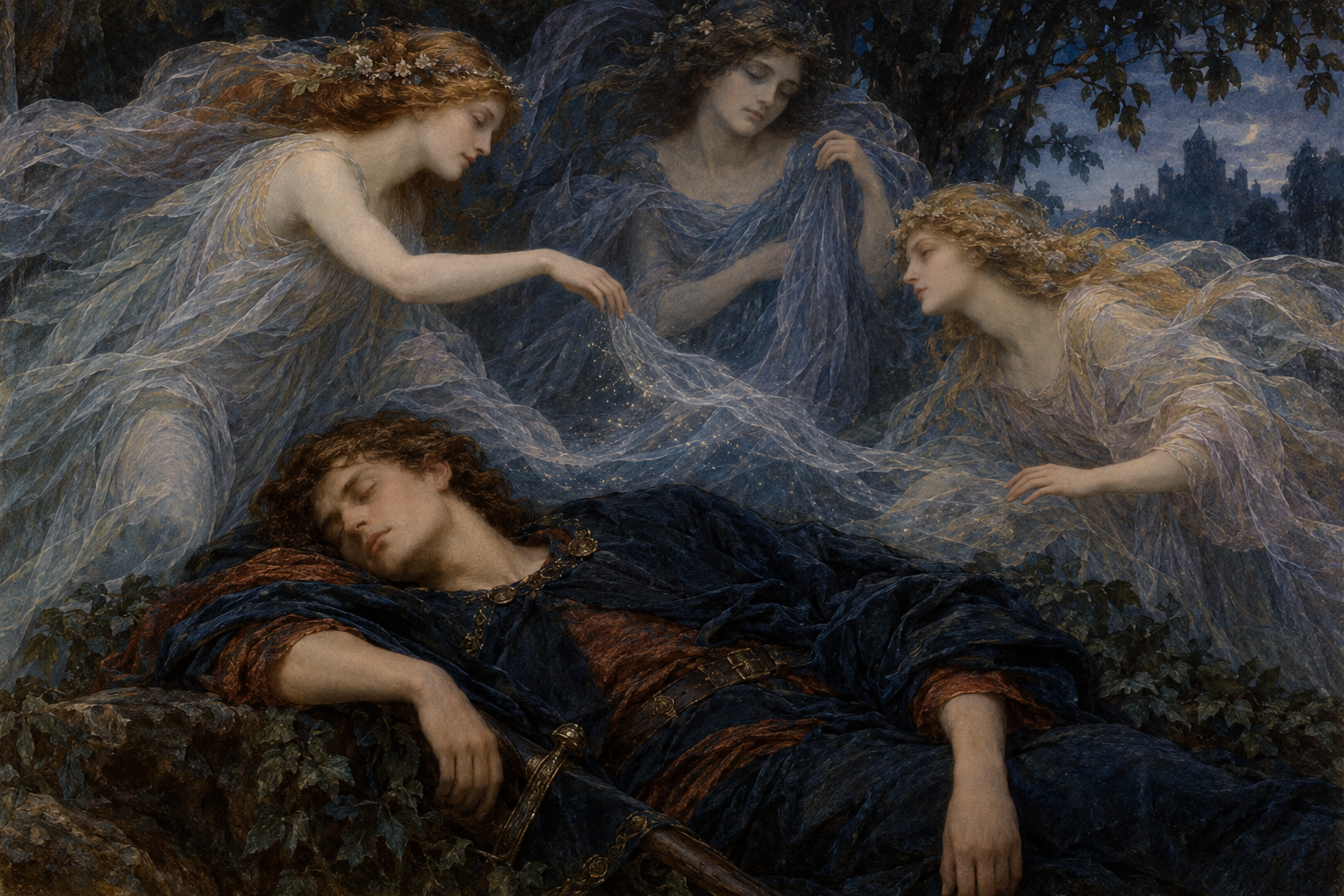
Sleep overwhelms creatures with magical slumber. In 2024 it incapacitates chosen targets before a second Wisdom save; in 2014 it spends a pool of hit points; in Pathfinder 1e and D&D 3.5e it affects up to 4 Hit Dice.
At a Glance
| D&D 5.5e / 2024 | Level: 1st-level Enchantment; Casting: Action; 60 feet; Area: 5-foot-radius Sphere; Save: Wisdom; Duration: Concentration, up to 1 minute; Result: First failure: Incapacitated; second failure: Unconscious; Ends for a target: Damage or an adjacent creature using an action to shake it out of the effect |
|---|---|
| 5e / 2014 | Level 1 Enchantment; 1 action; 90 feet; 20-foot-radius area; 1 minute; no Concentration or save; 5d8 hit-point pool; +2d8 per slot level above 1st. |
| Pathfinder 1e | Level: 1st-level Enchantment (Compulsion) [mind-affecting]; Casting: 1 round; Medium range; Area: 10-foot-radius burst; Save: Will negates; Spell Resistance: Yes; Duration: 1 minute per caster level; Result: Up to 4 HD, lowest HD first |
| D&D 3.5e | Level: Bard 1, Sorcerer/Wizard 1; Casting: 1 round; Medium range; Area: 10-foot-radius burst; Save: Will negates; Spell Resistance: Yes; Duration: 1 minute per level; Result: Up to 4 HD, lowest HD first |
Spell Mechanics by Edition
Sleep — D&D 5.5e / 2024
Bard, Sorcerer and Wizard
| Casting Time | Action |
|---|---|
| Range | 60 feet |
| Components | V, S, M (a pinch of sand or rose petals) |
| Duration | Concentration, up to 1 minute |
| Area | 5-foot-radius Sphere centred on a point within range |
| Saving Throw | Wisdom |
Each creature you choose in the Sphere makes a Wisdom saving throw. On a failed save, the creature has the Incapacitated condition until the end of its next turn. At that point, it repeats the saving throw.
If the creature fails the second save, it has the Unconscious condition for the remaining duration. The spell ends on that target if it takes damage or if a creature within 5 feet of it takes an action to shake it out of the spell’s effect.
A creature that does not sleep, such as an elf, or that has Immunity to the Exhaustion condition automatically succeeds on its saving throws against this spell.
D&D 2024 interactions
- The caster chooses which creatures in the Sphere make saving throws, so allies can be excluded.
- The Sphere determines which creatures are checked when the spell is cast. An affected creature does not need to remain inside the original area.
- An Incapacitated creature cannot take actions, Bonus Actions or Reactions, cannot speak and loses Concentration.
- A creature that becomes Unconscious is also Incapacitated and Prone, drops what it is holding, has Speed 0 and suffers the normal attack and saving-throw consequences of the Unconscious condition.
- Damage ends the effect on the target during either the initial Incapacitated stage or the later Unconscious stage.
- If the caster loses Concentration, every remaining effect of the spell ends.
- The spell provides no additional benefit when cast with a higher-level spell slot.
- Counterspell can interrupt the visible casting before Sleep resolves. The caster makes the Constitution saving throw required by the 2024 counterspell.
- Dispel Magic can end the ongoing spell on a chosen affected creature under the 2024 dispelling rules.
- Shield does not protect against Sleep, because the spell makes no attack roll and does not trigger Shield through Magic Missile.
Sleep — 5e / 2014
| Level / classes | 1st-level Enchantment; Bard, Sorcerer, Wizard |
|---|---|
| Casting time | 1 action |
| Range / area | 90 feet; creatures within 20 feet of a chosen point |
| Components | V, S, M (fine sand, rose petals, or a cricket) |
| Duration | 1 minute; no Concentration |
| Saving throw | None |
Roll 5d8 for a shared hit-point allowance. Consider creatures in the area from lowest current hit points upward, ignoring unconscious creatures. A creature falls unconscious only if its current hit points fit the remaining allowance; subtract that amount before considering the next creature.
A sleeper wakes when the duration expires, it takes damage, or someone spends an action shaking or slapping it awake. Undead and creatures immune to being charmed are unaffected; specific traits preventing magical sleep also apply.
Higher-level slots: add 2d8 to the allowance for each slot level above 1st.
Practical use
Allies can be caught by the allocation. Wounded enemies are easier to affect because the spell checks current hit points. The spell requires neither a saving throw nor ongoing Concentration.
Sleep — Pathfinder 1e
Adept 1, Arcanist 1, Bard 1, Mesmerist 1, Occultist 1, Psychic 1, Sahir-Afiyun 1, Shaman 1, Skald 1, Sorcerer 1, Witch 1, Wizard 1
| Casting Time | 1 round |
|---|---|
| Components | V, S, M (fine sand, rose petals or a live cricket) |
| Range | Medium (100 feet + 10 feet per caster level) |
| Area | One or more living creatures within a 10-foot-radius burst |
| Duration | 1 minute per caster level |
| Saving Throw | Will negates |
| Spell Resistance | Yes |
The spell brings magical slumber upon up to 4 HD of creatures. Creatures with the fewest Hit Dice are affected first. Among creatures with equal Hit Dice, those closest to the spell’s point of origin are affected first. Hit Dice that are insufficient to affect the next creature are wasted.
A sleeping creature is helpless. Slapping or wounding it awakens it, but normal noise does not. Awakening another creature is a standard action and an application of the aid another action.
The spell does not target unconscious creatures, constructs or undead creatures.
Mythic Sleep
The mythic version affects up to 8 HD and allows the caster to choose the order in which creatures are affected. An effect that would automatically awaken a sleeping creature instead allows it to attempt a new Will saving throw to awaken.
When augmented at 8th mythic tier by expending three uses of mythic power, the spell can target all other living creatures of 8 HD or fewer within a 1-mile radius centred on the caster. Creatures that fail their saves sleep for a number of days equal to the caster’s tier. The caster can exempt a number of creatures equal to that tier.
Pathfinder 1e interactions
- The 1-round casting time requires the caster to continue casting until immediately before the caster’s next turn. Damage or another disruption can cause the spell to be lost.
- Each creature reached by the HD allocation receives its own Will save and applies spell resistance normally.
- Damage awakens a sleeping creature because wounding is an explicit waking method.
- Lullaby can reduce a legacy target’s Will save against sleep effects. It does not alter the D&D 2024 spell.
- Deep Slumber is the higher-capacity legacy development of the same basic effect.
- A caster who has readied a counterspell can counter Sleep with another casting of Sleep or can attempt to counter it with Dispel Magic.
- Dispel Magic can also remove an ongoing effect through the Pathfinder dispel-check procedure.
- Shield does not apply because Sleep uses a Will save and spell resistance rather than an attack roll.
Sleep — D&D 3.5e
| Casting Time | 1 round |
|---|---|
| Components | V, S, M |
| Range | Medium (100 feet + 10 feet per level) |
| Area | One or more living creatures within a 10-foot-radius burst |
| Duration | 1 minute per level |
| Saving Throw | Will negates |
| Spell Resistance | Yes |
The spell causes magical slumber to come upon up to 4 Hit Dice of creatures. Creatures with the fewest Hit Dice are affected first. Among creatures with equal Hit Dice, those nearest the point of origin are affected first. Any remaining Hit Dice that cannot affect the next creature are wasted.
Sleeping creatures are helpless. Slapping or wounding an affected creature awakens it, but normal noise does not. Awakening another creature is a standard action and an application of the aid another action.
The spell does not target unconscious creatures, constructs or undead creatures.
Material component: a pinch of fine sand, rose petals or a live cricket.
D&D 3.5e interactions
- The spell completes immediately before the caster’s next turn, leaving the caster vulnerable to interruption throughout the 1-round casting time.
- Each creature reached by the 4-HD allocation receives its own Will save and applies spell resistance.
- Lullaby imposes a penalty on Will saves against sleep effects.
- Deep Slumber raises the legacy capacity to 10 HD.
- A caster who has readied a counterspell can counter Sleep with another casting of Sleep or can attempt to counter it with Dispel Magic.
- Dispel Magic can also end an ongoing effect through the D&D 3.5e dispel-check rules.
- Shield does not apply because Sleep uses a Will save and spell resistance rather than an attack roll.
How the Spell Resolves
The 2024 spell resolves in two saving throws. The 2014 spell spends hit points, while Pathfinder 1e and D&D 3.5e allocate Hit Dice.
D&D 2024 resolution
- Place the Sphere.
Choose a point within 60 feet and identify the creatures you choose inside the 5-foot-radius Sphere. - Make the first saves.
Each chosen creature makes a Wisdom save. A failure causes Incapacitated until the end of that creature’s next turn. - Check early endings.
Damage, an adjacent creature’s shaking action or the caster losing Concentration can end the effect before the second save. - Make the second save.
At the end of its next turn, the affected creature repeats the save. A second failure causes Unconscious for the remaining duration.
D&D 2014 resolution
Place the area, roll the hit-point allowance, then work upward from the eligible creature with the lowest current hit points. Subtract each sleeping creature’s current hit points from the allowance.
Pathfinder 1e and D&D 3.5e resolution
- Choose the burst.
Place the 10-foot-radius burst at a point within Medium range. - Order eligible creatures.
Begin with the creatures that have the fewest Hit Dice. Break equal-HD ties by distance from the point of origin. - Allocate 4 HD.
Continue through the ordered creatures until the 4-HD allowance is exhausted. Any remainder that cannot affect the next creature is lost. - Resolve defences.
Each creature reached by the allocation applies spell resistance and attempts its Will save as required by that edition.
Edition Comparison
| Rule | D&D 2024 | D&D 2014 | Pathfinder 1e | D&D 3.5e |
|---|---|---|---|---|
| Who is affected? | Each creature the caster chooses in the Sphere | Creatures in the area, lowest current hit points first | Eligible living creatures assigned through the 4-HD order | Eligible living creatures assigned through the 4-HD order |
| Primary defence | Wisdom saving throw | Hit-point allowance; no save | Will saving throw and spell resistance | Will saving throw and spell resistance |
| Initial result | Incapacitated after one failed save | Unconscious immediately | Magically asleep and helpless after a failed save | Magically asleep and helpless after a failed save |
| Unconsciousness | Requires a second failed Wisdom save | Applies immediately when hit points fit the allowance | The sleeping state applies immediately | The sleeping state applies immediately |
| Friendly creatures | Can be excluded by the caster | May be caught; no exclusion choice | Can be caught if their HD and position place them in the allocation | Can be caught if their HD and position place them in the allocation |
| Sustaining the spell | Requires Concentration | No Concentration | No Concentration after the 1-round casting is completed | No Concentration after the 1-round casting is completed |
| Scaling | No higher-level-slot improvement | An additional 2d8 per slot level above 1st | Duration increases with caster level; capacity remains 4 HD | Duration increases with level; capacity remains 4 HD |
Tactics, Counters and Adjudication
Placing the area
In D&D 2024, the small Sphere rewards precise placement and allows the caster to omit allies. In D&D 2014, avoid including wounded allies who could consume the hit-point allowance. In the legacy systems, position the burst so that low-HD enemies are closest to its centre and avoid including weak allies who could consume the limited allocation.
Breaking the effect
Damage is a practical answer in every edition. In D&D 2024, damage ends the spell on that target even during the initial Incapacitated stage. The D&D 2014 sleeper also wakes on damage. In Pathfinder 1e and D&D 3.5e, wounding explicitly awakens a sleeping creature.
Using an action to awaken
The editions use different distances and action language. The D&D 2024 helper must be within 5 feet and take an action to shake the target out of the effect. In D&D 2014, someone spends an action shaking or slapping the sleeper awake. A legacy helper uses a standard action and the aid another action.
Immunities and exclusions
In D&D 2024, creatures that do not sleep and creatures immune to Exhaustion automatically succeed. In D&D 2014, undead and creatures immune to being charmed are unaffected, and specific magical-sleep immunities apply. In the legacy versions, unconscious creatures, constructs and undead are excluded from targeting. Do not transfer either list into another edition.
Concentration and disruption
The D&D 2024 caster risks losing every remaining effect when Concentration ends. Legacy casters face their main vulnerability before resolution because the spell requires a 1-round casting time.
Counterspell and Dispel Magic
Counterspell can prevent the D&D 2024 spell from resolving. In Pathfinder 1e and D&D 3.5e, a readied caster can counter with Sleep itself or use Dispel Magic. Once the spell is active, Dispel Magic can end it using the procedure of the edition in play.
Historical and Occult Development
Magical sleep in fantasy draws on a long cultural overlap between sacred dreaming, trance, medical experiment and art. These traditions offer useful parallels rather than a single direct line of development.
Sacred sleep and dream incubation
In the ancient Greek and Roman worlds, people seeking healing could sleep at sanctuaries of Asclepius in the hope of receiving a diagnostic or curative dream. Sleep became an active ritual threshold through which divine aid might reach the sufferer.
Mesmerism and hypnotic trance
Late eighteenth- and nineteenth-century mesmerists described induced trance as the action of animal magnetism. Later hypnotists reframed similar sleep-like states through attention, suggestion and physiology, while popular culture retained their aura of occult command.
Wellcome Collection: The Rise and Fall of a Medical Mesmerist
Occultism, art and Hypnos
Nineteenth-century writers and artists repeatedly placed hypnosis beside magic, witchcraft and psychic experiment. Symbolist artist Fernand Khnopff created a private devotional setting around Hypnos, joining dream, ritual and artistic creation.
Wellcome Collection: James Braid on magic and hypnotism
The Metropolitan Museum of Art: Fernand Khnopff, The Offering
Mythological Parallels
Hypnos and the sleep of Zeus
Greek myth personifies sleep as Hypnos. Hera persuades him to overpower Zeus with sleep, closely paralleling a spell that neutralises a formidable being through a moment of supernatural vulnerability.
Hypnos, Thanatos and Sarpedon
Hypnos and his twin Thanatos carry the fallen Sarpedon from the battlefield. Their pairing gives sleep and death a shared visual language while preserving their distinction: one suspends awareness while the other ends life.
Endymion’s unending sleep
Endymion’s perpetual youthful slumber, watched over by Selene, turns sleep into enchanted suspension outside ordinary time. It parallels later tales of sleepers preserved until an external act breaks the enchantment.
The Oneiroi and the dream threshold
The Oneiroi embody dreams passing from the night world into sleeping minds. Their myths add an imaginative second layer to magical slumber: the rules determine the condition, while dreams, visions and omens shape the fiction.
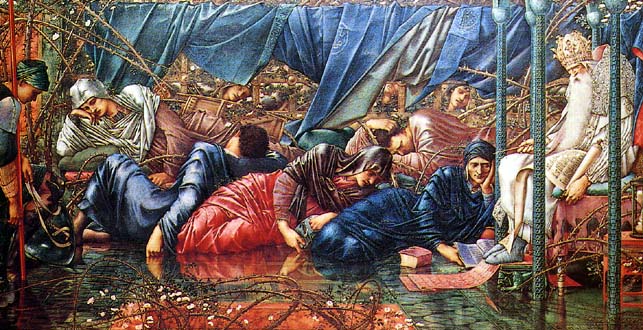
The Enchanted Court
Edward Burne-Jones’s sleeping court offers a fairy-tale image of an entire household arrested by supernatural slumber.
Related Spells
- Lullaby — A preparatory legacy spell that weakens resistance to magical sleep.
- Deep Slumber — The higher-capacity legacy development of Sleep, affecting up to 10 HD.
- Dispel Magic — The principal magical method for ending an active Sleep effect after it resolves.
- Counterspell — The D&D 2024 reaction that can prevent a visible casting of Sleep from resolving.
- Shield — A defensive spell that does not stop Sleep, because no attack roll or Magic Missile interaction is involved.
Sleep Spell FAQ
Does one failed save make a creature Unconscious in D&D 2024?
No. The first failed Wisdom save makes the creature Incapacitated until the end of its next turn. It becomes Unconscious only after failing the second save.
Can the D&D 2024 caster exclude allies?
Yes. The caster chooses which creatures in the Sphere make saving throws. Pathfinder 1e and D&D 3.5e do not use that selection method; their 4-HD effect follows the lowest-HD and nearest-creature order.
Does moving out of the D&D 2024 Sphere end the spell?
No. The Sphere identifies creatures when the spell is cast. Once a creature is affected, the spell gives no continuing requirement for it to remain inside the original area.
Does damage wake a sleeping creature?
Yes. In D&D 2024, taking damage ends the spell on that target. In Pathfinder 1e and D&D 3.5e, wounding explicitly awakens the creature.
Does immunity to being Charmed stop the D&D 2024 spell?
Not by itself. The spell does not impose the Charmed condition. A creature automatically succeeds if it does not sleep or has Immunity to Exhaustion, and any more specific creature trait still applies.
Does Shield stop the Sleep spell?
No. Shield protects against attacks and has a special interaction with Magic Missile. Sleep uses saving throws, hit-point allocation, Hit Dice allocation or spell resistance depending on the edition.
Can Sleep be cast with a higher-level spell slot?
D&D 2014 adds 2d8 to its hit-point allowance for each slot level above 1st. D&D 2024 provides no enhanced effect. Pathfinder 1e and D&D 3.5e retain their 4-HD capacity, while duration increases with caster level.
Rules, Research and Licensing
- System Reference Document 5.1 — D&D 2014 rules.
- System Reference Document 5.2.1 — D&D 2024 spell and condition rules.
- Archives of Nethys: Sleep — Pathfinder 1e rules.
- Hypertext d20 SRD: Sleep — D&D 3.5e rules.
- University College London: Dreams in Ancient Medicine.
- Wellcome Collection: The Rise and Fall of a Medical Mesmerist.
- Wellcome Collection: James Braid on magic, animal magnetism and hypnotism.
- The Metropolitan Museum of Art: Fernand Khnopff, The Offering.
- Theoi: Hypnos.
- Theoi: Endymion.
- Theoi: Oneiroi.
- Wikimedia Commons: The Council Chamber.
Attribution and rules-use notice
This work includes material from the System Reference Document 5.2.1 (“SRD 5.2.1”) by Wizards of the Coast LLC, available at https://www.dndbeyond.com/srd. The SRD 5.2.1 is licensed under the Creative Commons Attribution 4.0 International License, available at https://creativecommons.org/licenses/by/4.0/legalcode.
This work includes material taken from the System Reference Document 5.1 (“SRD 5.1”) by Wizards of the Coast LLC and available at https://dnd.wizards.com/resources/systems-reference-document. The SRD 5.1 is licensed under the Creative Commons Attribution 4.0 International License available at https://creativecommons.org/licenses/by/4.0/legalcode.
Open Game License v1.0a & Copyright Notices
The Pathfinder 1e and D&D 3.5e rules material is Open Game Content used under this licence. Artwork, navigation, original commentary and setting material are excluded.
OPEN GAME LICENSE Version 1.0a
The following text is the property of Wizards of the Coast, Inc. and is Copyright 2000 Wizards of the Coast, Inc (“Wizards”). All Rights Reserved.
- Definitions: (a)”Contributors” means the copyright and/or trademark owners who have contributed Open Game Content; (b)”Derivative Material” means copyrighted material including derivative works and translations (including into other computer languages), potation, modification, correction, addition, extension, upgrade, improvement, compilation, abridgment or other form in which an existing work may be recast, transformed or adapted; (c)”Distribute” means to reproduce, license, rent, lease, sell, broadcast, publicly display, transmit or otherwise distribute; (d)”Open Game Content” means the game mechanic and includes the methods, procedures, processes and routines to the extent such content does not embody the Product Identity and is an enhancement over the prior art and any additional content clearly identified as Open Game Content by the Contributor, and means any work covered by this License, including translations and derivative works under copyright law, but specifically excludes Product Identity. (e)”Product Identity” means product and product line names, logos and identifying marks including trade dress; artifacts; creatures characters; stories, storylines, plots, thematic elements, dialogue, incidents, language, artwork, symbols, designs, depictions, likenesses, formats, poses, concepts, themes and graphic, photographic and other visual or audio representations; names and descriptions of characters, spells, enchantments, personalities, teams, personas, likenesses and special abilities; places, locations, environments, creatures, equipment, magical or supernatural abilities or effects, logos, symbols, or graphic designs; and any other trademark or registered trademark clearly identified as Product identity by the owner of the Product Identity, and which specifically excludes the Open Game Content; (f)”Trademark” means the logos, names, mark, sign, motto, designs that are used by a Contributor to identify itself or its products or the associated products contributed to the Open Game License (g)”Use”, “Used” or “Using” means to use, Distribute, copy, edit, format, modify, translate and otherwise create Derivative Material of Open Game Content. (h)”You” or “Your” means the licensee in terms of this agreement.
- The License: This License applies to any Open Game Content that contains a notice indicating that the Open Game Content may only be Used under and in terms of this License. You must affix such a notice to any Open Game Content that you Use. No terms may be added to or subtracted from this License except as described by the License itself. No other terms or conditions may be applied to any Open Game Content distributed using this License.
- Offer and Acceptance: By Using the Open Game Content You indicate Your acceptance of the terms of this License.
- Grant and Consideration: In consideration for agreeing to use this License, the Contributors grant You a perpetual, worldwide, royalty-free, non-exclusive license with the exact terms of this License to Use, the Open Game Content.
- Representation of Authority to Contribute: If You are contributing original material as Open Game Content, You represent that Your Contributions are Your original creation and/or You have sufficient rights to grant the rights conveyed by this License.
- Notice of License Copyright: You must update the COPYRIGHT NOTICE portion of this License to include the exact text of the COPYRIGHT NOTICE of any Open Game Content You are copying, modifying or distributing, and You must add the title, the copyright date, and the copyright holder’s name to the COPYRIGHT NOTICE of any original Open Game Content you Distribute.
- Use of Product Identity: You agree not to Use any Product Identity, including as an indication as to compatibility, except as expressly licensed in another, independent Agreement with the owner of each element of that Product Identity. You agree not to indicate compatibility or co-adaptability with any Trademark or Registered Trademark in conjunction with a work containing Open Game Content except as expressly licensed in another, independent Agreement with the owner of such Trademark or Registered Trademark. The use of any Product Identity in Open Game Content does not constitute a challenge to the ownership of that Product Identity. The owner of any Product Identity used in Open Game Content shall retain all rights, title and interest in and to that Product Identity.
- Identification: If you distribute Open Game Content You must clearly indicate which portions of the work that you are distributing are Open Game Content.
- Updating the License: Wizards or its designated Agents may publish updated versions of this License. You may use any authorized version of this License to copy, modify and distribute any Open Game Content originally distributed under any version of this License.
- Copy of this License: You MUST include a copy of this License with every copy of the Open Game Content You Distribute.
- Use of Contributor Credits: You may not market or advertise the Open Game Content using the name of any Contributor unless You have written permission from the Contributor to do so.
- Inability to Comply: If it is impossible for You to comply with any of the terms of this License with respect to some or all of the Open Game Content due to statute, judicial order, or governmental regulation then You may not Use any Open Game Material so affected.
- Termination: This License will terminate automatically if You fail to comply with all terms herein and fail to cure such breach within 30 days of becoming aware of the breach. All sublicenses shall survive the termination of this License.
- Reformation: If any provision of this License is held to be unenforceable, such provision shall be reformed only to the extent necessary to make it enforceable.
- COPYRIGHT NOTICE
Open Game License v 1.0a Copyright 2000, Wizards of the Coast, Inc.
System Reference Document Copyright 2000-2003, Wizards of the Coast, Inc.; Authors Jonathan Tweet, Monte Cook, Skip Williams, Rich Baker, Andy Collins, David Noonan, Rich Redman, Bruce R. Cordell, John D. Rateliff, Thomas Reid, James Wyatt, based on original material by E. Gary Gygax and Dave Arneson.
Pathfinder Roleplaying Game Core Rulebook © 2009, Paizo Publishing, LLC; Author: Jason Bulmahn, based on material by Jonathan Tweet, Monte Cook, and Skip Williams.
END OF LICENSE