
Bard Magic • Spell Reference
Suggestion Spell
Enchantment Guide
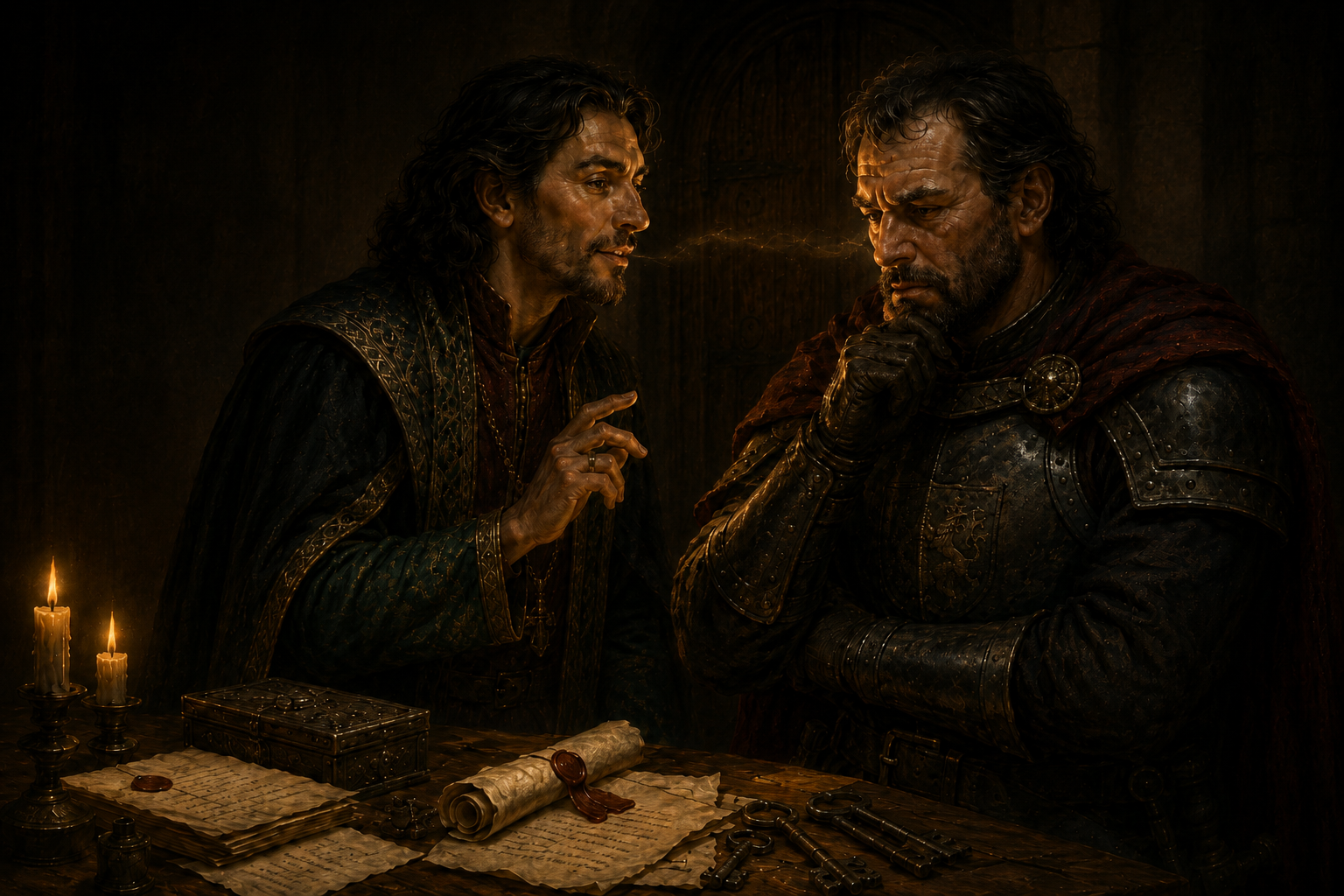
Honeyed words backed by magic can move a guard, redirect a witness, divide an enemy force, or place one disastrous decision into another person’s hands.
Suggestion is a spell of directed choice rather than direct puppetry. It does not erase memory or hand the caster unrestricted control of another creature. Instead, it places magical force behind a particular course of action and leaves the affected creature to carry that course out.
That makes it especially dangerous away from the obvious spectacle of battle. A guard sent to fetch a captain leaves a door unguarded. A witness persuaded to deliver a message loses precious time. A mercenary sent to demand overdue wages may simply walk out of a fight. In intrigue, infiltration, investigation, and diplomacy, one redirected decision can matter more than a defeated enemy.
Suggestion at a Glance
| 5.5e / 2024 | Bard 2 • Enchantment • 25 words • 30 feet • Concentration, up to 8 hours |
|---|---|
| 5e / 2014 | Bard 2 • Enchantment • One or two sentences • 30 feet • Concentration, up to 8 hours |
| Pathfinder 1e | Bard 2 • Enchantment (compulsion) • Close range • 1 hour/level or until completed |
| D&D 3.5e | Bard 2 • Enchantment (compulsion) • Close range • 1 hour/level or until completed |
Spell Rules by Edition
Suggestion — 5.5e / 2024
Rules source: System Reference Document 5.2.1.
| Level & School | Level 2 Enchantment |
|---|---|
| Classes | Bard, Sorcerer, Warlock, Wizard |
| Casting Time | Action |
| Range | 30 feet |
| Components | V, M |
| Material | A drop of honey |
| Duration | Concentration, up to 8 hours |
| Saving Throw | Wisdom |
Effect
You magically propose a course of activity to one creature you can see within range. The creature must be able to hear and understand you, and the complete course must be described in 25 words or fewer.
The proposed activity must sound achievable and cannot involve anything that would obviously deal damage to the target or its allies.
The creature makes a Wisdom saving throw. On a failed save, it has the Charmed condition for the duration and follows the suggested course to the best of its ability.
The spell ends early when the creature completes the suggested activity. It also ends if you or one of your allies deals damage to the affected creature, if your Concentration ends, or when the spell’s duration expires.
Using the Spell
Suggestion works best when the course is clear enough for the creature to act upon without further instructions. Sending a guard to fetch a superior, directing a messenger to deliver a warning, persuading an enemy to withdraw from a fight, or telling someone to surrender can all be useful applications when the proposed activity satisfies the spell’s requirements.
The spell does not erase memory. The creature can normally remember the conversation, the actions it took, and what happened while the enchantment was in effect.
Suggestion — 5e / 2014
Rules source: System Reference Document 5.1.
| Level & School | 2nd-level enchantment |
|---|---|
| Classes | Bard, Sorcerer, Warlock, Wizard |
| Casting Time | 1 action |
| Range | 30 feet |
| Components | V, M (a snake’s tongue and either a bit of honeycomb or a drop of sweet oil) |
| Duration | Concentration, up to 8 hours |
| Saving Throw | Wisdom |
You suggest a course of activity, limited to a sentence or two, to one creature you can see within range that can hear and understand you. Creatures immune to being charmed are immune to this spell. Word the suggestion so that the activity sounds reasonable; asking for an obviously harmful act ends the spell.
The target makes a Wisdom saving throw. If it fails, it follows the suggested activity to the best of its ability. The activity can last for the duration, but completing it sooner ends the spell.
You can specify conditions that trigger a special activity during the duration. If those conditions never occur before the spell expires, the activity is not performed.
If you or any of your companions damage the target, the spell ends. It also ends when Concentration ends or the duration expires. This version does not explicitly impose the Charmed condition, even though immunity to being charmed prevents the effect.
Suggestion — Pathfinder 1e
Rules source: Archives of Nethys — Suggestion.
| School | Enchantment (Compulsion) [Language-Dependent, Mind-Affecting] |
|---|---|
| Levels | Arcanist 3; Bard 2; Medium 2; Mesmerist 2; Occultist 3; Psychic 2; Skald 2; Sorcerer 3; Witch 3; Wizard 3 |
| Casting Time | 1 standard action |
| Range | Close (25 ft. + 5 ft./2 levels) |
| Components | V, M |
| Material | A snake’s tongue and a honeycomb |
| Target | One living creature |
| Duration | 1 hour/level or until completed |
| Saving Throw | Will negates |
| Spell Resistance | Yes |
Effect
You influence one living creature by suggesting a course of activity limited to a sentence or two. The wording must make the proposed course sound reasonable. Asking the creature to perform an obviously harmful act prevents the spell from taking effect.
The suggested activity can continue for the full duration or end sooner when the creature completes it.
You can specify a condition that causes the creature to perform a particular activity if that condition occurs before the spell ends. If the condition is never met, the activity is not performed.
A particularly reasonable suggestion can make the magic harder to resist. A penalty of –1 or –2 on the creature’s Will save is typical for especially convincing wording.
Spell resistance applies normally.
Mythic Suggestion
Mythic Suggestion removes the language-dependent descriptor and affects one or more living creatures in a 10-foot-radius burst.
Each affected creature is subject to the spell’s normal rules except where the mythic version specifically changes them.
Suggestion — D&D 3.5e
Rules source: D&D 3.5 SRD — Suggestion.
| School | Enchantment (Compulsion) [Language-Dependent, Mind-Affecting] |
|---|---|
| Level | Bard 2; Sorcerer/Wizard 3 |
| Casting Time | 1 standard action |
| Range | Close (25 ft. + 5 ft./2 levels) |
| Components | V, M |
| Material | A snake’s tongue and either a bit of honeycomb or a drop of sweet oil |
| Target | One living creature |
| Duration | 1 hour/level or until completed |
| Saving Throw | Will negates |
| Spell Resistance | Yes |
Effect
You influence one living creature by suggesting a course of activity limited to a sentence or two. The wording must make the proposed course sound reasonable. An obviously harmful act automatically negates the effect of the spell.
The suggested activity can continue for the entire duration or end sooner when the creature completes it.
You can specify a condition that triggers a particular activity during the spell’s duration. If the condition does not occur before the spell ends, the activity is never performed.
Particularly reasonable wording can impose a penalty on the creature’s Will saving throw. A –1 or –2 penalty is typical for an especially reasonable suggestion.
Spell resistance applies normally.
What Changed Between Editions
| 2024 versus 2014 | 2024 limits the instruction to 25 words, requires an achievable course with no obvious damage to the target or its allies, explicitly gives the Charmed condition, and uses a drop of honey. 2014 uses one or two sentences, reasonable wording, an obviously harmful act restriction, and a snake’s tongue with honeycomb or sweet oil. Both require Concentration for up to 8 hours and end if the caster or companions damage the target. |
|---|---|
| Conditional instructions | 2014, Pathfinder, and 3.5 expressly allow an activity triggered by a condition during the duration. The 2024 text instead describes one achievable course and contains no separate conditional-trigger rule. |
| Pathfinder and 3.5 | Both use caster-level duration, close range, a Will save, and Spell Resistance. Especially reasonable wording may penalise the save. Pathfinder requires honeycomb alongside the snake’s tongue; 3.5 also permits sweet oil. Neither base spell uses the modern Concentration duration. |
Legacy D&D 3.0e Reference
Suggestion — D&D 3.0e
School: Enchantment (Compulsion) [Language-Dependent, Mind-Affecting]
Level: Bard 2, Sorcerer/Wizard 3
Components: V, M
Casting Time: 1 standard action
Range: Close (25 ft. + 5 ft./2 levels)
Target: One living creature
Duration: 1 hour/level or until completed
Saving Throw: Will negates
Spell Resistance: Yes
You influence a creature by suggesting a course of activity limited to a sentence or two. The wording must make the activity sound reasonable, and an obviously harmful act negates the spell.
The activity can continue for the duration or end sooner when completed. A condition can also be established to trigger a particular activity before the spell expires.
Very reasonable wording can impose a –1 or –2 penalty on the target’s Will saving throw.
The material component is a snake’s tongue and either a bit of honeycomb or a drop of sweet oil.
Using Suggestion in Play
Suggestion is at its best when it changes the shape of a scene rather than replacing the scene altogether. Sending a sentry to fetch a superior can create an opening without leaving a body behind. Redirecting a messenger can delay reinforcements. Convincing a mercenary to seek overdue pay can remove a dangerous combatant without a fight.
In intrigue, the spell is particularly effective at controlling timing. A witness can be delayed, a courtier sent elsewhere, a rival separated from allies, or an official pushed toward the one bureaucratic action that benefits the caster. The most effective suggestions usually connect with something the target can readily do in the situation.
During combat, intelligent enemies are better targets than mindless ones because they have responsibilities beyond attacking the party. A commander might leave to secure a hostage. A priest might withdraw to protect a relic. A scout might be sent to warn the rear guard. In 5.5e / 2024 and 5e / 2014, damage dealt to the affected creature by the caster or the caster’s companions ends the spell, so the party must decide whether removing that enemy from the fight is worth leaving them unharmed.
Investigation offers subtler possibilities. Rather than demanding a confession, the caster can sometimes make a suspect reveal priorities through action. Someone told to secure the documents most likely to cause embarrassment may lead investigators directly to what matters.
Common Rulings
Can Suggestion make someone attack an ally?
In 5.5e / 2024, not when the proposed course obviously involves dealing damage to that ally. 5e / 2014, Pathfinder 1e, and D&D 3.5e instead judge the instruction through their reasonableness and harmful-act restrictions.
Can Suggestion make someone surrender or run away?
Yes, potentially. In the 2024 rules, an achievable surrender or retreat is not automatically invalid simply because the target would rather keep fighting. In the older rules, the circumstances must make the course sound reasonable.
Can Suggestion make someone give away property?
The 2024 spell does not automatically reject an instruction because it is financially foolish or personally disadvantageous. 5e / 2014, Pathfinder 1e, and D&D 3.5e retain a reasonableness requirement because the suggestion must sound reasonable and cannot be obviously harmful.
Can it force a confession?
It can direct a creature to speak, but it does not guarantee that what the creature says is true. For magic concerned specifically with truthful testimony, see Zone of Truth.
Does the target remember what happened?
Suggestion contains no memory-erasing effect. The target can normally remember the conversation, the course it followed, and the consequences. If memory itself must be changed, see Modify Memory.
Can one casting create several commands?
The spell establishes one course of activity, though that course can contain connected steps. It does not create a standing order to obey everything the caster says. For much broader control, compare Dominate Person.
Consent, Memory, and Consequences
Suggestion is unsettling because the affected creature carries out the imposed course through its own actions. The victim may speak normally, walk willingly, and remember everything afterward, yet the crucial decision was shaped by magic rather than freely made.
That distinction matters once the spell ends. A charmed guard may become furious at having abandoned a post. A merchant may demand the return of property. A courtier may realise that a seemingly sensible decision ruined an alliance. A witness may remember both the caster’s words and the statement later made because of them.
In a world where enchantment is known, magical coercion can become a serious legal matter. Using Suggestion on a common porter may result in local prosecution or retaliation. Using it on a sworn witness, guild treasurer, ambassador, military commander, judge, or ruler can become evidence tampering, treason, or an act of war.
Suggestion in the World
Suggestion threatens the trust on which courts, armies, guilds, noble households, and mercantile networks depend. A ruler does not need to be permanently enslaved for enchantment to change history. One altered order, delayed messenger, abandoned gate, redirected patrol, or compromised witness may be enough.
Institutions familiar with enchantment therefore have reasons to build procedure around it. Important agreements may require several witnesses. Testimony can be repeated after a delay. Sensitive orders may need seals, countersigns, or confirmation from more than one official. Courts may call upon independent spellcasters when coercion is suspected.
Magic such as Zone of Truth can help establish whether someone is knowingly lying, but even truthful testimony may not reveal why a person sincerely believed an enchanted course was the right thing to do.
Historical and Mythic Context
The fear behind Suggestion is far older than fantasy roleplaying. Myth, ritual, law, poetry, and folklore repeatedly treat carefully chosen words as forces capable of calming anger, redirecting violence, weakening judgement, binding behaviour, or making an unwelcome idea feel compelling.
Peitho and Persuasion
Ancient Greek tradition gave persuasion divine form in Peitho, associated with winning speech, attraction, negotiation, and reconciliation. She appears alongside Aphrodite in Greek art and literature, where persuasion can create peace and agreement but can also conceal coercion beneath charm and desire.
The J. Paul Getty Museum identifies Peitho directly as the goddess of Persuasion. She is a useful mythic parallel for Suggestion because her power lies not in physical force but in turning another person’s judgement.
Binding Words
Ancient Greek and Roman magical practice included binding spells scratched onto lead tablets. Names, commands, appeals, and ritual formulae could be folded, pierced, buried, or deposited in places believed to carry supernatural power.
Such rites sought to silence opponents, restrain rivals, alter affection, recover stolen property, or place enemies under supernatural control. The National Archaeological Museum of Greece preserves a striking surviving example.
These rituals differ greatly from the quick spoken spell, but they share the same anxiety: words can attach themselves to another person and interfere with intention.
Geis and Geas
Medieval Irish literature preserves another form of supernatural obligation in the geis, later anglicised as geas. A geis may command an action, forbid particular conduct, or bind a hero or ruler to conditions whose meaning becomes clear only later.
Conaire Mór’s accumulating prohibitions in The Destruction of Da Derga’s Hostel show how such obligations can become entangled with honour, identity, kingship, and fate.
Suggestion is much shorter-lived, but both ideas treat language as something capable of placing a burden on conduct. For the game’s stronger and longer-lasting form of magical obligation, see Geas/Quest.
Glamour and Altered Judgement
The older Scottish meaning of glamour referred to magical deception rather than elegance. The Dictionary of the Scots Language records the word in connection with witchcraft and deceptive appearances.
Glamour usually alters perception rather than directly compelling action, but the result can be similar. A stranger who appears trustworthy, a dangerous road that seems safe, or an enemy who resembles a friend can lead a victim toward precisely the choice an enchanter wants.
Honeyed Speech and the Serpent’s Tongue
The spell’s material symbolism changed with the rules. SRD 5.2.1 uses a drop of honey. Pathfinder 1e uses a snake’s tongue and a honeycomb. D&D 3.5e uses a snake’s tongue with either honeycomb or sweet oil.
The imagery is apt. Honey and sweet oil evoke attractive speech, while the serpent’s tongue suggests concealed intention and danger beneath persuasive words.
Hypnotism and the Suggestible Mind
During the nineteenth century, mesmerism and hypnotism generated intense debate about whether one person’s will could be weakened or redirected by another. Popular fears soon gathered around invisible influence, criminal compulsion, altered memory, and apparently respectable people performing acts they would normally refuse.
Fantasy turns those fears into genuine supernatural power. Real clinical hypnosis does not provide control comparable to this spell; modern medical guidance from the Mayo Clinic describes hypnosis as a therapeutic technique rather than magical domination.
Artistic Context: Influences
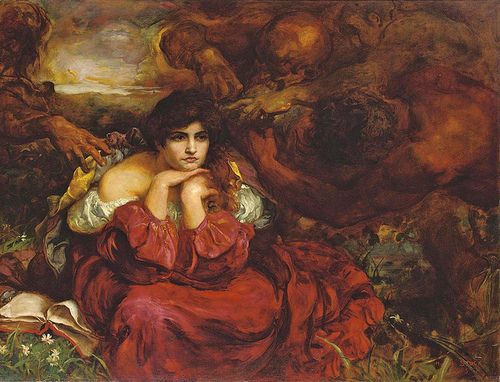
Henry John Stock’s 1905 painting Influences offers a fitting visual parallel: the mind appears surrounded by pressures that are difficult to separate from its own desires and fears.
A public-domain reproduction and provenance information are available through Wikimedia Commons.
Related Spells
Sources and Attribution
5.5e / 2024
This work includes material from the System Reference Document 5.2.1 (“SRD 5.2.1”) by Wizards of the Coast LLC, available at D&D Beyond. The SRD 5.2.1 is licensed under the Creative Commons Attribution 4.0 International License.
Pathfinder 1e
Pathfinder 1e mechanics were checked against Archives of Nethys — Suggestion. The base spell appears in the Pathfinder Roleplaying Game Core Rulebook; Mythic Suggestion appears in Mythic Adventures.
D&D 3.5e
D&D 3.5e mechanics were checked against the D&D 3.5 SRD — Suggestion. Applicable D&D 3.x and Pathfinder Open Game Content remains subject to the relevant Open Game License terms.
Historical and Mythic Sources
- J. Paul Getty Museum — Peitho
- J. Paul Getty Museum — Aphrodite and the Gods of Love
- National Archaeological Museum of Greece — Ancient Binding Tablet
- University College Cork CELT — The Destruction of Da Derga’s Hostel
- Dictionary of the Scots Language — Glamour
- British Museum — Henry John Stock
- Wikimedia Commons — Henry John Stock, Influences
- Mayo Clinic — Hypnosis
Rules Sources and Licensing
This work includes material taken from the System Reference Document 5.1 (“SRD 5.1”) by Wizards of the Coast LLC and available at https://dnd.wizards.com/resources/systems-reference-document. The SRD 5.1 is licensed under the Creative Commons Attribution 4.0 International License available at https://creativecommons.org/licenses/by/4.0/legalcode.
This work includes material from the System Reference Document 5.2.1 (“SRD 5.2.1”) by Wizards of the Coast LLC, available at https://www.dndbeyond.com/srd. The SRD 5.2.1 is licensed under the Creative Commons Attribution 4.0 International License, available at https://creativecommons.org/licenses/by/4.0/legalcode.
The Pathfinder and 3.5 spell mechanics and their tables are Open Game Content under the Open Game License v1.0a. Artwork and original setting prose are excluded from that designation.
Open Game License v1.0a and copyright notices
Permission to copy, modify and distribute the files collectively known as the System Reference Document (“SRD”) is granted solely through the use of the Open Gaming License, Version 1.0a.
This material is being released using the Open Gaming License Version 1.0a and you should read and understand the terms of that license before using this material.
The text of the Open Gaming License itself is not Open Game Content. Instructions on using the License are provided within the License itself.
The following items are designated Product Identity, as defined in Section 1(e) of the Open Game License Version 1.0a, and are subject to the conditions set forth in Section 7 of the OGL, and are not Open Content: Dungeons & Dragons, D&D, Player’s Handbook, Dungeon Master, Monster Manual, d20 System, Wizards of the Coast, d20 (when used as a trademark), Forgotten Realms, Faerûn, proper names (including those used in the names of spells or items), places, Red Wizard of Thay, the City of Union, Heroic Domains of Ysgard, Ever-Changing Chaos of Limbo, Windswept Depths of Pandemonium, Infinite Layers of the Abyss, Tarterian Depths of Carceri, Gray Waste of Hades, Bleak Eternity of Gehenna, Nine Hells of Baator, Infernal Battlefield of Acheron, Clockwork Nirvana of Mechanus, Peaceable Kingdoms of Arcadia, Seven Mounting Heavens of Celestia, Twin Paradises of Bytopia, Blessed Fields of Elysium, Wilderness of the Beastlands, Olympian Glades of Arborea, Concordant Domain of the Outlands, Sigil, Lady of Pain, Book of Exalted Deeds, Book of Vile Darkness, beholder, gauth, carrion crawler, tanar’ri, baatezu, displacer beast, githyanki, githzerai, mind flayer, illithid, umber hulk, yuan-ti.
All of the rest of the SRD is Open Game Content as described in Section 1(d) of the License.
More information on the Open Game License can be found at www.wizards.com/d20.
The terms of the Open Gaming License Version 1.0a are as follows:
OPEN GAME LICENSE Version 1.0a
The following text is the property of Wizards of the Coast, Inc. and is Copyright 2000 Wizards of the Coast, Inc (“Wizards”). All Rights Reserved.
1. Definitions: (a)”Contributors” means the copyright and/or trademark owners who have contributed Open Game Content; (b)”Derivative Material” means copyrighted material including derivative works and translations (including into other computer languages), potation, modification, correction, addition, extension, upgrade, improvement, compilation, abridgment or other form in which an existing work may be recast, transformed or adapted; (c) “Distribute” means to reproduce, license, rent, lease, sell, broadcast, publicly display, transmit or otherwise distribute; (d)”Open Game Content” means the game mechanic and includes the methods, procedures, processes and routines to the extent such content does not embody the Product Identity and is an enhancement over the prior art and any additional content clearly identified as Open Game Content by the Contributor, and means any work covered by this License, including translations and derivative works under copyright law, but specifically excludes Product Identity. (e) “Product Identity” means product and product line names, logos and identifying marks including trade dress; artifacts; creatures characters; stories, storylines, plots, thematic elements, dialogue, incidents, language, artwork, symbols, designs, depictions, likenesses, formats, poses, concepts, themes and graphic, photographic and other visual or audio representations; names and descriptions of characters, spells, enchantments, personalities, teams, personas, likenesses and special abilities; places, locations, environments, creatures, equipment, magical or supernatural abilities or effects, logos, symbols, or graphic designs; and any other trademark or registered trademark clearly identified as Product identity by the owner of the Product Identity, and which specifically excludes the Open Game Content; (f) “Trademark” means the logos, names, mark, sign, motto, designs that are used by a Contributor to identify itself or its products or the associated products contributed to the Open Game License by the Contributor (g) “Use”, “Used” or “Using” means to use, Distribute, copy, edit, format, modify, translate and otherwise create Derivative Material of Open Game Content. (h) “You” or “Your” means the licensee in terms of this agreement.
2. The License: This License applies to any Open Game Content that contains a notice indicating that the Open Game Content may only be Used under and in terms of this License. You must affix such a notice to any Open Game Content that you Use. No terms may be added to or subtracted from this License except as described by the License itself. No other terms or conditions may be applied to any Open Game Content distributed using this License.
3.Offer and Acceptance: By Using the Open Game Content You indicate Your acceptance of the terms of this License.
4. Grant and Consideration: In consideration for agreeing to use this License, the Contributors grant You a perpetual, worldwide, royalty-free, non-exclusive license with the exact terms of this License to Use, the Open Game Content.
5.Representation of Authority to Contribute: If You are contributing original material as Open Game Content, You represent that Your Contributions are Your original creation and/or You have sufficient rights to grant the rights conveyed by this License.
6.Notice of License Copyright: You must update the COPYRIGHT NOTICE portion of this License to include the exact text of the COPYRIGHT NOTICE of any Open Game Content You are copying, modifying or distributing, and You must add the title, the copyright date, and the copyright holder’s name to the COPYRIGHT NOTICE of any original Open Game Content you Distribute.
7. Use of Product Identity: You agree not to Use any Product Identity, including as an indication as to compatibility, except as expressly licensed in another, independent Agreement with the owner of each element of that Product Identity. You agree not to indicate compatibility or co-adaptability with any Trademark or Registered Trademark in conjunction with a work containing Open Game Content except as expressly licensed in another, independent Agreement with the owner of such Trademark or Registered Trademark. The use of any Product Identity in Open Game Content does not constitute a challenge to the ownership of that Product Identity. The owner of any Product Identity used in Open Game Content shall retain all rights, title and interest in and to that Product Identity.
8. Identification: If you distribute Open Game Content You must clearly indicate which portions of the work that you are distributing are Open Game Content.
9. Updating the License: Wizards or its designated Agents may publish updated versions of this License. You may use any authorized version of this License to copy, modify and distribute any Open Game Content originally distributed under any version of this License.
10. Copy of this License: You MUST include a copy of this License with every copy of the Open Game Content You Distribute.
11. Use of Contributor Credits: You may not market or advertise the Open Game Content using the name of any Contributor unless You have written permission from the Contributor to do so.
12. Inability to Comply: If it is impossible for You to comply with any of the terms of this License with respect to some or all of the Open Game Content due to statute, judicial order, or governmental regulation then You may not Use any Open Game Material so affected.
13. Termination: This License will terminate automatically if You fail to comply with all terms herein and fail to cure such breach within 30 days of becoming aware of the breach. All sublicenses shall survive the termination of this License.
14. Reformation: If any provision of this License is held to be unenforceable, such provision shall be reformed only to the extent necessary to make it enforceable.
15. COPYRIGHT NOTICE
Open Game License v 1.0a Copyright 2000, Wizards of the Coast, Inc.
System Reference Document Copyright 2000-2003, Wizards of the Coast, Inc.; Authors Jonathan Tweet, Monte Cook, Skip Williams, Rich Baker, Andy Collins, David Noonan, Rich Redman, Bruce R. Cordell, John D. Rateliff, Thomas Reid, James Wyatt, based on original material by E. Gary Gygax and Dave Arneson.
Pathfinder Roleplaying Game Core Rulebook. © 2009, Paizo Publishing, LLC; Author: Jason Bulmahn, based on material by Jonathan Tweet, Monte Cook, and Skip Williams. Pathfinder Roleplaying Game Mythic Adventures © 2013, Paizo Publishing, LLC; Authors: Jason Bulmahn, Stephen Radney-MacFarland, Sean K Reynolds, Dennis Baker, Jesse Benner, Ben Bruck, Jim Groves, Tim Hitchcock, Tracy Hurley, Jonathan Keith, Jason Nelson, Tom Phillips, Ryan Macklin, F. Wesley Schneider, Amber Scott, Tork Shaw, Russ Taylor, and Ray Vallese. END OF LICENSE
Keep this reference growing
If this page helped with your reading or game, you can support its upkeep or explore the curated books.
Explore the Bookshop — epics, classics and stories behind imagined worlds.