
Pandemonium — The Howling Labyrinth
Pandemonium is wild, deafening disorder made into geography: an endless cavern world where pressure becomes storm, voices lose their owners and every road offers motion without promising escape.
The plane is not merely chaotic because its passages twist. Its deeper character is the destruction of reliable connection. Directions become conditional, warnings arrive too late, familiar voices emerge from the wrong walls and the freedom to travel anywhere means little when nobody can agree where safety lies.
- Plane Type
- Outer Plane
- Moral Gravity
- Chaotic Neutral, darkening toward Chaotic Evil where confusion becomes deliberate cruelty or abandonment
- Common Names
- Pandemonium, the Howling Labyrinth, the Caverns Without End, the Wind-Black, the Echoing Deeps
- Planar Sigil
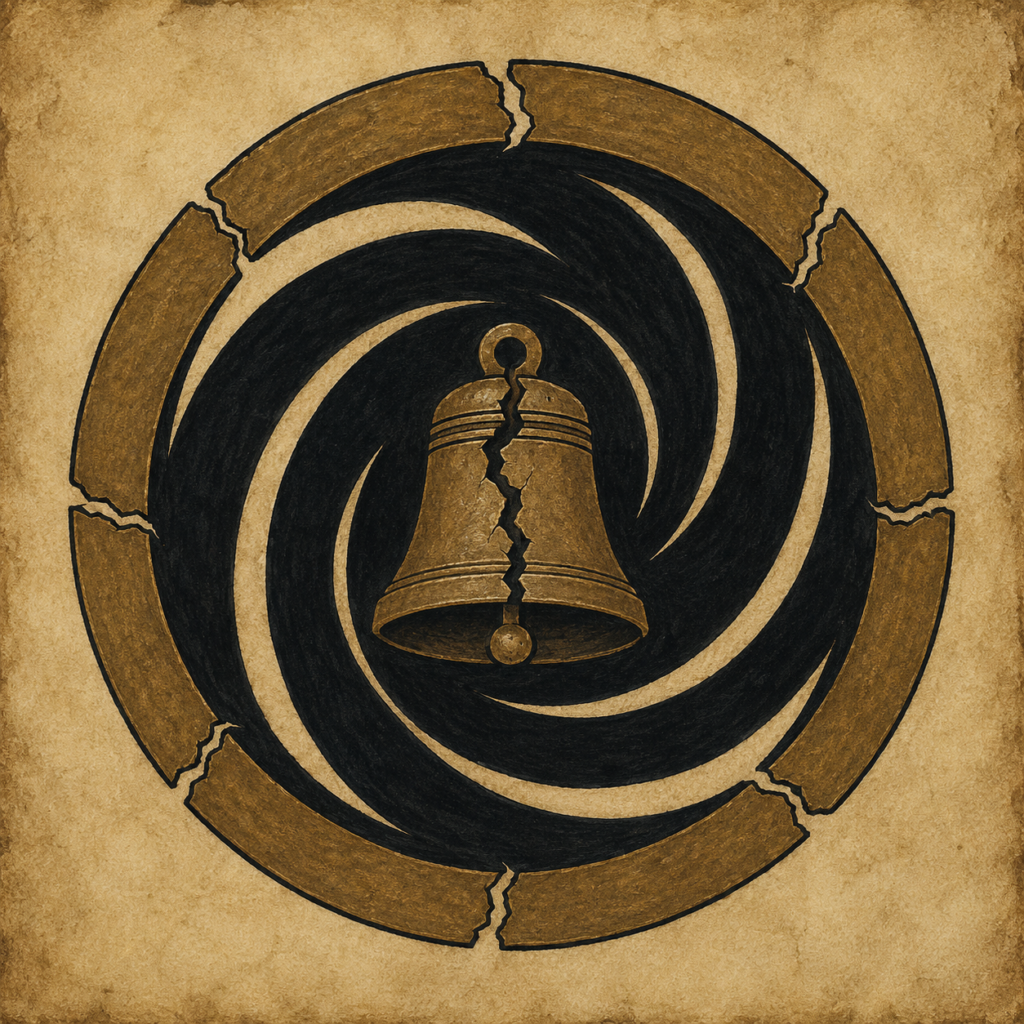
- A black spiral cavern mouth enclosing a cracked bronze bell, surrounded by a fractured ring
- Layers
- Outer Howl · Carved Lament · Blackwater Deeps · Sealed Dark
- Native Medium
- Stone, air, pressure, darkness and sound
- Primary Inhabitants
- Petitioners, exiles, fugitives, prisoners, isolated communities, native Howlers and later migrants
- Campaign Role
- Planar survival, rescue, refuge politics, acoustic investigation, exile and forgotten prisons
Overview
Pandemonium is uproar without release.
There is no exposed surface, no sky and no shared horizon. Every known destination lies inside stone. Tunnels open into shafts, galleries spill into chambers and chambers become voids so enormous that a traveller’s strongest light cannot find the opposite wall. The darkness does not conceal a world beyond the cavern. The cavern is the world.
Wind is everywhere. Some passages carry a low breath that barely stirs dust. Others compress the air until it screams. Great chambers permit separate currents to gather speed before colliding, dividing or forcing themselves into narrower routes with enough violence to carry stone fragments, abandoned equipment and bodies with them.
Gravity follows the stone surrounding a cavern rather than one universal downward direction. A company can stand on a floor while another expedition moves along the apparent wall and a third settlement hangs upside down from what the first group calls the ceiling. When two gravity fields overlap, movement can become suddenly treacherous.
Sound is equally unreliable. Voices travel along passages their speakers never entered. A warning may return after the danger has moved on. Footsteps can seem to approach from ahead while their owner follows behind. A name spoken carelessly in the Carved Lament can continue travelling through the stone long after everyone present has departed.
Most inhabitants therefore live as exiles, refugees, prisoners, fugitives or descendants of people who lost a way home. Permanent settlements are exceptional achievements. They survive by maintaining anchors, sealing pressure doors, guarding reliable water and accepting obligations that the surrounding plane constantly encourages people to abandon.
Every successful refuge is a small act of defiance against Pandemonium’s central lesson: that freedom without trust becomes isolation.
Cosmic History
Eon VII — Birth of the Howling Labyrinth
Pandemonium takes lasting form during the formation of the Outer Planes. The forces that produce it are not simply noise and wind. Possibility without direction, expression without understanding and conflict without resolution combine into an interior world of perpetual movement.
The first winds are therefore intrinsic to Pandemonium. They are pressure trapped inside an endless structure, forever seeking routes that never become true release.
Eon X — Breaches to Elemental Air
When the elemental foundations of creation stabilise, later fractures connect sections of the labyrinth with the Elemental Plane of Air. Air-born beings begin to appear as explorers, migrants, summoned servants, escaped captives and creatures stranded when the breach that brought them closes.
They do not create Pandemonium’s winds and do not become its primordial population. The distinction matters: the Howling Labyrinth already possessed its defining atmosphere before the first elemental traveller arrived.
Eon XIII — The Elder Wars
During the Elder Wars, the plane’s isolation becomes useful. Divine forces and planar engineers seal dangerous beings, weapons and records inside remote pockets whose approaches can be destroyed afterwards.
Wartime stabilisation devices also leave scars. Damaged anchors produce repeating portals, reversed pressure systems and gravity junctions linking areas that should not naturally touch.
Eon XIV — Leylines and Anchors
The strengthening of the cosmic leylines leaves behind a network of rare fixed points. Some of the oldest Hanging Havens are built around fragments of these works. Their inhabitants cannot reproduce the original engineering in full, but generations of practical knowledge allow them to repair, imitate and protect smaller anchoring systems.
The Last Anchorage owes its survival to one such ancient junction. The settlement is younger than the massive structure upon which its gate depends.
The Long Age of Refuge
After the great cosmic conflicts subside, the labyrinth becomes a destination for those whom more orderly powers refuse to receive. Broken hosts, displaced servants, fugitives, escaped captives and communities uprooted by planar war establish temporary settlements wherever wind, gravity and breathable space permit.
Most disappear. Some fail when a support breaks; some are abandoned after a water route changes; others fracture politically when survival obligations become permanent instruments of control.
The settlements that endure develop traditions of sanctuary, emergency authority and shared-line duty. Their laws are not philosophical abstractions. They are answers to specific ways in which one careless person can kill everyone connected to the same refuge.
The Mortal Ages
Material-world rulers eventually discover that Pandemonium makes an effective place to hide people and objects they cannot safely destroy. Controlled gates carry condemned witnesses, inconvenient heirs, dangerous artefacts and secret prisoners into the plane.
When those gates collapse, their captives may retain complete freedom to wander while losing every known means of returning home.
Over generations, the Carved Lament fills with route warnings and agreements written in languages their current readers only partly understand. Ancient messages become dangerously authoritative because nobody remembers the circumstances in which they were written.
The Present Age
Pandemonium remains active rather than fossilised. Routes change. Havens divide. Anchors weaken. Howler territories move when tunnels collapse. New mortal breaches appear when miners, soldiers and builders open stone that has not been disturbed for centuries.
The Sealed Dark still contains chambers whose prisoners outlived the authorities that judged them.
Place Among the Outer Planes
| Plane | Cosmic Expression |
|---|---|
| Limbo | Mutable possibility and freedom capable of becoming new form. |
| Pandemonium | Movement, uproar and fractured communication without dependable direction. |
| The Abyss | Destructive appetite and predatory chaos sharpened into Chaotic Evil. |
| Carceri — the Tarterian Depths | Captivity, betrayal and the maintenance of imprisonment. |
Carceri traps through confinement. Pandemonium traps by making every escape route uncertain. A prisoner of Carceri knows the problem is the cage. A lost traveller in Pandemonium may possess a hundred open passages and still have no meaningful way out.
Planar Laws
The Infinite Interior
Every explored region lies inside stone. Natural caverns coexist with worked passages, unfinished halls, buried stairways and doors opening onto rock where another chamber ought to exist.
No reliable expedition has discovered a universal exterior, central core or final wall. Whether the plane is literally infinite or repeatedly folded through itself remains unproven.
Wind and Pressure
Pandemonium behaves like one enormous pressure system whose parts can affect one another across distances no traveller understands. Opening a sealed route may redirect air through a chain of passages and threaten a refuge far beyond sight.
- Murmur Winds: low persistent currents carrying dust, scent and distant sound.
- Howling Winds: powerful flows that interfere with speech, hearing, flames and movement.
- Violent Winds: dangerous currents capable of moving unsecured creatures.
- Killing Winds: catastrophic pressure fronts filled with hard debris.
- Pressure Reversals: abrupt changes that turn sheltered routes into exposed ones.
- Splinter Storms: moving clouds of mineral shards, broken equipment, bone, glass and metal.
Gravity
Gravity pulls toward the stone enclosing a cavern. Several orientations can therefore exist around the same open void.
At a junction, competing fields may release a creature from one surface and seize it toward another. Architecture built by experienced residents accounts for this with rails, anchor points, reversible stairs and doorways intended to be approached from more than one direction.
Light
There is no ordinary natural illumination. Open flames are easily extinguished. Enclosed lanterns and magic are more reliable but make travellers conspicuous across large chambers.
The Blackwater Deeps suppresses illumination further. Its dark water and stone absorb rather than generously reflect light.
Sound
Sound can be swallowed, redirected, amplified or preserved. Most strange voices are products of airflow and cavern acoustics, but predators, magical residues and long-lived echoes make it dangerous to assume every sound has an ordinary source.
Experienced travellers confirm identity visually or through touch, written phrases and physical tokens. Hearing protection is ordinary survival gear.
Time
Time is broadly normal throughout the known plane, but the absence of daylight, seasons and familiar celestial cycles destroys ordinary intuition.
Havens maintain protected clocks, work bells, measured water flows and carefully recorded shifts.
Food, Water and Air
Refuges survive through condensation systems, clean mineral springs, fungus cultivation, pale cavern animals, preserved supplies and trade through stable portals.
Breathable air is not universal. In the Sealed Dark especially, a chamber that begins safe can become dangerous merely because too many breathing creatures remain inside it.
The Four Layers of Pandemonium
The first three layers pass gradually into one another. Travellers recognise the change by differences in space, sound, moisture, worked stone and the behaviour of the wind rather than by crossing a single universal gate.
The fourth layer is different. The Sealed Dark is not one continuous cave network but a universe of isolated pockets separated by solid stone.
The Outer Howl — First Layer of Pandemonium
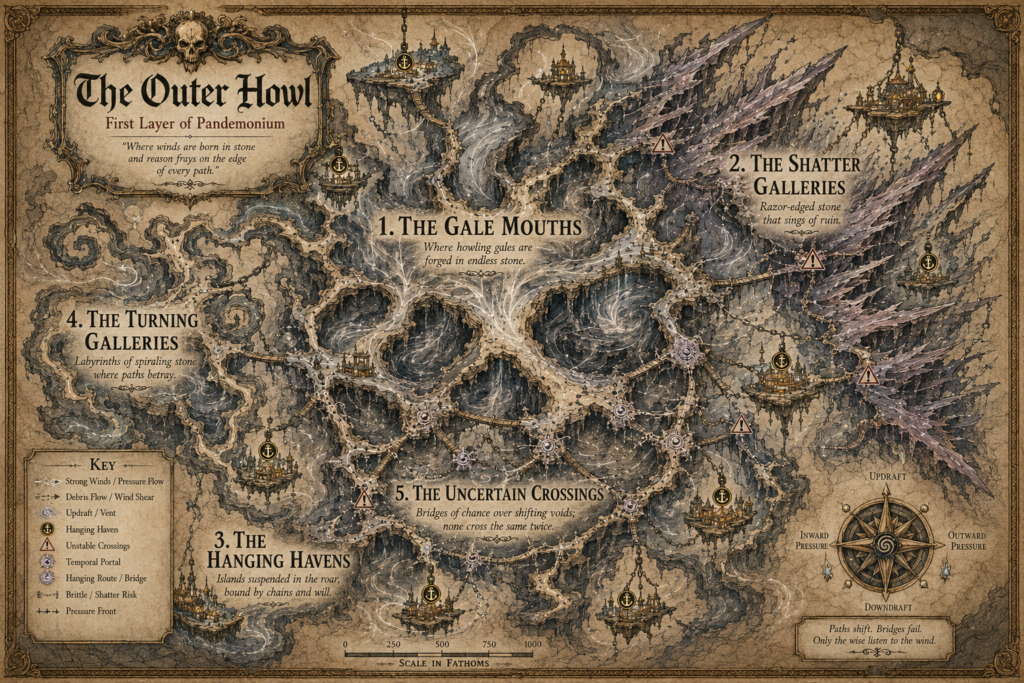
The Outer Howl is the broadest and most frequently entered layer of Pandemonium. Its caverns are enormous, its portals comparatively numerous and most surviving settlements are found somewhere within its immeasurable darkness.
Accessibility does not make it safe. The vastness of the chambers increases the distances across which wind can gather strength and exposes travellers to dangers they may see long before they can reach shelter.
Scale and Exposure
The great vaults of the Outer Howl are closer to underground worlds than ordinary caves. One may open so widely that a traveller’s lamp cannot reach the opposite surface. Roads visible across the central void can remain inaccessible because their gravity surface has no bridge to the one beneath the party.
Distance is especially difficult to judge without a horizon. A pinprick of light might be a lantern several hundred feet away or an entire refuge many miles across the chamber. A moving light can belong to another expedition, a warning signal, a piece of drifting wreckage or a creature carrying something taken from previous travellers.
The broad spaces also change the wind. A current may cross half a vault almost unnoticed before being forced through a narrow crack, emerging as a violent blast somewhere the travellers cannot see.
Arrival Without Orientation
Most known entrances to Pandemonium emerge somewhere in the Outer Howl, yet remarkably few open onto prepared platforms. Travellers may arrive on a narrow shelf, along an apparent wall or inside a chamber whose strongest current points directly back through the portal.
A newly arrived company therefore has immediate work to do. It must identify the gravity surface supporting it, establish the dominant airflow, secure loose equipment and determine whether the gate will remain accessible.
Even a familiar portal can behave differently after a pressure change elsewhere in the plane. A reliable gate may deposit travellers on the opposite side of the same cavern system or remain usable only during particular cycles of airflow.
Crossing the Outer Howl
There are paths but few roads in the ordinary sense. A route is normally a sequence of observed conditions: a warm draft, a distinctive vibration, a gravity transition, a patch of pale mineral and a pressure lull occurring in the correct order.
A map can remain geometrically correct and still become useless. The passages may all exist while the wind required for a crossing has reversed or the gravity transition that made a shaft passable has shifted.
Travel failures therefore accumulate rather than immediately kill. A group loses time, reaches shelter after its pressure doors have closed, wastes protected light, consumes water or is forced into a cavern from which the next dependable route is unknown.
Refuge Across the Distance
Most permanent Havens stand in the Outer Howl because its large chambers provide more opportunities to build around stable stone, older anchors and defensible pockets of air.
This does not create a continuous civilisation. Every settlement remains an island separated by days or weeks of hazardous travel. A route linking two Havens may remain unusable for years after a collapse.
The first signs of a refuge are often encountered long before its buildings: maintained bolts hammered into stone, emergency alcoves, recognised route marks, warning shutters or deliberate changes in the way dangerous passages are reinforced.
Local independence is the rule. One Haven may treat a traveller as a protected guest while the next considers the same person an unknown pressure risk until formally vouched for.
Howlers Beneath the Roar
Howlers are particularly well suited to the Outer Howl’s dark connecting passages. Their communication is not dependent upon ordinary hearing. Vibration and pressure pulses pass through stone beneath the audible storm.
A pack may become aware of an expedition through footsteps, dragging armour, hammering pitons or repeated impacts against a shared wall. The creatures can begin positioning themselves while the travellers hear nothing beyond the normal wind.
Howlers use the terrain intelligently. They wait near difficult crossings, approach through passages on other gravity surfaces and test whether a group understands boundary warnings before choosing whether to attack.
Packs differ. Some treat marked territory as a warning and permit withdrawal. Others hunt anything they can isolate. Travellers who have learned one pack’s signals should not assume those customs apply elsewhere.
The Descent Inward
The transition to the Carved Lament is gradual. Caverns narrow. Natural surfaces increasingly give way to cut channels, incomplete rooms and angular openings.
The sound changes first. Broad roars become sharper tones. A whistle continues long after the gust that produced it. Voices begin emerging from stone surfaces rather than simply travelling down the visible passage.
A traveller has entered the second layer when worked stone and directed resonance become more important to navigation than the open scale of the cavern itself.
The Gale Mouths
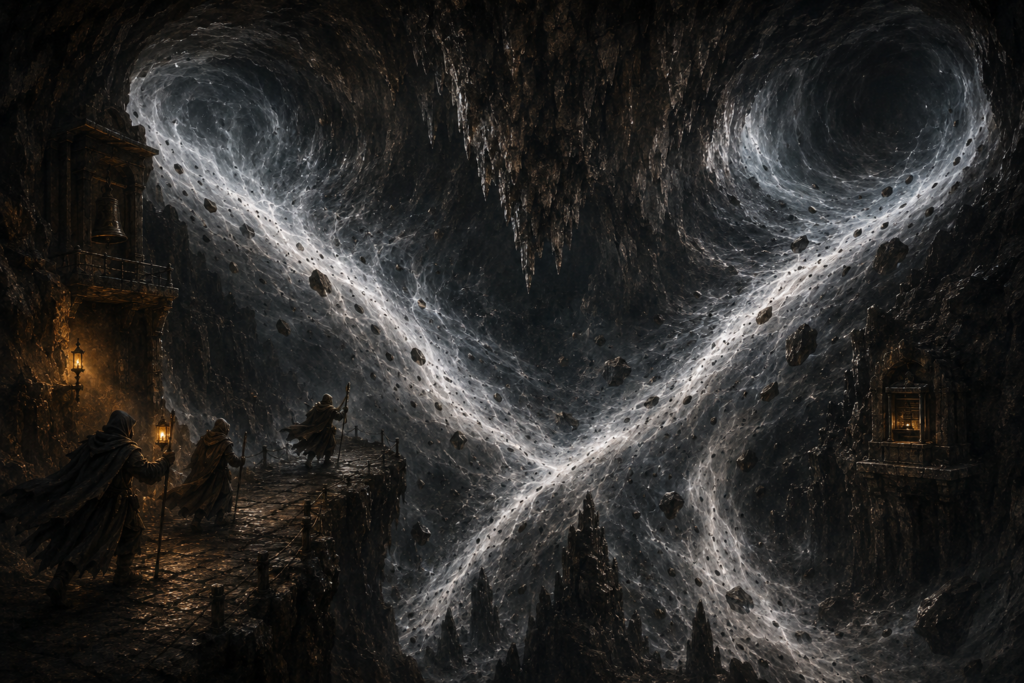
The Gale Mouths are colossal junctions where several major air systems meet. From a distance they resemble pale rivers crossing through darkness as airborne dust and fragments reveal currents that would otherwise remain invisible.
Opposing winds can create standing pressure waves. A traveller caught between them may be lifted away from one gravity surface and hurled toward another. Local guides distinguish individual mouths by temperature, mineral dust, pitch and the regular pattern with which debris strikes surrounding stone.
Observation posts are built inside protected hollows. Their shutters and warning bells communicate changes too dangerous to investigate directly. Deliberately imitating one of those signals is treated as a serious crime by nearby Havens because a false warning can redirect entire caravans into exposed routes.
Breaches to Elemental Air appear here more often than elsewhere in the plane. Air Elementals and other migrants sometimes emerge convinced that the current surrounding them will eventually return home, only to discover that Pandemonium’s winds do not obey elemental geography.
The Shatter Galleries
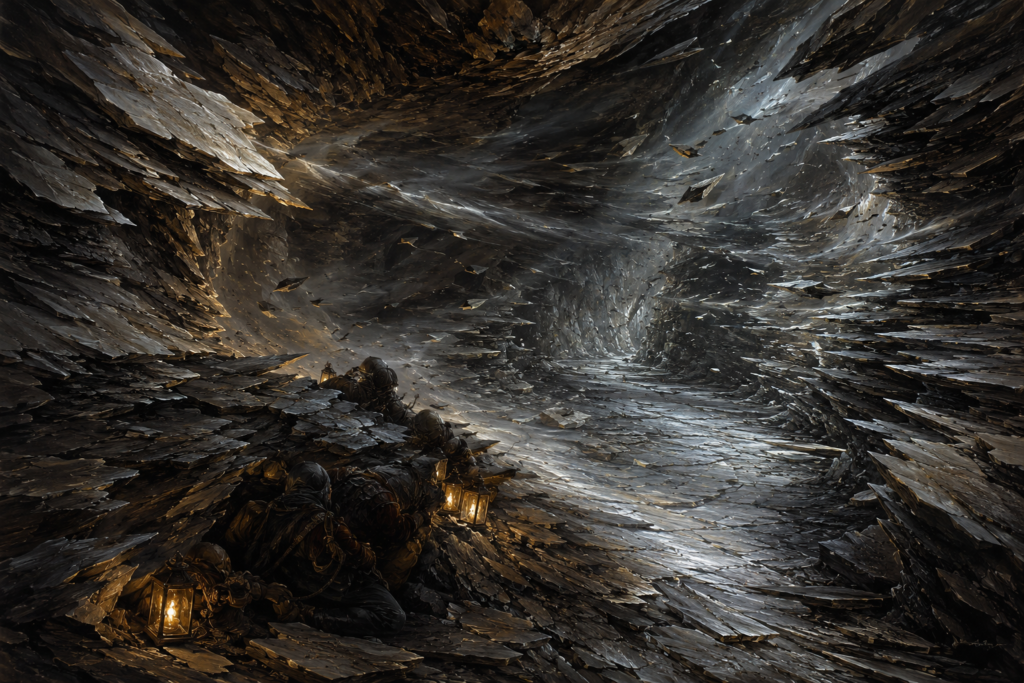
The Shatter Galleries are lined with brittle layers of mineral stone. Under calm conditions the formations resemble blades frozen into walls and ceiling. During pressure surges they break apart in sheets.
The resulting fragments do not immediately settle. Strong currents can carry them through entire tunnel systems, producing storms of razor-edged mineral debris.
Miners nevertheless enter because some formations are valuable for tools, magic and Haven construction. Excavation is politically sensitive. Removing the wrong support can redirect wind, collapse a connecting tunnel or weaken the stone supporting an inhabited structure.
Cave Fishers introduced through old portals have established themselves in sheltered shafts and over bridge approaches where strong currents carry scent and vibration toward them.
The Hanging Havens
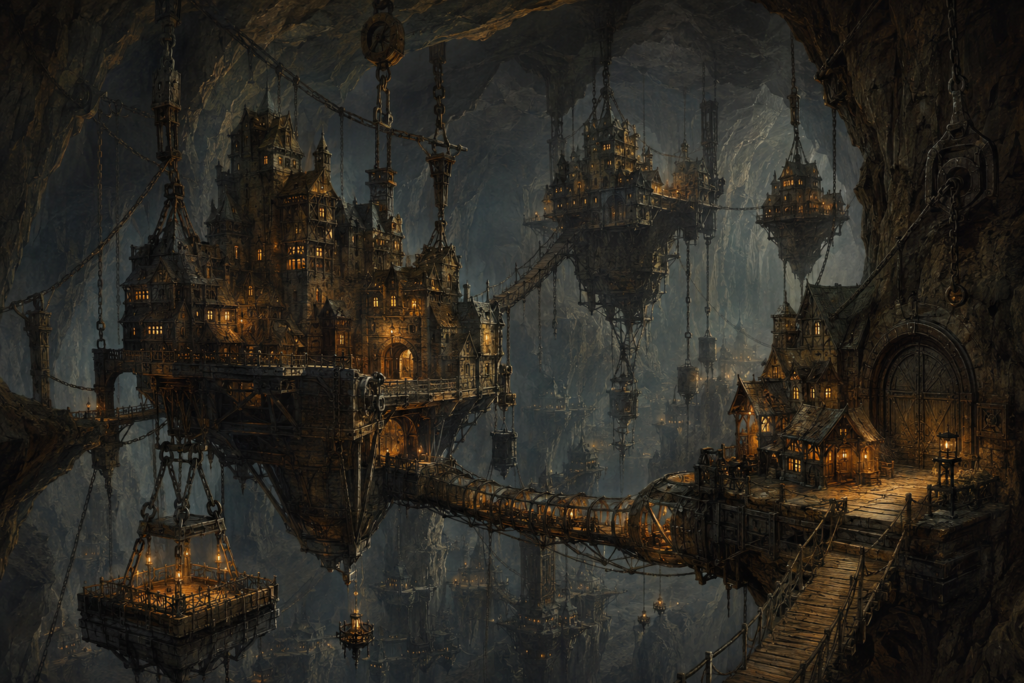
The Hanging Havens are not one city. They are a scattered family of independent settlements occupying unusually stable vaults.
Some districts hang from chains driven into ancient anchor points. Others grow across several gravity surfaces at once, connected by enclosed bridges, lifts and protected shafts. A building’s floor in one district may appear to be another district’s outer wall.
Every Haven develops local traditions, but several laws recur because they address universal dangers:
- Public anchor lines and pressure doors are protected above ordinary property.
- Emergency shelter cannot simply be seized from a recognised guest during danger.
- False distress signals are treated as potentially lethal acts.
- External doors cannot be opened during dangerous pressure cycles without recognised authority.
- Anyone accepting sanctuary also accepts temporary emergency commands necessary to preserve the refuge.
- People sharing the same safety line owe one another reasonable assistance.
- Known structural or atmospheric hazards must be reported.
These settlements are the closest thing Pandemonium possesses to dependable civilisation, yet even here safety produces political tension. The power to declare an emergency can save hundreds of lives or become a convenient excuse for permanent authoritarian rule.
The Turning Galleries
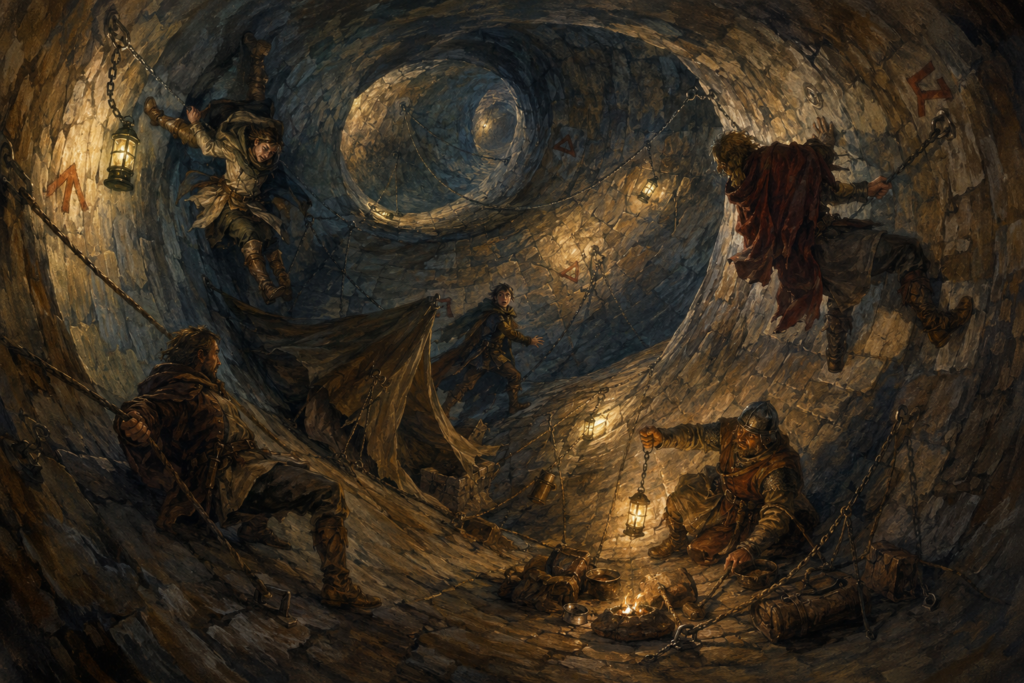
The Turning Galleries are famous for repeated shifts in local gravity and airflow. A broad floor can become a wall during the return journey, while a protected alcove can turn into the most exposed surface in the passage.
Local travellers secure camps to more than one surface and avoid storing equipment according to a single orientation. Route marks are carved where they remain readable from several possible directions.
The galleries are particularly dangerous to outsiders who assume that reaching a landmark once guarantees they can retrace the route. Many rescue operations begin with a traveller who knows exactly where they are but cannot reproduce the conditions that brought them there.
The Uncertain Crossings
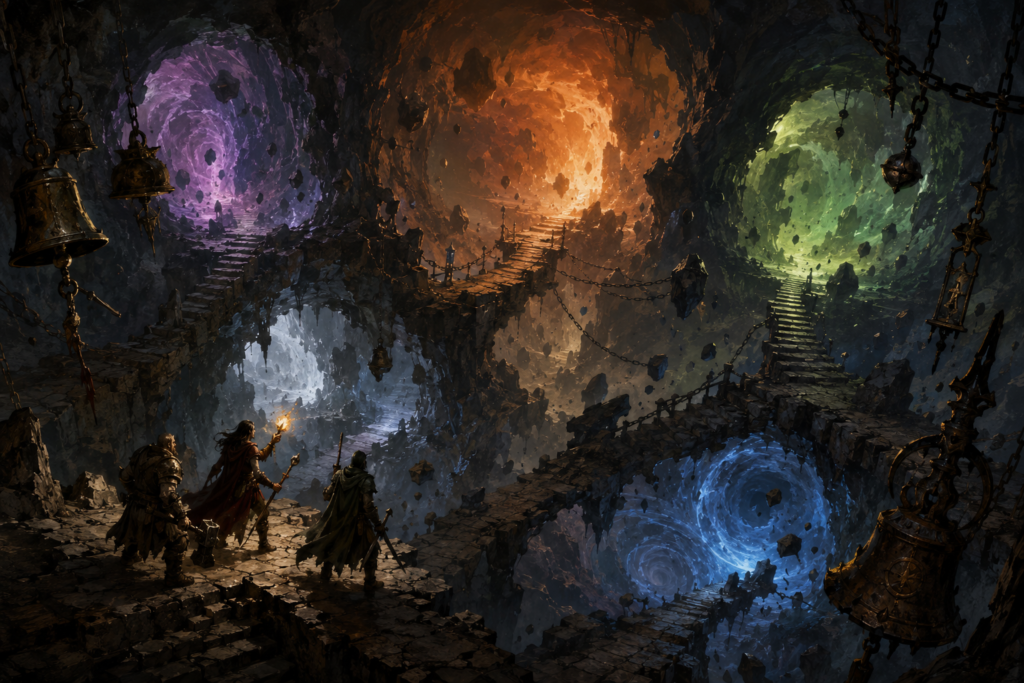
The Uncertain Crossings are unstable junctions where planar portals, ordinary passages and competing gravity fields briefly overlap.
Some persist for hours. Others exist for seconds. Several destinations can occasionally be visible through the same opening while wind pulls loose objects toward each one.
Eshu sometimes appears here as a divine visitor. He has no Pandemonium realm and does not rule the crossings. His presence centres upon the meaning of a choice, the wording of an agreement and whether a traveller has understood what was actually promised.
Small temporary shrines mark some junctions. Those who use them are expected to listen carefully, answer precisely and avoid assuming that the road they intended is necessarily the road they requested.
The Carved Lament — Second Layer of Pandemonium
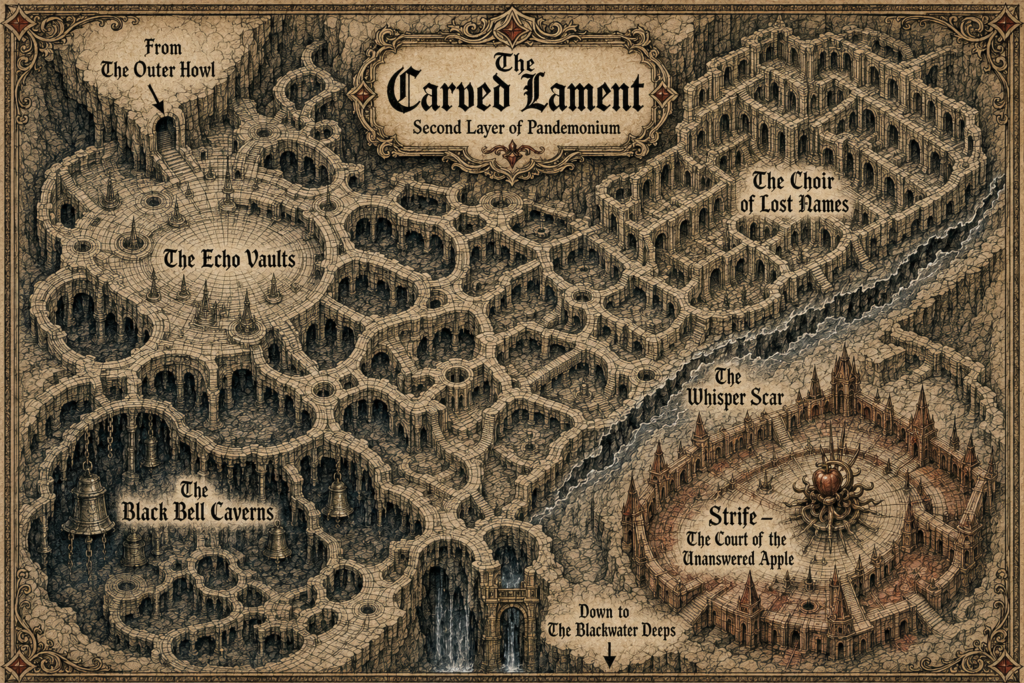
The Carved Lament begins where natural cavern country tightens into a maze of worked stone. The passages are narrower, denser and far more resonant than those of the Outer Howl.
Some unknown intelligence cut halls, channels, stairways and unfinished chambers through the layer. Whatever their original purpose, the architecture now transforms Pandemonium’s winds into an enormous acoustic machine.
The Worked Stone
The transition is immediately visible in some passages. Tool marks cross surfaces far larger than mortal hands could conveniently work. Geometric channels divide walls and floors without forming a consistent decorative language.
Some rooms are astonishingly complete: smooth surfaces, exact proportions and deliberate acoustic effects. Others end midway through construction. A staircase can stop above a shaft; a carved doorway can open directly onto unbroken rock.
Natural cave and artificial architecture overlap constantly. An immaculate hall may narrow into an untouched fissure before emerging inside another section shaped by completely different methods.
Most important, much of the architecture interacts with airflow. Grooves divide one current into several pitches. Ridges make stone resonate. Small apertures turn distant pressure changes into voices and cries.
Sound as Geography
In the Carved Lament, a location has an acoustic identity. Guides learn the pitch of junctions and the interval between returning echoes. They may recognise a route in complete darkness by striking the wall and waiting for the answer.
Sound does not always follow the visible space. Speech can disappear from the room where it is spoken and emerge several passages away. Footsteps may seem to move ahead of the traveller producing them. A vibration can pass through a wall that blocks every audible sound.
The result is a geography composed partly of invisible channels. Two passages running side by side can share speech without sharing air. Another corridor may be physically open yet acoustically isolated.
Fragments also endure. A warning, argument or name can circulate long after its source is gone. Most deteriorate into meaningless noise, but some remain disturbingly clear.
Residents therefore demand challenges that an echo cannot answer. A familiar voice proves little unless it responds correctly to a question invented after the group entered the layer.
Travel Through the Carved Passages
The Carved Lament confines travellers much more tightly than the Outer Howl. Passages split repeatedly, loop between gravity orientations and sometimes run alongside one another separated by stone too thick to breach safely.
Drawn maps remain useful, but serious route records include acoustic instructions.
Route marks are everywhere. Some belong to organised expeditions. Others come from vanished settlements or unknown builders. Important junctions accumulate generations of contradictory warnings.
A wrong turn normally leads somewhere rather than nowhere. The danger is arriving in the wrong place with fewer supplies, less time and no dependable landmark from which to correct the mistake.
Howlers in the Resonant Channels
Howlers are even more dangerous here because the stone channels extend their vibration signals.
A pack can occupy parallel galleries and coordinate without ever gathering in one chamber. One group pressures prey forward while another waits near the likely escape route.
Experienced parties alter their pace, suspend equipment away from the floor and create misleading impacts through side passages. Such techniques buy time; they rarely make the local Howlers forget how their own territory works.
Strife Beyond the Court
Eris rules a distinct divine enclave within the Carved Lament, not the whole layer.
Her influence spreads much farther than her formal territory because disputes travel easily through isolated settlements. A true accusation delivered at the worst possible moment can be more destructive than an invented lie.
Momus also appears as an exile and critic without a permanent realm. He can expose an actual weakness in a treaty while simultaneously destroying any chance of repairing it.
Neither deity is required for conflict to emerge. The layer already creates tension through uncertainty, limited passages and the inability to verify what was actually said.
Descent Toward the Blackwater Deeps
The approach to the third layer becomes apparent when damp stone and moving water begin competing with the acoustic character of the passages.
Cold spray moves through carved galleries. Pools gather beneath stairs. Drainage channels descend into darkness, while previously reliable echoes vanish when lower chambers flood.
When water stops being an obstacle within the journey and becomes the main force deciding how the journey is made, travellers have entered the Blackwater Deeps.
The Echo Vaults
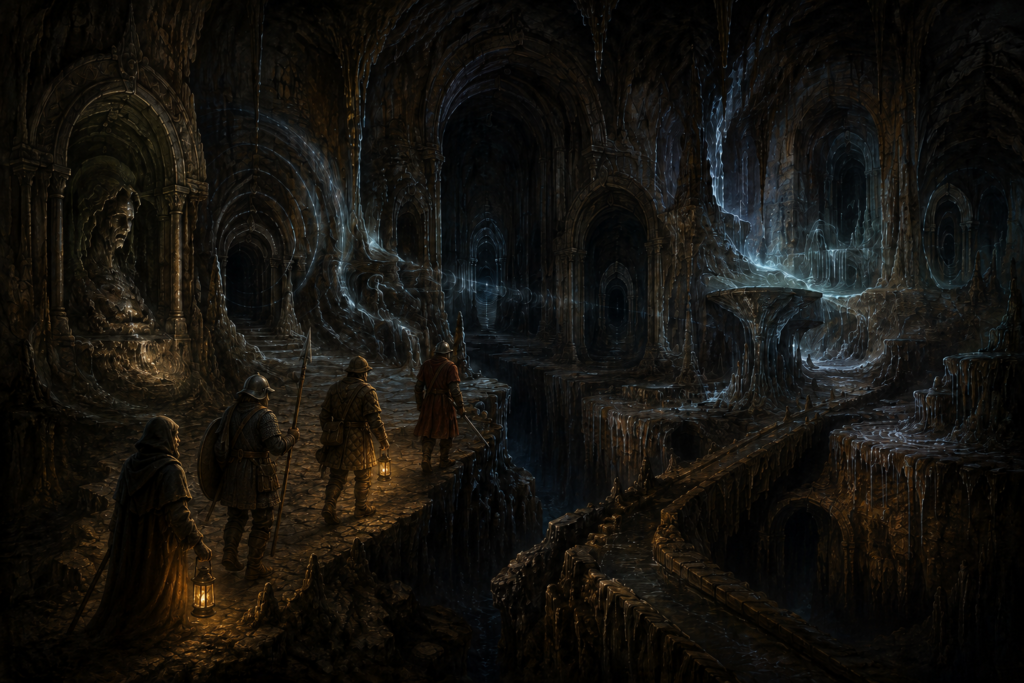
The Echo Vaults are enormous resonant chambers where certain sounds continue long after their makers leave.
Some repetitions decay within minutes. Others have persisted long enough to become features of the location. A cry, name or sentence can return according to an interval known by local guides.
Powerful echoes may become associated with a particular person, family, object or historical event. Whether that attachment is merely acoustic, magical or something stranger varies from vault to vault.
Residents communicate carefully. Signs, writing and physical contact are preferred when identity matters, and speaking a protected true name loudly is regarded as reckless.
The Choir of Lost Names
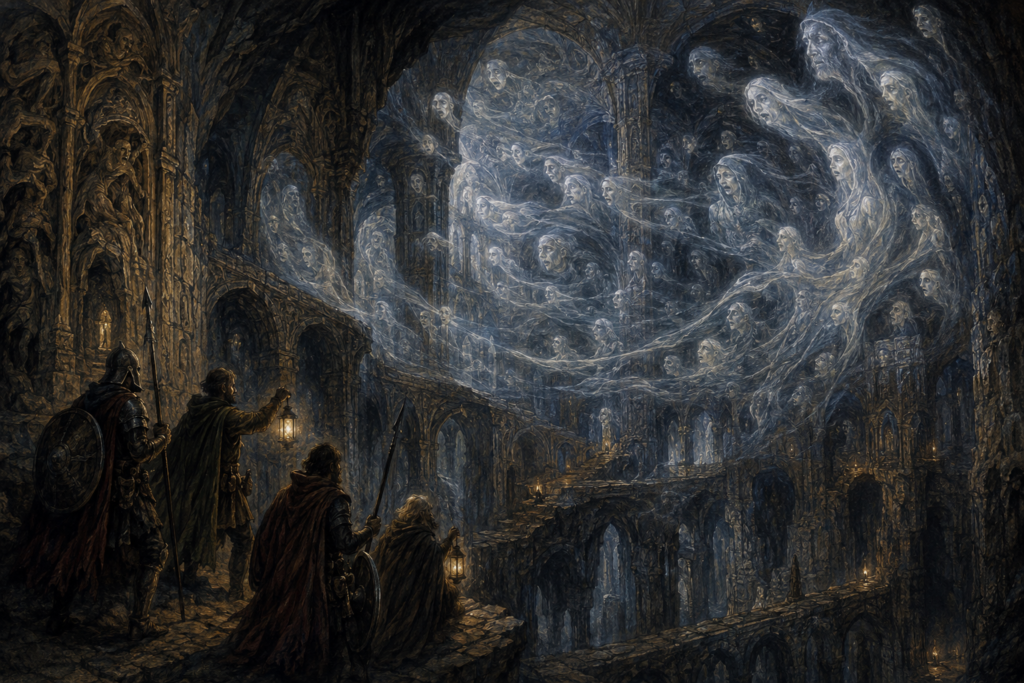
The Choir is filled with overlapping voices speaking names associated with people who vanished somewhere in the labyrinth.
Some names occur once and never return. Others cycle according to patterns measured by generations of searchers. A few voices can answer questions, but only by rearranging phrases already present within the surrounding echoes.
Families, rescuers and investigators come looking for proof that someone reached this part of the plane. The Choir rarely offers certainty. A missing person’s name might have been spoken by the victim, a companion, an enemy or someone who knew the name second-hand.
The place is therefore useful as evidence and dangerous as testimony.
The Black Bell Caverns
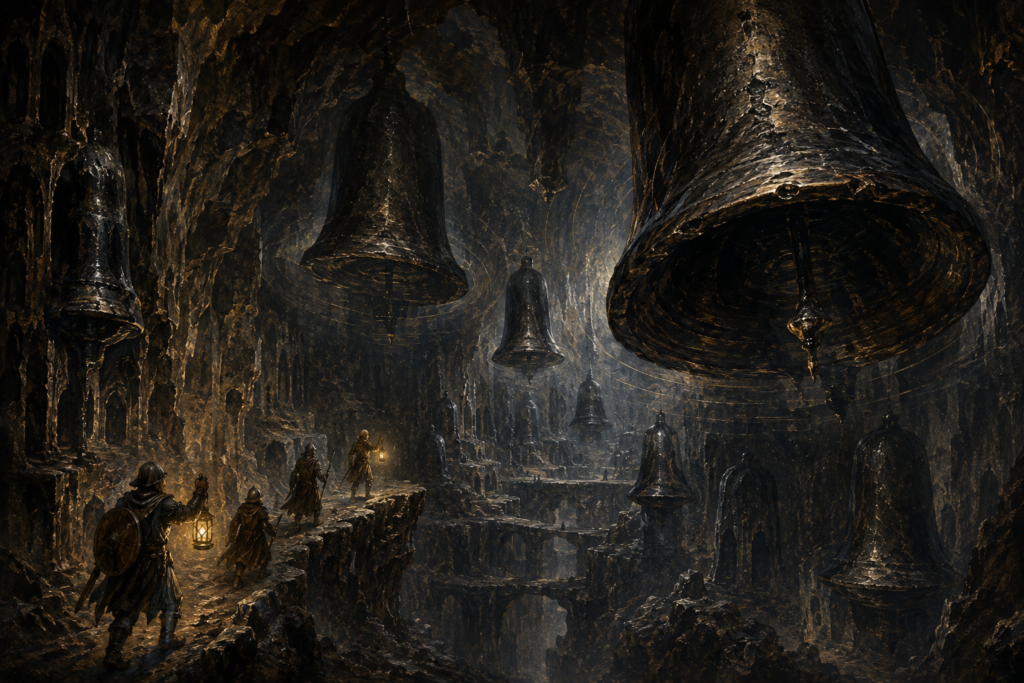
Immense bell-shaped mineral formations hang from the walls and roofs of these chambers.
They require no hand to ring them. Pressure changes, distant collapses and movement through deeper stone set different bells vibrating.
Skilled interpreters maintain records connecting particular sequences with floods, pressure fronts, portal activity and structural danger. Their work resembles both engineering and divination.
Fragments from fallen bells are valuable for warning devices and sound-based magic. Several refuges refuse to mine intact formations because particular bells serve as ancestral records: generations remember which tone sounded before the catastrophe that founded or nearly destroyed their community.
The Whisper Scar
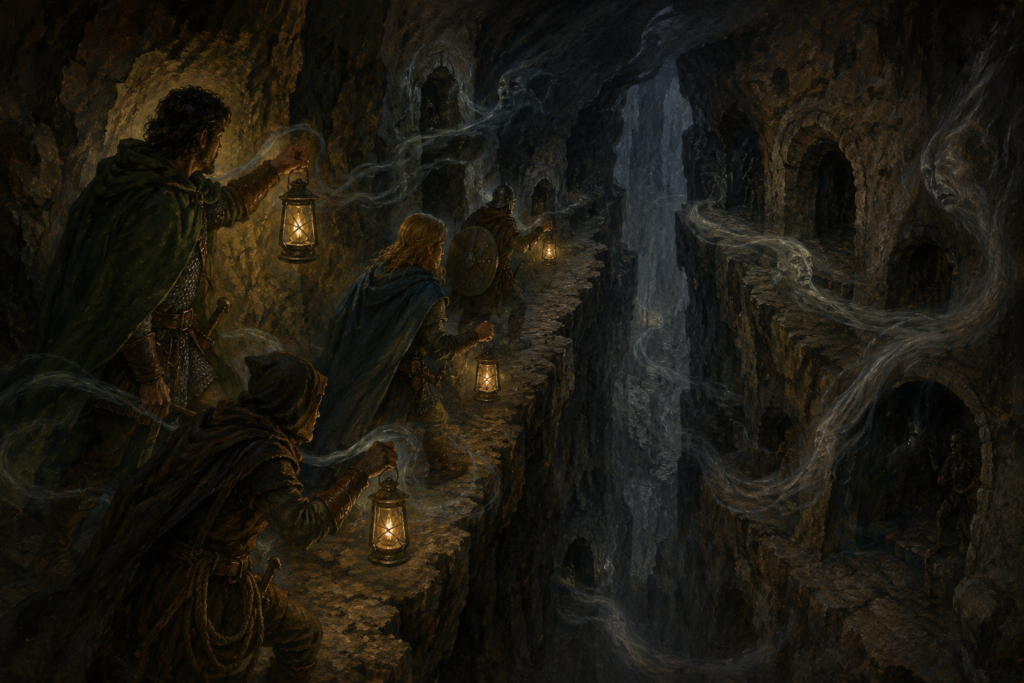
The Whisper Scar is an extremely narrow fissure cutting through hundreds of chambers.
Sounds entering it can reappear close to a listener’s ear with startling clarity. The Scar preserves fear, resentment, accusation and confession particularly well while losing most of the context that originally gave them meaning.
Investigators use it because true information can survive. Grieving families use it because a familiar voice may be heard again.
Both groups face the same danger: a genuine fragment can support a completely false conclusion when everything surrounding it has been stripped away.
Strife — The Court of the Unanswered Apple
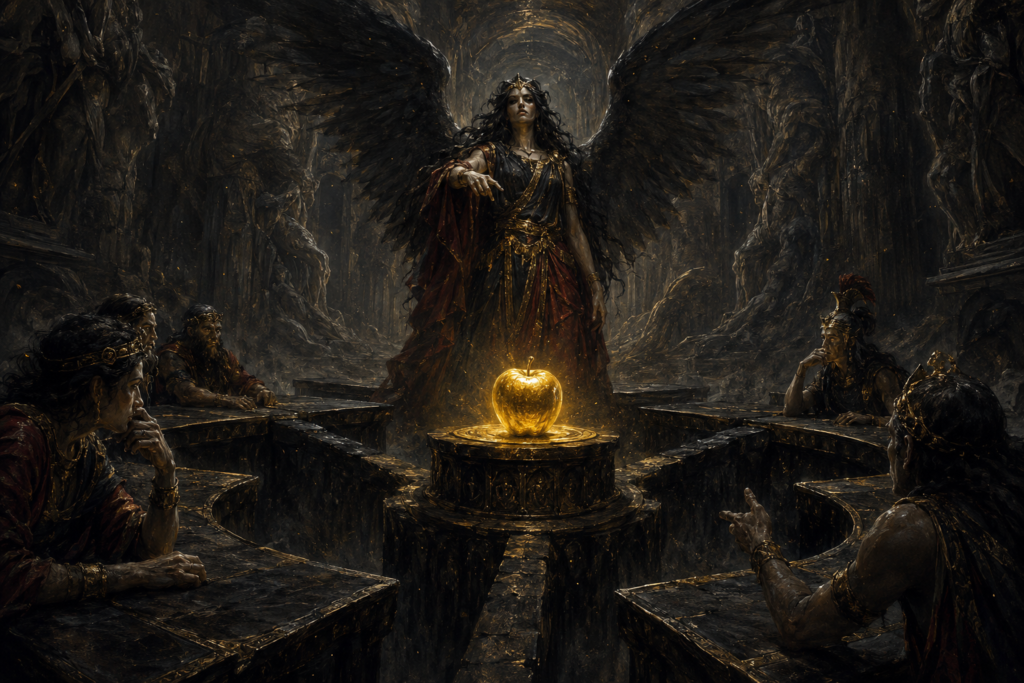
Strife is the principal Pandemonium enclave of Eris. It is a sovereign divine territory within the Carved Lament but not the capital of Pandemonium.
The enclave is formed from council halls, divided galleries and ceremonial courts designed so that participants are rarely comfortably close to one another. Delegations cross narrow bridges to negotiate. Statements return from resonant walls subtly distorted by timing and emphasis.
At its centre lies the Court of the Unanswered Apple. Dark tables surround deep channels, preventing rival parties from simply closing the distance between them.
Golden apples manifest when an alliance is already under sufficient strain. Each bears a title, judgement or claim capable of forcing a disagreement into the open.
Eris uses the enclave as a meeting place, refuge and point from which agents depart for other realms. Her principal Hellenic association remains Olympus in Arborea. Strife is a major cross-planar residence, not evidence that she rules the entire Howling Labyrinth.
Momus — The Unwelcome Guest
Momus maintains no recognised Pandemonium domain. He sometimes retreats into the Carved Lament following exclusion from more formal divine courts.
His criticism can reveal real hypocrisy, hidden motives and structural weaknesses in apparently respectable institutions. Eris welcomes that talent when it divides her enemies and dislikes it when his mockery exposes that one of her own conflicts depends upon manipulated evidence.
The Blackwater Deeps — Third Layer of Pandemonium
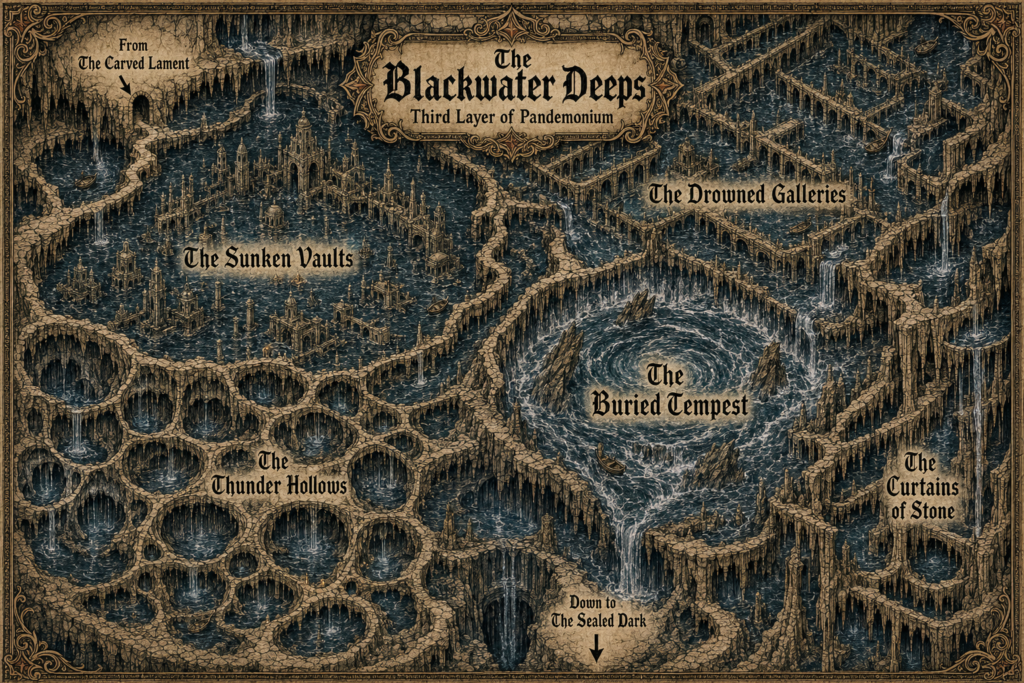
The Blackwater Deeps is a cold subterranean world of dark stone, overlapping lakes and water flowing according to several different gravity surfaces.
The change in tone is profound. The scream of the Carved Lament recedes. Water absorbs and carries sound differently, while apparently calm lakes conceal pressure systems and submerged routes capable of changing without warning.
Water on Every Surface
There is no universal sea level. Every sufficiently large stone surface can possess its own body of water according to the gravity acting upon it.
A vast chamber might therefore contain several separate lakes facing one another across its central darkness. Travellers on one shore can look upward and see waves crossing another lake overhead.
Waterfalls behave accordingly. Some descend in familiar fashion. Others curve sideways toward a competing gravity field, split between several surfaces or cross open cavern space before striking a distant wall.
Even the largest lakes remain completely enclosed. There is no sky above them. What appears to be a horizon is darkness concealing another wall.
Cold, Darkness and Sound
The water is bitterly cold. A long crossing can become dangerous even without a monster or storm.
Illumination performs poorly. The dark stone absorbs light and the water returns deceptive reflections. A distant lamp can appear to float on a nearby shore when it is actually travelling across another gravity surface.
Sound becomes quieter but not necessarily safer. Water muffles voices while transmitting impacts and low vibration across great distances. A small splash can reveal the presence of a traveller to something that remains far beyond the range of sight.
The apparent calm of a black lake is especially dangerous. Strong currents can move beneath an unbroken surface, and submerged creatures may detect pressure changes too small for humanoid senses.
Crossing the Black Lakes
Travel commonly combines climbing, wading, boating, swimming and crossing open voids between gravity surfaces.
Traditional maps struggle with the geometry. Experienced guides record which stone face holds each body of water, where currents disappear and how travellers can transfer from one lake to another.
Conditions are temporary. A submerged shaft can become accessible when pressure drains part of a lake. A dry route can vanish under water during the return journey.
A failed crossing frequently displaces the party rather than killing it outright. Travellers may emerge in the wrong lake, lose equipment when gravity changes or find themselves entering a known structure from below the waterline.
Flooded Shafts and Hidden Connections
Many lakes are connected by routes invisible from the surface. Currents disappear beneath shelves, behind mineral curtains and into flooded cracks.
A connection may lead only to another part of the same chamber or run for miles before emerging into a lake with a completely different orientation.
These hidden links make local water levels unstable. A collapse in a distant cavern can drain one reservoir while flooding another settlement that had no knowledge of the original event.
Explorers use marked floats, weighted lines and traceable substances to test where currents lead. Even mapped routes can change after debris blocks a shaft.
Ruins Beneath the Water
Several lakes contain drowned architecture. Some resembles the worked stone of the Carved Lament. Other structures use proportions and methods unknown elsewhere in Pandemonium.
Columns rise from the lake bed without meeting any dry floor. Stairs descend beneath overhanging stone before continuing sideways according to another gravity field.
Some ruins appear to have flooded after construction. Others contain pressure doors, drainage systems and sealed spaces suggesting that water was always part of their design.
Air pockets can survive within sealed sections. Such spaces are valuable as temporary shelter but can contain stale air, dangerous gases or previous occupants.
Opening a sealed ruin is never merely archaeological. A single broken door can alter surrounding currents.
Life in the Deeps
The Blackwater Deeps is sparsely inhabited rather than empty.
Most life clings close to stone or travels through submerged passages. Pale organisms feed upon mineral deposits, carrion and matter washed down from higher layers.
Larger predators rarely reveal themselves clearly. Their presence appears first as water moving against the prevailing current, bubbles rising toward an unexpected gravity surface or a shadow briefly interrupting reflected light.
Howlers are less common here. Some packs travel along dry shore galleries and passages where vibration remains useful, but the great flooded systems do not favour them.
Refuge Along the Shores
Permanent settlement is difficult. A viable refuge needs dry chambers, defensible access, stable ventilation and water that is genuinely safe rather than merely abundant.
Some communities build above known flood limits. Others occupy sealed ruins or suspended structures linked to several shores by rope systems.
Water is treated as a protected resource even here. Unknown shafts can introduce harmful minerals, decomposition and contamination into apparently clean lakes.
Boats are specialised. Many carry attachment points on all sides because a vessel travelling into a new gravity field may discover that what was previously its deck is no longer the useful orientation.
The Descent into the Sealed Dark
Open lakes become smaller and increasingly confined as travellers approach the fourth layer.
Wide currents weaken into isolated pools and narrow submerged fissures. The wind becomes less audible because solid stone increasingly separates one pocket of air from another.
Doors and deliberately blocked passages become common. Some hold back water; some merely isolate chambers.
The Sealed Dark begins when the traveller can no longer rely upon a continuous flooded route and every meaningful advance requires opening, discovering or crossing a sealed boundary.
The Buried Tempest
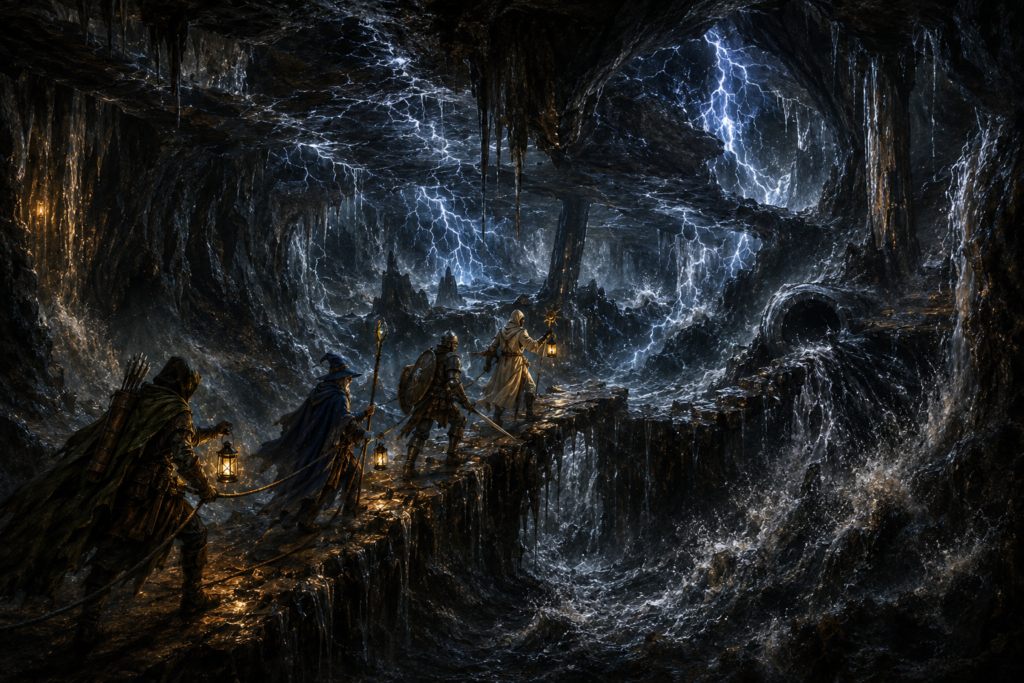
The Buried Tempest is not fixed to one cavern. It is a migrating pressure system moving through interconnected wet passages.
Lightning runs along mineral veins and leaps through sheets of spray. Rain drives sideways according to local gravity while water builds behind obstructed tunnels.
When sufficient pressure accumulates, weakened barriers burst. Routes that were flooded are suddenly drained while previously dry galleries are overwhelmed.
Communities track the Tempest through distant thunder, changing water levels and electrical activity in the stone. Its exact path cannot be relied upon twice.
The Thunder Hollows
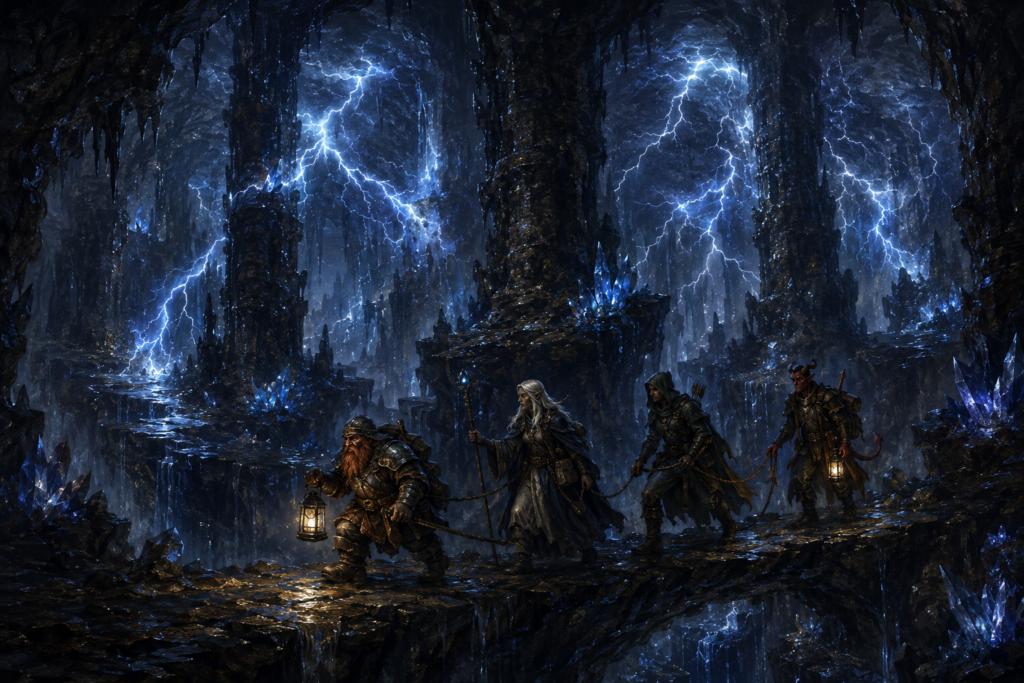
The Thunder Hollows contain storm systems that have remained trapped for generations.
Electrical discharges jump between wet columns and mineral growths while pressure waves repeatedly strike the same stone surfaces.
Salvagers risk the region for charged crystals and unusual mineral deposits altered by prolonged lightning.
Thunder magic, explosives and major construction are restricted by settlements operating nearby. A sufficiently powerful shock can trigger collapses far larger than the original blast.
The Sunken Vaults
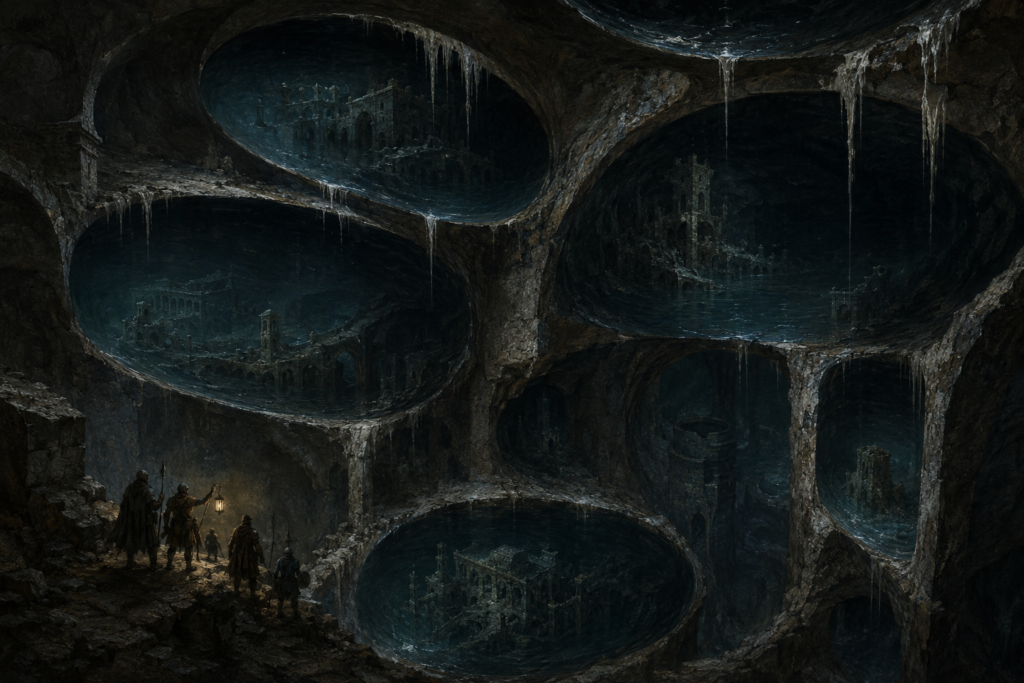
The Sunken Vaults are a complex of huge chambers containing separate lakes on multiple gravity surfaces.
From one shore it is possible to see ruined structures submerged inside a lake apparently suspended overhead. Some of those bodies of water are connected by shafts passing through intervening stone.
Architecture beneath the water includes bridges, towers, submerged doors and entire complexes whose usable orientation has changed as surrounding gravity fields shifted.
Exploration requires thinking in three dimensions. A tower that appears to rise from a lake bed may actually connect to another complex through what now appears to be its side wall.
The Drowned Galleries
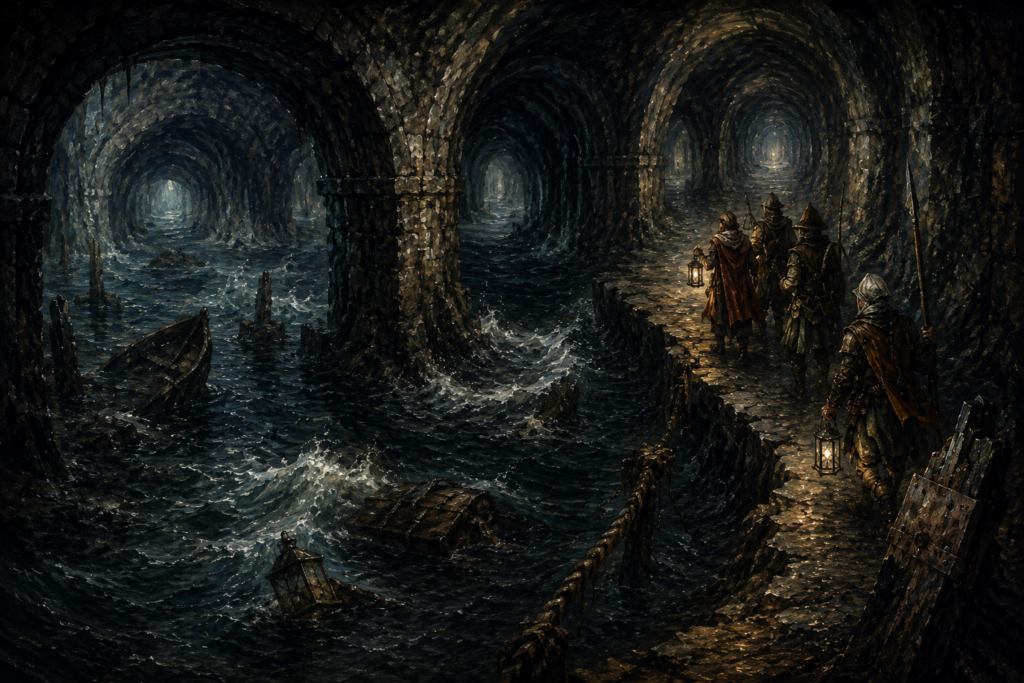
The Drowned Galleries are routes that alternate between navigable corridor and underground river.
A passage can remain dry for months before a change elsewhere sends black water racing through it. The same corridor may drain again before any expedition returns.
High arches and side rooms create temporary air pockets, though the air inside may be stale or contaminated.
Salvagers exploit low-water periods to recover tools, route records, supplies and the remains of previous expeditions. Everyone entering understands that the retreat route may not remain dry.
The Curtains of Stone
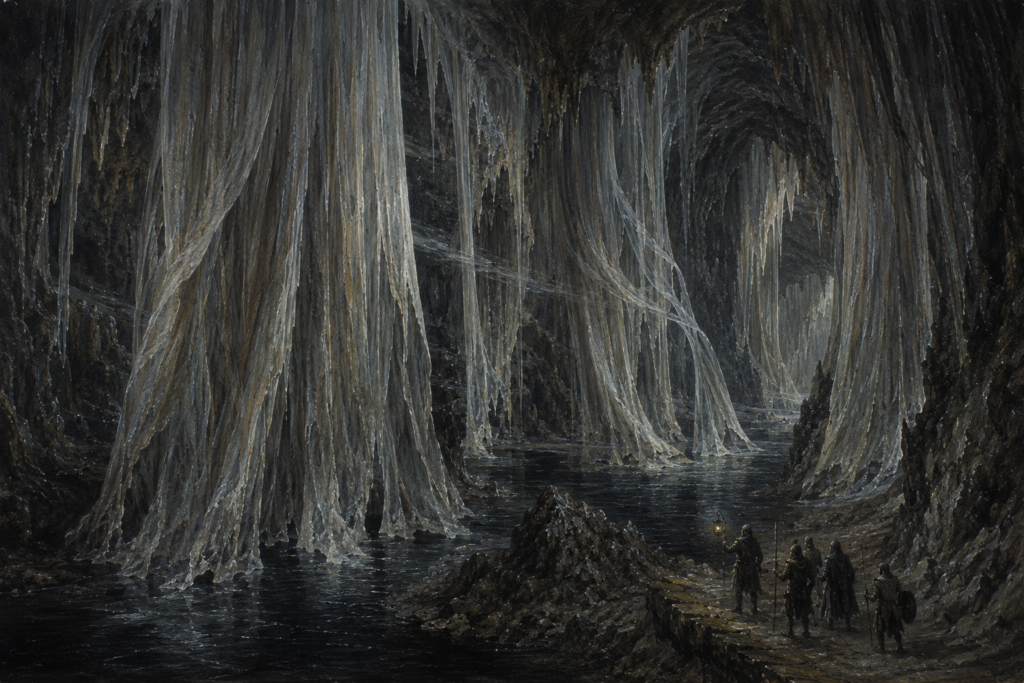
Constant dripping has produced mineral sheets large enough to divide entire caverns.
Some are thin, translucent and resonant. Others have grown into thick walls containing hidden passages between successive layers of mineral deposition.
Wind moving through the narrow gaps creates deep sustained notes. Experienced travellers listen for changes in those tones because altered resonance can indicate rising water or new fractures.
The formations create excellent concealment but poor certainty. A route behind a curtain may remain dry, flood suddenly or lead into a chamber completely hidden from the surrounding cavern.
The Sealed Dark — Fourth Layer of Pandemonium
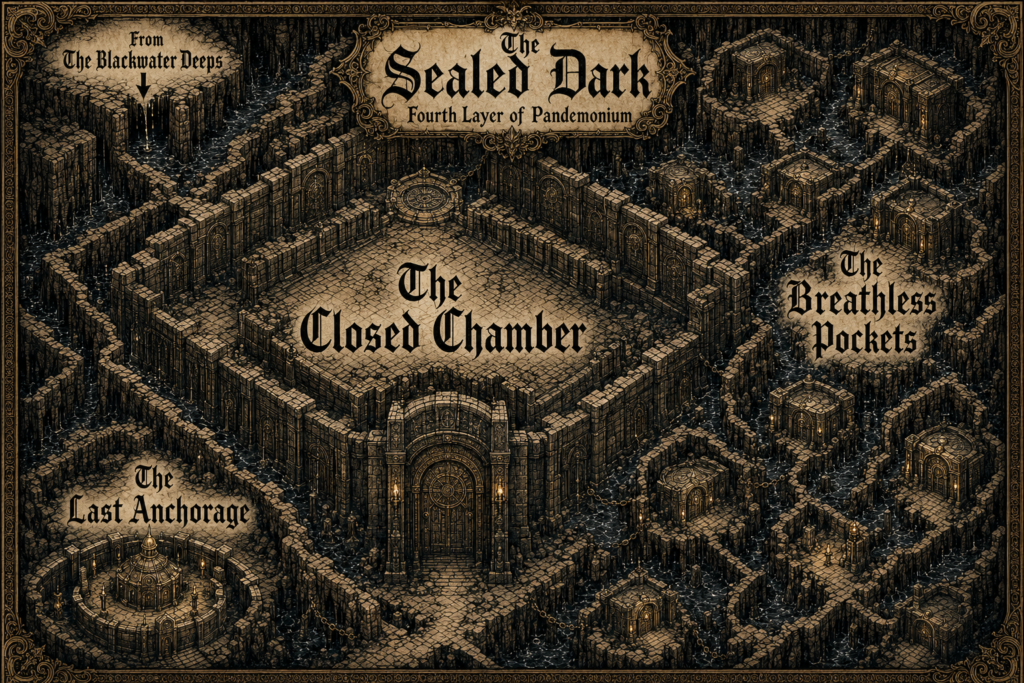
The Sealed Dark is fundamentally different from the layers above it. It is not one vast interconnected cavern system.
Instead, isolated pockets of space lie buried within immeasurable stone. Some are natural chambers. Others are deliberate cells, shelters, archives or prisons whose original entrances no longer exist.
The Last Descent
The approach begins as open blackwater routes collapse into narrow cracks, confined pools and passages buried under increasingly massive stone.
Water still appears, but no longer provides a continuous route. A still pool may have no visible source or outlet. A thin stream can emerge directly from a sealed wall.
There is no single gate into the fourth layer. Travellers arrive through collapsed stairs, temporary openings, submerged shafts, planar portals and breaches created through deliberate excavation.
Most significant is the changing wind. The howl no longer has room to cross entire chambers. Its presence is felt as vibration and pressure locked behind solid barriers.
Closed Stone
Natural geology and deliberate construction are almost impossible to separate with certainty.
A corridor can terminate beneath loose collapse or at a perfectly smooth wall. A door may be visible only from one side. A staircase can disappear into stone because the chamber it once reached now lies behind a gravity surface no longer connected to the route.
Every barrier creates a decision. The wall may conceal escape, water, poisonous air, unstable pressure or something deliberately confined.
Cracks provide clues through moisture, temperature and vibration, but none guarantees that breaking through will improve the situation.
Air, Pressure and Silence
Atmosphere varies dramatically between pockets.
Some chambers remain breathable through fissures too small for travellers. Others contain stale air, harmful vapours, ash or vacuum.
Even good air is finite when ventilation is poor. A chamber safe for one traveller may become dangerous when a large expedition attempts to camp inside it.
Opening a barrier can cause violent decompression or an almost imperceptible movement of air that continues for hours. Dust, loose cloth and the surface of standing water often reveal the change before anyone feels it directly.
The Sealed Dark feels quieter than the upper plane, but quiet should not be confused with peace. Entire walls groan under distant pressure. Vibrations travel through solid stone from events occurring somewhere beyond reach.
Travel Through Buried Passages
Progress is often physical work. Rubble has to be moved. Supports must be built. Water must be drained or diverted. Equipment is passed through cracks before travellers crawl after it.
Maps work only within known connected pockets. The most valuable route records describe barriers rather than destinations.
Excavation consumes time, air and tools while transmitting noise through the surrounding stone.
A failed attempt changes the available choices. A support may become unsafe. A flooded wall may force retreat. The wrong breach can release water while also exposing the only escape route.
Return can never be assumed. Parties constantly decide whether a route should be reinforced, left open for speed or sealed again behind them.
Chambers Without Entrances
Some pockets have remained untouched for extraordinary periods. They preserve abandoned camps, libraries, equipment, bodies and whole architectural interiors whose approach vanished long ago.
Dry chambers can preserve organic materials that would have vanished elsewhere. Wet chambers accumulate mineral crusts and slow-growing deposits.
Opening one changes the environment immediately. Fresh air can destroy preservation. New pressure can fracture weakened surfaces. Light can reveal a priceless archive while also alerting anything inside that the seal has failed.
The central uncertainty is always the same: was the chamber protected from Pandemonium, or was Pandemonium being protected from the chamber?
The Deepest Known Layer
The Sealed Dark is the deepest confirmed layer, but it contains no known centre.
Passages become too narrow to follow. Barriers carry vibration from spaces that cannot be reached. Water disappears through cracks. None of this proves the existence of a fifth layer.
Expeditions seeking a final bottom discover only increasing isolation.
Pandemonium’s uproar has not ended here. It has merely been trapped behind stone.
The Breathless Pockets
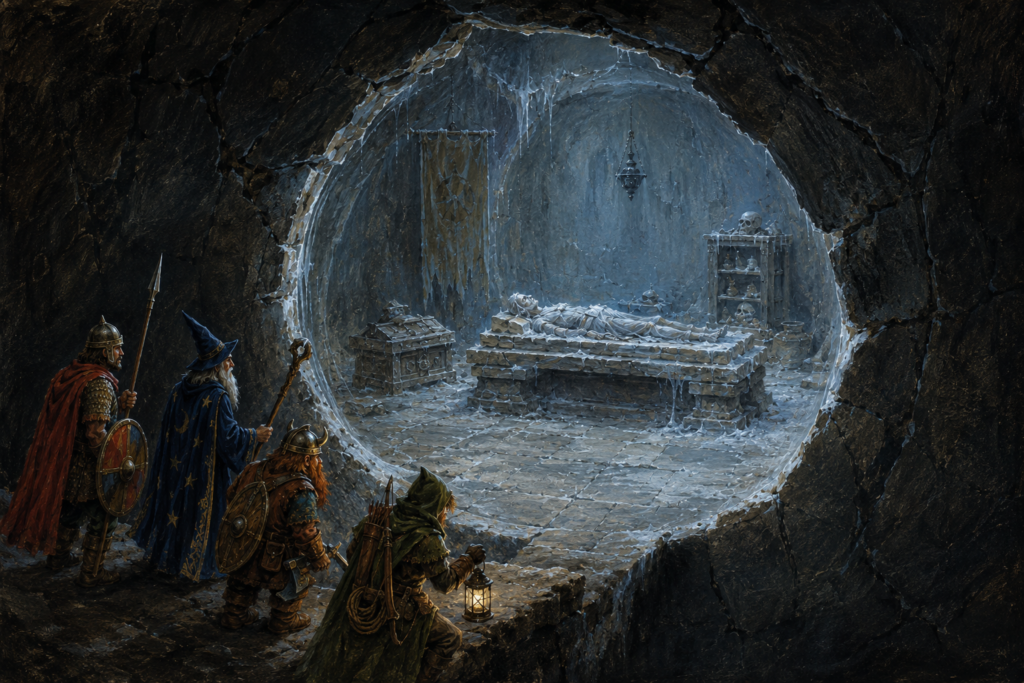
The Breathless Pockets are chambers whose atmospheres cannot sustain ordinary life.
One might contain freezing vapour. Another holds poison, ash, spores or nothing breathable at all.
Their danger is also what makes them valuable. Bodies, documents, battlefields and abandoned interiors can remain almost perfectly preserved.
The instant a pocket is opened, that preservation may begin to fail. Rescue and investigation therefore become races against both air and time.
The Closed Chamber
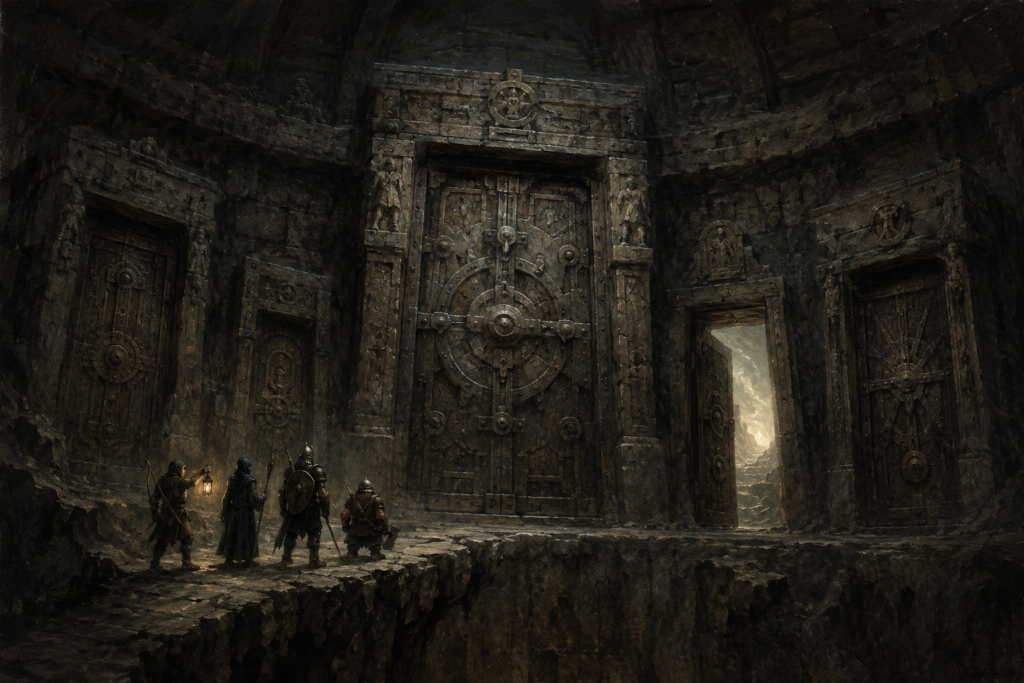
The Closed Chamber is less a single room than a recurring system of immense doors discovered in otherwise separate pockets.
Their designs vary enormously, yet enough repeated structural features suggest they belong to one hidden complex or tradition.
Some doors reveal conventional cells. Others open into tombs, palatial interiors, ancient battlefields or volumes of space apparently larger than the surrounding chamber can contain.
Not every prisoner was justly sentenced. Some were lawfully confined by powers that no longer exist. Others appear to have been hidden because their testimony, knowledge or mere survival threatened somebody powerful.
Opening a door therefore creates a legal and moral problem before it creates a combat encounter.
The Last Anchorage
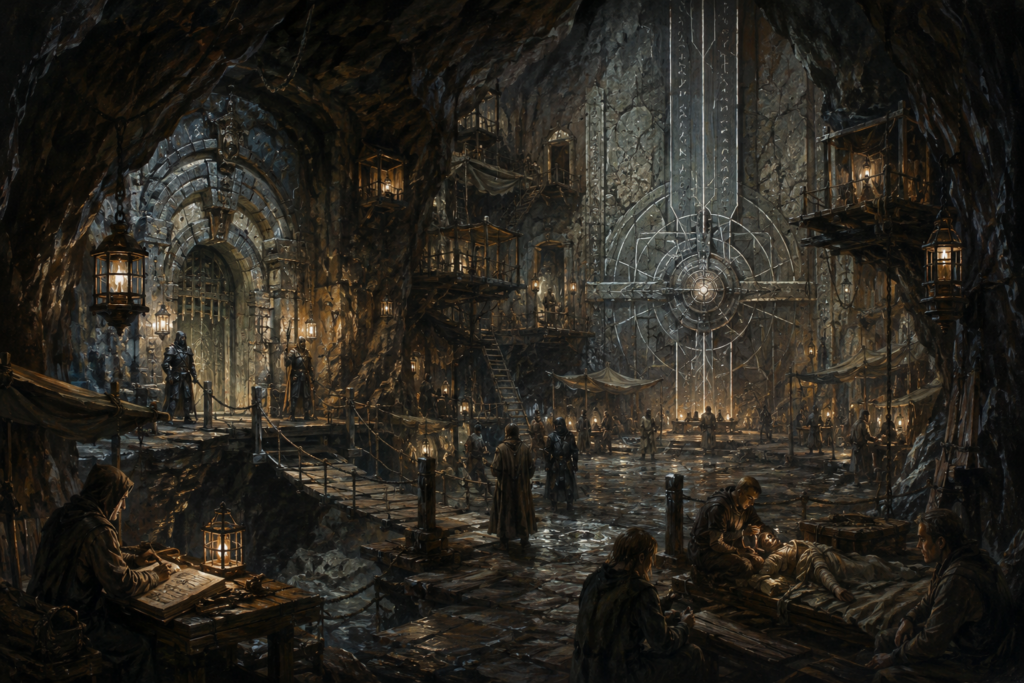
The Last Anchorage occupies one breathable pocket surrounding an ancient planar stabilisation point.
Its only dependable entrance is a guarded portal leading to a fortified receiving chamber. The gate is opened deliberately rather than left continuously exposed.
The inhabitants shelter injured travellers, refugees and people pursued by creatures that hunt through sound. Names are normally written rather than called across public spaces. Warning systems use light and vibration.
Important disputes are heard inside insulated rooms because information spoken carelessly can travel farther than intended.
The settlement exists only because an ancient anchor holds its portal to a fixed Outer Howl destination. Everyone living there understands the same uncomfortable fact: if that device finally fails, the Last Anchorage may become exactly what its name implies.
Divine Powers and Exiles
No deity rules Pandemonium as a whole.
The labyrinth is nevertheless attractive to powers seeking neutral territory, concealment, exile, private prisons or routes difficult for rivals to follow.
| Power | Relationship to Pandemonium |
|---|---|
| Eris | Maintains Strife as a sovereign cross-planar enclave in the Carved Lament. Her authority ends with her defended divine territory; she does not rule the plane. |
| Momus | Occasional Hellenic exile and independent critic. He maintains no permanent realm in Pandemonium. |
| Eshu | Occasional visitor at unstable crossings and disputed routes. He maintains no Pandemonium divine realm. |
A god can possess a sanctuary, court or prison here without becoming a sovereign of the plane itself.
Similarly, possession of a wind or storm portfolio does not automatically create jurisdiction over Pandemonium. The plane’s winds are a property of its own cosmological nature rather than ordinary weather waiting to be claimed.
Inhabitants of Pandemonium
Petitioners
Pandemonium attracts souls whose pursuit of personal freedom became abandonment, confusion or the deliberate transfer of responsibility onto other people.
They remain recognisable individuals. Some repeat their former patterns endlessly. Others understand what those choices cost and seek out settlements built upon deliberately accepted obligations.
The Unmoored
The Unmoored reject permanent membership in any Haven. Some are highly competent wanderers who simply prefer independence.
Others refuse every rescue procedure, remove route marks or reject safety restrictions while expecting other people to bear the consequences.
Havens have therefore developed ways to offer assistance without allowing a single person’s refusal to endanger the entire rescue group.
Howlers
Howlers are rare native outsiders and Pandemonium’s signature predators.
They are best known in the Outer Howl and Carved Lament, where their vibration-based communication gives them a profound advantage.
They are not uniform animals. Individual packs differ in intelligence, language, boundary custom and willingness to negotiate.
Some accept surrender and recognise agreements. Others do not. Their treatment should therefore depend upon the individuals encountered rather than a species-wide assumption.
Isolated Communities
Most communities are fortified refuges rather than great cities. Their economies centre upon anchor maintenance, fungus cultivation, salvage, water collection, guiding and portal trade.
Common communication systems include hand signs, touch signals, written instructions, protected speaking rooms and coded lights across cavern voids.
Many Havens protect considerable personal liberty during normal conditions while reserving temporary emergency powers for storms, decompression events and structural failure.
Exiles, Migrants and Fugitives
Pandemonium shelters escaped prisoners, political refugees, hunted witnesses, broken servants and oath-breakers.
Exile proves nothing by itself. A pursuer may be a lawful officer, a murderer seeking revenge or an agent trying to silence evidence.
Air-born creatures entering after the formation of Elemental Air are migrants or stranded travellers rather than the plane’s original natives.
Bestiary Relationships
| Creature | Status | Use in Pandemonium |
|---|---|---|
| Howler | Rare native outsider | Signature territorial predator and intelligent pack power. |
| Cloaker | Established cavern resident or migrant | Sonic ambusher, territorial intelligence or neighbouring flock. |
| Cave Fisher | Transplanted underground predator | Ledge, bridge, shaft and underground-river ambusher. |
| Air Elemental | Later migrant from Elemental Air | Stranded intelligence, guide, displaced resident or dangerous current. |
| Aerial Servant | Summoned or stranded visitor | Invisible tracker still attempting to fulfil an old command. |
Demons can enter from the Abyss as hunters, fugitives or invaders. They are not Pandemonium’s default native population.
Other subterranean Bestiary creatures belong here only when they have a credible route and history. Cavern terrain by itself is not enough reason to populate the plane with every underground monster.
Personhood, Law and Consequence
Pandemonium has no universal government, but settlements maintain recognised law.
- Anchor Damage: sabotaging an occupied support system endangers everyone connected to it.
- Shelter Theft: removing a recognised guest from emergency shelter during danger can amount to attempted killing.
- Air and Water Rights: cisterns, ventilation shafts and breathable chambers are protected communal resources.
- False Signals: forged warnings or rescue calls can cause mass casualties.
- Name Misuse: broadcasting a protected name can expose a person to imitation or hostile magic.
- Pressure Trespass: opening a door or cutting a route can alter an entire district’s environment.
- Shared-Line Duty: travellers connected to one safety line can acquire duties toward one another.
- Concealed Risk: knowingly hiding structural or atmospheric danger is treated seriously.
- Abandonment: deliberately cutting away a dependent traveller without immediate necessity can be prosecuted.
Surrender has meaning when the opposing creature or authority recognises it. Haven guards, organised exiles, intelligent outsiders and some Howler packs can accept negotiated surrender.
Pandemonium and the Mortal World
Mortal breaches most often appear beneath the earth: mines, caves, buried fortifications, collapsed cellars and excavated stone chambers.
The first sign is often pressure rather than a visible portal. Lamps flicker in enclosed rooms. A mine shaft produces wind despite having no known outlet. Voices return from directions where no passage exists.
A fully opened breach can expose a mine to the Outer Howl, flood underground works from the Blackwater Deeps or reveal a sealed prison chamber whose occupant predates the mortal settlement above it.
Miners, masons and soldiers are therefore often the first people to encounter a new Pandemonium breach, long before a planar scholar understands what has happened.
Travel and Arrival
Arrival
The first action after arrival is usually not exploration. It is securing the party.
Travellers identify the gravity surface, determine the strongest airflow, protect hearing and establish whether the portal remains open before moving away from it.
Essential Equipment
- Independent harnesses and ropes
- Chains, pitons, hooks and repair tools
- Effective hearing protection
- Face and eye protection
- Enclosed lights with backups
- Portable windbreaks
- Sealed food and water
- Written route records
- Silent signalling methods
- A predetermined separation procedure
- Physical identity tokens or passwords
- An agreement explaining rescue duties and when a shared line may be cut
Navigation
There is no universal north or downward direction.
Routes are identified through pressure, temperature, mineral texture, vibration, moisture, gravity transitions and maintained markers.
Portals
Stable portals often manifest as:
- Cave entrances blowing against local weather
- Mine shafts whose echoes return incorrectly
- Cracked bells ringing without being struck
- Ancient stone doors uncovered behind collapse
- Whistling fissures beneath mountains or buildings
- Damaged summoning circles
- Corridors becoming longer each time they are entered
The airflow through an open gate can provide advance warning of conditions on the far side.
Game Mechanics
Use these rules when the plane itself is an active challenge. A known protected route inside a functioning Haven does not require constant environmental checks.
5.5e / 2024-Compatible Mechanics
Common Wind Effects
Howling, Violent and Killing Wind impose Disadvantage on ranged attack rolls made with weapons.
They extinguish open nonmagical flames and disperse ordinary fog, smoke and similar airborne clouds.
A flying creature exposed to one of these winds must land at the end of its turn or fall unless it can Hover or is otherwise protected.
Hearing Protection
A creature wearing effective hearing protection has Disadvantage on Wisdom (Perception) checks relying on hearing and normally cannot understand ordinary speech beyond 5 feet.
Fitting or removing hearing protection requires the Utilize action.
Deafening Howl
After 10 minutes in Howling Wind without hearing protection, a creature must succeed on a DC 13 Constitution saving throw or have the Deafened condition until it spends 10 minutes within secure shelter.
After 1 minute in Violent Wind without hearing protection, a creature must succeed on a DC 15 Constitution saving throw or have the Deafened condition for 1 hour.
Repeat after each additional 10 minutes of exposure.
Effective hearing protection grants automatic success. Killing Wind overwhelms ordinary hearing protection unless the creature also possesses Total Cover or equivalent magical protection.
Securing a Creature
A creature attached by a suitable harness, rope, chain or magical fastening to a stable anchor has Advantage on saving throws against forced movement caused by Pandemonium’s winds.
If it would be pushed farther than the remaining length of the fastening, it stops at that limit unless the anchor or fastening breaks.
A conscious creature controlling the same line can use its Reaction before another attached creature makes such a saving throw, granting that creature Advantage.
Cavern Gravity
When a creature unexpectedly enters a competing gravity field, it must succeed on a DC 13 Dexterity saving throw or have the Prone condition upon reaching the new surface.
At a particularly unstable junction, the DC becomes 15.
A creature secured to a stable anchor has Advantage.
Howling Wind
Movement directly against Howling Wind costs 1 extra foot for every foot moved.
Wisdom (Perception) checks relying upon hearing have Disadvantage.
Violent Wind
An exposed area of Violent Wind is Difficult Terrain for creatures moving against or across the current.
An unsecured creature starting its turn in the wind must succeed on a DC 15 Strength saving throw or be pushed 20 feet and have the Prone condition.
An unsecured flying creature that fails is pushed 30 feet before falling.
Killing Wind
Killing Wind is an encounter-scale catastrophe.
A creature exposed at the start of its turn must make a DC 18 Strength saving throw.
On a failure it takes 14 (4d6) Bludgeoning damage, is pushed 40 feet and has the Prone condition.
On a success it takes half damage and is not pushed.
Total Cover prevents this effect.
Broken Communication
Ordinary speech in Howling Wind is clear within 15 feet for a creature without hearing protection.
In Violent or Killing Wind, ordinary speech is clear only within 5 feet.
Beyond these distances, understanding one shouted short phrase requires a DC 15 Wisdom (Perception) check.
Planar Light Suppression — Blackwater Deeps
The Blackwater Deeps suppresses illumination as an environmental property of the layer.
The radius and range of non-sunlight illumination are halved.
This applies to mundane and magical light unless an effect creates sunlight or explicitly prevents its illumination from being reduced.
Travel Legs
Make one navigation check when a group crosses a meaningful uncertain route, reaches an important junction or encounters changed environmental conditions.
A guide makes a DC 15 Wisdom (Survival) check. One proficient companion can Help if the group can communicate effectively.
On failure, choose or roll one consequence:
- The journey takes 1d4 additional hours.
- Additional food, water or repair supplies are consumed.
- The party reaches an exposed location.
- A rival, refuge or pursuer arrives first.
- Part of the route information becomes unusable.
- A regional complication occurs.
Reliable local instructions, a maintained route or an experienced guide grants Advantage.
Exposure
After four hours of continuous travel through Howling Wind, an exposed creature must succeed on a DC 13 Constitution saving throw or gain 1 Exhaustion level.
After one hour of continuous travel through Violent Wind, an exposed creature must succeed on a DC 14 Constitution saving throw or gain 1 Exhaustion level.
Repeat after each additional equivalent period.
Two hours within secure shelter resets the exposure timer but does not remove existing Exhaustion.
Rest
A creature safely anchored in an otherwise survivable location can take a Short Rest.
A Long Rest requires a stable refuge, reinforced camp, sealed chamber or equivalent magical protection.
Echo Disorientation
Once during an uncertain travel leg through the Carved Lament or another echo-haunted region, a creature separated from every ally may make a DC 13 Wisdom saving throw.
On failure it has Disadvantage on its next Wisdom (Perception) or Wisdom (Survival) check made to identify a voice or choose a route.
A reliable route marker, written separation plan or prearranged signal allows automatic success.
False Familiar Voices
When an area reproduces the voice of an absent familiar person, a listener can make a DC 15 Wisdom (Insight or Perception) check.
On success, the creature recognises an inconsistency in direction, wording or context.
A physical identity signal or written password establishes identity without a check.
Pressure Reversal
During a sudden pressure reversal, each unsecured creature must succeed on a DC 15 Strength or Dexterity saving throw.
On failure it is pushed 20 feet toward the new current and has the Prone condition.
Rockfall
When one effect deals at least 15 Thunder damage to a creature or object touching unstable stone, or an explosion directly strikes the cavern, the DM can make one collapse roll.
Roll 1d6. On a 1, stone falls across a 10-foot-radius area.
In the Thunder Hollows and Shatter Galleries, collapse occurs on a 1 or 2.
Each creature in the area makes a DC 15 Dexterity saving throw, taking 18 (4d8) Bludgeoning damage on a failed save or half as much on a success.
The area becomes Difficult Terrain and can block a passage.
Magical Silence
Magical silence suppresses sound-based environmental effects and prevents ordinary acoustic imitation inside its area.
It does not stop wind, pressure or airborne debris.
Creatures inside the silence cannot hear warning bells, cracking stone, approaching creatures or changes in wind pitch.
Planar Infusions
Basic — Anchor-Sense. You always know the direction of the nearest stable gravity surface within 60 feet. You have Advantage on checks made to secure an anchor and saving throws against nonmagical wind.
Improved — Voice Against the Howl. Creatures of your choice can understand your voice within 30 feet despite nonmagical wind. You have Advantage on checks and saving throws made to recognise false or imitated voices.
Greater — Fellowship of the Anchorage. Once per Long Rest, you create a 20-foot Emanation lasting 1 minute. Creatures of your choice within it cannot be moved by nonmagical wind, have Resistance to Thunder damage and can understand one another despite environmental noise. The Emanation moves with you.
Pathfinder First Edition / 3.5e-Compatible Mechanics
Hearing Protection
Effective hearing protection grants a +4 circumstance bonus on saving throws against deafening wind and sonic environmental effects.
While worn, it imposes a –5 penalty on Listen or hearing-based Perception checks.
Deafening Howl
After 10 minutes in strong wind without hearing protection, a creature must succeed on a DC 13 Fortitude save or become Deafened until it spends 10 minutes within secure shelter.
After 1 minute in severe or stronger wind, the creature must succeed on a DC 15 Fortitude save or become Deafened for 1 hour.
Repeat after each additional 10 minutes.
Secured Travellers
A creature fastened to a stable anchor gains a +4 circumstance bonus on checks and saving throws to resist wind, forced movement and gravity transitions.
In PF1e, another creature controlling the same line can use an immediate action to brace it.
In 3.5e, the assisting creature must ready an action.
The assisted creature gains a +2 circumstance bonus on the relevant check or save.
Cavern Gravity
At an unexpected gravity transition, creatures must succeed on a DC 15 Reflex save or fall Prone and slide 1d6 × 5 feet toward the new floor.
Wind
Use the normal strong, severe, windstorm and hurricane-force wind rules for the chosen system.
The Outer Howl commonly produces strong and severe wind. The Carved Lament concentrates those forces into narrower passages. The Blackwater Deeps combines wind with water, darkness and slippery stone.
Communication
Listen checks take a –5 circumstance penalty in strong howling wind and a –10 penalty in severe or stronger wind.
Speech beyond 10 feet in strong wind requires shouting and an appropriate Listen check.
In the Carved Lament, identifying a sound’s true direction normally requires a DC 20 Listen check.
Planar Light Suppression — Blackwater Deeps
The radius and range of mundane and magical illumination are halved as a property of the layer.
Navigation
An uncertain travel leg requires a DC 20 Survival check.
Failure costs 1d4 hours, supplies or positional advantage.
Failure by 5 or more also creates an environmental complication.
Reliable instructions, a maintained route or an experienced guide grants a +4 circumstance bonus.
Exposure
After four hours in continuous strong wind, an exposed creature must succeed on a DC 13 Fortitude save or become Fatigued.
After one hour in severe or stronger wind, an exposed creature must succeed on a DC 15 Fortitude save or become Fatigued.
A Fatigued creature that fails becomes Exhausted.
Two hours inside secure shelter resets the exposure period.
Rest
Normal sleep requires a stable refuge, reinforced camp, sealed chamber or equivalent magical protection.
Echo Disorientation
Once during an uncertain travel leg through an echo-haunted region, a creature separated from every ally must succeed on a DC 15 Will save or take a –2 penalty on its next Listen, Sense Motive or Survival check made to identify a voice or choose a route.
A reliable marker, written plan or known signal removes the penalty.
False Voices
Recognising an imitated familiar voice normally requires a DC 20 Listen or Sense Motive check.
A known password, physical signal or clear contradiction provides a +4 circumstance bonus or establishes the truth automatically.
Pressure Reversal
Each unsecured creature must make a DC 18 Reflex save or Strength check.
Failure moves the creature 2d6 × 5 feet and knocks it Prone.
Sonic Collapse
When one sonic effect deals at least 15 points of damage to a creature or object touching unstable stone, or an explosion strikes the cavern, roll 1d6.
On a 1, a collapse affects a 10-foot-radius area.
In the Thunder Hollows and Shatter Galleries, collapse occurs on a 1 or 2.
Creatures take 4d6 points of bludgeoning damage, with a DC 15 Reflex save for half.
Planar Infusions
Basic — Anchor-Sense. Gain a +2 bonus on Survival checks in Pandemonium and a +4 bonus on checks or saves against wind and forced movement.
Improved — Voice Against the Howl. Your speech can be understood within 30 feet despite nonmagical wind. Gain a +4 bonus on saves against sonic patterns, false voices and sound-based mind-affecting effects.
Greater — Fellowship of the Anchorage. Once per day, create a 20-foot-radius mobile zone lasting 1 minute per Hit Die. Allies within it count as one size category larger against wind, gain sonic resistance 10, receive a +4 bonus against forced movement and can understand one another despite environmental noise.
Running Pandemonium
Uproar First, Alienation Second
The first experience of Pandemonium should be physical: noise, pressure, confusion, darkness and movement.
Alienation emerges from surviving those conditions. Communication repeatedly fails. Routes depend upon people who may no longer be trustworthy. Groups begin asking whether remaining attached to one another is worth the danger.
Make Each Layer Feel Different
- Outer Howl: scale, wind exposure, distant refuges and uncertain crossings.
- Carved Lament: resonance, false voices, carved routes, investigation and Strife.
- Blackwater Deeps: freezing water, darkness, overlapping lakes, floods and submerged ruins.
- Sealed Dark: finite air, excavation, one-way routes, sealed environments and forgotten prisoners.
Preserve Player Agency
False voices create uncertainty without forcing anyone to follow them.
Wind threatens separation without making it unavoidable.
Preparation, investigation, alliances and magical resources should materially improve a group’s options.
Keep Failure Playable
Failure should usually alter the journey rather than instantly end it.
The party can lose time, supplies, secrecy, hearing, a route, political trust or access to a safe refuge and still have meaningful decisions to make.
Make Magic a Trade-Off
- Flight crosses voids but becomes dangerous in powerful wind.
- Silence defeats acoustic deception but removes warning sounds.
- Thunder harms enemies but can destabilise stone.
- Teleportation bypasses distance but can arrive inside an exposed or sealed environment.
- Wall magic creates shelter while redirecting airflow.
- Bright light reveals hazards while revealing the party.
Play-Pressure Test
- Arrival: the party appears on an exposed shelf and has seconds to secure itself.
- Predator: Howlers begin communicating through stone without becoming visible.
- Crossing: Eshu offers several technically accurate but easily misunderstood routes.
- Refuge: Haven guards offer sanctuary if the characters first help stabilise a damaged anchor.
- Carved Lament: a missing companion’s voice calls from several directions.
- Strife: Eris offers safe passage in exchange for a damaging truth about an ally.
- Sealed Dark: a prisoner claims its lawful sentence ended generations ago.
- Consequence: the decisions made during the journey determine future sanctuary and whether the prison remains sealed.
Adventure Hooks
The Haven That Cut Its Anchor
A Hanging Haven tears away from part of its support system and begins drifting toward a dangerous cavern surface. The authorities blame refugees who recently arrived. The refugees claim the failure was deliberately arranged to destroy evidence of an older crime.
The Apple No One Claims
A golden apple manifests inside an independent Haven bearing the words To the One Who Saved Us. Three respected leaders possess credible claims to the title.
Eris does not need to invent evidence. She merely ensures that everybody receives the most damaging true information about everyone else.
The Prisoner Whose Sentence Ended
A divine herald inside the Closed Chamber can prove that its sentence possessed a fixed term.
That term ended centuries ago. The court that imposed it no longer exists, and the seal was built so that nobody except that vanished authority could formally open it.
Encounters in the Howling Labyrinth
| d8 | Encounter |
|---|---|
| 1 | A Howler pack communicates through the stone beneath the party without revealing its position. |
| 2 | A lost petitioner possesses a map contradicting every maintained route marker. |
| 3 | A Cave Fisher catches a traveller attached to a shared anchor line. |
| 4 | Eshu waits beside three temporary portals and asks each traveller what they believe was actually promised. |
| 5 | An Aerial Servant continues pursuing an order issued by a summoner dead for generations. |
| 6 | A Cloaker offers safe passage in exchange for silence, food and one truthful answer. |
| 7 | An emissary of Eris offers a protected route if the party reveals something damaging but true about an ally. |
| 8 | A portal opens into a Sealed Dark chamber containing warm daylight and birdsong. |
Frequently Asked Questions
What does Pandemonium represent?
Wild and noisy disorder, confused movement and broken communication. Alienation emerges when people can no longer rely upon direction, responsibility or one another.
What are the four layers?
The Outer Howl, the Carved Lament, the Blackwater Deeps and the Sealed Dark.
When did Pandemonium form?
During Eon VII, when enduring cosmic concepts stabilised as the Outer Planes.
Do its winds come from Elemental Air?
No. Pandemonium’s winds are native to the plane and predate later breaches to Elemental Air.
Who rules Pandemonium?
No single deity. Eris rules Strife within the Carved Lament but does not rule Pandemonium itself.
Are Howlers native?
Yes. Howlers are rare native outsiders and one of Pandemonium’s signature intelligent predators.
Is Pandemonium a prison plane?
It contains ancient prisons, especially within the Sealed Dark, but imprisonment is not the plane’s central cosmic identity.
How is it different from Carceri?
Carceri embodies confinement and betrayal. Pandemonium embodies disorder, failed communication and movement that never becomes dependable escape.
How does gravity work?
Gravity pulls toward the stone enclosing a cavern rather than toward one universal downward direction.
Does magical silence stop the wind?
No. It suppresses sound but does nothing to the physical force of wind, pressure or debris.
Mythic and Historic Context
The word Pandemonium entered English literary history through John Milton’s Paradise Lost, where Pandæmonium is the great meeting place of the infernal host.
The poem can be read through Project Gutenberg, while the Milton Reading Room at Dartmouth provides an annotated text of Book I.
The later English meaning — uproar, confusion and noisy disorder — is the more important foundation for the SpiralWorlds plane. The Howling Labyrinth turns that idea into physical geography.
Its pressure systems also have a real geological point of departure. Large cave systems can experience strong airflow when pressure conditions differ between connected spaces and external openings.
See the United States National Park Service resources What Causes the Wind of Wind Cave? and Wind Cave Geology.
The Carved Lament takes real cave resonance and pushes it into supernatural geography. The Blackwater Deeps expands underground rivers, mineral deposition and flooded caverns into a complete gravity-bound world. The Sealed Dark takes the sealed chamber and makes it a cosmological principle.
Video Lore
These videos provide useful background on traditional tabletop presentations of Pandemonium. SpiralWorlds canon is defined by the page above.
Traditional Pandemonium Lore
A broader traditional tabletop treatment useful for comparing older planar lore with the modern SpiralWorlds reconstruction.
Watch directly on YouTube →Pandemonium and Carceri
Useful comparative lore showing why Pandemonium’s disorientation and Carceri’s imprisonment should remain distinct planar ideas.
Watch directly on YouTube →Pandemonium — The Howling Labyrinth
Pandemonium is wild and noisy disorder made into a world: an infinite cavern labyrinth where winds collide, voices lose their meaning and every direction offers confusion rather than escape.
Its endless uproar expresses alienated chaos. Unrestricted movement destroys direction, communication breaks into accusation and freedom without responsibility leaves travellers isolated within a realm that never becomes still.
- Plane Type: Outer Plane
- Moral Gravity: Chaotic Neutral, darkening toward Chaotic Evil where confusion becomes manipulation, isolation becomes cruelty or freedom becomes deliberate abandonment
- Common Names: Pandemonium, the Howling Labyrinth, the Caverns Without End, the Wind-Black and the Echoing Deeps
- Planar Sigil: A black spiral cavern mouth with a cracked bronze bell at its centre, surrounded by a fractured bronze ring.
- Primary Function: The cosmic realm of uproar, confusion and alienated chaos, where unrestricted movement destroys direction, expression loses meaning and freedom without responsibility becomes isolation
- Layers: The Outer Howl, the Carved Lament, the Blackwater Deeps and the Sealed Dark
- Dominant Terrain: Infinite natural caverns, narrow carved passages, drowned black galleries and isolated chambers enclosed within solid stone
- Native Medium: Air, stone, pressure, darkness and sound
- Native Light: None. Illumination comes from imported lamps, magic, portals and rare local organisms or supernatural events
- Dominant Hazards: Colliding winds, deafening noise, airborne debris, false signals, gravity changes, rockfall, flooding, exhaustion, separation and loss of shelter
- Primary Inhabitants: Petitioners, exiles, prisoners, marooned travellers, rare cavern communities, native Howlers, transplanted cavern life and later elemental migrants
- Usual Arrival Point: An exposed shelf in the Outer Howl, a screaming passage in the Carved Lament, a wet black cavern in the Blackwater Deeps or a sealed pocket within the Sealed Dark
- Related Planes: Limbo, the Abyss, Carceri, the Elemental Plane of Air and the Astral Plane
- Campaign Role: Planar survival, rescue, exile, refuge politics, divided alliances, acoustic investigation, hidden prisons and choices surrounding trust and responsibility
Overview
Pandemonium is uproar without release.
It is an immeasurable interior of caverns, tunnels and sealed hollows. Wind tears through every open passage. It whispers through hairline cracks, screams through narrow galleries and roars across vaults large enough to swallow cities.
Currents collide, divide and reverse. Dust, stone fragments, lost possessions and the wreckage of failed expeditions travel through the dark. A warning shouted into one passage may return from another direction after the danger has moved elsewhere.
There is no sky, planetary surface or universal horizon. A distant darkness may conceal the opposite wall of the same cavern. A passage that appears to descend may curve until its wall becomes the ground beneath a traveller’s feet.
Gravity pulls away from the central void of each cavern and toward the surrounding stone. Travellers can stand upon the floor, walls and ceiling of the same chamber. Where passages intersect, competing gravity fields can change the meaning of up and down without warning.
Pandemonium possesses no ordinary natural light. Open flames are rapidly extinguished. Enclosed lamps and magic survive more reliably, but a steady light may reveal travellers across an immense cavern long before they see what approaches them.
The plane transforms sound into geography. Residents recognise routes through pitch, vibration, pressure and echo delay. Voices travel across impossible distances while losing context and identity. A familiar call may belong to an echo, predator, remembered event or person who disappeared generations ago.
Movement is abundant. Escape is not.
Most inhabitants are exiles, prisoners, refugees or travellers who have lost the knowledge, allies or trust required to leave. The labyrinth offers countless directions but few dependable routes.
A small number of isolated communities endure. Every permanent refuge is remarkable, vulnerable and separated from its nearest neighbour by dangerous travel. Their people survive through maintained anchors, sealed doors, shared signals and carefully defined obligations.
Every stable refuge is an argument against the plane.
Cosmic History
Eon VII — The Birth of the Howling Labyrinth
Pandemonium crystallises during the formation of the Outer Planes, when enduring moral and conceptual forces acquire permanent geography.
Chaos and possibility supply unrestricted movement. Fractured thought divides voice from meaning and motion from direction. Conflict gathers wherever confusion hardens into accusation, hostility and abandonment.
The resulting plane contains endless passages but no dependable escape. Freedom survives, yet fellowship must be rebuilt deliberately.
Eon X — The Coming of Elemental Air
Pandemonium’s winds predate the Elemental Plane of Air.
They are part of the plane’s original conceptual geography: movement trapped inside stone, pressure without release and noise without mutual understanding.
When the Elemental Planes emerge during the Elemental Foundations, later breaches connect the labyrinth to Elemental Air. Air-born beings then begin entering as migrants, summoned servants, explorers and captives.
Eon XIII — The Elder Wars
During the Elder Wars, planar engines and divine armies seal unstable breaches throughout the multiverse.
Some pockets of the Sealed Dark become wartime prisons. Dangerous beings, weapons, voices and records are placed beyond ordinary travel. Abandoned shelters later become the foundations of mortal and outsider refuges.
Damaged engines leave pressure reversals, unstable gravity junctions and portals connecting regions with no natural relationship.
Eon XIV — The Cosmic Leylines
The Cosmic Leylines reinforce reality after the Elder Wars. Silver cords, runic anchors and guarded junctions stabilise damaged planar boundaries.
The oldest anchors used by the Hanging Havens are surviving fragments, later adaptations or smaller constructions based upon those ancient principles. Refuge builders cannot reproduce the original works, but they understand enough to secure inhabited caverns against changing pressure.
The Last Anchorage surrounds one surviving stabilisation junction. Its runic wall predates the settlement built against it.
After Eon XIV — The Long Age of Refuge and Exile
When the Elder Gods withdraw during the Great Retreat, their leylines, anchors and wardens remain behind.
Only a fraction of Pandemonium lies within their protection. Leywardens and runic sentinels patrol isolated routes, while damaged junctions produce repeating portals, sudden gravity changes and currents crossing regions that should remain separate.
Settlements gather around the few anchors that continue to function. Most disappear after a failed seal, redirected storm, internal division or broken supply route. Their ruins become salvage sites, predator territories and memorial chambers.
The Age of Exile and Rebellion
During the Age of Exile and Rebellion, outsider peoples split into rival hosts and compete for influence across the planes.
Pandemonium becomes a refuge, meeting ground and disposal site for those whom established realms refuse to receive. Defeated servants, escaped prisoners, broken companies, failed negotiators and displaced communities enter through unstable crossings.
Some establish temporary shelters around surviving anchors. Others disappear into the Carved Lament or are confined inside the Sealed Dark.
Several Hanging Havens trace their customs of sanctuary, shared-line duty and temporary emergency authority to this period. Their founders learn that unrestricted freedom offers little protection unless people also accept defined obligations toward one another.
The First Worlds
As stable worlds emerge, Pandemonium begins accumulating what other parts of creation lose.
Failed settlements contribute wreckage, sealed records, damaged instruments and displaced inhabitants. Splinter Storms carry fragments from one cavern system to another, distributing evidence from places that possess no surviving route between them.
Later Material worlds provide new languages, crafts, laws and rivalries. Some travellers escape after brief expeditions. Others become stranded, join existing refuges or establish settlements that survive for only a few generations.
The Mortal Ages
As mortal kingdoms grow, controlled gates are used to transport prisoners, spies, dangerous witnesses, inconvenient heirs and condemned objects.
Many of those passages are later destroyed or forgotten. Their captives retain freedom of movement within the labyrinth but possess no road home.
The Carved Lament accumulates mistranslated warnings, contradictory treaties and messages spoken by people whose descendants no longer share the same language. Writing, physical tokens and witnessed signals become more valuable than ordinary speech.
Divine powers use the plane as neutral ground, concealed passage and temporary sanctuary. None gains authority over the whole labyrinth.
The Present Age
Pandemonium remains ancient and active.
Cosmic anchors fail and require repair. Havens rise, divide, vanish and are rebuilt. Howler territories shift when collapses open new hunting passages or destroy old memorial chambers. The Sealed Dark still contains prisoners whose judges, jailers and sentences have been forgotten.
New breaches open through mining, siege work, earthquakes and the excavation of older ruins. A doorway beneath a castle, city wall or mountain mine may expose its surroundings to the Outer Howl or open directly into a prison sealed before Earth existed.
Every age sends new voices into the labyrinth, and the labyrinth returns them changed.
Place Among the Outer Planes
| Plane | Cosmic Expression |
|---|---|
| Limbo | Mutable possibility and freedom capable of creating new form. |
| Pandemonium | Uproar and confused motion that divide direction, communication and fellowship. |
| The Abyss | Predatory appetite, corruption and destructive freedom sharpened into Chaotic Evil. |
| Carceri | Captivity, betrayal and imprisonment maintained by prisoners and jailers. |
Carceri confines through captivity. Pandemonium isolates through disorder and failed connection. Its inhabitants may possess countless paths while lacking any trustworthy way to choose among them.
Planar Laws
The Infinite Interior
Every known region lies inside stone.
Caverns open into greater caverns. Tunnels narrow, divide and converge. Some passages appear naturally formed, while others bear cuts, grooves and tool marks left by unknown builders.
No verified expedition has reached a universal centre, outer crust or final wall. Scholars disagree over whether the plane is physically infinite or folded repeatedly through itself.
Wind and Pressure
Pandemonium functions as one immeasurable pressure system. A sealed door, opened tunnel or distant collapse can alter airflow across inhabited regions far beyond sight.
- Murmur Winds: Persistent currents carrying dust, scent and distant sounds
- Howling Winds: Powerful flows hindering speech, hearing, exposed flames and movement
- Violent Winds: Currents capable of lifting unsecured creatures and driving debris through galleries
- Killing Winds: Catastrophic fronts carrying broken stone, metal, bones and wreckage
- Pressure Reversals: Sudden changes exposing sheltered surfaces and slamming doors against their frames
- Splinter Storms: Moving fronts of stone, glass, bone, metal and abandoned equipment
A passage opened for escape may redirect a storm toward an unseen refuge.
Gravity
Gravity pulls away from the central void of each cavern or passage and toward the enclosing stone.
Travellers can stand upon the floor, walls and ceiling of the same chamber. Where caverns intersect, competing fields may release a traveller from one surface and pull them toward another.
Light
The caverns are ordinarily completely dark.
Open flames are rapidly extinguished. Enclosed lamps, magical illumination and rare luminous organisms can survive, but a steady light may be visible across an immense cavern and attract creatures beyond the travellers’ sight.
The Blackwater Deeps absorbs light rather than reflecting it.
Sound
A spoken word may vanish immediately or travel for miles through a resonant passage. Echoes overlap, divide and return from unexpected directions.
Most apparent voices come from wind moving through cracks, carved channels and abandoned structures. Others belong to creatures, retained memories or people speaking in distant caverns.
Residents verify identity through hand signs, written passwords, light codes and physical tokens rather than trusting a voice alone.
Hearing protection is standard equipment. Prolonged exposure to the full howl risks deafness and lasting injury.
Time
Time advances normally through most known regions, but the absence of daylight and seasons makes its passage difficult to judge.
Refuges use guarded clocks, measured water flow, pendulums, work shifts and distinctive bells. Local distortions occur around damaged portals, wartime prisons and ancient stabilisation works.
Food, Water and Air
Water comes from mineral seeps, condensation systems, underground streams and imported cisterns.
Food comes from fungus beds, pale cavern animals, edible lichen, preserved stores and imported livestock protected within sealed chambers.
Breathable air, water and cultivated space are strategic communal resources. Their control shapes local law more strongly than conventional treasure.
The Four Layers of Pandemonium
Pandemonium descends through the Outer Howl, the Carved Lament, the Blackwater Deeps and the Sealed Dark.
The first three layers blend gradually into one another. Their boundaries are recognised through changes in cavern shape, sound, moisture, stone and pressure rather than fixed gates.
The Sealed Dark contains no continuous cavern network. Its isolated pockets lie enclosed within solid stone and are normally reached only by portals, powerful excavation or deliberate planar passage.
The Outer Howl – the first layer of Pandemonium
The Outer Howl is the broadest and most accessible layer.
Its natural caverns are larger than those of the deeper layers, and most known portals open somewhere within it. The majority of the plane’s rare refuges stand here.
Even this layer remains sparsely inhabited. Its Havens are divided by enormous distances, unstable routes and caverns claimed by darkness, wind and predators.
Howler packs patrol some darker passage systems. Their vibration calls travel through stone beneath the ambient roar, allowing a hunt to begin before travellers hear any creature approaching.
Scale and Exposure
The greater size of the Outer Howl’s caverns gives travellers more room to move, but it also leaves them exposed across immense distances. A passage may open onto a vault whose opposite wall lies beyond the reach of ordinary light. Floors, walls and ceilings form separate gravity surfaces around the same central darkness, allowing distant travellers, settlements and predators to move above, below and around one another without sharing the same route.
Large caverns do not produce open landscapes in the Material Plane sense. Stone still encloses every direction. The apparent horizon is another wall, a curving ceiling or darkness concealing a gravity surface too distant to see. A party may travel for hours around the interior of one vault without reaching the passage visible across its centre.
The layer’s scale also magnifies the wind. Currents gather strength while crossing broad chambers and compress violently when they enter narrower tunnels. A cavern that feels almost still near one wall may contain a powerful stream through its centre or a pressure front moving slowly towards an inhabited ledge.
Darkness removes ordinary measures of distance. A lamp may appear close enough to reach and remain several miles away. A moving light may belong to another expedition, a Haven signal, loose equipment carried by the wind or a creature using illumination recovered from earlier prey.
Arrival Without Orientation
Most known portals into Pandemonium open within the Outer Howl, but few deliver travellers to a prepared landing place. An opening may appear upon a narrow shelf, against a vertical gravity surface or inside a cavern crossed by several competing currents.
The first challenge is orientation. New arrivals must determine which stone surface currently holds them, where the strongest wind is moving and whether the portal will remain open. A visible Haven may stand upon another gravity face with no direct crossing between the two.
Pressure commonly changes when a portal opens. Air may rush towards the breach, burst outward from it or begin circulating through passages that were previously still. Loose possessions can be pulled back through the opening, while dust and debris from Pandemonium may be driven into the world beyond.
Stable portals become valuable without becoming dependable. A gate used repeatedly may shift its destination within the same cavern system, open only during a particular pressure cycle or cease functioning after a collapse alters the surrounding stone. Knowledge of a portal therefore includes its warning signs, expected arrival conditions and the circumstances under which it becomes unsafe.
Crossing the Outer Howl
Travel through the Outer Howl follows sequences of physical conditions rather than permanent roads. Guides remember changes in airflow, mineral texture, echo delay, temperature and gravity. Route instructions describe actions that must be taken at the correct moment:
Follow the warm current until the stone begins to hum. Cross to the opposite gravity face during the third pressure lull. Take the narrow fissure after the wind turns cold.
A route can fail while every passage remains physically open. A current may reverse, a familiar echo may disappear or a gravity transition may place the next tunnel beyond reach. Markers survive best when they can be recognised by touch or from several orientations, but even a correctly identified marker may no longer point towards a usable crossing.
Maps remain useful around stable Havens and heavily travelled junctions. Across the greater wilderness, written route instructions, recent observations and knowledge of current pressure conditions are more valuable than a simple drawing of connected tunnels.
The principal danger is accumulated exposure. Each delay consumes protected light, water, food, rope and the strength required to resist the wind. A failed journey need not end in immediate death; it may instead leave the party approaching a Haven after its doors have sealed, crossing an exposed vault during a pressure reversal or entering a passage already claimed by predators.
Isolation also changes the value of information. A warning from another traveller may be months out of date, yet remain the best guidance available. An abandoned camp can reveal the direction of a refuge, the failure of a route or the presence of a danger that has since moved elsewhere.
Refuge Across the Distance
Most of Pandemonium’s known Havens stand within the Outer Howl because its broad caverns provide more opportunities for stable anchors, sealed chambers and defensible living space. Their presence does not make settlement common. Each refuge remains an isolated exception surrounded by enormous reaches of uninhabited stone.
A Haven affects the wilderness around it long before its walls become visible. Maintained warning signals, secured crossing points, salvage marks and emergency shelters show that organised life lies somewhere ahead. Beyond those limits, travellers depend upon their own equipment and agreements.
Contact between Havens is irregular. A route that once required several days may remain closed for years after a collapse or gravity shift. Messages travel through guides, expeditions, written packets and recognised signals, but every settlement must be capable of surviving long periods without help from its neighbours.
This separation prevents the Havens from becoming a unified civilisation. Customs, emergency authority and standards of hospitality develop locally. A traveller recognised as a guest in one refuge may arrive as an unknown risk at the next.
The distance between Havens creates opportunities as well as danger. Ruined shelters, failed anchorages and abandoned supply chambers remain scattered through the layer. Some contain useful stores or route records. Others survive as evidence of decisions whose consequences are still disputed by neighbouring communities.
Howlers Beneath the Roar
Howlers favour the darker passage systems linking the Outer Howl’s great caverns. A pack may control an extensive hunting range without appearing near every route within it.
The wind makes ordinary hearing unreliable, but Howler communication travels through the stone. Pressure pulses and resonant vibration pass beneath the audible roar, allowing pack members to exchange warnings and coordinate movement through connected passages.
A hunting pack may become aware of travellers through repeated footsteps, driven pitons, dragging equipment or impacts transmitted along a cavern wall. The party may hear nothing unusual while the pack determines its direction and moves towards a favourable interception point.
Howlers use the geography rather than simply charging through it. A pack can follow travellers from beyond the range of their lights, approach through passages hidden upon another gravity surface or wait near a crossing where wind and unstable footing restrict movement.
Evidence of Howler activity includes repeated scratches at a consistent height, fragments of prey carried into sheltered cracks, vibration calls felt through anchored equipment and sudden silence among smaller cavern animals. Such signs indicate a hunting territory rather than the exact position of the pack.
Individual packs differ in conduct. Some defend recognised boundaries and allow travellers to withdraw. Others pursue prey across several cavern systems. A guide who understands one pack’s signals cannot assume that another uses the same warnings or accepts the same terms.
The Descent Inward
The Outer Howl has no single lower gate. Its broad natural caverns narrow gradually into denser and increasingly resonant passage systems until travellers enter the Carved Lament.
The change becomes apparent through sound and stone. Open roars sharpen into whistles and sustained cries. Natural curves give way to cut channels, tool marks and unfinished chambers. Voices begin travelling through the rock with greater clarity while losing any reliable connection to their source.
Some routes cross between the two layers several times. A broad natural cavern may open beyond worked passages, while a carved gallery may reach upward into the Outer Howl. Travellers recognise the deeper layer when worked stone and directed resonance become the dominant features of the journey.
The transition changes the nature of danger. The Outer Howl threatens through exposure, distance and uncertain crossings. The Carved Lament confines those same winds within narrower passages, where sound becomes sharper, more persistent and easier for others to manipulate.
The Gale Mouths
The Gale Mouths are colossal junction caverns where several pressure systems meet.
Opposing currents create standing waves capable of throwing travellers between gravity surfaces. Guides identify individual mouths through pitch, temperature, mineral taste and the rhythm of debris striking stone.
Observation chambers maintain warning bells and shutter signals. Deliberately imitating those signals is a serious offence among nearby refuges.
Later breaches to Elemental Air appear most often here. Air-born migrants may seek a route home, follow an old command or claim a current as territory.
The Shatter Galleries
The Shatter Galleries are passages lined with brittle mineral shelves.
Powerful currents break them into sharp fragments and keep them airborne. During severe pressure surges, whole galleries become rivers of stone blades.
The galleries contain valuable minerals, but careless excavation can redirect wind toward a refuge or weaken the stone supporting it.
Cave Fishers transplanted through old gates sometimes establish themselves above sheltered ledges, bridge approaches and narrow shafts.
The Hanging Havens
The Hanging Havens are a small number of independent settlements suspended within comparatively stable vaults.
Some hang from chains and natural arches. Others occupy several gravity surfaces at once. Enclosed bridges, reinforced shafts and counterweighted lifts connect their districts.
The Havens do not form a unified civilisation. Each may lose contact with its neighbours for years.
Several laws are nevertheless widespread:
- Public anchors and pressure doors receive the highest protection.
- Emergency shelter cannot be seized casually from a recognised guest.
- Forged rescue calls and false alarms are serious offences.
- Opening an external door during a storm requires recognised authority.
- Anyone accepting sanctuary must obey emergency commands while the refuge remains sealed.
- A traveller attached to a shared anchor line owes reasonable aid to others upon that line.
- Structural or atmospheric danger threatening another district must be reported.
The Havens offer the safest known rest while generating disputes over asylum, public duty, limited air and emergency authority.
The Turning Galleries
The Turning Galleries undergo repeated changes in wind direction and local gravity.
A sheltered floor can become an exposed wall. A descent may become a climb during the return journey. Camps survive only when equipment and sleepers are secured to more than one surface.
Experienced guides place route marks where they remain visible under several orientations.
The Uncertain Crossings
The Uncertain Crossings are temporary junctions where routes, portals and gravity fields overlap.
Some remain open for hours. Others exist for less than a minute. Travellers may see several destinations through the same opening while the wind pulls objects toward each of them.
Eshu, divine messenger and keeper of crossings, occasionally appears at these junctions. He maintains no realm in Pandemonium.
Temporary shrines mark places where travellers must listen carefully and honour the exact terms of a bargain. Eshu tests attention, adaptability and reciprocal obligation rather than pursuing isolation as an end in itself.
A careless traveller may receive the route requested while losing the destination intended.
The Carved Lament – the second layer of Pandemonium
The Carved Lament lies beyond the broad natural caverns of the Outer Howl.
Its passages are narrower, more numerous and far more resonant. Many appear to have been cut deliberately through the stone. Chisel marks, geometric channels and unfinished chambers remain visible, but their makers are unknown.
The restricted tunnels sharpen the winds into cries, laments and piercing whistles. Sounds travel unpredictably through the carved network, allowing voices to reach chambers far from their source.
Howlers favour passages where carved channels carry vibration between disconnected rooms. Packs use these channels to surround prey, declare boundaries and exchange warnings.
The Worked Stone
The Carved Lament begins where the broad natural caverns of the Outer Howl narrow into dense networks of worked stone. Chisel marks cross walls too large for mortal tools, while geometric channels run through floors, ceilings and pillars without revealing a consistent purpose.
Some chambers appear finished, with polished surfaces, exact proportions and deliberate acoustic effects. Others remain incomplete. Tool cuts end halfway across a wall, stairways stop above empty shafts and carved doorways open onto solid rock.
Natural caverns and worked passages overlap throughout the layer. A precisely cut gallery may descend into an untouched fissure before emerging into another chamber shaped by unfamiliar methods.
Much of the carving interacts with the wind. Channels divide a single current into several tones, ridges make the stone hum and narrow openings transform distant pressure changes into cries that continue after the original gust has passed.
The builders and their purpose remain unknown. Whatever their original intention, the Carved Lament now functions as a vast instrument played continuously by Pandemonium itself.
Sound as Geography
Sound forms part of the Carved Lament’s geography. A passage may be recognised as readily by its pitch and rhythm as by its shape. Guides listen for sustained notes, returning echoes and changes in vibration to identify junctions hidden beyond the reach of their lights.
Carved channels carry sound far beyond its natural range. A spoken word may disappear from the chamber where it was uttered and emerge clearly from a wall several passages away. Footsteps may travel ahead of the person making them, while a hammer strike can return later from a route the travellers never entered.
Different sounds follow different channels. A passage that carries speech may swallow the noise of armour. A wall that transmits a Howler’s vibration may conceal the approach of another expedition. Guides test several tones and surfaces before trusting an unfamiliar route.
The layer also preserves fragments of speech. Names, warnings, arguments and cries may continue moving through its channels after their speakers have departed. Most decay into distorted sounds, but some remain clear enough to be mistaken for living voices.
Travellers use agreed phrases, repeated rhythms and visual or tactile signals to confirm identity. A familiar voice calling from an unseen passage proves little unless it can answer a question chosen after the group entered the layer.
Messages sent through the stone remain unreliable. Words may divide between several routes, arrive out of order or combine with older echoes. Silence can be equally significant: when a familiar resonance suddenly disappears, a passage may have collapsed, flooded or been sealed.
Travel Through the Carved Passages
Travel through the Carved Lament is confined but rarely straightforward. Passages branch repeatedly, loop through different gravity orientations and reconnect at unexpected levels. Several routes may run beside one another while remaining separated by walls too thick to breach.
Maps record chamber shapes and intersections, but acoustic instructions are often just as important:
Take the left passage where your footsteps return twice. Climb when the wind begins to whistle through the floor. Turn away from the voice that repeats your last word.
Carved signs occur throughout the layer. Some indicate airflow, depth or structural danger. Others belong to abandoned expeditions, vanished settlements or unknown builders. Later travellers add their own marks, creating clusters of competing instructions around difficult junctions.
A failed route usually leads somewhere rather than ending completely. Travellers may arrive in the wrong gallery, descend farther than intended or emerge behind a sealed refuge. The cost appears through lost time, depleted supplies, unwanted attention and separation from reliable landmarks.
The narrow passages make retreat difficult during storms or pursuit. A group that blocks a corridor may trap itself alongside everything following behind it. Camps therefore favour chambers with several exits, defensible side passages and stone surfaces capable of carrying warning vibrations.
Howlers in the Resonant Channels
Howler packs use the Carved Lament’s stone channels to extend their vibration calls through walls and across branching passage systems.
A pack may spread through several parallel galleries. Some members drive prey forward while others listen through the stone and move towards likely escape routes. Travellers may believe they have left the predators behind while moving deeper into an organised hunt.
Experienced travellers attempt to confuse these signals by suspending equipment away from the floor, varying their pace or creating vibrations along several passages. Such measures may delay a pack, but they rarely defeat creatures familiar with the local stone.
Scratches, scent marks and repeated low-frequency pulses may indicate a pack boundary. Recognising these warnings can allow travellers to withdraw before the hunt begins, although the behaviour of one pack does not establish the conduct of another.
Strife Beyond the Court
Eris rules the divine enclave of Strife within the Carved Lament, but her authority does not extend across the entire layer. Her influence travels farther than her borders through messengers, rumours, provocations and disputes carried between isolated communities.
Some travellers approach Strife seeking advantage over a rival, judgement in a dispute or an answer that will force hidden tensions into the open. Others avoid every route associated with the enclave, knowing that even a truthful message can cause conflict when delivered at the right moment.
Momus appears elsewhere in the Carved Lament as an exile, critic and disruptive observer. His mockery may expose a dangerous weakness, undermine an agreement or reveal that a respected custom has never worked as its defenders claim.
Neither Eris nor Momus creates every quarrel within the layer. Isolation, unreliable communication and dependence upon shared passages generate conflict without divine intervention. Strife gives some of those disputes direction, symbolism and a wider audience.
The Descent Towards the Blackwater Deeps
The approach to the Blackwater Deeps begins where the carved passages descend into colder stone and the sound of moving water joins the wind. Damp surfaces appear first, followed by narrow channels, flooded shafts and black pools filling the lowest parts of chambers.
Familiar acoustic landmarks become muffled by water. A route once identified by its echo may fall silent after a lower chamber floods, while currents heard through the stone may reveal passages hidden beneath the surface.
Wind continues to move through these tunnels, carrying cold spray and the mineral scent of deep water. Worked stairs descend beneath black pools, drainage channels open into unseen caverns and abandoned anchor points suggest that some routes were used before their lower sections flooded.
Travellers enter the Blackwater Deeps when water ceases to be an occasional obstruction and becomes the dominant force shaping movement, sound and survival. The cries of the Carved Lament fade behind them, replaced by dark currents and the movement of unseen bodies below.
The Echo Vaults
The Echo Vaults are resonant chambers where sounds outlast their speakers.
Some voices fade after minutes. Others repeat for centuries. Powerful echoes can attach themselves to a place, name, family, object or event.
Travellers communicate through signs, writing and physical contact. Speaking a true name openly is considered reckless.
The Choir of Lost Names
The Choir is a vast carved cavern filled with overlapping voices naming people who disappeared within the labyrinth.
Some names sound once. Others return in cycles. A few answer questions using fragments of previously heard speech.
Families and rescuers visit seeking evidence of the missing. The voices provide clues rather than certainty: a name may have been spoken by a companion, victim, captor or imitator.
The Black Bell Caverns
Enormous hollow mineral formations hang from the roofs and walls of these caverns.
Pressure changes cause them to toll without being struck. Interpreters compare sequences of tones to predict collapses, portal events and movements in deeper stone.
Fallen fragments are valuable in warning devices and acoustic magic. Several refuges protect the bells as ancestral monuments or records of disasters survived.
The Whisper Scar
The Whisper Scar is a narrow fissure passing through hundreds of connected chambers.
Sounds entering it return as intimate whispers near a listener’s ear. The Scar preserves secrets, fears and accusations more faithfully than their original context.
Investigators and grieving families seek answers there, often discovering a true fragment supporting a false conclusion.
Strife — The Court of the Unanswered Apple
Eris, goddess of destructive strife and discord, maintains a divine enclave within the Carved Lament known as Strife.
The enclave consists of echoing council chambers, divided galleries and ceremonial courts in which every statement returns altered by resentment. A careless word may reach the listener least able to forgive it. An apology may return as an accusation.
At its centre stands the Court of the Unanswered Apple. Black tables are divided by deep channels, forcing delegations to cross exposed bridges before they can meet.
Golden apples appear when alliances begin to fracture. Each bears a title, insult or claim capable of turning existing rivalry into open conflict.
Eris uses Strife as a refuge, meeting place and point of departure for her agents. She rules the enclave, not Pandemonium or the wider Carved Lament.
Momus — The Unwelcome Guest
Momus, god of satire, mockery and criticism, maintains no recognised realm in the plane.
He sometimes takes refuge in the Carved Lament after banishment from Olympus. His disembodied voice exposes hypocrisy, false authority and concealed motives, often in the most damaging manner possible.
Eris tolerates him when his ridicule divides her enemies and opposes him when his criticism reveals that one of her conflicts rests upon manufactured evidence.
The Blackwater Deeps – the third layer of Pandemonium
The Blackwater Deeps is a cold, water-worn layer of matte black stone.
Its caverns are narrower and wetter than those above. Streams flow across walls and ceilings according to local gravity. Stalactites, stalagmites and immense mineral curtains divide the darkness.
The rock absorbs light rather than reflecting it. Even magical illumination appears weak and isolated against its surfaces.
Water on Every Surface
The Blackwater Deeps begin where the carved passages of the Carved Lament descend into immense chambers containing cold, lightless lakes. Water gathers according to each cavern’s local gravity, forming separate bodies upon floors, walls, ceilings and curved shelves of stone.
A single chamber may contain several lakes facing one another across a central void. From one shore, travellers may see another lake hanging far above them, its waves moving across what appears to be the ceiling. Waterfalls can fall sideways, divide between competing gravity surfaces or curve through open space before striking distant stone.
The lakes vary greatly in size. Some fill narrow depressions between carved galleries. Others extend beyond the reach of light, concealing flooded shafts, drowned structures and passages leading into deeper cavern systems.
There is no universal water level. A route may climb away from one lake and emerge beneath another. A dry ledge can become a shoreline after a gravity change, while an exposed wall may begin shedding water into a newly opened shaft.
The Blackwater Deeps remain entirely enclosed within stone. There is no sky, natural horizon or surface world above the water. Even the largest lakes lie inside caverns whose distant walls are hidden by darkness.
Cold, Darkness and Sound
The Blackwater Deeps possess no natural light. Illumination reaches only a short distance across the black water, while the stone beyond remains concealed. Reflections upon several gravity surfaces can create the appearance of nearby shores, vessels or settlements that are actually far away.
The water is bitterly cold. Even sheltered lakes draw heat from unprotected travellers, and strong currents can carry swimmers away from the gravity surface upon which they entered. A creature pulled beyond one shore’s influence may fall through open cavern space towards another body of water.
Water muffles many of the cries carried down from the Carved Lament, but it transmits impacts, movement and low vibration across great distances. A splash may be detected from another shore long after its source has disappeared into darkness.
Wind continues to move through the layer. Broad lakes slow and redirect it, while narrow flooded passages can trap pressure until a sudden surge drives waves through tunnels or forces water from shafts without warning.
The apparent stillness of the Deeps is deceptive. A calm lake may conceal deep currents, flooded passages or creatures responding to vibrations too faint for travellers to notice.
Crossing the Black Lakes
Travel through the Blackwater Deeps requires movement between dry stone, submerged passages and separate gravity-bound lakes. A single route may involve climbing, swimming, boating and crossing exposed cavern voids.
Maps remain useful near stable shores, but they cannot easily represent overlapping water surfaces. Guides record which gravity face holds each lake, where its currents lead and how travellers can transfer safely between adjoining shores.
Directions often describe changes in water movement rather than fixed distances:
Follow the current until the ceiling lake passes overhead. Leave the water at the third carved pillar. Cross the dry wall before the returning wave reaches it.
Some routes depend upon temporary conditions. A flooded shaft may become passable only when pressure draws water away from its entrance. A stone bridge may remain accessible until a neighbouring lake spills across it. A passage that was dry during the outward journey may be submerged on the return.
A failed crossing usually leaves travellers displaced rather than immediately destroyed. They may emerge into an unfamiliar lake, lose equipment to a competing gravity field or reach a known ruin through a flooded entrance instead of the expected dry route.
Ropes, sealed containers, buoyant markers and several protected light sources are essential. Equipment secured only against falling may still be lost when water begins moving sideways or upward.
Flooded Shafts and Hidden Connections
Many lakes within the Blackwater Deeps connect through submerged shafts. Some descend into lower chambers, while others rise through walls or ceilings according to the local gravity.
A current disappearing beneath a stone shelf may enter another part of the same cavern. It may instead travel through miles of flooded passage before emerging in a lake with an entirely different orientation.
These concealed connections make water levels difficult to predict. A collapse in one cavern can drain a distant lake, flood a buried passage or release debris into a settlement that had no knowledge of the original disturbance.
Explorers test currents with marked floats, weighted lines and substances that can be recognised if they reappear elsewhere. Even a successfully charted connection can change after a pressure shift, collapse or obstruction.
Flooded shafts can provide direct routes through the layer, but they often remove the possibility of retreat. A strong current may carry travellers beyond the point from which they can swim back, forcing them to continue until the passage opens again.
Ruins Beneath the Water
Ruined structures stand beneath several of the Blackwater Deeps’ lakes. Their builders and original purpose remain unknown. Some resemble the worked stone of the Carved Lament, while others use forms and proportions not seen elsewhere in Pandemonium.
Columns rise from lake beds without reaching the shore. Doorways open beneath overhanging shelves. Stairs descend into deeper water, cross a wall and continue towards chambers buried beneath silt.
Some structures appear to have existed before their caverns flooded. Others contain channels, sealed chambers and pressure doors suggesting that water was always part of their intended environment.
Their condition varies according to the surrounding currents. Cold, still lakes can preserve carved surfaces, while stronger flows grind walls smooth or fill chambers with mineral deposits and debris carried from distant passages.
Air pockets survive within some sealed ruins. They may offer temporary shelter, but their air can be stale, poisonous or already claimed. Opening a sealed chamber can release trapped pressure, alter the surrounding water level or expose a dry interior to sudden flooding.
Salvage may include route records, sealed vessels, structural fittings and objects carried into Pandemonium through older portals. Removing such material can weaken a submerged structure or disturb something concealed within it.
Life in the Deeps
The Blackwater Deeps are sparsely inhabited, but they are not empty. Creatures adapted to cold water, complete darkness and shifting gravity move between lakes through submerged shafts and flooded galleries.
Some remain close to the stone, feeding upon mineral growths, carrion and matter carried down from the upper layers. Others move through open water and detect prey through pressure changes or vibration.
Predators rarely reveal their full size. Their presence may first appear as a current moving against the surrounding water, a trail of bubbles rising towards the wrong gravity surface or a shape passing briefly through reflected light.
The water complicates pursuit. A creature can move beneath a shoreline, cross into another gravity field or enter a submerged passage too narrow for an armoured traveller. A struggle that begins upon dry stone can become an underwater fight after a wave, collapse or failed crossing.
Howlers are less common here than in the Outer Howl and Carved Lament. Some packs hunt along dry galleries, shorelines and passages where vibration travels clearly through wet stone, but they avoid the largest flooded systems.
Refuge Along the Shores
Permanent refuge is rarer in the Blackwater Deeps than in the Outer Howl. A settlement requires stable dry chambers, protected access to water and routes that remain usable when nearby lakes rise or shift.
Some communities occupy ledges above known flood limits. Others survive within sealed ruins, suspended structures or chambers connected to several shores by ropes and enclosed passages.
Water is abundant but not automatically safe. Lakes may contain harmful minerals, decaying matter or contamination carried through unknown shafts. Reliable springs, condensation chambers and tested sections of larger lakes are therefore carefully guarded.
Boats and floating platforms are built for local conditions. A vessel designed for one gravity surface may become useless when a current carries it towards another. Many craft include anchor lines on several sides so they can attach to whichever surface becomes the new shore.
Visitors are expected to respect water stores, crossing lines and sealed doors. Damage to any of these can threaten an entire refuge long after the immediate incident has ended.
The Descent into the Sealed Dark
The transition towards the Sealed Dark begins where lakes become smaller, deeper and increasingly enclosed. Passages narrow around black water, while dry routes disappear behind collapsed stone and sealed barriers.
Currents weaken. The broad movement of the upper lakes gives way to isolated pools, submerged cracks and water trapped inside chambers with no visible outlet.
Sound diminishes with the wind. Waves no longer travel across immense caverns, and impacts return as short, heavy vibrations through nearby stone. The loss of distant noise makes every local movement more distinct.
Worked doors, blocked shafts and deliberately sealed passages become increasingly common. Some remain watertight. Others leak through narrow cracks, producing slow streams that vanish into darkness below.
Travellers enter the Sealed Dark when open lakes and navigable flooded routes give way to closed chambers, crushing confinement and passages whose original entrances have been buried or deliberately shut.
The Blackwater Deeps threaten through cold, depth and unseen movement. The Sealed Dark removes even the freedom of open water, enclosing travellers within the most remote stone of Pandemonium.
The Buried Tempest
The Buried Tempest is a migrating pressure system moving through the wet caverns.
Lightning travels through mineral veins. Cold rain is driven sideways across cavern walls. Pressure builds behind flooded tunnels before breaking through weakened passages.
The Tempest floods some routes while exposing others and never follows exactly the same course twice.
The Thunder Hollows
The Thunder Hollows contain enclosed storms that have persisted for generations.
Electrical discharges leap between wet mineral columns while pressure waves hammer the surrounding stone. Scavengers enter seeking charged crystal and condensed lightning.
Thunder magic, blasting powder and heavy construction are tightly controlled because a powerful sonic shock can destabilise the cavern.
The Sunken Vaults
The Sunken Vaults are immense chambers containing cold, lightless lakes.
Water clings to local gravity surfaces, producing lakes upon walls, ceilings and curved shelves. Some connect through flooded shafts to distant caverns.
Ruined structures stand beneath several lakes. Their builders and original purpose remain unknown.
The Drowned Galleries
The Drowned Galleries are tunnel networks periodically filled by pressure-driven floods.
A route may remain dry for months before black water surges through it without warning. Air pockets form beneath arches and within abandoned chambers, but their atmosphere may be stale or poisoned.
Salvagers enter during low-water cycles to recover tools, route records and the remains of lost expeditions.
The Curtains of Stone
The Curtains of Stone are immense mineral formations created by constant dripping.
Some are thin enough to ring like bells when struck. Others divide entire caverns into narrow chambers and concealed passages.
The wind produces deep tones as it passes between them. Changes in those tones warn of rising water or approaching collapse.
The Sealed Dark – the fourth layer of Pandemonium
The Sealed Dark is almost entirely solid stone.
It has no ordinary network of caverns or connecting tunnels. Isolated spherical pockets lie enclosed within an immeasurable mass of rock.
Some contain breathable air. Others hold poison, stale atmosphere, ash, freezing vapour or complete vacuum.
Many conceal beings, objects or ideas that powerful authorities were unwilling or unable to destroy.
The Sealed Dark is normally reached through portals, deliberate planar passage or magic capable of crossing solid stone. An ordinary traveller cannot walk there from the Blackwater Deeps.
The Last Descent
The Sealed Dark begins where the open lakes of the Blackwater Deeps contract into narrow flooded cracks, isolated pools and chambers buried behind immense masses of stone. Broad cavern space disappears. Passages become confined, steep and increasingly difficult to distinguish from natural fractures.
Water still reaches the layer, but it no longer dominates its geography. Thin streams emerge from sealed walls, gather in lightless hollows and vanish through fissures too narrow to follow. Some chambers contain deep pools without visible inlets or outlets, their surfaces remaining still even while distant stone trembles around them.
There is no single recognised entrance. Travellers descend through submerged shafts, collapsed stairs, drainage channels and openings exposed when water temporarily recedes. Many routes can be crossed in only one direction. A shaft that carries a party downward may later fill, collapse or become unreachable after a change in gravity.
The transition becomes unmistakable when the wind ceases to provide a continuous guide. Pandemonium’s roar remains present as pressure and vibration within the stone, but the open currents of the upper layers can no longer move freely through every chamber.
Closed Stone
The Sealed Dark consists of enclosed chambers divided by collapsed passages, fitted barriers and stone that appears to have been deliberately placed. Natural rock and worked construction overlap so completely that travellers cannot always determine whether a wall formed through pressure, collapse or design.
Some passages end beneath broken stone. Others terminate at smooth surfaces without seams, hinges or visible mechanisms. Doorways may be discovered only from one side, while stairways descend into walls whose adjoining chambers have been buried or removed.
Gravity complicates every structure. A door set into an apparent ceiling may once have opened onto the floor of another chamber. The collapse of a connecting passage can therefore leave an intact room only a few feet away and still completely inaccessible.
Not every barrier should be breached. A sealed wall may hold back water, unstable pressure, poisonous air or loose stone from a larger collapse. Opening a route can destroy the chamber from which the work begins.
Cracks, moisture, temperature and vibration offer clues about what lies beyond a barrier, but none provides certainty. Every wall conceals both a possible passage and a possible disaster.
Air, Pressure and Silence
Air is unevenly distributed throughout the Sealed Dark. Some chambers remain breathable because narrow fractures connect them to the upper layers. Others contain stale air, harmful vapours or no atmosphere capable of sustaining ordinary life.
A chamber that initially appears safe can deteriorate as flames and breathing creatures consume its remaining air. Secure rest therefore requires ventilation as well as shelter.
Pressure changes are equally dangerous. Opening a door or widening a crack may produce a violent inward pull, an outward burst or a slow movement of air that continues for hours. Dust, water and loose debris often reveal the change before travellers feel it.
The layer is quieter than the caverns above, but never truly silent. The winds of Pandemonium press against blocked passages, travel through hairline fractures and cause entire walls to groan beneath forces that cannot enter the chamber directly.
Sound carries only short distances through open air. Vibration travels much farther through the stone. A collapse, shifting body of water or repeated impact may be felt long before it becomes audible, although the source may lie in the next chamber or far across the layer.
Silence therefore offers no proof of safety. It means only that the immediate chamber has become isolated from the wider uproar.
Travel Through Buried Passages
Travel through the Sealed Dark depends upon finding, opening and preserving connections between enclosed spaces. Routes rarely remain broad enough for a group to move together. Travellers crawl through fractures, descend narrow shafts and pass equipment through openings before following it themselves.
Maps remain useful within connected chamber systems, but they become unreliable where passages collapse, flood or shift beyond reach. More valuable records describe the condition of barriers and the work required to cross them:
Pass the cracked door without touching its lower hinge. Follow the dry fissure until the air turns warm. Do not open the stone panel while the floor is trembling.
Progress often requires deliberate labour. Rubble must be moved, supports placed, water drained and narrow gaps widened. Such work consumes time, tools and breathable air while transmitting vibration through the surrounding stone.
A failed attempt usually changes the expedition’s choices rather than ending the journey immediately. A blocked route may force travellers towards an unknown chamber. A damaged support may require retreat. Opening the wrong barrier may release water while also revealing the only available escape.
Return is never guaranteed. Travellers must decide whether to reinforce a route behind them, leave it open for speed or seal it again to contain whatever lies beyond.
Chambers Without Entrances
The Sealed Dark contains chambers that have remained isolated for unknown periods. Some preserve abandoned camps, broken equipment and the remains of expeditions that reached them through routes no longer visible.
Others contain fitted stonework, carved supports and sealed interiors whose builders and purpose remain unknown. Their original entrances may lie behind collapsed walls, beneath flooded shafts or upon gravity surfaces no longer connected to the surrounding passages.
Dry chambers can preserve wood, cloth, writing and organic remains. Damp spaces become layered with mineral crusts, mould and deposits left by water moving slowly through the rock.
Opening an isolated chamber changes it. Fresh air may disturb pressure, weaken stone or cause fragile material to decay. Light can reveal a preserved interior while also announcing the breach to anything capable of detecting it.
Some chambers contain objects protected from the wider plane. Others appear to have been sealed to protect the wider plane from what remains inside. The difference may become clear only after the barrier has been broken.
The Deepest Known Layer
The Sealed Dark is the fourth and deepest confirmed layer of Pandemonium. No single chamber forms its centre, and no recognised boundary marks an end to the plane.
Some passages descend until they become too narrow to follow. Others end at barriers through which wind, water or vibration can still be detected. These signs suggest further spaces beyond the known chambers without proving that another layer exists.
Expeditions seeking a final depth find only increasing isolation. Connected routes become rarer, breathable chambers less dependable and every opened barrier creates new uncertainty about what pressure it contained.
The danger of the Sealed Dark lies in confinement rather than emptiness. Stone holds back water, wind, sound and movement from the rest of Pandemonium. Survival depends upon deciding which boundaries must be opened and which must remain intact.
Here the plane’s uproar has not vanished. It waits beyond every sealed wall, pressing against the chamber and searching for an opening.
The Breathless Pockets
The Breathless Pockets contain atmospheres incapable of supporting ordinary life.
One may hold poison, ash, spores or freezing vapour. Another may contain no atmosphere at all.
Some preserve bodies, libraries, battlefields or crime scenes almost perfectly. Opening them may immediately begin destroying what they preserved.
The Closed Chamber
The Closed Chamber is a network of immense stone doors discovered within separate pockets.
The doors possess different designs and mechanisms, yet appear connected to the same hidden structure.
Some open into small cells. Others reveal palaces, tombs, battlefields or spaces too large to fit within the surrounding pocket.
Some prisoners were confined under recognised judgement. Others were hidden because their testimony, knowledge or existence threatened a ruler or divine power.
The Last Anchorage
The Last Anchorage occupies a single breathable pocket within the Sealed Dark. Its only entrance is a guarded portal opening into a fortified receiving chamber.
Its inhabitants shelter refugees, wounded travellers and people pursued by creatures that hunt through sound. Names are written rather than spoken. Alarms use light and vibration, and disputes are heard inside insulated chambers.
An ancient planar anchor holds the portal to a fixed destination in the Outer Howl. The gate is opened only for controlled arrivals and departures. If the anchor fails, the portal will drift or close, leaving the settlement completely isolated.
Divine Powers and Exiles
No single divine power is recognised as sovereign over Pandemonium.
The concealed chambers, difficult approaches and unreliable communications attract exiles, fugitive prophets, imprisoned heralds and powers seeking neutral or hidden ground.
| Divine Power | Relationship to Pandemonium |
|---|---|
| Eris | Ruler of Strife, a limited divine enclave within the Carved Lament |
| Momus | Occasional exile and independent critic with no permanent realm |
| Eshu | Occasional visitor at unstable crossings and disputed routes |
A deity may establish a sanctuary or temporary court, but its authority extends only through its wards, servants, agreements and defended territory.
Wind and storm portfolios alone establish no connection with the plane. Pandemonium’s winds are conceptual uproar trapped within stone rather than weather governed beneath an open sky.
Inhabitants
Petitioners of Pandemonium
The plane draws souls whose pursuit of freedom became confusion, abandonment or harm.
They include people who treated every obligation as oppression, abandoned companions whenever responsibility became inconvenient, used confusion to control others or demanded independence while forcing others to carry its cost.
Petitioners retain recognisable personalities, memories and relationships. Some repeat their former conduct. Others recognise its consequences and seek refuge within communities founded upon chosen responsibility.
A petitioner remains a person. Family, surrender, sanctuary, recognised status and local law continue to matter.
The Unmoored
The Unmoored reject permanent refuge membership and travel alone or in temporary groups.
Some are skilled wanderers who respect the safety of others. Some sabotage route marks, reject rescue protocols or resent communities whose survival requires cooperation.
Several Havens maintain procedures for offering aid without allowing one person’s refusal of safety to endanger an entire rescue party.
Howlers — Signature Predators
Howlers are rare native outsiders adapted to complete darkness, violent winds and shattered acoustics.
They hunt primarily within the Outer Howl and Carved Lament. Packs coordinate through stone vibration, pressure pulses, scent, posture and resonant calls pitched beneath the surrounding wind.
Howlers are signature predators rather than common animals. A single pack may control many miles of connected cavern.
Individual Howlers differ in language, custom and conduct. Some behave as territorial predators. Others negotiate, observe boundaries, accept surrender or maintain lasting agreements.
Recognition and legal consequence depend upon the individual or pack encountered rather than species alone.
Isolated Communities
Permanent settlements are rare.
Most are fortified refuges, family shelters, salvage stations or isolated Haven districts rather than cities. They survive through anchor maintenance, fungus farming, condensation collection, salvage, guide services and portal trade.
Common communication systems include:
- Speech within protected chambers
- Hand signs during heavy wind
- Touch-signals in darkness
- Light codes across large caverns
- Written instructions in echo-haunted regions
Some refuges protect broad personal autonomy while imposing temporary emergency duties. Others exploit genuine danger to justify permanent domination.
Exiles, Migrants and Fugitives
Pandemonium shelters political refugees, escaped prisoners, abandoned servants, oath-breakers, hunted witnesses and people whose former homes have no place for them.
Exile establishes neither innocence nor guilt. Pursuers may represent lawful authority, private vengeance or powers attempting to silence dangerous knowledge.
Air-born beings enter through breaches formed after the Elemental Plane of Air. They remain local migrants rather than the plane’s native population.
Bestiary Relationships
| Creature | Relationship | Primary Use |
|---|---|---|
| Howler | Rare native outsider | Signature pack predator of the Outer Howl and Carved Lament |
| Cloaker | Rare established cavern resident or migrant | Intelligent sonic ambusher, territorial neighbour or flock leader |
| Cave Fisher | Transplanted underground predator | Ambusher above ledges, bridges, shafts and underground rivers |
| Air Elemental | Later migrant from Elemental Air | Displaced intelligence, unwilling power source, guide or uncontrolled current |
| Aerial Servant | Summoned or stranded Air-born visitor | Invisible tracker following an old command through the labyrinth |
Demons may enter from the Abyss as fugitives, hunters or invaders, but they do not form the plane’s native ecology.
Other subterranean creatures may arrive through portals or deliberate introduction. Their presence should have a specific route, history and ecological consequence rather than being assumed from cavern terrain alone.
Personhood, Law and Consequence
Pandemonium has no universal government, but inhabited refuges maintain law, authority and recognised status.
Personhood depends upon intelligence, conduct, custom, treaty, kinship and recognition rather than appearance or creature type.
Common legal concerns include:
- Anchor Damage: Sabotaging an occupied structure endangers everyone attached to it.
- Shelter Theft: Seizing protected space during a storm can amount to attempted killing.
- Air and Water Rights: Breathable pockets, cisterns and condensation systems are protected communal resources.
- False Signals: Forged warnings and rescue calls can cause mass casualties.
- Name Misuse: Selling or broadcasting a protected name may expose its owner to imitation or hostile magic.
- Pressure Trespass: Opening a door or cutting a passage can alter the safety of an entire refuge.
- Shared-Line Duty: Travellers may be required to assist recognised people attached to the same anchor line.
- Concealed Risk: Hiding structural or atmospheric danger from those likely to suffer it is serious wrongdoing.
- Abandonment: Deliberately cutting away a dependent person without immediate necessity may be prosecuted.
Surrender has force where recognised people and authorities are involved. Haven guards, organised exiles, intelligent outsiders and recognised Howler packs may accept it under local conditions.
Terms may include disarmament, temporary restraint, compensation, service, withdrawal or removal from a protected refuge.
Storms, rockfalls, unintelligent predators and uncontrolled elemental events do not recognise surrender.
Wrongful killing can lead to compensation, vendetta, exile, denial of shelter or prosecution under the law of a recognised Haven.
Pandemonium and the Mortal World
Gates most often appear in deep mines, wind-filled cave systems, abandoned underground fortifications and sealed chambers uncovered through excavation.
A breach may first reveal itself through pressure changes, lamps extinguishing inside enclosed rooms, voices returning from impossible directions or a shaft producing wind despite having no known opening.
Most authorities interpret these signs as mine instability, trapped air or haunting. Experienced planar travellers recognise that a true breach alters sound and pressure before opening fully.
Permanent gates are rare. Opening one can connect a mortal cave system to the pressure of the Outer Howl, flood tunnels with water from the Blackwater Deeps or expose a forgotten prison within the Sealed Dark.
In the mortal world, miners, masons, castle engineers and underground communities may encounter a breach before any scholar or magician understands what has opened.
Travel and Arrival
Arrival in Pandemonium
Most gates deliver travellers into exposed locations.
A party may appear upon a narrow shelf in the Outer Howl, inside a screaming carved tunnel in the Carved Lament, beside black water in the Blackwater Deeps or within a sealed pocket whose air is failing.
A portal may collapse after passage, while pressure pulls unsecured possessions back through the opening.
New arrivals should secure the group, identify the active gravity surface, protect their hearing and establish silent communication before exploring.
Essential Equipment
- Independent ropes and harnesses
- Pitons, hooks, chains, spikes and repair tools
- Effective hearing protection
- Eye, mouth and face protection
- Enclosed lights and backup illumination
- Portable wind barriers
- Sealed food and water
- Written route instructions
- Silent communication methods
- A separation procedure
- A password or physical identity signal
- An agreement covering rescue obligations and when an anchor line may be cut
Navigation
The plane possesses no universal north, downward direction or surface reference.
Guides navigate through airflow, pressure, mineral texture, echo delay, gravity transitions, moisture and maintained route marks.
Follow the warm current until the stone begins to hum. Cross to the opposite gravity face after the third pressure lull. Take the carved fissure and ignore every voice calling from below.
A copied map without route instructions may provide little help. Long journeys depend upon shelters, warnings and knowledge maintained by previous travellers.
Portals
Stable portals commonly resemble:
- Cave mouths blowing against local weather
- Mine shafts whose echoes return incorrectly
- Cracked bells sounding without being struck
- Stone doors uncovered behind collapsed walls
- Whistling fissures in mountains or cellars
- Storm-damaged summoning circles
- Passages that lengthen with each entry
Airflow through a portal can reveal conditions beyond it. A sudden reversal may indicate a collapse, pressure surge or deliberate sealing on the far side.
Pockets within the Sealed Dark are normally reached by portals rather than ordinary passages.
Mechanics
Pandemonium 5E-Compatible Mechanics — 2024
Pandemonium Pathfinder First Edition and 3.5e
Pandemonium 5E-Compatible Mechanics — 2024 Rules
Common Wind Effects
Howling, Violent and Killing Wind impose Disadvantage on ranged attack rolls made with weapons. They extinguish open nonmagical flames and disperse ordinary fog, smoke and similar airborne clouds.
A flying creature exposed to one of these winds must land at the end of its turn or fall unless it can Hover or is protected from the wind.
Hearing Protection
A creature wearing effective hearing protection has Disadvantage on Wisdom (Perception) checks relying upon hearing and cannot normally understand speech beyond 5 feet.
Fitting or removing hearing protection requires the Utilize action.
Deafening Howl
After 10 minutes in Howling Wind without hearing protection, a creature must succeed on a DC 13 Constitution saving throw or have the Deafened condition until it spends 10 minutes within secure shelter.
After 1 minute in Violent Wind without hearing protection, a creature must succeed on a DC 15 Constitution saving throw or have the Deafened condition for 1 hour.
Repeat the save after each additional 10 minutes of exposure to Violent Wind.
Effective hearing protection grants automatic success. Killing Wind overwhelms ordinary protection unless the creature also has Total Cover or magical defence.
Secured Creatures
A creature is Secured while attached by a suitable harness, rope, chain or magical fastening to a stable anchor.
A Secured creature has Advantage on saving throws against forced movement caused by the plane’s winds.
When a Secured creature would be pushed farther than the remaining length of its fastening, it stops at that limit unless the fastening or anchor breaks.
When another creature attached to the same line makes a saving throw against forced movement, a conscious Secured creature able to control the line can use its Reaction before the roll to brace it. The other creature has Advantage on the saving throw.
Cavern Gravity
Gravity pulls away from the central void of a cavern and toward its enclosing stone.
When a creature unexpectedly enters a competing gravity field, it must succeed on a DC 13 Dexterity saving throw or have the Prone condition upon the new surface.
At a violent or unstable junction, the DC becomes 15. A Secured creature has Advantage on the save.
Howling Wind
Movement directly against Howling Wind costs 1 extra foot for every foot moved.
Wisdom (Perception) checks relying upon hearing have Disadvantage.
Violent Wind
An exposed area of Violent Wind is Difficult Terrain for creatures moving against or across the current.
An unsecured creature that starts its turn in the wind must succeed on a DC 15 Strength saving throw or be pushed 20 feet and have the Prone condition.
An unsecured flying creature that fails is pushed 30 feet before falling.
Killing Wind
Killing Wind is an encounter-scale catastrophe rather than an ordinary travel condition.
A creature exposed at the start of its turn must make a DC 18 Strength saving throw.
On a failed save, it takes 14 (4d6) Bludgeoning damage, is pushed 40 feet and has the Prone condition.
On a successful save, it takes half damage and is not pushed.
Total Cover prevents the effect. Extended travel requires Total Cover, a reinforced vehicle, powerful magic or a similarly complete defence.
Broken Communication
Ordinary speech in Howling Wind is clear within 15 feet for creatures without hearing protection.
Ordinary speech in Violent or Killing Wind is clear only within 5 feet.
A creature beyond that distance can understand one shouted short phrase by succeeding on a DC 15 Wisdom (Perception) check.
Hand signs, written messages, touch-signals and magical communication function according to their normal limitations.
Blackwater Darkness
Within the Blackwater Deeps, the radius and range of non-sunlight illumination are halved.
This affects mundane and magical light unless an effect creates sunlight or explicitly prevents its illumination from being reduced.
Travel Legs
Make one navigation check when the party crosses a meaningful travel leg, reaches a route decision or encounters changed conditions.
A guide makes a DC 15 Wisdom (Survival) check. One proficient companion can assist if the group can communicate effectively.
On a failed check, choose or roll one consequence:
- The journey takes 1d4 additional hours.
- The group spends extra food, water or repair supplies.
- The group reaches an exposed location.
- A refuge, rival or pursuer arrives first.
- The party loses part of its route information.
- The group encounters a regional complication.
Reliable local instructions, a maintained route or an experienced guide grants Advantage. Known routes under unchanged conditions require no check.
Exposure
After four hours of continuous travel through Howling Wind, each exposed creature must succeed on a DC 13 Constitution saving throw or gain 1 Exhaustion level.
After one hour of continuous travel through Violent Wind, each exposed creature must succeed on a DC 14 Constitution saving throw or gain 1 Exhaustion level.
Repeat the relevant saving throw after each additional period of equal length.
Two hours within secure shelter resets the exposure timer but does not remove existing Exhaustion.
Rest
A Secured creature can take a Short Rest in an exposed region if the location is otherwise survivable.
A Long Rest requires a stable refuge, sealed chamber, reinforced camp or equivalent magical protection.
Echo Disorientation
Once during a travel leg through the Carved Lament or another echo-haunted region, a creature separated from every ally may make a DC 13 Wisdom saving throw.
On a failed save, it has Disadvantage on its next Wisdom (Perception) or Wisdom (Survival) check made to identify a voice or choose a route.
A written separation plan, reliable marker or prearranged signal allows automatic success.
False Familiar Voices
When an area reproduces the voice of an absent familiar person, a listener can make a DC 15 Wisdom (Insight or Perception) check.
On a success, the listener recognises a flaw in the voice, direction or context.
On a failure, the voice remains uncertain. The creature retains control of its actions and decides whether to investigate.
A physical signal or written password establishes identity without a check.
Pressure Reversal
During a pressure reversal, each unsecured creature must succeed on a DC 15 Strength or Dexterity saving throw.
On a failure, it is pushed 20 feet toward the new current and has the Prone condition.
Loose unattended objects move with the current. Doors may slam, jam or tear open.
Rockfall
When a single effect deals 15 or more Thunder damage to a creature or object touching unstable stone, or when an explosion strikes the cavern directly, the Game Master can make one collapse roll.
Roll 1d6. On a 1, stone collapses in a 10-foot-radius area. Within the Thunder Hollows and Shatter Galleries, collapse occurs on a 1 or 2.
Each creature in the area makes a DC 15 Dexterity saving throw, taking 18 (4d8) Bludgeoning damage on a failed save or half as much on a successful one.
The affected area becomes Difficult Terrain and may block a passage.
Magical Silence
Magical silence suppresses sound-based environmental effects and protects against creatures relying upon hearing or sonic imitation.
It leaves physical wind, pressure and debris unchanged.
Creatures within the silence cannot hear warning bells, cracking stone, approaching creatures or changes in the wind’s pitch.
Planar Infusions
Basic Infusion — Anchor-Sense: You always know the direction of the nearest stable gravity surface within 60 feet. You have Advantage on checks made to secure an anchor and on saving throws against nonmagical wind.
Improved Infusion — Voice Against the Howl: Creatures of your choice can understand your voice within 30 feet despite nonmagical wind. You have Advantage on checks and saving throws made to recognise false or imitated voices.
Greater Infusion — Fellowship of the Anchorage: Once per Long Rest, you create a 20-foot Emanation lasting 1 minute. Creatures of your choice within it cannot be moved by nonmagical wind, have Resistance to Thunder damage and can understand one another despite environmental noise. The Emanation moves with you.
Pandemonium Pathfinder First Edition and 3.5e-Compatible Mechanics
Hearing Protection
A creature wearing effective hearing protection gains a +4 circumstance bonus on saving throws against deafening wind and sonic environmental effects.
While wearing it, the creature takes a –5 penalty on Listen or hearing-based Perception checks.
Deafening Howl
After 10 minutes in strong wind without hearing protection, a creature must succeed on a DC 13 Fortitude save or become Deafened until it spends 10 minutes within secure shelter.
After 1 minute in severe or stronger wind without hearing protection, it must succeed on a DC 15 Fortitude save or become Deafened for 1 hour.
Repeat the save after each additional 10 minutes of exposure.
Secured Travellers
A creature fastened to a stable anchor gains a +4 circumstance bonus on checks and saving throws made to resist wind, forced movement and gravity transitions.
In Pathfinder First Edition, a creature can use an immediate action to brace another creature attached to the same line. In 3.5e, the creature must ready an action.
The assisted creature gains a +2 circumstance bonus on one check or saving throw against wind or forced movement.
Cavern Gravity
At a sudden transition between competing gravity fields, creatures must succeed on a DC 15 Reflex save or fall Prone and slide 1d6 × 5 feet toward the new floor.
Wind
Use the system’s normal strong, severe, windstorm and hurricane-force wind rules.
The Outer Howl commonly produces strong or severe wind. The Carved Lament channels the same winds into narrower and louder passages. The Blackwater Deeps combines wind with darkness, water and slippery stone.
Communication
Listen checks take a –5 circumstance penalty in Howling Wind and a –10 penalty in severe or stronger wind.
Speech beyond 10 feet in strong wind requires shouting and an appropriate Listen check.
Within the Carved Lament, identifying the true direction of a sound normally requires a DC 20 Listen check.
Blackwater Darkness
Within the Blackwater Deeps, the radius and range of mundane and magical illumination are halved.
Navigation
Each uncertain travel leg requires a DC 20 Survival check.
Failure costs 1d4 hours, supplies or positional advantage. Failure by 5 or more also produces an environmental complication.
Reliable instructions, a maintained route or an experienced guide provides a +4 circumstance bonus.
Exposure
After four hours in continuous strong wind, each exposed creature must succeed on a DC 13 Fortitude save or become Fatigued.
After one hour in severe or stronger wind, each exposed creature must succeed on a DC 15 Fortitude save or become Fatigued. A Fatigued creature that fails becomes Exhausted.
Repeat the relevant save after each additional period of equal length. Two hours within secure shelter resets the exposure period.
Rest
Normal sleep requires a stable refuge, sealed chamber, reinforced camp or equivalent magical protection.
Echo Disorientation
Once during an uncertain travel leg through an echo-haunted region, a creature separated from every ally must succeed on a DC 15 Will save or take a –2 penalty on its next Listen, Sense Motive or Survival check made to identify a voice or choose a route.
A written plan, known signal or maintained route marker removes the penalty.
False Voices
Recognising an imitated familiar voice normally requires a DC 20 Listen or Sense Motive check.
A known password, physical signal or contradiction in the repeated phrase provides a +4 circumstance bonus or establishes the truth automatically.
Pressure Reversal
Each unsecured creature must make a DC 18 Reflex save or Strength check.
Failure moves the creature 2d6 × 5 feet and knocks it Prone.
Sonic Collapse
When one sonic effect deals at least 15 points of damage to a creature or object touching unstable stone, or an explosion strikes the cavern directly, make one collapse roll.
On a 1 on 1d6, a collapse affects a 10-foot-radius area. Within the Thunder Hollows and Shatter Galleries, it occurs on a 1 or 2.
Creatures take 4d6 points of bludgeoning damage, with a DC 15 Reflex save for half.
Planar Infusions
Basic Infusion — Anchor-Sense: You gain a +2 bonus on Survival checks in Pandemonium and a +4 bonus on checks or saves against wind and forced movement.
Improved Infusion — Voice Against the Howl: Your speech can be understood within 30 feet despite nonmagical wind. You gain a +4 bonus on saves against sonic patterns, false voices and sound-based mind-affecting effects.
Greater Infusion — Fellowship of the Anchorage: Once per day, you create a 20-foot-radius mobile zone lasting 1 minute per Hit Die. Allies within it are treated as one size category larger against wind, gain sonic resistance 10, receive a +4 bonus on saves against forced movement and can understand one another despite environmental noise.
Running Pandemonium
Uproar First, Alienation Second
Noise, disorder, confusion and turmoil are the plane’s immediate identity.
Alienation is their consequence. Winds break communication, contradictory signals divide groups and unrestricted movement leaves travellers without dependable direction.
Keep the Layers Distinct
- The Outer Howl: Exposed movement, uncertain crossings, rare Havens and Howler territory
- The Carved Lament: False voices, worked passages, acoustic investigation and Strife
- The Blackwater Deeps: Darkness, floods, cold water, slippery stone and submerged ruins
- The Sealed Dark: Finite air, isolated environments, cosmic anchors and forgotten prisoners
Preserve Player Agency
False voices should create uncertainty without forcing characters to follow them. Wind should threaten lines and equipment without making separation unavoidable.
Preparation, relationships, investigation and magic should change the available choices.
Keep Failure Playable
A failed check should alter the situation rather than end the expedition.
Failure can cost time, supplies, hearing, secrecy, political trust or access to a safe route. It may separate characters while leaving each with meaningful decisions.
Make Magic a Trade-Off
- Flight crosses a shaft but becomes dangerous in violent wind.
- Silence defeats voice imitation but conceals warnings.
- Thunder harms enemies but may destabilise stone.
- Teleportation bypasses distance but may arrive within an exposed gravity field or sealed pocket.
- Wall magic creates shelter but may redirect pressure toward another refuge.
- Light reveals hazards but attracts attention across vast caverns.
A chain can imprison. A rope can also prevent a companion from falling into darkness.
Play-Pressure Test
- Arrival: The party appears upon an exposed shelf and must secure itself before colliding winds strike.
- Predator: Howlers begin coordinating through stone vibration while remaining unseen.
- Crossing: Eshu offers several routes described through exact but easily misunderstood conditions.
- Refuge: Haven guards offer sanctuary in exchange for repairing a damaged anchor.
- Carved Lament: A missing companion’s voice calls from several passages at once.
- Strife: Eris offers safe passage in exchange for revealing a damaging truth about an ally.
- Sealed Dark: The party finds a prisoner whose sentence may have ended centuries ago.
- Consequence: The group’s choices determine casualties, future sanctuary and whether the prison remains sealed.
Adventure Hooks in Pandemonium
The Haven That Cut Its Anchor
A Hanging Haven tears free from its supports and begins drifting toward a cavern wall. Its rulers blame newly arrived refugees, while the refugees claim the failure was arranged to destroy evidence of an earlier abandonment.
The Apple No One Claims
A golden apple appears within a Haven bearing the words “To the One Who Saved Us.” Three leaders claim the title while Eris ensures that each receives evidence against the others.
The Prisoner Whose Sentence Ended
A divine herald sealed within the Sealed Dark claims that its sentence expired centuries ago. The authority that passed judgement has vanished, leaving nobody recognised as able to confirm or end the punishment.
Encounters in the Howling Labyrinth
| d8 | Encounter |
|---|---|
| 1 | A Howler pack communicates through the stone beneath the party’s feet. |
| 2 | A lost petitioner carries a map contradicting every maintained route. |
| 3 | A Cave Fisher hauls a traveller away from a shared anchor line. |
| 4 | Eshu waits at a three-way portal and asks what each traveller believes was promised. |
| 5 | An Aerial Servant pursues a command issued by a summoner dead for generations. |
| 6 | A Cloaker offers safe passage in exchange for silence, food and one true answer. |
| 7 | An emissary of Eris offers a protected route in exchange for a damaging truth about an ally. |
| 8 | A portal opens into a sealed pocket containing warm daylight and birdsong. |
Frequently Asked Questions
What does Pandemonium represent?
Pandemonium represents wild and noisy disorder, confused motion and broken communication. Its uproar produces alienation when freedom loses direction, responsibility and fellowship.
What are its four layers?
The four layers are the Outer Howl, the Carved Lament, the Blackwater Deeps and the Sealed Dark.
When does the plane form?
It forms during Eon VII, when enduring concepts and moral forces crystallise into the Outer Planes.
Do its winds come from Elemental Air?
No. The winds form with Pandemonium and predate Elemental Air. Later breaches allow Air-born creatures to enter the labyrinth.
Who rules Pandemonium?
No single power rules the whole plane. Eris controls Strife, a limited enclave within the Carved Lament.
Are Howlers native?
Yes. Howlers are rare native outsiders and signature pack predators of the Outer Howl and Carved Lament.
Is it a prison plane?
It contains many prisons, especially within the Sealed Dark, but its wider identity is uproar, confusion and alienation rather than captivity alone.
How does it differ from Carceri?
Carceri embodies imprisonment and betrayal. Pandemonium embodies disorder, failed communication and movement that never becomes escape.
How does gravity work?
Gravity pulls away from the open centre of each cavern and toward the surrounding stone. Travellers can stand upon the floor, walls and ceiling of the same chamber.
Can magical silence stop the winds?
Magical silence suppresses sound while leaving physical wind, pressure and airborne debris unchanged.
Mythic and Historic Context
The name Pandemonium enters English literature through John Milton’s Paradise Lost, first published in 1667. Milton uses Pandæmonium as the immense capital where the infernal host gathers for council.
The complete poem can be read through Project Gutenberg. The Milton Reading Room at Dartmouth provides an annotated version of Book I.
In later English, pandemonium comes to mean wild and noisy disorder, confusion, turmoil and uproar. The plane makes that meaning physical through colliding winds, contradictory signals and voices travelling without dependable understanding.
Alienated chaos grows from that immediate meaning. The plane begins as overwhelming disorder. Alienation is what prolonged disorder does to people who can no longer communicate, trust directions or rely upon one another.
The winds also draw inspiration from real cave airflow. Differences between internal and external pressure can force strong currents through restricted cave entrances and passages.
The United States National Park Service explains this effect in What Causes the Wind of Wind Cave? and its Wind Cave geology resources.
Within Pandemonium, that natural principle becomes cosmic. Every connected cavern belongs to an immeasurable pressure system. A distant opened door can alter the wind across refuges whose inhabitants never see who opened it.
The Carved Lament draws upon the ancient association between caves, altered voices, prophecy and the unseen. Real caverns change the direction, timing and tone of sound. Here, some echoes remain natural while others become witnesses, memories or hunting tools.
The Blackwater Deeps develops water erosion, underground rivers and mineral deposition into a subterranean world where light, direction and dry ground become uncertain.
The Sealed Dark transforms the sealed chamber into a cosmic principle: isolated spaces hidden inside solid stone, preserving prisoners, secrets and abandoned judgements beyond ordinary travel.