
SpiralWorlds Timeline · Cosmic History
Foundations of Order Eons V–VIII
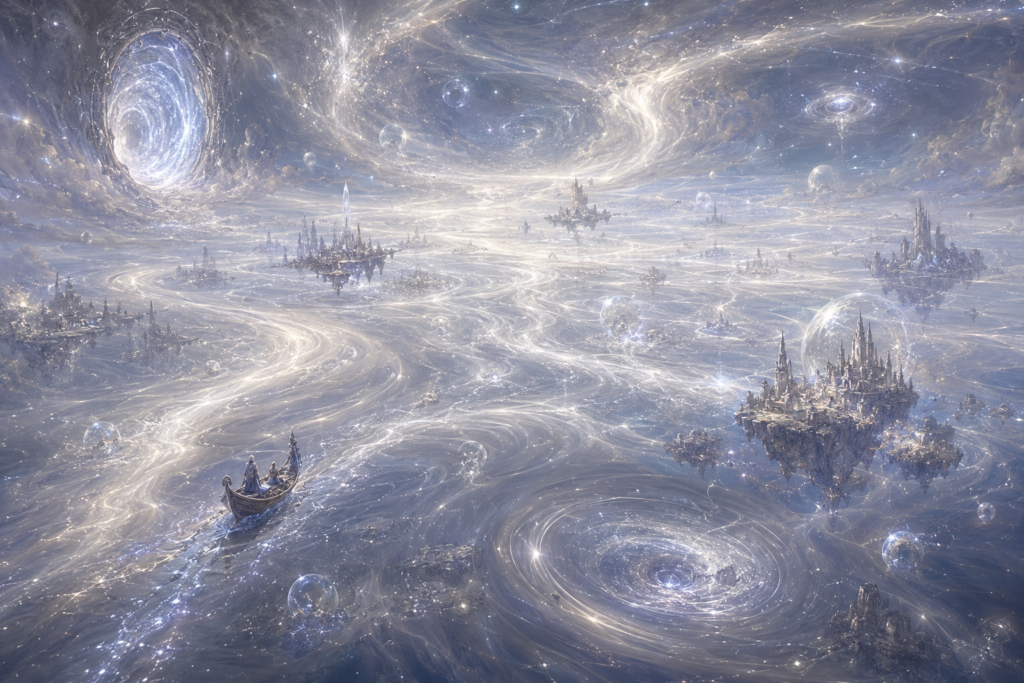
The Qlippoths assault the unfinished Codices, the Elder Gods raise the Astral Beacon, dependable cosmic laws are forged, the First Thought-Realms become the Outer Planes, and the dark material cosmos fills with its first stars and galaxies.
01 · Overview
From vulnerable creation to a structured cosmos
Foundations of Order covers the four eons in which the young universe survives its first great attack and acquires the structures upon which later worlds, gods, magic and civilisations depend.
During Cosmic Dawn, the Great Collision begins matter, energy, space and measurable time. The Astral Plane awakens, the first independent awarenesses arise, and the strongest Astral Embers become the Elder Gods. Those gods begin the Codices of Existence, but the laws they are building remain incomplete.
Eons V–VIII transform those beginnings into a dependable framework. The unfinished Codices survive the First Cosmic Schism. Their weaknesses are repaired and refined into cosmic law. Great Thought-Realms separate into self-sustaining planes. Matter then gathers under those laws, producing the first stars and galaxies.
Eon IX makes magic a universal responsive medium. The Elemental Planes and later planar developments follow. The major recognisable outsider peoples arise much later, while living worlds, terrestrial peoples and true dragons still lie ahead.
How Foundations of Order follows Cosmic Dawn
At the end of Eon IV, the Elder Gods have begun establishing stable identity, directed change, sequence, causality and the earliest repeatable relationships from which later magic can develop. The Codices remain incomplete and vulnerable.
Their growing order attracts the hatred of the Qlippoths , ancient intelligences of the Void Between Universes .
Eon V · The First War of Creation
The First Cosmic Schism
The Qlippoths attack the unfinished Codices, and the Elder Gods fight to prevent ordered creation from being unmade.
The Qlippothic incursion
The Qlippoths originate in the Void Between Universes , where they preserve individual identity before dependable physical law exists. The developing Codices offend them because those Codices make existence coherent, persistent and capable of consequence.
During Eon V, Qlippothic hosts force their way into the youngest reaches of the Astral order. Their assault attacks the relationships holding creation together. Boundaries fail. Causes detach from results. Names cease to identify their bearers. Sequences repeat without beginning or end.
The First Cosmic Schism predates the later structures of moral alignment. Its central conflict is between an emerging ordered creation and beings whose existence is fundamentally hostile to that order.
The Astral Beacon
No Elder God can preserve the Codices alone. For the first time, the divine generation concentrates its separate intentions into one shared act. Within the Astral Plane they raise the Astral Beacon, a vast stabilising concentration of identity, relationship and directed purpose.
The Beacon preserves enough of the Codices for creation to survive. It restores continuity where Qlippothic assaults have severed it and gives the Elder Gods a stable centre from which to drive the principal invading hosts back.
The Abyssal wound
The force of the defence tears open a region beyond the stabilised Astral order. Predatory chaos, dissolution and the pressure of the retreating Qlippothic host combine within this wound.
The principal invaders are forced into its depths, where they remain dangerous and active. The wound grows from the damage of the Schism, gathered destructive chaos and the imperfect confinement of the Qlippoths.
Nihros remains confined within the Void Between Universes. The Abyssal wound is not a second prison for Nihros, nor an extension of the Void.
The Beacon Scar
The victory leaves a permanent wound within the Astral Plane . The Astral Beacon Scar preserves reversed equations, damaged relationships, fragments of divine intention and Qlippothic remnants caught between states of existence.
The Scar proves that cosmic law can be strained. It becomes the first great warning against confusing dependable order with invulnerability.
The First Thought-Realms
The Schism also reveals that certain principles within the Astral currents have gathered enough coherence to persist as regions of their own.
These First Thought-Realms form around enduring pressures such as mercy, domination, freedom, punishment, cooperation, conflict, structure, change and dissolution.
During Eon V they remain dependent upon the Astral Plane. Their landscapes and native phenomena are still embryonic, but their emergence prepares the way for the Outer Planes.
Eon V establishes
- The First Cosmic Schism
- The Qlippothic assault upon the Codices
- The Astral Beacon
- The Astral Beacon Scar
- The earliest Abyssal wound
- The First Thought-Realms
Eon VI · The Great Repair
Forging the Cosmic Laws
The Elder Gods study the damage of the Schism and refine the surviving Codices into dependable physical and metaphysical order.
Repair after the Schism
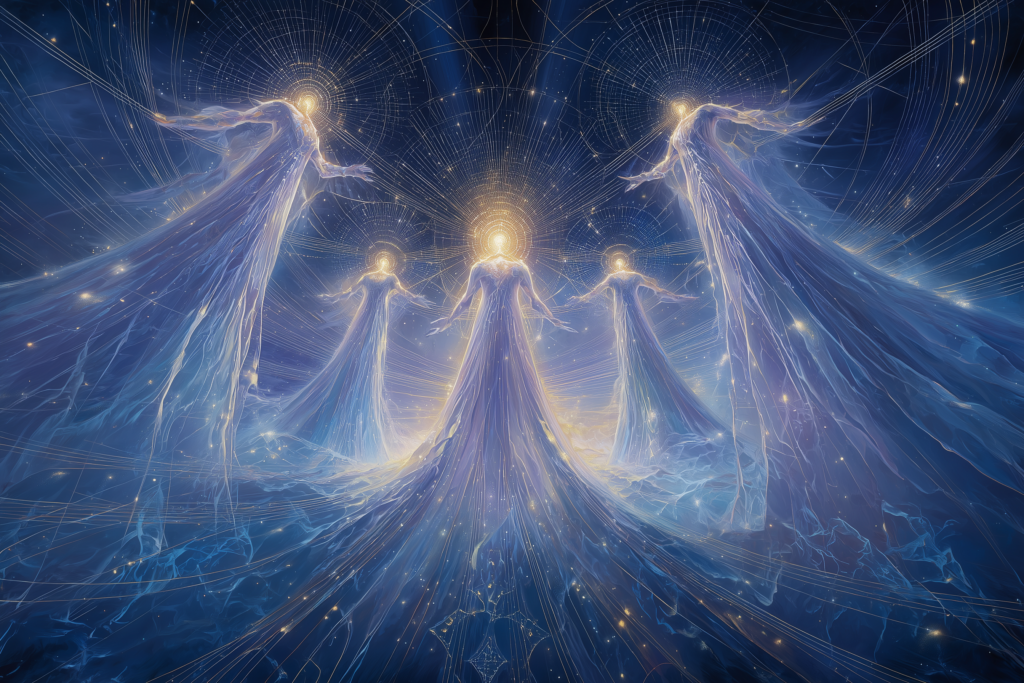
The Astral Beacon preserves creation, but survival alone is not enough. The Schism has exposed contradictions within the earliest Codices. Some principles work only under narrow conditions. Others collide, overlap or produce results the Elder Gods did not foresee.
During Eon VI, the Elder Gods examine those failures. They compare damaged regions, repeat acts of creation and test which relationships remain coherent under pressure.
The work is part divine intention, part discovery and part correction. The Elder Gods identify which relationships can endure and bind those relationships into the structure of creation.
Substance and form
Matter already exists from the Great Collision, but its behaviour remains inconsistent. The Elder Gods establish dependable relationships between substance, density, cohesion, separation and transformation.
Form can now persist while remaining capable of change.
Motion and duration
Space and measurable time begin during Eon II. Eon VI gives motion dependable relationships with distance, energy and duration. Sequence becomes stable enough for events to be compared across the growing material cosmos.
Energy and transformation
Positive and Negative Energy remain the oldest cosmic poles. The laws of Eon VI regulate how energy passes between states, how it alters matter and how creation sustains change without returning to the uncontrolled violence of the Great Collision.
Identity and boundary
The Schism proves that identity can be attacked. The Great Repair establishes stronger relationships between a thing, its properties, its name and the boundaries separating it from other things.
These laws will later permit souls, creatures, objects, planes and living worlds to endure alteration without losing all continuity.
Cause and consequence
Events acquire dependable consequences. A cause may produce several possible results, but those results remain connected to sequence except where exceptional powers interfere.
This framework later allows history, responsibility, prophecy and meaningful choice to exist.
Fate and possibility
Fate develops as the pressure created by relationships between choices, conditions and possible outcomes. Possibility remains real, but now develops within structures that allow patterns, tendencies and consequences to persist.
Dependable cosmic law
The cosmic laws become reliable enough to support planes, stars, worlds and later life.
Divine intervention, planar catastrophe, Far Realm intrusion and powerful magic will still be capable of straining those laws. Such events are dangerous precisely because the rest of creation depends upon their stability.
Eon VI establishes the relationships that later magic will use. Magic itself becomes a universal responsive medium during Eon IX.
Eon VI establishes
- Dependable substance and form
- Stable motion and duration
- Ordered energy and transformation
- Strengthened identity and boundary
- Reliable cause and consequence
- Fate as structured possibility
Eon VII · The Great Separation
Forming the Outer Planes
The First Thought-Realms become independent realities shaped by enduring moral, philosophical and cosmic pressures.
Principles become places
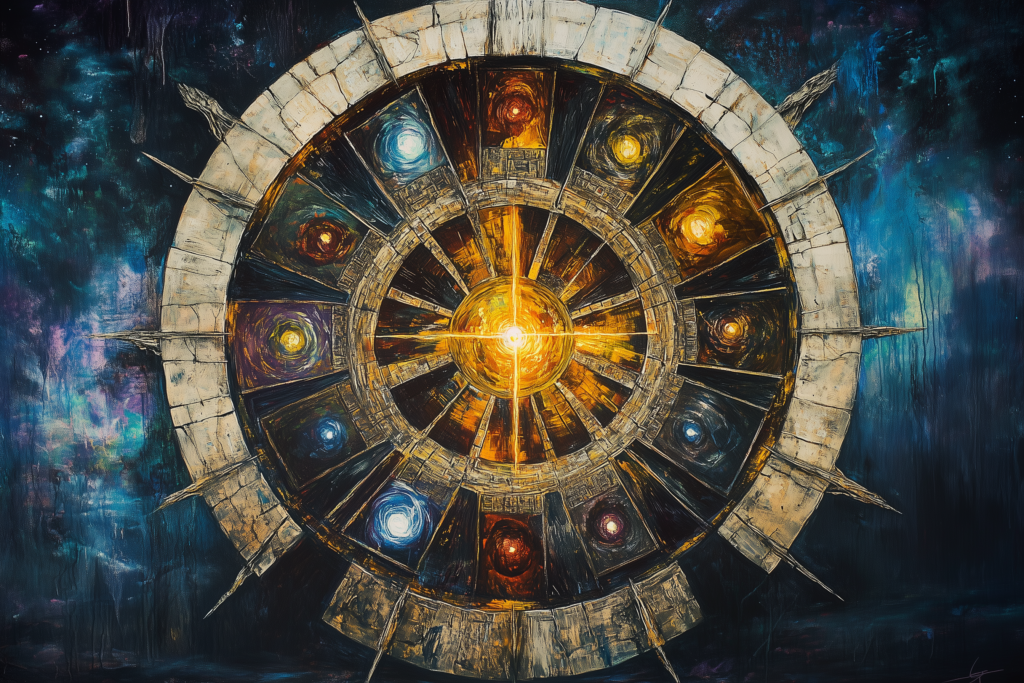
The First Thought-Realms begin as concentrations within the Astral Plane. As the cosmic laws stabilise, those concentrations develop boundaries, internal relationships and continuity of their own.
They cease to be temporary patterns and become independent realities: the earliest Outer Planes.
Each embodies a powerful combination of values, choices, conflicts and cosmic pressures. They grow from the consequences of divine action and the enduring principles revealed during the Schism and Great Repair.
Moral and philosophical pressure
Compassion, cruelty, freedom, control, mercy, punishment, cooperation, domination, structure, rebellion, preservation and destruction acquire lasting metaphysical weight.
Good, evil, law and chaos emerge as broad pressures produced by patterns of intention and consequence. Individual planes combine those pressures in different proportions and express them through their own landscapes and internal laws.
Flourishing and sacred realms
The Celestial Realms, Bytopia, Elysium, the Beastlands, Arborea and Asgard develop from compassion, shared labour, merciful rest, living instinct, passionate freedom and heroic courage.
Order, change and conflict
Arcadia, the Great Mechanism, Limbo, Pandemonium and Acheron emerge from different relationships between cultivated order, absolute law, possibility, failed communication and perpetual war.
Tyranny, ruin and imprisonment
Hell, Gehenna, Abaddon, the Abyss and Carceri develop around domination, exploitation, spiritual erasure, predatory chaos and cosmic confinement.
Astral connection
The Astral Plane remains the primary medium connecting the new realms. Passage depends upon affinity, intention, knowledge and the strength of relationships between destinations.
The Abyssal wound becomes a realm
The Abyss becomes anchored among the Outer Planes. Its deepest reaches retain the original wound of Eon V and the ancient Qlippothic presence driven into it during the First Cosmic Schism.
As the wound becomes a self-sustaining plane, the Qlippoths spread through its first rifts, caverns, black waters and unstable layers. The newborn Abyss suits beings whose identities developed before dependable reality.
They prey upon early planar life, establish territories and reshape local regions around their individual compulsions.
The Qlippoths become the earliest dominant intelligent inhabitants of the Abyss.
Their supremacy is broad but fragmented. Powerful individuals dominate broods, hunting packs, war hosts and ancient territories, while rival Qlippoths destroy one another elsewhere.
There is no single Qlippothic empire and no universal Abyssal government.
The Abyss before demonkind
Demonkind does not yet exist as the later stable populations, lineages and sovereign powers of the plane.
Its rise belongs to the Dawn of the Outsiders . Demon peoples eventually break broad Qlippothic supremacy without exterminating their ancient predecessors.
The oldest reaches of the Abyss continue to contain Qlippothic broods, territorial powers and things whose presence predates every demonic kingdom.
Developing identities
Several planes remain fluid during Eon VII. Their later layers, divine kingdoms, nations, afterlives and cultural identities develop through subsequent cosmic history.
Landscapes and internal laws
Each new plane acquires forms suited to its governing principles. Some develop ordered roads, repeating geometries or precise cycles. Others form endless forests, storm-filled skies, iron battlefields, prison worlds, volcanic slopes or realms where distance answers emotion more strongly than measurement.
These landscapes are physical expressions of each plane’s deepest relationships. Entering an Outer Plane means entering a reality whose fundamental assumptions differ from those of the Material Plane.
The first planar age
The Outer Planes of Eon VII support native phenomena, embryonic intelligences, living landscapes and primitive planar forms. Their internal laws begin producing inhabitants suited to each realm.
These are not yet the major recognisable outsider civilisations. Angels, archons, devils, yugoloths, modrons and other durable outsider peoples arise during later cosmic history.
The great exception is the Abyss, whose first established intelligent population is already present: the Qlippoths confined there after the First Cosmic Schism.
Eon VII establishes
- Independent Outer Planes
- Planar boundaries and internal laws
- Landscapes expressing cosmic principles
- Primitive native phenomena and embryonic planar forms
- Astral routes between the new realms
- The Abyss as an anchored planar wound
- The Qlippoths as its earliest dominant intelligent inhabitants
- The foundations of later alignment cosmology
Explore the developing planes
The modern structure, relationships and named realms of the cosmology are collected in the Planes of Existence. Eon VII describes their earliest independent forms rather than their later cultures, rulers and nations.
Eon VIII · The First Firmament
Sculpting Stars and Galaxies
Matter gathers under the laws of Eon VI, igniting the first stars and building the large-scale structure of the visible universe.
The dark material cosmos
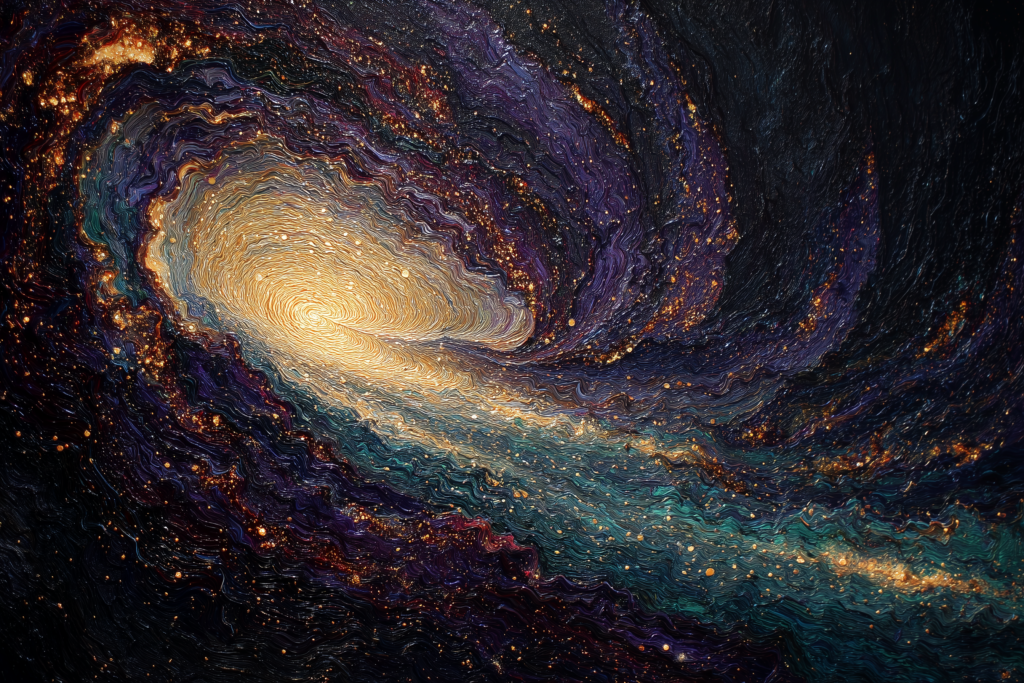
The material universe already possesses matter, energy, space and measurable time. It remains largely dark and unstructured.
Vast clouds of primitive matter drift through the expanding cosmos while the new laws of motion, cohesion, energy and transformation begin operating across immense distances.
This is the lawful material cosmos. The Void Between Universes remains outside ordered creation.
Matter gathers
Existing matter begins drawing together under dependable cosmic relationships. Small irregularities become concentrations. Concentrations grow into enormous clouds. Pressure and heat rise as matter falls inward.
The Elder Gods guide unstable regions, preserve developing structures and intervene when early failures threaten neighbouring formations. Most matter now organises through the laws established during Eon VI.
The first stars
The densest concentrations ignite. The first stars burn across the young universe, converting matter and releasing light on a scale creation has never previously sustained.
These earliest stellar generations are immense and often short-lived. Their existence demonstrates that cosmic law can sustain complex physical processes without continuous divine direction.
The first galaxies
Stars gather into larger structures. Great systems of stars, matter and darkness begin turning around common centres. Galaxies take form across enormous reaches of material space.
Distance and time already exist. Eon VIII reveals their astronomical scale as light crosses structures whose breadth exceeds every earlier measure.
Stellar death and cosmic enrichment
The earliest stars eventually exhaust their fuel. Some collapse. Others end in immense explosions. Their deaths distribute newly formed material throughout the surrounding cosmos.
Later generations of stars, worlds, oceans, mountains and living bodies depend upon this enrichment.
Eon VIII therefore establishes more than light in the darkness. It begins the long material preparation for habitable worlds.
Divine observation and intervention
The Elder Gods study the First Firmament. Some favour stability and long cycles. Others value violent transformation, renewal, expansion or the creation of new possibilities through destruction.
Their disagreements foreshadow later divine divisions. Mortal constellations, religious astronomy and named divine heavens develop during later ages.
The limits of ordered law
Eon VIII demonstrates the strength of the repaired Codices while revealing that dependable law still permits catastrophe. Stars fail, galaxies collide, matter collapses and unpredictable regions persist.
These weaknesses become increasingly important in the next stage of the timeline, when magic spreads through the established cosmos and cracks begin to admit stranger powers.
Eon VIII establishes
- Large-scale gathering of matter
- The first stars
- The first galaxies
- Stellar cycles of birth and death
- Cosmic enrichment by early stellar generations
- The material basis of later worlds
02 · Chronology
The four eons in sequence
Foundations of Order follows one continuous development: creation survives attack, repairs its laws, separates into distinct planes and expresses those laws across the material universe.
| Eon | Main event | Permanent result | Later development |
|---|---|---|---|
| Eon V | The Qlippoths attack the unfinished Codices. The Elder Gods raise the Astral Beacon. | The Codices survive, the Beacon Scar remains and the principal Qlippothic hosts are driven into the Abyssal wound. | Cosmic law is repaired and completed during Eon VI. |
| Eon VI | The Elder Gods repair contradictions exposed by the Schism. | Dependable physical and metaphysical laws govern creation. | The Outer Planes separate during Eon VII. |
| Eon VII | The First Thought-Realms become self-sustaining realities. | The Outer Planes acquire boundaries, landscapes and native phenomena. The Qlippoths become the earliest dominant intelligent inhabitants of the Abyss. | Major outsider peoples arise later, while demonkind eventually breaks broad Qlippothic supremacy. |
| Eon VIII | Matter gathers under cosmic law and the first stars ignite. | Galaxies, stellar cycles and the material basis of later worlds emerge. | Universal magic begins during Eon IX. |
Where the chronology goes next
Eon IX begins Raw Power and Hidden Cracks . Magic becomes a universal responsive medium woven through matter, thought, soul and symbol.
That same development creates immense new possibilities while exposing weaknesses through which alien forces may intrude.
03 · Enduring Legacy
What survives from the Foundations of Order
The events of Eons V–VIII remain accessible through damaged laws, planar anomalies, divine relics, ancient Astral regions and the physical structure of the cosmos itself.
The Astral Beacon Scar
The Scar contains damaged equations, reversed consequences, unstable routes and Qlippothic remnants. It is one of the oldest surviving battlefields in creation.
Broken Codex fragments
Pieces of superseded or damaged cosmic law survive as artefacts, impossible locations and commands that reality still attempts to obey.
Proto-planar regions
Some Thought-Realms never completed their separation. They drift within the Astral Plane as unstable environments governed by unfinished principles.
Qlippothic weapons
Relics of the First Cosmic Schism attack identity, sequence, boundary or consequence rather than merely damaging physical bodies.
Disputed laws
Gods, planar powers and mortal philosophers disagree over whether some laws were discovered, imposed or preserved from an earlier creation.
First-star remnants
Matter from the earliest stellar generations may possess extraordinary age, density or magical responsiveness and is prized for cosmic artefacts.
Planar foundations
Deep within several Outer Planes lie regions dating from before their modern layers, gods, nations and outsider inhabitants.
Abyssal fractures
The Abyss retains routes leading towards the original wound of Eon V, where ancient Qlippoth broods and territorial powers predate every later demonic kingdom.
Cosmic law failures
Rare regions preserve conditions under which gravity, identity, causality or time operate according to rejected early versions of the Codices.
04 · Campaign Use
Using the Foundations of Order in adventures
These eons become playable when ancient structures fail, a lost cosmic principle resurfaces or someone attempts to rewrite a law upon which later creation depends.
The Beacon Scar Expedition
A route opens into the Astral Beacon Scar. Scholars seek a surviving Codex fragment, while Qlippothic remnants attempt to follow the expedition back into stable creation.
The Rejected Law
A discarded version of causality begins spreading through a kingdom. Punishments arrive before crimes, heirs inherit before deaths and prophecies create the events they claim to predict.
The Unfinished Plane
A proto-planar region begins separating from the Astral Plane. Its governing principle is vengeance without memory, and every visitor is assigned an enemy they cannot remember wronging.
The First-Star Forge
A fallen fragment of an ancient star can be used to forge a weapon capable of damaging planar boundaries. Several powers want it for very different wars.
The Abyss Before Demons
An expedition descends beneath later Abyssal realms into strata still held by ancient Qlippoth broods, territorial lords and the raw wound created during the First Cosmic Schism.
The Law of Names
A stolen Codex fragment allows its bearer to sever names from identity. Gods, rulers and ancient monsters begin losing the histories and obligations attached to them.
05 · Knowledge and Belief
How later traditions remember these eons
Later religions often claim that their own gods forged cosmic law or created particular Outer Planes. Such traditions may preserve fragments of deeper truth but usually project younger divine names, moral systems and political structures backwards into the first eons.
The Elder Gods of Eons V–VIII predate familiar pantheons. Their identities survive imperfectly through Astral evidence, divine testimony, damaged Codices and myths inherited by younger gods.
Planar scholars also debate whether the Outer Planes were shaped primarily by divine intention or whether the gods helped stable Thought-Realms separate according to principles already developing within creation.
Reliable points of agreement
- The Qlippoths arise within the Void Between Universes before the present universe is fully ordered.
- They invade ordered creation during the First Cosmic Schism.
- The Astral Beacon preserves the Codices while leaving a permanent Astral Scar.
- The cosmic laws are repaired and stabilised during Eon VI.
- The Outer Planes become independent during Eon VII before their later civilisations arise.
- Primitive native phenomena and embryonic planar intelligences appear within the young planes.
- The Qlippoths become the earliest dominant intelligent inhabitants of the Abyss.
- Their Abyssal supremacy consists of rival broods, territories, war hosts and powerful individuals rather than a unified empire.
- Demonkind rises later and breaks broad Qlippothic supremacy without eliminating the older population.
- The first stars and galaxies arise through matter operating under the laws established in Eon VI.
- Universal magic and the great recognisable outsider peoples belong to later eons.
- True dragons and terrestrial peoples have not yet entered the chronology.
06 · Key Questions
Foundations of Order clarified
Where do the Qlippoths come from?
The Qlippoths arise within the Void Between Universes. They are not surviving mortal peoples from the Last Universe. They enter ordered creation during the First Cosmic Schism and attack the unfinished Codices.
What does the Astral Beacon accomplish?
The Astral Beacon preserves enough of the unfinished Codices for creation to survive, restores continuity around the divine defence and drives the principal Qlippothic hosts into the Abyssal wound.
What creates the Abyss?
The Abyss develops from damage caused during the First Cosmic Schism, gathered destructive chaos and the imperfect confinement of the Qlippoths. The wound becomes anchored as an Outer Plane during Eon VII.
Who inhabits the earliest Abyss?
The imprisoned Qlippoths spread through its earliest rifts, caverns, black waters and unstable layers. They become the first dominant intelligent population of the plane.
Did the Qlippoths possess an Abyssal empire?
No. Their supremacy is divided among broods, territories, war hosts and powerful individual rulers. They dominate much of the early Abyss without ever forming a single government.
Are demons already present?
Not as the later established demon peoples and sovereign lineages. Demonkind becomes a major population later and eventually breaks broad Qlippothic supremacy.
When are the cosmic laws completed?
Their earliest forms begin during Eon IV. They survive the Schism during Eon V and become dependable physical and metaphysical laws during Eon VI.
When do the Outer Planes form?
The First Thought-Realms gather during Eon V and become independent Outer Planes during Eon VII.
When do the major outsider peoples arise?
Primitive native forms and living planar phenomena begin during the first planar age. Angels, archons, devils, yugoloths, modrons and the other major recognisable outsider peoples develop during later cosmic history.
Are elemental peoples present yet?
No established elemental civilisation belongs to Eons V–VIII. The formation of the Elemental Planes and the earliest elemental intelligences belongs to the next stages of the chronology.
Are dragons present during Foundations of Order?
No. True dragons and later draconic lineages have not yet appeared. A later dragon may inhabit an Astral, celestial or stellar environment without having existed when that environment first formed.
What changes during Eon VIII?
Matter, space and measurable time already exist. Eon VIII shows the dependable laws of creation operating at astronomical scale as stars, galaxies and stellar cycles develop.
When does universal magic appear?
The Codices establish repeatable relationships that later magic can use. Magic becomes a universal responsive medium during Eon IX.
07 · Wider Context
Scientific inspiration and fantasy cosmology
SpiralWorlds combines mythic cosmology with a universe that develops through physical processes. The Elder Gods help establish dependable cosmic relationships, while stars and galaxies form as matter behaves according to those relationships.
In modern cosmology, stars form through the gravitational collapse of material within large clouds. Galaxies are enormous systems of stars, gas, dust and dark matter, while stellar evolution produces and disperses material from which later planetary systems can form.
The Astral Beacon, the Codices, the Outer Planes and divine intervention provide the mythic structure surrounding that physical history. Natural processes remain active within the ordered universe.
Keep this reference growing
If this page helped with your reading or game, you can support its upkeep or explore the curated books.
Explore the Bookshop — epics, classics and stories behind imagined worlds.