
Aerial Servant – Invisible Hunter of the Elemental Plane of Air
An Aerial Servant is a powerful, semi-intelligent elemental hunter from the Elemental Plane of Air. Naturally invisible, extraordinarily strong and almost impossible to shake from a trail, it is most feared when powerful magic calls it into another plane and binds it to the recovery of a creature, object or fugitive.
It is not a celestial spirit, divine judge or guardian of cosmic morality. An Aerial Servant is living elemental air: a swift, resentful and brutally practical being whose traditional relationship with mortal spellcasters is one of coercion, service and dangerous consequences.
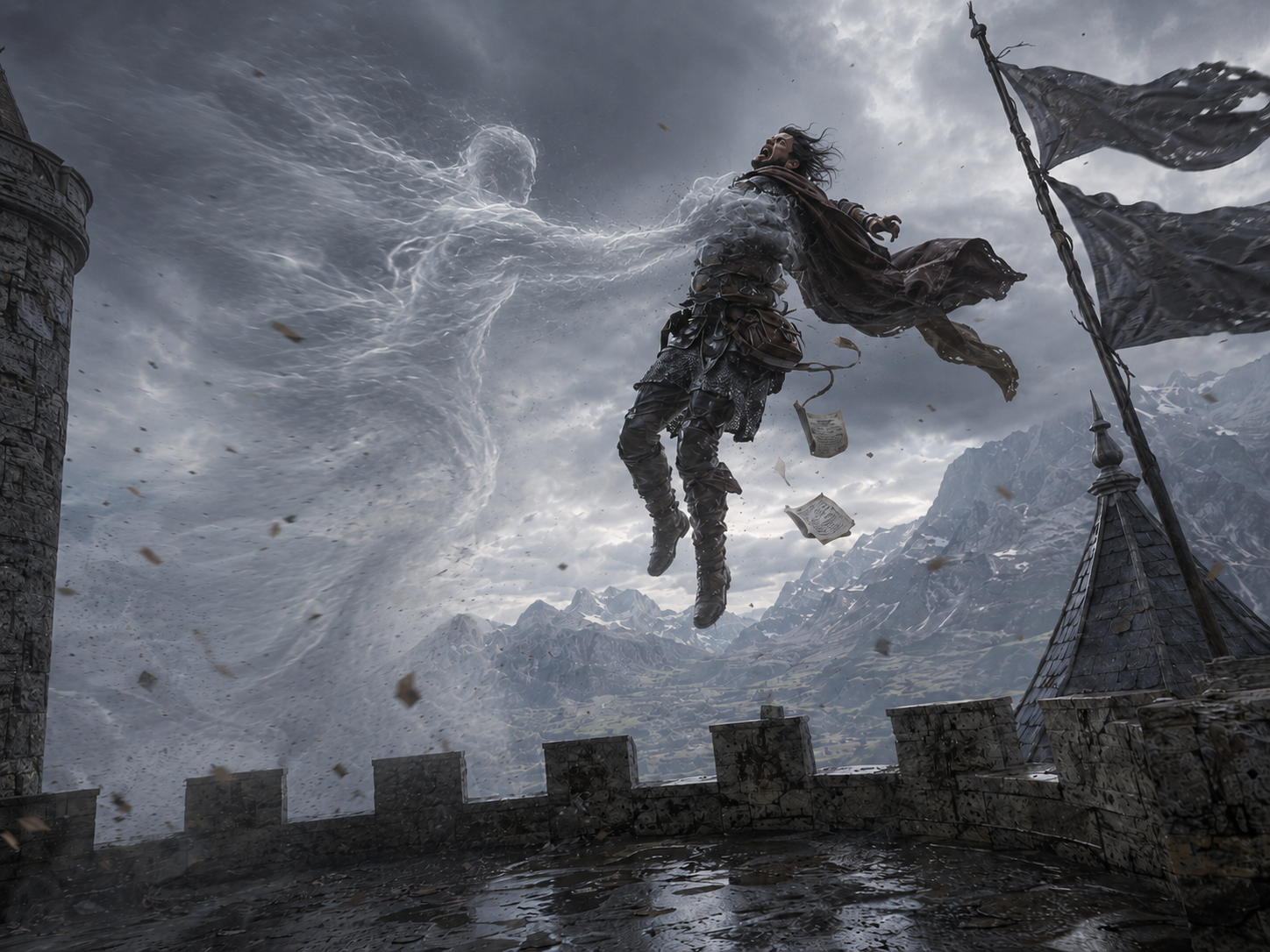
Aerial Servant at a Glance
Game Statistics
The Aerial Servant is presented below for D&D 5.5e / 2024, Pathfinder 1e and D&D 3.5e. Each treatment preserves the creature’s defining identity while respecting the grappling, invisibility, tracking and planar rules of its edition.
Aerial Servant
Medium Elemental, Neutral
| STR | DEX | CON | INT | WIS | CHA |
|---|---|---|---|---|---|
| 23 (+6) | 22 (+6) | 23 (+6) | 4 (−3) | 12 (+1) | 11 (+0) |
Air Form
The servant can enter another creature’s space and move through an opening as narrow as 1 inch wide without squeezing. It cannot pass through solid walls, closed doors or other impermeable barriers merely because its body is composed of air.
Natural Invisibility
The Aerial Servant has the Invisible condition. Attacking, grappling, using Crushing Grasp or releasing Wind Blast does not end this invisibility.
The effect is an inherent property of the creature rather than an ongoing Invisibility spell.
Relentless Tracker
The servant has Advantage on Wisdom (Survival) checks made to follow a creature’s trail. It can track while moving at full speed without suffering a penalty imposed solely for moving quickly.
Powerful Carrier
The servant counts as two sizes larger when determining how much weight it can carry, drag or lift.
Its speed is not reduced merely because it is moving with one Medium or smaller creature grappled by it.
Caller’s Link
When planar magic binds the servant to a specific caller and mission, a supernatural link forms between them. While caller and servant remain on the same plane, the servant knows the direction of its caller.
If the assigned mission becomes impossible, is deliberately thwarted or fails through the caller’s actions, the servant may become hostile to that caller.
Multiattack
The Aerial Servant makes two Slam attacks.
Slam
Melee Attack Roll: +10, reach 5 ft. Hit: 19 (3d8 + 6) Bludgeoning damage.
If the target is Large or smaller, the servant can also grapple it (escape DC 18). The servant can have no more than two creatures grappled at once.
Wind Blast (Recharge 5–6)
The servant releases a shearing current in an 80-foot-long, 10-foot-wide line. Each creature in that line must make a DC 18 Dexterity saving throw.
On a failed save, a creature takes 36 (8d8) Bludgeoning damage. A Large or smaller creature that fails is also knocked Prone and pushed up to 20 feet directly away from the servant.
On a successful save, a creature takes half damage and is neither pushed nor knocked Prone.
Crushing Grasp
The servant crushes one creature it is currently grappling. The target takes 17 (2d10 + 6) Bludgeoning damage.
Until that grapple ends, the creature cannot breathe. Resolve prolonged deprivation of air using the normal suffocation rules.
Aerial Servant
CR 11 • N Medium outsider (air, elemental, extraplanar)
Improved Tracking (Ex)
The servant takes no Survival penalty for following a trail while travelling at full speed and gains a +10 bonus on Survival checks made specifically to track.
Natural Invisibility (Su)
The servant remains invisible even while attacking. Its invisibility is a natural supernatural property rather than a conventional invisibility spell and is specifically unaffected by Invisibility Purge.
Against opponents unable to see invisible creatures, the servant receives the edition’s normal Stealth benefit for constant invisibility: +20 while moving and +40 while motionless.
On the Astral Plane or Ethereal Plane, the ability instead provides concealment with a 20% miss chance.
Grab (Ex)
The servant can begin a grapple when it successfully strikes an eligible opponent with one of its slam attacks, following the Pathfinder universal monster rules for grab.
Constrict (Ex)
The servant deals 2d8+6 points of bludgeoning damage when it successfully constricts a creature it has grappled.
Smother (Ex)
If the servant has grappled a creature that is holding its breath, it can attempt an additional grapple combat maneuver as a free action.
If this check succeeds, the amount of time the victim can continue holding its breath is reduced by 1d6 rounds. Repeated successful uses can therefore force a victim towards suffocation much more quickly.
Sneak Attack (Ex)
The servant deals an additional +2d6 damage whenever the Pathfinder sneak-attack requirements are met. Its constant invisibility makes this especially dangerous against creatures unable to perceive it.
Wind Blast (Su)
Once every 1d4 rounds, the servant can use a standard action to project a violent 80-foot line of wind.
Creatures caught in the blast take 8d8 points of bludgeoning damage, Reflex DC 22 half.
A Medium or smaller creature that fails the save is also knocked prone and pushed 1d4 × 5 feet away from the servant. The save DC is Constitution-based.
Aerial Servant
Medium Elemental (Air, Extraplanar), Usually Neutral
Magic Natural Weapons
The servant’s natural attacks count as magic weapons for the purpose of overcoming damage reduction.
Constrict (Ex)
A successful grapple inflicts 2d8+6 points of constrict damage.
Improved Grab (Ex)
After hitting a creature no more than one size category larger with a slam, the servant can attempt to begin a grapple without provoking an attack of opportunity. A successful grapple allows it to use constrict.
Wind Blast (Su)
Once every 1d4 rounds, the servant can use a standard action to send a violent blast through an 80-foot line. The blast deals 4d8 points of damage.
Creatures of the servant’s size or smaller can also be knocked down and driven 2d10 feet backward. A DC 22 Reflex save halves the damage and prevents the knockback. The save DC is Constitution-based.
Link with Caster (Ex)
When an Aerial Servant is summoned or called into service, it establishes a supernatural link with the spellcaster who brought it.
If the servant fails to complete its assigned mission or if that mission is deliberately thwarted, it immediately attempts to return to its caller.
Once it reaches the caster, the servant attempts either to kill the caller or seize the caller and carry them bodily back to the Elemental Plane of Air.
So long as servant and caster occupy the same plane, the servant can locate its caller through this link. Crossing to another plane can interrupt its ability to follow the link, but does not permanently sever the connection.
The link is permanently broken only when either the servant or its caller is destroyed.
Natural Invisibility (Su)
The servant remains invisible while attacking. This invisibility is inherent rather than the result of an ordinary invisibility spell and is specifically not suppressed by Invisibility Purge.
On the Astral Plane or Ethereal Plane, the servant is instead only concealed, using the legacy 20% miss-chance rule.
Planar Reversion
An Aerial Servant destroyed away from its native Plane of Air dissolves into vapour and returns to that plane rather than suffering final destruction.
An Aerial Servant can therefore be permanently destroyed only upon its home plane.
Appearance
An Aerial Servant is roughly human-sized. Its dimensions are those of a powerfully built humanoid rather than a giant, although its elemental nature allows it to exert far more physical force than its apparent size suggests.
It has no flesh, feathers, celestial radiance or ghostly corpse beneath its invisibility. Its body is a coherent mass of living elemental air compressed into a humanoid volume.
Most observers see nothing at all until the environment betrays it. Dust rises against an absent shoulder. Rain bends around an invisible torso. Smoke curls through the outline of a hand. Loose parchment lifts from a table. A cloak snaps towards something that is not visibly there.
When supernatural sight, planar conditions or magical illumination makes the creature perceptible, it usually resembles grey-white vapour caught in the suggestion of a human figure. Its outline never remains completely still. Fingers lengthen into currents, shoulders unwind into turbulence and the edges of its body trail into the surrounding air.
Behaviour and Temperament
Aerial Servants are semi-intelligent rather than mindless. They understand commands, recognise obstacles, choose routes, stalk prey and exploit opportunities, but they do not usually display the broad intellectual curiosity of mortals, djinni or highly intelligent outsiders.
Their reputation for hostility comes largely from their history of being called rather than invited. Powerful spellcasters value the creatures because an invisible being of extraordinary strength can retrieve things that ordinary summoned servants cannot.
An Aerial Servant may therefore find itself dragged across the planes to carry a sealed coffer, capture a fugitive, recover a corpse or drag a prisoner bodily before its caller.
Many obey because the magic requires obedience, not because they respect the person who spoke the command. Exact wording matters. A caller who treats a thinking elemental as an obedient tool may discover that compliance and cooperation are not the same thing.
The Elemental Plane of Air
The Aerial Servant is native to the Elemental Plane of Air, the infinite realm of breath, pressure, cloud, storm and open distance. This is its true home and the environment to which its nature is best adapted.
Free Aerial Servants may cross immense currents between cloudlands, pressure hollows, storm frontiers and the remote spaces between settled regions.
Some become associated with djinni courts or other powerful inhabitants, but they should not automatically be treated as citizens, soldiers or subjects of genie society.
The Plane of Air’s dead calms are especially suitable places for abandoned, trapped or resentful Aerial Servants. A being accustomed to speed and free movement can regard a region where the wind itself has stopped as prison, hunting ground or both.
Aerial Servants also pass through the Ethereal Plane and Astral Plane. Those planes are routes and hunting territories rather than their place of origin.
Summoning an Aerial Servant
The classic Aerial Servant is not simply another combat creature added to a battlefield by a short-lived summoning spell. Its strongest identity is as a powerful elemental called across the planes and assigned a task.
Legacy spellcasters most often seek one through powerful planar calling such as greater planar ally, greater planar binding, or an equivalent ritual appropriate to the campaign and edition.
Suitable missions include:
- finding and returning a fugitive alive;
- recovering a stolen magical object;
- abducting a specific person from a guarded location;
- carrying something far beyond ordinary human strength;
- recovering a body from dangerous ground;
- pursuing a quarry who has defeated mundane trackers;
- guarding a location where invisibility and flight are decisive;
- transporting a prisoner without using a visible escort.
When the Mission Fails
Aerial Servants are most memorable when the summoning itself creates the adventure. A badly phrased command, an impossible target or an unforeseen planar escape can turn a caller’s perfect invisible servant into a returning threat.
The creature need not become irrational. Its retaliation can instead be grimly purposeful. It may seize the caller and attempt to carry them back to the Plane of Air. It may destroy the summoning chamber. It may wait invisibly until guards leave. It may interpret an ambiguous instruction in the manner least favourable to the person who compelled it.
This makes an Aerial Servant useful even when the player characters never summon one. A wealthy astrologer, court magician, occult scholar, priest, noble patron or enemy sorcerer may have created the problem before the adventurers arrive.
Aerial Servant vs Invisible Stalker
The nearest relative in encounter design is the Invisible Stalker. Both are invisible natives of the Plane of Air and both are famously used to pursue targets, but they should not feel interchangeable.
| Trait | Aerial Servant | Invisible Stalker |
|---|---|---|
| Core role | Retriever, abductor, carrier and overpowering hunter | Tracker, assassin and relentless pursuer |
| Physical identity | Human-sized but exceptionally strong living air | Swift unseen elemental hunter |
| Preferred finish | Grab, crush, smother or carry away | Follow, ambush and kill |
| Battlefield control | Powerful line-shaped wind blast and forced movement | Relies more heavily upon pursuit and invisible attacks |
| Typical danger | Removing a character from the battlefield entirely | Remaining on a quarry until the mission is completed |
Seeing the Unseen
The most important rules question around an Aerial Servant is whether an observer can actually perceive it. Do not assume that every spell involving invisibility works in exactly the same way. The answer depends upon edition and the wording of the effect.
See Invisibility
See Invisibility is one of the most direct answers. It allows the beneficiary to perceive invisible creatures according to the edition being used.
It does not make the servant visible to everybody else, remove its elemental nature or prevent it from remaining invisible to other observers.
Invisibility Purge
The Pathfinder and classic 3.5e Aerial Servant possesses an important exception: its natural invisibility is not subject to Invisibility Purge.
Specific monster wording overrides the more general behaviour of the spell. Characters familiar only with conventional magical invisibility can therefore make a dangerous mistake when an Aerial Servant enters the area and remains unseen.
Faerie Fire
Faerie Fire attacks the problem differently. Rather than ending the servant’s inherent power, the spell can visibly outline a successfully affected creature according to the rules of the edition.
Describe cold green light tracing an otherwise absent human-sized mass: hands, shoulders and the pressure-shape of a head hanging inside the luminous outline.
Glitterdust
In Pathfinder and D&D 3.5e, Glitterdust is another classic answer. The dust does not need to dispel the underlying supernatural invisibility; it reveals the creature’s occupied space and severely undermines its ability to remain visually hidden.
Dispel Magic
Dispel Magic should not be treated as an automatic off-switch for the creature.
The servant’s natural invisibility is an inherent monster ability rather than merely an ordinary ongoing casting of Invisibility or Greater Invisibility.
Astral and Ethereal Conditions
Pathfinder and the classic 3.5e treatment contain an unusual planar exception. On the Astral or Ethereal Plane the servant does not receive its normal complete invisibility; it instead gains the edition’s concealment benefit.
Combat and Tactics
An Aerial Servant should not behave like a visible brute that happens to possess an invisibility bonus. Its entire encounter plan is built around the fact that enemies cannot initially see the force attacking them.
1. Find the Quarry
The servant first identifies its designated target and follows the trail with patience. It has little reason to attack expendable guards if it can bypass them.
2. Approach Without Being Seen
It exploits altitude, open windows, battlements, rooftops, courtyards and other routes that ordinary attackers cannot use. The servant does not need darkness to make its approach dangerous.
3. Break the Formation
Wind Blast is best used before committing to a grapple. It can scatter defenders, knock opponents prone, throw archers from advantageous positions or clear the space immediately around the quarry.
4. Seize the Target
The servant closes on the intended victim, establishes a grapple and uses its immense strength to make rescue difficult.
Its roughly human-sized form makes the attack especially disturbing: witnesses do not see a gigantic wind creature carrying someone away, but an apparently empty human-sized space holding a struggling victim with impossible strength.
5. Go Up
The most frightening Aerial Servant tactic is not simply constricting a character. It is leaving with them.
Once it has secured the quarry, the servant can rise above rooftops, walls, trees or melee fighters. Every round spent deciding how to detect the invisible attacker is another round in which the captive is being carried farther away.
6. Kill Only When Necessary
If the assignment requires a living prisoner, the servant does not conveniently fight to the death. It disables resistance, removes the target and escapes.
Using an Aerial Servant in an Adventure
The Locked Chamber
A noble vanishes from a barred room. The lock remains intact, the guards saw nobody enter and the only clue is a scattering of papers beneath an open upper window.
The Failed Calling
A scholar gave an elemental an impossible task. The ritual circle is now empty, and something invisible is travelling steadily back towards the scholar.
The Stolen Relic
Nothing defeats the temple’s locks. Instead, the relic rises from its pedestal and moves through the sanctuary in the grasp of something no witness can see.
The Living Bounty
The party must protect a fugitive whom a distant enemy has ordered an Aerial Servant to return alive. Killing the elemental may not be the only way to end the pursuit.
The Wrong Description
The caller described the target poorly. The servant has seized somebody who satisfies the literal wording of the command but was never meant to be taken.
The Returning Servant
The heroes successfully prevent the creature from completing its mission—only to discover that failure has redirected the elemental’s anger towards whoever summoned it.
Aerial Servants in SpiralWorlds
In 1454, the creature is known primarily through advanced works of natural philosophy, planar theory and ritual magic rather than as a common monster of village folklore.
Learned magicians classify it among the dangerous intelligences of elemental air: not a ghost, demon or angel, but a thinking concentration of wind and pressure whose natural state is difficult for mortal vision to perceive.
University-trained philosophers, court astrologers, alchemists and experienced ritualists may understand the theoretical distinction. That knowledge does not mean they can safely call one.
The art of planar binding requires not merely power but exact language, appropriate circles, knowledge of planar correspondences and a realistic understanding of what the summoned intelligence is actually capable of accomplishing.
Stories of unexplained abductions from towers, sealed chambers and fortified houses therefore acquire particular significance among educated investigators. A door that was never opened does not prove that nobody entered.
Origins in Fantasy Gaming
The Aerial Servant is a creature of tabletop fantasy gaming rather than a direct adaptation of a traditional mythological being.
Its early game identity established the characteristics that still define it: elemental air, great physical strength, invisibility, planar calling and the danger of an assigned mission going wrong.
Later d20 treatments developed that concept through formal grappling, wind-blast, tracking and planar mechanics. Pathfinder retained the creature as a substantially more dangerous relative of the Invisible Stalker and placed it at CR 11.
That lineage is worth preserving. Inventing celestial law, divine judgement or supposed folkloric origins obscures what makes the Aerial Servant distinctive: it is an invisible, human-sized, semi-intelligent elemental powerful enough to be useful to a master and resentful enough to make that usefulness dangerous.
GM Notes
The Aerial Servant works best when the encounter begins with evidence rather than with initiative.
A door moves. A horse panics. Dust rises. A character’s belt jerks upward. A witness is suddenly dragged across the floor.
Give observant characters clues before the creature attacks. Permanent invisibility is much more satisfying when players can reason about what occupies the room rather than being told that an undetectable monster has simply appeared beside them.
Once combat begins, remember the servant’s objective. If it was ordered to retrieve a particular person, it has no reason to remain in a balanced fight after obtaining that person.
Conversely, free Aerial Servants encountered on the Plane of Air need not behave like summoned assassins at all. They can be hostile predators, escaped servants, suspicious travellers, territorial elementals or beings whose past experience with mortal callers has made them unwilling to negotiate.
Rules Sources and Licensing
The D&D 5.5e / 2024 statistics above are a SpiralWorlds-compatible reconstruction designed around the historical identity of the Aerial Servant rather than a reproduction of an official modern stat block.
Pathfinder 1e mechanical reference derives from Pathfinder Roleplaying Game Bestiary 5. D&D 3.5e mechanical reference follows the open d20 treatment of the Aerial Servant in The Tome of Horrors, Revised.
Section 15 Notice: Pathfinder Roleplaying Game Bestiary 5 © 2015, Paizo Inc. Authors include Dennis Baker, Jesse Benner, John Bennett, Logan Bonner, Creighton Broadhurst, Robert Brookes, Benjamin Bruck, Jason Bulmahn, Adam Daigle, Thurston Hillman, Eric Hindley, Joe Homes, James Jacobs, Amanda Hamon Kunz, Ben McFarland, Jason Nelson, Thom Phillips, Stephen Radney-MacFarland, Alistair Rigg, Alex Riggs, David N. Ross, Wes Schneider, David Schwartz, Mark Seifter, Mike Shel, James L. Sutter and Linda Zayas-Palmer.
Tome of Horrors, Revised Edition © 2005, Necromancer Games, Inc.; authors Scott Greene, Clark Peterson, Erica Balsley, Kevin Baase, Casey Christofferson, Lance Hawvermale, Travis Hawvermale, Patrick Lawinger and Bill Webb; based on original content from TSR.
Keep this reference growing
If this page helped with your reading or game, you can support its upkeep or explore the curated books.
Explore the Bookshop — epics, classics and stories behind imagined worlds.