
Limbo — The Unfixed Realm
Limbo is the Outer Plane of possibility, transformation and freedom from permanent form: an immeasurable reality where landscapes answer thought, gravity changes allegiance, distances become uncertain and entire regions exist only because someone or something continues to insist that they should.
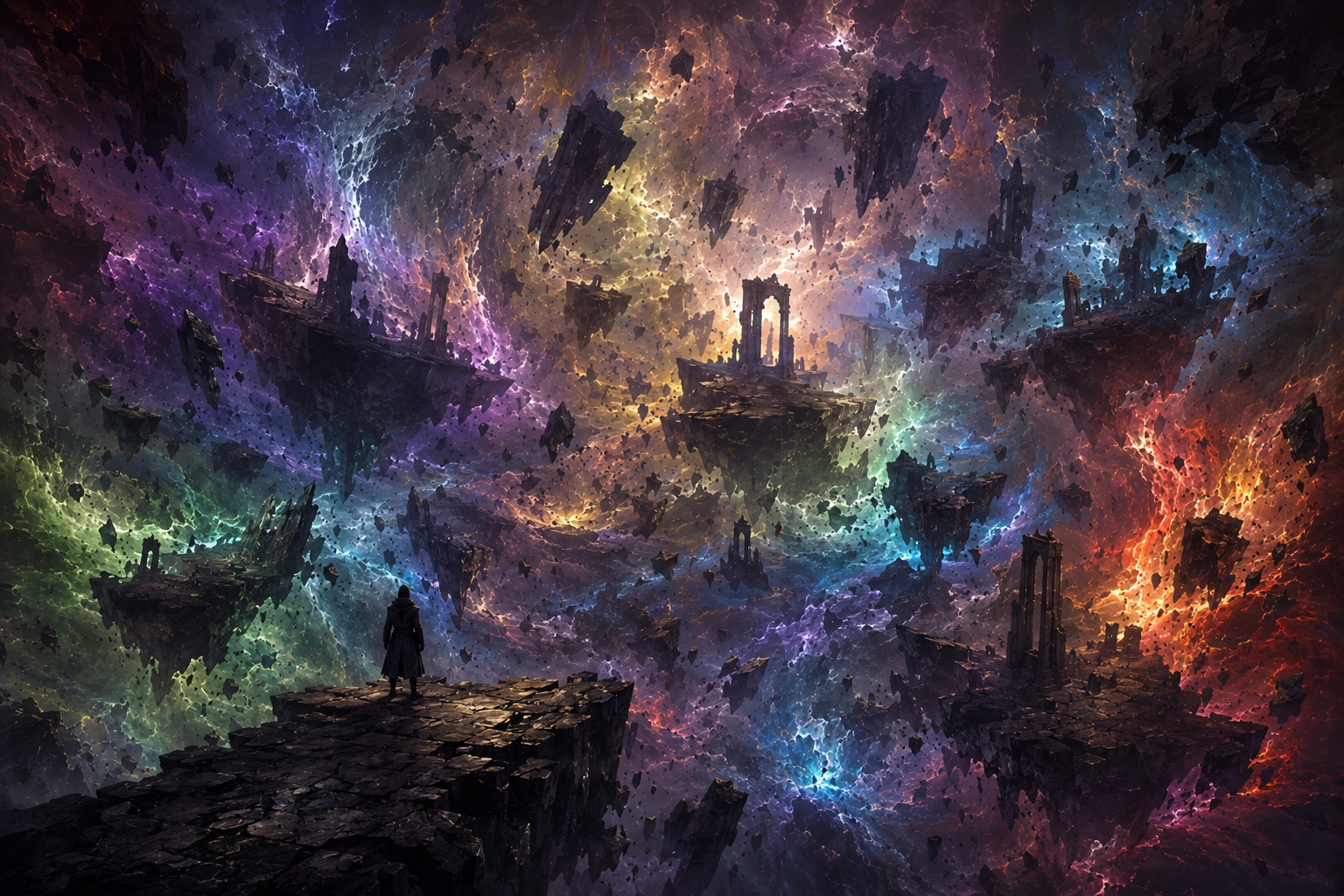
Where possibility becomes geography
Limbo is not meaningless randomness. It is a self-sustaining plane whose deepest principle is that the present form of something is not necessarily its final form.
Mountains disintegrate into clouds of stone and gather themselves into new continents. A road can split into three possible destinations. Gravity can pull neighbouring travellers in different directions. Architecture may remain standing because generations of inhabitants expect it to remain standing.
Entire landscapes can remain stable for years before a current of change reaches them. Elsewhere a traveller may watch the horizon reform several times during a single conversation.
This does not make settlement impossible. Limbo contains cities, fortresses, markets, shrines, roads and inhabited territories. Stability is simply something that must be created, maintained, inherited or defended.
Limbo is not the source of creation
Limbo’s roots begin among the First Thought-Realms. It becomes an independent Outer Plane during the Great Separation of Eon VII. Its extraordinary instability is an expression of possibility within the Codices of Existence, not evidence that it existed before ordered reality.
Possibility
Chaos appears as transformation and unrealised alternatives. Reality can become something else without first being destroyed.
Disorientation
Chaos undermines useful direction, communication and certainty. Movement continues even when destination and understanding fail.
Predatory Chaos
Chaos becomes corruption, appetite and destructive self-assertion. Its instability is actively dangerous rather than morally neutral.
Running the Unfixed Realm
Limbo works best when change creates tactical choices rather than becoming a constant random penalty. Give each scene one strong environmental idea and allow characters to understand, manipulate and exploit it.
D&D 5.5e / 2024-Compatible Rules
| Structure | Highly morphic outside anchored territory |
|---|---|
| Gravity | Normal in stable regions; subjective directional in open Limbo |
| Time | Normally standard; local anomalies may be erratic |
| Magic | Normal in most areas; designated flux zones may produce wild effects |
| Navigation | Anchors, relationships and destinations matter more than compass direction |
Subjective Directional Gravity
In open Limbo, a conscious creature can choose its direction of “down.” For practical play, the creature gains a Fly Speed of 60 feet and can hover while conscious and able to direct itself.
A stable island or Anchor Realm may impose its own local gravity.
Shaping Limbo
A creature in an unanchored region can use an Action to reshape mutable planar matter within 30 feet.
Make a DC 15 Intelligence (Arcana) check. On a success, reshape one unoccupied 10-foot cube.
- Create or remove Difficult Terrain.
- Create a bridge, stair, platform, ramp or opening.
- Create a wall or barrier providing cover.
- Change loose planar material into another common mundane substance.
- Create a simple nonmagical environmental feature of similar scale.
This shaping cannot directly damage or transform creatures, change worn or carried equipment, create magic items, reproduce artefacts, generate valuable permanent material or create complex functional machinery.
A shaped feature normally persists for 1 hour unless regional flux changes it first.
Major Shaping
A creature can spend 1 minute and succeed on a DC 18 Intelligence (Arcana) check to reshape a connected area fitting within a 30-foot cube.
This can form a large bridge, chamber, defensive position or simple building shell.
Contested Shaping
If two conscious creatures attempt to control the same mutable terrain, they make contested Intelligence (Arcana) checks. The existing form remains on a tie.
Anchored Matter
Weakly anchored terrain may increase the shaping DC by 5. Strongly anchored fortresses, divine realms and artefact-supported structures may be immune to ordinary shaping.
Stabilising a Refuge
A creature can spend 10 minutes concentrating and make a DC 18 Intelligence (Arcana) check. On a success, a 20-foot-radius area resists ordinary flux for 1 hour.
Navigation
| Region | Typical DC | Failure |
|---|---|---|
| Shifting Borderlands | 14 | Lose time or reach a neighbouring landmark. |
| Anchor Realm | 12–16 | Use local travel consequences. |
| Sea of Possibility | 18 | Drift from the route and trigger Limbo Flux. |
| Unbounded Deep | 22+ | Reach a related but unintended destination or lose the route. |
Pathfinder First Edition
| Gravity | Subjective directional; normal within stable territories |
|---|---|
| Time | Erratic in unstable regions |
| Morphic | Highly morphic |
| Alignment | Strongly chaos-aligned where alignment traits are used |
| Magic | Wild in designated unstable regions |
Subjective Directional Gravity
A creature can choose a new direction of gravity with a DC 16 Wisdom check as a free action once per round.
Wild Magic
In a wild-magic region, make a caster-level check against DC 15 + the spell or effect level.
Shaping Limbo
A creature can use a standard action and succeed on a DC 16 Charisma check to reshape an unoccupied 10-foot cube of unanchored Limbo matter within 30 feet.
Larger or more complex alterations increase the DC by 5 or more. Creatures, attended objects, magic items and strongly anchored structures cannot be directly reshaped.
Planar Infusion
- Basic: +1 initiative, +1 Reflex saves and +2 Bluff checks to feint.
- Improved: Once per day, use confusion as a spell-like ability.
- Greater: Once per day, use word of chaos as a spell-like ability.
D&D 3.5e
| Gravity | Subjective directional outside stable masses |
|---|---|
| Time | Erratic in unstable regions |
| Morphic | Highly morphic |
| Alignment | Strongly chaos-aligned |
| Magic | Wild in designated unstable regions |
Subjective Directional Gravity
A creature can select a new direction of gravity with a DC 16 Wisdom check as a free action once per round.
In open space, movement follows the normal subjective-gravity procedure: 150 feet during the first round and 300 feet during subsequent rounds while continuing in the same direction.
Wild Magic
In a wild-magic region, spells and spell-like abilities require a caster-level check against DC 15 + spell level.
Shaping Limbo
A creature can use a standard action and succeed on a DC 16 Wisdom check to reshape an unoccupied 10-foot cube of mutable Limbo matter within 30 feet.
Increase the DC by 5 for substantially larger or more complicated changes.
Limbo Flux
When local reality changes, choose the effect that best improves the scene or roll 1d8.
Loose matter assumes another mundane form.
Local gravity adopts a different direction.
Platforms, ridges, walls, caverns or islands emerge.
A road, bridge, wall or island loses coherence.
Two visible locations become nearer or farther apart.
A known route remains real but no longer lies where expected.
Memory or expectation briefly changes nearby terrain.
A location unexpectedly stabilises around an object, creature, leyline or portal.
From possibility to plane
Possibility begins to gather
During the First Cosmic Schism, persistent principles within the Astral currents become coherent enough to form embryonic regions. Freedom, change and unrealised possibility are among them.
Change becomes compatible with identity
The repaired Codices establish dependable relationships between form and transformation. A thing can change without ceasing to have continuity.
Limbo becomes an independent Outer Plane
The Thought-Realm of possibility develops independent boundaries, internal laws and persistent planar identity.
Will becomes an instrument of settlement
As magic becomes universally responsive, travellers and native intelligences develop increasingly effective ways to impose temporary form upon mutable planar reality.
Long-lived anchors become possible
Cosmic Leyline junctions create unusually persistent locations. Fortresses, settlements and divine enclaves gather around them.
Planar peoples establish enduring societies
Proteans and other recognisable planar peoples become part of the mature outsider civilisation. Limbo’s later history becomes one of competing free peoples, changing territories and long-lived relationships whose borders rarely remain fixed.
See Foundations of Order and Dawn of the Outsiders .
Relationship matters more than distance
The Astral Plane is Limbo’s most dependable great approach. Stable portals usually deliver travellers to an Anchor Realm or the Shifting Borderlands.
Travellers navigate through destination, association and recurring relationships rather than reliable compass bearings.
A gate key, remembered journey, true description, known guide, divine symbol, leyline alignment or object originating at the destination can all help preserve a route.
Getting lost
Getting lost in Limbo rarely means walking in circles. It means losing the relationship that made the destination reachable.
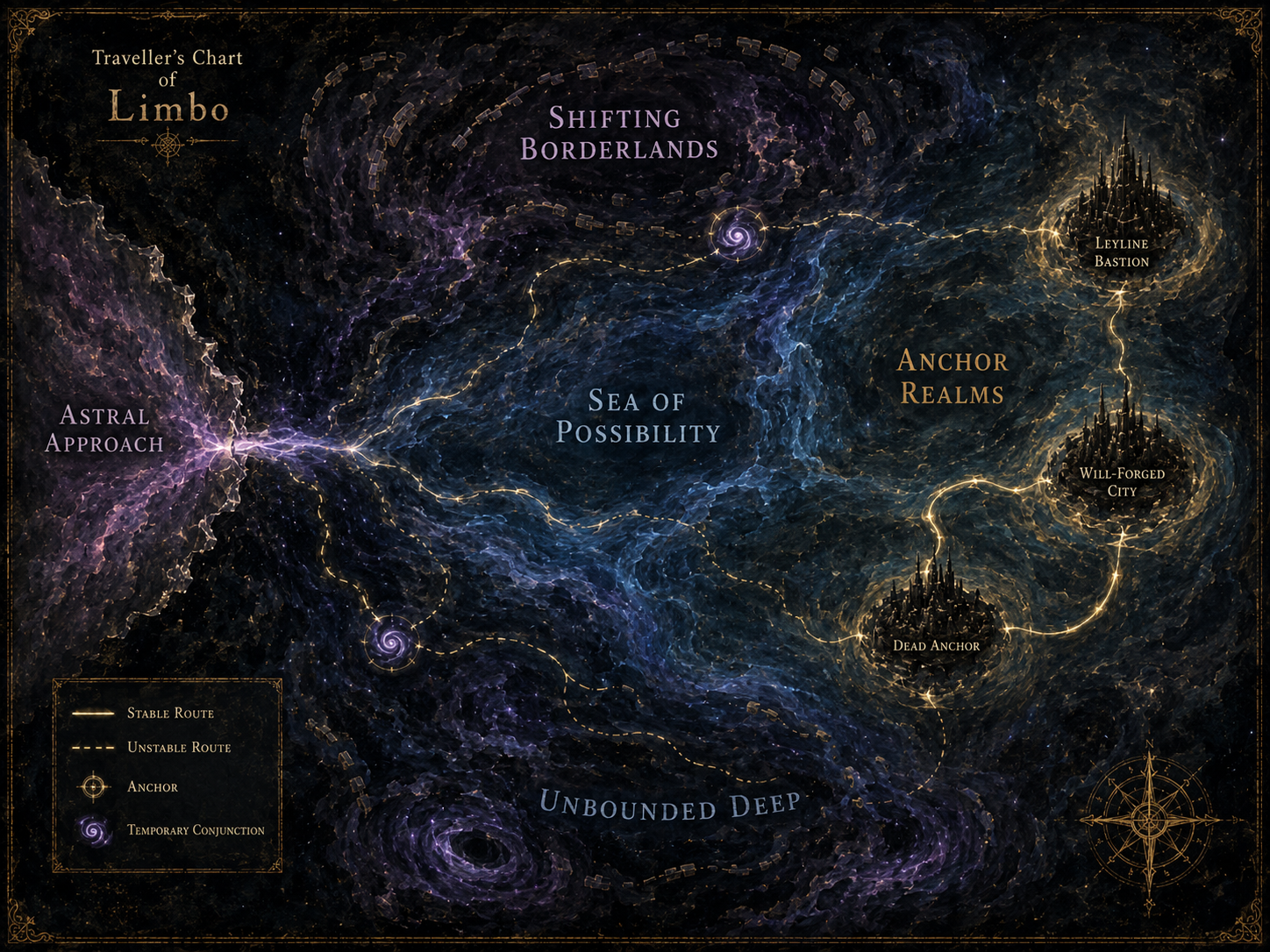
Stable Routes
Repeated relationships that usually persist while their anchors remain intact.
Unstable Routes
Paths that split, fade, change direction or temporarily disappear.
Anchors
Places whose identities remain stable enough to serve as dependable destinations.
Conjunctions
Temporary relationships with other planes or distant regions.
A geography that refuses to stay finished
Limbo has no universal continents or permanent layers. Travellers instead recognise four broad environmental conditions.
The Shifting Borderlands
The accessible margins where approaching realities leave temporary impressions upon Limbo.
The Borderlands contain landscapes that almost behave conventionally. Mountains, roads, rivers, settlements and forests can persist long enough to invite trust.
The resemblance is never complete. A road may branch like a river. A town encountered twice may remember different histories. A visible mountain may represent a destination rather than a measurable position.
The Sea of Possibility
The immense mutable reaches where reality no longer resembles ordinary geography.
The Sea of Possibility is not consistently liquid. The name describes the great middle reaches where landscapes exist as currents of temporary form.
Islands disintegrate and reform. Structures appear within clouds of debris. Entire horizons change colour, scale or apparent direction without warning.
The Anchor Realms
Islands of persistence maintained through power, memory, magic or collective will.
Limbo’s great settlements survive because something insists that they will continue to exist tomorrow.
An Anchor Realm may form around a god, artefact, Cosmic Leyline, powerful spell, sentient fortress, ancient agreement or generations of repeated habitation.
Stability does not mean sameness. A city may alter its architecture each season while preserving the identity of its streets, population and laws.
The Unbounded Deep
The least settled reaches, where even ordinary assumptions about space become unreliable.
The Unbounded Deep begins where experienced travellers stop waiting for conventional geography to return.
Distance may behave more like familiarity than measurement. Several possible versions of one place can coexist. A route may require moving toward an idea rather than a direction.
Creatures of the Ever-Changing Chaos
Limbo’s ecology is as unstable as its geography. Some creatures were born to chaos, others have adapted to it over generations, and still others are recognisable creatures transformed by prolonged existence on a plane where shape is never guaranteed permanence.
Native and Naturalised Creatures
Chaos Beast
Chaos beasts are among the creatures best suited to Limbo’s most unstable regions. Their bodies continuously melt, twist and reassemble into temporary arrangements of limbs, claws, eyes and tentacles.
They flourish around transformation currents, unstable Anchor Realms and places where reality has temporarily lost its ability to preserve one reliable form.
Anarchic Creatures
Anarchic creatures inhabit planes of chaos and are commonly called the Unfinished. They resemble animals, monsters and other familiar beings whose shapes seem rough, asymmetrical or only partly settled.
The anarchic condition can appear among many different kinds of nonlawful corporeal creatures, allowing Limbo to sustain recognisable ecologies without requiring every native creature to belong to a wholly separate species.
Anarchic Lion
Anarchic lions demonstrate how ordinary Material Plane lineages can become thoroughly naturalised within chaotic realms.
They retain the instincts and hunting behaviour of lions while bearing the roughened, resilient and extraplanar qualities of the Unfinished.
Similar anarchic predators can inhabit semi-stable wilderness, Borderland hunting grounds and large Anchor Realms.
Slaad Lord of Entropy
Slaadi are among the most dangerous organised inhabitants associated with Limbo. Their territories can range from temporary hunting grounds and moving lairs to regions held together by the presence of exceptionally powerful slaad lords.
The Slaad Lord of Entropy is a legendary chaotic-neutral power whose known environment is Limbo. Its retinues and summons include red, blue, green, gray and death slaadi.
At ordinary levels, encounters should involve slaad patrols, hunters, raiders or servants rather than the Lord of Entropy itself.
Planar Peoples
Proteans
Proteans are one of Limbo’s great outsider peoples. Transformation is not an environmental hazard to them but an ordinary condition of existence.
Their societies preserve traditions, alliances and rivalries while resisting the rigid hierarchies favoured by strongly lawful outsiders.
Protean territories are best represented as networks of relationships, migrating communities and influence rather than sharply fixed borders.
The Shapeless
Petitioners strongly attuned to Limbo are commonly called the Shapeless. Their outward forms gradually become fluid expressions of memory, self-image, mood and local planar conditions.
They have no single compulsory final transformation. Some remain within Anchor Realms, some join native planar communities and others wander deeper into the mutable plane.
Visitors and Borderland Wanderers
Shulsaga
Shulsagas are natives of the Astral Plane rather than Limbo, but their ability to sense planar rifts makes them particularly suitable encounters around Astral approaches, Gate Reefs and temporary conjunctions.
A hunting party may pursue dangerous travellers through a Limbo portal, guard an Astral approach or follow a newly opened planar breach into the Shifting Borderlands.
Inevitables
Inevitables enter Limbo as investigators, soldiers and agents of cosmic order. Their historical struggle against protean chaos gives them an established reason to appear around unstable borders, contested anchors and breaches threatening more ordered planes.
Their presence does not automatically mean combat. An inevitable may be pursuing a specific violation, protecting a planar boundary or seeking the same dangerous anomaly as the characters.
No throne rules all possibility
No single god, outsider sovereign or planar nation controls Limbo. Power is local and relational.
A being may rule an enormous Anchor Realm while having almost no authority beyond the routes connecting it to surrounding territories.
Divine Enclaves
Gods can establish sovereign territories within Limbo without becoming rulers of the greater plane.
Protean Powers
Great protean beings command followers and moving territories whose political relationships can endure even when their borders do not.
Slaad Lords
Slaad lords represent some of the most dangerous individual powers within Limbo. The Lord of Entropy is a campaign-scale threat rather than an ordinary encounter.
Limbo among the planes
The Astral Plane
The Astral Plane remains the principal great medium connecting Limbo to other established planes.
The Great Mechanism
The Great Mechanism embodies law made operational. Limbo embodies the legitimacy of alternative forms and uncontrolled possibility.
Their conflicts concern imposed structure, unstable boundaries, planar breaches and how much change ordered creation can tolerate.
Pandemonium
Limbo multiplies possible forms. Pandemonium disrupts direction, communication and dependable understanding.
The Abyss
The Abyss is not simply a deadlier Limbo. Its chaos is predatory, corruptive and destructive.
What waits between the anchors?
| d12 | Limbo Encounter |
|---|---|
| 1 | A chaos beast emerges from a region where terrain and creature have become difficult to distinguish. |
| 2 | A pride of anarchic lions hunts across a semi-stable island whose grassland is slowly folding vertically. |
| 3 | A slaad patrol claims that the characters have crossed into territory belonging to a distant chaos lord. |
| 4 | An inevitable investigates a breach whose closure would strand a populated Anchor Realm. |
| 5 | A shulsaga hunting party follows a newly formed rift from the Astral Plane into the Borderlands. |
| 6 | A community of Shapeless petitioners survives by maintaining a small refuge whose architecture changes with the prevailing mood of its inhabitants. |
| 7 | A temporary conjunction opens to another Outer Plane. Merchants, refugees and raiders race to reach it before it disappears. |
| 8 | An ordinary animal population is beginning to acquire the traits of anarchic creatures as its island drifts deeper into Limbo. |
| 9 | A dead Anchor Realm remains perfectly stable although its people vanished centuries ago. |
| 10 | A protean delegation wants a machine destroyed because it is forcing a transformation current into permanent geometric form. |
| 11 | Two equally real versions of a settlement overlap and each population believes the other to be invading shapeshifters. |
| 12 | The party can clearly see its destination, but every attempt to approach physically increases the distance. |
Adventures in the Unfixed Realm
The Failing Anchor
A city begins dissolving after the artefact supporting it deliberately withdraws its power.
The Road That Exists Once
A temporary route between distant planes opens for a single day.
The Two Cities
One settlement divides into two equally real histories.
The Lawful Expedition
Inevitables must close a dangerous breach that thousands of settlers now depend upon.
The Unfinished Hunt
Anarchic predators have learned to follow transformations that mortal trackers cannot perceive.
The Entropy Court
A slaad lord’s servants demand tribute from several Anchor Realms, but nobody agrees whether the threat is conquest, ritual or an elaborate joke whose consequences are nevertheless lethal.
Limbo and Earth in 1454
Mortal scholars know Limbo primarily through magical diagrams, traveller accounts, philosophical speculation and dangerous experiments in planar transit.
Natural philosophers and alchemists are fascinated by reports of matter altering state without ordinary transmutation. Learned magicians tend to be more interested in identifying repeatable relationships that allow travellers to return home.
The most valuable Limbo manuscripts are therefore route-books rather than atlases: collections of gate conditions, correspondences, conjunctions and descriptions of known anchors.
The realm at the edge of certainty
The name Limbo ultimately derives from Latin limbus, associated with an edge, border or fringe.
The older sense fits the Shifting Borderlands particularly well: places where one reality approaches another without becoming identical to it.
SpiralWorlds develops Limbo as the plane of unfixed possibility rather than an empty void. Its landscapes draw upon metamorphosis, unstable dreams, impossible journeys and stories in which understanding a place matters more than measuring it.
Describing Limbo
Avoid reducing Limbo to an elemental battlefield or simply covering the scenery in random colours.
Its defining quality is uncertainty of form: broken directions, incomplete landscapes, alternative routes, fragments that almost fit together and temporary islands of meaningful stability.
A traveller’s introduction to Limbo
This external overview provides additional inspiration for running the ever-changing plane. SpiralWorlds’ chronology, regions and inhabitants on this page define Limbo for this setting.
Limbo clarified
What does Limbo represent?
Possibility, transformation and freedom from permanent form.
When does Limbo form?
Its roots appear among the First Thought-Realms during Eon V. Limbo becomes an independent Outer Plane during Eon VII.
Did Limbo create the other planes?
No. Limbo develops alongside the other early Outer Planes during the Great Separation.
Does everything in Limbo constantly change?
No. Anchor Realms and stable routes can endure for centuries. The plane becomes increasingly unstable away from them.
What creatures live in Limbo?
Slaadi, proteans, chaos beasts, anarchic creatures and Shapeless petitioners are among its characteristic inhabitants. Astral creatures such as shulsagas and lawful outsiders such as inevitables frequently appear around approaches and contested boundaries.
Who rules Limbo?
No single being controls the entire plane. Slaad lords, protean powers, gods and other sovereigns can dominate individual territories.
Can Limbo be mapped?
Anchor Realms can be mapped conventionally. Wider Limbo is better represented through routes, relationships, conjunctions and persistent destinations.
Can travellers reshape Limbo?
Yes, especially in unanchored regions. See the edition-specific Game Mechanics above.
How is Limbo different from Pandemonium?
Limbo expresses chaos through possibility and transformation. Pandemonium expresses it through disorientation and failed communication.
How is Limbo different from the Abyss?
Limbo is chaotic neutral. The Abyss is predatory and corruptive.
Related SpiralWorlds entries
Planar traditions and rules references
SpiralWorlds combines its established cosmic chronology with fantasy roleplaying traditions concerning highly morphic planes, subjective directional gravity, planar creatures and wild magic.
- SpiralWorlds — Foundations of Order — the Thought-Realms, cosmic law and Limbo’s formation.
- SpiralWorlds — Dawn of the Outsiders — the later development of planar peoples.
- SpiralWorlds World Bestiary — the established creature catalogue used for Limbo inhabitants.
- Chaos Beast — a chaotic, shape-changing extraplanar predator.
- Anarchic Creature — the Unfinished template associated with planes of chaos.
- Slaad Lord of Entropy — an established Limbo slaad power.
- Shulsaga — Astral natives associated with planar rifts and travel.
- Pathfinder — Planar Infusion — Pathfinder First Edition planar-infusion mechanics.
- D&D 3.5 SRD — The Planes — subjective directional gravity and highly morphic planar traits.
Keep this reference growing
If this page helped with your reading or game, you can support its upkeep or explore the curated books.
Explore the Bookshop — epics, classics and stories behind imagined worlds.