
Howler — Pack Predator of Pandemonium
A measured call passes through wind, bone and stone. Before its final pressure pulse fades, the pack already knows where its quarry will run.
Howlers are rare native outsiders of Pandemonium. They hunt the Outer Howl and the Carved Lament in coordinated packs, reading movement through stone while complete darkness and deafening winds conceal their approach.
Large native outsider; typically Chaotic Neutral; rare pack predator of the Outer Howl and Carved Lament.
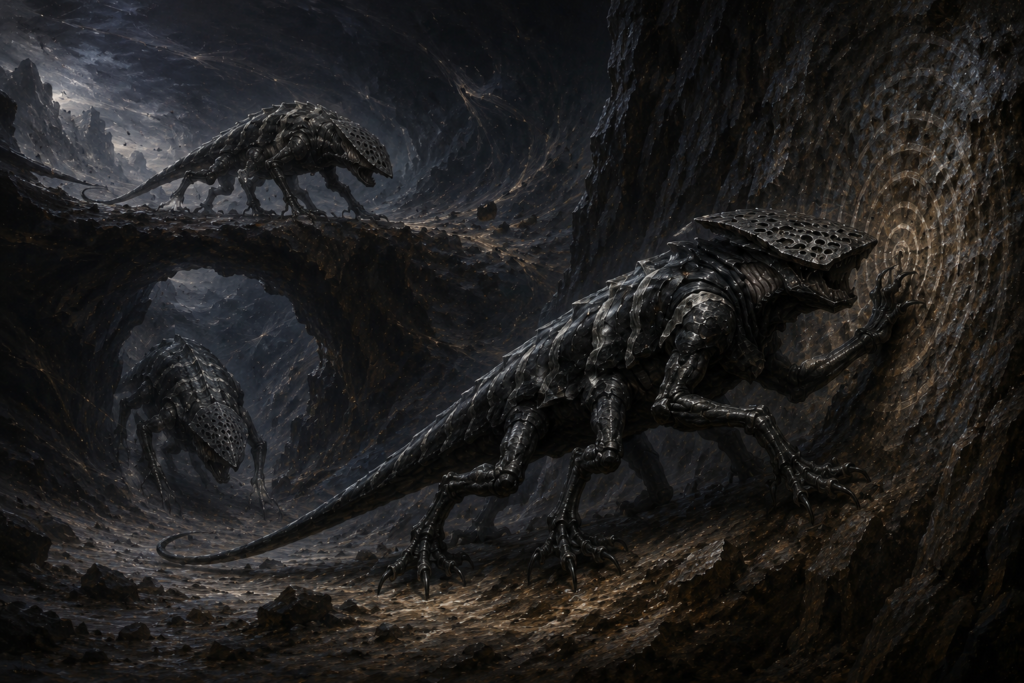
A Howler pack spends more time listening than calling.
Each hunter places its broad gripping feet against a floor, wall or cavern column and reads movement through the stone. Footfalls, falling grit, dragged equipment, armour striking rock and the pressure wake of a passing body contribute to a shared picture of the surrounding tunnels.
Short claw-taps transmit direction and urgency. Scent marks identify individuals and territorial standing. Changes in posture communicate challenge, caution and submission. Low pressure pulses passing through an enclosed cavern add emotional tone that ordinary sound cannot carry.
The howl for which the creature is named is a deliberate hunting instrument. A Howler releases it in three precisely separated stages: a low impact conducted through stone, a directional overtone that identifies the quarry and a final pressure drop that signals the pack to close.
Pandemonium’s wind is continuous, immense and frequently directionless. A Howler’s hunt-call is measured, localised and intentional. Experienced travellers fear the sudden pattern forming inside the greater noise.
Howlers remain uncommon even in their native plane. Each pack requires a vast range containing hunting passages, sheltered chambers, mineral deposits and stone formations capable of carrying vibration over great distances. A single pack may dominate many miles of connected cavern.
The presence of a pack marks a region rather than filling it with routine wildlife. Its territory should feel claimed, observed and increasingly dangerous before the creatures themselves appear.
Appearance
An adult Howler has a long, low body supported by three pairs of limbs. It commonly measures eight to ten feet from its blunt head to the end of its balancing tail, yet rarely stands higher than four feet at the shoulder.
The rear limbs provide sudden speed. The middle pair spreads wide to brace the body against violent crosswinds. The shorter forelimbs end in inward-curving claws used to seize prey, cling to steep stone and transmit coded impacts through cavern walls.
The creature’s eyeless head forms a broad wedge covered with rows of shallow pressure pits. These organs detect scent, moving air and nearby vibration. Its mouth opens beneath the head, allowing the sensory surface above it to remain directed towards approaching movement while the creature bites.
Its hide resembles matte black stone crossed by irregular mineral-grey bands. Flexible pressure membranes lie between the ribs along each flank. These membranes tighten and expand when the Howler prepares a resonant call.
During the final note, pale mineral lines briefly appear beneath the hide like cracks illuminated from deep inside black rock. The effect lasts for less than a heartbeat.
The resulting silhouette is unmistakable: six splayed limbs, a low mineral body, ribbed pressure membranes, an eyeless wedge-shaped head and a long tail held rigid against the wind.
Mechanics
The following rules represent the same creature in three systems. Its appearance, ecology, communication and personhood remain consistent between editions.
Rules distinction: the Howler is native to Pandemonium in the cosmological sense. Pathfinder 1e and D&D 3.5e do not give it the mechanically distinct native subtype. It gains the extraplanar subtype when encountered outside Pandemonium.
Howler — D&D 5E 2024
Howler — Pathfinder 1e
Howler — D&D 3.5e
Howler — D&D 5E 2024-Compatible
Howler
Large Monstrosity (Outsider), typically Chaotic Neutral
AC 16
Initiative +6 (16)
HP 142 (15d10 + 60)
Speed 50 ft., Climb 30 ft.
| Ability | Score | Modifier | Save |
|---|---|---|---|
| STR | 19 | +4 | +4 |
| DEX | 16 | +3 | +6 |
| CON | 18 | +4 | +7 |
| INT | 10 | +0 | +0 |
| WIS | 16 | +3 | +6 |
| CHA | 11 | +0 | +0 |
Skills Perception +9, Stealth +6, Survival +6
Resistances Thunder
Immunities Deafened
Senses Blindsight 30 ft., Tremorsense 120 ft. while touching stone; Passive Perception 19
Languages Resonant Cant
CR 6 (XP 2,300; PB +3)
Traits
Pandemonium Adaptation. The Howler ignores Difficult Terrain created by wind. Nonmagical wind cannot move it against its will or impose Disadvantage on its Wisdom (Perception) checks. Ambient wind cannot trigger or reproduce any of the Howler’s traits or actions.
Stone-Listening. While touching stone, the Howler’s Tremorsense detects creatures and moving objects touching the same continuous stone. The Howler cannot be surprised by a creature it detects this way unless it has the Incapacitated condition.
Pack Quarry. Once on each of its turns, when the Howler hits a creature that is Resonance-Marked or within 5 feet of another Howler that does not have the Incapacitated condition, the attack deals an extra 7 (2d6) Thunder damage.
Actions
Multiattack. The Howler makes one Bite attack and one Hooking Claw attack.
Bite. Melee Attack Roll: +7, reach 5 ft. Hit: 15 (2d10 + 4) Piercing damage. If the target is Resonance-Marked and Large or smaller, it must succeed on a DC 15 Strength saving throw or have the Prone condition.
Hooking Claw. Melee Attack Roll: +7, reach 5 ft. Hit: 11 (2d6 + 4) Slashing damage. If the target is Prone or Resonance-Marked and is Large or smaller, the Howler can pull it up to 5 feet to an unoccupied space.
Resonant Hunt-Call (Recharge 5–6). The Howler releases a deliberate three-part call in a 60-foot Cone. Each creature of the Howler’s choice in the area that can hear the call or is touching the same continuous stone as the Howler must make a DC 15 Constitution saving throw.
Failure: The creature takes 27 (6d8) Thunder damage and is Resonance-Marked until the end of the Howler’s next turn.
Success: The creature takes half as much damage and receives no mark.
While Resonance-Marked, a creature cannot take the Hide action against a Howler. A Howler touching the same continuous stone knows the marked creature’s direction and distance while it remains within 120 feet.
The hunt-call cannot originate inside magical Silence, and a creature wholly within magical Silence is unaffected. Pandemonium’s ambient wind cannot create a Resonance Mark.
Reaction
Echo Rush. Trigger: A creature within 60 feet of the Howler becomes Resonance-Marked by another Howler. Response: The Howler moves up to half its Speed. This movement does not provoke an Opportunity Attack from the marked creature.
Running the 5E Howler
- Use Resonant Hunt-Call when another Howler can immediately use Echo Rush.
- Concentrate attacks on one marked quarry.
- Use Bite to knock that quarry Prone and Hooking Claw to separate it.
- Place pack members on different surfaces and approaches.
- Let broken stone, flight and Silence disrupt the pack’s advantages.
- Allow the pack to retreat, bargain or accept surrender when its conduct supports doing so.
Howler — Pathfinder 1e
Howler CR 6
XP 2,400
Usually CN Large outsider (chaotic)
Extraplanar outside Pandemonium
Defense
Init +8;
Senses blindsight 30 ft., darkvision 60 ft., scent, tremorsense 120 ft. while touching stone; Perception +19
AC 20, touch 13, flat-footed 16 (−1 size, +4 Dex, +7 natural)
hp 84 (8d10+40)
Fort +11, Ref +10, Will +9
Immune deafness;
Resist sonic 10
Offense
Speed 50 ft., climb 30 ft.
Melee bite +14 (1d8+6), 2 claws +13 (1d6+3)
Space 10 ft.; Reach 5 ft.
Special Attacks hooking drag, pack quarry, resonant hunt-call
Statistics
Str 23, Dex 18, Con 20, Int 10, Wis 16, Cha 11
Base Atk +8; CMB +13 (+17 reposition); CMD 27 (31 against bull rush and trip)
Feats Alertness, Improved Initiative, Skill Focus (Perception), Weapon Focus (bite)
Skills Acrobatics +15, Climb +25, Perception +19, Sense Motive +16, Stealth +11, Survival +14
Languages Resonant Cant
SQ Pandemonium adaptation, resonant pursuit, six-footed brace, stone-listening
Ecology
Environment Pandemonium, especially the Outer Howl and Carved Lament
Organization solitary, pair or pack (3–7)
Treasure incidental
Special Abilities
Hooking Drag (Ex). When a Howler hits a Resonance-Marked or prone creature with a claw, it can attempt a reposition combat manoeuvre as a free action without provoking an attack of opportunity. It gains a +4 racial bonus on the check and can move the target only towards itself.
Pack Quarry (Su). Once per round, the first natural attack a Howler lands against a Resonance-Marked creature or a creature threatened by another conscious Howler deals an additional 2d6 points of sonic damage.
Pandemonium Adaptation (Ex). A Howler suffers no movement or Perception penalties from nonmagical wind or ambient noise. Wind effects cannot knock it prone or move it against its will. Ambient wind cannot activate any of the Howler’s supernatural abilities.
Resonant Hunt-Call (Su). Once every 1d4 rounds as a standard action, a Howler releases a three-part call in a 60-foot cone. Creatures in the area that can hear the call or are touching the same continuous stone as the Howler must attempt a DC 19 Fortitude save.
A failed save deals 6d6 points of sonic damage and leaves the creature Resonance-Marked until the end of the Howler’s next turn. A successful save halves the damage and prevents the mark.
A Resonance-Marked creature cannot use Stealth to avoid detection by a Howler. A Howler touching the same continuous stone knows the marked creature’s direction and distance while it remains within 120 feet.
Magical silence prevents the ability from originating inside or affecting creatures inside the silenced area. The save DC is Constitution-based.
Resonant Pursuit (Ex). When another Howler marks a creature within 60 feet, the Howler can move up to half its speed as an immediate action. This movement does not provoke an attack of opportunity from the marked creature.
Six-Footed Brace (Ex). A Howler gains a +4 racial bonus to CMD against bull rush and trip attempts. It can take 10 on Climb checks even while threatened.
Stone-Listening (Ex). While touching stone, the Howler’s tremorsense detects creatures touching the same continuous stone. The Howler retains its Dexterity bonus to AC against creatures detected this way and cannot be caught flat-footed by them.
Howler — D&D 3.5e
| Size/Type | Large Outsider (Chaotic) |
|---|---|
| Extraplanar Subtype | Gained outside Pandemonium |
| Hit Dice | 8d8+40 (76 hp) |
| Initiative | +8 |
| Speed | 50 ft. (10 squares), climb 30 ft. |
| Armor Class | 20 (−1 size, +4 Dex, +7 natural), touch 13, flat-footed 16 |
| Base Attack/Grapple | +8/+18 |
| Attack | Bite +13 melee (1d8+6) |
| Full Attack | Bite +13 melee (1d8+6) and 2 claws +11 melee (1d6+3) |
| Space/Reach | 10 ft./5 ft. |
| Special Attacks | Hooking drag, pack quarry, resonant hunt-call |
| Special Qualities | Blindsight 30 ft., darkvision 60 ft., immunity to deafness, Pandemonium adaptation, resistance to sonic 10, resonant pursuit, scent, six-footed brace, stone-listening, tremorsense 120 ft. |
| Saves | Fort +11, Ref +10, Will +9 |
| Abilities | Str 23, Dex 18, Con 20, Int 10, Wis 16, Cha 11 |
| Skills | Climb +25, Hide +11, Jump +21, Listen +18, Move Silently +15, Sense Motive +14, Spot +18, Survival +14 |
| Feats | Alertness, Improved Initiative, Multiattack |
| Environment | Pandemonium, especially the Outer Howl and Carved Lament |
| Organization | Solitary, pair or pack (3–7) |
| Challenge Rating | 6 |
| Treasure | Incidental |
| Alignment | Usually Chaotic Neutral |
| Advancement | 9–12 HD (Large); 13–18 HD (Huge) |
| Level Adjustment | — |
Combat
A Howler studies movement through stone before attacking. A pack marks one quarry with a resonant hunt-call, converges from several directions and attempts to drag that creature away from its companions.
Hooking Drag (Ex)
When a Howler hits a Resonance-Marked or prone creature with a claw, it may immediately make a special opposed Strength check as a free action. The Howler gains a +4 racial bonus on the check.
If the Howler succeeds, it pulls the target 5 feet into an unoccupied space closer to itself. This movement does not provoke attacks of opportunity.
Pack Quarry (Su)
Once per round, the first natural attack a Howler lands against a Resonance-Marked creature or a creature adjacent to another conscious Howler deals an additional 2d6 points of sonic damage.
Pandemonium Adaptation (Ex)
A Howler suffers no penalties to movement, Listen checks or Spot checks caused by nonmagical wind or Pandemonium’s ambient noise. Wind cannot knock it prone or move it against its will.
Ambient wind cannot activate the creature’s supernatural abilities.
Resonant Hunt-Call (Su)
Once every 1d4 rounds as a standard action, a Howler releases a three-part call in a 60-foot cone.
Creatures in the area that hear the call or are touching the same continuous stone as the Howler must succeed on a DC 19 Fortitude save or take 6d6 points of sonic damage and become Resonance-Marked until the end of the Howler’s next turn. A successful save halves the damage and prevents the mark.
A Resonance-Marked creature cannot use Hide to avoid detection by a Howler that can perceive it through stone-listening. While touching the same continuous stone, a Howler knows the marked creature’s direction and distance within 120 feet.
Magical silence prevents the call from originating inside or affecting creatures inside the silenced area. The save DC is Constitution-based.
Resonant Pursuit (Ex)
When another Howler marks a creature within 60 feet, the Howler can move up to half its speed as an immediate action. This movement does not provoke an attack of opportunity from the marked creature.
Six-Footed Brace (Ex)
A Howler gains a +4 racial bonus on checks or rolls made to resist bull rush and trip attempts. It can take 10 on Climb checks even when threatened or distracted.
Stone-Listening (Ex)
While touching stone, a Howler’s tremorsense detects creatures and moving objects touching the same continuous stone. It retains its Dexterity bonus to AC against creatures detected this way and cannot be caught flat-footed by them.
Skills
A Howler has a +8 racial bonus on Climb checks and a +2 racial bonus on Listen and Spot checks. It can always choose to take 10 on a Climb check, even when rushed or threatened.
Senses and Communication
Stone-Listening
A Howler reads vibration through any continuous body of stone it touches. It can distinguish walking from falling debris, separate several moving creatures and estimate the weight, pace and direction of an approaching traveller.
Soft ground, suspended bridges, deep water, flight and broken surfaces reduce the information available to it. A Howler can still use scent and nearby pressure changes, but its understanding becomes less precise.
Pressure Sense
The sensory pits covering the head detect small disturbances in the air. A creature moving through an enclosed passage displaces air even while moving silently.
Pandemonium’s winds create constant interference, but the Howler’s nervous system separates broad environmental pressure from nearby movement. This adaptation allows it to hunt within the plane without granting perfect awareness of everything inside a cavern.
Resonant Cant
Resonant Cant combines several channels:
- Stone taps communicate direction, distance, number and urgency.
- Pressure pulses carry warning, distress, invitation and emotional emphasis.
- Scent marks identify individuals, family groups, injuries and territorial standing.
- Posture expresses challenge, submission, readiness and restraint.
- Resonant calls carry names, remembered events and complex messages across large caverns.
A listener who perceives only the audible note receives an incomplete message. Full understanding includes the vibration beneath the feet, pressure in the air, scent and posture of the speaker.
The Three-Part Hunt-Call
- The Ground Note: a blunt vibration travels through connected stone and confirms the position of creatures touching it.
- The Cutting Note: a directional overtone identifies the chosen quarry to nearby pack members.
- The Hollow Note: a sudden pressure drop disrupts the quarry and signals the pack to converge.
The entire sequence lasts only a few seconds. Its exact timing carries information, allowing pack members to distinguish a hunt-call from a territorial warning, a summons or a call for aid.
The ambient winds of Pandemonium never reproduce the complete sequence. Wind may mask the first note or distort the final echo, but it cannot mark quarry or coordinate a pack.
Parley
A Howler willing to communicate usually remains at a distance while tapping the stone. It may place a scented token, scrape a boundary sign or repeat a traveller’s walking rhythm to demonstrate attention.
Food, mineral salts, safe passage, warnings, access to sheltered chambers and the return of stolen memorial objects can all support an exchange. Sudden movement towards the speaker is commonly interpreted as aggression.
Ecology
Habitat
Howlers favour extensive connected stone, powerful pressure changes and several approaches to the same location. A successful territory commonly contains:
- Long passages capable of carrying vibration.
- Crosswinds that break up the scent trails of less specialised predators.
- Side chambers protected from destructive gusts.
- Mineral deposits rich in salts and trace elements.
- High ledges or wall shelves overlooking major passages.
- Several routes through which a pack can surround moving prey.
Diet
Howlers consume flesh, marrow, mineral salts and porous stone growths found in Pandemonium. They can survive long periods without a successful kill, though hunger gradually pushes a pack towards greater risks.
A pack usually attempts to isolate one viable target and withdraw with the body. It has little reason to continue fighting merely to destroy every remaining opponent. Fresh meat may end a territorial confrontation when hunger is the pack’s primary motive.
The species feeds upon mortal creatures, petitioners and other outsiders. Its reliance upon vibration is sensory and social rather than a substitute for physical nourishment.
Territory
A healthy pack may range across many miles of cavern. Boundaries are marked with scented mineral paste, three parallel claw cuts and low-frequency pulses repeated at recognised intervals.
Neighbouring packs often maintain buffer passages used by neither group for ordinary hunting. A traveller may cross several miles of apparently empty cavern before reaching a clearly defended boundary.
Conflict begins when hunger, planar change or collapsing tunnels forces one pack across another’s recognised territory. Such disputes may end through migration, submission, negotiated hunting access or the destruction of one pack.
Brood Chambers
A breeding pack prepares a pressure crèche inside a sheltered wall hollow. Adults line the chamber with shed membrane, scent-rich mineral dust and pieces of porous stone that carry vibration clearly.
One to three young develop within thick brood sacs fixed to the stone. The young first communicate by tapping from inside the sacs. Adults answer these rhythms for weeks, establishing pack identity before the young emerge.
A pack defending a pressure crèche gives repeated boundary warnings. Once an intruder enters the chamber itself, the adults fight with far greater determination than they show during an ordinary hunt.
Growth
Young Howlers remain with their birth pack until they can distinguish intentional rhythms from environmental vibration and participate safely in a hunt.
Some later join neighbouring packs through a prolonged exchange of scent and identity patterns. Others form new hunting pairs or become solitary exiles.
Howlers mature slowly and may survive for several centuries. The oldest individuals often withdraw into deep caverns where younger pack members carry food and exchange remembered rhythms with them.
Death and Memorial Practice
After death, the pressure membranes collapse and much of the body gradually hardens into porous black mineral. A resonant nodule forms behind the chest plate.
Many packs remove this nodule and carry it to a remembered chamber. Tapping the nodule produces fragments of the dead individual’s identity rhythm. Several generations of nodules may be arranged together as a pack memorial.
The nodule is therefore both a useful planar material and a possible funerary object. Its treatment depends upon the identity and recognised customs of the dead Howler.
Beyond Pandemonium
A Howler can survive on another plane, but open ground, soft soil and broken stone reduce the effectiveness of its senses. Still air and surfaces that carry little vibration commonly cause agitation or withdrawal.
A captive Howler repeatedly strikes walls and floors, searching for an answering rhythm from its pack. Prolonged isolation may leave it violent, lethargic or fixated upon any creature that begins answering its calls.
Pack Society
A Howler pack is simultaneously a family, hunting unit and shared field of memory. Its coordination can appear effortless, yet each member retains individual motives and judgement. Members disagree, conceal information, challenge decisions and occasionally abandon the pack.
Pack Roles
Trail-Ear The forward hunter that tests passages, follows scent and identifies recent movement. Stone-Mouth The member that delivers long-range calls, declares boundaries and conducts formal exchanges with strangers. Deep-Ear A patient listener that remains behind the advancing hunters and interprets distant vibration. Wall-Claw A flanking hunter that uses side passages, vertical surfaces and crosswinds to prevent escape. Crèche-Guard An adult or older juvenile responsible for young, wounded members and memorial chambers.
These are practical functions rather than permanent ranks. The same Howler may serve as Stone-Mouth during an exchange and Wall-Claw during the following hunt.
Names
A Howler name combines a short rhythm, pressure pattern and scent. It may identify an individual, commemorate an important event or express a relationship to the pack.
Some Carved Lament packs preserve simplified versions of names as grooves cut into resonant walls. Travellers may mistake these inscriptions for maps, ownership marks or decoration. Damage to one can carry the meaning of defacing a memorial.
Pack Customs
Recorded customs include:
- Allowing travellers to cross a territory after they repeat a declared boundary rhythm.
- Exchanging mineral salts or meat for warnings about distant movement.
- Returning the resonant nodule of a dead pack member.
- Honouring temporary hunting boundaries marked with three parallel cuts.
- Adopting an exile following an extended exchange of scent and identity rhythms.
- Sparing creatures that carry the scent token of a recognised ally.
- Releasing captives after an agreed payment, service or withdrawal.
Custom varies between packs. Travellers must learn the practices of the individuals they encounter rather than assuming that one agreement governs the entire species.
Surrender
A Howler signals surrender by lowering its chest to the stone, folding its foreclaws beneath its body and releasing two slow pressure pulses without the Cutting Note.
A pack that recognises surrender may demand food, equipment, withdrawal or service. Another pack may interpret the same signal as submission without granting protection. Previous conduct and established custom determine the consequence.
Law, Personhood and Consequences
Howlers possess language, memory and the capacity for negotiated conduct. Legal and customary recognition nevertheless attaches to the individual or pack encountered rather than arising automatically from species membership.
Grounds for Recognition
- The individual communicates through a stable language extending beyond immediate hunting signals.
- The pack observes boundaries, exchange, surrender or safe-conduct.
- Members possess individual names and remembered obligations.
- The pack maintains memorials, inherited territory or funerary practices.
- An established settlement, authority or traveller community already recognises the pack.
- The individual understands an accusation or agreement and alters its conduct in response.
Predatory Conduct
Coordinated hunting, protection of young, tactical retreat and territorial behaviour demonstrate intelligence but do not by themselves establish recognised rights or obligations. Recognition becomes stronger when the creature communicates, restrains itself, honours an agreement or participates in an established custom.
Common Consequences
| Circumstance | Likely Consequence |
|---|---|
| An unknown pack launches a lethal ambush. | Immediate defence is justified. Earlier warnings or attempted communication may still affect later judgement. |
| The pack abandons the attack and retreats. | Pursuit becomes a separate act that may be judged as extermination, revenge or avoidable escalation. |
| A named Howler travels under recognised safe-conduct. | Killing it may be treated as homicide, oath-breaking or an attack upon the authority granting protection. |
| Travellers remove a memorial nodule from recognised dead. | The act may constitute theft, desecration or unlawful possession of funerary property. |
| A juvenile is captured and sold. | Evidence of language, pack recognition or customary standing can turn a monster sale into unlawful detention or enslavement. |
| A pack accepts surrender and later releases captives. | This strongly supports recognition of its capacity for agreement, restraint and customary conduct. |
| A recognised pack violates an established agreement. | The pack may be held responsible under the same custom or authority that granted its recognised standing. |
A Howler that repeatedly attacks travellers and recognises no restraint may be treated as a dangerous predator. A Howler that negotiates, accepts obligations and lives under recognised custom should be judged according to its conduct and standing.
Encounter Use
Signs of a Nearby Pack
- Three parallel claw marks repeated at regular intervals.
- Small deposits of mineral dust carrying a bitter animal scent.
- Six-limbed tracks ending where the creature climbed onto a wall.
- A body dragged away with little evidence of feeding at the kill site.
- Rhythmic impacts travelling through the floor while nothing is visible.
- An abrupt disappearance of lesser scavenging life.
- A three-part call repeated from another passage several minutes later.
- Metal objects collected and arranged according to the tones they produce.
Encounter Roles
Territorial Sentinel: One Howler shadows the party, repeats a warning rhythm and attacks only if the travellers continue towards a brood or memorial chamber.
Hunting Pair: One creature drives prey towards a side passage while the second waits in contact with the stone ahead.
Full Pack: Three to seven Howlers occupy several elevations and approaches. One marks the quarry while the others converge.
Wounded Exile: A solitary Howler is hungry, isolated and willing to take greater risks. It may also accept aid.
Boundary Pack: The pack controls passage through part of the Carved Lament under an established agreement. The encounter concerns communication, proof of safe-conduct or payment.
Crèche Defence: The pack attempts to drive intruders away from its brood chamber and ends pursuit once the young are secure.
Encounter Sequence
- Detection: reveal signs that something is reading movement through the stone.
- Testing: the pack creates false movement, repeats a boundary warning or pressures an isolated traveller.
- Decision: the party may withdraw, communicate, offer exchange, create counter-vibrations or continue.
- Commitment: the pack chooses a quarry and releases its hunt-call.
- Change: injury, loss of position, successful communication or discovery of the pack’s purpose alters its behaviour.
Failure Without Immediate Death
- The pack takes food, livestock or a carried animal and withdraws.
- A separated character is dragged into another passage.
- The party is driven from a sheltered route into a violent wind channel.
- The pack marks the group’s scent and follows at a distance.
- A boundary agreement is imposed at an unfavourable price.
- Equipment is lost while the party escapes across a cavern gap.
- A wounded Howler carries a recognisable possession back to its pack.
Using Darkness Fairly
Complete darkness should create pressure while preserving meaningful decisions. Describe the direction of impacts, movement of dust, vibration beneath the floor and changes in the three-part call.
The characters may lack sight, but they should receive enough information to choose their formation, route and countermeasures. A Howler encounter becomes frustrating when darkness simply conceals all information; it becomes effective when the party must interpret unfamiliar information quickly.
Tactics and Counterplay
Pack Tactics
- The pack maps the party through footfalls before revealing its position.
- The hunt-call begins when another Howler can immediately exploit the mark.
- Howlers target creatures separated by elevation, distance or broken stone.
- They knock prey down and drag it towards side passages.
- One member remains behind the immediate attack to read the wider encounter.
- The pack changes direction through claw-taps rather than shouted commands.
- It withdraws when successful isolation becomes impossible or the cost of the hunt exceeds the value of the prey.
Counterplay
- Break contact with stone: flight, levitation, suspended platforms, water and broad gaps limit stone-listening.
- Create magical silence: silence suppresses the supernatural hunt-call inside its area.
- Produce false vibration: thrown objects, hammer blows and moving decoys complicate the pack’s hunting picture.
- Control the approach: a narrow passage prevents several Howlers from surrounding one target.
- Mask scent: smoke and powerful competing odours interfere with close-range confirmation.
- Change rhythm: irregular movement makes a traveller harder to distinguish from falling debris.
- Recognise the warning: responding to a boundary cadence can prevent a hunt.
- Leave the brood boundary: a crèche pack usually ends pursuit after the threat withdraws.
Pandemonium’s ambient wind remains a separate environmental danger. It cannot mark quarry, activate Howler abilities or substitute for the deliberate hunt-call.
Treasure and Remains
Howlers select objects for scent, vibration, memory or practical usefulness. A lair may contain ordinary valuables taken from travellers, but coins have little inherent value unless their metal produces a useful tone.
| d8 | Lair Find |
|---|---|
| 1 | Armour fittings and broken weapons arranged according to the sounds they produce when struck. |
| 2 | A locked case dragged from a traveller and left unopened. |
| 3 | Three boundary stones carrying the scent and identity rhythm of a neighbouring pack. |
| 4 | Wind-polished metal strips used to test pressure changes. |
| 5 | A naturally shed pressure membrane worth 50–100 gp to an alchemist or instrument maker. |
| 6 | A resonant nodule worth 150–300 gp, accompanied by evidence that it belonged to a named Howler. |
| 7 | A scent token granting passage through another pack’s territory. |
| 8 | Travellers’ possessions arranged around a memorial wall rather than a feeding site. |
Resonant Nodule
A resonant nodule can be shaped into a focus for magic involving thunder, vibration or communication through stone. Such nodules can be obtained from naturally mineralised remains, given by a pack or recovered from an abandoned chamber.
A nodule taken from recognised dead may carry legal or customary obligations. Merchants familiar with Pandemonium often demand evidence of lawful recovery before purchasing one.
Adventure Hooks
The False Hunt-Call
Someone in the Carved Lament has learned to reproduce the first two notes of a Howler hunt-call. Travellers blame a nearby pack for attacks it did not commit, while the false caller uses the confusion to move unseen through its territory.
Safe-Conduct Broken
A recognised Stone-Mouth is killed while carrying a treaty scent. Its body is displayed as that of a common predator, and the pack prepares retaliation against the settlement responsible. The characters must establish what happened before the first answering hunt-call begins.
The Silent Crèche
A brood chamber has stopped answering its guardians. The pack permits outsiders to enter because the thing inside produces no vibration the Howlers can recognise. Every surviving adult waits outside, listening for a signal that never comes.
Individual and Pack Variations
Boundary Keeper
This Howler belongs to a pack maintaining recognised territorial agreements. It attempts warning, exchange and formal demand before attacking. It may understand a regional or planar language in addition to Resonant Cant.
Carved Lament Echo-Minder
An older Howler that remembers names, routes and obligations preserved in resonant carvings. Increase its Intelligence to 12 and add one appropriate language. Its combat Challenge Rating remains unchanged.
Outer Howl Runner
A lean migratory Howler accustomed to crossing exposed wind channels. It favours rapid pursuit and rarely defends a fixed lair.
Starved Exile
A solitary Howler cut off from its pack. It uses its hunt-call early, pursues prey beyond normal boundaries and takes risks a healthy pack would avoid.
Crèche Pack
A pack defending young gives repeated warning calls before combat. Once intruders withdraw from the brood boundary, the pack directs its efforts towards securing the crèche rather than continued pursuit.
Game Master Guidance
- Reveal evidence of the pack before rolling initiative.
- Keep the hunt-call distinct from Pandemonium’s ambient winds.
- Use the creature’s intelligence without granting perfect knowledge.
- Give flight, silence, false vibration and broken stone meaningful effects.
- Place pack members on different surfaces and approaches.
- Allow injured Howlers to retreat, signal submission or offer exchange.
- Determine the recognition and customary standing of the specific pack.
- Use one pack as a memorable regional danger rather than routine wildlife.
- Let discovery of a brood chamber, memorial or agreement change the encounter’s meaning.
Historic and Mythic Context
Howlers emerge during the Outsider Dawn, within the age remembered as the Rise of Outsiders. They arise within Pandemonium itself, shaped by its dark caverns, immense pressure, violent winds and networks of resonant stone.
The earliest packs follow broad vibration currents through newly forming passages. They hunt wherever the rock carries movement clearly and establish sheltered chambers where the wind divides around stable stone.
As the planes become fortified and their boundaries harden, Howler populations grow increasingly isolated within Pandemonium. Packs separated by collapsing passages and planar changes develop distinct hunting cadences, scent customs and forms of Resonant Cant.
The packs of the Outer Howl become wide-ranging hunters. They follow changing pressure fronts and migrate when prey routes alter. Carved Lament packs more often defend established chambers, resonant boundary stones and carvings that preserve identity rhythms.
No maintained account assigns the species to a creator god. Their nature expresses Pandemonium’s living environment rather than a divine office or deliberate act of manufacture.
Material Plane encounters remain rare. Most begin with a damaged portal, interrupted summoning, stolen brood sac or solitary exile driven through a planar breach.
These isolated encounters encourage mortal scholars to describe every Howler as a simple beast. Direct contact with established packs reveals language, memory, restraint, inherited custom and a much broader range of individual conduct.
Related Pages
Keep this reference growing
If this page helped with your reading or game, you can support its upkeep or explore the curated books.
Explore the Bookshop — epics, classics and stories behind imagined worlds.