
Hellenic Pantheon • Lesser Deity

Momus (Momos) — God of Mockery, Blame & Criticism

The divine faultfinder, personification of blame and scourge of pretension. Momus sees the flaw in the perfect argument, the weakness in the admired work and the motive concealed beneath an impressive speech.

Momus is dangerous because he is often right. He may expose hypocrisy, deception or a genuine weakness that nobody else dares name, but being correct has never made him merciful. Truth in the mouth of Momus can save a kingdom, destroy an alliance or accomplish both before supper.
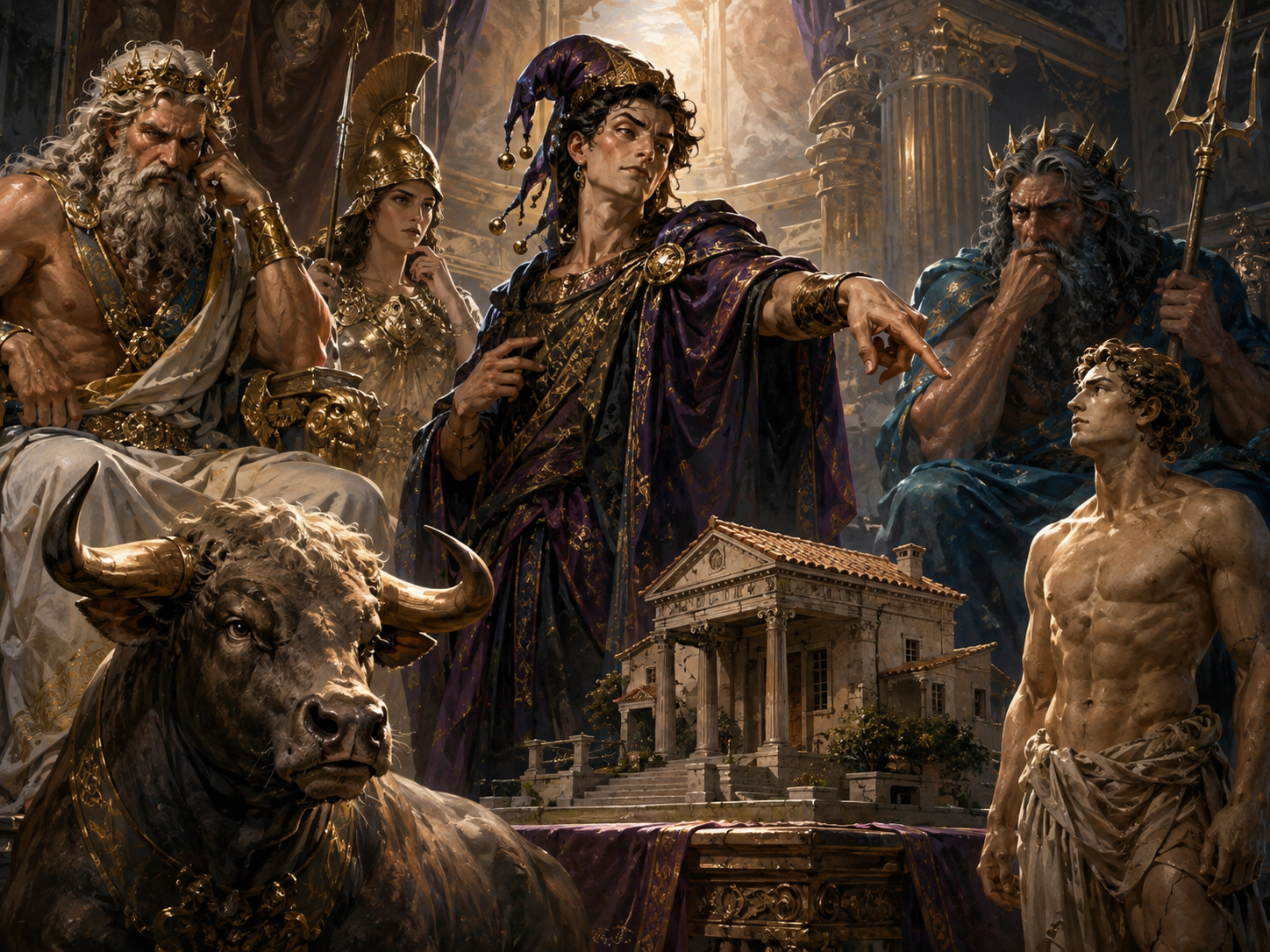
Momus judging the works of the gods before Zeus, Athena and Poseidon, with the bull, house and human creations
Momus Judging the Works of the Gods. Momus exposes flaws in the bull, the house and humanity before the assembled gods — a SpiralWorlds interpretation of his defining myth.
Divine Profile

The Faultfinder

Momos is the Greek divine personification of blame, mockery, ridicule, reproach and harsh criticism. SpiralWorlds preserves that difficult character: perceptive, intelligent and frequently correct, but also corrosive and almost incapable of allowing a defect to pass without comment.

  • Pantheon: Hellenic Pantheon
  • Greek Name: Momos (Μῶμος)
  • Common Name: Momus
  • Latin Counterpart: Querella — Complaint
  • Divine Rank: Lesser Deity / Divine Personification
  • Alignment: Chaotic Neutral
  • Portfolio: Blame, mockery, ridicule, criticism, reproach, censure and satire
  • Mother: Nyx
  • Alternative Genealogy: Nyx and Erebus in a later Roman tradition
  • Kindred Power: Oizys, Misery
  • Opposite Personification: Eupheme — Praise and Acclamation
  • Olympian Association: Divine Mount Olympus in Arborea, when admitted
  • Recognised Divine Realm: None
  • Cross-Planar Refuge: The Carved Lament, Pandemonium
  • Domains: Chaos, Knowledge, Trickery
  • Divine Artifact: Wand of the Jester’s Head
  • SpiralWorlds Iconography: A theatrical mask raised above an open eye
  • Worshippers: Satirists, critics, poets, performers, advisers, scribes and troublesome truth-tellers
Game Mechanics

Divine Manifestation of Momus

These statistics represent a manifestation through which Momus can enter an encounter directly. Defeating the manifestation drives the deity from the immediate scene; it does not erase an immortal divine being from the cosmology.

Momus normally carries the Wand of the Jester’s Head. Abilities marked Wand require the artifact.

Momus, Divine Manifestation

Medium Celestial, Chaotic Neutral
Armor Class24
Hit Points580 (40d8 + 400)
Speed40 ft., Fly 80 ft. (hover)
Challenge30 (155,000 XP)
STR18 (+4)
DEX26 (+8)
CON30 (+10)
INT28 (+9)
WIS24 (+7)
CHA30 (+10)

Saving Throws Dex +17, Con +19, Int +18, Wis +16, Cha +19

Skills Deception +19, Insight +16, Investigation +18, Perception +16, Performance +19, Persuasion +19

Damage Resistances Cold, Fire, Lightning, Psychic

Condition Immunities Charmed, Frightened, Poisoned

Senses Truesight 120 ft.; Passive Perception 26

Languages All; Telepathy 120 ft.

Equipment Wand of the Jester’s Head (Artifact)

Traits

Divine Awareness. Momus can’t be surprised. When a creature he can hear within 120 feet knowingly speaks a deliberate lie, Momus knows that the speaker does not believe what it has said. This trait does not reveal the objective truth and does not identify an honestly mistaken statement.
Divine Mastery of the Wand. Momus is automatically attuned to the Wand of the Jester’s Head. The artifact has 7 charges and regains 1d6 + 1 expended charges daily at dawn. Momus uses his own spell attack bonus (+19) and saving throw DC (27) for its properties. Abilities marked Wand are unavailable if Momus doesn’t possess the artifact.
Legendary Resistance (4/Day). If Momus fails a saving throw, he can choose to succeed instead.
Magic Resistance. Momus has Advantage on saving throws against spells and other magical effects.
Unmasked Sight. Momus recognises non-divine magical disguises and illusions within 60 feet as false, although this recognition does not automatically reveal what lies beneath them.
Expelled, Not Destroyed. When this manifestation is reduced to 0 Hit Points, it dissolves into fading laughter, wind and fragments of theatrical masks. Momus is driven from the encounter, but the immortal deity survives.

Actions

Multiattack. Momus makes three Censuring Word attacks.
Censuring Word. Ranged Spell Attack: +19 to hit, range 120 ft., one target. Hit: 41 (7d8 + 10) Psychic damage.
Barbed Truth (Wand; 1 Charge). When Momus hits a creature with Censuring Word, he can expend 1 charge from the Wand. The target takes an extra 18 (4d8) Psychic damage and can’t gain Advantage on a D20 Test until the start of Momus’s next turn.
Fault in the Work (Wand; 2 Charges). Momus chooses up to three creatures, Constructs or objects he can see within 120 feet. Intelligence Saving Throw: DC 27. An unattended object automatically fails. Failure: 55 (10d10) Force damage. Until the end of Momus’s next turn, attacks against the target score a Critical Hit on a roll of 19 or 20, and Resistance can’t reduce Psychic or Force damage dealt to the target. Success: Half damage only.
Window in the Heart (Wand; 2 Charges). Momus chooses one creature he can see within 90 feet. Intelligence Saving Throw: DC 27. Failure: 45 (10d8) Psychic damage. Until the end of Momus’s next turn, he knows the creature’s immediate objective and current emotional state, and knows whenever it knowingly speaks a deliberate lie. Invisibility and magical disguise provide no benefit against Momus during this time. Success: Half damage and no revelation.
Perfect Work, Ruined (1/Day). Momus identifies the intolerable flaw in everything before him. Intelligence Saving Throw: DC 27, each enemy in a 60-foot Cone. Failure: 90 (20d8) Psychic damage, and the creature has the Stunned condition until the end of its next turn. Success: Half damage only.

Bonus Actions

Wheels Under the House. Momus teleports up to 60 feet to an unoccupied space he can see. He can take one willing creature within 5 feet with him.

Reactions

No Flaw Unnamed. Trigger: A creature Momus can see within 120 feet succeeds on a D20 Test. Response: Momus identifies the mistake the creature almost made. The creature rerolls the D20 and uses the lower roll.
The Laugh After the Boast (Wand; 1 Charge). Trigger: A creature Momus can see within 120 feet scores a Critical Hit or uses Legendary Resistance. Charisma Saving Throw: DC 27. Failure: 22 (4d10) Psychic damage. The creature loses its Reaction and can’t gain Advantage on a D20 Test until the end of its next turn. Success: Half damage only.

Legendary Actions

Legendary Action Uses: 3. Immediately after another creature’s turn, Momus can expend one use to take one of the following actions. He regains all expended uses at the start of his turn.

Barbed Aside. Momus makes one Censuring Word attack.
Expose the Seam. Momus chooses one creature he can see within 120 feet. The next time that creature takes damage before the start of Momus’s next turn, it takes an extra 22 (4d10) Force damage. Resistance can’t reduce this extra damage.
Exit Laughing. Momus teleports up to 60 feet to an unoccupied space he can see.
Manifestation type: “Celestial” is the game-mechanical creature type used for this encounter form. It does not redefine Momus’s divine ancestry or make the actual deity an ordinary celestial outsider.
No lair actions: Momus possesses no recognised sovereign divine realm. Environmental effects belong to the location in which he is encountered.

Momus, Divine Manifestation

PF1e — SpiralWorlds Conversion • CR 30 • CN Medium Outsider (chaotic, extraplanar)

Init +14; Senses truesight 120 ft.; Perception +43

Equipment Wand of the Jester’s Head (Major Artifact)

Defense

AC 48, touch 31, flat-footed 37 (+10 Dex, +10 deflection, +17 natural, +1 dodge)

hp 525 (30d10+360)

Fort +34, Ref +32, Will +32

DR 20/epic and lawful; SR 41

Immune charm, fear, poison; Resist cold 30, electricity 30, fire 30

Offense

Speed 40 ft., fly 80 ft. (perfect)

Censuring Word (Su). Ranged touch +40, range 120 ft.; 8d8+20 points of untyped supernatural damage.
Barbed Truth (Wand; Su; 1 Charge). When Momus hits a creature with Censuring Word, he may expend 1 charge. The target takes an additional 6d6 points of untyped supernatural damage and takes a –4 penalty on attack rolls and Charisma-based skill checks for 1 round.
Fault in the Work (Wand; Su; 2 Charges). As a standard action, Momus chooses up to three creatures, Constructs or objects within 120 feet. A creature or Construct must succeed on a DC 38 Will save or take 12d6 points of untyped supernatural damage and suffer a –6 penalty to AC and saving throws for 1 round. A successful save halves the damage and negates the penalties. An unattended object receives no saving throw.
Window in the Heart (Wand; Su; 2 Charges). One creature within 90 feet must succeed on a DC 38 Will save. On a failure, Momus perceives the creature’s immediate intention and emotional state for 1 round, automatically recognises deliberate lies spoken by it and ignores benefits it receives from invisibility, magical disguise or feinting.
Perfect Work, Ruined (Su) 1/day. All enemies in a 60-foot cone take 20d6 points of untyped supernatural damage and are dazed for 1 round. A DC 38 Will save halves the damage and negates the dazed condition.
Wheels Under the House (Su). As a swift action, Momus teleports up to 60 feet to a space he can perceive.
No Flaw Unnamed (Su) 3/day. As an immediate action after a creature within 120 feet succeeds on an attack roll, saving throw or skill check, Momus forces that creature to reroll and use the lower result.
The Laugh After the Boast (Wand; Su; 1 Charge). As an immediate action when a creature within 120 feet confirms a critical hit or succeeds on a saving throw against an effect created by Momus, the Wand deals 6d6 points of untyped supernatural damage. A DC 38 Will save halves the damage. On a failed save, the creature is shaken for 1 round.

Statistics

Str 24, Dex 30, Con 34, Int 32, Wis 30, Cha 36

Base Atk +30; CMB +37; CMD 57

Skills Bluff +46, Diplomacy +46, Intimidate +46, Knowledge (history) +44, Knowledge (planes) +44, Perception +43, Perform (comedy) +46, Sense Motive +43, Spellcraft +44

Special Qualities

Divine Mastery of the Wand (Su). The Wand has 7 charges. All expended charges return at dawn. When Momus wields it, its saving throw DC is 38. Abilities marked Wand are unavailable if he does not possess it.
Divine Awareness (Su). Momus cannot be surprised and immediately recognises when a creature he can hear does not believe its own spoken statement. This ability does not reveal objective truth.
Expelled, Not Destroyed (Su). At 0 hit points, the manifestation dissolves and Momus is banished from the encounter. His immortal divine existence continues.

Momus, Lesser Deity

3.5e — SpiralWorlds Conversion • Divine Rank 6 • CR 30 Manifestation • CN Medium Outsider (Chaotic, Extraplanar)
Armor Class52
Hit Points495
Speed40 ft., Fly 80 ft.
ChallengeCR 30 Manifestation
STR24 (+7)
DEX30 (+10)
CON34 (+12)
INT32 (+11)
WIS30 (+10)
CHA36 (+13)

Base Attack/Grapple +30/+37

Saves Fort +34, Ref +32, Will +32

Domains Chaos, Knowledge, Trickery

Senses truesight 120 ft.

Possessions Wand of the Jester’s Head (Major Artifact)

This conversion uses the existing SpiralWorlds Salient Divine Ability framework for divine-rank play.

Momus-Specific Divine Abilities

Divine Mastery of the Wand (Su). The Wand has 7 charges. All expended charges return at dawn. When Momus wields it, its saving throw DC is 38. Abilities marked Wand require him to possess the artifact.
Faultfinder’s Sight (Su). Momus automatically recognises mundane falsehoods he can personally evaluate and perceives magical disguises and illusions within 60 feet as artificial. This does not automatically reveal the truth concealed beneath them.
Unanswerable Censure (Su). As a standard action, Momus targets one creature within 120 feet. The target takes 8d8+20 points of untyped supernatural damage.
Barbed Truth (Wand; Su; 1 Charge). When Momus successfully hits a creature with Unanswerable Censure, he may expend 1 charge. The target takes an additional 6d6 points of untyped supernatural damage and must succeed on a DC 38 Will save or take a –4 penalty on attack rolls, saving throws and Charisma-based checks for 1 round.
Fault in the Work (Wand; Su; 2 Charges). Momus chooses up to three creatures, Constructs or objects within 120 feet. A creature or Construct must make a DC 38 Will save. Failure deals 12d6 points of untyped supernatural damage and imposes a –6 penalty to Armor Class and saving throws for 1 round. A successful save halves the damage and negates the penalties.
Window in the Heart (Wand; Su; 2 Charges). One creature within 90 feet must make a DC 38 Will save. Failure reveals its immediate intention and surface thoughts to Momus for 1 round. During that time, the creature gains no benefit against Momus from Bluff, feinting, magical disguise or invisibility.
The Laugh After the Boast (Wand; Su; 1 Charge). As an immediate action when a creature within 120 feet confirms a critical hit or succeeds on a saving throw against one of Momus’s effects, the Wand deals 6d6 points of untyped supernatural damage. A DC 38 Will save halves the damage. A creature that fails is shaken for 1 round.
No Flaw Unnamed (Su) 3/day. When a creature within 120 feet succeeds on an attack roll, saving throw or skill check, Momus can force the roll to be made again. The lower result applies.
Wheels Under the House (Su). Momus may teleport up to 60 feet as a swift action.
Expelled, Not Destroyed (Su). Reducing this manifestation to 0 hit points expels it from the encounter. Momus remains an immortal divine being.
Divine Artifact

The Wand of the Jester’s Head

The Wand of the Jester’s Head is Momus’s personal divine artifact, an instrument of criticism, revelation and exposed imperfection. Its powers are incorporated directly into his manifestation statistics above.

The Wand resembles a slender marotte of dark polished wood, capped by a silver fool’s head whose expression changes whenever someone nearby exaggerates, boasts or deliberately deceives.

Small bells hang beneath the silver head, yet they seldom sound when the Wand is moved. Instead they ring when its bearer discovers a contradiction, concealed motive or weakness worth pursuing.

The Wand does not manufacture truth. Its greater power is more troublesome: it makes existing flaws much harder to hide.

In the hands of Momus, the artifact acts as an extension of his divine perception. It gives supernatural force to criticism, exposes weaknesses in creatures and structures, reveals concealed motives and punishes those whose confidence becomes boastful certainty.
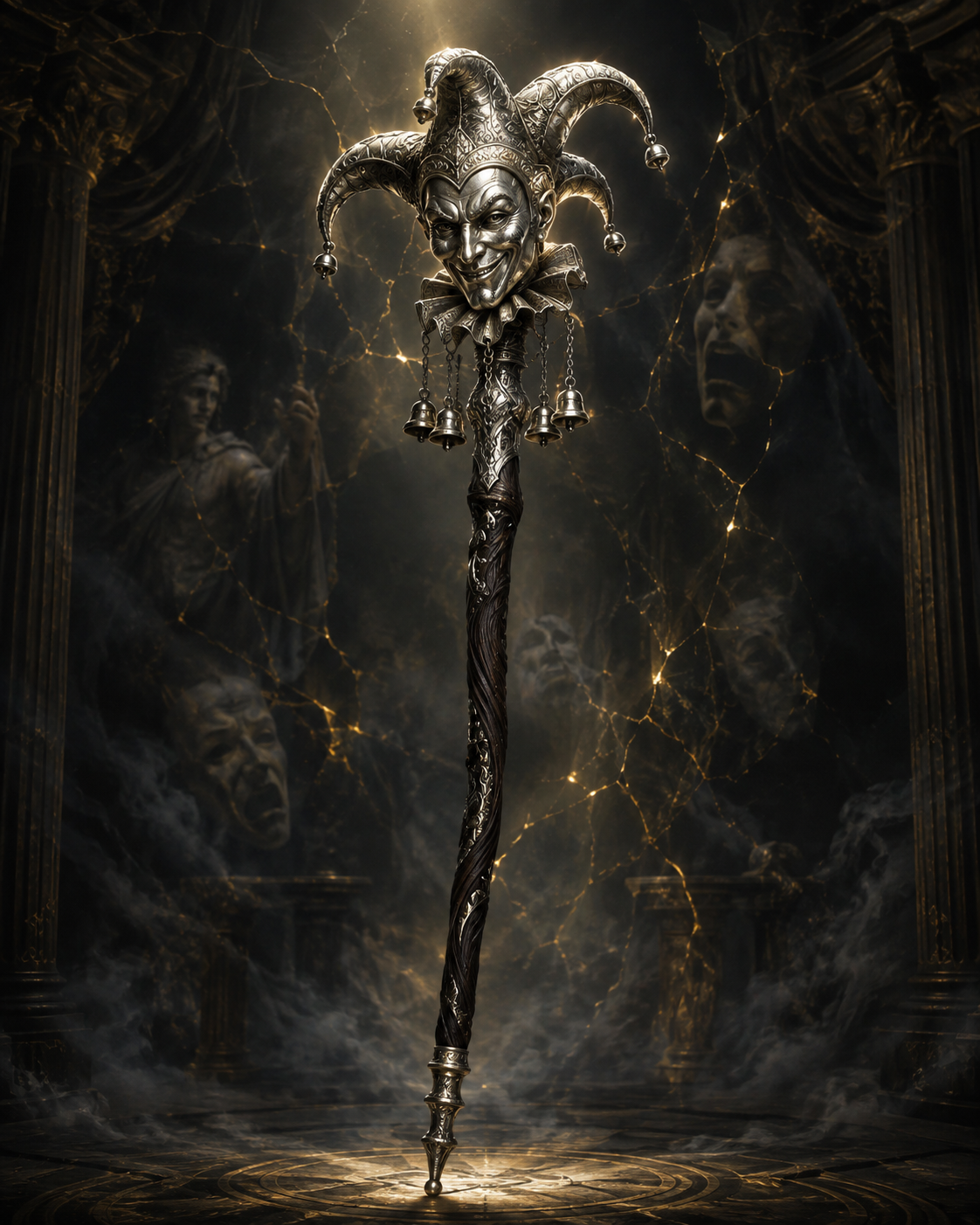
Wand of the Jester's Head, the divine artifact of Momus in SpiralWorlds
The Wand of the Jester’s Head. Momus’s divine artifact, used to reveal concealed motives, expose weaknesses and turn criticism into supernatural force.

Wand of the Jester’s Head

Artifact (Wand), Requires Attunement

The Wand has 7 charges and regains 1d6 + 1 expended charges daily at dawn.

Unless a property states otherwise, an attuned mortal wielder uses save DC 22 and +14 to hit with the Wand. Momus instead uses save DC 27 and +19 to hit.

Properties

Faultfinder’s Eye. While holding the Wand, you have Advantage on Wisdom (Insight) and Intelligence (Investigation) checks made to detect deception, concealed defects, illusions or deliberate misdirection.
Barbed Truth (1 Charge). As a Magic action, make a ranged spell attack against one creature within 120 feet. Hit: 27 (6d8) Psychic damage. Until the start of your next turn, the creature can’t gain Advantage on a D20 Test.
Fault in the Work (2 Charges). Choose one creature, Construct or object you can see within 120 feet. Intelligence Saving Throw: DC 22. An unattended object automatically fails. Failure: 44 (8d10) Force damage. Until the end of your next turn, attacks against the target score a Critical Hit on a roll of 19 or 20, and Resistance can’t reduce Psychic or Force damage dealt to it. Success: Half damage only.
Window in the Heart (2 Charges). Choose one creature you can see within 90 feet. Intelligence Saving Throw: DC 22. Failure: 27 (6d8) Psychic damage. Until the end of your next turn, you know the creature’s immediate objective and current emotional state, and know whenever it knowingly speaks a deliberate lie. Invisibility and magical disguise provide no benefit against you during this time. Success: Half damage and no revelation.
The Laugh After the Boast (1 Charge). When a creature you can see within 120 feet scores a Critical Hit or uses Legendary Resistance, you can take a Reaction. Charisma Saving Throw: DC 22. Failure: 22 (4d10) Psychic damage. The creature loses its Reaction and can’t gain Advantage on a D20 Test until the end of its next turn. Success: Half damage only.
Divine Owner. Momus is automatically attuned to the Wand. When he carries it, use the enhanced versions of its powers in his manifestation stat block above.

Wand of the Jester’s Head

Major Artifact • CL 25th

The Wand has 7 charges. All expended charges return at dawn. Its standard saving throw DC is 27. When Momus wields the artifact, its saving throw DC becomes 38.

Faultfinder’s Eye (Su). The wielder gains a +10 competence bonus on Perception and Sense Motive checks made to discover deception, disguises, illusions or concealed defects.
Barbed Truth (Su; 1 Charge). As a standard action, the wielder makes a ranged touch attack against one creature within 120 feet. On a hit, the target takes 8d6 points of untyped supernatural damage and must succeed on a DC 27 Will save or take a –4 penalty on attack rolls and Charisma-based skill checks for 1 round.
Fault in the Work (Su; 2 Charges). One creature or Construct within 120 feet must succeed on a DC 27 Will save or take 12d6 points of untyped supernatural damage and suffer a –6 penalty to AC and saving throws for 1 round. A successful save halves the damage and negates the penalties. An unattended object receives no saving throw.
Window in the Heart (Su; 2 Charges). One creature within 90 feet must succeed on a DC 27 Will save. On a failure, the wielder perceives the creature’s immediate intention and emotional state for 1 round, recognises deliberate lies spoken by it and ignores benefits it receives from invisibility, magical disguise or feinting.
The Laugh After the Boast (Su; 1 Charge). As an immediate action when a creature within 120 feet confirms a critical hit or succeeds on a saving throw against an effect created by the wielder, the Wand deals 6d6 points of untyped supernatural damage. A DC 27 Will save halves the damage. On a failed save, the creature is shaken for 1 round.

Wand of the Jester’s Head

Major Artifact • Caster Level 25th

The Wand has 7 charges, all of which return at dawn. Its standard saving throw DC is 27. When Momus wields it, use DC 38.

Faultfinder’s Eye (Su). The wielder gains a +10 competence bonus on Sense Motive, Search and Spot checks made to discover deception, illusions or concealed weaknesses.
Barbed Truth (Su; 1 Charge). As a standard action, make a ranged touch attack against one creature within 120 feet. On a hit, the target takes 8d6 points of untyped supernatural damage and must succeed on a DC 27 Will save or take a –4 penalty on attack rolls and Charisma-based checks for 1 round.
Fault in the Work (Su; 2 Charges). One creature or Construct within 120 feet must succeed on a DC 27 Will save or take 12d6 points of untyped supernatural damage and suffer a –6 penalty to Armor Class and saving throws for 1 round. A successful save halves the damage and negates the penalties.
Window in the Heart (Su; 2 Charges). One creature within 90 feet must succeed on a DC 27 Will save. On a failure, the wielder perceives its surface thoughts and immediate intention for 1 round and ignores benefits the target gains from Bluff, invisibility or magical disguise.
The Laugh After the Boast (Su; 1 Charge). As an immediate action when a creature within 120 feet confirms a critical hit or succeeds on a saving throw against one of the wielder’s effects, the Wand deals 6d6 points of untyped supernatural damage. A DC 27 Will save halves the damage. A creature that fails is shaken for 1 round.
The Wand of the Jester’s Head does not summon a separate “Cursed Jester” creature. Its supernatural identity remains tied directly to Momus, criticism, revelation and exposed imperfection.
Character

Who Is Momus?

Momus is not merely the divine patron of jokes. He is the impulse to look upon something admired and ask what everyone else has missed. He doubts praise, examines appearances and distrusts declarations of perfection.

A false king fears Momus because he may expose the lie supporting the throne. A good king may fear him just as much, because Momus can identify a genuine weakness without caring whether exposing it at that moment will destroy everything the ruler has spent years protecting.

He can therefore be useful without being benevolent and truthful without being wise. His criticism sometimes prevents catastrophe. At other times it turns an imperfect but workable settlement into open conflict simply because Momus cannot resist demonstrating that the settlement was imperfect.
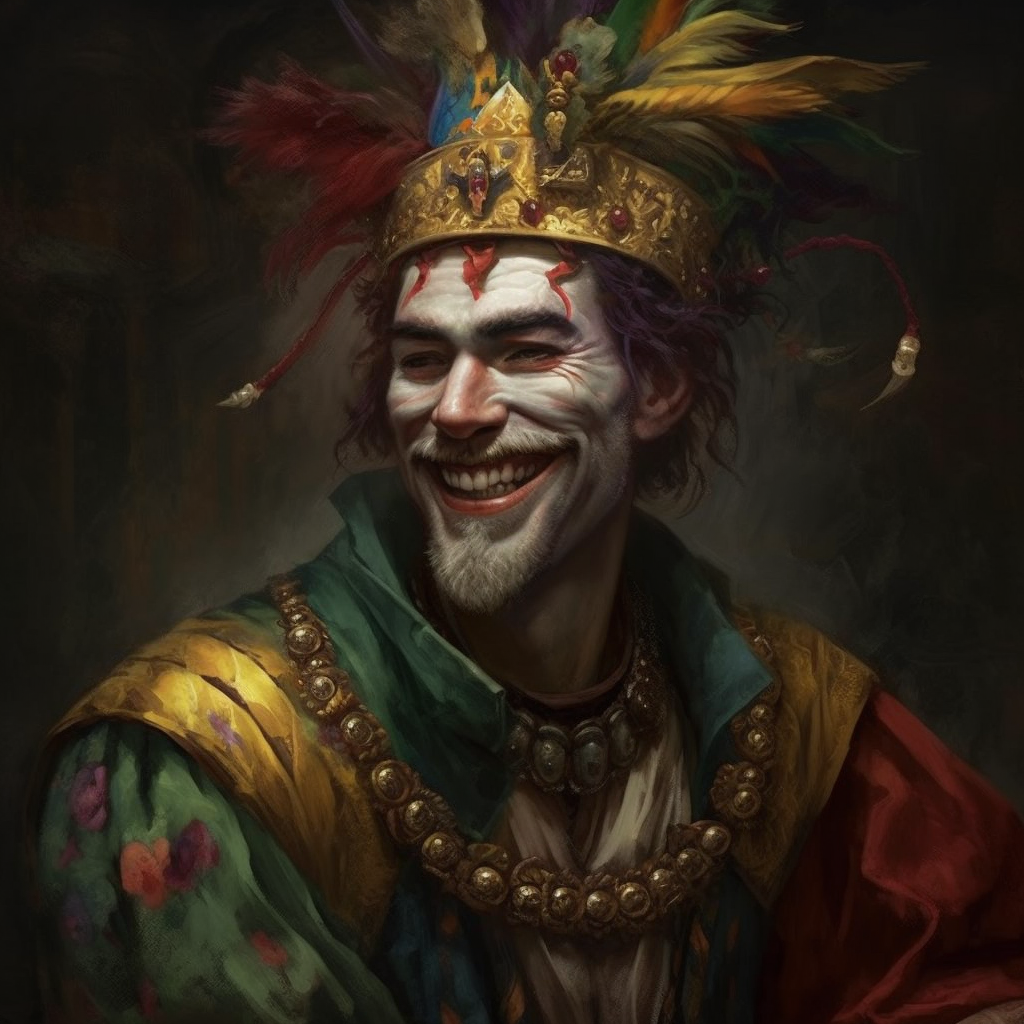
Momus the Greek god of mockery, blame and criticism in SpiralWorlds
Momus the Faultfinder — SpiralWorlds character interpretation.
Praise and Blame Ancient tradition gives Momus an opposite number in Eupheme, the personification of praise, favourable acclaim and good report. Momus is not laughter itself, nor comedy in general. He embodies the judgement that says: this is flawed, this claim is undeserved, this praise has gone too far.
Mythology

Born of Night

Momus belongs to the severe family of personified powers associated with Nyx: concepts that do not need Olympian civilisation in order to exist.

Hesiodic Tradition

Nyx Alone

In Hesiod’s Theogony, Nyx brings forth Momos without a father, alongside terrible and unavoidable powers including Oizys, Misery.

That genealogy makes blame itself something ancient: not a later invention of kings, courts or philosophers, but one of the realities that follows Night into the ordered cosmos.

Later Genealogy

Erebus and Night

A later Roman genealogy recorded by Cicero places the corresponding personification of Complaint among the children of Erebus and Nyx.

SpiralWorlds preserves both traditions rather than forcing one literary genealogy to erase the other. The older Hesiodic account remains the principal mythological lineage.

The Great Judgement

Momus Judges the Works of the Gods

In the famous fable tradition, Momus is asked to judge three creations: a human being, a bull and a house. Where others might admire the workmanship, Momus immediately sees defects.

The bull should be better able to see where its horns are aimed. The house should be capable of moving when its owners discover that the neighbours are intolerable.

His criticism of humanity is the most important. The human creature possesses thoughts, motives and intentions, yet the heart is hidden from everyone else. Momus argues that people should have been made with an opening through which another person could see what was truly taking place within.
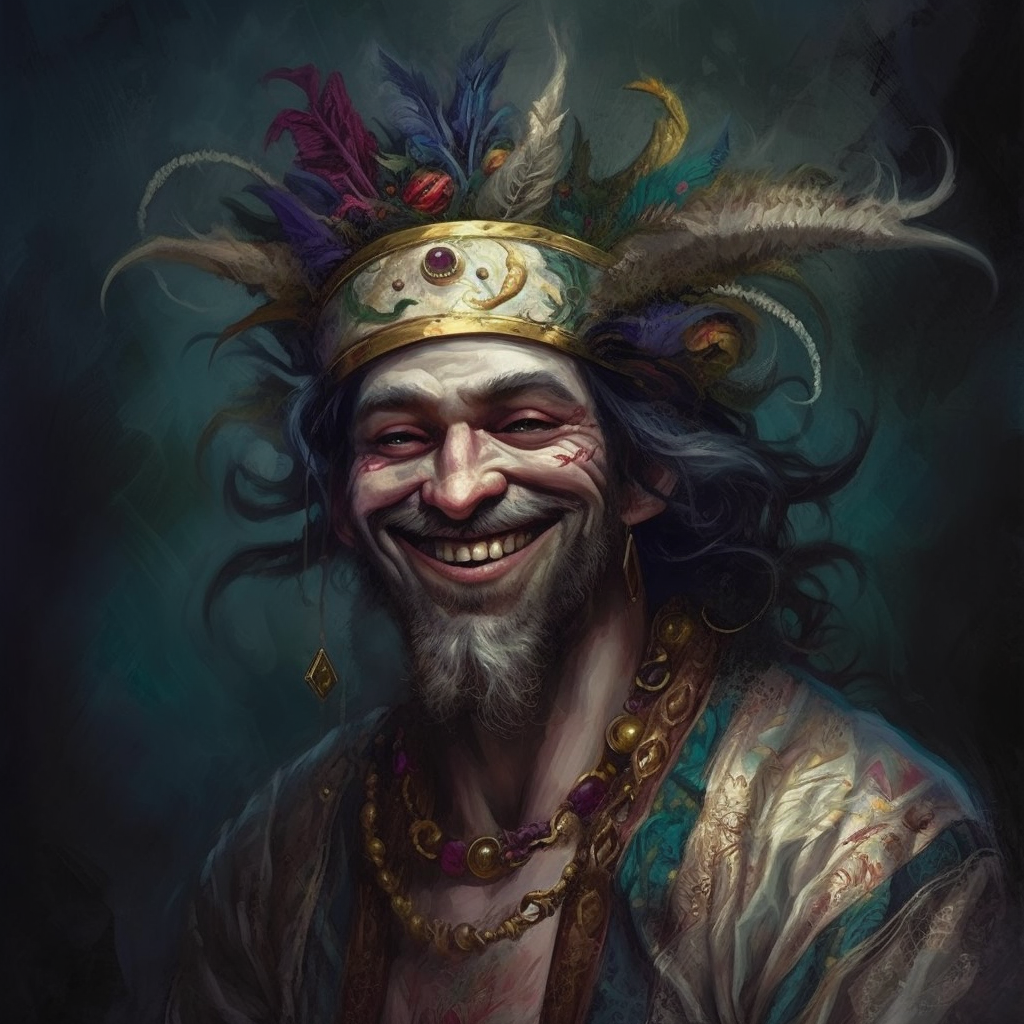
The Window in the Heart The myth becomes one of Momus’s defining SpiralWorlds themes. Titles, disguises, solemn promises and beautiful speeches matter less to him than the motive concealed beneath them. He cannot tolerate the fact that a convincing appearance may hide an entirely different intention.
Momus the divine faultfinder and Greek god of criticism in SpiralWorlds
Momus the divine critic — SpiralWorlds interpretation.
Olympian Tradition

Expelled from the Divine Court

Momus’s fault-finding eventually becomes intolerable even to the gods. Ancient tradition remembers Zeus expelling him from the divine company for his relentless ridicule.

In SpiralWorlds, exile becomes a recurring feature of his relationship with Olympus. Momus may be tolerated when his criticism reveals a genuine threat, then driven out again when he turns the same scrutiny upon his hosts.

The Exception

Aphrodite

In one ancient literary tradition, Momus can find no fault with Aphrodite herself.

She represents the rare object of judgement that frustrates the supreme faultfinder: a being against whom meaningful criticism refuses to come easily.

Fragmentary Trojan-cycle traditions: later sources associate Momus with divine deliberations preceding the Trojan War, but the surviving evidence is too fragmentary for SpiralWorlds to treat Momus as the simple or sole cause of that conflict.
Divine Relationships

The Most Unwelcome Seat at the Table

Momus does not fit comfortably into a permanent list of allies and enemies. The same deity may value his judgement during a crisis and demand his removal an hour later.

Divine Authority

Zeus

Zeus embodies exactly the kind of authority Momus cannot leave unexamined. The ruler of Olympus may value criticism that discovers a real weakness, but ridicule directed at divine government quickly exhausts even Olympian patience.

Mother

Nyx

Momus’s nature does not depend upon his acceptance at Olympus. As a child of Night he belongs to an older family of unavoidable realities: blame survives whether kings welcome it or not.

Kindred Power

Oizys

Misery and blame sit uncomfortably close together. Momus exposes the flaw; Oizys embodies the suffering that may remain after failure can no longer be ignored.

Subjects of Judgement

Athena and Poseidon

Both belong to traditions surrounding Momus’s judgement of divine workmanship. Great craftsmanship does not place a work beyond criticism.

The Blameless Exception

Aphrodite

Ancient literary tradition makes her the rare being against whom Momus’s appetite for criticism fails to find a meaningful target.

Dangerous Company

Eris

In SpiralWorlds, Eris can find Momus useful when his criticism fractures an enemy’s confidence or exposes hypocrisy. The arrangement becomes less comfortable when he applies the same standards to her intrigues.

SpiralWorlds Planar Canon

Olympus, Exile & the Carved Lament

Momus has no recognised sovereign divine realm. His cosmological identity is defined by his unstable place within the Olympian court and by the refuge he sometimes takes beyond it.

1

Arborea

The Olympian Glades of Arborea contain the principal divine court of the Hellenic gods.

Olympian plane
2

Divine Mount Olympus

Momus appears at the Olympian court as critic, guest and recurring exile. He does not rule a separate sovereign Olympian estate.

Court association • no recognised realm
3

The Carved Lament, Pandemonium

After exclusion from Olympus, Momus sometimes retreats into the Carved Lament as an exile and wandering divine presence.

Cross-planar refuge
Momus rules no Pandemonium domain. In the Carved Lament he may appear as an unwanted observer, a disembodied critic or an exile whose insight exposes false authority, concealed motives and institutional weakness.
Worship & Manifestations

The Uncomfortable Truth

Followers of Momus

Those drawn to Momus include satirists, poets, actors, critics, scribes, licensed fools, troublesome counsellors and people whose craft depends upon noticing what others have overlooked.

A follower of Momus is not commanded to oppose every authority. A follower is expected to examine authority. A ruler whose judgement survives criticism may earn grudging respect. A ruler whose legitimacy depends upon silence presents an irresistible target.

Manifestations

  • A disembodied critical voice follows a boast or solemn declaration.
  • Unexplained laughter follows a claim of perfection or invulnerability.
  • An overlooked flaw suddenly becomes impossible to ignore.
  • A disguise or carefully maintained pretence fails at the least convenient moment.
Currently in the World

Momus in 1454

1454

The mortal world does not require Momus to wait for some distant age of satire. A living scholar has already placed the ancient faultfinder at the centre of one of the most remarkable literary works of the fifteenth century.

Leon Battista Alberti’s Latin Momus was written around 1450. Its precise composition history is debated, but by 1454 the work belongs to the immediate intellectual world of the SpiralWorlds campaign present.

Alberti turns Momus into a vitriolic antihero through whom power, court life, philosophy, grand designs and both mortal and divine folly can be examined.

Whether Alberti independently rediscovered the ancient faultfinder, received some fleeting inspiration from the god or merely produced a work that Momus later discovered with considerable irritation remains deliberately unresolved.

Whatever the truth, Italy has become unusually interesting to him. Momus listens to rulers explain why their ambitions are necessary, scholars explain why their rivals are incompetent, architects explain why their designs are flawless and advisers explain why inconvenient contradictions should remain private.

He is rarely impressed.

Historical & Mythological Context

From Momos to Momus

Separating ancient mythology, later reception and SpiralWorlds canon prevents later satire and fantasy imagery from being mistaken for ancient Greek cult practice.

Ancient Mythology

Hesiod places Momos among the children brought forth by Nyx without a father. Cicero preserves a different genealogy in which the corresponding Complaint belongs among the children of Erebus and Night.

The fable tradition makes Momus the impossible critic of divine workmanship: the human, bull and house all contain defects once he is invited to judge them.

Ancient tradition also identifies Eupheme, Praise and Acclamation, as Momus’s opposite number.

Later Reception

Momus proved exceptionally useful to later authors interested in criticism, power and political absurdity.

Leon Battista Alberti’s Momus, written around 1450, is especially important to SpiralWorlds because it belongs almost exactly to the campaign present.

Later European art continued to depict Momus as the faultfinder who judges the works of gods. The court-jester imagery used in the older SpiralWorlds portraits belongs to this wider history of satire and reception.

Using Momus

Campaign Hooks

Momus works best when his criticism is valuable enough that the characters cannot simply dismiss him, but destructive enough that trusting him completely is equally dangerous.

Court Intrigue

The One Adviser Who Says It

A royal council has built its strategy around one dangerous misconception. Momus identifies the flaw immediately — and humiliates the only person who can still repair it.

Mystery

Window in the Heart

Momus insists that a trusted ally’s stated motive is false. He is correct about the deception, but detecting a lie does not mean he understands why it was told.

Planar

The Unwelcome Guest

The party needs guidance through Pandemonium. Momus knows which map is wrong, which guide is lying and which supposedly safe route contains a fatal flaw.

1454

Alberti’s Momus

A manuscript associated with Alberti’s Momus contains a passage absent from every expected copy. It may be a revision, forgery, divine intervention or something Momus would prefer no mortal to read.

Source Provenance

Myth, Reception & SpiralWorlds Canon

This entry distinguishes ancient evidence, later literary and artistic reception and SpiralWorlds-original campaign material.

Ancient Sources
Hesiod — Theogony

Principal genealogy for Momos as a child brought forth by Nyx without a father. Read the text .

Aesopic / Babrian Fable Tradition — Momus and the Gods

The judgement of the human, bull and house, including Momus’s famous criticisms. Read the fable .

Lucian — Momus Tradition

Important later ancient development of the complaint that the human chest should reveal thoughts and intentions.

Cicero — De Natura Deorum

Later genealogy placing Querella, Complaint, among the offspring of Erebus and Night.

Philostratus — Letters

Literary tradition in which Momus can find no fault with Aphrodite herself.

Theoi Project — Momos

Reference index collecting the principal ancient Momos traditions. Momos reference .

Later Reception
Leon Battista Alberti — Momus

Dark Latin comedy written around 1450, making Momus unusually relevant to the campaign present of 1454.

Maarten van Heemskerck — Momos Reproaches the Works of the Gods, 1561

Later visual reception of Momus as critic of divine workmanship.

SpiralWorlds Canon
Olympian Court Association

Momus belongs to the wider Hellenic divine order but possesses no recognised sovereign realm of his own.

Carved Lament Exile

Following exclusion from Olympus, Momus may retreat into the Carved Lament of Pandemonium.

Wand of the Jester’s Head

A legacy SpiralWorlds divine artifact rebuilt around criticism, revelation and exposed weakness, with full 5.5e, PF1e and 3.5e mechanics. Its rules are integrated directly into the Divine Manifestation of Momus section.

Game Mechanics

The 5.5e manifestation and PF1e/3.5e conversions are SpiralWorlds game material. The Wand’s powers become unavailable when Momus is separated from the artifact.

Frequently Asked Questions

Momus FAQ

Who is Momus in Greek mythology?
Momus, Greek Momos, is the divine personification of blame, mockery, ridicule, reproach and harsh criticism.
Is Momus the Greek god of satire?
“God of satire” is a useful later description, but the older conception is broader: blame, censure, ridicule, reproach and fault-finding.
Who are Momus’s parents?
Hesiod makes Momos a child brought forth by Nyx alone. A later genealogy recorded by Cicero places the corresponding Complaint among the offspring of Erebus and Night.
Who is the opposite of Momus?
Ancient tradition identifies Eupheme, the personification of Praise and Acclamation, as Momus’s opposite number.
Why was Momus expelled from Olympus?
Ancient tradition associates his expulsion with relentless criticism and ridicule of the gods.
Where does Momus live in SpiralWorlds?
Momus possesses no recognised sovereign divine realm. He is associated with the Olympian court in Arborea when admitted, and may retreat into the Carved Lament of Pandemonium following exile.
What is the Wand of the Jester’s Head?
The Wand of the Jester’s Head is Momus’s personal SpiralWorlds divine artifact. Its powers reveal weaknesses, expose motives and punish boastful certainty. Momus normally carries it, and several abilities in his game statistics depend upon the artifact.
Can Momus use his Wand powers without the Wand?
No. Abilities marked Wand in Momus’s game statistics require the Wand of the Jester’s Head. If he is separated from the artifact, those powers become unavailable until he regains it.
What connects Momus to 1454?
Leon Battista Alberti’s Latin Momus was written around 1450, placing the work directly within the intellectual world of the SpiralWorlds campaign present.
Scroll to Top